

SIST-TP CEN/TR 15592:2007
(Main)Health services - Quality management systems - Guide for the use of EN ISO 9004:2000 in health services for performance improvement
General Information
- Abstract
This International Standard provides guidelines beyond the requirements given in ISO 9001 in order to consider both the effectiveness and efficiency of a quality management system, and consequently the potential for improvement of the performance of an organization. When compared to ISO 9001, the objectives of customer satisfaction and product quality are extended to include the satisfaction of interested parties and the performance of the organization.
This International Standard is applicable to the processes of the organization and consequently the quality management principles on which it is based can be deployed throughout the organization. The focus of this International Standard is the achievement of ongoing improvement, measured through the satisfaction of customers and other interested parties.
This International Standard consists of guidance and recommendations and is not intended for certification, regulatory or contractual use, nor as a guide to the implementation of ISO 9001.
This Technical Report provides assistance on how the EN ISO 9004:2000 guidelines may be applied to health services, without prescribing the activities that need to be done by the health service provider; the latter should use its own professional knowledge and/or follow guidelines and protocols established by relevant professional bodies.
Even though EN ISO 9004:2000 promotes a better understanding of the EN ISO 9001:2000 requirements, its scope goes further than that. It is a technical document for managers and process owners to monitor and improve organisation performance, minimise risks, reduce costs, satisfy customers and improve competitiveness.
To fulfil the requirements of processes that have impact on patient safety this Technical Report provides an approach for improvement of risk management in the organisation.
An important value of EN ISO 9004:2000 is that it can be used for self-assessment (see Annex A) comparing the performance of the organisation with the 290 in
- Status
- Published
- Publication Date
- 23-May-2007
- Technical Committee
- VZK - Quality management and quality assurance
- Current Stage
- 6060 - National Implementation/Publication (Adopted Project)
- Start Date
- 06-Apr-2007
- Due Date
- 11-Jun-2007
- Completion Date
- 24-May-2007



Overview
CEN/TR 15592:2007 - "Health services - Quality management systems - Guide for the use of EN ISO 9004:2000 in health services for performance improvement" is a CEN Technical Report that explains how the broader guidance of EN ISO 9004:2000 can be applied in healthcare organizations. It provides practical, sector-specific guidance to help health service providers move beyond ISO 9001 compliance toward sustained performance improvement, greater efficiency, and satisfaction of customers and other interested parties. This document is guidance only - it is not intended for certification, regulatory or contractual use.
Key topics
The Technical Report aligns EN ISO 9004:2000 with healthcare practices and addresses major quality management themes, including:
- Quality management system (QMS) scope and process approach - applying process thinking across clinical and support functions.
- Management responsibility - leadership, quality policy, planning and management review tailored to health services.
- Needs of interested parties - identifying patients, families, regulators and payers and incorporating their expectations.
- Resource management - human resources, infrastructure, information and financial resources relevant to health care delivery.
- Product realization / service delivery - clinical pathways, design and development of services, purchasing and supplier control.
- Measurement, analysis and improvement - performance metrics, monitoring, nonconformity control and continual improvement.
- Risk management for patient safety - approaches to identify, assess and reduce risks that impact patient outcomes.
- Self‑assessment (Annex A) - maturity levels and self-assessment questions to benchmark organizational performance.
- Continual improvement process (Annex B) - structured steps to translate findings into improvement actions.
Practical applications
CEN/TR 15592:2007 is designed to be practical and actionable for healthcare settings:
- Use as a management guide to improve overall organizational performance, not for certification.
- Adapt EN ISO 9004:2000 principles to clinical governance, patient safety programs and service design.
- Support self-assessment and benchmarking to prioritise improvement projects and measure outcomes.
- Integrate with existing clinical guidelines and professional protocols while minimising risk and reducing costs.
- Guide procurement and supplier relationships for medical devices, supplies and outsourced services.
Who should use it
- Healthcare executives and senior management seeking performance improvement.
- Quality managers, clinical governance leads and process owners.
- Risk managers focused on patient safety and compliance teams.
- Improvement teams implementing continual improvement, Lean or QI programs.
Related standards
- EN ISO 9004:2000 - guidance on achieving sustained success through a QMS.
- EN ISO 9001:2000 - requirements for QMS (CEN/TR 15592 complements and extends this for health services).
- CEN/TS 15224 - guidance for applying EN ISO 9001 specifically in health services.
Keywords: CEN/TR 15592:2007, EN ISO 9004:2000, quality management systems, health services, performance improvement, patient safety, self-assessment, continual improvement.
Relations
- Effective Date
- 28-Jan-2026
- Refers
SIST EN ISO 9000:2005 - Quality management systems - Fundamentals and vocabulary (ISO 9000:2005) - Effective Date
- 28-Jan-2026
Get Certified
Connect with accredited certification bodies for this standard

BSI Group
BSI (British Standards Institution) is the business standards company that helps organizations make excellence a habit.

TÜV SÜD
TÜV SÜD is a trusted partner of choice for safety, security and sustainability solutions.

Bureau Veritas
Bureau Veritas is a world leader in laboratory testing, inspection and certification services.
Sponsored listings
Frequently Asked Questions
SIST-TP CEN/TR 15592:2007 is a technical report published by the Slovenian Institute for Standardization (SIST). Its full title is "Health services - Quality management systems - Guide for the use of EN ISO 9004:2000 in health services for performance improvement". This standard covers: This International Standard provides guidelines beyond the requirements given in ISO 9001 in order to consider both the effectiveness and efficiency of a quality management system, and consequently the potential for improvement of the performance of an organization. When compared to ISO 9001, the objectives of customer satisfaction and product quality are extended to include the satisfaction of interested parties and the performance of the organization. This International Standard is applicable to the processes of the organization and consequently the quality management principles on which it is based can be deployed throughout the organization. The focus of this International Standard is the achievement of ongoing improvement, measured through the satisfaction of customers and other interested parties. This International Standard consists of guidance and recommendations and is not intended for certification, regulatory or contractual use, nor as a guide to the implementation of ISO 9001. This Technical Report provides assistance on how the EN ISO 9004:2000 guidelines may be applied to health services, without prescribing the activities that need to be done by the health service provider; the latter should use its own professional knowledge and/or follow guidelines and protocols established by relevant professional bodies. Even though EN ISO 9004:2000 promotes a better understanding of the EN ISO 9001:2000 requirements, its scope goes further than that. It is a technical document for managers and process owners to monitor and improve organisation performance, minimise risks, reduce costs, satisfy customers and improve competitiveness. To fulfil the requirements of processes that have impact on patient safety this Technical Report provides an approach for improvement of risk management in the organisation. An important value of EN ISO 9004:2000 is that it can be used for self-assessment (see Annex A) comparing the performance of the organisation with the 290 in
This International Standard provides guidelines beyond the requirements given in ISO 9001 in order to consider both the effectiveness and efficiency of a quality management system, and consequently the potential for improvement of the performance of an organization. When compared to ISO 9001, the objectives of customer satisfaction and product quality are extended to include the satisfaction of interested parties and the performance of the organization. This International Standard is applicable to the processes of the organization and consequently the quality management principles on which it is based can be deployed throughout the organization. The focus of this International Standard is the achievement of ongoing improvement, measured through the satisfaction of customers and other interested parties. This International Standard consists of guidance and recommendations and is not intended for certification, regulatory or contractual use, nor as a guide to the implementation of ISO 9001. This Technical Report provides assistance on how the EN ISO 9004:2000 guidelines may be applied to health services, without prescribing the activities that need to be done by the health service provider; the latter should use its own professional knowledge and/or follow guidelines and protocols established by relevant professional bodies. Even though EN ISO 9004:2000 promotes a better understanding of the EN ISO 9001:2000 requirements, its scope goes further than that. It is a technical document for managers and process owners to monitor and improve organisation performance, minimise risks, reduce costs, satisfy customers and improve competitiveness. To fulfil the requirements of processes that have impact on patient safety this Technical Report provides an approach for improvement of risk management in the organisation. An important value of EN ISO 9004:2000 is that it can be used for self-assessment (see Annex A) comparing the performance of the organisation with the 290 in
SIST-TP CEN/TR 15592:2007 is classified under the following ICS (International Classification for Standards) categories: 03.100.70 - Management systems; 11.020.01 - Quality and environmental management in health care. The ICS classification helps identify the subject area and facilitates finding related standards.
SIST-TP CEN/TR 15592:2007 has the following relationships with other standards: It is inter standard links to SIST-TS CEN/TS 15224:2006, SIST EN ISO 9000:2005. Understanding these relationships helps ensure you are using the most current and applicable version of the standard.
SIST-TP CEN/TR 15592:2007 is available in PDF format for immediate download after purchase. The document can be added to your cart and obtained through the secure checkout process. Digital delivery ensures instant access to the complete standard document.
Standards Content (Sample)
SLOVENSKI STANDARD
01-junij-2007
Zdravstvene storitve – Sistemi vodenja kakovosti – Vodilo za uporabo EN ISO
9004:2000 za izboljšanje izvajanja zdravstvenih storitev
Health services - Quality management systems - Guide for the use of EN ISO 9004:2000
in health services for performance improvement
Dienstleistungen in der Gesundheitsversorgung - Qualitätsmanagementsysteme -
Leitfaden für die Anwendung der EN ISO 9004:2000 auf die Dienstleistungen in der
Gesundheitsversorgung zur Leistungsverbesserung
Services en santé - Systemes de management de la qualité - Guide d'utilisation de l'EN
ISO 9004:2000 pour l'amélioration continue des performances dans les services en
santé
Ta slovenski standard je istoveten z: CEN/TR 15592:2007
ICS:
03.100.70 Sistemi vodenja Management systems
11.020.01 Vodenje kakovosti in Quality and environmental
ravnanje z okoljem v management in health care
zdravstvu
2003-01.Slovenski inštitut za standardizacijo. Razmnoževanje celote ali delov tega standarda ni dovoljeno.
TECHNICAL REPORT
CEN/TR 15592
RAPPORT TECHNIQUE
TECHNISCHER BERICHT
May 2007
ICS 03.120.10; 11.020
English Version
Health services - Quality management systems - Guide for the
use of EN ISO 9004:2000 in health services for performance
improvement
Services en santé - Systèmes de management de la Dienstleistungen in der Gesundheitsversorgung -
qualité - Guide d'utilisation de l'EN ISO 9004:2000 pour Qualitätsmanagementsysteme - Leitfaden für die
l'amélioration continue des performances dans les services Anwendung der EN ISO 9004:2000 auf die
en santé Dienstleistungen in der Gesundheitsversorgung zur
Leistungsverbesserung
This Technical Report was approved by CEN on 8 April 2007. It has been drawn up by the Technical Committee CEN/SS F20.
CEN members are the national standards bodies of Austria, Belgium, Bulgaria, Cyprus, Czech Republic, Denmark, Estonia, Finland,
France, Germany, Greece, Hungary, Iceland, Ireland, Italy, Latvia, Lithuania, Luxembourg, Malta, Netherlands, Norway, Poland, Portugal,
Romania, Slovakia, Slovenia, Spain, Sweden, Switzerland and United Kingdom.
EUROPEAN COMMITTEE FOR STANDARDIZATION
COMITÉ EUROPÉEN DE NORMALISATION
EUROPÄISCHES KOMITEE FÜR NORMUNG
Management Centre: rue de Stassart, 36 B-1050 Brussels
© 2007 CEN All rights of exploitation in any form and by any means reserved Ref. No. CEN/TR 15592:2007: E
worldwide for CEN national Members.
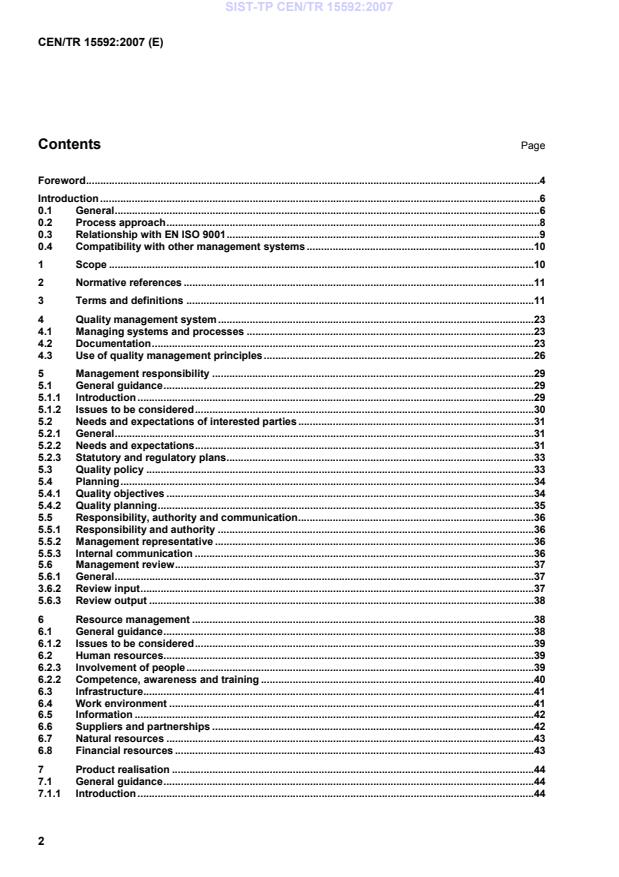
Contents Page
Foreword.4
Introduction .6
0.1 General.6
0.2 Process approach.8
0.3 Relationship with EN ISO 9001.9
0.4 Compatibility with other management systems .10
1 Scope.10
2 Normative references.11
3 Terms and definitions .11
4 Quality management system.23
4.1 Managing systems and processes .23
4.2 Documentation.23
4.3 Use of quality management principles.26
5 Management responsibility.29
5.1 General guidance.29
5.1.1 Introduction.29
5.1.2 Issues to be considered.30
5.2 Needs and expectations of interested parties .31
5.2.1 General.31
5.2.2 Needs and expectations.31
5.2.3 Statutory and regulatory plans.33
5.3 Quality policy.33
5.4 Planning.34
5.4.1 Quality objectives.34
5.4.2 Quality planning.35
5.5 Responsibility, authority and communication.36
5.5.1 Responsibility and authority .36
5.5.2 Management representative.36
5.5.3 Internal communication.36
5.6 Management review.37
5.6.1 General.37
3.6.2 Review input.37
5.6.3 Review output.38
6 Resource management.38
6.1 General guidance.38
6.1.2 Issues to be considered.39
6.2 Human resources.39
6.2.3 Involvement of people.39
6.2.2 Competence, awareness and training .40
6.3 Infrastructure.41
6.4 Work environment.41
6.5 Information.42
6.6 Suppliers and partnerships .42
6.7 Natural resources.43
6.8 Financial resources.43
7 Product realisation.44
7.1 General guidance.44
7.1.1 Introduction.44
7.1.2 Issues to be considered.44
7.1.3. Managing processes.45
7.2 Process related to interested parties .48
7.3 Design and development.49
7.3.1 Design and development planning.49
7.3.2 Design and development input and output .51
7.3.3 Design and development review.52
7.4 Purchasing.53
7.4.1 Purchasing process.53
7.4.2 Supplier control process .54
7.5 Production and service operations .55
7.5.1 Operation and realization .55
7.5.2 Identification and traceability.56
7.5.3 Customer property.57
7.5.4 Preservation of product.57
7.6 Control of monitoring and measuring devices.58
8 Measurement, analysis and improvement.58
8.1 General guidance.58
8.1.1 Introduction.58
8.1.2 Issues to be considered.59
8.2 Measurement and monitoring .60
8.2.1 Measurement and monitoring of system performance .60
8.2.2 Measurement and monitoring of processes.63
8.2.3 Measurement and monitoring of products .63
8.2.4 Measurement and monitoring the satisfaction of interested parties.64
8.3 Control of non-conformity.65
8.3.1 General.65
8.3.2 Nonconformity review and disposition.66
8.4 Analysis of data .67
8.5 Improvement.67
8.5.1 General.67
8.5.2 Corrective action.68
8.5.3 Loss prevention.69
8.5.4 Continual improvement of the organisation.69
Annex A (informative .72
A.1 Introduction .72
A.2 Performance maturity levels.72
A.3 Self-assessment questions.73
A.4 Documentation of self-assessment results .82
A.5 Linking potential benefits of ISO 9004 to self-assessment.83
Annex B (informative) Process for continual improvement .86
Bibliography.88
Foreword
This document (CEN/TR 15592-1:2007) has been prepared by CEN/BT/TF 142 “Healthcare service - Quality
management systems“, the secretariat of which is held by SIS.
Layouts of this document:
Grey-shaded black text is the original EN ISO 9004:2000.
Black italic text is material take from CEN/TS 15224.
Black normal text is the guidance offered in this document for implementing EN ISO 9004:2000.
ISO (the International Organisation for Standardization) is a worldwide federation of national standards bodies
(ISO member bodies). The work of preparing International Standards is normally carried out through ISO
technical committees. Each member body interested in a subject for which a technical committee has been
established has the right to be represented on that committee. International organisations, governmental and
non-governmental, in liaison with ISO, also take part in the work. ISO collaborates closely with the
International Electro-technical Commission (IEC) on all matters of electro technical standardization.
International Standards are drafted in accordance with the rules given in the ISO/IEC Directives, Part 3. Draft
International Standards adopted by the technical committees are circulated to the member bodies for voting.
Publication as an International Standard requires approval by at least 75 % of the member bodies casting
a vote. Attention is drawn to the possibility that some of the elements of this International Standard may be the
subject of patent rights. ISO shall not be held responsible for identifying any or all such patent rights.
International Standard ISO 9004 was prepared by Technical Committee ISO/TC 176, Quality management
and quality assurance, Subcommittee SC 2, Quality systems. This second edition of ISO 9004 cancels and
replaces ISO 9004-1:1994, which has been technically revised. The title has been modified to reflect the
comprehensiveness of the quality management system. Many of the existing International Standards within
the ISO 9000 family will be reviewed for withdrawal, or for re-issue as Technical Reports, as many of their
provisions are incorporated into this International Standard. In comparison to previous editions, ISO 9001 and
ISO 9004 now form a consistent pair of standards on quality management. ISO 9001 aims to give quality
assurance of product and to enhance customer satisfaction, while ISO 9004 uses a broader perspective of
quality management to give guidance for performance improvement. Annexes A and B of this International
Standard are for information only.
This Technical Report is intended to provide a guide for applying EN ISO 9004:2000 in health service
organisations by stating appropriate comments and examples in order to clarify the text of the
EN ISO 9004:2000 standard by using health sector specific terminology. This guide is intended to form a
consistent pair with CEN/TS 15224 “Health services — Quality management systems — Guide for the use of
EN ISO 9001:2000 which is a guide for the interpretation and implementation of EN ISO 9001:2000 in the
health service sector which has been recently prepared by CEN/BT/TF 142.
The Technical Specification takes the actual practice of the health care service sector as its clause of
departure. It specifies how organisations in the European health care service sector may interpret and apply
the requirements of the EN ISO 9001:2000 standard when developing and implementing a quality
management system. The CEN/TS 15224 “Health services — Quality management systems — Guide for the
use of EN ISO 9001:2000 is applicable to all health service organisations regardless of structure, owner, size,
type of service provided, locally used approaches or location.
This Technical Report as a guide to EN ISO 9004:2000 implementation in health services takes into account
providing a framework for managing risk in the health sector. Risk management aspects are therefore
emphasized in the guidance. The ISO-IWA 1 version 2, the Spanish UNE 66174:2003, the United Kingdom
HQS International Standards and the Australian and New Zealand Guidelines for Managing Risk in the Health
services Sector have been used as reference documents (see Bibliography).
This Technical Report cannot be used for third party certification. This document is aimed to be used by
organisations that already have implemented a quality management system according to EN ISO 9001:2000
using CEN/TS 15224:2005. It should be used for continuously improving a quality management system
compliant with EN ISO 9001:2000 applied to health service organisations.
Introduction
0.1 General
The adoption of a quality management system should be a strategic decision by the top management of an
organisation. The design and implementation of an organisation's quality management system is influenced
by varying needs, particular objectives, the products provided, the processes employed and the size and
structure of the organisation. This International Standard is based on eight quality management principles.
However, it is not the intent of this International Standard to imply uniformity in the structure of quality
management systems or uniformity of documentation.
The purpose of an organisation is
— to identify and meet the needs and expectations of its customers and other interested parties (people in
the organisation, suppliers, owners, society), to achieve competitive advantage, and to do this in an effective
and efficient manner, and
— to achieve, maintain, and improve overall organisational performance and capabilities.
The application of quality management principles not only provides direct benefits but also makes an
important contribution to managing costs and risks. Benefit, cost and risk management considerations are
important for the organisation, its customers and other interested parties. These considerations on overall
performance of the organisation may impact
— customer loyalty,
— repeat business and referral,
— operational results such as revenue and market share,
— flexible and fast responses to market opportunities,
— costs and cycle times through effective and efficient use of resources,
— alignment of processes which will best achieve desired results,
— competitive advantage through improved organisational capabilities,
— understanding and motivation of people towards the organisation's goals and objectives, as well as
participation in continual improvement,
— confidence of interested parties in the effectiveness and efficiency of the organisation, as demonstrated
by the financial and social benefits from the organisation's performance, product life cycle, and reputation,
ability to create value for both the organisation and its suppliers by optimization of costs and resources as well
as flexibility and speed of joint responses to changing markets.
The goal of this Technical Report is to guide in the application of EN ISO 9004:2000 in health services
organisations with focus on patient safety and providing a generic overview of risk management in health
services.
The guidance in this document is addressed to anyone in the organisation whose work could affect the quality
of any of its processes and therefore its products or services.
Effective risk management evolved from manufacturing and insurance industries, and is being increasingly
accepted in many countries, both in public and private sectors, as integral part of management, quality and
good practice.
It is recognised that health services is a high risk business and even though, at present, management of risk
in health services is way behind other high risk industries such as the aviation industry, management of risk
should be considered an integral part of any health services sector management reform.
Unfortunately, in health services, even though risk is managed continuously, it is not, yet, managed as
systematically as it could be and therefore all health services managers and staff should recognize the
importance of effective risk management for becoming a modus operandi in any health service institution.
Risk management is an integral part of any health service system. Specifically it provides a comprehensive
approach to patient safety, minimizing losses that can occur anytime as patient moves along the health
service system. In general it improves the use of resources and policy decision making at all levels of the
health service system.
Risk management follows a series of process steps but it is also a system with a culture of consultation and
communication. It requires a logical analysis of facts and data as well as management structures so that
culture is understood and the process is followed.
It also requires a pro-active approach. In any system where safety is critical as in health services, it is not
acceptable to wait for loss before identifying the need for improvement. Risk management involves identifying
potential problems in advance of the problem becoming critical.
Besides taking accountability of the environment, risk management includes the realisation of opportunities or
introducing new approaches where a lack of action exposes the organisation to unnecessary risks.
Risk management in health services should cover risk management activities related to:
• patient care;
• personnel;
• documentation, data and communication;
• management;
• departmental procedures;
• environment.
Risk can arise both from internals and external sources and might include:
• an adverse event during the care process;
• occurrence of an avoidable complication to the current health issue;
• occurrence of an avoidable side-effect which is not categorized as an adverse event;
• failure of equipment;
• a threat to physical safety;
• a breach of security;
• a breach of legal or contractual responsibility;
• fraud.
This document is therefore addressed to the organisation’s top management, i.e., the organisation’s CEO, the
medical, nursing, general administration and other directors; as well as the intermediate management, i.e.
heads of administration, clinical and technical units, departments or services; and all the process owners.
Guidance is provided on how to improve the health care organisation’s performance, safety, effectiveness,
efficiency and quality of its services, in order to manage risks, reduce costs, manage risks and improve
competitiveness, therefore increasing satisfaction of customers and other interested parties.
This Technical Report can also be used for self-assessment to determine how the organisation compares to
the improvement guidelines as well as for assessing the maturity of their quality management system, and for
identification of opportunities for improvement through multidisciplinary teams. Assessment using the
EN ISO 9004:2000 criteria can be a first step towards comparison to quality award criteria such as the EFQM
Excellence Model.
Annex A of EN ISO 9004:2000 contains information about self-assessment to grade the organisation.
0.2 Process approach
This International Standard promotes the adoption of a process approach when developing, implementing and
improving the effectiveness and efficiency of a quality management system to enhance interested party
satisfaction by meeting interested party requirements.
For an organization to function effectively and efficiently, it has to identify and manage numerous linked
activities. An activity using resources, and managed in order to enable the transformation of inputs into
outputs, is considered as a process. Often the output from one process directly forms the input to the next.
The application of a system of processes within an organization, together with the identification and
interactions and managing of these processes can be referred to as the “process approach”.
An advantage of the process approach is the ongoing control that it provides over the linkage between the
individual processes within the system of processes, as well as their combination and interaction.
When used within a quality management system, such an approach emphasizes the importance of
a) understanding and fulfilling the requirements,
b) the need to consider processes in terms of added value,
c) obtaining results of process performance and effectiveness, and
d) continual improvement of processes based on objective measurement.
The model of a process-based quality management system shown in Figure 1 illustrates the process linkages
presented in clauses 4 to 8. This illustration shows that interested parties play a significant role in defining
requirements as inputs. Monitoring the satisfaction of interested parties requires the evaluation of information
relating to the perception of interested parties as to whether the organization has met their requirements. The
model shown in Figure 1 does not show processes at a detailed level.
Figure 1—Model of a process-based quality management system
In a health service organisation, the health services are understood as the whole of health care provider
activities that pursue to restore the health condition of the user as well as the services necessary to increase
the population’s health level.
Processes in health service organisations can be classified according to different approaches. See definitions.
0.3 Relationship with EN ISO 9001
The present editions of ISO 9001 and ISO 9004 have been developed as a consistent pair of quality
management system standards which have been designed to complement each other but can also be used
independently. Although the two International Standards have different scopes, they have similar structures in
order to assist their application as a consistent pair.
ISO 9001 specifies requirements for a quality management system that can be used for internal application by
organizations, or for certification, or for contractual purposes. It focuses on the effectiveness of the quality
management system in meeting customer requirements.
ISO 9004 gives guidance on a wider range of objectives of a quality management system than does ISO 9001,
particularly for the continual improvement of an organization's overall performance and efficiency, as well as
its effectiveness. ISO 9004 is recommended as a guide for organizations whose top management wishes to
move beyond the requirements of ISO 9001, in pursuit of continual improvement of performance. However, it
is not intended for certification or for contractual purposes
This Technical Report is aimed to be used as a complement to CEN/TS 15224 “Health Services — Quality
management system — Guide for the use of EN ISO 9001:2000” to obtain a broader perspective of quality
management for performance improvement as well as risk management, benefit and cost in the provision of
health services. This Technical Report is not an implementation guide for CEN/TS 15224.
The clause numbering of CEN/TS 15224 and this Technical Report is the same for the first two number levels
(0.1 Introduction, 0.2 Process approach) so cross reference can be easily made.
0.4 Compatibility with other management systems
This International Standard does not include requirements specific to other management systems, such as
those particular to environmental management, occupational health and safety management, financial
management or risk management. However, this International Standard enables an organization to align or
integrate its own quality management system with related management system requirements. It is possible for
an organization to adapt its existing management system(s) in order to establish a quality management
system that complies with the requirements of this International Standard.
The following international standards are relevant to health services organisations and should be considered
for inclusion in developing an integrated management system in order to improve quality in health service:
ISO 14971:2000, Medical devices — Application of risk management to medical devices (ISO 14971:2000)
ISO/TS 22004:2005, Food safety management systems — Guidance on the application of ISO 22000:2005
ISO 15190:2003, Medical laboratories — Requirements for safety
ISO 14063, Environmental management — Environmental communication — Guidelines and examples
1 Scope
This International Standard provides guidelines beyond the requirements given in ISO 9001 in order to
consider both the effectiveness and efficiency of a quality management system, and consequently the
potential for improvement of the performance of an organization. When compared to ISO 9001, the objectives
of customer satisfaction and product quality are extended to include the satisfaction of interested parties and
the performance of the organization.
This International Standard is applicable to the processes of the organization and consequently the quality
management principles on which it is based can be deployed throughout the organization. The focus of this
International Standard is the achievement of ongoing improvement, measured through the satisfaction of
customers and other interested parties.
This International Standard consists of guidance and recommendations and is not intended for certification,
regulatory or contractual use, nor as a guide to the implementation of ISO 9001.
This Technical Report provides assistance on how the EN ISO 9004:2000 guidelines may be applied to health
services, without prescribing the activities that need to be done by the health service provider; the latter
should use its own professional knowledge and/or follow guidelines and protocols established by relevant
professional bodies.
Even though EN ISO 9004:2000 promotes a better understanding of the EN ISO 9001:2000 requirements, its
scope goes further than that. It is a technical document for managers and process owners to monitor and
improve organisation performance, minimise risks, reduce costs, satisfy customers and improve
competitiveness.
To fulfil the requirements of processes that have impact on patient safety this Technical Report provides an
approach for improvement of risk management in the organisation.
An important value of EN ISO 9004:2000 is that it can be used for self-assessment (see Annex A) comparing
the performance of the organisation with the 290 individual “should” performance improvement guideline
statements of the standard. These statements can be used to create a check list for evaluators (see A.3).
Using the EN ISO 9004:2000 criteria, organisations can assess the maturity of their quality management
system (see A.2) and identify opportunities for improvement.
This Technical Report ensures that those health system activities that are necessary for continuous
improvement, risk management and reduction of variation and organisational waste are carried out
consistently and in a controlled manner.
This Technical Report addresses any health system or health care organisation involved in the provision of
health services to the population including prevention, care and rehabilitation, regardless of the type and size
of the system/organisation and the product or service provided.
2 Normative references
The following normative document contains provisions which, through reference in this text, constitute
provisions of this International Standard. For dated references, subsequent amendments to, or revisions of,
any of these publications do not apply. However, parties to agreements based on this International Standard
are encouraged to investigate the possibility of applying the most recent edition of the normative document
indicated below. For undated references, the latest edition of the normative document referred to applies.
Members of ISO and IEC maintain registers of currently valid International Standards.
EN ISO 9000:2005, Quality management systems — Fundamentals and vocabulary (ISO 9000:2005)
CEN/TS 15224:2005, Health services — Quality management systems — Guide for the use of
EN ISO 9001:2000
3 Terms and definitions
The following terms, used in this edition of ISO 9004 to describe the supply-chain, have been changed to
reflect the vocabulary currently used:
supplier organization customer (interested parties)
For the purposes of this International Standard, the terms and definitions given in ISO 9000 apply.
Throughout the text of this International Standard, wherever the term “product” occurs, it can also mean
“service”.
The following terms and definitions are of special interest and importance for the health services sector and
for the understanding of this guide.
For the purposes of this document, the terms and definitions given in CEN/TS 15224:2005 apply.
To make this Technical Report more user friendly, they are included in alphabetical order, together with new
terms used in this Technical Report. As a consequence the numbering of terms and definitions do not follow
the numbering in the CEN/TS 15224 and EN ISO 9000:2005.
Correspondence to the numbering of the terminology in this document is shown (in brackets) when applicable.
In this guide, as in CEN/TS 15224, the term health services means health services produced. The term health
services could in other circumstances also be used to nominate the health services sector. In that case the
term health services sector will be used.
The services that are included in the term ’health services' may vary from country to country and this has to be
considered in national translations. In this guide, health services include hospital care, primary health care and
preventive health care, psychiatry and dental services.
3.1
adverse event
event which is not consistent with the desired, normal or usual operation of the organisation (Cf.IWA-1:2001).
This may include: Injury or accidental death, accidents involving patient, personnel or third parties; medication
variances (delays, incorrect dose, wrong medication); unexpected results from a treatment or procedure
(3.35); mistaken identity; medical devices that malfunction/or incorrect use of medical devices, with or without
injury to patient, personnel etc.
3.2
benchmarking
methodology that consists in comparing the processes and features of the products and services of an
organisation with those of renowned leaders in order to identify opportunities for quality improvement
(UNE 66174:2003, 3.3)
3.3
care plan
description of planned and duly personalised services bundles, addressing one or more health issues, and
encompassing all health care services to be provided to a subject of care (3.51) by one health care
professional
[ENV 13940:2001, CONTsys]
3.4
clinical guidelines
set of systematically developed statements to assist the decision of health care parties about health care
services to be provided with regard to a health issue (3.22) in specified clinical circumstances
[ENV 13940:2001, CONTsys]
3.5
clinical process
set of interrelated or interacting health care activities which are performed for patients/subjects of care with a
health issue
3.6
customer
organisation (3.31) or person that receives a product (3.37)
EXAMPLE Consumer, client, end-user, retailer, beneficiary and purchaser.
NOTE A customer can be internal or external to the organisation.
[EN ISO 9000:2005, 3.3.5]
The patient/subject of care (3.51) is the key customer and the recipient of the health services (3.21)
provision. In the health services sector, the citizens in the affiliated area or target group need to be taken into
consideration in dimensioning health care resources as an act of quality management. Examples of other
customers could be other health care providers or department/part of the organisation receiving
products/services produced. It can also be insurance companies asking for services from the health care
organisation (3.16) etc.
Concerning relatives/next of kin see stakeholder (3.49)
3.7
customer satisfaction
customer's perception of the degree to which the customer's requirements (3.45) have been fulfilled.
EXAMPLE Consumer, client, end-user, retailer, beneficiary and purchaser.
NOTE 1 Customer complaints are a common indicator of low customer satisfaction but their absence does not
necessarily imply high customer satisfaction.
NOTE 2 Even when customer requirements have been agreed with the customer and fulfilled, this does not necessarily
ensure high customer satisfaction.
[EN ISO 9000:2005, 3.1.4]
The primary customer in health services is the patient/subject of care (3.51) i.e. the degree to which the
needs of and expectations on health care services have been fulfilled, as judged by the patient/subject of
care/health care third parties
Cf. customer [EN ISO 9000:2000, 3.3.5] subject of care [ENV 13940:2001, CONTsys]
3.8
defect
non-fulfilment of a requirement (3.45) related to an intended or specified use
NOTE 1 The distinction between the concepts defect and nonconformity is important as it has legal connotations,
particularly those associated with product liability issues. Consequently the term “defect” should be used with extreme
caution.
NOTE 2 The intended use as intended by the customer (3.6) can be affected by the nature of the information, such as
operating or maintenance instructions, provided by the supplier.
[EN ISO 9000:2005, 3.6.3]
3.9
deviation
degree to which the compliance of a requirement (3.45) differs from the expected value (UNE 66174:2003,
3.12)
3.10
event
occurrence of a particular set of circumstances
NOTE 1 The event can be certain or uncertain.
NOTE 2 The event can be a single occurrence or a series of occurrences.
NOTE 3 The probability associated with the event can be estimated for a given period of time.
(ISO/IEC GUIDE 73:2002, 3.2.4)
3.11
event tree analysis
technique which describes the possible range and sequence of the outcomes which may arise from an
initiating event (HB 228:2001)
3.12
FMEA (Failure Mode and Effects Analysis)
method for risk prioritizing and the undertaking of preventive action aimed at risk reduction (UNE 66174:2003,
3.2)
3.13
health
state of complete physical, mental and social well-being and not merely the absence of disease or infirmity
[WHO definition of Health]
3.14
health care activity
activity performed for a subject of care (3.51) by a health care agent with the intention of directly or indirectly
improving or maintaining the health (3.13) of that subject of care
[ENV 13940:2001, CONTsys]
3.15
health care objective
desired ultimate achievement of a programme of care
[ENV 13940:2001, CONTsys]
3.16
health care organisation
organisation involved in the direct provision of health care services.
Groupings or subdivisions of an organisation, such as departments or sub-departments, may also be
considered as organisations where there is need to identify them. Therefore, a health care organisation may
be considered in itself as a stand alone organisation or as a superstructure containing departments and sub-
departments, i.e. other lower level organisations.
A free-standing self employed solo practising health care professional (3.17) shall be considered as the only
member of his/her own health care organisation
[ENV 13940:2001, CONTsys]
3.17
health care professiona
...