Adjustable speed electrical power drive systems - Part 3: EMC requirements and specific test methods (IEC 61800-3:2017)

specifies electromagnetic compatibility (EMC) requirements for power drive systems (PDSs). A PDS is defined in 3.1. These are adjustable speed a.c. or d.c. motor drives. Requirements are stated for PDSs with converter input and/or output voltages (line-to-line voltage), up to 35 kV a.c. r.m.s.

Drehzahlveränderbare elektrische Antriebe - Teil 3: EMV-Anforderungen einschließlich spezieller Prüfverfahren (IEC 61800-3:2017)

Entraînements électriques de puissance à vitesse variable - Partie 3: Exigences de CEM et méthodes d'essais spécifiques (IEC 61800-3:2017)

spécifie les prescriptions de compatibilité électromagnétique (CEM) applicables aux entraînements de puissance (PDS). Le PDS est défini en 3.1. Il s'agit d'entraînements à vitesse variable pour moteurs électriques à courant alternatif ou continu. Cette norme spécifie les exigences afférentes aux PDS avec convertisseurs ayant des tensions d'entrée et/ou sortie (tensions entre phases), de valeur efficace allant jusqu'à 35 kV en alternatif.

Električni pogonski sistemi z nastavljivo hitrostjo - 3. del: Zahteve za elektromagnetno združljivost in posebne preskusne metode (IEC 61800-3:2017)

Standard določa zahteve za elektromagnetno združljivost za pogonske sisteme. Pogonski sistem je opredeljen v točki 3.1. Pogonski sistemi so motorni pogoni z enosmerno ali izmenično napetostjo z nastavljivo hitrostjo. Zahteve so navedene za pogonske sisteme z vhodnimi in/ali izhodnimi (medlinijskimi) napetostmi pretvornika do 35 kV efektivne vrednosti izmenične napetosti.

General Information

Status
Published
Publication Date
13-Nov-2018
Current Stage
6060 - National Implementation/Publication (Adopted Project)
Start Date
02-Oct-2018
Due Date
07-Dec-2018
Completion Date
14-Nov-2018

Relations

Overview

SIST EN IEC 61800-3:2018 (identical to IEC 61800-3:2017) defines electromagnetic compatibility (EMC) requirements and specific test methods for adjustable speed electrical power drive systems (PDSs) - i.e., a.c. and d.c. motor drives with converter input and/or output voltages up to 35 kV a.c. r.m.s.. The standard sets emission and immunity criteria, test conditions, documentation and installation-related guidance to ensure drives operate reliably without causing or being susceptible to electromagnetic disturbances.

Key topics and technical requirements

  • Scope & definitions: Clear definitions for PDS components, interfaces, installation boundaries and intended use.
  • EMC performance criteria: Acceptance criteria (performance types) for immunity tests and guidance on selecting appropriate performance levels.
  • Immunity requirements:
    • Low-frequency disturbances - harmonics, commutation notches, voltage dips, short interruptions, unbalance and frequency variations.
    • High-frequency disturbances - radiated and conducted RF immunity, electrostatic discharge, fast transients (EFT), surge immunity and magnetic field influences.
  • Emission limits:
    • Low-frequency emissions (harmonics, interharmonics, voltage fluctuations/flicker, commutation notches).
    • High-frequency conducted and radiated emissions with equipment categories (C1–C4) and measurement boundary conditions.
  • Test methods & conditions:
    • Detailed test setups, load conditions, connection requirements and reporting rules for reproducible EMC testing.
    • References to IEC/CISPR test techniques (e.g., IEC 61000 and CISPR series) used for immunity and emission testing.
  • Documentation & reporting:
    • Required user documentation, test reports and installation guidance to support compliant deployment.
  • Engineering practice:
    • Guidance for installations, filtering, cabling and grounding to achieve EMC compliance, including statistical aspects of emission/immunity.

Practical applications - who uses this standard

  • Drive and inverter manufacturers - design and verify EMC performance, prepare declarations of conformity and technical files.
  • EMC/test laboratories - perform standardized immunity and emission tests and produce compliant test reports.
  • System integrators & electrical engineers - apply installation practices to meet site EMC constraints and select mitigation measures (filters, shielding, grounding).
  • Utilities & OEMs - assess grid compatibility (harmonics, voltage fluctuations) and conditional connection requirements up to 35 kV.
  • Regulatory and compliance teams - align with European/CENELEC harmonized requirements for market access.

Related standards (normative references)

EN IEC 61800-3 cross-references many IEC/CISPR standards for specific test methods, notably the IEC 61000 series (EMC immunity and emission tests), CISPR 11/16 and equipment-specific standards for harmonics and flicker. For conformity work, consult the cited IEC/CISPR publications listed in the standard.

Keywords: SIST EN IEC 61800-3:2018, EMC requirements, adjustable speed drives, power drive systems, EMC testing, immunity, emissions, harmonics, commutation notches.

Standard
SIST EN 61800-3:2018 - BARVE na PDF-str 20,24,25,52,75,78,85,110
English language
126 pages
sale 10% off
Preview
sale 10% off
Preview
e-Library read for
1 day
Standard
SIST EN IEC 61800-3:2018 - BARVE
English language
126 pages
sale 10% off
Preview
sale 10% off
Preview
e-Library read for
1 day

Standards Content (Sample)


SLOVENSKI STANDARD
SIST EN 61800-3:2018
01-december-2018
1DGRPHãþD
SIST EN 61800-3:2005
SIST EN 61800-3:2005/A1:2012
(OHNWULþQLSRJRQVNLVLVWHPL]QDVWDYOMLYRKLWURVWMRGHO=DKWHYH]D
HOHNWURPDJQHWQR]GUXåOMLYRVWLQSRVHEQHSUHVNXVQHPHWRGH ,(&
Adjustable speed electrical power drive systems - Part 3: EMC requirements and specific
test methods (IEC 61800-3:2017)
Drehzahlveränderbare elektrische Antriebe - Teil 3: EMV-Anforderungen einschließlich
spezieller Prüfverfahren (IEC 61800-3:2017)
Entraînements électriques de puissance à vitesse variable - Partie 3: Exigences de CEM
et méthodes d'essais spécifiques (IEC 61800-3:2017)
Ta slovenski standard je istoveten z: EN IEC 61800-3:2018
ICS:
29.200 8VPHUQLNL3UHWYRUQLNL Rectifiers. Convertors.
6WDELOL]LUDQRHOHNWULþQR Stabilized power supply
QDSDMDQMH
33.100.01 Elektromagnetna združljivost Electromagnetic compatibility
na splošno in general
SIST EN 61800-3:2018 en
2003-01.Slovenski inštitut za standardizacijo. Razmnoževanje celote ali delov tega standarda ni dovoljeno.

SIST EN 61800-3:2018
EUROPEAN STANDARD EN IEC 61800-3

NORME EUROPÉENNE
EUROPÄISCHE NORM
September 2018
ICS 29.200; 33.100 Supersedes EN 61800-3:2004
English Version
Adjustable speed electrical power drive systems - Part 3: EMC
requirements and specific test methods
(IEC 61800-3:2017)
Entraînements électriques de puissance à vitesse variable - Drehzahlveränderbare elektrische Antriebssysteme - Teil 3:
Partie 3: Exigences de CEM et méthodes d'essais EMV-Anforderungen einschließlich spezieller Prüfverfahren
spécifiques (IEC 61800-3:2017)
(IEC 61800-3:2017)
This European Standard was approved by CENELEC on 2018-07-09. CENELEC members are bound to comply with the CEN/CENELEC
Internal Regulations which stipulate the conditions for giving this European Standard the status of a national standard without any alteration.
Up-to-date lists and bibliographical references concerning such national standards may be obtained on application to the CEN-CENELEC
Management Centre or to any CENELEC member.
This European Standard exists in three official versions (English, French, German). A version in any other language made by translation
under the responsibility of a CENELEC member into its own language and notified to the CEN-CENELEC Management Centre has the
same status as the official versions.
CENELEC members are the national electrotechnical committees of Austria, Belgium, Bulgaria, Croatia, Cyprus, the Czech Republic,
Denmark, Estonia, Finland, Former Yugoslav Republic of Macedonia, France, Germany, Greece, Hungary, Iceland, Ireland, Italy, Latvia,
Lithuania, Luxembourg, Malta, the Netherlands, Norway, Poland, Portugal, Romania, Serbia, Slovakia, Slovenia, Spain, Sweden,
Switzerland, Turkey and the United Kingdom.

European Committee for Electrotechnical Standardization
Comité Européen de Normalisation Electrotechnique
Europäisches Komitee für Elektrotechnische Normung
CEN-CENELEC Management Centre: Rue de la Science 23, B-1040 Brussels
© 2018 CENELEC All rights of exploitation in any form and by any means reserved worldwide for CENELEC Members.
Ref. No. EN IEC 61800-3:2018 E

SIST EN 61800-3:2018
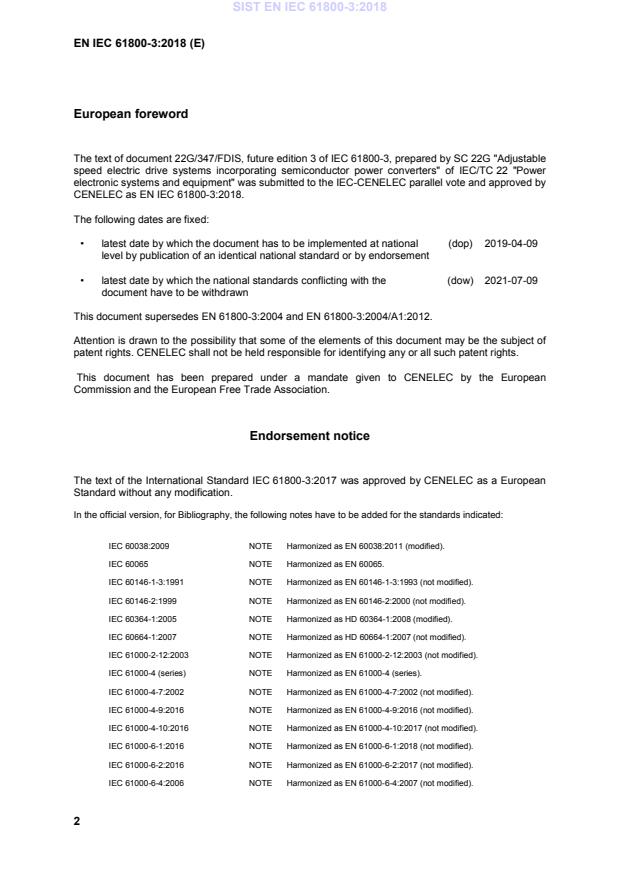
European foreword
The text of document 22G/347/FDIS, future edition 3 of IEC 61800-3, prepared by SC 22G "Adjustable
speed electric drive systems incorporating semiconductor power converters" of IEC/TC 22 "Power
electronic systems and equipment" was submitted to the IEC-CENELEC parallel vote and approved by
CENELEC as EN IEC 61800-3:2018.
The following dates are fixed:
• latest date by which the document has to be implemented at national (dop) 2019-04-09
level by publication of an identical national standard or by endorsement
• latest date by which the national standards conflicting with the (dow) 2021-07-09
document have to be withdrawn
This document supersedes EN 61800-3:2004 and EN 61800-3:2004/A1:2012.
Attention is drawn to the possibility that some of the elements of this document may be the subject of
patent rights. CENELEC shall not be held responsible for identifying any or all such patent rights.
This document has been prepared under a mandate given to CENELEC by the European
Commission and the European Free Trade Association.
Endorsement notice
The text of the International Standard IEC 61800-3:2017 was approved by CENELEC as a European
Standard without any modification.
In the official version, for Bibliography, the following notes have to be added for the standards indicated:
IEC 60038:2009 NOTE Harmonized as EN 60038:2011 (modified).
IEC 60065 NOTE Harmonized as EN 60065.
IEC 60146-1-3:1991 NOTE Harmonized as EN 60146-1-3:1993 (not modified).
IEC 60146-2:1999 NOTE Harmonized as EN 60146-2:2000 (not modified).
IEC 60364-1:2005 NOTE Harmonized as HD 60364-1:2008 (modified).
IEC 60664-1:2007 NOTE Harmonized as HD 60664-1:2007 (not modified).
IEC 61000-2-12:2003 NOTE Harmonized as EN 61000-2-12:2003 (not modified).
IEC 61000-4 (series) NOTE Harmonized as EN 61000-4 (series).
IEC 61000-4-7:2002 NOTE Harmonized as EN 61000-4-7:2002 (not modified).
IEC 61000-4-9:2016 NOTE Harmonized as EN 61000-4-9:2016 (not modified).
IEC 61000-4-10:2016 NOTE Harmonized as EN 61000-4-10:2017 (not modified).
IEC 61000-6-1:2016 NOTE Harmonized as EN 61000-6-1:2018 (not modified).
IEC 61000-6-2:2016 NOTE Harmonized as EN 61000-6-2:2017 (not modified).
IEC 61000-6-4:2006 NOTE Harmonized as EN 61000-6-4:2007 (not modified).
SIST EN 61800-3:2018
IEC 61000-6-5:2015 NOTE Harmonized as EN 61000-6-5:2015 (not modified).
IEC 61400-21:2008 NOTE Harmonized as EN 61400-21:2008 (not modified).
IEC 61557-8:2014 NOTE Harmonized as EN 61557-8:2015 (not modified).
IEC 61557-9 NOTE Harmonized as EN 61557-9.
IEC 61800-1:1997 NOTE Harmonized as EN 61800-1:1998 (not modified).
IEC 61800-2:2015 NOTE Harmonized as EN 61800-2:2015 (not modified).
IEC 61800-4:2002 NOTE Harmonized as EN 61800-4:2003 (not modified).
IEC 61800-5-1:2007 NOTE Harmonized as EN 61800-5-1:2007 (not modified).
CISPR 14-1:2016 NOTE Harmonized as EN 55014-1:2017 (not modified).
CISPR 16-2-1:2014 NOTE Harmonized as EN 55016-2-1:2014 (not modified).
CISPR 16-2-3:2016 NOTE Harmonized as EN 55016-2-3:2017 (not modified).
SIST EN 61800-3:2018
Annex ZA
(normative)
Normative references to international publications
with their corresponding European publications
The following documents are referred to in the text in such a way that some or all of their content
constitutes requirements of this document. For dated references, only the edition cited applies. For
undated references, the latest edition of the referenced document (including any amendments)
applies.
NOTE 1  Where an International Publication has been modified by common modifications, indicated by (mod), the relevant
EN/HD applies.
NOTE 2  Up-to-date information on the latest versions of the European Standards listed in this annex is available here:
www.cenelec.eu.
Publication Year Title EN/HD Year
IEC 60146-1-1 2009 Semiconductor converters - General EN 60146-1-1 2010
requirements and line commutated
converters -- Part 1-1: Specification of
basic requirements
IEC 61000-2-2 2002 Electromagnetic compatibility (EMC) -- Part EN 61000-2-2 2002
2-2: Environment - Compatibility levels for
low-frequency conducted disturbances and
signalling in public low-voltage power
supply systems
IEC 61000-2-4 2002 Electromagnetic compatibility (EMC) -- Part EN 61000-2-4 2002
2-4: Environment - Compatibility levels in
industrial plants for low-frequency
conducted disturbances
IEC 61000-3-2 2014 Electromagnetic compatibility (EMC) - Part EN 61000-3-2 2014
3-2: Limits - Limits for harmonic current
emissions (equipment input current - 16 A
per phase)
IEC 61000-3-3 2013 Electromagnetic compatibility (EMC) - Part EN 61000-3-3 2013
3-3: Limits - Limitation of voltage changes,
voltage fluctuations and flicker in public
low-voltage supply systems, for equipment
with rated current - 16 A per phase and not
subject to conditional connection
IEC 61000-3-11 2000 Electromagnetic compatibility (EMC) -- Part EN 61000-3-11 2000
3-11: Limits - Limitation of voltage
changes, voltage fluctuations and flicker in
public low-voltage supply systems -
Equipment with rated current <= 75 A and
subject to conditional connection
SIST EN 61800-3:2018
IEC 61000-3-12 2011 Electromagnetic compatibility (EMC) -- Part EN 61000-3-12 2011
3-12: Limits - Limits for harmonic currents
produced by equipment connected to
public low-voltage systems with input
current > 16 A and <= 75 A per phase
IEC 61000-4-2 2008 Electromagnetic compatibility (EMC) -- Part EN 61000-4-2 2009
4-2: Testing and measurement techniques
- Electrostatic discharge immunity test
IEC 61000-4-3 2006 Electromagnetic compatibility (EMC) -- Part EN 61000-4-3 2006
4-3: Testing and measurement techniques
- Radiated, radio-frequency,
electromagnetic field immunity test
IEC 61000-4-4 2012 Electromagnetic compatibility (EMC) -- Part EN 61000-4-4 2012
4-4: Testing and measurement techniques
- Electrical fast transient/burst immunity
test
IEC 61000-4-5 2014 Electromagnetic compatibility (EMC) - Part EN 61000-4-5 2014
4-5: Testing and measurement techniques
- Surge immunity test
IEC 61000-4-6 2013 Electromagnetic compatibility (EMC) -- Part EN 61000-4-6 2014
4-6: Testing and measurement techniques
- Immunity to conducted disturbances,
induced by radio-frequency fields
IEC 61000-4-8 2009 Electromagnetic compatibility (EMC) -- Part EN 61000-4-8 2010
4-8: Testing and measurement techniques
- Power frequency magnetic field immunity
test
IEC 61000-4-11 2004 Electromagnetic compatibility (EMC) -- Part EN 61000-4-11 2004
4-11: Testing and measurement
techniques - Voltage dips, short
interruptions and voltage variations
immunity tests
IEC 61000-4-13 2002 Electromagnetic compatibility (EMC) -- Part EN 61000-4-13 2002
4-13: Testing and measurement
techniques - Harmonics and
interharmonics including mains signaling at
a.c. power port, low frequency immunity
tests
IEC 61000-4-34 2005 Electromagnetic compatibility (EMC) -- Part EN 61000-4-34 2007
4-34: Testing and measurement
techniques - Voltage dips, short
interruptions and voltage variations
immunity tests for equipment with input
current more than 16 A per phase
CISPR 11 (mod) 2015 Industrial, scientific and medical equipment EN 55011 2016
- Radio-frequency disturbance
characteristics - Limits and methods of
measurement
+ A1 2016  + A1 2017
SIST EN 61800-3:2018
CISPR 16-1-2 2014 Specification for radio disturbance and EN 55016-1-2 2014
immunity measuring apparatus and
methods - Part 1-2: Radio disturbance and
immunity measuring apparatus - Coupling
devices for conducted disturbance
measurements
CISPR 16-1-4 2010 Specification for radio disturbance and EN 55016-1-4 2010
immunity measuring apparatus and
methods -- Part 1-4: Radio disturbance and
immunity measuring apparatus - Antennas
and test sites for radiated disturbance
measurements
CISPR 22 -  Information technology equipment - Radio - -
disturbance characteristics - Limits and
methods of measurement
CISPR 32 2015 Electromagnetic compatibility of multimedia EN 55032 2015
equipment - Emission requirements

SIST EN 61800-3:2018
IEC 61800-3 ®
Edition 3.0 2017-02
INTERNATIONAL
STANDARD
NORME
INTERNATIONALE
colour
inside
Adjustable speed electrical power drive systems –

Part 3: EMC requirements and specific test methods

Entrainements électriques de puissance à vitesse variable –

Partie 3: Exigences de CEM et méthodes d'essai spécifiques

INTERNATIONAL
ELECTROTECHNICAL
COMMISSION
COMMISSION
ELECTROTECHNIQUE
INTERNATIONALE
ICS 29.200; 33.100.01 ISBN 978-2-8322-3888-2

SIST EN 61800-3:2018
– 2 – IEC 61800-3:2017 © IEC 2017
CONTENTS
FOREWORD . 7
1 Scope . 9
2 Normative references . 10
3 Terms and definitions . 12
3.1 Installation and its content . 12
3.2 Intended use . 13
3.3 Location, ports and interfaces . 14
3.4 Components of the PDS . 17
3.5 Phenomena-related definitions . 18
4 Common requirements. 19
4.1 General conditions . 19
4.2 Tests . 20
4.2.1 Conditions . 20
4.2.2 Test report . 20
4.3 Documentation for the user . 21
5 Immunity requirements . 22
5.1 General conditions . 22
5.1.1 Acceptance criteria (performance criteria) . 22
5.1.2 Selection of performance type . 22
5.1.3 Conditions during the test . 24
5.2 Basic immunity requirements – low-frequency disturbances . 25
5.2.1 Common principle . 25
5.2.2 Harmonics and commutation notches/voltage distortion . 25
5.2.3 Voltage deviations, dips and short interruptions . 27
5.2.4 Voltage unbalance and frequency variations . 30
5.2.5 Supply influences – Magnetic fields . 31
5.3 Basic immunity requirements – High-frequency disturbances . 32
5.3.1 Conditions . 32
5.3.2 First environment . 32
5.3.3 Second environment . 33
5.3.4 Immunity against electromagnetic fields. 35
5.4 Application of immunity requirements – Statistical aspect . 35
6 Emission. 35
6.1 General emission requirements . 35
6.2 Basic low-frequency emission limits . 37
6.2.1 Compliance method . 37
6.2.2 Commutation notches . 37
6.2.3 Harmonics and interharmonics . 37
6.2.4 Voltage fluctuations . 38
6.2.5 Emissions in the frequency range from 2 kHz to 9 kHz. 39
6.2.6 Common mode harmonic emission (low-frequency common mode
voltage) . 39
6.3 Conditions related to high-frequency emission measurement . 39
6.3.1 General requirements . 39
6.3.2 Connection requirements . 44

SIST EN 61800-3:2018
IEC 61800-3:2017 © IEC 2017 – 3 –
6.4 Basic high-frequency emission limits . 44
6.4.1 Equipment of categories C1 and C2 . 44
6.4.2 Equipment of category C3 . 47
6.5 Engineering practice . 48
6.5.1 PDS of category C4 . 48
6.5.2 Limits outside the boundary of an installation, for a PDS of category C4
– Example of propagation of disturbances . 49
6.6 Application of emission requirements – Statistical aspects . 52
Annex A (informative) EMC techniques . 53
A.1 Application of PDSs and EMC . 53
A.2 Load conditions regarding high-frequency phenomena . 53
A.2.1 Load conditions during emission tests . 53
A.2.2 Load conditions during immunity tests . 54
A.2.3 Load test . 54
A.3 Immunity to power frequency magnetic fields . 54
A.4 High-frequency emission measurement techniques . 54
A.4.1 Impedance/artificial mains network (AMN) . 54
A.4.2 Performing high-frequency in situ emission tests . 56
A.4.3 Established experience with high power PDSs . 56
Annex B (informative) Low-frequency phenomena . 57
B.1 Commutation notches . 57
B.1.1 Occurrence – description . 57
B.1.2 Calculation . 59
B.1.3 Recommendations regarding commutation notches . 60
B.2 Definitions related to harmonics and interharmonics . 61
B.2.1 General discussion . 61
B.2.2 Phenomena related definitions . 62
B.2.3 Conditions of application. 64
B.3 Application of harmonic emission standards . 68
B.3.1 General . 68
B.3.2 Public networks . 69
B.3.3 Summation methods for harmonics in an installation – Practical rules . 73
B.4 Installation rules – Assessment of harmonic compatibility . 75
B.4.1 Low power industrial three-phase system . 75
B.4.2 Large industrial system . 78
B.4.3 Interharmonics and voltages or currents at higher frequencies . 80
B.5 Voltage unbalance . 80
B.5.1 Origin . 80
B.5.2 Definition and assessment . 81
B.5.3 Effect on PDSs . 83
B.6 Voltage dips – Voltage fluctuations . 83
B.6.1 Voltage dips . 83
B.6.2 Voltage fluctuation . 85
B.7 Verification of immunity to low frequency disturbances . 86
Annex C (informative) Reactive power compensation – Filtering . 87
C.1 Installation . 87
C.1.1 Usual operation . 87
C.1.2 Power definitions under distorted conditions . 87

SIST EN 61800-3:2018
– 4 – IEC 61800-3:2017 © IEC 2017
C.1.3 Practical solutions . 88
C.1.4 Reactive power compensation . 89
C.1.5 Filtering methods . 93
C.2 Reactive power and harmonics . 95
C.2.1 Usual installation mitigation methods . 95
C.2.2 Other solutions . 97
Annex D (informative) Considerations on high-frequency emission . 101
D.1 User guidelines . 101
D.1.1 Expected emission of PDSs . 101
D.1.2 Guidelines . 103
D.2 Safety and RFI-filtering in power supply systems . 105
D.2.1 Safety and leakage currents . 105
D.2.2 Safety and RFI-filtering in power supply systems isolated from earth . 105
Annex E (informative) EMC analysis and EMC plan for PDS of category C4 . 107
E.1 General – System EMC analysis applied to PDSs . 107
E.1.1 Electromagnetic environment . 107
E.1.2 System EMC analysis techniques . 108
E.2 Example of EMC plan . 109
E.2.1 Project data and description . 109
E.2.2 Electromagnetic environment analysis . 110
E.2.3 EMC analysis. 111
E.2.4 Establishment of installation rules . 111
E.2.5 Formal result and maintenance . 113
E.3 Example of supplement to EMC plan for particular application . 113
E.3.1 Electromagnetic environment complementary analysis . 113
E.3.2 EMC analysis. 115
Bibliography . 117

Figure 1 –Installation and its content . 12
Figure 2 – Internal interfaces of the PDS and examples of ports . 15
Figure 3 – Power interfaces of a PDS with common DC BUS . 16
Figure 4 – Power interfaces with common input transformer . 17
Figure 5 – Example for a typical cable arrangement for measurements in 3 m
separation distance, for a table-top or wall-mounted equipment, top view . 43
Figure 6 – Example for a typical cable arrangement for measurements in 3 m
separation distance for a table-top or wall-mounted equipment, side view . 43
Figure 7 – Example for a typical test set up for measurement of conducted and/or
radiated disturbances from a floor-standing PDS, 3D view . 44
Figure 8 – Propagation of disturbances . 50
Figure 9 – Propagation of disturbances in installation with a PDS rated > 1 000 V . 50
Figure B.1 – Typical waveform of commutation notches – Distinction from non-
repetitive transient . 57
Figure B.2 – PCC, IPC, installation current ratio and R . 67
SI
Figure B.3 – PCC, IPC, installation current ratio and R . 68
SC
Figure B.4 – Assessment of the harmonic emission of a PDS . 70
Figure B.5 – Test set-up with mechanical load . 71
Figure B.6 – Test set-up with electrical load replacing the loaded motor . 72

SIST EN 61800-3:2018
IEC 61800-3:2017 © IEC 2017 – 5 –
Figure B.7 – Test set-up with resistive load . 72
Figure B.8 – Assessment of harmonic emission where PDS is used (apparatus,
systems or installations) . 77
Figure C.1 – Reactive power compensation . 90
Figure C.2 – Simplified diagram of an industrial network . 92
Figure C.3 – Impedance versus frequency of the simplified network . 92
Figure C.4 – Example of passive filter battery . 94
Figure C.5 – Example of inadequate solution in reactive power compensation . 96
Figure C.6 – VSI PWM active filter topologies . 98
Figure C.7 – Boost mode converter . 98
Figure C.8 – Front-End inverter system . 99
Figure D.1 – Conducted emission of various unfiltered PDSs . 102
Figure D.2 – Expected radiated emission of PDS up to rated voltage 400 V Peak
values normalised at 10 m . 103
Figure D.3 – Safety and filtering. 106
Figure E.1 – Interaction between systems and EM environment . 107
Figure E.2 – Zone concept . 108
Figure E.3 – Example of drive . 109

Table 1 – Subclauses containing alternative test methods . 21
Table 2 – Criteria to prove the acceptance of a PDS against electromagnetic
disturbances . 24
Table 3 – Minimum immunity requirements for total harmonic distortion on power ports
of low voltage PDSs . 26
Table 4 – Minimum immunity requirements for individual harmonic orders on power
ports of low voltage PDSs . 26
Table 5 – Minimum immunity requirements for commutation notches on power ports of
low voltage PDSs . 27
Table 6 – Minimum immunity requirements for harmonics and commutation notches/
voltage distortion on main power ports of PDSs of rated voltage above 1 000 V . 27
Table 7 – Minimum immunity requirements for voltage deviations, dips and short
interruptions on power ports of low voltage PDSs . 28
Table 8 – Minimum immunity requirements for voltage deviations, dips and short
interruptions on main power ports of rated voltage above 1 000 V of PDSs . 29
Table 9 – Minimum immunity requirements for voltage deviations, dips and short
interruptions on auxiliary low voltage power ports of PDSs . 30
Table 10 – Minimum immunity requirements for voltage unbalance and frequency
variations on power ports of low voltage PDSs . 30
Table 11 – Minimum immunity requirements for voltage unbalance and frequency
variations on main power ports of rated voltage above 1 000 V of PDSs . 31
Table 12 – Minimum immunity requirements for voltage unbalance and frequency
variations on auxiliary low voltage power ports of PDSs . 31
Table 13 – Minimum immunity requirements for PDSs intended for use in the first
environment . 32
Table 14 – Minimum immunity requirements for PDSs intended for use in the second
environment . 34
Table 15 – Summary of emission requirements . 36

SIST EN 61800-3:2018
– 6 – IEC 61800-3:2017 © IEC 2017
Table 16 – Limits for mains terminal disturbance voltage in the frequency band
150 kHz to 30 MHz . 45
Table 17 – Limits for electromagnetic radiation disturbance in the frequency band 30
MHz to 1 000 MHz . 46
Table 18 – Limits of disturbance voltage on the power interface. 46
Table 19 – Limits for mains terminal disturbance voltage in the frequency band
150 kHz to 30 MHz for a PDS in the second environment – PDS of category C3 . 47
Table 20 – Limits for electromagnetic radiation disturbance in the frequency band
30 MHz to 1 000 MHz for a PDS in the second environment – PDS of category C3 . 48
Table 21 – Limits for propagated disturbance voltage ("outside" in the first environment)
............................................................................................................................................. 51
Table 22 – Limits for propagated disturbance voltage ("outside" in the second
environment) . 51
Table 23 – Limits for propagated electromagnetic disturbance above 30 MHz . 51
Table 24 – Limits for electromagnetic disturbance below 30 MHz . 52
Table B.1 – Maximum allowable depth of commutation notches at the PC . 60
Table B.2 – Harmonic current emission requirements relative to the total current of the
agreed power at the PCC or IPC . 79
Table B.3 – Verification plan for immunity to low frequency disturbances . 86
Table E.1 – EM interaction between subsystems and environment . 109
Table E.2 – Frequency analysis . 115

SIST EN 61800-3:2018
IEC 61800-3:2017 © IEC 2017 – 7 –
INTERNATIONAL ELECTROTECHNICAL COMMISSION
____________
ADJUSTABLE SPEED ELECTRICAL POWER
DRIVE SYSTEMS –
Part 3: EMC requirements and specific test methods

FOREWORD
1) The International Electrotechnical Commission (IEC) is a worldwide organization for standardization comprising
all national electrotechnical committees (IEC National Committees). The object of IEC is to promote
international co-operation on all questions concerning standardization in the electrical and electronic fields. To
this end and in addition to other activities, IEC publishes International Standards, Technical Specifications,
Technical Reports, Publicly Available Specifications (PAS) and Guides (hereafter referred to as “IEC
Publication(s)”). Their preparation is entrusted to technical committees; any IEC National Committee interested
in the subject dealt with may participate in this preparatory work. International, governmental and non-
governmental organizations liaising with the IEC also participate in this preparation. IEC collaborates closely
with the International Organization for Standardization (ISO) in accordance with conditions determined by
agreement between the two organizations.
2) The formal decisions or agreements of IEC on technical matters express, as nearly as possible, an international
consensus of opinion on the relevant subjects since each technical committee has representation from all
interested IEC National Committees.
3) IEC Publications have the form of recommendations for international use and are accepted by IEC National
Committees in that sense. While all reasonable efforts are made to ensure that the technical content of IEC
Publications is accurate, IEC cannot be held responsible for the way in which they are used or for any
misinterpretation by any end user.
4) In order to promote international uniformity, IEC National Committees undertake to apply IEC Publications
transparently to the maximum extent possible in their national and regional publications. Any divergence
between any IEC Publication and the corresponding national or regional publication shall be clearly indicated in
the latter.
5) IEC itself does not provide any attestation of conformity. Independent certification bodies provide conformity
assessment services and, in some areas, access to IEC marks of conformity. IEC is not responsible for any
services carried out by independent certification bodies.
6) All users should ensure that they have the latest edition of this publication.
7) No liability shall attach to IEC or its directors, employees, servants or agents including individual experts and
members of its technical committees and IEC National Committees for any personal injury, property damage or
other damage of any nature whatsoever, whether direct or indirect, or for costs (including legal fees) and
expenses arising out of the publication, use of, or reliance upon, this IEC Publication or any other IEC
Publications.
8) Attention is drawn to the Normative references cited in this publication. Use of the referenced publications is
indispensable for the correct application of this publication.
9) Attention is drawn to the possibility that some of the elements of this IEC Publication may be the subject of
patent rights. IEC shall not be held responsible for identifying any or all such patent rights.
International Standard IEC 61800-3 has been prepared by subcommittee 22G: Adjustable
speed electric drive systems incorporating semiconductor power converters, of IEC technical
committee 22: Power electronic systems and equipment.
This third edition cancels and replaces the second edition published in 2004 and
Amendment 1:2011. This edition constitutes a technical revision.
This edition includes the following significant technical changes with respect to the previous
edition:
a) clarification of requirements for the test report, particularly when a number of alternative
test methods exist;
b) introduction of a more detailed test setup for radiated emission measurements, along with
the introduction of a 3 m measurement distance for small size equipment;
c) general updates in the informative annexes.

SIST EN 61800-3:2018
– 8 – IEC 61800-3:2017 © IEC 2017
The text of this standard is based on the following documents:
FDIS Report on voting
22G/347/FDIS 22G/350/RVD
Full information on the voting for the approval of this International Standard can be found in
the report on voting indicated in the above table.
This publication has been drafted in accordance with the ISO/IEC Directives, Part 2, and with
IEC Guide 107.
A list of all parts in the IEC 61800 series, published under the general title Adjustable speed
electrical power drive systems, can be found on the IEC website.
The committee has decided that the contents of this document will remain unchanged until the
stability date indicated on the IEC website under "http://webstore.iec.ch" in the data related to
the specific document. At this date, the document will be
• reconfirmed,
• withdrawn,
• replaced by a revised edition, or
• amended.
IMPORTANT – The "colour inside" logo on the cover page of this publication
indicates that it contains colours which are considered to be useful for the correct
understanding of its contents. Users should therefore print this publication using a
colour printer.
SIST EN 61800-3:2018
IEC 61800-3:2017 © IEC 2017 – 9 –
ADJUSTABLE SPEED ELECTRICAL POWER
DRIVE SYSTEMS –
Part 3: EMC requirements and specific test methods

1 Scope
This part of IEC 61800 specifies electromagnetic compatibility (EMC) requirements for power
drive systems (PDSs, defined in 3.1). These are adjustable speed AC or DC motor drives.
Requirements are stated for PDSs with converter input and/or output voltages (line-to-line
voltage), up to 35 kV AC RMS.
PDSs covered by this document are those installed in residential, commercial and industrial
locations with the exception of traction applications, and electric vehicles. PDSs can be
connected to either industrial or public power distribution networks. Industrial networks are
supplied by a dedicated distribution transformer, which is usually adjacent to or inside the
industrial location, and supplies only industrial customers. Industrial networks can also be
supplied by their own electric generating equipment. On the other hand, PDSs can be directly
connected to low-voltage public mains networks which also supply residential premises, and
in which the neutral is generally earthed (grounded).
The scope of this part of IEC 61800, related to EMC, includes a broad range of PDSs from a
few hundred watts to hundreds of megawatts. PDSs are often included in a larger system. The
system aspect is not covered by this document but guidance is provided in the informative
annexes.
The requirements have been selected so as to ensure EMC for PDSs at residential,
commercial and industrial locations. The requirements cannot, however, cover extreme cases
which can occur with an extremely low probability. Changes in the EMC behaviour of a PDS,
as a result of fault conditions, are not taken into account.
The object of this document is to define the limits and test methods for a PDS according to its
intended use. This document includes immunity requirements and requirements for electro-
magnetic emissions.
NOTE 1 Emission can cause interference in other electronic equipment (for example radio receivers, measuring
and computing devices). Immunity is meant to protect the equipment from continuous and transient conducted and
radiated disturbances including electrostatic discharges. The emission and immunity requirements are balanced
against each other and against the actual environment of the PDS.
This document defines the minimum EMC requirements for a PDS.
Immunity requirements are given according to the environment classification. Low-frequency
emission requirements are given according to the nature of the supply network. High-
frequency emission requirements are given according to four categories of intended use,
which cover both environment and bringing into operation.
As a product standard, this document can be used for the assessment of PDS. It can also be
used for the assessment of complete drive mod
...


SLOVENSKI STANDARD
01-december-2018
Nadomešča:
SIST EN 61800-3:2005
SIST EN 61800-3:2005/A1:2012
Električni pogonski sistemi z nastavljivo hitrostjo - 3. del: Zahteve za
elektromagnetno združljivost in posebne preskusne metode (IEC 61800-3:2017)
Adjustable speed electrical power drive systems - Part 3: EMC requirements and specific
test methods (IEC 61800-3:2017)
Drehzahlveränderbare elektrische Antriebe - Teil 3: EMV-Anforderungen einschließlich
spezieller Prüfverfahren (IEC 61800-3:2017)
Entraînements électriques de puissance à vitesse variable - Partie 3: Exigences de CEM
et méthodes d'essais spécifiques (IEC 61800-3:2017)
Ta slovenski standard je istoveten z: EN IEC 61800-3:2018
ICS:
29.200 Usmerniki. Pretvorniki. Rectifiers. Convertors.
Stabilizirano električno Stabilized power supply
napajanje
33.100.01 Elektromagnetna združljivost Electromagnetic compatibility
na splošno in general
2003-01.Slovenski inštitut za standardizacijo. Razmnoževanje celote ali delov tega standarda ni dovoljeno.

EUROPEAN STANDARD EN IEC 61800-3

NORME EUROPÉENNE
EUROPÄISCHE NORM
September 2018
ICS 29.200; 33.100 Supersedes EN 61800-3:2004
English Version
Adjustable speed electrical power drive systems - Part 3: EMC
requirements and specific test methods
(IEC 61800-3:2017)
Entraînements électriques de puissance à vitesse variable - Drehzahlveränderbare elektrische Antriebssysteme - Teil 3:
Partie 3: Exigences de CEM et méthodes d'essais EMV-Anforderungen einschließlich spezieller Prüfverfahren
spécifiques (IEC 61800-3:2017)
(IEC 61800-3:2017)
This European Standard was approved by CENELEC on 2018-07-09. CENELEC members are bound to comply with the CEN/CENELEC
Internal Regulations which stipulate the conditions for giving this European Standard the status of a national standard without any alteration.
Up-to-date lists and bibliographical references concerning such national standards may be obtained on application to the CEN-CENELEC
Management Centre or to any CENELEC member.
This European Standard exists in three official versions (English, French, German). A version in any other language made by translation
under the responsibility of a CENELEC member into its own language and notified to the CEN-CENELEC Management Centre has the
same status as the official versions.
CENELEC members are the national electrotechnical committees of Austria, Belgium, Bulgaria, Croatia, Cyprus, the Czech Republic,
Denmark, Estonia, Finland, Former Yugoslav Republic of Macedonia, France, Germany, Greece, Hungary, Iceland, Ireland, Italy, Latvia,
Lithuania, Luxembourg, Malta, the Netherlands, Norway, Poland, Portugal, Romania, Serbia, Slovakia, Slovenia, Spain, Sweden,
Switzerland, Turkey and the United Kingdom.

European Committee for Electrotechnical Standardization
Comité Européen de Normalisation Electrotechnique
Europäisches Komitee für Elektrotechnische Normung
CEN-CENELEC Management Centre: Rue de la Science 23, B-1040 Brussels
© 2018 CENELEC All rights of exploitation in any form and by any means reserved worldwide for CENELEC Members.
Ref. No. EN IEC 61800-3:2018 E

European foreword
The text of document 22G/347/FDIS, future edition 3 of IEC 61800-3, prepared by SC 22G "Adjustable
speed electric drive systems incorporating semiconductor power converters" of IEC/TC 22 "Power
electronic systems and equipment" was submitted to the IEC-CENELEC parallel vote and approved by
CENELEC as EN IEC 61800-3:2018.
The following dates are fixed:
• latest date by which the document has to be implemented at national (dop) 2019-04-09
level by publication of an identical national standard or by endorsement
• latest date by which the national standards conflicting with the (dow) 2021-07-09
document have to be withdrawn
This document supersedes EN 61800-3:2004 and EN 61800-3:2004/A1:2012.
Attention is drawn to the possibility that some of the elements of this document may be the subject of
patent rights. CENELEC shall not be held responsible for identifying any or all such patent rights.
This document has been prepared under a mandate given to CENELEC by the European
Commission and the European Free Trade Association.
Endorsement notice
The text of the International Standard IEC 61800-3:2017 was approved by CENELEC as a European
Standard without any modification.
In the official version, for Bibliography, the following notes have to be added for the standards indicated:
IEC 60038:2009 NOTE Harmonized as EN 60038:2011 (modified).
IEC 60065 NOTE Harmonized as EN 60065.
IEC 60146-1-3:1991 NOTE Harmonized as EN 60146-1-3:1993 (not modified).
IEC 60146-2:1999 NOTE Harmonized as EN 60146-2:2000 (not modified).
IEC 60364-1:2005 NOTE Harmonized as HD 60364-1:2008 (modified).
IEC 60664-1:2007 NOTE Harmonized as HD 60664-1:2007 (not modified).
IEC 61000-2-12:2003 NOTE Harmonized as EN 61000-2-12:2003 (not modified).
IEC 61000-4 (series) NOTE Harmonized as EN 61000-4 (series).
IEC 61000-4-7:2002 NOTE Harmonized as EN 61000-4-7:2002 (not modified).
IEC 61000-4-9:2016 NOTE Harmonized as EN 61000-4-9:2016 (not modified).
IEC 61000-4-10:2016 NOTE Harmonized as EN 61000-4-10:2017 (not modified).
IEC 61000-6-1:2016 NOTE Harmonized as EN 61000-6-1:2018 (not modified).
IEC 61000-6-2:2016 NOTE Harmonized as EN 61000-6-2:2017 (not modified).
IEC 61000-6-4:2006 NOTE Harmonized as EN 61000-6-4:2007 (not modified).
IEC 61000-6-5:2015 NOTE Harmonized as EN 61000-6-5:2015 (not modified).
IEC 61400-21:2008 NOTE Harmonized as EN 61400-21:2008 (not modified).
IEC 61557-8:2014 NOTE Harmonized as EN 61557-8:2015 (not modified).
IEC 61557-9 NOTE Harmonized as EN 61557-9.
IEC 61800-1:1997 NOTE Harmonized as EN 61800-1:1998 (not modified).
IEC 61800-2:2015 NOTE Harmonized as EN 61800-2:2015 (not modified).
IEC 61800-4:2002 NOTE Harmonized as EN 61800-4:2003 (not modified).
IEC 61800-5-1:2007 NOTE Harmonized as EN 61800-5-1:2007 (not modified).
CISPR 14-1:2016 NOTE Harmonized as EN 55014-1:2017 (not modified).
CISPR 16-2-1:2014 NOTE Harmonized as EN 55016-2-1:2014 (not modified).
CISPR 16-2-3:2016 NOTE Harmonized as EN 55016-2-3:2017 (not modified).
Annex ZA
(normative)
Normative references to international publications
with their corresponding European publications
The following documents are referred to in the text in such a way that some or all of their content
constitutes requirements of this document. For dated references, only the edition cited applies. For
undated references, the latest edition of the referenced document (including any amendments)
applies.
NOTE 1  Where an International Publication has been modified by common modifications, indicated by (mod), the relevant
EN/HD applies.
NOTE 2  Up-to-date information on the latest versions of the European Standards listed in this annex is available here:
www.cenelec.eu.
Publication Year Title EN/HD Year
IEC 60146-1-1 2009 Semiconductor converters - General EN 60146-1-1 2010
requirements and line commutated
converters -- Part 1-1: Specification of
basic requirements
IEC 61000-2-2 2002 Electromagnetic compatibility (EMC) -- Part EN 61000-2-2 2002
2-2: Environment - Compatibility levels for
low-frequency conducted disturbances and
signalling in public low-voltage power
supply systems
IEC 61000-2-4 2002 Electromagnetic compatibility (EMC) -- Part EN 61000-2-4 2002
2-4: Environment - Compatibility levels in
industrial plants for low-frequency
conducted disturbances
IEC 61000-3-2 2014 Electromagnetic compatibility (EMC) - Part EN 61000-3-2 2014
3-2: Limits - Limits for harmonic current
emissions (equipment input current - 16 A
per phase)
IEC 61000-3-3 2013 Electromagnetic compatibility (EMC) - Part EN 61000-3-3 2013
3-3: Limits - Limitation of voltage changes,
voltage fluctuations and flicker in public
low-voltage supply systems, for equipment
with rated current - 16 A per phase and not
subject to conditional connection
IEC 61000-3-11 2000 Electromagnetic compatibility (EMC) -- Part EN 61000-3-11 2000
3-11: Limits - Limitation of voltage
changes, voltage fluctuations and flicker in
public low-voltage supply systems -
Equipment with rated current <= 75 A and
subject to conditional connection
IEC 61000-3-12 2011 Electromagnetic compatibility (EMC) -- Part EN 61000-3-12 2011
3-12: Limits - Limits for harmonic currents
produced by equipment connected to
public low-voltage systems with input
current > 16 A and <= 75 A per phase
IEC 61000-4-2 2008 Electromagnetic compatibility (EMC) -- Part EN 61000-4-2 2009
4-2: Testing and measurement techniques
- Electrostatic discharge immunity test
IEC 61000-4-3 2006 Electromagnetic compatibility (EMC) -- Part EN 61000-4-3 2006
4-3: Testing and measurement techniques
- Radiated, radio-frequency,
electromagnetic field immunity test
IEC 61000-4-4 2012 Electromagnetic compatibility (EMC) -- Part EN 61000-4-4 2012
4-4: Testing and measurement techniques
- Electrical fast transient/burst immunity
test
IEC 61000-4-5 2014 Electromagnetic compatibility (EMC) - Part EN 61000-4-5 2014
4-5: Testing and measurement techniques
- Surge immunity test
IEC 61000-4-6 2013 Electromagnetic compatibility (EMC) -- Part EN 61000-4-6 2014
4-6: Testing and measurement techniques
- Immunity to conducted disturbances,
induced by radio-frequency fields
IEC 61000-4-8 2009 Electromagnetic compatibility (EMC) -- Part EN 61000-4-8 2010
4-8: Testing and measurement techniques
- Power frequency magnetic field immunity
test
IEC 61000-4-11 2004 Electromagnetic compatibility (EMC) -- Part EN 61000-4-11 2004
4-11: Testing and measurement
techniques - Voltage dips, short
interruptions and voltage variations
immunity tests
IEC 61000-4-13 2002 Electromagnetic compatibility (EMC) -- Part EN 61000-4-13 2002
4-13: Testing and measurement
techniques - Harmonics and
interharmonics including mains signaling at
a.c. power port, low frequency immunity
tests
IEC 61000-4-34 2005 Electromagnetic compatibility (EMC) -- Part EN 61000-4-34 2007
4-34: Testing and measurement
techniques - Voltage dips, short
interruptions and voltage variations
immunity tests for equipment with input
current more than 16 A per phase
CISPR 11 (mod) 2015 Industrial, scientific and medical equipment EN 55011 2016
- Radio-frequency disturbance
characteristics - Limits and methods of
measurement
+ A1 2016  + A1 2017
CISPR 16-1-2 2014 Specification for radio disturbance and EN 55016-1-2 2014
immunity measuring apparatus and
methods - Part 1-2: Radio disturbance and
immunity measuring apparatus - Coupling
devices for conducted disturbance
measurements
CISPR 16-1-4 2010 Specification for radio disturbance and EN 55016-1-4 2010
immunity measuring apparatus and
methods -- Part 1-4: Radio disturbance and
immunity measuring apparatus - Antennas
and test sites for radiated disturbance
measurements
CISPR 22 -  Information technology equipment - Radio - -
disturbance characteristics - Limits and
methods of measurement
CISPR 32 2015 Electromagnetic compatibility of multimedia EN 55032 2015
equipment - Emission requirements

IEC 61800-3 ®
Edition 3.0 2017-02
INTERNATIONAL
STANDARD
NORME
INTERNATIONALE
colour
inside
Adjustable speed electrical power drive systems –

Part 3: EMC requirements and specific test methods

Entrainements électriques de puissance à vitesse variable –

Partie 3: Exigences de CEM et méthodes d'essai spécifiques

INTERNATIONAL
ELECTROTECHNICAL
COMMISSION
COMMISSION
ELECTROTECHNIQUE
INTERNATIONALE
ICS 29.200; 33.100.01 ISBN 978-2-8322-3888-2

– 2 – IEC 61800-3:2017 © IEC 2017
CONTENTS
FOREWORD . 7
1 Scope . 9
2 Normative references . 10
3 Terms and definitions . 12
3.1 Installation and its content . 12
3.2 Intended use . 13
3.3 Location, ports and interfaces . 14
3.4 Components of the PDS . 17
3.5 Phenomena-related definitions . 18
4 Common requirements. 19
4.1 General conditions . 19
4.2 Tests . 20
4.2.1 Conditions . 20
4.2.2 Test report . 20
4.3 Documentation for the user . 21
5 Immunity requirements . 22
5.1 General conditions . 22
5.1.1 Acceptance criteria (performance criteria) . 22
5.1.2 Selection of performance type . 22
5.1.3 Conditions during the test . 24
5.2 Basic immunity requirements – low-frequency disturbances . 25
5.2.1 Common principle . 25
5.2.2 Harmonics and commutation notches/voltage distortion . 25
5.2.3 Voltage deviations, dips and short interruptions . 27
5.2.4 Voltage unbalance and frequency variations . 30
5.2.5 Supply influences – Magnetic fields . 31
5.3 Basic immunity requirements – High-frequency disturbances . 32
5.3.1 Conditions . 32
5.3.2 First environment . 32
5.3.3 Second environment . 33
5.3.4 Immunity against electromagnetic fields. 35
5.4 Application of immunity requirements – Statistical aspect . 35
6 Emission. 35
6.1 General emission requirements . 35
6.2 Basic low-frequency emission limits . 37
6.2.1 Compliance method . 37
6.2.2 Commutation notches . 37
6.2.3 Harmonics and interharmonics . 37
6.2.4 Voltage fluctuations . 38
6.2.5 Emissions in the frequency range from 2 kHz to 9 kHz. 39
6.2.6 Common mode harmonic emission (low-frequency common mode
voltage) . 39
6.3 Conditions related to high-frequency emission measurement . 39
6.3.1 General requirements . 39
6.3.2 Connection requirements . 44

IEC 61800-3:2017 © IEC 2017 – 3 –
6.4 Basic high-frequency emission limits . 44
6.4.1 Equipment of categories C1 and C2 . 44
6.4.2 Equipment of category C3 . 47
6.5 Engineering practice . 48
6.5.1 PDS of category C4 . 48
6.5.2 Limits outside the boundary of an installation, for a PDS of category C4
– Example of propagation of disturbances . 49
6.6 Application of emission requirements – Statistical aspects . 52
Annex A (informative) EMC techniques . 53
A.1 Application of PDSs and EMC . 53
A.2 Load conditions regarding high-frequency phenomena . 53
A.2.1 Load conditions during emission tests . 53
A.2.2 Load conditions during immunity tests . 54
A.2.3 Load test . 54
A.3 Immunity to power frequency magnetic fields . 54
A.4 High-frequency emission measurement techniques . 54
A.4.1 Impedance/artificial mains network (AMN) . 54
A.4.2 Performing high-frequency in situ emission tests . 56
A.4.3 Established experience with high power PDSs . 56
Annex B (informative) Low-frequency phenomena . 57
B.1 Commutation notches . 57
B.1.1 Occurrence – description . 57
B.1.2 Calculation . 59
B.1.3 Recommendations regarding commutation notches . 60
B.2 Definitions related to harmonics and interharmonics . 61
B.2.1 General discussion . 61
B.2.2 Phenomena related definitions . 62
B.2.3 Conditions of application. 64
B.3 Application of harmonic emission standards . 68
B.3.1 General . 68
B.3.2 Public networks . 69
B.3.3 Summation methods for harmonics in an installation – Practical rules . 73
B.4 Installation rules – Assessment of harmonic compatibility . 75
B.4.1 Low power industrial three-phase system . 75
B.4.2 Large industrial system . 78
B.4.3 Interharmonics and voltages or currents at higher frequencies . 80
B.5 Voltage unbalance . 80
B.5.1 Origin . 80
B.5.2 Definition and assessment . 81
B.5.3 Effect on PDSs . 83
B.6 Voltage dips – Voltage fluctuations . 83
B.6.1 Voltage dips . 83
B.6.2 Voltage fluctuation . 85
B.7 Verification of immunity to low frequency disturbances . 86
Annex C (informative) Reactive power compensation – Filtering . 87
C.1 Installation . 87
C.1.1 Usual operation . 87
C.1.2 Power definitions under distorted conditions . 87

– 4 – IEC 61800-3:2017 © IEC 2017
C.1.3 Practical solutions . 88
C.1.4 Reactive power compensation . 89
C.1.5 Filtering methods . 93
C.2 Reactive power and harmonics . 95
C.2.1 Usual installation mitigation methods . 95
C.2.2 Other solutions . 97
Annex D (informative) Considerations on high-frequency emission . 101
D.1 User guidelines . 101
D.1.1 Expected emission of PDSs . 101
D.1.2 Guidelines . 103
D.2 Safety and RFI-filtering in power supply systems . 105
D.2.1 Safety and leakage currents . 105
D.2.2 Safety and RFI-filtering in power supply systems isolated from earth . 105
Annex E (informative) EMC analysis and EMC plan for PDS of category C4 . 107
E.1 General – System EMC analysis applied to PDSs . 107
E.1.1 Electromagnetic environment . 107
E.1.2 System EMC analysis techniques . 108
E.2 Example of EMC plan . 109
E.2.1 Project data and description . 109
E.2.2 Electromagnetic environment analysis . 110
E.2.3 EMC analysis. 111
E.2.4 Establishment of installation rules . 111
E.2.5 Formal result and maintenance . 113
E.3 Example of supplement to EMC plan for particular application . 113
E.3.1 Electromagnetic environment complementary analysis . 113
E.3.2 EMC analysis. 115
Bibliography . 117

Figure 1 –Installation and its content . 12
Figure 2 – Internal interfaces of the PDS and examples of ports . 15
Figure 3 – Power interfaces of a PDS with common DC BUS . 16
Figure 4 – Power interfaces with common input transformer . 17
Figure 5 – Example for a typical cable arrangement for measurements in 3 m
separation distance, for a table-top or wall-mounted equipment, top view . 43
Figure 6 – Example for a typical cable arrangement for measurements in 3 m
separation distance for a table-top or wall-mounted equipment, side view . 43
Figure 7 – Example for a typical test set up for measurement of conducted and/or
radiated disturbances from a floor-standing PDS, 3D view . 44
Figure 8 – Propagation of disturbances . 50
Figure 9 – Propagation of disturbances in installation with a PDS rated > 1 000 V . 50
Figure B.1 – Typical waveform of commutation notches – Distinction from non-
repetitive transient . 57
Figure B.2 – PCC, IPC, installation current ratio and R . 67
SI
Figure B.3 – PCC, IPC, installation current ratio and R . 68
SC
Figure B.4 – Assessment of the harmonic emission of a PDS . 70
Figure B.5 – Test set-up with mechanical load . 71
Figure B.6 – Test set-up with electrical load replacing the loaded motor . 72

IEC 61800-3:2017 © IEC 2017 – 5 –
Figure B.7 – Test set-up with resistive load . 72
Figure B.8 – Assessment of harmonic emission where PDS is used (apparatus,
systems or installations) . 77
Figure C.1 – Reactive power compensation . 90
Figure C.2 – Simplified diagram of an industrial network . 92
Figure C.3 – Impedance versus frequency of the simplified network . 92
Figure C.4 – Example of passive filter battery . 94
Figure C.5 – Example of inadequate solution in reactive power compensation . 96
Figure C.6 – VSI PWM active filter topologies . 98
Figure C.7 – Boost mode converter . 98
Figure C.8 – Front-End inverter system . 99
Figure D.1 – Conducted emission of various unfiltered PDSs . 102
Figure D.2 – Expected radiated emission of PDS up to rated voltage 400 V Peak
values normalised at 10 m . 103
Figure D.3 – Safety and filtering. 106
Figure E.1 – Interaction between systems and EM environment . 107
Figure E.2 – Zone concept . 108
Figure E.3 – Example of drive . 109

Table 1 – Subclauses containing alternative test methods . 21
Table 2 – Criteria to prove the acceptance of a PDS against electromagnetic
disturbances . 24
Table 3 – Minimum immunity requirements for total harmonic distortion on power ports
of low voltage PDSs . 26
Table 4 – Minimum immunity requirements for individual harmonic orders on power
ports of low voltage PDSs . 26
Table 5 – Minimum immunity requirements for commutation notches on power ports of
low voltage PDSs . 27
Table 6 – Minimum immunity requirements for harmonics and commutation notches/
voltage distortion on main power ports of PDSs of rated voltage above 1 000 V . 27
Table 7 – Minimum immunity requirements for voltage deviations, dips and short
interruptions on power ports of low voltage PDSs . 28
Table 8 – Minimum immunity requirements for voltage deviations, dips and short
interruptions on main power ports of rated voltage above 1 000 V of PDSs . 29
Table 9 – Minimum immunity requirements for voltage deviations, dips and short
interruptions on auxiliary low voltage power ports of PDSs . 30
Table 10 – Minimum immunity requirements for voltage unbalance and frequency
variations on power ports of low voltage PDSs . 30
Table 11 – Minimum immunity requirements for voltage unbalance and frequency
variations on main power ports of rated voltage above 1 000 V of PDSs . 31
Table 12 – Minimum immunity requirements for voltage unbalance and frequency
variations on auxiliary low voltage power ports of PDSs . 31
Table 13 – Minimum immunity requirements for PDSs intended for use in the first
environment . 32
Table 14 – Minimum immunity requirements for PDSs intended for use in the second
environment . 34
Table 15 – Summary of emission requirements . 36

– 6 – IEC 61800-3:2017 © IEC 2017
Table 16 – Limits for mains terminal disturbance voltage in the frequency band
150 kHz to 30 MHz . 45
Table 17 – Limits for electromagnetic radiation disturbance in the frequency band 30
MHz to 1 000 MHz . 46
Table 18 – Limits of disturbance voltage on the power interface. 46
Table 19 – Limits for mains terminal disturbance voltage in the frequency band
150 kHz to 30 MHz for a PDS in the second environment – PDS of category C3 . 47
Table 20 – Limits for electromagnetic radiation disturbance in the frequency band
30 MHz to 1 000 MHz for a PDS in the second environment – PDS of category C3 . 48
Table 21 – Limits for propagated disturbance voltage ("outside" in the first environment)
............................................................................................................................................. 51
Table 22 – Limits for propagated disturbance voltage ("outside" in the second
environment) . 51
Table 23 – Limits for propagated electromagnetic disturbance above 30 MHz . 51
Table 24 – Limits for electromagnetic disturbance below 30 MHz . 52
Table B.1 – Maximum allowable depth of commutation notches at the PC . 60
Table B.2 – Harmonic current emission requirements relative to the total current of the
agreed power at the PCC or IPC . 79
Table B.3 – Verification plan for immunity to low frequency disturbances . 86
Table E.1 – EM interaction between subsystems and environment . 109
Table E.2 – Frequency analysis . 115

IEC 61800-3:2017 © IEC 2017 – 7 –
INTERNATIONAL ELECTROTECHNICAL COMMISSION
____________
ADJUSTABLE SPEED ELECTRICAL POWER
DRIVE SYSTEMS –
Part 3: EMC requirements and specific test methods

FOREWORD
1) The International Electrotechnical Commission (IEC) is a worldwide organization for standardization comprising
all national electrotechnical committees (IEC National Committees). The object of IEC is to promote
international co-operation on all questions concerning standardization in the electrical and electronic fields. To
this end and in addition to other activities, IEC publishes International Standards, Technical Specifications,
Technical Reports, Publicly Available Specifications (PAS) and Guides (hereafter referred to as “IEC
Publication(s)”). Their preparation is entrusted to technical committees; any IEC National Committee interested
in the subject dealt with may participate in this preparatory work. International, governmental and non-
governmental organizations liaising with the IEC also participate in this preparation. IEC collaborates closely
with the International Organization for Standardization (ISO) in accordance with conditions determined by
agreement between the two organizations.
2) The formal decisions or agreements of IEC on technical matters express, as nearly as possible, an international
consensus of opinion on the relevant subjects since each technical committee has representation from all
interested IEC National Committees.
3) IEC Publications have the form of recommendations for international use and are accepted by IEC National
Committees in that sense. While all reasonable efforts are made to ensure that the technical content of IEC
Publications is accurate, IEC cannot be held responsible for the way in which they are used or for any
misinterpretation by any end user.
4) In order to promote international uniformity, IEC National Committees undertake to apply IEC Publications
transparently to the maximum extent possible in their national and regional publications. Any divergence
between any IEC Publication and the corresponding national or regional publication shall be clearly indicated in
the latter.
5) IEC itself does not provide any attestation of conformity. Independent certification bodies provide conformity
assessment services and, in some areas, access to IEC marks of conformity. IEC is not responsible for any
services carried out by independent certification bodies.
6) All users should ensure that they have the latest edition of this publication.
7) No liability shall attach to IEC or its directors, employees, servants or agents including individual experts and
members of its technical committees and IEC National Committees for any personal injury, property damage or
other damage of any nature whatsoever, whether direct or indirect, or for costs (including legal fees) and
expenses arising out of the publication, use of, or reliance upon, this IEC Publication or any other IEC
Publications.
8) Attention is drawn to the Normative references cited in this publication. Use of the referenced publications is
indispensable for the correct application of this publication.
9) Attention is drawn to the possibility that some of the elements of this IEC Publication may be the subject of
patent rights. IEC shall not be held responsible for identifying any or all such patent rights.
International Standard IEC 61800-3 has been prepared by subcommittee 22G: Adjustable
speed electric drive systems incorporating semiconductor power converters, of IEC technical
committee 22: Power electronic systems and equipment.
This third edition cancels and replaces the second edition published in 2004 and
Amendment 1:2011. This edition constitutes a technical revision.
This edition includes the following significant technical changes with respect to the previous
edition:
a) clarification of requirements for the test report, particularly when a number of alternative
test methods exist;
b) introduction of a more detailed test setup for radiated emission measurements, along with
the introduction of a 3 m measurement distance for small size equipment;
c) general updates in the informative annexes.

– 8 – IEC 61800-3:2017 © IEC 2017
The text of this standard is based on the following documents:
FDIS Report on voting
22G/347/FDIS 22G/350/RVD
Full information on the voting for the approval of this International Standard can be found in
the report on voting indicated in the above table.
This publication has been drafted in accordance with the ISO/IEC Directives, Part 2, and with
IEC Guide 107.
A list of all parts in the IEC 61800 series, published under the general title Adjustable speed
electrical power drive systems, can be found on the IEC website.
The committee has decided that the contents of this document will remain unchanged until the
stability date indicated on the IEC website under "http://webstore.iec.ch" in the data related to
the specific document. At this date, the document will be
• reconfirmed,
• withdrawn,
• replaced by a revised edition, or
• amended.
IMPORTANT – The "colour inside" logo on the cover page of this publication
indicates that it contains colours which are considered to be useful for the correct
understanding of its contents. Users should therefore print this publication using a
colour printer.
IEC 61800-3:2017 © IEC 2017 – 9 –
ADJUSTABLE SPEED ELECTRICAL POWER
DRIVE SYSTEMS –
Part 3: EMC requirements and specific test methods

1 Scope
This part of IEC 61800 specifies electromagnetic compatibility (EMC) requirements for power
drive systems (PDSs, defined in 3.1). These are adjustable speed AC or DC motor drives.
Requirements are stated for PDSs with converter input and/or output voltages (line-to-line
voltage), up to 35 kV AC RMS.
PDSs covered by this document are those installed in residential, commercial and industrial
locations with the exception of traction applications, and electric vehicles. PDSs can be
connected to either industrial or public power distribution networks. Industrial networks are
supplied by a dedicated distribution transformer, which is usually adjacent to or inside the
industrial location, and supplies only industrial customers. Industrial networks can also be
supplied by their own electric generating equipment. On the other hand, PDSs can be directly
connected to low-voltage public mains networks which also supply residential premises, and
in which the neutral is generally earthed (grounded).
The scope of this part of IEC 61800, related to EMC, includes a broad range of PDSs from a
few hundred watts to hundreds of megawatts. PDSs are often included in a larger system. The
system aspect is not covered by this document but guidance is provided in the informative
annexes.
The requirements have been selected so as to ensure EMC for PDSs at residential,
commercial and industrial locations. The requirements cannot, however, cover extreme cases
which can occur with an extremely low probability. Changes in the EMC behaviour of a PDS,
as a result of fault conditions, are not taken into account.
The object of this document is to define the limits and test methods for a PDS according to its
intended use. This document includes immunity requirements and requirements for electro-
magnetic emissions.
NOTE 1 Emission can cause interference in other electronic equipment (for example radio receivers, measuring
and computing devices). Immunity is meant to protect the equipment from continuous and transient conducted and
radiated disturbances including electrostatic discharges. The emission and immunity requirements are balanced
against each other and against the actual environment of the PDS.
This document defines the minimum EMC requirements for a PDS.
Immunity requirements are given according to the environment classification. Low-frequency
emission requirements are given according to the nature of the supply network. High-
frequency emission requirements are given according to four categories of intended use,
which cover both environment and bringing into operation.
As a product standard, this document can be used for the assessment of PDS. It can also be
use
...

Questions, Comments and Discussion

Ask us and Technical Secretary will try to provide an answer. You can facilitate discussion about the standard in here.

Loading comments...

Frequently Asked Questions

SIST EN IEC 61800-3:2018 is a standard published by the Slovenian Institute for Standardization (SIST). Its full title is "Adjustable speed electrical power drive systems - Part 3: EMC requirements and specific test methods (IEC 61800-3:2017)". This standard covers: specifies electromagnetic compatibility (EMC) requirements for power drive systems (PDSs). A PDS is defined in 3.1. These are adjustable speed a.c. or d.c. motor drives. Requirements are stated for PDSs with converter input and/or output voltages (line-to-line voltage), up to 35 kV a.c. r.m.s.

specifies electromagnetic compatibility (EMC) requirements for power drive systems (PDSs). A PDS is defined in 3.1. These are adjustable speed a.c. or d.c. motor drives. Requirements are stated for PDSs with converter input and/or output voltages (line-to-line voltage), up to 35 kV a.c. r.m.s.

SIST EN IEC 61800-3:2018 is classified under the following ICS (International Classification for Standards) categories: 29.200 - Rectifiers. Convertors. Stabilized power supply; 33.100.01 - Electromagnetic compatibility in general. The ICS classification helps identify the subject area and facilitates finding related standards.

SIST EN IEC 61800-3:2018 has the following relationships with other standards: It is inter standard links to SIST EN 61800-3:2005, SIST EN 61800-3:2005/A1:2012, SIST EN IEC 61800-3:2024. Understanding these relationships helps ensure you are using the most current and applicable version of the standard.

SIST EN IEC 61800-3:2018 is associated with the following European legislation: EU Directives/Regulations: 2004/108/EU, 2014/30/EU; Standardization Mandates: M/404, M/552. When a standard is cited in the Official Journal of the European Union, products manufactured in conformity with it benefit from a presumption of conformity with the essential requirements of the corresponding EU directive or regulation.

You can purchase SIST EN IEC 61800-3:2018 directly from iTeh Standards. The document is available in PDF format and is delivered instantly after payment. Add the standard to your cart and complete the secure checkout process. iTeh Standards is an authorized distributor of SIST standards.

SIST EN IEC 61800-3:2018 표준은 전력 드라이브 시스템(PDS)의 전자기 적합성(EMC) 요구 사항을 명확히 규정하고 있어, 산업 전반에서 중요한 역할을 합니다. 이 표준은 조정 가능한 속도의 a.c. 또는 d.c. 모터 드라이브를 포함하여, 35 kV a.c. r.m.s.까지의 변환기 입력 및/또는 출력 전압에 대한 요구 사항을 다루고 있습니다. 이 표준의 강점 중 하나는 다양한 PDS에 적용할 수 있는 광범위한 지침을 제공한다는 점입니다. 이는 전력 드라이브 시스템의 설계 및 운영에 있어 중요하며, 기술 발전에 따라 변화하는 시장의 요구를 충족할 수 있도록 합니다. 또한, EMC 요건을 충족함으로써 시스템 간의 간섭을 최소화하고, 안전성과 신뢰성을 높이는 데 기여합니다. 표준의 적합성은 전력 드라이브 시스템의 성능 및 안정성을 극대화하는 데 필수적인 요소인 전자기 호환성을 보장함으로써 더욱 강조됩니다. 이와 같은 표준은 국제적으로 통용되며, 기업들이 글로벌 시장에서 경쟁력을 유지하도록 돕는 역할을 합니다. 따라서 SIST EN IEC 61800-3:2018은 전력 드라이브 시스템의 설계 및 구현에 있어 매우 중요한 기준이 됩니다.

Die Norm SIST EN IEC 61800-3:2018 legt die Anforderungen an die elektromagnetische Verträglichkeit (EMV) für elektrischen Antriebssysteme (PDS), insbesondere für verstellbare Drehstrom- und Gleichstrommotorantriebe, fest. Diese Norm ist von erheblicher Bedeutung, da sie klare Vorgaben für die EMV schafft, was in der heutigen technisierten Welt unerlässlich ist. Ein wesentlicher Aspekt dieser Norm ist der spezifizierte Spannungsbereich der PDS, der bis zu 35 kV a.c. r.m.s. reicht. Diese Festlegung sorgt dafür, dass Geräte und Systeme, die in diesen Spannungsbereichen betrieben werden, die erforderlichen EMV-Anforderungen erfüllen. Dadurch wird nicht nur die Sicherheit verbessert, sondern auch die zuverlässige Funktion der Antriebssysteme in verschiedenen Anwendungen gefördert. Die Stärken der SIST EN IEC 61800-3:2018 liegen in ihrer umfassenden Abdeckung und der detaillierten Beschreibung spezifischer Prüfmethoden zur Evaluierung der EMV. Die Norm bietet spezifische Vorgaben für Prüfungen, die sicherstellen, dass die anwendbaren PDS in Bezug auf Störungen durch elektromagnetische Felder oder durch emittierte Störungen konform sind. Diese Methodik unterstützt Hersteller und Anwender dabei, die notwendigen Schritte zur Einhaltung der EMV-Vorgaben zu unternehmen und damit die Marktakzeptanz ihrer Produkte zu erhöhen. Darüber hinaus ist die Relevanz dieser Norm nicht zu unterschätzen. In einer Zeit, in der elektrische und elektronische Systeme in fast jedem Bereich des Lebens vorhanden sind, ist die Sicherstellung der elektromagnetischen Verträglichkeit von grundlegender Bedeutung für die Vermeidung von Störungen, die sowohl die Funktionalität als auch die Sicherheit beeinträchtigen können. Die Norm SIST EN IEC 61800-3:2018 stellt einen klaren Rahmen bereit, der es Unternehmen ermöglicht, ihre Produkte entsprechend den geltenden EMV-Vorgaben zu entwickeln und zu validieren. Insgesamt stellt die SIST EN IEC 61800-3:2018 eine wichtige Grundlage für die Entwicklung und den Betrieb von verstellbaren elektrischen Antriebssystemen dar, die auch in zukunftsorientierten Technologien Anwendung finden werden. Es ist daher ratsam, diese Anforderungen in jeden Entwicklungsprozess einzubeziehen, um die optimale Leistung und Sicherheit der Antriebssysteme zu gewährleisten.

The SIST EN IEC 61800-3:2018 standard provides a comprehensive framework for electromagnetic compatibility (EMC) requirements pertinent to adjustable speed electrical power drive systems (PDSs). This standard is particularly relevant for professionals in the electrical engineering and manufacturing sectors, as it outlines the necessary specifications for both a.c. and d.c. motor drives, which are central to numerous applications across industries. One of the primary strengths of this standard is its clear definition of power drive systems that are subject to EMC requirements. It specifically addresses PDSs with converter input and/or output voltages up to 35 kV a.c. r.m.s., ensuring that manufacturers and engineers have a precise understanding of the scope and limitations of the EMC requirements they need to adhere to. This clarity aids in designing systems that meet regulatory compliance and succeed in competitive markets. Moreover, SIST EN IEC 61800-3:2018 effectively consolidates various specific test methods for evaluating the EMC of PDSs, which enhances its practical applicability. By providing standardized testing protocols, the document ensures consistency and reliability in determining the performance of electrical drive systems under various electromagnetic conditions. This feature is paramount, as it assists in mitigating issues related to electromagnetic interference, ultimately leading to safer and more efficient power drive systems. The relevance of this standard is underscored by the increasing demand for adjustable speed drives in applications that require precise control of motor speeds and torque. As industries move toward automation and energy efficiency, compliance with the EMC requirements set forth in this standard becomes crucial to enhance system reliability and reduce operational disturbances. Overall, SIST EN IEC 61800-3:2018 stands out as a pivotal standard, encapsulating essential EMC requirements and test methods that support the development and implementation of high-performance adjustable speed electrical power drive systems. It not only contributes to improved product quality but also fosters innovation within the sector by establishing a clear benchmark for electromagnetic compatibility in electrical systems.

La norme SIST EN IEC 61800-3:2018 est un document de référence clé pour la compatibilité électromagnétique (CEM) des systèmes d'entraînement électrique à vitesse variable. Son champ d'application couvre spécifiquement les exigences CEM pour les systèmes d'entraînement de puissance (PDS), qui incluent les entraînements à courant alternatif et continu. Ce standard définit des normes claires pour les PDS, spécifiant les tensions d'entrée et/ou de sortie des convertisseurs, allant jusqu'à 35 kV en tension efficace. Parmi ses forces, cette norme offre un cadre complet pour l'évaluation de l'interférence électromagnétique, ce qui est crucial dans un environnement où la fiabilité et la performance des systèmes d'entraînement sont impératives. La clarté dans les exigences de test et les méthodes spécifiques décrites dans le document garantit que les produits conformes répondent aux normes les plus élevées en matière de sécurité et de durabilité. La pertinence de la norme SIST EN IEC 61800-3:2018 est renforcée par son alignement avec les pratiques industrielles actuelles, tenant compte des avancées technologiques et des défis émergents en matière de CEM. Cela permet aux fabricants de concevoir des systèmes d'entraînement qui non seulement respectent les normes réglementaires, mais également répondent aux attentes croissantes en matière de performance et de qualité sur le marché global. En conclusion, cette norme se positionne comme un pilier fondamental pour assurer la conformité et l’efficacité des systèmes d'entraînement électrique à vitesse variable dans divers secteurs d'activité.

SIST EN IEC 61800-3:2018は、可変速電力駆動システム(PDS)に関するEMC要件と特定の試験方法について規定しています。この標準は、同期および非同期の交流(AC)または直流(DC)モーター駆動の性能を向上させるために重要であり、35kVまでの入力および出力電圧を持つコンバータに対応しています。 標準の強みの一つは、PDSに対する明確なEMC要件を策定している点です。これは、機器が電磁干渉を受けず、また他の機器に干渉しないことを保証します。このことにより、安全で信頼性の高い動作が実現できます。さらに、EMC要件は、最新の技術と業界のベストプラクティスを反映しており、使用される機器が高い性能基準を満たしていることを確保します。 また、SIST EN IEC 61800-3:2018は、具体的な試験方法を提供することで、標準の適用性を高めています。これにより、メーカーやエンジニアは、製品の設計段階でEMC要件を明確に理解し、適切な対策を講じることが可能になります。試験方法の詳細は、実際の運用条件を考慮したものであり、多様な使用環境においても確実なパフォーマンスを約束します。 この標準は、特に可変速駆動システムの冗長性や耐久性を求める現代の電子機器市場において、非常に重要です。国際的に調和された規格として、さまざまな業界での信頼性の高い導入を可能にし、競争力を高める要因となります。SIST EN IEC 61800-3:2018は、電力システムの設計と評価における基準を設定し、持続可能な技術の発展にも寄与しています。