

SIST-TS IEC TS 63527:2025
(Main)Safe management and operation of electrical installations (IEC TS 63527:2025)
General Information
- Abstract
This document is applicable to the safe management and operation (3.1.2) of and work activity
(3.4.1) on, with, or near electrical installations operating at voltage levels from, and including,
extra-low voltage up to and including high voltage.
This latter term includes those levels commonly referred to as medium and extra-high voltage.
These electrical installations are designed for the generation, transmission, conversion,
distribution and use of electrical power. Some of these electrical installations are permanent
and fixed, such as a distribution installation in a factory or office complex. Others are temporary,
such as on construction sites, and some are mobile or capable of being moved either whilst
energized or whilst not energized nor charged, examples are electrically driven excavating
machines in quarries or open-cast coal sites.
This document sets out the requirements for the safe management and operation (3.1.2) of and
work activity (3.4.1) on, with, or near these electrical installations. The requirements apply to
all operational, working and maintenance procedures. They apply to all non-electrical work
(3.4.3) such as building work near to overhead lines or underground cables as well as electrical
work (3.4.2), when there is a risk (3.1.3) of electrical danger (3.1.5).
This document does not apply to ordinary persons (3.2.7) when using installations and
equipment, provided that the installations and equipment comply with relevant standards and
are designed and installed for use by ordinary persons (3.2.7).
This document has not been developed specifically to apply to the electrical installations listed
below. However, if there are no other rules or procedures, the principles of this document could
be applied to them:
– on any aircraft and hovercraft moving under its own power, (international aviation laws can
apply);
– on any sea going ship moving under its own power, or under the direction of the master,
(international marine laws can apply);
– electronic telecommunications and information systems;
– electronic instrumentation, control and automation systems;
– at coal or other mines;
– on off-shore installations (international marine laws can apply);
– on vehicles;
– on electric traction systems;
– on experimental electrical research work.
- Status
- Published
- Publication Date
- 15-Sep-2025
- Technical Committee
- DPN - Live Working
- Current Stage
- 6060 - National Implementation/Publication (Adopted Project)
- Start Date
- 05-Sep-2025
- Due Date
- 10-Nov-2025
- Completion Date
- 16-Sep-2025

Overview
IEC TS 63527:2025 - "Safe management and operation of electrical installations" provides guidance and requirements for managing, operating and performing work on electrical installations operating from extra‑low voltage up to high (including medium and extra‑high) voltage. It covers permanent, temporary and mobile installations used for generation, transmission, conversion, distribution and use of electrical power. The Technical Specification focuses on safe operational, working and maintenance procedures and on non‑electrical work performed near electrical equipment where there is a risk of electrical danger.
Key topics and requirements
- Scope of application: covers installations across voltage ranges (extra‑low to high voltage) and a wide variety of site types (industrial, construction, mobile equipment). Principles may be applied to other environments when no specific rules exist.
- Organization & roles: defines responsibilities for the installation manager, operation controller, work controller, workers and competence/authorization requirements.
- Working procedures: detailed treatment of dead working (isolation, lockout, verify absence of operating voltage, earthing and short‑circuiting) and live working (training, methods, tools, organization).
- Protection and distances: requirements on working distances, vicinity zones, and protective means (screens, barriers, enclosures, protective covers).
- Risk management: structured risk assessment approaches (design, work plan, work location, start‑of‑work) and application of the ALARP (as low as reasonably practicable) principle.
- Hazards and mitigation: guidance on electric shock, arc flash hazards and arc flash risk assessment, electromagnetic fields, environmental/weather considerations, emergency arrangements and fire protection.
- Documentation & communication: mandates drawings, records, signage and effective transmission of safety information.
Practical applications
IEC TS 63527 is intended to be used to:
- Develop safe operating procedures, permit‑to‑work systems and maintenance routines.
- Define competence, authorization and supervision levels for electrical and non‑electrical workers.
- Specify isolation, earthing, testing and verification steps before work.
- Inform site risk assessments for construction sites, factories, distribution networks and mobile electrical equipment.
- Support safety audits, training programs and emergency planning.
Who should use this standard
- Electrical engineers and asset managers
- Maintenance supervisors and technicians
- Safety managers and occupational health professionals
- Contractors working near overhead lines or underground cables
- Regulators and auditors seeking harmonized best practice for electrical safety
Related standards and references
IEC TS 63527 complements other IEC publications, national electrical codes and occupational safety regulations. Users should apply this Technical Specification together with local legal requirements and any discipline‑specific standards or company procedures.
Get Certified
Connect with accredited certification bodies for this standard

DIBt (Deutsches Institut für Bautechnik)
German Institute for Building Technology.
DIN CERTCO
DIN Group product certification.

IMQ S.p.A. (Certification)
Italian electrical product certification.
Sponsored listings
Frequently Asked Questions
SIST-TS IEC TS 63527:2025 is a technical specification published by the Slovenian Institute for Standardization (SIST). Its full title is "Safe management and operation of electrical installations (IEC TS 63527:2025)". This standard covers: This document is applicable to the safe management and operation (3.1.2) of and work activity (3.4.1) on, with, or near electrical installations operating at voltage levels from, and including, extra-low voltage up to and including high voltage. This latter term includes those levels commonly referred to as medium and extra-high voltage. These electrical installations are designed for the generation, transmission, conversion, distribution and use of electrical power. Some of these electrical installations are permanent and fixed, such as a distribution installation in a factory or office complex. Others are temporary, such as on construction sites, and some are mobile or capable of being moved either whilst energized or whilst not energized nor charged, examples are electrically driven excavating machines in quarries or open-cast coal sites. This document sets out the requirements for the safe management and operation (3.1.2) of and work activity (3.4.1) on, with, or near these electrical installations. The requirements apply to all operational, working and maintenance procedures. They apply to all non-electrical work (3.4.3) such as building work near to overhead lines or underground cables as well as electrical work (3.4.2), when there is a risk (3.1.3) of electrical danger (3.1.5). This document does not apply to ordinary persons (3.2.7) when using installations and equipment, provided that the installations and equipment comply with relevant standards and are designed and installed for use by ordinary persons (3.2.7). This document has not been developed specifically to apply to the electrical installations listed below. However, if there are no other rules or procedures, the principles of this document could be applied to them: – on any aircraft and hovercraft moving under its own power, (international aviation laws can apply); – on any sea going ship moving under its own power, or under the direction of the master, (international marine laws can apply); – electronic telecommunications and information systems; – electronic instrumentation, control and automation systems; – at coal or other mines; – on off-shore installations (international marine laws can apply); – on vehicles; – on electric traction systems; – on experimental electrical research work.
This document is applicable to the safe management and operation (3.1.2) of and work activity (3.4.1) on, with, or near electrical installations operating at voltage levels from, and including, extra-low voltage up to and including high voltage. This latter term includes those levels commonly referred to as medium and extra-high voltage. These electrical installations are designed for the generation, transmission, conversion, distribution and use of electrical power. Some of these electrical installations are permanent and fixed, such as a distribution installation in a factory or office complex. Others are temporary, such as on construction sites, and some are mobile or capable of being moved either whilst energized or whilst not energized nor charged, examples are electrically driven excavating machines in quarries or open-cast coal sites. This document sets out the requirements for the safe management and operation (3.1.2) of and work activity (3.4.1) on, with, or near these electrical installations. The requirements apply to all operational, working and maintenance procedures. They apply to all non-electrical work (3.4.3) such as building work near to overhead lines or underground cables as well as electrical work (3.4.2), when there is a risk (3.1.3) of electrical danger (3.1.5). This document does not apply to ordinary persons (3.2.7) when using installations and equipment, provided that the installations and equipment comply with relevant standards and are designed and installed for use by ordinary persons (3.2.7). This document has not been developed specifically to apply to the electrical installations listed below. However, if there are no other rules or procedures, the principles of this document could be applied to them: – on any aircraft and hovercraft moving under its own power, (international aviation laws can apply); – on any sea going ship moving under its own power, or under the direction of the master, (international marine laws can apply); – electronic telecommunications and information systems; – electronic instrumentation, control and automation systems; – at coal or other mines; – on off-shore installations (international marine laws can apply); – on vehicles; – on electric traction systems; – on experimental electrical research work.
SIST-TS IEC TS 63527:2025 is classified under the following ICS (International Classification for Standards) categories: 29.260.10 - Electrical installations for outdoor use; 91.140.01 - Installations in buildings in general. The ICS classification helps identify the subject area and facilitates finding related standards.
SIST-TS IEC TS 63527:2025 is available in PDF format for immediate download after purchase. The document can be added to your cart and obtained through the secure checkout process. Digital delivery ensures instant access to the complete standard document.
Standards Content (Sample)
SLOVENSKI STANDARD
01-oktober-2025
Varno upravljanje in obratovanje električnih postrojev (IEC TS 63527:2025)
Safe management and operation of electrical installations (IEC TS 63527:2025)
Gestion et exploitation en toute sécurité des installations électriques (IEC TS
63527:2025)
Ta slovenski standard je istoveten z: IEC TS 63527:2025
ICS:
29.260.10 Električne inštalacije za Electrical installations for
uporabo na prostem outdoor use
91.140.01 Napeljave v stavbah na Installations in buildings in
splošno general
2003-01.Slovenski inštitut za standardizacijo. Razmnoževanje celote ali delov tega standarda ni dovoljeno.
IEC TS 63527 ®
Edition 1.0 2025-08
TECHNICAL
SPECIFICATION
Safe management and operation of electrical installations
ICS 29.260.10; 91.140.01 ISBN 978-2-8327-0634-3
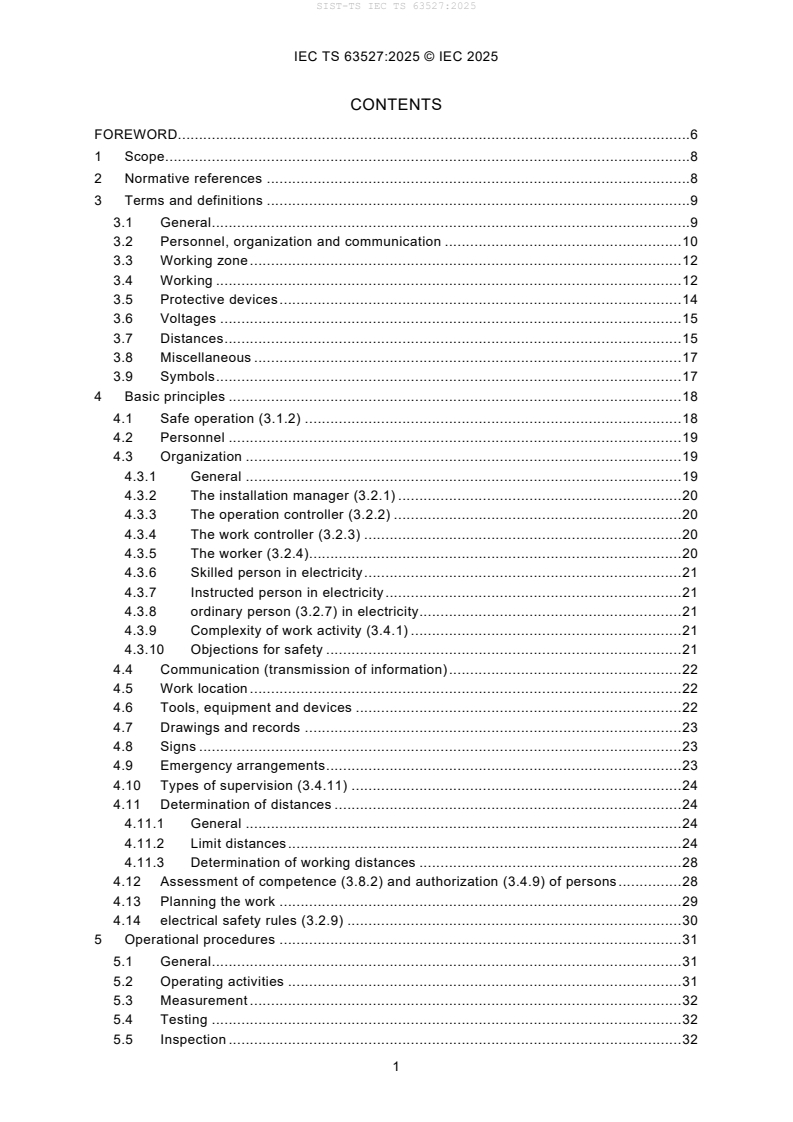
CONTENTS
FOREWORD. 6
1 Scope . 8
2 Normative references . 8
3 Terms and definitions . 9
3.1 General . 9
3.2 Personnel, organization and communication . 10
3.3 Working zone . 12
3.4 Working . 12
3.5 Protective devices . 14
3.6 Voltages . 15
3.7 Distances . 15
3.8 Miscellaneous . 17
3.9 Symbols . 17
4 Basic principles . 18
4.1 Safe operation (3.1.2) . 18
4.2 Personnel . 19
4.3 Organization . 19
4.3.1 General . 19
4.3.2 The installation manager (3.2.1) . 20
4.3.3 The operation controller (3.2.2) . 20
4.3.4 The work controller (3.2.3) . 20
4.3.5 The worker (3.2.4) . 20
4.3.6 Skilled person in electricity . 21
4.3.7 Instructed person in electricity . 21
4.3.8 ordinary person (3.2.7) in electricity . 21
4.3.9 Complexity of work activity (3.4.1) . 21
4.3.10 Objections for safety . 21
4.4 Communication (transmission of information) . 22
4.5 Work location . 22
4.6 Tools, equipment and devices . 22
4.7 Drawings and records . 23
4.8 Signs . 23
4.9 Emergency arrangements . 23
4.10 Types of supervision (3.4.11) . 24
4.11 Determination of distances . 24
4.11.1 General . 24
4.11.2 Limit distances . 24
4.11.3 Determination of working distances . 28
4.12 Assessment of competence (3.8.2) and authorization (3.4.9) of persons . 28
4.13 Planning the work . 29
4.14 electrical safety rules (3.2.9) . 30
5 Operational procedures . 31
5.1 General . 31
5.2 Operating activities . 31
5.3 Measurement . 32
5.4 Testing . 32
5.5 Inspection . 32
6 Working procedures . 33
6.1 General . 33
6.1.1 General requirements . 33
6.1.2 Specific requirements in case of induction . 35
6.1.3 Specific requirements according to weather conditions . 35
6.2 Dead working (3.4.8) . 35
6.2.1 General . 35
6.2.2 Disconnect completely . 36
6.2.3 Secure against re-connection . 36
6.2.4 Verify absence of operating voltage (3.6.4) . 36
6.2.5 Earthing and short-circuiting . 37
6.2.6 Protection against adjacent live parts . 39
6.2.7 permission to start work (3.4.10) . 39
6.2.8 Re-energizing after work . 39
6.3 Live working (3.4.4) . 39
6.3.1 General . 39
6.3.2 Training and qualification . 40
6.3.3 Maintenance of personnel ability . 40
6.3.4 Working methods . 40
6.3.5 Working instructions . 41
6.3.6 Tools, equipment and devices . 41
6.3.7 Environmental conditions . 41
6.3.8 Organization of work . 42
6.3.9 Specific requirements for extra-low voltage installations . 43
6.3.10 Specific requirements for low voltage installations . 43
6.3.11 Specific requirements for high voltage installations . 43
6.3.12 Specific works on live parts . 43
6.4 Working within the vicinity zone (3.4.5) . 43
6.4.1 General . 43
6.4.2 Protection by screen (3.5.1), barrier (3.5.2), enclosure (3.5.4) or
protective cover (3.5.3) . 44
6.4.3 Protection by safe distance and supervision (3.4.11) . 45
6.5 Working outside the vicinity zone (3.3.3) . 45
6.5.1 General . 45
6.5.2 Specific requirements for non-electrical work (3.4.3), e.g. construction
work, and electrical work (3.4.2) . 45
7 Maintenance procedures . 46
7.1 General . 46
7.2 Personnel . 47
7.3 Repair work . 47
7.4 Replacement work . 48
7.4.1 Replacement of fuses . 48
7.4.2 Replacement of lamps and accessories . 48
7.5 Temporary interruption of maintenance work . 48
7.6 End of maintenance work . 48
Annex A (informative) Guidance for distances in air for working procedures . 49
A.1 Limit distances . 49
A.2 Working distances . 49
A.2.1 General . 49
A.2.2 Determination of the distance value related to the voltage level . 49
A.2.3 Considerations of tools, devices or equipment . 49
A.2.4 Ergonomic considerations . 50
A.2.5 Working distance for live working . 50
A.2.6 Working distance for working within the vicinity zone . 51
A.2.7 Working distance for working outside the vicinity zone . 52
Annex B (informative) Additional information for safe working . 54
B.1 Example for responsibility levels . 54
B.1.1 General scheme . 54
B.1.2 Domestic . 54
B.1.3 Small company or craftsman . 55
B.1.4 Large or Industrial company . 55
B.2 Example of application of live working . 55
B.3 Atmospheric conditions that are part of environmental conditions to be
assessed . 55
B.3.1 Precipitation . 55
B.3.2 Thick fog . 55
B.3.3 Thunderstorms . 55
B.3.4 Violent wind . 56
B.3.5 Salt storms . 56
B.3.6 Extra low temperature . 56
B.4 Fire protection and fire fighting . 56
B.5 Work location presenting explosion risks . 56
B.6 Emergency arrangements . 57
Annex C (informative) Hazards of electricity . 58
C.1 Introduction . 58
C.2 Electric shock hazard . 59
C.3 Arc hazard . 60
C.3.1 General . 60
C.3.2 Hazards . 61
C.3.3 Arc flash risk assessment . 61
C.4 Electromagnetic fields . 62
Annex D (informative) Risk assessment. 63
D.1 General . 63
D.2 Principles of prevention . 64
D.3 Hierarchy of controls . 64
D.4 Categories of risk assessment . 65
D.4.1 General . 65
D.5 Design risk assessment . 65
D.5.1 General . 65
D.5.2 Electrical installation risk assessment . 65
D.5.3 Work plan risk assessment . 66
D.5.4 Work location risk assessment . 66
D.5.5 Work start risk assessment . 66
D.5.6 Specific risk assessment . 67
D.6 Risk assessment formats . 67
D.6.1 General . 67
D.6.2 As low as reasonably practicable (ALARP) . 67
D.6.3 Consequence/likelihood matrix (risk matrix or heat map) . 71
Annex E (informative) Safe system of work and safety documents . 72
E.1 Safe system of work . 72
E.2 Safety documents for dead working (3.4.8) (6.2) . 72
E.2.1 General . 72
E.2.2 Switching plan . 73
E.2.3 Request for dead working . 73
E.2.4 Authorization for dead working . 73
E.2.5 Definition of the work location . 74
E.2.6 Authorization for electrical test, measurement and verification . 74
E.2.7 Permission to start work . 75
E.2.8 Cancellation of permission to start work . 75
E.2.9 Notification of readiness to re-energize . 75
E.3 Safety documents for live working (3.4.4) (6.3) . 76
E.3.1 General . 76
E.3.2 Request for live working . 76
E.3.3 Authorization for live working . 77
E.3.4 Definition of work location . 77
E.3.5 Authorization for equipment used if required . 77
E.3.6 Permission to start work . 78
E.4 Safety documents for working within the vicinity zone (3.3.3) (sub-clause
6.4) . 78
E.4.1 General . 78
E.4.2 Switching plan (3.8.3) (if necessary) . 79
E.4.3 Request for working within the vicinity zone (3.3.3) . 80
E.4.4 Authorization for working within the vicinity zone (3.3.3) . 80
E.4.5 Definition of work location (3.3.1) . 80
E.4.6 Authorization for electrical test, measurement and verification (if
necessary) . 81
E.4.7 Permission to start work . 81
E.4.8 Notification of readiness to re-energize (if necessary) . 82
E.5 Safety documents for working outside the vicinity zone (6.5) . 82
Annex F (informative) Terms and definitions in alphabetic order . 83
F.1 General . 83
F.2 English . 83
F.3 French . 84
F.4 German . 86
Bibliography . 88
Figure 1 – Distances in air and zones . 25
Figure 2 – Example of eliminating limit zones by the use of an insulating protective
device . 26
Figure 3 – Example of eliminating limit zones by the use of a barrier (3.5.2) (insulating
or non-insulating) . 27
Figure 4 – Flowchart "planning working procedure" . 34
Figure A.1 – Example for determination of the minimum working distance for working
within the vicinity zone (3.4.5) . 52
Figure A.2 – Example for determination of the minimum working distance for working
outside the vicinity zone (3.3.3) . 53
Figure B.1 – Responsibility levels . 54
Figure C.1 – Time and current zones for effects of alternating and direct current
through human body . 60
Figure D.1 – Hierarchy of risk controls: the most efficient way is to remove the hazard,
and the least effective is using PPE . 64
Figure D.2 – A graphical tool for visualising the risk (3.1.3) . 68
Figure D.3 – Example of consequence/likelihood matrix (IEC 31010 [15]) . 71
Table 1 – Estimated values for distances D and D . 28
L V
Table C.1 – Summarized impacts of AC and DC current through human body (see
Figure C.1 . 60
Table D.1 – Risk classification for personal injuries . 68
Table D.2 – A matrix for assessing design risk with ALARP . 70
Table F.1 – Terms in English . 83
Table F.2 – Terms in French . 84
Table F.3 – Terms in German . 86
INTERNATIONAL ELECTROTECHNICAL COMMISSION
____________
Safe management and operation of electrical installations
FOREWORD
1) The International Electrotechnical Commission (IEC) is a worldwide organization for
standardization comprising all national electrotechnical committees (IEC National Committees).
The object of IEC is to promote international co-operation on all questions concerning
standardization in the electrical and electronic fields. To this end and in addition to other
activities, IEC publishes International Standards, Technical Specifications, Technical Reports,
Publicly Available Specifications (PAS) and Guides (hereafter referred to as “IEC
Publication(s)”). Their preparation is entrusted to technical committees; any IEC National
Committee interested in the subject dealt with may participate in this preparatory work.
International, governmental and non-governmental organizations liaising with the IEC also
participate in this preparation. IEC collaborates closely with the International Organization for
Standardization (ISO) in accordance with conditions determined by agreement between the two
organizations.
2) The formal decisions or agreements of IEC on technical matters express, as nearly as
possible, an international consensus of opinion on the relevant subjects since each technical
committee has representation from all interested IEC National Committees.
3) IEC Publications have the form of recommendations for international use and are accepted
by IEC National Committees in that sense. While all reasonable efforts are made to ensure that
the technical content of IEC Publications is accurate, IEC cannot be held responsible for the
way in which they are used or for any misinterpretation by any end user.
4) In order to promote international uniformity, IEC National Committees undertake to apply
IEC Publications transparently to the maximum extent possible in their national and regional
publications. Any divergence between any IEC Publication and the corresponding national or
regional publication shall be clearly indicated in the latter.
5) IEC itself does not provide any attestation of conformity. Independent certification bodies
provide conformity assessment services and, in some areas, access to IEC marks of conformity.
IEC is not responsible for any services carried out by independent certification bodies.
6) All users should ensure that they have the latest edition of this publication.
7) No liability shall attach to IEC or its directors, employees, servants or agents including
individual experts and members of its technical committees and IEC National Committees for
any personal injury, property damage or other damage of any nature whatsoever, whether direct
or indirect, or for costs (including legal fees) and expenses arising out of the publication, use
of, or reliance upon, this IEC Publication or any other IEC Publications.
8) Attention is drawn to the Normative references cited in this publication. Use of the referenced
publications is indispensable for the correct application of this publication.
9) IEC draws attention to the possibility that the implementation of this document may involve
the use of (a) patent(s). IEC takes no position concerning the evidence, validity or applicability
of any claimed patent rights in respect thereof. As of the date of publication of this document,
IEC [had/had not] received notice of (a) patent(s), which may be required to implement this
document. However, implementers are cautioned that this may not represent the latest
information, which may be obtained from the patent database available at https://patents.iec.ch.
IEC shall not be held responsible for identifying any or all such patent rights.
IEC TS 63527 has been prepared by IEC project committee 128: Operation of electrical
installations. It is a Technical Specification.
The text of this Technical Specification is based on the following documents:
Draft Report on voting
128/59/DTS 128/60/RVDTS
Full information on the voting for its approval can be found in the report on voting indicated in
the above table.
The language used for the development of this Technical Specification is English.
This document was drafted in accordance with ISO/IEC Directives, Part 2, and developed in
accordance with ISO/IEC Directives, Part 1 and ISO/IEC Directives, IEC Supplement, available
at www.iec.ch/members_experts/refdocs. The main document types developed by IEC are
described in greater detail at www.iec.ch/publications.
The committee has decided that the contents of this document will remain unchanged until the
stability date indicated on the IEC website under webstore.iec.ch in the data related to the
specific document. At this date, the document will be
– reconfirmed,
– withdrawn, or
– revised.
1 Scope
This document is applicable to the safe management and operation (3.1.2) of and work activity
(3.4.1) on, with, or near electrical installations operating at voltage levels from, and including,
extra-low voltage up to and including high voltage.
This latter term includes those levels commonly referred to as medium and extra-high voltage.
These electrical installations are designed for the generation, transmission, conversion,
distribution and use of electrical power. Some of these electrical installations are permanent
and fixed, such as a distribution installation in a factory or office complex. Others are temporary,
such as on construction sites, and some are mobile or capable of being moved either whilst
energized or whilst not energized nor charged, examples are electrically driven excavating
machines in quarries or open-cast coal sites.
This document sets out the requirements for the safe management and operation (3.1.2) of and
work activity (3.4.1) on, with, or near these electrical installations. The requirements apply to
all operational, working and maintenance procedures. They apply to all non-electrical work
(3.4.3) such as building work near to overhead lines or underground cables as well as electrical
work (3.4.2), when there is a risk (3.1.3) of electrical danger (3.1.5).
This document does not apply to ordinary persons (3.2.7) when using installations and
equipment, provided that the installations and equipment comply with relevant standards and
are designed and installed for use by ordinary persons (3.2.7).
This document has not been developed specifically to apply to the electrical installations listed
below. However, if there are no other rules or procedures, the principles of this document could
be applied to them:
– on any aircraft and hovercraft moving under its own power, (international aviation laws can
apply);
– on any sea going ship moving under its own power, or under the direction of the master,
(international marine laws can apply);
– electronic telecommunications and information systems;
– electronic instrumentation, control and automation systems;
– at coal or other mines;
– on off-shore installations (international marine laws can apply);
– on vehicles;
– on electric traction systems;
– on experimental electrical research work.
2 Normative references
The following documents are referred to in the text in such a way that some or all of their content
constitutes requirements of this document. For dated references, only the edition cited applies.
For undated references, the latest edition of the referenced document (including any
amendments) applies.
IEC 60050-195:2021, International Electrotechnical Vocabulary (IEV) - Part 195: Earthing and
protection against electric shock
IEC 60364-1, Low-voltage electrical installations - Part 1: Fundamental principles, assessment
of general characteristics, definitions
IEC 60364-4-41, Low-voltage electrical installations - Part 4-41: Protection for safety -
Protection against electric shock
IEC 60364-5-51, Electrical installations of buildings - Part 5-51: Selection and erection of
electrical equipment - Common rules
IEC 61219, Live working - Earthing or earthing and short-circuiting equipment using lances as
a short-circuiting device - Lance earthing
IEC 61230, Live working - Portable equipment for earthing or earthing and short-circuiting
IEC 61243-1, Live working - Voltage detectors - Part 1: Capacitive type to be used for voltages
exceeding 1 kV AC
IEC 61243-2, Live working - Voltage detectors - Part 2: Resistive type to be used for voltages
of 1 kV to 36 kV a.c.
IEC 61243-3, Live working - Voltage detectors - Part 3: Two-pole low-voltage type
IEC 61243-5, Live working - Voltage detectors - Part 5: Voltage detecting systems (VDS)
IEC 61472:2013, Live working - Minimum approach distances for a.c. systems in the voltage
range 72,5 kV to 800 kV - A method of calculation
IEC 61472-2:2021, Live working - Minimum approach distances - Part 2: Method of
determination of the electrical component distance for AC systems from 1,0 kV to 72,5 kV
IEC 61936-1, Power installations exceeding 1 kV AC and 1,5 kV DC - Part 1: AC
IEC 61936-1:2021, Power installations exceeding 1 kV AC and 1,5 kV DC - Part 1: AC
IEC 62271-1, High-voltage switchgear and controlgear - Part 1: Common specifications for
alternating current switchgear and controlgear
IEC 62271-102, High-voltage switchgear and controlgear - Part 102: Alternating current
disconnectors and earthing switches
IEC 62271-213, High-voltage switchgear and controlgear - Part 213: Voltage detecting and
indicating system
3 Terms and definitions
For the purposes of this document, the following terms and definitions apply.
ISO and IEC maintain terminology databases for use in standardization at the following
addresses:
– IEC Electropedia: available at https://www.electropedia.org/
– ISO Online browsing platform: available at https://www.iso.org/obp
3.1 General
3.1.1
electrical installation
assembly of electrical equipment which is used for the generation, transmission, conversion,
distribution and use of electrical energy
Note 1 to entry: The electrical installation (3.1.1) includes energy sources such as batteries, capacitors and all
other sources of stored electric energy.
[SOURCE: IEC 60050-651:2014 [1], 651-26-01, modified – Note 2 to entry was removed.]
3.1.2
operation
combination of activities including work activities necessary to permit an electrical installation
(3.1.1) to function
Note 1 to entry: The operation (3.1.2) includes such matters as switching, controlling, monitoring, verification of the
electrical installation (3.1.1), inspection and maintenance as well as both electrical work (3.4.2) and non-electrical
work (3.4.3).
[SOURCE: IEC 60050-651:2014 [1], 651-26-02 modified, the term “verification of the electrical
installation” was added in Note 1 to entry , Note 2 to entry was removed.]
3.1.3
risk
combination of the probability of occurrence of harm and the severity of that harm
Note 1 to entry: The term “harm” in this context relates to damage to either persons and/or electrical installations.
[SOURCE: IEC 60050-351:2013 [2], 351-57-03 modified, Note 1 to entry was added.]
3.1.4
electrical hazard
potential source of harm when electric energy is present in an electrical installation (3.1.1)
Note 1 to entry: The term “harm” in this context relates to damage to either persons and/or electrical installations.
Note 2 to entry: This entry was numbered 651-01-30 in IEC 60050-651:2014 [1]. It has been modified to follow the
new translation of ISO/IEC Guide 51 and to precise the term “harm”.
[SOURCE: IEC 60050-651:2014 [1], 651-26-05]
3.1.5
electrical danger
risk (3.1.3) of electrical injury when electrical energy is present in an electrical installation
(3.1.1)
[SOURCE: IEC 60050-651:2014 [1], 651-26-07]
3.2 Personnel, organization and communication
3.2.1
installation manager
IM
designated person with the overall responsibility to ensure the safe operation (3.1.2) of the
electrical installation (3.1.1) by setting rules and organization or framework
Note 1 to entry: This person can be the owner, employer, proprietor or a delegated person or legal entity
represented by a natural person.
Note 2 to entry: Some of these duties can be delegated to others as required. For large or complex electrical
installations or networks, the duties can be delegated for parts of the installations or the network (see 4.3).
Note 3 to entry: See Figure B.1, classification a).
3.2.2
operation controller
OC
designated person who is responsible during work activities for the safe operation (3.1.2) of the
electrical installation (3.1.1)
Note 1 to entry: This person has to judge the possible effects of the work activities on the electrical installation
(3.1.1) or parts of it which are under their responsibility and the effects of the electrical installation (3.1.1) on persons
carrying out the work activities. Some of these duties can be delegated to others as required (see 4.3).
Note 2 to entry: See Figure B.1, classification b).
3.2.3
work controller
WC
designated person with direct management responsibility for the work activity (3.4.1) at work
location (3.3.1)
Note 1 to entry: Parts of this responsibility can be delegated to others as required.
Note 2 to entry: See Figure B.1, classification c).
3.2.4
worker
W
person carrying out work activities
Note 1 to entry: See Figure B.1, classification d).
3.2.5
skilled person
qualified person (US)
person with relevant education, knowledge and experience to enable them to
analyse risks and to avoid hazards which electricity can create
[SOURCE: IEC 60050-651:2014 [1], 651-26-11 modified, the term "training" was
deleted,"perceive" was replaced by "analyse"; "danger" was replaced by "hazard", Note 1 to
entry was removed.]
3.2.6
instructed person
trained person (US)
person adequately advised by a skilled person (3.2.5) to enable them to perceive
risks as instructed and to avoid hazards which electricity can create
[SOURCE: IEC 60050-651:2014 [1] 651-26-12 modified, the term "supervised" was deleted,
"electrically" was deleted "danger" was replaced by "hazard" and added "as instructed."]
3.2.7
ordinary person
person who is neither a skilled person (3.2.5) nor an instructed person (3.2.6)
[SOURCE: IEC 60050-195:2021 [3], 195-04-03]
3.2.8
notification
message or instruction which is either verbal or in writing associated with operation (3.1.2) of
any electrical installation (3.1.1)
3.2.9
electrical safety rules
set of rules and associated procedures and forms used by the installation manager (3.2.1) to
ensure the safe operation (3.1.2) of the electrical installation (3.1.1)
3.3 Working zone
3.3.1
work location
site, place or area where a work activity (3.4.1) is to be, is being, or has been carried out
[SOURCE: IEC 60050-651:2014 [1], 651-26-03, modified – Note 1 to entry was removed.]
3.3.2
live working zone
space around live (3.4.14) parts in which the insulation level to prevent electrical danger (3.1.5)
is not assured when reaching into or entering it without protective measures
Note 1 to entry: The outer limit of the live working zone (3.3.2) is denoted as the distance D (see Figure 1, Figure
L
2 and Figure 3).
3.3.3
vicinity zone
limited space outside the live working zone (3.3.2)
Note 1 to entry: The outer limit of the vicinity zone (3.3.3) is denoted as the distance D (see Figure 1, Figure 2
V
and Figure 3).
Note 2 to entry: In this zone, specific precautions are taken to avoid encroaching into the live working zone (3.3.2).
3.4 Working
3.4.1
work activity
form of electrical work (3.4.2) or non-electrical work (3.4.3) where there is the possibility of an
electrical hazard (3.1.4)
3.4.2
electrical work
work on, with or near an electrical installation (3.1.1) such as testing and measurement,
repairing, replacing, modifying, extending, erecting, maintaining and inspecting
[SOURCE: IEC 60050-651:2014 [1], 651-26-04, modified - The definition was reworded by
combining the definition and the Note 1 to entry. Note 2 to entry and Note 3 to entry were
removed.]
3.4.3
non-electrical work
work near to an electrical installation (3.1.1) such as construction, excavation, cleaning,
painting, etc.
3.4.4
live working
work in which a worker (3.2.4) deliberately makes contact with live (3.4.14) parts or reaches
into the live working zone (3.3.2) with either parts of their body or with tools, equipment or
devices being handled
Note 1 to entry: At low voltage, live working (3.4.4) is carried out by the worker (3.2.4), when making contact with
bare live (3.4.14) parts. At high voltage, live working (3.4.4) is carried out by the worker (3.2.4), when entering the
live working zone (3.3.2), regardless of whether contact is made with bare live (3.4.14) parts or not.
[SOURCE: IEC 60050-651:2014 [1], 651-21-01, modified - The definition was reworded; the
three Notes to entry have been replaced by a new Note 1 to entry .]
3.4.5
working within the vicinity zone
work activity (3.4.1) in which a worker (3.2.4) with part of their body, with a tool or with any
other object enters into the vicinity zone (3.3.3) without encroaching into the live working zone
(3.3.2)
3.4.6
isolate
disconnect completely a device or an electric circuit from other devices or electric circuits
[SOURCE: IEC 60050-151:2001 [4], 151-15-37]
3.4.7
dead
qualifies a conductive part when it is not energized
Note 1 to entry: The part is considered dead (3.4.7) if it is isolated (3.4.6) in accordance with 6.2.
[SOURCE: IEC 60050-151:2001 [4], 151-15-59, modified – Note 1 to entry was added.]
3.4.8
dead working
work activity (3.4.1) on electrical installations (3.1.1) which are neither live (3.4.14) nor charged,
carried out after having taken all measures to prevent electrical danger (3.1.5)
3.4.9
authorization
formal approval to perform specific roles, operations and tasks
Note 1 to entry: See 4.12.
3.4.10
permission to start work
direct instruction to the workers (3.2.4) at work location (3.3.1) to commence work after all
safety measures are taken
3.4.11
supervision
task to apply electrical safety control to the work activity (3.4.1)
3.4.12
management instruction
written instruction giving effect to additional arrangements approved by the installation manager
to account for situations in excepti
...
IEC TS 63527 ®
Edition 1.0 2025-08
TECHNICAL
SPECIFICATION
Safe management and operation of electrical installations
ICS 29.260.10; 91.140.01 ISBN 978-2-8327-0634-3
All rights reserved. Unless otherwise specified, no part of this publication may be reproduced or utilized in any form or
by any means, electronic or mechanical, including photocopying and microfilm, without permission in writing from either
IEC or IEC's member National Committee in the country of the requester. If you have any questions about IEC copyright
or have an enquiry about obtaining additional rights to this publication, please contact the address below or your local
IEC member National Committee for further information.
IEC Secretariat Tel.: +41 22 919 02 11
3, rue de Varembé info@iec.ch
CH-1211 Geneva 20 www.iec.ch
Switzerland
About the IEC
The International Electrotechnical Commission (IEC) is the leading global organization that prepares and publishes
International Standards for all electrical, electronic and related technologies.
About IEC publications
The technical content of IEC publications is kept under constant review by the IEC. Please make sure that you have the
latest edition, a corrigendum or an amendment might have been published.
IEC publications search - IEC Products & Services Portal - products.iec.ch
webstore.iec.ch/advsearchform Discover our powerful search engine and read freely all the
publications previews, graphical symbols and the glossary.
The advanced search enables to find IEC publications by a
variety of criteria (reference number, text, technical With a subscription you will always have access to up to date
committee, …). It also gives information on projects, content tailored to your needs.
replaced and withdrawn publications.
Electropedia - www.electropedia.org
The world's leading online dictionary on electrotechnology,
IEC Just Published - webstore.iec.ch/justpublished
Stay up to date on all new IEC publications. Just Published containing more than 22 500 terminological entries in English
details all new publications released. Available online and and French, with equivalent terms in 25 additional languages.
once a month by email. Also known as the International Electrotechnical Vocabulary
(IEV) online.
IEC Customer Service Centre - webstore.iec.ch/csc
If you wish to give us your feedback on this publication or
need further assistance, please contact the Customer
Service Centre: sales@iec.ch.
CONTENTS
FOREWORD. 6
1 Scope . 8
2 Normative references . 8
3 Terms and definitions . 9
3.1 General . 9
3.2 Personnel, organization and communication . 10
3.3 Working zone . 12
3.4 Working . 12
3.5 Protective devices . 14
3.6 Voltages . 15
3.7 Distances . 15
3.8 Miscellaneous . 17
3.9 Symbols . 17
4 Basic principles . 18
4.1 Safe operation (3.1.2) . 18
4.2 Personnel . 19
4.3 Organization . 19
4.3.1 General . 19
4.3.2 The installation manager (3.2.1) . 20
4.3.3 The operation controller (3.2.2) . 20
4.3.4 The work controller (3.2.3) . 20
4.3.5 The worker (3.2.4) . 20
4.3.6 Skilled person in electricity . 21
4.3.7 Instructed person in electricity . 21
4.3.8 ordinary person (3.2.7) in electricity . 21
4.3.9 Complexity of work activity (3.4.1) . 21
4.3.10 Objections for safety . 21
4.4 Communication (transmission of information) . 22
4.5 Work location . 22
4.6 Tools, equipment and devices . 22
4.7 Drawings and records . 23
4.8 Signs . 23
4.9 Emergency arrangements . 23
4.10 Types of supervision (3.4.11) . 24
4.11 Determination of distances . 24
4.11.1 General . 24
4.11.2 Limit distances . 24
4.11.3 Determination of working distances . 28
4.12 Assessment of competence (3.8.2) and authorization (3.4.9) of persons . 28
4.13 Planning the work . 29
4.14 electrical safety rules (3.2.9) . 30
5 Operational procedures . 31
5.1 General . 31
5.2 Operating activities . 31
5.3 Measurement . 32
5.4 Testing . 32
5.5 Inspection . 32
6 Working procedures . 33
6.1 General . 33
6.1.1 General requirements . 33
6.1.2 Specific requirements in case of induction . 35
6.1.3 Specific requirements according to weather conditions . 35
6.2 Dead working (3.4.8) . 35
6.2.1 General . 35
6.2.2 Disconnect completely . 36
6.2.3 Secure against re-connection . 36
6.2.4 Verify absence of operating voltage (3.6.4) . 36
6.2.5 Earthing and short-circuiting . 37
6.2.6 Protection against adjacent live parts . 39
6.2.7 permission to start work (3.4.10) . 39
6.2.8 Re-energizing after work . 39
6.3 Live working (3.4.4) . 39
6.3.1 General . 39
6.3.2 Training and qualification . 40
6.3.3 Maintenance of personnel ability . 40
6.3.4 Working methods . 40
6.3.5 Working instructions . 41
6.3.6 Tools, equipment and devices . 41
6.3.7 Environmental conditions . 41
6.3.8 Organization of work . 42
6.3.9 Specific requirements for extra-low voltage installations . 43
6.3.10 Specific requirements for low voltage installations . 43
6.3.11 Specific requirements for high voltage installations . 43
6.3.12 Specific works on live parts . 43
6.4 Working within the vicinity zone (3.4.5) . 43
6.4.1 General . 43
6.4.2 Protection by screen (3.5.1), barrier (3.5.2), enclosure (3.5.4) or
protective cover (3.5.3) . 44
6.4.3 Protection by safe distance and supervision (3.4.11) . 45
6.5 Working outside the vicinity zone (3.3.3) . 45
6.5.1 General . 45
6.5.2 Specific requirements for non-electrical work (3.4.3), e.g. construction
work, and electrical work (3.4.2) . 45
7 Maintenance procedures . 46
7.1 General . 46
7.2 Personnel . 47
7.3 Repair work . 47
7.4 Replacement work . 48
7.4.1 Replacement of fuses . 48
7.4.2 Replacement of lamps and accessories . 48
7.5 Temporary interruption of maintenance work . 48
7.6 End of maintenance work . 48
Annex A (informative) Guidance for distances in air for working procedures . 49
A.1 Limit distances . 49
A.2 Working distances . 49
A.2.1 General . 49
A.2.2 Determination of the distance value related to the voltage level . 49
A.2.3 Considerations of tools, devices or equipment . 49
A.2.4 Ergonomic considerations . 50
A.2.5 Working distance for live working . 50
A.2.6 Working distance for working within the vicinity zone . 51
A.2.7 Working distance for working outside the vicinity zone . 52
Annex B (informative) Additional information for safe working . 54
B.1 Example for responsibility levels . 54
B.1.1 General scheme . 54
B.1.2 Domestic . 54
B.1.3 Small company or craftsman . 55
B.1.4 Large or Industrial company . 55
B.2 Example of application of live working . 55
B.3 Atmospheric conditions that are part of environmental conditions to be
assessed . 55
B.3.1 Precipitation . 55
B.3.2 Thick fog . 55
B.3.3 Thunderstorms . 55
B.3.4 Violent wind . 56
B.3.5 Salt storms . 56
B.3.6 Extra low temperature . 56
B.4 Fire protection and fire fighting . 56
B.5 Work location presenting explosion risks . 56
B.6 Emergency arrangements . 57
Annex C (informative) Hazards of electricity . 58
C.1 Introduction . 58
C.2 Electric shock hazard . 59
C.3 Arc hazard . 60
C.3.1 General . 60
C.3.2 Hazards . 61
C.3.3 Arc flash risk assessment . 61
C.4 Electromagnetic fields . 62
Annex D (informative) Risk assessment. 63
D.1 General . 63
D.2 Principles of prevention . 64
D.3 Hierarchy of controls . 64
D.4 Categories of risk assessment . 65
D.4.1 General . 65
D.5 Design risk assessment . 65
D.5.1 General . 65
D.5.2 Electrical installation risk assessment . 65
D.5.3 Work plan risk assessment . 66
D.5.4 Work location risk assessment . 66
D.5.5 Work start risk assessment . 66
D.5.6 Specific risk assessment . 67
D.6 Risk assessment formats . 67
D.6.1 General . 67
D.6.2 As low as reasonably practicable (ALARP) . 67
D.6.3 Consequence/likelihood matrix (risk matrix or heat map) . 71
Annex E (informative) Safe system of work and safety documents . 72
E.1 Safe system of work . 72
E.2 Safety documents for dead working (3.4.8) (6.2) . 72
E.2.1 General . 72
E.2.2 Switching plan . 73
E.2.3 Request for dead working . 73
E.2.4 Authorization for dead working . 73
E.2.5 Definition of the work location . 74
E.2.6 Authorization for electrical test, measurement and verification . 74
E.2.7 Permission to start work . 75
E.2.8 Cancellation of permission to start work . 75
E.2.9 Notification of readiness to re-energize . 75
E.3 Safety documents for live working (3.4.4) (6.3) . 76
E.3.1 General . 76
E.3.2 Request for live working . 76
E.3.3 Authorization for live working . 77
E.3.4 Definition of work location . 77
E.3.5 Authorization for equipment used if required . 77
E.3.6 Permission to start work . 78
E.4 Safety documents for working within the vicinity zone (3.3.3) (sub-clause
6.4) . 78
E.4.1 General . 78
E.4.2 Switching plan (3.8.3) (if necessary) . 79
E.4.3 Request for working within the vicinity zone (3.3.3) . 80
E.4.4 Authorization for working within the vicinity zone (3.3.3) . 80
E.4.5 Definition of work location (3.3.1) . 80
E.4.6 Authorization for electrical test, measurement and verification (if
necessary) . 81
E.4.7 Permission to start work . 81
E.4.8 Notification of readiness to re-energize (if necessary) . 82
E.5 Safety documents for working outside the vicinity zone (6.5) . 82
Annex F (informative) Terms and definitions in alphabetic order . 83
F.1 General . 83
F.2 English . 83
F.3 French . 84
F.4 German . 86
Bibliography . 88
Figure 1 – Distances in air and zones . 25
Figure 2 – Example of eliminating limit zones by the use of an insulating protective
device . 26
Figure 3 – Example of eliminating limit zones by the use of a barrier (3.5.2) (insulating
or non-insulating) . 27
Figure 4 – Flowchart "planning working procedure" . 34
Figure A.1 – Example for determination of the minimum working distance for working
within the vicinity zone (3.4.5) . 52
Figure A.2 – Example for determination of the minimum working distance for working
outside the vicinity zone (3.3.3) . 53
Figure B.1 – Responsibility levels . 54
Figure C.1 – Time and current zones for effects of alternating and direct current
through human body . 60
Figure D.1 – Hierarchy of risk controls: the most efficient way is to remove the hazard,
and the least effective is using PPE . 64
Figure D.2 – A graphical tool for visualising the risk (3.1.3) . 68
Figure D.3 – Example of consequence/likelihood matrix (IEC 31010 [15]) . 71
Table 1 – Estimated values for distances D and D . 28
L V
Table C.1 – Summarized impacts of AC and DC current through human body (see
Figure C.1 . 60
Table D.1 – Risk classification for personal injuries . 68
Table D.2 – A matrix for assessing design risk with ALARP . 70
Table F.1 – Terms in English . 83
Table F.2 – Terms in French . 84
Table F.3 – Terms in German . 86
INTERNATIONAL ELECTROTECHNICAL COMMISSION
____________
Safe management and operation of electrical installations
FOREWORD
1) The International Electrotechnical Commission (IEC) is a worldwide organization for
standardization comprising all national electrotechnical committees (IEC National Committees).
The object of IEC is to promote international co-operation on all questions concerning
standardization in the electrical and electronic fields. To this end and in addition to other
activities, IEC publishes International Standards, Technical Specifications, Technical Reports,
Publicly Available Specifications (PAS) and Guides (hereafter referred to as “IEC
Publication(s)”). Their preparation is entrusted to technical committees; any IEC National
Committee interested in the subject dealt with may participate in this preparatory work.
International, governmental and non-governmental organizations liaising with the IEC also
participate in this preparation. IEC collaborates closely with the International Organization for
Standardization (ISO) in accordance with conditions determined by agreement between the two
organizations.
2) The formal decisions or agreements of IEC on technical matters express, as nearly as
possible, an international consensus of opinion on the relevant subjects since each technical
committee has representation from all interested IEC National Committees.
3) IEC Publications have the form of recommendations for international use and are accepted
by IEC National Committees in that sense. While all reasonable efforts are made to ensure that
the technical content of IEC Publications is accurate, IEC cannot be held responsible for the
way in which they are used or for any misinterpretation by any end user.
4) In order to promote international uniformity, IEC National Committees undertake to apply
IEC Publications transparently to the maximum extent possible in their national and regional
publications. Any divergence between any IEC Publication and the corresponding national or
regional publication shall be clearly indicated in the latter.
5) IEC itself does not provide any attestation of conformity. Independent certification bodies
provide conformity assessment services and, in some areas, access to IEC marks of conformity.
IEC is not responsible for any services carried out by independent certification bodies.
6) All users should ensure that they have the latest edition of this publication.
7) No liability shall attach to IEC or its directors, employees, servants or agents including
individual experts and members of its technical committees and IEC National Committees for
any personal injury, property damage or other damage of any nature whatsoever, whether direct
or indirect, or for costs (including legal fees) and expenses arising out of the publication, use
of, or reliance upon, this IEC Publication or any other IEC Publications.
8) Attention is drawn to the Normative references cited in this publication. Use of the referenced
publications is indispensable for the correct application of this publication.
9) IEC draws attention to the possibility that the implementation of this document may involve
the use of (a) patent(s). IEC takes no position concerning the evidence, validity or applicability
of any claimed patent rights in respect thereof. As of the date of publication of this document,
IEC [had/had not] received notice of (a) patent(s), which may be required to implement this
document. However, implementers are cautioned that this may not represent the latest
information, which may be obtained from the patent database available at https://patents.iec.ch.
IEC shall not be held responsible for identifying any or all such patent rights.
IEC TS 63527 has been prepared by IEC project committee 128: Operation of electrical
installations. It is a Technical Specification.
The text of this Technical Specification is based on the following documents:
Draft Report on voting
128/59/DTS 128/60/RVDTS
Full information on the voting for its approval can be found in the report on voting indicated in
the above table.
The language used for the development of this Technical Specification is English.
This document was drafted in accordance with ISO/IEC Directives, Part 2, and developed in
accordance with ISO/IEC Directives, Part 1 and ISO/IEC Directives, IEC Supplement, available
at www.iec.ch/members_experts/refdocs. The main document types developed by IEC are
described in greater detail at www.iec.ch/publications.
The committee has decided that the contents of this document will remain unchanged until the
stability date indicated on the IEC website under webstore.iec.ch in the data related to the
specific document. At this date, the document will be
– reconfirmed,
– withdrawn, or
– revised.
1 Scope
This document is applicable to the safe management and operation (3.1.2) of and work activity
(3.4.1) on, with, or near electrical installations operating at voltage levels from, and including,
extra-low voltage up to and including high voltage.
This latter term includes those levels commonly referred to as medium and extra-high voltage.
These electrical installations are designed for the generation, transmission, conversion,
distribution and use of electrical power. Some of these electrical installations are permanent
and fixed, such as a distribution installation in a factory or office complex. Others are temporary,
such as on construction sites, and some are mobile or capable of being moved either whilst
energized or whilst not energized nor charged, examples are electrically driven excavating
machines in quarries or open-cast coal sites.
This document sets out the requirements for the safe management and operation (3.1.2) of and
work activity (3.4.1) on, with, or near these electrical installations. The requirements apply to
all operational, working and maintenance procedures. They apply to all non-electrical work
(3.4.3) such as building work near to overhead lines or underground cables as well as electrical
work (3.4.2), when there is a risk (3.1.3) of electrical danger (3.1.5).
This document does not apply to ordinary persons (3.2.7) when using installations and
equipment, provided that the installations and equipment comply with relevant standards and
are designed and installed for use by ordinary persons (3.2.7).
This document has not been developed specifically to apply to the electrical installations listed
below. However, if there are no other rules or procedures, the principles of this document could
be applied to them:
– on any aircraft and hovercraft moving under its own power, (international aviation laws can
apply);
– on any sea going ship moving under its own power, or under the direction of the master,
(international marine laws can apply);
– electronic telecommunications and information systems;
– electronic instrumentation, control and automation systems;
– at coal or other mines;
– on off-shore installations (international marine laws can apply);
– on vehicles;
– on electric traction systems;
– on experimental electrical research work.
2 Normative references
The following documents are referred to in the text in such a way that some or all of their content
constitutes requirements of this document. For dated references, only the edition cited applies.
For undated references, the latest edition of the referenced document (including any
amendments) applies.
IEC 60050-195:2021, International Electrotechnical Vocabulary (IEV) - Part 195: Earthing and
protection against electric shock
IEC 60364-1, Low-voltage electrical installations - Part 1: Fundamental principles, assessment
of general characteristics, definitions
IEC 60364-4-41, Low-voltage electrical installations - Part 4-41: Protection for safety -
Protection against electric shock
IEC 60364-5-51, Electrical installations of buildings - Part 5-51: Selection and erection of
electrical equipment - Common rules
IEC 61219, Live working - Earthing or earthing and short-circuiting equipment using lances as
a short-circuiting device - Lance earthing
IEC 61230, Live working - Portable equipment for earthing or earthing and short-circuiting
IEC 61243-1, Live working - Voltage detectors - Part 1: Capacitive type to be used for voltages
exceeding 1 kV AC
IEC 61243-2, Live working - Voltage detectors - Part 2: Resistive type to be used for voltages
of 1 kV to 36 kV a.c.
IEC 61243-3, Live working - Voltage detectors - Part 3: Two-pole low-voltage type
IEC 61243-5, Live working - Voltage detectors - Part 5: Voltage detecting systems (VDS)
IEC 61472:2013, Live working - Minimum approach distances for a.c. systems in the voltage
range 72,5 kV to 800 kV - A method of calculation
IEC 61472-2:2021, Live working - Minimum approach distances - Part 2: Method of
determination of the electrical component distance for AC systems from 1,0 kV to 72,5 kV
IEC 61936-1, Power installations exceeding 1 kV AC and 1,5 kV DC - Part 1: AC
IEC 61936-1:2021, Power installations exceeding 1 kV AC and 1,5 kV DC - Part 1: AC
IEC 62271-1, High-voltage switchgear and controlgear - Part 1: Common specifications for
alternating current switchgear and controlgear
IEC 62271-102, High-voltage switchgear and controlgear - Part 102: Alternating current
disconnectors and earthing switches
IEC 62271-213, High-voltage switchgear and controlgear - Part 213: Voltage detecting and
indicating system
3 Terms and definitions
For the purposes of this document, the following terms and definitions apply.
ISO and IEC maintain terminology databases for use in standardization at the following
addresses:
– IEC Electropedia: available at https://www.electropedia.org/
– ISO Online browsing platform: available at https://www.iso.org/obp
3.1 General
3.1.1
electrical installation
assembly of electrical equipment which is used for the generation, transmission, conversion,
distribution and use of electrical energy
Note 1 to entry: The electrical installation (3.1.1) includes energy sources such as batteries, capacitors and all
other sources of stored electric energy.
[SOURCE: IEC 60050-651:2014 [1], 651-26-01, modified – Note 2 to entry was removed.]
3.1.2
operation
combination of activities including work activities necessary to permit an electrical installation
(3.1.1) to function
Note 1 to entry: The operation (3.1.2) includes such matters as switching, controlling, monitoring, verification of the
electrical installation (3.1.1), inspection and maintenance as well as both electrical work (3.4.2) and non-electrical
work (3.4.3).
[SOURCE: IEC 60050-651:2014 [1], 651-26-02 modified, the term “verification of the electrical
installation” was added in Note 1 to entry , Note 2 to entry was removed.]
3.1.3
risk
combination of the probability of occurrence of harm and the severity of that harm
Note 1 to entry: The term “harm” in this context relates to damage to either persons and/or electrical installations.
[SOURCE: IEC 60050-351:2013 [2], 351-57-03 modified, Note 1 to entry was added.]
3.1.4
electrical hazard
potential source of harm when electric energy is present in an electrical installation (3.1.1)
Note 1 to entry: The term “harm” in this context relates to damage to either persons and/or electrical installations.
Note 2 to entry: This entry was numbered 651-01-30 in IEC 60050-651:2014 [1]. It has been modified to follow the
new translation of ISO/IEC Guide 51 and to precise the term “harm”.
[SOURCE: IEC 60050-651:2014 [1], 651-26-05]
3.1.5
electrical danger
risk (3.1.3) of electrical injury when electrical energy is present in an electrical installation
(3.1.1)
[SOURCE: IEC 60050-651:2014 [1], 651-26-07]
3.2 Personnel, organization and communication
3.2.1
installation manager
IM
designated person with the overall responsibility to ensure the safe operation (3.1.2) of the
electrical installation (3.1.1) by setting rules and organization or framework
Note 1 to entry: This person can be the owner, employer, proprietor or a delegated person or legal entity
represented by a natural person.
Note 2 to entry: Some of these duties can be delegated to others as required. For large or complex electrical
installations or networks, the duties can be delegated for parts of the installations or the network (see 4.3).
Note 3 to entry: See Figure B.1, classification a).
3.2.2
operation controller
OC
designated person who is responsible during work activities for the safe operation (3.1.2) of the
electrical installation (3.1.1)
Note 1 to entry: This person has to judge the possible effects of the work activities on the electrical installation
(3.1.1) or parts of it which are under their responsibility and the effects of the electrical installation (3.1.1) on persons
carrying out the work activities. Some of these duties can be delegated to others as required (see 4.3).
Note 2 to entry: See Figure B.1, classification b).
3.2.3
work controller
WC
designated person with direct management responsibility for the work activity (3.4.1) at work
location (3.3.1)
Note 1 to entry: Parts of this responsibility can be delegated to others as required.
Note 2 to entry: See Figure B.1, classification c).
3.2.4
worker
W
person carrying out work activities
Note 1 to entry: See Figure B.1, classification d).
3.2.5
skilled person
qualified person (US)
person with relevant education, knowledge and experience to enable them to
analyse risks and to avoid hazards which electricity can create
[SOURCE: IEC 60050-651:2014 [1], 651-26-11 modified, the term "training" was
deleted,"perceive" was replaced by "analyse"; "danger" was replaced by "hazard", Note 1 to
entry was removed.]
3.2.6
instructed person
trained person (US)
person adequately advised by a skilled person (3.2.5) to enable them to perceive
risks as instructed and to avoid hazards which electricity can create
[SOURCE: IEC 60050-651:2014 [1] 651-26-12 modified, the term "supervised" was deleted,
"electrically" was deleted "danger" was replaced by "hazard" and added "as instructed."]
3.2.7
ordinary person
person who is neither a skilled person (3.2.5) nor an instructed person (3.2.6)
[SOURCE: IEC 60050-195:2021 [3], 195-04-03]
3.2.8
notification
message or instruction which is either verbal or in writing associated with operation (3.1.2) of
any electrical installation (3.1.1)
3.2.9
electrical safety rules
set of rules and associated procedures and forms used by the installation manager (3.2.1) to
ensure the safe operation (3.1.2) of the electrical installation (3.1.1)
3.3 Working zone
3.3.1
work location
site, place or area where a work activity (3.4.1) is to be, is being, or has been carried out
[SOURCE: IEC 60050-651:2014 [1], 651-26-03, modified – Note 1 to entry was removed.]
3.3.2
live working zone
space around live (3.4.14) parts in which the insulation level to prevent electrical danger (3.1.5)
is not assured when reaching into or entering it without protective measures
Note 1 to entry: The outer limit of the live working zone (3.3.2) is denoted as the distance D (see Figure 1, Figure
L
2 and Figure 3).
3.3.3
vicinity zone
limited space outside the live working zone (3.3.2)
Note 1 to entry: The outer limit of the vicinity zone (3.3.3) is denoted as the distance D (see Figure 1, Figure 2
V
and Figure 3).
Note 2 to entry: In this zone, specific precautions are taken to avoid encroaching into the live working zone (3.3.2).
3.4 Working
3.4.1
work activity
form of electrical work (3.4.2) or non-electrical work (3.4.3) where there is the possibility of an
electrical hazard (3.1.4)
3.4.2
electrical work
work on, with or near an electrical installation (3.1.1) such as testing and measurement,
repairing, replacing, modifying, extending, erecting, maintaining and inspecting
[SOURCE: IEC 60050-651:2014 [1], 651-26-04, modified - The definition was reworded by
combining the definition and the Note 1 to entry. Note 2 to entry and Note 3 to entry were
removed.]
3.4.3
non-electrical work
work near to an electrical installation (3.1.1) such as construction, excavation, cleaning,
painting, etc.
3.4.4
live working
work in which a worker (3.2.4) deliberately makes contact with live (3.4.14) parts or reaches
into the live working zone (3.3.2) with either parts of their body or with tools, equipment or
devices being handled
Note 1 to entry: At low voltage, live working (3.4.4) is carried out by the worker (3.2.4), when making contact with
bare live (3.4.14) parts. At high voltage, live working (3.4.4) is carried out by the worker (3.2.4), when entering the
live working zone (3.3.2), regardless of whether contact is made with bare live (3.4.14) parts or not.
[SOURCE: IEC 60050-651:2014 [1], 651-21-01, modified - The definition was reworded; the
three Notes to entry have been replaced by a new Note 1 to entry .]
3.4.5
working within the vicin
...