

SIST EN 13155:2021+A1:2025
(Main + Amendment)Crane - Safety - Non-fixed load lifting attachments
General Information
- Abstract
This document specifies safety requirements for the following non-fixed load lifting attachments for cranes, hoists and manually controlled load manipulating devices:
a) plate clamps;
b) vacuum lifters:
1) self-priming;
2) non-self-priming (pump, venturi, turbine);
c) lifting magnets:
1) electric lifting magnets (battery fed and mains-fed);
2) permanent lifting magnets;
3) electro-permanent lifting magnets;
d) lifting beams;
e) C-hooks;
f) lifting forks;
g) clamps;
h) lifting insert systems for use in normal weight concrete,
as defined in Clause 3.
This document does not give requirements for:
- non-fixed load lifting attachments in direct contact with foodstuffs or pharmaceuticals requiring a high level of cleanliness for hygiene reasons;
- hazards resulting from handling specific hazardous materials (e.g. explosives, hot molten masses, radiating materials);
- hazards caused by operation in an explosive atmosphere;
- hazards caused by noise;
- hazards relating to the lifting of persons;
- electrical hazards;
- hazards due to hydraulic and pneumatic components.
For high risk applications not covered by this standard, EN 13001-2:2014, 4.3.2 gives guidance to deal with them.
This document covers the proof of static strength, the elastic stability and the proof of fatigue strength.
This document does not generally applies to attachments intended to lift above people. Some attachments are suitable for that purpose if equipped with additional safety features. In such cases the additional safety features are specified in the specific requirements.
This document does not cover slings, ladles, expanding mandrels, buckets, grabs, or grab buckets. This document does not cover power operated container handling spreaders, which are in the scope of EN 15056.
This document is not applicable to non-fixed load attachments manufactured before the date of its publication.
- Status
- Published
- Publication Date
- 06-Oct-2025
- Technical Committee
- DTN - Lift and transport appliances
- Current Stage
- 6060 - National Implementation/Publication (Adopted Project)
- Start Date
- 02-Jul-2025
- Due Date
- 06-Sep-2025
- Completion Date
- 07-Oct-2025
- Directive
- 2006/42/EC - Directive 2006/42/EC of the European Parliament and of the Council of 17 May 2006 on machinery, and amending Directive 95/16/EC (recast)OJ Ref: L 2026/546, STANDARD TIPA C OJ Date: 13-Mar-2026

Overview
SIST EN 13155:2021+A1:2025 - "Crane - Safety - Non-fixed load lifting attachments" is the European standard that defines safety requirements, verification methods and information for use of non-fixed load lifting attachments used with cranes, hoists and manually controlled load manipulating devices. It covers a wide range of detachable lifting attachments including plate clamps, vacuum lifters, lifting magnets, lifting beams, C‑hooks, lifting forks, clamps and lifting insert systems for normal weight concrete. The standard addresses mechanical safety (static strength, elastic stability and fatigue strength) and sets out testing, inspection and documentation expectations.
Key technical topics and requirements
- Scope and exclusions: Applies to detachable attachments produced after publication; excludes items such as slings, buckets, grab buckets and container spreaders (EN 15056). It also excludes hygiene-sensitive food/pharmaceutical contact, certain hazardous materials, explosive atmospheres, noise, lifting of persons, and electrical/hydraulic/pneumatic hazards.
- Mechanical safety: Proof of static strength, elastic stability and fatigue strength are required. Verification methods are provided (calculation and type/individual testing).
- Specific attachment requirements: Dedicated clauses for each category - plate clamps, vacuum lifters (self-priming and non-self-priming), lifting magnets (electric, permanent, electro-permanent), C‑hooks, lifting forks, lifting beams, clamps, and lifting insert systems.
- Verification & testing: Normative annexes describe verification methods - static tests, friction and no‑slip checks for plate clamps, pressure/indicator/leakage checks for vacuum lifters, and inspection procedures.
- Information for use: Requirements for instruction handbooks, maintenance guidance, inspection intervals, marking and safety plates to support safe operation and traceability.
- Quality and construction: Expectations for mechanical load‑bearing parts, welding quality, integrated slings, controls and storage stability.
Practical applications
- Ensures safe design, manufacture and commissioning of non‑fixed lifting attachments used in construction, manufacturing, metalworking, precast concrete handling and material handling operations.
- Guides conformity assessment, factory and type testing, routine inspections and in-service verification by operators and maintenance personnel.
- Supports procurement specifications, risk assessments and preparation of instruction manuals and marking for attachments.
Who should use this standard
- Manufacturers and designers of crane attachments
- Crane owners, safety managers and lifting engineers
- Inspection bodies, notified bodies and conformity assessors
- Maintenance teams, riggers and procurement specialists
Related standards
- EN 13001-2:2014 - referenced for guidance on high‑risk applications not covered by EN 13155
- EN 15056 - covers power operated container handling spreaders (outside EN 13155 scope)
Keywords: crane safety, non-fixed load lifting attachments, EN 13155, plate clamps, vacuum lifters, lifting magnets, lifting beams, verification, static strength, fatigue strength, inspection, marking.
Relations
- Effective Date
- 14-Apr-2025
- Effective Date
- 14-Apr-2025
- Effective Date
- 28-Jan-2026
- Effective Date
- 28-Jan-2026
- Effective Date
- 28-Jan-2026
- Effective Date
- 28-Jan-2026
- Effective Date
- 28-Jan-2026
- Effective Date
- 28-Jan-2026
- Effective Date
- 28-Jan-2026
- Effective Date
- 28-Jan-2026
- Effective Date
- 28-Jan-2026
- Effective Date
- 28-Jan-2026
- Effective Date
- 28-Jan-2026
- Effective Date
- 28-Jan-2026
- Effective Date
- 28-Jan-2026
Frequently Asked Questions
SIST EN 13155:2021+A1:2025 is a standard published by the Slovenian Institute for Standardization (SIST). Its full title is "Crane - Safety - Non-fixed load lifting attachments". This standard covers: This document specifies safety requirements for the following non-fixed load lifting attachments for cranes, hoists and manually controlled load manipulating devices: a) plate clamps; b) vacuum lifters: 1) self-priming; 2) non-self-priming (pump, venturi, turbine); c) lifting magnets: 1) electric lifting magnets (battery fed and mains-fed); 2) permanent lifting magnets; 3) electro-permanent lifting magnets; d) lifting beams; e) C-hooks; f) lifting forks; g) clamps; h) lifting insert systems for use in normal weight concrete, as defined in Clause 3. This document does not give requirements for: - non-fixed load lifting attachments in direct contact with foodstuffs or pharmaceuticals requiring a high level of cleanliness for hygiene reasons; - hazards resulting from handling specific hazardous materials (e.g. explosives, hot molten masses, radiating materials); - hazards caused by operation in an explosive atmosphere; - hazards caused by noise; - hazards relating to the lifting of persons; - electrical hazards; - hazards due to hydraulic and pneumatic components. For high risk applications not covered by this standard, EN 13001-2:2014, 4.3.2 gives guidance to deal with them. This document covers the proof of static strength, the elastic stability and the proof of fatigue strength. This document does not generally applies to attachments intended to lift above people. Some attachments are suitable for that purpose if equipped with additional safety features. In such cases the additional safety features are specified in the specific requirements. This document does not cover slings, ladles, expanding mandrels, buckets, grabs, or grab buckets. This document does not cover power operated container handling spreaders, which are in the scope of EN 15056. This document is not applicable to non-fixed load attachments manufactured before the date of its publication.
This document specifies safety requirements for the following non-fixed load lifting attachments for cranes, hoists and manually controlled load manipulating devices: a) plate clamps; b) vacuum lifters: 1) self-priming; 2) non-self-priming (pump, venturi, turbine); c) lifting magnets: 1) electric lifting magnets (battery fed and mains-fed); 2) permanent lifting magnets; 3) electro-permanent lifting magnets; d) lifting beams; e) C-hooks; f) lifting forks; g) clamps; h) lifting insert systems for use in normal weight concrete, as defined in Clause 3. This document does not give requirements for: - non-fixed load lifting attachments in direct contact with foodstuffs or pharmaceuticals requiring a high level of cleanliness for hygiene reasons; - hazards resulting from handling specific hazardous materials (e.g. explosives, hot molten masses, radiating materials); - hazards caused by operation in an explosive atmosphere; - hazards caused by noise; - hazards relating to the lifting of persons; - electrical hazards; - hazards due to hydraulic and pneumatic components. For high risk applications not covered by this standard, EN 13001-2:2014, 4.3.2 gives guidance to deal with them. This document covers the proof of static strength, the elastic stability and the proof of fatigue strength. This document does not generally applies to attachments intended to lift above people. Some attachments are suitable for that purpose if equipped with additional safety features. In such cases the additional safety features are specified in the specific requirements. This document does not cover slings, ladles, expanding mandrels, buckets, grabs, or grab buckets. This document does not cover power operated container handling spreaders, which are in the scope of EN 15056. This document is not applicable to non-fixed load attachments manufactured before the date of its publication.
SIST EN 13155:2021+A1:2025 is classified under the following ICS (International Classification for Standards) categories: 53.020.30 - Accessories for lifting equipment. The ICS classification helps identify the subject area and facilitates finding related standards.
SIST EN 13155:2021+A1:2025 has the following relationships with other standards: It is inter standard links to SIST EN 13155:2021/kprA1:2025, SIST EN 13155:2021, SIST EN ISO 13854:2020, SIST EN 981:1998+A1:2008, SIST EN 13001-3-1:2012+A2:2018, SIST EN ISO 7731:2008, SIST EN 10029:2011, SIST EN 1677-2:2001+A1:2008, SIST EN 818-4:1999+A1:2008, SIST EN 13889:2004+A1:2009, SIST EN 1677-6:2001+A1:2009, SIST EN ISO 15609-4:2010, SIST EN ISO 15609-6:2013, SIST EN ISO 5817:2023, SIST EN ISO 15609-3:2004. Understanding these relationships helps ensure you are using the most current and applicable version of the standard.
SIST EN 13155:2021+A1:2025 is associated with the following European legislation: EU Directives/Regulations: 2006/42/EC, EUR-PUB; Standardization Mandates: M/396. When a standard is cited in the Official Journal of the European Union, products manufactured in conformity with it benefit from a presumption of conformity with the essential requirements of the corresponding EU directive or regulation.
SIST EN 13155:2021+A1:2025 is available in PDF format for immediate download after purchase. The document can be added to your cart and obtained through the secure checkout process. Digital delivery ensures instant access to the complete standard document.
Standards Content (Sample)
SLOVENSKI STANDARD
01-november-2025
Žerjavi - Varnost - Snemljivi dvižni priključki
Crane - Safety - Non-fixed load lifting attachments
Krane - Sicherheit - Lose Lastaufnahmemittel
Appareils de levage à charge suspendue - Sécurité - Accessoires de levage amovibles
Ta slovenski standard je istoveten z: EN 13155:2020+A1:2025
ICS:
53.020.30 Pribor za dvigalno opremo Accessories for lifting
equipment
2003-01.Slovenski inštitut za standardizacijo. Razmnoževanje celote ali delov tega standarda ni dovoljeno.
EN 13155:2020+A1
EUROPEAN STANDARD
NORME EUROPÉENNE
June 2025
EUROPÄISCHE NORM
ICS 53.020.30 Supersedes EN 13155:2020
English Version
Crane - Safety - Non-fixed load lifting attachments
Appareils de levage à charge suspendue - Sécurité - Krane - Sicherheit - Lose Lastaufnahmemittel
Accessoires de levage amovibles
This European Standard was approved by CEN on 17 January 2020 and includes Amendment 1 approved by CEN on 4 May 2025.
This European Standard was corrected and reissued by the CEN-CENELEC Management Centre on 9 July 2025.
CEN members are bound to comply with the CEN/CENELEC Internal Regulations which stipulate the conditions for giving this
European Standard the status of a national standard without any alteration. Up-to-date lists and bibliographical references
concerning such national standards may be obtained on application to the CEN-CENELEC Management Centre or to any CEN
member.
This European Standard exists in three official versions (English, French, German). A version in any other language made by
translation under the responsibility of a CEN member into its own language and notified to the CEN-CENELEC Management
Centre has the same status as the official versions.
CEN members are the national standards bodies of Austria, Belgium, Bulgaria, Croatia, Cyprus, Czech Republic, Denmark, Estonia,
Finland, France, Germany, Greece, Hungary, Iceland, Ireland, Italy, Latvia, Lithuania, Luxembourg, Malta, Netherlands, Norway,
Poland, Portugal, Republic of North Macedonia, Romania, Serbia, Slovakia, Slovenia, Spain, Sweden, Switzerland, Türkiye and
United Kingdom.
EUROPEAN COMMITTEE FOR STANDARDIZATION
COMITÉ EUROPÉEN DE NORMALISATIO N
EUROPÄISCHES KOMITEE FÜR NORMUN G
CEN-CENELEC Management Centre: Rue de la Science 23, B-1040 Brussels
© 2025 CEN All rights of exploitation in any form and by any means reserved Ref. No. EN 13155:2020+A1:2025 E
worldwide for CEN national Members.
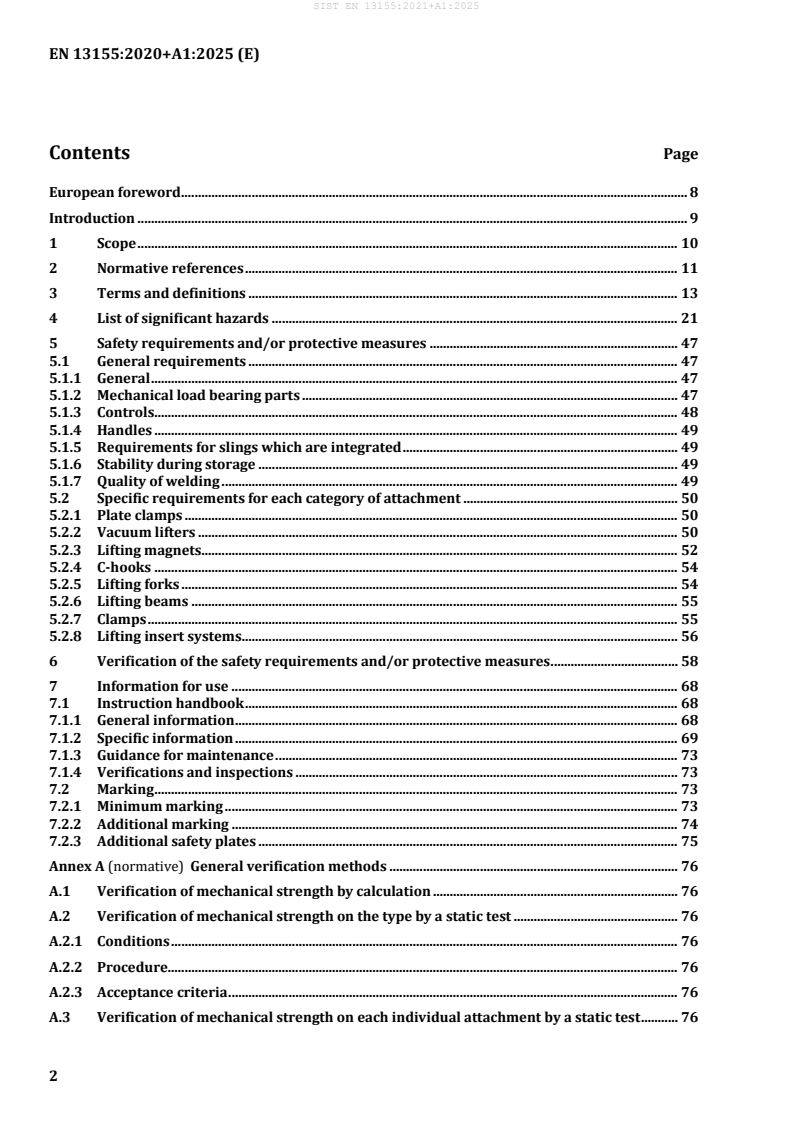
Contents Page
European foreword . 8
Introduction . 9
1 Scope . 10
2 Normative references . 11
3 Terms and definitions . 13
4 List of significant hazards . 21
5 Safety requirements and/or protective measures . 47
5.1 General requirements . 47
5.1.1 General . 47
5.1.2 Mechanical load bearing parts . 47
5.1.3 Controls . 48
5.1.4 Handles . 49
5.1.5 Requirements for slings which are integrated . 49
5.1.6 Stability during storage . 49
5.1.7 Quality of welding . 49
5.2 Specific requirements for each category of attachment . 50
5.2.1 Plate clamps . 50
5.2.2 Vacuum lifters . 50
5.2.3 Lifting magnets. 52
5.2.4 C-hooks . 54
5.2.5 Lifting forks . 54
5.2.6 Lifting beams . 55
5.2.7 Clamps . 55
5.2.8 Lifting insert systems . 56
6 Verification of the safety requirements and/or protective measures . 58
7 Information for use . 68
7.1 Instruction handbook . 68
7.1.1 General information . 68
7.1.2 Specific information . 69
7.1.3 Guidance for maintenance . 73
7.1.4 Verifications and inspections . 73
7.2 Marking . 73
7.2.1 Minimum marking . 73
7.2.2 Additional marking . 74
7.2.3 Additional safety plates . 75
Annex A (normative) General verification methods . 76
A.1 Verification of mechanical strength by calculation . 76
A.2 Verification of mechanical strength on the type by a static test . 76
A.2.1 Conditions . 76
A.2.2 Procedure. 76
A.2.3 Acceptance criteria . 76
A.3 Verification of mechanical strength on each individual attachment by a static test . 76
A.3.1 Conditions . 76
A.3.2 Procedure . 77
A.3.3 Acceptance criteria . 77
A.4 Verification by inspection . 77
A.4.1 Procedure . 77
A.4.2 Acceptance criteria . 77
A.5 !Verification of the calculated mechanical strength by test . 77
A.5.1 General . 77
A.5.2 Conditions . 77
A.5.3 Procedure" . 78
A.5.4 Acceptance criteria . 78
Annex B (normative) Verification methods for plate clamps . 79
B.1 No detachment when the load is brought down and in case of impact . 79
B.1.1 Conditions . 79
B.1.2 Procedure . 79
B.1.3 Acceptance criteria . 79
B.2 Determination of the friction coefficient . 79
B.2.1 Conditions . 79
B.2.2 Procedure . 80
B.2.3 Acceptance criteria . 81
B.3 No slipping of the load - clamping by friction or penetration . 81
B.3.1 Procedure . 81
B.3.2 Acceptance criteria . 82
B.4 Range of thickness of clamps . 82
B.4.1 Conditions . 82
B.4.2 Procedure . 82
B.4.3 Acceptance criteria . 82
B.5 Minimum working load . 82
B.5.1 Conditions . 82
B.5.2 Procedure . 82
B.5.3 Acceptance criteria . 82
Annex C (normative) Verification methods for vacuum lifters . 83
C.1 Verification of pressure measuring device . 83
C.1.1 Conditions . 83
C.1.2 Procedure . 83
C.1.3 Acceptance criteria . 83
C.2 Verification of leakage indicator . 83
C.2.1 Conditions . 83
C.2.2 Procedure. 83
C.2.3 Acceptance criteria . 83
C.3 Verification of visibility of measuring device or indicator . 83
C.3.1 Conditions . 83
C.3.2 Procedure. 83
C.3.3 Acceptance criteria . 83
C.4 Verification of devices to compensate for vacuum losses . 84
C.4.1 Conditions . 84
C.4.2 Procedure. 84
C.4.3 Acceptance criteria . 84
C.5 Verification of warning device . 84
C.5.1 Conditions . 84
C.5.2 Procedure. 84
C.5.3 Acceptance criteria . 84
C.6 Verification of the non-return valve . 84
C.6.1 Conditions . 84
C.6.2 Procedure. 84
C.6.3 Acceptance criteria . 84
C.7 Verification of controls . 85
C.7.1 Conditions . 85
C.7.2 Procedure. 85
C.7.3 Acceptance criteria . 85
C.8 Verification of energy source failure warning system . 85
C.8.1 Conditions . 85
C.8.2 Procedure. 85
C.8.3 Acceptance criteria . 85
C.9 Verification of the position of the load . 85
C.9.1 Conditions . 85
C.9.2 Procedure. 85
C.9.3 Acceptance criteria . 85
C.10 Verification of adhesion force by calculation or testing . 85
C.10.1 General . 85
C.10.2 Verification by calculation . 86
C.10.3 Verification by testing . 87
C.11 Determination of the friction coefficient . 87
C.11.1 Conditions . 87
C.11.2 Procedure . 88
C.11.3 Acceptance criteria . 88
Annex D (normative) Verification methods for lifting magnets . 89
D.1 Verification of tear-off force . 89
D.1.1 Verification by pull test . 89
D.1.2 Verification by flux measurement and calculation . 90
D.2 Verification of controls . 91
D.2.1 Conditions . 91
D.2.2 Procedure . 91
D.2.3 Acceptance criteria . 91
D.3 Verification of back-up and warning devices . 91
D.3.1 Conditions . 91
D.3.2 Procedure . 91
D.3.3 Acceptance criteria . 91
D.4 Verification of the discharge time of batteries . 91
D.4.1 Conditions . 91
D.4.2 Procedure . 92
D.4.3 Acceptance criteria . 92
D.5 Verification of indicating devices . 92
D.5.1 Conditions . 92
D.5.2 Procedure . 92
D.5.3 Acceptance criteria . 92
D.6 Verification of alternative mechanical back-up devices . 92
D.6.1 Conditions . 92
D.6.2 Procedure . 92
D.6.3 Acceptance criteria . 92
D.7 Verification that the magnet is matched to the intended load(s) . 93
D.7.1 Procedure . 93
D.7.2 Acceptance criteria . 93
Annex E (normative) Verification methods for lifting beams. 94
E.1 Verification of locking or holding devices by testing. 94
E.1.1 Conditions . 94
E.1.2 Procedure . 94
E.1.3 Acceptance criteria . 95
E.2 Verification of the locking or holding by calculation . 95
Annex F (normative) Verification methods for lifting forks . 96
F.1 Verification of mechanical strength of the secondary positive holding device for
lifting forks in horizontal direction . 96
F.1.1 Conditions . 96
F.1.2 Procedure. 96
F.1.3 Acceptance criteria . 96
F.2 Verification of mechanical strength of the secondary positive holding device for
lifting forks in vertical direction . 96
F.2.1 Conditions . 96
F.2.2 Procedure. 96
F.2.3 Acceptance criteria . 96
Annex G (normative) Verification methods for clamps . 97
G.1 Determination of the friction coefficient . 97
G.1.1 Conditions . 97
G.1.2 Procedure. 97
G.1.3 Acceptance criteria . 98
G.2 No slipping of the load – clamping by friction or penetration . 98
G.2.1 Conditions . 98
G.2.2 Acceptance criteria . 99
G.3 Verification of mechanical strength of the secondary positive holding device for
clamps in horizontal direction . 99
G.3.1 Conditions . 99
G.3.2 Procedure. 99
G.3.3 Acceptance criteria . 99
G.4 Verification of mechanical strength of the secondary positive holding device for
clamps in vertical direction . 99
G.4.1 Conditions . 99
G.4.2 Procedure. 99
G.4.3 Acceptance criteria . 99
G.5 Range of thickness of clamps . 100
G.5.1 Conditions . 100
G.5.2 Procedure. 100
G.5.3 Acceptance criteria . 100
Annex H (normative) Verification methods for lifting insert systems . 101
H.1 Verification of the embedment in concrete . 101
H.1.1 Conditions . 101
H.1.2 Procedure. 101
H.1.3 Acceptance criteria . 108
H.2 Individual verifications . 110
H.2.1 Conditions . 110
H.2.2 Procedure . 111
H.2.3 Acceptance criteria . 111
Annex I (informative) Selection of a suitable set of crane standards for a given application . 112
Annex ZA (informative) Relationship between this European Standard and the Essential
Requirements of EU Directive 2006/42/EC aimed to be covered. 114
Bibliography . 117
European foreword
!This document (EN 13155:2020+A1:2025) has been prepared by Technical Committee CEN/TC 147
“Cranes - Safety”, the secretariat of which is held by SFS.
This document supersedes EN 13155:2020.
The main modifications between EN 13155:2020 and EN 13155:2020+A1:2025 concern:
— there are two distinct verification methods, by calculation and test or by test only. The errors
associated with each of these verification methods have been rectified;
— the verification by test only requires testing to the elastic condition, 2 × WLL without permanent
deformation and yielded condition, 3 × WLL without releasing the load;
— the verification by calculation makes allowance for lower working coefficients for certain technically
justified cases;
— load testing using a scaled load factor dependent on working load limit has been included to verify
calculated mechanical strength.
This document has been prepared under a standardization request addressed to CEN by the European
Commission. The Standing Committee of the EFTA States subsequently approves these requests for its
Member States.
For the relationship with EU Legislation, see informative Annex ZA, which is an integral part of this
document."
The main modifications between EN 13155:2003+A2:2009 and EN 13155:2020 concern:
— general requirement to introduce the reference to EN 13001-1 and −2 for the calculation;
— vacuum lifters;
— lifting magnet;
— the addition to the scope of lifting insert systems for lifting prefabricated concrete products;
— reduction of load changes from 20 000 to 16 000 in all clauses.
!Any feedback and questions on this document should be directed to the users’ national standards
body. A complete listing of these bodies can be found on the CEN website.
According to the CEN-CENELEC Internal Regulations, the national standards organisations of the
following countries are bound to implement this European Standard: Austria, Belgium, Bulgaria, Croatia,
Cyprus, Czech Republic, Denmark, Estonia, Finland, France, Germany, Greece, Hungary, Iceland, Ireland,
Italy, Latvia, Lithuania, Luxembourg, Malta, Netherlands, Norway, Poland, Portugal, Republic of North
Macedonia, Romania, Serbia, Slovakia, Slovenia, Spain, Sweden, Switzerland, Türkiye and the United
Kingdom."
Introduction
!This document has been prepared to be a harmonized standard to provide one means for non-fixed
load lifting attachments used on cranes to conform with the essential health and safety requirements of
the Machinery Directive, as amended.
This document is a type C standard as stated in EN ISO 12100:2010.
This document is of relevance, in particular, for the following stakeholder groups representing the market
players with regard to machinery safety:
— machine manufacturers (small, medium and large enterprises);
— health and safety bodies (regulators, accident prevention organizations, market surveillance, etc.)
Others can be affected by the level of machinery safety achieved with the means of the document by the
above-mentioned stakeholder groups:
— machine users/employers (small, medium and large enterprises);
— machine users/employees (e.g. trade unions, organizations for people with special needs);
— service providers, e.g. for maintenance (small, medium and large enterprises);
— consumers (in case of machinery intended for use by consumers).
The above-mentioned stakeholder groups have been given the possibility to participate at the drafting
process of this document.
The machinery concerned and the extent to which hazards are covered are indicated in the scope of this
document.
When provisions of this type C standard are different from those which are stated in type A or B
standards, the provisions of this type C standard take precedence over the provisions of the other
standards, for non-fixed load lifting attachments which have been designed and built according to the
provisions of this type C standard."
1 Scope
This document specifies safety requirements for the following non-fixed load lifting attachments for
cranes, hoists and manually controlled load manipulating devices:
a) plate clamps;
b) vacuum lifters:
1) self-priming;
2) non-self-priming (pump, venturi, turbine);
c) lifting magnets:
1) electric lifting magnets (battery fed and mains-fed);
2) permanent lifting magnets;
3) electro-permanent lifting magnets;
d) lifting beams;
e) C-hooks;
f) lifting forks;
g) clamps;
h) lifting insert systems for use in normal weight concrete,
as defined in Clause 3.
This document does not give requirements for:
— non-fixed load lifting attachments in direct contact with foodstuffs or pharmaceuticals requiring a
high level of cleanliness for hygiene reasons;
— hazards resulting from handling specific hazardous materials (e.g. explosives, hot molten masses,
radiating materials);
— hazards caused by operation in an explosive atmosphere;
— hazards caused by noise;
— hazards relating to the lifting of persons;
— electrical hazards;
— hazards due to hydraulic and pneumatic components.
For high risk applications not covered by this standard, !EN 13001-2:2021", 4.3.2 gives guidance to
deal with them.
This document covers the proof of static strength, the elastic stability and the proof of fatigue strength.
This document does not generally applies to attachments intended to lift above people. Some attachments
are suitable for that purpose if equipped with additional safety features. In such cases the additional
safety features are specified in the specific requirements.
This document does not cover slings, ladles, expanding mandrels, buckets, grabs, or grab buckets. This
document does not cover power operated container handling spreaders, which are in the scope of
EN 15056.
This document is not applicable to non-fixed load attachments manufactured before the date of its
publication.
2 Normative references
The following documents are referred to in the text in such a way that some or all of their content
constitutes requirements of this document. For dated references, only the edition cited applies. For
undated references, the latest edition of the referenced document (including any amendments) applies.
!EN 206:2016+A2:2021, Concrete — Specification, performance, production and conformity"
EN 818-4:1996+A1:2008, Short link chain for lifting purposes — Safety — Part 4: Chain slings — Grade 8
EN 818-5:1999+A1:2008, Short link chain for lifting purposes — Safety — Part 5: Chain slings — Grade 4
EN 842:1996+A1:2008, Safety of machinery — Visual danger signals — General requirements, design and
testing
EN 981:1996+A1:2008, Safety of machinery — System of auditory and visual danger and information
signals
EN 1492-1:2000+A1:2008, Textile slings — Safety — Part 1: Flat woven webbing slings made of man-made
fibres for general purpose use
EN 1492-2:2000+A1:2008, Textile slings — Safety — Part 2: Roundslings made of man-made fibres for
general purpose use
EN 1492-4:2004+A1:2008, Textile slings — Safety — Part 4: Lifting slings for general service made from
natural and man-made fibre ropes
EN 1677-1:2000+A1:2008, Components for slings — Safety — Part 1: Forged steel components, Grade 8
EN 1677-2:2000+A1:2008, Components for slings — Safety — Part 2: Forged steel lifting hooks with latch,
Grade 8
EN 1677-3:2001+A1:2008, Components for slings — Safety — Part 3: Forged steel self-locking hooks —
Grade 8
EN 1677-4:2000+A1:2008, Components for slings — Safety — Part 4: Links, Grade 8
EN 1677-5:2001+A1:2008, Components for slings — Safety — Part 5: Forged steel lifting hooks with
latch — Grade 4
EN 1677-6:2001+A1:2008, Components for slings — Safety — Part 6: Links - Grade 4
EN 10029:2010, Hot-rolled steel plates 3 mm thick or above — Tolerances on dimensions and shape
EN 10034:1993, Structural steel I and H sections — Tolerances on shape and dimensions
EN 12385-4:2002+A1:2008, Steel wire ropes — Safety — Part 4: Stranded ropes for general lifting
applications
EN 13001-1:2015, Cranes — General design — Part 1: General principles and requirements
!EN 13001-2:2021, Cranes safety — General design — Part 2: Load actions"
EN 13001-3-1:2012+A2:2018, Cranes — General Design — Part 3-1: Limit States and proof competence of
steel structure
!EN 13369:2023, Common rules for precast concrete products"
EN 13414-1:2003+A2:2008, Steel wire rope slings — Safety — Part 1: Slings for general lifting service
!EN 13557:2024, Cranes — Control devices and control stations"
!EN 13889:2003+A1:2008, Forged steel shackles for general lifting purposes — Dee shackles and bow
shackles — Grade 6 — Safety"
!EN ISO 3266:2010, Forged steel eyebolts grade 4 for general lifting purposes (ISO 3266:2010)"
!EN ISO 3266:2010/A1:2015, Forged steel eyebolts grade 4 for general lifting purposes (ISO
3266:2010/Amd 1:2015)"
!EN ISO 5817:2023, Welding — Fusion-welded joints in steel, nickel, titanium and their alloys (beam
welding excluded) — Quality levels for imperfections (ISO 5817:2023)"
EN ISO 7731:2008, Ergonomics — Danger signals for public and work areas — Auditory danger signals
(ISO 7731:2003)
EN ISO 9606-1:2017, Qualification testing of welders — Fusion welding — Part 1: Steels (ISO 9606-1:2012
including Cor 1:2012 and Cor 2:2013)
EN ISO 12100:2010, Safety of machinery — General principles for design — Risk assessment and risk
reduction (ISO 12100:2010)
!EN ISO 13849-1:2023, Safety of machinery — Safety-related parts of control systems — Part 1: General
principles for design (ISO 13849-1:2023)"
!EN ISO 13854:2019, Safety of machinery — Minimum gaps to avoid crushing of parts of the human body
(ISO 13854:2017)"
!EN ISO 15609-1:2019, Specification and qualification of welding procedures for metallic materials —
Welding procedure specifi
...