


SIST EN 15267-3:2024
(Main)Air quality - Assessment of air quality monitoring equipment - Part 3: Performance criteria and test procedures for stationary automated measuring systems for continuous monitoring of emissions from stationary sources
Air quality - Assessment of air quality monitoring equipment - Part 3: Performance criteria and test procedures for stationary automated measuring systems for continuous monitoring of emissions from stationary sources
This document specifies the performance criteria and test procedures for the performance test of stationary automated measuring systems (AMS) that continuously measure gases and particulate matter in, and flow of, the waste gas from stationary sources.
This document supports the requirements of particular EU Directives. It provides the detailed procedures covering the QAL1 requirements of EN 14181 and, where required, input data used in QAL3.
Luftbeschaffenheit - Beurteilung von Einrichtungen zur Überwachung der Luftbeschaffenheit - Teil 3: Mindestanforderungen und Prüfprozeduren für stationäre automatische Messeinrichtungen zur kontinuierlichen Überwachung von Emissionen aus stationären Quellen
Dieses Dokument legt Mindestanforderungen und Prüfprozeduren für die Eignungsprüfung von stationären automatischen Messeinrichtungen (AMS) zur kontinuierlichen Messung von Gasen und partikelförmigen Stoffen im Abgas stationärer Quellen sowie zur Messung des Volumenstroms des Abgases fest.
Dieses Dokument unterstützt die Anforderungen von bestimmten EU-Richtlinien. Es stellt detaillierte Verfahren zur Umsetzung der Anforderungen der ersten Qualitätssicherungsstufe (QAL1) der EN 14181 und, soweit gefordert, die Eingangsdaten für die dritte Qualitätssicherungsstufe (QAL3) bereit.
Qualité de l'air - Évaluation des équipements de surveillance de la qualité de l'air - Partie 3: Spécifications de performance et procédures d'essai pour systèmes de mesurage automatisés fixes de surveillance en continu des émissions de sources fixes
Le présent document spécifie les critères de performance et les modes opératoires des essais de
performance des systèmes de mesurage automatisés (AMS) servant à mesurer en continu les gaz,
les particules et le débit des effluents gazeux de sources fixes.
Le présent document vient à l’appui des exigences de Directives de l’UE spécifiques. Il définit les modes
opératoires détaillés couvrant les exigences du QAL1 de l’EN 14181 ainsi que, le cas échéant,
les données d’entrée utilisées pendant le QAL3.
Kakovost zraka - Ocenjevanje opreme za monitoring kakovosti zraka - 3. del: Merila za delovanje in postopki preskušanja nepremičnih avtomatskih merilnih sistemov za kontinuirani monitoring emisij iz nepremičnih virov
Ta dokument določa merila za delovanje in postopke preskušanja za izvajanje preskusov nepremičnih avtomatskih merilnih sistemov (AMS), ki nepretrgano merijo pline in trdne delce v odpadnih plinih nepremičnih virov in pretok teh plinov.
Ta dokument podpira zahteve posebnih direktiv EU. Določa podrobne postopke, ki zajemajo zahteve QAL1 iz standarda EN 14181 in vhodne podatke, ki se uporabljajo v QAL3, kjer je to potrebno.
General Information
- Status
- Published
- Public Enquiry End Date
- 02-Oct-2022
- Publication Date
- 15-Jan-2024
- Technical Committee
- KAZ - Air quality
- Current Stage
- 6060 - National Implementation/Publication (Adopted Project)
- Start Date
- 20-Dec-2023
- Due Date
- 24-Feb-2024
- Completion Date
- 16-Jan-2024


Relations
- Effective Date
- 01-Feb-2024
- Refers
SIST EN 60068-2-6:2008 - Environmental testing - Part 2-6: Tests - Test Fc: Vibration (sinusoidal) - Effective Date
- 09-Feb-2026
- Effective Date
- 09-Feb-2026
- Refers
SIST EN 50160:2023 - Voltage characteristics of electricity supplied by public distribution networks - Effective Date
- 09-Feb-2026
- Effective Date
- 28-Jan-2026
- Effective Date
- 28-Jan-2026
- Effective Date
- 28-Jan-2026
- Effective Date
- 28-Jan-2026
- Refers
SIST EN 14181:2015 - Stationary source emissions - Quality assurance of automated measuring systems - Effective Date
- 28-Jan-2026
- Effective Date
- 28-Jan-2026
- Effective Date
- 28-Jan-2026
- Effective Date
- 28-Jan-2026
- Effective Date
- 28-Jan-2026
- Referred By
SIST-TS CEN/TS 17286:2019 - Stationary source emissions - Mercury monitoring using sorbent traps - Effective Date
- 28-Jan-2026
- Effective Date
- 28-Jan-2026
Overview
SIST EN 15267-3:2024 is a European standard developed by the Slovenian Institute for Standardization (SIST) that sets out the performance criteria and test procedures for stationary automated measuring systems (AMS). These systems are used for the continuous monitoring of emissions, including gases and particulate matter, from stationary sources such as industrial plants. The standard is an essential component in the monitoring and assessment of air quality and directly supports compliance with key European Union (EU) Directives related to industrial emissions and air quality, including Directive 2010/75/EU.
Key Topics
- Performance Criteria for AMS: The standard specifies clear requirements for aspects such as response time, repeatability, drift, linearity (lack of fit), influence of environmental factors, and cross-sensitivity.
- Laboratory and Field Testing: Detailed procedures for both laboratory and field testing are provided, ensuring AMS reliability under controlled and operational conditions.
- Quality Assurance: Covers quality assurance levels (QAL1 and data for QAL3) as outlined in EN 14181, critical for ongoing compliance and validation of measurement data.
- Test Procedures: Includes methods for validating AMS performance against reference or alternative methods, as well as requirements for test reporting.
- Legal Compliance: Assists in meeting the requirements of EU Directives on industrial emissions and air quality, supporting regulatory conformity across member states.
Applications
Adoption of SIST EN 15267-3:2024 brings practical value and supports the following applications:
- Industrial Emissions Monitoring: Ensures that continuous emission monitoring systems used in industrial facilities provide accurate, reliable data for regulatory reporting and process control.
- Regulatory Compliance: Enables companies to demonstrate compliance with EU Directives, particularly those regulating emissions from stationary sources.
- Certification and Quality Management: Supports the certification process of AMS equipment, verifying performance through robust laboratory and field tests, and underpins manufacturers’ quality management systems.
- Environmental Protection: Enables reliable tracking of pollutants, contributing to improved air quality management and environmental health by facilitating enforcement of emission limits.
- Process Optimization: Real-time emission data enables process industries to optimize operational efficiency while minimizing environmental impact.
- Data Consistency in Reporting: Standardized performance and testing criteria ensure measurement consistency across different plants and countries, improving the comparability of emission data.
Related Standards
SIST EN 15267-3:2024 forms part of a broader framework for air quality and emission monitoring:
- EN 15267-1: General principles of certification for air quality monitoring equipment.
- EN 15267-2: Initial assessment and surveillance of manufacturer’s quality management systems.
- EN 15267-4: Performance criteria and test procedures for portable automated measuring systems.
- EN 14181: Quality assurance of automated measuring systems, defining QAL procedures.
- EN 13284-1/2: Methods for determining dust concentration.
- EN 15259: Requirements for measurement sections, sites, and objectives.
- EN ISO 14956: Suitability evaluation of measurement procedures.
- EN 50160 / EN 60529 / EN 60068-2-6: Standards referenced for related electrical and mechanical properties.
Summary
SIST EN 15267-3:2024 provides a comprehensive, harmonized approach to performance testing and certification of stationary AMS for continuous emissions monitoring from stationary sources. By defining rigorous performance requirements and test methodologies, the standard ensures the accuracy, reliability, and regulatory compliance of emission data - key to effective air quality management and environmental protection across Europe. Adherence facilitates legal compliance, supports quality management, and promotes public and environmental health.
Get Certified
Connect with accredited certification bodies for this standard

BSI Group
BSI (British Standards Institution) is the business standards company that helps organizations make excellence a habit.

Bureau Veritas
Bureau Veritas is a world leader in laboratory testing, inspection and certification services.

DNV
DNV is an independent assurance and risk management provider.
Sponsored listings
Frequently Asked Questions
SIST EN 15267-3:2024 is a standard published by the Slovenian Institute for Standardization (SIST). Its full title is "Air quality - Assessment of air quality monitoring equipment - Part 3: Performance criteria and test procedures for stationary automated measuring systems for continuous monitoring of emissions from stationary sources". This standard covers: This document specifies the performance criteria and test procedures for the performance test of stationary automated measuring systems (AMS) that continuously measure gases and particulate matter in, and flow of, the waste gas from stationary sources. This document supports the requirements of particular EU Directives. It provides the detailed procedures covering the QAL1 requirements of EN 14181 and, where required, input data used in QAL3.
This document specifies the performance criteria and test procedures for the performance test of stationary automated measuring systems (AMS) that continuously measure gases and particulate matter in, and flow of, the waste gas from stationary sources. This document supports the requirements of particular EU Directives. It provides the detailed procedures covering the QAL1 requirements of EN 14181 and, where required, input data used in QAL3.
SIST EN 15267-3:2024 is classified under the following ICS (International Classification for Standards) categories: 03.120.20 - Product and company certification. Conformity assessment; 13.040.99 - Other standards related to air quality. The ICS classification helps identify the subject area and facilitates finding related standards.
SIST EN 15267-3:2024 has the following relationships with other standards: It is inter standard links to SIST EN 15267-3:2008, SIST EN 60068-2-6:2008, SIST EN 60529:1997, SIST EN 50160:2023, SIST EN 15259:2008, SIST EN 13284-2:2018, SIST EN ISO 14956:2003, SIST EN 13284-1:2018, SIST EN 14181:2015, SIST EN 15859:2010, SIST EN 17255-4:2023, SIST EN 15267-1:2009, SIST EN ISO 25139:2011, SIST-TS CEN/TS 17286:2019, SIST-TS CEN/TS 17198:2018. Understanding these relationships helps ensure you are using the most current and applicable version of the standard.
SIST EN 15267-3:2024 is available in PDF format for immediate download after purchase. The document can be added to your cart and obtained through the secure checkout process. Digital delivery ensures instant access to the complete standard document.
Standards Content (Sample)
SLOVENSKI STANDARD
01-februar-2024
Nadomešča:
SIST EN 15267-3:2008
Kakovost zraka - Ocenjevanje opreme za monitoring kakovosti zraka - 3. del:
Merila za delovanje in postopki preskušanja nepremičnih avtomatskih merilnih
sistemov za kontinuirani monitoring emisij iz nepremičnih virov
Air quality - Assessment of air quality monitoring equipment - Part 3: Performance
criteria and test procedures for stationary automated measuring systems for continuous
monitoring of emissions from stationary sources
Luftbeschaffenheit - Beurteilung von Einrichtungen zur Überwachung der
Luftbeschaffenheit - Teil 3: Mindestanforderungen und Prüfprozeduren für stationäre
automatische Messeinrichtungen zur kontinuierlichen Überwachung von Emissionen aus
stationären Quellen
Qualité de l'air - Évaluation des équipements de surveillance de la qualité de l'air - Partie
3: Spécifications de performance et procédures d'essai pour systèmes de mesurage
automatisés fixes de surveillance en continu des émissions de sources fixes
Ta slovenski standard je istoveten z: EN 15267-3:2023
ICS:
03.120.20 Certificiranje proizvodov in Product and company
podjetij. Ugotavljanje certification. Conformity
skladnosti assessment
13.040.99 Drugi standardi v zvezi s Other standards related to air
kakovostjo zraka quality
2003-01.Slovenski inštitut za standardizacijo. Razmnoževanje celote ali delov tega standarda ni dovoljeno.
EN 15267-3
EUROPEAN STANDARD
NORME EUROPÉENNE
December 2023
EUROPÄISCHE NORM
ICS 13.040.99 Supersedes EN 15267-3:2007
English Version
Air quality - Assessment of air quality monitoring
equipment - Part 3: Performance criteria and test
procedures for stationary automated measuring systems
for continuous monitoring of emissions from stationary
sources
Qualité de l'air - Évaluation des équipements de Luftbeschaffenheit - Beurteilung von Einrichtungen zur
surveillance de la qualité de l'air - Partie 3: Critères de Überwachung der Luftbeschaffenheit - Teil 3:
performance et modes opératoires d'essai pour les Mindestanforderungen und Prüfprozeduren für
systèmes de mesurage automatisés fixes de stationäre automatische Messeinrichtungen zur
surveillance en continu des émissions de sources fixes kontinuierlichen Überwachung von Emissionen aus
stationären Quellen
This European Standard was approved by CEN on 27 November 2023.
CEN members are bound to comply with the CEN/CENELEC Internal Regulations which stipulate the conditions for giving this
European Standard the status of a national standard without any alteration. Up-to-date lists and bibliographical references
concerning such national standards may be obtained on application to the CEN-CENELEC Management Centre or to any CEN
member.
This European Standard exists in three official versions (English, French, German). A version in any other language made by
translation under the responsibility of a CEN member into its own language and notified to the CEN-CENELEC Management
Centre has the same status as the official versions.
CEN members are the national standards bodies of Austria, Belgium, Bulgaria, Croatia, Cyprus, Czech Republic, Denmark, Estonia,
Finland, France, Germany, Greece, Hungary, Iceland, Ireland, Italy, Latvia, Lithuania, Luxembourg, Malta, Netherlands, Norway,
Poland, Portugal, Republic of North Macedonia, Romania, Serbia, Slovakia, Slovenia, Spain, Sweden, Switzerland, Türkiye and
United Kingdom.
EUROPEAN COMMITTEE FOR STANDARDIZATION
COMITÉ EUROPÉEN DE NORMALISATION
EUROPÄISCHES KOMITEE FÜR NORMUNG
CEN-CENELEC Management Centre: Rue de la Science 23, B-1040 Brussels
© 2023 CEN All rights of exploitation in any form and by any means reserved Ref. No. EN 15267-3:2023 E
worldwide for CEN national Members.
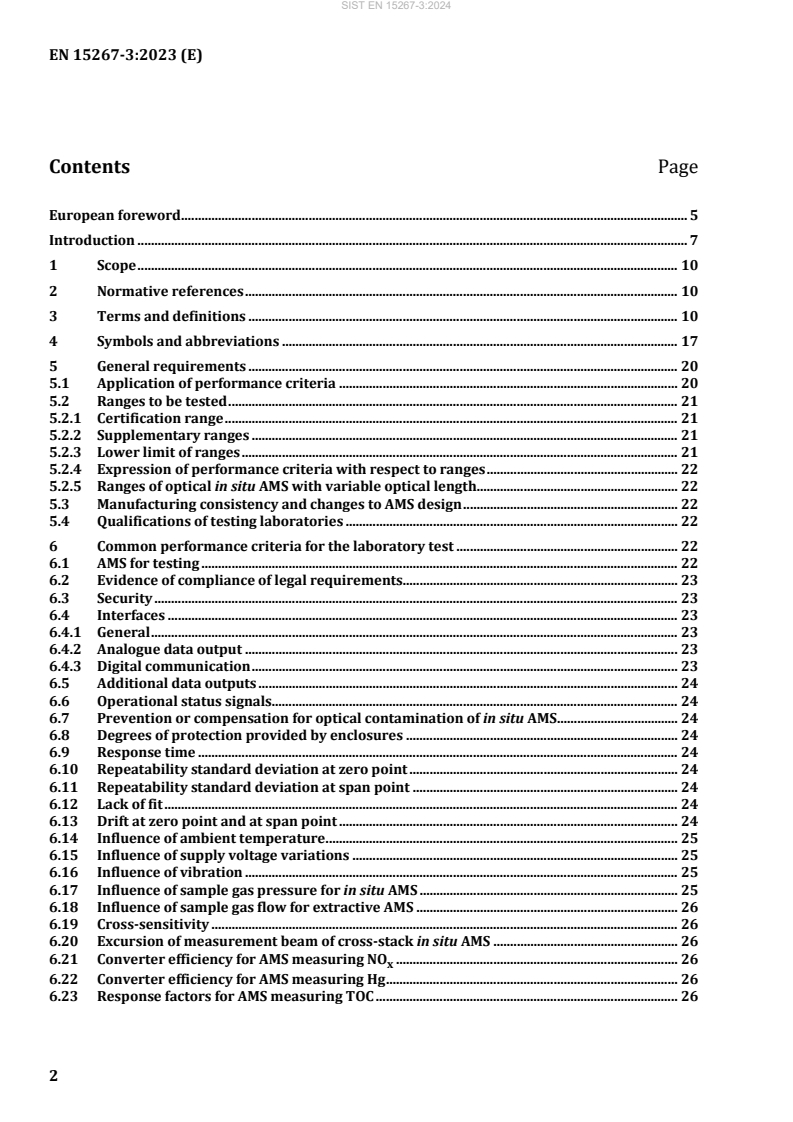
Contents Page
European foreword . 5
Introduction . 7
1 Scope . 10
2 Normative references . 10
3 Terms and definitions . 10
4 Symbols and abbreviations . 17
5 General requirements . 20
5.1 Application of performance criteria . 20
5.2 Ranges to be tested . 21
5.2.1 Certification range . 21
5.2.2 Supplementary ranges . 21
5.2.3 Lower limit of ranges . 21
5.2.4 Expression of performance criteria with respect to ranges . 22
5.2.5 Ranges of optical in situ AMS with variable optical length. 22
5.3 Manufacturing consistency and changes to AMS design . 22
5.4 Qualifications of testing laboratories . 22
6 Common performance criteria for the laboratory test . 22
6.1 AMS for testing . 22
6.2 Evidence of compliance of legal requirements. 23
6.3 Security . 23
6.4 Interfaces . 23
6.4.1 General . 23
6.4.2 Analogue data output . 23
6.4.3 Digital communication . 23
6.5 Additional data outputs . 24
6.6 Operational status signals. 24
6.7 Prevention or compensation for optical contamination of in situ AMS . 24
6.8 Degrees of protection provided by enclosures . 24
6.9 Response time . 24
6.10 Repeatability standard deviation at zero point . 24
6.11 Repeatability standard deviation at span point . 24
6.12 Lack of fit . 24
6.13 Drift at zero point and at span point . 24
6.14 Influence of ambient temperature . 25
6.15 Influence of supply voltage variations . 25
6.16 Influence of vibration . 25
6.17 Influence of sample gas pressure for in situ AMS . 25
6.18 Influence of sample gas flow for extractive AMS . 26
6.19 Cross-sensitivity . 26
6.20 Excursion of measurement beam of cross-stack in situ AMS . 26
6.21 Converter efficiency for AMS measuring NO . 26
x
6.22 Converter efficiency for AMS measuring Hg . 26
6.23 Response factors for AMS measuring TOC . 26
7 Common performance criteria for the field test . 26
7.1 Calibration function . 26
7.2 Response time . 27
7.3 Lack of fit . 27
7.4 Maintenance interval . 27
7.5 Drift at zero point and at span point . 27
7.6 Availability . 27
7.7 Reproducibility . 27
7.8 Contamination check of in situ systems . 27
8 Specific performance criteria for measured components . 28
8.1 General . 28
8.2 AMS measuring gaseous measured components . 28
8.2.1 Performance criteria . 28
8.2.2 AMS measuring TOC . 30
8.2.3 AMS measuring Hg . 31
8.3 AMS measuring particulate matter . 31
8.4 AMS measuring gas flow . 33
9 General test requirements . 34
10 Test procedures for the laboratory test . 35
10.1 AMS for testing . 35
10.2 Evidence of compliance of legal requirements . 35
10.3 Security . 35
10.4 Interfaces . 36
10.4.1 General . 36
10.4.2 Analog data output . 36
10.4.3 Digital communication . 36
10.5 Additional data output . 36
10.6 Operational status signals . 36
10.7 Prevention or compensation for optical contamination for in situ AMS . 36
10.8 Degrees of protection provided by enclosures . 37
10.9 Response time . 37
10.10 Repeatability standard deviation at zero point . 39
10.11 Repeatability standard deviation at span point . 39
10.12 Lack of fit . 40
10.13 Drift at zero point and at span point . 41
10.14 Influence of ambient temperature . 42
10.15 Influence of supply voltage variations . 43
10.16 Influence of vibration . 43
10.17 Influence of sample gas pressure for in situ AMS . 44
10.18 Influence of sample gas flow for extractive AMS . 45
10.19 Cross-sensitivity . 45
10.20 Excursion of measurement beam of cross-stack in situ AMS . 46
10.21 Converter efficiency for AMS measuring NO . 47
X
10.22 Converter efficiency for AMS measuring Hg . 48
10.23 Response factors for AMS measuring TOC . 48
11 Requirements for the field test . 49
11.1 Provisions . 49
11.2 Field test duration . 49
12 Common test procedures for the field test . 50
12.1 Calibration function . 50
12.2 Response time . 50
12.3 Lack of fit . 50
12.4 Maintenance interval . 51
12.5 Drift at zero point and at span point . 51
12.6 Availability . 52
12.7 Reproducibility . 52
12.8 Contamination check of in situ systems . 54
13 Specific test procedures for AMS measuring particulate matter . 55
13.1 Lack of fit . 55
13.2 Extractive AMS . 55
14 Measurement uncertainty . 55
15 Test report . 56
Annex A (informative) Selected standard reference methods, reference methods and
general documents . 57
Annex B (normative) Interferents . 59
Annex C (normative) Test of linearity . 60
C.1 Description of the test procedure . 60
C.2 Establishment of the regression line . 60
C.3 Calculation of the residuals of the average concentrations . 61
Annex D (informative) Example for the determination of the expanded uncertainty . 62
D.1 Determination of uncertainty contributions . 62
D.2 Elements required for the uncertainty determinations . 62
D.3 Example of an uncertainty calculation for an AMS measuring SO . 64
D.4 Determination of uncertainty contributions by use of sensitivity coefficients . 66
D.5 Example of a calculation of an uncertainty contribution by use of a sensitivity
coefficient . 66
Annex E (informative) Elements of a performance test report . 67
Bibliography . 70
European foreword
This document (EN 15267-3:2023) has been prepared by Technical Committee CEN/TC 264 “Air quality”,
the secretariat of which is held by DIN.
This European Standard shall be given the status of a national standard, either by publication of an
identical text or by endorsement, at the latest by June 2024, and conflicting national standards shall be
withdrawn at the latest by June 2024.
Attention is drawn to the possibility that some of the elements of this document may be the subject of
patent rights. CEN shall not be held responsible for identifying any or all such patent rights.
This document supersedes EN 15267-3:2007.
The main changes compared to the previous edition are listed below:
a) The title of the revised EN 15267 series has been clarified to avoid the impression that all parts deal
with the certification of automated measuring systems. The title has been generalized so that
specifically Part 1 and Part 2 are also applicable to other air quality monitoring equipment.
b) The title of revised EN 15267-3 has been clarified to make it clear that Part 3 deals with stationary
automated measuring systems for continuous monitoring of emissions from stationary sources.
c) The performance criteria and test procedures were adapted to the state of the art in measurement
technology.
d) Requirements for stationary automated measuring systems measuring mercury have been added.
e) References have been updated.
This document is Part 3 of a series of European Standards:
— EN 15267-1, Air quality — Assessment of air quality monitoring equipment — Part 1: General
principles of certification
— EN 15267-2, Air quality — Assessment of air quality monitoring equipment — Part 2: Initial assessment
of the manufacturer’s quality management system and post certification surveillance for the
manufacturing process
— EN 15267-3, Air quality — Assessment of air quality monitoring equipment — Part 3: Performance
criteria and test procedures for stationary automated measuring systems for continuous monitoring of
emissions from stationary sources
— EN 15267-4, Air quality — Assessment of air quality monitoring equipment — Part 4: Performance
criteria and test procedures for portable automated measuring systems for periodic measurements of
emissions from stationary sources
Any feedback and questions on this document should be directed to the users’ national standards body.
A complete listing of these bodies can be found on the CEN website.
According to the CEN-CENELEC Internal Regulations, the national standards organisations of the
following countries are bound to implement this European Standard: Austria, Belgium, Bulgaria, Croatia,
Cyprus, Czech Republic, Denmark, Estonia, Finland, France, Germany, Greece, Hungary, Iceland, Ireland,
Italy, Latvia, Lithuania, Luxembourg, Malta, Netherlands, Norway, Poland, Portugal, Republic of North
Macedonia, Romania, Serbia, Slovakia, Slovenia, Spain, Sweden, Switzerland, Türkiye and the United
Kingdom.
Introduction
0.1 General
The assessment of air quality monitoring equipment (AQME) supports the requirements of certain
Directives of the European Union (EU), which require, either directly or indirectly, that this equipment
complies with performance criteria, maximum permissible measurement uncertainties and test
requirements. These Directives include Directive 2010/75/EU on industrial emissions (IED),
Directive (EU) 2015/2193 on medium combustion plants and Directive 2008/50/EC on ambient air
quality and cleaner air for Europe.
The assessment of AQME consists of the following sequential stages:
a) performance testing;
b) initial assessment of the manufacturer’s quality management system (QMS);
c) certification;
d) surveillance for the manufacturing process.
This document specifies the performance criteria and test procedures for performance testing of
stationary AMS for continuous monitoring of emissions from stationary sources. Testing applies to
complete measuring systems.
The overall assessment for the purposes of certification is conformity testing, while the evaluation of
performance against specified performance criteria is performance testing.
0.2 Legal drivers
This document supports at least the requirements of the following EU Directives:
— Directive 2010/75/EU on industrial emissions;
— Directive (EU) 2015/2193 on the limitation of emissions of certain pollutants into the air from
medium combustion plants;
— Directive 2003/87/EC establishing a system for greenhouse gas emission allowance trading.
However, this document can also be applied to the monitoring requirements specified in other
EU Directives.
0.3 Relationship to EN 14181
The quality assurance levels (QAL) defined in EN 14181 cover the suitability of an AMS for its measuring
task (QAL1), the regular calibration and validation of the AMS (QAL2), and the control of the AMS during
its ongoing operation on an industrial plant (QAL3). An annual surveillance test (AST) is also defined in
EN 14181.
This document provides the detailed procedures covering the QAL1 requirements of EN 14181.
Furthermore, it provides input data for QAL3.
0.4 Processes
Field testing of an AMS is ordinarily carried out on the most highly demanding industrial process in the
range of applications for which a manufacturer seeks certification. The premise is that if the AMS
performs acceptably on this process, then experience has shown that the AMS generally performs well
on the majority of other processes. However, there are always exceptions and it is the responsibility of
the manufacturer in conjunction with the user to ensure that the AMS performs adequately on a specific
process.
0.5 Performance characteristics
A combination of laboratory test and field test is detailed within this document. The laboratory test is
designed to assess whether an AMS can meet, under controlled conditions, the relevant performance
criteria. The field test is designed to assess whether an AMS can continue to work and meet the relevant
performance criteria in a real application. Field testing is carried out on an industrial process
representative of the intended application for the AMS for which the manufacturer seeks certification.
The main AMS performance characteristics are:
— response time;
— repeatability standard deviation;
— lack of fit (linearity);
— drift;
— influence of ambient temperature;
— influence of supply voltage variations;
— influence of vibration;
— influence of sample gas pressure;
— influence of sample gas flow for extractive AMS;
— cross-sensitivity to likely interferents contained in the waste gas other than the measured
component;
— excursion of measurement beam of cross-stack in situ AMS;
— converter efficiency for AMS measuring NO ;
x
— converter efficiency for AMS measuring Hg;
— response factors for AMS measuring TOC;
— performance and accuracy of the AMS against the standard reference method (SRM) or alternative
method (AM);
— maintenance interval;
— availability;
— reproducibility.
The quality of reference or surrogate materials used under QAL3 for both gaseous measured components
and particulate matter measuring AMS is also assessed.
This document is an application and elaboration of EN ISO 9169 with additional and alternative
provisions for paired testing. Where this document appears to differ from EN ISO 9169, it either
elaborates upon the requirements of EN ISO 9169 or differs in minor ways owing to the necessity to
conduct paired testing.
0.6 Relationship to EN 15267-4
This document forms the basis of EN 15267-4, which specifies the performance test of portable
automated measuring systems (P-AMS) for periodic measurements of emissions from stationary sources.
Many requirements of EN 15267-4 are identical to those of this document. EN 15267-4 deviates from this
document only where the portable use and the use as SRM or AM require different or additional
requirements. Therefore, this document allows a combined testing according to EN 15267-3 and
EN 15267-4 where an AMS is designed for stationary and portable use.
1 Scope
This document specifies the performance criteria and test procedures for the performance test of
stationary automated measuring systems (AMS) that continuously measure gases and particulate matter
in, and flow of, the waste gas from stationary sources.
This document supports the requirements of particular EU Directives. It provides the detailed procedures
covering the QAL1 requirements of EN 14181 and, where required, input data used in QAL3.
2 Normative references
The following documents are referred to in the text in such a way that some or all of their content
constitutes requirements of this document. For dated references, only the edition cited applies. For
undated references, the latest edition of the referenced document (including any amendments) applies.
EN 13284-1, Stationary source emissions - Determination of low range mass concentration of dust - Part 1:
Manual gravimetric method
EN 13284-2, Stationary source emissions - Determination of low range mass concentration of dust - Part 2:
Quality assurance of automated measuring systems
EN 14181:2014, Stationary source emissions - Quality assurance of automated measuring systems
EN 15259, Air quality - Measurement of stationary source emissions - Requirements for measurement
sections and sites and for the measurement objective, plan and report
EN 50160, Voltage characteristics of electricity supplied by public electricity networks
EN 60068-2-6, Environmental testing - Part 2-6: Tests - Test Fc: Vibration (sinusoidal)
EN 60529, Degrees of protection provided by enclosures (IP Code)
EN ISO 14956:2002, Air quality - Evaluation of the suitability of a measurement procedure by comparison
with a required measurement uncertainty (ISO 14956:2002)
ISO/IEC 60559, Floating-point arithmetic
3 Terms and definitions
For the purposes of this document, the following terms and definitions apply.
ISO and IEC maintain terminology databases for use in standardization at the following addresses:
— ISO Online browsing platform: available at https://www.iso.org/obp
— IEC Electropedia: available at https://www.electropedia.org/
3.1
air quality monitoring equipment
AQME
automated measuring system or data acquisition and handling system
[SOURCE: EN 15267-1:2023, 3.1]
3.2
automated measuring system
AMS
entirety of all measuring instruments and additional devices for obtaining a result of measurement
Note 1 to entry: The term “automated measuring system” applies to stationary and portable AMS.
Note 2 to entry: Apart from the actual measuring device (the analyser), a stationary AMS includes facilities for
taking samples (e.g. probe, sample gas lines, flow meters and regulator, delivery pump) and for sample conditioning
(e.g. dust filter, pre-separator for interferents, cooler, converter). This definition also includes testing and adjusting
devices that are required for functional checks and QAL3 procedures and, if applicable, for commissioning.
Note 3 to entry: The term “automated measuring system” (AMS) is typically used in Europe. The terms
“continuous emission monitoring system” (CEM) and “continuous ambient-air-quality monitoring system” (CAM)
are also typically used in the UK and USA.
[SOURCE: EN 15267-1:2023, 3.2]
3.3
portable automated measuring system
P-AMS
automated measuring system which is in a condition or application to be moved from one to another
measurement site to obtain measurement results for a short measurement period
Note 1 to entry: The measurement period is typically 8 h for a day.
Note 2 to entry: The P-AMS can be configured at the measurement site for the special application but can be also
set-up in a van or mobile container. The probe and the sample gas lines are installed often just before the
measurement task is started.
[SOURCE: EN 15267-1:2023, 3.3]
3.4
reference method
RM
measurement method taken as a reference by convention, which gives, the accepted reference value of
the measurand
Note 1 to entry: A reference method is fully described.
Note 2 to entry: A reference method can be a manual or an automated method.
Note 3 to entry: Alternative methods can be used if equivalence to the reference method has been demonstrated.
[SOURCE: EN 15259:2007, 3.8]
3.5
standard reference method
SRM
reference method prescribed by European or national legislation
Note 1 to entry: Standard reference methods are used e.g. to calibrate and validate AMS and for periodic
measurements to check compliance with limit values.
[SOURCE: EN 15259:2007, 3.9]
3.6
alternative method
AM
measurement method which complies with the criteria given by EN 14793 with respect to the reference
method
Note 1 to entry: An alternative method can consist of a simplification of the reference method.
Note 2 to entry: Alternative methods can be used if equivalence to the reference method has been demonstrated.
[SOURCE: EN 14793:2017, 3.3, modified – “this European Standard” has been replaced by “EN 14793”
and note 2 has been added]
3.7
measurement method
method described in a written procedure containing all the means and procedures required to sample
and analyse, namely: field of application, principle and/or reactions, definitions, equipment, procedures,
presentation of results, other requirements and measurement report
[SOURCE: EN 14793:2017, 3.4]
3.8
measurement
set of operations having the object of determining a value of a quantity
3.9
paired measurement
simultaneous recording of results of measurement at the same measurement point using two AMS of
identical design
3.10
measurand
particular quantity subject to measurement
Note 1 to entry: The measurand is a quantifiable property of the waste gas under test, for example mass
concentration of a measured component, temperature, velocity, mass flow, oxygen content and water vapour
content.
[SOURCE: EN 15259:2007, 3.5]
3.11
measured component
constituent of the waste gas for which a defined measurand is to be determined by measurement
[SOURCE: EN 15259:2007, 3.6]
Note 1 to entry: Measured component is also called determinand.
3.12
interferent
substance present in the waste gas under investigation, other than the measured component, that affects
the output
3.13
calibration
determination of a calibration function with (time) limited validity applicable to the AMS at a specific
measurement site
3.14
calibration function
linear relationship between the values of the SRM and the AMS with the assumption of a constant residual
standard deviation
[SOURCE: EN 14181:2014, 3.13]
Note 1 to entry: The calibration function describes the statistical relationship between the starting variable
(measured signal) of the measuring system and the associated result of measurement (measured value)
simultaneously determined at the same point of measurement using an SRM.
Note 2 to entry: An AM can be used in place of the SRM if the equivalence of the AM to the SRM has been
demonstrated.
3.15
reference material
substance or mixture of substances, with a known concentration within specified limits, or a device of
known characteristics
3.16
zero gas
gas mixture used to establish the zero point of a calibration curve when used with a given analytical
procedure within a given calibration range
3.17
zero point
specified value of the output of the AMS which, in the absence of the measured component, represents
the zero crossing of the AMS characteristic
Note 1 to entry: In case of oxygen and some flow monitoring AMS, the zero point is interpreted as the lowest
measurable value.
3.18
span point
value of the output of the AMS for the purpose of calibrating, adjusting, etc. that represents a correct
measured value generated by reference material between 70 % and 90 % of the range tested
3.19
measured signal
output of the AMS in analogue or digital form which is converted into the measured value with the aid of
the calibration function
3.20
output
reading, or digital or analogue electrical signal generated by the AMS in response to a measured object
3.21
independent reading
reading that is not influenced by a previous individual reading by separating two individual readings by
at least four response times
3.22
individual reading
reading averaged over a time period equal to at least the response time of the AMS
3.23
averaging time
time period over which an arithmetic or time-weighted average of concentrations is calculated
3.24
short-term average
STA
average related to the shortest time period used for reporting
Note 1 to entry: Short-term averages are based on the shortest time period of averages the plant must report to
the authorities for each measured component. According to variations in different EU Directives the shortest time
period can be 10 min, 30 min or 1 h, depending on the type and application of the plant.
[SOURCE: EN 17255-1:2019, 3.25]
3.25
performance characteristic
quantity assigned to the AMS in order to define its performance
Note 1 to entry: The values of relevant performance characteristics are determined in the performance test and
compared to the applicable performance criteria.
3.26
response time
t
time interval between the instant of a sudden change in the value of the input quantity to the AMS and
the time as from which the value of the output quantity is reliably maintained above 90 % of the correct
value of the input quantity
Note 1 to entry: The response time is also referred to as the 90 % time.
3.27
lack of fit
systematic deviation, within the measurement range, between the accepted value of a reference material
applied to the measuring system and the corresponding result of measurement produced by the
calibrated measuring system
Note 1 to entry: In common language lack of fit is often called “linearity” or “deviation from linearity”. Lack of fit
test is often called “linearity test”.
3.28
NO converter efficiency
x
efficiency with which the converter unit of a NO analyser reduces NO to NO
x 2
3.29
Hg converter efficiency
2+ 0
efficiency with which the converter unit of a mercury analyser reduces Hg to Hg
3.30
interference
negative or positive effect that a substance has upon the output of the AMS, when that substance is not
the measured component
3.31
cross-sensitivity
response of the AMS to interfering components
Note 1 to entry: See interference.
3.32
accuracy
closeness in agreement between a single measured value of the measurand, and the true value (or an
accepted reference value)
3.33
availability
fraction of the total monitoring time for which data of acceptable quality have been collected
3.34
drift
monotonic change of the calibration function over a stated period of unattended operation, which results
in a change of the measured value
3.35
drift at zero point
change in AMS reading at the zero point over the maintenance interval
3.36
drift at span point
change in AMS reading at the span point over the maintenance interval
3.37
maintenance interval
maximum admissible interval of time for which the performance characteristics remain within a pre-
defined range without external servicing, e.g. refill, calibration, adjustment
Note 1 to entry: This is also known as the “period of unattended operation”.
3.38
repeatability
ability of the AMS to provide closely similar indications for repeated applications of the same measurand
under the same conditions of measurement
3.39
reproducibility
measure of the agreement between two identical AMS applied in parallel in field tests at a level of
confidence of 95 % using the standard deviation of the difference of the paired measurements
Note 1 to entry: Reproducibility is determined by means of two identical AMS operated side by side. It is an AMS
performance characteristic for describing the production tolerance specific to that AMS. The reproducibility is
calculated from the short-term averages of the output signals (raw values as analogue or digital outputs) obtained
during the field test.
Note 2 to entry: The term “field repeatability” is sometimes used instead of reproducibility.
3.40
uncertainty
parameter associated with the result of a measurement, that characterises the dispersion of the values
that could reasonably be attributed to the measurand
[SOURCE: ISO/IEC Guide 98-3:2008, B.2.18]
3.41
standard uncertainty
uncertainty of the result of measurement expressed as a standard deviation
[SOURCE: ISO/IEC Guide 98-3:2008, 2.3.1]
3.42
expanded uncertainty
quantity defining an interval about the result of a measurement that may be expected to encompass a
large fraction of the distribution of values that could reasonably be attributed to the measurand
Note 1 to entry: The interval about the result of measurement is established for a level of confidence of typically
95 %.
[SOURCE: ISO/IEC Guide 98-3:2008, 2.3.5]
3.43
maximum permissible expanded uncertainty
criterion specified for the measurement method to assess the expand
...