

SIST ISO 3972:2013/AC:2013
(Corrigendum)Sensory analysis - Methodology - Method of investigating sensitivity of taste
General Information
- Abstract
This International Standard specifies a set of objective tests for familiarizing assessors with sensory analysis. The test methods specified can be useful to:
a) teach assessors to recognize tastes and to distinguish between them (see Clause 8);
b) teach assessors to know and to familiarize different types of threshold tests (see Clause 9);
c) make assessors aware of their own sensitivity of taste;
d) enable test supervisors to carry out a preliminary categorization of assessors.
The methods can also be used as a periodic monitor of the sensitivity of taste of assessors who are already members of sensory analysis panels.
- Status
- Published
- Public Enquiry End Date
- 24-Dec-2012
- Publication Date
- 26-Dec-2012
- Technical Committee
- KŽP - Agricultural food products
- Current Stage
- 6060 - National Implementation/Publication (Adopted Project)
- Start Date
- 27-Nov-2012
- Due Date
- 01-Feb-2013
- Completion Date
- 27-Dec-2012
Buy Documents
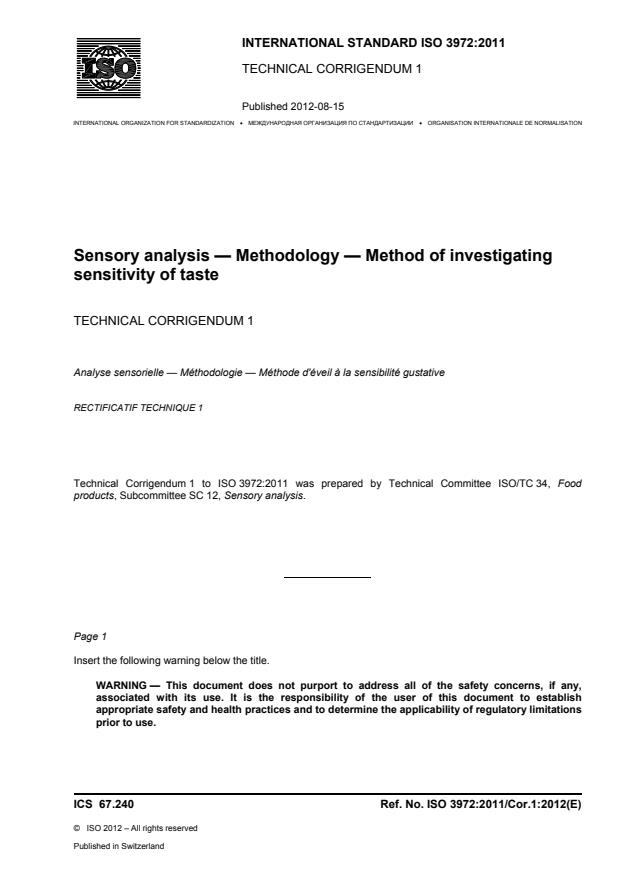


ISO 3972:2011/Cor 1:2012 - Sensory analysis — Methodology — Method of investigating sensitivity of taste — Technical Corrigendum 1 Released:8/3/2012
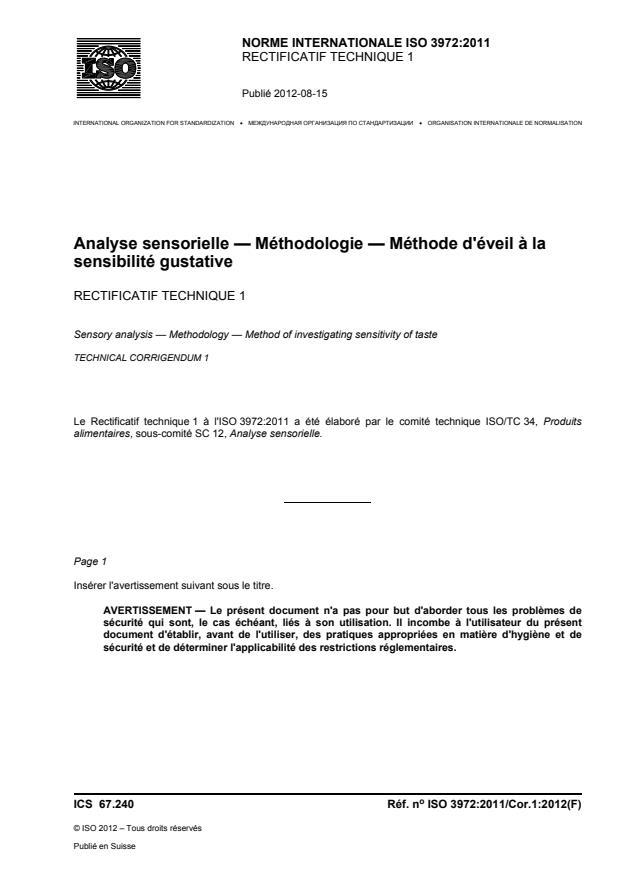


ISO 3972:2011/Cor 1:2012 - Analyse sensorielle — Méthodologie — Méthode d'éveil a la sensibilité gustative — Rectificatif technique 1 Released:8/3/2012



Overview
SIST ISO 3972:2013/AC:2013 is a technical corrigendum to the international standard ISO 3972:2011, focusing on sensory analysis methodologies, specifically the method of investigating taste sensitivity. Published by the International Organization for Standardization (ISO), this corrigendum clarifies and updates critical aspects of the original document to ensure accurate application in sensory testing environments.
This standard falls under ISO Technical Committee ISO/TC 34, Subcommittee SC 12, which specializes in sensory analysis of food products. The corrigendum emphasizes the importance of safety and regulatory compliance for users employing taste sensitivity investigations.
Key Topics
Taste Sensitivity Investigation
The primary focus is on standardized methods to assess an individual's sensitivity to different taste stimuli. This plays a crucial role in sensory evaluation for food quality, research, and product development.Methodology Clarifications
SIST ISO 3972:2013/AC:2013 provides precise instructions and warnings that improve the reliability and reproducibility of taste sensitivity tests.Safety Considerations
A warning is explicitly included in this corrigendum, alerting users that the document does not address all possible safety concerns. Users bear responsibility for establishing proper health practices and verifying regulatory compliance before implementing the testing methods.Technical Committee Oversight
Prepared by ISO/TC 34/SC 12, the document ensures alignment with broader food sensory analysis standards and methodologies.
Applications
SIST ISO 3972:2013/AC:2013 has practical applications across several industries and research fields:
Food and Beverage Industry
Used to test consumer taste sensitivity variations, essential for new product formulations, flavor profiling, and quality control.Sensory Research
Enables researchers to conduct calibrated taste sensitivity investigations, improving the scientific understanding of human taste perception.Quality Assurance Laboratories
Assists in standardizing sensory panels to ensure consistent and accurate taste evaluation results.Regulatory and Compliance Assessment
Supports organizations in meeting safety and health requirements when conducting taste sensitivity experiments, by emphasizing user responsibility for such protocols.
Related Standards
- ISO 5492 – Vocabulary for sensory analysis
- ISO 4120 – Triangle test methodology for sensory analysis
- ISO 8586 – General guidance for the selection, training, and monitoring of sensory assessors
- ISO 11036 – Sensory analysis methods for texture profiling
- ISO 11132 – Guidelines for sensory analysis sampling procedures
These associated standards help build a comprehensive framework for sensory analysis, complementing the taste sensitivity investigation method detailed in SIST ISO 3972:2013/AC:2013.
By following the technical corrections and safety guidance provided in SIST ISO 3972:2013/AC:2013, sensory professionals and product developers can enhance the accuracy, safety, and regulatory compliance of their taste sensitivity assessments. This ensures reliable results that contribute to higher quality food products and better consumer satisfaction.
Relations
- Corrects
SIST ISO 3972:2013 - Sensory analysis - Methodology - Method of investigating sensitivity of taste - Effective Date
- 01-Jan-2013
- Child
SIST ISO 3972:2013 - Sensory analysis - Methodology - Method of investigating sensitivity of taste - Effective Date
- 10-Jul-2021
Buy Documents
ISO 3972:2011/Cor 1:2012 - Sensory analysis — Methodology — Method of investigating sensitivity of taste — Technical Corrigendum 1 Released:8/3/2012
ISO 3972:2011/Cor 1:2012 - Analyse sensorielle — Méthodologie — Méthode d'éveil a la sensibilité gustative — Rectificatif technique 1 Released:8/3/2012
Get Certified
Connect with accredited certification bodies for this standard

BSI Group
BSI (British Standards Institution) is the business standards company that helps organizations make excellence a habit.

Bureau Veritas
Bureau Veritas is a world leader in laboratory testing, inspection and certification services.

DNV
DNV is an independent assurance and risk management provider.
Sponsored listings
Frequently Asked Questions
SIST ISO 3972:2013/AC:2013 is a standard published by the Slovenian Institute for Standardization (SIST). Its full title is "Sensory analysis - Methodology - Method of investigating sensitivity of taste". This standard covers: This International Standard specifies a set of objective tests for familiarizing assessors with sensory analysis. The test methods specified can be useful to: a) teach assessors to recognize tastes and to distinguish between them (see Clause 8); b) teach assessors to know and to familiarize different types of threshold tests (see Clause 9); c) make assessors aware of their own sensitivity of taste; d) enable test supervisors to carry out a preliminary categorization of assessors. The methods can also be used as a periodic monitor of the sensitivity of taste of assessors who are already members of sensory analysis panels.
This International Standard specifies a set of objective tests for familiarizing assessors with sensory analysis. The test methods specified can be useful to: a) teach assessors to recognize tastes and to distinguish between them (see Clause 8); b) teach assessors to know and to familiarize different types of threshold tests (see Clause 9); c) make assessors aware of their own sensitivity of taste; d) enable test supervisors to carry out a preliminary categorization of assessors. The methods can also be used as a periodic monitor of the sensitivity of taste of assessors who are already members of sensory analysis panels.
SIST ISO 3972:2013/AC:2013 is classified under the following ICS (International Classification for Standards) categories: 67.240 - Sensory analysis. The ICS classification helps identify the subject area and facilitates finding related standards.
SIST ISO 3972:2013/AC:2013 has the following relationships with other standards: It is inter standard links to SIST ISO 3972:2013; is excused to SIST ISO 3972:2013. Understanding these relationships helps ensure you are using the most current and applicable version of the standard.
SIST ISO 3972:2013/AC:2013 is available in PDF format for immediate download after purchase. The document can be added to your cart and obtained through the secure checkout process. Digital delivery ensures instant access to the complete standard document.
Standards Content (Sample)
INTERNATIONAL STANDARD ISO 3972:2011
TECHNICAL CORRIGENDUM 1
Published 2012-08-15
INTERNATIONAL ORGANIZATION FOR STANDARDIZATION МЕЖДУНАРОДНАЯ ОРГАНИЗАЦИЯ ПО СТАНДАРТИЗАЦИИ ORGANISATION INTERNATIONALE DE NORMALISATION
Sensory analysis — Methodology — Method of investigating
sensitivity of taste
TECHNICAL CORRIGENDUM 1
Analyse sensorielle — Méthodologie — Méthode d'éveil à la sensibilité gustative
RECTIFICATIF TECHNIQUE 1
Technical Corrigendum 1 to ISO 3972:2011 was prepared by Technical Committee ISO/TC 34, Food
products, Subcommittee SC 12, S
...
NORME INTERNATIONALE ISO 3972:2011
RECTIFICATIF TECHNIQUE 1
Publié 2012-08-15
INTERNATIONAL ORGANIZATION FOR STANDARDIZATION МЕЖДУНАРОДНАЯ ОРГАНИЗАЦИЯ ПО СТАНДАРТИЗАЦИИ ORGANISATION INTERNATIONALE DE NORMALISATION
Analyse sensorielle — Méthodologie — Méthode d'éveil à la
sensibilité gustative
RECTIFICATIF TECHNIQUE 1
Sensory analysis — Methodology — Method of investigating sensitivity of taste
TECHNICAL CORRIGENDUM 1
Le Rectificatif technique 1 à l'ISO 3972:2011 a été élaboré par le comité technique ISO/TC 34, Produits
alimentaires, sous-comité SC 12, Analyse sensorielle.
...
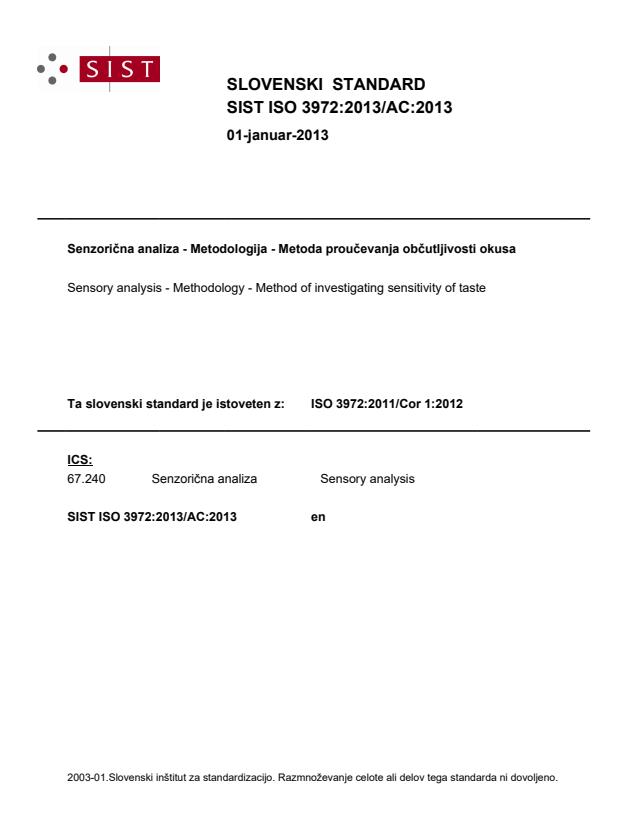
2003-01.Slovenski inštitut za standardizacijo. Razmnoževanje celote ali delov tega standarda ni dovoljeno.Sensory analysis - Methodology - Method of investigating sensitivity of taste67.240Sensory analysisICS:Ta slovenski standard je istoveten z:ISO 3972:2011/Cor 1:2012SIST ISO 3972:2013/AC:2013en01-januar-2013SIST ISO 3972:2013/AC:2013SLOVENSKI
STANDARD
INTERNATIONAL STANDARD ISO 3972:2011 TECHNICAL CORRIGENDUM 1 Published 2012-08-15 INTERNATIONAL ORGANIZATION FOR STANDARDIZATION
ORGANISATION INTERNATIONALE DE NORMALISATION
Sensory analysis — Methodology — Method of investigating sensitivity of taste TECHNICAL CORRIGENDUM 1 Analyse sensorielle — Méth
...