

SIST EN 835:2002
(Main)Heat cost allocators for the determination of the consumption of room heating radiators - Appliances without an electrical energy supply, based on the evaporation principle
General Information
- Abstract
Heat cost allocators in accordance with this standard are instruments for the registration of the heat output of radiators in consumer units. Consumer units are dwellings, office buildings, business premises, industrial plants in which the heat is supplied by a common central heating systems or by a common district heating connection. A complete grouping of consumer units is called an account unit.
- Status
- Published
- Publication Date
- 28-Feb-2002
- Technical Committee
- OGS - Heating for buildings
- Current Stage
- 6060 - National Implementation/Publication (Adopted Project)
- Start Date
- 01-Mar-2002
- Due Date
- 01-Mar-2002
- Completion Date
- 01-Mar-2002

Overview
EN 835:1994 (CEN) specifies requirements for heat cost allocators that determine the consumption of room heating radiators using the evaporation principle. These devices are appliances without an electrical energy supply and are intended to register the heat output of radiators in consumer units served by a common central or district heating system. A complete grouping of consumer units supplied together is termed an account unit. ICS classification: 91.140.10 (Central heating systems).
Key topics and requirements
EN 835:1994 focuses on the functional and application aspects of non-electrical heat cost allocators based on evaporation. Key technical topics and requirements covered by the standard include:
- Measurement principle: use of the evaporation principle to record relative radiator heat output without electrical power.
- Intended use: device application for consumer units such as dwellings, offices, business premises and industrial plants connected to central or district heating.
- Device characteristics: parameters that define how the appliance registers heat output and how readings are expressed for allocation.
- Installation and mounting: guidance on placement on radiators to ensure representative measurement of room heating.
- Performance and reliability: expected operational behavior under normal heating system conditions and typical building environments.
- Documentation and marking: identification, user information and records required for correct use and billing.
- Account unit concept: how readings from individual consumer units are aggregated for billing within a shared heating connection.
(EN 835:1994 is specifically limited to evaporation-type, non-powered heat cost allocators; it does not cover electrical or electronic heat meters.)
Applications
EN 835 is applicable in situations where radiator-level registration is required for fair distribution of heating costs across multiple consumers sharing a central or district heating system. Typical users and applications:
- Manufacturers designing or certifying evaporation-based heat cost allocators.
- Building owners and property managers implementing radiator-level cost allocation in multi-unit buildings.
- District and central heating operators who require consistent methods to allocate heat consumption.
- Energy auditors and consultants assessing heating cost allocation strategies and compliance.
- Installers and maintenance personnel responsible for correct placement and servicing.
Using EN 835 helps ensure consistent, comparable radiator consumption registration for billing and energy management without electrical power at the device.
Related standards
For comprehensive heat metering and cost allocation programs, EN 835 should be used alongside other CEN/ISO standards covering heat meters, building energy measurement, and billing methods (see national and CEN catalogs for specific references).
Get Certified
Connect with accredited certification bodies for this standard

DIBt (Deutsches Institut für Bautechnik)
German Institute for Building Technology.
DIN CERTCO
DIN Group product certification.

Aboma Certification B.V.
Specialized in construction, metal, and transport sectors.
Sponsored listings
Frequently Asked Questions
SIST EN 835:2002 is a standard published by the Slovenian Institute for Standardization (SIST). Its full title is "Heat cost allocators for the determination of the consumption of room heating radiators - Appliances without an electrical energy supply, based on the evaporation principle". This standard covers: Heat cost allocators in accordance with this standard are instruments for the registration of the heat output of radiators in consumer units. Consumer units are dwellings, office buildings, business premises, industrial plants in which the heat is supplied by a common central heating systems or by a common district heating connection. A complete grouping of consumer units is called an account unit.
Heat cost allocators in accordance with this standard are instruments for the registration of the heat output of radiators in consumer units. Consumer units are dwellings, office buildings, business premises, industrial plants in which the heat is supplied by a common central heating systems or by a common district heating connection. A complete grouping of consumer units is called an account unit.
SIST EN 835:2002 is classified under the following ICS (International Classification for Standards) categories: 91.140.10 - Central heating systems. The ICS classification helps identify the subject area and facilitates finding related standards.
SIST EN 835:2002 is associated with the following European legislation: EU Directives/Regulations: TRRTP021. When a standard is cited in the Official Journal of the European Union, products manufactured in conformity with it benefit from a presumption of conformity with the essential requirements of the corresponding EU directive or regulation.
SIST EN 835:2002 is available in PDF format for immediate download after purchase. The document can be added to your cart and obtained through the secure checkout process. Digital delivery ensures instant access to the complete standard document.
Standards Content (Sample)
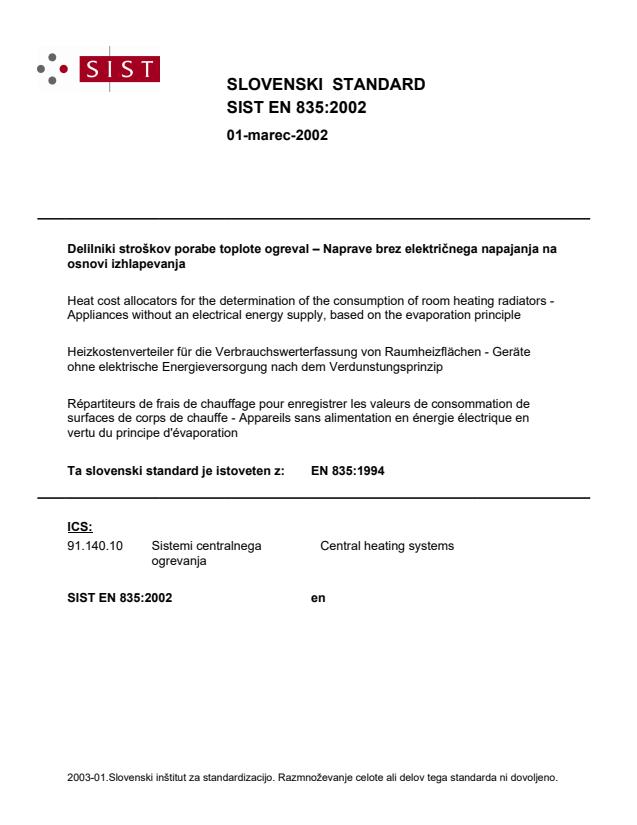
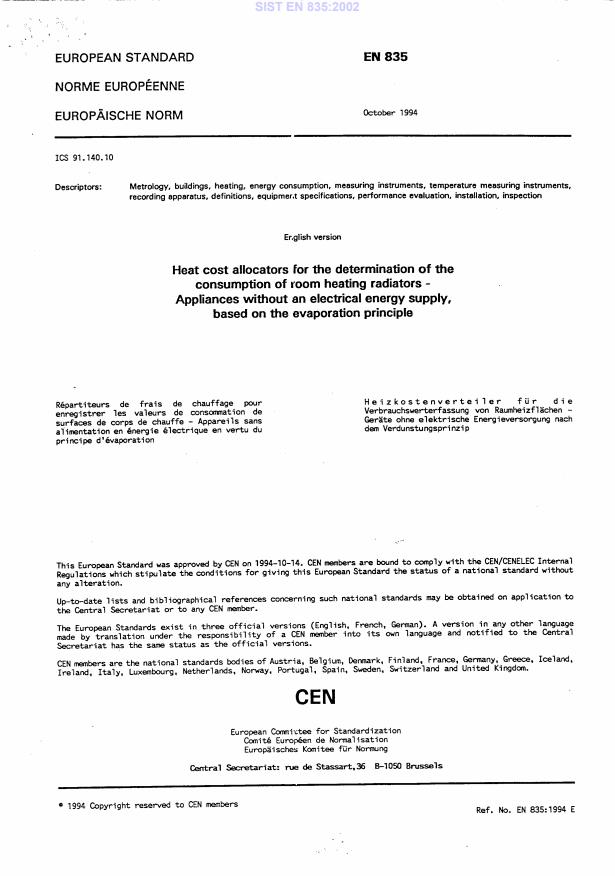
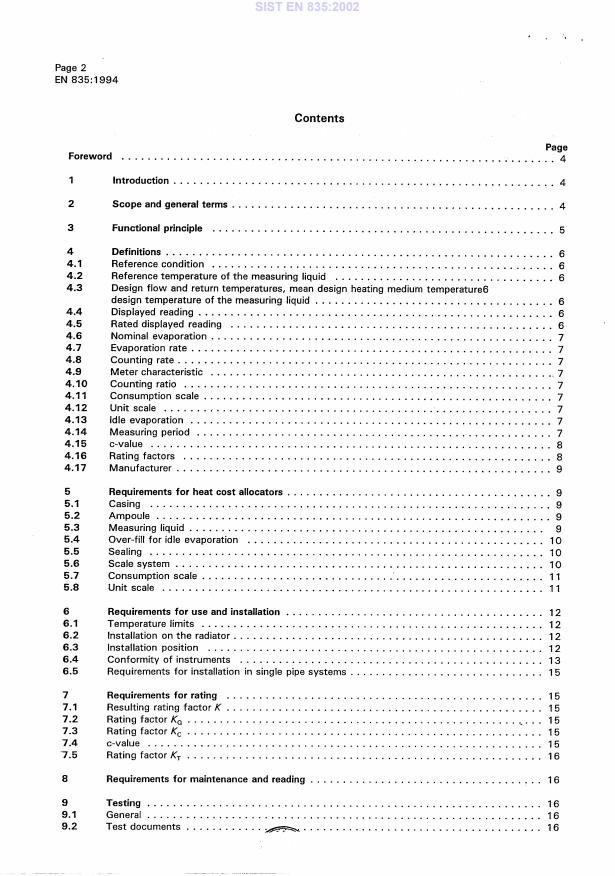
2003-01.Slovenski inštitut za standardizacijo. Razmnoževanje celote ali delov tega standarda ni dovoljeno.Heizkostenverteiler für die Verbrauchswerterfassung von Raumheizflächen - Geräte ohne elektrische Energieversorgung nach dem VerdunstungsprinzipRépartiteurs de frais de chauffage pour enregistrer les valeurs de consommation de surfaces de corps de chauffe - Appareils sans alimentation en énergie électrique en vertu du principe d'évaporationHeat cost allocators for the determination of the consumption of room heating radiators - Appliances without an electrical energy supply, based on the evaporation principle91.140.10Sistemi c
...