

SIST EN 16242:2013
(Main)Conservation of cultural property - Procedures and instruments for measuring humidity in the air and moisture exchanges between air and cultural property
General Information
- Abstract
This European Standard gives guidance and specifies procedures and instruments for the measurement of relative humidity (RH) in air, in outdoor or indoor environments. It indicates how RH can be directly measured or how it can be calculated from air temperature, wet-bulb temperature and dew-point temperature. This standard contains recommendations for accurate measurements of ambient conditions and moisture exchanges between air and cultural heritage objects. It is addressed to anyone in charge of environmental diagnosis, conservation or maintenance of buildings, collections or single objects.
- Status
- Published
- Public Enquiry End Date
- 24-Apr-2011
- Publication Date
- 15-Apr-2013
- Technical Committee
- I13 - Imaginarni 13
- Current Stage
- 6060 - National Implementation/Publication (Adopted Project)
- Start Date
- 09-Apr-2013
- Due Date
- 14-Jun-2013
- Completion Date
- 16-Apr-2013

Overview
EN 16242:2012 - "Conservation of cultural heritage - Procedures and instruments for measuring humidity in the air and moisture exchanges between air and cultural property" (CEN) provides guidance and specified procedures for accurate humidity measurement in indoor and outdoor environments relevant to cultural heritage. The standard explains how to measure or calculate relative humidity (RH) from dry-bulb, wet-bulb and dew-point temperatures and gives recommendations for assessing moisture exchanges between air and objects to inform preventive conservation and environmental monitoring.
Key topics and technical requirements
- Quantities and definitions: RH, dew-point temperature, absolute humidity (AH), humidity mixing ratio (MR), dry/wet-bulb and surface temperatures, equilibrium moisture content (EMC).
- Instrument types covered:
- Chilled‑mirror dew‑point hygrometers
- Electronic psychrometers
- Electronic hygrometers with capacitive or resistive sensors
- Hair hygrometers / hygrographs
- Thermometers and barometers for combined measurements
- Measurement considerations: sensor placement, ventilation/aspiration, thermal shielding, response time, resolution, measuring range and time stability.
- Performance characteristics: repeatability, uncertainty of measurement, calibration needs and traceability.
- Calculation guidance: formulae to compute RH and related variables from combinations of t, tw, td and pressure (Annex A).
- Practical diagnostics (Annex B): examples for recognizing air penetration, wall dampness due to condensation vs. evaporation, and external dampness using MR plots.
- Instrumental errors (Annex C): typical error sources (pressure effects, thermal inertia, sensor non‑linearity/hysteresis) and their impact on readings.
Applications and practical value
EN 16242 is intended to support environmental diagnosis, preventive conservation and maintenance by enabling reliable humidity monitoring and interpretation. Typical uses include:
- Museums, archives and historic buildings - monitoring RH and moisture exchanges to reduce risk of dimensional change, mould growth, corrosion and chemical degradation.
- Conservation scientists and collection care professionals - selecting appropriate instruments and procedures for field surveys and long‑term monitoring.
- Facilities and building managers - diagnosing moisture ingress, HVAC performance and microclimate control strategies.
- Restoration projects and condition assessments - documenting ambient conditions and guiding mitigation measures.
Who should use this standard
- Conservators, collection managers and curators
- Conservation scientists and environmental consultants
- Museum technicians, facilities managers and building engineers
- Laboratories performing humidity instrument calibration and environmental monitoring
Related standards
Normative references include: EN 15757:2010, EN 15758:2010, EN 60751, EN ISO/IEC 17025 and ISO/IEC Guide 98‑3 - all relevant for temperature/humidity specification, measurement quality and uncertainty.
Keywords: EN 16242, humidity measurement, relative humidity, dew point, hygrometer, psychrometer, cultural heritage conservation, environmental monitoring, moisture exchanges, calibration.
Relations
- Effective Date
- 09-Feb-2026
- Effective Date
- 28-Jan-2026
- Effective Date
- 28-Jan-2026
- Effective Date
- 28-Jan-2026
- Effective Date
- 28-Jan-2026
- Effective Date
- 28-Jan-2026
- Effective Date
- 28-Jan-2026
- Effective Date
- 28-Jan-2026
Get Certified
Connect with accredited certification bodies for this standard

CIS Institut d.o.o.
Personal Protective Equipment (PPE) certification body. Notified Body NB-2890 for EU Regulation 2016/425 PPE.

Kiwa BDA Testing
Building and construction product certification.
Kmetijski inštitut Slovenije
Agricultural Institute of Slovenia. Soil testing, plant health, agricultural product analysis.
Sponsored listings
Frequently Asked Questions
SIST EN 16242:2013 is a standard published by the Slovenian Institute for Standardization (SIST). Its full title is "Conservation of cultural property - Procedures and instruments for measuring humidity in the air and moisture exchanges between air and cultural property". This standard covers: This European Standard gives guidance and specifies procedures and instruments for the measurement of relative humidity (RH) in air, in outdoor or indoor environments. It indicates how RH can be directly measured or how it can be calculated from air temperature, wet-bulb temperature and dew-point temperature. This standard contains recommendations for accurate measurements of ambient conditions and moisture exchanges between air and cultural heritage objects. It is addressed to anyone in charge of environmental diagnosis, conservation or maintenance of buildings, collections or single objects.
This European Standard gives guidance and specifies procedures and instruments for the measurement of relative humidity (RH) in air, in outdoor or indoor environments. It indicates how RH can be directly measured or how it can be calculated from air temperature, wet-bulb temperature and dew-point temperature. This standard contains recommendations for accurate measurements of ambient conditions and moisture exchanges between air and cultural heritage objects. It is addressed to anyone in charge of environmental diagnosis, conservation or maintenance of buildings, collections or single objects.
SIST EN 16242:2013 is classified under the following ICS (International Classification for Standards) categories: 13.040.99 - Other standards related to air quality; 97.195 - Items of art and handicrafts. Cultural property and heritage. The ICS classification helps identify the subject area and facilitates finding related standards.
SIST EN 16242:2013 has the following relationships with other standards: It is inter standard links to SIST EN IEC 60751:2022, SIST EN ISO/IEC 17025:2017, SIST EN 15758:2010, SIST EN 15757:2010, SIST EN 1504-10:2017, SIST EN 16682:2017, SIST EN 15759-2:2018, SIST EN 15759-1:2012. Understanding these relationships helps ensure you are using the most current and applicable version of the standard.
SIST EN 16242:2013 is available in PDF format for immediate download after purchase. The document can be added to your cart and obtained through the secure checkout process. Digital delivery ensures instant access to the complete standard document.
Standards Content (Sample)
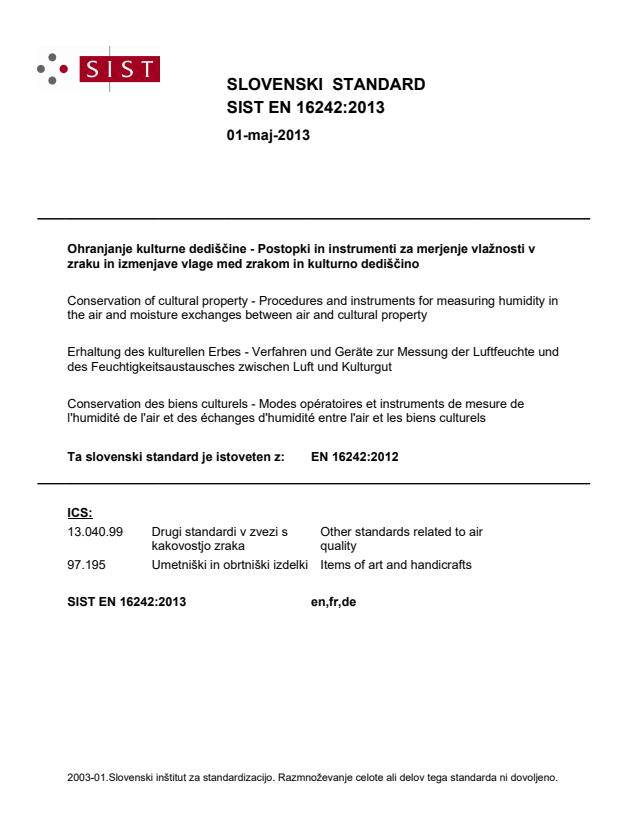
2003-01.Slovenski inštitut za standardizacijo. Razmnoževanje celote ali delov tega standarda ni dovoljeno.Erhaltung des kulturellen Erbes - Verfahren und Geräte zur Messung der Luftfeuchte und des Feuchtigkeitsaustausches zwischen Luft und KulturgutConservation des biens culturels - Modes opératoires et instruments de mesure de l'humidité de l'air et des échanges d'humidité entre l'air et les biens culturelsConservation of cultural property - Procedures and instruments for measuring humidity in the air and moisture exchanges between air and cultural property97.195Umetniški in obrtniški izdelkiItems of art and handicrafts13.040.99Drugi standardi v zvezi s kakovostjo zrakaOther standards related to air qualityICS:Ta slovenski standard je istoveten z:EN 16242:2012SIST EN 16242:2013en,fr,de01-maj-2013SIST EN 16242:2013SLOVENSKI
STANDARD
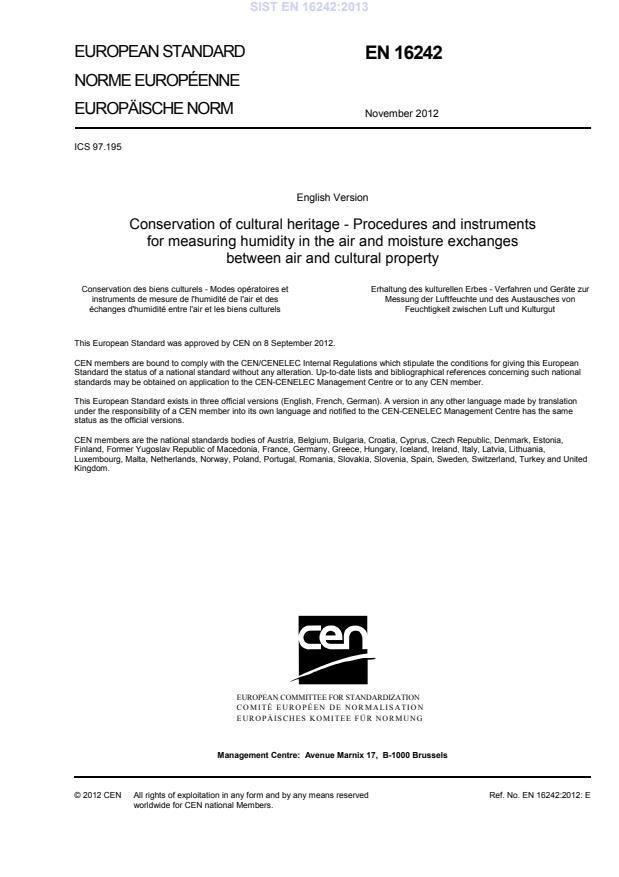
EUROPEAN STANDARD NORME EUROPÉENNE EUROPÄISCHE NORM
EN 16242
November 2012 ICS 97.195 English Version
Conservation of cultural heritage - Procedures and instruments for measuring humidity in the air and moisture exchanges between air and cultural property
Conservation des biens culturels - Modes opératoires et instruments de mesure de l'humidité de l'air et des échanges d'humidité entre l'air et les biens culturels
Erhaltung des kulturellen Erbes - Verfahren und Geräte zur Messung der Luftfeuchte und des Austausches von Feuchtigkeit zwischen Luft und Kulturgut This European Standard was approved by CEN on 8 September 2012.
CEN members are bound to comply with the CEN/CENELEC Internal Regulations which stipulate the conditions for giving this European Standard the status of a national standard without any alteration. Up-to-date lists and bibliographical references concerning such national standards may be obtained on application to the CEN-CENELEC Management Centre or to any CEN member.
This European Standard exists in three official versions (English, French, German). A version in any other language made by translation under the responsibility of a CEN member into its own language and notified to the CEN-CENELEC Management Centre has the same status as the official versions.
CEN members are the national standards bodies of Austria, Belgium, Bulgaria, Croatia, Cyprus, Czech Republic, Denmark, Estonia, Finland, Former Yugoslav Republic of Macedonia, France, Germany, Greece, Hungary, Iceland, Ireland, Italy, Latvia, Lithuania, Luxembourg, Malta, Netherlands, Norway, Poland, Portugal, Romania, Slovakia, Slovenia, Spain, Sweden, Switzerland, Turkey and United Kingdom.
EUROPEAN COMMITTEE FOR STANDARDIZATION
COMITÉ EUROPÉEN DE NORMALISATION EUROPÄISCHES KOMITEE FÜR NORMUNG
Management Centre:
Avenue Marnix 17,
B-1000 Brussels © 2012 CEN All rights of exploitation in any form and by any means reserved worldwide for CEN national Members. Ref. No. EN 16242:2012: ESIST EN 16242:2013
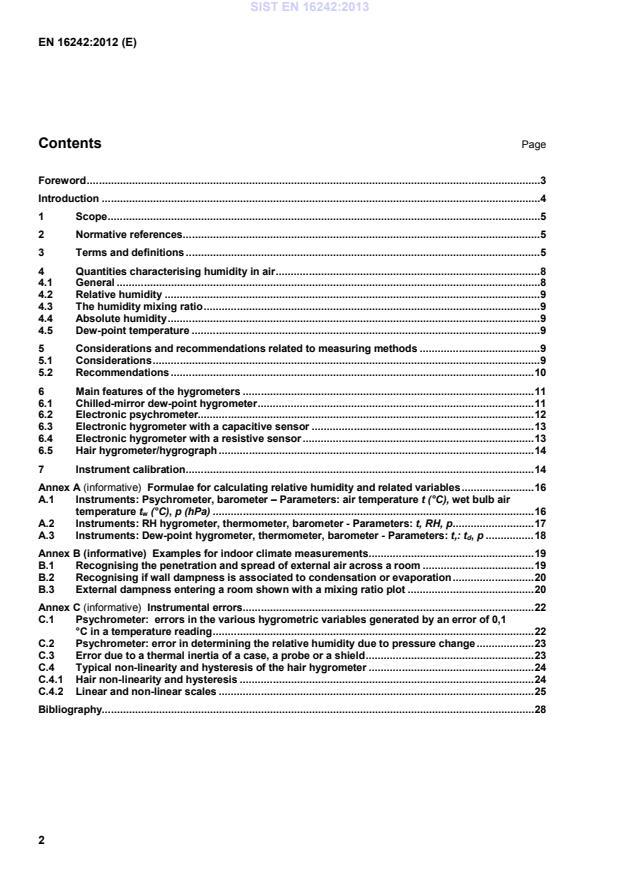
Formulae for calculating relative humidity and related variables . 16 A.1 Instruments: Psychrometer, barometer – Parameters: air temperature t (°C), wet bulb air temperature tw (°C), p (hPa) . 16 A.2 Instruments: RH hygrometer, thermometer, barometer - Parameters: t, RH, p . 17 A.3 Instruments: Dew-point hygrometer, thermometer, barometer - Parameters: t,: td, p . 18 Annex B (informative)
Examples for indoor climate measurements . 19 B.1 Recognising the penetration and spread of external air across a room . 19 B.2 Recognising if wall dampness is associated to condensation or evaporation . 20 B.3 External dampness entering a room shown with a mixing ratio plot . 20 Annex C (informative)
Instrumental errors . 22 C.1 Psychrometer:
errors in the various hygrometric variables generated by an error of 0,1 °C in a temperature reading . 22 C.2 Psychrometer: error in determining the relative humidity due to pressure change . 23 C.3 Error due to a thermal inertia of a case, a probe or a shield . 23 C.4 Typical non-linearity and hysteresis of the hair hygrometer . 24 C.4.1 Hair non-linearity and hysteresis . 24 C.4.2 Linear and non-linear scales . 25 Bibliography. 28
Note 1 to entry: This volume density is also noted ρv (v for volume) 3.2 atmospheric (or barometric) pressure (p) pressure is the force per unit area exerted by the air column above the measuring point, expressed in hPa (hectopascal) Note 1 to entry: 1 hPa = 1 mbar (millibar) 3.3 barometer instrument for measuring atmospheric pressure SIST EN 16242:2013
3.17 repeatability ability of the measuring instrument to reproduce the same output when successively measuring the same value of the air or the surface under investigation, taken under the same conditions Note 1 to entry: This is expressed as ± percent of the range.
[SOURCE: EN 15758:2010] 3.18 resolution smallest difference between indications of a displaying device that can be meaningfully distinguished 3.19 response time time interval between the instant when the parameter under investigation is subjected to a specified abrupt change and the instant when the response reaches and remains within specified limits around its final steady value Note 1 to entry: The response time is typically expressed as the time needed to reach 63,2 % of the final value and in this case is called time constant, or 90 % or 95 % of it. The 90 % response time is 2,3 times longer than the time constant and the 95 % response time is three times longer. The response time is independent of the span of the output change.
[SOURCE: EN 15758:2010] 3.20 saturation vapour pressure (esat(t)) maximum pressure of the water vapour in equilibrium with plane surface of pure water, expressed in hPa (hectopascal) 3.21 sensor device that senses either an absolute value or a change in a physical quantity and converts them into a useful signal for an information-gathering system SIST EN 16242:2013
[SOURCE: EN 15758:2010] 3.23 time constant time interval between the instant when the air, or the surface temperature, is subjected to a specified abrupt change and the instant when the response reaches (1 – 1/e) x 100 = 63,2 % and remains within specified limits around its final steady value Note 1 to entry: See also response time.
[SOURCE: EN 15758:2010] 3.24 time stability rate at which characteristics change in the course of time Note 1 to entry: It is often expressed in terms of a percent change of the response per year (% / year). 3.25 surface temperature (ts) temperature of a given surface of an object Note 1 to entry: This can be measured with contact thermometers, quasi-contact total radiation thermometers or remote infrared thermometers. The surface temperature is generally different from the air temperature, and varies between different objects and different places on the same object. It is expressed in degrees Celsius (°C). In general, the measured surface temperature is not representative of the whole object.
[SOURCE: EN 15758:2010] 3.26 uncertainty (of measurement) uncertainty is a non-negative parameter characterising the dispersion of the values attributed to a measured quantity
[SOURCE: EN 15758:2010] 3.27 wet-bulb temperature (tw) in a psychrometer, the temperature reached by a thermometer sheathed in wet wicking, expressed in degrees Celsius (°C) 4 Quantities characterising humidity in air 4.1 General
Air humidity is expressed in a number of ways. In this standard, we refer to four key quantities characterising humidity in air for the purposes of environmental diagnosis to preserve cultural heritage: relative humidity, humidity mixing ratio, absolute humidity and dew-point temperature. SIST EN 16242:2013
Relative humidity (RH) is responsible for, or related to, many deterioration mechanisms affecting cultural property preservation. Dry environments become dusty and electrostatic deposition is enhanced. Humid environments increase chemical reactivity of gaseous pollutants. Hygroscopic materials, such as wood, paper, textiles, leather or bone, absorb and release moisture in response to changes in RH, reaching eventually at a given temperature and RH a constant level of moisture termed Equilibrium Moisture Content (EMC). The variations in EMC produce dimensional changes of the materials, i.e. expansion when EMC is increasing and shrinkage when decreasing, which may lead to high levels of stress and physical damage as fracture and deformation. High EMC favours mould growth, as well as hydrolysis, oxidation, corrosion or other chemical reactions. RH has a synergic effect with light, temperature, pollution and other environmental factors in accelerating fading, discoloration and embrittlement. 4.3 The humidity mixing ratio The humidity mixing ratio (MR) is used to distinguish if water molecules are added to or removed from the atmosphere, e.g. to monitor evaporation, condensation, or mixing of two air masses. It is useful for environmental diagnostic purposes, to provide evidence of the action of heating, ventilation and air-conditioning systems (HVAC systems) or air-surface interactions. By measuring this parameter along a horizontal cross-section of a room, it is possible to reveal external air penetrating through openings, or moisture released by visitors, or when and where masonry is evaporating (higher MR close to the wall) or adsorbing moisture (lower MR to the wall). 4.4 Absolute humidity
The absolute humidity (AH) is useful in assessing the maximum quantity of water vapour that a given volume can contain at specified temperature conditions. When AH exceeds the saturation level in the air, the excess moisture will condense. From the knowledge of the volume of a closed space, it is possible to calculate how much water will condense on objects and masonry. Such information can be used to determine, e.g., the maximum allowable number of visitors in a closed room, in order to avoid high humidity levels. 4.5 Dew-point temperature
When the dew-point (DP) of the air is compared with the surface temperature (TS) of a structure or an object, the potential risk of water vapour condensation on that surface can be evaluated, i.e. condensation occurs if TS is below DP and does not occur if TS is above DP. Formulae to calculate the above quantities are reported in Annex A. Examples of environmental diagnosis using these quantities are reported in Annex B. 5 Considerations and recommendations related to measuring methods 5.1 Considerations An accurate determination of relative humidity (RH) requires particular care because the measurement depends on the temperatures of the air and the instrument, which should be in equilibrium with each other. Recommendations described in EN 15757 should be considered in the frame of this standard. They should also be considered in the frame of a specific monitoring campaign that contains not only the quantity but also the thermal and/or humidity fields in the surrounding environment as well as close to the object. The locations of the measuring points should be selected in such a way that they are representative of the environment under investigation. Each room generally shows variations of temperature and RH from point to point, therefore temperature and RH of the air that interacts with the object should be measured at a close SIST EN 16242:2013
Dew-point hygrometer a
Electronic psychrometer Capacitive electronic hygrometer Resistive electronic hygrometer Hair hygrometer Accuracy level 1: very high 2: high 3: medium 3: medium 4: low Measuring range -20 °C to 50 °C 5 % - 95 % 10 °C to 50 °C 5 % - 95 % -10 °C to 50 °C 5 % - 95 % -10 °C to 50 °C 35 % - 95 % -10 °C to 50 °C Uncertainty b
0,5 °C 2 % 3 % 3 % 10 % Repeatability 0,2 °C 1 % 2 % 2 % 5 % Resolution 0,1 °C 1 % 1 % 1 % 2,5 % Instrument time constant (63 %) in still air not relevant
required:
≤ 2 min desirable c
:
≤ 1 min
required:
≤ 5 min desirable:
≤ 2 min
required:
≤ 5 min desirable:
≤ 2 min
10 min Stability ≤ 0,2 °C/year ≤ 2 %/year ≤ 2 %/year ≤ 2 %/year 5 %/month Periodic checking and maintenance d
6 months Calibration:
1 year; Wick: daily, or when the instrument is used 1 year 1 year 3 months Recommended use laboratory calibration 1) checking calibration of other hygrometers
2) spot field measurements spot or routine measurements; data collection for statistical
analysis spot or routine measurements; data collection for statistical
analysis only in exceptional circumstances for visual inspection a The specifications apply to chilled-mirror dew-point meters. Other hygrometers exist, based on temperature and (capacitive or resistive) RH sensors that calculate and provide dew-point values, and for this reason are improperly called “dew-point meters”. For them, reference should be made to the related “Capacitive” or “Resistive” electronic hygrometer in this Table b Uncertainly includes everything under the condition of use, stated by the supplier/manufacturer, i.e. display resolution and short-term repeatability, calibration, periodical service, air quality, etc. See ISO/IEC Guide 98-3: c The ‘desirable’ response time would be of a considerable benefit for spot readings or continuous monitoring of short-term effects d In case of polluted air or marine environments the intervals will have to be shorter. 6 Main features of the hygrometers 6.1 Chilled-mirror dew-point hygrometer Operating principle: This hygrometer is based on the detection of the temperature of a cooled mirror at the point at which condensation forms. The temperature of a mirror is controlled by an electronic feedback to maintain a dynamic equilibrium between evaporation and condensation, thus closely following the dew-point temperature changes. NOTE The chilled-mirror hygrometer is more accurate than other hygrometers because the measurement is based on only one temperature sensor, and temperature sensors are more accurate than humidity sensors. Other commercially available instruments exist under the name “dew-point hygrometer” but are based on a combination of temperature and SI
...