

oSIST prEN IEC 55032:2026
(Main)Electromagnetic compatibility of multimedia equipment - Emission requirements
General Information
- Abstract
- Status
- Not Published
- Public Enquiry End Date
- 31-Jan-2026
- Technical Committee
- EMC - Electromagnetic compatibility
- Current Stage
- 4020 - Public enquire (PE) (Adopted Project)
- Start Date
- 25-Nov-2025
- Due Date
- 14-Apr-2026
- Completion Date
- 18-Dec-2025

Overview
oSIST prEN IEC 55032:2026 is an international standard developed by SIST, aligning with prEN IEC 55032:2025 and the IEC CISPR 32 ED3 project. This standard specifies emission requirements for electromagnetic compatibility (EMC) in multimedia equipment, including information technology, audio/video equipment, broadcast receivers, and systems used in teleconferencing. The standard plays a critical role in ensuring that multimedia devices operate without causing or being affected by electromagnetic interference, supporting reliable operation and regulatory compliance in global markets.
Key Topics
- Electromagnetic emission requirements: The standard outlines comprehensive emission limits for a wide range of multimedia equipment including both radiated and conducted emissions.
- Classification of equipment: Devices are categorized to determine applicable emission limits depending on their function and intended environment (e.g., Class A for industrial, Class B for residential).
- Measurement procedures: Guidelines detail how to conduct accurate and repeatable emissions testing, including the setup for table-top, floor-standing equipment, and systems with radio functionality.
- Applicable ports and connections: Specific requirements apply to various interface ports, such as AC mains, analogue/digital data ports, RF modulator outputs, and broadcast receiver tuner ports.
- Compliance and documentation: The standard provides guidance on test reporting, measurement uncertainties, and documentation needed to demonstrate compliance.
- Special provisions: There are additional requirements for equipment with embedded radio functions, outdoor satellite receiver units, and guidance on in situ measurements.
Applications
oSIST prEN IEC 55032:2026 is applicable to a broad array of multimedia equipment, supporting manufacturers, test laboratories, and regulatory authorities by:
- Design and development: Guiding product design to prevent excessive electromagnetic emissions, ensuring products are robust against interference and meet regulatory needs.
- Pre-market testing: Establishing the methodology and criteria for EMC testing of multimedia equipment prior to market release.
- Product certification: Facilitating the certification process by providing clear benchmarks for emission limits and compliance requirements recognized by global regulatory bodies.
- Quality assurance: Assisting internal or third-party quality checks post-production to ensure ongoing compliance as products are modified or updated.
- Installation and integration: Supporting system integrators in evaluating EMC performance when assembling multimedia systems in different environments.
This standard is crucial in industries such as consumer electronics, professional AV, telecommunication, IT infrastructure, and home automation, where the electromagnetic environment is becoming more complex and demanding.
Related Standards
Manufacturers and stakeholders implementing oSIST prEN IEC 55032:2026 should also be aware of several related international standards that form the foundation of electromagnetic compatibility requirements for multimedia equipment:
- CISPR 16 series - Basic standards for EMC testing and measurement methods, referenced extensively for test procedures and equipment setup.
- CISPR 32 - The international root standard on which oSIST prEN IEC 55032:2026 is based.
- IEC 61000 series - Covers broader EMC immunity and emission requirements for electrical and electronic equipment.
- IEC 62368-1 - Addresses safety requirements relevant for audio/video, IT, and communication equipment.
- EN 55035 - Specifies immunity requirements for multimedia equipment, complementing the emission requirements in 55032.
- National EMC regulations - Compliance with this standard supports conformance to regional directives such as the EU EMC Directive.
Ensuring familiarity with these related standards is essential for achieving full compliance and mitigating electromagnetic compatibility risks in multimedia equipment design and deployment.
Keywords: electromagnetic compatibility, EMC emission requirements, multimedia equipment, CISPR 32, IEC 55032, SIST, information technology, audio/video equipment, compliance testing, conducted emissions, radiated emissions, broadcast equipment, measurement procedures, standardization.
Relations
- Effective Date
- 20-Feb-2024
- Effective Date
- 20-Feb-2024
- Revises
SIST EN 55032:2015 - Electromagnetic compatibility of multimedia equipment - Emission Requirements - Effective Date
- 20-Feb-2024
- Effective Date
- 20-Feb-2024
- Effective Date
- 20-Feb-2024
Get Certified
Connect with accredited certification bodies for this standard

ANCE
Mexican certification and testing association.

Intertek Slovenia
Intertek testing, inspection, and certification services in Slovenia.

LNE (Laboratoire National de Métrologie et d'Essais)
French national laboratory for metrology and testing.
Sponsored listings
Frequently Asked Questions
oSIST prEN IEC 55032:2026 is a draft published by the Slovenian Institute for Standardization (SIST). Its full title is "Electromagnetic compatibility of multimedia equipment - Emission requirements". This standard covers: Electromagnetic compatibility of multimedia equipment - Emission requirements
Electromagnetic compatibility of multimedia equipment - Emission requirements
oSIST prEN IEC 55032:2026 is classified under the following ICS (International Classification for Standards) categories: 33.100.10 - Emission; 33.160.60 - Multimedia systems and teleconferencing equipment. The ICS classification helps identify the subject area and facilitates finding related standards.
oSIST prEN IEC 55032:2026 has the following relationships with other standards: It is inter standard links to SIST EN 55032:2015/FprAB:2026, SIST EN 55032:2015/A1:2021, SIST EN 55032:2015, SIST EN 55032:2015/A11:2020, SIST EN 55032:2015/AC:2016. Understanding these relationships helps ensure you are using the most current and applicable version of the standard.
oSIST prEN IEC 55032:2026 is associated with the following European legislation: EU Directives/Regulations: 2014/30/EU, 2014/53/EU; Standardization Mandates: M/536, M/552. When a standard is cited in the Official Journal of the European Union, products manufactured in conformity with it benefit from a presumption of conformity with the essential requirements of the corresponding EU directive or regulation.
oSIST prEN IEC 55032:2026 is available in PDF format for immediate download after purchase. The document can be added to your cart and obtained through the secure checkout process. Digital delivery ensures instant access to the complete standard document.
Standards Content (Sample)
SLOVENSKI STANDARD
01-januar-2026
Elektromagnetna združljivost večpredstavnostne opreme - Zahteve glede
elektromagnetnega sevanja
Electromagnetic compatibility of multimedia equipment - Emission requirements
Compatibilité électromagnétique des équipements multimédia - Exigences d'émission
Ta slovenski standard je istoveten z: prEN IEC 55032:2025
ICS:
33.100.10 Emisija Emission
33.160.60 Večpredstavni (multimedijski) Multimedia systems and
sistemi in oprema za teleconferencing equipment
telekonference
2003-01.Slovenski inštitut za standardizacijo. Razmnoževanje celote ali delov tega standarda ni dovoljeno.
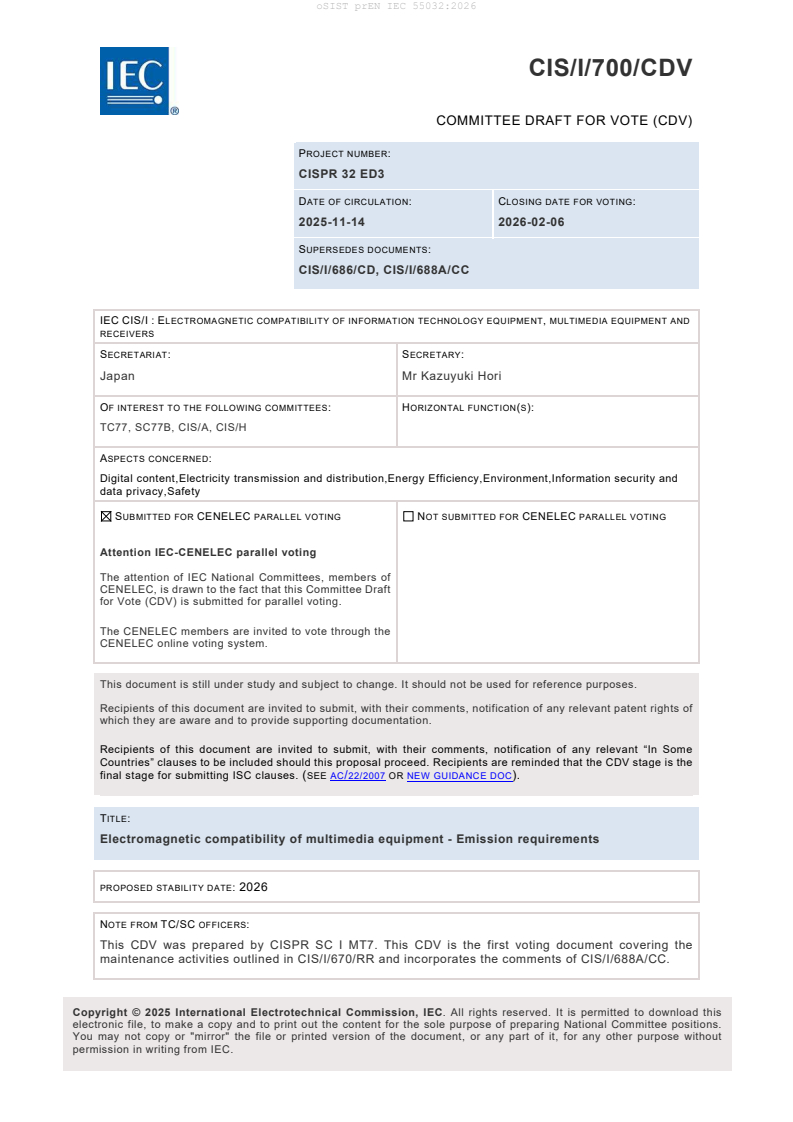
CIS/I/700/CDV
COMMITTEE DRAFT FOR VOTE (CDV)
PROJECT NUMBER:
CISPR 32 ED3
DATE OF CIRCULATION: CLOSING DATE FOR VOTING:
2025-11-14 2026-02-06
SUPERSEDES DOCUMENTS:
CIS/I/686/CD, CIS/I/688A/CC
IEC CIS/I : ELECTROMAGNETIC COMPATIBILITY OF INFORMATION TECHNOLOGY EQUIPMENT, MULTIMEDIA EQUIPMENT AND
RECEIVERS
SECRETARIAT: SECRETARY:
Japan Mr Kazuyuki Hori
OF INTEREST TO THE FOLLOWING COMMITTEES: HORIZONTAL FUNCTION(S):
TC77, SC77B, CIS/A, CIS/H
ASPECTS CONCERNED:
Digital content,Electricity transmission and distribution,Energy Efficiency,Environment,Information security and
data privacy,Safety
SUBMITTED FOR CENELEC PARALLEL VOTING NOT SUBMITTED FOR CENELEC PARALLEL VOTING
Attention IEC-CENELEC parallel voting
The attention of IEC National Committees, members of
CENELEC, is drawn to the fact that this Committee Draft
for Vote (CDV) is submitted for parallel voting.
The CENELEC members are invited to vote through the
CENELEC online voting system.
This document is still under study and subject to change. It should not be used for reference purposes.
Recipients of this document are invited to submit, with their comments, notification of any relevant patent rights of
which they are aware and to provide supporting documentation.
Recipients of this document are invited to submit, with their comments, notification of any relevant “In Some
Countries” clauses to be included should this proposal proceed. Recipients are reminded that the CDV stage is the
final stage for submitting ISC clauses. (SEE AC/22/2007 OR NEW GUIDANCE DOC).
TITLE:
Electromagnetic compatibility of multimedia equipment - Emission requirements
PROPOSED STABILITY DATE: 2026
NOTE FROM TC/SC OFFICERS:
This CDV was prepared by CISPR SC I MT7. This CDV is the first voting document covering the
maintenance activities outlined in CIS/I/670/RR and incorporates the comments of CIS/I/688A/CC.
electronic file, to make a copy and to print out the content for the sole purpose of preparing National Committee positions.
You may not copy or "mirror" the file or printed version of the document, or any part of it, for any other purpose without
permission in writing from IEC.
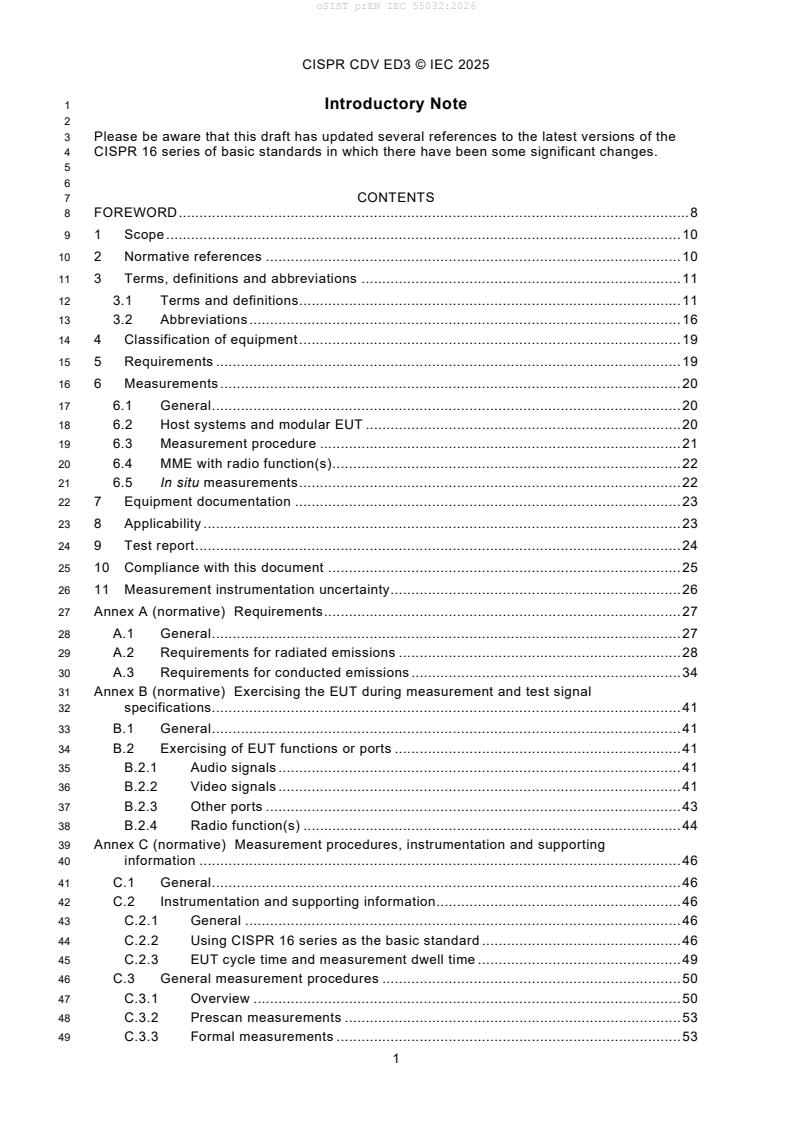
CISPR CDV ED3 © IEC 2025
1 Introductory Note
3 Please be aware that this draft has updated several references to the latest versions of the
4 CISPR 16 series of basic standards in which there have been some significant changes.
7 CONTENTS
8 FOREWORD . 8
9 1 Scope . 10
10 2 Normative references . 10
11 3 Terms, definitions and abbreviations . 11
12 3.1 Terms and definitions . 11
13 3.2 Abbreviations . 16
14 4 Classification of equipment . 19
15 5 Requirements . 19
16 6 Measurements . 20
17 6.1 General . 20
18 6.2 Host systems and modular EUT . 20
19 6.3 Measurement procedure . 21
20 6.4 MME with radio function(s) . 22
21 6.5 In situ measurements . 22
22 7 Equipment documentation . 23
23 8 Applicability . 23
24 9 Test report . 24
25 10 Compliance with this document . 25
26 11 Measurement instrumentation uncertainty . 26
27 Annex A (normative) Requirements . 27
28 A.1 General . 27
29 A.2 Requirements for radiated emissions . 28
30 A.3 Requirements for conducted emissions . 34
31 Annex B (normative) Exercising the EUT during measurement and test signal
32 specifications. 41
33 B.1 General . 41
34 B.2 Exercising of EUT functions or ports . 41
35 B.2.1 Audio signals . 41
36 B.2.2 Video signals . 41
37 B.2.3 Other ports . 43
38 B.2.4 Radio function(s) . 44
39 Annex C (normative) Measurement procedures, instrumentation and supporting
40 information . 46
41 C.1 General . 46
42 C.2 Instrumentation and supporting information . 46
43 C.2.1 General . 46
44 C.2.2 Using CISPR 16 series as the basic standard . 46
45 C.2.3 EUT cycle time and measurement dwell time . 49
46 C.3 General measurement procedures . 50
47 C.3.1 Overview . 50
48 C.3.2 Prescan measurements . 53
49 C.3.3 Formal measurements . 53
CISPR CDV ED3 © IEC 2025
50 C.3.4 Specifics for radiated emission measurements . 53
51 C.3.5 Specifics for conducted emission measurements on AC mains
52 power ports . 54
53 C.3.6 Specifics for conducted emission measurements on
54 analogue/digital data ports . 54
55 C.3.7 Specifics for conducted emission measurements on broadcast
56 receiver tuner ports . 54
57 C.3.8 Specifics for conducted emission measurements on RF modulator
58 output ports . 54
59 C.3.9 Specifics for conducted emission measurements on DC network
60 power ports . 54
61 C.4 MME-related measurement procedures . 55
62 C.4.1 Measurement of conducted emissions at analogue/digital data
63 ports . 55
64 C.4.2 Measurement of emission voltages at TV/audio broadcast receiver
65 tuner ports in the frequency range 30 MHz to 2,15 GHz . 66
66 C.4.3 Measurement of the wanted signal and emission voltage at RF
67 modulator output ports, in the frequency range 30 MHz to 2,15 GHz . 67
68 Annex D (normative) Arrangement of EUT, local AE and associated cabling . 69
69 D.1 Overview. 69
70 D.1.1 General . 69
71 D.1.2 Table-top arrangement . 72
72 D.1.3 Floor standing arrangement . 73
73 D.1.4 Combinations of table-top and floor standing EUT arrangement . 73
74 D.1.5 Arrangements for radiated measurement in a FAR (30 MHz – 1
75 GHz) . 73
76 D.1.6 Arrangements for radiated measurement in a RVC . 74
77 D.2 MME-related conditions for conducted emission measurement . 74
78 D.2.1 General . 74
79 D.2.2 Specific conditions for table-top equipment . 75
80 D.2.3 Specific requirements for floor standing equipment . 76
81 D.2.4 Specific requirements for combined table-top and floor standing
82 equipment. 76
83 D.3 MME-related requirements for radiated measurement . 76
84 D.3.1 General . 76
85 D.3.2 Requirements for table-top equipment . 76
86 Annex E (informative) Prescan measurements . 88
87 Annex F (informative) Test report contents summary . 89
88 Annex G (informative) Support information for the measurement procedures defined in
89 C.4.1.1 . 91
90 G.1 Schematic diagrams of examples of artificial networks . 91
91 G.2 Rationale for emission measurements and procedures for wired network
92 ports . 106
93 G.2.1 Introduction . 106
94 G.2.2 Combination of current probe and CVP . 107
95 G.2.3 Basic ideas of the CVP . 107
96 G.2.4 Combination of current and voltage limit . 108
97 G.2.5 Ferrite requirements for use in C.4.1.1 . 109
98 Annex H (normative) Outdoor unit of home satellite broadcast receiving systems . 113
99 H.1 Rationale . 113
100 H.2 General . 114
CISPR CDV ED3 © IEC 2025
101 H.3 Operation conditions . 114
102 H.4 EUT arrangements . 115
103 H.4.1 Conducted measurements (table clause A8.4) . 115
104 H.4.2 Radiated measurements . 116
105 Annex I (informative) Other test methods and associated limits for radiated emissions . 122
106 I.1 General . 122
107 I.2 Procedures for radiated emission measurements using a GTEM . 122
108 I.3 Additional measurement procedure information . 123
109 I.3.1 General . 123
110 I.3.2 Specific considerations for radiated emission measurements using
111 a GTEM . 123
112 I.4 Use of a GTEM for radiated emission measurements . 124
113 I.4.1 General . 124
114 I.4.2 EUT layout . 124
115 I.4.3 GTEM, measurements above 1 GHz . 125
116 I.4.4 Uncertainties . 125
117 I.5 Reference documents . 126
118 Annex J (informative) Colour bar image . 127
119 J.1 Overview. 127
120 J.2 Image description . 127
121 J.3 Primary colour contributions and saturation . 127
122 J.4 Moving element . 128
123 Annex K (informative) Guidance on testing MME incorporating radiocommunication or
124 radiodetermination functionality . 129
125 K.1 Introduction . 129
126 K.2 MME with radio functionality . 129
127 K.3 Test arrangements . 130
128 Annex L (normative) In situ measurement . 132
129 L.1 General . 132
130 L.2 In situ conducted emission measurement . 132
131 L.2.1 General . 132
132 L.2.2 Mains power ports . 132
133 L.2.3 Analogue/digital data ports . 132
134 L.3 In situ radiated emission measurement . 133
135 L.3.1 General . 133
136 L.3.2 Ambient noise . 134
137 Annex M (informative) Explanation of the changes to radiated electric field emission
138 requirements for frequencies above 1 GHz in CISPR 32 Edition 2 Amendment 1 . 135
139 M.1 Introduction . 135
140 M.2 Original requirements development . 136
141 M.2.1 FCC 47 CFR 15 . 136
142 M.2.2 Test method . 136
143 M.2.3 Original 4 dB limit reduction . 137
144 M.2.4 Class A limits . 137
145 M.3 Problems found from the measurement of actual equipment . 137
146 M.4 Solutions to the problems. 147
147 M.5 CISPR 16-4-4 Model . 148
148 Annex N (informative) Use of VHF-LISN for radiated emission measurements . 153
149 N.1 Introduction . 153
CISPR CDV ED3 © IEC 2025
150 N.2 VHF-LISN specification . 153
151 N.3 Installation of VHF-LISN . 153
152 N.4 Terminating condition of mains cables . 153
153 Bibliography . 155
155 Figure 1 - Examples of ports . 16
156 Figure 2 - Example of a host system with different types of modules . 21
157 Figure A.1 – Graphical representation of the limits for the AC mains power port defined
158 in Table A.10 . 27
159 Figure A.2 – Example of the range of receive antenna locations used during NSA
160 validation of a weather-protected OATS or SAC . 28
161 Figure C.1 – Measurement distance . 45
162 Figure C.2 – Boundary of EUT, Local AE and associated cabling . 46
163 Figure C.3 – Decision tree for using different detectors with quasi peak and average
164 limits . 48
165 Figure C.4 – Decision tree for using different detectors with peak and average limits . 49
166 Figure C.5 – Decision tree for using different detectors with a quasi-peak limit . 50
167 Figure C.6 – PSD limits for a Class B device . 54
168 Figure C.7 – Example comparing PSD masks against Class B PSD limit for Cat 3 cable . 55
169 Figure C.8 – Example arrangement for measurements using an AN . 58
170 Figure C.9 – example arrangement for using a 150 Ω load to the outside surface of the
171 cable screen . 59
172 Figure C.10 – Example arrangement when using a combination of current probe and
173 capacitive voltage probe with a table top EUT . 60
174 Figure C.11 – Calibration fixture . 61
175 Figure C.12 – Arrangement for measuring impedance in accordance with C.4.1.7. 61
176 Figure C.13 – Circuit arrangement for measurement of emission voltages at broadcast
177 receiver tuner ports . 62
178 Figure C.14 – Circuit arrangement for the measurement of the wanted signal and
179 emission voltage at the RF modulator output port of an EUT . 63
180 Figure D.1 – Example measurement arrangement for table-top EUT (conducted and
181 radiated emission) (top view) . 72
182 Figure D.2 – Example measurement arrangement for table-top EUT (conducted
183 emission measurement – alternative 1) . 73
184 Figure D.3 – Example measurement arrangement for table-top EUT (conducted
185 emission measurement – alternative 2) . 74
186 Figure D.4 – Example measurement arrangement for table-top EUT measuring in
187 accordance with C.4.1.6.4 . 74
188 Figure D.5 – Example measurement arrangement for table-top EUT (conducted
189 emission measurement – alternative 2, showing AAN position) . 75
190 Figure D.6 – Example measurement arrangement for floor standing EUT (conducted
191 emission measurement) . 76
192 Figure D.7 – Example measurement arrangement for combinations of EUT (conducted
193 emission measurement) . 77
194 Figure D.8 – Example measurement arrangement for table-top EUT (radiated emission
195 measurement) . 77
196 Figure D.9 – Example measurement arrangement for floor standing EUT (radiated
197 emission measurement) . 78
CISPR CDV ED3 © IEC 2025
198 Figure D.10 – Example measurement arrangement for combinations of EUT (radiated
199 emission measurement) . 79
200 Figure D.11 – Example measurement arrangement for tabletop EUT (radiated emission
201 measurement within a FAR) . 80
202 Figure D.12 – Example cable configuration and EUT height (radiated emission
203 measurement within a FAR) . 81
204 Figure G.1 – Example AAN for use with unscreened single balanced pairs . 85
205 Figure G.2 – Example AAN with high LCL for use with either one or two unscreened
206 balanced pairs . 86
207 Figure G.3 – Example AAN with high LCL for use with one, two, three, or four
208 unscreened balanced pairs . 87
209 Figure G.4 – Example AAN, including a 50 Ω source matching network at the voltage
210 measuring port, for use with two unscreened balanced pairs . 88
211 Figure G.5 – Example AAN for use with two unscreened balanced pairs . 89
212 Figure G.6 – Example AAN, including a 50 Ω source matching network at the voltage
213 measuring port, for use with four unscreened balanced pairs . 90
214 Figure G.7 – Example AAN for use with four unscreened balanced pairs . 91
215 Figure G.8 – Example AAN for use with unscreened single balanced pairs . 92
216 Figure G.9 – Example AAN for use with unscreened single balanced pairs . 93
217 Figure G.10 – Example AAN for use with two unscreened balanced pairs . 94
218 Figure G.11 – Example AAN for use with two unscreened balanced pairs . 95
219 Figure G.12 – Example AAN for use with four unscreened balanced pairs . 96
220 Figure G.13 – Example AAN for use with four unscreened balanced pairs . 97
221 Figure G.14 – Example C-AN for use with coaxial cables, employing an internal
222 common mode choke created by bifilar winding an insulated centre-conductor wire and
223 an insulated screen-conductor wire on a common magnetic core (for example, a ferrite
224 toroid) . 98
225 Figure G.15 – Example C-AN for use with coaxial cables, employing an internal
226 common mode choke created by miniature coaxial cable (miniature semi-rigid solid
227 copper screen or miniature double-braided screen coaxial cable) wound on ferrite
228 toroids . 98
229 Figure G.16 – Example C-AN for use with multi-conductor screened cables, employing
230 an internal common mode choke created by multifilar winding multiple insulated signal
231 wires and an insulated screen-conductor wire on a common magnetic core (for
232 example, a ferrite toroid) . 99
233 Figure G.17 – Example C-AN for use with multi-conductor screened cables, employing
234 an internal common mode choke created by winding a multi-conductor screened cable
235 on ferrite toroids . 99
236 Figure G.18 – Basic circuit for considering the limits with defined common mode
237 impedance of 150 Ω . 102
238 Figure G.19 – Basic circuit for the measurement with unknown common mode
239 impedance . 102
240 Figure G.20 – Impedance layout of the components in the method described
241 in C.4.1.6.3 . 104
242 Figure G.21 – Basic measurement setup to measure combined impedance of the
243 150 Ω and ferrites . 105
244 Figure H.1 – Conducted emissions measurement setup (table clause A8.4) . 108
245 Figure H.2 – Description of the zone ±7° of the main beam axis of the EUT . 109
246 Figure H.3 – Example measurement arrangements of EUT and transmit antenna for the
247 wanted signal (table clauses A8.1 and A8.2, EUT without parabolic reflector) . 110
CISPR CDV ED3 © IEC 2025
248 Figure H.4 – Example measurement arrangements of EUT and transmit antenna for the
249 wanted signal (table clauses A8.1 and A8.2, EUT with parabolic reflector) . 111
250 Figure H.5 – Example measurement arrangements of EUT and transmit antenna for the
251 wanted signal (table clause A8.3) . 112
252 Figure I.1 – Typical GTEM side sectional view showing some basic parts . 116
253 Figure I.2 – Typical GTEM plan sectional view showing floor layout . 116
254 Figure I.3 – Typical EUT mounting for combination of modules being measured . 117
255 Figure J.1 – Colour bar image . 119
256 Figure K.1 - Example MME configuration containing radio functionality with external
257 antenna connected via an antenna port . 120
258 Figure K.2 - Example MME configuration containing radio functionality with an internal
259 antenna . 121
260 Figure K.3 - Example arrangement where the radio link is by cable exiting the
261 chamber, for EUT typically connected to a remote antenna . 121
262 Figure K.4 - Example arrangement where the radio link is established over the air . 122
263 Figure M.1 – Radiated emission limits at 3 m distance for frequencies above 1 GHz,
264 from 47 CFR 15/B, applicable to class B equipment . 127
265 Figure M.2 - Difference in the 3 m limits below 1 GHz (guasi-peak) and above 1 GHz
266 (average), as specified in CISPR 32:2015+A1:2019 . 128
267 Figure M.3 - Examples of amplitude variation with height . 134
268 Figure M.4 - Typical layout of absorber for a ALTS . 136
269 Figure M.5 – Modelled radio service protection requirements and CISPR 32 Limits. 139
271 Table 1 – Required highest frequency for radiated measurement . 23
272 Table A.1 - Radiated emissions, basic standards and the limitation of the use of
273 particular methods . 28
274 Table A.2 – Requirements for radiated emissions at frequencies between 30 MHz and
275 1 GHz for class A equipment . 31
276 Table A.3 – Requirements for radiated emissions at frequencies between 30 MHz and
277 1 GHz for class B equipment . 31
278 Table A.4 – Requirements for radiated emissions at frequencies above 1 GHz for
279 class A equipment . 31
280 Table A.5 – Requirements for radiated emissions at frequencies above 1 GHz for
281 class B equipment . 32
282 Table A.6 – Requirements for radiated emissions from FM receivers . 32
283 Table A.7 – Requirements for outdoor units of home satellite broadcast receiving
284 systems . 33
285 Table A.8 – Conducted emissions, basic standards and the limitation of the use of
286 particular methods . 34
287 Table A.9 – Requirements for conducted emissions from the AC mains power ports of
288 Class A equipment . 35
289 Table A.10 – Requirements for conducted emissions from the AC mains power ports of
290 Class B equipment . 35
291 Table A.11 – Requirements for asymmetric mode conducted emissions from Class A
292 equipment . 36
293 Table A.12 – Requirements for asymmetric mode conducted emissions from Class B
294 equipment . 37
295 Table A.13 – Requirements for conducted differential voltage emissions from Class B
296 equipment . 38
CISPR CDV ED3 © IEC 2025
297 Table A.14 – Requirements for DC network power port conducted emissions from
298 Class A equipment . 39
299 Table A.15 – Requirements for DC network power port conducted emissions from
300 Class B equipment . 39
301 Table B.1 – Methods of exercising displays and video ports . 41
302 Table B.2 – Display and video parameters . 41
303 Table B.3 – Methods used to exercise ports . 42
304 Table C.1 – Analogue/digital data port emission procedure selection . 53
305 Table C.2 – LCL values. 56
306 Table D.1 – Measurement arrangements of EUT . 64
307 Table D.2 – Arrangement spacing, distances and tolerances . 66
308 Table F.1 – Summary of information to include in a test report . 83
309 Table G.1 – Summary of advantages and disadvantages of the procedures described
310 in C.4.1.6 . 101
311 Table H.1 – Derivation of the limit at or inside ±7° of the main beam axis . 106
312 Table I.1 – Radiated emissions, basic standard and the limitation of the use of GTEM
313 method . 114
314 Table I.2 – Proposed limits for radiated emissions at frequencies up to 1 GHz for
315 Class A equipment, for GTEM . 114
316 Table I.3 – Proposed limits for radiated emission for frequencies above 1 GHz for
317 Class A equipment, for GTEM . 115
318 Table I.4 – Proposed limits for radiated emissions at frequencies up to 1 GHz for
319 Class B equipment, for GTEM . 115
320 Table I.5 – Proposed limits for radiated emission for frequencies above 1 GHz for
321 Class B equipment, for GTEM . 115
322 Table J.1 – Relative colour bar position . 118
323 Table J.2 – Primary colour contributions . 119
324 Table M.1 – Summary of values shown in Figure M.3 . 135
325 Table M.2 – Probability factor description . 137
326 Table M.3 – Probability factor values used in the model . 137
327 Table M.4 – Modelled parameters and results . 137
CISPR CDV ED3 © IEC 2025
330 INTERNATIONAL ELECTROTECHNICAL COMMISSION
331 ____________
333 ELECTROMAGNETIC COMPATIBILITY
334 OF MULTIMEDIA EQUIPMENT –
336 Emission requirements
338 FOREWORD
339 1) The International Electrotechnical Commission (IEC) is a worldwide organization for standardization comprising
340 all national electrotechnical committees (IEC National Committees). The object of IEC is to promote international
341 co-operation on all questions concerning standardization in the electrical and electronic fields. To this end and
342 in addition to other activities, IEC publishes International Standards, Technical Specifications, Technical Reports,
343 Publicly Available Specifications (PAS) and Guides (hereafter referred to as “IEC Publication(s)”). Their
344 preparation is entrusted to technical committees; any IEC National Committee interested in the subject dealt with
345 may participate in this preparatory work. International, governmental and non-governmental organizations liaising
346 with the IEC also participate in this preparation. IEC collaborates closely with the International Organization for
347 Standardization (ISO) in accordance with conditions determined by agreement between the two organizations.
348 2) The formal decisions or agreements of IEC on technical matters express, as nearly as possible, an international
349 consensus of opinion on the relevant subjects since each technical committee has representation from all
350 interested IEC National Committees.
351 3) IEC Publications have the form of recommendations for international use and are accepted by IEC National
352 Committees in that sense. While all reasonable efforts are made to ensure that the technical content of IEC
353 Publications is accurate, IEC cannot be held responsible for the way in which they are used or for any
354 misinterpretation by any end user.
355 4) In order to promote international uniformity, IEC National Committees undertake to apply IEC Publications
356 transparently to the maximum extent possible in their national and regional publications. Any divergence between
357 any IEC Publication and the corresponding national or regional publication shall be clearly indicated in the latter.
358 5) IEC itself does not provide any attestation of conformity. Independent certification bodies provide conformity
359 assessment services and, in some areas, access to IEC marks of conformity. IEC is not responsible for any
360 services carried out by independent certification bodies.
361 6) All users should ensure that they have the latest edition of this document.
362 7) No liability shall attach to IEC or its directors, employees, servants or agents including individual experts and
363 members of its technical committees and IEC National Committees for any personal injury, property damage or
364 other damage of any nature whatsoever, whether direct or indirect, or for costs (including legal fees) and
365 expenses arising out of the publication, use of, or reliance upon, this IEC Publication or any other IEC Publications.
366 8) Attention is drawn to the Normative references cited in this document. Use of the referenced publications is
367 indispensable for the correct application of this document.
368 9) Attention is drawn to the possibility that some of the elements of this IEC Publication may be the subject of patent
369 rights. IEC shall not be held responsible for identifying any or all such patent rights.
370 International Standard CISPR 32 has been prepared by CISPR subcommittee I:
371 Electromagnetic compatibility of information technology equipment, multimedia equipment and
372 receivers.
373 This third edition constitutes a technical revision.
374 This edition includes the following significant technical changes with respect to the previous
375 edition:
376 a) numerous maintenance items are addressed to improve the testing of MME.
377 b) Alignment and update of Scope
378 c) Incorporation of in situ methods and requirements
379 d) Revision of TV Tuner Port requirements
380 e) Inclusion of APD methods and limits
381 f) Inclusion of conducted requirements below 950 MHz for satellite broadcast receiver tuner
382 ports
CISPR CDV ED3 © IEC 2025
383 g) Editorial improvements and corrections identified from Edition 2 amendment 1
384 h) DC Network Port Requirements
385 i) Testing MME with Radio Function
386 j) Informative annex explaining the changes above 1 GHz in Edition 2 Amendment 1
387 k) Informative annex on the use of a VHF-LISN as a cable termination of AC Power cables to
388 improve test reproducibility (VHF-LISN characteristics are defined in CISPR 16-1-4 Edition
389 5)
390 l) Update of references to the latest basic standards
...