

oSIST prEN IEC 62264-2:2025
(Main)Enterprise-control system integration - Part 2: Object and attributes for enterprise-control system integration
General Information
- Abstract
IEC 62264-2:2026 specifies interface content exchanged between manufacturing control functions and other enterprise functions as interrelated information models. The information models are represented as an interrelated collection of conceptual object models which can be used for the implementation of applications with logical data and physical data models. The data exchanges in interfaces are scoped as between Level 3 manufacturing operations and Level 4 business systems in the hierarchical model defined in IEC 62264-1. The purpose of this document is to reduce the risk, cost, and errors associated with interface implementation.
Since this document covers many manufacturing operations and enterprise domains and there are many different standards for those domains, the semantics of this data exchange standard are described at a conceptual level intended to enable the other standards to be mapped to these semantics. To this end, this document defines a set of elements contained in the generic interface, together with a mechanism for extending the interface content for implementations.
The scope is limited to the definition of object models and attributes of the exchanged information defined in the IEC 62264-1.
This third edition cancels and replaces the second edition published in 2013. It is published as a double logo standard. This edition constitutes a technical revision. Due to the extent of the changes and updates, this document cannot ensure backward compatibility to implementations based on older editions. This edition includes the following significant technical changes with respect to the previous edition and ANSI/ISA 95.00.02-2018 (ED3):
a) object models are added for the use of interactive communications to notify subscribers about the occurrence of events and to provide context information about the event, making the information exchange more efficient and consistent. The added object models were the operations event model and operations record model.
b) operations location model and spatial definition attribute added to allow the description of operation locations.
c) operations test model added to define how test specifications and test results are related to testable objects, operations test requirements, actual resource, and work definitions.
d) definition of possible measurement uncertainty sub-attributes for all value, quantity and duration attributes defined in this document.
e) updated hierarchy scope model.
f) removed as separate models in this edition were the models for product definition, production schedule, production performance, and production capability. Their content is covered for all manufacturing operations management categories under operations models.
g) object model was added for the operations segment capability as a collection of resources related to other operations models.
h) updated relationship name and role name conventions established in 3.3.4 and implemented across all models and associated tables.
i) updated all objects’ relationship role table with explicit source and target names.
j) updated common header attributes for objects and property objects established in 4.5 and implemented across all models and associated tables.
k) updated explanation of the ‘relationships between resource reference objects in operations management information models and resource models. These additional resource relationships are added to all operations management models.
l) added an annex explanation for implementation options for specifying values in unit of measurement a
- Status
- Not Published
- Public Enquiry End Date
- 16-Mar-2025
- Technical Committee
- MOV - Measuring equipment for electromagnetic quantities
- Current Stage
- 4020 - Public enquire (PE) (Adopted Project)
- Start Date
- 07-Jan-2025
- Due Date
- 27-May-2025
- Completion Date
- 25-Mar-2025


Overview
oSIST prEN IEC 62264-2:2025 - "Enterprise-Control System Integration - Part 2: Object Models and Relationships for Interfaces between Manufacturing Operations and Business Functions" - defines the object models and their relationships for the integration of manufacturing operations management (MOM) systems and business functions. Developed by the International Electrotechnical Commission (IEC) and European Committee for Standardization (CLC), this standard specifies the information models used to exchange data between Level 3 (manufacturing operations) and Level 4 (business planning and logistics) systems in line with the IEC 62264-1 hierarchical model.
The primary goal is to minimize risk, reduce costs, and eliminate errors in implementing interfaces between various manufacturing and enterprise systems. oSIST prEN IEC 62264-2:2025 establishes a conceptual basis for semantic consistency across diverse manufacturing domains, enabling effective mapping to other industrial standards.
Key Topics
Conceptual Object Models:
Provides structured object models representing manufacturing operations and business function data, supporting logical and physical data model implementations.Interrelated Information Models:
Information content is exchanged in interfaces as a collection of interconnected object models (covering areas such as personnel, equipment, materials, operations events, and more).Model Extensions and Flexibility:
Defines a mechanism for extending interface content, supporting adaptation to evolving requirements and additional domain-specific needs.New and Updated Models:
- Addition of operations event and operations record models for interactive event notifications and contextual event information
- Introduction of operations location and spatial definition attributes for precise operation location descriptions
- Expanded operations test models linking test specifications, requirements, resources, and results
- Updates regarding measurement uncertainty and hierarchical model scope
- Simplified and consolidated coverage for product definition, schedule, performance, and capability under unified operations models
Relationship and Role Naming Conventions:
Enhanced clarity with updated conventions for relationship roles and explicit naming in models and associated tables.Compliance and Implementation Guidance:
Provides details for object inheritance, persistence, database mapping, XML usage, and implementation options for specifying data values and units of measurement.
Applications
oSIST prEN IEC 62264-2:2025 is designed to facilitate seamless enterprise-control system integration for industries seeking to connect their manufacturing operations with higher-level business systems. Specific applications include:
Manufacturing Execution Systems (MES) Integration:
Integrating MES with Enterprise Resource Planning (ERP), supply chain, or business intelligence platforms.Data Exchange Standardization:
Providing a standardized semantic layer for information exchanged between MOM and business systems, reducing the need for custom interface development.System Upgrades and Interoperability:
Supporting compatibility in multi-vendor or multi-standard environments through conceptual mappings to other domain-specific standards and technologies.Event-driven Operations:
Enabling real-time notification and tracking of manufacturing events, improving responsiveness and operational transparency.Quality, Resource, and Performance Management:
Applying object models to manage test specifications, track resource assignments, analyze operational performance, and optimize production capabilities.
Organizations implementing this standard benefit from increased efficiency, lower integration costs, improved data consistency, and reduced project risks.
Related Standards
For comprehensive enterprise and manufacturing integration, consider these related standards:
- IEC 62264-1: Models and terminology for enterprise-control system integration
- ANSI/ISA-95.00.02: Enterprise-Control System Integration - Object model attributes
- IEC 62264-4: Object models and attributes for manufacturing operations management
- MESA B2MML: Business to Manufacturing Markup Language, for XML implementations of ISA-95
- OPC Unified Architecture (UA): Open platform for secure, reliable interoperability in automation
- Relevant ISO and CEN standards for industrial communications and IT in manufacturing
By leveraging oSIST prEN IEC 62264-2:2025 alongside these standards, organizations can ensure a robust, future-ready integration strategy for complex manufacturing and business environments.
Relations
- Effective Date
- 31-Mar-2026
- Effective Date
- 31-Mar-2026
- Refers
SIST EN IEC 62474:2019 - Material declaration for products of and for the electrotechnical industry - Effective Date
- 31-Mar-2026
- Effective Date
- 28-Apr-2026
- Effective Date
- 28-Apr-2026
- Effective Date
- 28-Apr-2026
- Effective Date
- 12-Apr-2022
Get Certified
Connect with accredited certification bodies for this standard

BSI Group
BSI (British Standards Institution) is the business standards company that helps organizations make excellence a habit.

DVS-ZERT GmbH
German welding certification society.
CARES (UK Certification Authority for Reinforcing Steels)
UK certification for reinforcing steels and construction.
Sponsored listings
Frequently Asked Questions
oSIST prEN IEC 62264-2:2025 is a draft published by the Slovenian Institute for Standardization (SIST). Its full title is "Enterprise-control system integration - Part 2: Object and attributes for enterprise-control system integration". This standard covers: IEC 62264-2:2026 specifies interface content exchanged between manufacturing control functions and other enterprise functions as interrelated information models. The information models are represented as an interrelated collection of conceptual object models which can be used for the implementation of applications with logical data and physical data models. The data exchanges in interfaces are scoped as between Level 3 manufacturing operations and Level 4 business systems in the hierarchical model defined in IEC 62264-1. The purpose of this document is to reduce the risk, cost, and errors associated with interface implementation. Since this document covers many manufacturing operations and enterprise domains and there are many different standards for those domains, the semantics of this data exchange standard are described at a conceptual level intended to enable the other standards to be mapped to these semantics. To this end, this document defines a set of elements contained in the generic interface, together with a mechanism for extending the interface content for implementations. The scope is limited to the definition of object models and attributes of the exchanged information defined in the IEC 62264-1. This third edition cancels and replaces the second edition published in 2013. It is published as a double logo standard. This edition constitutes a technical revision. Due to the extent of the changes and updates, this document cannot ensure backward compatibility to implementations based on older editions. This edition includes the following significant technical changes with respect to the previous edition and ANSI/ISA 95.00.02-2018 (ED3): a) object models are added for the use of interactive communications to notify subscribers about the occurrence of events and to provide context information about the event, making the information exchange more efficient and consistent. The added object models were the operations event model and operations record model. b) operations location model and spatial definition attribute added to allow the description of operation locations. c) operations test model added to define how test specifications and test results are related to testable objects, operations test requirements, actual resource, and work definitions. d) definition of possible measurement uncertainty sub-attributes for all value, quantity and duration attributes defined in this document. e) updated hierarchy scope model. f) removed as separate models in this edition were the models for product definition, production schedule, production performance, and production capability. Their content is covered for all manufacturing operations management categories under operations models. g) object model was added for the operations segment capability as a collection of resources related to other operations models. h) updated relationship name and role name conventions established in 3.3.4 and implemented across all models and associated tables. i) updated all objects’ relationship role table with explicit source and target names. j) updated common header attributes for objects and property objects established in 4.5 and implemented across all models and associated tables. k) updated explanation of the ‘relationships between resource reference objects in operations management information models and resource models. These additional resource relationships are added to all operations management models. l) added an annex explanation for implementation options for specifying values in unit of measurement a
IEC 62264-2:2026 specifies interface content exchanged between manufacturing control functions and other enterprise functions as interrelated information models. The information models are represented as an interrelated collection of conceptual object models which can be used for the implementation of applications with logical data and physical data models. The data exchanges in interfaces are scoped as between Level 3 manufacturing operations and Level 4 business systems in the hierarchical model defined in IEC 62264-1. The purpose of this document is to reduce the risk, cost, and errors associated with interface implementation. Since this document covers many manufacturing operations and enterprise domains and there are many different standards for those domains, the semantics of this data exchange standard are described at a conceptual level intended to enable the other standards to be mapped to these semantics. To this end, this document defines a set of elements contained in the generic interface, together with a mechanism for extending the interface content for implementations. The scope is limited to the definition of object models and attributes of the exchanged information defined in the IEC 62264-1. This third edition cancels and replaces the second edition published in 2013. It is published as a double logo standard. This edition constitutes a technical revision. Due to the extent of the changes and updates, this document cannot ensure backward compatibility to implementations based on older editions. This edition includes the following significant technical changes with respect to the previous edition and ANSI/ISA 95.00.02-2018 (ED3): a) object models are added for the use of interactive communications to notify subscribers about the occurrence of events and to provide context information about the event, making the information exchange more efficient and consistent. The added object models were the operations event model and operations record model. b) operations location model and spatial definition attribute added to allow the description of operation locations. c) operations test model added to define how test specifications and test results are related to testable objects, operations test requirements, actual resource, and work definitions. d) definition of possible measurement uncertainty sub-attributes for all value, quantity and duration attributes defined in this document. e) updated hierarchy scope model. f) removed as separate models in this edition were the models for product definition, production schedule, production performance, and production capability. Their content is covered for all manufacturing operations management categories under operations models. g) object model was added for the operations segment capability as a collection of resources related to other operations models. h) updated relationship name and role name conventions established in 3.3.4 and implemented across all models and associated tables. i) updated all objects’ relationship role table with explicit source and target names. j) updated common header attributes for objects and property objects established in 4.5 and implemented across all models and associated tables. k) updated explanation of the ‘relationships between resource reference objects in operations management information models and resource models. These additional resource relationships are added to all operations management models. l) added an annex explanation for implementation options for specifying values in unit of measurement a
oSIST prEN IEC 62264-2:2025 is classified under the following ICS (International Classification for Standards) categories: 25.040.40 - Industrial process measurement and control; 35.240.50 - IT applications in industry. The ICS classification helps identify the subject area and facilitates finding related standards.
oSIST prEN IEC 62264-2:2025 has the following relationships with other standards: It is inter standard links to SIST-V ISO/IEC Vodilo 99:2012, SIST EN 62264-1:2013, SIST EN IEC 62474:2019, SIST EN 62264-3:2017, SIST EN IEC 62264-6:2022, SIST EN 62264-5:2012, SIST EN 62264-2:2014. Understanding these relationships helps ensure you are using the most current and applicable version of the standard.
oSIST prEN IEC 62264-2:2025 is available in PDF format for immediate download after purchase. The document can be added to your cart and obtained through the secure checkout process. Digital delivery ensures instant access to the complete standard document.
Standards Content (Sample)
SLOVENSKI STANDARD
01-marec-2025
Integracija sistemov za upravljanje podjetij - 2. del: Objektni modeli in lastnosti za
integracijo sistemov za upravljanje podjeti
Enterprise-control system integration - Part 2: Object and attributes for enterprise-control
system integration
Intégration des systèmes entreprise-contrôle - Partie 2: Objets et attributs pour
l'intégration des systèmes de commande d'entreprise
Ta slovenski standard je istoveten z: prEN IEC 62264-2:2024
ICS:
25.040.40 Merjenje in krmiljenje Industrial process
industrijskih postopkov measurement and control
35.240.50 Uporabniške rešitve IT v IT applications in industry
industriji
2003-01.Slovenski inštitut za standardizacijo. Razmnoževanje celote ali delov tega standarda ni dovoljeno.
65E/1147/CDV
COMMITTEE DRAFT FOR VOTE (CDV)
PROJECT NUMBER:
IEC 62264-2 ED3
DATE OF CIRCULATION: CLOSING DATE FOR VOTING:
2024-12-27 2025-03-21
SUPERSEDES DOCUMENTS:
65E/960/CD, 65E/1068/CC
IEC SC 65E : DEVICES AND INTEGRATION IN ENTERPRISE SYSTEMS
SECRETARIAT: SECRETARY:
United States of America Mr David Richmond
OF INTEREST TO THE FOLLOWING COMMITTEES: HORIZONTAL FUNCTION(S):
ASPECTS CONCERNED:
SUBMITTED FOR CENELEC PARALLEL VOTING NOT SUBMITTED FOR CENELEC PARALLEL VOTING
Attention IEC-CENELEC parallel voting
The attention of IEC National Committees, members of CENELEC,
is drawn to the fact that this Committee Draft for Vote (CDV) is
submitted for parallel voting.
The CENELEC members are invited to vote through the CENELEC
online voting system.
This document is still under study and subject to change. It should not be used for reference purposes.
Recipients of this document are invited to submit, with their comments, notification of any relevant patent rights of which they are aware
and to provide supporting documentation.
Recipients of this document are invited to submit, with their comments, notification of any relevant “In Some Countries” clau ses to be
included should this proposal proceed. Recipients are reminded that the CDV stage is the final stage for submitting ISC c lauses. (SEE
AC/22/2007 OR NEW GUIDANCE DOC).
TITLE:
Enterprise-control system integration - Part 2: Object and attributes for enterprise-control system integration
PROPOSED STABILITY DATE: 2029
NOTE FROM TC/SC OFFICERS:
file, to make a copy and to print out the content for the sole purpose of preparing National Committee positions. You may not copy or
"mirror" the file or printed version of the document, or any part of it, for any other purpose without permission in writing from IEC.
65E/1147/CDV – 2 – IEC CDV 62264-2 © IEC 2024
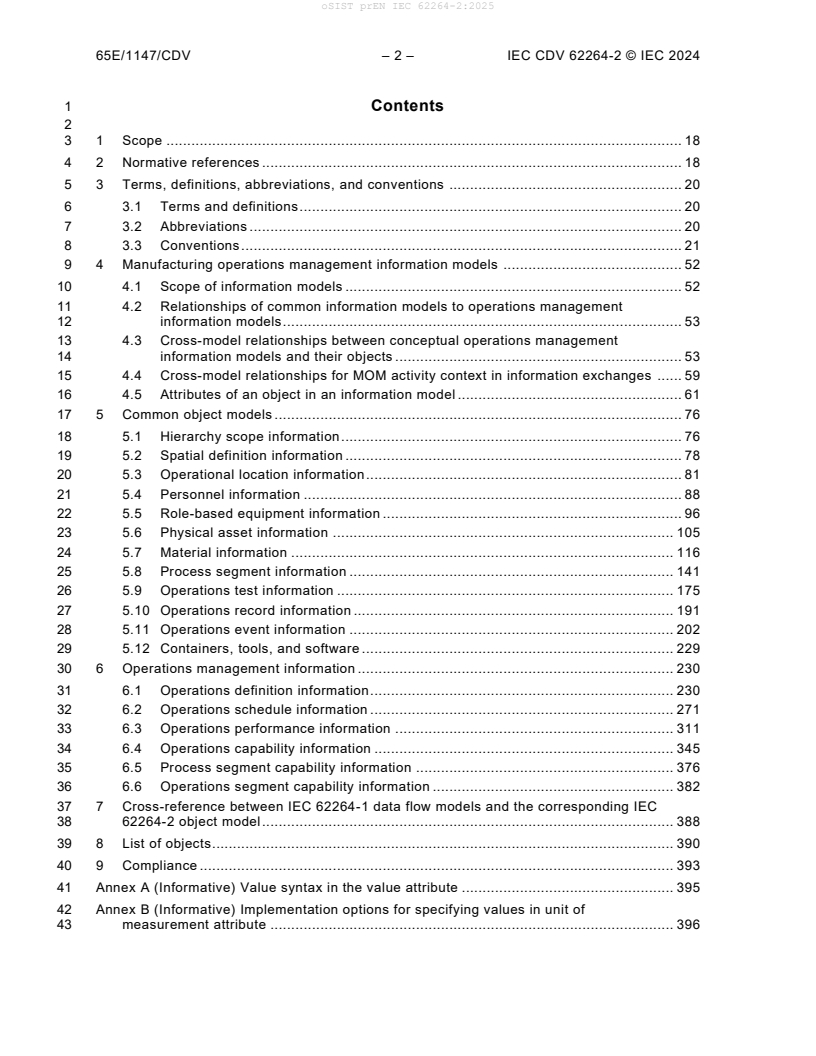
1 Contents
3 1 Scope . 18
4 2 Normative references . 18
5 3 Terms, definitions, abbreviations, and conventions . 20
6 3.1 Terms and definitions . 20
7 3.2 Abbreviations . 20
8 3.3 Conventions . 21
9 4 Manufacturing operations management information models . 52
10 4.1 Scope of information models . 52
11 4.2 Relationships of common information models to operations management
12 information models . 53
13 4.3 Cross-model relationships between conceptual operations management
14 information models and their objects . 53
15 4.4 Cross-model relationships for MOM activity context in information exchanges . 59
16 4.5 Attributes of an object in an information model . 61
17 5 Common object models . 76
18 5.1 Hierarchy scope information . 76
19 5.2 Spatial definition information . 78
20 5.3 Operational location information . 81
21 5.4 Personnel information . 88
22 5.5 Role-based equipment information . 96
23 5.6 Physical asset information . 105
24 5.7 Material information . 116
25 5.8 Process segment information . 141
26 5.9 Operations test information . 175
27 5.10 Operations record information . 191
28 5.11 Operations event information . 202
29 5.12 Containers, tools, and software . 229
30 6 Operations management information . 230
31 6.1 Operations definition information . 230
32 6.2 Operations schedule information . 271
33 6.3 Operations performance information . 311
34 6.4 Operations capability information . 345
35 6.5 Process segment capability information . 376
36 6.6 Operations segment capability information . 382
37 7 Cross-reference between IEC 62264-1 data flow models and the corresponding IEC
38 62264-2 object model . 388
39 8 List of objects . 390
40 9 Compliance . 393
41 Annex A (Informative) Value syntax in the value attribute . 395
42 Annex B (Informative) Implementation options for specifying values in unit of
43 measurement attribute . 396
IEC CDV 62264-2 © IEC 2024 – 3 – 65E/1147/CDV
44 B.1 Specifying value(s) for the “value unit of measurement” attribute in operations -
45 related class and definition property objects (IEC 62264-2) and work-related
46 definition and type property objects (IEC 62264-4) . 396
47 B.2 Specifying value(s) for the “unit of measurement” attribute where no object
48 specifies permissible values. . 397
49 Annex C (Informative) Use cases and examples . 401
50 C.1 Use case and examples . 401
51 C.2 Application of the standard . 407
52 C.3 Database mapping of the models . 407
53 C.4 XML usage . 408
54 Annex D (Informative) Example data sets . 412
55 D.1 General . 412
56 D.2 Material model example . 412
57 D.3 Equipment model and hierarchy scope examples . 414
58 D.4 Personnel model example . 418
59 D.5 Operations capability example . 419
60 D.6 Operations performance example . 420
61 D.7 Operations test model use case examples . 420
62 D.8 Example of planning and response state attributes and defined values . 427
63 D.9 Operations event definition record specification example . 430
64 D.10 Resource acquired example . 430
65 D.11 Work commenced/redirected/completed/aborted example . 433
66 Annex E (Informative) Questions and answers about object use . 436
67 E.1 General . 436
68 E.2 Inflow materials . 436
69 E.3 Multiple products per process segment . 436
70 E.4 Process segments vs. operations segments . 437
71 E.5 Segment parameter references . 438
72 E.6 Use of hierarchy scope in parameter objects . 439
73 E.7 Use of spatial definition in personnel objects . 439
74 E.8 How class name and property IDs are used to identify elements . 440
75 E.9 Possible capability overcounts . 441
76 E.10 Routing and process capability . 443
77 E.11 Product and process capability dependencies . 444
78 E.12 Representation of dependencies . 445
79 E.13 How a material transfer is handled . 446
80 E.14 How to extend the standard when properties cannot be used . 447
81 E.15 Modeling of tools . 447
82 E.16 What is equipment and what is a physical asset? . 447
83 E.17 How should dependencies in the operations schedule and operations response
84 be handled? . 448
85 E.18 How are “mixed” operations types used? . 448
86 E.19 What is the relationship between this standard and MESA International’s
87 B2MML? . 449
65E/1147/CDV – 4 – IEC CDV 62264-2 © IEC 2024
88 Annex F (informative) Implementation considerations for inheritance and persistence of
89 data exchange object models. . 452
90 F.1 Object inheritance considerations . 452
91 F.2 Record inheritance . 454
92 F.3 Object persistence considerations . 455
93 Annex G (informative) Logical information flows . 458
94 Annex H (Informative) Conceptual model to implementation model transformations . 460
95 Annex I (informative) Conceptual model to implementation data model examples . 465
96 I.1 Conceptual object model example: personnel model . 465
97 I.2 MESA – B2MML 7.0 (XSD) implementation model . 467
98 I.3 Simplified XSD implementation model . 468
99 I.4 Object Management Group (OMG) – Interface Definition Language (IDL) –
100 Common Data Representation (CDR) implementation model . 468
101 I.5 OPC Unified Architecture (UA) implementation model . 469
102 I.6 Flat buffers – Interactive Data Language (IDL) implementation model . 471
103 I.7 Internet Engineering Task Force (IETF) – JavaScript Object Notation (JSON) –
104 Schema implementation model . 471
105 I.8 Open Source Robotics Foundation (OSRF) as so known as Open Robotics,
106 Robot Operating System (ROS) message description specifications (MDS) . 472
107 I.9 World Wide Web Consortium (W3C) Resource Description Framework (RDF)
108 schema . 472
109 I.10 SQL database model . 473
110 I.11 Transport Protocols . 473
111 Bibliography . 475
113 Figures
115 Figure 1 – Example of aggregation relationship notation . 27
116 Figure 2 – Example of composition relationship notation . 28
117 Figure 3 – Example: Object model using the simplified UML diagram for an information
118 model, personnel model . 36
119 Figure 4 – Simplified UML model convention for cross-model relationships between
120 resource objects . 40
121 Figure 5 – Operations information models supporting operations management activities . 52
122 Figure 6 – Information and object model inter-relationships for operations management
123 information exchanges . 55
124 Figure 7 – Data flow diagram for defined cross-model MOM relationships between
125 operations management and work information models . 60
126 Figure 8 – Hierarchy scope model . 77
127 Figure 9 – Example, value attribute for WKT in 2D (3D is equally supported) . 80
128 Figure 10 – Operational location model . 81
129 Figure 11 – Personnel model . 88
130 Figure 12 – Role-based equipment model . 97
131 Figure 13 – Physical asset model . 106
IEC CDV 62264-2 © IEC 2024 – 5 – 65E/1147/CDV
132 Figure 14 – Physical asset and equipment relationships . 107
133 Figure 15 – Material model . 117
134 Figure 16 – Example, material with an assembly . 140
135 Figure 17 – Process segment model . 142
136 Figure 18 – Example, Segment dependency . 175
137 Figure 19 – Operations test model . 175
138 Figure 20 – Operations record model (abstract) . 192
139 Figure 21 – Operations event model . 203
140 Figure 22 – Example, Relationship of operations event definition with operations events . 211
141 Figure 23 – Operations definition model . 231
142 Figure 24 – Operations schedule model . 272
143 Figure 25 – Operations performance model . 312
144 Figure 26 – Operations capability model . 346
145 Figure 27 – Process segment capability model . 377
146 Figure 28 – Operations segment capability model . 383
147 Figure C.1 – Personnel model . 402
148 Figure C.2 – Instances of a person class . 404
149 Figure C.3 – UML model for class and class properties . 405
150 Figure C.4 – Class property . 405
151 Figure C.5 – Instances of a person properties . 406
152 Figure C.6 – Instances of person and person properties . 406
153 Figure C.7 – XML schema for a person object . 409
154 Figure C.8 – XML schema for person properties . 409
155 Figure C.9 – Example of person and person property . 410
156 Figure C.10 – Example of person class information . 410
157 Figure C.11 – Adaptor to map different property IDs and values . 411
158 Figure D.1 – Example of simplified job order state model . 429
159 Figure D.2 –Typical MOM functions subscribing to the ResourceAcquired event . 431
160 Figure D.3 – Typical MOM functions subscribing to the WorkCommenced,
161 WorkRedirected, WorkCompleted and WorkAborted events . 434
162 Figure E.1 – Class and property IDs used to identify elements . 441
163 Figure E.2 – A property defining overlapping subsets of the capability . 442
164 Figure E.3 – Routing for a product . 443
165 Figure E.4 – Routing with co-products and material dependencies . 444
166 Figure E.5 – Product and process capability relationships . 445
167 Figure E.6 – Time-based dependencies . 446
168 Figure E.7 – Mixed operation example . 449
169 Figure F.1 – Enterprise to manufacturing system conceptual information flows . 458
170 Figure F.2 – Conceptual information flows among multiple systems . 459
65E/1147/CDV – 6 – IEC CDV 62264-2 © IEC 2024
171 Figure I.1 – Conceptual object model example: personnel model . 465
172 Figure I.2 – OPC UA Specification Notation . 470
173 Figure I.3 – OPC UA representation of the personnel model . 471
176 Tables
178 Table 1 – Simplified UML symbols and notation used in object models . 23
179 Table 2 – Relationship role name template with examples for each relationship name by
180 relationship type . 30
181 Table 3 – Object color convention for object relationships between information models . 35
182 Table 4 – Example: Relationship table for an object model, personnel model relationships . 36
183 Table 5 – Example: Relationship role table, Personnel class relationship roles . 38
184 Table 6 – Example: Usage of object attribute table . 39
185 Table 7 – Detailed UML model relationships in Figure 4 . 41
186 Table 8 – Resource reference object relationship roles . 43
187 Table 9 – Example: Personnel requirement cross-model relationships to personnel model
188 (resource group and resource) . 44
189 Table 10 – Example: Personnel requirement cross-model relationships to personnel
190 reference objects . 44
191 Table 11 – Resource reference object property relationship roles . 45
192 Table 12 – Example: Personnel requirement property cross-model relationships to
193 personnel model . 45
194 Table 13 – Example: Personnel requirement property cross-model relationships to
195 personnel reference object properties . 46
196 Table 14 – Resource group relationship roles . 46
197 Table 15 – Example: Personnel requirement cross-model relationships to personnel class . 47
198 Table 16 – Resource group property relationship roles . 47
199 Table 17 – Example: Personnel requirement property cross-model relationships with a
200 Personnel class property . 47
201 Table 18 – Resource relationship roles . 48
202 Table 19 – Example: Personnel requirement cross-model relationships with a person . 48
203 Table 20 – Resource property relationship roles . 48
204 Table 21 – Example: Personnel requirement property cross-model relationships with a
205 person property . 49
206 Table 22 – Base resource reference object relationship roles . 49
207 Table 23 – Example: Personnel requirement cross-model relationships with a personnel
208 specification . 49
209 Table 24 – Base resource reference object property relationship roles . 50
210 Table 25 – Example: Personnel requirement property cross-model relationships with a
211 personnel specification property . 50
212 Table 26 – Applied resource reference object relationship roles . 50
IEC CDV 62264-2 © IEC 2024 – 7 – 65E/1147/CDV
213 Table 27 – Example: Personnel actual cross-model relationships with a personnel
214 requirement . 51
215 Table 28 – Applied resource reference object property relationship roles . 51
216 Table 29 – Example: Personnel actual property cross-model relationships with a
217 personnel requirement property . 51
218 Table 30 – Operations management information models cross-model relationships to
219 resource information models and base/applied resource reference objects . 57
220 Table 31 – Cross-model MOM relationship description . 60
221 Table 32 – Common header attributes for a primary object . 63
222 Table 33 – Common header attributes for a property object . 66
223 Table 34 – Class, definition, or type property objects with permissible value and value
224 (default) attributes . 68
225 Table 35 – Comment sub-attributes . 69
226 Table 36 – Personnel identification manifest sub-attributes . 70
227 Table 37 – Commonly used CCTS types for exchange . 73
228 Table 38 – Hierarchy scope relationships . 77
229 Table 39 – Hierarchy scope relationship roles . 77
230 Table 40 – Hierarchy scope attributes . 78
231 Table 41 – Attributes of spatial definition . 79
232 Table 42 – Operational location model relationships . 81
233 Table 43 – Operational location class relationship roles . 83
234 Table 44 – Operational location class attributes . 83
235 Table 45 – Operational location class property relationship roles . 84
236 Table 46 – Operational location class property attributes . 84
237 Table 47 – Operational location relationship roles . 85
238 Table 48 – Operational location attributes . 86
239 Table 49 – Operational location property relationship roles . 87
240 Table 50 – Operational location property attributes . 87
241 Table 51 – Personnel model relationships . 88
242 Table 52 – Personnel class relationship roles . 89
243 Table 53 – Personnel class attributes . 90
244 Table 54 – Personnel class property relationship roles . 91
245 Table 55 – Personnel class property attributes . 92
246 Table 56 – Person relationship roles . 93
247 Table 57 – Person attributes . 94
248 Table 58 – Person property relationship roles . 95
249 Table 59 – Person property attributes . 95
250 Table 60 – Role-based equipment model relationships . 97
251 Table 61 – Equipment class relationship roles . 98
252 Table 62 – Equipment class attributes . 99
65E/1147/CDV – 8 – IEC CDV 62264-2 © IEC 2024
253 Table 63 – Equipment class property relationship roles . 100
254 Table 64 – Equipment class property attributes . 101
255 Table 65 – Equipment relationship roles . 102
256 Table 66 – Equipment attributes . 103
257 Table 67 – Equipment property relationships . 104
258 Table 68 – Equipment property attributes . 105
259 Table 69 – Physical asset model relationships . 106
260 Table 70 – Physical asset and equipment relationships . 108
261 Table 71 – Physical asset class relationship roles . 108
262 Table 72 – Physical asset class attributes . 109
263 Table 73 – Physical asset class property relationship roles . 110
264 Table 74 – Physical asset class property attributes . 111
265 Table 75 – Physical asset relationship roles . 112
266 Table 76 – Physical asset attributes . 113
267 Table 77 – Physical asset property relationship roles . 114
268 Table 78 – Physical asset property attributes . 114
269 Table 79 – Equipment asset mapping relationship roles . 115
270 Table 80 – Equipment asset mapping attributes. 116
271 Table 81 – Material model relationships. 118
272 Table 82 – Material class relationship roles . 119
273 Table 83 – Material class attributes . 120
274 Table 84 – Material class property relationship roles . 123
275 Table 85 – Material class property attributes . 124
276 Table 86 – Material definition relationship roles . 125
277 Table 87 – Material definition attributes . 126
278 Table 88 – Material definition property relationship roles . 128
279 Table 89 – Material definition property attributes . 129
280 Table 90 – Material lot relationship roles . 130
281 Table 91 – Material lot attributes . 131
282 Table 92 – Material lot property relationship roles . 134
283 Table 93 – Material lot property attributes. 135
284 Table 94 – Material sublot relationship roles . 136
285 Table 95 – Material sublot attributes . 137
286 Table 96 – Process segment model relationships . 143
287 Table 97 – Process segment relationship roles . 147
288 Table 98 – Process segment attributes . 148
289 Table 99 – Process segment parameter relationship roles . 149
290 Table 100 – Process segment parameter attributes . 150
291 Table 101 – Personnel segment specification relationship roles . 150
IEC CDV 62264-2 © IEC 2024 – 9 – 65E/1147/CDV
292 Table 102 – Personnel segment specification attributes . 152
293 Table 103 – Personnel segment specification property relationship roles . 153
294 Table 104 – Personnel segment specification property attributes . 154
295 Table 105 – Equipment segment specification relationship roles. 155
296 Table 106 – Equipment segment specification attributes . 157
297 Table 107 – Equipment segment specification property relationship roles . 158
298 Table 108 – Equipment segment specification property attributes . 159
299 Table 109 – Physical asset segment specification relationship roles . 160
300 Table 110 – Physical asset segment specification attributes . 161
301 Table 111 – Physical asset segment specification property relationship roles . 162
302 Table 112 – Physical asset segment specification property attributes . 164
303 Table 113 – Material segment specification relationship roles . 165
304 Table 114 – Material segment specification attributes . 166
305 Table 115 – Material segment specification property relationships . 171
306 Table 116 – Material segment specification property attributes . 172
307 Table 117 – Segment dependency relationship roles . 173
308 Table 118 – Segment dependency attributes . 173
309 Table 119 – Operations test model relationships . 176
310 Table 120 – Instances of operations test requirement . 177
311 Table 121 – Operations test requirement relationship roles in the operations test model . 178
312 Table 122 – Instances of testable object / testable object property pair . 179
313 Table 123 – Testable object relationship roles in operations test model . 180
314 Table 124 – Testable object property relationship roles in the operations test model . 180
315 Table 125 – Test specification relationship roles . 181
316 Table 126 – Test specification attributes. 182
317 Table 127 – Test specification property relationship roles . 184
318 Table 128 – Test specification property attributes . 184
319 Table 129 – Test specification criteria relationship roles . 185
320 Table 130 – Test specification criteria attributes . 185
321 Table 131 – Evaluated property relationship roles . 187
322 Table 132 – Evaluated property attributes . 187
323 Table 133 – Test result relationship roles . 188
324 Table 134 – Test result attributes . 188
325 Table 135 – Property measurement relationship roles . 189
326 Table 136 – Property measurement attributes . 190
327 Table 137 – Instances of resource actual . 191
328 Table 138 – Resource actual relationship roles in operations test model . 191
329 Table 139 – Operations record model (abstract) relationships . 193
330 Table 140 – Operations record specification relationship roles . 194
65E/1147/CDV – 10 – IEC CDV 62264-2 © IEC 2024
331 Table 141 – Operations record specification attributes . 195
332 Table 142 – Operations record template relationship roles . 198
333 Table 143 – Operations record template attributes . 198
334 Table 144 – Operations record entry template relationships . 200
335 Table 145 – Operations record entry template attributes . 201
336 Table 146 – Operations Event model relationships . 203
337 Table 147 – Operations event class relationship roles . 205
338 Table 148 – Operations event class attributes . 206
339 Table 149 – Example of operations event class locked hierarchy . 206
340 Table 150 – Operations event class property relationship roles . 207
341 Table 151 – Operations event class property attributes . 208
342 Table 152 – Operations event class record specification relationship roles . 209
343 Table 153 – Operations event definition relationship roles . 211
344 Table 154 – Operations event definition attributes . 212
345 Table 155 – Operations event definition property relationship roles . 215
346 Table 156 – Operations event definition property attributes . 216
347 Table 157 – Operations event definition record specification relationship roles . 218
348 Table 158 – Operations event relationship roles . 220
349 Table 159 – Operations event attributes . 220
350 Table 160 – Operations event property relationship roles . 223
351 Table 161 – Operations event property attributes . 224
352 Table 162 – Operations event record relationship roles . 224
353 Table 163 – Operations event record attributes . 225
354 Table 164 – Operations event record entry relationships . 227
355 Table 165 – Operations event record entry attributes . 228
356 Table 166 – Operations definition model relationships . 232
357 Table 167 – Operations definition relationship roles .
...