

oSIST prEN 10370:2019
(Main)Steel for the reinforcement of concrete - Stainless steel
General Information
- Abstract
This document specifies product characteristic, test/assessment method and the way of expressing test results, for stainless steel as defined in EN 10088-1 and designated as in EN 10088-1 for the use of the reinforcement of concrete.
It applies to stainless steel products with ribbed or indented surfaces, which are in the form of:
- bars and coils (rod, wire);
- sheets of factory-made machine-welded fabric;
- lattice girders and hybrid lattice girders composed by stainless steel and by weldable reinforcing steel according to EN 10080.
This document does not apply to:
- pre-stressed stainless steels;
- indented strip;
- stainless steel tube filled with carbon steel swarf, which is then hot or cold reduced;
- stainless steel smooth bar with weld material deposited on it;
- galvanized reinforcing steel;
- epoxy-coated reinforcing steel.
- Status
- Not Published
- Public Enquiry End Date
- 31-Jul-2019
- Technical Committee
- IFEK - Ferrous metals
- Current Stage
- 98 - Abandoned project (Adopted Project)
- Start Date
- 29-May-2024
- Due Date
- 03-Jun-2024
- Completion Date
- 29-May-2024



Overview
prEN 10370 - Steel for the reinforcement of concrete - Stainless steel (CEN draft) defines product characteristics, testing and assessment methods, and the required ways of expressing test results for stainless steel used as concrete reinforcement. It applies to stainless steels defined and designated in EN 10088-1 and covers products with ribbed or indented surfaces in the form of bars and coils (rod, wire), factory‑made welded fabric sheets, lattice girders and hybrid lattice girders (stainless plus weldable reinforcing steel to EN 10080). The document excludes pre‑stressed stainless steels, indented strip, certain composite tubes, galvanized or epoxy‑coated reinforcing steel, and smooth bars with weld deposit.
Key topics
- Product characteristics: mechanical properties (proof strength, tensile strength, elongation), bond geometry (ribbed/indented surfaces) and dimensional tolerances for bars, coils and welded fabric.
- Mechanical performance: bendability, cyclic/low‑cycle fatigue, high‑cycle fatigue, and strength at elevated temperatures.
- Durability and corrosion resistance: guidance and test methods for assessing corrosion performance of stainless reinforcement in chloride‑contaminated or carbonated concrete (informative annexes).
- Weldability and joints: requirements and tests for welded fabric, lattice girders and hybrid joints (including shear tests and weld point examples).
- Testing, sampling and reporting: standardized test methods and the form of expressed test results for laboratory and factory testing.
- Assessment and verification (AVCP): Type testing, factory production control (FPC), initial inspection, continuous surveillance and audit testing to ensure constancy of performance.
- Classification, designation and identification: marking rules for manufacturers, product identification for bars, coils, welded fabric and lattice elements.
- Manufacturing and delivery conditions: required steelmaking, production processes and delivery state (descaled or not).
Applications and users
prEN 10370 is intended for:
- Structural and civil engineers specifying stainless steel reinforcement for durable or aggressive environments.
- Manufacturers and fabricators of stainless rebar, welded fabric and lattice girders seeking consistent product specification and certification.
- Test laboratories performing mechanical, bond and corrosion tests.
- Project procurement, quality managers and conformity assessment bodies implementing AVCP and FPC procedures.
- Designers specifying reinforcement for infrastructure, marine, bridge, parking and other structures where enhanced corrosion resistance is needed.
Related standards
- EN 10088-1 - Stainless steels: designations and definitions (referenced for material grades)
- EN 10080 - Weldable reinforcing steel (referenced for hybrid lattice girders)
Using prEN 10370 helps ensure consistent stainless steel rebar performance, reliable durability data, and clear traceability for long‑term concrete reinforcement applications.
Get Certified
Connect with accredited certification bodies for this standard

Element Materials Technology
Materials testing and product certification.

Inštitut za kovinske materiale in tehnologije
Institute of Metals and Technology. Materials testing, metallurgical analysis, NDT.
Sponsored listings
Frequently Asked Questions
oSIST prEN 10370:2019 is a draft published by the Slovenian Institute for Standardization (SIST). Its full title is "Steel for the reinforcement of concrete - Stainless steel". This standard covers: This document specifies product characteristic, test/assessment method and the way of expressing test results, for stainless steel as defined in EN 10088-1 and designated as in EN 10088-1 for the use of the reinforcement of concrete. It applies to stainless steel products with ribbed or indented surfaces, which are in the form of: - bars and coils (rod, wire); - sheets of factory-made machine-welded fabric; - lattice girders and hybrid lattice girders composed by stainless steel and by weldable reinforcing steel according to EN 10080. This document does not apply to: - pre-stressed stainless steels; - indented strip; - stainless steel tube filled with carbon steel swarf, which is then hot or cold reduced; - stainless steel smooth bar with weld material deposited on it; - galvanized reinforcing steel; - epoxy-coated reinforcing steel.
This document specifies product characteristic, test/assessment method and the way of expressing test results, for stainless steel as defined in EN 10088-1 and designated as in EN 10088-1 for the use of the reinforcement of concrete. It applies to stainless steel products with ribbed or indented surfaces, which are in the form of: - bars and coils (rod, wire); - sheets of factory-made machine-welded fabric; - lattice girders and hybrid lattice girders composed by stainless steel and by weldable reinforcing steel according to EN 10080. This document does not apply to: - pre-stressed stainless steels; - indented strip; - stainless steel tube filled with carbon steel swarf, which is then hot or cold reduced; - stainless steel smooth bar with weld material deposited on it; - galvanized reinforcing steel; - epoxy-coated reinforcing steel.
oSIST prEN 10370:2019 is classified under the following ICS (International Classification for Standards) categories: 77.140.15 - Steels for reinforcement of concrete; 77.140.20 - Stainless steels. The ICS classification helps identify the subject area and facilitates finding related standards.
oSIST prEN 10370:2019 is associated with the following European legislation: EU Directives/Regulations: 305/2011, 89/106/EEC; Standardization Mandates: M/115. When a standard is cited in the Official Journal of the European Union, products manufactured in conformity with it benefit from a presumption of conformity with the essential requirements of the corresponding EU directive or regulation.
oSIST prEN 10370:2019 is available in PDF format for immediate download after purchase. The document can be added to your cart and obtained through the secure checkout process. Digital delivery ensures instant access to the complete standard document.
Standards Content (Sample)
SLOVENSKI STANDARD
01-julij-2019
Jekla za armiranje betona - Nerjavno jeklo
Steel for the reinforcement of concrete - Stainless steel
Stahl für die Bewehrung von Beton - Nichtrostender Stahl
Aciers pour l'armature du béton - Aciers inoxydables
Ta slovenski standard je istoveten z: prEN 10370
ICS:
77.140.15 Jekla za armiranje betona Steels for reinforcement of
concrete
77.140.20 Visokokakovostna jekla Stainless steels
2003-01.Slovenski inštitut za standardizacijo. Razmnoževanje celote ali delov tega standarda ni dovoljeno.
DRAFT
EUROPEAN STANDARD
NORME EUROPÉENNE
EUROPÄISCHE NORM
June 2019
ICS 77.140.15
English Version
Steel for the reinforcement of concrete - Stainless steel
Aciers pour l'armature du béton - Aciers inoxydables Stahl für die Bewehrung von Beton - Nichtrostender
Stahl
This draft European Standard is submitted to CEN members for enquiry. It has been drawn up by the Technical Committee
CEN/TC 459/SC 4.
If this draft becomes a European Standard, CEN members are bound to comply with the CEN/CENELEC Internal Regulations
which stipulate the conditions for giving this European Standard the status of a national standard without any alteration.
This draft European Standard was established by CEN in three official versions (English, French, German). A version in any other
language made by translation under the responsibility of a CEN member into its own language and notified to the CEN-CENELEC
Management Centre has the same status as the official versions.
CEN members are the national standards bodies of Austria, Belgium, Bulgaria, Croatia, Cyprus, Czech Republic, Denmark, Estonia,
Finland, Former Yugoslav Republic of Macedonia, France, Germany, Greece, Hungary, Iceland, Ireland, Italy, Latvia, Lithuania,
Luxembourg, Malta, Netherlands, Norway, Poland, Portugal, Romania, Serbia, Slovakia, Slovenia, Spain, Sweden, Switzerland,
Turkey and United Kingdom.
Recipients of this draft are invited to submit, with their comments, notification of any relevant patent rights of which they are
aware and to provide supporting documentation.
Warning : This document is not a European Standard. It is distributed for review and comments. It is subject to change without
notice and shall not be referred to as a European Standard.
EUROPEAN COMMITTEE FOR STANDARDIZATION
COMITÉ EUROPÉEN DE NORMALISATION
EUROPÄISCHES KOMITEE FÜR NORMUNG
CEN-CENELEC Management Centre: Rue de la Science 23, B-1040 Brussels
© 2019 CEN All rights of exploitation in any form and by any means reserved Ref. No. prEN 10370:2019 E
worldwide for CEN national Members.
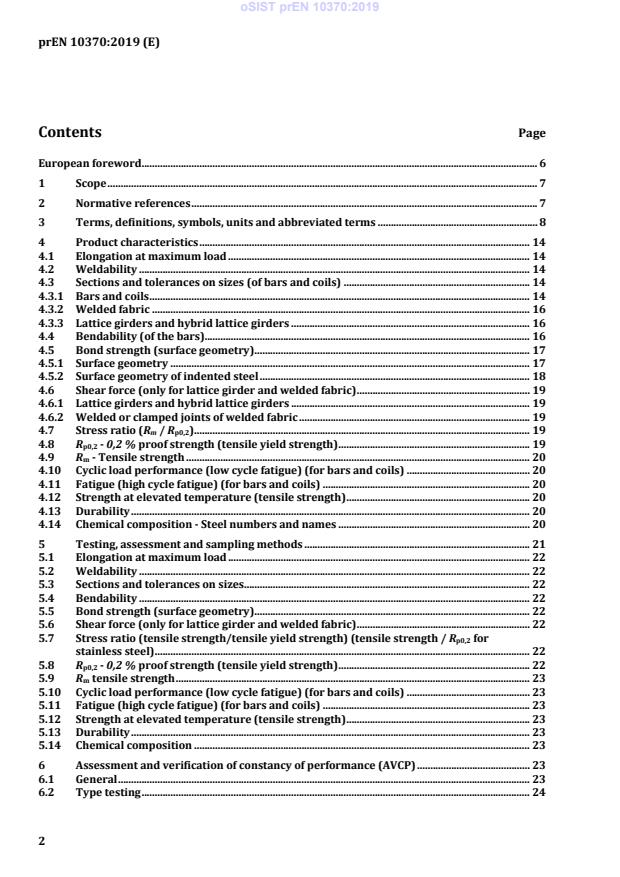
Contents Page
European foreword . 6
1 Scope . 7
2 Normative references . 7
3 Terms, definitions, symbols, units and abbreviated terms . 8
4 Product characteristics . 14
4.1 Elongation at maximum load . 14
4.2 Weldability . 14
4.3 Sections and tolerances on sizes (of bars and coils) . 14
4.3.1 Bars and coils . 14
4.3.2 Welded fabric . 16
4.3.3 Lattice girders and hybrid lattice girders . 16
4.4 Bendability (of the bars). 16
4.5 Bond strength (surface geometry) . 17
4.5.1 Surface geometry . 17
4.5.2 Surface geometry of indented steel . 18
4.6 Shear force (only for lattice girder and welded fabric) . 19
4.6.1 Lattice girders and hybrid lattice girders . 19
4.6.2 Welded or clamped joints of welded fabric . 19
4.7 Stress ratio (R / R ). 19
m p0,2
4.8 R - 0,2 % proof strength (tensile yield strength) . 19
p0,2
4.9 R - Tensile strength . 20
m
4.10 Cyclic load performance (low cycle fatigue) (for bars and coils) . 20
4.11 Fatigue (high cycle fatigue) (for bars and coils) . 20
4.12 Strength at elevated temperature (tensile strength) . 20
4.13 Durability . 20
4.14 Chemical composition - Steel numbers and names . 20
5 Testing, assessment and sampling methods . 21
5.1 Elongation at maximum load . 22
5.2 Weldability . 22
5.3 Sections and tolerances on sizes. 22
5.4 Bendability . 22
5.5 Bond strength (surface geometry) . 22
5.6 Shear force (only for lattice girder and welded fabric) . 22
5.7 Stress ratio (tensile strength/tensile yield strength) (tensile strength / R for
p0,2
stainless steel) . 22
5.8 R - 0,2 % proof strength (tensile yield strength) . 22
p0,2
5.9 R tensile strength . 23
m
5.10 Cyclic load performance (low cycle fatigue) (for bars and coils) . 23
5.11 Fatigue (high cycle fatigue) (for bars and coils) . 23
5.12 Strength at elevated temperature (tensile strength) . 23
5.13 Durability . 23
5.14 Chemical composition . 23
6 Assessment and verification of constancy of performance (AVCP) . 23
6.1 General . 23
6.2 Type testing . 24
6.2.1 General . 24
6.2.2 Test samples, testing and compliance criteria . 24
6.2.3 Test report . 29
6.3 Factory production control (FPC) . 30
6.3.1 General . 30
6.3.2 Requirements . 30
6.4 Initial inspection of factory and of factory production control (FPC) . 36
6.5 Continuous surveillance of FPC . 37
6.5.1 General . 37
6.5.2 Audit testing of samples taken before placing the product on the market . 37
6.6 Assessment of the long term quality level . 40
6.6.1 General . 40
6.6.2 Evaluation of the test results . 41
7 Classification and designation . 43
7.1 Bars and coils . 43
7.2 Welded fabric . 43
7.3 Lattice girders and hybrid lattice girders . 45
8 Identification of the manufacturer and the product . 49
8.1 General . 49
8.2 Bar . 50
8.2.1 Identification of the manufacturer . 50
8.2.2 Identification of the product . 51
8.3 Coil . 53
8.4 Welded fabric . 53
8.5 Lattice girders . 53
9 Verification of mechanical properties in the case of dispute . 53
10 Manufacturing process and delivery conditions . 54
10.1 Steelmaking and manufacturing processes . 54
10.2 Delivery conditions . 54
10.2.1 Chemically and/or mechanically descaled . 54
10.2.2 Not descaled . 55
Annex A (informative) Examples of weld points in lattice girder joints . 56
Annex B (normative) Test methods for lattice girders . 57
B.1 General . 57
B.2 Measurement of the dimensions of the lattice girder . 57
B.2.1 Test piece . 57
B.2.2 Test equipment . 57
B.2.3 Measuring procedure . 57
B.3 Shear test . 57
B.3.1 Shear test on weld points . 57
B.3.2 Shear test on clamped joints . 59
B.4 Test apparatus . 60
B.4.1 Tensile testing machine . 60
B.4.2 Holder . 61
B.4.3 Test piece . 61
B.4.4 Test procedure . 61
Annex C (informative) Guidance on durability . 62
C.1 General . 62
C.2 Terminology . 62
C.3 Prescriptive guidance . 63
C.4 Performance guidance . 65
C.4.1 Performance guidance for carbonation induced corrosion . 65
C.4.2 Performance guidance for chloride induced corrosion . 65
C.4.3 Performance guidance for chloride induced corrosion in carbonated concrete . 65
C.5 Test method for determining the corrosion resistance of stainless steel
reinforcement in chloride contaminated concrete . 66
C.5.1 Test method . 66
C.5.2 Adaptations and limitations . 66
Annex D (informative) Corrosion test method . 68
D.1 Scope . 68
D.2 Materials . 68
D.2.1 Rebars . 68
D.2.2 Mortar . 68
D.3 Specimens . 68
D.4 Testing procedure . 70
D.5 Test results . 70
D.6 Final evaluation criteria . 70
D.7 Test report . 70
Annex E (informative) Guidance on welding procedures, non-magnetic properties and
thermal expansion . 72
E.1 Welding procedures . 72
E.1.1 Ferritic stainless steel . 72
E.1.2 Austenitic stainless steel . 72
E.1.3 Austenitic- ferritic (Duplex) stainless steel . 72
E.1.4 Welding stainless steels to carbon steels . 72
E.1.5 Handling and processing . 72
E.2 Guidance on non-magnetic properties . 73
E.3 Guidance on thermal expansion and other physical properties . 73
Annex F (informative) Comparison of symbols used in this European standard with those
used in EN 1992-1-1 and EN 1992-1-2 . 74
Annex G (informative) Design guidance: constitutive relationship . 75
G.1 Background . 75
G.2 Recommendations . 76
Annex ZA (informative) Relationship of this European Standard with Regulation (EU)
No.305/2011 . 77
Bibliography . 81
European foreword
This document (prEN 10370:2019) has been prepared by Technical Committee CEN/TC 459/SC 4
“Concrete reinforcing and prestressing steels”, the secretariat of which is held by DIN.
This document is currently submitted to the CEN Enquiry.
This document has been prepared under a standardization request given to CEN by the European
Commission and the European Free Trade Association, and supports essential requirements of
EU Construction Product Regulation (EU 305/2011).
For relationship with EU Regulation (EU 305/2011), see informative Annex ZA, which is an integral part
of this document.
1 Scope
This document specifies product characteristic, test/assessment method and the way of expressing test
results, for stainless steel as defined in EN 10088-1 and designated as in EN 10088-1 for the use of the
reinforcement of concrete.
It applies to stainless steel products with ribbed or indented surfaces, which are in the form of:
— bars and coils (rod, wire);
— sheets of factory-made machine-welded fabric;
— lattice girders and hybrid lattice girders composed by stainless steel and by weldable reinforcing
steel according to EN 10080.
This document does not apply to:
— pre-stressed stainless steels;
— indented strip;
— stainless steel tube filled with carbon steel swarf, which is then hot or cold reduced;
— stainless steel smooth bar with weld material deposited on it;
— galvanized reinforcing steel;
— epoxy-coated reinforcing steel.
2 Normative references
The following documents are referred to in the text in such a way that some or all of their content
constitutes requirements of this document. For dated references, only the edition cited applies. For
undates references, the latest edition of the referenced document (including any amendments) applies.
EN 10020, Definition and classification of grades of steel
EN 10079, Definition of steel products
EN 10080, Steel for the reinforcement of concrete - Weldable reinforcing steel - General
EN 10088-1:2014, Stainless steels - Part 1: List of stainless steels
EN 10088-5, Stainless steels - Part 5: Technical delivery conditions for bars, rods, wire, sections and bright
products of corrosion resisting steels for construction purposes
EN ISO 377, Steel and steel products - Location and preparation of samples and test pieces for mechanical
testing (ISO 377)
EN ISO 6892-2, Metallic materials - Tensile testing - Part 2: Method of test at elevated temperature (ISO
6892-2)
EN ISO 7500-1, Metallic materials - Calibration and verification of static uniaxial testing machines - Part
1: Tension/compression testing machines - Calibration and verification of the force-measuring system (ISO
7500-1)
EN ISO 15630-1, Steel for the reinforcement and prestressing of concrete - Test methods - Part 1:
Reinforcing bars, rods and wire (ISO 15630-1)
EN ISO 15630-2, Steel for the reinforcement and prestressing of concrete - Test methods - Part 2: Welded
fabric and lattice girders (ISO 15630-2)
3 Terms, definitions, symbols, units and abbreviated terms
For the purposes of this document, the terms and definitions given in EN 10020, EN 10079 and the
following apply.
3.1
7 % strength
strength at 7 % total elongation, R
7,0
3.2
angle of inclination of diagonals, ϑ
angle between the axis of a diagonal and the longitudinal axis of a lattice girder in the plane of the
diagonal in the middle of the height of a lattice girder
3.3
angle of transverse rib or indentation inclination, ß
angle between the axis of the transverse rib and the longitudinal axis of the bar, rod or wire
3.4
batch
quantity of rebars, processed from an identical heat or cast, size or alloy, processed in the same
production lot, in the same process conditions or any quantity of welded fabric or lattice girders of one
type produced by one manufacturer and presented for examination at any one time
3.5
characteristic value C
v
value of a material or product property having a prescribed probability of not being attained in a
hypothetical unlimited test series
Note 1 to entry: This value generally corresponds to a specific fractile of the assumed statistical distribution of
the particular property of the material or product.
3.6
coil
single length of reinforcing steel wound in concentric rings, including coils welded together to produce
a single coiled length
3.7
design height of a lattice girder, H1
distance between the lowest point of the lower chord and the highest point of the upper chord
3.8
design width of a lattice girder, B
distance between the outlying points of the lower chords
3.9
hybrid lattice girder
lattice girder where the metallic structure is composed of both stainless steel used for the
reinforcement of concrete and weldable reinforcing steel; for hybrid lattice girders apply the same
definitions as for lattice girders, i.e
3.10
indented reinforcing steel
reinforcing steel with defined indentations uniformly distributed over the entire length
3.11
indentation depth, t
distance between the surface of the wire and the deepest point of the indentation
3.12
indentation width, b
width of the indention to be measured parallel to the axis of the bar, rod or wire
3.13
lattice girder
two or three-dimensional metallic structure comprising an upper chord, one or more lower chords and
continuous or discontinuous diagonals which are welded or mechanically assembled to the chords
3.14
lattice girder length, L
lg
overall length of a lattice girder
3.15
lattice girder overhang, u u
1, 2
length of the diagonals beyond either the upper chord (u ) or the lower chord (u )
1 2
3.16
length of a welded fabric sheet, L
wf
dimension of the longest side of a sheet of welded fabric, irrespective of the manufacturing direction
3.17
longitudinal rib
uniform continuous protrusion parallel to the axis of the bar, rod or wire
3.18
longitudinal wire
reinforcing steel in the manufacturing direction of the welded fabric
3.19
lower chord
set of longitudinal reinforcing steels placed in the lower part of a lattice girder
Note 1 to entry: They form harmonic curves in the case of continuous diagonals or are independent elements in
the case of discontinuous diagonals.
3.20
minimum value
value below which no test result shall fall
3.21
maximum value
value which no test result shall exceed
3.22
nominal cross-sectional area, A
n
cross-sectional area equivalent to the area of a circular plain bar of the same nominal diameter, d (i.e.
nom
πd
nom
)
3.23
overall height of a lattice girder, H
distance between the lowest point and the highest point of a lattice girder
3.24
overall width of a lattice girder, B
distance between the outlying points of a lattice girder
3.25
overhang of welded fabric, u , u , u , u
1 2 3 4
length of longitudinal or transverse wires projecting beyond the centre of the outer crossing wire in a
sheet of welded fabric
3.26
pitch of diagonals, P
s
distance between equivalent consecutive junction points of the diagonals with the chords
3.27
pitch of welded fabric
centre-to-centre distance of wires in a sheet of welded fabric
3.28
production lot
uninterrupted period of production
3.29
purpose made lattice girder
lattice girder manufactured according to user's specific requirements
3.30
purpose made welded fabric
welded fabric manufactured according to user's specific requirements
3.31
reinforcing steel
steel product with a circular or practically circular cross-section which is suitable for the reinforcement
of concrete
3.32
relative indentation area f
P
area of the projection of all indentations on a plane perpendicular to the longitudinal axis of the bar, rod
or wire, divided by the indentation spacing and the nominal circumference
3.33
relative rib area, f
R
area of the projection of all ribs on a plane perpendicular to the longitudinal axis of the bar, rod or wire,
divided by the rib spacing and the nominal circumference
3.34
ribbed reinforcing steel
reinforcing steel with at least two rows of transverse ribs, which are uniformly distributed over the
entire length
3.35
rib height, h
distance from the highest point of the rib (transverse or longitudinal) to the surface of the core, to be
measured normal to the axis of the bar, rod or wire
3.36
rib or indentation spacing, c
distance between the centres of two consecutive transverse ribs measured parallel to the axis of the
bar, rod or wire
3.37
semi-finished product
ribbed or indented product which requires further processing in order to achieve the standard and
special properties specified in this document for reinforcing steels
3.38
special property
property contained in this document which is not determined as part of the factory production control
requirements for every test unit
3.39
standard lattice girder
lattice girder manufactured according to specified delivery conditions and available from stock
3.40
standard property
property which is contained in this document as part of the factory production control requirements for
every test unit
3.41
standard welded fabric
welded fabric manufactured according to specified delivery conditions and available from stock
3.42
transverse rib
any rib on the surface of the bar, rod or wire other than a longitudinal rib
3.43
transverse rib flank inclination, α
angle of the rib flank measured perpendicular to the longitudinal axis of the rib
3.44
transverse wire
reinforcing steel perpendicular to the manufacturing direction of the welded fabric
3.45
welded fabric
arrangement of longitudinal and transverse bars, rods or wires of the same or different nominal
diameter and length that are arranged substantially at right angles to each other and factory electrical
resistance welded together by automatic machines at all points of intersection
3.46
width of a welded fabric sheet, B
dimension of the shortest side of the sheet of welded fabric, irrespective of the manufacturing direction
3.47
bar
product of plain round or ribbed cross-section
For the purposes of this document, the symbols, units and abbreviated terms are listed in Table 1
Note 1 to entry: For comparison of symbols used in this European standard with those used in EN 1992-1-1 and
EN 1992-1-2 see Annex F.
Table 1 — Symbols, unit and abbreviated terms
Symbol Description Unit
Average value of test results a
x
α Transverse rib flank inclination °
Inclination of the diagonals in lattice girder or in hybrid lattice
ϑ °
girder
a1, a2, a3, a4 Increment (specified in the product specification) a
ACh Cross-sectional area of chord mm
A Cross-sectional area of diagonal mm
Di
Agt Percentage total elongation at maximum force %
A Nominal cross-sectional area mm
n
b Width of indentation mm
B Length of transverse wire in welded fabric mm
B1 Design width of lattice girder or hybrid lattice girder mm
B Overall width of lattice girder or hybrid lattice girder mm
c Transverse rib or indentation spacing mm
C Specified characteristic value
v
dnom Nominal diameter of the reinforcing steel mm
d Diameter of transverse wires in welded fabric mm
C
dL Diameter of longitudinal wires in welded fabric mm
e Gap between rib or indentation rows mm
b
E Young’s modulus
MPa
Shear force of a clamped joint in lattice girder or hybrid lattice
Fd kN
girder
Symbol Description Unit
fP Relative indentation area -
f Relative rib area -
R
Fw Shear force of a single weld in lattice girder or hybrid lattice girder kN
h Rib height mm
H1 Design height of lattice girder or hybrid lattice girder mm
H Overall height of lattice girder or hybrid lattice girder mm
k Coefficient as a function of the number of test results -
L Length of lattice girder or hybrid lattice girder mm
lg
L Length of longitudinal wire in welded fabric mm
wf
NC Number of transverse wires in welded fabric -
N Number of longitudinal wires in welded fabric -
L
PC Pitch of transverse wires in welded fabric mm
P Pitch of longitudinal wires in welded fabric mm
L
Ps Pitch of diagonals of lattice girder or hybrid lattice girder mm
b
R7.0 strength at 7 % total elongation
MPa
b
R Tensile strength
m
MPa
R /R Ratio tensile strength/0,2 % proof strength -
m p0,2
b
R 0,2 % proof strength (tensile yield strength)
p0,2
MPa
R Actual value of 0,2 % proof strength MPa
p0,2act
Ratio actual value of 0,2 % proof strength/specified value of 0,2 %
Rp0,2act/Rp0,2nom -
proof strength
0,2 % proof strength of the chord in lattice girder or in hybrid
b
Rp0.2Ch
MPa
lattice grider
0,2 % proof strength of the diagonal in lattice girder or in hybrid
b
Rp0.2Di
MPa
lattice girder
R Specified value of 0,2 % proof strength MPa
p0.2nom
s Estimate of the standard deviation a
ß Angle of transverse rib or indentation inclination °
t Depth of indentation mm
Overhang of the longitudinal wires in welded fabric or length of the
u1, u2 diagonals beyond the upper or lower chord of a lattice girder or mm
hybrid lattice girder
u3, u4 Overhang of the transverse wires in welded fabric mm
a
The unit depends on the property.
b
1 MPa = 1 N/mm .
4 Product characteristics
4.1 Elongation at maximum load
The elongation at maximum load (A %) is the elongation registered during the tensile test when the
gt
maximum load is applied. When tested according to 5.1 results shall be in accordance to Table 2.
Table 2 — Tensile properties
Ductility classes
(*)
Properties
A B C
Characteristic value of
a b
0,2 % proof strength
400 to 750
Rp0,2** [MPa]
Characteristic values of
≥ 1,15
Ratio tensile strength
≥ 1,05 ≥ 1,08
c
0,2 % proof strength R
m
˂1,35
/ R
p0,2
Characteristic values of
Elongation at maximum ≥ 2,5 ≥ 5,0 ≥ 7,5
load A (%)
gt
(*)
The specified values for the tensile properties (Rp0,2, Rm / Rp0,2, Agt) shall be the
corresponding specified characteristic value with P = 95 % for Rp0,2, and P = 90 % for Agt, Rm /
R . The values R and R shall be calculated using the nominal cross-sectional area of the
p0,2 p0,2 m
product.
** For stainless steel the 0,2 % proof strength (Rp0,2) shall be assumed as the tensile yield
strength
a
In EN 1992-1-1 the minimum prof strength range is 400 ÷ 600 [MPa].
b
In EN 1992-1-1 the maximum actual proof stress Rp0,2, shall not exceed (1,3 × Rp0,2), where Rp0,2 is
the characteristic value.
c
In the case of austenitic and duplex stainless steels, because of their specific stress-strain
constitutive relationship, the ratio is calculated by using the value of R instead of R
p0,2 m.
4.2 Weldability
The weldability of stainless steel for the reinforcement of concrete is a function of the chemical
composition. The list of the stainless steels designations is given in EN 10088-1 or EN 10088-5.
NOTE Annex E contains guidance on welding procedures.
4.3 Sections and tolerances on sizes (of bars and coils)
4.3.1 Bars and coils
The nominal diameters and the cross-sectional area shall be measured according to 5.3 using a test
sample length of not less than 0,5 M and results shall comply with Table 3. The tolerances on mass per
metre are indicated in Table 3.
Table 3 — Nominal diameters and the cross-sectional area and tolerances
on mass per metre run
Nominal cross Tolerances on mass
a
Nominal diameter
sectional area per metre run
(mm)
(mm ) %
3 7,1
4 12,6
4,5 15,9
5 19,6 ±9,0
5,5 23,8
6 28,3
6,5 33,2
7 38,5
7,5 44,2
8 50,3
8,5 56,7
9 63,6 ±6,0
9,5 70,9
10 78,5
11 95,0
12 113,1
14 153,9
16 201,1
20 314,2
22 380,0
24 452,4
25 490,9
26 530,7
28 615,8
±4,5
30 706,9
32 804,2
34 907,9
35 962,1
40 1 256,6
43 1 452,2
50 1 963,5
63,5 3 166,9
Nominal cross Tolerances on mass
a
Nominal diameter
sectional area per metre run
(mm)
(mm ) %
a
On the base of the nominal diameter the nominal mass per meter (M ) can be
pm
calculated with the following formula:
Md= ( / 2) ×πρ×( /1 000)
pm nom
where
Mpm is the mass per meter in kg
dnom is the nominal diameter in mm
ρ is the material density in kg/dm as reported in EN 10088-1.
4.3.2 Welded fabric
Sheets of factory-made machine-welded fabric are obtained from bars and/or coils with nominal
diameters and cross sectional area as in Table 3.
Length width and pitch (spacing) are measured according to 5.3 shall be numerical values.
Tolerances shall be as follow:
length (L ) and width (B) of the welded fabric ± 25 mm or ± 0,5 % whichever is greater,
wf
pitch (P or P ) ± 15 mm or ± 7,5 % whichever is greater.
C L
Overhangs might be agreed at the time of enquiry and order.
4.3.3 Lattice girders and hybrid lattice girders
Lattice girders and hybrid lattice girders are composed by stainless steel used for the reinforcement of
concrete with nominal diameters and cross sectional area as in Table 3 and weldable reinforcing steel
according to EN 10080.
The pitch (spacing) of longitudinal wires and transverse wires measured according to Annex B shall be:
≥ 50 mm.
Height (H , H ) and width (B , B ) and length (L ) measured according to Annex B shall be numerical
1 2 1 2 lg
values.
Tolerances shall be as follow:
Length (L ) ±40 mm if L ≤ 5,0 m
lg lg
±0,8 %, if L > 5,0 m:
lg
Height (H , H ) + 1 / - 3 mm;
1 2
Width (B , B ) ±7,5 mm;
1 2
pitch (P ) ±2,5 mm.
S
4.4 Bendability (of the bars)
The bendability is the capability of the bar to be bent for the expected uses.
When tested according to 5.4 the results shall be expressed according to EN ISO 15630-1:, 6.4, using the
mandrel diameters specified in Table 4.
Table 4 — Mandrel diameter for the bend test
Nominal diameter of the bar
Mandrel diameter
(d )
nom
max
(mm)
≤ 16 3 d
> 16 6 d
4.5 Bond strength (surface geometry)
Ribbed and indented steel products covered by this European standard are characterized by their
surface geometry, by means of which bond with the concrete is achieved.
The bond properties of ribbed and indented reinforcing steels shall be based on surface geometry.
4.5.1 Surface geometry
Surface geometry of ribbed steels is characterized by dimensions, number, configuration of transverse
and longitudinal ribs. The bars and coils shall have two or more rows of transverse ribs uniformly
distributed around the perimeter. Within each row, the ribs shall be uniformly spaced. Longitudinal ribs
may be present or not.
An example of a ribbed steel is given in Figure 1.
Figure 1 — Example of the geometry of two rows of transverse ribs
The geometry, the ribs distribution and configuration shall be measured according to EN ISO 15630-1.
Measurements of rib parameters and fR shall be performed according to EN ISO 15630-1.
For relative rib area f , the rib spacing c, the rib height h and the rib inclination β of the transverse ribs
R
the results shall comply with Tables 5 and 6.
Table 5 — Minimum relative rib area, f
R
Nominal diameter (dnom) of the bar
Relative rib area fR
(mm)
≤ 6 0,039
6,5 to 8,5 0,045
9 to 10,5 0,052
11 to 50 0,056
Table 6 — Ranges for the rib parameters
Rib height h Rib spacing c Rib inclination β
(mm) (mm) (°)
0,03 d to 0,15 d 0,4 d to 1,2 d 35° to 75°
The projection of the transverse ribs shall be ≥ 75 % of the circumference of the product, which shall be
calculated from the nominal diameter.
The transverse rib flank inclination (α) shall be ≥ 45° and the transition from the rib to the core of the
product shall be radiused.
4.5.2 Surface geometry of indented steel
Indented steels are characterized by the dimensions, number and configuration of indentations.
Indented steels shall have at least two equally distributed rows of indentations.
The indentations form an angle of inclination with the bar, rod or wire axis.
An example of an indented steel is shown in Figure 2.
Figure 2 — Example of three rows indentations geometry
Measurements of indentation parameters and fP shall be performed according to EN ISO 15630-1.
For the indentation area fP (expressed as the sum of gaps Σe), the depth of indentation t, the width b,
the spacing c the results shall complied with Table 7.
The indentations shall form an angle of inclination with the longitudinal axis, ß of 35° to 75°.
Table 7 — Ranges for the indentation parameters
Depth of indentation t Width b Spacing c Sum of gaps Σe max
0,02 d to 0,1 d 0,2 d to 1,0 d 0,4 d to 1,5 d 0,75 d
...