

SIST ISO 5721-1:2017
(Main)Agricultural tractors - Requirements, test procedures and acceptance criteria for the operator's field of vision - Part 1: Field of vision to the front
General Information
- Abstract
ISO 5721-1:2013 specifies the requirements, test procedures and acceptance criteria for the field of vision to the front of the operator of agricultural tractors.
- Status
- Published
- Publication Date
- 15-Mar-2017
- Technical Committee
- IMKG - Machinery for agriculture and forestry
- Current Stage
- 6060 - National Implementation/Publication (Adopted Project)
- Start Date
- 10-Mar-2017
- Due Date
- 15-May-2017
- Completion Date
- 16-Mar-2017
Buy Documents



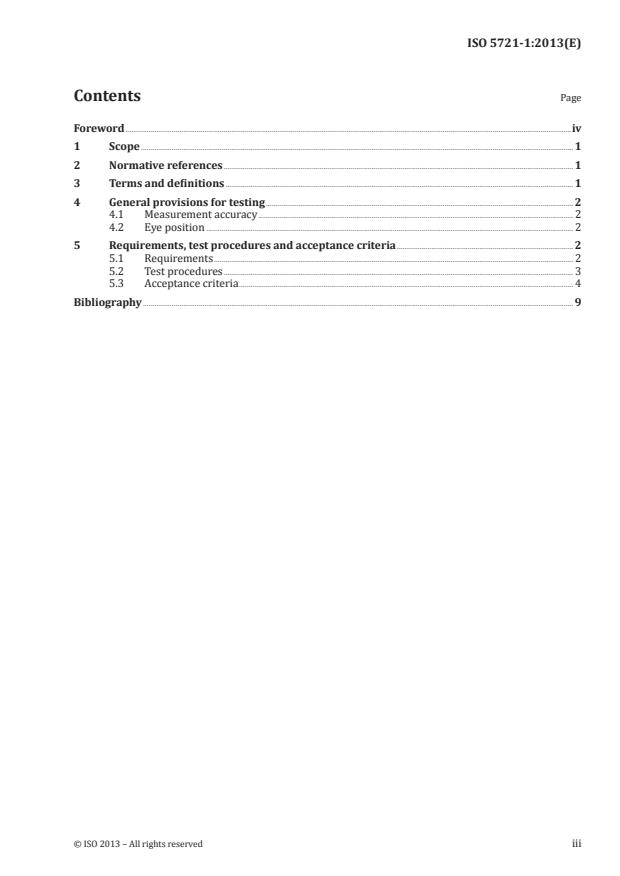
ISO 5721-1:2013 - Agricultural tractors — Requirements, test procedures and acceptance criteria for the operator's field of vision — Part 1: Field of vision to the front Released:6/21/2013

ISO 5721-1:2013 - Tracteurs agricoles — Exigences, modes opératoires d'essai et criteres d'acceptation relatifs au champ de visibilité du conducteur — Partie 1: Champ de visibilité vers l'avant Released:7/23/2013
Overview
ISO 5721-1:2013 - Agricultural tractors - Requirements, test procedures and acceptance criteria for the operator’s field of vision - Part 1: Field of vision to the front defines requirements and test methods to evaluate the operator’s forward field of vision on agricultural tractors. The standard specifies how to measure visibility from a defined eye position, acceptable limits for obstructions (masking effects and blind spots), required windscreen wiper performance, and practical acceptance criteria used in design validation, type approval and safety testing.
Key Topics
- Scope and definitions: Establishes terms such as field of vision, semi-circle of vision to the front (12 m radius), reference point and masking effects.
- Eye position and reference geometry: Eye position is located 680 mm above and 20 mm in front of the seat index point (per ISO 5353) for all measurements.
- Measurement accuracy: Physical measurements must be accurate to within ±2%.
- Masking effects and limits:
- Masking effects shall not exceed 700 mm in the main semi-circle of vision.
- Special provisions allow larger masking effects outside the principal sector (up to 1 500 mm under constrained design conditions) with limits on number and spacing.
- Maximum number of masking effects allowed: no more than six in the semi-circle and no more than two inside the defined sector to the front.
- Minimum intervals between masking centres are specified (e.g. 2 200 mm for certain components; acceptance testing references a 2 500 mm chord minimum in some cases).
- Visibility testing procedures:
- Uses two point light sources mounted at the reference plane (example: two × 150 W, 12 V filaments, 65 mm apart) on a pivotable support to project silhouettes and determine deepest shadows.
- Additional lateral movement of light sources during testing varies with maximum design speed (≤25 km/h: 170 mm; ≤50 km/h: 100 mm; >50 km/h: 50 mm).
- A mathematical method for calculating masking effects for binocular vision (inter‑ocular distance 65 mm) is provided as an alternative to optical testing.
- Windscreen wipers: Wipers must sweep a chord equivalent to at least 8 m on the semi-circle and offer at least one setting of ≥20 cycles/min.
- Equivalency: ISO 5006:2006 is acknowledged as an equivalent reference for operator field-of-view criteria.
Applications
- Vehicle manufacturers and designers: Integrate visibility requirements into cab, bonnet, exhaust and intake layout to meet regulatory and market safety expectations.
- Test laboratories and certification bodies: Use the specified test procedures and acceptance criteria for type approval, inspection and compliance verification.
- Safety engineers and fleet managers: Evaluate risk at yard exits, road merges and intersections and implement operational mitigations (mirrors, CCTV, spotters) when design limits cannot be met.
- Regulators and standards committees: Reference ISO 5721-1:2013 for national legislation and harmonized tractor safety rules.
Related Standards
- ISO 5006:2006 - Earth‑moving machinery - Operator’s field of view (methods considered equivalent).
- ISO 5353:1995 - Seat index point (used to determine eye position).
Keywords: ISO 5721-1:2013, agricultural tractors, operator's field of vision, field of vision to the front, masking effects, visibility testing, windscreen wipers, test procedures, acceptance criteria.
Relations
- Effective Date
- 05-Jun-2010
- Effective Date
- 09-Feb-2026
Buy Documents
ISO 5721-1:2013 - Agricultural tractors — Requirements, test procedures and acceptance criteria for the operator's field of vision — Part 1: Field of vision to the front Released:6/21/2013
ISO 5721-1:2013 - Tracteurs agricoles — Exigences, modes opératoires d'essai et criteres d'acceptation relatifs au champ de visibilité du conducteur — Partie 1: Champ de visibilité vers l'avant Released:7/23/2013
Get Certified
Connect with accredited certification bodies for this standard

Control Union Certifications
Global certification for agriculture and sustainability.

ECOCERT
Organic and sustainability certification.

FSC International
Forest Stewardship Council certification.
Sponsored listings
Frequently Asked Questions
SIST ISO 5721-1:2017 is a standard published by the Slovenian Institute for Standardization (SIST). Its full title is "Agricultural tractors - Requirements, test procedures and acceptance criteria for the operator's field of vision - Part 1: Field of vision to the front". This standard covers: ISO 5721-1:2013 specifies the requirements, test procedures and acceptance criteria for the field of vision to the front of the operator of agricultural tractors.
ISO 5721-1:2013 specifies the requirements, test procedures and acceptance criteria for the field of vision to the front of the operator of agricultural tractors.
SIST ISO 5721-1:2017 is classified under the following ICS (International Classification for Standards) categories: 65.060.10 - Agricultural tractors and trailed vehicles. The ICS classification helps identify the subject area and facilitates finding related standards.
SIST ISO 5721-1:2017 has the following relationships with other standards: It is inter standard links to SIST ISO 5721:1995, SIST EN ISO 4254-20:2026. Understanding these relationships helps ensure you are using the most current and applicable version of the standard.
SIST ISO 5721-1:2017 is available in PDF format for immediate download after purchase. The document can be added to your cart and obtained through the secure checkout process. Digital delivery ensures instant access to the complete standard document.
Standards Content (Sample)
SLOVENSKI STANDARD
01-maj-2017
Kmetijski traktorji - Zahteve, preskusni postopki in merila sprejemljivosti za vidno
polje traktorista - 1. del: Vidno polje spredaj
Agricultural tractors - Requirements, test procedures and acceptance criteria for the
operator's field of vision - Part 1: Field of vision to the front
Tracteurs agricoles - Exigences, modes opératoires d'essai et critères d'acceptation
relatifs au champ de visibilité du conducteur - Partie 1: Champ de visibilité vers l'avant
Ta slovenski standard je istoveten z: ISO 5721-1:2013
ICS:
65.060.10 Kmetijski traktorji in prikolice Agricultural tractors and
trailed vehicles
2003-01.Slovenski inštitut za standardizacijo. Razmnoževanje celote ali delov tega standarda ni dovoljeno.
INTERNATIONAL ISO
STANDARD 5721-1
First edition
2013-07-01
Agricultural tractors — Requirements,
test procedures and acceptance criteria
for the operator’s field of vision —
Part 1:
Field of vision to the front
Tracteurs agricoles — Exigences, modes opératoires d’essai et critères
d’acceptation relatifs au champ de visibilité du conducteur —
Partie 1: Champ de visibilité vers l’avant
Reference number
©
ISO 2013
© ISO 2013
All rights reserved. Unless otherwise specified, no part of this publication may be reproduced or utilized otherwise in any form
or by any means, electronic or mechanical, including photocopying, or posting on the internet or an intranet, without prior
written permission. Permission can be requested from either ISO at the address below or ISO’s member body in the country of
the requester.
ISO copyright office
Case postale 56 • CH-1211 Geneva 20
Tel. + 41 22 749 01 11
Fax + 41 22 749 09 47
E-mail copyright@iso.org
Web www.iso.org
Published in Switzerland
ii © ISO 2013 – All rights reserved
Contents Page
Foreword .iv
1 Scope . 1
2 Normative references . 1
3 Terms and definitions . 1
4 General provisions for testing . 2
4.1 Measurement accuracy . 2
4.2 Eye position . 2
5 Requirements, test procedures and acceptance criteria . 2
5.1 Requirements . 2
5.2 Test procedures . 3
5.3 Acceptance criteria . 4
Bibliography . 9
Foreword
ISO (the International Organization for Standardization) is a worldwide federation of national standards
bodies (ISO member bodies). The work of preparing International Standards is normally carried out
through ISO technical committees. Each member body interested in a subject for which a technical
committee has been established has the right to be represented on that committee. International
organizations, governmental and non-governmental, in liaison with ISO, also take part in the work.
ISO collaborates closely with the International Electrotechnical Commission (IEC) on all matters of
electrotechnical standardization.
The procedures used to develop this document and those intended for its further maintenance are
described in the ISO/IEC Directives, Part 1. In particular the different approval criteria needed for the
different types of ISO documents should be noted. This document was drafted in accordance with the
editorial rules of the ISO/IEC Directives, Part 2. www.iso.org/directives
Attention is drawn to the possibility that some of the elements of this document may be the subject of
patent rights. ISO shall not be held responsible for identifying any or all such patent rights. Details of
any patent rights identified during the development of the document will be in the Introduction and/or
on the ISO list of patent declarations received. www.iso.org/patents
Any trade name used in this document is information given for the convenience of users and does not
constitute an endorsement.
The committee responsible for this document is ISO/TC 23, Tractors and machinery for agriculture and
forestry, Subcommittee SC 4, Tractors.
This first edition of ISO 5721-1, together with ISO 5721-2, cancels and replaces ISO 5721:1989, which has
been technically revised.
ISO 5721 consists of the following parts, under the general title Agricultural tractors — Requirements,
test procedures and acceptance criteria for the operator’s field of vision:
— Part 1: Field of vision to the front
— Part 2: Field of vision to the side and to the rear
iv © ISO 2013 – All rights reserved
INTERNATIONAL STANDARD ISO 5721-1:2013(E)
Agricultural tractors — Requirements, test procedures and
acceptance criteria for the operator’s field of vision —
Part 1:
Field of vision to the front
1 Scope
This part of ISO 5721 specifies the requirements, test procedures and acceptance criteria for the field of
vision to the front of the operator of agricultural tractors.
2 Normative references
The following documents, in whole or in part, are normatively referenced in this document and are
indispensable for its application. For dated references, only the edition cited applies. For undated
references, the latest edition of the referenced document (including any amendments) applies.
ISO 5353:1995, Earth-moving machinery, and tractors and machinery for agriculture and forestry —
Seat index point
3 Terms and definitions
For the purposes of this document, the following terms and definitions apply.
3.1
field of vision
area which can be viewed from the seated operators eye position
3.1.1
direct field of vision
visibility by direct line of sight as determined by the light from the light source
3.1.2
indirect field of vision
visibility with the aid of mirrors or with other visual aids such as closed circuit television cameras (CCTV)
3.2
semi-circle of vision to the front
semi-circle described by a radius of 12 m about a point situated in the horizontal plane of the road
vertically below the reference point, in such a way that, when facing the direction of motion, the arc of
the semi-circle lies in front of the tractor, while the diameter bounding the semi-circle is at right angles
to the longitudinal axis of the tractor
Note 1 to entry: See Figure 2.
3.3
angle of vision upwards
angle of vision limited downwards by a horizontal plane passing through the eye pos ition and upwards
by planes containing the rays of vision from the eye position to points of obscuration caused by vehicle
components other than those which cause masking effects (3.4)
3.4
masking effects
chords of the sectors of the semi-circle of vision to the front which cannot be seen owing to structural
components such as roof-pillars, air intakes or exhaust stacks and the frame of the windscreen
3.5
sector of vision to the front
part of the field of vision limited by a horizontal plane passing through the reference point
3.6
sector of vision to the front
part of the field of vision limited by the zone lying outside the semi-circle of
vision to the front, and forming the continuation of the sector of the semi-circle of vision to the front, the
chord of which is 9,50 m long, perpendicular to the plane parallel to the longitudinal median pl
...
INTERNATIONAL ISO
STANDARD 5721-1
First edition
2013-07-01
Agricultural tractors — Requirements,
test procedures and acceptance criteria
for the operator’s field of vision —
Part 1:
Field of vision to the front
Tracteurs agricoles — Exigences, modes opératoires d’essai et critères
d’acceptation relatifs au champ de visibilité du conducteur —
Partie 1: Champ de visibilité vers l’avant
Reference number
©
ISO 2013
© ISO 2013
All rights reserved. Unless otherwise specified, no part of this publication may be reproduced or utilized otherwise in any form
or by any means, electronic or mechanical, including photocopying, or posting on the internet or an intranet, without prior
written permission. Permission can be requested from either ISO at the address below or ISO’s member body in the country of
the requester.
ISO copyright office
Case postale 56 • CH-1211 Geneva 20
Tel. + 41 22 749 01 11
Fax + 41 22 749 09 47
E-mail copyright@iso.org
Web www.iso.org
Published in Switzerland
ii © ISO 2013 – All rights reserved
Contents Page
Foreword .iv
1 Scope . 1
2 Normative references . 1
3 Terms and definitions . 1
4 General provisions for testing . 2
4.1 Measurement accuracy . 2
4.2 Eye position . 2
5 Requirements, test procedures and acceptance criteria . 2
5.1 Requirements . 2
5.2 Test procedures . 3
5.3 Acceptance criteria . 4
Bibliography . 9
Foreword
ISO (the International Organization for Standardization) is a worldwide federation of national standards
bodies (ISO member bodies). The work of preparing International Standards is normally carried out
through ISO technical committees. Each member body interested in a subject for which a technical
committee has been established has the right to be represented on that committee. International
organizations, governmental and non-governmental, in liaison with ISO, also take part in the work.
ISO collaborates closely with the International Electrotechnical Commission (IEC) on all matters of
electrotechnical standardization.
The procedures used to develop this document and those intended for its further maintenance are
described in the ISO/IEC Directives, Part 1. In particular the different approval criteria needed for the
different types of ISO documents should be noted. This document was drafted in accordance with the
editorial rules of the ISO/IEC Directives, Part 2. www.iso.org/directives
Attention is drawn to the possibility that some of the elements of this document may be the subject of
patent rights. ISO shall not be held responsible for identifying any or all such patent rights. Details of
any patent rights identified during the development of the document will be in the Introduction and/or
on the ISO list of patent declarations received. www.iso.org/patents
Any trade name used in this document is information given for the convenience of users and does not
constitute an endorsement.
The committee responsible for this document is ISO/TC 23, Tractors and machinery for agriculture and
forestry, Subcommittee SC 4, Tractors.
This first edition of ISO 5721-1, together with ISO 5721-2, cancels and replaces ISO 5721:1989, which has
been technically revised.
ISO 5721 consists of the following parts, under the general title Agricultural tractors — Requirements,
test procedures and acceptance criteria for the operator’s field of vision:
— Part 1: Field of vision to the front
— Part 2: Field of vision to the side and to the rear
iv © ISO 2013 – All rights reserved
INTERNATIONAL STANDARD ISO 5721-1:2013(E)
Agricultural tractors — Requirements, test procedures and
acceptance criteria for the operator’s field of vision —
Part 1:
Field of vision to the front
1 Scope
This part of ISO 5721 specifies the requirements, test procedures and acceptance criteria for the field of
vision to the front of the operator of agricultural tractors.
2 Normative references
The following documents, in whole or in part, are normatively referenced in this document and are
indispensable for its application. For dated references, only the edition cited applies. For undated
references, the latest edition of the referenced document (including any amendments) applies.
ISO 5353:1995, Earth-moving machinery, and tractors and machinery for agriculture and forestry —
Seat index point
3 Terms and definitions
For the purposes of this document, the following terms and definitions apply.
3.1
field of vision
area which can be viewed from the seated operators eye position
3.1.1
direct field of vision
visibility by direct line of sight as determined by the light from the light source
3.1.2
indirect field of vision
visibility with the aid of mirrors or with other visual aids such as closed circuit television cameras (CCTV)
3.2
semi-circle of vision to the front
semi-circle described by a radius of 12 m about a point situated in the horizontal plane of the road
vertically below the reference point, in such a way that, when facing the direction of motion, the arc of
the semi-circle lies in front of the tractor, while the diameter bounding the semi-circle is at right angles
to the longitudinal axis of the tractor
Note 1 to entry: See Figure 2.
3.3
angle of vision upwards
angle of vision limited downwards by a horizontal plane passing through the eye pos ition and upwards
by planes containing the rays of vision from the eye position to points of obscuration caused by vehicle
components other than those which cause masking effects (3.4)
3.4
masking effects
chords of the sectors of the semi-circle of vision to the front which cannot be seen owing to structural
components such as roof-pillars, air intakes or exhaust stacks and the frame of the windscreen
3.5
sector of vision to the front
part of the field of vision limited by a horizontal plane passing through the reference point
3.6
sector of vision to the front
part of the field of vision limited by the zone lying outside the semi-circle of
vision to the front, and forming the continuation of the sector of the semi-circle of vision to the front, the
chord of which is 9,50 m long, perpendicular to the plane parallel to the longitudinal median plane of the
tractor passing through the centre of the driver’s seat and bisected by that plane
3.7
swept area of the windscreen wipers
area of the outer surface of the windscreen swept by the windscreen wipers
3.8
reference point
position on the ground vertically below the eye position
4 General provisions for testing
4.1 Measurement accuracy
The equipment and techniques used to make the physical measurements shall be accurate to within ±
2 % of the value measured.
4.2 Eye position
The eye position shall be located 680 mm ab
...
NORME ISO
INTERNATIONALE 5721-1
Première édition
2013-07-01
Tracteurs agricoles — Exigences,
modes opératoires d’essai et critères
d’acceptation relatifs au champ de
visibilité du conducteur —
Partie 1:
Champ de visibilité vers l’avant
Agricultural tractors — Requirements, test procedures and
acceptance criteria for the operator’s field of vision —
Part 1: Field of vision to the front
Numéro de référence
©
ISO 2013
DOCUMENT PROTÉGÉ PAR COPYRIGHT
© ISO 2013
Droits de reproduction réservés. Sauf indication contraire, aucune partie de cette publication ne peut être reproduite ni utilisée
sous quelque forme que ce soit et par aucun procédé, électronique ou mécanique, y compris la photocopie, l’affichage sur
l’internet ou sur un Intranet, sans autorisation écrite préalable. Les demandes d’autorisation peuvent être adressées à l’ISO à
l’adresse ci-après ou au comité membre de l’ISO dans le pays du demandeur.
ISO copyright office
Case postale 56 • CH-1211 Geneva 20
Tel. + 41 22 749 01 11
Fax + 41 22 749 09 47
E-mail copyright@iso.org
Web www.iso.org
Publié en Suisse
ii © ISO 2013 – Tous droits réservés
Sommaire Page
Avant-propos .iv
1 Domaine d’application . 1
2 Références normatives . 1
3 Termes et définitions . 1
4 Dispositions générales pour les essais . 2
4.1 Précision de mesurage . 2
4.2 Position de l’œil . 2
5 Exigences, modes opératoires d’essai et critères d’acceptation . 2
5.1 Exigences . 2
5.2 Modes opératoires d’essai . 3
5.3 Critères d’acceptation . 4
Bibliographie . 9
Avant-propos
L’ISO (Organisation internationale de normalisation) est une fédération mondiale d’organismes
nationaux de normalisation (comités membres de l’ISO). L’élaboration des Normes internationales est
en général confiée aux comités techniques de l’ISO. Chaque comité membre intéressé par une étude
a le droit de faire partie du comité technique créé à cet effet. Les organisations internationales,
gouvernementales et non gouvernementales, en liaison avec l’ISO participent également aux travaux.
L’ISO collabore étroitement avec la Commission électrotechnique internationale (CEI) en ce qui concerne
la normalisation électrotechnique.
Les procédures utilisées pour élaborer le présent document et celles destinées à sa mise à jour sont
décrites dans les Directives ISO/CEI, Partie 1. Il convient, en particulier de prendre note des différents
critères d’approbation requis pour les différents types de documents ISO. Le présent document a été
rédigé conformément aux règles de rédaction données dans les Directives ISO/CEI, Partie 2, www.iso.
org/directives.
L’attention est appelée sur le fait que certains des éléments du présent document peuvent faire l’objet de
droits de propriété intellectuelle ou de droits analogues. L’ISO ne saurait être tenue pour responsable
de ne pas avoir identifié de tels droits de propriété et averti de leur existence. Les détails concernant les
références aux droits de propriété intellectuelle ou autres droits analogues identifiés lors de l’élaboration
du document sont indiqués dans l’Introduction et/ou sur la liste ISO des déclarations de brevets reçues,
www.iso.org/patents.
Les éventuelles appellations commerciales utilisées dans le présent document sont données pour
information à l’intention des utilisateurs et ne constituent pas une approbation ou une recommandation.
Le comité chargé de l’élaboration du présent document est l’ISO/TC 23, Tracteurs et matériels agricoles et
forestiers, sous-comité SC 4, Tracteurs.
La première édition de l’ISO 5721-1, conjointement avec l’ISO 5721-2, annule et remplace l’ISO 5721:1989,
qui a fait l’objet d’une révision technique.
L’ISO 5721 comprend les parties suivantes, présentées sous le titre général Tracteurs agricoles —
Exigences, modes opératoires d’essai et critères d’acceptation relatifs au champ de visibilité du conducteur:
— Partie 1: Champ de visibilité vers l’avant
— Partie 2: Champ de visibilité latéral et vers l’arrière
iv © ISO 2013 – Tous droits réservés
NORME INTERNATIONALE ISO 5721-1:2013(F)
Tracteurs agricoles — Exigences, modes opératoires
d’essai et critères d’acceptation relatifs au champ de
visibilité du conducteur —
Partie 1:
Champ de visibilité vers l’avant
1 Domaine d’application
La présente partie de l’ISO 5721 spécifie les exigences, les modes opératoires d’essai et les critères
d’acceptation relatifs au champ de visibilité vers l’avant des conducteurs de tracteurs agricoles.
2 Références normatives
Les documents suivants, en totalité ou en partie, sont référencés de manière normative dans le présent
document et sont indispensables pour son application. Pour les références datées, seule l’édition citée
s’applique. Pour les références non datées, la dernière édition du document de référence s’applique (y
compris les éventuels amendements).
ISO 5353:1995, Engins de terrassement, et tracteurs et matériels agricoles et forestiers — Point repère du siège
3 Termes et définitions
Pour les besoins du présent document, les termes et définitions suivants s’appliquent.
3.1
champ de visibilité
espace qui peut être vu à partir de la position de l’œil du conducteur assis
3.1.1
champ de visibilité directe
visibilité obtenue par visée directe et déterminée par la lumière émise par la source lumineuse
3.1.2
champ de visibilité indirecte
visibilité assurée à l’aide de miroirs ou de toute autre aide visuelle, telle que des caméras de systèmes de
télévision en circuit fermé (CCTV)
3.2
hémicycle de visibilité à l’avant
demi-cercle décrit par un rayon de 12 m autour du point situé dans le plan horizontal de la route, à
la verticale au-dessous du point de référence, de sorte que l’arc du demi-cercle, vu dans le sens de la
marche, se situe devant le tracteur et que le diamètre délimitant l’hémicycle forme un angle droit avec
l’axe longitudinal du tracteur
Note 1 à l’article: Voir Figure 2.
3.3
angle de visibilité vers le haut
angle de visibilité limité, vers le bas, par un plan horizontal passant par la position de l’œil et, vers le
haut, par des plans contenant les rayons de vision à partir de la position de l’œil et jusqu’aux points de
masquage provoqués par les éléments du véhicule autres que ceux qui causent les effets de masque (3.4)
3.4
effets de masque
cordes des secteurs de l’hémicycle de visibilité à l’avant qui ne peuvent être vues en raison d’éléments
de construction, par exemple les montants du toit, les tuyaux d’aspiration d’air ou d’échappement et le
cadre du pare-brise
3.5
secteur de visibilité à l’avant
partie du champ de visibilité qui est délimitée par un plan horizontal passant par le
point de référence
3.6
secteur de visibilité à l’avant
partie du champ de visibilité qui est délimitée par la zone située à l’extérieur
de l’hémicycle de visibilité à l’avant, qui prolonge le secteur de l’hémicycle de visibilité à l’avant, dont la
corde de 9,50 m de long est perpendiculaire au plan parallèle au plan médian longitudinal du tracteur
passant par le milieu du siège du conducteur et partagé en deux par ce plan
3.7
champ d’action des essuie-glaces de pare-brise
secteur de la surface extérieure du pare-brise balayé par les essuie-glaces de pare-brise
3.8
point de référence
position au sol située verticalement en dessous de la position de l’œil
4 Dispositions générales pour les essais
4.1 Précision de mesurage
L’équipement et les techniques utilisés pour effectuer les mesurages physiques doivent permettre une
précision de ± 2 % de la valeur mesurée.
4.2 Position de l’œil
La position de l’œil doit être localisée à 680 mm au-dessus et 20 mm en avant du point repère du siège
lorsqu’il est déterminé conformément à l’ISO 5353 (voir Figure 1).
5 Exigences, modes opératoires d’essai et cri
...