

SIST EN 12368:2024
(Main)Traffic control equipment - Signal heads
General Information
- Abstract
This document applies to signal heads with one or more signal lights of the colours red, yellow and/or green signal lights for road traffic with 200 mm and 300 mm roundels and to optical units to be integrated in signal heads to produce the individual signal lights. It defines the product characteristics for the visual, structural, environmental performances and testing of signal heads and optical units for pedestrian and road traffic use, and the rules for the evaluation of the conformity of these products.
This document can be partly or fully applied on a voluntary basis to other signal heads outside of the scope specified above like for instance white optical units or small signal heads with a diameter smaller than 200 mm.
- Status
- Published
- Public Enquiry End Date
- 19-Mar-2019
- Publication Date
- 28-May-2024
- Technical Committee
- OCE - Road equipment
- Current Stage
- 6060 - National Implementation/Publication (Adopted Project)
- Start Date
- 08-May-2024
- Due Date
- 13-Jul-2024
- Completion Date
- 29-May-2024


Overview
EN 12368:2024 (CEN) is the European standard for traffic control equipment - specifically signal heads and the optical units used to produce individual red, yellow and green signal lights (200 mm and 300 mm roundels). It defines product characteristics, test methods and rules for conformity assessment covering visual, structural, environmental, EMC and electrical performance for pedestrian and road traffic signal heads. The 2024 edition supersedes EN 12368:2015 and adds clarifications, updated LED-related guidance and options for voluntary application to other signal head types (e.g., white optics or <200 mm).
Key Topics and Requirements
- Scope and definitions: signal head, optical unit, optical surface, lens, background screen, hood/visor.
- Constructional characteristics: ingress protection (IP), impact resistance, constructional integrity and durability for a minimum expected life in exposed roadside environments.
- Environmental & EMC requirements: tests for cold, heat, solar radiation, temperature cycling, damp heat, vibration and electromagnetic compatibility referencing EN 60068 series, EN 50293 and EN 50556.
- Optical characteristics:
- Light-emitting diameter and nominal roundel sizes (200 mm, 300 mm).
- Luminous intensity and angular distributions (extra wide, wide, medium, narrow) to suit urban and long-distance visibility.
- Luminance uniformity, colour requirements, maximum phantom signal, visible flicker, and signal lights with symbols.
- Practical guidance on failure-mode thresholds (e.g., red considered failed if I ≤ 10 cd; green in operation if I ≥ 0.05 cd).
- Test methods: optical measurement procedures, luminance and phantom signal measurement, and constructional/environmental testing.
- Conformity & quality control: rules for Assessment and Verification of Constancy of Performance (AVCP), type testing, Factory Production Control (FPC), initial inspections and surveillance.
Applications and Who Uses It
- Traffic engineers, municipal authorities and transport planners specifying road and pedestrian signal heads.
- Manufacturers and suppliers of traffic signal equipment and optical units ensuring design and production compliance.
- Test laboratories conducting optical, environmental and EMC testing for product certification.
- Procurement teams using EN 12368:2024 as the basis for technical specifications and conformity verification in tenders.
- Maintenance teams referencing performance and restoration expectations after lamp replacement and cleaning.
Related Standards
- EN 50293 - Road traffic signal systems: Electromagnetic compatibility
- EN 50556 - Road traffic signal systems
- EN 60068 series - Environmental testing (cold, heat, solar, humidity, vibration)
- EN 60529 - Degrees of protection (IP Code)
- EN 60598-1 - Luminaires - general requirements and tests
EN 12368:2024 provides a practical, testable framework for designing, producing and verifying reliable, durable and visible traffic signal heads - helping authorities and suppliers ensure safe road-user signalling.
Relations
- Effective Date
- 01-Jul-2024
- Effective Date
- 09-Feb-2026
- Effective Date
- 09-Feb-2026
- Effective Date
- 09-Feb-2026
- Effective Date
- 09-Feb-2026
- Effective Date
- 09-Feb-2026
- Effective Date
- 09-Feb-2026
- Effective Date
- 09-Feb-2026
- Effective Date
- 09-Feb-2026
- Effective Date
- 09-Feb-2026
- Effective Date
- 09-Feb-2026
- Effective Date
- 28-Jan-2026
Get Certified
Connect with accredited certification bodies for this standard

Zavod za gradbeništvo Slovenije (ZAG) - Inšpekcija
ZAG inspection body for construction products, structures, and materials.
Sponsored listings
Frequently Asked Questions
SIST EN 12368:2024 is a standard published by the Slovenian Institute for Standardization (SIST). Its full title is "Traffic control equipment - Signal heads". This standard covers: This document applies to signal heads with one or more signal lights of the colours red, yellow and/or green signal lights for road traffic with 200 mm and 300 mm roundels and to optical units to be integrated in signal heads to produce the individual signal lights. It defines the product characteristics for the visual, structural, environmental performances and testing of signal heads and optical units for pedestrian and road traffic use, and the rules for the evaluation of the conformity of these products. This document can be partly or fully applied on a voluntary basis to other signal heads outside of the scope specified above like for instance white optical units or small signal heads with a diameter smaller than 200 mm.
This document applies to signal heads with one or more signal lights of the colours red, yellow and/or green signal lights for road traffic with 200 mm and 300 mm roundels and to optical units to be integrated in signal heads to produce the individual signal lights. It defines the product characteristics for the visual, structural, environmental performances and testing of signal heads and optical units for pedestrian and road traffic use, and the rules for the evaluation of the conformity of these products. This document can be partly or fully applied on a voluntary basis to other signal heads outside of the scope specified above like for instance white optical units or small signal heads with a diameter smaller than 200 mm.
SIST EN 12368:2024 is classified under the following ICS (International Classification for Standards) categories: 93.080.30 - Road equipment and installations. The ICS classification helps identify the subject area and facilitates finding related standards.
SIST EN 12368:2024 has the following relationships with other standards: It is inter standard links to SIST EN 12368:2015, SIST EN IEC 60068-2-30:2025, SIST EN IEC 60068-2-14:2024, SIST EN IEC 60068-2-2:2026, SIST EN IEC 60068-2-1:2026, SIST EN 60529:1997, SIST EN 60068-2-64:2008, SIST EN 50293:2012, SIST EN 60598-1:2015, SIST EN IEC 60068-2-5:2018, SIST EN 50556:2019, SIST EN 12675:2002. Understanding these relationships helps ensure you are using the most current and applicable version of the standard.
SIST EN 12368:2024 is associated with the following European legislation: EU Directives/Regulations: 305/2011; Standardization Mandates: M/111. When a standard is cited in the Official Journal of the European Union, products manufactured in conformity with it benefit from a presumption of conformity with the essential requirements of the corresponding EU directive or regulation.
SIST EN 12368:2024 is available in PDF format for immediate download after purchase. The document can be added to your cart and obtained through the secure checkout process. Digital delivery ensures instant access to the complete standard document.
Standards Content (Sample)
SLOVENSKI STANDARD
01-julij-2024
Nadomešča:
SIST EN 12368:2015
Oprema za nadzor in vodenje cestnega prometa - Signalne luči
Traffic control equipment - Signal heads
Anlagen zur Verkehrssteuerung - Signalleuchten
Équipement de régulation du trafic - Signaux
Ta slovenski standard je istoveten z: EN 12368:2024
ICS:
93.080.30 Cestna oprema in pomožne Road equipment and
naprave installations
2003-01.Slovenski inštitut za standardizacijo. Razmnoževanje celote ali delov tega standarda ni dovoljeno.
EN 12368
EUROPEAN STANDARD
NORME EUROPÉENNE
April 2024
EUROPÄISCHE NORM
ICS 93.080.30 Supersedes EN 12368:2015
English Version
Traffic control equipment - Signal heads
Équipement de régulation du trafic - Signaux Anlagen zur Verkehrssteuerung - Signalleuchten
This European Standard was approved by CEN on 29 January 2024.
CEN members are bound to comply with the CEN/CENELEC Internal Regulations which stipulate the conditions for giving this
European Standard the status of a national standard without any alteration. Up-to-date lists and bibliographical references
concerning such national standards may be obtained on application to the CEN-CENELEC Management Centre or to any CEN
member.
This European Standard exists in three official versions (English, French, German). A version in any other language made by
translation under the responsibility of a CEN member into its own language and notified to the CEN-CENELEC Management
Centre has the same status as the official versions.
CEN members are the national standards bodies of Austria, Belgium, Bulgaria, Croatia, Cyprus, Czech Republic, Denmark, Estonia,
Finland, France, Germany, Greece, Hungary, Iceland, Ireland, Italy, Latvia, Lithuania, Luxembourg, Malta, Netherlands, Norway,
Poland, Portugal, Republic of North Macedonia, Romania, Serbia, Slovakia, Slovenia, Spain, Sweden, Switzerland, Türkiye and
United Kingdom.
EUROPEAN COMMITTEE FOR STANDARDIZATION
COMITÉ EUROPÉEN DE NORMALISATION
EUROPÄISCHES KOMITEE FÜR NORMUNG
CEN-CENELEC Management Centre: Rue de la Science 23, B-1040 Brussels
© 2024 CEN All rights of exploitation in any form and by any means reserved Ref. No. EN 12368:2024 E
worldwide for CEN national Members.
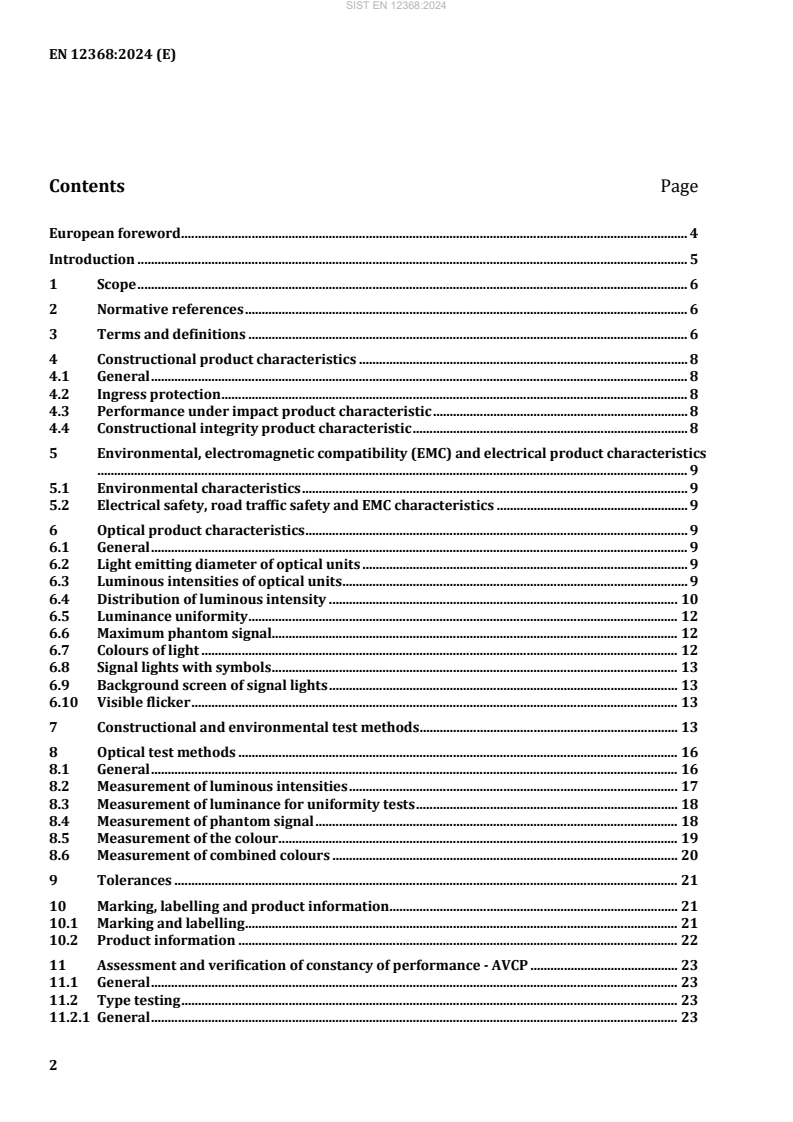
Contents Page
European foreword . 4
Introduction . 5
1 Scope . 6
2 Normative references . 6
3 Terms and definitions . 6
4 Constructional product characteristics . 8
4.1 General . 8
4.2 Ingress protection . 8
4.3 Performance under impact product characteristic . 8
4.4 Constructional integrity product characteristic . 8
5 Environmental, electromagnetic compatibility (EMC) and electrical product characteristics
................................................................................................................................................................................ 9
5.1 Environmental characteristics . 9
5.2 Electrical safety, road traffic safety and EMC characteristics . 9
6 Optical product characteristics . 9
6.1 General . 9
6.2 Light emitting diameter of optical units . 9
6.3 Luminous intensities of optical units . 9
6.4 Distribution of luminous intensity . 10
6.5 Luminance uniformity . 12
6.6 Maximum phantom signal. 12
6.7 Colours of light . 12
6.8 Signal lights with symbols . 13
6.9 Background screen of signal lights . 13
6.10 Visible flicker . 13
7 Constructional and environmental test methods . 13
8 Optical test methods . 16
8.1 General . 16
8.2 Measurement of luminous intensities . 17
8.3 Measurement of luminance for uniformity tests . 18
8.4 Measurement of phantom signal . 18
8.5 Measurement of the colour . 19
8.6 Measurement of combined colours . 20
9 Tolerances . 21
10 Marking, labelling and product information. 21
10.1 Marking and labelling . 21
10.2 Product information . 22
11 Assessment and verification of constancy of performance - AVCP . 23
11.1 General . 23
11.2 Type testing . 23
11.2.1 General . 23
11.2.2 Test samples, testing and compliance criteria . 24
11.2.3 Test reports . 26
11.2.4 Shared other party results . 26
11.2.5 Cascading determination of the product-type results . 27
11.3 Factory production control (FPC) . 28
11.3.1 General . 28
11.3.2 Requirements . 28
11.3.3 Product specific requirements . 31
11.3.4 Initial inspection of factory and of FPC . 32
11.3.5 Continuous surveillance of FPC . 32
11.3.6 Procedure for modifications . 33
11.3.7 One-off products, pre-production products (e.g. prototypes) and products produced in very
low quantity . 33
Annex A (informative) Test, declarations and requirements . 34
Bibliography . 36
European foreword
This document (EN 12368:2024) has been prepared by Technical Committee CEN/TC 226 “Road equipment”,
the secretariat of which is held by AFNOR.
This European Standard shall be given the status of a national standard, either by publication of an identical text
or by endorsement, at the latest by October 2024, and conflicting national standards shall be withdrawn at the
latest by January 2026.
Attention is drawn to the possibility that some of the elements of this document may be the subject of patent
rights. CEN shall not be held responsible for identifying any or all such patent rights.
This document supersedes EN 12368:2015.
This document has been prepared under a mandate given to CEN by the European Commission and the European
Free Trade Association.
The main changes in this revision EN 12368:2024 compared to the previous edition EN 12368:2015 are as
follows:
a) editorial changes for enhanced clarity and consistency;
b) change of the scope to include volunteerly application of this standard to other types of signal heads;
c) clarification of the terms optical surface and reference axis;
d) change of the headline of 4.2 to better match the content;
e) part of the content of 6.3 and 6.4 was moved to 8.2;
f) the explanatory notes in 6.6 referred to the obsolete incandescent lamp technology and were changed based
on the current LED technology;
g) change in the wording of 6.8 for better technical clarification;
h) change in the testing method regarding the stabilization of the luminous intensity in 8.2;
i) added the address as an information which is required to be on the product label.
Any feedback and questions on this document should be directed to the users’ national standards body. A
complete listing of these bodies can be found on the CEN website.
According to the CEN-CENELEC Internal Regulations, the national standards organisations of the following
countries are bound to implement this European Standard: Austria, Belgium, Bulgaria, Croatia, Cyprus, Czech
Republic, Denmark, Estonia, Finland, France, Germany, Greece, Hungary, Iceland, Ireland, Italy, Latvia, Lithuania,
Luxembourg, Malta, Netherlands, Norway, Poland, Portugal, Republic of North Macedonia, Romania, Serbia,
Slovakia, Slovenia, Spain, Sweden, Switzerland, Türkiye and the United Kingdom.
Introduction
Signal heads are mainly used to transfer safety messages to the road user to achieve specific reactions. Signal
heads in road traffic transfer this information optically by signal lights which have a specific meaning and which
differ in their colour of light and in the design of their illuminating surface.
The visibility of a signal light depends on the colour, luminous intensity, luminous intensity distribution,
luminance and luminance uniformity, the surrounding luminance (background luminance), the size of the
illuminating area, the phantom light and the distance and angle between observer and signal head.
Four angular distributions of luminous intensities for signal lights are specified. The user can choose between an
extra wide, wide, medium and narrow beam signal to obtain a good recognition of the signal for short distances
in urban areas, for long distances in rural areas. To achieve a good performance the standard provides a number
of different performance levels and two different diameters for the optical units.
This document does not require limits for the recognition of red or green signals with reduced luminous
intensities operating in a failure mode. These limits depend on the surrounding lights (on or off) and on the
situation. However, for a simple rule a red signal should be considered as failed if the luminous intensity in the
reference axes is I ≤ 10 cd, and a green signal should be considered as being in operation if the luminous intensity
is I ≥ 0,05 cd.
The working environment for signal heads is relatively harsh and equipment that is deemed “fit for purpose” is
expected to last in this exposed, corrosive environment for a minimum of 10 years. It is essential that all materials
and manufacturing processes take this into account. The supplier should detail all steps taken to comply with
this clause.
The optical performance of signal heads in use is a function of lens soiling, mirror soiling and a decrease of
luminous flux from the lamp. To maintain the performance of the signal heads during their lifetime, it is important
to ensure that after lamp replacement and cleaning of lens and mirror the light output is restored to as near
100 % as possible and never lower than 80 % of the declared specified performance.
For devices randomly selected from series production it is important that the product characteristic as to
minimum luminous intensity of the light emitted, are in each relevant direction, of the minimum values
prescribed.
For a full applicability of this document the national standardization/regulatory bodies are requested to define
the set of classes relevant for their national requirements.
1 Scope
This document applies to signal heads with one or more signal lights of the colours red, yellow and/or green
signal lights for road traffic with 200 mm and 300 mm roundels and to optical units to be integrated in signal
heads to produce the individual signal lights. It defines the product characteristics for the visual, structural,
environmental performances and testing of signal heads and optical units for pedestrian and road traffic use, and
the rules for the evaluation of the conformity of these products.
This document can be partly or fully applied on a voluntary basis to other signal heads outside of the scope
specified above like for instance white optical units or small signal heads with a diameter smaller than 200 mm.
2 Normative references
The following documents are referred to in the text in such a way that some or all of their content constitutes
requirements of this document. For dated references, only the edition cited applies. For undated references, the
latest edition of the referenced document (including any amendments) applies.
EN 50293, Road traffic signal systems - Electromagnetic compatibility
EN 50556, Road traffic signal systems
EN 60068-2-1, Environmental testing - Part 2-1: Tests - Test A: Cold
EN 60068-2-2, Environmental testing - Part 2-2: Tests - Test B: Dry heat
EN 60068-2-5, Environmental testing — Part 2-5: Tests — Test Sa: Simulated solar radiation at ground level and
guidance for solar radiation testing (IEC 60068-2-5)
EN 60068-2-14, Environmental testing - Part 2-14: Tests - Test N: Change of temperature
EN 60068-2-30, Environmental testing - Part 2-30: Tests - Test Db: Damp heat, cyclic (12 h + 12 h cycle)
EN 60068-2-64, Environmental testing - Part 2-64: Tests - Test Fh: Vibration, broadband random and guidance
EN 60529, Degrees of protection provided by enclosures (IP Code)
EN 60598-1:2015, Luminaires - Part 1: General requirements and tests
3 Terms and definitions
For the purposes of this document, the following terms and definitions apply.
ISO and IEC maintain terminological databases for use in standardization at the following addresses:
— IEC Electropedia: available at https://www.electropedia.org/
— ISO Online browsing platform: available at https://www.iso.org/obp
3.1
signal head
device which comprises one or more optical units, including the housing(s), together with all the mounting
brackets, fixings, hoods, visors, cowls and background screens, whose task is to convey a visual message to
vehicle and pedestrian traffic
3.2
optical unit
assembly of components designed to produce a light of the specified nominal size, colour, luminous intensity and
shape
3.3
optical surface
surface of the optical unit which emits light
Note 1 to entry: In many cases it is the external surface of the lens.
3.4
lens
light transmitting element of the optical unit which distributes the luminous flux from the light source into
preferred directions of the signal light
3.5
background screen
opaque board placed around the optical unit, either incorporated in the housing of the optical unit or detachable,
intended to increase the contrast and to enhance visibility
3.6
hood (visor, cowl)
device located above the front of an optical unit to reduce phantom effect or to restrict the field of view
3.7
phantom signal
false signal that is created by sunlight striking an optical unit
Note 1 to entry: For the technologies that don’t use coloured filters, the light reflexion doen’t induce a coloured image, but
decreases the visibility of the signal because of the contrat loss.
3.8
reference axis
axis specified by the supplier, used for environmental and optical tests. If not specified by the manufacture it will
be taken as perpendicular to the centre of the optical surface. The reference axis is labelled as 0° / 0°
3.9
Factory Production Control (FPC)
permanent internal control of production exercised by the manufacturer
3.10
batch
quantity of a product manufactured with no change in raw material, equipment, settings or operation as defined
in the FPC system manual of the manufacturer
3.11
individual (and non-series)
product manufactured under a manufacturing process that is specifically conceived for one unique production
3.12
apparent luminous surface
projection of the optical surface on a plane perpendicular to the reference axis used for the luminance uniformity
and the phantom signal measurements
4 Constructional product characteristics
4.1 General
The manufacturer shall ensure the design is such that there is a facility for maintenance. Any component
requiring replacement shall be designed such that this is easily accommodated and does not affect the optical
performance of the signal head.
The construction and choice of materials shall be such that they will provide declared performance for a
reasonable economic lifetime of the product as verified by the relevant tests given in this European standard.
The supplier shall detail in his documentation what maintenance shall be carried out, including cleaning methods
and materials, to ensure that the optical performance shall be maintained to at least 80 % of the minimum values
set out in the appropriate parts of 6.3 and 6.4 during the lifetime as defined by the supplier.
During the declared lifetime of the optical unit the colours shall remain within the colour boxes of Table 7.
4.2 Ingress protection
There are 5 classes for the Index Protection, IP, rating in accordance with EN 60529 of a signal head:
— Class I: IP34;
— Class II: IP44;
— Class III: IP54;
— Class IV: IP55;
— Class V: IP65.
NOTE A level of sealing in accordance with IP65 can result in a risk of water collection within the optic housing due to
condensation.
Where separate protection of the optical units is required they shall be protected to IP55 or IP65. The signal
head, including its optical components, shall be so designed that after installation, during its lifetime as defined
by the supplier, including any replacement of components, the optical and mechanical product characteristics
are guaranteed to meet the requirements of this standard.
4.3 Performance under impact product characteristic
There are 3 classes of performance under impact, IR1, IR2 and IR3. When required by the regulatory authority
this characteristic shall be determined in accordance with Clause 7 Constructional and environmental test
methods Table 8 — Impact resistance.
4.4 Constructional integrity product characteristic
The product is expected to survive levels of vibration that may be expected in normal operation. This
characteristic shall be determined in accordance with Clause 7 Constructional and environmental test methods
Table 9 — Constructional integrity.
5 Environmental, electromagnetic compatibility (EMC) and electrical product
characteristics
5.1 Environmental characteristics
The signal heads shall comply with one or more of the following classes of operational temperature ranges:
— Class A +60 °C to –15 °C;
— Class B +55 °C to –25 °C;
— Class C +40 °C to –40 °C.
5.2 Electrical safety, road traffic safety and EMC characteristics
The signal heads shall comply with the requirements of EN 50293.
Whilst this specification is for a traffic signal product, it is clear that this product is connected to a “Traffic system”
and as such the connections/wiring, etc. that is required between it and any controller shall meet the
requirements of EN 50556 for electrical safety and in particular attention is drawn to 5.1 Electric safety and to
5.2 road traffic safety.
6 Optical product characteristics
6.1 General
The optical units of a signal head should normally be of the same classes regarding luminous intensity, dimming,
distribution of luminous intensity and phantom light, but it is permissible in special cases that the classes are
different.
EXAMPLE In signal head with red, yellow and green optical units, it can be required that the red be in a brighter class
than the yellow and green on high speed roads.
All values in this section refer to the stabilized values according to 8.2.
6.2 Light emitting diameter of optical units
Optical units for road traffic conditions which fall in the scope of this standard shall be circular and have a
nominal light emitting diameter of 200 mm or 300 mm ± 10 %. Local requirements could exist in order to state
which signal head to use. When no regulation exists, it is not feasible to give strict rules for the situations where
either 200 mm or 300 mm optical unit signals should be used, as the requirements for visibility depend on the
local conditions of road lay-out and infrastructure, on traffic conditions and light conditions.
6.3 Luminous intensities of optical units
The performance levels for signal lights, for both 200 mm and 300 mm optical units, shall be as specified in
Table 1.
Table 1 — Luminous intensities (I) for red, yellow and green signal lights in the reference axis
Performance level 1 2 3
I 100 cd 200 cd 400 cd
min
I class 0 200 cd 400 cd 600 cd
max
I class 1 400 cd 800 cd 1 000 cd
max
I class 2 1 100 cd 2 000 cd 2 500 cd
max
For example the performance level 2/1 is the designation of an optical light with: I = 200 cd; I = 800 cd.
min max
Dimmed operation is an operating mode of the road traffic signal system in which the luminous intensity of the
signal heads is reduced. These classes of dimmed operation are available:
— Class D0 Dimmed operation is not required;
— Class D1 As declared by the manufacturer.
For Class D1, the manufacturer shall declare the performance of their signal in dimmed operation against the
optical product characteristics of this specification and operational voltage ranges.
NOTE Refer to CLC/TS 50509:2007, Annex B regarding dimmed operation in the Netherlands and Annex C regarding
dimmed operation in Spain.
6.4 Distribution of luminous intensity
In Tables 2, 3, 4, and 5 four angular distributions of luminous intensity for optical units are specified as minimum
luminous intensities, expressed as percentage values dependent on the choice of the following categories:
— A as a percentage of the measured values on the reference axis;
— B as a percentage of the minimum values as defined in Table 1 required on the on the the reference axis.
Outside the area described in Tables 2 to 5 (as applicable) the luminous intensities shall not exceed the maximum
of the relevant class of performance level.
Only the listed combinations of classes and performance levels shall be applied.
Within the field of measurement, the light pattern shall be substantially uniform, i.e. the light intensity in each
direction at each test point shall meet at least the level achieved by the next consecutive measurement. e.g. if the
measurement in the reference axis is 100 % and at +5 the measurement is 85 % then in between the two a
measurement should be at least 85 %.
Table 2 — Extra wide-optical unit (Type E) possible combinations B 1/0, B 1/1, B 2/2
α 0° ±2,5° ±5° ±10° ±15° ±20° ±30°
horiz
α 100 – 85 80 – 60 40
vert
0° – – – – – – –
–1,5° 80 – 75 – – – –
–3° 60 – – 45 – – –
–5° 50 – – – – 20 –
–10°
–20° 20 – – – – – 10
– means no specific values are required
Table 3 — Wide optical unit (Type W) possible combinations A 1/0, A 1/1; A 2/0, A 2/1; A 3/0, A 3/1;
B 1/2; B 2/1,B 2/2; B 3/2
α 0° ±2,5° ±5° ±10° ±15° ±20° ±30°
horiz
α 100 – 85 55 – 3 1
vert
0° – – – – – – –
–1,5° 80 – 75 – – – –
–3° 60 – – 35 – – –
–5° 30 – – – – 8 –
–10°
–20° 2 – – – – – 2
– means no specific values are required
Table 4 — Medium wide optical unit (Type M) possible combinations A 2/0, A 2/1; A 3/0, A 3/1; A 2/2;
A 3/2
α 0° ±2,5° ±5° ±10° ±15° ±20° ±30°
horiz
α 100 – 75 40 10 1 *
vert
0° – – – – – – *
–1,5° 75 – 60 – – – *
–3° 50 – – 20 – – *
–5° 12,5 – – – – 6 *
–10°
–20° 1,5 – – – – – 1
– means no specific values are required
* means no requirements
Table 5 — Narrow optical unit (Type N) possible combinations A 2/0, A 2/1; A 3/0, A 3/1; B 2/2; B 3/2
α 0° ±2,5° ±5° ±10° ±15° ±20° ±30°
horiz
α 100 75 65 15 1,5 * *
vert
0° 95 90 – – – * *
–1,5° 70 – 45 – – * *
–3° 40 – – 10 – * *
–5° 6 – – – 5 * *
–10°
–20° * * * * * * *
– means no specific values are required
* means no requirements
6.5 Luminance uniformity
The luminance uniformity of the optical unit as the ratio of the lowest and greatest luminance L : L shall
min max
be ≥ 1 : 10 for types E, W and M and ≥ 1 : 15 for type N.
6.6 Maximum phantom signal
For each signal colour the maximum phantom signal I for light incident at an angle of 10° to the reference axis
ph
shall comply with of Table 6, where I is the actual measured luminous intensity I of the signal light:
s
Table 6 — Requirement for the ratio of I to I
s ph
Signal light Class 1 Class 2 Class 3 Class 4 Class 5
red, yellow > 1 > 5 > 4 > 8 > 16
green > 1 > 5 > 8 > 16 > 16
The phantom signal is measured in laboratory conditions for a given geometrical situation (refer to 8.4), but
illustrates the phantom light that can be seen in a signal light in a range of situations with the sun in a low position
behind the observer. Phantom light may cause ambiguity as to which optical units are on or off unless it is weak
in comparison to the intensity emitted by the optical unit itself. Phantom light can be reduced by particular
designs of the optics, black interiors, anti-phantom devices or hoods, etc. Care shall be taken to ensure that the
phantom light is weak in all relevant situations.
NOTE In classes 3 and 4 the ratio of I to I is higher for green than for red and yellow because of the reddish light of
s ph
the sun in a low position
6.7 Colours of light
The colours of the optical units and the combined colours for all classes of phantom light, except class 1, shall
comply with Table 7 or Table 12 (illustrated by Figure 3) which are equivalent.
Table 7 — Required chromaticity regions for the colour boundaries of signal lights and combined
colours from real signal and phantom light
Colour of light Colour boundaries of signal lights Boundary
Red y = 0,290 red
y = 0,980 – x purple
y = 0,320 yellow
Yellow y = 0,387 red
y = 0,980 – x white
y = 0,727 x + 0,054 green
Green y = 0,726 – 0,726 x yellow
x = 0,625 y – 0,041 white
y = 0,400 blue
6.8 Signal lights with symbols
Symbols may be placed in front of the optical units. Signal heads with symbols are compliant to this standard
when the optical unit without symbol meets the requirements 6.3 to 6.7.
Class S1: Symbols placed on optical units meeting 100 % of one of the levels set out in Table 1.
Class S2: Symbols placed on optical units meeting 50 % of one of the levels set out in Table 1 (only pedestrian
traffic).
6.9 Background screen of signal lights
Signal lights shall have an opaque background screen or a rim of 25 mm which gives a permanent background
providing contrast. The background screen may be incorporated in the housing of the signal head or may consist
of a detachable screen.
6.10 Visible flicker
No light flicker shall be visible. When the light sources of a signal head are operating in a pulse mode, the
manufacturer shall inform the test laboratory as to the frequency of the light emitted, and the frequency shall be
verified by testing. This frequency shall not be less than 90 Hz.
NOTE In some member states a photograph of the signal can be required as recorded evidence of an offence of crossing
the light whilst at red. In this instance even a small amount of flicker not necessary perceptible can interfere with accurate
photographic evidence (the signal can appear to be off at the instance the photograph is taken), and in this instance the
purchaser can request “No Flicker” and define it.
7 Constructional and environmental test methods
Impact resistance, constructional integrity, ingress and tolerance to temperature, damp heat and solar radiation
shall be tested in accordance with Tables 8, 9, 10 and 11 respectively.
Signal heads with optical units of the two different nominal diameters (200 mm and 300 mm) are different
products in all aspects and shall be tested separately, even when of the same physical construction.
Table 8 — Impact resistance
IMPACT test 0,51 kg ball of 50 mm class IR 1 class IR 2 class IR 3
EN 60598-1:2015, 4.13.4 diameter dropped
100 mm 400 mm 1 300 mm
from:
NOTE Surface cracks are allowed providing complete penetration does not occur, i.e. the integrity of the seal is
not broken.
Table 9 — Constructional integrity
Random vibration Frequency range: 10 Hz to 200 Hz
EN 60068-2-64 ASD levels:
0,02 g /Hz (10 Hz to 50 Hz)
Test Fh, Duration 2 h in each of 3 axes
0,02 g /Hz (50 Hz to 200 Hz with slope 3
dB/octave).
Overall RMS acceleration 1,2 g
Table 10 — Water and Dust Ingress
Water penetration and dust As required for the specified
EN 60529, test 13 and 14 IP rating
NOTE Ingress is allowed into the signal head provided it does not affect its performance either electrically or
optically.
Table 11 —Tolerance to temperature, damp heat and solar radiation
Test Class A Class B Class C
Dry heat preconditioning none
EN 60068-2-2
initial examination visual inspection, operational test
Test Bb
condition of the specimen during equipment switched on as specified in
exposure period 11.1
conditioning temperature 60 °C 55 °C 40 °C
conditioning time 16 h
loading and measurement during visual inspection during last hour at
exposure period exposure temperature and during cooling
period
non-standard recovery none
final measurement visual inspection, operational test
Cold EN 60068-2-1 preconditioning none
initial examination visual inspection, operational test
condition of the specimen during equipment off until the final hour
exposure period
conditioning temperature –15 °C –25 °C –40 °C
conditioning time 16 h
Test Class A Class B Class C
loading and measurement during visual inspection during last hour at
exposure period exposure temperature and during
heating period
non-standard recovery none
final measurement visual inspection, operational test
Change of lower temperature T –15 °C –25 °C –40 °C
A
temperature
upper temperature T +60 °C +55 °C +40 °C
B
EN 60068-2-14
Test Nb rate of change of temperature 1 °C/min
(This test may be
number of cycles 1
carried out instead of
the dry heat and cold
initial examination visual inspection, operational test
test.)
exposure time t 16 h
measurements during exposure and visual inspection, operational test during
time of execution the last hour of exposure time t at lower
temperature and during cooling period in
5 °C-intervals; during the last hour of
exposure time t at upper temperature
and during heating period in 5 °C-
intervals
recovery
final measurements visual inspection, operational tests
Damp heat, cyclic air temperature 40 °C
EN 60068-2-30
number of cycles 2
Test Db
initial examination visual inspection, operational test
condition of specimens during
exposure
mounting or support
variant 2
intermediate measurements visual inspection, operational test during
first 3 h of both cycles, and cool down
period of the 2nd cycle
recovery at standard atmospheric conditions, 2 h
electrical and mechanical final visual inspection, operational test within
measurement 30 min after recovery is finished
Solar radiation preconditioning
incidence to the front
initial examination visual inspection, operational test
of the signal under
45°
substrate for specimen, position of /
the irradiation measurement plane
Test Class A Class B Class C
EN 60068-2-5
test procedure and object of the test B
Test Sa
equipment on and fully loaded, this test
may be carried out as an alternative to the
dry heat test Bb
air temperature inside the test 40 °C
chamber during irradiation
maximum permissible air velocity 2 m/s
inside the test chamber
humidity conditions /
test duration 1 cycle
loading and measurement during equipment on as specified in 11.1
exposure (measurement of the
temperature of the specimen
included)
recovery
final measurements visual inspection, operational test
NOTE Visual inspection means to look for physical problems. Operational test means to look for correct
operation of the light source.
8 Optical test methods
8.1 General
The described test methods are for indoor (laboratory) measurements in an environment of draft-free air and a
temperature of (25 ± 2) °C.
The photometer or spectrophotometer used for the measurement of luminous intensity and luminance shall be
stable, not subject to fatigue and have a linear response in the relevant range. In addition, the spectral sensitivity
shall closely follow the CIE spectral luminous efficiency curve V(λ) in order to ensure a maximum error of 3 %
even for light sources with emission in narrow bands of wavelengths such as red, yellow and green LEDs.
NOTE The photometer or spectrophotometer can be subjected to the following requirements according to CIE 69:
— V(λ) match error f ≤ 3 %;
— linearity error f3 ≤ 1 %;
— display unit error f4 ≤ 3 %;
— fatigue error f ≤ 0,5 %;
— temperature coefficient α ≤ 0,2 % / K.
The signal head shall be operated with the manufacturer's equipment. The supplier of the signal head shall
specify the operating voltage for the tests. He shall declare the operational tolerances of this value. For all light
sources the specification from the manufacturer shall include nominal flux/luminous intensity relative to the
specified voltage/wattage, the position of the source in the optical geometry of the signal and the angle of the
reference axis. The manufacturer shall provide the signal head with light sources and specifications (for the
luminous flux or luminous intensity measurements).
8.2 Measurement of luminous intensities
The luminous intensity is measured with the optical unit on a goniometer. The angles in Tables 2, 3, 4 and 5 are
chosen to correspond with a goniometer, where the horizontal axis is fixed and the vertical axis is moveable in
space, see Figure 1 (type 1 CIE 70:1987). For a goniometer with another arrangement the angles have to be
recalculated correspondingly (see CIE 54:2001, Annex B).
The distance of measurement shall be such that the inverse square distance law is applicable (I = r E). The
measuring equipment shall be such that the angular aperture of the detector viewed from the reference centre
of the lamp is ≤ 10’ (minutes of arc).
The total effect of systematic and random errors in the goniometer shall not exceed:
a) for measurement of luminous intensity: 5 % of the actual intensity;
b) for measurement of angular direction: beams with half peak side angle:
1) 2° < α < 4°: 0,1°;
2) 4° < α < 8°: 0,2°;
3) 8° < α : 0,4°.
Optical units shall be suitably stabilized before goniometric measurement so that their electrical and optical
characteristics are stable. An optical unit shall be considered stable when the variations of the light intensity
within a 15 min interval is less than 2 %.
For the yellow sources, the reference value is taken according to the following procedure:
Use a flashing mode with (60 ± 1) flashes per minute (1 Hz) and a duty cycle of 50 %. Once the variations of the
luminous intensity within an 15 min interval is less than 2 % the measured luminous intensity on-axis is I .
flash mode
Use a non flashing mode (continuous on), the on-axis stabilized value is called Inonflash mode.
The ratio R equal to I /I is calculated.
flash mode nonflash mode
The goniometric measurements may be performed in non flashing mode and multiplied by R for the calculation
of the relevant intensities in flashing mode.
Figure 1 — Goniometer for measuring luminous intensities with fixed horizontal axis X
8.3 Measurement of luminance for uniformity tests
The apparent luminous surface of an optical unit shall appear as essentially circular, not hexagonal, elliptical or
any other characteristic shape deviating from circular.
Local luminance values of the optical surface shall be measured on the reference axis with a circular measuring
field of a diameter of 25 mm. This field is moved by translation in both directions, or rotation about the optical
axis in successive steps of a maximum pitch of 25 mm (in any direction) so as to have covered the entire apparent
luminous surface. The smallest and the greatest luminance values are selected and the luminance ratio is
calculated as the ratio of the two.
NOTE The circular measuring field of 25 mm can be defined either by optics as with a luminance meter placed at a
distance, or with a circular mask placed in front of the light emitting surface. The translation of the field can be done either
by translating a luminance meter, or by translating the optical unit without tilt.
The total error (systematic and random) of luminance measurements should not exceed 5 %.
8.4 Measurement of phantom signal
For measurements of phantom signals the signal head shall be fitted with its signal light source. The light source
generating a phantom luminous intensity according to Figure 2 is a projector simulating CIE illuminant A. The
light from the projector shall illuminate the light emitting surface of the optical unit with an illuminance which
has to be measured for the application of Formula (1). The 1 000 lx value for the illuminance is suitable in order
to avoid the excessive thermal heating of the material. The local deviations within the measurement field shall
not exceed 10 % of E. For this particular test no hood shall be fitted.
The reference axis of the signal head and the axis of the projector shall form an angle of 10°. The maximum
permitted angular spread of illuminating directions is limited to 0,5°. The plane formed from both axes shall be
the operational vertical plane. The arrangement shall be in a way that the projector radiates the light as if from
above the signal head.
To avoid also measuring the part of the frontal phantom signal due to the reflexion on a convex polished lens, it
is necessary to cover the image of the projector on the illuminating surface of the optical unit by means of a mask.
The diameter of the mask shall be 30 mm (for 200 mm optical units) or 45 mm (for 300 mm roundel optical
units).
The measured reflected luminous intensity I is converted to a phantom signal I at an illuminance of 40 000 lx
r ph
by:
40000 lx
(1)
II = ⋅
ph r
E
Key
1 projector
2 signal head
3 plane of the light emitting surface
4 photometer
Figure 2 — Typical arrangement for the measurement of the luminous intensity of phantom signal
(γ = photometer head aperture, δ = source aperture)
Measurements of phantom signal depend strongly on the geometry of measurement. 10 m distance for
measurements is preferred for obtaining comparable results and it should be used to use the following distances
and apertures:
— photometer head aperture: γ ≤ 1
...