

SIST EN 1275:2006
(Main)Chemical disinfectants and antiseptics - Quantitative suspension test for the evaluation of basic fungicidal or basic yeasticidal activity of chemical disinfectants and antiseptics - Test method and requirements (phase 1)
General Information
- Abstract
This European Standard specifies a test method and the minimum requirements for basic fungicidal or basic yeasticidal activity of chemical disinfectant and antiseptic products that form a homogeneous, physically stable preparation when diluted with water. Products can only be tested at a concentration of 80 percent or less as some dilution is always produced by adding the test organisms and water.
This European Standard applies to active substances (antifungal biocides) and to formulations under development that are planned to be used in food, industrial, domestic and institutional, medical and veterinary areas. It applies also to the evaluation of fungicidal or yeasticidal activity of chemical antiseptics and disinfectants when appropriate European Standards are not available.
NOTE 1 This European Standard does not evaluate the activity of a product for an intended use.
NOTE 2 This method corresponds to a phase 1 test (Annex F).
- Status
- Published
- Publication Date
- 31-May-2006
- Technical Committee
- KDS - Cosmetics, chemical disinfectants and surface active agents
- Current Stage
- 6060 - National Implementation/Publication (Adopted Project)
- Start Date
- 01-Jun-2006
- Due Date
- 01-Jun-2006
- Completion Date
- 01-Jun-2006



Overview
EN 1275:2005 - published by CEN - defines a quantitative suspension test (phase 1) for assessing the basic fungicidal and yeasticidal activity of chemical disinfectants and antiseptics. The standard is a screening method for active substances and formulations that form homogeneous, water-dilutable preparations (tested at ≤ 80 % concentration). It establishes test procedures, minimum performance requirements and validation steps but does not itself determine suitability for a specific intended use.
Key topics and technical requirements
- Objective: Phase 1 screening to determine basic fungicidal/yeasticidal activity using a quantitative suspension method.
- Obligatory test organisms:
- Candida albicans (vegetative cells) - ATCC 10231 (yeasticidal and fungicidal assessments)
- Aspergillus niger (spores) - ATCC 16404 (fungicidal assessments)
- Mandatory conditions: contact time 15 minutes, temperature 20 ± 1 °C, minimum required log reduction ≥ 4 (4 decimal log reduction).
- Test methods: dilution-neutralization is preferred; membrane filtration used when neutralization is not possible.
- Materials and media: examples include Malt Extract Agar (MEA) and tryptone-sodium chloride diluent; water must be glass-distilled or equivalent.
- Validation and controls: neutralizer validation, rinsing liquid validation (for membrane filtration), control counts, precision/replicates and documentation.
- Annexes: informative guidance on strain references, suitable neutralizers, graphical procedures, example reports, precision data and phase-1 interpretation (Annexes A–F).
Applications and users
EN 1275:2005 is primarily used by:
- Manufacturers and R&D teams developing antifungal biocides and disinfectant formulations.
- Microbiology and quality control laboratories performing efficacy screening.
- Regulatory and standards bodies assessing baseline fungicidal/yeasticidal performance prior to application-specific testing.
- Institutions working in food, industrial, domestic, medical, veterinary and institutional sanitation contexts.
Practical uses:
- Screening candidate active substances and formulations to select effective concentrations.
- Demonstrating baseline inactivation (≥ 4 log reduction) of yeast or mold spores under standardized conditions.
- Informing further phase 2/3 efficacy tests under real-use conditions required for product claims.
Related standards
- EN 12353 - preservation of microbial strains used for efficacy testing.
- ISO 4793 - specifications for laboratory sintered filters (porosity/grading) used with membrane filtration.
Keywords: EN 1275:2005, chemical disinfectants, antiseptics, quantitative suspension test, phase 1, fungicidal, yeasticidal, Candida albicans, Aspergillus niger, dilution-neutralization, membrane filtration, CEN.
Relations
- Effective Date
- 01-Jun-2006
- Effective Date
- 25-Aug-2026
- Effective Date
- 28-Jan-2026
- Effective Date
- 28-Jan-2026
- Effective Date
- 28-Jan-2026
- Effective Date
- 28-Jan-2026
Get Certified
Connect with accredited certification bodies for this standard

BSI Group
BSI (British Standards Institution) is the business standards company that helps organizations make excellence a habit.

TÜV Rheinland
TÜV Rheinland is a leading international provider of technical services.

TÜV SÜD
TÜV SÜD is a trusted partner of choice for safety, security and sustainability solutions.
Sponsored listings
Frequently Asked Questions
SIST EN 1275:2006 is a standard published by the Slovenian Institute for Standardization (SIST). Its full title is "Chemical disinfectants and antiseptics - Quantitative suspension test for the evaluation of basic fungicidal or basic yeasticidal activity of chemical disinfectants and antiseptics - Test method and requirements (phase 1)". This standard covers: This European Standard specifies a test method and the minimum requirements for basic fungicidal or basic yeasticidal activity of chemical disinfectant and antiseptic products that form a homogeneous, physically stable preparation when diluted with water. Products can only be tested at a concentration of 80 percent or less as some dilution is always produced by adding the test organisms and water. This European Standard applies to active substances (antifungal biocides) and to formulations under development that are planned to be used in food, industrial, domestic and institutional, medical and veterinary areas. It applies also to the evaluation of fungicidal or yeasticidal activity of chemical antiseptics and disinfectants when appropriate European Standards are not available. NOTE 1 This European Standard does not evaluate the activity of a product for an intended use. NOTE 2 This method corresponds to a phase 1 test (Annex F).
This European Standard specifies a test method and the minimum requirements for basic fungicidal or basic yeasticidal activity of chemical disinfectant and antiseptic products that form a homogeneous, physically stable preparation when diluted with water. Products can only be tested at a concentration of 80 percent or less as some dilution is always produced by adding the test organisms and water. This European Standard applies to active substances (antifungal biocides) and to formulations under development that are planned to be used in food, industrial, domestic and institutional, medical and veterinary areas. It applies also to the evaluation of fungicidal or yeasticidal activity of chemical antiseptics and disinfectants when appropriate European Standards are not available. NOTE 1 This European Standard does not evaluate the activity of a product for an intended use. NOTE 2 This method corresponds to a phase 1 test (Annex F).
SIST EN 1275:2006 is classified under the following ICS (International Classification for Standards) categories: 11.080.20 - Disinfectants and antiseptics; 71.100.35 - Chemicals for industrial and domestic disinfection purposes. The ICS classification helps identify the subject area and facilitates finding related standards.
SIST EN 1275:2006 has the following relationships with other standards: It is inter standard links to SIST EN 1275:2001, SIST ISO 4793:1995, SIST EN 12353:2022, SIST EN 14885:2007, SIST EN 13697:2002, SIST EN 14885:2022. Understanding these relationships helps ensure you are using the most current and applicable version of the standard.
SIST EN 1275:2006 is available in PDF format for immediate download after purchase. The document can be added to your cart and obtained through the secure checkout process. Digital delivery ensures instant access to the complete standard document.
Standards Content (Sample)
2003-01.Slovenski inštitut za standardizacijo. Razmnoževanje celote ali delov tega standarda ni dovoljeno.Chemische Desinfektionsmittel und Antiseptika - Quantitativer Suspensionsversuch zur Bestimmung der fungiziden oder levuroziden Wirkung (Basistest) chemischer Desinfektionsmittel und Antiseptika - Prüfverfahren und Anforderungen (Phase 1)Antiseptiques et désinfectants chimiques - Essai quantitatif de suspension pour l'évaluation de l'activité fongicide ou levuricide de base des antiseptiques et des désinfectants chimiques
- Méthode d'essai et prescriptions (phase 1)Chemical disinfectants and antiseptics - Quantitative suspension test for the evaluation of basic fungicidal or basic yeasticidal activity of chemical disinfectants and antiseptics - Test method and requirements (phase 1)71.100.35Kemikalije za dezinfekcijo v industriji in domaChemicals for industrial and domestic disinfection purposes11.080.20Dezinfektanti in antiseptikiDisinfectants and antisepticsICS:Ta slovenski standard je istoveten z:EN 1275:2005SIST EN 1275:2006en01-junij-2006SIST EN 1275:2006SLOVENSKI
STANDARDSIST EN 1275:20011DGRPHãþD
EUROPEAN STANDARDNORME EUROPÉENNEEUROPÄISCHE NORMEN 1275December 2005ICS 11.080.20; 71.100.35Supersedes EN 1275:1997
English VersionChemical disinfectants and antiseptics - Quantitative suspensiontest for the evaluation of basic fungicidal or basic yeasticidalactivity of chemical disinfectants and antiseptics - Test methodand requirements (phase 1)Antiseptiques et désinfectants chimiques - Essai quantitatifde suspension pour l'évaluation de l'activité fongicide oulevuricide de base des antiseptiques et des désinfectantschimiques
- Méthode d'essai et prescriptions (phase 1)Chemische Desinfektionsmittel und Antiseptika -Quantitativer Suspensionsversuch zur Bestimmung derfungiziden oder levuroziden Wirkung (Basistest)chemischer Desinfektionsmittel und Antiseptika -Prüfverfahren und Anforderungen (Phase 1)This European Standard was approved by CEN on 28 July 2005.CEN members are bound to comply with the CEN/CENELEC Internal Regulations which stipulate the conditions for giving this EuropeanStandard the status of a national standard without any alteration. Up-to-date lists and bibliographical references concerning such nationalstandards may be obtained on application to the Central Secretariat or to any CEN member.This European Standard exists in three official versions (English, French, German). A version in any other language made by translationunder the responsibility of a CEN member into its own language and notified to the Central Secretariat has the same status as the officialversions.CEN members are the national standards bodies of Austria, Belgium, Cyprus, Czech Republic, Denmark, Estonia, Finland, France,Germany, Greece, Hungary, Iceland, Ireland, Italy, Latvia, Lithuania, Luxembourg, Malta, Netherlands, Norway, Poland, Portugal, Slovakia,Slovenia, Spain, Sweden, Switzerland and United Kingdom.EUROPEAN COMMITTEE FOR STANDARDIZATIONCOMITÉ EUROPÉEN DE NORMALISATIONEUROPÄISCHES KOMITEE FÜR NORMUNGManagement Centre: rue de Stassart, 36
B-1050 Brussels© 2005 CENAll rights of exploitation in any form and by any means reservedworldwide for CEN national Members.Ref. No. EN 1275:2005: ESIST EN 1275:2006
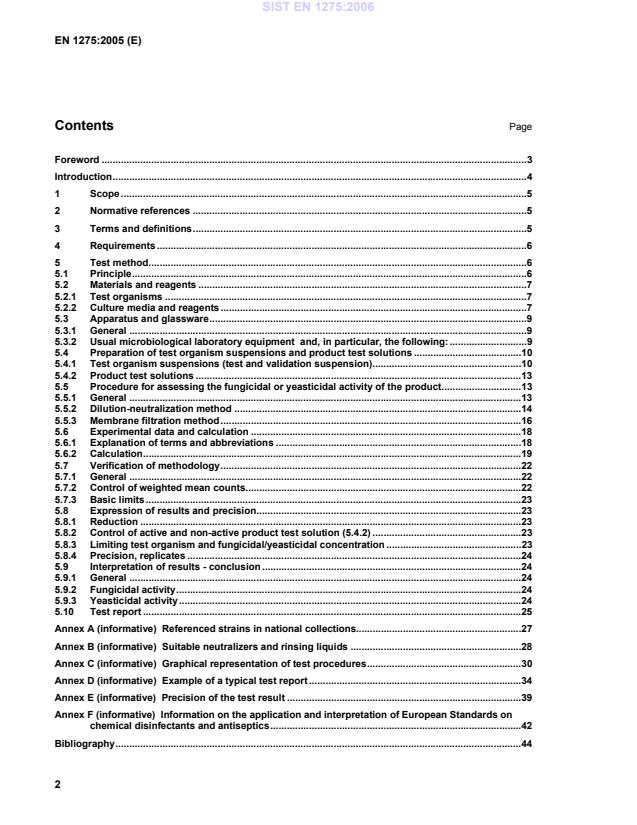
and, in particular, the following:.9 5.4 Preparation of test organism suspensions and product test solutions.10 5.4.1 Test organism suspensions (test and validation suspension).10 5.4.2 Product test solutions.13 5.5 Procedure for assessing the fungicidal or yeasticidal activity of the product.13 5.5.1 General.13 5.5.2 Dilution-neutralization method.14 5.5.3 Membrane filtration method.16 5.6 Experimental data and calculation.18 5.6.1 Explanation of terms and abbreviations.18 5.6.2 Calculation.19 5.7 Verification of methodology.22 5.7.1 General.22 5.7.2 Control of weighted mean counts.22 5.7.3 Basic limits.23 5.8 Expression of results and precision.23 5.8.1 Reduction.23 5.8.2 Control of active and non-active product test solution (5.4.2).23 5.8.3 Limiting test organism and fungicidal/yeasticidal concentration.23 5.8.4 Precision, replicates.24 5.9 Interpretation of results - conclusion.24 5.9.1 General.24 5.9.2 Fungicidal activity.24 5.9.3 Yeasticidal activity.24 5.10 Test report.25 Annex A (informative)
Referenced strains in national collections.27 Annex B (informative)
Suitable neutralizers and rinsing liquids.28 Annex C (informative)
Graphical representation of test procedures.30 Annex D (informative)
Example of a typical test report.34 Annex E (informative)
Precision of the test result.39 Annex F (informative)
Information on the application and interpretation of European Standards on chemical disinfectants and antiseptics.42 Bibliography.44 SIST EN 1275:2006
min ± 10 s (obligatory test conditions). At the end of this contact time, an aliquot is taken, and the fungicidal and/or the fungistatic activity in this portion is immediately neutralized or suppressed by a validated method. The method of choice is dilution-neutralization. If a suitable neutralizer cannot be found, membrane filtration is used. The numbers of surviving fungi in each sample are determined and the reduction is calculated. 5.1.2 The test is performed using the vegetative cells of Candida albicans and the spores of Aspergillus niger (fungicidal activity) or only the vegetative cells of Candida albicans (yeasticidal activity) as test organisms (obligatory test conditions). 5.1.3 Additional and optional contact times and temperatures are specified. Additional test organisms can be used. SIST EN 1275:2006
1) The ATCC numbers are the collection numbers of strains supplied by the American Type Culture Collection (ATCC). This information is given for the convenience of users of this European Standard and does not constitute an endorsement by CEN of the product named. SIST EN 1275:2006
121+) °C for a minimum holding time of 15 min; b) for dry heat sterilization, a hot air oven capable of being maintained at (50
180+)°C for a minimum holding time of 30 min, at (50
170+) °C for a minimum holding time of 1 h or at (50
160+)°C for a minimum holding time of 2 h. 5.3.2.2 Water baths, capable of being controlled at (20 ± 1) °C, at (45 ± 1) °C (to maintain melted MEA in case of pour plate technique) and at additional test temperatures ± 1 °C (5.5.1). 5.3.2.3 Incubator, capable of being controlled at (30 ± 1) °C. 5.3.2.4 pH-meter, having an inaccuracy of calibration of no more than ± 0,1 pH units at (20 ± 1) °C.
NOTE A puncture electrode or a flat membrane electrode should be used for measuring the pH of the agar media (5.2.2.3). 5.3.2.5 Stopwatch 5.3.2.6 Shakers a) Electromechanical agitator, e.g. Vortex® mixer3) b) Mechanical shaker 5.3.2.7 Membrane filtration apparatus, constructed of a material compatible with the substances to be filtered The apparatus shall have a filter holder of at least 50 ml volume. It shall be suitable for use with filters of diameter 47 mm to 50 mm and 0,45 µm pore size for the membrane filtration method (5.5.3). The vacuum source used shall give an even filtration flow rate. In order to obtain a uniform distribution of the micro-organisms over the membrane and to prevent overlong filtration, the device shall be set so as to obtain the filtration of 100 ml of rinsing liquid in 20 s to 40 s.
2) Disposable sterile equipment is an acceptable alternative to reusable glassware. 3) Vortex® is an example of a suitable product available commercially. This information is given for the convenience of users of this European Standard and does not constitute an endorsement by CEN of this product. SIST EN 1275:2006
5.3.2.10 Petri dishes (plates), of size 90 mm to 100 mm.
5.3.2.11 Glass beads, 3 mm to 4 mm in diameter. 5.3.2.12 Volumetric flasks. 5.3.2.13 Fritted filter, with porosity of 40 µm to 100 µm according to ISO 4793. 5.3.2.14 Centrifuge (2 000 gN). 5.3.2.15 Roux bottles or similar flasks. 5.4 Preparation of test organism suspensions and product test solutions 5.4.1 Test organism suspensions (test and validation suspension) 5.4.1.1 General For each test organism, two different suspensions have to be prepared: the “test suspension” to perform the test and the “validation suspension” to perform the controls and method validation. 5.4.1.2 Preservation and stock cultures of test organisms The test organisms and their stock cultures shall be prepared and kept in accordance with EN 12353. 5.4.1.3 Working culture of test organisms 5.4.1.3.1 Candida albicans (yeast) In order to prepare the working culture of Candida albicans (5.2.1), prepare a subculture from the stock culture (5.4.1.2) by streaking onto MEA (5.2.2.3) slopes or plates (5.3.2.10) and incubate (5.3.2.3). After 42 h to 48 h, prepare a second subculture from the first subculture in the same way and incubate for 42 h to 48 h. From this second subculture, a third subculture may be produced in the same way. The second and (if produced) third subcultures are the working cultures. If it is not possible to prepare the second subculture on a particular day, a 72 h subculture may be used for subsequent subculturing, provided that the subculture has been kept in the incubator (5.3.2.3) during the 72 h period. Never produce and use a fourth subculture. 5.4.1.3.2 Aspergillus niger (mould) For Aspergillus niger (5.2.1), use only the first subculture grown on MEA (5.2.2.3) in Roux bottles (5.3.2.15) and incubate for 9 d to 11 d. No further subculturing is needed. 5.4.1.3.3 Other test organisms (yeasts or moulds) For additional test organisms, any departure from this method of culturing the yeast or the mould or of preparing the suspensions shall be noted, giving the reasons in the test report. SIST EN 1275:2006
[5.5.1.1 a)] and use within 2 h; NOTE The use of a spectrophotometer for adjusting the number of cells is highly recommended (approximately 620 nm wavelength — cuvette 10 mm path length). Each laboratory should therefore produce calibration data for each test organism knowing that suitable values of optical density are generally found between 0,200 and 0,350. A colorimeter is a suitable alternative. c) for counting, prepare 10-5 and 10-6 dilutions of the test suspension using diluent (5.2.2.4). Mix [5.3.2.6a)]. Take a sample of 1,0 ml of each dilution in duplicate and inoculate using the pour plate or the spread plate technique. 1) When using the pour plate technique, transfer each 1,0 ml sample into separate Petri dishes and add 15 ml to 20 ml melted MEA (5.2.2.3), cooled to (45 ± 1) °C; 2) when using the spread plate technique, spread each 1,0 ml sample – divided into portions of approximately equal size – on an appropriate number (at least two) of surface dried plates containing MEA (5.2.2.3). For incubation and counting, see 5.4.1.6. 5.4.1.4.2 Aspergillus niger The procedure for preparing the Aspergillus niger test suspension is as follows: a) take the working culture (5.4.1.3.2) and suspend the spores in 10 ml of sterile 0,05 % (w/v) polysorbate 80 solution in water (5.2.2.2). Using a glass rod or spatula, detach the conidiospores from the culture surface. Transfer the suspension into a flask and gently shake by hand for one minute together with 5 g of glass beads (5.3.2.11). Filter the suspension through a fritted filter (5.3.2.13); b) carry out a microscopic examination under x 400 magnification immediately after the preparation and just before the test, to show the absence of mycelia fragments and spore germination (check at least ten fields of view for absence of both). If germinated spores are present, discard the suspension. If mycelia are present, set up a washing process (centrifugation) as follows. Transfer the filtered suspension to centrifuge tubes. The filtered suspension is centrifuged (5.3.2.14) at 2 000 gN for 20 min. The conidiospores are washed at least twice by resuspension in diluent (5.2.2.4) and subsequent centrifugation. If mycelia are still present, repeat the washing process;
4) cfu/ml = colony-forming unit(s) per millilitre. SIST EN 1275:2006
(in °C): the obligatory temperature to be tested is
= 20 °C; the additional temperature may be chosen from 4 °C, 10 °C or 40 °C; the allowed deviation for each chosen temperature is ± 1 °C; b) contact time t (in min): the obligatory contact time to be tested is t = 15 min; additional contact times may be chosen from 1 min, 5 min, 30 min or 60 min; the allowed deviation for each chosen contact time is ± 10 s, except for 1 min, for which it is ± 5 s; c) test organisms (5.2.1): the obligatory test organisms for testing fungicidal activity are Candida albicans and Aspergillus niger; the obligatory test organism for testing yeasticidal activity is Candida albicans. Additional test organisms may be tested. SIST EN 1275:2006
[5.5.1.1 a)]) using the water bath (5.3.2.2). Check that the temperature of the reagents is stabilized at θ. The neutralizer (5.2.2.5) or the rinsing liquid (5.2.2.6) and water (5.2.2.2) shall be equilibrated at a temperature of (20 ± 1) °C. 5.5.1.5 Precautions for manipulation of test organisms Do not touch the upper part of the test tube sides when adding the test- or the validation suspensions (5.4.1). 5.5.2 Dilution-neutralization method5) 5.5.2.1 General The test and the control and validation procedures (5.5.2.2 through 5.5.2.5) shall be carried out at the same time. 5.5.2.2 Test "Na" – determination of fungicidal or yeasticidal concentrations The procedure for determining fungicidal or yeasticidal concentrations is as follows: a) pipette 1,0 ml of water (5.2.2.2) into a tube. Add 1,0 ml of the test suspension (5.4.1.4). Start the stopwatch (5.3.2.5) immediately, mix [5.3.2.6a)] and place the tube in a water bath controlled at the chosen temperature
[5.5.1.1 a)] for 2 min ± 10 s.
5) For a graphical representation of this method, see C.1. SIST EN 1275:2006
[5.5.1.1 b)]. Just before the end of t, mix [5.3.2.6a)] again; b) at the end of t, take a 1,0 ml sample of the test mixture “Na” and transfer into a tube containing 8,0 ml neutralizer (5.2.2.5) and 1,0 ml water (5.2.2.2). Mix [5.3.2.6a)] and place in a water bath controlled at (20 °± 1) C. After a neutralization time of 5 min ± 10 s, mix [5.3.2.6a)] and immediately take a sample of 1,0 ml of the neutralized test mixture “Na” (containing neutralizer, product test solution, test suspension) in duplicate and inoculate using the pour plate or the spread plate technique: 1) when using the pour plate technique, pipette each 1,0 ml sample into separate Petri dishes and add 15 ml to 20 ml of melted MEA (5.2.2.3), cooled to (45 ± 1) °C; 2) when using the spread plate technique, spread each 1,0 ml sample – divided into portions of approximately equal size – on an appropriate number (at least two) of surface dried plates containing MEA (5.2.2.3). For incubation and counting see 5.5.2.6: c) perform the procedure a) and b) using the other product test solutions at the same time; d) perform the procedure a) to c) applying the other obligatory and – if appropriate – other additional experimental conditions (5.5.1.1). 5.5.2.3 Experimental conditions control “A” – validation of the selected experimental conditions and/or verification of the absence of any lethal effect in the test conditions To validate the selected experimental conditions and/or verify the absence of any lethal effect in the test conditions, the procedure is as follows: NOTE When the test is performed at the following conditions: Candida albicans or Aspergillus niger, 20 °C, any contact time, this control can be skipped. a) pipette 1,0 ml of water (5.2.2.2) into a tube. Add 1,0 ml of the validation suspension (5.4.1.5). Start the stopwatch immediately, mix [5.3.2.6a)] and place the tube in a water bath controlled at
for 2 min ± 10 s. At the end of this time, add 8,0 ml of water (5.2.2.2). Restart the stopwatch at the beginning of the addition. Mix [5.3.2.6a)] and place the tube in a water bath controlled at θ for t. Just before the end of t, mix [5.3.2.6a)] again; b) at the end of t, take a sample of 1,0 ml of this mixture “A” in duplicate and inoculate using the pour plate or the spread plate technique [5.5.2.2 b]. For incubation and counting see 5.5.2.6. 5.5.2.4 Neutralizer control “B” – (Verification of the absence of toxicity of the neutralizer) To verify the absence of toxicity of the neutralizer, the procedure is as follows: a) pipette 8,0 ml of the neutralizer – used in the test (5.5.2.2) – and 1,0 ml of water (5.2.2.2) into a tube. Add 1,0 ml of the validation suspension (5.4.1.5). Start the stopwatch at the beginning of the addition, mix [5.3.2.6a)], and place the tube in a water bath controlled at (20 ± 1) °C for 5 min ± 10 s. Just before the end of this time, mix [5.3.2.6a)]; b) at the end of this time take a sample of 1,0 ml of this mixture “B” in duplicate and inoculate using the pour plate or the spread plate technique [5.5.2.2 b)]. For incubation and counting see 5.5.2.6. SIST EN 1275:2006
in parallel and separately for each experimental condition (5.5.1.1). Each membrane filtration apparatus shall be equipped with a membrane of 0,45 µm pore size and
47 mm to 50 mm diameter (5.3.2.7) and filled with 50 ml of the rinsing liquid (5.2.2.6). The time required for filtering – if longer than one minute in exceptional cases – shall be recorded in the test report. When transferring the membranes to the surface of an agar plate, care should be taken to ensure that the test organisms are on the upper side of the membrane when placed on the plate and to avoid trapping air between the membrane and agar surface. 5.5.3.2 Test “Na” – (Determination of the fungicidal or yeasticidal – concentrations) The procedure for determining the fungicidal or yeasticidal concentrations is as follows:
6) For a graphical representation of this method, see C.2. SIST EN 1275:2006
...