

SIST ISO 6139:2000
(Main)Aluminium ores -- Experimental determination of the heterogeneity of distribution of a lot
General Information
- Abstract
The heterogeneity of distribution is characterized by the distribution variance and is determined by experimentally measuring the sampling variance. Because both the composition variance and distribution variance contribute to the measured sampling variance, it is necessary to separate these two components. Two methods of data analysis are permitted: Visman's theory of sampling which uses classical statistics and the variogram method which gives a better estimate because of taking into account serial correlation between adjacent increments.
- Status
- Published
- Publication Date
- 31-May-2000
- Technical Committee
- IRUD - Mining
- Current Stage
- 6060 - National Implementation/Publication (Adopted Project)
- Start Date
- 01-Jun-2000
- Due Date
- 01-Jun-2000
- Completion Date
- 01-Jun-2000
Buy Documents

ISO 6139:1993 - Aluminium ores — Experimental determination of the heterogeneity of distribution of a lot Released:8/5/1993
ISO 6139:1993 - Minerais alumineux — Détermination expérimentale de l'hétérogénéité de distribution d'un lot
Overview
ISO 6139:1993 - "Aluminium ores - Experimental determination of the heterogeneity of distribution of a lot" specifies experimental procedures to quantify how aluminium ore is spatially distributed within a lot. The standard defines the distribution variance (heterogeneity of distribution) and prescribes how to separate it from composition variance by measuring sampling variance at two increment masses. It supports sound design of sampling schemes and determination of the minimum number and mass of primary increments.
Key topics and requirements
- Objective: Evaluate heterogeneity of distribution to determine the minimum number of primary increments and an effective sampling scheme.
- Data collection:
- Determine the minimum increment mass per ISO 8685.
- Collect a minimum of 30 increments (preferably at the intended sampling interval).
- Analyze each increment separately.
- Repeat with a substantially larger increment mass (e.g., increase by a factor of 10).
- Variance components: The measured sampling variance includes both composition variance and distribution variance. The standard requires subtracting sample preparation and analysis variance (per ISO 10277) from measured variances.
- Permitted analysis methods:
- Visman’s theory of sampling (classical statistics): Produces conservative estimates of sampling and distribution variances.
- Variogram method: Accounts for serial correlation between adjacent increments and their spacing, giving a more realistic estimate and better basis for optimizing sampling schemes.
- Calculations: From two increment-mass datasets, derive composition variance and distribution variance; then compute sampling variance for any increment mass and estimate the number of increments needed to achieve a target sampling error.
- Practical recommendations: Compute corrected experimental variograms for lags (recommended t = 1 to 20), estimate intercept and slope, and use these to compute sampling variance for systematic sampling.
Applications and users
ISO 6139 is practical for:
- Mining companies and sampling engineers designing ore-sampling programs for production and reserve estimation.
- Quality assurance and control teams specifying sampling frequencies and increment masses.
- Metallurgists, mineral statisticians, and consultants optimizing sampling strategy to meet required sampling error limits.
- Laboratories and auditors validating sampling precision and variance partitioning.
Key outputs include distribution variance, recommended number of increments, and a validated sampling scheme minimizing sampling error for aluminium ores.
Related standards
- ISO 8685:1992 - Aluminium ores - Sampling procedures.
- ISO 10277 - Aluminium ores - Sample preparation and analysis; methods for checking precision of sampling.
Keywords: ISO 6139:1993, aluminium ores, heterogeneity of distribution, distribution variance, sampling variance, Visman’s theory, variogram method, sampling scheme, increment mass.
Buy Documents
ISO 6139:1993 - Aluminium ores — Experimental determination of the heterogeneity of distribution of a lot Released:8/5/1993
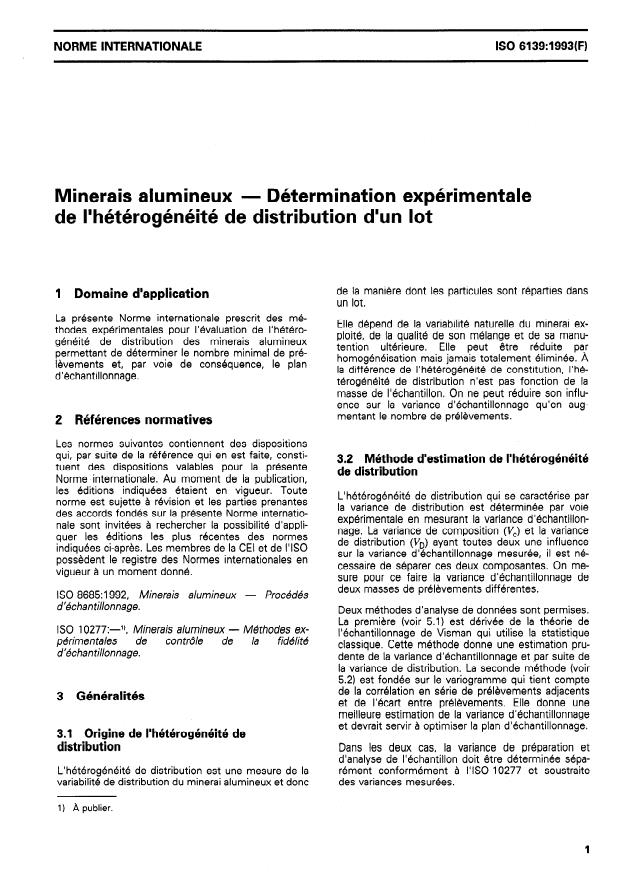
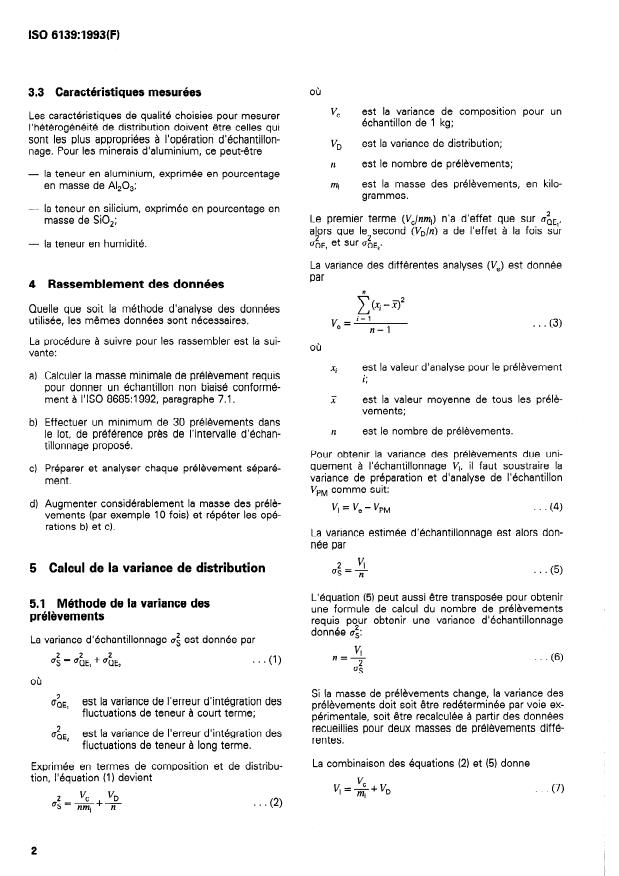
ISO 6139:1993 - Minerais alumineux — Détermination expérimentale de l'hétérogénéité de distribution d'un lot
Get Certified
Connect with accredited certification bodies for this standard

Bureau Veritas Chile
Bureau Veritas certification services in Chile.
Bureau Veritas Peru
Bureau Veritas certification services in Peru.
BVQI Peru
Bureau Veritas certification in Peru.
Sponsored listings
Frequently Asked Questions
SIST ISO 6139:2000 is a standard published by the Slovenian Institute for Standardization (SIST). Its full title is "Aluminium ores -- Experimental determination of the heterogeneity of distribution of a lot". This standard covers: The heterogeneity of distribution is characterized by the distribution variance and is determined by experimentally measuring the sampling variance. Because both the composition variance and distribution variance contribute to the measured sampling variance, it is necessary to separate these two components. Two methods of data analysis are permitted: Visman's theory of sampling which uses classical statistics and the variogram method which gives a better estimate because of taking into account serial correlation between adjacent increments.
The heterogeneity of distribution is characterized by the distribution variance and is determined by experimentally measuring the sampling variance. Because both the composition variance and distribution variance contribute to the measured sampling variance, it is necessary to separate these two components. Two methods of data analysis are permitted: Visman's theory of sampling which uses classical statistics and the variogram method which gives a better estimate because of taking into account serial correlation between adjacent increments.
SIST ISO 6139:2000 is classified under the following ICS (International Classification for Standards) categories: 73.060.40 - Aluminium ores. The ICS classification helps identify the subject area and facilitates finding related standards.
SIST ISO 6139:2000 is available in PDF format for immediate download after purchase. The document can be added to your cart and obtained through the secure checkout process. Digital delivery ensures instant access to the complete standard document.
Standards Content (Sample)
SLOVENSKI STANDARD
01-junij-2000
Aluminijeve rude - Poskusno ugotavljanje heterogenosti razporeditve vzorcev
Aluminium ores -- Experimental determination of the heterogeneity of distribution of a lot
Minerais alumineux -- Détermination expérimentale de l'hétérogénéité de distribution
d'un lot
Ta slovenski standard je istoveten z: ISO 6139:1993
ICS:
73.060.40 Aluminijeve rude Aluminium ores
2003-01.Slovenski inštitut za standardizacijo. Razmnoževanje celote ali delov tega standarda ni dovoljeno.
INTERNATIONAL
STANDARD
First edition
1993-08-01
Aluminium ores - Experimental
determination of the heterogeneity of
distribution of a lot
Minerais alumineux - Determination experimentale de I’h6 Wog&&6
de distribution d’un lot
Reference number
ISO 6139: 1993(E)
Foreword
ISO (the International Organization for Standardization) is a worldwide
federation of national Standards bodies (ISO member bodies). The work
of preparing International Standards is normally carried out through ISO
technical committees. Esch member body interested in a subject for
which a technical committee has been established has the right to be
represented on that committee. International organizations, governmental
and non-governmental, in liaison with ISO, also take part in the work. ISO
collaborates closely with the International Electrotechnical Commission
(IEC) on all matters of electrotechnical standardization.
Draft International Standards adopted by the technical committees are
circulated to the member bodies for voting. Publication as an International
Standard requires approval by at least 75 % of the member bodies casting
a vote.
International Standard ISO 6139 was prepared by Technical Committee
lSO/TC 129, Aluminium ores, Sub-Committee SC 1, Sampling.
0 ISO 1993
All rights reserved. No part of this publication may be reproduced or utilized in any form or
by any means, electronie or mechanicai, including photocopying and microfilm, without per-
mission in writing from the publisher.
International Organization for Standardization
Case Postale 56 l Cl-l-l 211 Geneve 20 l Switzerland
Printed in Switzerland
INTERNATIONAL STANDARD
Aluminium ores - Experimental determination of th,e-
heterogeneity of distribution of a lot
ante tan be reduced only by increasing the number
1 Scope
of increments.
This International Standard specifies experimental
methods for evaluating the heterogeneity of distri- 3.2 Method of estimating the heterogeneity
bution of aluminium ores, for the purpose of deter-
of distribution
mining the minimum number of primary increments
and consequently the sampling scheme.
The heterogeneity of distribution, characterized by the
distribution variance, is determined by experimentally
measuring the sampling variance. However, because
2 Normative references
both the composition variance (VJ and distribution
variance (V,,) contribute to the measured sampling
The following Standards contain provisions which,
variance, it is necessary to separate these two com-
through reference in this text, constitute provisions
ponents. This is achieved by measuring the sampling
of this International Standard. At the time of publi-
variance at two different increment masses.
cation, the editions indicated were valid. All Standards
are subject to revision, and Parties to agreements
Two methods of data analysis are permitted. The first
based on this International Standard are encouraged
(see 5.1) is based on Visman’s theory of sampling
to investigate the possibility of applying the most re-
which uses classical statistics. This method gives
cent editions of the Standards indicated below.
conservative estimates of the sampling variance and
Members of IEC and ISO maintain registers of cur-
hence the distribution variance. The second method
rently valid International Standards.
(see 5.2) is based on the variogram which takes into
account serial correlation between adjacent in-
ISO 8685: 1992, Aluminium ores - Sampling pro-
crements and the spacing between increments. lt
cedures.
gives a better estimate of the sampling variance and
should be used to optimize the sampling scheme.
- Experimental
ISO 10277:-‘1, Aluminium ores
In both cases, the variance of Sample preparation and
methods for checking the precision of sampling.
analysis shall be determined separately in accordance
with ISO 10277, and subtracted from the measured
3 General
variances.
3.1 Origin of heterogeneity of distribution 3.3 Charactqristics measured
The quality characteristics Chosen for measuring the
The heterogeneity of distribution is a measure of the
heterogeneity of distribution should be those that are
distribution variability of the aluminium ore and hence
most relevant to the sampling Operation. For alumi-
the manner in which the particles are distributed
nium ores these could be
throughout the lot. lt depends on the natura1 variability
of the aluminium ore being mined, how weil it is
- aluminium content, expressed as a percentage by
blended, and how it is subsequently handled. lt tan
mass of AI,O,;
be reduced by mixing, but it tan never be completely
eliminated. Unlike the heterogeneity of constitution,
- Silicon content, expressed as a percentage by
the heterogenity of distribution is not a function of
mass of SiO,;
Sample mass. lts contribution to the sampling vari-
1) To be published.
- moisture content.
where
is the analysis value for increment i;
4 Collection of data
x is the mean value for all increments;
Regardless of which method of data analysis is used,
n is the number of increments.
the same data are required. The procedure for col-
lecting the data is as follows: In Order to obtain the increment variance VI due to
sampling only, the Sample preparation and ‘analysis
a) Calculate the minimum mass of increment re- variance VpM shall be subtracted as follows:
quired to give an unbiased Sample in accordance
v, = ve - VpM . . .
(4)
with ISO 8685, subclause 7.1.
The estimated sampling variance is then given by
b) Collect a minimum of 30 increments from the lot,
preferably close to the proposed sampling interval.
2 v
=-
. . .
(5)
3 n
c) Prepare and analyse each increment separately.
Alternatively, equation (5) tan be transposed to give
the following equation for calculating the number of
d) Increase the increment mass substantially (e.g. by
increments required to achieve a given sampling vari-
a factor of IO) and repeat Steps b) and c).
ante 02,:
5 Calculation of distribution variance n=2 . . .
(6)
%
5.1 Increment variance method
If the increment mass is changed, the increment
variance shall either be redetermined experimentally
The sampling variance CJ~ is given by
or recalculated from data collected at two different
2 2 2 increment masses.
. . .
(1)
OS = %E, + %E,
Combining equations (2) and (5) gives
where
V
=*+vD . . .
(7)
is the short range quality fluctuation vari- Y
QE,
ante;
Rewriting this for the two different increment masses
is the long range quality fluctuation vari-
QE,
ml, and m12 used for data collection gives
ante.
V
=g+“D . . .
In terms of the composition and distribution variances,
...
INTERNATIONAL
STANDARD
First edition
1993-08-01
Aluminium ores - Experimental
determination of the heterogeneity of
distribution of a lot
Minerais alumineux - Determination experimentale de I’h6 Wog&&6
de distribution d’un lot
Reference number
ISO 6139: 1993(E)
Foreword
ISO (the International Organization for Standardization) is a worldwide
federation of national Standards bodies (ISO member bodies). The work
of preparing International Standards is normally carried out through ISO
technical committees. Esch member body interested in a subject for
which a technical committee has been established has the right to be
represented on that committee. International organizations, governmental
and non-governmental, in liaison with ISO, also take part in the work. ISO
collaborates closely with the International Electrotechnical Commission
(IEC) on all matters of electrotechnical standardization.
Draft International Standards adopted by the technical committees are
circulated to the member bodies for voting. Publication as an International
Standard requires approval by at least 75 % of the member bodies casting
a vote.
International Standard ISO 6139 was prepared by Technical Committee
lSO/TC 129, Aluminium ores, Sub-Committee SC 1, Sampling.
0 ISO 1993
All rights reserved. No part of this publication may be reproduced or utilized in any form or
by any means, electronie or mechanicai, including photocopying and microfilm, without per-
mission in writing from the publisher.
International Organization for Standardization
Case Postale 56 l Cl-l-l 211 Geneve 20 l Switzerland
Printed in Switzerland
INTERNATIONAL STANDARD
Aluminium ores - Experimental determination of th,e-
heterogeneity of distribution of a lot
ante tan be reduced only by increasing the number
1 Scope
of increments.
This International Standard specifies experimental
methods for evaluating the heterogeneity of distri- 3.2 Method of estimating the heterogeneity
bution of aluminium ores, for the purpose of deter-
of distribution
mining the minimum number of primary increments
and consequently the sampling scheme.
The heterogeneity of distribution, characterized by the
distribution variance, is determined by experimentally
measuring the sampling variance. However, because
2 Normative references
both the composition variance (VJ and distribution
variance (V,,) contribute to the measured sampling
The following Standards contain provisions which,
variance, it is necessary to separate these two com-
through reference in this text, constitute provisions
ponents. This is achieved by measuring the sampling
of this International Standard. At the time of publi-
variance at two different increment masses.
cation, the editions indicated were valid. All Standards
are subject to revision, and Parties to agreements
Two methods of data analysis are permitted. The first
based on this International Standard are encouraged
(see 5.1) is based on Visman’s theory of sampling
to investigate the possibility of applying the most re-
which uses classical statistics. This method gives
cent editions of the Standards indicated below.
conservative estimates of the sampling variance and
Members of IEC and ISO maintain registers of cur-
hence the distribution variance. The second method
rently valid International Standards.
(see 5.2) is based on the variogram which takes into
account serial correlation between adjacent in-
ISO 8685: 1992, Aluminium ores - Sampling pro-
crements and the spacing between increments. lt
cedures.
gives a better estimate of the sampling variance and
should be used to optimize the sampling scheme.
- Experimental
ISO 10277:-‘1, Aluminium ores
In both cases, the variance of Sample preparation and
methods for checking the precision of sampling.
analysis shall be determined separately in accordance
with ISO 10277, and subtracted from the measured
3 General
variances.
3.1 Origin of heterogeneity of distribution 3.3 Charactqristics measured
The quality characteristics Chosen for measuring the
The heterogeneity of distribution is a measure of the
heterogeneity of distribution should be those that are
distribution variability of the aluminium ore and hence
most relevant to the sampling Operation. For alumi-
the manner in which the particles are distributed
nium ores these could be
throughout the lot. lt depends on the natura1 variability
of the aluminium ore being mined, how weil it is
- aluminium content, expressed as a percentage by
blended, and how it is subsequently handled. lt tan
mass of AI,O,;
be reduced by mixing, but it tan never be completely
eliminated. Unlike the heterogeneity of constitution,
- Silicon content, expressed as a percentage by
the heterogenity of distribution is not a function of
mass of SiO,;
Sample mass. lts contribution to the sampling vari-
1) To be published.
- moisture content.
where
is the analysis value for increment i;
4 Collection of data
x is the mean value for all increments;
Regardless of which method of data analysis is used,
n is the number of increments.
the same data are required. The procedure for col-
lecting the data is as follows: In Order to obtain the increment variance VI due to
sampling only, the Sample preparation and ‘analysis
a) Calculate the minimum mass of increment re- variance VpM shall be subtracted as follows:
quired to give an unbiased Sample in accordance
v, = ve - VpM . . .
(4)
with ISO 8685, subclause 7.1.
The estimated sampling variance is then given by
b) Collect a minimum of 30 increments from the lot,
preferably close to the proposed sampling interval.
2 v
=-
. . .
(5)
3 n
c) Prepare and analyse each increment separately.
Alternatively, equation (5) tan be transposed to give
the following equation for calculating the number of
d) Increase the increment mass substantially (e.g. by
increments required to achieve a given sampling vari-
a factor of IO) and repeat Steps b) and c).
ante 02,:
5 Calculation of distribution variance n=2 . . .
(6)
%
5.1 Increment variance method
If the increment mass is changed, the increment
variance shall either be redetermined experimentally
The sampling variance CJ~ is given by
or recalculated from data collected at two different
2 2 2 increment masses.
. . .
(1)
OS = %E, + %E,
Combining equations (2) and (5) gives
where
V
=*+vD . . .
(7)
is the short range quality fluctuation vari- Y
QE,
ante;
Rewriting this for the two different increment masses
is the long range quality fluctuation vari-
QE,
ml, and m12 used for data collection gives
ante.
V
=g+“D . . .
In terms of the composition and distribution variances, (8)
4,
equation (1) becomes
V
=++vD . . .
2 = vc 1 vD
. . .
(2)
% 2
nm1 n
The Solution to these two equations is
ml,m12w, - Y2)
V is the composition variance for a 1 kg
C
=
V . . .
C
Sample; rn12 - 7,
is the distribution variance;
rn12Y2 - 4,Y2
. . .
(11)
‘D = ml - ml
2 1
n is the number of increments;
Once Vc and VD are known V, tan be recalculated for
is the increment mass, in kilograms.
any increment mass using equation (7).
The first term (Vc/nml) contributes only to &, while
&
the second term (VD/@ contributes t0 both
5.
...
NORME
Iso
INTERNATIONALE 6139
Première édition
1993-08-01
Minerais alumineux - Détermination
expérimentale de l’hétérogénéité de
distribution d’un lot
Aluminium ores - Experimental determina tion of the he terogeneity of
distribution of a lot
Numéro de référence
Avant-propos
L’ISO (Organisation internationale de normalisation) est une féderation
mondiale d’organismes nationaux de normalisation (comités membres de
I’ISO). L’élaboration des Normes internationales est en général confiée aux
comités techniques de I’ISO. Chaque comité membre intéressé par une
etude a le droit de faire partie du comité technique crée à cet effet. Les
organisations internationales, gouvernementales et non gouvernemen-
tales, en liaison avec I’ISO participent également aux travaux. L’ISO colla-
bore etroitement avec la Commission électrotechnique internationale (CEI)
en ce qui concerne la normalisation électrotechnique.
Les projets de Normes internationales adoptes par les comités techniques
sont soumis aux comites membres pour vote. Leur publication comme
Normes internationales requiert l’approbation de 75 % au moins des co-
mites membres votants.
La Norme internationale ISO 6139 a été élaborée par le comite technique
ISO/TC 129, Minerais alumineux, sous-comite SC 1, Échantillonnage.
0 ISO 1993
Droits de reproduction reservés. Aucune partie de cette publication ne peut Qtre reproduite
ni utilisee sous quelque forme que ce soit et par aucun procédé, électronique ou mécanique,
y compris la photocopie et les microfilms, sans l’accord ecrit de l’editeur.
Organisation internationale de normalisation
Case Postale 56 l CH-l 211 Geneve 20 l Suisse
Imprimé en Suisse
ii
NORME INTERNATIONALE
Minerais alumineux - Détermination expérimentale
de l’hétérogénéité de distribution d’un lot
de la maniére dont les particules sont reparties dans
1 Domaine d’application
un lot.
La présente Norme internationale prescrit des mé-
Elle dépend de la variabilite naturelle du minerai ex-
thodes expérimentales pour l’évaluation de I’hetero-
ploite, de la qualité de son mélange et de sa manu-
généité de distribution des minerais alumineux
tention ultérieure. Elle peut être réduite par
permettant de déterminer le nombre minimal de pré-
homogénéisation mais jamais totalement eliminee. À
levements et, par voie de conséquence, le plan
la difference de l’hétérogénéité de constitution, I’he-
d’échantillonnage.
térogénéité de distribution n’est pas fonction de la
masse de l’échantillon. On ne peut réduire son influ-
ence sur la variante d’échantillonnage qu’en aug-
mentant le nombre de prélèvements.
2 Références normatives
Les normes suivantes contiennent des dispositions
qui, par suite de la reference qui en est faite, consti-
3.2 Méthode d’estimation de l’hétérogénéité
tuent des dispositions valables pour la présente
de distribution
Norme internationale. Au moment de la publication,
les éditions indiquées etaient en vigueur. Toute
L’hétérogénéité de distribution qui se caractérise par
norme est sujette à révision et les parties prenantes
la variante de distribution est déterminée par voie
des accords fondes sur la présente Norme internatio-
expérimentale en mesurant la variante d’échantillon-
nale sont invitées à rechercher la possibilité d’appli-
nage. La variante de composition (VJ et la variante
quer les éditions les plus recentes des normes
de distribution (Vo) ayant toutes deux une influence
indiquées ci-après. Les membres de la CEI et de I’ISO
sur la variante d’échantillonnage mesurée, il est ne-
possédent le registre des Normes internationales en
cessaire de séparer ces deux composantes. On me-
vigueur à un moment donne.
sure pour ce faire la variante d’échantillonnage de
deux masses de prélévements différentes.
ISO 8685: 1992, Minerais alumineux - Procéd&
d ‘&han tillonnage.
Deux methodes d’analyse de données sont permises.
La première (voir 5.1) est dérivée de la théorie de
ISO 10277:- ‘), Minerais alumineux - Méthodes ex-
l’échantillonnage de Visman qui utilise la statistique
périmentales de contrôle de la fidélité
classique. Cette méthode donne une estimation pru-
d Xchan tillonnage.
dente de la variante d’échantillonnage et par suite de
la variante de distribution. La seconde methode (voir
5.2) est fondée sur le variogramme qui tient compte
de la correlation en serie de prélévements adjacents
3 Généralités
et de l’écart entre prélèvements. Elle donne une
meilleure estimation de la variante d’échantillonnage
et devrait servir à optimiser la plan d’échantillonnage.
3.1 Origine de l’hétérogénéité de
distribution Dans les deux cas, la variante de préparation et
d’analyse de I’echantillon doit être determinée sépa-
L’hétérogénéité de distribution est une mesure de la rément conformément à I’ISO 10277 et soustraite
variabilite de distribution du minerai alumineux et donc des variantes mesurees.
1) À publier.
où
3.3 Caractéristiques mesurées
est la variante de composition pour un
vc
Les caractéristiques de qualité choisies pour mesurer
échantillon de 1 kg;
l’hétérogénéité de distribution doivent être celles qui
sont les plus appropriées à l’opération d’échantillon-
est la variante de distribution;
nage. Pour les minerais d’aluminium, ce peut-être
est le nombre de prélévements;
la teneur en aluminium, exprimée en pourcentage
est la masse des prélèvements, en kilo-
en masse de AI,O,;
grammes.
la teneur en silicium, exprimée en pourcentage en
Le premier terme (V&uq) n’a d’effet que sur a&,
masse de SiO,;
aiors que le2second (VD/n) a de l’effet à la fois sur
OQE, et sur CT~E.
la teneur en humidite.
La variante des differentes analyses (Ve) est donnee
Par
Rassemblement des données
n
Quelle que soit la méthode d’analyse des donnees
utilisée, les mêmes donnees sont necessaires.
(3)
La procédure à suivre pour les rassembler est la sui-
où
vante:
est la valeur d’analyse pour le prélèvement
l .
Calculer la masse minimale de prélèvement requis
a)
1,
pour donner un échantillon non biaise conforme-
ment a I’ISO 8685:1992, paragraphe 7.1. x est la valeur moyenne de tous les prélè-
vements;
Effectuer un minimum de 30 prélèvements dans
b)
est le nombre de prélèvements.
n
le lot, de préférence prés de l’intervalle d’échan-
tillonnage propose.
Pour obtenir la variante des prélèvements due uni-
quement a l’échantillonnage V,, il faut soustraire la
Préparer et analyser chaque prélèvement séparé-
d
variante de préparation et d’analyse de I’echantillon
ment.
VPM comme suit:
Augmenter considerablement la masse des prélé-
d)
. . .
v, = Ve - VpM
(4)
vements (par exemple 10 fois) et répéter les opé-
rations b) et c).
La variante estimée d’échantillonnage est alors don-
nec par
2 v
=-
5 Calcul de la variante de distribution . . .
(5)
OS n
L’équation (5) peut aussi être transposée pour obtenir
5.1 Méthode de la variante des
une formule de calcul du nombre de prélevements
prélèvements
requis pour obtenir une variante d’échantillonnage
donnee 0::
La variante d’échantillonnage 0: est donnée par
Y
2 2 2
=-
n . . .
(6)
. . .
% = OQE, + %E, 2
%
où
Si la masse de prélévements change, la variante des
est la variante de l’erreur d’intégration des
QE,
prélévements doit soit être redeterminée par voie ex-
fluctuations de teneur à court terme;
périmentale, soit être recalculee à partir des données
2 recueillies pour deux masses de prélèvements diffe-
est la variante de l’erreur d’intégration des
QE,
rentes.
fluctuations de teneur à long terme.
La combinaison des équations (2) et (5) donne
Exprimée en termes de composition et de distribu-
tion, l’équation (1) devient
. . .
2 h vD
os=-jjjfj-+y . . .
(2)
I
Si l’on réecrit l’équation (7) pour les deux masses de où
prélèvements differentes ml et ml utilisees pour re-
A est la composante aleatoire de la variante
cueillir les données, on obtient 2
...