

SIST EN 17128:2020
(Main)Light motorized vehicles for the transportation of persons and goods and related facilities and not subject to type-approval for on-road use - Personal light electric vehicles (PLEV) - Requirements and test methods
General Information
- Abstract
This document applies to personal light electric vehicles totally or partially electrically powered from self-contained power sources with or without self-balancing system, with exception of vehicles intended for hire from unattended station.
This document applies to personal light electric vehicles with or without self-balancing system totally or partially electrically powered from self-contained power sources having battery voltages up to 100 VDC, with or without an integrated battery charger with up to a 240 VAC input. This document specifies safety requirements, test methods, marking and information relating to personal light electric vehicles to reduce the risk of injuries to both third parties and the user during intended use, i.e. when used as intended and under conditions of misuse that are reasonably foreseeable by the manufacturer.
This document does not apply to:
- vehicles that are considered as toys;
- vehicles without self-balancing system with a seat;
- vehicles intended for competition;
- electrically powered assisted cycles (EPAC);
- vehicles and/or devices intend for use for medical care;
- electric vehicles having a maximum design speed above 25 Km/h;
- vehicles having a rated voltage of more than 100 VDC or 240 VAC;
- vehicles without an on-board driving operator.
NOTE 1 EN ISO 13482 gives the requirements for vehicles without on-board driving operator.
NOTE 2 See D.2.
NOTE 3 The local regulation could limit the use of the vehicle to a speed lower than 25 km/h.
- Status
- Published
- Public Enquiry End Date
- 31-Oct-2017
- Publication Date
- 03-Nov-2020
- Technical Committee
- I13 - Imaginarni 13

Overview
SIST EN 17128:2020 defines safety requirements and test methods for Personal Light Electric Vehicles (PLEV) that are partly or fully electrically driven from self-contained power sources. It covers PLEV designs with or without self‑balancing systems, battery voltages up to 100 VDC and integrated chargers with up to 240 VAC input, and targets vehicles not subject to type‑approval for on‑road use (for example many shared and private e‑scooters and similar micromobility devices). The standard’s objective is to reduce injury risk to users and third parties during intended use and reasonably foreseeable misuse.
Key topics and technical requirements
SIST EN 17128:2020 addresses a broad set of technical safety topics and associated test methods, including:
- Scope and classifications of PLEV types and exclusions (e.g., toys, EPAC, medical devices, competition vehicles, vehicles >25 km/h or >100 VDC).
- Electrical safety: mechanical strength of electrical components, power on/off control, cables, moisture resistance, vibration resistance.
- Driving power management: activation, power‑failure behavior and prevention of unintended/unauthorized use.
- Speed limitation: pedestrian mode and maximum assist speeds (note: local rules may require limiting speed below 25 km/h).
- Electromagnetic compatibility (EMC): emissions and immunity requirements for vehicle and electronic subassemblies (normative annex).
- Charging and battery energy storage: safe charging practice, test methods and protective measures.
- Structural integrity and mechanical tests: static loading, impact resistance, fatigue/dynamic tests and stability assessments.
- Braking, lighting and presence awareness: braking performance, lighting, audible warnings and signaling for user and pedestrian safety.
- Edges, moving parts and hot surfaces: guarding, sharp edge limits and thermal hazards.
- Marking and documentation: required markings, purchase information, user instructions, and maintenance guidance.
Practical applications and users
This standard is practical for:
- Manufacturers and product designers developing compliant PLEV hardware and firmware
- Test laboratories and conformity assessors implementing standardized test methods
- Safety and quality engineers documenting risk reduction and product labeling
- Urban mobility operators and fleet managers ensuring vehicles meet safe operational requirements
- Regulators and procurement teams using the standard as a technical reference for non‑type‑approved micromobility
Applying SIST EN 17128:2020 helps reduce liability, improve user safety, and provide consistent test and documentation practices across the personal light electric vehicle sector.
Related standards
- EN ISO 13482 - referenced for vehicles without an on‑board driving operator (robotic devices and some ESAs).
- Normative EMC and charging annexes within EN 17128 provide harmonized test procedures.
Relations
- Effective Date
- 28-Apr-2026
- Effective Date
- 10-Feb-2026
- Effective Date
- 09-Feb-2026
- Effective Date
- 09-Feb-2026
- Effective Date
- 09-Feb-2026
- Effective Date
- 09-Feb-2026
- Effective Date
- 09-Feb-2026
- Refers
SIST EN 61851-1:2002 - Electric vehicle conductive charging system -- Part 1: General requirements - Effective Date
- 09-Feb-2026
- Effective Date
- 09-Feb-2026
- Effective Date
- 09-Feb-2026
- Effective Date
- 09-Feb-2026
- Effective Date
- 09-Feb-2026
- Effective Date
- 09-Feb-2026
- Refers
SIST EN 61851-1:2011 - Electric vehicle conductive charging system - Part 1: General requirements - Effective Date
- 09-Feb-2026
- Effective Date
- 09-Feb-2026
Get Certified
Connect with accredited certification bodies for this standard

TÜV Rheinland
TÜV Rheinland is a leading international provider of technical services.

TÜV SÜD
TÜV SÜD is a trusted partner of choice for safety, security and sustainability solutions.

DEKRA Certification Inc.
DEKRA US certification services.
Sponsored listings
Frequently Asked Questions
SIST EN 17128:2020 is a standard published by the Slovenian Institute for Standardization (SIST). Its full title is "Light motorized vehicles for the transportation of persons and goods and related facilities and not subject to type-approval for on-road use - Personal light electric vehicles (PLEV) - Requirements and test methods". This standard covers: This document applies to personal light electric vehicles totally or partially electrically powered from self-contained power sources with or without self-balancing system, with exception of vehicles intended for hire from unattended station. This document applies to personal light electric vehicles with or without self-balancing system totally or partially electrically powered from self-contained power sources having battery voltages up to 100 VDC, with or without an integrated battery charger with up to a 240 VAC input. This document specifies safety requirements, test methods, marking and information relating to personal light electric vehicles to reduce the risk of injuries to both third parties and the user during intended use, i.e. when used as intended and under conditions of misuse that are reasonably foreseeable by the manufacturer. This document does not apply to: - vehicles that are considered as toys; - vehicles without self-balancing system with a seat; - vehicles intended for competition; - electrically powered assisted cycles (EPAC); - vehicles and/or devices intend for use for medical care; - electric vehicles having a maximum design speed above 25 Km/h; - vehicles having a rated voltage of more than 100 VDC or 240 VAC; - vehicles without an on-board driving operator. NOTE 1 EN ISO 13482 gives the requirements for vehicles without on-board driving operator. NOTE 2 See D.2. NOTE 3 The local regulation could limit the use of the vehicle to a speed lower than 25 km/h.
This document applies to personal light electric vehicles totally or partially electrically powered from self-contained power sources with or without self-balancing system, with exception of vehicles intended for hire from unattended station. This document applies to personal light electric vehicles with or without self-balancing system totally or partially electrically powered from self-contained power sources having battery voltages up to 100 VDC, with or without an integrated battery charger with up to a 240 VAC input. This document specifies safety requirements, test methods, marking and information relating to personal light electric vehicles to reduce the risk of injuries to both third parties and the user during intended use, i.e. when used as intended and under conditions of misuse that are reasonably foreseeable by the manufacturer. This document does not apply to: - vehicles that are considered as toys; - vehicles without self-balancing system with a seat; - vehicles intended for competition; - electrically powered assisted cycles (EPAC); - vehicles and/or devices intend for use for medical care; - electric vehicles having a maximum design speed above 25 Km/h; - vehicles having a rated voltage of more than 100 VDC or 240 VAC; - vehicles without an on-board driving operator. NOTE 1 EN ISO 13482 gives the requirements for vehicles without on-board driving operator. NOTE 2 See D.2. NOTE 3 The local regulation could limit the use of the vehicle to a speed lower than 25 km/h.
SIST EN 17128:2020 is classified under the following ICS (International Classification for Standards) categories: 43.120 - Electric road vehicles. The ICS classification helps identify the subject area and facilitates finding related standards.
SIST EN 17128:2020 has the following relationships with other standards: It is inter standard links to SIST EN IEC 62133-1:2026, SIST EN 55025:2017, SIST EN 60384-14:2014, SIST EN 61000-4-2:2009, SIST EN IEC 62485-2:2018, SIST EN 61558-1:2006, SIST EN 60068-2-75:2014, SIST EN 61851-1:2002, SIST EN 61851-23:2014, SIST EN IEC 61851-25:2021, SIST EN 61558-2-16:2010, SIST EN 62133-1:2018, SIST EN IEC 62485-4:2018, SIST EN 61851-1:2011, SIST EN 61851-21-1:2018. Understanding these relationships helps ensure you are using the most current and applicable version of the standard.
SIST EN 17128:2020 is associated with the following European legislation: EU Directives/Regulations: 2006/42/EC, 2014/30/EU; Standardization Mandates: M/396, M/552. When a standard is cited in the Official Journal of the European Union, products manufactured in conformity with it benefit from a presumption of conformity with the essential requirements of the corresponding EU directive or regulation.
SIST EN 17128:2020 is available in PDF format for immediate download after purchase. The document can be added to your cart and obtained through the secure checkout process. Digital delivery ensures instant access to the complete standard document.
Standards Content (Sample)
SLOVENSKI STANDARD
01-december-2020
Lahka motorna vozila za prevoz ljudi in blaga ter s tem povezanih naprav, za katere
ni potrebna homologacija za uporabo v cestnem prometu - Lahka osebna
električna vozila (PLEV) - Zahteve in preskusne metode
Light motorized vehicles for the transportation of persons and goods and related facilities
and not subject to type-approval for on-road use - Personal light electric vehicles (PLEV)
- Requirements and test methods
Nicht-typzugelassene leicht motorisierte Fahrzeuge für den Transport von Personen und
Gütern und damit verbundene Einrichtungen - Persönliche leichte Elektrofahrzeuge
(PLEV) - Sicherheitstechnische Anforderungen und Prüfverfahren
Véhicules légers motorisés pour le transport de personnes et de marchandises, non
homologables pour l’utilisation sur la route, ainsi que les installations d’utilisation -
Véhicules électriques personnels légers (PLEV) - Exigences de sécurité et méthodes
d'essai
Ta slovenski standard je istoveten z: EN 17128:2020
ICS:
43.120 Električna cestna vozila Electric road vehicles
2003-01.Slovenski inštitut za standardizacijo. Razmnoževanje celote ali delov tega standarda ni dovoljeno.
EN 17128
EUROPEAN STANDARD
NORME EUROPÉENNE
October 2020
EUROPÄISCHE NORM
ICS 43.120
English Version
Light motorized vehicles for the transportation of persons
and goods and related facilities and not subject to type-
approval for on-road use - Personal light electric vehicles
(PLEV) - Requirements and test methods
Véhicules légers motorisés pour le transport de Nicht-typzugelassene leicht motorisierte Fahrzeuge für
personnes et de marchandises, non homologables pour den Transport von Personen und Gütern und damit
l'utilisation sur la route, ainsi que les installations verbundene Einrichtungen - Persönliche leichte
d'utilisation - Véhicules électriques personnels légers Elektrofahrzeuge (PLEV) - Sicherheitstechnische
(PLEV) - Exigences de sécurité et méthodes d'essai Anforderungen und Prüfverfahren
This European Standard was approved by CEN on 17 August 2020.
CEN members are bound to comply with the CEN/CENELEC Internal Regulations which stipulate the conditions for giving this
European Standard the status of a national standard without any alteration. Up-to-date lists and bibliographical references
concerning such national standards may be obtained on application to the CEN-CENELEC Management Centre or to any CEN
member.
This European Standard exists in three official versions (English, French, German). A version in any other language made by
translation under the responsibility of a CEN member into its own language and notified to the CEN-CENELEC Management
Centre has the same status as the official versions.
CEN members are the national standards bodies of Austria, Belgium, Bulgaria, Croatia, Cyprus, Czech Republic, Denmark, Estonia,
Finland, France, Germany, Greece, Hungary, Iceland, Ireland, Italy, Latvia, Lithuania, Luxembourg, Malta, Netherlands, Norway,
Poland, Portugal, Republic of North Macedonia, Romania, Serbia, Slovakia, Slovenia, Spain, Sweden, Switzerland, Turkey and
United Kingdom.
EUROPEAN COMMITTEE FOR STANDARDIZATION
COMITÉ EUROPÉEN DE NORMALISATION
EUROPÄISCHES KOMITEE FÜR NORMUNG
CEN-CENELEC Management Centre: Rue de la Science 23, B-1040 Brussels
© 2020 CEN All rights of exploitation in any form and by any means reserved Ref. No. EN 17128:2020 E
worldwide for CEN national Members.
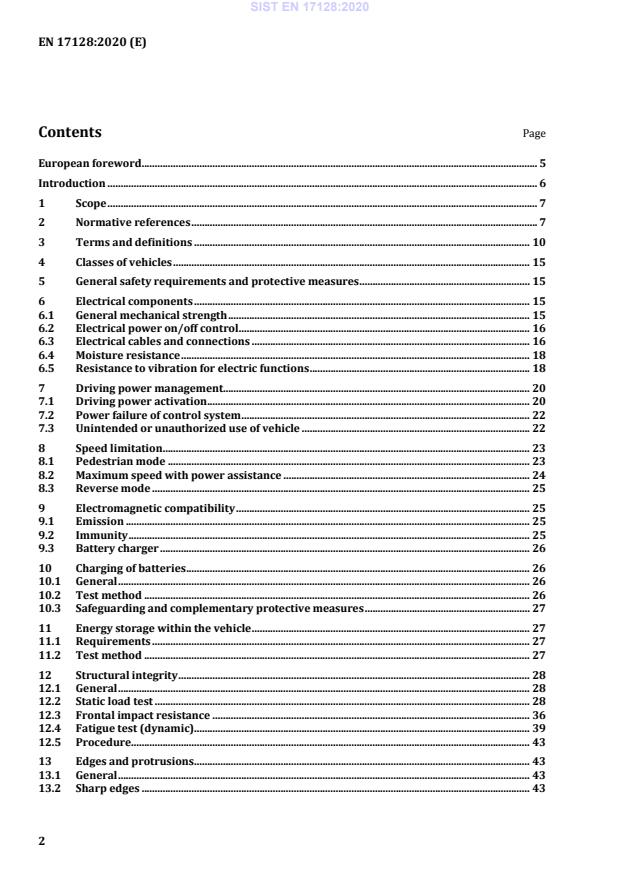
Contents Page
European foreword . 5
Introduction . 6
1 Scope . 7
2 Normative references . 7
3 Terms and definitions . 10
4 Classes of vehicles . 15
5 General safety requirements and protective measures . 15
6 Electrical components . 15
6.1 General mechanical strength . 15
6.2 Electrical power on/off control . 16
6.3 Electrical cables and connections . 16
6.4 Moisture resistance . 18
6.5 Resistance to vibration for electric functions . 18
7 Driving power management. 20
7.1 Driving power activation . 20
7.2 Power failure of control system . 22
7.3 Unintended or unauthorized use of vehicle . 22
8 Speed limitation . 23
8.1 Pedestrian mode . 23
8.2 Maximum speed with power assistance . 24
8.3 Reverse mode . 25
9 Electromagnetic compatibility . 25
9.1 Emission . 25
9.2 Immunity . 25
9.3 Battery charger . 26
10 Charging of batteries . 26
10.1 General . 26
10.2 Test method . 26
10.3 Safeguarding and complementary protective measures . 27
11 Energy storage within the vehicle . 27
11.1 Requirements . 27
11.2 Test method . 27
12 Structural integrity . 28
12.1 General . 28
12.2 Static load test . 28
12.3 Frontal impact resistance . 36
12.4 Fatigue test (dynamic). 39
12.5 Procedure. 43
13 Edges and protrusions . 43
13.1 General . 43
13.2 Sharp edges . 43
13.3 Protrusions . 43
14 Moving parts . 43
14.1 Clearance between moving parts . 43
14.2 Guarding of moving parts . 44
14.3 Folding mechanism . 44
15 Adequate stability (see D.10) . 45
15.1 Footrest/ deck. 45
15.2 Handlebar adjustment . 45
15.3 Surface . 46
15.4 Braking devices . 47
16 Presence awareness . 51
16.1 Lighting . 51
16.2 Audible warning to alert persons . 51
17 System failure and malfunction warning devices . 52
17.1 General . 52
17.2 Audible/ vibrating signalling . 52
17.3 Loss of connection to the warning system . 52
18 Hot surfaces . 52
18.1 Requirements . 52
18.2 Test method . 52
19 Product information and marking . 53
19.1 General . 53
19.2 Marking . 53
19.3 Purchase information . 54
19.4 Instructions for use . 55
19.5 Instructions on servicing and maintenance . 58
Annex A (informative) List of significant hazards . 59
Annex B (normative) Electromagnetic compatibility of vehicle . 60
B.1 Conditions applying to vehicle and to electrical/electronic sub-assemblies (ESA) . 60
B.2 Method of measuring broad-band electromagnetic radiation from vehicle . 63
B.3 Method of measuring narrow band electromagnetic radiation from vehicles . 64
B.4 Methods of testing vehicle immunity to electromagnetic radiation . 64
B.5 Method of measuring broad-band electromagnetic radiation from separate technical
units (ESA) . 68
B.6 Method of measuring narrow-band electromagnetic radiation from separate
technical units (ESAs). 69
B.7 Methods of testing the ESA immunity to electromagnetic radiation . 69
B.8 ESD test . 71
Annex C (informative) Example of recommendation for battery charging . 72
Annex D (informative) Rationale . 73
D.1 Introduction. 73
D.2 Scope . 73
D.3 Power limits . 73
D.4 Thermal hazards . 73
D.5 Protective function . 74
D.6 Entrapment hazards. 74
D.7 Hazards due to moving parts . 74
D.8 Hazardous edges, corners and protruding parts . 74
D.9 Hazards from inadequate structural integrity . 74
D.10 Hazards due to inadequate stability . 74
D.11 EMC requirements . 74
D.12 Driving power management. 77
D.13 Vibration hazard. 78
D.14 Lightning . 78
D.15 Noise . 78
D.16 Unintended and unauthorized use . 78
D.17 Driving power management. 78
Annex E (informative) Examples of vehicles . 79
Annex F (normative) Light, warning device, on-off symbols . 82
Annex G (informative) Types of parking devices . 83
Bibliography . 85
European foreword
This document (EN 17128:2020) has been prepared by Technical Committee CEN/TC 354 “Light
motorized vehicles for the transportation of persons and goods and related facilities and not subject to
type-approval for on-road use”, the secretariat of which is held by AFNOR.
This European Standard shall be given the status of a national standard, either by publication of an
identical text or by endorsement, at the latest by April 2021, and conflicting national standards shall be
withdrawn at the latest by April 2021.
Attention is drawn to the possibility that some of the elements of this document may be the subject of
patent rights. CEN shall not be held responsible for identifying any or all such patent rights.
This document has been prepared under a mandate given to CEN by the European Commission and the
European Free Trade Association.
According to the CEN-CENELEC Internal Regulations, the national standards organisations of the
following countries are bound to implement this European Standard: Austria, Belgium, Bulgaria, Croatia,
Cyprus, Czech Republic, Denmark, Estonia, Finland, France, Germany, Greece, Hungary, Iceland, Ireland,
Italy, Latvia, Lithuania, Luxembourg, Malta, Netherlands, Norway, Poland, Portugal, Republic of North
Macedonia, Romania, Serbia, Slovakia, Slovenia, Spain, Sweden, Switzerland, Turkey and the United
Kingdom.
Introduction
This document has been developed in response to an increased demand throughout Europe for light
electrically powered vehicles of a type which are excluded from the scope of Regulation (EU)
No 168/2013.
This has created the possibility to initiate a European standardization work for personal light electric
vehicles. Such standardization will help manufacturers to ensure that safe products are put into the
European market, will give to testing institutes common guidelines to assess the products, will initiate
confidence to users and also be useful to convince member states to apply harmonized rules for the use
of these vehicles with the aim decrease uncertainty due to different national regulation.
This document will not deal with topics like comfort of the user, quality of the product or ergonomic
issues unless there is an impact on the safety of the user.
This document is of relevance, in particular, for the following stakeholder groups representing the market
players with regard to machinery safety:
— machine manufacturers (small, medium and large enterprises);
— health and safety bodies (regulators, accident prevention organizations, market surveillance etc.).
Others can be affected by the level of machinery safety achieved with the means of the document by the
above-mentioned stakeholder groups:
— machine users/employers (small, medium and large enterprises);
— machine users/employees (e.g. trade unions, organizations for people with special needs);
— service providers, e.g. for maintenance (small, medium and large enterprises);
— consumers (in case of machinery intended for use by consumers).
The above-mentioned stakeholder groups have been given the possibility to participate at the drafting
process of this document.
The machinery concerned and the extent to which hazards, hazardous situations or hazardous events are
covered are indicated in the Scope of this document.
When requirements of this type-C standard are different from those which are stated in type-A or type-B
standards, the requirements of this type-C standard take precedence over the requirements of the other
standards for machines that have been designed and built according to the requirements of this type-C
standard.
1 Scope
This document applies to personal light electric vehicles totally or partially electrically powered from
self-contained power sources with or without self-balancing system, with exception of vehicles intended
for hire from unattended station.
This document applies to personal light electric vehicles with or without self-balancing system totally or
partially electrically powered from self-contained power sources having battery voltages up to 100 VDC,
with or without an integrated battery charger with up to a 240 VAC input. This document specifies safety
requirements, test methods, marking and information relating to personal light electric vehicles to reduce
the risk of injuries to both third parties and the user during intended use, i.e. when used as intended and
under conditions of misuse that are reasonably foreseeable by the manufacturer.
This document does not apply to:
— vehicles that are considered as toys;
— vehicles without self-balancing system with a seat;
— vehicles intended for competition;
— electrically powered assisted cycles (EPAC);
— vehicles and/or devices intend for use for medical care;
— electric vehicles having a maximum design speed above 25 Km/h;
— vehicles having a rated voltage of more than 100 VDC or 240 VAC;
— vehicles without an on-board driving operator.
NOTE 1 EN ISO 13482 gives the requirements for vehicles without on-board driving operator.
NOTE 2 See D.2.
NOTE 3 The local regulation could limit the use of the vehicle to a speed lower than 25 km/h.
2 Normative references
The following documents are referred to in the text in such a way that some or all of their content
constitutes requirements of this document. For dated references, only the edition cited applies. For
undated references, the latest edition of the referenced document (including any amendments) applies.
EN ISO 3744:2010, Acoustics — Determination of sound power levels and sound energy levels of noise
sources using sound pressure — Engineering methods for an essentially free field over a reflecting plane (ISO
3744:2010)
EN 22248:1992, Packaging — Complete, filled transport packages — Vertical impact test by dropping
(ISO 2248:1985)
EN IEC 55012:— , Vehicles, boats and internal combustion engines — Radio disturbance characteristics —
Limits and methods of measurement for the protection of off-board receivers (CISPR 12)
Under preparation. Stage at the time of publication: FprEN IEC 55012:2018.
EN 55025:2017, Vehicles, boats and internal combustion engines — Radio disturbance characteristics —
Limits and methods of measurement for the protection of on-board receivers (CISPR 25)
EN 60068-2-64:2008, Environmental testing — Part 2-64: Tests — Test Fh: Vibration, broadband random
and guidance (IEC 60068-2-64)
EN 60068-2-75:2014, Environmental testing — Part 2-75: Tests — Test Eh: Hammer tests
(IEC 60068-2-75)
EN 60335-1:2012, Household and similar electrical appliances — Safety — Part 1: General requirements
(IEC 60335-1:2010)
EN 60335-2-29:2004, Household and similar electrical appliances — Safety — Part 2-29: Particular
requirements for battery chargers (IEC 60335-2-29)
HD 60364-5-52:2011, Low-voltage electrical installations — Part 5-52: Selection and erection of electrical
equipment — Wiring systems
EN 60384-14:2013, Fixed capacitors for use in electronic equipment — Part 14: Sectional specification —
Fixed capacitors for electromagnetic interference suppression and connection to the supply mains
EN 61000-4-2:2009, Electromagnetic compatibility (EMC) — Part 4-2: Testing and measurement
techniques — Electrostatic discharge immunity test (IEC 61000-4-2)
EN IEC 61000-6-1:2019, Electromagnetic compatibility (EMC) — Part 6-1: Generic standards — Immunity
for residential, commercial and light-industrial environments (IEC 61000-6-1)
EN 61000-6-3:2007, Electromagnetic compatibility (EMC) — Part 6-3: Generic standards — Emission
standard for residential, commercial and light-industrial environments (IEC 61000-6-3)
EN 61140:2016, Protection against electric shock — Common aspects for installation and equipment
EN 61558-1:2005, Safety of power transformers, power supplies, reactors and similar products — Part 1:
General requirements and tests
EN 61558-2-16:2009, Safety of transformers, reactors, power supply units and similar products for supply
voltages up to 1 100 V — Part 2-16: Particular requirements and tests for switch mode power supply units
and transformers for switch mode power supply units
EN 61851:2001 (all parts), Electric vehicle conductive charging system (IEC 61851)
EN 60204-1:2018, Safety of machinery — Electrical equipment of machines — Part 1: General requirements
(IEC 60204-1)
EN 62133 (all parts), Secondary cells and batteries containing alkaline or other non-acid electrolytes —
Safety requirements for portable sealed secondary cells, and for batteries made from them, for use in
portable applications (IEC 62133)
ISO 6742-1:2015, Cycles — Lighting and retro-reflective devices — Part 1: Lighting and light signalling
devices
ISO 6742-2:2015, Cycles — Lighting and retro-reflective devices — Part 2: Retro-reflective devices
ISO 14878:2015, Cycles — Audible warning devices — Technical specification and test methods
EN IEC 62485 (all parts), Safety requirements for secondary batteries and battery installations (IEC 62485)
ISO 11451-1, Road vehicles — Vehicle test methods for electrical disturbances from narrowband radiated
electromagnetic energy — Part 1: General principles and terminology
ISO 11452-1:2015, Road vehicles — Component test methods for electrical disturbances from narrowband
radiated electromagnetic energy — Part 1: General principles and terminology
ISO 11452-2:2019, Road vehicles — Component test methods for electrical disturbances from narrowband
radiated electromagnetic energy — Part 2: Absorber-lined shielded enclosure
ISO 11452-3:2016, Road vehicles — Component test methods for electrical disturbances from narrowband
radiated electromagnetic energy — Part 3: Transverse electromagnetic (TEM) cell
ISO 11452-4:2020, Road vehicles — Component test methods for electrical disturbances from narrowband
radiated electromagnetic energy — Part 4: Harness excitation methods
ISO 11452-5:2002, Road vehicles — Component test methods for electrical disturbances from narrowband
radiated electromagnetic energy — Part 5: Stripline
3 Terms and definitions
For the purposes of this document, the following terms and definitions apply.
ISO and IEC maintain terminological databases for use in standardization at the following addresses:
— IEC Electropedia: available at http://www.electropedia.org/
— ISO Online browsing platform: available at https://www.iso.org/obp
3.1
public space
place that is accessible to the public whether it is in the public domain or privately owned
Note 1 to entry: Examples are roads, cycle tracks, sidewalks, public squares, parks, stations, airports…
3.2
private space
place that is not accessible to the public
Note 1 to entry: Enclosed or fenced area.
3.3
driving power
electric power enabling the vehicle to move
3.4
personal light electric vehicle
PLEV
wheeled vehicle partially or totally motorized used for the transportation of one person in a public and/or
private space
Note 1 to entry: For the purpose of this standard the word “vehicle(s)” is used.
3.5
self-balancing vehicle
inherently instable vehicle that dynamically stabilizes in at least one direction (pitch) itself using a control
system
Note 1 to entry: PLEV can be stable without the action of the user or a control system can provide a self-balancing
function.
Note 2 to entry: Self-balancing PLEV oscillates slightly in order to maintain its balance.
Note 3 to entry: User controls its direction and speed by shifting his centre of gravity, without using any
traditional device such as handle, steering, brake pedal, etc.
Note 4 to entry: Self-balancing vehicle controlled using inverted pendulum model is already in the market.
3.6
intended use
supposed use according to the manufacturer’s specification, instructions and other information including
communication
3.7
fully-assembled vehicle
vehicle fitted with all of the equipment required for its intended use
3.8
direct braking system
system actuated directly by the user (for example, a brake handle or a brake pedal)
3.9
indirect braking system
system actuated without voluntary action by the user (for example, braking activated by a gyroscopic
system or through the detection of obstacles/anomalies)
3.10
parking device
device to maintain the vehicle in a stationary position
3.11
braking device
device to reduce the speed of the vehicle
3.12
locking mechanism
assembly of components consisting of one or more locking device(s) and one or more operating device(s)
3.13
locking device
mechanical component that maintains part(s) of the vehicle erected in the position of use or storage (e.g.
latch(es), hooks, over centre lock.) which could be deactivated or activated by action(s) on the operating
device
3.14
operating device
part of the locking mechanism(s) designed to be activated by the user through one or several positive
action(s)
3.15
folding or unfolding system
mechanism enabling the vehicle to be folded or unfolded in order to change from the configuration of use
(unfolded) to the configuration of storage (folded) and vice versa
3.16
no-load current
current for which there is no torque on the driving wheel
3.17
electromagnetic compatibility
ability of a vehicle or one of its electrical/electronic systems to function satisfactorily in its
electromagnetic environment without producing intolerable electromagnetic disturbance to anything in
that environment
3.18
electromagnetic disturbance
electromagnetic phenomenon which may degrade the performance of a vehicle or one of its
electronic/electrical systems
EXAMPLE An electromagnetic disturbance is for example an electromagnetic noise, an unwanted signal or a
change in the propagation medium itself.
[SOURCE: EN 15194:2017, 3.10]
3.19
electromagnetic environment
all electromagnetic phenomena existing in a given point
3.20
reference limit
nominal level to which both the component type-approval of the vehicle and conformity of production
limit value refer
3.21
electrical/electronic subassembly
ESA
electrical and/or electronic device or assembly of such units intended, together with all electrical
connections and the associated wiring, to form an integral part of a vehicle and perform several
specialized functions
3.22
rated voltage
voltage declared by the manufacturer of the vehicle
3.23
continuous rated power
continuous (or constant) output power specified by the manufacturer at which the motor reaches its
thermal equilibrium under given ambient conditions
Note 1 to entry: Thermal equilibrium: the temperature variation of the motor's parts does not exceed 2K per
hour.
3.24
integrated charger
charger forming an integral part of the vehicle and the dismantling of which requires the use of tools
3.25
suspension frame
frame incorporating controlled, vertical flexibility to reduce the transmission of road-shocks to the user
[SOURCE: EN ISO 4210-1:2014, 2.47 modified: “user” instead of “rider”]
3.26
braking distance
distance travelled by a vehicle between the commencement of braking and the point at which it comes to
rest
[SOURCE: EN ISO 4210-1:2014, 2.10 modified: “vehicle” instead of “bicycle”]
3.27
commencement of braking
point on the test track or test machine at which the brake-actuating mechanism, operated directly by the
user's hand or foot or by a test device, starts to move from its rest position
[SOURCE: EN ISO 4210-1:2014, 2.10 modified: “mechanism” instead of “device”, “user” instead of “rider”,
Note 1 deleted]
3.28
braking force
tangential rearward force between the tyre and the ground or the tyre and the drum or belt of the test
machine
3.29
visible crack
crack which results from a test where that crack is visible to the naked eye
3.30
fracture
unintentional separation into two or more parts
3.31
wheel
assembly or combination of hub, spokes or disc, and rim, but excluding the tyre
3.32
brake
parts of the braking system where the forces opposing the movement of the vehicle are developed
3.33
brake system
combination of parts consisting of the control, transmission, and brake, whose function it is to
progressively reduce the speed of a moving vehicle, bring it to a halt, and keep it stationary when halted,
the electric motor can be a part of the system
3.34
service brake system
brake system which is used for slowing the vehicle when in motion
3.35
Technical Permissible Maximum Mass
TPMM
sum of the mass of the vehicle in running order and the maximum payload (user, cargo, etc.) as indicated
by the manufacturer
3.36
mass in running order
unladen mass to which the mass of the following components are added
— all standard (removable) batteries as used for normal operation and indicated in the owner's manual,
— additional equipment installed in or fitted to the vehicle by the manufacturer in addition to that
needed for normal operation (tool kit, luggage carrier, windscreen, protective equipment, etc.)
3.37
partially electrically powered vehicle
vehicle that needs to be pushed forward by human power to start, to accelerate and/or keep running in
addition to the electric power
3.38
all wheel integrated braking system
brake system where the brakes on all wheels are operated by the actuation of a single control
3.39
acceleration controlled braking system
brake system to decelerate the PLEV by means of combination of wheel acceleration and deceleration,
which detect and control the attitude of the whole PLEV system including the user
Note 1 to entry: For vehicles class 3 and 4, the abovementioned brakes are controlled brakes for stop category 1
or 2.
Note 2 to entry: Stop categories are specified in EN 60204-1:2018, 9.2.2.
3.40
deck
platform supporting the mass of the user standing during use
3.41
footrest
surface provided to support the feet during a seating intended use
3.42
pedestrian mode
speed limit of the vehicle up to 6 km/h
3.43
overspeed
over than 10 % of the maximum designed speed
3.44
overheat
temperature defined by the manufacturer as a threshold beyond which the operating functions are
impaired
3.45
insufficient battery power
below the minimum level defined by the manufacturer
3.46
normal operation
functional part of the PLEV, with a fully charged battery is operated in such a way to simulate the riding
position and is operated
Note 1 to entry: The appliance is loaded with a minimum mass of 100 kg or the maximum load specified in the
instructions, whichever is higher. The motors are loaded to 66 % of their locked rotor current by adjusting the load
on its rotational axis in the forward direction.
4 Classes of vehicles
Various personal light electric vehicles (vehicles) exist covering as many different uses offered to
different users based on their age, mass, size and driving experience.
The main classes of vehicle are defined below combined with the main design choices that characterize
them.
Table 1 — Classes of vehicle (Design elements)
Maximum design
With self-balanced
speed
Classes Seating position
system
(km/h)
Class 1 No Up to 6 km/h No
Class 2 No Up to 25 km/h No
Class 3 Yes Up to 6 km/h with or without
Class 4 Yes Up to 25 km/h with or without
NOTE Examples of vehicles are given in Annex E.
5 General safety requirements and protective measures
Vehicle shall comply with the specific requirements of all clauses of this standard.
NOTE Annex A shows the list of hazards considered this document.
For vehicles which are not sold fully assembled, there shall be a maximum of three separate parts
requiring assembly (e.g. steering device, wheels and batteries), the necessary tools and detailed assembly
instructions shall be provided which specify by a text and diagrams the operations to be carried out as
well as the clamping force.
6 Electrical components
6.1 General mechanical strength
The ESA including the battery shall have adequate mechanical strength and be constructed to withstand
such rough handling that may be expected in intended use and foreseeable misuse.
Compliance is checked by:
— Applying impacts to the enclosures of ESA mounted on the vehicles by means of the spring hammer
as specified in EN 60068-2-75:2014. The ESA is rigidly supported and three impacts are applied to
every point of the enclosure that is likely to be weak with an impact energy of (0,7 ± 0,05) J.
— Detachable ESA are submitted to free fall on a rigid surface as specified in EN 22248:1992 at a height
of 0,90 m in three different positions. The positions shall be one surface, one edge and one corner of
the enclosure that are likely to be the most onerous position.
After the test the ESA shall show no damage that could lead to emission of dangerous substances (gas or
liquid) ignition, fire or overheating. A temperature rise test shall be performed, in accordance with
6.3.2.2, During the test, the temperature rises are monitored continuously and shall not exceed the values
shown in EN 60335-1:2012, Table 3 and after the test the ESA shall show no damage or malfunction that
could impair the safe use of the vehicles.
Batteries and other electric conductive power supply systems shall be assessed and tested in accordance
with EN 62133-1:2017 and EN 62133-2:2017 or other relevant standards.
NOTE Transportation regulations can give additional requirements for general design of the battery and
battery pack.
6.2 Electrical power on/off control
An electrical power on/off control shall be fitted to on and power-off the driving power. It shall be
apparent, easy to reach and unmistakable. This electrical power on/off control shall be activated
voluntary by the user to enable the driving power.
The electrical power on/off system shall be designed such that, in the event of a malfunction, the vehicle
shall still be able to stop or be able to be stopped with a smooth deceleration (as defined in 15.4.2.5
Electric failure braking compensation).
The electrical power on/off system shall be located in a position easily reachable by the user with
appropriate symbol given in Annex F.
On self-balancing vehicles or vehicles with electric brake, the power -off control shall not disconnect the
power while driving: the power -off control shall only work without user on the vehicle.
NOTE The electrical power on/off system is a mechanical solution (key-lock, button, etc.) or an electrical
solution (user detection, turn off timer, etc.).
6.3 Electrical cables and connections
6.3.1 General
All electrical connectors shall be selected to prevent the corrosion.
6.3.2 Cable and plugs
6.3.2.1 Requirements
After the test according to 6.3.2.2, there shall be no deterioration of the insulation on either assembly.
The cable cross sections shall be selected in accordance with EN 61558-1:2005, EN 61558-2-16:2009,
EN 60335-1:2012, EN 60335-2-29:2004, Table 11 or a temperature rise test shall be performed, in
accordance with 6.3.2.2 the temperature of the cables and plugs in use shall be at least 5 °C lower than
the maximum specified by the manufacturer.
NOTE 1 Cable used only for communication line is excluded.
NOTE 2 the rated current (accordance with EN 61558-1:2005, EN 61558-2-16:2009, EN 60335-1:2012,
EN 60335-2-29:2004 Table 11) measured when the vehicle is supplied at rated voltage and operated under normal
operation.
6.3.2.2 Test method
At an ambient room temperature (20 ± 5) °C, discharge the fully charged vehicle battery to the
discharging limit for the vehicle, and the vehicle is supplied at rated voltage and operated under normal
operation:
— measure the cable and plug temperature rises.
6.3.3 Wiring
Wiring shall be checked according to the following sequence at an ambient room temperature (20 ± 5) °C.
a) Wireway shall be smooth and fre
...