

SIST ES 204 915-10 V1.1.1:2008
Open Service Access (OSA) - Application Programming Interface (API) - Part 10: Connectivity Manager SCF (Parlay 6)
- Abstract
ETSI OSA APIs Phase 4. Based on ES 203 915 and the new requirements for OSA Phase 4, to produce ES 204 915 V1.1.1. ETSI OSA Phase 4 incorporates 3GPP OSA Release 7 and is also known as Parlay 6.0.The present document is part 10 of the Stage 3 specification for an Application Programming Interface (API) for Open Service Access (OSA).
The OSA specifications define an architecture that enables application developers to make use of network functionality through an open standardised interface, i.e. the OSA APIs.
The present document specifies the Connectivity Manager Service Capability Feature (SCF) aspects of the interface. All aspects of the Connectivity Manager SCF are defined here, these being:
• Sequence Diagrams.
• Class Diagrams.
• Interface specification plus detailed method descriptions.
• State Transition diagrams.
• Data Definitions.
• IDL Description of the interfaces.
The process by which this task is accomplished is through the use of object modelling techniques described by the Unified Modelling Language (UML).
- Status
- Published
- Publication Date
- 02-Jul-2008
- Technical Committee
- SPN - Services and Protocols for Networks
- Current Stage
- 6060 - National Implementation/Publication (Adopted Project)
- Start Date
- 11-Jun-2008
- Due Date
- 16-Aug-2008
- Completion Date
- 03-Jul-2008
Buy Documents
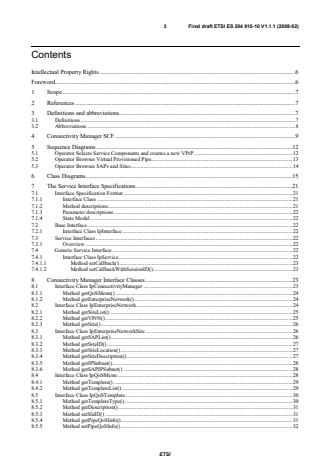
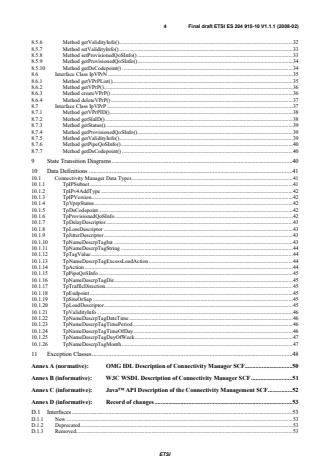
ETSI ES 204 915-10 V1.1.1 (2008-02) - Open Service Access (OSA); Application Programming Interface (API); Part 10: Connectivity Manager SCF (Parlay 6)
ETSI ES 204 915-10 V1.1.1 (2008-05) - Open Service Access (OSA); Application Programming Interface (API); Part 10: Connectivity Manager SCF (Parlay 6)

SIST ES 204 915-10 V1.1.1:2008 is the ETSI Open Service Access (OSA) application programming interface for the Connectivity Manager Service Capability Feature (SCF), part 10 of the Parlay 6.0 OSA API set. It specifies how an enterprise operator can retrieve enterprise network information, choose QoS templates, create and delete Virtual Provisioned Pipes (VPrPs), and query the status and parameters of existing VPrPs. The document is written for implementers of the OSA APIs, especially application developers and service providers working between an enterprise network and a provider network.
What does SIST ES 204 915-10 V1.1.1:2008 specify?
SIST ES 204 915-10 V1.1.1:2008 specifies the Connectivity Manager SCF part of the OSA Stage 3 API. The standard defines the interfaces and data used to let an enterprise operator manage provisioned QoS services over a provider network, using UML to describe the API structure.
The scope covers these aspects of the interface:
- sequence diagrams
- class diagrams
- interface specifications with method details
- state transition diagrams
- data definitions
- OMG IDL description of the interfaces
The document is organized into scope, references, definitions and abbreviations, the Connectivity Manager SCF overview, sequence diagrams, class diagrams, service interface specifications, state transition diagrams, data definitions, exception classes, and annexes.
| Annex | What it covers |
|---|---|
| Annex A | OMG IDL description of the Connectivity Manager SCF |
| Annex B | W3C WSDL description of the Connectivity Manager SCF |
| Annex C | Java API description of the Connectivity Management SCF |
| Annex D | Record of changes |
What are the key requirements of SIST ES 204 915-10 V1.1.1:2008?
SIST ES 204 915-10 V1.1.1:2008 defines an API where the enterprise operator can read network information, select QoS offerings, and provision VPrPs through a provider network. In practice, that means the operator can browse available services, fill in template values, submit a request, and later inspect the resulting pipe.
Entry point and callback behavior
The Connectivity Manager interface is the entry point to the service. getQoSMenu() returns the QoS menu, and getEnterpriseNetwork() returns the enterprise network view. The generic service interface also provides setCallback() and setCallbackWithSessionID() so the provider can call back into the application; this matters because provisioning may be asynchronous.
Reading enterprise network information
IpEnterpriseNetwork lets the operator retrieve a list of site IDs, a VPrN reference, or a specific site reference. IpEnterpriseNetworkSite then exposes the site ID, location, description, IP subnet, and SAP list. In practice, these methods tell the operator which sites and SAPs can be used as VPrP endpoints.
Working with QoS templates
IpQoSMenu provides the list of QoS templates and a reference to a specific template. IpQoSTemplate lets the operator inspect template type, description, pipe QoS information, validity information, provisioned QoS information, and DS Codepoint. The template uses the tags PROVIDER_SPECIFIED, OPERATOR_SPECIFIED, and UNSPECIFIED to control which values the operator can change.
Creating and managing VPrPs
IpVPrN is the interface used to list, create, and delete VPrPs. createVPrP() takes a populated template and creates a new pipe reference, while deleteVPrP() removes a pipe by ID. The returned VPrP can be in ACTIVE, PENDING, or DISALLOWED status, so the operator can track whether the provider approved the request.
What the QoS parameters mean
The template groups QoS settings into TpProvisionedQoSInfo and TpPipeQoSInfo. Provisioned QoS covers delay, loss, jitter, and excess load action, while pipe QoS covers direction, endpoints, and load parameters. This matters because some values describe the service level itself, while others describe the traffic admitted at the pipe edges.
What happens when requests are invalid
The standard uses common exceptions such as P_ILLEGAL_TAG, P_ILLEGAL_VALUE, P_ILLEGAL_COMBINATION, P_UNKNOWN_VPRP, and P_UNKNOWN_DSCODEPOINT. These exceptions show where the API expects the caller to provide legal references, legal parameter combinations, and values consistent with provider advice.
Implementation rule
If an implementation supports a method, it shall support the method’s functionality for at least one valid parameter set. If a service interface does not support a method, it shall return P_METHOD_NOT_SUPPORTED. That gives implementers a clear floor for conformance testing.
What terms does SIST ES 204 915-10 V1.1.1:2008 define?
SIST ES 204 915-10 V1.1.1:2008 defines the following key terms and abbreviations for the Connectivity Manager service:
- Open Service Access (OSA) - an architecture that lets application developers use network functionality through an open standardized interface.
- Service Capability Feature (SCF) - a service area of the OSA API, such as Connectivity Manager, Call Control, or Messaging.
- Virtual Provisioned Network (VPrN) - a collection of VPrPs delivered as a service to one enterprise network.
- Virtual Provisioned Pipe (VPrP) - a provider network service that behaves like a virtual leased line with QoS levels.
- Service Access Point (SAP) - the enterprise network connection point into the provider network.
- Quality of Service (QoS) - the service levels delivered by the provider network, including delay, loss, and traffic policing measures.
- DiffServ Codepoint (DS Codepoint) - the marking associated with a specific VPrP and used in packet headers.
- Service Level Agreement (SLA) - the agreement that can constrain which QoS values or sites the operator may select.
Who uses SIST ES 204 915-10 V1.1.1:2008?
SIST ES 204 915-10 V1.1.1:2008 is used by enterprise operators, provider-network operators, and software developers implementing the OSA APIs. It is relevant in telecom and network service environments where enterprises buy or manage VPN, VLL, or QoS-based connectivity services.
In practice, the main users are:
- enterprise operators who provision and review connectivity services
- provider network engineers who expose and support the Connectivity Manager API
- API and platform developers who implement the service and callback interfaces
- quality or service managers who need to understand what can be set, queried, or validated
- integrators building applications that create or monitor VPrPs
Which standards are used with SIST ES 204 915-10 V1.1.1:2008?
SIST ES 204 915-10 V1.1.1:2008 is used with ES 204 915-1, which provides the overview, common definitions, and referenced provisions for the OSA API family. It also relies on ES 204 915-2 for common data definitions that are reused where this part does not redefine a type.
The document also uses UML as its modeling method, and TpIPSubnet follows the DMTF CIM IP subnet specification. TpNameDescrpTagDateTime uses a TpDateAndTime type in line with ISO 8601.
What does the SIST ES 204 915-10 V1.1.1:2008 document contain?
SIST ES 204 915-10 V1.1.1:2008 contains worked interface definitions, not implementation code. Its core content is the set of sequence diagrams for browsing sites, browsing QoS templates, and creating a new VPrP, plus the class diagrams that show how IpConnectivityManager, IpQoSMenu, IpEnterpriseNetwork, IpVPrN, IpVPrP, and related classes connect.
It also includes detailed method descriptions for reading enterprise network data, selecting template values, provisioning a new VPrP, and reading back VPrP status and QoS parameters. The data definition clauses expand the key structures used by the methods, including subnet data, QoS descriptors, load descriptors, validity windows, VPrP status, and DS Codepoint handling.
The annexes provide machine-readable and developer-oriented realisations: OMG IDL in Annex A, W3C WSDL in Annex B, and Java API material in Annex C. Annex D lists the record of changes by category for interfaces, methods, data definitions, service properties, and exceptions.
Buy Documents
ETSI ES 204 915-10 V1.1.1 (2008-02) - Open Service Access (OSA); Application Programming Interface (API); Part 10: Connectivity Manager SCF (Parlay 6)
ETSI ES 204 915-10 V1.1.1 (2008-05) - Open Service Access (OSA); Application Programming Interface (API); Part 10: Connectivity Manager SCF (Parlay 6)
Get Certified
Connect with accredited certification bodies for this standard

BSI Group
BSI (British Standards Institution) is the business standards company that helps organizations make excellence a habit.

NYCE
Mexican standards and certification body.
Sponsored listings
Frequently Asked Questions
SIST ES 204 915-10 V1.1.1:2008 is a standard published by the Slovenian Institute for Standardization (SIST). Its full title is "Open Service Access (OSA) - Application Programming Interface (API) - Part 10: Connectivity Manager SCF (Parlay 6)". This standard covers: ETSI OSA APIs Phase 4. Based on ES 203 915 and the new requirements for OSA Phase 4, to produce ES 204 915 V1.1.1. ETSI OSA Phase 4 incorporates 3GPP OSA Release 7 and is also known as Parlay 6.0.The present document is part 10 of the Stage 3 specification for an Application Programming Interface (API) for Open Service Access (OSA). The OSA specifications define an architecture that enables application developers to make use of network functionality through an open standardised interface, i.e. the OSA APIs. The present document specifies the Connectivity Manager Service Capability Feature (SCF) aspects of the interface. All aspects of the Connectivity Manager SCF are defined here, these being: • Sequence Diagrams. • Class Diagrams. • Interface specification plus detailed method descriptions. • State Transition diagrams. • Data Definitions. • IDL Description of the interfaces. The process by which this task is accomplished is through the use of object modelling techniques described by the Unified Modelling Language (UML).
ETSI OSA APIs Phase 4. Based on ES 203 915 and the new requirements for OSA Phase 4, to produce ES 204 915 V1.1.1. ETSI OSA Phase 4 incorporates 3GPP OSA Release 7 and is also known as Parlay 6.0.The present document is part 10 of the Stage 3 specification for an Application Programming Interface (API) for Open Service Access (OSA). The OSA specifications define an architecture that enables application developers to make use of network functionality through an open standardised interface, i.e. the OSA APIs. The present document specifies the Connectivity Manager Service Capability Feature (SCF) aspects of the interface. All aspects of the Connectivity Manager SCF are defined here, these being: • Sequence Diagrams. • Class Diagrams. • Interface specification plus detailed method descriptions. • State Transition diagrams. • Data Definitions. • IDL Description of the interfaces. The process by which this task is accomplished is through the use of object modelling techniques described by the Unified Modelling Language (UML).
SIST ES 204 915-10 V1.1.1:2008 is classified under the following ICS (International Classification for Standards) categories: 35.100.01 - Open systems interconnection in general. The ICS classification helps identify the subject area and facilitates finding related standards.
SIST ES 204 915-10 V1.1.1:2008 is available in PDF format for immediate download after purchase. The document can be added to your cart and obtained through the secure checkout process. Digital delivery ensures instant access to the complete standard document.
Standards Content (Sample)
Final draft ETSI ES 204 915-10 V1.1.1 (2008-02)
ETSI Standard
Open Service Access (OSA);
Application Programming Interface (API);
Part 10: Connectivity Manager SCF
(Parlay 6)
�
2 Final draft ETSI ES 204 915-10 V1.1.1 (2008-02)
Reference
DES/TISPAN-01032-10-OSA
Keywords
API, IDL, OSA, UML
ETSI
650 Route des Lucioles
F-06921 Sophia Antipolis Cedex - FRANCE
Tel.: +33 4 92 94 42 00 Fax: +33 4 93 65 47 16
Siret N° 348 623 562 00017 - NAF 742 C
Association à but non lucratif enregistrée à la
Sous-Préfecture de Grasse (06) N° 7803/88
Important notice
Individual copies of the present document can be downloaded from:
http://www.etsi.org
The present document may be made available in more than one electronic version or in print. In any case of existing or
perceived difference in contents between such versions, the reference version is the Portable Document Format (PDF).
In case of dispute, the reference shall be the printing on ETSI printers of the PDF version kept on a specific network drive
within ETSI Secretariat.
Users of the present document should be aware that the document may be subject to revision or change of status.
Information on the current status of this and other ETSI documents is available at
http://portal.etsi.org/tb/status/status.asp
If you find errors in the present document, please send your comment to one of the following services:
http://portal.etsi.org/chaircor/ETSI_support.asp
Copyright Notification
No part may be reproduced except as authorized by written permission.
The copyright and the foregoing restriction extend to reproduction in all media.
© European Telecommunications Standards Institute 2008.
© The Parlay Group 2008.
All rights reserved.
TM TM TM TM
DECT , PLUGTESTS , UMTS , TIPHON , the TIPHON logo and the ETSI logo are Trade Marks of ETSI registered
for the benefit of its Members.
TM
3GPP is a Trade Mark of ETSI registered for the benefit of its Members and of the 3GPP Organizational Partners.
ETSI
3 Final draft ETSI ES 204 915-10 V1.1.1 (2008-02)
Contents
Intellectual Property Rights.6
Foreword.6
1 Scope.7
2 References.7
3 Definitions and abbreviations.7
3.1 Definitions.7
3.2 Abbreviations.8
4 Connectivity Manager SCF.9
5 Sequence Diagrams.12
5.1 Operator Selects Service Components and creates a new VPrP.12
5.2 Operator Browses Virtual Provisioned Pipe.13
5.3 Operator Browses SAPs and Sites.14
6 Class Diagrams.15
7 The Service Interface Specifications.21
7.1 Interface Specification Format .21
7.1.1 Interface Class.21
7.1.2 Method descriptions.21
7.1.3 Parameter descriptions.22
7.1.4 State Model.22
7.2 Base Interface.22
7.2.1 Interface Class IpInterface .22
7.3 Service Interfaces.22
7.3.1 Overview.22
7.4 Generic Service Interface .22
7.4.1 Interface Class IpService .22
7.4.1.1 Method setCallback().23
7.4.1.2 Method setCallbackWithSessionID().23
8 Connectivity Manager Interface Classes.23
8.1 Interface Class IpConnectivityManager .23
8.1.1 Method getQoSMenu().24
8.1.2 Method getEnterpriseNetwork().24
8.2 Interface Class IpEnterpriseNetwork.24
8.2.1 Method getSiteList().25
8.2.2 Method getVPrN().25
8.2.3 Method getSite().26
8.3 Interface Class IpEnterpriseNetworkSite .26
8.3.1 Method getSAPList().26
8.3.2 Method getSiteID().27
8.3.3 Method getSiteLocation().27
8.3.4 Method getSiteDescription().27
8.3.5 Method getIPSubnet().28
8.3.6 Method getSAPIPSubnet().28
8.4 Interface Class IpQoSMenu .28
8.4.1 Method getTemplate().29
8.4.2 Method getTemplateList().29
8.5 Interface Class IpQoSTemplate.30
8.5.1 Method getTemplateType().30
8.5.2 Method getDescription().31
8.5.3 Method setSlaID().31
8.5.4 Method getPipeQoSInfo().31
8.5.5 Method setPipeQoSInfo().32
ETSI
4 Final draft ETSI ES 204 915-10 V1.1.1 (2008-02)
8.5.6 Method getValidityInfo().32
8.5.7 Method setValidityInfo().33
8.5.8 Method setProvisionedQoSInfo().33
8.5.9 Method getProvisionedQoSInfo().34
8.5.10 Method getDsCodepoint().34
8.6 Interface Class IpVPrN .35
8.6.1 Method getVPrPList().35
8.6.2 Method getVPrP().36
8.6.3 Method createVPrP().36
8.6.4 Method deleteVPrP().37
8.7 Interface Class IpVPrP .37
8.7.1 Method getVPrPID().38
8.7.2 Method getSlaID().38
8.7.3 Method getStatus().39
8.7.4 Method getProvisionedQoSInfo().39
8.7.5 Method getValidityInfo().39
8.7.6 Method getPipeQoSInfo().40
8.7.7 Method getDsCodepoint().40
9 State Transition Diagrams.40
10 Data Definitions.41
10.1 Connectivity Manager Data Types.41
10.1.1 TpIPSubnet.41
10.1.2 TpIPv4AddType.42
10.1.3 TpIPVersion.42
10.1.4 TpVprpStatus.42
10.1.5 TpDsCodepoint.42
10.1.6 TpProvisionedQoSInfo.42
10.1.7 TpDelayDescriptor.43
10.1.8 TpLossDescriptor.43
10.1.9 TpJitterDescriptor.43
10.1.10 TpNameDescrpTagInt.43
10.1.11 TpNameDescrpTagString.44
10.1.12 TpTagValue.44
10.1.13 TpNameDescrpTagExcessLoadAction.44
10.1.14 TpAction.44
10.1.15 TpPipeQoSInfo.45
10.1.16 TpNameDescrpTagDir.45
10.1.17 TpTrafficDirection.45
10.1.18 TpEndpoint .45
10.1.19 TpSiteOrSap.45
10.1.20 TpLoadDescriptor.45
10.1.21 TpValidityInfo.46
10.1.22 TpNameDescrpTagDateTime.46
10.1.23 TpNameDescrpTagTimePeriod.46
10.1.24 TpNameDescrpTagTimeOfDay.46
10.1.25 TpNameDescrpTagDayOfWeek.47
10.1.26 TpNameDescrpTagMonth.47
11 Exception Classes.48
Annex A (normative): OMG IDL Description of Connectivity Manager SCF.50
Annex B (informative): W3C WSDL Description of Connectivity Manager SCF.51
Annex C (informative): Java™ API Description of the Connectivity Management SCF.52
Annex D (informative): Record of changes .53
D.1 Interfaces.53
D.1.1 New.53
D.1.2 Deprecated.53
D.1.3 Removed.53
ETSI
5 Final draft ETSI ES 204 915-10 V1.1.1 (2008-02)
D.2 Methods.53
D.2.1 New.53
D.2.2 Deprecated.53
D.2.3 Modified.54
D.2.4 Removed.54
D.3 Data Definitions.54
D.3.1 New.54
D.3.2 Modified.54
D.3.3 Removed.54
D.4 Service Properties.54
D.4.1 New.54
D.4.2 Deprecated.55
D.4.3 Modified.55
D.4.4 Removed.55
D.5 Exceptions.55
D.5.1 New.55
D.5.2 Modified.55
D.5.3 Removed.55
D.6 Others.55
History .56
ETSI
6 Final draft ETSI ES 204 915-10 V1.1.1 (2008-02)
Intellectual Property Rights
IPRs essential or potentially essential to the present document may have been declared to ETSI. The information
pertaining to these essential IPRs, if any, is publicly available for ETSI members and non-members, and can be found
in ETSI SR 000 314: "Intellectual Property Rights (IPRs); Essential, or potentially Essential, IPRs notified to ETSI in
respect of ETSI standards", which is available from the ETSI Secretariat. Latest updates are available on the ETSI Web
server (http://webapp.etsi.org/IPR/home.asp).
Pursuant to the ETSI IPR Policy, no investigation, including IPR searches, has been carried out by ETSI. No guarantee
can be given as to the existence of other IPRs not referenced in ETSI SR 000 314 (or the updates on the ETSI Web
server) which are, or may be, or may become, essential to the present document.
Foreword
This ETSI Standard (ES) has been produced by ETSI Technical Committee Telecommunications and Internet
converged Services and Protocols for Advanced Networking (TISPAN), and is now submitted for the ETSI standards
Membership Approval Procedure.
The present document is part 10 of a multi-part deliverable covering Open Service Access (OSA); Application
Programming Interface (API), as identified below. The API specification (ES 204 915) is structured in the following
parts:
Part 1: "Overview";
Part 2: "Common Data Definitions";
Part 3: "Framework";
Part 4: "Call Control";
Part 5: "User Interaction SCF";
Part 6: "Mobility SCF";
Part 7: "Terminal Capabilities SCF";
Part 8: "Data Session Control SCF";
Part 9: "Generic Messaging SCF";
Part 10: "Connectivity Manager SCF";
Part 11: "Account Management SCF";
Part 12: "Charging SCF";
Part 13: "Policy Management SCF";
Part 14: "Presence and Availability Management SCF";
Part 15: "Multi-Media Messaging SCF";
Part 16: "Service Broker SCF".
The present document has been defined jointly between ETSI, The Parlay Group (http://www.parlay.org) and the 3GPP,
in co-operation with a number of JAIN™ Community (http://www.java.sun.com/products/jain) member companies.
The present document forms part of the Parlay 6.0 set of specifications.
ETSI
7 Final draft ETSI ES 204 915-10 V1.1.1 (2008-02)
1 Scope
The present document is part 10 of the Stage 3 specification for an Application Programming Interface (API) for Open
Service Access (OSA).
The OSA specifications define an architecture that enables application developers to make use of network functionality
through an open standardised interface, i.e. the OSA APIs.
The present document specifies the Connectivity Manager Service Capability Feature (SCF) aspects of the interface. All
aspects of the Connectivity Manager SCF are defined here, these being:
• Sequence Diagrams.
• Class Diagrams.
• Interface specification plus detailed method descriptions.
• State Transition diagrams.
• Data Definitions.
• IDL Description of the interfaces.
The process by which this task is accomplished is through the use of object modelling techniques described by the
Unified Modelling Language (UML).
2 References
The references listed in clause 2 of ES 204 915-1 contain provisions which, through reference in this text, constitute
provisions of the present document.
ETSI ES 204 915-1: "Open Service Access (OSA); Application Programming Interface (API); Part 1: Overview
(Parlay 6)".
3 Definitions and abbreviations
3.1 Definitions
For the purposes of the present document, the terms and definitions given in ES 204 915-1 and the following apply:
best effort traffic: traffic that is not carried by a VPrN established for the enterprise network by the provider
differentiated services: effort in the Internet Engineering Task Force (IETF) to provide quality of service in networks
employing small well defined building blocks from which variety of service may be built
DS Codepoint: marking associated with a specific VPrP
enterprise operator: administrator of the enterprise network/user of APIs
NOTE: Also referred to as operator.
operator: enterprise operator
provider network: provides a VPN and VPrP service to the enterprise network, and offers APIs for connectivity
manager to the enterprise operator
NOTE: Also referred to as network service provider.
ETSI
8 Final draft ETSI ES 204 915-10 V1.1.1 (2008-02)
provider: entity that offers the VPN and VPrP services, and implements the APIs in the provider network
Quality of Service (QoS): collection of service levels delivered by a provider network to an enterprise network
NOTE: QoS can be characterised by various performance attributes such as: packet loss, packet delay; traffic
policing measures such as maximum bandwidth and burst rate for traffic entering the providers network.
Service Access Point (SAP): enterprise network is connected to the provider network through the enterprise network
service access points
NOTE: A SAP is typically the egress router from the enterprise network that connects to the provider network.
TOS bits: value held in the TOS field
NOTE: IETF defined the use the TOS field in the IPv4 packet header as a signalling mechanism aimed at
providing definitions of aggregation of flows, where each aggregate is supported by the same level of
QoS.
Virtual Leased Line (VLL): network that uses a provider network infrastructure to connect two geographically
separated sites of an enterprise
Virtual Private Network (VPN): network that uses a provider network infrastructure to connect geographically
separated sites of an enterprise
NOTE: Such a network looks like a private network to the enterprise as the sites are connected using tunnelling
and security technologies. With no QoS measures, VPN passes all packets among the sites with a best
effort approach.
Virtual Provisioned Network (VPrN): collection of VPrP delivered as a service to a single enterprise network
Virtual Provisioned Pipe (VPrP): service provided by the provider network to the enterprise network, which is a type
of virtual leased line (VLL) provisioned with QoS levels
NOTE: VPrP carries enterprise network traffic whose packets are marked with the specific DS Codepoint that is
associated with this VPrP. The enterprise operator using APIs can create on-line a VPrP.
3.2 Abbreviations
For the purposes of the present document, the abbreviations given in ES 204 915-1 and the following apply:
CIM Common Information Model
CM Connectivity Manager
DiffServ Differentiated Services
DMTF Distributed Management Task Force
DS Differentiated Services
QoS Quality of Service
SAP Service Access Point
SLA Service Level Agreement terms
TOS Type Of Service
VLL Virtual Leased Line
VPN Virtual Private Network
VPrN Virtual Provisioned Network
VPrP Virtual Provisioned Pipe
ETSI
9 Final draft ETSI ES 204 915-10 V1.1.1 (2008-02)
4 Connectivity Manager SCF
Connectivity Manager includes the APIs between the enterprise operator and the provider network for the two parties to
establish QoS parameters for enterprise network packets travelling through the provider network.
The Connectivity Manager service provides tools for the enterprise operator to set up a Provisioned QoS service in the
provider network. The QoS measures used in the enterprise network are outside the scope of the service. The API does
not require any specific QoS method to be used in the enterprise network, nor in the provider network. However, in
order for Provisioned QoS service to be applied to packets arriving from the enterprise network into the provider
network, the packets have to be marked using DS Codepoint marking. Once the packets are so marked, they can enjoy
the QoS service provisioned in the provider network.
APIs provide the enterprise network operator on-line access to provision quality of service measures that control the
enterprise's own traffic passing through the provider network. Using APIs the operator can create Virtual Provisioned
Pipes (VPrPs) in the provider network to carry the enterprise traffic and support it with pre-specified quality of service
attributes. A VPrP can be thought of as a Virtual Leased Line (VLL) provisioned to deliver pre-specified QoS. The
provider may offer to the enterprise operator a set of templates that are used by the operator to specify a VPrP. For
instance, the provider may offer templates for video conferencing, audio conferencing, Gold Service, Silver Service,
etc. Using these templates the operator can select and provision a VPrP that specifies the quality of service attributes for
this VPrP.
Elements that can be specified for a VPrP include attributes such as packet delay and packet loss. Characteristics of
traffic that enters the VPrP at its access point to the provider network can be also specified with attributes such as
maximum rate and burst rate.
The following is an example of a possible scenario:
• The provider prepares a template with operator-specified attributes, provider-specified attributes, and
unspecified attributes, one for each QoS level.
• The provider generates for the enterprise network a list of all the current sites and their access points to the
provider network.
• Enterprise operator logs into connectivity manager after being authenticated and authorised by the Framework
service.
• Operator gets the list of the sites and service access points of the enterprise Virtual Private Network (VPN)
already provided to the enterprise by the provider.
• Enterprise operator retrieves the set of templates available to the enterprise (as supported by the SLA), selects
one, and requests a template for constructing a new VPrP based upon the selected QoS.
• Enterprise operator completes the VPrP template: i.e. selects a value for delay, loss, jitter and excess traffic
treatment action, enters the SLA ID against which the template could be validated, selects endpoints, load
parameters and traffic flow direction, and selects the time requirements desired. The enterprise operator can
choose or modify those attributes that are operator-specified attributes in the template. Provider-specified
attributes cannot be modified and are inherently part of the service.
• Enterprise operator submits the completed VPrP template for validation by the CM service. Operator creates a
new VPrP with pending-status that holds these selections.
• The provider responds after validating the requests, which may be an approval or a denial (e.g. the requested
service is not available at this access point, or at the specified time).
• If the provider approves service, the operator may send packets marked with the templates DiffServ
Codepoint, which identifies together with the endpoints the VPrP that carries these packets.
ETSI
10 Final draft ETSI ES 204 915-10 V1.1.1 (2008-02)
Some additional clarification points:
• A VPrN is associated with a single network provider.
• A VPrP defines QoS parameters for traffic flowing through this provider network, between two specified
enterprise endpoints, optionally during specified date/time period(s).
• The enterprise operator may be (provider's choice) constrained to selecting QoS parameter values from a pre-
defined set of values, and selecting endpoints from a predefined set of enterprise sites; where these sets were
negotiated off-line between the enterprise and the network provider and possibly documented in a Service
Level Agreement (SLA).
• The CM service validates each VPrP request submitted by the enterprise operator. The validation process is
not specified here. Validation against the SLA is an example of such possible validation.
• If the CM service accepts the VPrP request, it adds it to the VPrN. The DiffServ Codepoint provided by the
enterprise operator is then used by the enterprise for marking all packets belonging to any traffic flow
associated with the VPrP.
The following is a summary of interfaces and methods supported by connectivity manager. The syntax method
(interface) is used for this description.
There are Passive CM interface functions (CM1, CM2, CM4) that are used to retrieve information (read) relative to
VPN, VPrN, and QoS templates provided by the service provider, and active (CM3) functions (read/write) used to
provision new services.
CM1: Retrieve information on a Virtual Private Network, its sites and their service access points:
getEnterpriseNetwork(IpConnectivityManager)
getSiteList(IpEterpriseNetwork)
getSite(IpEterpriseNetwork)
getSAPList(IpEnterpriseNetworkSite)
getSiteID(IpEnterpriseNetworkSite)
getSiteLocation(IpEnterpriseNetworkSite)
getSiteDescription(IpEnterpriseNetworkSite)
getSAPIPSubnet(IpEnterpriseNetworkSite)
getSiteIPSubnet(IpEnterpriseNetworkSite)
CM2: Retrieve QoS services offered by provider, stored in QoS templates:
getQoSMenu(IpConnectivityManager)
getTemplateList(IpQoSMenu)
getTemplate(IpQoSMenu)
getTemplateType(IpQoSTemplate)
getDescription(IpQoSTemplate)
getPipeQoSInfo(IpQoSTemplate)
getValidityInfo(IpQoSTemplate)
getProvisionedQoSInfo(IpQoSTemplate)
getDsCodepoint(IpQoSTemplate)
CM3: Set up a new Virtual Provisioned Pipe:
createVPrP(IpVPrN)
deleteVPrP(IpVPrN)
setSlaID(IpQoSTemplate)
setPipeQoSInfo(IpQoSTemplate)
setValidityInfo(IpQoSTemplate)
setProvisionedQoSInfo(IpQoSTemplate)
ETSI
11 Final draft ETSI ES 204 915-10 V1.1.1 (2008-02)
CM4: Retrieve information on a Virtual Provisioned Network and its Virtual Provisioned Pipes:
getVPrN(IpEterpriseNetwork)
getVPrPList(IpVPrN)
getVPrP(IpVPrN)
getVPrPID(IpVPrP)
getSlaID(IpVPrP)
getStatus(IpVPrP)
getProvisionedQoSInfo(IpVPrP)
getPipeQoSInfo(IpVPrP)
getDsCodepoint(IpVPrP)
Two typical scenarios:
1) To set up a new VPrP:
The enterprise operator retrieves information regarding enterprise's existing VPN (sites and SAPs),
using as needed the methods listed in CM1 above.
Enterprise operator retrieves information on provider's offered QoS services, using methods listed
in CM2 above as needed.
Enterprise operator submits a request to set up a new VPrP, using methods listed in CM3 above as
needed.
Enterprise operator checks the status of the request using the methods listed in CM4 above as
needed.
If the request was approved by the network provider, the VPrP is put in an active mode, and
packets that are marked in the enterprise network with appropriate marking in their packet header
will travel the provider's network through the new Virtual Provisioned Pipe that supports the
requested QoS levels.
2) Retrieve information on current enterprise network services delivered to the enterprise by the provider
network:
Enterprise operator retrieves information on current QoS services delivered to the enterprise
network using CM4 methods listed above as needed.
Enterprise operator checks if the provider offers new QoS services using CM2 listed above as
needed.
The following clauses describe each aspect of the Connectivity Manager Service Capability Feature (SCF).
The order is as follows:
• The Sequence diagrams give the reader a practical idea of how each of the SCF is implemented.
• The Class relationships clause shows how each of the interfaces applicable to the SCF, relate to one another.
• The Interface specification clause describes in detail each of the interfaces shown within the Class diagram
part.
• The State Transition Diagrams (STD) show the transition between states in the SCF. The states and transitions
are well-defined; either methods specified in the Interface specification or events occurring in the underlying
networks cause state transitions.
• The Data Definitions clause shows a detailed expansion of each of the data types associated with the methods
within the classes. Note that some data types are used in other methods and classes and are therefore defined
within the Common Data types part ES 204 915-2.
An implementation of this API which supports or implements a method described in the present document, shall
support or implement the functionality described for that method, for at least one valid set of values for the parameters
of that method. Where a method is not supported by an implementation of a Service interface, the exception
P_METHOD_NOT_SUPPORTED shall be returned to any call of that method.
ETSI
12 Final draft ETSI ES 204 915-10 V1.1.1 (2008-02)
5 Sequence Diagrams
5.1 Operator Selects Service Components and creates a new
VPrP
The following sequence diagram shows how an enterprise operator client collects the information required to select a
service, and then selects the service parameters, and finally submits it to the connectivity manager.
: : IpQoSMenu : : IpVPrN
OperatorClient IpConnectivityManager IpQoSTemplate
1: getQoSMenu( )
2: getTemplateList( )
3: getTemplate( )
4: getPipeQoSInfo( )
5: setPipeQoSInfo( )
6: getProvisionedQoSInfo( )
7: setProvisionedQoSInfo( )
8: getValidityInfo( )
9: setValidityInfo( )
10: createVPrP( )
ETSI
13 Final draft ETSI ES 204 915-10 V1.1.1 (2008-02)
5.2 Operator Browses Virtual Provisioned Pipe
The following shows an enterprise operator client browses and collect information pertinent to an existing virtual
provisioned pipe, including all the QoS parameters that have been set for this pipe.
: : : IpVPrN : IpVPrP
OperatorClient IpConnectivityManager IpEnterpriseNetwork
1: getEnterpriseNetwork( )
2: getVPrN( )
3: getVPrPList( )
4: getVPrP( )
5: getVPrPID( )
6: getSlaID( )
7: getProvisionedQoSInfo( )
8: getValidityInfo( )
9: getPipeQoSInfo( )
10: getDsCodepoint( )
11: getStatus( )
ETSI
14 Final draft ETSI ES 204 915-10 V1.1.1 (2008-02)
5.3 Operator Browses SAPs and Sites
The following sequence diagram shows how an enterprise operator browses service access points and sites to retrieve
information regarding a site and its SAP(s).
: : :
OperatorClient IpConnectivityManager IpEnterpriseNetwork IpEnterpriseNetworkSite
1: getEnterpriseNetwork( )
2: getSiteList( )
3: getSite( )
4: getSAPList( )
5: getSiteID( )
6: getSiteLocation( )
7: getSiteDescription( )
8: getSAPIPSubnet( )
9: getIPSubnet( )
ETSI
15 Final draft ETSI ES 204 915-10 V1.1.1 (2008-02)
6 Class Diagrams
The class diagram below shows the connectivity manager interfaces. The connectivity manager interface is the entry
point to this service. From this interface a reference to the enterprise network and to the Quality of Service (QoS) menu
interfaces can be retrieved. The QoS menu interface provides a list of templates, each of which specifies the QoS
service parameters that are offered by the service provider. The service is composed of components that are associated
with a Provisioned QoS. The template interface is used to specify the service parameters that are offered by the service
provider, and also, for temporary storage of parameters that the operator selects. The enterprise network interface is
associated with two components: enterprise network sites, and the Virtual Provisioned Network that has been already
provisioned in the provider network. The Virtual Provisioned Network interface contains references to all the Virtual
Provisioned Pipes (VPrPs) already established. The QoS Menu contains references to all the QoS templates offered by
the provider. Each template specifies the QoS parameters that can be set in order to create a new VPrP. Once the
operator selects the QoS parameters provided in the QoS template, and submits the request to create a new VPrP, the
provider validates the information submitted and if the request is approved, the new VPrP is set to an active mode.
<>
IpConnectivityManager
(from cm)
<>
IpQoSMenu
<>
(from cm)
IpEnterpriseNetwork
(from cm)
11 11
<>
IpVPrN
(from cm)
00.n.n
11.n.n
<>
<>
IpQoSTemplate
IpEnterpriseNetworkSite
(from cm)
(from cm)
00.n.n
<>
IpVPrP
(from cm)
Figure 1: Connectivity Management High level class diagram
The connectivity manager class is associated with the QoS menu class and the enterprise network class as shown in the
figure below. From the CM class the QoS Menu and Enterprise Network reference can be retrieved. The QoS menu
provides a method (getTemplateList()), to get the list of all the QoS offered services, each of which is stored as a
template (e.g. Gold template, Silver template). The QoS menu provides a method (getTemplate()) that instantiates a
temporary template to retrieve the default parameters for a specific template, and store the parameters selected by the
operator for a new service (VPrP). The Enterprise Network class is used to retrieve the list of sites that the operator has
established for a Virtual Private Network (VPN) service with the service provider, and to get a reference to a specific
site. This class also provides a reference to the Virtual Provisioned Network class that holds the information regarding
the already established QoS network with the provider.
ETSI
16 Final draft ETSI ES 204 915-10 V1.1.1 (2008-02)
<>
IpConnectivityManager
(f ro m cm)
getQoSMenu()
getEnterpriseNetwork()
<> <>
IpQoSMenu IpEnterpriseNetwork
(from cm)
(from cm)
getTemplate()
getSiteList()
getTemplateList() getVPrN()
getSite()
Figure 2: QoS Menu and Enterprise Network class diagram
The figure below shows QoS templates class that is used to retrieve the QoS parameters offered by the provider and
select the parameters for a new VPrP and store them in this template. Most of these parameters are tagged using the
TPNameDescrpTag class to indicate whether the parameter is set by the provider and cannot be changed by the
operator, or is a
...
ETSI Standard
Open Service Access (OSA);
Application Programming Interface (API);
Part 10: Connectivity Manager SCF
(Parlay 6)
�
2 ETSI ES 204 915-10 V1.1.1 (2008-05)
Reference
DES/TISPAN-01032-10-OSA
Keywords
API, IDL, OSA, UML
ETSI
650 Route des Lucioles
F-06921 Sophia Antipolis Cedex - FRANCE
Tel.: +33 4 92 94 42 00 Fax: +33 4 93 65 47 16
Siret N° 348 623 562 00017 - NAF 742 C
Association à but non lucratif enregistrée à la
Sous-Préfecture de Grasse (06) N° 7803/88
Important notice
Individual copies of the present document can be downloaded from:
http://www.etsi.org
The present document may be made available in more than one electronic version or in print. In any case of existing or
perceived difference in contents between such versions, the reference version is the Portable Document Format (PDF).
In case of dispute, the reference shall be the printing on ETSI printers of the PDF version kept on a specific network drive
within ETSI Secretariat.
Users of the present document should be aware that the document may be subject to revision or change of status.
Information on the current status of this and other ETSI documents is available at
http://portal.etsi.org/tb/status/status.asp
If you find errors in the present document, please send your comment to one of the following services:
http://portal.etsi.org/chaircor/ETSI_support.asp
Copyright Notification
No part may be reproduced except as authorized by written permission.
The copyright and the foregoing restriction extend to reproduction in all media.
© European Telecommunications Standards Institute 2008.
© The Parlay Group 2008.
All rights reserved.
TM TM TM TM
DECT , PLUGTESTS , UMTS , TIPHON , the TIPHON logo and the ETSI logo are Trade Marks of ETSI registered
for the benefit of its Members.
TM
3GPP is a Trade Mark of ETSI registered for the benefit of its Members and of the 3GPP Organizational Partners.
ETSI
3 ETSI ES 204 915-10 V1.1.1 (2008-05)
Contents
Intellectual Property Rights.6
Foreword.6
1 Scope.7
2 References.7
3 Definitions and abbreviations.7
3.1 Definitions.7
3.2 Abbreviations.8
4 Connectivity Manager SCF.9
5 Sequence Diagrams.12
5.1 Operator Selects Service Components and creates a new VPrP.12
5.2 Operator Browses Virtual Provisioned Pipe.13
5.3 Operator Browses SAPs and Sites.14
6 Class Diagrams.15
7 The Service Interface Specifications.21
7.1 Interface Specification Format .21
7.1.1 Interface Class.21
7.1.2 Method descriptions.21
7.1.3 Parameter descriptions.22
7.1.4 State Model.22
7.2 Base Interface.22
7.2.1 Interface Class IpInterface .22
7.3 Service Interfaces.22
7.3.1 Overview.22
7.4 Generic Service Interface .22
7.4.1 Interface Class IpService .22
7.4.1.1 Method setCallback().23
7.4.1.2 Method setCallbackWithSessionID().23
8 Connectivity Manager Interface Classes.23
8.1 Interface Class IpConnectivityManager .23
8.1.1 Method getQoSMenu().24
8.1.2 Method getEnterpriseNetwork().24
8.2 Interface Class IpEnterpriseNetwork.24
8.2.1 Method getSiteList().25
8.2.2 Method getVPrN().25
8.2.3 Method getSite().26
8.3 Interface Class IpEnterpriseNetworkSite .26
8.3.1 Method getSAPList().26
8.3.2 Method getSiteID().27
8.3.3 Method getSiteLocation().27
8.3.4 Method getSiteDescription().27
8.3.5 Method getIPSubnet().28
8.3.6 Method getSAPIPSubnet().28
8.4 Interface Class IpQoSMenu .28
8.4.1 Method getTemplate().29
8.4.2 Method getTemplateList().29
8.5 Interface Class IpQoSTemplate.30
8.5.1 Method getTemplateType().30
8.5.2 Method getDescription().31
8.5.3 Method setSlaID().31
8.5.4 Method getPipeQoSInfo().31
8.5.5 Method setPipeQoSInfo().32
ETSI
4 ETSI ES 204 915-10 V1.1.1 (2008-05)
8.5.6 Method getValidityInfo().32
8.5.7 Method setValidityInfo().33
8.5.8 Method setProvisionedQoSInfo().33
8.5.9 Method getProvisionedQoSInfo().34
8.5.10 Method getDsCodepoint().34
8.6 Interface Class IpVPrN .35
8.6.1 Method getVPrPList().35
8.6.2 Method getVPrP().36
8.6.3 Method createVPrP().36
8.6.4 Method deleteVPrP().37
8.7 Interface Class IpVPrP .37
8.7.1 Method getVPrPID().38
8.7.2 Method getSlaID().38
8.7.3 Method getStatus().39
8.7.4 Method getProvisionedQoSInfo().39
8.7.5 Method getValidityInfo().39
8.7.6 Method getPipeQoSInfo().40
8.7.7 Method getDsCodepoint().40
9 State Transition Diagrams.40
10 Data Definitions.41
10.1 Connectivity Manager Data Types.41
10.1.1 TpIPSubnet.41
10.1.2 TpIPv4AddType.42
10.1.3 TpIPVersion.42
10.1.4 TpVprpStatus.42
10.1.5 TpDsCodepoint.42
10.1.6 TpProvisionedQoSInfo.42
10.1.7 TpDelayDescriptor.43
10.1.8 TpLossDescriptor.43
10.1.9 TpJitterDescriptor.43
10.1.10 TpNameDescrpTagInt.43
10.1.11 TpNameDescrpTagString.44
10.1.12 TpTagValue.44
10.1.13 TpNameDescrpTagExcessLoadAction.44
10.1.14 TpAction.44
10.1.15 TpPipeQoSInfo.45
10.1.16 TpNameDescrpTagDir.45
10.1.17 TpTrafficDirection.45
10.1.18 TpEndpoint .45
10.1.19 TpSiteOrSap.45
10.1.20 TpLoadDescriptor.45
10.1.21 TpValidityInfo.46
10.1.22 TpNameDescrpTagDateTime.46
10.1.23 TpNameDescrpTagTimePeriod.46
10.1.24 TpNameDescrpTagTimeOfDay.46
10.1.25 TpNameDescrpTagDayOfWeek.47
10.1.26 TpNameDescrpTagMonth.47
11 Exception Classes.48
Annex A (normative): OMG IDL Description of Connectivity Manager SCF.50
Annex B (informative): W3C WSDL Description of Connectivity Manager SCF.51
Annex C (informative): Java™ API Description of the Connectivity Management SCF.52
Annex D (informative): Record of changes .53
D.1 Interfaces.53
D.1.1 New.53
D.1.2 Deprecated.53
D.1.3 Removed.53
ETSI
5 ETSI ES 204 915-10 V1.1.1 (2008-05)
D.2 Methods.53
D.2.1 New.53
D.2.2 Deprecated.53
D.2.3 Modified.54
D.2.4 Removed.54
D.3 Data Definitions.54
D.3.1 New.54
D.3.2 Modified.54
D.3.3 Removed.54
D.4 Service Properties.54
D.4.1 New.54
D.4.2 Deprecated.55
D.4.3 Modified.55
D.4.4 Removed.55
D.5 Exceptions.55
D.5.1 New.55
D.5.2 Modified.55
D.5.3 Removed.55
D.6 Others.55
History .56
ETSI
6 ETSI ES 204 915-10 V1.1.1 (2008-05)
Intellectual Property Rights
IPRs essential or potentially essential to the present document may have been declared to ETSI. The information
pertaining to these essential IPRs, if any, is publicly available for ETSI members and non-members, and can be found
in ETSI SR 000 314: "Intellectual Property Rights (IPRs); Essential, or potentially Essential, IPRs notified to ETSI in
respect of ETSI standards", which is available from the ETSI Secretariat. Latest updates are available on the ETSI Web
server (http://webapp.etsi.org/IPR/home.asp).
Pursuant to the ETSI IPR Policy, no investigation, including IPR searches, has been carried out by ETSI. No guarantee
can be given as to the existence of other IPRs not referenced in ETSI SR 000 314 (or the updates on the ETSI Web
server) which are, or may be, or may become, essential to the present document.
Foreword
This ETSI Standard (ES) has been produced by ETSI Technical Committee Telecommunications and Internet
converged Services and Protocols for Advanced Networking (TISPAN).
The present document is part 10 of a multi-part deliverable covering Open Service Access (OSA); Application
Programming Interface (API), as identified below. The API specification (ES 204 915) is structured in the following
parts:
Part 1: "Overview";
Part 2: "Common Data Definitions";
Part 3: "Framework";
Part 4: "Call Control";
Part 5: "User Interaction SCF";
Part 6: "Mobility SCF";
Part 7: "Terminal Capabilities SCF";
Part 8: "Data Session Control SCF";
Part 9: "Generic Messaging SCF";
Part 10: "Connectivity Manager SCF";
Part 11: "Account Management SCF";
Part 12: "Charging SCF";
Part 13: "Policy Management SCF";
Part 14: "Presence and Availability Management SCF";
Part 15: "Multi-Media Messaging SCF";
Part 16: "Service Broker SCF".
The present document has been defined jointly between ETSI, The Parlay Group (http://www.parlay.org) and the 3GPP,
in co-operation with a number of JAIN™ Community (http://www.java.sun.com/products/jain) member companies.
The present document forms part of the Parlay 6.0 set of specifications.
ETSI
7 ETSI ES 204 915-10 V1.1.1 (2008-05)
1 Scope
The present document is part 10 of the Stage 3 specification for an Application Programming Interface (API) for Open
Service Access (OSA).
The OSA specifications define an architecture that enables application developers to make use of network functionality
through an open standardised interface, i.e. the OSA APIs.
The present document specifies the Connectivity Manager Service Capability Feature (SCF) aspects of the interface. All
aspects of the Connectivity Manager SCF are defined here, these being:
• Sequence Diagrams.
• Class Diagrams.
• Interface specification plus detailed method descriptions.
• State Transition diagrams.
• Data Definitions.
• IDL Description of the interfaces.
The process by which this task is accomplished is through the use of object modelling techniques described by the
Unified Modelling Language (UML).
2 References
The references listed in clause 2 of ES 204 915-1 contain provisions which, through reference in this text, constitute
provisions of the present document.
ETSI ES 204 915-1: "Open Service Access (OSA); Application Programming Interface (API); Part 1: Overview
(Parlay 6)".
3 Definitions and abbreviations
3.1 Definitions
For the purposes of the present document, the terms and definitions given in ES 204 915-1 and the following apply:
best effort traffic: traffic that is not carried by a VPrN established for the enterprise network by the provider
differentiated services: effort in the Internet Engineering Task Force (IETF) to provide quality of service in networks
employing small well defined building blocks from which variety of service may be built
DS Codepoint: marking associated with a specific VPrP
enterprise operator: administrator of the enterprise network/user of APIs
NOTE: Also referred to as operator.
operator: enterprise operator
provider network: provides a VPN and VPrP service to the enterprise network, and offers APIs for connectivity
manager to the enterprise operator
NOTE: Also referred to as network service provider.
ETSI
8 ETSI ES 204 915-10 V1.1.1 (2008-05)
provider: entity that offers the VPN and VPrP services, and implements the APIs in the provider network
Quality of Service (QoS): collection of service levels delivered by a provider network to an enterprise network
NOTE: QoS can be characterised by various performance attributes such as: packet loss, packet delay; traffic
policing measures such as maximum bandwidth and burst rate for traffic entering the providers network.
Service Access Point (SAP): enterprise network is connected to the provider network through the enterprise network
service access points
NOTE: A SAP is typically the egress router from the enterprise network that connects to the provider network.
TOS bits: value held in the TOS field
NOTE: IETF defined the use the TOS field in the IPv4 packet header as a signalling mechanism aimed at
providing definitions of aggregation of flows, where each aggregate is supported by the same level of
QoS.
Virtual Leased Line (VLL): network that uses a provider network infrastructure to connect two geographically
separated sites of an enterprise
Virtual Private Network (VPN): network that uses a provider network infrastructure to connect geographically
separated sites of an enterprise
NOTE: Such a network looks like a private network to the enterprise as the sites are connected using tunnelling
and security technologies. With no QoS measures, VPN passes all packets among the sites with a best
effort approach.
Virtual Provisioned Network (VPrN): collection of VPrP delivered as a service to a single enterprise network
Virtual Provisioned Pipe (VPrP): service provided by the provider network to the enterprise network, which is a type
of virtual leased line (VLL) provisioned with QoS levels
NOTE: VPrP carries enterprise network traffic whose packets are marked with the specific DS Codepoint that is
associated with this VPrP. The enterprise operator using APIs can create on-line a VPrP.
3.2 Abbreviations
For the purposes of the present document, the abbreviations given in ES 204 915-1 and the following apply:
CIM Common Information Model
CM Connectivity Manager
DiffServ Differentiated Services
DMTF Distributed Management Task Force
DS Differentiated Services
QoS Quality of Service
SAP Service Access Point
SLA Service Level Agreement terms
TOS Type Of Service
VLL Virtual Leased Line
VPN Virtual Private Network
VPrN Virtual Provisioned Network
VPrP Virtual Provisioned Pipe
ETSI
9 ETSI ES 204 915-10 V1.1.1 (2008-05)
4 Connectivity Manager SCF
Connectivity Manager includes the APIs between the enterprise operator and the provider network for the two parties to
establish QoS parameters for enterprise network packets travelling through the provider network.
The Connectivity Manager service provides tools for the enterprise operator to set up a Provisioned QoS service in the
provider network. The QoS measures used in the enterprise network are outside the scope of the service. The API does
not require any specific QoS method to be used in the enterprise network, nor in the provider network. However, in
order for Provisioned QoS service to be applied to packets arriving from the enterprise network into the provider
network, the packets have to be marked using DS Codepoint marking. Once the packets are so marked, they can enjoy
the QoS service provisioned in the provider network.
APIs provide the enterprise network operator on-line access to provision quality of service measures that control the
enterprise's own traffic passing through the provider network. Using APIs the operator can create Virtual Provisioned
Pipes (VPrPs) in the provider network to carry the enterprise traffic and support it with pre-specified quality of service
attributes. A VPrP can be thought of as a Virtual Leased Line (VLL) provisioned to deliver pre-specified QoS. The
provider may offer to the enterprise operator a set of templates that are used by the operator to specify a VPrP. For
instance, the provider may offer templates for video conferencing, audio conferencing, Gold Service, Silver Service,
etc. Using these templates the operator can select and provision a VPrP that specifies the quality of service attributes for
this VPrP.
Elements that can be specified for a VPrP include attributes such as packet delay and packet loss. Characteristics of
traffic that enters the VPrP at its access point to the provider network can be also specified with attributes such as
maximum rate and burst rate.
The following is an example of a possible scenario:
• The provider prepares a template with operator-specified attributes, provider-specified attributes, and
unspecified attributes, one for each QoS level.
• The provider generates for the enterprise network a list of all the current sites and their access points to the
provider network.
• Enterprise operator logs into connectivity manager after being authenticated and authorised by the Framework
service.
• Operator gets the list of the sites and service access points of the enterprise Virtual Private Network (VPN)
already provided to the enterprise by the provider.
• Enterprise operator retrieves the set of templates available to the enterprise (as supported by the SLA), selects
one, and requests a template for constructing a new VPrP based upon the selected QoS.
• Enterprise operator completes the VPrP template: i.e. selects a value for delay, loss, jitter and excess traffic
treatment action, enters the SLA ID against which the template could be validated, selects endpoints, load
parameters and traffic flow direction, and selects the time requirements desired. The enterprise operator can
choose or modify those attributes that are operator-specified attributes in the template. Provider-specified
attributes cannot be modified and are inherently part of the service.
• Enterprise operator submits the completed VPrP template for validation by the CM service. Operator creates a
new VPrP with pending-status that holds these selections.
• The provider responds after validating the requests, which may be an approval or a denial (e.g. the requested
service is not available at this access point, or at the specified time).
• If the provider approves service, the operator may send packets marked with the templates DiffServ
Codepoint, which identifies together with the endpoints the VPrP that carries these packets.
ETSI
10 ETSI ES 204 915-10 V1.1.1 (2008-05)
Some additional clarification points:
• A VPrN is associated with a single network provider.
• A VPrP defines QoS parameters for traffic flowing through this provider network, between two specified
enterprise endpoints, optionally during specified date/time period(s).
• The enterprise operator may be (provider's choice) constrained to selecting QoS parameter values from a pre-
defined set of values, and selecting endpoints from a predefined set of enterprise sites; where these sets were
negotiated off-line between the enterprise and the network provider and possibly documented in a Service
Level Agreement (SLA).
• The CM service validates each VPrP request submitted by the enterprise operator. The validation process is
not specified here. Validation against the SLA is an example of such possible validation.
• If the CM service accepts the VPrP request, it adds it to the VPrN. The DiffServ Codepoint provided by the
enterprise operator is then used by the enterprise for marking all packets belonging to any traffic flow
associated with the VPrP.
The following is a summary of interfaces and methods supported by connectivity manager. The syntax method
(interface) is used for this description.
There are Passive CM interface functions (CM1, CM2, CM4) that are used to retrieve information (read) relative to
VPN, VPrN, and QoS templates provided by the service provider, and active (CM3) functions (read/write) used to
provision new services.
CM1: Retrieve information on a Virtual Private Network, its sites and their service access points:
getEnterpriseNetwork(IpConnectivityManager)
getSiteList(IpEterpriseNetwork)
getSite(IpEterpriseNetwork)
getSAPList(IpEnterpriseNetworkSite)
getSiteID(IpEnterpriseNetworkSite)
getSiteLocation(IpEnterpriseNetworkSite)
getSiteDescription(IpEnterpriseNetworkSite)
getSAPIPSubnet(IpEnterpriseNetworkSite)
getSiteIPSubnet(IpEnterpriseNetworkSite)
CM2: Retrieve QoS services offered by provider, stored in QoS templates:
getQoSMenu(IpConnectivityManager)
getTemplateList(IpQoSMenu)
getTemplate(IpQoSMenu)
getTemplateType(IpQoSTemplate)
getDescription(IpQoSTemplate)
getPipeQoSInfo(IpQoSTemplate)
getValidityInfo(IpQoSTemplate)
getProvisionedQoSInfo(IpQoSTemplate)
getDsCodepoint(IpQoSTemplate)
CM3: Set up a new Virtual Provisioned Pipe:
createVPrP(IpVPrN)
deleteVPrP(IpVPrN)
setSlaID(IpQoSTemplate)
setPipeQoSInfo(IpQoSTemplate)
setValidityInfo(IpQoSTemplate)
setProvisionedQoSInfo(IpQoSTemplate)
ETSI
11 ETSI ES 204 915-10 V1.1.1 (2008-05)
CM4: Retrieve information on a Virtual Provisioned Network and its Virtual Provisioned Pipes:
getVPrN(IpEterpriseNetwork)
getVPrPList(IpVPrN)
getVPrP(IpVPrN)
getVPrPID(IpVPrP)
getSlaID(IpVPrP)
getStatus(IpVPrP)
getProvisionedQoSInfo(IpVPrP)
getPipeQoSInfo(IpVPrP)
getDsCodepoint(IpVPrP)
Two typical scenarios:
1) To set up a new VPrP:
The enterprise operator retrieves information regarding enterprise's existing VPN (sites and SAPs),
using as needed the methods listed in CM1 above.
Enterprise operator retrieves information on provider's offered QoS services, using methods listed
in CM2 above as needed.
Enterprise operator submits a request to set up a new VPrP, using methods listed in CM3 above as
needed.
Enterprise operator checks the status of the request using the methods listed in CM4 above as
needed.
If the request was approved by the network provider, the VPrP is put in an active mode, and
packets that are marked in the enterprise network with appropriate marking in their packet header
will travel the provider's network through the new Virtual Provisioned Pipe that supports the
requested QoS levels.
2) Retrieve information on current enterprise network services delivered to the enterprise by the provider
network:
Enterprise operator retrieves information on current QoS services delivered to the enterprise
network using CM4 methods listed above as needed.
Enterprise operator checks if the provider offers new QoS services using CM2 listed above as
needed.
The following clauses describe each aspect of the Connectivity Manager Service Capability Feature (SCF).
The order is as follows:
• The Sequence diagrams give the reader a practical idea of how each of the SCF is implemented.
• The Class relationships clause shows how each of the interfaces applicable to the SCF, relate to one another.
• The Interface specification clause describes in detail each of the interfaces shown within the Class diagram
part.
• The State Transition Diagrams (STD) show the transition between states in the SCF. The states and transitions
are well-defined; either methods specified in the Interface specification or events occurring in the underlying
networks cause state transitions.
• The Data Definitions clause shows a detailed expansion of each of the data types associated with the methods
within the classes. Note that some data types are used in other methods and classes and are therefore defined
within the Common Data types part ES 204 915-2.
An implementation of this API which supports or implements a method described in the present document, shall
support or implement the functionality described for that method, for at least one valid set of values for the parameters
of that method. Where a method is not supported by an implementation of a Service interface, the exception
P_METHOD_NOT_SUPPORTED shall be returned to any call of that method.
ETSI
12 ETSI ES 204 915-10 V1.1.1 (2008-05)
5 Sequence Diagrams
5.1 Operator Selects Service Components and creates a new
VPrP
The following sequence diagram shows how an enterprise operator client collects the information required to select a
service, and then selects the service parameters, and finally submits it to the connectivity manager.
: : IpQoSMenu : : IpVPrN
OperatorClient IpConnectivityManager IpQoSTemplate
1: getQoSMenu( )
2: getTemplateList( )
3: getTemplate( )
4: getPipeQoSInfo( )
5: setPipeQoSInfo( )
6: getProvisionedQoSInfo( )
7: setProvisionedQoSInfo( )
8: getValidityInfo( )
9: setValidityInfo( )
10: createVPrP( )
ETSI
13 ETSI ES 204 915-10 V1.1.1 (2008-05)
5.2 Operator Browses Virtual Provisioned Pipe
The following shows an enterprise operator client browses and collect information pertinent to an existing virtual
provisioned pipe, including all the QoS parameters that have been set for this pipe.
: : : IpVPrN : IpVPrP
OperatorClient IpConnectivityManager IpEnterpriseNetwork
1: getEnterpriseNetwork( )
2: getVPrN( )
3: getVPrPList( )
4: getVPrP( )
5: getVPrPID( )
6: getSlaID( )
7: getProvisionedQoSInfo( )
8: getValidityInfo( )
9: getPipeQoSInfo( )
10: getDsCodepoint( )
11: getStatus( )
ETSI
14 ETSI ES 204 915-10 V1.1.1 (2008-05)
5.3 Operator Browses SAPs and Sites
The following sequence diagram shows how an enterprise operator browses service access points and sites to retrieve
information regarding a site and its SAP(s).
: : :
OperatorClient IpConnectivityManager IpEnterpriseNetwork IpEnterpriseNetworkSite
1: getEnterpriseNetwork( )
2: getSiteList( )
3: getSite( )
4: getSAPList( )
5: getSiteID( )
6: getSiteLocation( )
7: getSiteDescription( )
8: getSAPIPSubnet( )
9: getIPSubnet( )
ETSI
15 ETSI ES 204 915-10 V1.1.1 (2008-05)
6 Class Diagrams
The class diagram below shows the connectivity manager interfaces. The connectivity manager interface is the entry
point to this service. From this interface a reference to the enterprise network and to the Quality of Service (QoS) menu
interfaces can be retrieved. The QoS menu interface provides a list of templates, each of which specifies the QoS
service parameters that are offered by the service provider. The service is composed of components that are associated
with a Provisioned QoS. The template interface is used to specify the service parameters that are offered by the service
provider, and also, for temporary storage of parameters that the operator selects. The enterprise network interface is
associated with two components: enterprise network sites, and the Virtual Provisioned Network that has been already
provisioned in the provider network. The Virtual Provisioned Network interface contains references to all the Virtual
Provisioned Pipes (VPrPs) already established. The QoS Menu contains references to all the QoS templates offered by
the provider. Each template specifies the QoS parameters that can be set in order to create a new VPrP. Once the
operator selects the QoS parameters provided in the QoS template, and submits the request to create a new VPrP, the
provider validates the information submitted and if the request is approved, the new VPrP is set to an active mode.
<>
IpConnectivityManager
(from cm)
<>
IpQoSMenu
<>
(from cm)
IpEnterpriseNetwork
(from cm)
11 11
<>
IpVPrN
(from cm)
00.n.n
11.n.n
<>
<>
IpQoSTemplate
IpEnterpriseNetworkSite
(from cm)
(from cm)
00.n.n
<>
IpVPrP
(from cm)
Figure 1: Connectivity Management High level class diagram
The connectivity manager class is associated with the QoS menu class and the enterprise network class as shown in the
figure below. From the CM class the QoS Menu and Enterprise Network reference can be retrieved. The QoS menu
provides a method (getTemplateList()), to get the list of all the QoS offered services, each of which is stored as a
template (e.g. Gold template, Silver template). The QoS menu provides a method (getTemplate()) that instantiates a
temporary template to retrieve the default parameters for a specific template, and store the parameters selected by the
operator for a new service (VPrP). The Enterprise Network class is used to retrieve the list of sites that the operator has
established for a Virtual Private Network (VPN) service with the service provider, and to get a reference to a specific
site. This class also provides a reference to the Virtual Provisioned Network class that holds the information regarding
the already established QoS network with the provider.
ETSI
16 ETSI ES 204 915-10 V1.1.1 (2008-05)
<>
IpConnectivityManager
(f ro m cm)
getQoSMenu()
getEnterpriseNetwork()
<> <>
IpQoSMenu IpEnterpriseNetwork
(from cm)
(from cm)
getTemplate()
getSiteList()
getTemplateList() getVPrN()
getSite()
Figure 2: QoS Menu and Enterprise Network class diagram
The figure below shows QoS templates class that is used to retrieve the QoS parameters offered by the provider and
select the parameters for a new VPrP and store them in this template. Most of these parameters are tagged using the
TPNameDescrpTag class to indicate whether the parameter is set by the provider and cannot be changed by the
operator, or is a parameter that can be set by the operator. A third option associated with each QoS parameter is the
unspecified tag, that means that the operator does not offer this parameter as an option for this template. All the QoS
parameters that constitute a VPrP are stored i
...
SLOVENSKI STANDARD
01-september-2008
Odprti dostop do storitve (OSA) - Aplikacijski programski vmesnik (API) - 10. del:
Lastnost storitvene zmožnosti (SCF) za upravitelja povezljivosti (Parlay 6)
Open Service Access (OSA) - Application Programming Interface (API) - Part 10:
Connectivity Manager SCF (Parlay 6)
Ta slovenski standard je istoveten z: ES 204 915-10 Version 1.1.1
ICS:
35.100.01 Medsebojno povezovanje Open systems
odprtih sistemov na splošno interconnection in general
2003-01.Slovenski inštitut za standardizacijo. Razmnoževanje celote ali delov tega standarda ni dovoljeno.
ETSI Standard
Open Service Access (OSA);
Application Programming Interface (API);
Part 10: Connectivity Manager SCF
(Parlay 6)
�
2 ETSI ES 204 915-10 V1.1.1 (2008-05)
Reference
DES/TISPAN-01032-10-OSA
Keywords
API, IDL, OSA, UML
ETSI
650 Route des Lucioles
F-06921 Sophia Antipolis Cedex - FRANCE
Tel.: +33 4 92 94 42 00 Fax: +33 4 93 65 47 16
Siret N° 348 623 562 00017 - NAF 742 C
Association à but non lucratif enregistrée à la
Sous-Préfecture de Grasse (06) N° 7803/88
Important notice
Individual copies of the present document can be downloaded from:
http://www.etsi.org
The present document may be made available in more than one electronic version or in print. In any case of existing or
perceived difference in contents between such versions, the reference version is the Portable Document Format (PDF).
In case of dispute, the reference shall be the printing on ETSI printers of the PDF version kept on a specific network drive
within ETSI Secretariat.
Users of the present document should be aware that the document may be subject to revision or change of status.
Information on the current status of this and other ETSI documents is available at
http://portal.etsi.org/tb/status/status.asp
If you find errors in the present document, please send your comment to one of the following services:
http://portal.etsi.org/chaircor/ETSI_support.asp
Copyright Notification
No part may be reproduced except as authorized by written permission.
The copyright and the foregoing restriction extend to reproduction in all media.
© European Telecommunications Standards Institute 2008.
© The Parlay Group 2008.
All rights reserved.
TM TM TM TM
DECT , PLUGTESTS , UMTS , TIPHON , the TIPHON logo and the ETSI logo are Trade Marks of ETSI registered
for the benefit of its Members.
TM
3GPP is a Trade Mark of ETSI registered for the benefit of its Members and of the 3GPP Organizational Partners.
ETSI
3 ETSI ES 204 915-10 V1.1.1 (2008-05)
Contents
Intellectual Property Rights.6
Foreword.6
1 Scope.7
2 References.7
3 Definitions and abbreviations.7
3.1 Definitions.7
3.2 Abbreviations.8
4 Connectivity Manager SCF.9
5 Sequence Diagrams.12
5.1 Operator Selects Service Components and creates a new VPrP.12
5.2 Operator Browses Virtual Provisioned Pipe.13
5.3 Operator Browses SAPs and Sites.14
6 Class Diagrams.15
7 The Service Interface Specifications.21
7.1 Interface Specification Format .21
7.1.1 Interface Class.21
7.1.2 Method descriptions.21
7.1.3 Parameter descriptions.22
7.1.4 State Model.22
7.2 Base Interface.22
7.2.1 Interface Class IpInterface .22
7.3 Service Interfaces.22
7.3.1 Overview.22
7.4 Generic Service Interface .22
7.4.1 Interface Class IpService .22
7.4.1.1 Method setCallback().23
7.4.1.2 Method setCallbackWithSessionID().23
8 Connectivity Manager Interface Classes.23
8.1 Interface Class IpConnectivityManager .23
8.1.1 Method getQoSMenu().24
8.1.2 Method getEnterpriseNetwork().24
8.2 Interface Class IpEnterpriseNetwork.24
8.2.1 Method getSiteList().25
8.2.2 Method getVPrN().25
8.2.3 Method getSite().26
8.3 Interface Class IpEnterpriseNetworkSite .26
8.3.1 Method getSAPList().26
8.3.2 Method getSiteID().27
8.3.3 Method getSiteLocation().27
8.3.4 Method getSiteDescription().27
8.3.5 Method getIPSubnet().28
8.3.6 Method getSAPIPSubnet().28
8.4 Interface Class IpQoSMenu .28
8.4.1 Method getTemplate().29
8.4.2 Method getTemplateList().29
8.5 Interface Class IpQoSTemplate.30
8.5.1 Method getTemplateType().30
8.5.2 Method getDescription().31
8.5.3 Method setSlaID().31
8.5.4 Method getPipeQoSInfo().31
8.5.5 Method setPipeQoSInfo().32
ETSI
4 ETSI ES 204 915-10 V1.1.1 (2008-05)
8.5.6 Method getValidityInfo().32
8.5.7 Method setValidityInfo().33
8.5.8 Method setProvisionedQoSInfo().33
8.5.9 Method getProvisionedQoSInfo().34
8.5.10 Method getDsCodepoint().34
8.6 Interface Class IpVPrN .35
8.6.1 Method getVPrPList().35
8.6.2 Method getVPrP().36
8.6.3 Method createVPrP().36
8.6.4 Method deleteVPrP().37
8.7 Interface Class IpVPrP .37
8.7.1 Method getVPrPID().38
8.7.2 Method getSlaID().38
8.7.3 Method getStatus().39
8.7.4 Method getProvisionedQoSInfo().39
8.7.5 Method getValidityInfo().39
8.7.6 Method getPipeQoSInfo().40
8.7.7 Method getDsCodepoint().40
9 State Transition Diagrams.40
10 Data Definitions.41
10.1 Connectivity Manager Data Types.41
10.1.1 TpIPSubnet.41
10.1.2 TpIPv4AddType.42
10.1.3 TpIPVersion.42
10.1.4 TpVprpStatus.42
10.1.5 TpDsCodepoint.42
10.1.6 TpProvisionedQoSInfo.42
10.1.7 TpDelayDescriptor.43
10.1.8 TpLossDescriptor.43
10.1.9 TpJitterDescriptor.43
10.1.10 TpNameDescrpTagInt.43
10.1.11 TpNameDescrpTagString.44
10.1.12 TpTagValue.44
10.1.13 TpNameDescrpTagExcessLoadAction.44
10.1.14 TpAction.44
10.1.15 TpPipeQoSInfo.45
10.1.16 TpNameDescrpTagDir.45
10.1.17 TpTrafficDirection.45
10.1.18 TpEndpoint .45
10.1.19 TpSiteOrSap.45
10.1.20 TpLoadDescriptor.45
10.1.21 TpValidityInfo.46
10.1.22 TpNameDescrpTagDateTime.46
10.1.23 TpNameDescrpTagTimePeriod.46
10.1.24 TpNameDescrpTagTimeOfDay.46
10.1.25 TpNameDescrpTagDayOfWeek.47
10.1.26 TpNameDescrpTagMonth.47
11 Exception Classes.48
Annex A (normative): OMG IDL Description of Connectivity Manager SCF.50
Annex B (informative): W3C WSDL Description of Connectivity Manager SCF.51
Annex C (informative): Java™ API Description of the Connectivity Management SCF.52
Annex D (informative): Record of changes .53
D.1 Interfaces.53
D.1.1 New.53
D.1.2 Deprecated.53
D.1.3 Removed.53
ETSI
5 ETSI ES 204 915-10 V1.1.1 (2008-05)
D.2 Methods.53
D.2.1 New.53
D.2.2 Deprecated.53
D.2.3 Modified.54
D.2.4 Removed.54
D.3 Data Definitions.54
D.3.1 New.54
D.3.2 Modified.54
D.3.3 Removed.54
D.4 Service Properties.54
D.4.1 New.54
D.4.2 Deprecated.55
D.4.3 Modified.55
D.4.4 Removed.55
D.5 Exceptions.55
D.5.1 New.55
D.5.2 Modified.55
D.5.3 Removed.55
D.6 Others.55
History .56
ETSI
6 ETSI ES 204 915-10 V1.1.1 (2008-05)
Intellectual Property Rights
IPRs essential or potentially essential to the present document may have been declared to ETSI. The information
pertaining to these essential IPRs, if any, is publicly available for ETSI members and non-members, and can be found
in ETSI SR 000 314: "Intellectual Property Rights (IPRs); Essential, or potentially Essential, IPRs notified to ETSI in
respect of ETSI standards", which is available from the ETSI Secretariat. Latest updates are available on the ETSI Web
server (http://webapp.etsi.org/IPR/home.asp).
Pursuant to the ETSI IPR Policy, no investigation, including IPR searches, has been carried out by ETSI. No guarantee
can be given as to the existence of other IPRs not referenced in ETSI SR 000 314 (or the updates on the ETSI Web
server) which are, or may be, or may become, essential to the present document.
Foreword
This ETSI Standard (ES) has been produced by ETSI Technical Committee Telecommunications and Internet
converged Services and Protocols for Advanced Networking (TISPAN).
The present document is part 10 of a multi-part deliverable covering Open Service Access (OSA); Application
Programming Interface (API), as identified below. The API specification (ES 204 915) is structured in the following
parts:
Part 1: "Overview";
Part 2: "Common Data Definitions";
Part 3: "Framework";
Part 4: "Call Control";
Part 5: "User Interaction SCF";
Part 6: "Mobility SCF";
Part 7: "Terminal Capabilities SCF";
Part 8: "Data Session Control SCF";
Part 9: "Generic Messaging SCF";
Part 10: "Connectivity Manager SCF";
Part 11: "Account Management SCF";
Part 12: "Charging SCF";
Part 13: "Policy Management SCF";
Part 14: "Presence and Availability Management SCF";
Part 15: "Multi-Media Messaging SCF";
Part 16: "Service Broker SCF".
The present document has been defined jointly between ETSI, The Parlay Group (http://www.parlay.org) and the 3GPP,
in co-operation with a number of JAIN™ Community (http://www.java.sun.com/products/jain) member companies.
The present document forms part of the Parlay 6.0 set of specifications.
ETSI
7 ETSI ES 204 915-10 V1.1.1 (2008-05)
1 Scope
The present document is part 10 of the Stage 3 specification for an Application Programming Interface (API) for Open
Service Access (OSA).
The OSA specifications define an architecture that enables application developers to make use of network functionality
through an open standardised interface, i.e. the OSA APIs.
The present document specifies the Connectivity Manager Service Capability Feature (SCF) aspects of the interface. All
aspects of the Connectivity Manager SCF are defined here, these being:
• Sequence Diagrams.
• Class Diagrams.
• Interface specification plus detailed method descriptions.
• State Transition diagrams.
• Data Definitions.
• IDL Description of the interfaces.
The process by which this task is accomplished is through the use of object modelling techniques described by the
Unified Modelling Language (UML).
2 References
The references listed in clause 2 of ES 204 915-1 contain provisions which, through reference in this text, constitute
provisions of the present document.
ETSI ES 204 915-1: "Open Service Access (OSA); Application Programming Interface (API); Part 1: Overview
(Parlay 6)".
3 Definitions and abbreviations
3.1 Definitions
For the purposes of the present document, the terms and definitions given in ES 204 915-1 and the following apply:
best effort traffic: traffic that is not carried by a VPrN established for the enterprise network by the provider
differentiated services: effort in the Internet Engineering Task Force (IETF) to provide quality of service in networks
employing small well defined building blocks from which variety of service may be built
DS Codepoint: marking associated with a specific VPrP
enterprise operator: administrator of the enterprise network/user of APIs
NOTE: Also referred to as operator.
operator: enterprise operator
provider network: provides a VPN and VPrP service to the enterprise network, and offers APIs for connectivity
manager to the enterprise operator
NOTE: Also referred to as network service provider.
ETSI
8 ETSI ES 204 915-10 V1.1.1 (2008-05)
provider: entity that offers the VPN and VPrP services, and implements the APIs in the provider network
Quality of Service (QoS): collection of service levels delivered by a provider network to an enterprise network
NOTE: QoS can be characterised by various performance attributes such as: packet loss, packet delay; traffic
policing measures such as maximum bandwidth and burst rate for traffic entering the providers network.
Service Access Point (SAP): enterprise network is connected to the provider network through the enterprise network
service access points
NOTE: A SAP is typically the egress router from the enterprise network that connects to the provider network.
TOS bits: value held in the TOS field
NOTE: IETF defined the use the TOS field in the IPv4 packet header as a signalling mechanism aimed at
providing definitions of aggregation of flows, where each aggregate is supported by the same level of
QoS.
Virtual Leased Line (VLL): network that uses a provider network infrastructure to connect two geographically
separated sites of an enterprise
Virtual Private Network (VPN): network that uses a provider network infrastructure to connect geographically
separated sites of an enterprise
NOTE: Such a network looks like a private network to the enterprise as the sites are connected using tunnelling
and security technologies. With no QoS measures, VPN passes all packets among the sites with a best
effort approach.
Virtual Provisioned Network (VPrN): collection of VPrP delivered as a service to a single enterprise network
Virtual Provisioned Pipe (VPrP): service provided by the provider network to the enterprise network, which is a type
of virtual leased line (VLL) provisioned with QoS levels
NOTE: VPrP carries enterprise network traffic whose packets are marked with the specific DS Codepoint that is
associated with this VPrP. The enterprise operator using APIs can create on-line a VPrP.
3.2 Abbreviations
For the purposes of the present document, the abbreviations given in ES 204 915-1 and the following apply:
CIM Common Information Model
CM Connectivity Manager
DiffServ Differentiated Services
DMTF Distributed Management Task Force
DS Differentiated Services
QoS Quality of Service
SAP Service Access Point
SLA Service Level Agreement terms
TOS Type Of Service
VLL Virtual Leased Line
VPN Virtual Private Network
VPrN Virtual Provisioned Network
VPrP Virtual Provisioned Pipe
ETSI
9 ETSI ES 204 915-10 V1.1.1 (2008-05)
4 Connectivity Manager SCF
Connectivity Manager includes the APIs between the enterprise operator and the provider network for the two parties to
establish QoS parameters for enterprise network packets travelling through the provider network.
The Connectivity Manager service provides tools for the enterprise operator to set up a Provisioned QoS service in the
provider network. The QoS measures used in the enterprise network are outside the scope of the service. The API does
not require any specific QoS method to be used in the enterprise network, nor in the provider network. However, in
order for Provisioned QoS service to be applied to packets arriving from the enterprise network into the provider
network, the packets have to be marked using DS Codepoint marking. Once the packets are so marked, they can enjoy
the QoS service provisioned in the provider network.
APIs provide the enterprise network operator on-line access to provision quality of service measures that control the
enterprise's own traffic passing through the provider network. Using APIs the operator can create Virtual Provisioned
Pipes (VPrPs) in the provider network to carry the enterprise traffic and support it with pre-specified quality of service
attributes. A VPrP can be thought of as a Virtual Leased Line (VLL) provisioned to deliver pre-specified QoS. The
provider may offer to the enterprise operator a set of templates that are used by the operator to specify a VPrP. For
instance, the provider may offer templates for video conferencing, audio conferencing, Gold Service, Silver Service,
etc. Using these templates the operator can select and provision a VPrP that specifies the quality of service attributes for
this VPrP.
Elements that can be specified for a VPrP include attributes such as packet delay and packet loss. Characteristics of
traffic that enters the VPrP at its access point to the provider network can be also specified with attributes such as
maximum rate and burst rate.
The following is an example of a possible scenario:
• The provider prepares a template with operator-specified attributes, provider-specified attributes, and
unspecified attributes, one for each QoS level.
• The provider generates for the enterprise network a list of all the current sites and their access points to the
provider network.
• Enterprise operator logs into connectivity manager after being authenticated and authorised by the Framework
service.
• Operator gets the list of the sites and service access points of the enterprise Virtual Private Network (VPN)
already provided to the enterprise by the provider.
• Enterprise operator retrieves the set of templates available to the enterprise (as supported by the SLA), selects
one, and requests a template for constructing a new VPrP based upon the selected QoS.
• Enterprise operator completes the VPrP template: i.e. selects a value for delay, loss, jitter and excess traffic
treatment action, enters the SLA ID against which the template could be validated, selects endpoints, load
parameters and traffic flow direction, and selects the time requirements desired. The enterprise operator can
choose or modify those attributes that are operator-specified attributes in the template. Provider-specified
attributes cannot be modified and are inherently part of the service.
• Enterprise operator submits the completed VPrP template for validation by the CM service. Operator creates a
new VPrP with pending-status that holds these selections.
• The provider responds after validating the requests, which may be an approval or a denial (e.g. the requested
service is not available at this access point, or at the specified time).
• If the provider approves service, the operator may send packets marked with the templates DiffServ
Codepoint, which identifies together with the endpoints the VPrP that carries these packets.
ETSI
10 ETSI ES 204 915-10 V1.1.1 (2008-05)
Some additional clarification points:
• A VPrN is associated with a single network provider.
• A VPrP defines QoS parameters for traffic flowing through this provider network, between two specified
enterprise endpoints, optionally during specified date/time period(s).
• The enterprise operator may be (provider's choice) constrained to selecting QoS parameter values from a pre-
defined set of values, and selecting endpoints from a predefined set of enterprise sites; where these sets were
negotiated off-line between the enterprise and the network provider and possibly documented in a Service
Level Agreement (SLA).
• The CM service validates each VPrP request submitted by the enterprise operator. The validation process is
not specified here. Validation against the SLA is an example of such possible validation.
• If the CM service accepts the VPrP request, it adds it to the VPrN. The DiffServ Codepoint provided by the
enterprise operator is then used by the enterprise for marking all packets belonging to any traffic flow
associated with the VPrP.
The following is a summary of interfaces and methods supported by connectivity manager. The syntax method
(interface) is used for this description.
There are Passive CM interface functions (CM1, CM2, CM4) that are used to retrieve information (read) relative to
VPN, VPrN, and QoS templates provided by the service provider, and active (CM3) functions (read/write) used to
provision new services.
CM1: Retrieve information on a Virtual Private Network, its sites and their service access points:
getEnterpriseNetwork(IpConnectivityManager)
getSiteList(IpEterpriseNetwork)
getSite(IpEterpriseNetwork)
getSAPList(IpEnterpriseNetworkSite)
getSiteID(IpEnterpriseNetworkSite)
getSiteLocation(IpEnterpriseNetworkSite)
getSiteDescription(IpEnterpriseNetworkSite)
getSAPIPSubnet(IpEnterpriseNetworkSite)
getSiteIPSubnet(IpEnterpriseNetworkSite)
CM2: Retrieve QoS services offered by provider, stored in QoS templates:
getQoSMenu(IpConnectivityManager)
getTemplateList(IpQoSMenu)
getTemplate(IpQoSMenu)
getTemplateType(IpQoSTemplate)
getDescription(IpQoSTemplate)
getPipeQoSInfo(IpQoSTemplate)
getValidityInfo(IpQoSTemplate)
getProvisionedQoSInfo(IpQoSTemplate)
getDsCodepoint(IpQoSTemplate)
CM3: Set up a new Virtual Provisioned Pipe:
createVPrP(IpVPrN)
deleteVPrP(IpVPrN)
setSlaID(IpQoSTemplate)
setPipeQoSInfo(IpQoSTemplate)
setValidityInfo(IpQoSTemplate)
setProvisionedQoSInfo(IpQoSTemplate)
ETSI
11 ETSI ES 204 915-10 V1.1.1 (2008-05)
CM4: Retrieve information on a Virtual Provisioned Network and its Virtual Provisioned Pipes:
getVPrN(IpEterpriseNetwork)
getVPrPList(IpVPrN)
getVPrP(IpVPrN)
getVPrPID(IpVPrP)
getSlaID(IpVPrP)
getStatus(IpVPrP)
getProvisionedQoSInfo(IpVPrP)
getPipeQoSInfo(IpVPrP)
getDsCodepoint(IpVPrP)
Two typical scenarios:
1) To set up a new VPrP:
The enterprise operator retrieves information regarding enterprise's existing VPN (sites and SAPs),
using as needed the methods listed in CM1 above.
Enterprise operator retrieves information on provider's offered QoS services, using methods listed
in CM2 above as needed.
Enterprise operator submits a request to set up a new VPrP, using methods listed in CM3 above as
needed.
Enterprise operator checks the status of the request using the methods listed in CM4 above as
needed.
If the request was approved by the network provider, the VPrP is put in an active mode, and
packets that are marked in the enterprise network with appropriate marking in their packet header
will travel the provider's network through the new Virtual Provisioned Pipe that supports the
requested QoS levels.
2) Retrieve information on current enterprise network services delivered to the enterprise by the provider
network:
Enterprise operator retrieves information on current QoS services delivered to the enterprise
network using CM4 methods listed above as needed.
Enterprise operator checks if the provider offers new QoS services using CM2 listed above as
needed.
The following clauses describe each aspect of the Connectivity Manager Service Capability Feature (SCF).
The order is as follows:
• The Sequence diagrams give the reader a practical idea of how each of the SCF is implemented.
• The Class relationships clause shows how each of the interfaces applicable to the SCF, relate to one another.
• The Interface specification clause describes in detail each of the interfaces shown within the Class diagram
part.
• The State Transition Diagrams (STD) show the transition between states in the SCF. The states and transitions
are well-defined; either methods specified in the Interface specification or events occurring in the underlying
networks cause state transitions.
• The Data Definitions clause shows a detailed expansion of each of the data types associated with the methods
within the classes. Note that some data types are used in other methods and classes and are therefore defined
within the Common Data types part ES 204 915-2.
An implementation of this API which supports or implements a method described in the present document, shall
support or implement the functionality described for that method, for at least one valid set of values for the parameters
of that method. Where a method is not supported by an implementation of a Service interface, the exception
P_METHOD_NOT_SUPPORTED shall be returned to any call of that method.
ETSI
12 ETSI ES 204 915-10 V1.1.1 (2008-05)
5 Sequence Diagrams
5.1 Operator Selects Service Components and creates a new
VPrP
The following sequence diagram shows how an enterprise operator client collects the information required to select a
service, and then selects the service parameters, and finally submits it to the connectivity manager.
: : IpQoSMenu : : IpVPrN
OperatorClient IpConnectivityManager IpQoSTemplate
1: getQoSMenu( )
2: getTemplateList( )
3: getTemplate( )
4: getPipeQoSInfo( )
5: setPipeQoSInfo( )
6: getProvisionedQoSInfo( )
7: setProvisionedQoSInfo( )
8: getValidityInfo( )
9: setValidityInfo( )
10: createVPrP( )
ETSI
13 ETSI ES 204 915-10 V1.1.1 (2008-05)
5.2 Operator Browses Virtual Provisioned Pipe
The following shows an enterprise operator client browses and collect information pertinent to an existing virtual
provisioned pipe, including all the QoS parameters that have been set for this pipe.
: : : IpVPrN : IpVPrP
OperatorClient IpConnectivityManager IpEnterpriseNetwork
1: getEnterpriseNetwork( )
2: getVPrN( )
3: getVPrPList( )
4: getVPrP( )
5: getVPrPID( )
6: getSlaID( )
7: getProvisionedQoSInfo( )
8: getValidityInfo( )
9: getPipeQoSInfo( )
10: getDsCodepoint( )
11: getStatus( )
ETSI
14 ETSI ES 204 915-10 V1.1.1 (2008-05)
5.3 Operator Browses SAPs and Sites
The following sequence diagram shows how an enterprise operator browses service access points and sites to retrieve
information regarding a site and its SAP(s).
: : :
OperatorClient IpConnectivityManager IpEnterpriseNetwork IpEnterpriseNetworkSite
1: getEnterpriseNetwork( )
2: getSiteList( )
3: getSite( )
4: getSAPList( )
5: getSiteID( )
6: getSiteLocation( )
7: getSiteDescription( )
8: getSAPIPSubnet( )
9: getIPSubnet( )
ETSI
15 ETSI ES 204 915-10 V1.1.1 (2008-05)
6 Class Diagrams
The class diagram below shows the connectivity manager interfaces. The connectivity manager interface is the entry
point to this service. From this interface a reference to the enterprise network and to the Quality of Service (QoS) menu
interfaces can be retrieved. The QoS menu interface provides a list of templates, each of which specifies the QoS
service parameters that are offered by the service provider. The service is composed of components that are associated
with a Provisioned QoS. The template interface is used to specify the service parameters that are offered by the service
provider, and also, for temporary storage of parameters that the operator selects. The enterprise network interface is
associated with two components: enterprise network sites, and the Virtual Provisioned Network that has been already
provisioned in the provider network. The Virtual Provisioned Network interface contains references to all the Virtual
Provisioned Pipes (VPrPs) already established. The QoS Menu contains references to all the QoS templates offered by
the provider. Each template specifies the QoS parameters that can be set in order to create a new VPrP. Once the
operator selects the QoS parameters provided in the QoS template, and submits the request to create a new VPrP, the
provider validates the information submitted and if the request is approved, the new VPrP is set to an active mode.
<>
IpConnectivityManager
(from cm)
<>
IpQoSMenu
<>
(from cm)
IpEnterpriseNetwork
(from cm)
11 11
<>
IpVPrN
(from cm)
00.n.n
11.n.n
<>
<>
IpQoSTemplate
IpEnterpriseNetworkSite
(from cm)
(from cm)
00.n.n
<>
IpVPrP
(from cm)
Figure 1: Connectivity Management High level class diagram
The connectivity manager class is associated with the QoS menu class and the enterprise network class as shown in the
figure below. From the CM class the QoS Menu and Enterprise Network reference can be retrieved. The QoS menu
provides a method (getTemplateList()), to get the list of all the QoS offered services, each of which is stored as a
template (e.g. Gold template, Silver template). The QoS menu provides a method (getTemplate()) that instantiates a
temporary template to retrieve the default parameters for a specific template, and store the parameters selected by the
operator for a new service (VPrP). The Enterprise Network class is used to retrieve the list of sites that the operator h
...