

oSIST prEN 14587-2:2021
(Main)Railway applications - Infrastructure - Flash butt welding of rails - Part 2: New R200, R220, R260, R260Mn, R320Cr, R350HT, R350LHT, R370CrHT and R400HT grade rails by mobile welding machines at sites other than a fixed plant
General Information
- Abstract
This European Standard specifies requirements for the approval of a welding process by a MFBW machine at sites other than fixed plant, as well as the welding contractor together with the requirements for subsequent welding production. Where a MFBW machine is to be used in a static but temporary situation, the requirements of this part of the standard shall apply.
It applies to new Vignole R200, R220, R260, R260Mn, R320Cr, R350HT, R350LHT, R370CrHT and R400HT grade rails of 46 kg/m and above, as contained in EN 13674-1, welded by a MFBW machine at sites other than a fixed plant and intended for use on railway infrastructures.
This European Standard applies to the welding of rails into welded strings.
- Status
- Not Published
- Public Enquiry End Date
- 08-Sep-2021
- Technical Committee
- IŽNP - Reilway applications
- Current Stage
- 98 - Abandoned project (Adopted Project)
- Start Date
- 21-Nov-2024
- Due Date
- 26-Nov-2024
- Completion Date
- 21-Nov-2024

Overview
prEN 14587-2 (CEN) defines requirements for flash butt welding of new Vignole rails by mobile welding machines at sites other than a fixed plant. It covers approval of the welding process performed by a MFBW machine, approval of the welding contractor, and controls for subsequent weld production. The standard applies to new rail grades listed in EN 13674‑1 (R200, R220, R260, R260Mn, R320Cr, R350HT, R350LHT, R370CrHT and R400HT) of 46 kg/m and above and is intended for welding rails into continuous welded strings used on railway infrastructure.
Key topics and technical requirements
- Process approval: requirements for validating a mobile flash‑butt welding procedure at non‑fixed sites, including sample preparation and test matrix.
- Welding parameters & sequence: controls for rail end preparation, clamping force, pre‑heating, flashing, upsetting, unclamping and slippage limits.
- Post‑weld treatment: requirements for removal of excess upset, post‑weld thermal treatment and profile finishing of the rail head.
- Quality assurance & monitoring: weld parameter monitoring, weld identification, documentation and production controls after approval.
- Acceptance testing: mandatory examinations and tests such as visual inspection, magnetic particle/dye penetrant testing, macro/micro examination, hardness testing, bend tests and fatigue testing (annexed methods).
- Straightness & flatness: tolerances and measurement procedures for weld alignment in vertical and horizontal planes.
- Contractor approval: competency of operators, supervision, equipment checks, field approval and responsibility for weld testing.
Applications and practical value
- Ensures consistent, safe, and durable rail joints created with mobile flash butt welding (MFBW) during track construction, renewal or on‑site stringing operations.
- Used by infrastructure owners and contractors to qualify mobile welding procedures and demonstrate compliance with European technical expectations.
- Supports risk reduction for rail failures by specifying testing (bend, fatigue, hardness, microstructure) that validates mechanical integrity and metallurgical soundness of flash butt welds.
- Facilitates cross‑border acceptance of welding procedures and contractors within European markets by harmonizing approval and production requirements.
Who uses this standard
- Railway infrastructure owners and maintenance authorities
- Welding contractors and mobile welding teams
- Rail manufacturers and suppliers of welding services
- QA/QC engineers, inspectors and testing laboratories involved in rail welding approval and production
Related standards
- EN 14587 series (Part 1: fixed plant; Part 3: welding with crossing construction)
- EN 13674‑1 (rail grades and sections)
- Annex ZA: alignment with EU Directive(s) (e.g., essential requirements targeted by the standard)
Relations
- Effective Date
- 26-May-2015
Get Certified
Connect with accredited certification bodies for this standard

DVS-ZERT GmbH
German welding certification society.
CARES (UK Certification Authority for Reinforcing Steels)
UK certification for reinforcing steels and construction.
EWF/IIW (European/International Welding Federation)
International welding personnel certification.
Sponsored listings
Frequently Asked Questions
oSIST prEN 14587-2:2021 is a draft published by the Slovenian Institute for Standardization (SIST). Its full title is "Railway applications - Infrastructure - Flash butt welding of rails - Part 2: New R200, R220, R260, R260Mn, R320Cr, R350HT, R350LHT, R370CrHT and R400HT grade rails by mobile welding machines at sites other than a fixed plant". This standard covers: This European Standard specifies requirements for the approval of a welding process by a MFBW machine at sites other than fixed plant, as well as the welding contractor together with the requirements for subsequent welding production. Where a MFBW machine is to be used in a static but temporary situation, the requirements of this part of the standard shall apply. It applies to new Vignole R200, R220, R260, R260Mn, R320Cr, R350HT, R350LHT, R370CrHT and R400HT grade rails of 46 kg/m and above, as contained in EN 13674-1, welded by a MFBW machine at sites other than a fixed plant and intended for use on railway infrastructures. This European Standard applies to the welding of rails into welded strings.
This European Standard specifies requirements for the approval of a welding process by a MFBW machine at sites other than fixed plant, as well as the welding contractor together with the requirements for subsequent welding production. Where a MFBW machine is to be used in a static but temporary situation, the requirements of this part of the standard shall apply. It applies to new Vignole R200, R220, R260, R260Mn, R320Cr, R350HT, R350LHT, R370CrHT and R400HT grade rails of 46 kg/m and above, as contained in EN 13674-1, welded by a MFBW machine at sites other than a fixed plant and intended for use on railway infrastructures. This European Standard applies to the welding of rails into welded strings.
oSIST prEN 14587-2:2021 is classified under the following ICS (International Classification for Standards) categories: 25.160.10 - Welding processes; 93.100 - Construction of railways. The ICS classification helps identify the subject area and facilitates finding related standards.
oSIST prEN 14587-2:2021 has the following relationships with other standards: It is inter standard links to SIST EN 14587-2:2009. Understanding these relationships helps ensure you are using the most current and applicable version of the standard.
oSIST prEN 14587-2:2021 is associated with the following European legislation: EU Directives/Regulations: 2008/57/EC, 2016/797/EU, 93/38/EEC, 96/48/EC; Standardization Mandates: M/024, M/483. When a standard is cited in the Official Journal of the European Union, products manufactured in conformity with it benefit from a presumption of conformity with the essential requirements of the corresponding EU directive or regulation.
oSIST prEN 14587-2:2021 is available in PDF format for immediate download after purchase. The document can be added to your cart and obtained through the secure checkout process. Digital delivery ensures instant access to the complete standard document.
Standards Content (Sample)
SLOVENSKI STANDARD
01-september-2021
Železniške naprave - Infrastruktura - Uporovno varjenje tirnic - 2. del: Varjenje
novih tirnic kakovosti R200, R220, R260, R260Mn, R320Cr, R350HT, R350LHT,
R370CrHT in R400HT s prevoznimi varilnimi stroji zunaj proizvodnega postroja
Railway applications - Infrastructure - Flash butt welding of rails - Part 2: New R200,
R220, R260, R260Mn, R320Cr, R350HT, R350LHT, R370CrHT and R400HT grade rails
by mobile welding machines at sites other than a fixed plant
Bahnanwendungen - Infrastruktur - Abbrennstumpfschweißen von Schienen - Teil 2:
Abbrennstumpfschweißen neuer Schienen der Stahlsorten R200, R220, R260, R260Mn,
R320Cr, R350HT, R350LHT, R370CrHT und R400HT durch mobile Schweißmaschinen
an Orten außerhalb eines Schweißwerkes
Applications ferroviaires - Infrastructure - Soudage des rails neufs par étincelage - Partie
2 : Rails de nuances R200, R220, R260, R260Mn, R320Cr, R350HT, R350 LHT,
R370CrHT et R400HT par des machines à souder mobiles dans des sites autres qu'une
installation fixe
Ta slovenski standard je istoveten z: prEN 14587-2
ICS:
25.160.10 Varilni postopki in varjenje Welding processes
93.100 Gradnja železnic Construction of railways
2003-01.Slovenski inštitut za standardizacijo. Razmnoževanje celote ali delov tega standarda ni dovoljeno.
DRAFT
EUROPEAN STANDARD
NORME EUROPÉENNE
EUROPÄISCHE NORM
June 2021
ICS 25.160.10; 93.100 Will supersede EN 14587-2:2009
English Version
Railway applications - Infrastructure - Flash butt welding
of rails - Part 2: New R200, R220, R260, R260Mn, R320Cr,
R350HT, R350LHT, R370CrHT and R400HT grade rails by
mobile welding machines at sites other than a fixed plant
Bahnanwendungen - Infrastruktur -
Abbrennstumpfschweißen von Schienen - Teil 2:
Abbrennstumpfschweißen neuer Schienen der
Stahlsorten R200, R220, R260, R260Mn, R320Cr,
R350HT, R350LHT, R370CrHT und R400HT durch
mobile Schweißmaschinen an Orten außerhalb eines
Schweißwerkes
This draft European Standard is submitted to CEN members for enquiry. It has been drawn up by the Technical Committee
CEN/TC 256.
If this draft becomes a European Standard, CEN members are bound to comply with the CEN/CENELEC Internal Regulations
which stipulate the conditions for giving this European Standard the status of a national standard without any alteration.
This draft European Standard was established by CEN in three official versions (English, French, German). A version in any other
language made by translation under the responsibility of a CEN member into its own language and notified to the CEN-CENELEC
Management Centre has the same status as the official versions.
CEN members are the national standards bodies of Austria, Belgium, Bulgaria, Croatia, Cyprus, Czech Republic, Denmark, Estonia,
Finland, France, Germany, Greece, Hungary, Iceland, Ireland, Italy, Latvia, Lithuania, Luxembourg, Malta, Netherlands, Norway,
Poland, Portugal, Republic of North Macedonia, Romania, Serbia, Slovakia, Slovenia, Spain, Sweden, Switzerland, Turkey and
United Kingdom.
Recipients of this draft are invited to submit, with their comments, notification of any relevant patent rights of which they are
aware and to provide supporting documentation.
Warning : This document is not a European Standard. It is distributed for review and comments. It is subject to change without
notice and shall not be referred to as a European Standard.
EUROPEAN COMMITTEE FOR STANDARDIZATION
COMITÉ EUROPÉEN DE NORMALISATION
EUROPÄISCHES KOMITEE FÜR NORMUNG
CEN-CENELEC Management Centre: Rue de la Science 23, B-1040 Brussels
© 2021 CEN All rights of exploitation in any form and by any means reserved Ref. No. prEN 14587-2:2021 E
worldwide for CEN national Members.
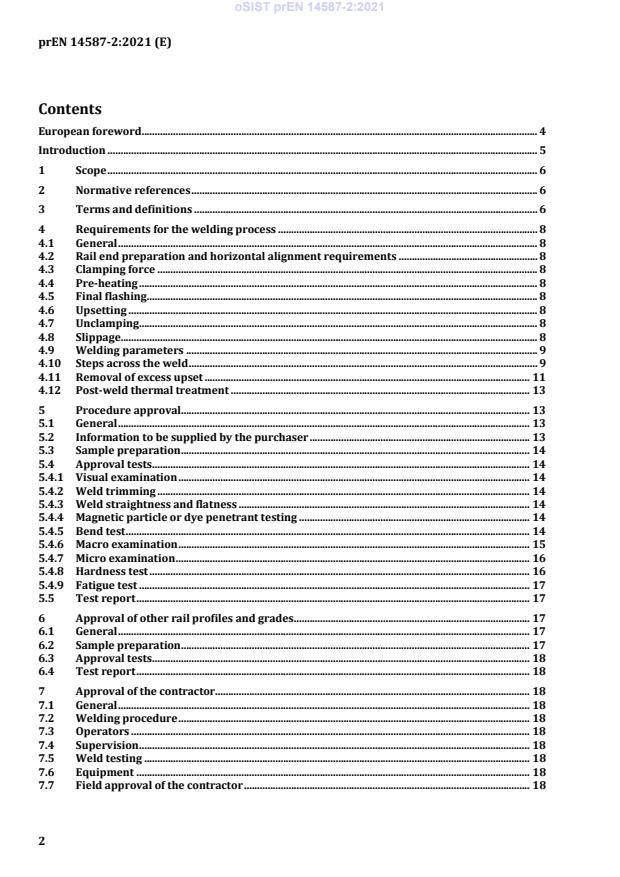
Contents
European foreword . 4
Introduction . 5
1 Scope . 6
2 Normative references . 6
3 Terms and definitions . 6
4 Requirements for the welding process . 8
4.1 General . 8
4.2 Rail end preparation and horizontal alignment requirements . 8
4.3 Clamping force . 8
4.4 Pre-heating . 8
4.5 Final flashing . 8
4.6 Upsetting . 8
4.7 Unclamping. 8
4.8 Slippage. 8
4.9 Welding parameters . 9
4.10 Steps across the weld . 9
4.11 Removal of excess upset . 11
4.12 Post-weld thermal treatment . 13
5 Procedure approval. 13
5.1 General . 13
5.2 Information to be supplied by the purchaser . 13
5.3 Sample preparation . 14
5.4 Approval tests . 14
5.4.1 Visual examination . 14
5.4.2 Weld trimming . 14
5.4.3 Weld straightness and flatness . 14
5.4.4 Magnetic particle or dye penetrant testing . 14
5.4.5 Bend test . 14
5.4.6 Macro examination . 15
5.4.7 Micro examination . 16
5.4.8 Hardness test . 16
5.4.9 Fatigue test . 17
5.5 Test report . 17
6 Approval of other rail profiles and grades . 17
6.1 General . 17
6.2 Sample preparation . 17
6.3 Approval tests . 18
6.4 Test report . 18
7 Approval of the contractor. 18
7.1 General . 18
7.2 Welding procedure . 18
7.3 Operators . 18
7.4 Supervision . 18
7.5 Weld testing . 18
7.6 Equipment . 18
7.7 Field approval of the contractor . 18
8 Weld production following procedure approval . 19
8.1 Weld production . 19
8.2 Information supplied by the purchaser . 19
8.3 Rail end preparation and horizontal rail alignment requirements . 19
8.4 Weld parameter monitoring . 19
8.5 Weld identification . 19
8.6 Visual examination . 20
8.7 Steps across the weld . 20
8.8 Finishing . 20
8.8.1 Correction of vertical and horizontal weld alignment . 20
8.8.2 Profile finishing of the rail head . 20
8.9 Weld straightness and flatness . 20
8.9.1 Alignment requirements . 20
8.9.2 Straightness and flatness measurement . 21
8.10 Bend test . 21
8.10.1 General . 21
8.10.2 Bend test procedure . 22
8.10.3 Interpretation of results . 22
8.10.4 Retesting . 23
8.11 Documentation . 23
Annex A (normative) Bend test requirements . 24
Annex B (normative) Test weld fracture faces – Recording of defects . 26
Annex C (normative) Fatigue test method for flash butt welds . 28
C.1 General . 28
C.2 Test equipment . 28
C.3 Calibration . 30
C.3.1 General . 30
C.3.2 Test piece . 30
C.4 Fatigue test method . 30
C.4.1 General . 30
C.4.2 Staircase test method . 30
C.4.3 Example of the data analysis of a fatigue strength determination by the staircase
method . 33
C.4.4 Past-the-post test method . 33
Annex D (normative) Macro examination and micro examination . 35
D.1 Macro examination . 35
D.2 Micro examination . 35
Annex E (normative) Hardness testing . 37
Annex ZA (informative) Relationship between this European Standard and the Essential
Requirements of EU Directive (EU) 2016/797 aimed to be covered . 39
Bibliography . 41
European foreword
This document (prEN 14587-2:2021) has been prepared by Technical Committee CEN/TC 256 “Railway
applications”, the secretariat of which is held by DIN.
This document is currently submitted to the CEN Enquiry.
This document will supersede EN 14587-2:2009.
This document is one of a series of three parts of the EN 14587, Railway applications – Infrastructure –
Flash butt welding of new rails. The list of parts is as follows:
— Part 1: R220, R260, R260Mn, R320Cr, R350HT, R350LHT, R370CrHT and R400HT grade rails in a fixed
plant
— Part 2: R200, R220, R260, R260Mn, R320Cr, R350HT, R350LHT, R370CrHT and R400HT grade rails by
mobile welding machines at sites other than a fixed plant
— Part 3: Welding in association with crossing construction
This document has been prepared under a standardization request addressed to CEN by the European
Commission, and it aims to support essential or other requirements of EU Directive(s) or Regulation(s).
For relationship with EU Directive(s) or Regulation(s), see informative Annex ZA, which is an integral
part of this document.
Introduction
This part of EN 14587 has five main topics:
a) requirements of a welding process;
b) procedure approval for a mobile plant;
c) approval of other rail profiles or grades;
d) approval of welding contractor;
e) weld production following approval.
This part of EN 14587 supports a European Directive that will permit the freedom of an open European
market. To enable this, it is essential that a standard is in place that satisfies the needs of the
infrastructure owners or custodians and reflects the production capabilities of the manufacturers in
technical and quality terms.
1 Scope
This document specifies requirements for the approval of a welding process by mobile plant, together
with the requirements for subsequent welding production.
It applies to new Vignole railway rails R200, R220, R260, R260Mn, R320Cr, R350HT, R350LHT,
R370CrHT and R400HT grade rails of 46 kg/m and above, as contained in EN 13674-1, welded by a flash
butt welding process by mobile plant and intended for use on railway infrastructure.
This document applies to the welding of rails into welded strings.
2 Normative references
The following documents are referred to in the text in such a way that some or all of their content
constitutes requirements of this document. For dated references, only the edition cited applies. For
undated references, the latest edition of the referenced document (including any amendments) applies.
EN 13674-1, Railway applications - Track - Rail - Part 1: Vignole railway rails 46 kg/m and above
EN ISO 3452-1, Non-destructive testing - Penetrant testing - Part 1: General principles (ISO 3452-1)
EN ISO 6507-1, Metallic materials - Vickers hardness test - Part 1: Test method (ISO 6507-1)
EN ISO 7500-1:2018, Metallic materials - Calibration and verification of static uniaxial testing machines -
Part 1: Tension/compression testing machines - Calibration and verification of the force-measuring system
(ISO 7500-1:2018)
EN ISO 17638, Non-destructive testing of welds - Magnetic particle testing (ISO 17638)
3 Terms and definitions
For the purposes of this document, the following terms and definitions apply.
ISO and IEC maintain terminological databases for use in standardization at the following addresses:
— ISO Online browsing platform: available at https://www.iso.org/obp
— IEC Electropedia: available at http://www.electropedia.org/
3.1
as-welded condition
rails that have been welded and trimmed only
3.2
contractor
company approved by a railway authority to provide staff and machinery to execute the production of
flash butt welds by mobile plant. This may include staff and machinery from within the railway authority
3.3
die burn
damage caused by localised overheating (arcing) on the surface of the rail due to poor contact between
the rail and electrode during welding
3.4
dressing
removing trimmed upset by grinding or other similar process
3.5
finished condition
welded, trimmed and rail head profile finished
3.6
flat spot
process driven discontinuity shown after the slow bend test on the weld fracture face, which has a small
lens like shape. In a vertical longitudinal section (macro) it appears elliptical in shape
3.7
lack of bond
area of incomplete fusion between the rails at the fusion line. This may appear crack like or as a line
discontinuity at the interface either on the surface after removal of the upset or in a weld macro section
3.8
profile finishing
operation by which the rail head or relevant part of the rail head at the weld is restored to rail profile.
The operation can be by grinding, milling, planing or any other suitable means
3.9
purchaser
purchaser of the welds
3.10
railway authority
either the railway regulator or the owner of the railway infrastructure or the custodian with a delegated
responsibility for a railway infrastructure
3.11
trimmed upset
metal remaining around the rail profile following the shearing process
3.12
trimming
removal of upset
3.13
upset
metal extruded around the rail profile as a result of forging
3.14
welded string
long rail comprising of a number of shorter rails welded together
3.15
welding process
part of the sequence from the selection of the rail prior to welding through to the finishing of the welded
string
4 Requirements for the welding process
4.1 General
All welding shall be carried out on a flash butt mobile welding machine using an automatic, programmed
welding sequence.
4.2 Rail end preparation and horizontal alignment requirements
The rail ends shall always be sawn or disc cut to the tolerances specified by the purchaser. Areas of
electrical contact on the rails and the machine shall be cleaned to bright metal to give a consistent and
good electrical contact at the interface.
The rail shall not be damaged by the cleaning operation or through poor electrical contact.
Rails of the same profile shall be positioned in the welding machine such that the welding interface is
central to the contact electrodes as assessed by visual or mechanical means.
Before welding, rails shall be aligned laterally to the required rail face or edge, i.e. left, or right, or to the
rail centreline.
For reasons of asymmetry rails should be welded with the brand marks on the same side throughout the
welded string.
4.3 Clamping force
Rails shall be secured in the flash butt welding machine by a clamping arrangement. The clamping force
that is exerted on the rails shall not damage in such a way that subsequent cracking in the rail is
generated, see 5.4.1.
4.4 Pre-heating
For the pre-heating, the rail ends shall progress uniformly in a reversible or a continuous process, and
perpendicular to the running surface during the whole welding cycle.
4.5 Final flashing
Once initiated the final flashing shall be continuous.
4.6 Upsetting
Upsetting shall immediately follow final flashing. Sufficient forging pressure shall be applied to ensure
that voids are closed and oxides are expelled such that they are kept to a minimum at the weld interface.
The weld interface shall extend into the upset.
4.7 Unclamping
In order to maintain the alignment, the time between completion of forging and unclamping shall be a
minimum of 4 s.
4.8 Slippage
Clamping force shall be maintained to avoid any movement between the contact dies and rails.
4.9 Welding parameters
1) The welding machine and/or management system equipment shall be capable of displaying the
following:
a) programme identification and setting details;
b) welding current;
c) upset force or pressure;
d) displacement;
e) welding time;
f) limits/range of the main welding parameters;
g) weld identification number.
2) The welding parameters shall be determined during procedural trials and, once approval has been
granted, shall not be changed, with the exception of changes concerning the environments in 4.9 4).
3) The welding parameters shall be monitored and recorded. These records shall be referenced to the
appropriate welds.
4) Due to extreme variations in seasonal temperatures, the contractor may request from the railway
authority the use of an alternative welding program. A bending test according to 5.4.5 shall be carried
out in this case.
5) The weld identification number shall be created and recorded by the machine in a chronological order
for all welds produced during approval and production processes.
4.10 Steps across the weld
— Any step between the rails across the weld in the trimmed but not dressed condition shall not exceed
those dimensions shown in Table 1.
— Checks shall be made at a position 20 mm on each side of the weld upset centreline using a 1 m
nibbed straight edge and feeler shims as shown in Figure 1. An alternative step measurement gauge
may be used as shown in Figure 2.
Table 1 — Maximum permitted steps
Maximum
permitted
Position of step on the rail
step (in
mm)
Vertically on the longitudinal centreline of the running
0,5
surface
Horizontally on the aligned face or edge 14 ± 1 mm
0,5
below the running surface
Horizontally on the edge of the rail foot 2,0
Where the step arises from the rail dimensions the rail foot tips may be dressed locally to achieve this
requirement.
Dimensions in millimetres
Key
A running surface
B nibbed straight edge
C weld upset centreline
Z detail view of the step
NOTE Step = [x-y] mm
Figure 1 — Measurement of the step with nibbed straight edge
Dimensions in millimetres
Figure 2 — Gauge for measuring the step
4.11 Removal of excess upset
a) Excess upset should be automatically trimmed. If not possible, the upset shall be removed by
grinding.
b) Removal of the excess upset shall not cause any mechanical or thermal damage to the rails.
c) The surface of the trimmed area shall be free from visible transverse cracking.
d) Removal of the excess upset shall be completed in such a manner to keep the joint in compression.
e) Any dressing of the weld following the removal of upset shall not cause damage to the rail or weld
nor reduce either to a dimension below the original rail profile.
f) The maximum thickness of the trimmed upset shall be as set out in Table 2 below and shown in
Figure 3. A suggested measurement gauge is shown in Figure 4.
Table 2 — Maximum permitted trimmed upset
Maximum
Zone Position of trimmed upset about the weld permitted upset
(in mm)
Full head profile from the lower corner on the gauge face to
A 2,5
the lower corner on the opposite face
B The fishing surface on the underside of the head 3,0
The web, including the top fillet radius and extending down
C 2,5
to the start of the bottom fillet radius
The foot, including the start of the bottom fillet radii in the
D web and extending to the foot tips and completely across the 2,0
underside of the rail foot
Where there is a difference in the rail dimensions, the trimmed upset shall be measured in relation to the
rail giving the maximum protruding surface. If the values of the trimmed upset are above the maximum
values, the trimmed upset shall be dressed locally to the required values without damaging the parent
rails.
Dimensions in millimetres
Key
A zone A – rail head
B zone B – on the underside of the rail head
C zone C – web of the rail
D zone D – foot of the rail
Figure 3 — Maximum permitted trimmed upset
Dimensions in millimetres
Key
A zone A – rail head
B zone B – on the underside of the rail head
C zone C – web of the rail
D zone D – foot of the rail
Figure 4 — Gauge for measuring upset
4.12 Post-weld thermal treatment
With the exception of R200, R220 and R260 rail grades it may be necessary to conduct a post-weld
thermal treatment. This may involve either an accelerated (forced) cooling process or additional heat
input.
5 Procedure approval
5.1 General
Procedure approval shall be carried out by testing weld samples produced in accordance with this
European Standard.
Procedure approval testing shall be carried out on the rail profile and grade specified by the purchaser,
see 5.2.
All test results and weld fracture faces shall be made available for inspection.
5.2 Information to be supplied by the purchaser
The following information shall be supplied by the purchaser:
a) the rail profile;
b) the rail grade;
c) running edge requirements and identification – left, right or centre alignment;
d) alignment class/classes, according to Table 4;
e) the type of fatigue test.
5.3 Sample preparation
For each specified rail profile and grade, five welds in the as-welded conditions shall be manufactured for
bending tests and four welds in finished conditions for the hardness testing, macro and micro
examination.
Depending on the type of fatigue test specified by the purchaser, ten additional welds in the finished
condition for the staircase test method, or three additional welds in the finished condition for the past-
the-post test method shall be manufactured to meet the test program.
5.4 Approval tests
5.4.1 Visual examination
All of the welds and rails shall be inspected visually for welding, trimming, pressing, clamping or profile
finishing imperfections. This may include tears, cavities, cracks, damage, geometrical non-conformities
and thermal damage in particular in the electrode contact areas. The examination shall include the
contact positions of the electrodes on the rails.
The weld shall be rejected and the approval shall be classed as a failure if any of the above-mentioned
features exist.
5.4.2 Weld trimming
The weld upset on all the welds in the as-welded condition shall be measured and shall conform to the
requirements in Table 2. In addition, there shall be no evidence in the upset of tearing, undercut or
damage to the adjacent rails.
Attention shall be given to the quality of trimming on the underside of the rail foot.
5.4.3 Weld straightness and flatness
All the welds submitted in the as-welded condition shall be measured to determine the step across the
weld, which shall not exceed the limits specified in 4.10.
All the welds submitted in the finished condition shall be measured, using the procedures in 8.9 to
determine the horizontal and vertical straightness, which shall meet the requirements of the purchaser
as given in 8.2 l).
5.4.4 Magnetic particle or dye penetrant testing
Following visual examination, all of the welds in the finished condition shall undergo magnetic particle
testing in accordance with EN ISO 17638 or dye penetrant testing in accordance with EN ISO 3452-1.
The profile finished area and the area of the electrode contacts shall be checked. The tested area shall be
free of cracks. If any crack is revealed the welding process shall be deemed unsuitable.
5.4.5 Bend test
Five welds in the as-welded condition having met the requirements of 5.4.1 to 5.4.3 shall be subject to
bend testing in accordance with Annex A.
Each bend test shall meet the minimum requirements as specified in Table A.1. The test can be stopped
when the mandatory values are reached. The force displacement results shall be recorded in graphical
form.
If fracture occurs the fracture surfaces shall be inspected. The details of any weld imperfection shall be
recorded in accordance with Annex B. Lack of bond shall not be permitted. Flat spots shall not be
considered to be lack of bond.
If fracture occurs remote from the weld the fracture surfaces shall be checked for the presence of die
burn, which if detected shall cause the process to fail approval. If fracture occurs within the rail (out of
the weld) for reasons other than die burn then another test weld specimen shall be substituted for testing,
only if the fracture occurs below the mandatory values.
5.4.6 Macro examination
The four welds in the finished condition shall be sectioned for macro examination in accordance with D.1
and shall conform to the following requirements.
a) The visible heat-affected zone shall be of a nominally symmetrical shape about the weld line and fall
within the widths of 45 mm maximum (Wmax) and 20 mm minimum (Wmin). The tolerance is
applicable for each individual sample.
The definition of the heat-affected zone widths is given in Figure 5.
The permissible deviation between the maximum and minimum dimensions on any of the four welds
shall not exceed 20 mm. This requirement shall be for all samples cut for heat affected zone
evaluation (the full rail depth and both foot tips).
For R320Cr rail grade the width of the HAZ shall be specified by the Railway Authority.
Key
A section at the vertical longitudinal axis of the full rail depth
B section at rail foot tip
1 fusion line
2 limit of the heat-affected zone visible on the etched samples
Figure 5 — Width of the heat-affected zone
b) There shall be no evidence of lack of bond, inclusions, cracks, shrinkage or cavities. Imperfections
that cannot be positively identified by macro examination shall be inspected by micro examination.
c) Flat spots are accepted on the fusion line provided they meet the following requirements:
— a maximum of two with a vertical dimension of 10 mm and a maximum thickness of 1 mm in the
case where the flat spot appears to be a thickening of the weld line and not a lens-like
appearance;
— a maximum of four with a vertical dimension of 10 mm and a maximum thickness of 1 mm in the
case where a flat spot appears to be a lens.
d) There shall be no embrittlement due to welding, cooling or finishing.
5.4.7 Micro examination
Following the completion of the macro examination, a micro examination shall be carried out on two of
the four welds in accordance with D.2. There shall be no evidence of martensite or bainite at
100 × magnification in the visible heat-affected zone.
5.4.8 Hardness test
5.4.8.1 General
The remaining two of the four full rail depth longitudinal vertical sections taken for macro and micro
examination shall be subjected to hardness testing which shall be carried out in accordance with Annex E.
5.4.8.2 Rail grades R200, R220, R260 and R260Mn
For the grades R200, R220, R260 and R260Mn, the minimum and maximum hardness values obtained
shall conform to the following requirements:
a) minimum hardness shall not be less than P - 30 HV
b) maximum hardness shall not exceed P + 60 HV
where:
P is the average hardness of the parent rail as measured in the hardness traverse
An isolated hardness value falling outside of the stated minima and maxima above is permitted when
such a hardness value falls between the two adjacent values that conform to the requirements.
5.4.8.3 Rail grades R320Cr, R350HT, R350LHT, R370CrHT and R400HT
For the rail grades R320Cr, R350HT, R350LHT, R370CrHT and R400HT the minimum and maximum
hardness values obtained within 8 mm each side from the weld line shall conform to the requirements
stated in Table 3.
An isolated hardness value falling outside of the stated minima and maxima is permitted only when found
at the weld centre line.
Table 3 — Minimum and maximum hardness requirements for individual rail steel grades
Hardness
R320Cr R350HT R350LHT R370CrHT R400HT
HV30
Min 290 325 325 350 350
Max 380 410 410 425 440
5.4.9 Fatigue test
The fatigue test, if required by the railway authority, shall be carried out in accordance with Annex C and
to the requirements of the purchaser as specified in 5.2 f).
Depending on the type of fatigue test specified by the purchaser, ten welds in the finished condition shall
be produced for the staircase test method, or three welds in the finished condition shall be produced for
the past-the-post test method.
5.5 Test report
A report, which contains the results, shall include a record of the following:
a) welding machine identity/serial number;
b) rail grade and profile;
c) weld parameter settings and graphs according to 4.9;
d) graphical bend test chart to include force, displacement and sample identification;
e) fracture face photographs (one per sample) of all broken welds;
f) rail profile record grid shown in Annex B;
g) macro and micro examinations including photographs of the sectioned welds;
h) hardness distribution in graphical form including hardness and distance values;
i) Weld identification number.
6 Approval of other rail profiles and grades
6.1 General
Following the procedure approval according to Clause 5 with a particular rail profile, grade and welding
program, other rail profiles and the other rail grades, as contained in EN 13674-1, shall be undertaken
for approval as and when required.
Similarly the other rail grades permitted by this European Standard shall be qualified for approval as and
when required.
6.2 Sample preparation
For each rail profile or grade, five welds shall be submitted for bending tests in the as-welded condition
and four in the finished condition for hardness testing, macro and micro examination.
6.3 Approval tests
All of the welds shall be subjected to approval testing and shall fulfil the requirements of 5.4, with the
exception of the fatigue test 5.4.9, which is not mandatory.
6.4 Test report
A report in accordance with 5.5 shall be produced.
7 Approval of the contractor
7.1 General
The contractor shall meet the approval requirements as defined in 7.2 to 7.6. The purchaser reserves the
right to audit the contractor at any time.
The contractor shall operate a quality system approved by the relevant purchaser. The quality system
shall contain a system of traceability for all welds produced.
7.2 Welding procedure
The contractor shall only use approved welding procedures.
7.3 Operators
The contractor shall maintain a system that ensures the competence of their welding operators by
appropriate training and assessment.
7.4 Supervision
The contractor shall maintain a management and supervision system of flash butt welding that complies
with the requirements of the purchaser.
7.5 Weld testing
The contractor shall maintain a system of weld testing according to the purchaser requirements. Non-
conformances found during these tests shall be recorded in the traceability system.
7.6 Equipment
Welding equipment shall comply with the operating manual and record any component replacements in
a maintenance register. Test and calibration equipment shall comply with those requirements as agreed
between the contractor and the purchaser.
7.7 Field approval of the contractor
The purchaser shall specify if a trial approval of the contractor is required after execution of welds
installed into track. For example; a total of thirty welds carried out over two separate shifts.
8 Weld production following procedure approval
8.1 Weld production
Following procedure approval, weld production may commence on those rail profiles and grades
approved.
Weld production shall be carried out in accordance with the requirements of this European Standard.
8.2 Information supplied by the purchaser
The following information shall be supplied by the purchaser, agreed with the contractor and shall be
fully documented:
a) the rail profile;
b) the rail grade;
c) minimum length of rail selected for welding and maximum number of short rails per string;
d) maximum length of the welded string and tolerance;
e) offloading requirements – offloading holes or blind ends;
f) rail end squareness;
g) running edge requirements and identification – left, right or centre alignment;
h) weld identification, see 8.5;
i) welded string identification;
j) weld straightness and flatness, see Table 4;
k) traceability system of the welds.
8.3 Rail end preparation and horizontal rail alignment requirements
Refer to 4.2.
8.4 Weld parameter monitoring
Automatic monitoring and recording of the weld parameters shall be required for all welds.
The welding programme shall be as those for which approval was granted.
The records shall be analysed in accordance with the requirements of this European Standard and shall
be retained for not less than five years.
8.5 Weld identification
a) The weld shall be marked by such a means that it can be identified in situ or otherwise for a minimum
of 5 years. The method is to be agreed between the purchaser and contractor.
b) The means of weld identification shall permit traceability to the records and information obtained at
the time of production.
8.6 Visual examination
All welds shall be visually examined for compliance with this European Standard.
8.7 Steps across the weld
A weld with a step exceeding the maximum dimensions shall be removed from the welded string. The
weld shall be removed by cutting at a minimum distance of 100 mm on each side of the weld.
8.8 Finishing
8.8.1 Correction of vertical and horizontal weld alignment
The correction of the weld alignment shall be carried out by pressing. Any pressing operation shall not
be carried out when the rail temperature exceeds 200°C.
8.8.2 Profile finishing of the rail head
a) The profile fini
...