

SIST-TS CEN/TS 17770:2023
(Main)Organic and organo-mineral fertilizers - Determination of the total content of specific elements by ICP-AES after digestion by aqua regia
General Information
- Abstract
This document specifies a method for the determination of elements in organic fertilizers and organo-mineral fertilizers digests using inductively coupled plasma-atomic emission spectrometry (ICP-AES).
NOTE Alternatively, inductively coupled plasma mass spectrometry (ICP-MS) can be used for the measurement if the user proves that the method gives the same results.
This method is applicable to aqua regia digests prepared according to CEN/TS 17768 for the determination of P, K, Ca, Mg, Na, S, B, Co, Cu, Fe, Mn, Mo, Zn, As, Cd, Cr, Ni, Pb by ICP-AES. The method can be used for the determination of other elements, provided the user has verified the applicability.
- Status
- Published
- Public Enquiry End Date
- 02-Jan-2022
- Publication Date
- 09-Jan-2023
- Technical Committee
- KAT - Soil quality
- Current Stage
- 6060 - National Implementation/Publication (Adopted Project)
- Start Date
- 06-Jan-2023
- Due Date
- 13-Mar-2023
- Completion Date
- 10-Jan-2023



Overview
SIST-TS CEN/TS 17770:2023 is a technical specification developed by the European Committee for Standardization (CEN) for analyzing organic and organo-mineral fertilizers. This standard outlines a precise analytical method to determine the total content of specific elements in fertilizer samples by using inductively coupled plasma-atomic emission spectrometry (ICP-AES) after digestion with aqua regia. Alternatively, inductively coupled plasma mass spectrometry (ICP-MS) may be used if equivalent results are demonstrated. The document supports accurate compositional analysis vital for fertilizer quality control and regulatory compliance.
Key Topics
- Scope and Purpose: Defines a method to quantify elements such as phosphorus (P), potassium (K), calcium (Ca), magnesium (Mg), sodium (Na), sulfur (S), boron (B), cobalt (Co), copper (Cu), iron (Fe), manganese (Mn), molybdenum (Mo), zinc (Zn), arsenic (As), cadmium (Cd), chromium (Cr), nickel (Ni), and lead (Pb) in organic and organo-mineral fertilizers. The method is applicable to aqua regia digests prepared according to CEN/TS 17768.
- Analytical Principle: Utilizes ICP-AES technology to excite atoms/ions in a high-temperature argon plasma, generating specific emission spectra detected and quantified by photosensitive devices. The procedure allows multi-element analysis in a single run with options for axial or radial viewing.
- Interference Management: Addresses spectral, transport, excitation, chemical, and memory interferences critical to ensure accurate measurements. Effective strategies include background correction, matrix matching, dilution, internal standards, and optimized plasma operating conditions.
- Sample Preparation and Calibration: Specifies digestion of samples with aqua regia, preparation of test and blank solutions, and calibration using certified standard solutions. Calibration ranges are carefully defined for target elements for quantitative reliability.
- Reagents and Apparatus: Recommends using analytical grade reagents including nitric and hydrochloric acids to prepare aqua regia; requires an ICP-AES instrument equipped with a nebulizer, spray chamber, and spectrometer. Purity of argon gas and proper labware are emphasized for method integrity.
Applications
- Fertilizer Quality Control: Ensures fertilizers meet specified element content for agronomic performance and environmental safety.
- Regulatory Compliance: Enables manufacturers and regulators to verify the composition of organic and organo-mineral fertilizers under European standards.
- Research and Development: Facilitates precise elemental analysis for product development, formulation adjustments, and trace element monitoring.
- Environmental Monitoring: Helps assess potential contaminants such as heavy metals in fertilizers, supporting sustainable agricultural practices.
Related Standards
- CEN/TS 17768: Provides the standardized aqua regia digestion procedure complementary to this analysis technique.
- EN ISO 11885:2009: Details ICP-OES methods for water quality, whose principles align with ICP-AES elemental detection in fertilizers.
- Other Fertilizer Testing Standards: Standards addressing additional fertilizer properties may be used in conjunction to provide a comprehensive quality profile.
This SIST-TS CEN/TS 17770:2023 specification plays a crucial role in harmonizing analytical approaches within Europe for fertilizer testing, supporting consistent data quality and aiding the agriculture sector in optimizing fertilizer use and safety.
Relations
- Effective Date
- 28-Jan-2026
- Effective Date
- 28-Jan-2026
- Effective Date
- 01-Mar-2026
Get Certified
Connect with accredited certification bodies for this standard

Control Union Certifications
Global certification for agriculture and sustainability.

ECOCERT
Organic and sustainability certification.

FSC International
Forest Stewardship Council certification.
Sponsored listings
Frequently Asked Questions
SIST-TS CEN/TS 17770:2023 is a technical specification published by the Slovenian Institute for Standardization (SIST). Its full title is "Organic and organo-mineral fertilizers - Determination of the total content of specific elements by ICP-AES after digestion by aqua regia". This standard covers: This document specifies a method for the determination of elements in organic fertilizers and organo-mineral fertilizers digests using inductively coupled plasma-atomic emission spectrometry (ICP-AES). NOTE Alternatively, inductively coupled plasma mass spectrometry (ICP-MS) can be used for the measurement if the user proves that the method gives the same results. This method is applicable to aqua regia digests prepared according to CEN/TS 17768 for the determination of P, K, Ca, Mg, Na, S, B, Co, Cu, Fe, Mn, Mo, Zn, As, Cd, Cr, Ni, Pb by ICP-AES. The method can be used for the determination of other elements, provided the user has verified the applicability.
This document specifies a method for the determination of elements in organic fertilizers and organo-mineral fertilizers digests using inductively coupled plasma-atomic emission spectrometry (ICP-AES). NOTE Alternatively, inductively coupled plasma mass spectrometry (ICP-MS) can be used for the measurement if the user proves that the method gives the same results. This method is applicable to aqua regia digests prepared according to CEN/TS 17768 for the determination of P, K, Ca, Mg, Na, S, B, Co, Cu, Fe, Mn, Mo, Zn, As, Cd, Cr, Ni, Pb by ICP-AES. The method can be used for the determination of other elements, provided the user has verified the applicability.
SIST-TS CEN/TS 17770:2023 is classified under the following ICS (International Classification for Standards) categories: 65.080 - Fertilizers. The ICS classification helps identify the subject area and facilitates finding related standards.
SIST-TS CEN/TS 17770:2023 has the following relationships with other standards: It is inter standard links to SIST EN ISO 11885:2009, SIST-TS CEN/TS 17777:2023, oSIST prEN 17770:2026. Understanding these relationships helps ensure you are using the most current and applicable version of the standard.
SIST-TS CEN/TS 17770:2023 is associated with the following European legislation: EU Directives/Regulations: 2019/1009; Standardization Mandates: M/564. When a standard is cited in the Official Journal of the European Union, products manufactured in conformity with it benefit from a presumption of conformity with the essential requirements of the corresponding EU directive or regulation.
SIST-TS CEN/TS 17770:2023 is available in PDF format for immediate download after purchase. The document can be added to your cart and obtained through the secure checkout process. Digital delivery ensures instant access to the complete standard document.
Standards Content (Sample)
SLOVENSKI STANDARD
01-februar-2023
Organska in organsko-mineralna gnojila - Določanje celotne vsebnosti specifičnih
elementov z atomsko emisijsko spektrometrijo z induktivno sklopljeno plazmo
(ICP-AES) po razklopu z zlatotopko
Organic and organo-mineral fertilizers - Determination of the total content of specific
elements by ICP-AES after digestion by aqua regia
Organische und organisch-mineralische Düngemittel - Bestimmung des Gesamtgehaltes
spezifischer Elemente durch ICP-AES nach Aufschluss durch Königswasser
Engrais organiques et organo-minéraux - Détermination de la teneur totale en éléments
spécifiques par ICP-AES après digestion à l’eau régale
Ta slovenski standard je istoveten z: CEN/TS 17770:2022
ICS:
65.080 Gnojila Fertilizers
2003-01.Slovenski inštitut za standardizacijo. Razmnoževanje celote ali delov tega standarda ni dovoljeno.
CEN/TS 17770
TECHNICAL SPECIFICATION
SPÉCIFICATION TECHNIQUE
April 2022
TECHNISCHE SPEZIFIKATION
ICS 65.080
English Version
Organic and organo-mineral fertilizers - Determination of
the total content of specific elements by ICP-AES after
digestion by aqua regia
Engrais organiques et organo-minéraux - Organische und organisch-mineralische Düngemittel -
Détermination de la teneur totale en éléments Bestimmung des Gesamtgehaltes spezifischer
spécifiques par ICP-AES après digestion à l'eau régale Elemente durch ICP-AES nach Aufschluss durch
Königswasser
This Technical Specification (CEN/TS) was approved by CEN on 13 March 2022 for provisional application.
The period of validity of this CEN/TS is limited initially to three years. After two years the members of CEN will be requested to
submit their comments, particularly on the question whether the CEN/TS can be converted into a European Standard.
CEN members are required to announce the existence of this CEN/TS in the same way as for an EN and to make the CEN/TS
available promptly at national level in an appropriate form. It is permissible to keep conflicting national standards in force (in
parallel to the CEN/TS) until the final decision about the possible conversion of the CEN/TS into an EN is reached.
CEN members are the national standards bodies of Austria, Belgium, Bulgaria, Croatia, Cyprus, Czech Republic, Denmark, Estonia,
Finland, France, Germany, Greece, Hungary, Iceland, Ireland, Italy, Latvia, Lithuania, Luxembourg, Malta, Netherlands, Norway,
Poland, Portugal, Republic of North Macedonia, Romania, Serbia, Slovakia, Slovenia, Spain, Sweden, Switzerland, Turkey and
United Kingdom.
EUROPEAN COMMITTEE FOR STANDARDIZATION
COMITÉ EUROPÉEN DE NORMALISATION
EUROPÄISCHES KOMITEE FÜR NORMUNG
CEN-CENELEC Management Centre: Rue de la Science 23, B-1040 Brussels
© 2022 CEN All rights of exploitation in any form and by any means reserved Ref. No. CEN/TS 17770:2022 E
worldwide for CEN national Members.
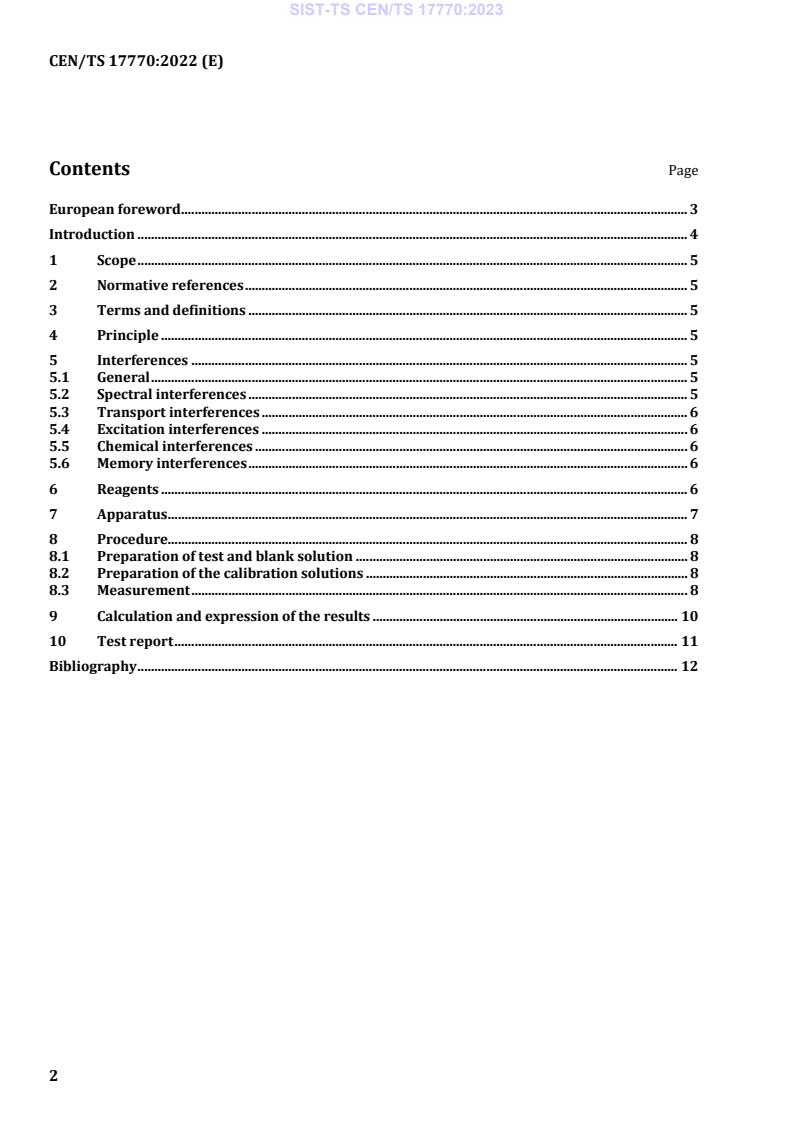
Contents Page
European foreword . 3
Introduction . 4
1 Scope . 5
2 Normative references . 5
3 Terms and definitions . 5
4 Principle . 5
5 Interferences . 5
5.1 General . 5
5.2 Spectral interferences . 5
5.3 Transport interferences . 6
5.4 Excitation interferences . 6
5.5 Chemical interferences . 6
5.6 Memory interferences . 6
6 Reagents . 6
7 Apparatus . 7
8 Procedure. 8
8.1 Preparation of test and blank solution . 8
8.2 Preparation of the calibration solutions . 8
8.3 Measurement . 8
9 Calculation and expression of the results . 10
10 Test report . 11
Bibliography . 12
European foreword
This document (CEN/TS 17770:2022) has been prepared by Technical Committee CEN/TC 260
“Fertilizers and liming materials”, the secretariat of which is held by DIN.
Attention is drawn to the possibility that some of the elements of this document may be the subject of
patent rights. CEN shall not be held responsible for identifying any or all such patent rights.
This document has been prepared under a Standardization Request given to CEN by the European
Commission and the European Free Trade Association.
Any feedback and questions on this document should be directed to the users’ national standards body.
A complete listing of these bodies can be found on the CEN website.
According to the CEN/CENELEC Internal Regulations, the national standards organisations of the
following countries are bound to announce this Technical Specification: Austria, Belgium, Bulgaria,
Croatia, Cyprus, Czech Republic, Denmark, Estonia, Finland, France, Germany, Greece, Hungary, Iceland,
Ireland, Italy, Latvia, Lithuania, Luxembourg, Malta, Netherlands, Norway, Poland, Portugal, Republic of
North Macedonia, Romania, Serbia, Slovakia, Slovenia, Spain, Sweden, Switzerland, Turkey and the United
Kingdom.
Introduction
This document is part of a modular approach and concerns the analytical measurement step. “Modular”
means that a test standard concerns a specific step in assessing a property and not the whole chain of
measurements. Inductively coupled plasma atomic emission spectrometry (ICP-AES) is nowadays widely
used and a well-established method in many laboratories.
1 Scope
This document specifies a method for the determination of elements in organic fertilizers and organo-
mineral fertilizers digests using inductively coupled plasma-atomic emission spectrometry (ICP-AES).
NOTE Alternatively, inductively coupled plasma mass spectrometry (ICP-MS) can be used for the measurement
if the user proves that the method gives the same results.
This method is applicable to aqua regia digests prepared according to CEN/TS 17768 for the
determination of P, K, Ca, Mg, Na, S, B, Co, Cu, Fe, Mn, Mo, Zn, As, Cd, Cr, Ni, Pb by ICP-AES. The method
can be used for the determination of other elements, provided the user has verified the applicability.
2 Normative references
The following documents are referred to in the text in such a way that some or all of their content
constitutes requirements of this document. For dated references, only the edition cited applies. For
undated references, the latest edition of the referenced document (including any amendments) applies.
EN ISO 11885:2009, Water quality — Determination of selected elements by inductively coupled plasma
optical emission spectrometry (ICP-OES) (ISO 11885:2007)
3 Terms and definitions
No terms and definitions are listed in this document.
ISO and IEC maintain terminological databases for use in standardization at the following addresses:
— IEC Electropedia: available at https://www.electropedia.org/
— ISO Online browsing platform: available at https://www.iso.org/obp
4 Principle
The method is based on the inductively coupled plasma atomic emission spectrometry (ICP-AES)
measurement of the concentration of elements in organic fertilizers and organo-mineral fertilizers in
aqua regia digests. The elements are determined after an appropriate dilution of the digest, if necessary.
The solution is dispersed by a suitable nebulizer of the ICP-AES instrument and the resulting aerosol is
transported into the plasma torch. Element specific emission spectra are produced by a radiofrequency
inductively coupled argon plasma where atoms or ions are excited at high temperature. The emission
spectra are dispersed by a spectrometer, and the intensities of the emission lines are monitored by
photosensitive devices. Multi-element determinations using sequential or simultaneous optical systems
and axial, radial or dual viewing of the plasma may be used.
5 Interferences
5.1 General
Interferences and matrix effects shall be recognized and appropriate measures to minimize them shall be
made. There are several types of interferences, see 5.2 to 5.6.
5.2 Spectral interferences
Spectral interferences are due to incomplete isolation of the radiation emitted by the analyte from other
detected radiation sources. Spectral interferences are caused by the background emission from
continuous or recombination phenomena, by stray light which causes background increase or overlap of
a spectral line from another element, or by the unresolved overlap of molecular band spectra. Background
emission and stray light can usually be compensated for by subtracting the background emission
measured adjacent to the analyte wavelength peak. To correct a sloping background shift background
correction points on each side of the peak are used. The increase of background is more intensive with
axial-view instruments. Background correction is not required in cases of line broadening where a
background correction measurement would actually degrade the analytical result. A spectral line overlap
usually leads to the choice of an alternative line. If this is not possible, mathematical correction
procedures (e.g. inter-element correction technique or multi-component spectral fitting) can be used to
compensate for the interference. These correction procedures are usually a part of the instrument
software.
5.3 Transport interferences
Transport interferences are caused by differences in the properties between the sample solutions and
the calibration solutions (viscosity, surface tension, density, dissolved solid content, type and
concentration of acids). As a consequence, the supply of solution to the nebuliser, the efficiency of
nebulisation and the droplet size distribution of the aerosol is altered, resulting in a change of sensitivity.
Errors due to these interferences can be overcome by dilution of the solutions, by matrix matching, by
standard addition or by internal standard.
5.4 Excitation interferences
Excitation interferences are attributed to a change in the excitation conditions in the plasma, especially
by the presence of easily ionisable elements. The interference depends on the operating conditions of the
plasma (e.g. power, sample introduction, gas flowrate or observation height) and differ from element to
element. Improvement of the plasma conditions can therefore reduce excitation interferences. Other
possibilities are dilution of the solutions, matrix matching or the standard addition technique.
5.5 Chemical interferences
Chemical interferences are not significant with the ICP-AES technique, but if observed, they can be
minimized by a careful selection of operating conditions (e.g. radio frequency power, observation
position, gas flow rate and so forth).
5.6 Memory interferences
Memory interferences result when analytes in a previous sample contribute to the signals measured in a
new sample. This type of interference can be caused by sample deposits or the accumulation in pump
tubing, nebulizer, spray chamber or plasma torch. The possibility of memory interferences should b
...