

SIST EN ISO 3166-1:2020
(Main)Codes for the representation of names of countries and their subdivisions - Part 1: Country code (ISO 3166-1:2020)
General Information
- Abstract
This document specifies basic guidelines for the implementation and maintenance of country codes.
This code is intended for use in any application requiring the expression of current country names in coded form.
- Status
- Published
- Public Enquiry End Date
- 20-Oct-2019
- Publication Date
- 29-Oct-2020
- Technical Committee
- IDT - Information, documentation, language and terminology
- Current Stage
- 6100 - Translation of adopted SIST standards (Adopted Project)
- Start Date
- 09-Nov-2023
- Due Date
- 07-Nov-2024
- Completion Date
- 27-Oct-2025
Buy Documents

Overview
EN ISO 3166-1:2020 (ISO 3166-1:2020) is the international standard that defines codes for the representation of names of countries and their subdivisions - Part 1: Country code. Published by CEN and ISO, this fourth edition specifies the principles, structure and maintenance of country code elements intended for “any application requiring the expression of current country names in coded form.” The 2020 edition modernizes the standard by moving codes to a database format, standardizing character encoding (UTF-8 / ISO/IEC 10646), and making the status of each alpha-2 code explicit.
Key Topics
- Code types: definitions and rules for alpha-2, alpha-3, numeric (num-3) and an alternate num-4 algorithmic representation.
- Principles for inclusion: criteria and sources for listing country names, handling overlaps and current status of names.
- Code element formation: construction rules and the relationship between name and code elements.
- Database-based maintenance: ISO 3166 Maintenance Agency (ISO 3166/MA) processes for additions, deletions, alterations and reservations of code elements.
- Status and reservation: explicit status indicators for alpha-2 codes, periods for reservation and non-assignment, and exception reservations.
- User guidance: special provisions, aggregations, user-assigned codes and practical advice for implementers.
- Technical annexes: algorithm for numerical representations, conversion matrices, mappings to UN numeric codes and lists of language codes used in the standard.
- Character set and encoding: verification of diacritical characters against ISO/IEC 10646 and consistent use of UTF-8.
Applications
This country code standard is widely used wherever standardized, unambiguous country identifiers are required. Typical practical applications include:
- Databases and data exchange: consistent country coding in international datasets and APIs.
- Administrative and commercial systems: forms, shipping, customs and cross-border transactions.
- Information systems and documentation: reporting, statistics and archival records that require stable country identifiers.
- Software development and localization: internationalized applications that reference country names and codes.
Primary users: standards bodies, government agencies, customs and trade organizations, statisticians, database administrators, software developers, and enterprises involved in international commerce.
Related Standards
- ISO 3166 series (other parts covering subdivisions and code lists)
- ISO 639 (language codes referenced in Annex D)
- ISO/IEC 10646 (Universal Coded Character Set) - character verification and UTF-8 encoding guidance
EN ISO 3166-1:2020 is essential for reliable international interoperability where authoritative, maintained country codes are required.
Relations
- Effective Date
- 01-Dec-2020
- Effective Date
- 10-Feb-2026
- Effective Date
- 10-Feb-2026
- Referred By
SIST EN 62571:2011 - Digital audiobook file format and player requirements (IEC 62571:2011) - Effective Date
- 09-Feb-2026
- Effective Date
- 09-Feb-2026
- Effective Date
- 09-Feb-2026
- Effective Date
- 09-Feb-2026
- Effective Date
- 09-Feb-2026
- Effective Date
- 09-Feb-2026
- Effective Date
- 09-Feb-2026
- Effective Date
- 09-Feb-2026
- Effective Date
- 09-Feb-2026
- Effective Date
- 28-Jan-2026
- Effective Date
- 28-Jan-2026
- Effective Date
- 28-Jan-2026
Buy Documents
Related Packages

Frequently Asked Questions
SIST EN ISO 3166-1:2020 is a standard published by the Slovenian Institute for Standardization (SIST). Its full title is "Codes for the representation of names of countries and their subdivisions - Part 1: Country code (ISO 3166-1:2020)". This standard covers: This document specifies basic guidelines for the implementation and maintenance of country codes. This code is intended for use in any application requiring the expression of current country names in coded form.
This document specifies basic guidelines for the implementation and maintenance of country codes. This code is intended for use in any application requiring the expression of current country names in coded form.
SIST EN ISO 3166-1:2020 is classified under the following ICS (International Classification for Standards) categories: 01.140.20 - Information sciences; 01.140.30 - Documents in administration, commerce and industry. The ICS classification helps identify the subject area and facilitates finding related standards.
SIST EN ISO 3166-1:2020 has the following relationships with other standards: It is inter standard links to SIST EN ISO 3166-1:2014, SIST EN 60243-3:2014, SIST EN 50465:2015, SIST EN 62571:2011, SIST EN 61804-3:2011, SIST EN 62455:2011, SIST EN 61400-25-2:2016, SIST EN 61360-1:2018, SIST EN 61360-1:2010, SIST EN 62448:2014, SIST EN 61360-2:2013, SIST EN IEC 61804-3:2020, SIST EN 14829:2008, SIST EN 10253-4:2008, SIST EN 10253-2:2021. Understanding these relationships helps ensure you are using the most current and applicable version of the standard.
SIST EN ISO 3166-1:2020 is associated with the following European legislation: EU Directives/Regulations: 2014-01-3644, 2018-01-1387, 2022-01-1196, TP162, TP186. When a standard is cited in the Official Journal of the European Union, products manufactured in conformity with it benefit from a presumption of conformity with the essential requirements of the corresponding EU directive or regulation.
SIST EN ISO 3166-1:2020 is available in PDF format for immediate download after purchase. The document can be added to your cart and obtained through the secure checkout process. Digital delivery ensures instant access to the complete standard document.
Standards Content (Sample)
SLOVENSKI STANDARD
01-december-2020
Nadomešča:
SIST EN ISO 3166-1:2014
Kode za predstavljanje imen držav in njihovih podrejenih enot - 1. del: Kode držav
(ISO 3166-1:2020)
Codes for the representation of names of countries and their subdivisions - Part 1:
Country code (ISO 3166-1:2020)
Codes für die Namen von Ländern und deren Untereinheiten - Teil 1: Codes für
Ländernamen (ISO 3166-1:2020)
Codes pour la représentation des noms de pays et de leurs subdivisions - Partie 1:
Codes de pays (ISO 3166-1:2020)
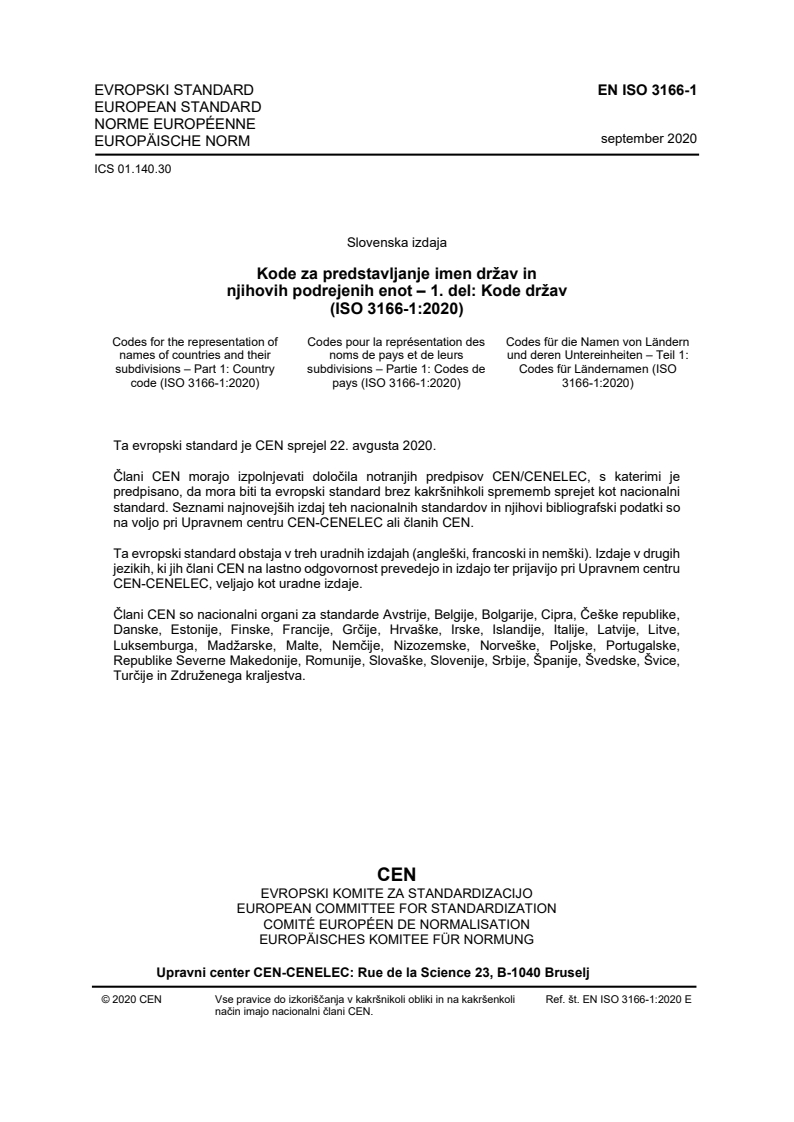
Ta slovenski standard je istoveten z: EN ISO 3166-1:2020
ICS:
01.140.20 Informacijske vede Information sciences
01.140.30 Dokumenti v upravi, trgovini Documents in administration,
in industriji. commerce and industry
2003-01.Slovenski inštitut za standardizacijo. Razmnoževanje celote ali delov tega standarda ni dovoljeno.
EN ISO 3166-1
EUROPEAN STANDARD
NORME EUROPÉENNE
September 2020
EUROPÄISCHE NORM
ICS 01.140.30 Supersedes EN ISO 3166-1:2014
English Version
Codes for the representation of names of countries and
their subdivisions - Part 1: Country code (ISO 3166-
1:2020)
Codes pour la représentation des noms de pays et de Codes für die Namen von Ländern und deren
leurs subdivisions - Partie 1: Codes de pays (ISO 3166- Untereinheiten - Teil 1: Codes für Ländernamen (ISO
1:2020) 3166-1:2020)
This European Standard was approved by CEN on 22 August 2020.
CEN members are bound to comply with the CEN/CENELEC Internal Regulations which stipulate the conditions for giving this
European Standard the status of a national standard without any alteration. Up-to-date lists and bibliographical references
concerning such national standards may be obtained on application to the CEN-CENELEC Management Centre or to any CEN
member.
This European Standard exists in three official versions (English, French, German). A version in any other language made by
translation under the responsibility of a CEN member into its own language and notified to the CEN-CENELEC Management
Centre has the same status as the official versions.
CEN members are the national standards bodies of Austria, Belgium, Bulgaria, Croatia, Cyprus, Czech Republic, Denmark, Estonia,
Finland, France, Germany, Greece, Hungary, Iceland, Ireland, Italy, Latvia, Lithuania, Luxembourg, Malta, Netherlands, Norway,
Poland, Portugal, Republic of North Macedonia, Romania, Serbia, Slovakia, Slovenia, Spain, Sweden, Switzerland, Turkey and
United Kingdom.
EUROPEAN COMMITTEE FOR STANDARDIZATION
COMITÉ EUROPÉEN DE NORMALISATION
EUROPÄISCHES KOMITEE FÜR NORMUNG
CEN-CENELEC Management Centre: Rue de la Science 23, B-1040 Brussels
© 2020 CEN All rights of exploitation in any form and by any means reserved Ref. No. EN ISO 3166-1:2020 E
worldwide for CEN national Members.
Contents Page
European foreword . 3
European foreword
This document (EN ISO 3166-1:2020) has been prepared by Technical Committee ISO/TC 46
"Information and documentation" in collaboration with Technical Committee CEN/SS F17
“Administrative documents” the secretariat of which is held by CCMC.
This European Standard shall be given the status of a national standard, either by publication of an
identical text or by endorsement, at the latest by March 2021, and conflicting national standards shall
be withdrawn at the latest by March 2021.
Attention is drawn to the possibility that some of the elements of this document may be the subject of
patent rights. CEN shall not be held responsible for identifying any or all such patent rights.
This document supersedes EN ISO 3166-1:2014.
According to the CEN-CENELEC Internal Regulations, the national standards organizations of the
following countries are bound to implement this European Standard: Austria, Belgium, Bulgaria,
Croatia, Cyprus, Czech Republic, Denmark, Estonia, Finland, France, Germany, Greece, Hungary, Iceland,
Ireland, Italy, Latvia, Lithuania, Luxembourg, Malta, Netherlands, Norway, Poland, Portugal, Republic of
North Macedonia, Romania, Serbia, Slovakia, Slovenia, Spain, Sweden, Switzerland, Turkey and the
United Kingdom.
Endorsement notice
The text of ISO 3166-1:2020 has been approved by CEN as EN ISO 3166-1:2020 without any
modification.
INTERNATIONAL ISO
STANDARD 3166-1
Fourth edition
2020-08
Codes for the representation of names
of countries and their subdivisions —
Part 1:
Country code
Codes pour la représentation des noms de pays et de leurs
subdivisions —
Partie 1: Codes de pays
Reference number
ISO 3166-1:2020(E)
©
ISO 2020
ISO 3166-1:2020(E)
© ISO 2020
All rights reserved. Unless otherwise specified, or required in the context of its implementation, no part of this publication may
be reproduced or utilized otherwise in any form or by any means, electronic or mechanical, including photocopying, or posting
on the internet or an intranet, without prior written permission. Permission can be requested from either ISO at the address
below or ISO’s member body in the country of the requester.
ISO copyright office
CP 401 • Ch. de Blandonnet 8
CH-1214 Vernier, Geneva
Phone: +41 22 749 01 11
Email: copyright@iso.org
Website: www.iso.org
Published in Switzerland
ii © ISO 2020 – All rights reserved
ISO 3166-1:2020(E)
Contents Page
Foreword .v
Introduction .vi
1 Scope . 1
2 Normative references . 1
3 Terms and definitions . 1
4 Principles for inclusion in the list of country names . 4
4.1 List . 4
4.2 Source of names . 4
4.3 Overlaps . 5
4.4 Current status of names . 5
4.5 Independent countries . 5
5 Principles for assigning code elements . 5
5.1 Code element formation . 5
5.2 Relationship with names . 5
5.3 Construction of the alpha-2 code . 5
5.4 Construction of the alpha-3 code . 6
5.5 Construction of the num-3 code . 6
5.6 Alternate algorithmic construction of the numeric code num-4 . 6
6 List of country names and their code elements . 6
6.1 Specification for use . 6
6.2 Content of the list . 7
6.3 Choice of language, romanization, character set . 7
7 Maintenance . 8
7.1 Maintenance Agency (ISO 3166/MA) . 8
7.2 Standard as a database — Change of paradigm . 8
7.3 Addition to the list of country names . 8
7.4 Deletion from the list of country names . 9
7.5 Alterations to country name or code element . 9
7.6 Reservation of country code elements . 9
7.6.1 Overview . 9
7.6.2 Period of non-assignment . 9
7.6.3 Period of non-use . 9
7.6.4 Exceptionally reserved code elements. 9
7.6.5 List of reserved code elements .10
8 Guidelines for users .10
8.1 Special provisions .10
8.2 Aggregations .10
8.3 User assigned code element .10
8.4 Advice regarding use of country code elements .10
Annex A (informative) Algorithm for numerical representation, num-4, of ISO 3166 alpha-2
country code elements .11
Annex B (informative) Conversion matrix for the numerical representation of ISO 3166
alpha-2 country code elements .12
Annex C (informative) Conversion table from alpha-2 country codes elements of ISO 3166
standard to num-3 code element of the UNSD .14
Annex D (informative) List of ISO 639 language codes, alpha-2 and alpha-3, used in
the ISO 3166 standard of country codes .16
ISO 3166-1:2020(E)
Annex E (normative) Alphabetical index of names from the list of country codes appearing
in the remarks, corresponding to "territory names", or forming the second
significant part of composite country names .20
Annex F (informative) Principles for minor modification to the short form of country name
received from UNTERM, allowing for display in alphabetic order .25
Annex G (informative) Source of names — Procedures concerning official full country
names at UNTERM, confirmed by UNTERM to ISO 3166/MA on 2019-03-07 .27
Annex H (normative) OBP Labels .28
Bibliography .30
iv © ISO 2020 – All rights reserved
ISO 3166-1:2020(E)
Foreword
ISO (the International Organization for Standardization) is a worldwide federation of national standards
bodies (ISO member bodies). The work of preparing International Standards is normally carried out
through ISO technical committees. Each member body interested in a subject for which a technical
committee has been established has the right to be represented on that committee. International
organizations, governmental and non-governmental, in liaison with ISO, also take part in the work.
ISO collaborates closely with the International Electrotechnical Commission (IEC) on all matters of
electrotechnical standardization.
The procedures used to develop this document and those intended for its further maintenance are
described in the ISO/IEC Directives, Part 1. In particular, the different approval criteria needed for the
different types of ISO documents should be noted. This document was drafted in accordance with the
editorial rules of the ISO/IEC Directives, Part 2 (see www .iso .org/ directives).
Attention is drawn to the possibility that some of the elements of this document may be the subject of
patent rights. ISO shall not be held responsible for identifying any or all such patent rights. Details of
any patent rights identified during the development of the document will be in the Introduction and/or
on the ISO list of patent declarations received (see www .iso .org/ patents).
Any trade name used in this document is information given for the convenience of users and does not
constitute an endorsement.
For an explanation of the voluntary nature of standards, the meaning of ISO specific terms and
expressions related to conformity assessment, as well as information about ISO's adherence to the
World Trade Organization (WTO) principles in the Technical Barriers to Trade (TBT) see www .iso .org/
iso/ foreword .html.
This document was prepared by Technical Committee ISO/TC 46, Information and documentation, in
collaboration with the European Committee for Standardization (CEN) Technical Committee CEN/SS
F17, Administrative documents, in accordance with the Agreement on technical cooperation between
ISO and CEN (Vienna Agreement).
This fourth edition cancels and replaces the descriptive text of the third edition (ISO 3166-1:2013),
which has been technically revised.
The main changes compared to the previous edition are as follows.
— The codes have been moved to the database format
— The components of the codes have been defined by descriptors, not by column or line numbers.
— The status of each alpha-2 country code element has been made explicit, as it is the main resource
managed by ISO 3166/MA, necessary for traceability over time.
— All characters in the database, specifically those with diacritical marks, have been checked with the
Universal Coded Character Set, ISO/IEC 10646, and are used consistently.
— The database encoding is UTF-8 (Universal Character Set Transformation Format - 8 bits) from
ISO/IEC 10646, and the same has been used in many applications.
— The three parts — three codes — belong to the same database, updates are done only once for
all parts.
A list of all parts in the ISO 3166 series can be found on the ISO website.
Any feedback or questions on this document should be directed to the user's national standards body. A
complete listing of these bodies can be found at www .iso .org/ members .html.
ISO 3166-1:2020(E)
Introduction
The initial edition of the International Standard ISO 3166 was prepared by Technical Committee
ISO/TC 46 in collaboration with the following International Organizations: Customs Cooperation
Council (CCC), [since 1995: World Customs Organization (WCO)], United Nations Economic Commission
for Europe (ECE), Food and Agriculture Organization of the United Nations (FAO), International
Atomic Energy Agency (IAEA), International Air Transport Association (IATA), International Chamber
of Commerce (ICC), International Chamber of Shipping (ICS), International Federation of Library
Associations (IFLA), International Labour Office (ILO), International Telecommunication Union (ITU),
International Union of Railways (UIC), United Nations Organization (UN), United Nations Conference
on Trade and Development (UNCTAD), Universal Postal Union (UPU), World Intellectual Property
Organization (WIPO), and World Health Organization (WHO).
ISO 3166 was first published in 1974, subsequent editions in 1981, 1988 and 1993. In 1997, it was
divided into three parts.
— Editions of ISO 3166-1: ISO 3166-1:1997, ISO 3166-1:2006, ISO 3166-1:2013.
— Editions of ISO 3166-2: ISO 3166-2:1998, ISO 3166-2:2007, ISO 3166-2:2013.
— Editions of ISO 3166-3: ISO 3166-3:1999, ISO 3166-3:2013.
The ISO 3166 series provides universally applicable coded representations of names of countries
(current and non-current), dependencies, and other areas of particular geopolitical interest and their
subdivisions.
ISO 3166-1 establishes codes that represent the current names of countries, dependencies, and other
areas of particular geopolitical interest, on the basis of country names obtained from the United
Nations.
ISO 3166-2 establishes a code that represents the names of the principal administrative divisions, or
similar areas, of the countries and entities included in ISO 3166-1.
ISO 3166-3 establishes a code that represents non-current country names, i.e. the country names
deleted from ISO 3166 since its first publication in 1974.
The ISO 3166 series do not express any opinion whatsoever concerning the legal status of any country,
dependency, or other area named herein, or concerning its frontiers or boundaries.
The 2013 edition of the ISO 3166 series has been the last one published as paper standard, with the
descriptive text, and the codes together.
At the end of 2013, the split had happened: ISO 3166 codes have been moved to the database format
(de facto merging three contents together), with access from ISO Online Browsing Platform, while the
descriptive text has been awaiting updates.
This 2020 edition of the ISO 3166 series includes an update of the descriptive text (description of the
codes) from 2013, for each of three parts. It takes into account the stricter database rules imposed on
the code itself, as opposed to paper documents.
The International Standard ISO 3166 has been the very first ISO achievement of the concept of "standard
as a database", implemented in the end of 2013. The ISO OBP (Open Browsing Platform) is an application
to visualise ISO3166 codes on the web interface, the data being stored in the unseen database.
The International Standard ISO 3166, for each of its three parts - three codes - is formed of two
components: documented description of its content, and its related content inside a database.
Both terms "this document" and "the code corresponding to this document" are used throughout this
2020 edition of the ISO 3166 series.
vi © ISO 2020 – All rights reserved
INTERNATIONAL STANDARD ISO 3166-1:2020(E)
Codes for the representation of names of countries and
their subdivisions —
Part 1:
Country code
1 Scope
This document specifies basic guidelines for the implementation and maintenance of country codes.
This code is intended for use in any application requiring the expression of current country names in
coded form.
2 Normative references
There are no normative references in this document.
3 Terms and definitions
For the purposes of this document, the following terms and definitions apply.
ISO and IEC maintain terminological databases for use in standardization at the following addresses:
— ISO Online browsing platform: available at https:// www .iso .org/ obp
— IEC Electropedia: available at http:// www .electropedia .org/
3.1
code
set of data transformed or represented in different forms according to a pre-established set of rules
[SOURCE: ISO 5127:2017, 3.1.13.10]
3.2
code element
result of applying a code to an element of a coded set
Note 1 to entry: In the country code part, a code element represents a country name.
[SOURCE: ISO/IEC 2382:2015, 2121555]
3.3
country code
list of country names with their representations by code elements
Note 1 to entry: The country code types are alpha-2, alpha-3 and num-3.
3.4
country name
name of a country, dependency, or other area of particular geopolitical interest
ISO 3166-1:2020(E)
3.5
script
set of graphic characters used for the written form of one or more languages
Note 1 to entry: Codes for the representation of names of scripts are defined in ISO 15924.
[SOURCE: ISO/IEC 10646-1:2017, 3.50]
3.6
language of the ISO 3166 standard
language in which the terminology has been defined, the terminology shall be maintained current
Note 1 to entry: English and French are the main languages of the ISO 3166 standard.
3.7
administrative language of the country
written language used by the administration of the country at the national level
3.10
status of alpha-2 country code element
information whether the code element is assigned, unassigned or reserved transitionally, exceptionally,
or for an indeterminate period
Note 1 to entry: Changes in status of alpha-2 country code elements have been kept by ISO 3166/MA since the
first publication of ISO 3166 in 1974.
3.11
alpha-2 country code element
alphabetic 2 character (alpha-2) code
Note 1 to entry: An alpha-2 code is generally recommended to represent country names.
3.12
alpha-3 country code element
alphabetic 3 character (alpha-3) code
Note 1 to entry: Based on the alpha-2 country code when possible, it is intended for use in cases where a specific
need has been identified.
3.13
num-3 country code element
three-digit numeric (num-3) code
Note 1 to entry: A numeric code is intended for use in cases where language independence is needed.
Note 2 to entry: See Annex C for conversion table from alpha-2 country code elements to num-3 of the UNSD.
3.14
short NAME of country
short form of the country name, distinctive word first
Note 1 to entry: In language of the ISO 3166 standard.
Note 2 to entry: This item might be inverted, allowing the distinctive word to appear first, so that items can be
easily found in an alphabetical list. See Annex F, principles F.2.
3.15
short name of country
short form of the country name, distinctive word first, based on official short form in UNTERM
Note 1 to entry: In language of the ISO 3166 standard.
2 © ISO 2020 – All rights reserved
ISO 3166-1:2020(E)
Note 2 to entry: This item might be inverted, listed with its articles if any, allowing an alphabetical order on the
distinctive word. See Annex F, principles F.1.
3.16
full name of country
full name, as recorded in UNTERM
Note 1 to entry: If the full name of country is identical to the short name of country (3.15), then the full name shall
be omitted.
Note 2 to entry: In language of the ISO 3166 standard.
Note 3 to entry: The full name of country is also called "formal name" in some UNTERM files.
3.17
territory names
names of geographically separated territories covered by the main entry, see Annex E "territory names"
Note 1 to entry: In language of the ISO 3166 standard.
3.18
remarks part 1
remarks related to the country name, such as other widely-used country names
Note 1 to entry: In language of the ISO 3166 standard.
Note 2 to entry: Sometimes "Variants" noted as remark part 1 are identical to local short country name (3.22) in
an administrative language.
3.19
independent or not
political status of a country or territory indicated by "yes" if independent or "no" if not
Note 1 to entry: In language of the ISO 3166 standard.
Note 2 to entry: See 4.5 for information on independent countries.
3.20
alpha-2 language code element
alpha-2 ISO 639 language code element of each administrative language of the country (3.7)
Note 1 to entry: With a hyphen-minus when the code element is missing.
Note 2 to entry: See Annex D for languages used in ISO 3166 standard.
3.21
alpha-3 language code element
alpha-3 ISO 639 language code element ("T" terminological version) of each administrative language of
the country (3.7)
Note 1 to entry: When an alpha-3 language code element for a language name used in the ISO 3166 is missing in
ISO 639-2 and in ISO 639-3, it is indicated with a number, such as 002.
Note 2 to entry: See Annex D for languages used in ISO 3166 standard.
3.22
local short name of country
short name of country given in an administrative language of the country
Note 1 to entry: It might be noted in language of the ISO 3166 standard as remark part 1 (3.18).
EXAMPLE 1
Schweiz (die) is the local short country name in German language for Switzerland.
ISO 3166-1:2020(E)
Svizzera (la) is the local short country name in Italian language for Switzerland.
Magyarország is the local short country name in Hungarian language for Hungary.
EXAMPLE 2
Zhongguo is the local short country name in Chinese language for China, with Romanization system National
1958 = ISO 7098:2015 = UN III/8 1977, used to convert Han (Simplified variant) script to Latin script.
Qaţar is the local short country name in Arabic language for Qatar, with Romanization system BGN/PCGN 1956,
used to convert Arab script to Latin script.
3.23
romanization system used
conversion of writing system from a different writing system to the Roman (Latin) script
Note 1 to entry: If the administrative language so requires.
Note 2 to entry: In language of the ISO 3166 standard.
4 Principles for inclusion in the list of country names
4.1 List
The list of country names in the code corresponding to this document includes those required to satisfy
the broadest possible range of applications. It is based on the list established by the United Nations
Statistics Division Reference [22].
4.2 Source of names
The three main languages of ISO standards are given in ISO/IEC Guide 2:2004, Clause 1. Between 1981
and 2013, the ISO 3166 standard was bilingual, English and French side by side, and the corresponding
terminology has been maintained current.
Until September 2000, the names of independent countries were given, in English and French, in
Reference [23], as well as those published in Reference [22].
Today, the authority for country names used officially in the United Nations is the UN Terminology
Section, which maintains the United Nations Multilingual Terminology Database (or UNTERM), see
Reference [24]. This database contains records for each country that list, among other things, the short
and formal country names in the six official languages of the UN.
The information presented in the code corresponding to this document, available on ISO Online
Browsing Platform, has been extracted from the UNTERM database. The full name is the formal title as
notified by the permanent mission of the country concerned to the Protocol and Liaison Service of the
United Nations, and adjusted grammatically by UNTERM linguists, see Annex G. The short form may
have some minor modifications, see Annex F. The code corresponding to this document provides both
forms, full and short, when they are different.
The short form is provided in two presentations, the additional one being in capital letters, both
allowing for display in an alphabetical order of country names based on the distinctive word. For ease
of use, the name in capitals is sometimes inverted.
Other widely used forms of country names may also be provided in local short country name, see
content of the list in 6.2.
4 © ISO 2020 – All rights reserved
ISO 3166-1:2020(E)
4.3 Overlaps
Some country names included in the code corresponding to this document cover areas that have also
been coded separately where an interchange requirement justifies a separate code element. The entries
are therefore not mutually exclusive.
EXAMPLE France FR, 250, FRA
Martinique MQ, 474, MTQ
4.4 Current status of names
Country names listed in the code corresponding to this document are intended to reflect the current
situation, at the time of issue of the latest update of the code corresponding to this document.
4.5 Independent countries
Independent countries are indicated in a specific item in the lists of this document. For the purpose of
the code corresponding to this document, the member states of United Nations and the Holy See are
regarded as independent.
5 Principles for assigning code elements
5.1 Code element formation
Code element shall consist only of the following characters (cf. ISO/IEC 10646):
— LATIN CAPITAL LETTER A through LATIN CAPITAL LETTER Z
— DIGIT ZERO through DIGIT 9
— HYPHEN-MINUS
Code elements alpha-2 and alpha-3 are formed with LETTERS, num-3 is formed with DIGITS.
Code elements alpha-4 are formed with LETTERS.
Code elements for subdivisions are formed with up to 6 characters: alpha-2, HYPHEN-MINUS, and 1 up
to 3 LETTERS or DIGITS.
5.2 Relationship with names
The principle behind the alphabetic codes in the code corresponding to this document is a visual
association between the country names (in English or French, or sometimes in another language)
and their corresponding code elements. In applying this principle, the code elements have generally
been assigned on the basis of the short names of the countries, thus avoiding, wherever possible, any
reflection of their political status.
The distinguishing signs for road vehicles reported by the contracting parties to the Conventions on
Road Traffic (1949 and 1968; see Reference [21]) provided the major source for code elements for the
code corresponding to this document.
5.3 Construction of the alpha-2 code
The ISO 3166 series establishes, in the code corresponding to this document, an alphabetic 2-character
(alpha-2) code, which is generally recommended to represent country names and which is the basis for
the codes laid down in part 2 and in part 3 and for other international standards and recommendations
(see Bibliography, section Global economy).
ISO 3166-1:2020(E)
The alpha-2 code uses combinations, in upper case, of two letters of the 26-character alphabet in Latin
script, allowing for 26 × 26 = 676 combinations. The ISO 3166 country code uses combinations in the
range AB to QL, RA to WZ, and YA to ZY.
Code elements AA, QM to QZ, XA to XZ, and ZZ are not used in the ISO 3166 country code. Their use is
described in Clause 8 (see 8.3).
5.4 Construction of the alpha-3 code
The ISO 3166 also provides an alphabetic 3-character (alpha-3) code, based on the alpha-2 code, when
possible, and using combinations, in upper case, of three letters of the 26-character alphabet in Latin
script, in the range ABA to QLZ, RAA to WZZ, and YAA to ZYZ for use in cases where a specific need has
been identified.
Code elements AAA to AAZ, QMA to QZZ, XAA to XZZ, and ZZA to ZZZ are not used in the ISO 3166
country code. Their use is described in Clause 8 (see 8.3).
5.5 Construction of the num-3 code
Recognizing that a numeric code for country names is of advantage (e.g. to provide language
independence), a three-digit numeric (num-3) code from the range 000 to 899 is also provided in the
code corresponding to this document.
This numeric code is an excerpt from the standard coding of countries or areas, for which statistical
data are compiled by the United Nations Statistical Division, and has been published in ISO 3166 since
its second edition in 1981.
Table C.1, showing the correspondence between the alpha-2 country code elements and the num-3 code
elements, is given in Annex C.
5.6 Alternate algorithmic construction of the numeric code num-4
A numerical representation of the alpha-2 country code is provided for use when direct transliteration
is not possible, i.e. in the case of languages using non-Latin script characters, or when for other reasons
an algorithmic conversion is convenient.
The numerical representation is obtained by converting the alpha-2 country code elements into
numbers using simple mathematical rules. It is a reversible function, the numeric code can be converted
back into alpha-2 country code, by the application of conversion rules.
This conversion matrix is a closed system, all elements are 4 digits long, first digit is always "1".
The algorithm is given in Annex A, and the corresponding Table B.1 with conversion matrix in Annex B.
6 List of country names and their code elements
6.1 Specification for use
The list of country names and their code elements is available at the ISO Online Browsing Platform at
https:// www .iso .org/ obp. It is maintained current irrespective of the issue status of this document.
When applying this document, users should clearly state which of the three codes they are using. If
a code element from the code corresponding to this document is used in combination with other
characters for special purposes, it is strongly recommended that the choice and function of any such
additional characters be specified.
6 © ISO 2020 – All rights reserved
ISO 3166-1:2020(E)
6.2 Content of the list
A single entry in this list is shared with all three parts of the ISO 3166 series. For the code corresponding
to this document the following items apply:
— item 3.10: status of alpha-2 country code element
— item 3.11: alpha-2 country code element
— item 3.12: alpha-3 country code element
— item 3.13: num-3 country code element
— item 3.14: short NAME of country
— item 3.15: short name of country
— item 3.16: full name of country
— item 3.17: territory names
— item 3.18: remarks part 1
— item 3.19: independent or not
As well as the additional informative items about each administrative language (item 3.7) of each
country. This information is on a single line, and has three fields:
{
— item 3.20: alpha-2 language code element,
— item 3.21: alpha-3 language code element,
— item 3.22: local short name of country,
}
In addition to the above list describing country code content, Annex E provides users with a convenient
reference to all territory names, mostly of islands, given with the label "territory names". This is
particularly helpful when there is a need to identify the country code elements for territory names
which do not appear as main entries.
6.3 Choice of language, romanization, character set
Country names are given in the administrative language(s) of the country concerned, as expressed in
Latin alphabet, and with the provisions as to character set as stated below.
Where country names are submitted in non-Latin alphabets, they are shown in the ISO 3166 in
romanized form, which is as far as possible in accordance with the relevant International Standards,
especially those which are recommended by the United Nations experts groups on geographical names,
UNGEGN, Reference [25].
For the country names listed in the code corresponding to this document, the 26-character Latin
alphabet is used, in relevant cases using diacritic signs as contained in the character inventory of
ISO/IEC 10646.
ISO 3166-1:2020(E)
7 Maintenance
7.1 Maintenance Agency (ISO 3166/MA)
A Maintenance Agency (ISO 3166/MA) has been established by the ISO Council to operate under
guidelines approved by the Council. It has been entrusted with the following functions:
a) to add and eliminate country names and country subdivision names and to assign code elements as
needed, in accordance with the rules in the ISO 3166 series;
b) to advise users and ISO member bodies regarding application of the codes;
c) to update and disseminate lists of country names and country subdivision names, code elements
and their definitions;
d) to maintain a reference list of all country and country subdivision names used in and their periods
of validity;
e) to publish changes made to the codes;
f) to administer the reservation of code elements.
Changes to the code corresponding to this document are decided by the ISO 3166/MA and become
effective immediately upon publication.
The criteria provided in 7.3 to 7.6 shall be observed by the ISO 3166/MA for changes to the list of country
names in the code corresponding to this document, and their code elements, and for reservations of
code elements.
The name and contact information of the Maintenance Agencies and Registration Authorities can be
found at https:// www .iso .org/ mara.
7.2 Standard as a database — Change of paradigm
The ISO 3166 series of standards as a database requires the ISO 3166/MA to facilitate work with experts
by providing them adequate means to analyse the database content and traceability of changes, such as:
a) to publish for experts the entire content of the database as tables, so the subsequent publication as
PDF, for visual comparison, or global view shall be easy for everyone;
b) to publish for experts once a year all labels used in all three parts, making correspondence with all
definitions as stated in Clause 3; this edition provides a list of OBP Labels which shall replace the
current ones from 2013 in Annex H;
c) to document any necessary changes and adjustments in labels and presentations, and announce it
in advance to experts;
d) to preserve traceability, diff files will be produced once a year, with the date in the file name, and a
short statement or summary posted to all experts;
e) all ISO 3166 tables shall be either Excel or CSV files or XML files, UTF-8 encoding, and shall follow
the best practices in that matters — it includes communication with experts;
f) for traceability purposes, all ISO 3166 tables shall be preserved in the dedicated ISO 3166/MA
space, similar to N documents.
7.3 Addition to the list of country names
Additions to the list of country names shall be made on the basis of information from United
Nations Headquarters, or upon the request of a member of ISO 3166/MA. In the latter case, the
8 © ISO 2020 – All rights reserved
ISO 3166-1:2020(E)
ISO 3166/MA decides upon the addition, on the basis of the justification given for the actual
requirements for international interchange. Code elements are assigned accordingly.
If a country name is not included in the list provided in the "Standard Country or Area Codes for
Statistical Use", the ISO 3166/MA may assign the numeric code element from the series 900–999 which
has been made available by the United Nations Statistics Division for this purpose.
7.4 Deletion from the list of country names
Deletions from the list of country names shall be made on the basis of information from United Nations
Headquarters, or upon the request of a member of ISO 3166/MA. The ISO 3166/MA shall decide upon
the deletion, on the basis of the information received. The corresponding code element is reserved.
ISO 3166-3 provides the list of country names deleted from the code corresponding to this document
since its first edition in 1974. The traceability of country code elements and their status are also
provided.
7.5 Alterations to country name or code element
Alterations to a country name or code element shall be based primarily on information from United
Nations Headquarters. A significant change of name may require the ISO 3166/MA to change the alpha
code element concerned. The ISO 3166/MA, however, shall endeavour to maintain stability in the list of
code elements.
7.6 Reservation of country code elements
7.6.1 Overview
Some code elements are reserved
— for a limited period when their reservation is the result of the deletion (see 7.4) or the alteration (see
7.5) of a country name,
— for an indeterminate period when the reservation is the result of the application of international
law (see 7.6.3) or of exceptional requests (see 7.6.4).
7.6.2 Period of non-assignment
Country code elements that the ISO 3166/MA has altered or deleted should not be reassigned during a
period of at least fifty years after the change. The exact period is determined in each case on the basis
of the extent to which the former code element was used.
7.6.3 Period of non-use
Certain co
...
ba
SIST EN ISO 3166-1
SL O V EN S K I
S T ANDAR D
december 2020
Kode za predstavljanje imen držav in njihovih podrejenih enot – 1. del: Kode
držav (ISO 3166-1:2020)
Codes for the representation of names of countries and their subdivisions – Part 1:
Country code (ISO 3166-1:2020)
Codes für die Namen von Ländern und deren Untereinheiten – Teil 1: Codes für
Ländernamen (ISO 3166-1:2020)
Codes pour la représentation des noms de pays et de leurs subdivisions – Partie
1: Codes de pays (ISO 3166-1:2020)
Referenčna oznaka
ICS 01.140.20; 01.140.30 SIST EN ISO 3166-1:2020 (sl)
Nadaljevanje na straneh II in od 1 do 41
© 2025-11. Slovenski inštitut za standardizacijo. Razmnoževanje celote ali delov tega standarda ni dovoljeno.
SIST EN ISO 3166-1 : 2020
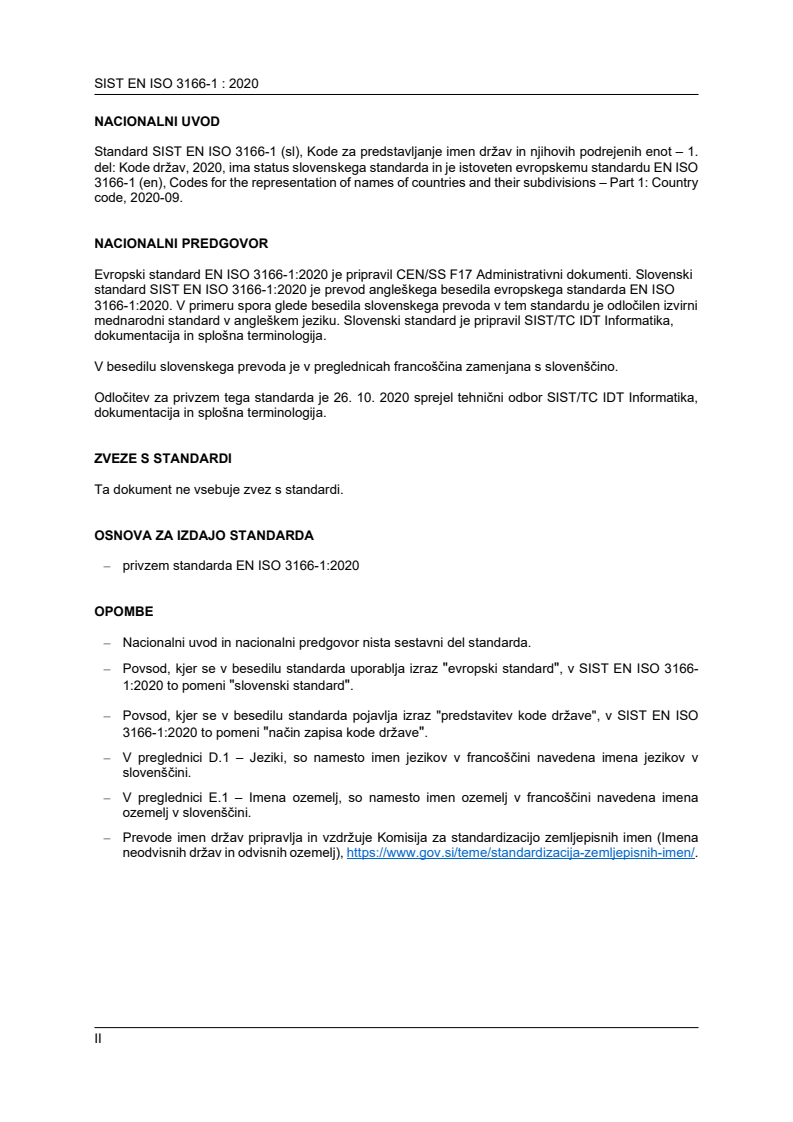
NACIONALNI UVOD
Standard SIST EN ISO 3166-1 (sl), Kode za predstavljanje imen držav in njihovih podrejenih enot – 1.
del: Kode držav, 2020, ima status slovenskega standarda in je istoveten evropskemu standardu EN ISO
3166-1 (en), Codes for the representation of names of countries and their subdivisions – Part 1: Country
code, 2020-09.
NACIONALNI PREDGOVOR
Evropski standard EN ISO 3166-1:2020 je pripravil CEN/SS F17 Administrativni dokumenti. Slovenski
standard SIST EN ISO 3166-1:2020 je prevod angleškega besedila evropskega standarda EN ISO
3166-1:2020. V primeru spora glede besedila slovenskega prevoda v tem standardu je odločilen izvirni
mednarodni standard v angleškem jeziku. Slovenski standard je pripravil SIST/TC IDT Informatika,
dokumentacija in splošna terminologija.
V besedilu slovenskega prevoda je v preglednicah francoščina zamenjana s slovenščino.
Odločitev za privzem tega standarda je 26. 10. 2020 sprejel tehnični odbor SIST/TC IDT Informatika,
dokumentacija in splošna terminologija.
ZVEZE S STANDARDI
Ta dokument ne vsebuje zvez s standardi.
OSNOVA ZA IZDAJO STANDARDA
– privzem standarda EN ISO 3166-1:2020
OPOMBE
– Nacionalni uvod in nacionalni predgovor nista sestavni del standarda.
– Povsod, kjer se v besedilu standarda uporablja izraz "evropski standard", v SIST EN ISO 3166-
1:2020 to pomeni "slovenski standard".
– Povsod, kjer se v besedilu standarda pojavlja izraz "predstavitev kode države", v SIST EN ISO
3166-1:2020 to pomeni "način zapisa kode države".
– V preglednici D.1 – Jeziki, so namesto imen jezikov v francoščini navedena imena jezikov v
slovenščini.
– V preglednici E.1 – Imena ozemelj, so namesto imen ozemelj v francoščini navedena imena
ozemelj v slovenščini.
– Prevode imen držav pripravlja in vzdržuje Komisija za standardizacijo zemljepisnih imen (Imena
neodvisnih držav in odvisnih ozemelj), https://www.gov.si/teme/standardizacija-zemljepisnih-imen/.
II
EVROPSKI STANDARD EN ISO 3166-1
EUROPEAN STANDARD
NORME EUROPÉENNE
september 2020
EUROPÄISCHE NORM
ICS 01.140.30
Slovenska izdaja
Kode za predstavljanje imen držav in
njihovih podrejenih enot – 1. del: Kode držav
(ISO 3166-1:2020)
Codes for the representation of Codes pour la représentation des Codes für die Namen von Ländern
names of countries and their noms de pays et de leurs und deren Untereinheiten – Teil 1:
subdivisions – Part 1: Country subdivisions – Partie 1: Codes de Codes für Ländernamen (ISO
code (ISO 3166-1:2020) pays (ISO 3166-1:2020) 3166-1:2020)
Ta evropski standard je CEN sprejel 22. avgusta 2020.
Člani CEN morajo izpolnjevati določila notranjih predpisov CEN/CENELEC, s katerimi je
predpisano, da mora biti ta evropski standard brez kakršnihkoli sprememb sprejet kot nacionalni
standard. Seznami najnovejših izdaj teh nacionalnih standardov in njihovi bibliografski podatki so
na voljo pri Upravnem centru CEN-CENELEC ali članih CEN.
Ta evropski standard obstaja v treh uradnih izdajah (angleški, francoski in nemški). Izdaje v drugih
jezikih, ki jih člani CEN na lastno odgovornost prevedejo in izdajo ter prijavijo pri Upravnem centru
CEN-CENELEC, veljajo kot uradne izdaje.
Člani CEN so nacionalni organi za standarde Avstrije, Belgije, Bolgarije, Cipra, Češke republike,
Danske, Estonije, Finske, Francije, Grčije, Hrvaške, Irske, Islandije, Italije, Latvije, Litve,
Luksemburga, Madžarske, Malte, Nemčije, Nizozemske, Norveške, Poljske, Portugalske,
Republike Severne Makedonije, Romunije, Slovaške, Slovenije, Srbije, Španije, Švedske, Švice,
Turčije in Združenega kraljestva.
CEN
EVROPSKI KOMITE ZA STANDARDIZACIJO
EUROPEAN COMMITTEE FOR STANDARDIZATION
COMITÉ EUROPÉEN DE NORMALISATION
EUROPÄISCHES KOMITEE FÜR NORMUNG
Upravni center CEN-CENELEC: Rue de la Science 23, B-1040 Bruselj
© 2020 CEN Vse pravice do izkoriščanja v kakršnikoli obliki in na kakršenkoli Ref. št. EN ISO 3166-1:2020 E
način imajo nacionalni člani CEN.
SIST EN ISO 3166-1 : 2020
VSEBINA Stran
Evropski predgovor . 3
SIST EN ISO 3166-1 : 2020
Evropski predgovor
Ta dokument (EN ISO 3166-1:2020) je pripravil tehnični odbor ISO/TC 46 "Informatika in dokumentacija"
v sodelovanju s tehničnim (sektorskim) pododborom CEN/SS F17 "Upravni dokumenti", katerega
sekretariat vodi CCMC.
Ta evropski standard mora dobiti status nacionalnega standarda z objavo istovetnega besedila bodisi z
objavo istovetnega besedila ali z razglasitvijo najpozneje do marca 2021, nasprotujoče nacionalne
standarde pa je treba razveljaviti najpozneje do marca 2021.
Opozoriti je treba na možnost, da so nekateri elementi tega dokumenta lahko predmet patentnih pravic.
CEN ne prevzema odgovornosti za identifikacijo nekaterih ali vseh takih patentnih pravic.
Ta evropski standard nadomešča EN ISO 3166-1:2014.
V skladu z notranjimi predpisi CEN-CENELEC morajo ta evropski standard obvezno privzeti nacionalne
organizacije za standardizacijo naslednjih držav: Avstrije, Belgije, Bolgarije, Cipra, Češke republike,
Danske, Estonije, Finske, Francije, Grčije, Hrvaške, Irske, Islandije, Italije, Latvije, Litve, Luksemburga,
Madžarske, Malte, Nemčije, Nizozemske, Norveške, Poljske, Portugalske, Republike Severne
Makedonije, Romunije, Slovaške, Slovenije, Srbije, Španije, Švedske, Švice, Turčije in Združenega
kraljestva.
Razglasitvena objava
Besedilo standarda ISO 3166-1:2020 je CEN odobril kot standard EN ISO 3166-1:2020 brez kakršnihkoli
sprememb.
SIST EN ISO 3166-1 : 2020
Vsebina Stran
Predgovor .6
Uvod .7
1 Področje uporabe . 9
2 Zveze s standardi . 9
3 Izrazi in definicije . 9
4 Načela uvrščanja na seznam imen držav . 12
4.1 Seznam . 12
4.2 Viri imen . 12
4.3 Prekrivanje . 13
4.4 Trenutno stanje imen . 13
4.5 Neodvisne države . 13
5 Načela dodeljevanja kodnih elementov . 13
5.1 Oblikovanje kodnih elementov . 13
5.2 Razmerje do imen . 13
5.3 Sestava dvočrkovne (alfa-2) kode . 13
5.4 Sestava tričrkovne (alfa-3) kode . 14
5.5 Sestava trištevilčne (num-3) kode . 14
5.6 Alternativna algoritemska sestava štirimestne številčne (num-4) kode . 14
6 Seznam imen držav s pripadajočimi kodnimi elementi . 14
6.1 Podrobnosti o uporabi . 14
6.2 Vsebina seznama . 14
6.3 Izbira jezika, pretvorba v latinico in nabor znakov . 15
7 Vzdrževanje . 15
7.1 Agencija za vzdrževanje (ISO 3166/MA) . 15
7.2 Standard kot zbirka podatkov – sprememba paradigme . 16
7.3 Vključitev na seznam imen držav . 16
7.4 Odstranitev s seznama imen držav . 17
7.5 Spremembe imena ali kodnega elementa države . 17
7.6 Rezervacija kodnih elementov držav . 17
7.6.1 Pregled . 17
7.6.2 Obdobje nedodeljenosti . 17
7.6.3 Obdobje neuporabe . 17
7.6.4 Izjemoma rezervirani kodni elementi . 17
7.6.5 Seznam rezerviranih kodnih elementov . 17
8 Smernice za uporabnike . 18
8.1 Posebna določila . 18
8.2 Združevanje . 18
8.3 Uporabniško dodeljeni kodni elementi . 18
8.4 Svetovanje glede uporabe kodnih elementov držav . 18
SIST EN ISO 3166-1 : 2020
Dodatek A (informativni) Algoritem za štirimestno (num-4) številčno predstavljanje
dvočrkovnih (alfa-2) kodnih elementov držav v skladu s standardom ISO 3166 . 19
Dodatek B (informativni) Matrika za pretvorbo v številčno predstavljanje dvočrkovnih
(alfa-2) kodnih elementov držav v skladu s standardom ISO 3166 . 20
Dodatek C (informativni) Preglednica za pretvorbo dvočrkovnih (alfa-2) kodnih
elementov držav v skladu s standardom ISO 3166 v trištevilčne (num-3) kodne
elemente UNSD. 22
Dodatek D (informativni) Seznam dvočrkovnih (alfa-2) in tričrkovnih (alfa-3) jezikovnih
kod v skladu s standardom ISO 639, ki se za kode držav uporabljajo v skladu s
standardom ISO 3166 . 24
Dodatek E (normativni) Abecedni seznam imen s seznama kod držav, ki se pojavljajo v
opombah in ustrezajo "imenom ozemelj" ali tvorijo drugi pomembni del sestavljenih
imen držav . 29
Dodatek F (informativni) Načela za manjše spremembe kratke oblike imena države,
prejete od UNTERM, ki dopuščajo prikaz v abecednem redu . 35
Dodatek G (informativni) Viri imen – Postopki v zvezi z uradnimi polnimi imeni držav v
zbirki podatkov UNTERM, ki jih je organizacija UNTERM 7. marca 2019 potrdila za
ISO 3166/MA . 37
Dodatek H (normativni) Oznake na platformi za brskanje po spletu (OBP) . 38
Viri in literatura . 40
SIST EN ISO 3166-1 : 2020
Predgovor
ISO (Mednarodna organizacija za standardizacijo) je svetovna zveza nacionalnih organov za standarde
(članov ISO). Mednarodne standarde navadno pripravljajo tehnični odbori ISO. Vsak član, ki želi delovati
na določenem področju, za katero je bil ustanovljen tehnični odbor, ima pravico biti zastopan v tem
odboru. Pri delu sodelujejo tudi mednarodne vladne in nevladne organizacije, povezane z ISO. V vseh
zadevah, ki so povezane s standardizacijo na področju elektrotehnike, ISO tesno sodeluje z
Mednarodno elektrotehniško komisijo (IEC).
Postopki, uporabljeni pri pripravi tega dokumenta, in predvideni postopki za njegovo vzdrževanje so
opisani v 1. delu direktiv ISO/IEC. Posebna pozornost naj se nameni različnim kriterijem odobritve,
potrebnim za različne vrste dokumentov ISO. Ta dokument je bil zasnovan v skladu z uredniškimi pravili
direktiv ISO/IEC, 2. del (glej www.iso.org/directives).
Opozoriti je treba na možnost, da so nekateri elementi tega dokumenta lahko predmet patentnih pravic.
ISO ne prevzema odgovornosti za identifikacijo nekaterih ali vseh takih patentnih pravic. Podrobnosti o
morebitnih patentnih pravicah, identificiranih med pripravo tega dokumenta, bodo navedene v uvodu
in/ali na seznamu patentnih izjav, ki jih je prejela organizacija ISO (glej www.iso.org/patents).
Vsakršna trgovska imena, uporabljena v tem dokumentu, so informacije za uporabnike in ne pomenijo
podpore blagovni znamki.
Za razlago prostovoljne narave standardov, pomena specifičnih pojmov in izrazov ISO, povezanih z
ugotavljanjem skladnosti, ter informacije o tem, kako ISO upošteva načela Svetovne trgovinske
organizacije (World Trade Organization, WTO) v tehničnih ovirah pri trgovanju (Technical Barriers to
Trade, TBT) glej spletno mesto www.iso.org/iso/foreword.html.
Ta dokument je pripravil tehnični odbor Mednarodne organizacije za standardizacijo/TC 46 Informatika
in dokumentacija v sodelovanju s tehničnim sektorskim pododborom Evropskega odbora za
standardizacijo CEN/SS F17 Upravni dokumenti v skladu s Sporazumom o tehničnem sodelovanju med
ISO in CEN (Dunajski sporazum).
Ta četrta izdaja razveljavlja in nadomešča tretjo izdajo (ISO 3166-1:2013), ki je bila strokovno revidirana.
Glavne spremembe glede na predhodno različico:
– Kode so prenesene v obliko zbirke podatkov.
– Sestavni deli kod so opredeljeni z opisnimi elementi (deskriptorji) in ne s številkami stolpcev ali
vrstic.
– Stanje posameznega dvočrkovnega (alfa-2) kodnega elementa države je jasno opredeljeno, saj je
to glavni vir, ki ga upravlja agencija ISO 3166/MA, in je potreben za časovno sledljivost.
– Vsi znaki v zbirki podatkov, zlasti tisti z diakritičnimi znamenji, so bili preverjeni glede na univerzalni
večoktetni nabor znakov iz standarda ISO/IEC 10646 in se dosledno uporabljajo.
– Kodiranje zbirke podatkov je v zapisu UTF-8 (8-bitna oblika zapisa univerzalnega večoktetnega
nabora znakov) iz standarda ISO/IEC 10646, ki se uporablja v številnih aplikacijah.
– Vsi trije deli – trije seznami kod – so del iste zbirke podatkov, tako da se posodobitve za vse tri dele
izvedejo samo enkrat.
Seznam vseh delov skupine standardov ISO 3166 je na voljo na spletnem mestu ISO.
Uporabnik naj vse povratne informacije ali vprašanja o tem dokumentu posreduje nacionalnemu organu
za standarde v svoji državi. Celoten seznam teh organov je na voljo na spletnem mestu
www.iso.org/members.html.
SIST EN ISO 3166-1 : 2020
Uvod
Prvotno izdajo mednarodnega standarda ISO 3166 je pripravil tehnični odbor ISO/TC 46 v sodelovanju
z naslednjimi mednarodnimi organizacijami: Svet za carinsko sodelovanje (Customs Cooperation
Council, CCC), [od leta 1995: Svetovna carinska organizacija (World Customs Organization, WCO)],
Ekonomska komisija Združenih narodov za Evropo (United Nations Economic Commission for Europe,
ECE), Organizacija Združenih narodov za prehrano in kmetijstvo (Food and Agriculture Organization of
the United Nations, FAO), Mednarodna agencija za jedrsko energijo (International Atomic Energy
Agency, IAEA), Mednarodno združenje letalskih prevoznikov (International Air Transport Association,
IATA), Mednarodna trgovinska zbornica (International Chamber of Commerce, ICC), Mednarodna
ladjarska zbornica (International Chamber of Shipping, ICS), Mednarodna zveza bibliotekarskih društev
in ustanov (International Federation of Library Associations, IFLA), Sekretariat Mednarodne organizacije
dela (International Labour Office, ILO), Mednarodna zveza za telekomunikacije (International
Telecommunication Union, ITU), Mednarodna železniška zveza (International Union of Railways, UIC),
Organizacija Združenih narodov (United Nations, UN), Konferenca Združenih narodov za trgovino in
razvoj (United Nations Conference on Trade and Development, UNCTAD), Svetovna poštna zveza
(Universal Postal Union, UPU), Svetovna organizacija za intelektualno lastnino (World Intellectual
Property Organization, WIPO) in Svetovna zdravstvena organizacija (World Health Organization, WHO).
Prva izdaja standarda ISO 3166 je bila objavljena leta 1974, naslednje izdaje pa so izšle v letih 1981,
1988 in 1993. Leta 1997 je bil standard razdeljen na tri dele.
– Izdaje standarda ISO 3166-1: ISO 3166-1:1997, ISO 3166-1:2006, ISO 3166-1:2013.
– Izdaje standarda ISO 3166-2: ISO 3166-2:1998, ISO 3166-2:2007, ISO 3166-2:2013.
– Izdaje standarda ISO 3166-3: ISO 3166-3:1999, ISO 3166-3:2013.
Skupina standardov ISO 3166 zagotavlja univerzalno uporabne kodirane predstavitve (sedanjih in
nekdanjih) imen držav, odvisnih območij in drugih območij z geopolitičnim pomenom ter njihovih
podrejenih enot.
V standardu ISO 3166-1 so opredeljene kode, ki predstavljajo sedanja imena držav, odvisnih območij
in drugih območij z geopolitičnim pomenom na podlagi imen držav, pridobljenih od Združenih narodov.
V standardu ISO 3166-2 je opredeljen seznam kod, ki predstavljajo imena glavnih upravnih enot ali
podobnih območij držav in subjektov, vključenih v standard ISO 3166-1.
V standardu ISO 3166-3 je opredeljen seznam kod, ki predstavljajo nekdanja imena držav, ki so bila iz
standarda ISO 3166 od njegove prve objave leta 1974 odstranjena.
Skupina standardov ISO 3166 ne izraža nikakršnega mnenja o pravnem položaju nobene države,
odvisne enote ali drugega območja, navedenega v tem dokumentu, ali o njihovih mejah ali obsegu.
Izdaja skupine standardov ISO 3166 iz leta 2013 je bila zadnja objava v tiskani obliki, ki je vključevala
opisno besedilo skupaj s kodami.
Konec leta 2013 je prišlo do razdelitve: kode v skladu s standardom ISO 3166 so bile prenesene v obliko
zbirke podatkov (hkratna de facto združitev treh vsebin), ki je postala dostopna prek platforme za
brskanje po spletu ISO (ISO Online Browsing Platform, OBP), medtem ko opisno besedilo še ni bilo
posodobljeno.
Ta izdaja skupine standardov ISO 3166 iz leta 2020 vključuje posodobitev opisnega besedila (opis kod)
iz leta 2013 za vsakega od treh delov. V tej izdaji so v primerjavi s tiskanimi dokumenti upoštevana
strožja pravila o zbirkah podatkov, ki veljajo za seznam kod.
Mednarodni standard ISO 3166 pomeni sploh prvo uspešno izvedeno obliko koncepta "standard kot
zbirka podatkov" organizacije ISO, ki je bil uveden konec leta 2013. Platforma za brskanje po spletu ISO
(ISO OBP) je aplikacija za vizualizacijo kod v skladu s standardom ISO 3166 prek spletnega vmesnika,
SIST EN ISO 3166-1 : 2020
podatki pa so shranjeni v nevidni zbirki podatkov v ozadju.
Vsak od treh delov – treh seznamov kod – mednarodnega standarda ISO 3166 je sestavljen iz dveh
sklopov; dokumentiranega opisa vsebine in pripadajoče vsebine v zbirki podatkov.
V celotni vsebini te skupine standardov ISO 3166, izdane leta 2020, se uporabljata izraza "ta dokument"
in "seznam kod v skladu s tem dokumentom".
SIST EN ISO 3166-1 : 2020
Kode za predstavljanje imen držav in njihovih podrejenih enot –
1. del: Kode držav
1 Področje uporabe
V tem dokumentu so določene osnovne smernice za uvedbo in vzdrževanje kod držav.
Ta seznam kod je namenjen katerikoli uporabi, pri kateri je potrebno izražanje sedanjih imen držav v
kodirani obliki.
2 Zveze s standardi
Ta dokument ne vsebuje zvez s standardi.
3 Izrazi in definicije
V tem dokumentu se uporabljajo naslednji izrazi in definicije.
ISO in IEC hranita terminološke zbirke podatkov za uporabo pri standardizaciji na naslednjih naslovih:
– platforma za brskanje po spletu ISO: na voljo na spletnem mestu https://www.iso.org/obp
– IEC Electropedia: na voljo na spletnem mestu http://www.electropedia.org/
3.1
koda
nabor podatkov, preoblikovanih ali predstavljenih v različnih oblikah v skladu z vnaprej določenim
naborom pravil
[VIR: ISO 5127:2017, 3.1.13.10]
3.2
kodni element
rezultat uporabe kode za element kodiranega nabora
Opomba 1: V delu s kodo države kodni element predstavlja ime države.
[VIR: ISO/IEC 2382:2015, 2121555]
3.3
koda države
seznam imen države s pripadajočimi kodnimi elementi
Opomba 1: Koda države je lahko dvočrkovna (alfa-2), tričrkovna (alfa-3) ali trištevilčna (num-3).
3.4
ime države
ime države, odvisnega območja ali drugega območja z geopolitičnim pomenom
3.5
pisava
nabor grafičnih znakov, ki se uporabljajo za pisno obliko enega ali več jezikov
Opomba 1: Kode za predstavljanje imen pisav so opredeljene v standardu ISO 15924.
[VIR: ISO/IEC 10646-1:2017, 3.50]
SIST EN ISO 3166-1 : 2020
3.6
jezik standarda ISO 3166
jezik, v katerem je opredeljena terminologija; terminologija mora biti vedno posodobljena
Opomba 1: Glavna jezika standarda ISO 3166 sta angleščina in francoščina.
3.7
uradni jezik države
pisni jezik, ki ga uporablja uprava države na državni ravni
3.10
stanje dvočrkovnega (alfa-2) kodnega elementa države
podatek o tem, ali je kodni element dodeljen, nedodeljen ali rezerviran prehodno, izjemoma ali za
nedoločen čas
Opomba 1: ISO 3166/MA od prve objave standarda ISO 3166 leta 1974 beleži spremembe stanja dvočrkovnih (alfa-2) kodnih
elementov držav.
3.11
dvočrkovni (alfa-2) kodni element države
dvomestna črkovna koda (alfa-2)
Opomba 1: Za predstavljanje imen držav se običajno priporoča dvočrkovna koda (alfa-2).
3.12
tričrkovni (alfa-3) kodni element države
trimestna črkovna koda (alfa-3)
Opomba 1: Če je mogoče, temelji na dvočrkovni (alfa-2) kodi države in se uporablja v posebnih primerih.
3.13
trištevilčni (num-3) kodni element države
trimestna številčna koda (num-3)
Opomba 1: Številčna koda je namenjena uporabi v primerih, ko je potrebna jezikovna neodvisnost.
Opomba 2: Za preglednico za pretvorbo iz dvočrkovnih (alfa-2) kodnih elementov držav v trištevilčne (num-3) kodne elemente
UNSD glej dodatek C.
3.14
kratko IME države
z izpisana kratka oblika imena države, prepoznavna beseda je na prvem
mestu
Opomba 1: V jeziku standarda ISO 3166.
Opomba 2: Ta element je lahko obrnjen, tako da je prepoznavna beseda na prvem mestu, kar omogoča enostavno iskanje
po abecednem seznamu. Glej dodatek F, načela F.2.
3.15
kratko ime države
kratka oblika imena države, na prvem mestu je prepoznavna beseda, ki temelji na uradni kratki obliki v
terminološki bazi UNTERM
Opomba 1: V jeziku standarda ISO 3166.
Opomba 2: Ta element je lahko obrnjen, naveden z morebitnimi členi, kar omogoča razvrščanje po abecednem vrstnem redu
za prepoznavno besedo. Glej dodatek F, načela F.1.
SIST EN ISO 3166-1 : 2020
3.16
polno ime države
polno ime, kot je navedeno v terminološki bazi UNTERM
Opomba 1: Če je polno ime države enako kot kratko ime države (3.15), je treba polno ime izpustiti.
Opomba 2: V jeziku standarda ISO 3166.
Opomba 3: Polno ime države se v nekaterih datotekah terminološke baze UNTERM imenuje tudi "uradno ime".
3.17
imena ozemelj
imena geografsko ločenih ozemelj, zajetih v glavnem vnosu (glej dodatek E, "imena ozemelj")
Opomba 1: V jeziku standarda ISO 3166.
3.18
1. del opomb
opombe, povezane z imenom države, npr. druga pogosto uporabljena imena države
Opomba 1: V jeziku standarda ISO 3166.
Opomba 2: Včasih so "različice", navedene v 1. delu opomb, enake kot krajevno kratko ime države (3.22) v uradnem jeziku.
3.19
neodvisnost ali ne
politični status države ali ozemlja, ki je v primeru neodvisnosti označeno z "da", v nasprotnem primeru
pa z "ne"
Opomba 1: V jeziku standarda ISO 3166.
Opomba 2: Za podatke o neodvisnih državah glej 4.5.
3.20
dvočrkovni (alfa-2) kodni element jezika
dvomestni črkovni (alfa-2) kodni element jezika v skladu s standardom ISO 639 za posamezni uradni
jezik države (3.7)
Opomba 1: Če kodnega elementa ni, je naveden vezaj (minus).
Opomba 2: Za jezike, uporabljene v standardu ISO 3166, glej dodatek D.
3.21
tričrkovni (alfa-3) kodni element jezika
trimestni črkovni (alfa-3) kodni element jezika (terminološka različica "T") v skladu s standardom ISO
639 za posamezni uradni jezik države (3.7)
Opomba 1: Če tričrkovni (alfa-3) kodni element jezika za ime jezika, ki se uporablja v standardu ISO 3166, v standardih ISO
639-2 in ISO 639-3 ni naveden, se označi s številko (npr. 002).
Opomba 2: Za jezike, uporabljene v standardu ISO 3166, glej dodatek D.
3.22
kratko krajevno ime države
kratko ime države, navedeno v uradnem jeziku države
Opomba 1: V jeziku standarda ISO 3166 je lahko navedeno v 1. delu opomb (3.18).
PRIMER 1:
Schweiz (die) je krajevno kratko ime države v nemškem jeziku za Švico.
SIST EN ISO 3166-1 : 2020
Svizzera (la) je krajevno kratko ime države v italijanskem jeziku za Švico.
Magyarország je krajevno kratko ime države v madžarskem jeziku za Madžarsko.
PRIMER 2:
Zhongguo je krajevno kratko ime države v kitajskem jeziku za Kitajsko, pri čemer je za pretvorbo kitajske
pisave Han (poenostavljena različica) v latinico uporabljen sistem latiničnega zapisa National 1958 =
ISO 7098:2015 = UN III/8 1977.
Qaţar je krajevno kratko ime države v arabskem jeziku za Katar, pri čemer je za pretvorbo arabske
pisave v latinico uporabljen sistem latiničnega zapisa BGN/PCGN 1956.
3.23
uporabljeni sistem pretvorbe v latinico
pretvorba sistema zapisovanja iz drugega sistema zapisovanja v latinizirano (latinično) pisavo
Opomba 1: Če je to potrebno zaradi uradnega jezika.
Opomba 2: V jeziku standarda ISO 3166.
4 Načela uvrščanja na seznam imen držav
4.1 Seznam
Seznam imen držav, kodiranih v skladu s tem dokumentom, zajema imena za čim širšo uporabo. Temelji
na seznamu, ki ga vodi Statistični oddelek Združenih narodov [22].
4.2 Viri imen
Trije glavni jeziki standardov ISO so navedeni v točki 1 Vodila ISO/IEC 2:2004. Med letoma 1981 in
2013 je bil standard ISO 3166 dvojezičen, vzporedno v angleščini in francoščini, ustrezna terminologija
pa je bila posodobljena.
Do septembra 2000 so bila imena neodvisnih držav v angleščini in francoščini navedena v [23] in
objavljena v [22].
Danes je za imena držav, ki se uradno uporabljajo v Združenih narodih, pristojna Terminološka sekcija
Združenih narodov, ki vzdržuje Večjezično terminološko zbirko podatkov Združenih narodov
(UNTERM), glej [24]. Ta zbirka podatkov vsebuje zapise za vsako državo, v kateri so med drugim
navedena kratka in uradna imena držav v šestih uradnih jezikih ZN.
Podatki, predstavljeni na seznamu kod v skladu s tem dokumentom, ki je na voljo na platformi za
brskanje po spletu ISO, so bili pridobljeni iz zbirke podatkov UNTERM. Polno ime je uradni naziv, ki ga
stalno predstavništvo zadevne države sporoči Službi za protokol in zveze Združenih narodov (Protocol
and Liaison Service of the United Nations), jezikoslovci baze UNTERM pa ga slovnično prilagodijo, glej
dodatek G. Kratka oblika ima lahko nekaj manjših sprememb, glej dodatek F. Če se polna in kratka
oblika imena razlikujeta, sta na seznamu kod v skladu s tem dokumentom navedeni obe.
Kratka oblika je na voljo v dveh predstavitvah (zapisih), pri čemer je dodatni zapis sestavljen iz velikih
črk, oba pa omogočata prikaz po abecednem vrstnem redu imen držav, ki temelji na prepoznavni besedi.
Zaradi lažje uporabe je ime z velikimi tiskanimi črkami včasih obrnjeno.
Druge pogosto uporabljene oblike imen držav so lahko navedene tudi v polju s krajevnim kratkim
imenom države, glej vsebino seznama v točki 6.2.
SIST EN ISO 3166-1 : 2020
4.3 Prekrivanje
Nekatera imena držav na seznamu kod v skladu s tem dokumentom zajemajo območja, ki imajo tudi
svojo kodo, če zahteva po izmenjavi utemeljuje ločen kodni element. Vnosi se zato medsebojno ne
izključujejo.
PRIMER: France FR, 250, FRA
Martinique MQ, 474, MTQ
4.4 Trenutno stanje imen
Imena držav, navedena na seznamu kod v skladu s tem dokumentom odražajo trenutne razmere ob
izdaji njegove najnovejše posodobitve.
4.5 Neodvisne države
Neodvisne države so na seznamih v tem dokumentu označene v posebnem elementu. Države članice
Združenih narodov in Sveti sedež se za namen seznama kod v skladu s tem dokumentom štejejo kot
neodvisni.
5 Načela dodeljevanja kodnih elementov
5.1 Oblikovanje kodnih elementov
Kodni element lahko vsebuje samo naslednje znake (glej ISO/IEC 10646):
– VELIKE LATINSKE ČRKE od A do Z
– ŠTEVKE od NIČ do 9
– VEZAJ (MINUS)
Dvočrkovni (alfa-2) in tričrkovni (alfa-3) kodni elementi so sestavljeni iz ČRK, medtem ko so trištevilčni
(num-3) sestavljeni iz ŠTEVK.
Štiričrkovni (alfa-4) kodni elementi so sestavljeni iz ČRK.
Kodni elementi podrejenih enot so sestavljeni iz največ 6 znakov: dvočrkovna koda (alfa-2), VEZAJ
(MINUS) in od 1 do 3 ČRKE ali ŠTEVKE.
5.2 Razmerje do imen
Načelo črkovnega kodiranja, kot je navedeno na seznamu kod v skladu s tem dokumentom, je vizualna
povezava med imeni držav (v angleščini ali francoščini ali včasih v drugem jeziku) in pripadajočimi
kodnimi elementi. Pri uporabi tega načela so kodni elementi v splošnem dodeljeni na podlagi kratkih
imen držav in, kjer je to mogoče, brez izražanja njihovega političnega statusa.
Glavni vir za določanje kodnih elementov za seznam kod v skladu s tem dokumentom so oznake za
cestna vozila, kot so jih podale pogodbenice v Konvenciji o cestnem prometu (leto 1949 in 1968;
glej [21]).
5.3 Sestava dvočrkovne (alfa-2) kode
Skupina standardov ISO 3166 s kodnim seznamom v skladu s tem dokumentom določa dvomestno
črkovno (alfa-2) kodo, ki je v splošnem najbolj priporočljiva za predstavljanje imen držav in je podlaga
za kode, določene v drugem in tretjem delu, ter za druge mednarodne standarde in priporočila (glej
literaturo, razdelek Svetovno gospodarstvo).
SIST EN ISO 3166-1 : 2020
Dvočrkovna (alfa-2) koda zajema kombinacije dveh velikih črk 26-znakovne abecede v latinici, kar
pomeni 26 × 26 = 676 kombinacij. Koda države v skladu s standardom ISO 3166 zajema kombinacije
od AB do QL, od RA do WZ in od YA do ZY.
V kodi države se v skladu s standardom ISO 3166 ne uporabljajo kodni elementi AA, od QM do QZ, od
XA do XZ in ZZ. Uporaba teh elementov je opisana v točki 8 (glej 8.3).
5.4 Sestava tričrkovne (alfa-3) kode
Standard ISO 3166 določa tudi trimestno črkovno (alfa-3) kodo, ki temelji na dvočrkovni (alfa-2) kodi,
kadar je to mogoče, in zajema kombinacije treh velikih črk 26-znakovne abecede v latinici v razponu od
ABA do QLZ, od RAA do WZZ in od YAA do ZYZ. Po potrebi se uporablja v posebnih primerih.
V kodi države v skladu s standardom ISO 3166 se ne uporabljajo kodni elementi od AAA do AAZ, od
QMA do QZZ, od XAA do XZZ in od ZZA do ZZZ. Uporaba teh elementov je opisana v točki 8 (glej 8.3).
5.5 Sestava trištevilčne (num-3) kode
V skladu s tem dokumentom so na kodnem seznamu za imena držav navedene tudi trimestne številčne
(num-3) kode v razponu od 000 do 899, saj ima to prednost (npr. za zagotavljanje jezikovne
neodvisnosti).
Ta številčni seznam kod je izvleček iz standardnega kodiranja držav ali območij, za katerega zbira
statistične podatke Statistični oddelek Združenih narodov (United Nations Statistical Division), in je od
druge izdaje leta 1981 objavljen v standardu ISO 3166.
Preglednica C.1, v kateri je prikazano ujemanje med dvočrkovnimi (alfa-2) in trištevilčnimi (num-3)
kodnimi elementi, je podana v dodatku C.
5.6 Alternativna algoritemska sestava štirimestne številčne (num-4) kode
Predstavitev dvočrkovne (alfa-2) kode države s številkami je predvidena za uporabo, kadar neposredna
transliteracija ni mogoča, tj. v primeru jezikov, ki nimajo znakov latinične pisave, oziroma kadar je zaradi
drugih razlogov primernejša algoritemska pretvorba.
Številčna predstavitev se pridobi tako, da se dvočrkovne (alfa-2) kodni elementi imena države s
preprostimi matematičnimi pravili pretvorijo v številke. To je reverzibilna funkcija, torej je številčno kodo
mogoče na podlagi pravil za pretvorbo prevesti nazaj v dvočrkovno (alfa-2) kodo države.
Pretvorbena matrika je zaprt sistem, vsi elementi so štirimestna števila (sestavljena iz 4 števk), na prvem
mestu je vedno "1".
Algoritem je naveden v dodatku A, ustrezna preglednica B.1 s pretvorbeno matriko pa v dodatku B.
6 Seznam imen držav s pripadajočimi kodnimi elementi
6.1 Podrobnosti o uporabi
Seznam imen držav in pripadajočih kodnih elementov je na voljo na platformi za brskanje po spletu ISO
na naslovu https://www.iso.org/obp. Seznam je posodobljen, ne glede na stanje izdaje tega dokumenta.
Uporabniki naj pri uporabi tega dokumenta jasno navedejo, katero od treh kod uporabljajo. Če se kodni
element s kodnega seznama v skladu s tem dokumentom uporablja za posebne namene v kombinaciji
z drugimi znaki, je zelo priporočljivo, da se navedeta izbira in funkcija morebitnih dodatnih znakov.
6.2 Vsebina seznama
Posamezni vnos na tem seznamu je skupen vsem trem delom skupine standardov ISO 3166. Na
SIST EN ISO 3166-1 : 2020
kodnem seznamu v skladu s tem dokumentom so naslednji elementi:
– element 3.10: stanje dvočrkovnega (alfa-2) kodnega elementa države,
– element 3.11: dvočrkovni (alfa-2) kodni element države,
– element 3.12: tričrkovni (alfa-3) kodni element države,
– element 3.13: trištevilčni (num-3) kodni element države,
– element 3.14: kratko IME države,
– element 3.15: kratko ime države,
– element 3.16: polno ime države,
– element 3.17: imena ozemelj,
– element 3.18: 1. del opomb,
– element 3.19: neodvisnost ali ne.
Poleg teh so navedeni tudi dodatni informativni elementi o posameznem uradnem jeziku (element 3.7)
posamezne države. Podatek o tem je v eni sami vrstici in ima tri polja:
{
– element 3.20: dvočrkovni (alfa-2) kodni element jezika,
– element 3.21: tričrkovni (alfa-3) kodni element jezika,
– element 3.22: kratko krajevno ime države.
}
Poleg zgornjega seznama, s katerim je opisana vsebina kod držav, je v dodatku E uporabnikom na voljo
priročna referenca vseh imen ozemelj, večinoma otokov, ki so navedena z oznako "imena ozemelj". To
je še posebej uporabno, kadar je treba določiti kodne elemente države za imena ozemelj, ki se ne
pojavljajo kot glavni vnosi.
6.3 Izbira jezika, pretvorba v latinico in nabor znakov
Imena držav so navedena v uradnem jeziku (ali uradnih jezikih) zadevne države, kot se zapišejo v
latinici, in s pravili za nabor znakov, kot je navedeno spodaj.
Imena držav, ki so predložena v nelatiničnih abecedah, so v standardu ISO 3166 prikazana v latinizirani
obliki, ki je v največji možni meri v skladu z ustreznimi mednarodnimi standardi, zlasti tistimi, ki jih
priporoča skupina strokovnjakov Združenih narodov za standardizacijo zemljepisnih imen (United
Nations experts groups on geographical names, UNGEGN) [25].
Za imena držav, navedena na seznamu kod v skladu s tem dokumentom, se uporablja 26 znakov
latinične abecede, po potrebi z diakritičnimi znaki iz nabora znakov v standardu ISO/IEC 10646.
7 Vzdrževanje
7.1 Agencija za vzdrževanje (ISO 3166/MA)
Svet ISO je ustanovil agencijo za vzdrževanje (ISO 3166/MA), da deluje v skladu s smernicami, ki jih je
odobril Svet. Agencija ima naslednje naloge:
a) dodajanje in odstranjevanje imen držav in podrejenih enot držav ter po potrebi dodeljevanje kodnih
SIST EN ISO 3166-1 : 2020
elementov v skladu s pravili iz skupine standardov ISO 3166;
b) svetovanje uporabnikom in članom ISO glede uporabe kodnih seznamov;
c) posodabljanje in razširjanje seznamov imen držav, podrejenih enot držav in kodnih elementov ter
njihovih opredelitev;
d) vodenje referenčnega seznama vseh uporabljenih imen držav in podrejenih enot držav ter njihovih
obdobij veljavnosti;
e) objavljanje sprememb kodnih seznamov;
f) upravljanje rezervacij kodnih elementov.
O spremembah seznama kod v skladu s tem dokumentom odloča agencija ISO 3166/MA, pri čemer
spremembe začnejo veljati takoj po objavi.
Agencija ISO 3166/MA pri vseh spremembah seznama imen držav na kodnem seznamu v skladu s tem
dokumentom ter njihovih kodnih elementov oziroma rezervacij njihovih kodnih elementov upošteva
merila iz točk od 7.3 do 7.6.
Imena in kontaktni podatki agencij za vzdrževanje in registracijskih organov so dostopni na povezavi
https://www.iso.org/mara.
7.2 Standard kot zbirka podatkov – sprememba paradigme
Skupina standardov ISO 3166 je zasnovana kot zbirka podatkov, zato mora agencija ISO 3166/MA
sodelovati z izvedenci tako, da jim zagotovi ustrezna sredstva za analizo vsebine podatkovne zbirke in
sledljivost sprememb, kar doseže na naslednje načine:
a) za izvedence objavi celotno vsebino zbirke podatkov v obliki preglednic, tako da je poznejša objava
v obliki PDF za vizualno primerjavo ali celosten pregled enostavna za vsakogar;
b) enkrat letno za izvedence objavi vse oznake, ki se uporabljajo v vseh treh delih in ustrezajo vsem
opredelitvam iz točke 3; ta izdaja obsega seznam oznak s platforme za brskanje po spletu, ki
nadomesti sedanje oznake iz leta 2013, navedene v dodatku H;
c) dokumentira vse potrebne spremembe in prilagoditve oznak oziroma predstavitev (zapisov) ter o
tem vnaprej obvesti izvedence;
d) za namen ohranjanja sledljivosti enkrat letno pripravi datoteke z označenimi razlikami, pri čemer je
v imenu datoteke naveden datum, vsem izvedencem pa pošlje kratko izjavo ali povzetek;
e) vse preglednice standarda ISO 3166 so datoteke v obliki zapisa Excel, CSV ali XML, pri čemer je
uporabljeni kodni nabor UTF-8, ki upoštevajo dobre prakse na tem področju – vključno s
komunikacijo z izvedenci;
f) za namene sledljivosti se vse preglednice standarda ISO 3166 hranijo v namenskem prostoru
agencije ISO 3166/MA, podobno kot pri dokumentih N.
7.3 Vključitev na seznam imen držav
Vključitev na seznam imen držav se izvede na podlagi informacij s sedeža Združenih narodov ali na
zahtevo člana agencije ISO 3166/MA. V slednjem primeru agencija ISO 3166/MA sprejme odločitev
glede dodajanja na podlagi utemeljitve dejanske zahteve za mednarodno izmenjavo. Skladno s tem
dodeli kodne elemente.
Če imena države ni na seznamu "Standardne kode držav ali območij za statistično uporabo", lahko
agencija ISO 3166/MA dodeli številčni kodni element iz razpona 900–999, ki ga za ta namen zagotovi
Statistični oddelek Združenih narodov.
SIST EN ISO 3166-1 : 2020
7.4 Odstranitev s seznama imen držav
Odstranitev s seznama imen držav je treba izvesti na podlagi informacij s sedeža Združenih narodov ali
na zahtevo člana agencije ISO 3166/MA. Na podlagi prejetih informacij agencija ISO 3166/MA odloči o
odstranitvi s seznama. Pripadajoči kodni element ostane rezerviran.
Standard ISO 3166-3 zagotavlja seznam imen držav, odstranjenih s kodnega seznama v skladu s tem
dokumentom, vse od njegove prve izdaje leta 1974. Zagotovljena je tudi sledljivost kodnih elementov
držav in njihovega stanja.
7.5 Spremembe imena ali kodnega elementa države
Spremembe imena ali kodnega elementa države temeljijo predvsem na informacijah s sedeža Združenih
narodov. V primeru večje spremembe imena države mora agencija ISO 3166/MA spremeniti ustrezno
črkovno kodo, vendar si prizadeva ohraniti čim večjo nespremenljivost (stabilnost) seznama kodnih
elementov.
7.6 Rezervacija kodnih elementov držav
7.6.1 Pregled
Nekateri kodni elementi so rezervirani:
– za omejeno obdobje, če je rezervacija posledica odstranitve (glej 7.4) ali spremembe (glej 7.5)
imena države,
– za nedoločen čas, če je rezervacija posledica določil mednarodnega prava (glej 7.6.3) ali izrednih
zahtev (glej 7.6.4).
7.6.2 Obdobje nedodeljenosti
Kodni elementi držav, ki jih agencija ISO 3166/MA spremeni ali izbriše, se naj najmanj petdeset let po
spremembi ne dodelijo znova. Točno trajanje obdobja se določi za vsak primer posebej na podlagi
obsega uporabe prejšnjega elementa kode.
7.6.3 Obdobje neuporabe
Nekateri kodni elementi držav, ki so obstajali v času prve objave kod držav v standardu ISO 3166 in se
razlikujejo od tistih v tem delu standarda ISO 3166, se naj za nedoločen čas ne uporabljajo za
predstavljanje imen drugih držav. Ta določba velja za nekatere oznake cestnih vozil v Konvenciji o
cestnem prometu (Convention on Road Traffic) iz leta 1949 in leta 1968 (glej [21]).
Kodne elemente, za katere velja ta določba, je priporočljivo vključiti na seznam rezerviranih kodnih
elementov (glej 7.6.5) in naj se ne dodelijo ponovno najmanj petdeset let od dne, ko so jih zadevne
države ali organizacije prenehale uporabljati.
7.6.4 Izjemoma rezervirani kodni elementi
Kodne elemente je izjemoma mogoče rezervirati za imena držav, ki jih agencija ISO 3166/MA ni vključila
na kodni seznam v skladu s tem dokumentom, a zanje obstaja zahteva za izmenjavo. Pred rezervacijo
takih kodni
...