

SIST-TP CEN/TR 17739:2022
(Main)Algae and algae products - Specifications for chemicals and biofuels sector applications
General Information
- Abstract
The purpose of this document is to provide an overview on how quality indicating parameters for algae and algae products and intermediates relevant for chemical and bioenergy applications can be handled and to identify the need for future standards development for chemicals, bioenergy and biofuels applications.
This document does not provide instructions on handling of technical requirements in existing legislations.
- Status
- Published
- Public Enquiry End Date
- 31-Oct-2021
- Publication Date
- 23-Jan-2022
- Technical Committee
- I13 - Imaginarni 13
- Current Stage
- 6060 - National Implementation/Publication (Adopted Project)
- Start Date
- 29-Dec-2021
- Due Date
- 05-Mar-2022
- Completion Date
- 24-Jan-2022

Overview - CEN/TR 17739:2021 (Algae and algae products)
CEN/TR 17739:2021 is a Technical Report from CEN/TC 454 that provides an overview of how quality‑indicating parameters for algae and algae products (whole biomass, extracts and derivatives) can be handled for the chemicals and biofuels sectors. The document identifies gaps and the need for future standards development for chemicals, bioenergy and biofuels applications. It is an informational reference - it does not replace or interpret existing legislation.
Key topics and technical requirements
- Scope and definitions: Covers terms such as raw material specification (RMS), technical data sheet (TDS), certificate of analysis (CoA), extracts, biofuels, bioliquids and advanced biofuels.
- Quality documentation: Recommends structured product information:
- RMS (detailed producer dossier)
- TDS (one-page technical specification for CoA alignment)
- CoA (lot‑specific laboratory test results)
- Product characterisation & test methods: Describes algal product characteristics and points to relevant test methods and identification techniques (microalgae, macroalgae, cyanobacteria).
- Applications as chemical raw materials: Guidance on multi‑constituent variability, minimum active component levels and bio‑based product claims (refers to EN 16848 / EN 16935).
- Biofuels from algae: Overview of algae‑derived biofuels, advanced biofuels, and interactions with fuel standards and fuel quality requirements.
- Sustainability and LCA: Discusses sustainable development principles and life cycle assessment (LCA) considerations specific to algae value chains.
- Informative annexes: Examples of raw material specifications, TDS/CoA templates, regulatory references (FPR), algae extracts, literature overview on algae biofuels and EU contaminants table.
Practical applications and target users
Who benefits from CEN/TR 17739:
- Algae producers and biorefineries - for preparing RMS, TDS and CoAs to meet buyer and regulatory expectations.
- Chemical manufacturers and biofuel producers - to assess feedstock quality, variability and suitability for conversion routes (oils, extracts, polymers).
- Testing laboratories and certification bodies - for aligning test reporting with TDS/CoA parameters.
- Purchasers, traders and OEMs - to set procurement specifications for algae biomass, extracts and intermediates.
- Policy makers and standards developers - to identify gaps and prioritize new standards for algae in chemicals and energy sectors. Practical uses include feedstock acceptance criteria, supplier quality contracts, R&D benchmarking and sustainability/LCA reporting.
Related standards and references
Key normative references cited in the report:
- EN 17399 (Terms and definitions for algae)
- EN 17477 (Identification of algae biomass)
- EN 14214, EN 590, EN 16709, EN 16734, EN 16723-1 (fuel specifications and methods)
- EN 14103 (FAME analysis)
- EN 16848 / EN 16935 (bio‑based product claims)
CEN/TR 17739 is a central guidance resource for aligning algae product quality, documentation and sustainability practice across chemicals and biofuels supply chains.
Relations
- Effective Date
- 28-Jan-2026
- Effective Date
- 28-Jan-2026
- Effective Date
- 28-Jan-2026
- Effective Date
- 28-Jan-2026
- Effective Date
- 28-Jan-2026
- Effective Date
- 28-Jan-2026
- Effective Date
- 28-Jan-2026
- Refers
SIST EN 16734:2022 - Automotive fuels - Automotive B10 diesel fuel - Requirements and test methods - Effective Date
- 28-Jan-2026
Get Certified
Connect with accredited certification bodies for this standard

BSI Group
BSI (British Standards Institution) is the business standards company that helps organizations make excellence a habit.

Bureau Veritas
Bureau Veritas is a world leader in laboratory testing, inspection and certification services.

DNV
DNV is an independent assurance and risk management provider.
Sponsored listings
Frequently Asked Questions
SIST-TP CEN/TR 17739:2022 is a technical report published by the Slovenian Institute for Standardization (SIST). Its full title is "Algae and algae products - Specifications for chemicals and biofuels sector applications". This standard covers: The purpose of this document is to provide an overview on how quality indicating parameters for algae and algae products and intermediates relevant for chemical and bioenergy applications can be handled and to identify the need for future standards development for chemicals, bioenergy and biofuels applications. This document does not provide instructions on handling of technical requirements in existing legislations.
The purpose of this document is to provide an overview on how quality indicating parameters for algae and algae products and intermediates relevant for chemical and bioenergy applications can be handled and to identify the need for future standards development for chemicals, bioenergy and biofuels applications. This document does not provide instructions on handling of technical requirements in existing legislations.
SIST-TP CEN/TR 17739:2022 is classified under the following ICS (International Classification for Standards) categories: 13.020.55 - Biobased products. The ICS classification helps identify the subject area and facilitates finding related standards.
SIST-TP CEN/TR 17739:2022 has the following relationships with other standards: It is inter standard links to SIST EN 17399:2020, SIST EN 590:2025, SIST EN 17477:2021, SIST EN 14214:2012+A2:2019, SIST EN 16723-1:2017, SIST EN 16709:2024, SIST EN 14103:2020, SIST EN 16734:2022. Understanding these relationships helps ensure you are using the most current and applicable version of the standard.
SIST-TP CEN/TR 17739:2022 is associated with the following European legislation: EU Directives/Regulations: 2009/128/EC; Standardization Mandates: M/547. When a standard is cited in the Official Journal of the European Union, products manufactured in conformity with it benefit from a presumption of conformity with the essential requirements of the corresponding EU directive or regulation.
SIST-TP CEN/TR 17739:2022 is available in PDF format for immediate download after purchase. The document can be added to your cart and obtained through the secure checkout process. Digital delivery ensures instant access to the complete standard document.
Standards Content (Sample)
SLOVENSKI STANDARD
01-marec-2022
Alge in izdelki iz alg - Specifikacije za uporabo v kemijskem in bioenergetskem
sektorju
Algae and algae products - Specifications for chemicals and biofuels sector applications
Algen und algenbasierte Produkte - Spezifikationen für Anwendungen im Chemie- und
Biokraftstoffsektor
Algues et produits d’algues - Spécifications pour les applications dans le secteur de la
chimie et de la bioénergie
Ta slovenski standard je istoveten z: CEN/TR 17739:2021
ICS:
13.020.55 Biološki izdelki Biobased products
2003-01.Slovenski inštitut za standardizacijo. Razmnoževanje celote ali delov tega standarda ni dovoljeno.
CEN/TR 17739
TECHNICAL REPORT
RAPPORT TECHNIQUE
December 2021
TECHNISCHER BERICHT
ICS 13.020.55
English Version
Algae and algae products - Specifications for chemicals and
biofuels sector applications
Algues et produits d'algues - Spécifications pour les Algen und algenbasierte Produkte - Spezifikationen für
applications dans le secteur de la chimie et de la Anwendungen im Chemie- und Biokraftstoffsektor
bioénergie
This Technical Report was approved by CEN on 5 December 2021. It has been drawn up by the Technical Committee CEN/TC
454.
CEN members are the national standards bodies of Austria, Belgium, Bulgaria, Croatia, Cyprus, Czech Republic, Denmark, Estonia,
Finland, France, Germany, Greece, Hungary, Iceland, Ireland, Italy, Latvia, Lithuania, Luxembourg, Malta, Netherlands, Norway,
Poland, Portugal, Republic of North Macedonia, Romania, Serbia, Slovakia, Slovenia, Spain, Sweden, Switzerland, Turkey and
United Kingdom.
EUROPEAN COMMITTEE FOR STANDARDIZATION
COMITÉ EUROPÉEN DE NORMALISATION
EUROPÄISCHES KOMITEE FÜR NORMUNG
CEN-CENELEC Management Centre: Rue de la Science 23, B-1040 Brussels
© 2021 CEN All rights of exploitation in any form and by any means reserved Ref. No. CEN/TR 17739:2021 E
worldwide for CEN national Members.
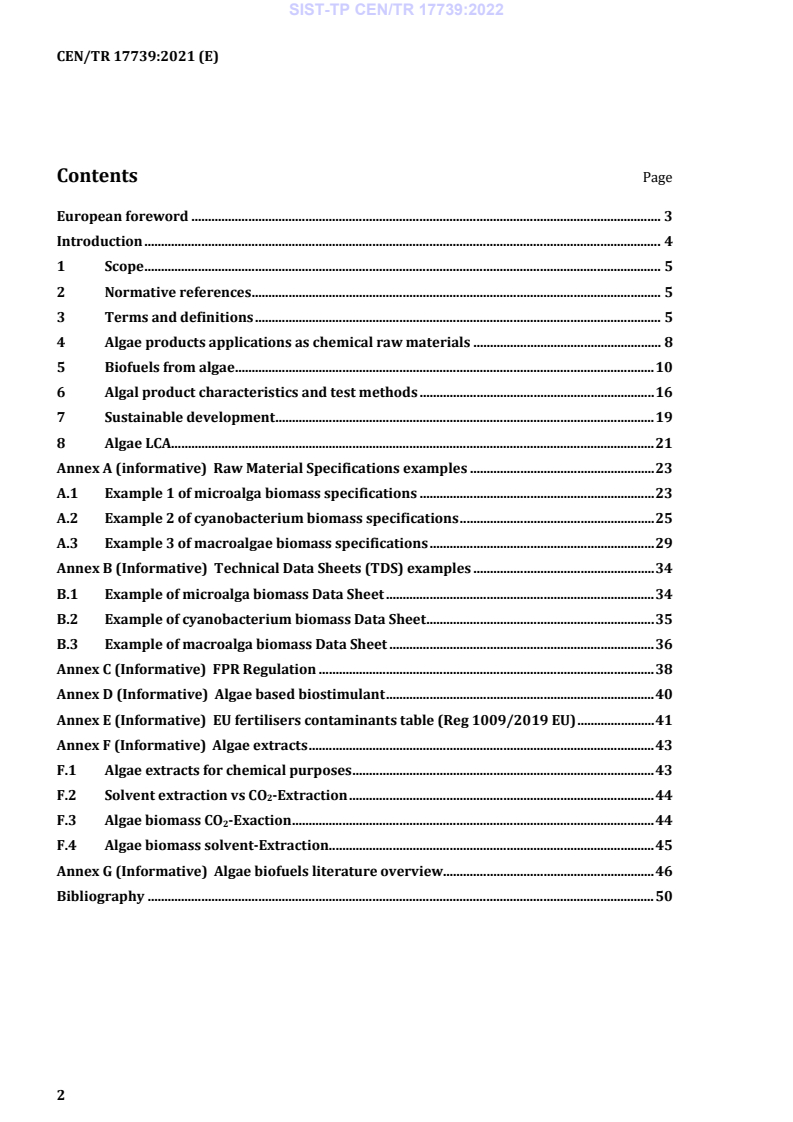
Contents Page
European foreword . 3
Introduction . 4
1 Scope . 5
2 Normative references . 5
3 Terms and definitions . 5
4 Algae products applications as chemical raw materials . 8
5 Biofuels from algae . 10
6 Algal product characteristics and test methods . 16
7 Sustainable development . 19
8 Algae LCA. 21
Annex A (informative) Raw Material Specifications examples . 23
A.1 Example 1 of microalga biomass specifications . 23
A.2 Example 2 of cyanobacterium biomass specifications . 25
A.3 Example 3 of macroalgae biomass specifications . 29
Annex B (Informative) Technical Data Sheets (TDS) examples . 34
B.1 Example of microalga biomass Data Sheet . 34
B.2 Example of cyanobacterium biomass Data Sheet . 35
B.3 Example of macroalga biomass Data Sheet . 36
Annex C (Informative) FPR Regulation . 38
Annex D (Informative) Algae based biostimulant . 40
Annex E (Informative) EU fertilisers contaminants table (Reg 1009/2019 EU) . 41
Annex F (Informative) Algae extracts . 43
F.1 Algae extracts for chemical purposes . 43
F.2 Solvent extraction vs CO -Extraction . 44
F.3 Algae biomass CO -Exaction . 44
F.4 Algae biomass solvent-Extraction . 45
Annex G (Informative) Algae biofuels literature overview. 46
Bibliography . 50
European foreword
This document (CEN/TR 17739:2021) has been prepared by Technical Committee CEN/TC 454 “Algae
and algae products”, the secretariat of which is held by NEN.
Attention is drawn to the possibility that some of the elements of this document may be the subject of
patent rights. CEN shall not be held responsible for identifying any or all such patent rights.
The European committee for Standardisation (CEN) was requested by the European Commission (EC) to
draft European standards or European standardisation deliverables to support the implementation of
Article 3 of Directive 2009/28/EC for algae and algae products or intermediates. The request presented
as Mandate M/547, also contributes to the Communication on “Innovating for Sustainable Growth: A Bio
economy for Europe”.
The former working group CEN Technical Board Working Group 218 “Algae” was created in 2016 to
develop a work programme as part of the Mandate. The technical committee CEN/ TC 454 “Algae and
algae products” was established to carry out the work program the secretariat of which is held by NEN.
CEN TC 454 set up a number of topic specific working Groups listed below to develop standards for algae
and algae products.
This document has been prepared by Working Group 5 “Specifications for the chemicals and fuels
applications sector” with the support of UNI as the secretariat, in close collaboration with the other CEN
TC 454 working groups:
CEN TC 454 WG 1 “Terminology”
CEN TC 454 WG 2 “Identification”
CEN TC 454 WG 3 “Productivity”
CEN TC 454 WG 4 “Specifications for food/feed sectors applications”
CEN TC 454 WG 6 “Product test methods”
The interest in algae and algae-based products or intermediates as a renewable and sustainable source
of carbohydrates, proteins, lipids and pigments has increased significantly in Europe.
Algae-based products and intermediates, in this TR referred to as ‘products’, are defined as whole
biomass, extracts or derivatives from algae, including algae oil and algal meal.
This document will allow the stakeholders to have access to a clear point of reference on the use of algae
in technical applications.
Algae as raw materials have specific challenges and show a wide potential from sustainability and blue
economy point of view. This document aims helping to fill this gap.
Any feedback and questions on this document should be directed to the users’ national standards body.
A complete listing of these bodies can be found on the CEN website.
According to the CEN/CENELEC Internal Regulations, the national standards organisations of the
following countries are bound to announce this Technical Specification: Austria, Belgium, Bulgaria,
Croatia, Cyprus, Czech Republic, Denmark, Estonia, Finland, France, Germany, Greece, Hungary, Iceland,
Ireland, Italy, Latvia, Lithuania, Luxembourg, Malta, Netherlands, Norway, Poland, Portugal, Republic of
North Macedonia, Romania, Serbia, Slovakia, Slovenia, Spain, Sweden, Switzerland, Turkey and the United
Kingdom.
Introduction
The interest in algae and algae-based products or intermediates as a renewable and sustainable source
of carbohydrates, proteins, lipids and pigments has increased significantly in Europe.
The biochemical composition of algae with regard to the ratio of usable components is unique and the
selected conversion pathway determines the kind of products that can be obtained.
Algae are available and used in many countries as fertiliser, biostimulant, animal feed, medicine, cosmetic
and food ingredients, and can provide different compounds depending on species. Due to the high interest
in replacing fossil feedstock for chemicals and fuels by biological ones, as algae, several pilot initiatives
have been undertaken in last decades. Results strongly vary, as many techno-economic parameters are
expected to influence the success of an algae related initiative.
Cultivation of algae has advantages over other sources of biomass, since they can be cultivated on
marginal lands and unused aquatic areas, generating new economic opportunities for poor soil and
aquatic areas, which would not have traditionally been used.
Due to their relatively simple cellular structure, algae have a large biomass productivity per unit area.
Algae are of great ecological importance, since they act in the capture of atmospheric CO and can be used
as wastewater treatment, due to their capacity to remove nutrients, as their growth requires sunlight,
water, CO and nutrients.
1 Scope
The purpose of this document is to provide an overview on how quality indicating parameters for algae
and algae products and intermediates relevant for chemical and bioenergy applications can be handled
and to identify the need for future standards development for chemicals, bioenergy and biofuels
applications.
This document does not provide instructions on handling of technical requirements in existing
legislations.
2 Normative references
The following documents are referred to in the text in such a way that some or all of their content
constitutes requirements of this document. For dated references, only the edition cited applies. For
undated references, the latest edition of the referenced document (including any amendments) applies.
EN 17399:2020, Algae and algae products - Terms and definitions
EN 14214, Liquid petroleum products - Fatty acid methyl esters (FAME) for use in diesel engines and heating
applications - Requirements and test methods
EN 590, Automotive fuels - Diesel - Requirements and test methods
EN 16734, Automotive fuels - Automotive B10 diesel fuel - Requirements and test methods
EN 16709, Automotive fuels - High FAME diesel fuel (B20 and B30) - Requirements and test methods
EN 16723-1, Natural gas and biomethane for use in transport and biomethane for injection in the natural
gas network - Part 1: Specifications for biomethane for injection in the natural gas network
EN 14103, Fat and oil derivatives - Fatty Acid Methyl Esters (FAME) - Determination of ester and linolenic
acid methyl ester contents
EN 17477, Algae and algae products - Identification of the biomass of microalgae, macroalgae,
cyanobacteria and Labyrithulomycetes - Detection and identification with morphological and/or molecular
methods
3 Terms and definitions
For the purposes of this document, the terms and definitions given in EN 17399:2020 and the following
apply.
ISO and IEC maintain terminological databases for use in standardization at the following addresses:
• IEC Electropedia: available at https://www.electropedia.org/
• ISO Online browsing platform: available at https://www.iso.org/obp
3.1
Raw Material Specification
RMS
technical dossier, several pages long, about the product, usually prepared by manufacturer, directed to
provide all product approval information to the customer and usually attached to commercial contract
Note 1 to entry: Examples of models of RMS for some algae categories are reported in Annex A.
3.2
Technical Data Sheet
TDS
technical document, one (or few) page long, showing the technical (bio- and physicochemical)
parameters adopted to characterize the product and therefore being the paradigm of the Certificate of
Analysis (CoA)
Note 1 to entry: It includes ranges of different parameters used to define the product characteristics or applicable
regulatory limits.
Note 2 to entry: Examples of Models of TDS for some algae categories are reported in Annex B.
Note 3 to entry: In cases where the producer wants to make statements regarding the algal product as a bio-based
product EN 16848 and EN 16935 should be used.
3.3
Certificate of Analysis
CoA
one (or few) page document issued from a laboratory (or laboratories) and reporting test results for a
specific lot, usually in front of TDS parameters, including references to test method
Note 1 to entry: It may or may not have legal value.
3.4
Material Safety Data Sheet
MSDS
SDS
document issued with the aim of providing information about product compliance in respect of human
health and safety at the workplace and protection of the environment
Note 1 to entry: The MSDS should comply with Reg 1907/2006 (REACH).
3.5
sustainable development
development that meets the environmental, social and economic needs of the present without
compromising the ability of future generations to meet their own needs
[SOURCE: ISO Guide 82:2019, definition 3.2]
3.6
extracts
products of liquid, solid or intermediate consistency, obtained from algal biomass and containing
components present in and/or derived from the algal biomass
Note 1 to entry: For some preparations, the biomass to be extracted undergoes a preliminary treatment, for
example, inactivation of enzymes, grinding or freezing.
3.7
energy from renewable sources
energy from renewable non-fossil sources, namely wind, solar (solar thermal and solar photovoltaic) and
geothermal energy, ambient energy, tide, wave and other ocean energy, hydropower, biomass, landfill
gas, sewage treatment plant gas and biogas
[SOURCE: Directive (EU) 2018/2001 of the European Parliament and of the Council of 11 December 2018
on the promotion of the use of energy from renewable sources (recast) [6]]
3.8
bioliquids
liquid fuel for energy purposes other than for transport, including electricity and heating and cooling,
produced from biomass
[SOURCE: Directive (EU) 2018/2001, ibid. [6]]
3.9
biofuels
liquid fuel for transport produced from biomass
[SOURCE: Directive (EU) 2018/2001, ibid. [6]]
3.10
advanced biofuels
biofuels which technology is more innovative and less mature that are produced from feedstock which
has low indirect land-use change impacts
Note 1 to entry: this feedstock includes algae if cultivated on land in ponds or photobioreactors.
[SOURCE: Directive (EU) 2018/2001, ibid. [6]]
3.11
biomass fuels
gaseous and solid fuels produced from biomass
[SOURCE: Directive (EU) 2018/2001, ibid. [6]]
3.12
biogas
gaseous fuels produced from biomass
[SOURCE: Directive (EU) 2018/2001, ibid. [6]]
3.13
guarantee of origin
an electronic document which has the sole function of providing evidence to a final customer that a given
share or quantity of energy was produced from renewable sources
[SOURCE: Directive (EU) 2018/2001, ibid. [6]]
3.14
low indirect land-use change-risk biofuels, bioliquids and biomass fuels
biofuels, bioliquids and biomass fuels, the feedstock of which was produced within schemes which avoid
displacement effects of food and feed-crop based biofuels, bioliquids and biomass fuels through improved
agricultural practices as well as through the cultivation of crops on areas which were previously not used
for cultivation of crops
Note 1 to entry: Crops which were produced in accordance with the sustainability criteria for biofuels, bioliquids
and biomass fuels laid down in Article 29 of Directive (EU) 2018/2001.
[SOURCE: Directive (EU) 2018/2001, ibid. [6]]
4 Algae products applications as chemical raw materials
4.1 General
For multi-constituent natural ingredients, with variable composition, it is essential that the producers
provide clearly defined specifications in view of the range of variability of the components.
The variability should not change significantly and minimum levels of active components should be
specified.
In cases where the producer wants to make statements regarding the algal product as a bio-based product
EN 16848 and EN 16935 should be used.
4.2 Bioplastics from algae
A considerable attention has been paid, in recent years, to alternative feedstock for bioplastics
production. Microbial production of exopolysaccharides (EPSs) is an interesting field of research, in view
of the increasing demand for natural biofilm products for medical, and industrial applications. Microalgal
EPSs have potential antioxidant, antibacterial, and emulsifying activities and may be potentially obtained
from direct extraction from algae. Specifically, polymers such as starch or polyhydroxyalkanoates (PHAs),
which are already being used in plastic production, are of interest. Starch on the other hand is not a
polymer with plastic properties. It can be modified with additives to achieve thermoplastic properties or
used as a filler in other plastics. Similarly, saccharides found in algae can be used as feedstock for the
production of building blocks for bio-based plastic, such as lactic and succinic acid [1] [2] [3].
Moreover, PHAs are widely produced by heterotrophic bacteria. These compounds can replace
commercial plastics, such as polyethylene and polypropylene, because of their high biodegradability and
biocompatibility. One of the best-studied and commercially available biopolymers is poly-b-
hydroxybutyrate (PHB) see Figure 1, which constitutes the intracellular components of microbial cells,
and that can be accumulated in significant amount under specific growth conditions. PHAs possess
inherent thermoplastic properties and will not need to be modified to create a plastic film.
Figure 1 — Chemical structure of P3HB
Properties will depend on the exact structure of the PHA, the purity of the extracted material, molecular
weight and the extracted amount of PHAs.
However, if a plastic is produced with PHAs and additives or fillers the degradation process can become
more complex.
Life-Cycle analysis has been a valuable tool to assess the environmental impact of bio-plastics along their
life cycle. Taking into account the various challenges of this field and the constant development, a specific
methodology was proposed in order to assess the potential environmental impacts of the use of
alternative feedstocks (biomass, recycled plastics, CO ) in comparison to current feedstocks (oil and gas)
[4].
EN 16760 "Bio-based products – Life cycle assessment" is applicable for bioplastics produced from algae,
see also clause 8.
Beside LCA issues, methodology for assessing standards for alternative feedstock for bioplastic
production is a field still under development. The current production relies on few feedstocks, and there
is a need to enlarge the basket of potential alternatives, if the sector aims to continue on the current
growth.
It could be of interest to focus the analysis of the current legislative framework on the availability of
quality standards for alternative feedstock, including algae as potential interesting and widely available
source.
4.3 Fertilisers
Fertilisers are defined and regulated by Reg 1009/2019 EU (Fertiliser Product Regulation, FPR) [5].
Whereas microalgae only recently got this application due to high cost, and mainly as biostimulants,
seaweeds have long history of use as fertilisers since 3000 BC thanks to availability from wild gathering,
which action improved the sea life environment and helped to prevent the accumulation of dead seaweed
on the shores and in the deep sea.
According to FPR, algae are included together with plants as i) raw material for EU fertiliser product or
ii) input material for the production of biogas in anaerobic fermenters, from which the digestate can be
contained in EU fertiliser product. However, in both cases cyanobacteria (“blue-green algae”) are
excluded; this gap excludes actually Arthospira sp. (Spirulina) from EU fertiliser and might be fixed by
appropriate amendment of FPR, e.g. inclusion of safe cyanobacteria in microorganism category. More
information about FPR is given in Annex C.
4.4 Biostimulants
Plant biostimulants are substances, mixtures and micro-organisms which, differently from straight
fertilisers, are not as such inputs of nutrients, but nevertheless stimulate plants’ natural nutrition
processes. They act in addition to fertilisers, with the aim of optimising the efficiency of those fertilisers
and reducing the nutrient application rates and are by nature more similar to fertilising products than to
most categories of plant protection products. Such products are therefore eligible for CE marking under
Reg 1009/2019 and excluded from the scope of Reg (EC) No 1107/2009 on Plant protection products
(e.g. pesticides).
Plant biostimulants constitute Product Function Category (PFC) 6 of fertilisers, products made to
stimulate plant nutrition processes independently of the product’s nutrient content with the sole aim of
improving one or more of the following characteristics of the plant or the plant rhizosphere:
a) nutrient use efficiency;
b) tolerance to abiotic stress;
c) quality traits; or
d) availability of confined nutrients in the soil or rhizosphere.
An example of main product requirements and conformity assessment for a plant biostimulant composed
of algae-based material (under FPR) to be marketed as EU fertiliser is given in Annex D.
A table of regulated contaminants filled from Reg 1009/2019 EU is given in Annex E.
5 Biofuels from algae
5.1 General
The product characteristics specified from clause 5.2 to clause 5.5 should comply with the relevant
standards and regulations.
In case the product characteristics are referred to algae and algae products raw materials, existing
standards are referenced when applicable and recommendations for possible developments provided.
In the current worldwide energy matrix, there is a strong dependence on non-renewable energy sources,
mainly coal, oil and natural gas. Considering the production of sustainable energy sources, the use of
biofuels has become an important alternative, due to a reduction in CO emissions into the atmosphere.
An overview on algae biofuels literature is given in Annex G.
Biomass production aimed for biofuels has general sustainability standards: ISO 13065 as well as
EN 16214-1, EN 16214-3 and EN 16214-4, where the first is applicable to all types of bioenergy.
Concerning liquid biofuels, it is usual to classify them as first, second and third generation. The most well-
known first-generation biofuel is ethanol, extracted from the fermentation of sugar and starch present in
plants in addition to biodiesel produced from oilseed plants. Second-generation biofuels are those
produced from the processing of the lignocellulosic fraction of biomass from higher plants. Biofuels from
algae are often mentioned as third generation.
Algae are explicitly mentioned in The Renewable Energy Directive recast (RED II) [6] as feedstock for the
production of biogas for transport and advanced biofuels, and can be counted twice if cultivated on land
in ponds or photobioreactors. Additionally, algae are listed in RED II as feedstock that can be processed
only with advanced technologies. Feedstock that can be processed into biofuels, or biogas for transport,
with mature technologies, such as used cooking oils and animal fats, have a share limited to 1,7% (energy
content).
Bioethanol, biohydrogen, biodiesel and biogas (biomethane) have been proposed from algae through
processes such as fermentation, dark fermentation/photobiological production, lipid
extraction/transesterification and anaerobic digestion, respectively. On the other hand, different
thermochemical processes have been proposed for algae, such as pyrolysis, gasification, torrefaction and
hydrothermal liquefaction, depending on process conditions (pressure, temperature, reaction time,
oxygen availability and feedstock water content, among others). Thermochemical conversion processes
yield bio-oil (which can be eventually converted in drop-in liquid biofuels), biogas/syngas and char.
There is still need for algae-based process development and intensification in order to make full use of
the wide range of bio-based products, biofuels and environmental services algae and algae products can
generate (such as CO2 and other GHG biosequestration, waste water treatment – phycoremediation- and
heavy metals tertiary treatment, among others). Besides bioenergy production from algae, a wide range
of commercially valuable bio-based products/materials and/or high added value products can be
extracted, fractionated and purified, following the biorefinery approach. For commercial viability, a
matrix approach leading to numerous products is preferred for successful operation of algal biorefineries.
5.2 Fuel specifications
Fuels are characterized by energy density and technical parameters related to engine suitability (e.g.
cetane or octane number, impurities, ash content, oxidation stability, etc.).
No algae fuels are currently present in the market even if several Institutions (EU Commission, U.S.
Department of Energy) are interested and several Companies are working on that topic. According to
available literature, algae derived fuel feedstock allow for entering in already developed conversion
pathways, e.g. gaseous fuels like biomethane, and liquid fuels for diesel substitution like biodiesel or
alternative fuels for aviation sector.
It is worth to note that algae are considered for their photosynthetic potential as alternatives to terrestrial
plants (the actual main source of biodiesel, hydrogenated vegetable oil (HVO) and biogas besides waste
products) whereby the carbon-based molecule is biosynthesized converting solar energy in chemical
energy. Algae have neither to be considered as an intermediate nor as a finished fuel, but as a raw material
for certified fuels production, therefore no algae specific standards have to be mentioned in this section.
NOTE The only relevant exemption is represented by the aviation sector. In aviation not only the final fuel, but
also the conversion process has to be fully certified.
The American Society for Testing and Materials (ASTM) issued two technical norms regulating the sector:
ASTM D4054 (Standard Practice for Qualification and Approval of New Aviation Turbine Fuels and Fuel
Additives), which describes the qualification process for an alternative fuel to be considered compliant
for use in ASTM D7566– 17a (Standard Specification for Aviation Turbine Fuel Containing Synthesized
Hydrocarbons).
Currently eight production pathways are already fully certified for blending with fossil aviation jet fuel.
These aviation biofuels are drop-in fuels: they can be directly blended with fossil (ASTM D1655:
Specification for Aviation Turbine Fuels) but with different blending limits.
At the time of writing, no specific algae-based pathway results certified for aviation [7].
5.3 Liquid biofuels from algae
5.3.1 General
A first categorisation of liquid fuels can be performed on the base of their possibility to be directly mixed
to regular fuel without specific limitations. The term “drop-in” fuel is generally used to describe an
alternative fuel, that can be blended into a regular fuel, without compromising any functionality of the
engine. Hydrogenated Vegetable Oil (HVO) is usually recognised as a drop-in fuel, while biodiesel and
bioethanol are not.
The final characteristics of the alternative fuels, which derive from the feedstock/conversion process
couple, determines whether the final product can be considered a drop-in fuel or has to respect a blending
limit.
Liquid fuels from algae currently under development can be divided in two main groups, e.g. fuels derived
from algae oil (biodiesel, HVO) and alcohols, usually ethanol, obtained by fermentation of algae
carbohydrates. In principle, alcohols and other algae derived molecules can be used to synthesize drop-
in liquid fuels (i.e. Fischer-Tropsch fuels from algal biomethane, jet fuel from algal alcohols).
5.3.2 Product characteristics of liquid fuels from algae lipids
5.3.2.1 General
The lipid content in microalgae is very diverse. The cell structure, cell wall characteristics, the lipid
binding with proteins and carbohydrates and lipids for energy storage vary from species to species and
even within species depending on cultivation (culture age, growth phase and nutrient availability) or
extraction condition. The extraction methods will affect not only the total extraction yield, but, in some
cases, the fatty acid profile, especially when extraction yield is low. Therefore, a general recommendation
on a specific algae or extraction method cannot be given. However, heterotrophic algae and phototrophic
algae under starvation (metabolic induction, e.g. by nitrogen depletion in the last culture phase) are
known to have increased lipid content.
5.3.2.2 Algae lipids
Algae lipids are defined as class of natural organic substances characterized by very low water solubility,
high solubility in organic solvents, high carbon and hydrogen content, biosynthesized for energy storage
and/or metabolic and structural functions. Several test methods for total lipids content of marine tissues
were applied to algae since the fifties (Bligh&Dyer [8], Folch [9], Smedes [10]) ending in the highly
recommended need for a standard, which is currently developed in CEN/TC 454, see below, and the one
described in clause 6.7.
5.3.2.3 Algae oil
Algae oil is defined as glyceridic fraction of lipids derived from algae (EN 17399:2020, 3.2).
The detailed composition and molecular profile of lipids is required for reporting on oil quality and
biomass valorisation and will be highly influential when targeting particular bioproduct markets, for
example for biodiesel or green diesel. Not all lipids can be considered equally valuable for fuel or even
food or feed applications. The lipid composition, with respect to polar (phospho- and glycolipids) and
non-polar (triglycerides and sterols) lipids and the respective impurities found in each fraction, is highly
dependent on the origin and type of biomass. Autotrophically grown algae are rich in polar lipids, waxes,
sterols, and pigments, whereas heterotrophic cultivation will yield triglyceride-rich oil similar to plant-
derived oils, but often with very different fatty-acid profiles. Traditionally, lipids have been measured
gravimetrically after solvent extraction. The completeness of extraction depends on composition,
therefore on the biochemistry of the alga and on the recent physiological conditions experienced by the
organism. Therefore the extraction solvent polarity must cope with the lipid molecule polarity and the
extraction conditions used, in order to avoid inconsistent lipid yields. Inevitably, the extractable oil
fraction will contain non-fuel components (e.g. chlorophyll, other pigments, proteins, and soluble
carbohydrates). Thus, it may be very useful to assess its fuel fraction (i.e. fatty acid content) by
transesterification followed by quantification of the fatty acid methyl esters (FAMEs). However, due to
the large number of variables, it is necessary to standardize the extraction-based total lipid quantification
procedure [11] in order to be in position to refer the fatty acids content to lipids and not only to whole
biomass. There are two extraction systems currently in use across analytical laboratories: conventional
Soxhlet extractor systems and the Randall extraction systems with the more recently developed
pressurized fluid extraction systems. However modified Bligh-Dyer [13] or Smedes [10] dual solvents
extraction method were recommended for complex matrixes of marine origin such as fish tissue [11]
[12]. Since most microalgae and seaweeds are marine organisms and show lipids patterns similar to fish
tissue and very different from terrestrial oilseeds, a more powerful extraction system than Soxhlet and
its variations is necessary. Immersion extraction and sonication over freeze dried test portions provided
best accuracy and precision with appropriate and well standardized protocol which was demonstrated
to work also with algae showing composition similar to oilseeds, such as heterotrophs. [13]. The basic
principles of such protocol are: 1) to extract quantitatively all lipids by proper mixed solvent
(chloroform/methanol), high solvent/solid ratio and multiple washes, 2) to purify the extract by removal
of non-lipids fractions through liquid-liquid purification. For certain microalgae with a very hard cell wall,
a pre-treatment of bead beating is provided.
This protocol is going to become the new standard as the reference test method for total lipid content.
As an alternative to extraction, for routinary purposes of multiple testing of the same alga there is a
growing emphasis on the quantification of lipids through a direct (or in situ) transesterification of whole
algal biomass and to application of rapid indirect measurement of lipids by near infrared spectroscopy
(NIR) and nuclear resonance spectroscopy (NMR).
However this methods have two major drawbacks: 1) the need for case by case calibration by absolute
method (e.g. extraction and gravimetry) and 2) the need of sophisticated and expensive apparatuses.
Finally, qualitative or semi-quantitative (after calibration) lipids data can be gathered through high-
throughput methodologies that are based on hydrophobic (lipophilic) fluorescent dyes such as Nile Red
[14].
While fatty acids measurement by direct transesterification and gas chromatography (GC) cannot
substitute extraction for total lipids, it is a powerful tool for algae oil quality characterization. The process
consists of either a two-step alkaline and subsequent acid hydrolysis of the biomass, or a single-step acid
catalysis, followed by the methylation of the fatty acids to fatty acids methyl esters (FAME) and
quantification by GC. These procedures have been demonstrated to be robust across species and their
efficacy is less dependent on the parameters listed above that influence lipid extraction. However, if the
relative composition of intact lipids is required (e.g. polar versus neutral lipid content), an extraction
process may be the only way to isolate intact lipids from the rest of the biomass, with the utilization of
advanced instrumentation, such as liquid chromatography for the characterization of the lipid molecular
profile.
Fatty acid profile and content of vegetable fats and oils can be measured according the standards of
ISO 12966. It is strongly recommended that for fatty acids determination in algae ISO 12966 is examined.
5.3.3 Algae oil for biodiesel
5.3.3.1 General
Algae oil, i.e. fatty acids, either free or bound (on glycerol), could be converted into FAME, also known as
biodiesel. The product shall comply with the biodiesel standard EN 14214 for its usage, either pure or as
blending component for a diesel fuel according EN 590, EN 16734 or EN 16709.
The share of FAME in mineral diesel is limited in EN 590 to 7,0 %v/v, in EN 16734 to maximum of 10,0
%v/v and in EN 16709 to a maximum of 30,0 %v/v.
Several parameters of EN 14214 are related to the fatty acid profile of the raw material, as they will not
be changed significantly in the biodiesel process. As consequence, these parameters should already be
fulfilled by the algae oil, or the algae oil should be blended with other fats and oils to meet the parameters.
5.3.3.2 Fatty acid profile
The fatty acid profile related parameters should be fulfilled in the final biodiesel according to EN 14214.
As unsaturated fatty acids are vulnerable for oxidation, they are limited by several parameters. Oxidation
products can damage the engine [15]. However, due to this oxidizability, biodiesel is more easily
biodegradable than fossil fuels.
5.3.3.3 Other chemical parameters of oils
The iodine value is a measure for the content of unsaturated fatty acids. It describes the mass of halogen,
expressed as iodine, absorbed by the test portion when determined in accordance with the procedure
specified in EN ISO 3961, divided by the mass of the test portion [16]. The limit for the iodine value is
maximum 120 g iodine /100 g. The iodine can be measured according to EN ISO 3961 by titration or
EN 16300 via the fatty acid profile.
The linolenic acid methyl ester (C18:3) content is limited with maximum 12,0 %(m/m). In the final
product it should be measured according EN 14103.
The content of polyunsaturated methyl ester (PUFA) shall be below 1,0 %(m/m), whereas in this case
polyunsaturated is defined as “more or equal 4 double bounds” in the fatty acid chain. Its content is
measured according EN 15779 which covers the usual predominant four PUFA (C20:4, C20:5, C22:5,
C22:6). Short chain PUFA, which might be present in algae oil, e.g. C16:4, are not considered but might
have an influence on the oxidation stability of the fuel.
The oxidation stability [15] is related to the fatty acid profile and to the presence of natural antioxidants
in the oil. However, if a distillation is required as purification step of the FAME, natural antioxidants will
remain in the distillation residue and therefore oxidation stabilizer must be added to the distilled
product.
Saturated fatty acids influence the cold weather properties, the cold filter plugging point (CFPP) and the
cloud point (CP). The cold filter plugging point is the highest temperature at which a given volume of fuel
fails to pass through a standardized filtration device in a specific time, when cooled under standardized
conditions as described in EN 16329.
The CP is the temperature at which a cloud of crystals first appears in a liquid when it is cooled under
specific conditions as described in EN ISO 3015. Both values are lowered with increasing content of
saturated FAME. The limit for CFPP is given for biodiesel usage as 100% fuel, the CP of biodiesel is
required to use it as blending component.
The climate-depending requirements are set for seasonal grades by the national standardization bodies
and can be found in the national annex of EN 14214.
The ester content of the final product shall be higher than 96,5 %m/m, it is measured according
EN 14103. This method is based on the usage of a C19:0 methyl ester as internal standard, this fatty acid
is not present in vegetable oils or animal or waste fats. However, it is recommended to check the algae oil
for that specific C19:0 FAME. Its presence in the algae oil may reduce the result of the ester content
significantly.
The ester content may also be reduced by other algae lipids co-extracted especially when polar lipids
were used. These lipids may contain a lower amount of fatty acids. Additionally a high content of
unsaponifiable matter (see 6.9 below) may reduce the ester content. A distillation may reduce these kinds
of lipids so that the distilled product has an increased ester content.
Several other parameters can be found in high concentrations in algae oil, which are limited in biodiesel.
5.3.3.4 Phosphorous
Phosphorous is originated from phospholipids membrane lipids of the algae. Its content is also influenced
by the polarity of the extraction solvent. A high content of phospholipids may hinder required phase
separation in the biodiesel process. As the final content in FAME must be below 4 mg/kg according to
EN 14214, special attention shall be taken in the purification of the FAME. Rectification, a multi stage
distillation, can be used to appropriately reduce the phosphorous content.
5.3.3.5 Sulphur
The limit of sulphur in FAME is maximum 10,0 mg/kg and can be much higher in algae oil due to the
presence of sulpholipids. It can also be reduced by a rectification unit.
5.3.3.6 Magnesium
Magnesium is limited in the FAME together with calcium as metals II with a maximum 5,0 mg/kg.
Magnesium can be present in significant amounts in algae oil since it is present in chlorophyll, which is
co-extracted with the oil from the biomass.
In FAME, it can be removed by distillation as it remains in the distillation residue.
5.3.4 Algae oil for hydrogenation
Hydrogenation is a process in which hydrogen is chemically bound to the algal oil. The process involves
the usage of hydrogen at high pressure in the presence of a catalyst. The product of this process is called
“paraffinic diesel fuel from synthesis or hydrogenation” and is specified in EN 15940.
In contrast to biodiesel there will be no oxygen in the product, which contain only hydrocarbons, the fatty
acid profile has no influence on the product quality. The cold weather properties of the hydrogenated
algae oil may allow its usage as aviation fuel.
The hydrogenation catalyst is sensitive to metals, e.g. magnesium from co-extracted chlorophyll.
Especially phosphorous may reduce the lifetime of the catalyst enormously, so that only a few ppm is
recommended.
It would be possible to use a distilled biodiesel as raw material for hydrogenation as the most unwanted
impurities are already removed during the final purification.
Details considering maximum allowable contamination with metals and phosphorous must be discussed
with the catalyst supplier.
5.4 Algae for alcohols
As algae can store relevant amounts of carbohydrates/polysaccharides, they have been considered as a
source of alcohol production, including ethanol, butanol and others [17] [18] [19] [20]. Ethanol from
fermentation is widely produced, and feedstock for this process is typically characterized by its sugar
content.
Main technological challenges for converting algae into alcohol are related to pre-treatment. For
terrestrial biomass, biomass pre-treatment aims at separating and providing easier access to th
...