

SIST EN 15593:2008
Packaging - Management of hygiene in the production of packaging for foodstuffs - Requirements
General Information
- Abstract
This European Standard specifies requirements for a hygiene management system for manufacturers and suppliers of food packaging including storage and transportation.
This European Standard enables an organization to:
- plan, design, implement, operate, maintain and update a hazard analysis and risk assessment system that ensures the production of food packaging materials conforming with the hygiene requirements;
- demonstrate conformity with agreed customers’ hygiene requirements;
- demonstrate the effectiveness of the system;
- help food manufacturers to provide adequate evidence to compliance with food and packaging safety regulations;
- ensure that it complies with its stated hygiene policy;
- demonstrate such compliance to other interested parties;
- seek registration or certification of its food packaging hygiene management system by an external organization.
This European Standard can be applied to all organizations wishing to implement an adequate and effective hygiene management system in the field of food packaging manufacturing including producers and suppliers of materials and services to the packaging manufacturers.
It is intended that this European Standard be applied in conjunction with a quality management system such as EN ISO 9001.
It may be appropriate to apply this European Standard to other articles and items coming into contact with food and to packaging of products other than food.
- Status
- Published
- Publication Date
- 05-Aug-2008
- Technical Committee
- EPO - Packaging - sales and grouped
- Current Stage
- 6060 - National Implementation/Publication (Adopted Project)
- Start Date
- 10-Jul-2008
- Due Date
- 14-Sep-2008
- Completion Date
- 06-Aug-2008


Overview
EN 15593:2008 - "Packaging - Management of hygiene in the production of packaging for foodstuffs - Requirements" is a European Standard published by CEN that specifies requirements for a hygiene management system for manufacturers and suppliers of food packaging, including storage and transportation. The standard helps organizations plan, implement and maintain a hazard analysis and risk assessment system to ensure packaging hygiene and demonstrate conformity with customer and regulatory hygiene expectations.
Key Topics and Requirements
EN 15593 is built around management-system principles and hazard analysis. Major technical topics include:
- Hygiene management system: top management responsibility, hygiene policy, management review, resource allocation and appointing a competent hygiene coordinator.
- Document and record control: approved, current documents and retention of records for foreseeable shelf-life of packaged food.
- Specifications: defined and reviewed specifications for incoming materials and finished products, agreed with interested parties where appropriate.
- Hazard analysis & risk assessment: planning, implementation and updating of hazard analysis covering procurement, production, storage and delivery.
- Control of nonconformities and incidents: incident definitions, corrective actions, reporting and record keeping.
- Traceability, internal audits, complaints and supplier approval/outsourcing: procedures to ensure product integrity through the supply chain.
- Product monitoring: measurements and evidence to demonstrate system effectiveness.
- Sources of contamination: management of physical, chemical and biological contaminants; cleaning, maintenance, scrap and waste handling.
- Factory & personnel requirements: site layout, buildings, equipment, facilities, access routes, work clothes, hygiene facilities, visitor controls and health/injury procedures.
- Recall preparedness: procedures to retrieve potentially hazardous products.
Applications and Who Uses It
EN 15593 is intended for:
- Manufacturers of food packaging (primary, secondary, tertiary)
- Suppliers of packaging materials and services
- Packaging converters, printers and pack-fill equipment suppliers
- Quality, EHS and regulatory compliance managers seeking certification or registration of a packaging hygiene management system
- Food manufacturers requiring supplier hygiene evidence
Practical uses:
- Implementing a structured hygiene program integrated with quality systems
- Demonstrating compliance to customers and regulators for food-contact packaging
- Supporting supplier audits, supplier approval and traceability requirements
- Reducing contamination risks across production, storage and transport
Related Standards
- EN ISO 9000 / EN ISO 9001 (quality management compatibility)
- EN ISO 22000 (food safety management systems) - EN 15593 aligns with food-chain principles and can be applied alongside these standards.
Keywords: EN 15593, packaging hygiene, hygiene management system, food packaging, hazard analysis, risk assessment, traceability, CEN, EN ISO 9001, EN ISO 22000.
Relations
- Effective Date
- 28-Jan-2026
- Refers
SIST EN ISO 9000:2005 - Quality management systems - Fundamentals and vocabulary (ISO 9000:2005) - Effective Date
- 28-Jan-2026
- Effective Date
- 28-Jan-2026
- Referred By
SIST EN ISO 19131:2008 - Geographic information - Data product specifications (ISO 19131:2007) - Effective Date
- 28-Jan-2026
- Effective Date
- 28-Jan-2026
- Referred By
SIST EN ISO 19128:2008 - Geographic information - Web map server interface (ISO 19128:2005) - Effective Date
- 28-Jan-2026
- Effective Date
- 28-Jan-2026
- Effective Date
- 28-Jan-2026
- Effective Date
- 28-Jan-2026
- Effective Date
- 28-Jan-2026
Get Certified
Connect with accredited certification bodies for this standard

BSI Group
BSI (British Standards Institution) is the business standards company that helps organizations make excellence a habit.

Bureau Veritas
Bureau Veritas is a world leader in laboratory testing, inspection and certification services.

DNV
DNV is an independent assurance and risk management provider.
Sponsored listings
Frequently Asked Questions
SIST EN 15593:2008 is a standard published by the Slovenian Institute for Standardization (SIST). Its full title is "Packaging - Management of hygiene in the production of packaging for foodstuffs - Requirements". This standard covers: This European Standard specifies requirements for a hygiene management system for manufacturers and suppliers of food packaging including storage and transportation. This European Standard enables an organization to: - plan, design, implement, operate, maintain and update a hazard analysis and risk assessment system that ensures the production of food packaging materials conforming with the hygiene requirements; - demonstrate conformity with agreed customers’ hygiene requirements; - demonstrate the effectiveness of the system; - help food manufacturers to provide adequate evidence to compliance with food and packaging safety regulations; - ensure that it complies with its stated hygiene policy; - demonstrate such compliance to other interested parties; - seek registration or certification of its food packaging hygiene management system by an external organization. This European Standard can be applied to all organizations wishing to implement an adequate and effective hygiene management system in the field of food packaging manufacturing including producers and suppliers of materials and services to the packaging manufacturers. It is intended that this European Standard be applied in conjunction with a quality management system such as EN ISO 9001. It may be appropriate to apply this European Standard to other articles and items coming into contact with food and to packaging of products other than food.
This European Standard specifies requirements for a hygiene management system for manufacturers and suppliers of food packaging including storage and transportation. This European Standard enables an organization to: - plan, design, implement, operate, maintain and update a hazard analysis and risk assessment system that ensures the production of food packaging materials conforming with the hygiene requirements; - demonstrate conformity with agreed customers’ hygiene requirements; - demonstrate the effectiveness of the system; - help food manufacturers to provide adequate evidence to compliance with food and packaging safety regulations; - ensure that it complies with its stated hygiene policy; - demonstrate such compliance to other interested parties; - seek registration or certification of its food packaging hygiene management system by an external organization. This European Standard can be applied to all organizations wishing to implement an adequate and effective hygiene management system in the field of food packaging manufacturing including producers and suppliers of materials and services to the packaging manufacturers. It is intended that this European Standard be applied in conjunction with a quality management system such as EN ISO 9001. It may be appropriate to apply this European Standard to other articles and items coming into contact with food and to packaging of products other than food.
SIST EN 15593:2008 is classified under the following ICS (International Classification for Standards) categories: 55.020 - Packaging and distribution of goods in general; 67.020 - Processes in the food industry. The ICS classification helps identify the subject area and facilitates finding related standards.
SIST EN 15593:2008 has the following relationships with other standards: It is inter standard links to SIST EN ISO 22000:2005, SIST EN ISO 9000:2005, SIST EN ISO 19115:2005, SIST EN ISO 19131:2008, SIST EN ISO 19123:2007, SIST EN ISO 19128:2008, SIST EN ISO 19125-1:2006, SIST EN ISO 19133:2007, SIST EN ISO 19137:2008, SIST EN ISO 19112:2005. Understanding these relationships helps ensure you are using the most current and applicable version of the standard.
SIST EN 15593:2008 is available in PDF format for immediate download after purchase. The document can be added to your cart and obtained through the secure checkout process. Digital delivery ensures instant access to the complete standard document.
Standards Content (Sample)
SLOVENSKI STANDARD
01-september-2008
Embalaža - Obvladovanje higiene v proizvodnji embalaže za živila - Zahteve
Packaging - Management of hygiene in the production of packaging for foodstuffs -
Requirements
Verpackung - Hygienemanagement bei der Herstellung von Lebensmittelverpackungen -
Anforderungen
Emballages - Management de l'hygiene dans la fabrication des emballages destinés aux
denrées alimentaires - Exigences
Ta slovenski standard je istoveten z: EN 15593:2008
ICS:
55.020 Pakiranje in distribucija blaga Packaging and distribution of
na splošno goods in general
67.020 Procesi v živilski industriji Processes in the food
industry
2003-01.Slovenski inštitut za standardizacijo. Razmnoževanje celote ali delov tega standarda ni dovoljeno.
EUROPEAN STANDARD
EN 15593
NORME EUROPÉENNE
EUROPÄISCHE NORM
March 2008
ICS 55.020; 67.020
English Version
Packaging - Management of hygiene in the production of
packaging for foodstuffs - Requirements
Emballages - Management de l'hygiène dans la fabrication Verpackung - Hygienemanagement bei der Herstellung von
des emballages destinés aux denrées alimentaires - Lebensmittelverpackungen - Anforderungen
Exigences
This European Standard was approved by CEN on 7 February 2008.
CEN members are bound to comply with the CEN/CENELEC Internal Regulations which stipulate the conditions for giving this European
Standard the status of a national standard without any alteration. Up-to-date lists and bibliographical references concerning such national
standards may be obtained on application to the CEN Management Centre or to any CEN member.
This European Standard exists in three official versions (English, French, German). A version in any other language made by translation
under the responsibility of a CEN member into its own language and notified to the CEN Management Centre has the same status as the
official versions.
CEN members are the national standards bodies of Austria, Belgium, Bulgaria, Cyprus, Czech Republic, Denmark, Estonia, Finland,
France, Germany, Greece, Hungary, Iceland, Ireland, Italy, Latvia, Lithuania, Luxembourg, Malta, Netherlands, Norway, Poland, Portugal,
Romania, Slovakia, Slovenia, Spain, Sweden, Switzerland and United Kingdom.
EUROPEAN COMMITTEE FOR STANDARDIZATION
COMITÉ EUROPÉEN DE NORMALISATION
EUROPÄISCHES KOMITEE FÜR NORMUNG
Management Centre: rue de Stassart, 36 B-1050 Brussels
© 2008 CEN All rights of exploitation in any form and by any means reserved Ref. No. EN 15593:2008: E
worldwide for CEN national Members.
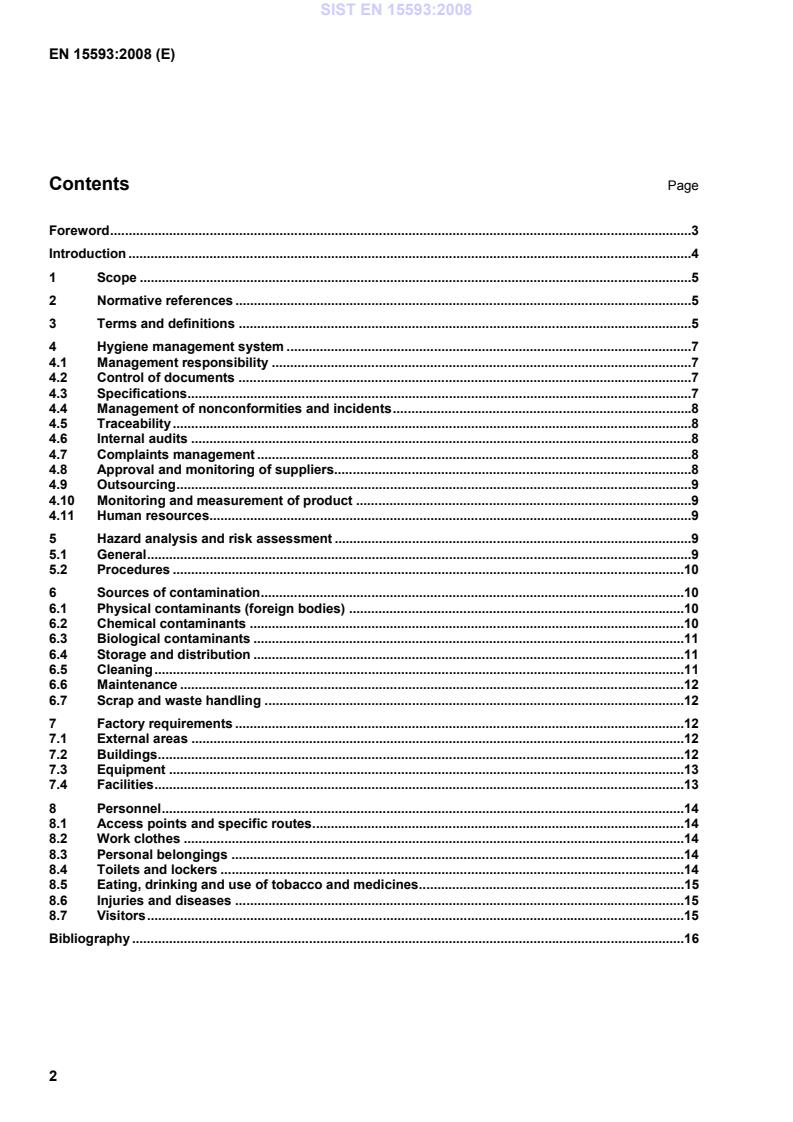
Contents Page
Foreword.3
Introduction .4
1 Scope.5
2 Normative references.5
3 Terms and definitions .5
4 Hygiene management system .7
4.1 Management responsibility.7
4.2 Control of documents .7
4.3 Specifications.7
4.4 Management of nonconformities and incidents.8
4.5 Traceability.8
4.6 Internal audits.8
4.7 Complaints management.8
4.8 Approval and monitoring of suppliers.8
4.9 Outsourcing.9
4.10 Monitoring and measurement of product .9
4.11 Human resources.9
5 Hazard analysis and risk assessment .9
5.1 General.9
5.2 Procedures.10
6 Sources of contamination.10
6.1 Physical contaminants (foreign bodies) .10
6.2 Chemical contaminants.10
6.3 Biological contaminants.11
6.4 Storage and distribution.11
6.5 Cleaning.11
6.6 Maintenance.12
6.7 Scrap and waste handling .12
7 Factory requirements.12
7.1 External areas.12
7.2 Buildings.12
7.3 Equipment.13
7.4 Facilities.13
8 Personnel.14
8.1 Access points and specific routes.14
8.2 Work clothes.14
8.3 Personal belongings.14
8.4 Toilets and lockers .14
8.5 Eating, drinking and use of tobacco and medicines.15
8.6 Injuries and diseases .15
8.7 Visitors.15
Bibliography .16
Foreword
This document (EN 15593:2008) has been prepared by Technical Committee CEN/TC 261 “Packaging”, the
secretariat of which is held by AFNOR.
This European Standard shall be given the status of a national standard, either by publication of an identical
text or by endorsement, at the latest by September 2008, and conflicting national standards shall be
withdrawn at the latest by September 2008.
Attention is drawn to the possibility that some of the elements of this document may be the subject of patent
rights. CEN [and/or CENELEC] shall not be held responsible for identifying any or all such patent rights.
According to the CEN/CENELEC Internal Regulations, the national standards organizations of the following
countries are bound to implement this European Standard: Austria, Belgium, Bulgaria, Cyprus, Czech
Republic, Denmark, Estonia, Finland, France, Germany, Greece, Hungary, Iceland, Ireland, Italy, Latvia,
Lithuania, Luxembourg, Malta, Netherlands, Norway, Poland, Portugal, Romania, Slovakia, Slovenia, Spain,
Sweden, Switzerland and the United Kingdom.
Introduction
All manufacturers of food packaging recognize the increasing need to demonstrate and provide adequate
evidence of their ability to identify and control hygiene hazards related to their products.
Packaging hygiene is a joint responsibility that is principally assured through the combined efforts of all the
parties participating in the chain.
Communication along the food packaging chain is essential to ensure that all relevant packaging hygiene
hazards are identified and adequately controlled.
This European Standard is based on the principles of hazard analysis and risk assessment.
This European Standard provides for the definition of the appropriate level of controls and measures for each
stage in the manufacturing process.
The most effective food packaging hygiene systems are designed, operated and updated within the
framework of a structured management system and incorporated into the overall management activities of the
organization. This provides maximum benefit for the organization and interested parties.
This European Standard has taken due consideration of the provisions of the EN ISO 9000 series in order to
enhance the compatibility of the two standards.
This European Standard may be applied independently from other management system standards. Its
implementation can be aligned or integrated with existing related management system requirements while
organizations may utilize existing management system(s) to establish a food packaging hygiene management
system that complies with the requirements of this European Standard.
This European Standard is a document describing both management system and hygiene practices for
packaging manufacturers considering themselves as an organization within the food chain as described in EN
ISO 22000.
This European Standard does not purport to address the compulsory conformity of packaging to food contact
regulations.
It is expected that the user of this European Standard has knowledge of applicable food contact regulations.
1 Scope
This European Standard specifies requirements for a hygiene management system for manufacturers and
suppliers of food packaging including storage and transportation.
This European Standard enables an organization to:
plan, design, implement, operate, maintain and update a hazard analysis and risk assessment system
that ensures the production of food packaging materials conforming with the hygiene requirements;
demonstrate conformity with agreed customers’ hygiene requirements;
demonstrate the effectiveness of the system;
help food manufacturers to provide adequate evidence to compliance with food and packaging safety
regulations;
ensure that it complies with its stated hygiene policy;
demonstrate such compliance to other interested parties;
seek registration or certification of its food packaging hygiene management system by an external
organization.
This European Standard can be applied to all organizations wishing to implement an adequate and effective
hygiene management system in the field of food packaging manufacturing including producers and suppliers
of materials and services to the packaging manufacturers.
It is intended that this European Standard be applied in conjunction with a quality management system such
as EN ISO 9001.
It may be appropriate to apply this European Standard to other articles and items coming into contact with
food and to packaging of products other than food.
2 Normative references
The following referenced documents are indispensable for the application of this document. For dated
references, only the edition cited applies. For undated references, the latest edition of the referenced docu-
ment (including any amendments) applies.
EN ISO 9000:2005, Quality management systems – Fundamentals and vocabulary (ISO 9000:2005)
EN ISO 22000:2005, Food safety management systems – Requirements for any organization in the food
chain (ISO 22000:2005)
3 Terms and definitions
For the purposes of this document, the terms and definitions given in EN ISO 9000:2005, EN ISO 22000:2005
and the following apply.
3.1
contaminant
any biological (including microbiological) or chemical agent or foreign matter or other substances not
intentionally added which may compromise product safety or suitability
3.2
contamination
introduction or occurrence of a contaminant
3.3
hazard
biological, chemical or physical contaminant in the product, or a condition of the product that may cause an
adverse health effect or a nonconformity to the hygiene requirements for that product
3.4
hygiene
set of measures taken to ensure the safety and suitability of a product that might otherwise become
hazardous or harmful
3.5
incident
event that may potentially compromise the safety and suitability of a material or product
3.6
outsourced activity
any activity subcontracted by an organization to an external organization
3.7
packaging
any kind of product or material used by the packaging industry to wrap, pack, protect, handle or transport its
own product
3.8
product
physical final output of any kind of production process that takes place in the packaging industry.
NOTE This includes products that undergo further production steps to fulfil the specification defined by the filler/packer.
3.9
recall procedure
procedure to ensure the efficient return of products identified as potentially having a nonconformity that could
present a hazard
3.10
risk
function of the probability of the possible occurrence of a hazard and the severity of its outcome
3.11
safety
condition of a product being free from unacceptable risk of harm
3.12
specification
explicit or detailed description of a material, product or service including hygiene aspects
3.13
top management
person or group of people who directs and controls an organization at the highest level
4 Hygiene management system
4.1 Management responsibility
4.1.1 Top management shall define its hygiene policy which shall state its commitment to develop and
implement a hygiene management system to ensure that it meets its obligations to produce safe products and
shall communicate this effectively through the organization. It shall conduct management reviews at planned
intervals and at least once a year and shall ensure the availability of resources in accordance with the
requirements of this document.
4.1.2 The organization shall apply hazard analysis and risk assessment to every stage from procurement to
delivery of the product to determine the application of this document.
4.1.3 Top management shall appoint a competent person responsible for implementing and maintaining the
hygiene management system.
4.1.4 A manual defining the scope of the system including the documented procedures or references to
them shall be established by the organization. The scope shall specify the products or product categories,
processes and production sites that are addressed by the hygiene management system.
4.1.5 The organization shall establish documents needed to ensure the effective planning, operation and
control of processes related to hygiene and to recalls.
4.1.6 The organization shall periodically review customer feedback, audit results and follow-up actions.
4.1.7 Top management shall ensure that responsibilities and authorities are defined. Duties of personnel
that relate to this document shall be provided in job descriptions or other suitable documents.
4.1.8 Top management shall ensure that appropriate communication processes are in place within the
organization.
4.1.9 The organization shall have a plan for cleaning and maintenance.
4.1.10 The requirements of this document shall also apply to contractors and temporary personnel.
4.2 Control of documents
4.2.1 The organization shall have a procedure to control documents and records.
4.2.2 Documents shall be properly approved, reviewed and updated with changes and current version
status identified. They shall be made available at the point of use.
4.2.3 Records shall be maintained to provide evidence of the effective operation of the hygiene
management system and retained for a period covering the normal and foreseeable shelf life of the packaged
food.
4.3 Specifications
4.3.1 The organization shall establish and regularly review specifications for incoming materials and for
products.
4.3.2 Where appropriate, the specifications shall be agreed between the organization and the interested
parties.
4.4 Management of nonconformities and incidents
4.4.1 The organization shall have procedures for dealing with nonconformities and incidents and shall take
action to eliminate them. Action shall be taken to eliminate the causes of nonconformities and incidents to
prevent a recurrence.
4.4.2 The organization shall have written guidance to its personnel on events that could constitute an
incident.
4.4.3 The nature of nonconformities and incidents and any subsequent actions taken shall be recorded. The
effectiveness of the corrective action implemented shall be verified.
4.4.4 Where a nonconforming product is detected after delivery, or its use has started, the organization
shall take appropriate action for all p
...