

SIST EN 12794:2005+A1:2007
(Main)Precast concrete products - Foundation piles
General Information
- Abstract
This document specifies the terminology, requirements, basic performance criteria, test methods and evaluation of conformity that will be applied to precast concrete foundation piles, factory produced for building and civil engineering works and installed at the site by the use of impact, vibration, pressing or other suitable techniques. This document may also be applied to products manufactured in temporary plants on site where production is controlled in accordance with the provisions of Clause 6 and is protected against adverse weather conditions as necessary.
This document applies to foundation piles produced in a plant as reinforced or prestressed concrete elements. The cross-section may be solid or provided with a hollow core, either prismatic or cylindrical. The cross-section may be constant over the full length or tapered partly or wholly along the pile or pile segment length.
This document deals with foundation piles manufactured either in one length or in segments with cast-in pile joints. The foundation piles may have an enlarged toe or a pile shoe.
This document applies to normal weight concrete as defined in EN 206-1 compacted so as to retain no appreciable amount of entrapped air other than entrained air.
- Status
- Published
- Publication Date
- 01-Jul-2007
- Withdrawal Date
- 02-Apr-2008
- Technical Committee
- BBB - Concrete, reinforced concrete and prestressed concrete
- Current Stage
- 6060 - National Implementation/Publication (Adopted Project)
- Start Date
- 13-Jun-2007
- Due Date
- 18-Aug-2007
- Completion Date
- 02-Jul-2007
- Directive
- 305/2011 - Regulation (eu) No 305/2011 of the European Parliament and of the Council of 9 march 2011 laying down harmonised conditions for the marketing of construction products and repealing council directive 89/106/eecOJ Ref: C 259 OJ Date: 08-Aug-2014
89/106/EEC - Construction productsOJ Ref: C 290 OJ Date: 04-Dec-2007


Overview
EN 12794:2005+A1:2007 is the CEN product standard for precast concrete foundation piles. It defines terminology, production and finished-product requirements, basic performance criteria, test methods and evaluation of conformity for factory-produced piles used in building and civil engineering works. The standard applies to reinforced and prestressed precast piles (solid or hollow, constant or tapered sections), single-length or segmental piles with cast-in joints, and piles with enlarged toes or pile shoes. Concrete must be normal weight as defined in EN 206-1 and the minimum concrete class is C35/45.
Key topics and technical requirements
- Scope and definitions: Precise terminology for pile parts (shaft, toe, segment, joint, shoe) and shape-factor limits.
- Material and production controls: Requirements for concrete, reinforcement and prestressing, with reference to EN 13369 and EN 206-1.
- Minimum concrete class: C35/45 for reinforced or prestressed precast foundation piles.
- Geometrical tolerances: Specified tolerances for cross-section, length, straightness and reinforcement position (examples include cover limits of 10–50 mm and permissible deviations for cross-section and straightness).
- Pile joints and shoes: Cast-in steel components, coaxial alignment and angular deviation limits; Annex A gives type-test methods for joint robustness and rigidity.
- Design coordination: Links to Eurocodes for structural design (EN 1992-1-1) and geotechnical design (EN 1997-1); Annex B and other normative annexes provide guidance on design aspects and single-bar piles.
- Conformity & marking: Procedures for evaluation of conformity, technical documentation and CE marking (Annex ZA and informative guidance on CE marking routes).
Practical applications
- Standardizes factory production of precast piles for piled foundations installed by impact, vibration, pressing or other techniques.
- Applicable to precast pile manufacturers, precast plant operators (including controlled temporary site plants), quality managers and factory production control systems.
- Supports clients and contractors specifying precast piles for building foundations, civil engineering works and infrastructure projects where uniform product performance and traceability are required.
Who should use this standard
- Precast pile manufacturers and quality assurance personnel
- Structural and geotechnical engineers specifying and designing piled foundations
- Construction contractors and site installation teams working with driven or pressed piles
- Notified bodies and conformity assessors responsible for CE marking and product certification
Related standards
- EN 13369 - Common rules for precast concrete products (referenced for general production rules)
- EN 206-1 - Concrete specification and conformity (normal weight concrete)
- EN 1992-1-1 (Eurocode 2) - Design of concrete structures
- EN 1997-1 (Eurocode 7) - Geotechnical design
Keywords: EN 12794:2005+A1:2007, precast concrete foundation piles, precast piles, pile joints, C35/45, EN 13369, EN 206-1, Eurocode, CE marking.
Relations
- Effective Date
- 01-May-2008
- Effective Date
- 28-Jan-2026
- Effective Date
- 28-Jan-2026
- Effective Date
- 28-Jan-2026
- Effective Date
- 28-Jan-2026
- Effective Date
- 28-Jan-2026
- Effective Date
- 28-Jan-2026
- Effective Date
- 28-Jan-2026
- Effective Date
- 18-Jan-2023
- Effective Date
- 01-Feb-2009
- Effective Date
- 05-Aug-2026
Get Certified
Connect with accredited certification bodies for this standard

DIBt (Deutsches Institut für Bautechnik)
German Institute for Building Technology.
DIN CERTCO
DIN Group product certification.
Zavod za gradbeništvo Slovenije (ZAG) - Inšpekcija
ZAG inspection body for construction products, structures, and materials.
Sponsored listings
Frequently Asked Questions
SIST EN 12794:2005+A1:2007 is a standard published by the Slovenian Institute for Standardization (SIST). Its full title is "Precast concrete products - Foundation piles". This standard covers: This document specifies the terminology, requirements, basic performance criteria, test methods and evaluation of conformity that will be applied to precast concrete foundation piles, factory produced for building and civil engineering works and installed at the site by the use of impact, vibration, pressing or other suitable techniques. This document may also be applied to products manufactured in temporary plants on site where production is controlled in accordance with the provisions of Clause 6 and is protected against adverse weather conditions as necessary. This document applies to foundation piles produced in a plant as reinforced or prestressed concrete elements. The cross-section may be solid or provided with a hollow core, either prismatic or cylindrical. The cross-section may be constant over the full length or tapered partly or wholly along the pile or pile segment length. This document deals with foundation piles manufactured either in one length or in segments with cast-in pile joints. The foundation piles may have an enlarged toe or a pile shoe. This document applies to normal weight concrete as defined in EN 206-1 compacted so as to retain no appreciable amount of entrapped air other than entrained air.
This document specifies the terminology, requirements, basic performance criteria, test methods and evaluation of conformity that will be applied to precast concrete foundation piles, factory produced for building and civil engineering works and installed at the site by the use of impact, vibration, pressing or other suitable techniques. This document may also be applied to products manufactured in temporary plants on site where production is controlled in accordance with the provisions of Clause 6 and is protected against adverse weather conditions as necessary. This document applies to foundation piles produced in a plant as reinforced or prestressed concrete elements. The cross-section may be solid or provided with a hollow core, either prismatic or cylindrical. The cross-section may be constant over the full length or tapered partly or wholly along the pile or pile segment length. This document deals with foundation piles manufactured either in one length or in segments with cast-in pile joints. The foundation piles may have an enlarged toe or a pile shoe. This document applies to normal weight concrete as defined in EN 206-1 compacted so as to retain no appreciable amount of entrapped air other than entrained air.
SIST EN 12794:2005+A1:2007 is classified under the following ICS (International Classification for Standards) categories: 91.100.30 - Concrete and concrete products; 93.020 - Earthworks. Excavations. Foundation construction. Underground works. The ICS classification helps identify the subject area and facilitates finding related standards.
SIST EN 12794:2005+A1:2007 has the following relationships with other standards: It is inter standard links to SIST EN 12794:2005, SIST EN 1997-1:2005, SIST EN 1992-1-1:2005, SIST EN 13369:2004, SIST EN 12699:2015, SIST EN 1536:2011, SIST EN 14199:2005, SIST EN 1536:2011+A1:2015, SIST EN 12794:2005, SIST EN 12794:2005+A1:2007/AC:2009, kSIST FprEN 18190:2026. Understanding these relationships helps ensure you are using the most current and applicable version of the standard.
SIST EN 12794:2005+A1:2007 is associated with the following European legislation: EU Directives/Regulations: 305/2011, 89/106/EEC; Standardization Mandates: M/100. When a standard is cited in the Official Journal of the European Union, products manufactured in conformity with it benefit from a presumption of conformity with the essential requirements of the corresponding EU directive or regulation.
SIST EN 12794:2005+A1:2007 is available in PDF format for immediate download after purchase. The document can be added to your cart and obtained through the secure checkout process. Digital delivery ensures instant access to the complete standard document.
Standards Content (Sample)
2003-01.Slovenski inštitut za standardizacijo. Razmnoževanje celote ali delov tega standarda ni dovoljeno.Precast concrete products - Foundation pilesMontažni betonski izdelki - Piloti za temeljenjeProduits préfabriqués en béton - Pieux de fondationBetonfertigteile - GründungspfähleTa slovenski standard je istoveten z:EN 12794:2005+A1:2007SIST EN 12794:2005+A1:2007en;fr93.020Zemeljska dela. Izkopavanja. Gradnja temeljev. Dela pod zemljoEarthworks. Excavations. Foundation construction. Underground works91.100.30Beton in betonski izdelkiConcrete and concrete productsICS:SLOVENSKI
STANDARDSIST EN 12794:2005+A1:200701-julij-2007
EUROPEAN STANDARD NORME EUROPÉENNE EUROPÄISCHE NORM
EN 12794:2005+A1
May 2007 ICS 91.100.30; 93.020 SupersedesEN 12794:2005English Version
Precast concrete products - Foundation piles
Produits préfabriqués en béton - Pieux de fondation
Betonfertigteile - Gründungspfähle This European Standard was approved by CEN on 22 November 2004 and includes Amendment 1 approved by CEN on 6 April 2007.
CEN members are bound to comply with the CEN/CENELEC Internal Regulations which stipulate the conditions for giving this European Standard the status of a national standard without any alteration. Up-to-date lists and bibliographical references concerning such national standards may be obtained on application to the CEN Management Centre or to any CEN member.
This European Standard exists in three official versions (English, French, German). A version in any other language made by translation under the responsibility of a CEN member into its own language and notified to the CEN Management Centre has the same status as the official versions.
CEN members are the national standards bodies of Austria, Belgium, Bulgaria, Cyprus, Czech Republic, Denmark, Estonia, Finland, France, Germany, Greece, Hungary, Iceland, Ireland, Italy, Latvia, Lithuania, Luxembourg, Malta, Netherlands, Norway, Poland, Portugal, Romania, Slovakia, Slovenia, Spain, Sweden, Switzerland and United Kingdom.
EUROPEAN COMMITTEE FOR STANDARDIZATION
COMITÉ EUROPÉEN DE NORMALISATION EUROPÄISCHES KOMITEE FÜR NORMUNG
Management Centre: rue de Stassart, 36
B-1050 Brussels © 2007 CEN All rights of exploitation in any form and by any means reserved worldwide for CEN national Members. Ref. No. EN 12794:2005+A1:2007: E
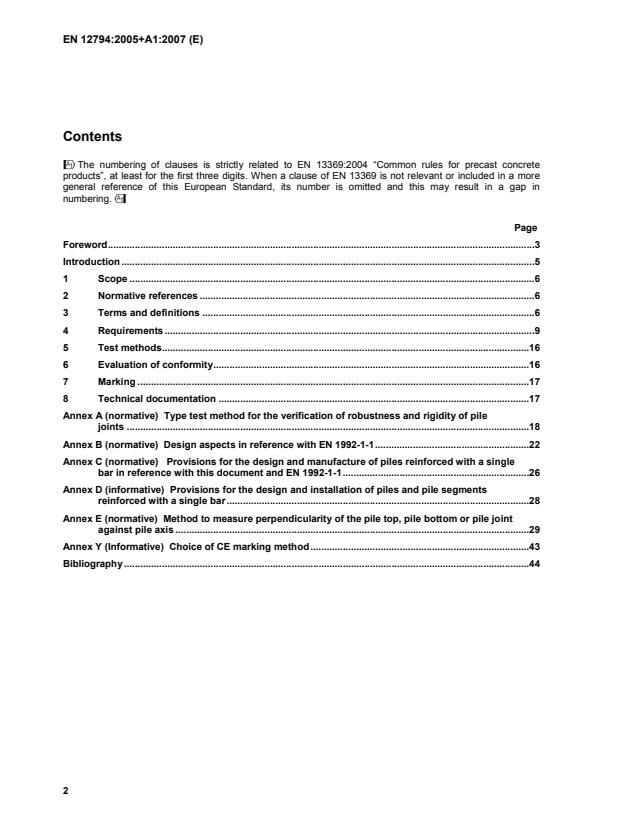
Type test method for the verification of robustness and rigidity of pile joints.18 Annex B (normative)
Design aspects in reference with EN 1992-1-1.22 Annex C (normative)
Provisions for the design and manufacture of piles reinforced with a single bar in reference with this document and EN 1992-1-1.26 Annex D (informative)
Provisions for the design and installation of piles and pile segments reinforced with a single bar.28 Annex E (normative)
Method to measure perpendicularity of the pile top, pile bottom or pile joint against pile axis.29 Annex Y (Informative)
Choice of CE marking method.43 Bibliography.44
Key 1 Pile top 2 Pile length 3 Shaft length 4 Pile segment 5 Segment length 6 Pile joint 7 Pile shoe 8 Pile toe 9 Pile bottom Figure 1 — Terms and definitions
4.2.3.2.3 of EN 13369:2004 shall apply. 4.2.3.2.4 Slippage of tendons Not relevant due to the common production technique.
The actual cross section shall be greater than 95 % of the nominal cross section
+ 150
Nominal length of the pile − 100
Straightness of the axis of the shaft
L ≤ 10 m ± 20
10 m ≤ L < 20 m ± 2 L 1
L ≥ 20 m
± 40
NOTE 1 ∆L and ∆d are given to ensure that deviations in either cross-sectional dimensions or !straightness" as well as in the position of the reinforcement do not exceed values covered by the relevant safety factors in the Eurocodes. NOTE 2 The values for ∆c are given for durability purposes. 1 In this formula the dimension of length L is m. 4.3.1.2 Minimum dimensions The shape factor shall not exceed the following values: Multiple bar reinforced piles/pile segments 75 Prestressed piles 100 The dimensions of an enlarged toe shall be in compliance with Figure 2.
shaft
a ≥≥≥≥ b c ≥≥≥≥ 500 mm and c ≥≥≥≥ de de ≤≤≤≤ 1,6 e Key 1 Axis Figure 2 — Requirements for the dimensions of the toe The requirements shall be verified in accordance with 5.2. 4.3.1.3 Pile joints The steel components of the pile joint shall be integrated in the pile segments to be joined. They shall be cast in, in such a way, that their position can be inspected during production and on the finished product. The quality of the further structural parts, e.g. locking parts, necessary to complete the actual joining of the pile segments at the site of installation, shall be the pile producer’s responsibility. The site assembly of pile joints is not covered by this document. Pile joints shall locate and maintain a coaxial connection between pile segments. The faces of the pile components shall be perpendicular to the axis of the pile segments within the following tolerances: centres of cast in components shall not deviate more than 10 mm from the central axis of the pile/pile segment; angular deviation of the faces of the pile components shall not exceed an inclination of 1:150. Coaxial and angular deviation shall be verified in accordance with 5.2. The classification of pile joints is specified under 4.3.8.3. 4.3.1.4 Pile shoes Pile shoes, when fitted shall be coaxial with the pile. The face of the pile shoe shall be perpendicular to the axis of the pile within the following tolerances: central axis of the pile shoe shall not deviate more than 10 mm from the central axis of the pile/pile segment; angular deviation of the face of the pile shoe shall not exceed an inclination of 1:75.
2 Piles or segmental piles reinforced with single centrally placed bars, see Annex C 4.3.3.2 Verification by calculation 4.3.3.2 of EN 13369:2004 shall apply. 4.3.3.2.1 Verification of the resistance for transportation The characteristic concrete strength at time of transportation, as specified in 4.2.2 shall be used in verification of the resistance according to 4.3.3.2 of EN 13369:2004 with the complementary rules given in Annex B. 4.3.3.2.2 Verification of the resistance for pile installation The characteristic concrete strength at time of pile installation shall be used in verification of the resistance for pile installation. The verification of the resistance for pile installation shall conform to relevant documents or other provisions valid in the place of use taking in consideration the specific geographical conditions which refer specifically to the installation of the precast concrete foundation piles. !NOTE 1
Provisions for pile installation may give higher minimum requirements for the concrete class and reinforcement than specified in 4.2, Annex B (class 1) and Annex C (class 2) of this European Standard." NOTE 2 Guidance for the execution of pile foundations is given in EN 12699. NOTE 3 Provisions regarding the soil conditions in the place of use can be given for pile type – Class 2 – as specified in Annex C. 4.3.3.2.3 Resistance to design loads Resistance to design loads at the critical section of the pile shaft shall (e.g. near the joint) be verified by the calculation in accordance with 4.3.3.2 of EN 13369:2004. NOTE The calculated resistance of the pile cross section with respect to the axial force will be at least equal to the geotechnical load bearing capacity of the installed foundation pile.
Type test method for the verification of robustness and rigidity of pile joints A.1 Impact load test with subsequent bending test A.1.1 Principle Impact load test with subsequent bending test consisting of submitting a segmental pile with cast in pile joint to a series of impact loads, which generates substantial stresses in the pile joint and in the pile segments. After impact test the gap between two joint halves is measured and the segmental pile is submitted to a two point load bending test, where the bending capacity of the pile joint is determined. A.1.2 Apparatus The following apparatus are used to perform the test: pile driving rig with an impact hammer capable of achieving adequate stresses to the pile joint. The pile driving rig shall be capable of maintaining the submitted impact loads to an accuracy of ± 10 % of the specified value; stress wave measurement device; loading device for applying two equal vertical loads. The device shall be capable of increasing the load continuously and maintaining the chosen load level constant for the required time (3 minutes to 5 minutes). The force applied shall be measured to an accuracy of 3 %; gauges for measuring deflections of the segmental pile due to imposed load during bending test to an accuracy of 0,1 mm; gauge for measuring gap between two joints halves to an accuracy of 0,1 mm. A.1.3 Test specimens The test specimen is the segmental pile composed of two pile joint components. When impact test is performed the length of the upper pile segment shall be at least 3 m. The bottom pile segment may be provided with a pile shoe and shall have a length, which ensures that the joint will remain above the ground during the impact test. The three test specimens, one per test, are assumed to be identical. A.1.4 Impact load test The test piling shall take place in a well-defined area, where geotechnical investigation shows sufficient soil bearing capacity in a suitable depth. A reinforced foundation slab in the prescribed depth can also be used as a footing to increase the resistance during the driving operations. The bottom pile segment is driven vertically until it stands firmly imbedded in the soil in such a way that the pile joint is above the ground and can be observed during the whole test. Care should be taken that failure in the pile does not occur, due to high stresses during driving.
Figure A.1 — Measurement of the gap v0 between two joint halves without external loading
Figure A.2 — Bending test arrangement The test pile is loaded with two equal point loads in the third point of the span as shown in Figure A.2. Data to be recorded: deflection is measured using three gauges, which are installed in point ai (at the middle of the span) and in points al and ar at a distance of (0,5 a) from the middle on the span (see also Figure A.2); the first deflection measurement is made when the pile is exposed to its own weight only (zero reading). The increase of each load step is chosen in order that at least 10 load steps are made before ultimate bending moment has been reached. After each load step the load is kept constant for about 3 minutes before reading the gauges; the gap, on the lower side of the test specimen, between the two joint halves, shall be measured and recorded during the test for each load step to an accuracy of 0,1 mm; the failure load; the test is carried on to the point when failure in the test specimen occurs. A.1.6 Evaluation of test results The measured deflection values provide the background for calculating the flexural stiffness from the following formula: m2eq8δMaEl= where see Figure A.2 !a
= 2h + L/3, in which h is the depth of the pile;" M = bending moment in the pile joint caused by imposed load; δm = deflection in the middle of the span = δi – (δl + δr)/2 where δi, δl and
δr are respectively the displacements of points ai, al and ar.
Design aspects in reference with EN 1992-1-1 B.1 General B.1.1 Scope This Annex B applies to the design of precast concrete foundation piles made of reinforced or prestressed concrete and is complementary to EN 1992-1-1. The numbering of Clauses of this Annex is arranged in the same order as used for the numbering of Clauses of EN 1992-1-1. The principles and application rules of EN 1992-1-1 shall be adhered to, unless explicitly adapted, amended or modified. Additional provisions for the single bar foundation pile are given in Annex C. B.2 Basis of design B.2.1 Requirements B.2.1.1 Basic Requirements P(4) The precast foundation pile shall be designed in accordance with the principles and application rules of EN 1997-1:2004, 7.8. P(5) The design for transient situations shall consider the intended methods of handling, transportation and installation, using the nominal dimensions and a time corresponding specified minimum strength. B.2.3 Basic variables B.2.3.1 Actions and environmental influences B.2.3.1.1 General P(2) The dynamic action during handling, transportation and driving shall be taken into account according to the actual operational methods. !NOTE In absence of more rigorous determination, in addition to partial load factors, the factor allowing for the dynamic effects on the self-weight of the pile may be taken on the basis of the following recommended values: γkd, dyn = 1,2 for handling and for transportation of continuously supported piles; γkd, dyn = 1,6 for transportation of locally supported piles."
P(1) For piles Class 1 the following requirements shall be met: a) bars shall have a diameter not less than 8 mm; b) welds or lap !splices" in bars shall be staggered. The distance between those shall not be less than two times the largest transversal dimension of the pile shaft; c) for piles shafts with a non-circular cross-section, at least one bar shall be positioned at each corner; d) for piles shafts with a circular cross-section, at least 6 bars shall be positioned around the periphery; e) the spacing of bars shall comply with EN 1992-1-1:2004, 8.2. B.9.5.3 Transverse reinforcement P(2) For piles Class 1 the following requirements shall be met: a) for precast concrete foundation piles with transverse dimensions 300 mm or larger, the diameter of the transverse reinforcement may be reduced to 5 mm; b) for precast foundation piles with transverse dimensions smaller than 300 mm, the diameter of the transverse reinforcement may be reduced to 4 mm; c) the links, either stirrups or spirals, shall have a nominal diameter not less than 4 mm !for spun piles"; d) the transverse reinforcement in the pile head shall be applied over a length of at least 500 mm. The number of links along this minimum length shall not be less than 9; e) in case the pile toe is positioned in alluvial deposits, the transverse reinforcement shall be applied over a length of at least 200 mm. The number of links over this minimum length shall be not less than 5. In case a pile rests on hard rock or moraine layers, the transverse reinforcement shall be applied over a length of at least 500 mm. The number of links shall be adapted accordingly; f) the transverse reinforcement of the pile shaft between the pile head and pile toe shall be evenly distributed, while the spacing of the links shall not exceed three times the shaft depth/width, whichever is the less; g) the diameter of mandrels used for bending the transverse reinforcement shall not be less than 2,5 times the nominal diameter in case of cold bending and nor less than 1,5 times in case of hot bending;
Exceeding 20 m 0,2
Provisions for the design and manufacture of piles reinforced with a single bar in reference with this document and EN 1992-1-1 General This Annex aims to give the additional specific requirements for the piles reinforced with a single bar. The reference of the chapters and sub-sections of this Annex are arranged in the same order as used in the main body of this document for Clauses C.4 to C.8 and in the same order as in Annex B for Clause C.9. C.4 Requirements C.4.1 Material requirements 4.1 of this document is applicable. C.4.2 Production requirements 4.2 of this document is applicable, except 4.2.3.1. B.4.4.1, concrete cover, is not applicable to single bar, !short single length piles" or pile segments. Minimum cover to reinforcement from any plane surface of the pile shall be 50 mm. C.4.3 Finished product requirements 4.3 of this document is applicable to !single bar single length piles" and pile segments except where modi
...