

SIST EN 50549-10:2023
(Main)Requirements for generating plants to be connected in parallel with distribution networks - Part 10: Tests for conformity assessment of generating units
General Information
- Abstract
The purpose of this document is to provide technical guidance for tests on generating units and interface protection to evaluate their electrical characteristics.
NOTE 1 Mechanical issues are taken into account as far as they influence the electrical characteristics.
The evaluation results are intended to be used to demonstrate conformity of generating units to technical requirements for grid connection. In this context the evaluation results can also be used as part of a certification programme.
NOTE 2 Besides the type test results of the generating unit all additional elements for connection to the grid (e.g. transformer, cabling, multiple units) are considered in the evaluation of the final installation of a generating plant.
The requirements to be evaluated are covered in the following standardization documents:
– EN 50549 1:2019: Requirements for generating plants to be connected in parallel with distribution networks - Part 1: connection to a LV distribution network - Generating plants up to and including Type B
– EN 50549 2:2019: Requirements for generating plants to be connected in parallel with distribution networks - Part 2: Connection to a MV distribution network - Generating plants up to and including Type B
If grid connection requirements are dealt with in other documents or for other generating module types, where no specific testing procedure is provided, testing methods of this document can be used if applicable.
This document provides evaluation criteria for the conformity assessment of generating units with respect to the abovementioned standardization documents, based on type testing. However, some requirements are applicable on the generating plant level. The assessment of the conformity to these plant requirements are out of the scope of this document. Nevertheless, this document may be used to show the capabilities of a generating unit to be used in a plant.
As a consequence, it is possible that the conformity assessment of a generating unit does not cover all aspects of the above-mentioned standardization documents, typically when a requirement is evaluated on a plant level. Therefore, the conformity assessment report indicates clearly which clauses of this document are covered and which clauses are not covered.
This document recognizes the existence of specific technical test requirements within several member states that must be complied with.
- Status
- Published
- Publication Date
- 04-Dec-2022
- Technical Committee
- NTF - Electricity energy supply systems
- Current Stage
- 6060 - National Implementation/Publication (Adopted Project)
- Start Date
- 01-Dec-2022
- Due Date
- 05-Feb-2023
- Completion Date
- 05-Dec-2022



Overview
SIST EN 50549-10:2023 (EN 50549-10:2022) defines tests and evaluation criteria for conformity assessment of generating units intended to operate in parallel with distribution networks. The standard provides technical guidance for type testing of generating units and their interface protection to verify electrical behaviour required for grid connection. Mechanical aspects are considered only insofar as they influence electrical characteristics. Results from the tests can be used for certification or to demonstrate compliance with national and European grid connection requirements.
Key topics and technical requirements
This standard addresses a comprehensive set of test methods, measurement requirements and evaluation criteria, including:
- Assessment methods and test equipment: complete unit, component, HIL (Controller‑Hardware‑in‑the‑Loop), simulated input, field measurements and numerical simulation approaches.
- Normal operating range: frequency and voltage operating ranges and verification procedures.
- Immunity to disturbances: rate of change of frequency (ROCOF), phase jump testing, and fault ride-through (OVRT/UVRT) tests.
- Active response to frequency deviation: test procedures and assessment for governor/active power control responses.
- Power/voltage interaction: reactive power capability, voltage support modes, P(U) (voltage-related active power reduction) and dynamic steady‑state tests.
- EMC and power quality: measurement and compliance checks relevant to grid connection.
- Interface protection: verification of protection functions, islanding detection, interface switch behaviour, single‑fault tolerance and test procedures for LV and MV connections.
- Connection and starting: synchronisation, automatic reconnection after trip, start-up tests and acceptance criteria.
- Model validation: for synchronous-generating technology, including model definition and verification environment.
- Annexes include fault ride-through test setups and templates for statements of conformity.
The standard also clarifies that some requirements are plant-level (e.g., transformer, cabling, multiple-unit interactions) and may not be fully covered by unit-level type tests - conformity reports must state which clauses were assessed.
Practical applications and who uses it
SIST EN 50549-10 is used by:
- Manufacturers and OEMs of inverters, generators and wind‑turbine controls - to validate product electrical behaviour and prepare conformity documentation.
- Test laboratories and certification bodies - to perform type testing and issue statements of conformity.
- Distribution system operators (DSOs) and utilities - to evaluate compliance of generating units seeking grid connection.
- System integrators and project developers - to verify that generating units will meet grid code requirements in LV and MV networks.
Typical uses: type testing, pre‑commissioning verification, certification evidence, supplier acceptance testing, and providing technical input for grid‑connection agreements.
Related standards
- EN 50549‑1:2019 - connection to LV distribution networks (Type B generators)
- EN 50549‑2:2019 - connection to MV distribution networks (Type B generators)
SIST EN 50549‑10 may also be used to support testing where other documents or module types do not specify explicit procedures.
Relations
- Effective Date
- 01-Jan-2023
- Effective Date
- 01-Jan-2023
- Effective Date
- 28-Apr-2026
- Effective Date
- 03-Mar-2026
- Effective Date
- 03-Feb-2026
- Effective Date
- 03-Feb-2026
- Effective Date
- 03-Feb-2026
- Effective Date
- 03-Feb-2026
- Effective Date
- 03-Feb-2026
- Effective Date
- 03-Feb-2026
- Effective Date
- 03-Feb-2026
- Refers
SIST EN IEC 60034-9:2025 - Rotating electrical machines - Part 9: Noise limits (IEC 60034-9:2021) - Effective Date
- 03-Feb-2026
- Effective Date
- 03-Feb-2026
- Effective Date
- 03-Feb-2026
- Effective Date
- 03-Feb-2026
Get Certified
Connect with accredited certification bodies for this standard

IMQ S.p.A. (Certification)
Italian electrical product certification.

SLG Prüf- und Zertifizierungs GmbH
German testing and certification body.

UL Solutions
Global safety science company with testing, inspection and certification.
Sponsored listings
Frequently Asked Questions
SIST EN 50549-10:2023 is a standard published by the Slovenian Institute for Standardization (SIST). Its full title is "Requirements for generating plants to be connected in parallel with distribution networks - Part 10: Tests for conformity assessment of generating units". This standard covers: The purpose of this document is to provide technical guidance for tests on generating units and interface protection to evaluate their electrical characteristics. NOTE 1 Mechanical issues are taken into account as far as they influence the electrical characteristics. The evaluation results are intended to be used to demonstrate conformity of generating units to technical requirements for grid connection. In this context the evaluation results can also be used as part of a certification programme. NOTE 2 Besides the type test results of the generating unit all additional elements for connection to the grid (e.g. transformer, cabling, multiple units) are considered in the evaluation of the final installation of a generating plant. The requirements to be evaluated are covered in the following standardization documents: – EN 50549 1:2019: Requirements for generating plants to be connected in parallel with distribution networks - Part 1: connection to a LV distribution network - Generating plants up to and including Type B – EN 50549 2:2019: Requirements for generating plants to be connected in parallel with distribution networks - Part 2: Connection to a MV distribution network - Generating plants up to and including Type B If grid connection requirements are dealt with in other documents or for other generating module types, where no specific testing procedure is provided, testing methods of this document can be used if applicable. This document provides evaluation criteria for the conformity assessment of generating units with respect to the abovementioned standardization documents, based on type testing. However, some requirements are applicable on the generating plant level. The assessment of the conformity to these plant requirements are out of the scope of this document. Nevertheless, this document may be used to show the capabilities of a generating unit to be used in a plant. As a consequence, it is possible that the conformity assessment of a generating unit does not cover all aspects of the above-mentioned standardization documents, typically when a requirement is evaluated on a plant level. Therefore, the conformity assessment report indicates clearly which clauses of this document are covered and which clauses are not covered. This document recognizes the existence of specific technical test requirements within several member states that must be complied with.
The purpose of this document is to provide technical guidance for tests on generating units and interface protection to evaluate their electrical characteristics. NOTE 1 Mechanical issues are taken into account as far as they influence the electrical characteristics. The evaluation results are intended to be used to demonstrate conformity of generating units to technical requirements for grid connection. In this context the evaluation results can also be used as part of a certification programme. NOTE 2 Besides the type test results of the generating unit all additional elements for connection to the grid (e.g. transformer, cabling, multiple units) are considered in the evaluation of the final installation of a generating plant. The requirements to be evaluated are covered in the following standardization documents: – EN 50549 1:2019: Requirements for generating plants to be connected in parallel with distribution networks - Part 1: connection to a LV distribution network - Generating plants up to and including Type B – EN 50549 2:2019: Requirements for generating plants to be connected in parallel with distribution networks - Part 2: Connection to a MV distribution network - Generating plants up to and including Type B If grid connection requirements are dealt with in other documents or for other generating module types, where no specific testing procedure is provided, testing methods of this document can be used if applicable. This document provides evaluation criteria for the conformity assessment of generating units with respect to the abovementioned standardization documents, based on type testing. However, some requirements are applicable on the generating plant level. The assessment of the conformity to these plant requirements are out of the scope of this document. Nevertheless, this document may be used to show the capabilities of a generating unit to be used in a plant. As a consequence, it is possible that the conformity assessment of a generating unit does not cover all aspects of the above-mentioned standardization documents, typically when a requirement is evaluated on a plant level. Therefore, the conformity assessment report indicates clearly which clauses of this document are covered and which clauses are not covered. This document recognizes the existence of specific technical test requirements within several member states that must be complied with.
SIST EN 50549-10:2023 is classified under the following ICS (International Classification for Standards) categories: 29.160.20 - Generators; 29.240.01 - Power transmission and distribution networks in general. The ICS classification helps identify the subject area and facilitates finding related standards.
SIST EN 50549-10:2023 has the following relationships with other standards: It is inter standard links to SIST EN 50438:2014, SIST EN 50438:2014/IS1:2015, SIST EN IEC 61326-1:2021/A11:2026, SIST EN IEC 60034-26:2026, SIST EN IEC 60034-11:2025, SIST EN IEC 61010-2-120:2018, SIST EN IEC 60034-7:2022, SIST EN 61000-4-7:2003/A1:2009, SIST EN 50549-2:2019, SIST EN 50549-1:2019, SIST EN IEC 61010-2-201:2018, SIST EN IEC 60034-9:2025, SIST EN IEC 61000-3-2:2019, SIST EN IEC 61010-2-061:2021/A11:2021, SIST EN IEC 61010-2-030:2021/A11:2021. Understanding these relationships helps ensure you are using the most current and applicable version of the standard.
SIST EN 50549-10:2023 is associated with the following European legislation: EU Directives/Regulations: 2016/631; Standardization Mandates: M/490. When a standard is cited in the Official Journal of the European Union, products manufactured in conformity with it benefit from a presumption of conformity with the essential requirements of the corresponding EU directive or regulation.
SIST EN 50549-10:2023 is available in PDF format for immediate download after purchase. The document can be added to your cart and obtained through the secure checkout process. Digital delivery ensures instant access to the complete standard document.
Standards Content (Sample)
SLOVENSKI STANDARD
01-januar-2023
Nadomešča:
SIST EN 50438:2014
SIST EN 50438:2014/IS1:2015
Zahteve za vzporedno vezavo generatorskih postrojev z javnim nizkonapetostnim
razdelilnim omrežjem - 10. del: Preskusi za oceno skladnosti generatorskih enot
Requirements for generating plants to be connected in parallel with distribution networks
- Part 10: Tests for conformity assessment of generating units
Anforderungen für zum Parallelbetrieb mit einem Verteilnetz vorgesehene
Erzeugungsanlagen - Teil 10: Tests für die Konformitätsbeurteilung von
Erzeugungseinheiten
Exigences relatives aux centrales électriques destinées à être raccordées en parallèle à
des réseaux de distribution - Partie 10: Essais d’évaluation de la conformité des unités
de production
Ta slovenski standard je istoveten z: EN 50549-10:2022
ICS:
29.160.20 Generatorji Generators
29.240.01 Omrežja za prenos in Power transmission and
distribucijo električne energije distribution networks in
na splošno general
2003-01.Slovenski inštitut za standardizacijo. Razmnoževanje celote ali delov tega standarda ni dovoljeno.
EUROPEAN STANDARD EN 50549-10
NORME EUROPÉENNE
EUROPÄISCHE NORM October 2022
ICS 29.160.20 Supersedes EN 50438:2013 (PART); EN
50438:2013/IS1:2015 (PART)
English Version
Requirements for generating plants to be connected in parallel
with distribution networks - Part 10: Tests for conformity
assessment of generating units
Exigences relatives aux centrales électriques destinées à Anforderungen für zum Parallelbetrieb mit einem Verteilnetz
être raccordées en parallèle à des réseaux de distribution - vorgesehene Erzeugungsanlagen - Teil 10:
Partie 10: Essais d'évaluation de la conformité des unités Prüfanforderungen für die Konformitätsbeurteilung von
de production Erzeugungseinheiten
This European Standard was approved by CENELEC on 2022-08-09. CENELEC members are bound to comply with the CEN/CENELEC
Internal Regulations which stipulate the conditions for giving this European Standard the status of a national standard without any alteration.
Up-to-date lists and bibliographical references concerning such national standards may be obtained on application to the CEN-CENELEC
Management Centre or to any CENELEC member.
This European Standard exists in three official versions (English, French, German). A version in any other language made by translation
under the responsibility of a CENELEC member into its own language and notified to the CEN-CENELEC Management Centre has the
same status as the official versions.
CENELEC members are the national electrotechnical committees of Austria, Belgium, Bulgaria, Croatia, Cyprus, the Czech Republic,
Denmark, Estonia, Finland, France, Germany, Greece, Hungary, Iceland, Ireland, Italy, Latvia, Lithuania, Luxembourg, Malta, the
Netherlands, Norway, Poland, Portugal, Republic of North Macedonia, Romania, Serbia, Slovakia, Slovenia, Spain, Sweden, Switzerland,
Türkiye and the United Kingdom.
European Committee for Electrotechnical Standardization
Comité Européen de Normalisation Electrotechnique
Europäisches Komitee für Elektrotechnische Normung
CEN-CENELEC Management Centre: Rue de la Science 23, B-1040 Brussels
© 2022 CENELEC All rights of exploitation in any form and by any means reserved worldwide for CENELEC Members.
Ref. No. EN 50549-10:2022 E
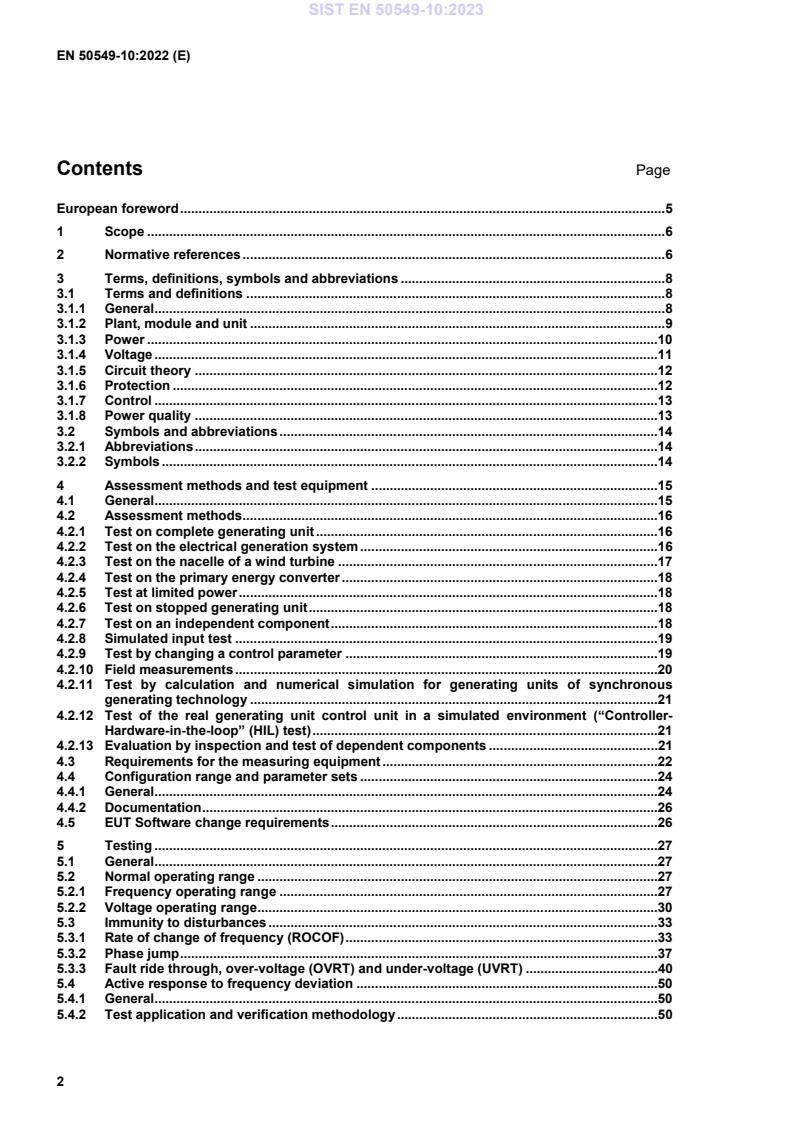
Contents Page
European foreword . 5
1 Scope . 6
2 Normative references . 6
3 Terms, definitions, symbols and abbreviations . 8
3.1 Terms and definitions . 8
3.1.1 General . 8
3.1.2 Plant, module and unit . 9
3.1.3 Power .10
3.1.4 Voltage .11
3.1.5 Circuit theory .12
3.1.6 Protection .12
3.1.7 Control .13
3.1.8 Power quality .13
3.2 Symbols and abbreviations .14
3.2.1 Abbreviations .14
3.2.2 Symbols .14
4 Assessment methods and test equipment .15
4.1 General .15
4.2 Assessment methods .16
4.2.1 Test on complete generating unit .16
4.2.2 Test on the electrical generation system .16
4.2.3 Test on the nacelle of a wind turbine .17
4.2.4 Test on the primary energy converter .18
4.2.5 Test at limited power .18
4.2.6 Test on stopped generating unit .18
4.2.7 Test on an independent component .18
4.2.8 Simulated input test .19
4.2.9 Test by changing a control parameter .19
4.2.10 Field measurements .20
4.2.11 Test by calculation and numerical simulation for generating units of synchronous
generating technology .21
4.2.12 Test of the real generating unit control unit in a simulated environment (“Controller-
Hardware-in-the-loop” (HIL) test) .21
4.2.13 Evaluation by inspection and test of dependent components .21
4.3 Requirements for the measuring equipment .22
4.4 Configuration range and parameter sets .24
4.4.1 General .24
4.4.2 Documentation .26
4.5 EUT Software change requirements .26
5 Testing .27
5.1 General .27
5.2 Normal operating range .27
5.2.1 Frequency operating range .27
5.2.2 Voltage operating range .30
5.3 Immunity to disturbances .33
5.3.1 Rate of change of frequency (ROCOF) .33
5.3.2 Phase jump .37
5.3.3 Fault ride through, over-voltage (OVRT) and under-voltage (UVRT) .40
5.4 Active response to frequency deviation .50
5.4.1 General .50
5.4.2 Test application and verification methodology .50
5.4.3 Verification procedure . 53
5.4.4 Assessment criteria . 64
5.4.5 Documentation . 64
5.5 Power specification and response to voltage variations . 65
5.5.1 Power capabilities assessment - voltage support by reactive power . 65
5.5.2 Voltage support by reactive power - test to determine the reactive power control modes 72
5.6 Voltage related active power reduction - P(U) . 87
5.6.1 General . 87
5.6.2 Test application and verification . 88
5.6.3 Test procedure for steady-state behaviour . 88
5.6.4 Test procedure for dynamic behaviour . 88
5.6.5 Assessment criteria . 89
5.6.6 Documentation . 89
5.7 EMC and power quality . 90
5.7.1 EMC . 90
5.7.2 Power Quality . 90
5.8 Interface protection . 95
5.8.1 General . 95
5.8.2 Test application and verification methodology . 96
5.8.3 Verification procedure for generating plants to be connected to a LV distribution network
with Interface protection as internal device . 96
5.8.4 Verification procedure for generating plants to be connected to a LV distribution network
with Interface protection as dedicated device . 118
5.8.5 Verification procedure for generating plants to be connected to a MV distribution network
.................................................................................................................................................... 118
5.8.6 Islanding detection . 119
5.9 Connection and starting . 119
5.9.1 General . 119
5.9.2 Test application and verification methodology . 121
5.9.3 Automatic reconnection after tripping . 121
5.9.4 Starting to generate electrical power . 123
5.9.5 Assessment criteria . 123
5.9.6 Documentation . 124
5.9.7 Synchronisation . 124
5.10 Active power reduction on set point . 125
5.10.1 General . 125
5.10.2 Test application and verification methodology . 125
5.10.3 Verification procedure . 126
5.11 Remote information exchange . 129
5.12 Requirements regarding single fault tolerance of interface protection system and interface
switch. 130
5.12.1 General . 130
5.12.2 Single fault tolerance of the interface protection system . 130
5.12.3 Single fault tolerance of the interface switch . 131
5.13 Model definition and model validation for generating units of synchronous generating
technology . 131
5.13.1 General . 131
5.13.2 Model definition . 132
5.13.3 Verification environment . 133
5.13.4 Verification process . 136
Annex A (normative) Fault ride through test setup . 153
A.1 Example UVRT test setup . 153
A.2 Example OVRT test setup . 153
A.3 AC Grid simulator converter system . 154
Annex B (normative) Template for statements of conformity and parameters . 157
B.1 General . 157
B.2 Templates for statements of conformity .157
Annex C (informative) Table 8 of EN 61000-4-13:2002 and Table 26 of EN IEC 60255-181:2019 .166
C.1 Table 26 of EN IEC 60255-181:2019 .166
C.2 Table 8 of EN 61000-4-13:2002 .167
Bibliography .168
European foreword
This document (EN 50549-10:2022) has been prepared by CLC/TC 8X “System aspects of electrical energy
supply”.
The following dates are fixed:
• latest date by which this document has to be (dop) 2023-08-09
implemented at national level by publication of
an identical national standard or by
endorsement
• latest date by which the national standards (dow) 2025-08-09
conflicting with this document have to be
withdrawn
Attention is drawn to the possibility that some of the elements of this document may be the subject of patent
rights. CENELEC shall not be held responsible for identifying any or all such patent rights.
EN 50438:2013 has been superseded by EN 50549-1:2019. However, Annex D of EN 50438:2013 provided
requirements on compliance type testing, which is out of the scope of EN 50549-1:2019 resulting in a gap
regarding type testing. This document provides requirements for compliance type testing for generating units
and closes this gap.
This document has been prepared under a Standardization Request given to CENELEC by the European
Commission and the European Free Trade Association.
Any feedback and questions on this document should be directed to the users’ national committee. A complete
listing of these bodies can be found on the CENELEC website.
1 Scope
The purpose of this document is to provide technical guidance for tests on generating units and interface
protection to evaluate their electrical characteristics.
NOTE 1 Mechanical issues are taken into account as far as they influence the electrical characteristics.
The evaluation results are intended to be used to demonstrate conformity of generating units to technical
requirements for grid connection. In this context the evaluation results can also be used as part of a certification
programme.
NOTE 2 Besides the type test results of the generating unit all additional elements for connection to the grid (e.g.
transformer, cabling, multiple units) are considered in the evaluation of the final installation of a generating plant.
The requirements to be evaluated are covered in the following standardization documents:
– EN 50549-1:2019: Requirements for generating plants to be connected in parallel with distribution networks
- Part 1: connection to a LV distribution network - Generating plants up to and including Type B
– EN 50549-2:2019: Requirements for generating plants to be connected in parallel with distribution networks
- Part 2: Connection to a MV distribution network - Generating plants up to and including Type B
If grid connection requirements are dealt with in other documents or for other generating module types, where
no specific testing procedure is provided, testing methods of this document can be used if applicable.
This document provides evaluation criteria for the conformity assessment of generating units with respect to the
abovementioned standardization documents, based on type testing. However, some requirements are
applicable on the generating plant level. The assessment of the conformity to these plant requirements are out
of the scope of this document. Nevertheless, this document may be used to show the capabilities of a generating
unit to be used in a plant.
As a consequence, it is possible that the conformity assessment of a generating unit does not cover all aspects
of the above-mentioned standardization documents, typically when a requirement is evaluated on a plant level.
Therefore, the conformity assessment report indicates clearly which clauses of this document are covered and
which clauses are not covered.
This document recognizes the existence of specific technical test requirements within several member states
that must be complied with.
2 Normative references
The following documents are referred to in the text in such a way that some or all of their content constitutes
requirements of this document. For dated references, only the edition cited applies. For undated references, the
latest edition of the referenced document (including any amendments) applies.
EN 50549-1:2019, Requirements for generating plants to be connected in parallel with distribution networks -
Part 1: Connection to a LV distribution network - Generating plants up to and including Type B
EN 50549-2:2019, Requirements for generating plants to be connected in parallel with distribution networks -
Part 2: Connection to a MV distribution network - Generating plants up to and including Type B
EN IEC 60034 (all parts), Rotating electrical machines
EN IEC 60034-4-1, Rotating electrical machines - Part 4-1: Methods for determining electrically excited
synchronous machine quantities from tests
EN 50524, Data sheet for photovoltaic inverters
EN 60255-1, Measuring relays and protection equipment - Part 1: Common requirements
EN 60255-26, Measuring relays and protection equipment - Part 26: Electromagnetic compatibility requirements
EN 60255-27, Measuring relays and protection equipment - Part 27: Product safety requirements
EN 60255-127, Measuring relays and protection equipment - Part 127: Functional requirements for over/under
voltage protection
EN IEC 60255-181:2019, Measuring relays and protection equipment - Part 181: Functional requirements for
frequency protection
EN 60730-1:2016 , Automatic electrical controls - Part 1: General requirements
EN 61000-3-2, Electromagnetic compatibility (EMC) - Part 3-2: Limits - Limits for harmonic current emissions
(equipment input current ≤16 A per phase)
EN 61000-3-3, Electromagnetic compatibility (EMC) - Part 3-3: Limits - Limitation of voltage changes, voltage
fluctuations and flicker in public low-voltage supply systems, for equipment with rated current <= 16 A per phase
and not subject to conditional connection
EN 61508-3:2010, Functional safety of electrical/electronic/programmable electronic safety-related systems -
Part 3: Software requirements
EN IEC 61000-3-11, Electromagnetic compatibility (EMC) - Part 3-11: Limits - Limitation of voltage changes,
voltage fluctuations and flicker in public low-voltage supply systems - Equipment with rated current ≤ 75 A and
subject to conditional connection
EN 61000-3-12, Electromagnetic compatibility (EMC) - Part 3-12: Limits - Limits for harmonic currents produced
by equipment connected to public low-voltage systems with input current >16 A and ≤ 75 A per phase
EN 61000-4-7:2002, Electromagnetic compatibility (EMC) – Part 4-7: Testing and measurement techniques -
General guide on harmonics and interharmonics measurements and instrumentation, for power supply systems
and equipment connected thereto
EN 61000-4-13:2002, Electromagnetic compatibility (EMC) - Part 4-13: Testing and measurement techniques
- Harmonics and interharmonics including mains signalling at a.c. power port, low frequency immunity tests
EN 61869-2, Instrument transformers - Part 2: Additional requirements for current transformers
EN 61869-3, Instrument transformers – Part 3: Additional requirements for inductive voltage transformers
EN 62116, Utility-interconnected photovoltaic inverters - Test procedure of islanding prevention measures
EN 62109-2, Safety of power converters for use in photovoltaic power systems - Part 2: Particular requirements
for inverters
EN IEC 61010 (all parts), Safety requirements for electrical equipment for measurement, control, and laboratory
use
EN IEC 61326 (all parts), Electrical equipment for measurement, control and laboratory use - EMC requirements
UL 1998:2013, Standard for Software in Programmable Components
As amended by EN 60730-1:2016/A1:2019 and EN 60730-1:2016/A2:2022.
As amended by EN 61000-4-7:2002/A1:2009.
As amended by EN 61000-4-13:2002/A1:2009 and EN 61000-4-13:2002/A2:2016.
3 Terms, definitions, symbols and abbreviations
3.1 Terms and definitions
For the purposes of this document, the terms and definitions given in EN 50549-1:2019, EN 50549-2:2019 and
the following apply. The terms and definitions given in this clause are structured in the same way as the terms
and definitions of EN 50549-1:2019 and EN 50549-2:2019.
ISO and IEC maintain terminological databases for use in standardization at the following addresses:
— IEC Electropedia: available at https://www.electropedia.org/
— ISO Online browsing platform: available at https://www.iso.org/obp/
NOTE Terms and definitions are selected to achieve consistency with IEV (cf. www.electropedia.org) and CENELEC
terminology, recognizing that terms in COMMISSION REGULATION (EU) 2016/631 can deviate.
3.1.1 General
3.1.1.1
relevant parties
stakeholders having role and responsibility in the different conformity procedures in place within different EU
countries
EXAMPLE TSOs, DSOs, certifiers, measuring institutes, manufacturers, etc.
3.1.1.2
manufacturer
organisation, situated at a stated location or stated locations that carries out or controls such stages in the
process of bringing a product to the market as manufacture, assessment, verification, handling and storage of
a product
Note 1 to entry: A manufacturer has full responsibility for continued compliance of the product until delivery to the customer
with the relevant requirements and undertakes all obligations in that connection.
[SOURCE: IECRE Definitions, modified – Limitation until delivery to the customer added.]
3.1.1.3
conformity
fulfilment of a requirement
[SOURCE: IEV 192-01-15]
3.1.1.4
conformity assessment
demonstration that specified requirements relating to a product, process, system, person or body are fulfilled
Note 1 to entry: The subject field of conformity assessment includes activities defined elsewhere in ISO/IEC 17000, such
as testing, inspection and certification, as well as the accreditation of conformity assessment bodies.
Note 2 to entry: The expression “object of conformity assessment” or “object” is used in ISO/IEC 17000 to encompass any
particular material, product, installation, process, system, person or body to which conformity assessment is applied. A
service is covered by the definition of a product (see Note 1 to IEV 902-02-03).
[SOURCE: IEV 902-01-01]
3.1.1.5
conformity evaluation
systematic examination of the extent to which a product, process or service fulfils specified requirements
[SOURCE: IEV 151-16-14]
3.1.2 Plant, module and unit
3.1.2.1
type test
conformity test made on one or more items representative of the production
[SOURCE: IEV 151-16-16]
3.1.2.2
measuring equipment
assembly of measuring instruments intended for specified measurement purposes
[SOURCE: IEC 311-03-05]
3.1.2.3
test equipment
all equipment that is added to a test setup for the purpose of testing and measuring during the test
Note 1 to entry: This includes among others specific impedances, FRT-container, measurement equipment, grid-simulator
as applicable.
3.1.2.4
test set-up
electrical system where the test is carried out
Note to entry 1: This includes, among others, grid-characteristics at POC, transformers, cables, test equipment as
applicable.
3.1.2.5
generating unit under test
GUT
generating unit subjected to tests
3.1.2.6
equipment under test
EUT
equipment (products, devices, components and systems) subjected to tests
3.1.2.7
component
constituent part of a device which cannot be physically divided into smaller parts without losing its particular
function
[SOURCE: IEV 151-11-21]
3.1.2.8
primary energy converter
system that converts any form of primary energy into either electrical or mechanical energy as part of the
conversion to AC electricity
EXAMPLE PV generator; fuel driven engines; gas, steam or water turbines; aerodynamic system of a wind turbine.
3.1.2.9
on-load tap-changer
load-tap-changer (US)
OLTC
device for changing the tapping connections of a winding, suitable for operation while the transformer is
energized or on load
[SOURCE: IEV 421-11-01, modified – An abbreviation was added.]
3.1.2.10
software
assembly of programs, procedures, rules, documentation and data, pertaining to the operation of an information
processing device or system
EXAMPLE Firmware, operating system, application software.
Note 1 to entry: Software is an intellectual creation that is independent of the medium upon which it is recorded.
Note 2 to entry: Software requires hardware to execute programs, and to store and transmit data.
[SOURCE: IEV 171-01-21]
3.1.3 Power
3.1.3.1
nominal power
P
n
nominal value of a generating unit’s active power, which is stated by the manufacturer
3.1.3.2
nominal current
I
n
nominal value of generating unit, either as stated by the manufacturer or which shall be calculated from nominal
active power P and nominal voltage U according to
n n
P
n
I =
n
3U
n
[SOURCE: IEC 61400-27, ed. 1.0 (2015-02) 3.1.6, modified – Applicable for generating units, manufacturer
statement added.]
3.1.3.3
minimum regulating level
minimum active power, as specified by the manufacturer, down to which the generating unit can control active
power
Note 1 to entry: In special cases, generating units of non-synchronous generating technology also have a minimum
technical power.
Note 2 to entry: The minimum regulating level of a power generating plant is to be determined in a suitable manner based
on the minimum regulating levels of the power generating units.
[SOURCE: COMMISSION REGULATION 2016/631 Article 2 (24) modified – RfG definition adopted to the
formal terminology structure in CLC standards and two notes have been added.]
3.1.3.4
maximum reactive power
Q
max over
maximum continuous overexcited reactive power, measured in a 10 min average, which a
generating unit or the sum of all the generating units in a generating plant can exchange as specified in the
connection agreement or as agreed between the DSO and the generating plant operator
Note 1 to entry: In some configurations Q is not available for all active power operating points.
max
3.1.3.5
maximum reactive power
Q
max under
maximum continuous underexcited reactive power, measured in a 10 min average, which a
generating unit or the sum of all the generating units in a generating plant can exchange as specified in the
connection agreement or as agreed between the DSO and the generating plant operator
Note 1 to entry: In some configurations Q is not available for all active power operating points.
max
3.1.4 Voltage
3.1.4.1
rate of change of frequency
ROCOF
change of frequency by a given amount per unit of time
Note 1 to entry: A ROCOF relay measures the characteristic quantity and triggers if a given amount of this quantity per
unit of time has changed.
3.1.4.2
phase
instantaneous phase
ϑ
argument of the cosine function in the representation of a sinusoidal quantity
Note 1 to entry: The term “instantaneous phase” is only used when the independent variable is time.
ˆ
Note 2 to entry: For the quantity a(t) = Atcos ω +ϑ , the phase is ωt+ϑ .
( )
0 0
[SOURCE: IEV 103-07-04]
3.1.4.3
phase jump
abrupt change in the phase of the voltage of an AC electrical network
3.1.5 Circuit theory
3.1.5.1
root-mean-square value
RMS value
quadratic mean
quantity representing the quantities in a finite set or in an interval,
1. for n quantities xx, …x , by the positive square root of the mean value of their squares
12 n
12/
22 2
X x+ x+…+ x
( )
qn12
n
2. for a quantity x depending on a variable t, by the positive square root of the mean value of the square of the
quantity taken over a given interval tt, +T of a variable:
( )
12/
tT+ 2
X = x t dt
( ())
q
∫
t
T
Note 1 to entry: The root-mean-square value of a periodic quantity is usually taken over an integration interval the range
of which is the period multiplied by a natural number.
Note 2 to entry: The root-mean-square value of a quantity is denoted by adding the subscript q to the symbol of the
quantity.
Note 3 to entry: The abbreviation RMS was formerly denoted as r.m.s. or rms, but these notations are now deprecated.
[SOURCE: IEV 103-02-02]
3.1.6 Protection
3.1.6.1
characteristic quantity
electric quantity, or one of its parameters, the name of which characterizes a measuring relay or protection
equipment and the values of which are the subject of accuracy requirements
[SOURCE: IEV 447-07-01]
3.1.6.2
setting value of the characteristic quantity
threshold value of the characteristic quantity at which a measuring relay or protection equipment is required to
operate under specified conditions
[SOURCE: IEV 447-07-02]
3.1.6.3
reset value
value of the characteristic quantity at which a measuring relay or protection equipment resets
[SOURCE: IEV 447-02-12]
=
3.1.7 Control
3.1.7.1
steady state
state of a system at which all state and output variables remain constant in time while all input variables are
constant
Note 1 to entry: A state under periodic conditions is often considered as a steady-state.
[SOURCE: IEV 351-45-10, modified, irrelevant note deleted, note of IEV 103-05-01 added]
3.1.7.2
accuracy
degree to which a measurement, calculation, performed function etc. is exact or correct
3.1.7.3
required accuracy
A
r
accuracy required by an assessment criterion
EXAMPLE EN 50549-1:2019 requires a voltage measurement accuracy of 1 % U .
n
3.1.8 Power quality
3.1.8.1
switching current factor
k
i
ratio of the highest current occurring during a switching operation (e.g. starting or connecting current or the
highest breaking current under normal operating conditions) to the rated current I of the generating unit
r
Note 1 to entry: For this purpose, the current is to be considered as an RMS value over one period.
Note 2 to entry: If controlled power operation is possible, only the electromechanical switching operation (inrush of
inductances and capacities) is observed.
3.1.8.2
flicker coefficient for continuous operation
c(ψ )
k
normalized measure of the flicker emission during continuous operation of the generating unit
S
k,fic
cPΨ ×
( )
k st,fic
S
n
where
P is the short-term flicker severity from the wind turbine on the fictitious grid;
st,fic
S is the nominal apparent power of the generating unit;
n
S is the short-circuit apparent power of the fictitious grid
k,fic
[SOURCE: EN IEC 61400-21-1 modified – Definition applied to generating units.]
=
3.1.8.3
fictitious grid
representation of an ideal phase-to-neutral voltage source with the instantaneous value u (t), in series with a
defined grid resistance R and grid inductance L
Note 1 to entry: The fictitious grid is used for the normalization of flicker measurements.
[SOURCE: EN IEC 61400-21-1]
3.2 Symbols and abbreviations
For the purposes of this document, the following symbols and abbreviations apply
3.2.1 Abbreviations
AVR automatic voltage regulator
CHP combined heat and power
CT current transformer
DFIG doubly fed induction generator
DSO distribution system operator
EES electrical energy storage
EHV extra high voltage
EMC electromagnetic compatibility
HV high voltage
IEV international electrotechnical vocabulary (IEC 60050)
LV low voltage
MV medium voltage
OEL overexcitation limit
OVRT over voltage ride through
POC point of connection
PV photovoltaic
ROCOF rate of change of frequency
THD total harmonic distortion
UEL underexcitation Limit
UVRT under voltage ride through
VT voltage transformer
3.2.2 Symbols
required accuracy
A
r
reset value of the characteristic quantity
G
R
setting value of the characteristic quantity (activation threshold)
G
S
switching current factor
k
i
operate time (equals start time plus time delay setting)
T
Op
reset time
T
Res
overshoot time
T
Ov
> / > > first / second stage of protection function
Δf frequency step
Δt time step
voltage step
ΔU
4 Assessment methods and test equipment
4.1 General
In order to prove conformity with the requirements, tests and evaluations shall be performed. All tests shall be
conducted as type tests either on a unique generating unit or on an item representative of the production of one
type of generating unit. The results of the evaluation are considered valid for the whole production of this type
of generating unit manufactured to the same design and operating with the same software as during the type
test of the EUT.
For changed software (updates) intended to be used in the product, 4.5 applies.
NOTE 1 This covers changes in software during the test procedure, in production and at field updates.
For the type test different types of assessment methods and tests are considered.
As the reference assessment method, the test on the complete generating unit (4.2.1) is considered. When (a
combination of) alternative assessment methods are permitted, this document describes the conditions to be
fulfilled.
These conditions are based on e.g.:
– the power rating of the generating unit
– the kind of primary energy source
– the technology of the generating unit
– the type of requirement to be assessed
Due to limitations of available test sites, test equipment and other constraints, it may not be reasonably feasible
to perform the full set of tests on the complete generating unit. Hence alternative methods are defined to
demonstrate compliance with the requirements.
NOTE 2 The alternatives are always considered as an option. It is always possible to test the complete unit instead of
the alternatives proposed.
It is possible to combine different proposed alternatives. Consequently, in this case, all of the conditions relevant
for the chosen alternatives shall then be fulfilled.
In the following clauses the characteristics of the reference method and its alternatives are given.
4.2 Assessment methods
4.2.1 Test on complete generating unit
The test on the complete generating unit is defined by all the following conditions:
– Test is performed on an EUT covering the complete generating unit from the primary energy converter up
to and including the output stage intended for the connection to the distribution network.
– The nominal frequency of the output of the EUT corresponds to the nominal frequency of the distribution
network
– For generating units to be connected to the LV distribution network, the voltage level at the output stage of
the EUT shall correspond to the voltage of the LV distribution network.
– For generating units to be connected to the MV distribution network the voltage level at the output stage of
the EUT shall either corresponds to the voltage of the MV distribution network or the manufacturer shall
declare the output boundary at a different voltage level requiring a transformer in the final installation.
NOTE 1 If the output voltage of the generating unit is not matching with the voltage of the distribution network, all
additional elements for connection to the grid (e.g. transformer, cabling) are considered in the final installation of a generating
plant.
– The EUT includes all necessary auxiliary equipments which can affect the assessment results; it is not
necessary to include all auxiliary equipment.
NOTE 2 Tests in the field with use of specific test equipment other than measurement equipment, e.g. a fault ride through
test container, is considered as a complete unit test and not as field measurement (see further).
4.2.2 Test on the electrical generation system
Test on the electrical generation system is defined by all the following conditions:
– Test is performed on a EUT that is limited to the electrical generation system, a subsystem of the generating
unit.
– The boundary of the EUT (which does not necessarily include the complete generating unit) is chosen such
that there will be no impact on the results of the conducted test. This means that the result is the same as
if the test would have been conducted on the complete generating unit. This shall be justified in the test
report.
– The characteristics of the source (e.g. PV panel, battery, reciprocating engine, etc) shall be taken into
account when defining the boundary of the electric generating system for the assessment of a particular
requirement. The boundary can depend on the assessed requirement.
– The boundary of the EUT shall be unambiguously defined and described in the test report.
– The nominal frequency of the output stage of the EUT corresponds to the nominal frequency of
...