

SIST IEC 60050-904:2022
International Electrotechnical Vocabulary - Part 904: Environmental standardization for electrical and electronic products and systems
General Information
- Abstract
This part of IEC 60050 gives the general terminology used in environmental standardization
for electrical and electronic products and systems. It has the status of a horizontal standard in
accordance with IEC Guide 108, Guidelines for ensuring the coherency of IEC publications –
Application of horizontal standards.
This terminology is consistent with the terminology developed in the other specialized parts of
the IEV.
This horizontal standard is primarily intended for use by technical committees in the
preparation of standards in accordance with the principles laid down in IEC Guide 108.
One of the responsibilities of a technical committee is, wherever applicable, to make use of
horizontal standards in the preparation of its publications. The content of this horizontal
standard will not apply unless specifically referred to or included in the relevant publications.
- Status
- Published
- Publication Date
- 20-Nov-2022
- Technical Committee
- TRM - Terminology
- Current Stage
- 6060 - National Implementation/Publication (Adopted Project)
- Start Date
- 14-Nov-2022
- Due Date
- 19-Jan-2023
- Completion Date
- 21-Nov-2022

Overview
SIST IEC 60050-904:2022, titled International Electrotechnical Vocabulary - Part 904: Environmental standardization for electrical and electronic products and systems, is a critical international standard published by the International Electrotechnical Commission (IEC). This standard provides comprehensive and harmonized terminology in the specialized field of environmental standardization related to electrical and electronic products and systems.
As a horizontal standard under IEC Guide 108:2006, SIST IEC 60050-904:2022 serves as a foundational reference to ensure consistent use of terms across national and international standardization efforts, supporting clear communication and effective regulatory compliance in environment-related areas of electrotechnology.
The standard is part of the IEC 60050 series-the International Electrotechnical Vocabulary (IEV)-which collectively covers diverse electrotechnical domains with multilingual entries aiding global accessibility.
Key Topics
SIST IEC 60050-904:2022 focuses on general terminology used for environmental aspects of electrical and electronic equipment. Key areas covered include:
Environmental Standardization Terms: Definitions of concepts related to environmental considerations in electrical and electronic products, such as sustainability, lifecycle assessment, and ecological impact.
Horizontal Standardization: Language consistency with other parts of the IEC 60050 series and alignment with ISO/IEC terminology principles.
Terminology Structure: Clear hierarchical organization with entries including:
- Entry numbers (Part/Section/Concept format)
- Preferred terms and synonyms in principal IEV languages (English, French, Russian)
- Additional language terms (e.g., German, Spanish, Chinese, Slovenian)
- Definitions, examples, and notes to clarify usage
Multilingual Support: Provides terms in multiple languages to facilitate international cooperation and understanding.
Standardization Scope: Covers environmental protection and ecological aspects within electrical engineering and electronic components.
Applications
Utilizing SIST IEC 60050-904:2022 offers numerous practical benefits for stakeholders involved in electrical and electronic product development, compliance, and environmental management:
Standardized Communication: Enables manufacturers, engineers, regulators, and certification bodies to speak the same language on environmental topics, reducing ambiguity and errors.
Regulatory Compliance: Supports alignment with environmental laws and standards by offering reliably defined terminology essential for documentation and certification processes.
Sustainable Product Design: Assists designers and engineers in integrating environmental considerations effectively through common understanding of relevant terms.
Global Market Access: Facilitates entry into international markets by adhering to internationally agreed environmental terminology, easing technical assessments and audits.
Technical Documentation and Training: Provides a reference vocabulary for preparing manuals, training materials, and educational content related to environmental standardization in the electrotechnical field.
Related Standards
SIST IEC 60050-904:2022 is part of the broader IEC 60050 series and aligns closely with other standards and guides focused on electrotechnical terminology and environmental issues:
IEC Guide 108:2006 - Horizontal standards guidelines supporting uniform terminology use across electrotechnical standards.
Other Parts of IEC 60050 - Such as Part 161 (Electromagnetic Compatibility) and Part 411 (Rotating Machines) for overlapping technical vocabulary.
ISO/IEC Directives - Influences and is developed in compliance with ISO/IEC directives for standardization content and format.
ISO environmental standards - Complements ISO standards addressing environmental management and product lifecycle assessment.
Keywords: SIST IEC 60050-904:2022, International Electrotechnical Vocabulary, environmental standardization, electrical products, electronic systems, electrotechnical terminology, sustainable product design, IEC standards, environmental protection, global standardization, multilingual terminology, IEC Guide 108.
Get Certified
Connect with accredited certification bodies for this standard

BSI Group
BSI (British Standards Institution) is the business standards company that helps organizations make excellence a habit.

Bureau Veritas
Bureau Veritas is a world leader in laboratory testing, inspection and certification services.

DNV
DNV is an independent assurance and risk management provider.
Sponsored listings
Frequently Asked Questions
SIST IEC 60050-904:2022 is a standard published by the Slovenian Institute for Standardization (SIST). Its full title is "International Electrotechnical Vocabulary - Part 904: Environmental standardization for electrical and electronic products and systems". This standard covers: This part of IEC 60050 gives the general terminology used in environmental standardization for electrical and electronic products and systems. It has the status of a horizontal standard in accordance with IEC Guide 108, Guidelines for ensuring the coherency of IEC publications – Application of horizontal standards. This terminology is consistent with the terminology developed in the other specialized parts of the IEV. This horizontal standard is primarily intended for use by technical committees in the preparation of standards in accordance with the principles laid down in IEC Guide 108. One of the responsibilities of a technical committee is, wherever applicable, to make use of horizontal standards in the preparation of its publications. The content of this horizontal standard will not apply unless specifically referred to or included in the relevant publications.
This part of IEC 60050 gives the general terminology used in environmental standardization for electrical and electronic products and systems. It has the status of a horizontal standard in accordance with IEC Guide 108, Guidelines for ensuring the coherency of IEC publications – Application of horizontal standards. This terminology is consistent with the terminology developed in the other specialized parts of the IEV. This horizontal standard is primarily intended for use by technical committees in the preparation of standards in accordance with the principles laid down in IEC Guide 108. One of the responsibilities of a technical committee is, wherever applicable, to make use of horizontal standards in the preparation of its publications. The content of this horizontal standard will not apply unless specifically referred to or included in the relevant publications.
SIST IEC 60050-904:2022 is classified under the following ICS (International Classification for Standards) categories: 01.040.29 - Electrical engineering (Vocabularies); 13.020 - Environmental protection; 13.020.01 - Environment and environmental protection in general; 29.020 - Electrical engineering in general; 31.020 - Electronic components in general. The ICS classification helps identify the subject area and facilitates finding related standards.
SIST IEC 60050-904:2022 is available in PDF format for immediate download after purchase. The document can be added to your cart and obtained through the secure checkout process. Digital delivery ensures instant access to the complete standard document.
Standards Content (Sample)
SLOVENSKI STANDARD
01-december-2022
Mednarodni elektrotehniški slovar - 904. del: Okoljska standardizacija električnih
in elektronskih proizvodov in sistemov
International Electrotechnical Vocabulary - Part 904: Environmental standardization for
electrical and electronic products and systems
Vocabulaire Electrotechnique International - Partie 904: Normalisation environnementale
pour les produits et les systèmes électriques et électroniques
Ta slovenski standard je istoveten z: IEC 60050-904
ICS:
01.040.29 Elektrotehnika (Slovarji) Electrical engineering
(Vocabularies)
13.020.01 Okolje in varstvo okolja na Environment and
splošno environmental protection in
general
29.020 Elektrotehnika na splošno Electrical engineering in
general
31.020 Elektronske komponente na Electronic components in
splošno general
2003-01.Slovenski inštitut za standardizacijo. Razmnoževanje celote ali delov tega standarda ni dovoljeno.
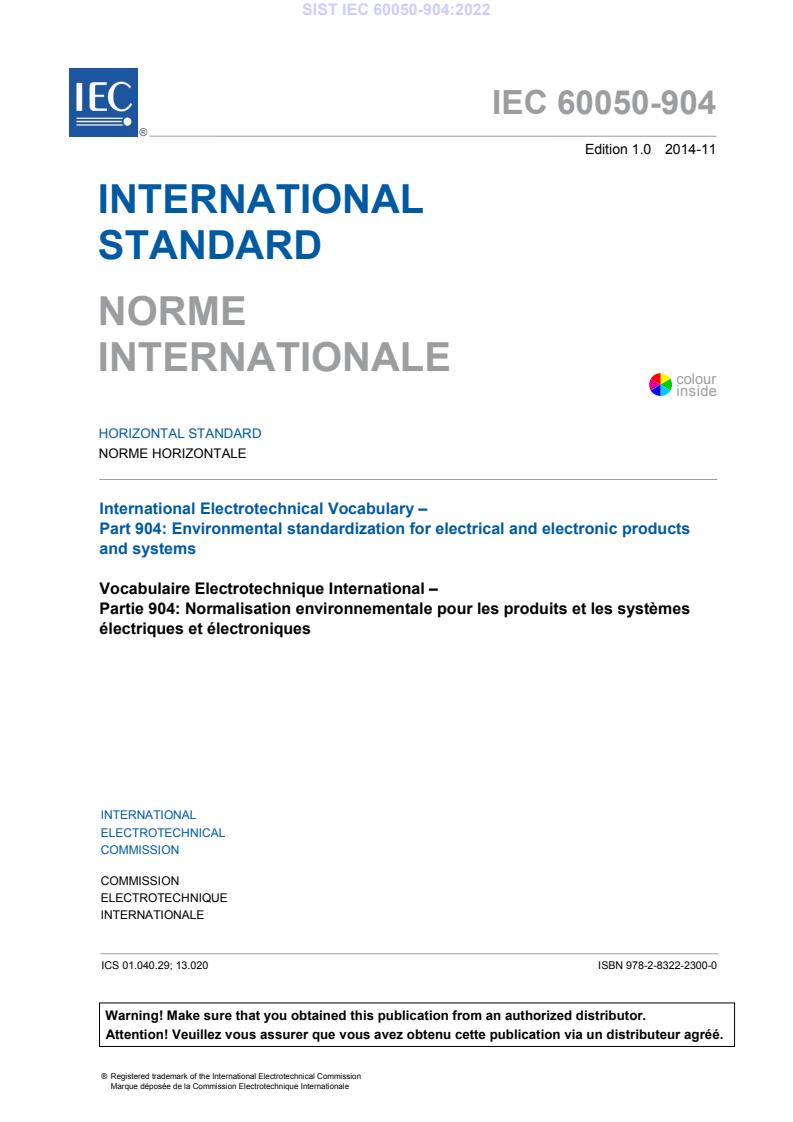
®
Edition 1.0 2014-11
INTERNATIONAL
STANDARD
NORME
INTERNATIONALE
colour
inside
HORIZONTAL STANDARD
NORME HORIZONTALE
International Electrotechnical Vocabulary –
Part 904: Environmental standardization for electrical and electronic products
and systems
Vocabulaire Electrotechnique International –
Partie 904: Normalisation environnementale pour les produits et les systèmes
électriques et électroniques
INTERNATIONAL
ELECTROTECHNICAL
COMMISSION
COMMISSION
ELECTROTECHNIQUE
INTERNATIONALE
ICS 01.040.29; 13.020 ISBN 978-2-8322-2300-0
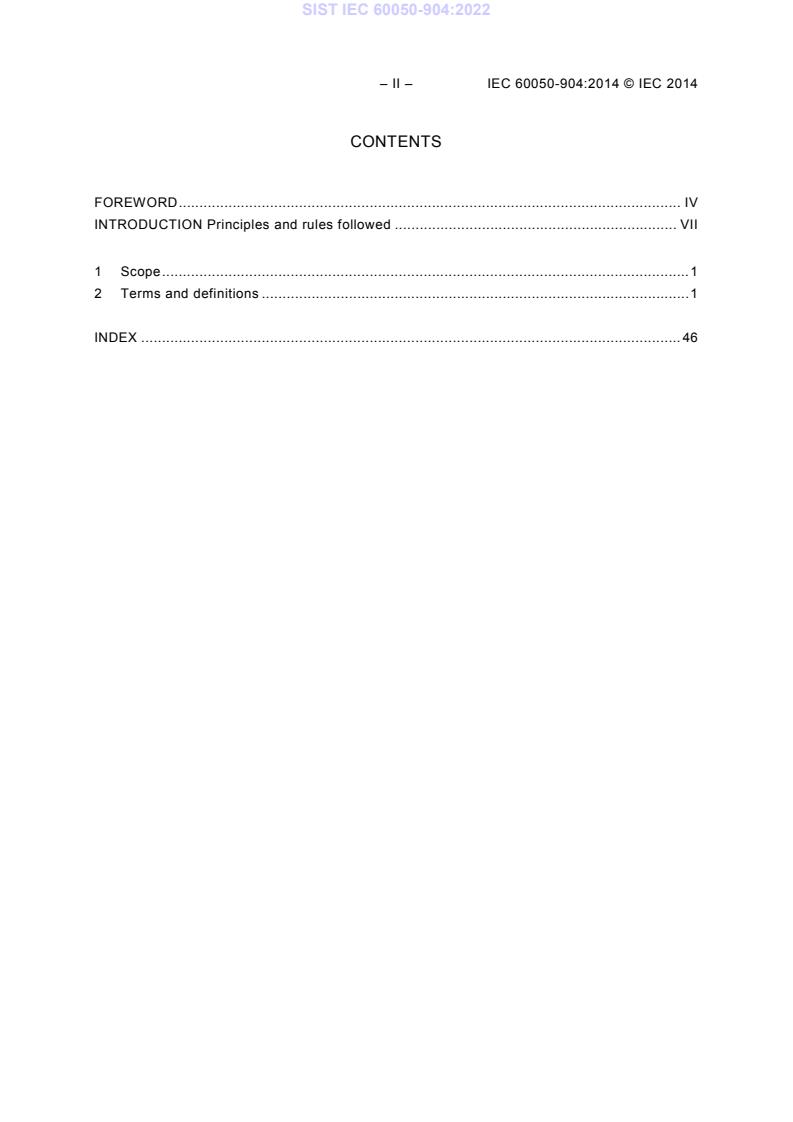
– II – IEC 60050-904:2014 © IEC 2014
CONTENTS
FOREWORD . IV
INTRODUCTION Principles and rules followed . VII
1 Scope . 1
2 Terms and definitions . 1
INDEX . 46
SOMMAIRE
AVANT-PROPOS . V
INTRODUCTION Principes d’établissement et règles suivies . X
1 Domaine d’application . 2
2 Termes et définitions . 2
INDEX . 48
– IV – IEC 60050-904:2014 © IEC 2014
INTERNATIONAL ELECTROTECHNICAL COMMISSION
_______________
INTERNATIONAL ELECTROTECHNICAL VOCABULARY –
Part 904: Environmental standardization for electrical and electronic
products and systems
FOREWORD
1) The International Electrotechnical Commission (IEC) is a worldwide organization for standardization comprising
all national electrotechnical committees (IEC National Committees). The object of IEC is to promote
international co-operation on all questions concerning standardization in the electrical and electronic fields. To
this end and in addition to other activities, IEC publishes International Standards, Technical Specifications,
Technical Reports, Publicly Available Specifications (PAS) and Guides (hereafter referred to as
“IEC Publication(s)”). Their preparation is entrusted to technical committees; any IEC National Committee
interested in the subject dealt with may participate in this preparatory work. International, governmental and
non-governmental organizations liaising with the IEC also participate in this preparation. IEC collaborates
closely with the International Organization for Standardization (ISO) in accordance with conditions determined
by agreement between the two organizations.
2) The formal decisions or agreements of IEC on technical matters express, as nearly as possible, an international
consensus of opinion on the relevant subjects since each technical committee has representation from all
interested IEC National Committees.
3) IEC Publications have the form of recommendations for international use and are accepted by IEC National
Committees in that sense. While all reasonable efforts are made to ensure that the technical content of
IEC Publications is accurate, IEC cannot be held responsible for the way in which they are used or for any
misinterpretation by any end user.
4) In order to promote international uniformity, IEC National Committees undertake to apply IEC Publications
transparently to the maximum extent possible in their national and regional publications. Any divergence
between any IEC Publication and the corresponding national or regional publication shall be clearly indicated in
the latter.
5) IEC itself does not provide any attestation of conformity. Independent certification bodies provide conformity
assessment services and, in some areas, access to IEC marks of conformity. IEC is not responsible for any
services carried out by independent certification bodies.
6) All users should ensure that they have the latest edition of this publication.
7) No liability shall attach to IEC or its directors, employees, servants or agents including individual experts and
members of its technical committees and IEC National Committees for any personal injury, property damage or
other damage of any nature whatsoever, whether direct or indirect, or for costs (including legal fees) and
expenses arising out of the publication, use of, or reliance upon, this IEC Publication or any other
IEC Publications.
8) Attention is drawn to the Normative references cited in this publication. Use of the referenced publications is
indispensable for the correct application of this publication.
9) Attention is drawn to the possibility that some of the elements of this IEC Publication may be the subject of
patent rights. IEC shall not be held responsible for identifying any or all such patent rights.
International Standard IEC 60050-904 has been prepared by IEC technical committee 1:
Terminology.
This first edition comprises terminology formerly published in IEC 62542, and reviewed as
change request C00011 for inclusion in the International Electrotechnical Vocabulary.
This publication was developed in accordance with the ISO/IEC Directives, Part 1,
IEC Supplement, Annexes SK and SL, and was approved by the validation team of
IEC technical committee 1: Terminology, under the normal database procedure.
A list of all parts of the IEC 60050 series, published under the general title International
Electrotechnical Vocabulary can be found on the IEC website and is available at
http://www.electropedia.org.
All parts of the IEC 60050 series have the status of a horizontal standard in accordance with
IEC Guide 108.
COMMISSION ÉLECTROTECHNIQUE INTERNATIONALE
________________
VOCABULAIRE ÉLECTROTECHNIQUE INTERNATIONAL –
Partie 904: Normalisation environnementale pour les produits et les
systèmes électriques et électroniques
AVANT-PROPOS
1) La Commission Electrotechnique Internationale (IEC) est une organisation mondiale de normalisation
composée de l'ensemble des comités électrotechniques nationaux (Comités nationaux de l’IEC). L’IEC a pour
objet de favoriser la coopération internationale pour toutes les questions de normalisation dans les domaines
de l'électricité et de l'électronique. A cet effet, l’IEC – entre autres activités – publie des Normes
internationales, des Spécifications techniques, des Rapports techniques, des Spécifications accessibles au
public (PAS) et des Guides (ci-après dénommés "Publication(s) de l’IEC"). Leur élaboration est confiée à des
comités d'études, aux travaux desquels tout Comité national intéressé par le sujet traité peut participer. Les
organisations internationales, gouvernementales et non gouvernementales, en liaison avec l’IEC, participent
également aux travaux. L’IEC collabore étroitement avec l'Organisation Internationale de Normalisation (ISO),
selon des conditions fixées par accord entre les deux organisations.
2) Les décisions ou accords officiels de l’IEC concernant les questions techniques représentent, dans la mesure
du possible, un accord international sur les sujets étudiés, étant donné que les Comités nationaux de
l’IEC intéressés sont représentés dans chaque comité d’études.
3) Les Publications de l’IEC se présentent sous la forme de recommandations internationales et sont agréées
comme telles par les Comités nationaux de l’IEC. Tous les efforts raisonnables sont entrepris afin que
l’IEC s'assure de l'exactitude du contenu technique de ses publications; l’IEC ne peut pas être tenue
responsable de l'éventuelle mauvaise utilisation ou interprétation qui en est faite par un quelconque utilisateur
final.
4) Dans le but d'encourager l'uniformité internationale, les Comités nationaux de l’IEC s'engagent, dans toute la
mesure possible, à appliquer de façon transparente les Publications de l’IEC dans leurs publications nationales
et régionales. Toutes divergences entre toutes Publications de l’IEC et toutes publications nationales ou
régionales correspondantes doivent être indiquées en termes clairs dans ces dernières.
5) L’IEC elle-même ne fournit aucune attestation de conformité. Des organismes de certification indépendants
fournissent des services d'évaluation de conformité et, dans certains secteurs, accèdent aux marques de
conformité de l’IEC. L’IEC n'est responsable d'aucun des services effectués par les organismes de certification
indépendants.
6) Tous les utilisateurs doivent s'assurer qu'ils sont en possession de la dernière édition de cette publication.
7) Aucune responsabilité ne doit être imputée à l’IEC, à ses administrateurs, employés, auxiliaires ou
mandataires, y compris ses experts particuliers et les membres de ses comités d'études et des Comités
nationaux de l’IEC, pour tout préjudice causé en cas de dommages corporels et matériels, ou de tout autre
dommage de quelque nature que ce soit, directe ou indirecte, ou pour supporter les coûts (y compris les frais
de justice) et les dépenses découlant de la publication ou de l'utilisation de cette Publication de l’IEC ou de
toute autre Publication de l’IEC, ou au crédit qui lui est accordé.
8) L'attention est attirée sur les références normatives citées dans cette publication. L'utilisation de publications
référencées est obligatoire pour une application correcte de la présente publication.
9) L’attention est attirée sur le fait que certains des éléments de la présente Publication de l’IEC peuvent faire
l’objet de droits de propriété intellectuelle ou de droits analogues. L’IEC ne saurait être tenue pour responsable
de ne pas avoir identifié de tels droits de propriété et de ne pas avoir signalé leur existence.
La Norme internationale IEC 60050-904 a été établie par le comité d'études 1 de l'IEC:
Terminologie.
Cette première édition comprend la terminologie publiée auparavant dans l'IEC 62542, et
revue en tant que « change request » C00014 pour inclusion dans le Vocabulaire
Electrotechnique International.
Cette publication a été développée en conformité avec les Annexes SK et SL du Supplément
IEC aux Directives ISO/IEC, Partie 1, et a été approuvée par l’équipe de validation du comité
d'études 1 de l’IEC: Terminologie, selon la procédure base de données «normale».
– VI – IEC 60050-904:2014 © IEC 2014
Une liste de toutes les parties de la série IEC 60050, publiée sous le titre général Vocabulaire
Electrotechnique International, peut être consultée sur le site web de l’IEC et est disponible à
l’adresse www.electropedia.org.
Toutes les parties de la série IEC 60050 ont le statut d'une norme horizontale conformément
au Guide IEC 108.
INTRODUCTION
Principles and rules followed
General
The IEV (IEC 60050 series) is a general purpose multilingual vocabulary covering the field of
electrotechnology, electronics and telecommunication (available at www.electropedia.org). It
comprises about 20 000 terminological entries, each corresponding to a concept. These
entries are distributed among about 80 parts, each part corresponding to a given field.
EXAMPLE
Part 161 (IEC 60050-161): Electromagnetic compatibility
Part 411 (IEC 60050-411): Rotating machines
The entries follow a hierarchical classification scheme Part/Section/Concept; within the
sections, the concepts are organized in a systematic order.
The terms and definitions (and possibly non-verbal representations, examples, notes to entry
and sources) in the entries are given in two or more of the three IEC languages, that is
French, English and Russian (principal IEV languages).
In each entry, the terms alone are also given in several of the additional IEV languages
[Arabic (ar), Czech (cs), German (de), Spanish (es), Finnish (fi), Italian (it), Japanese (ja),
Norwegian (no), Polish (pl), Portuguese (pt), Slovenian (sl), Serbian (sr), Swedish (sv) and
Chinese (zh)].
Organization of a terminological entry
Each of the entries corresponds to a concept, and comprises:
- an entry number,
- possibly a letter symbol for the quantity or unit,
then, for the principal IEV languages present in the part:
- the term designating the concept, called “preferred term”, possibly accompanied by
synonyms and abbreviations,
- the definition of the concept,
- possibly non-verbal representations, examples and notes to entry,
- possibly the source,
and finally, for the additional IEV languages, the terms alone.
Entry number
The entry number is comprised of three elements, separated by hyphens:
Part number: 3 digits,
Section number: 2 digits,
Concept number: 2 digits (01 to 99).
EXAMPLE 131-13-22
– VIII – IEC 60050-904:2014 © IEC 2014
Letter symbols for quantities and units
These symbols, which are language independent, are given on a separate line following the
entry number.
EXAMPLE
131-12-04
R
resistance
Preferred term and synonyms
The preferred term is the term that heads a terminological entry in a given language; it may
be followed by synonyms. It is printed in boldface.
Synonyms:
The synonyms are printed on separate lines under the preferred term: preferred synonyms are
printed in boldface, and deprecated synonyms are printed in lightface. Deprecated synonyms
are prefixed by the text “DEPRECATED:”.
Absence of an appropriate term:
When no appropriate term exists in a given language, the preferred term is replaced by five
dots, as follows:
.....
“ ” (and there are of course no synonyms).
Attributes
Each term (or synonym) may be followed by attributes giving additional information, and
printed in lightface on the same line as the corresponding term, following this term.
EXAMPLE
specific use of the term:
transmission line,
national variant:
lift, GB
grammatical information:
quantize, verb
transient, noun
AC, adj
Source
In some cases, it has been necessary to include in an IEV part a concept taken from another
IEV part, or from another authoritative terminology document (ISO/IEC Guide 99,
ISO/IEC 2382, etc.), either with or without modification to the definition (and possibly to the
term).
This is indicated by the mention of this source, printed in lightface, and placed at the end of
the entry in each of the principal IEV languages present.
EXAMPLE SOURCE: IEC 60050-131:2002, 131-03-13, modified
Terms in additional IEV languages
These terms are placed following the entries in the principal IEV languages, on separate lines
(a single line for each language), preceded by the alpha-2 code for the language defined in
ISO 639-1, and in the alphabetic order of this code.
– X – IEC 60050-904:2014 © IEC 2014
INTRODUCTION
Principes d’établissement et règles suivies
Généralités
L'IEV (série de normes IEC 60050) est un vocabulaire multilingue à usage général couvrant le
champ de l’électrotechnique, de l’électronique et des télécommunications (disponible à
www.electropedia.org). Il comprend environ 20 000 articles terminologiques correspondant
chacun à un concept (une notion). Ces articles sont répartis dans environ 80 parties, chacune
correspondant à un domaine donné.
EXEMPLE
Partie 161 (IEC 60050-161): Compatibilité électromagnétique
Partie 411 (IEC 60050-411): Machines tournantes
Les articles suivent un schéma de classification hiérarchique Partie/Section/Concept, les
concepts étant, au sein des sections, classés par ordre systématique.
Les termes et définitions (et éventuellement les représentations non verbales, exemples,
notes à l'article et sources) sont donnés dans deux ou plus des trois langues de l’IEC, c’est-à-
dire français, anglais et russe (langues principales de l'IEV).
Dans chaque article, les termes seuls sont également donnés dans plusieurs des langues
additionnelles de l'IEV [arabe (ar), tchèque (cs), allemand (de), espagnol (es), finnois (fi),
italien (it), japonais (ja), norvégien (no), polonais (pl), portugais (pt), slovène (sl), serbe (sr),
suédois (sv) et chinois (zh)].
Constitution d’un article terminologique
Chacun des articles correspond à un concept, et comprend:
* un numéro d’article,
* éventuellement un symbole littéral de grandeur ou d’unité,
puis, pour chaque langue principale de l'IEV présente dans la partie:
* le terme désignant le concept, appelé « terme privilégié », éventuellement
accompagné de synonymes et d’abréviations,
* la définition du concept,
* éventuellement des représentations non verbales, des exemples et des notes à
l’article,
* éventuellement la source,
et enfin, pour les langues additionnelles de l'IEV, les termes seuls.
Numéro d’article
Le numéro d’article comprend trois éléments, séparés par des traits d’union:
Numéro de partie: 3 chiffres,
Numéro de section: 2 chiffres,
Numéro du concept: 2 chiffres (01 à 99).
EXEMPLE 131-13-22
Symboles littéraux de grandeurs et d’unités
Ces symboles, indépendants de la langue, sont donnés sur une ligne séparée suivant le
numéro d’article.
EXEMPLE
131-12-04
R
résistance, f
Terme privilégié et synonymes
Le terme privilégié est le terme qui figure en tête d’un article dans une langue donnée; il peut
être suivi par des synonymes. Il est imprimé en gras.
Synonymes:
Les synonymes sont imprimés sur des lignes séparées sous le terme privilégié: les
synonymes privilégiés sont imprimés en gras, et les synonymes déconseillés sont imprimés
en maigre. Les synonymes déconseillés sont précédés par le texte « DÉCONSEILLÉ: ».
Absence de terme approprié:
Lorsqu’il n’existe pas de terme approprié dans une langue, le terme privilégié est remplacé
par cinq points, comme ceci:
.....
« » (et il n’y a alors bien entendu pas de synonymes).
Attributs
Chaque terme (ou synonyme) peut être suivi d’attributs donnant des informations
supplémentaires; ces attributs sont imprimés en maigre, à la suite de ce terme, et sur la
même ligne.
EXEMPLE
spécificité d’utilisation du terme:
rang,
variante nationale:
unité de traitement, CA
catégorie grammaticale:
quantifier, verbe
électronique, f
électronique, adj
– XII – IEC 60050-904:2014 © IEC 2014
Source
Dans certains cas, il a été nécessaire d’inclure dans une partie de l'IEV un concept pris dans
une autre partie de l'IEV, ou dans un autre document de terminologie faisant autorité
(Guide ISO/IEC 99, ISO/IEC 2382, etc.), avec ou sans modification de la définition (ou
éventuellement du terme).
Ceci est indiqué par la mention de cette source, imprimée en maigre et placée à la fin de
l’article dans chacune des langues principales de l'IEV présentes.
EXEMPLE SOURCE: IEC 60050-131:2002, 131-03-13, modifié
Termes dans les langues additionnelles de l'IEV
Ces termes sont placés à la fin des articles dans les langues principales de l'IEV, sur des
lignes séparées (une ligne par langue), précédés par le code alpha-2 de la langue, défini
dans l'ISO 639-1, et dans l'ordre alphabétique de ce code.
– 1 – IEC 60050-904:2014 © IEC 2014
INTERNATIONAL ELECTROTECHNICAL VOCABULARY –
Part 904: Environmental standardization for electrical and electronic
products and systems
1 Scope
This part of IEC 60050 gives the general terminology used in environmental standardization
for electrical and electronic products and systems. It has the status of a horizontal standard in
accordance with IEC Guide 108, Guidelines for ensuring the coherency of IEC publications –
Application of horizontal standards.
This terminology is consistent with the terminology developed in the other specialized parts of
the IEV.
This horizontal standard is primarily intended for use by technical committees in the
preparation of standards in accordance with the principles laid down in IEC Guide 108.
One of the responsibilities of a technical committee is, wherever applicable, to make use of
horizontal standards in the preparation of its publications. The content of this horizontal
standard will not apply unless specifically referred to or included in the relevant publications.
2 Terms and definitions
The terms and definitions contained in this part of IEC 60050 were extracted from the
Electropedia (www.electropedia.org) (also known as the "IEV Online") – the world's most
comprehensive online terminology database covering the field of electrotechnology,
electronics and telecommunication.
VOCABULAIRE ÉLECTROTECHNIQUE INTERNATIONAL –
Partie 904: Normalisation environnementale pour les produits et les
systèmes électriques et électroniques
1 Domaine d’application
Cette partie de l'IEC 60050 donne la terminologie générale utilisée dans le domaine de
l’appréciation de la normalisation environnementale pour les produits et les systèmes
électriques et électroniques. Elle a le statut de norme horizontale conformément au
Guide IEC 108, Lignes directrices pour assurer la cohérence des publications de l’IEC –
Application des normes horizontales.
Cette terminologie est en accord avec la terminologie figurant dans les autres parties
spécialisées de l'IEV.
La présente norme horizontale est essentiellement destinée à l'usage des comités d'études
dans la préparation des normes, conformément aux principes établis dans le Guide IEC 108.
L'une des responsabilités d'un comité d'études est d'utiliser, autant que possible, les normes
horizontales lors de la préparation de ses publications. Le contenu de la présente norme
horizontale ne s'appliquera pas, à moins qu'il ne soit spécifiquement cité ou inclus, dans les
publications concernées.
2 Termes et définitions
Les termes et définitions contenus dans la présente partie de l’IEC 60050 ont été extraits de
l’Electropedia (www.electropedia.org) (également connu sous le nom "IEV Online") – la base
de données terminologique en ligne la plus complète couvrant le champ de l’électrotechnique,
de l’électronique et des télécommunications.
– 3 – IEC 60050-904:2014 © IEC 2014
SECTION 904-01 – GENERAL TERMS RELATING TO ENVIRONMENTAL
PROTECTION AND MANAGEMENT
SECTION 904-01 – TERMES GENERAUX RELATIFS A LA PROTECTION ET AU
MANAGEMENT ENVIRONNEMENTAL
904-01-01
environment
surroundings in which a product or system exists, including air, water, land, natural resources, flora,
fauna, humans and their interrelation
SOURCE: IEC Guide 109:2012, 3.3
environnement, m
milieu dans lequel un produit ou un système existe, y compris l'air, l'eau, le sol, les ressources
naturelles, la flore, la faune, les êtres humains et leurs interrelations
SOURCE: Guide IEC 109:2012, 3.3
904-01-02
environmental aspect
element of an organization's activities or products that can interact with the environment
Note 1 to entry: A significant environmental aspect has or can have a significant environmental impact.
SOURCE: IEC Guide 109:2012, 3.4
aspect environnemental, m
élément des activités ou des produits d'une organisation susceptibles d'interagir avec l'environnement
Note 1 à l’article: Un aspect environnemental significatif a, ou peut avoir, un impact environnemental
significatif.
SOURCE: Guide IEC 109:2012, 3.4
904-01-03
environmental impact
change to the environment, whether adverse or beneficial, wholly or partly resulting from
environmental aspects
SOURCE: IEC Guide 109:2012, 3.5, modified – The expression "an organization's" has been omitted.
impact environnemental, m
modification de l’environnement, négative ou bénéfique, résultant totalement ou partiellement des
aspects environnementaux
SOURCE: Guide IEC 109:2012, 3.5, modifié – Les expressions "qu'elle soit " et "d’un organisme" ont
été omis.
904-01-04
environmental parameter
quantifiable attribute of an environmental aspect
EXAMPLE Environmental parameters include the type and quantity of materials used (weight,
volume), power consumption, emissions, rate of recyclability, etc.
SOURCE: IEC 62430:2009, definition 3.5
paramètre environnemental, m
attribut quantifiable d’un aspect environnemental
EXEMPLE Les paramètres environnementaux englobent le type et la quantité de matériaux utilisés
(masse, volume), la consommation d'énergie, les émissions, le taux de recyclabilité, etc.
SOURCE: IEC 62430:2009, définition 3.5
904-01-05
process
set of interrelated or interacting activities which transforms inputs into outputs
Note 1 to entry: Inputs to a process are generally outputs of other processes.
Note 2 to entry: Processes in an organization are generally planned and carried out under controlled
conditions to add value.
SOURCE: ISO 9000:2005, definition 3.4.1, modified – "NOTE 3 A process where the conformity of the
resulting product cannot be readily or economically verified is frequently referred to as a "special
process". deleted.
processus, m
ensemble d'activités corrélées ou interactives qui transforme des éléments entrants en éléments
sortants
Note 1 à l’article: Les éléments entrants d'un processus sont généralement les éléments sortants
d'autres processus.
Note 2 à l’article: Les processus d'une organisation sont généralement planifiés et mis en œuvre dans
des conditions maîtrisées afin d'apporter une valeur ajoutée.
SOURCE: ISO 9000:2005, définition 3.4.1, modifié – Les termes "organisme", "éléments d'entrée" et
"éléments de sortie" ont été remplacés par "organisation", "éléments entrants" et "éléments sortants"
respectivement pour compatibilité avec l'IEV. “NOTE 3 Lorsque la conformité du produit résultant ne
peut être immédiatement ou économiquement vérifiée, le processus est souvent qualifié de «procédé
spécial»." supprimée.
904-01-06
product category
group of technologically or functionally similar products where the environmental aspects can
reasonably be expected to be similar
SOURCE: IEC 62430:2009, definition 3.15
catégorie de produit, f
groupe de produits similaires d’un point de vue technologique ou fonctionnel dont les aspects
environnementaux peuvent raisonnablement être estimés similaires
SOURCE: IEC 62430:2009, définition 3.15
904-01-07
under consideration
à l'étude
– 5 – IEC 60050-904:2014 © IEC 2014
904-01-08
electronic assembly
set of components, at least one of which is an electronic component, assembled into a single unit
EXAMPLE Group of components mounted on a printed circuit board.
SOURCE: IEC 62542:2013, 3.2
ensemble électronique, m
ensemble de composants, dont l'un au moins est un composant électronique, réunis en une seule
unité
EXEMPLE Un groupe de composants montés sur une carte de circuit imprimé.
SOURCE: IEC 62542:2013, 3.2, modifié – Le terme "ensemble d'éléments" a été remplacé par
"ensemble de composants" pour compatibilité avec l'IEV.
904-01-09
electronic component
electronic part
piece part
electronic device that cannot be taken apart without destruction or impairment of its intended use
EXAMPLE Resistors, capacitors, diodes, integrated circuits, hybrids, application specific integrated
circuits, wound components and relays.
SOURCE: IEC 62542:2013, 3.3
composant électronique, m
pièce électronique, f
pièce élémentaire, f
dispositif électronique qui ne peut pas être démonté sans le détruire ou nuire à son utilisation prévue
EXEMPLE Résistances, condensateurs, diodes, circuits intégrés, hybrides, circuits intégrés
spécifiques, composants enroulés et relais.
SOURCE: IEC 62542:2013, 3.3
904-01-10
stakeholder
interested party
individual, group or organization that has an interest in an organization or activity
Note 1 to entry: Usually a stakeholder can affect or is affected by the organization or the activity.
SOURCE: IEC 62542:2013, 3.19, modified – "interested party" has been specified as a synonym and
the respective note to entry deleted.
partie prenante, f
partie intéressée, f
individu, groupe ou organisation qui a un intérêt dans une organisation ou une activité
Note 1 à l’article: Généralement, une partie prenante peut influencer ou est influencée par
l'organisation ou l'activité.
SOURCE: IEC 62542:2013, 3.19, modifié – Le terme "organisme" a été remplacé par
"organisation" pour compatibilité avec l'IEV. "partie intéressée" a été spécifié comme synonyme et
note à l'article respectif a été supprimé.
904-01-11
emission
direct or indirect release from a product or process into the air, water or soil
EXAMPLE The release could include one or more substances, heat, light, sound, electromagnetic
fields, etc.
émission, f
rejet direct ou indirect, à partir d’un produit ou d’un processus, dans l’air, l’eau ou le sol
EXEMPLE Le rejet est susceptible de comporter une ou plusieurs substances, chaleur, lumière, son,
champs électromagnétiques, etc.
904-01-12
design and development
activities that take an idea or requirement and transform these into a product
Note 1 to entry: The process of design and development usually follows a series of defined steps
starting with an initial idea, transforming that into a formal specification, and resulting in the creation of
a working prototype and whatever documentation is required to support production of the goods or
provision of the service.
SOURCE: IEC 62430:2009, definition 3.1
conception et développement, m
activités qui utilisent une idée ou une exigence et la transforment en un produit
Note 1 à l’article: Le processus de conception et de développement suit généralement une série
d’étapes définies qui commencent avec une idée de départ et transforment celle-ci en une
spécification formalisée débouchant sur la création d’un prototype de travail et sur la documentation
nécessaire pour permettre la production des biens ou la fourniture du service.
SOURCE: IEC 62430:2009, définition 3.1
904-01-13
environmentally conscious design
ECD
systematic approach which takes into account environmental aspects in the design and development
process with the aim to reduce adverse environmental impacts
SOURCE: IEC 62430:2009, definition 3.6
éco-conception, f
ECD, f
approche systématique qui prend en compte les aspects environnementaux dans le processus de
conception et de développement dans le but de réduire les impacts environnementaux négatifs
SOURCE: IEC 62430:2009, définition 3.6
– 7 – IEC 60050-904:2014 © IEC 2014
904-01-14
environmentally conscious design tool
formalized method which facilitates qualitative or quantitative analysis, comparison and/or solution
finding during the environmentally conscious design process
SOURCE: IEC 62430:2009, definition 3.7
outil d’éco-conception, m
méthode formalisée qui facilite l’analyse qualitative ou quantitative, la comparaison et/ou la recherche
de solutions au cours du processus éco-conception
SOURCE: IEC 62430:2009, définition 3.7
904-01-15
environmental management system
EMS
part of an organization’s management system used to develop and implement its environmental policy
and manage its environmental aspects
Note 1 to entry: A management system is a set of interrelated elements used to establish policy and
objectives and to achieve those objectives.
Note 2 to entry: A management system includes organizational structure, planning activities,
responsibilities, practices, procedures, processes and resources.
SOURCE: ISO 14001:2004, definition 3.8
système de management environnemental, m
SME, m
composante du système de management d'une organisation utilisée pour développer et mettre en
œuvre sa politique environnementale et gérer ses aspects environnementaux
Note 1 à l’article: Un système de management est un ensemble d'éléments liés entre eux, utilisé pour
établir une politique et des objectifs et pour atteindre ces objectifs.
Note 2 à l’article: Un système de management comprend la structure organisationnelle, les activités
de planification, les responsabilités, les pratiques, les procédures, les processus et les ressources.
SOURCE: ISO 14001:2004, définition 3.8, modifié – Les termes "organisme" et "procédés" ont été
remplacés par "organisation" et "processus" respectivement pour compatibilité avec l'IEV.
904-01-16
under consideration
à l'étude
904-01-17
end of life
life cycle stage of a product starting when it is removed from its intended use stage
SOURCE: IEC 62542:2013, 6.3
fin de vie, m
phase du cycle de vie d'un produit qui débute lorsqu'il est retiré de sa phase d'utilisation prévue
SOURCE: IEC 62542:2013, 6.3
904-01-18
life cycle assessment
LCA
compilation and evaluation of the inputs, outputs and the potential environmental impacts of a product
system throughout its life cycle
SOURCE: ISO 14040:2006, definition 3.2
analyse du cycle de vie, f
ACV, f
compilation et évaluation des éléments entrants, des éléments sortants et des impacts
environnementaux potentiels d'un système de produits au cours de son cycle de vie
SOURCE: ISO 14040:2006, définition 3.2, modifié – Les termes "intrants" et "sortants" ont été
remplacés par "éléments entrants" et "éléments sortants" respectivement pour compatibilité avec
l'IEV.
904-01-19
life cycle stage
life cycle phase
element of a life cycle
EXAMPLE Examples of life cycle stages: raw material acquisition and production; manufacturing;
packaging and distribution; installation and use, maintenance and upgrading and end of life.
SOURCE: IEC 62430:2009, definition 3.10
phase du cycle de vie, f
élément d’un cycle de vie
EXEMPLE Exemples des phases d’un cycle de vie: l’acquisition des matières premières et la
production; la fabrication; le conditionnement et la distribution; l'installation et l'utilisation, la
maintenance et l’amélioration et la fin de vie.
SOURCE: IEC 62430:2009, définition 3.10
904-01-20
life cycle thinking
LCT
consideration of all relevant environmental aspects during the entire life cycle of products
Note 1 to entry: This note applies to the French language only.
SOURCE: IEC Guide 109:2012, 3.10, modified – Note 1 to entry has been added.
approche du cycle de vie, f
LCT, f
prise en compte de tous les aspects environnementaux au cours de tout le cycle de vie des produits
Note 1 à l'article: L’abréviation «LCT» est dérivé du terme anglais développé correspondant «life cycle
thinking».
SOURCE: Guide IEC 109:2012, 3.10, modifié – L'explication de l'origine de l'abréviation «LCT» a été
transférée à la Note 1 à l'article.
– 9 – IEC 60050-904:2014 © IEC 2014
SECTION 904-02 – TERMS RELATING TO DETERMINATION AND DECLARATION
OF SUBSTANCES AND MATERIALS
SECTION 904-02 – TERMES RELATIFS A LA DETERMINATION ET A LA
DECLARATION DES SUBSTANCES ET MATERIAUX
904-02-01
substance
chemical element and its compounds in the natural state or obtained by any manufacturing process,
including any additive necessary to preserve its stability and any impurity deriving from the process
used, but excluding any solvent which may be separated without affecting its stability or changing its
composition
Note 1 to entry: Definition is taken from Globally harmonized system of classification and labelling
(GHS): 2003, Chapter 1.2, Definitions and abbreviations.
SOURCE: IEC 62474:2012, definition 3.13
substance, f
élément chimique et ses composés, à l’état naturel ou obtenus par un quelconque processus de
fabrication, y compris d’éventuels additifs nécessaires pour en préserver la stabilité et les éventuelles
impuretés résultant du processus utilisé, mais à l’exclusion de tout solvant qui peut en être séparé
sans affecter sa stabilité ou modifier sa composition
Note 1 à l’article: La définition est extraite du Système général harmonisé de classification et
d’étiquetage des produits chimiques (SGH): 2003, Chapitre 1.2, Définitions et Abréviations.
SOURCE: IEC 62474:2012, définition 3.13
904-02-02
under consideration
à l'étude
904-02-03
matrix
substance or mixture and its form or state in which analyte is embedded or to which analyte is
attached
Note 1 to entry: For “matrix” in mathematics, see IEV 102-06-01.
matrice, f
substance ou mélange et sa forme ou son état dans lequel l'analyte est intégré ou auquel l'analyte est
fixé
Note 1 à l'article: Pour “matrice” en mathématiques, voir IEV 102-06-01.
904-02-04
substance group
one or more substances, where in the case of multiple substances they share at least one chemical
sub-structure, or chemical or physical property under a generic name
SOURCE: IEC 62474:2012, definition 3.14
groupe de substances, m
une ou plusieurs substances qui, dans le cas de plusieurs substances, partagent au moins une sous-
structure chimique, ou une propriété physique ou chimique sous un nom générique
SOURCE: IEC 62474:2012, définition 3.14
904-02-05
declarable substance and declarable substance group
substance and substance group that meet the criteria stated in IEC 62474 and are specified in the
IEC 62474 database
Note 1 to entry: Declarable substances and declarable substance groups are listed in the IEC 62474
database with either a mandatory or an optional reporting requirement above the specified threshold in
the IEC 62474 database.
SOURCE: IEC 62474:2012, definition 3.2, modified – in the Note 1 to entry, “Such substances and
substance groups” replaced by "Declarable substances and declarable substance groups”
substance déclarable et groupe de substances déclarable, m
substance et groupe de substances qui satisfont aux critères établis dans la IEC 62474, et spécifiés
dans la base de données de la IEC 62474
Note 1 à l’article: Les substances déclarables et groupes de substances déclarables sont répertoriés
dans la base de données de l'IEC 62474 avec une exigence de déclaration obligatoire ou facultative
au-dessus du seuil spécifié dans la base de données de l'IEC 62474.
SOURCE: IEC 62474:2012, définition 3.2, modifié – “Ces substances et groupes de substances”
remplacé par "Les substances déclarables et groupes de substances déclarables” dans la Note 1 à
l'article
904-02-06
hazardous mixture
mixture that has, according to defined classification criteria, the potential for adversely impacting
human health and/or the environment
Note 1 to entry: The criteria for determining whether a mixture (or preparation) is classified as
hazardous are defined by law or regulation.
mélange dangereux, m
mélange qui a, selon des critères de classification définis, la capacité d'affecter de manière
préjudiciable la santé et/ou l'environnement
Note 1 à l’article: Les critères de classification d'un mélange (ou d’une préparation) en tant que
dangereuse sont définis par la loi ou la réglementation.
904-02-07
screening
analytical procedure to determine the presence or absence of substances in the representative part or
section of a product, relative to the value or values chosen as the criterion for presence, absence or
further testing
Note 1 to entry: If the screening method produces values that are not conclusive, then additional
analysis or other follow-up actions may be necessary to make a final presence/absence decision.
détection, f
procédure analytique utilisée pour déterminer la présence ou l'absence de substances dans la partie
ou section représentative d'un produit, eu égard à la (aux) valeur(s) choisie(s) comme critère pour
déterminer la présence, l’absence de la substance ou la poursuite des essais
Note 1 à l’article: Si les valeurs obtenues par la méthode de détection ne sont pas concluantes, une
analyse supplémentaire ou d'autres mesures de suivi peuvent être nécessaires pour la décision finale
quant à la présence/absence de substances.
– 11 – IEC 60050-904:2014 © IEC 2014
904-02-08
reporting threshold level
concentration limit at or above which the presence of a substance in a material or product is declared
if declaration of the substance is mandatory according to the IEC 62474 database, or if it is agreed on
to be declared
SOURCE: IEC 62474:2012, definition 3.12
niveau de seuil de déclaration, m
limite de concentration à laquelle ou au-dessus de laquelle la présence de substance dans une
matériau de produit ou un produit est déclarée si la déclaration de la substance est obligatoire selon la
base de données de l'IEC 62474, ou s’il est convenu de la déclarer
SOURCE: IEC 62474:2012, définition 3.12
904-02-09
performance-based measurement system
PBMS
set of processes wherein the data needs, mandates or limitations of a programme or project are
specified, serving as criteria for selecting appropriate methods to meet those needs in a cost-effective
manner
Note 1 to entry: The criteria may be published in regulations, technical guidance documents, permits,
work plans or enforcement orders.
SOURCE: IEC 62321:2008, definition 3.1.11
sy
...