


ISO 80601-2-12:2020
Medical electrical equipment - Part 2-12: Particular requirements for basic safety and essential performance of critical care ventilators
Medical electrical equipment - Part 2-12: Particular requirements for basic safety and essential performance of critical care ventilators
Medical electrical equipment — Part 2-12: Particular requirements for basic safety and essential performance of critical care ventilators
General Information
- Status
- Published
- Technical Committee
- COVID 19 - COVID 19 - ISO
- Current Stage
Frequently Asked Questions
ISO 80601-2-12:2020 is a standard published by the Slovenian Institute for Standardization (SIST). Its full title is "Medical electrical equipment - Part 2-12: Particular requirements for basic safety and essential performance of critical care ventilators". This standard covers: Medical electrical equipment - Part 2-12: Particular requirements for basic safety and essential performance of critical care ventilators
Medical electrical equipment - Part 2-12: Particular requirements for basic safety and essential performance of critical care ventilators
ISO 80601-2-12:2020 is associated with the following European legislation: EU Directives/Regulations: standardi COVID-19. When a standard is cited in the Official Journal of the European Union, products manufactured in conformity with it benefit from a presumption of conformity with the essential requirements of the corresponding EU directive or regulation.
ISO 80601-2-12:2020 is available in PDF format for immediate download after purchase. The document can be added to your cart and obtained through the secure checkout process. Digital delivery ensures instant access to the complete standard document.
Standards Content (Sample)
Posebna objava SIST z dovoljenjem CEN, CENELEC, ISO in IEC: Za potrebe zagotavljanja brezplačnega dostopa do vsebin standardov v času epidemije COVID-19.
Samo za branje. Kopiranje in posredovanje prepovedano. © SIST 2020-04-10
INTERNATIONAL ISO
STANDARD 80601-2-12
Second edition
2020-02
Medical electrical equipment —
Part 2-12:
Particular requirements for basic
safety and essential performance of
critical care ventilators
Appareils électromédicaux —
Partie 2-12: Exigences particulières relatives à la sécurité de base
et aux performances essentielles des ventilateurs pulmonaires pour
utilisation en soins intensifs
Reference number
©
ISO 2020
Posebna objava SIST z dovoljenjem CEN, CENELEC, ISO in IEC: Za potrebe zagotavljanja brezplačnega dostopa do vsebin standardov v času epidemije COVID-19.
Samo za branje. Kopiranje in posredovanje prepovedano. © SIST 2020-04-10
© ISO 2020
All rights reserved. Unless otherwise specified, or required in the context of its implementation, no part of this publication may
be reproduced or utilized otherwise in any form or by any means, electronic or mechanical, including photocopying, or posting
on the internet or an intranet, without prior written permission. Permission can be requested from either ISO at the address
below or ISO’s member body in the country of the requester.
ISO copyright office
CP 401 • Ch. de Blandonnet 8
CH-1214 Vernier, Geneva
Phone: +41 22 749 01 11
Fax: +41 22 749 09 47
Email: copyright@iso.org
Website: www.iso.org
Published in Switzerland
ii © ISO 2020 – All rights reserved
Posebna objava SIST z dovoljenjem CEN, CENELEC, ISO in IEC: Za potrebe zagotavljanja brezplačnega dostopa do vsebin standardov v času epidemije COVID-19.
Samo za branje. Kopiranje in posredovanje prepovedano. © SIST 2020-04-10
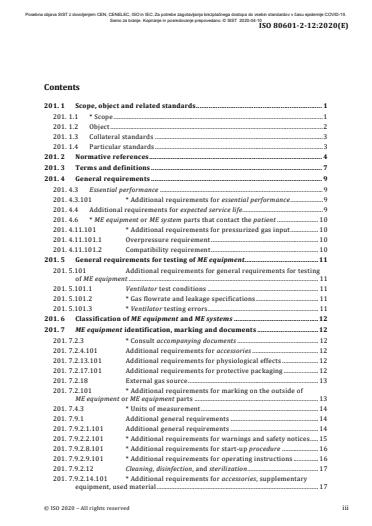
Contents
201. 1 Scope, object and related standards . 1
201. 1.1 * Scope . 1
201. 1.2 Object . 2
201. 1.3 Collateral standards . 3
201. 1.4 Particular standards . 3
201. 2 Normative references . 4
201. 3 Terms and definitions . 7
201. 4 General requirements . 9
201. 4.3 Essential performance . 9
201. 4.3.101 * Additional requirements for essential performance . 9
201. 4.4 Additional requirements for expected service life . 9
201. 4.6 * ME equipment or ME system parts that contact the patient . 10
201. 4.11.101 * Additional requirements for pressurized gas input . 10
201. 4.11.101.1 Overpressure requirement . 10
201. 4.11.101.2 Compatibility requirement . 10
201. 5 General requirements for testing of ME equipment. 11
201. 5.101 Additional requirements for general requirements for testing
of ME equipment . 11
201. 5.101.1 Ventilator test conditions . 11
201. 5.101.2 * Gas flowrate and leakage specifications . 11
201. 5.101.3 * Ventilator testing errors . 11
201. 6 Classification of ME equipment and ME systems . 12
201. 7 ME equipment identification, marking and documents . 12
201. 7.2.3 * Consult accompanying documents . 12
201. 7.2.4.101 Additional requirements for accessories . 12
201. 7.2.13.101 Additional requirements for physiological effects . 12
201. 7.2.17.101 Additional requirements for protective packaging . 12
201. 7.2.18 External gas source . 13
201. 7.2.101 * Additional requirements for marking on the outside of
ME equipment or ME equipment parts . 13
201. 7.4.3 * Units of measurement . 14
201. 7.9.1 Additional general requirements . 14
201. 7.9.2.1.101 Additional general requirements . 14
201. 7.9.2.2.101 * Additional requirements for warnings and safety notices . 15
201. 7.9.2.8.101 * Additional requirements for start-up procedure . 16
201. 7.9.2.9.101 * Additional requirements for operating instructions . 16
201. 7.9.2.12 Cleaning, disinfection, and sterilization . 17
201. 7.9.2.14.101 * Additional requirements for accessories, supplementary
equipment, used material . 17
Posebna objava SIST z dovoljenjem CEN, CENELEC, ISO in IEC: Za potrebe zagotavljanja brezplačnega dostopa do vsebin standardov v času epidemije COVID-19.
Samo za branje. Kopiranje in posredovanje prepovedano. © SIST 2020-04-10
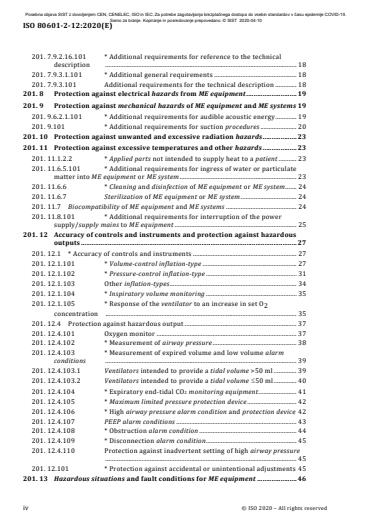
201. 7.9.2.16.101 * Additional requirements for reference to the technical
description . 18
201. 7.9.3.1.101 * Additional general requirements . 18
201. 7.9.3.101 Additional requirements for the technical description . 18
201. 8 Protection against electrical hazards from ME equipment . 19
201. 9 Protection against mechanical hazards of ME equipment and ME systems 19
201. 9.6.2.1.101 * Additional requirements for audible acoustic energy . 19
201. 9.101 * Additional requirements for suction procedures . 20
201. 10 Protection against unwanted and excessive radiation hazards . 23
201. 11 Protection against excessive temperatures and other hazards . 23
201. 11.1.2.2 * Applied parts not intended to supply heat to a patient . 23
201. 11.6.5.101 * Additional requirements for ingress of water or particulate
matter into ME equipment or ME system . 23
201. 11.6.6 * Cleaning and disinfection of ME equipment or ME system . 24
201. 11.6.7 Sterilization of ME equipment or ME system . 24
201. 11.7 Biocompatibility of ME equipment and ME systems . 24
201. 11.8.101 * Additional requirements for interruption of the power
supply/supply mains to ME equipment . 25
201. 12 Accuracy of controls and instruments and protection against hazardous
outputs . 27
201. 12.1 * Accuracy of controls and instruments . 27
201. 12.1.101 * Volume-control inflation-type . 27
201. 12.1.102 * Pressure-control inflation-type . 31
201. 12.1.103 Other inflation-types . 34
201. 12.1.104 * Inspiratory volume monitoring . 35
201. 12.1.105 * Response of the ventilator to an increase in set O
concentration . 35
201. 12.4 Protection against hazardous output . 37
201. 12.4.101 Oxygen monitor . 37
201. 12.4.102 * Measurement of airway pressure . 38
201. 12.4.103 * Measurement of expired volume and low volume alarm
conditions . 39
201. 12.4.103.1 Ventilators intended to provide a tidal volume >50 ml . 39
201. 12.4.103.2 Ventilators intended to provide a tidal volume ≤50 ml . 40
201. 12.4.104 * Expiratory end-tidal CO monitoring equipment . 41
201. 12.4.105 * Maximum limited pressure protection device . 42
201. 12.4.106 * High airway pressure alarm condition and protection device 42
201. 12.4.107 PEEP alarm conditions . 43
201. 12.4.108 * Obstruction alarm condition . 44
201. 12.4.109 * Disconnection alarm condition . 45
201. 12.4.110 Protection against inadvertent setting of high airway pressure .
.................................................................................................................... 45
201. 12.101 * Protection against accidental or unintentional adjustments 45
201. 13 Hazardous situations and fault conditions for ME equipment . 46
iv © ISO 2020 – All rights reserved
Posebna objava SIST z dovoljenjem CEN, CENELEC, ISO in IEC: Za potrebe zagotavljanja brezplačnega dostopa do vsebin standardov v času epidemije COVID-19.
Samo za branje. Kopiranje in posredovanje prepovedano. © SIST 2020-04-10
201. 13.2.101 * Additional specific single fault conditions . 46
201. 13.2.102 * Failure of one gas supply to a ventilator . 46
201. 13.2.103 * Independence of ventilation control function and related risk
control measures . 47
201. 13.2.104 * Failure of functional connection to a ventilator control or
monitoring means . 47
201. 14 Programmable electrical medical systems (PEMS) . 47
201. 14.101 Software life cycle . 48
201. 15 Construction of ME equipment . 48
201. 15.3.5.101 Additional requirements for rough handling . 48
201. 15.3.5.101.1 * Shock and vibration (robustness) . 48
201. 15.3.5.101.2 * Shock and vibration for a transit-operable ventilator during
operation . 49
201. 15.4.1 Construction of connectors . 51
201. 15.101 Mode of operation . 51
201. 15.102 Delivered oxygen concentration . 51
201. 15.103 Accessory self-check . 51
201. 16 ME systems . 52
201. 16.1.101 Additional general requirements for ME systems . 52
201. 16.2.101 * Additional general requirements for accompanying documents
of an ME system . 52
201. 17 Electromagnetic compatibility of ME equipment and ME systems. 52
201. 101 Gas connections . 52
201. 101.1 * Protection against reverse gas leakage . 52
201. 101.2 Connection to a high-pressure input port . 53
201. 101.2.1 Connector . 53
201. 101.2.2 * Filter . 53
201. 101.3 VBS connectors . 53
201. 101.3.1 * General . 53
201. 101.3.2 Other named ports . 53
201. 101.3.2.1 Patient-connection port . 53
201. 101.3.2.2 Gas output port and gas return port . 54
201. 101.3.2.3 Emergency intake port . 54
201. 101.3.2.4 Flow-direction-sensitive components. 54
201. 101.3.2.5 * Accessory port . 54
201. 101.3.2.6 Gas exhaust port . 55
201. 101.3.2.7 Temperature sensor port . 55
201. 102 Requirements for the VBS and accessories . 55
201. 102.1 * General . 55
201. 102.2 Labelling . 55
201. 102.3 Breathing tubes . 55
201. 102.4 * Water vapour management . 56
201. 102.4.1 Humidification system . 56
201. 102.4.2 Heat and moisture exchanger (HME) . 56
Posebna objava SIST z dovoljenjem CEN, CENELEC, ISO in IEC: Za potrebe zagotavljanja brezplačnega dostopa do vsebin standardov v času epidemije COVID-19.
Samo za branje. Kopiranje in posredovanje prepovedano. © SIST 2020-04-10
201. 102.6 Breathing system filters . 56
201. 102.7 Ventilator breathing systems . 56
201. 102.7.1 * Leakage from complete VBS . 56
201. 102.7.2 * Non-invasive ventilation . 57
201. 103 * Spontaneous breathing during loss of power supply . 57
201. 104 * Indication of duration of operation . 57
201. 105 Functional connection . 58
201. 105.1 General . 58
201. 105.2 * Connection to an electronic health record . 58
201. 105.3 * Connection to a distributed alarm system . 58
201. 105.4 Connection for remote control . 58
201. 106 Display loops . 58
201. 106.1 Pressure-volume loops . 58
201. 106.2 Flow-volume loops . 59
201. 107 * Timed ventilatory pause. 59
201. 107.1 Expiratory pause . 59
201. 107.2 Inspiratory pause . 60
202 Electromagnetic disturbances — Requirements and tests . 61
206 Usability . 62
206.101 Primary operating functions . 62
206.102 * Training . 63
208 General requirements, tests and guidance for alarm systems in medical
electrical equipment and medical electrical systems . 64
Annex C (informative) Guide to marking and labelling requirements for
ME equipment and ME systems . 66
201.C.101 Marking on the outside of ME equipment, ME systems or their
parts . 66
201.C.102 Accompanying documents, general . 67
201.C.103 Accompanying documents, instructions for use . 67
201.C.104 Accompanying documents, technical description . 70
Annex D (informative) Symbols on marking . 71
Annex AA (informative) Particular guidance and rationale . 75
AA.1 General guidance. 75
AA.2 Rationale for particular clauses and subclauses . 75
Annex BB (informative) Data interfaces . 114
BB.1 Background and purpose . 114
BB.2 Data definition . 115
Annex CC (informative) Reference to the essential principles . 123
Annex DD (informative) Reference to the general safety and performance
requirements .126
Annex EE (informative) Terminology — Alphabetized index of defined terms . 129
Bibliography .134
vi © ISO 2020 – All rights reserved
Posebna objava SIST z dovoljenjem CEN, CENELEC, ISO in IEC: Za potrebe zagotavljanja brezplačnega dostopa do vsebin standardov v času epidemije COVID-19.
Samo za branje. Kopiranje in posredovanje prepovedano. © SIST 2020-04-10
Foreword
ISO (the International Organization for Standardization) is a worldwide federation of national standards
bodies (ISO member bodies). The work of preparing International Standards is normally carried out
through ISO technical committees. Each member body interested in a subject for which a technical
committee has been established has the right to be represented on that committee. International
organizations, governmental and non-governmental, in liaison with ISO, also take part in the work. ISO
collaborates closely with the International Electrotechnical Commission (IEC) on all matters of
electrotechnical standardization.
The procedures used to develop this document and those intended for its further maintenance are
described in the ISO/IEC Directives, Part 1. In particular, the different approval criteria needed for the
different types of ISO documents should be noted. This document was drafted in accordance with the
editorial rules of the ISO/IEC Directives, Part 2 (see www.iso.org/directives).
Attention is drawn to the possibility that some of the elements of this document may be the subject of
patent rights. ISO shall not be held responsible for identifying any or all such patent rights. Details of any
patent rights identified during the development of the document will be in the Introduction and/or on
the ISO list of patent declarations received (see www.iso.org/patents).
Any trade name used in this document is information given for the convenience of users and does not
constitute an endorsement.
For an explanation of the voluntary nature of standards, the meaning of ISO specific terms and
expressions related to conformity assessment, as well as information about ISO's adherence to the World
Trade Organization (WTO) principles in the Technical Barriers to Trade (TBT) see
www.iso.org/iso/foreword.html.
This document was prepared by Technical Committee ISO/TC 121, Anaesthetic and respiratory
equipment, Subcommittee SC 3, Respiratory devices and related equipment used for patient care and
Technical Committee IEC/TC 62, Electrical equipment in medical practice, Subcommittee SC 62D, Electric
equipment, in collaboration with the European Committee for Standardization (CEN) Technical
Committee CEN/TC 215, Respiratory and anaesthetic equipment, in accordance with the Agreement on
technical cooperation between ISO and CEN (Vienna Agreement).
This second edition cancels and replaces the first edition (ISO 80601-2-12:2011), which has been
technically revised. It also incorporates the Technical Corrigendum ISO 80601-2-12:2011/Cor 1:2011.
The main changes compared to the previous edition are as follows:
— alignment with IEC 60601-1:2005+AMD1:2012, IEC 60601-1-8:2006+AMD1:2012, IEC
60601-1-2:2014 and IEC 60601-1-6:2010+AMD1:2013.
— determination of probability of component failure during the expected service life;
— delivered gas maximum enthalpy requirement;
— new test protocol for internal electrical power source operation time;
— performance test and disclosure requirements for other inflation-types;
— additional protections against hazardous outputs;
— clarification of performance requirements during abnormals testing;
— consideration of input gas of Oxygen 93 %; and
— harmonization of terminology with ISO 19223, where appropriate.
Posebna objava SIST z dovoljenjem CEN, CENELEC, ISO in IEC: Za potrebe zagotavljanja brezplačnega dostopa do vsebin standardov v času epidemije COVID-19.
Samo za branje. Kopiranje in posredovanje prepovedano. © SIST 2020-04-10
A list of all parts in the ISO 80601 series and the IEC 80601 series can be found on the ISO website.
Any feedback or questions on this document should be directed to the user’s national standards
body. A complete listing of these bodies can be found at www.iso.org/members.html.
viii © ISO 2020 – All rights reserved
Posebna objava SIST z dovoljenjem CEN, CENELEC, ISO in IEC: Za potrebe zagotavljanja brezplačnega dostopa do vsebin standardov v času epidemije COVID-19.
Samo za branje. Kopiranje in posredovanje prepovedano. © SIST 2020-04-10
Introduction
In this document, the following print types are used:
— Requirements and definitions: roman type;
— Instructions, test specifications and terms defined in Clause 3 of the general standard, in this
document or as noted: italic type;
— Informative material appearing outside of tables, such as notes, examples and references: in smaller
type. Normative text of tables is also in a smaller type.
In referring to the structure of this document, the term
— “clause” means one of the four numbered divisions within the table of contents, inclusive of
all subdivisions (e.g. Clause 201 includes subclauses 201.7, 201.8, etc.);
— “subclause” means a numbered subdivision of a clause (e.g. 201.7, 201.8 and 201.12 are all
subclauses of Clause 201).
References to clauses within this document are preceded by the term “Clause” followed by the
clause number. References to subclauses within this document are by number only.
In this document, the conjunctive “or” is used as an “inclusive or” so a statement is true if any
combination of the conditions is true.
For the purposes of this document, the auxiliary verb
— “shall” means that conformance with a requirement or a test is mandatory for conformance
with this document,
— “should” means that conformance with a requirement or a test is recommended but is not
mandatory for conformance with this document;
— “may” is used to describe permission (e.g. a permissible way to achieve conformance with a
requirement or test),
— "can" is used to describe a possibility or capability, and
— "must" is used to express an external constraint.
Annex C contains a guide to the marking and labelling requirements in this document.
Annex D contains a summary of the symbols referenced in this document.
An asterisk (*) as the first character of a title or at the beginning of a paragraph or table title
indicates that there is guidance or rationale related to that item in Annex AA.
Posebna objava SIST z dovoljenjem CEN, CENELEC, ISO in IEC: Za potrebe zagotavljanja brezplačnega dostopa do vsebin standardov v času epidemije COVID-19.
Samo za branje. Kopiranje in posredovanje prepovedano. © SIST 2020-04-10
Posebna objava SIST z dovoljenjem CEN, CENELEC, ISO in IEC: Za potrebe zagotavljanja brezplačnega dostopa do vsebin standardov v času epidemije COVID-19.
Samo za branje. Kopiranje in posredovanje prepovedano. © SIST 2020-04-10
INTERNATIONAL STANDARD ISO 80601-2-12:2020(E)
Medical electrical equipment — Part 2-12: Particular
requirements for basic safety and essential performance of
critical care ventilators
201.1 Scope, object and related standards
Clause 1 of the general standard applies, except as follows:
NOTE The general standard is IEC 60601-1:2005+AMD1:2012.
201.1.1 * Scope
Replacement:
This document applies to the basic safety and essential performance of a ventilator in combination
with its accessories, hereafter referred to as ME equipment:
intended for use in an environment that provides specialized care for patients whose
conditions can be life-threatening and who can require comprehensive care and constant
monitoring in a professional healthcare facility;
NOTE 1 For the purposes of this document, such an environment is referred to as a critical care environment.
Ventilators for this environment are considered life-sustaining.
NOTE 2 For the purposes of this document, such a ventilator can provide transport within a professional
healthcare facility (i.e. be a transit-operable ventilator).
NOTE 3 A critical care ventilator intended for use in transport within a professional healthcare facility is not
considered as an emergency medical services environment ventilator.
intended to be operated by a healthcare professional operator; and
intended for those patients who need differing levels of support from artificial ventilation
including for ventilator-dependent patients.
A critical care ventilator is not considered to utilize a physiologic closed-loop-control system
unless it uses a physiological patient variable to adjust the ventilation therapy settings.
This document is also applicable to those accessories intended by their manufacturer to be
connected to a ventilator breathing system, or to a ventilator, where the characteristics of those
accessories can affect the basic safety or essential performance of the ventilator.
NOTE 4 If a clause or subclause is specifically intended to be applicable to ME equipment only, or to ME systems
only, the title and content of that clause or subclause will say so. If that is not the case, the clause or subclause applies
both to ME equipment and to ME systems, as relevant.
Posebna objava SIST z dovoljenjem CEN, CENELEC, ISO in IEC: Za potrebe zagotavljanja brezplačnega dostopa do vsebin standardov v času epidemije COVID-19.
Samo za branje. Kopiranje in posredovanje prepovedano. © SIST 2020-04-10
Hazards inherent in the intended physiological function of ME equipment or ME systems within
the scope of this document are not covered by specific requirements in this document except in
IEC 60601-1:2005, 7.2.13 and 8.4.1.
NOTE 5 Additional information can be found in IEC 60601-1:2005+AMD1:2012, 4.2.
This document is not applicable to ME equipment or an ME system operating in a ventilator-
operational mode solely intended for patients who are not dependent on artificial ventilation.
NOTE 6 A critical care ventilator, when operating in such a ventilator-operational mode, is not considered life-
sustaining.
This document is not applicable to ME equipment that is intended solely to augment the
ventilation of spontaneously breathing patients within a professional healthcare facility.
This document does not specify the requirements for:
ventilators or accessories intended for anaesthetic applications, which are given in
[2]
ISO 80601-2-13 ;
ventilators or accessories intended for the emergency medical services environment, which are
[3] [4]
given in ISO 80601-2-84 , the future replacement for ISO 10651-3 ;
ventilators or accessories intended for ventilator-dependent patients in the home healthcare
[5]
environment, which are given in ISO 80601-2-72:2015 ;
ventilators or accessories intended for home-care ventilatory support devices, which are
[6] [7]
given in ISO 80601-2-79:2018 and ISO 80601-2-80:2018 ;
[9]
obstructive sleep apnoea therapy ME equipment, which are given in ISO 80601-2-70 ;
continuous positive airway pressure (CPAP) ME equipment;
high-frequency jet ventilators (HFJVs) and high-frequency oscillatory ventilators (HFOVs),
[63]
which are given in ISO 80601-2-87 ;
NOTE 7 A critical care ventilator can incorporate high-frequency jet or high-frequency oscillatory ventilator-
operational modes.
oxygen therapy constant flow ME equipment; and
cuirass or “iron-lung” ventilation equipment.
201.1.2 Object
Replacement:
The object of this document is to establish basic safety and essential performance requirements
for a ventilator and its accessories.
ISO 80601-2-79 and ISO 80601-2-80 replace ISO 10651-6, which has been withdrawn.
2 © ISO 2020 – All rights reserved
Posebna objava SIST z dovoljenjem CEN, CENELEC, ISO in IEC: Za potrebe zagotavljanja brezplačnega dostopa do vsebin standardov v času epidemije COVID-19.
Samo za branje. Kopiranje in posredovanje prepovedano. © SIST 2020-04-10
Accessories are included because the combination of the ventilator and the accessories needs to
be adequately safe. Accessories can have a significant impact on the basic safety or essential
performance of a ventilator.
NOTE 1 This document has been prepared to address the relevant essential principles of safety and performance of
ISO 16142-1:2016 as indicated in Annex CC.
NOTE 2 This document has been prepared to address the relevant general safety and performance requirements
of European regulation (EU) 2017/745 as indicated in Annex DD.
201.1.3 Collateral standards
Amendment (add after existing text):
This document refers to those applicable collateral standards that are listed in Clause 2 of the
general standard and in 201.2 of this document.
IEC 60601-1-2, IEC 60601-1-6 and IEC 60601-1-8 apply as modified in Clauses 202, 206 and 208
[12] [13]
respectively. IEC 60601-1-3 , IEC 60601-1-9 , IEC 60601-1-11 and IEC 60601-1-12 do not
apply. All other published collateral standards in the IEC 60601-1 series apply as published.
201.1.4 Particular standards
Replacement:
In the IEC 60601 series, particular standards may modify, replace or delete requirements
contained in the general standard, including the collateral standards, as appropriate for the
particular ME equipment under consideration, and may add other basic safety or essential
performance requirements.
A requirement of a particular standard takes priority over IEC 60601-1:2005 or the collateral
standards.
For brevity, IEC 60601-1:2005+AMD1:2012 is referred to in this particular document as the
general standard. Collateral standards are referred to by their document number.
The numbering of clauses and subclauses of this document corresponds to those of the general
standard with the prefix “201” (e.g. 201.1 in this document addresses the content of Clause 1 of
the general standard) or applicable collateral standard with the prefix “2xx” where xx is the final
digits of the collateral standard document number (e.g. 202.4 in this document addresses the
content of Clause 4 of the IEC 60601-1-2 collateral standard, 208.4 in this document addresses
the content of Clause 4 of the IEC 60601-1-8 collateral standard, etc.). The changes to the text of
the general standard are specified by the use of the following words:
“Replacement” means that the clause or subclause of IEC 60601-1:2005+AMD1:2012 or the
applicable collateral standard is replaced completely by the text of this document.
“Addition” means that the text of this document is additional to the requirements of IEC 60601-
1:2005+AMD1:2012 or the applicable collateral standard.
“Amendment” means that the clause or subclause of IEC 60601-1:2005+AMD1:2012 or the
applicable collateral standard is amended as indicated by the text of this document.
Posebna objava SIST z dovoljenjem CEN, CENELEC, ISO in IEC: Za potrebe zagotavljanja brezplačnega dostopa do vsebin standardov v času epidemije COVID-19.
Samo za branje. Kopiranje in posredovanje prepovedano. © SIST 2020-04-10
Subclauses, figures or tables that are additional to those of the general standard are numbered
starting from 201.101. However, due to the fact that definitions in the general standard are
numbered 3.1 through 3.147, additional definitions in this document are numbered beginning
from 201.3.201. Additional annexes are lettered AA, BB, etc., and additional items aa), bb), etc.
Subclauses or figures that are additional to those of a collateral standard are numbered starting
from 20x, where “x” is the number of the collateral standard, e.g. 202 for IEC 60601-1-2, 203 for
[12]
IEC 60601-1-3 , etc.
The term “this document” is used to make reference to the general standard, any applicable
collateral standards and this particular document taken together.
Where there is no corresponding clause or subclause in this document, the clause or subclause
of IEC 60601-1:2005+AMD1:2012 or the applicable collateral standard, although possibly not
relevant, applies without modification; where it is intended that any part of
IEC 60601-1:2005+AMD1:2012 or the applicable collateral standard, although possibly relevant,
is not to be applied, a statement to that effect is given in this particular document.
201.2 Normative references
The following documents are referred to in the text in such a way that some or all of their content
constitutes requirements of this document. For dated references, only the edition cited applies.
For undated references, the latest edition of the referenced document (including any
amendments) applies.
Clause 2 of the general standard applies, except as follows:
Replacement:
ISO 7000, Graphical symbols for use on equipment — Registered symbols
ISO 7010:2019, Graphical symbols — Safety colours and safety signs — Registered safety signs
ISO 15223-1:2016, Medical devices — Symbols to be used with medical device labels, labelling and
information to be supplied — Part 1: General requirements
IEC 60601-1-2:2014, Medical electrical equipment — Part 1-2: General requirements for basic
safety and essential performance — Collateral Standard: Electromagnetic disturbances —
Requirements and tests
IEC 60601-1-6:2010+AMD1:2013, Medical electrical equipment — Part 1-6: General requirements
for basic safety and essential performance — Collateral Standard: Usability
IEC 60601-1-8:2006+AMD1:2012, Medical electrical equipment — Part 1-8: General requirements
for basic safety and essential performance — Collateral Standard: General requirements, tests and
guidance for alarm systems in medical electrical equipment and medical electrical systems
IEC 61672-1:2013, Electroacoustics — Sound level meters — Part 1: Specifications
IEC 62304:2006+AMD1:2015, Medical device software — Software life cycle processes
4 © ISO 2020 – All rights reserved
Posebna objava SIST z dovoljenjem CEN, CENELEC, ISO in IEC: Za potrebe zagotavljanja brezplačnega dostopa do vsebin standardov v času epidemije COVID-19.
Samo za branje. Kopiranje in posredovanje prepovedano. © SIST 2020-04-10
Addition:
ISO 3744:2010, Acoustics — Determination of sound power levels and sound energy levels of noise
sources using sound pressure — Engineering methods for an essentially free field over a reflecting
plane
ISO 4871:1996, Acoustics — Declaration and verification of noise emission values of machinery and
equipment
ISO 5356-1:2015, Anaesthetic and respiratory equipment — Conical connectors — Part 1: Cones
and sockets
ISO 5359:2014, Anaesthetic and respiratory equipment — Low-pressure hose assemblies for use
with medical gases
ISO 5367:2014, Anaesthetic and respiratory equipment — Breathing sets and connectors
ISO 7396-1:2016, Medical gas pipeline systems — Part 1: Pipeline systems for compressed medical
gases and vacuum
ISO 8836:2014, Suction catheters for use in the respiratory tract
ISO 9000:2015, Quality management systems — Fundamentals and vocabulary
ISO 9360-1:2000, Anaesthetic and respiratory equipment — Heat and moisture exchangers (HMEs)
for humidifying respired gases in humans — Part 1: HMEs for use with minimum tidal volumes of
250 ml
ISO 9360-2:2001, Anaesthetic and respiratory equipment — Heat and moisture exchangers (HMEs)
for humidifying respired gases in humans — Part 2: HMEs for use with tracheostomized patients
having minimum tidal volumes of 250 ml
ISO 14937:2009, Sterilization of health care products — General requirements for
characterization of a sterilizing agent and the development, validation and routine control of a
sterilization process for medical devices
ISO 16142-1:2016, Medical devices — Recognized essential principles of safety and performance of
medical devices — Part 1: General essential principles and additional specific essential principles
for all non-IVD medical devices and guidance on the selection of standards
ISO 17510:2015, Medical devices — Sleep apnoea breathing therapy — Masks and application
accessories
ISO 17664:2017, Processing of health care products — Information to be provided by the medical
device manufacturer for the processing of medical devices
ISO 18562-1:2017, Biocompatibility evaluation of breathing gas pathways in healthcare
applications — Part 1: Evaluation and testing within a risk management process
ISO 19223:2019, Lung ventilators and related equipment — Vocabulary and semantics
Posebna objava SIST z dovoljenjem CEN, CENELEC, ISO in IEC: Za potrebe zagotavljanja brezplačnega dostopa do vsebin standardov v času epidemije COVID-19.
Samo za branje. Kopiranje in posredovanje prepovedano. © SIST 2020-04-10
ISO 23328-1:2003, Breathing system filters for anaesthetic and respiratory use — Part 1: Salt test
method to assess filtration performance
ISO 23328-2:2002, Breathing system filters for anaesthetic and respiratory use — Part 2: Non-
filtration aspects
ISO 80369-1:2018, Small-bore connectors for liquids and gases in healthcare applications — Part
1: General requirements
ISO 80601-2-55:2018, Medical electrical equipment — Part 2-55: Particular requirements for the
basic safety and essential performance of respiratory gas monitors
ISO 80601-2-74:2017, Medical electrical equipment — Part 2-74: Particular requirements for
basic safety and essential performance of respiratory humidifying equipment
IEC 60068-2-27:2008, Environmental testing — Part 2-27: Tests — Test Ea and guidance: Shock
IEC 60068-2-31:2008, Environmental testing — Part 2-31: Tests — Test Ec: Rough handling
shocks, primarily for equipment-type specimens
IEC 60068-2-64:2008, Environmental testing — Part 2-64: Tests — Test Fh: Vibration, broadband
random and guidance
IEC 60529:1989+AMD1:1999+AMD2:2013, Degrees of protection provided by enclosures (IP Code)
IEC 60601-1:2005+AMD1:2012, Medical electrical equipment — Part 1: General requirements for
basic safety and essential performance
IEC 60601-1-10:2007, Medical electrical equipment — Part 1-10: General requirements for basic
safety and essential performance — Collateral Standard: Requirements for the development of
physiologic closed-loop controllers
IEC 60601-1-11:2015, Medical electrical equipment — Part 1-11: General requirements for basic
safety and essential performance — Collateral Standard: Requirements for medical electrical
equipment and medical electrical systems used in the home healthcare environment
IEC 60601-1-12:2014, Medical electrical equipment — Part 1-12: General requirements for basic
safety and essential performance — Collateral Standard: Requirements for medical electrical
equipment and medical electrical systems intended for use in the emergency medical services
environment
IEC 60601-2-2:2017, Medical electrical equipment — Part 2-2: Particular requirements for the
basic safety and essential performance of high frequency surgical equipment and high frequency
surgical accessories
IEC 62366-1:2015, Medical devices — Part 1: Application of usability engineering to medical
devices
IEC 62570:2014, Standard practice for ma
...
Questions, Comments and Discussion
Ask us and Technical Secretary will try to provide an answer. You can facilitate discussion about the standard in here.
Loading comments...