

SIST EN 12252:2022+A1:2026
(Main)LPG equipment and accessories - Equipping of LPG road tankers
General Information
- Abstract
This document specifies equipment and accessories for road tankers used for the transport of Liquefied Petroleum Gas (LPG) and identifies the equipment that is considered necessary to ensure that filling, transportation and discharge operations can be carried out safely. It specifies the requirements for the assembly of the accessories and the vehicle LPG equipment to the road tanker. This document also identifies additional equipment and accessories that can be used on road tankers carrying LPG.
This document does not preclude the use of alternative designs, materials and equipment testing which provide the same or a higher level of safety. ADR [9] requires that such alternative technical codes be recognized by the competent authority, provided that the minimum requirements of section 6.8.2 of ADR [9] are complied with.
This document does not apply to “tank-containers” or “battery-vehicles” used for the transport of LPG.
- Status
- Published
- Publication Date
- 08-Dec-2025
- Technical Committee
- TLP - Pressure vessels
- Current Stage
- 6060 - National Implementation/Publication (Adopted Project)
- Start Date
- 21-Oct-2025
- Due Date
- 26-Dec-2025
- Completion Date
- 09-Dec-2025

Overview
EN 12252:2022+A1:2025 (CEN) specifies the equipment and accessories required for the safe equipping of LPG road tankers used for the transport of Liquefied Petroleum Gas (LPG). The standard defines which fittings, assemblies and vehicle-mounted LPG equipment are considered necessary so that filling, transport and discharge operations can be performed safely. It covers pressure vessel mounting, accessory assembly and optional equipment, while excluding tank‑containers and battery‑vehicles. The standard allows alternative designs and materials provided they achieve an equivalent or higher safety level and are recognised by the competent authority under ADR requirements.
Key topics and technical requirements
- Mandatory vessel accessories: contents gauge, pressure gauge, primary shut-off system, pressure relief valves (PRVs).
- Vehicle LPG equipment: pipework, connecting hoses, fittings, metering systems, earth connections and related accessories.
- Pressure vessel requirements: mounting principles, attachment calculations and mounting hardware guidance (see Annex B).
- Materials and fabrication: suitable materials for pressure-retaining and non-pressure parts, welding consumables, non‑metallic materials and certification/control of materials.
- Assembly and installation: welding rules, flanged and screwed connections, external corrosion protection and compliance with assembly practices.
- Safety systems: Emergency Shut-Down (ESD) systems, general safety requirements and the role of safety instrumentation.
- Optional equipment & traffic safety: additional accessories and traffic safety measures (see Annex C).
- Normative references & definitions: terms, definitions and referenced standards required for consistent application.
Practical applications
- Design and manufacture of LPG road tankers and their mounted equipment.
- Specification for procurement of tankers, valves, hoses, meters and PRVs.
- Guidance for safe installation, assembly and welding of LPG systems on vehicles.
- Basis for inspection, maintenance and periodic testing procedures.
- Input for risk assessments, conformity checks and certification to ADR/RID transport rules.
Who uses this standard
- Tanker manufacturers and vehicle OEMs
- LPG system designers and component suppliers (valves, gauges, hoses, metering systems)
- Fleet operators, transport companies and logistics managers handling LPG
- Inspection bodies, notified/certification authorities and competent authorities enforcing ADR
- Maintenance and safety engineers responsible for compliance and safe operations
Related standards and regulatory context
- ADR/RID transport regulations (take precedence where applicable)
- Other CEN and ISO standards referenced in the normative section
- Note: EN 12252 does not preclude alternative designs - these must meet ADR section 6.8.2 and be accepted by the competent authority.
Keywords: EN 12252:2022+A1:2025, LPG road tankers, LPG equipment, pressure relief valve, contents gauge, vehicle LPG equipment, ADR compliance, tanker mounting, ESD.
Relations
- Effective Date
- 01-Jan-2026
- Effective Date
- 28-Jan-2026
- Effective Date
- 28-Jan-2026
- Effective Date
- 28-Jan-2026
- Effective Date
- 28-Jan-2026
- Effective Date
- 28-Jan-2026
- Effective Date
- 28-Jan-2026
- Effective Date
- 28-Jan-2026
- Effective Date
- 28-Jan-2026
- Effective Date
- 28-Jan-2026
- Effective Date
- 28-Jan-2026
- Effective Date
- 28-Jan-2026
- Effective Date
- 28-Jan-2026
- Effective Date
- 28-Jan-2026
- Effective Date
- 28-Jan-2026
Get Certified
Connect with accredited certification bodies for this standard

TÜV Rheinland
TÜV Rheinland is a leading international provider of technical services.

TÜV SÜD
TÜV SÜD is a trusted partner of choice for safety, security and sustainability solutions.

DEKRA Certification Inc.
DEKRA US certification services.
Sponsored listings
Frequently Asked Questions
SIST EN 12252:2022+A1:2026 is a standard published by the Slovenian Institute for Standardization (SIST). Its full title is "LPG equipment and accessories - Equipping of LPG road tankers". This standard covers: This document specifies equipment and accessories for road tankers used for the transport of Liquefied Petroleum Gas (LPG) and identifies the equipment that is considered necessary to ensure that filling, transportation and discharge operations can be carried out safely. It specifies the requirements for the assembly of the accessories and the vehicle LPG equipment to the road tanker. This document also identifies additional equipment and accessories that can be used on road tankers carrying LPG. This document does not preclude the use of alternative designs, materials and equipment testing which provide the same or a higher level of safety. ADR [9] requires that such alternative technical codes be recognized by the competent authority, provided that the minimum requirements of section 6.8.2 of ADR [9] are complied with. This document does not apply to “tank-containers” or “battery-vehicles” used for the transport of LPG.
This document specifies equipment and accessories for road tankers used for the transport of Liquefied Petroleum Gas (LPG) and identifies the equipment that is considered necessary to ensure that filling, transportation and discharge operations can be carried out safely. It specifies the requirements for the assembly of the accessories and the vehicle LPG equipment to the road tanker. This document also identifies additional equipment and accessories that can be used on road tankers carrying LPG. This document does not preclude the use of alternative designs, materials and equipment testing which provide the same or a higher level of safety. ADR [9] requires that such alternative technical codes be recognized by the competent authority, provided that the minimum requirements of section 6.8.2 of ADR [9] are complied with. This document does not apply to “tank-containers” or “battery-vehicles” used for the transport of LPG.
SIST EN 12252:2022+A1:2026 is classified under the following ICS (International Classification for Standards) categories: 23.020.20 - Vessels and containers mounted on vehicles; 43.080.10 - Trucks and trailers. The ICS classification helps identify the subject area and facilitates finding related standards.
SIST EN 12252:2022+A1:2026 has the following relationships with other standards: It is inter standard links to SIST EN 12252:2022, SIST EN 10028-2:2017, SIST EN 16125:2019, SIST EN 10217-1:2019, SIST EN 10028-5:2017, SIST EN 1984:2011, SIST EN 12760:2016, SIST EN 13709:2011, SIST EN 1983:2014, SIST EN 10025-3:2019, SIST EN 10028-4:2017, SIST EN 1591-1:2002, SIST EN ISO 3834-2:2021, SIST EN 10025-1:2004, SIST EN 10028-6:2017. Understanding these relationships helps ensure you are using the most current and applicable version of the standard.
SIST EN 12252:2022+A1:2026 is associated with the following European legislation: EU Directives/Regulations: 2008/68/EC; Standardization Mandates: M/TDG. When a standard is cited in the Official Journal of the European Union, products manufactured in conformity with it benefit from a presumption of conformity with the essential requirements of the corresponding EU directive or regulation.
SIST EN 12252:2022+A1:2026 is available in PDF format for immediate download after purchase. The document can be added to your cart and obtained through the secure checkout process. Digital delivery ensures instant access to the complete standard document.
Standards Content (Sample)
SLOVENSKI STANDARD
01-januar-2026
Nadomešča:
SIST EN 12252:2022
Oprema in pribor za utekočinjeni naftni plin (UNP) - Oprema cestnih cistern za
UNP (vključno z dopolnilom A1)
LPG equipment and accessories - Equipping of LPG road tankers
Flüssiggas-Geräte und Ausrüstungsteile - Ausrüstung von Straßentankwagen für
Flüssiggas (LPG)
Equipements pour GPL et leurs accessoires - Equipements des camions citernes pour
GPL
Ta slovenski standard je istoveten z: EN 12252:2022+A1:2025
ICS:
23.020.20 Posode in vsebniki, montirani Vessels and containers
na vozila mounted on vehicles
43.080.10 Tovornjaki in priklopniki Trucks and trailers
2003-01.Slovenski inštitut za standardizacijo. Razmnoževanje celote ali delov tega standarda ni dovoljeno.
EN 12252:2022+A1
EUROPEAN STANDARD
NORME EUROPÉENNE
October 2025
EUROPÄISCHE NORM
ICS 43.080.10 Supersedes EN 12252:2022
English Version
LPG equipment and accessories - Equipping of LPG road
tankers
Equipements pour GPL et leurs accessoires - Flüssiggas-Geräte und Ausrüstungsteile - Ausrüstung
Equipements des camions citernes pour GPL von Straßentankwagen für Flüssiggas (LPG)
This European Standard was approved by CEN on 20 April 2022 and includes Amendment 1 approved by CEN on 29 November
2024.
CEN members are bound to comply with the CEN/CENELEC Internal Regulations which stipulate the conditions for giving this
European Standard the status of a national standard without any alteration. Up-to-date lists and bibliographical references
concerning such national standards may be obtained on application to the CEN-CENELEC Management Centre or to any CEN
member.
This European Standard exists in three official versions (English, French, German). A version in any other language made by
translation under the responsibility of a CEN member into its own language and notified to the CEN-CENELEC Management
Centre has the same status as the official versions.
CEN members are the national standards bodies of Austria, Belgium, Bulgaria, Croatia, Cyprus, Czech Republic, Denmark, Estonia,
Finland, France, Germany, Greece, Hungary, Iceland, Ireland, Italy, Latvia, Lithuania, Luxembourg, Malta, Netherlands, Norway,
Poland, Portugal, Republic of North Macedonia, Romania, Serbia, Slovakia, Slovenia, Spain, Sweden, Switzerland, Türkiye and
United Kingdom.
EUROPEAN COMMITTEE FOR STANDARDIZATION
COMITÉ EUROPÉEN DE NORMALISATION
EUROPÄISCHES KOMITEE FÜR NORMUNG
CEN-CENELEC Management Centre: Rue de la Science 23, B-1040 Brussels
© 2025 CEN All rights of exploitation in any form and by any means reserved Ref. No. EN 12252:2022+A1:2025 E
worldwide for CEN national Members.
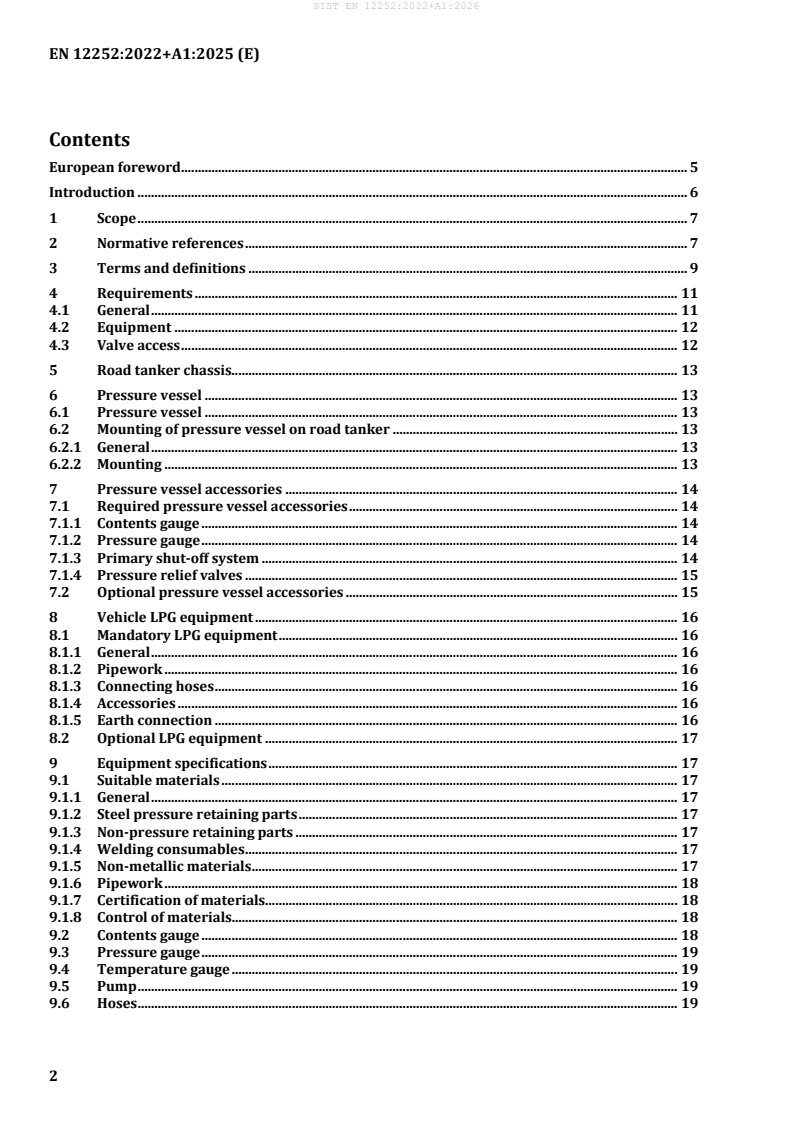
Contents
European foreword . 5
Introduction . 6
1 Scope . 7
2 Normative references . 7
3 Terms and definitions . 9
4 Requirements . 11
4.1 General . 11
4.2 Equipment . 12
4.3 Valve access . 12
5 Road tanker chassis. 13
6 Pressure vessel . 13
6.1 Pressure vessel . 13
6.2 Mounting of pressure vessel on road tanker . 13
6.2.1 General . 13
6.2.2 Mounting . 13
7 Pressure vessel accessories . 14
7.1 Required pressure vessel accessories . 14
7.1.1 Contents gauge . 14
7.1.2 Pressure gauge . 14
7.1.3 Primary shut-off system . 14
7.1.4 Pressure relief valves . 15
7.2 Optional pressure vessel accessories . 15
8 Vehicle LPG equipment . 16
8.1 Mandatory LPG equipment . 16
8.1.1 General . 16
8.1.2 Pipework . 16
8.1.3 Connecting hoses . 16
8.1.4 Accessories . 16
8.1.5 Earth connection . 16
8.2 Optional LPG equipment . 17
9 Equipment specifications . 17
9.1 Suitable materials . 17
9.1.1 General . 17
9.1.2 Steel pressure retaining parts . 17
9.1.3 Non-pressure retaining parts . 17
9.1.4 Welding consumables . 17
9.1.5 Non-metallic materials . 17
9.1.6 Pipework . 18
9.1.7 Certification of materials. 18
9.1.8 Control of materials. 18
9.2 Contents gauge . 18
9.3 Pressure gauge . 19
9.4 Temperature gauge . 19
9.5 Pump . 19
9.6 Hoses . 19
9.7 Hose reel . 20
9.8 Earth reel . 20
9.9 Metering system . 20
9.10 Valves . 20
9.11 Pressure relief valves (PRV) . 21
9.12 Filters and strainers . 21
9.13 Drain valves . 21
10 Assembly . 21
10.1 General . 21
10.2 Welding . 22
10.2.1 Welding of the pressure containing parts . 22
10.2.2 Welding of the non-pressure containing parts . 22
10.3 Flanged connections . 22
10.4 Screwed connections . 22
10.5 External corrosion protection . 22
11 Safety systems . 22
11.1 General . 22
11.2 Emergency Shut-Down (ESD)system . 23
11.3 General safety requirements . 23
Annex A (normative) Discharge rates for pressure relief valves — Discharge capacity . 25
Annex B (informative) Calculation of mountings of pressure vessel to the chassis . 27
B.1 General . 27
B.2 Mounting of pressure vessel to the chassis . 28
B.2.1 Vertical bolts . 28
B.2.2 Horizontal bolts . 28
B.2.3 Bracket welds . 28
B.2.4 Allowable stress . 28
B.2.5 Typical mounting . 29
B.3 Calculation of vertical bolts . 29
B.3.1 In the direction of travel . 29
B.3.2 At right angles to the direction of travel . 30
B.3.3 Vertically upwards . 30
B.4 Calculation of the bracket welds . 31
B.4.1 General . 31
B.4.2 In the direction of travel . 31
B.4.3 At right angles to the direction of travel . 31
B.4.4 Vertically upwards . 31
B.5 Calculation of horizontal bolts . 32
B.5.1 General . 32
B.5.2 In the direction of travel . 32
B.5.3 At right angles to the direction of travel . 32
B.5.4 Vertically upwards. 33
Annex C (informative) Additional traffic safety measures . 34
Bibliography . 35
European foreword
This document (EN 12252:2022+A1:2025) has been prepared by Technical Committee CEN/TC 286 “LPG
equipment and accessories”, the secretariat of which is held by NSAI.
This European Standard shall be given the status of a national standard, either by publication of an
identical text or by endorsement, at the latest by April 2026, and conflicting national standards shall be
withdrawn at the latest by April 2026.
Attention is drawn to the possibility that some of the elements of this document may be the subject of
patent rights. CEN shall not be held responsible for identifying any or all such patent rights.
This document includes Amendment 1 approved by CEN on 29 November 2024.
The start and finish of text introduced or altered by amendment is indicated in the text by tags !".
This document supersedes !EN 12252:2022".
!Deleted paragraph"
This document has been submitted for reference in
— the RID and/or
— the technical annexes of the ADR.
NOTE These regulations take precedence over any clause of this document. It is emphasized that RID/ADR are
being revised regularly at intervals of two years which may lead to temporary non-compliances with the clauses of
this document.
Any feedback and questions on this document should be directed to the users’ national standards body.
A complete listing of these bodies can be found on the CEN website.
According to the CEN-CENELEC Internal Regulations, the national standards organisations of the
following countries are bound to implement this European Standard: Austria, Belgium, Bulgaria, Croatia,
Cyprus, Czech Republic, Denmark, Estonia, Finland, France, Germany, Greece, Hungary, Iceland, Ireland,
Italy, Latvia, Lithuania, Luxembourg, Malta, Netherlands, Norway, Poland, Portugal, Republic of North
Macedonia, Romania, Serbia, Slovakia, Slovenia, Spain, Sweden, Switzerland, Turkey and the United
Kingdom.
Introduction
This document calls for the use of substances and procedures that may be injurious to health and also the
environment if adequate precautions are not taken. It refers only to technical suitability; it does not
absolve the user from their legal obligations at any stage.
Protection of the environment is a key political issue in Europe and elsewhere. For CEN/TC 286 this is
covered in CEN/TS 16765 and this Technical Specification should be read in conjunction with this
document. This Technical Specification provides guidance on the environmental aspects to be considered
regarding equipment and accessories produced for the LPG industry and the following is addressed:
a) design;
b) manufacture;
c) packaging;
d) use and operation; and
e) disposal.
Provisions need to be restricted to a general guidance. Limit values are specified in national laws.
It is recommended that manufacturers develop an environmental management policy. For guidance see
the ISO 14000 series.
It has been assumed in the drafting of this document that the execution of its provisions is entrusted to
appropriately qualified and experienced people.
All pressures are gauge pressures unless otherwise stated.
NOTE This document requires measurement of material properties, dimensions and pressures. All such
measurements are subject to a degree of uncertainty due to tolerances in measuring equipment etc. It might be
beneficial to refer to the leaflet “measurement uncertainty leaflet” SP INFO 2000 27 [10].
1 Scope
This document specifies equipment and accessories for road tankers used for the transport of Liquefied
Petroleum Gas (LPG) and identifies the equipment that is considered necessary to ensure that filling,
transportation and discharge operations can be carried out safely. It specifies the requirements for the
assembly of the accessories and the vehicle LPG equipment to the road tanker. This document also
identifies additional equipment and accessories that can be used on road tankers carrying LPG.
This document does not preclude the use of alternative designs, materials and equipment testing which
provide the same or a higher level of safety. ADR [9] requires that such alternative technical codes be
recognized by the competent authority, provided that the minimum requirements of section 6.8.2 of ADR
[9] are complied with.
This document does not apply to “tank-containers” or “battery-vehicles” used for the transport of LPG.
For design of road tankers, see EN 12493, and for the inspection and test requirements of road tankers,
see EN 14334 [11].
2 Normative references
The following documents are referred to in the text in such a way that some or all of their content
constitutes requirements of this document. For dated references, only the edition cited applies. For
undated references, the latest edition of the referenced document (including any amendments) applies.
EN 549, Rubber materials for seals and diaphragms for gas appliances and gas equipment
EN 558, Industrial valves - Face-to-face and centre-to-face dimensions of metal valves for use in flanged pipe
systems - PN and Class designated valves
EN 837-2, Pressure gauges - Part 2: Selection and installation recommendations for pressure gauges
EN 1012-1, Compressors and vacuum pumps - Safety requirements - Part 1: Air compressors
EN 14129, LPG Equipment and accessories - Pressure relief valves for LPG pressure vessels
EN 1591-1, Flanges and their joints - Design rules for gasketed circular flange connections - Part 1:
Calculation
EN 1762, Rubber hoses and hose assemblies for liquefied petroleum gas, LPG (liquid or gaseous phase), and
natural gas up to 25 bar (2,5 MPa) - Specification
EN 1983, Industrial valves - Steel ball valves
EN 1984, Industrial valves - Steel gate valves
EN 10025-1, Hot rolled products of structural steels - Part 1: General technical delivery conditions
EN 10025-2, Hot rolled products of structural steels - Part 2: Technical delivery conditions for non-alloy
structural steels
EN 10025-3, Hot rolled products of structural steels - Part 3: Technical delivery conditions for
normalized/normalized rolled weldable fine grain structural steels
EN 10025-4, Hot rolled products of structural steels - Part 4: Technical delivery conditions for
thermomechanical rolled weldable fine grain structural steels
EN 10025-5, Hot rolled products of structural steels - Part 5: Technical delivery conditions for structural
steels with improved atmospheric corrosion resistance
EN 10025-6, Hot rolled products of structural steels - Part 6: Technical delivery conditions for flat products
of high yield strength structural steels in the quenched and tempered condition
EN 10028-1, Flat products made of steels for pressure purposes - Part 1: General requirements
EN 10028-2, Flat products made of steels for pressure purposes - Part 2: Non-alloy and alloy steels with
specified elevated temperature properties
EN 10028-3, Flat products made of steels for pressure purposes - Part 3: Weldable fine grain steels,
normalized
EN 10028-4, Flat products made of steels for pressure purposes - Part 4: Nickel alloy steels with specified
low temperature properties
EN 10028-5, Flat products made of steels for pressure purposes - Part 5: Weldable fine grain steels,
thermomechanically rolled
EN 10028-6, Flat products made of steels for pressure purposes - Part 6: Weldable fine grain steels,
quenched and tempered
EN 10204:2004, Metallic products - Types of inspection documents
EN 10216-1, Seamless steel tubes for pressure purposes - Technical delivery conditions - Part 1: Non-alloy
steel tubes with specified room temperature properties
EN 10217-1, Welded steel tubes for pressure purposes - Technical delivery conditions - Part 1: Electric
welded and submerged arc welded non-alloy steel tubes with specified room temperature properties
EN 12074, Welding consumables - Quality requirements for manufacture, supply and distribution of
consumables for welding and allied processes
EN 12493, LPG equipment and accessories - Welded steel pressure vessels for LPG road tankers - Design and
manufacture
EN 12627, Industrial valves - Butt welding ends for steel valves
EN 12760, Industrial valves - Socket welding ends for steel valves
EN 13175, LPG equipment and accessories — Specification and testing for Liquefied Petroleum Gas (LPG)
tank valves and fittings
EN 13709, Industrial valves - Steel globe and globe stop and check valves
EN 13789, Industrial valves - Cast iron globe valves
EN 13799, LPG equipment and accessories - Contents gauges for Liquefied Petroleum Gas (LPG) pressure
vessels
EN 14422, Clamp type coupling assemblies for liquefied petroleum gas (LPG) transfer hoses
EN 14424, Hose fittings with screwed ferrules
!EN 16125:2019, LPG Equipment and Accessories - Pipework systems and supports - LPG in liquid phase
and vapour pressure phase"
EN ISO 148-1, Metallic materials - Charpy pendulum impact test - Part 1: Test method (ISO 148-1:2016)
EN ISO 3834-2, Quality requirements for fusion welding of metallic materials - Part 2: Comprehensive
quality requirements (ISO 3834-2:2021)
EN ISO 3834-3, Quality requirements for fusion welding of metallic materials - Part 3: Standard quality
requirements (ISO 3834-3:2021)
EN ISO 9606-1, Qualification testing of welders - Fusion welding - Part 1: Steels (ISO 9606-1:2012 including
Cor 1:2012 and Cor 2:2013)
EN ISO 10497, Testing of valves - Fire type-testing requirements (ISO 10497:2010)
EN ISO 14732, Welding personnel - Qualification testing of welding operators and weld setters for
mechanized and automatic welding of metallic materials (ISO 14732:2013)
EN ISO 15609-1, Specification and qualification of welding procedures for metallic materials - Welding
procedure specification - Part 1: Arc welding (ISO 15609-1:2019)
EN ISO 15614-1, Specification and qualification of welding procedures for metallic materials - Welding
procedure test - Part 1: Arc and gas welding of steels and arc welding of nickel and nickel alloys (ISO 15614-
1:2017, Corrected version 2017-10-01)
3 Terms and definitions
For the purposes of this document, the following terms and definitions apply.
ISO and IEC maintain terminological databases for use in standardization at the following addresses:
— ISO Online browsing platform: available at https://www.iso.org/obp
— IEC Electropedia: available at http://www.electropedia.org/
3.1
liquefied petroleum gas
LPG
low pressure liquefied gas composed of one or more light hydrocarbons which are assigned to UN 1011,
UN 1075, UN 1965, UN 1969 or UN 1978 only and which consists mainly of propane, propene, butane,
butane isomers and butene with traces of other hydrocarbon gases
3.2
pressure vessel
assembly of the pressure envelope (including the openings and their closures) and non-pressure-
retaining parts attached directly to it
3.3
primary shut-off system
valve or a series of valves attached to the pressure vessel which provides a method of sealing off the flow
from the pressure vessel
3.4
vehicle LPG equipment
equipment and pipework on the road tanker which is in contact with LPG and forms part of the LPG
operating system, shut-down system or safety system, but which is not directly connected to the pressure
vessel and is not part of the automotive LPG system
3.5
accessory
device connected to the system whose main function is not for the storage or conveyance of LPG
Note 1 to entry: Safety and pressure accessories are defined in the PED.
Note 2 to entry: Referred to as “service and structural equipment” in ADR [9].
3.6
thermowell
permanently sealed pocket in the pressure vessel/pipework for the temperature gauge
3.7
pipework
pressure containing enclosure used for the conveyance of LPG, consisting of pipe, pipe fittings, valves and
other accessories
3.8
road tanker
rigid vehicle, semi-trailer or trailer comprising of one or more fixed pressure vessels
Note 1 to entry: Referred to as fixed tanks (tank-vehicles) and demountable tanks in the ADR [9].
3.9
thermal expansion valve
self-closing valve which automatically, without the assistance of any energy other than that of the fluid
concerned, discharges fluid at a predetermined pressure
3.10
non-return valve
valve designed to close automatically to restrict reverse flow
3.11
excess flow valve
valve designed to close automatically, with a small residual flow, when the fluid flow passing through it
exceeds a predetermined value, and to re-open when the pressure differential across the valve has been
restored below a certain value
3.12
shut-off valve
valve to provide a leak-tight seal which is operated either manually, remotely or is self-closing
3.13
pressure relief valve
PRV
self-closing valve which automatically, without the assistance of any energy other than that of the vapour
concerned, discharges vapour at a predetermined pressure, and operates with a pop action
Note 1 to entry: This is known as a “safety valve” in ADR [9].
3.14
design pressure
DEPRECATED: calculation pressure
pressure used for the calculation of the minimum wall thickness
3.15
gas-free
less than 20 % of the lower explosive limit of LPG in air
3.16
competent person
person which by combination of appropriate qualification, training, experience, and resources, is able to
make objective judgments on the subject
3.17
fixed liquid level gauge
control device, such as a dip tube in combination with a vent valve to indicate when a predetermined
liquid level has been reached or surpassed
3.18
competent authority
authority or authorities or any other body or bodies designated as such in each State and in each specific
case in accordance with domestic law
4 Requirements
4.1 General
4.1.1 The complete road tanker, its equipment and accessories, shall withstand the anticipated
mechanical, chemical and thermal stresses without leakage of LPG.
NOTE ADR [9] requires that each new design of a road tanker (tank vehicle) including equipment to be
approved by the competent authority.
4.1.2 Equipment and accessories shall be:
— protected against accidental damage where such damage could lead to an unintended escape of LPG;
— able to withstand dynamic stresses due to motion;
— suitably protected if the road tanker rolls over;
— arranged and protected against being wrenched off or damaged during operation;
— suitable to withstand thermal expansion and contraction, mechanical shock and vibration;
— designed to keep openings in the pressure vessel and associated pipework and accessories to a
minimum; all other openings shall be fitted with suitable blanking plugs or flanges; and
— manufactured from materials which give the finished equipment the required mechanical properties,
in particular, where equipment is subject to low temperatures (including low temperatures caused
by filling), suitably ductile material shall be used.
4.1.3 It is recommended that materials and components be acquired from suppliers who have a
declared environmental policy (see EN ISO 14021 [5], EN ISO 14024 [6] and EN ISO 14025[7]).
4.2 Equipment
Mandatory and optional equipment to be fitted to LPG road tankers shall be in accordance with Table 1.
Table 1 — Road tanker equipment
Description Clauses Mandatory Optional
Accessories
Contents gauge 7.1.1 / 9.2 X
Pressure gauge 7.1.2 / 9.3 X
Primary shut-off system 7.1.3 X
Drain valves 9.13 X
Temperature gauge 7.2 / 9.4 X
Pressure relief valve (PRV) 9.11 X
Sun shield 7.2 X
Vehicle LPG equipment
Pipework 8.1.2 / 9.1.6 X
Emergency shut-down system 11.2 X
Hoses 8.1.3 / 9.6 X
Thermal expansion valves 8.1.4.1 X
Valves 9.10 X
Compressor 8.2 X
Pump 8.2 / 9.5 X
Hose reel 8.2 / 9.7 X
Metering system 8.2 / 9.9 X
Earth connection 8.1.5 X
Earth reel 8.2 / 9.8 X
Filters and strainers 9.12 X
4.3 Valve access
Valves required for normal and emergency operation shall be readily accessible or remotely operated.
5 Road tanker chassis
5.1 The vehicle chassis shall meet the requirements of FL type vehicle.
NOTE For a definition of FL type vehicle see ADR 9.1.1.2 [9]
5.2 Enhanced safety features as outlined in Annex C may also be included in the chassis specification.
6 Pressure vessel
6.1 Pressure vessel
The pressure vessel shall be designed and manufactured in accordance with EN 12493 or an equivalent
standard and shall meet the requirements of Clause 6.
6.2 Mounting of pressure vessel on road tanker
6.2.1 General
The pressure vessel and fastenings to the structure of the road tanker shall be designed and constructed
to absorb safely the stresses from normal use such as surge, vibration, braking action etc.
6.2.2 Mounting
6.2.2.1 The fixing of the pressure vessel to the road tanker shall be designed in accordance with a
calculation based on the forces given in Table 2.
NOTE A sample method of calculation for the mountings of the pressure vessel to the chassis is given in
Annex B.
6.2.2.2 The pressure vessel shall be electrically continuous with the chassis. The resistance of this
electrical path shall not exceed 10 Ω.
6.2.2.3 Where the pressure vessel, while on the chassis, will be subjected to a hydraulic test, during
which the pressure vessel can contain 2,4 times the normal mass of its normal operating capacity, it shall
be established that the chassis is capable of taking this mass without additional support.
Table 2 — Forces for fixing the pressure vessel to the road tanker
Direction of force Force
N
In the direction of travel 2 g × total mass of pressure vessel
At right angles to the direction of travel 1 g × total mass of pressure vessel
Vertical, upwards 1 g × total mass of pressure vessel
Vertical, downwards 2 g × total mass of pressure vessel
The total mass of the pressure vessel shall be taken as the tare mass plus the maximum allowable
mass of the contents.
Key
g = gravitational acceleration
7 Pressure vessel accessories
7.1 Required pressure vessel accessories
7.1.1 Contents gauge
7.1.1.1 Pressure vessels shall be equipped with a suitable contents gauge. The requirements of
EN 12493 for maximum fill shall apply.
7.1.1.2 Where the contents of the pressure vessel are to be measured by volume rather than by mass,
at least two independent systems of measuring the contents shall be fitted, only one of which can be a
fixed liquid level gauge.
7.1.2 Pressure gauge
Pressure vessels shall be equipped with a pressure gauge in accordance with 9.3.
7.1.3 Primary shut-off system
7.1.3.1 The road tanker shall have three mutually independent shut-off devices for each bottom
filling or discharge opening.
The first shall be a stop-valve mounted inside the pressure vessel (see 7.1.3.3 a)).
Filling connections piped into the vapour space of the pressure vessel can use a spring loaded (held closed
by the spring) soft seat non-return valve as the first stop-valve.
The second shall be an external stop-valve which shall be mounted at the end of each pipe.
The third shall be in the form of a blanking flange or cap.
The position and/or direction of closure of valve type shut-off devices shall be clearly apparent.
7.1.3.2 All connections to the pressure vessel in excess of 1,5 mm diameter, other than those for
pressure relief valves or those permanently fitted with blank flanges or plugs, shall incorporate a primary
shut-off system.
7.1.3.3 The primary shut-off system shall be designed to:
a) prevent the unintended opening of the internal valve through damage or inadvertent acts;
b) protect the internal stop-valve from external stresses;
c) allow pressure to be safely released before the blanking flanges or plugs are completely removed;
and
d) allow filling and discharge devices/caps to be secured against unintended opening.
7.1.3.4 The primary shut-off system required depends upon the purpose of the pressure vessel
connection as follows:
a) Liquid phase discharge:
1) Primary valve with discharge pump directly mounted:
A normally closed internal shut-off valve opened by hydraulic, pneumatic or mechanical power from
the road tanker shall be designed for rapid closure on command (see 11.2). The system shall
incorporate a thermally sensitive device or other means that will ensure positive closure in the event
of a fire and shall incorporate an excess flow valve. The operation of the internal valve shall be not
adversely affected by any other valve and the valve shall remain effective in the event that the
external manual valve is damaged.
2) Primary valve with remotely mounted discharge pump (i.e. not directly on the pressure vessel):
The road tanker shall have a secondary valve located downstream from the internal valve mounted
on the pressure vessel and upstream of the pump. In addition to the primary shut-off valve, this valve
shall be readily accessible or remotely operated for immediate closure in case the first primary shut
off valve fails.
b) Filling to vapour phase:
The road tanker filling connection shall be provided with either:
an internal, soft seat spring loaded (held closed by the spring) non-return valve in series combination
with an external manual shut-off valve, or
a normally closed internal shut-off valve opened by hydraulic, pneumatic or mechanical power from
the road tanker along with an anti-drive-away system/emergency-shut down system in series
combination with an external manual shut-off valve. The operation of the internal valve shall be
completely independent of any other valve and the valve shall remain effective in the event that the
external manual valve is damaged.
c) Filling to the liquid phase:
Filling to the liquid phase shall incorporate vapour return to the supply vessel, to prevent excess
pressure build up in the road tanker. A normally closed internal shut-off valve opened by hydraulic,
pneumatic or mechanical power from the road tanker shall be designed for rapid closure on
command (see 11.2). The system shall incorporate a thermally sensitive device or other means that
will ensure positive closure in the event of a fire and shall incorporate an excess flow valve. The
operation of the internal valve shall not be adversely affected by any other valve and the valve shall
remain effective in the event that the external manual valve is damaged)
Other liquid or vapour piped connections:
All other liquid or vapour connections shall have an internal excess flow valve or internal non-return
valve in series combination with a manual shut-off valve with the exception of the following:
1. pressure relief valve;
2. permanently blanked; and
3. connections with an internal bore no larger than 1,5 mm diameter.
7.1.4 Pressure relief valves
Pressure relief valves (PRV) shall be in accordance with 9.11 and sized with a flow capacity in accordance
with Annex A.
7.2 Optional pressure vessel accessories
Where any of the optional accessories are fitted (see Table 1), the following requirements shall apply:
a) temperature gauges shall be in accordance with 9.4;
b) sun shields shall satisfy the requirements of EN 12493.
c) drain valves shall be in accordance 9.13.
8 Vehicle LPG equipment
8.1 Mandatory LPG equipment
8.1.1 General
Vehicle LPG equipment and accessories shall be protected against mechanical damage, by its design or
location and/or by barriers.
8.1.2 Pipework
Mechanical barriers shall not be attached to pipework or to the accessories which they are intended to
protect. The pipework shall be installed so as to prevent damage due to thermal expansion and
contraction, mechanical shock and vibration.
The number of joints shall be kept to a minimum. Joints shall be welded or weld flanged except if
permitted by 10.4.
8.1.3 Connecting hoses
Connecting hoses for pipework/equipment shall be in accordance with 9.6.
8.1.4 Accessories
8.1.4.1 Thermal expansion valves
Thermal expansion valves shall be provided for all pipework sections where liquid can be trapped
between closed valves unless the system is otherwise protected.
Thermal expansion valves shall be positioned so that they do not point at the LPG pressure vessel; nor
shall they be placed in the bottom quarter of horizontal pipework.
Thermal expansion valves shall be set to discharge at a pressure not above the design pressure of the
equipment being protected.
Thermal expansion valves (HRV) shall meet the requirements of EN 14129.
8.1.4.2 Valves
A shut-off valve is required in the pipework for liquid transfer or vapour balance connections used for
routine operations. It shall be positioned as close as reasonable to the end of the pipework and/or hose
outlet.
Valves shall be in accordance with 9.10.
8.1.5 Earth connection
A suitably marked earth connection shall be provided, clearly marked with the earth symbol in Figure 1.
Figure 1 — Earth symbol
8.2 Optional LPG equipment
Where any of the following equipment is fitted to the road tanker, the following requirements shall apply:
— compressors shall be in accordance with EN 1012-1;
— pumps shall be in accordance with 9.5;
— delivery hoses shall be in accordance with 9.6;
— hose reels shall be in accordance with 9.7;
— earth reels shall be in accordance with 9.8; and
— metering systems shall be in accordance with 9.9, and
— Filters and strainers shall be in accordance with 9.12.
A road tanker may be fitted with an overfill protection system on the discharge side. This can include
automatic detection of the product fill level in the customer vessel which activates an automatic shut-off
of the delivery system.
9 Equipment specifications
9.1 Suitable materials
9.1.1 General
Unless otherwise specified by the design documents, the design temperature range shall be –20 °C to
+50 °C. The materials of con
...