

SIST EN 17212:2019
(Main)Animal Feeding stuffs: Methods of sampling and analysis - Determination of melamine and cyanuric acid content by liquid chromatographic method with mass spectrometric detection (LC-MS/MS)
General Information
- Abstract
This document specifies a high-performance liquid chromatographic (HPLC) mass spectrometric (MS) method for screening and quantification of melamine and cyanuric acid in the concentration range between 1 mg/kg and 100 mg/kg feed.
The method is validated in an international collaborative trial for melamine in complete feed, complementary feed, feed material, milk replacer and pet food including canned pet food in the range between 1 mg/kg and 80 mg/kg with particular regard to the maximum level of 2,5 mg/kg as established by the European Commission.
Laboratory experiences have shown that the method is also applicable for cyanuric acid in the same concentration range in complete feed (n = 7), complementary feed (n = 6), feed material (n = 7, resp. 9), milk replacer (n = 7) and pet food (n = 7) including canned pet food.
Since the LC-MS/MS sensitivity for cyanuric acid is lower than for melamine, it has to be ensured that the LC-MS/MS system is in excellent working order. The method is applicable to feeding stuffs but not tested for pre-mixtures and feed additives.
Quantification of concentrations above 100 mg/kg is possible, but the method has to be validated by the operator.
- Status
- Published
- Public Enquiry End Date
- 19-Feb-2018
- Publication Date
- 13-Oct-2019
- Technical Committee
- KŽP - Agricultural food products
- Current Stage
- 6060 - National Implementation/Publication (Adopted Project)
- Start Date
- 24-Sep-2019
- Due Date
- 29-Nov-2019
- Completion Date
- 14-Oct-2019



Overview
EN 17212:2019 (CEN) specifies a liquid chromatography–tandem mass spectrometric method (LC‑MS/MS / HPLC‑MS/MS) for screening and quantifying melamine and cyanuric acid in animal feeding stuffs. The method covers concentrations from 1 mg/kg to 100 mg/kg, with an international collaborative validation for melamine in the 1–80 mg/kg range and particular regard to the European Commission maximum level of 2.5 mg/kg. Sample types validated include complete feed, complementary feed, feed material, milk replacer and pet food (including canned pet food). The standard applies to feeding stuffs but has not been tested for pre‑mixtures and feed additives.
Key Topics and Requirements
- Analytical principle: High‑performance liquid chromatography coupled to tandem mass spectrometry (LC‑MS/MS) for sensitive, selective detection.
- Scope of quantification: Screening and confirmatory methods for 1–100 mg/kg; quantification above 100 mg/kg possible only after operator validation.
- Validated matrices: Complete feed, complementary feed, feed material, milk replacer, pet food (canned included).
- Method performance: International collaborative trial data for melamine (precision, repeatability, reproducibility) and laboratory experience for cyanuric acid.
- Quality control: Blank extracts, control standards, control matrix samples, use of internal standards and standard addition for confirmatory analysis.
- Practical constraints: LC‑MS/MS sensitivity for cyanuric acid is lower than for melamine - instruments must be in excellent working order.
- Documentation: Procedures include sample preparation, extraction, injection, HPLC conditions, MS/MS transitions, calculation and test reporting.
- Safety: Use of hazardous reagents; laboratories must implement appropriate health and safety measures.
Applications and Users
Who uses EN 17212:2019:
- Official control laboratories and food/feed safety authorities performing regulatory monitoring.
- Commercial feed testing laboratories conducting contamination screens and confirmatory analyses.
- Feed manufacturers and quality assurance teams verifying raw materials and finished products.
- Veterinary diagnostic labs and research institutions investigating contamination incidents. Practical applications include routine surveillance for illicit melamine/cyanuric acid adulteration, incident investigations, and compliance testing relative to EU maximum levels.
Related Standards
Normative references commonly used with EN 17212:2019:
- EN ISO 6497 – Animal feeding stuffs - Sampling
- EN ISO 6498:2012 – Sample preparation guidelines
- EN ISO/IEC 17043:2010 – Proficiency testing requirements
- ISO 3534‑2, ISO 16577, ISO 24276, ISO/IEC Guide 99
Keywords: EN 17212:2019, melamine analysis, cyanuric acid, LC‑MS/MS, animal feeding stuffs, feed testing, HPLC‑MS/MS, CEN standard, feed safety, method validation.
Relations
- Effective Date
- 25-Aug-2026
- Effective Date
- 09-Feb-2026
- Effective Date
- 28-Jan-2026
- Effective Date
- 28-Jan-2026
- Effective Date
- 28-Jan-2026
- Refers
SIST EN ISO 6498:2012 - Animal feeding stuffs - Guidelines for sample preparation (ISO 6498:2012) - Effective Date
- 28-Jan-2026
Get Certified
Connect with accredited certification bodies for this standard

Control Union Certifications
Global certification for agriculture and sustainability.

ECOCERT
Organic and sustainability certification.

FSC International
Forest Stewardship Council certification.
Sponsored listings
Frequently Asked Questions
SIST EN 17212:2019 is a standard published by the Slovenian Institute for Standardization (SIST). Its full title is "Animal Feeding stuffs: Methods of sampling and analysis - Determination of melamine and cyanuric acid content by liquid chromatographic method with mass spectrometric detection (LC-MS/MS)". This standard covers: This document specifies a high-performance liquid chromatographic (HPLC) mass spectrometric (MS) method for screening and quantification of melamine and cyanuric acid in the concentration range between 1 mg/kg and 100 mg/kg feed. The method is validated in an international collaborative trial for melamine in complete feed, complementary feed, feed material, milk replacer and pet food including canned pet food in the range between 1 mg/kg and 80 mg/kg with particular regard to the maximum level of 2,5 mg/kg as established by the European Commission. Laboratory experiences have shown that the method is also applicable for cyanuric acid in the same concentration range in complete feed (n = 7), complementary feed (n = 6), feed material (n = 7, resp. 9), milk replacer (n = 7) and pet food (n = 7) including canned pet food. Since the LC-MS/MS sensitivity for cyanuric acid is lower than for melamine, it has to be ensured that the LC-MS/MS system is in excellent working order. The method is applicable to feeding stuffs but not tested for pre-mixtures and feed additives. Quantification of concentrations above 100 mg/kg is possible, but the method has to be validated by the operator.
This document specifies a high-performance liquid chromatographic (HPLC) mass spectrometric (MS) method for screening and quantification of melamine and cyanuric acid in the concentration range between 1 mg/kg and 100 mg/kg feed. The method is validated in an international collaborative trial for melamine in complete feed, complementary feed, feed material, milk replacer and pet food including canned pet food in the range between 1 mg/kg and 80 mg/kg with particular regard to the maximum level of 2,5 mg/kg as established by the European Commission. Laboratory experiences have shown that the method is also applicable for cyanuric acid in the same concentration range in complete feed (n = 7), complementary feed (n = 6), feed material (n = 7, resp. 9), milk replacer (n = 7) and pet food (n = 7) including canned pet food. Since the LC-MS/MS sensitivity for cyanuric acid is lower than for melamine, it has to be ensured that the LC-MS/MS system is in excellent working order. The method is applicable to feeding stuffs but not tested for pre-mixtures and feed additives. Quantification of concentrations above 100 mg/kg is possible, but the method has to be validated by the operator.
SIST EN 17212:2019 is classified under the following ICS (International Classification for Standards) categories: 65.120 - Animal feeding stuffs. The ICS classification helps identify the subject area and facilitates finding related standards.
SIST EN 17212:2019 has the following relationships with other standards: It is inter standard links to SIST ISO 3534-2:2008, SIST-V ISO/IEC Vodilo 99:2012, SIST EN ISO 6497:2005, SIST EN 923:2016, SIST EN ISO/IEC 17043:2010, SIST EN ISO 6498:2012. Understanding these relationships helps ensure you are using the most current and applicable version of the standard.
SIST EN 17212:2019 is associated with the following European legislation: EU Directives/Regulations: 882/2004; Standardization Mandates: M/522. When a standard is cited in the Official Journal of the European Union, products manufactured in conformity with it benefit from a presumption of conformity with the essential requirements of the corresponding EU directive or regulation.
SIST EN 17212:2019 is available in PDF format for immediate download after purchase. The document can be added to your cart and obtained through the secure checkout process. Digital delivery ensures instant access to the complete standard document.
Standards Content (Sample)
SLOVENSKI STANDARD
01-november-2019
Krma: metode vzorčenja in analize - Določevanje melamina in cianurne kisline z
metodo tekočinske kromatografije z masno spektrometrično detekcijo (LC-MS/MS)
Animal Feeding stuffs: Methods of sampling and analysis - Determination of melamine
and cyanuric acid content by liquid chromatographic method with mass spectrometric
detection (LC-MS/MS)
Futtermittel - Probenahme- und Untersuchungsverfahren - Bestimmung des Gehaltes
von Melamin und Cyanursäure mittels flüssigkeitschromatographischen Verfahrens mit
massenspektrometrischem Nachweis (LC-MS/MS)
Aliments des animaux : Méthodes d'échantillonnage et d'analyse - Détermination des
teneurs en mélamine et en acide cyanurique par chromatographie liquide couplée à la
spectrométrie de masse (LC‐MS/MS)
Ta slovenski standard je istoveten z: EN 17212:2019
ICS:
65.120 Krmila Animal feeding stuffs
2003-01.Slovenski inštitut za standardizacijo. Razmnoževanje celote ali delov tega standarda ni dovoljeno.
EN 17212
EUROPEAN STANDARD
NORME EUROPÉENNE
September 2019
EUROPÄISCHE NORM
ICS 65.120
English Version
Animal Feeding stuffs - Methods of sampling and analysis -
Determination of melamine and cyanuric acid content by
liquid chromatographic method with mass spectrometric
detection (LC-MS/MS)
Aliments des animaux - Méthodes d'échantillonnage et Futtermittel - Probenahme- und
d'analyse - Détermination des teneurs en mélanine et Untersuchungsverfahren - Bestimmung des Gehaltes
en acide cyanurique par chromatographie liquide von Melamin und Cyanursäure mittels
couplée à la spectrométrie de masse (LC-MS/MS) flüssigkeitschromatographischem Verfahren mit
massenspektrometrischem Nachweis (LC-MS/MS)
This European Standard was approved by CEN on 7 July 2019.
CEN members are bound to comply with the CEN/CENELEC Internal Regulations which stipulate the conditions for giving this
European Standard the status of a national standard without any alteration. Up-to-date lists and bibliographical references
concerning such national standards may be obtained on application to the CEN-CENELEC Management Centre or to any CEN
member.
This European Standard exists in three official versions (English, French, German). A version in any other language made by
translation under the responsibility of a CEN member into its own language and notified to the CEN-CENELEC Management
Centre has the same status as the official versions.
CEN members are the national standards bodies of Austria, Belgium, Bulgaria, Croatia, Cyprus, Czech Republic, Denmark, Estonia,
Finland, France, Germany, Greece, Hungary, Iceland, Ireland, Italy, Latvia, Lithuania, Luxembourg, Malta, Netherlands, Norway,
Poland, Portugal, Republic of North Macedonia, Romania, Serbia, Slovakia, Slovenia, Spain, Sweden, Switzerland, Turkey and
United Kingdom.
EUROPEAN COMMITTEE FOR STANDARDIZATION
COMITÉ EUROPÉEN DE NORMALISATION
EUROPÄISCHES KOMITEE FÜR NORMUNG
CEN-CENELEC Management Centre: Rue de la Science 23, B-1040 Brussels
© 2019 CEN All rights of exploitation in any form and by any means reserved Ref. No. EN 17212:2019 E
worldwide for CEN national Members.
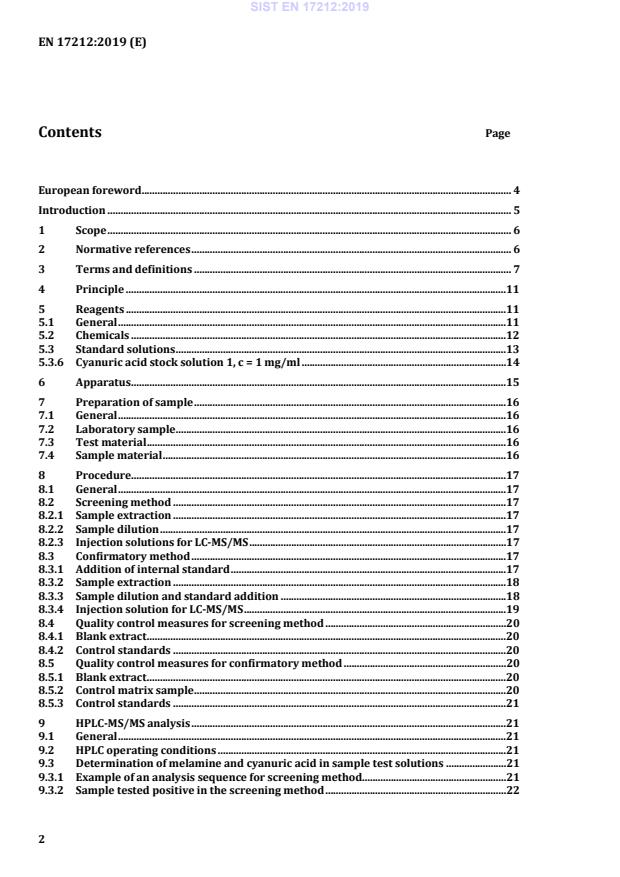
Contents Page
European foreword . 4
Introduction . 5
1 Scope . 6
2 Normative references . 6
3 Terms and definitions . 7
4 Principle .11
5 Reagents .11
5.1 General .11
5.2 Chemicals .12
5.3 Standard solutions .13
5.3.6 Cyanuric acid stock solution 1, c = 1 mg/ml .14
6 Apparatus .15
7 Preparation of sample .16
7.1 General .16
7.2 Laboratory sample .16
7.3 Test material .16
7.4 Sample material .16
8 Procedure.17
8.1 General .17
8.2 Screening method .17
8.2.1 Sample extraction .17
8.2.2 Sample dilution .17
8.2.3 Injection solutions for LC-MS/MS .17
8.3 Confirmatory method .17
8.3.1 Addition of internal standard .17
8.3.2 Sample extraction .18
8.3.3 Sample dilution and standard addition .18
8.3.4 Injection solution for LC-MS/MS .19
8.4 Quality control measures for screening method .20
8.4.1 Blank extract .20
8.4.2 Control standards .20
8.5 Quality control measures for confirmatory method .20
8.5.1 Blank extract .20
8.5.2 Control matrix sample .20
8.5.3 Control standards .21
9 HPLC-MS/MS analysis .21
9.1 General .21
9.2 HPLC operating conditions .21
9.3 Determination of melamine and cyanuric acid in sample test solutions .21
9.3.1 Example of an analysis sequence for screening method.21
9.3.2 Sample tested positive in the screening method .22
9.3.3 Example of an analysis sequence for confirmatory method . 22
10 Calculation . 22
10.1 Peak identification . 22
10.2 Quantification (confirmatory method) . 22
11 Precision . 24
11.1 Collaborative trial . 24
11.2 Repeatability limit . 24
11.3 Reproducibility limit . 24
12 Test report . 25
Annex A (informative) Examples for suitable HPLC-MS/MS conditions . 26
A.1 Example of suitable HPLC conditions . 26
A.2 Example suitable for SCIEX API 4000 Q-Trap or API 4000 . 27
Annex B (informative) Results of the international collaborative trial . 29
Annex C (informative) Results of the in-house validation of the method . 32
Annex D (informative) Typical chromatograms . 35
Bibliography . 37
European foreword
This document (EN 17212:2019) has been prepared by Technical Committee CEN/TC 327 “Animal
feeding stuffs: Methods of sampling and analysis”, the secretariat of which is held by NEN.
This European Standard shall be given the status of a national standard, either by publication of an
identical text or by endorsement, at the latest by March 2020, and conflicting national standards shall be
withdrawn at the latest by March 2020.
Attention is drawn to the possibility that some of the elements of this document may be the subject of
patent rights. CEN shall not be held responsible for identifying any or all such patent rights.
This document has been prepared under a mandate given to CEN by the European Commission and the
European Free Trade Association.
According to the CEN-CENELEC Internal Regulations, the national standards organisations of the
following countries are bound to implement this European Standard: Austria, Belgium, Bulgaria, Croatia,
Cyprus, Czech Republic, Denmark, Estonia, Finland, France, Germany, Greece, Hungary, Iceland, Ireland,
Italy, Latvia, Lithuania, Luxembourg, Malta, Netherlands, Norway, Poland, Portugal, Republic of North
Macedonia, Romania, Serbia, Slovakia, Slovenia, Spain, Sweden, Switzerland, Turkey and the United
Kingdom.
Introduction
This document was developed in response to the demand for a reliable method to detect and quantify
melamine and cyanuric acid in feeding stuffs. Both substances were illegally mixed into feed.
WARNING — The method described in this standard implies the use of reagents that pose a hazard
to health. The standard does not claim to address all associated safety problems. It is the
responsibility of the user of this standard to take appropriate measures for the health and safety
protection of the personnel prior to use of the standard and to ensure that regulatory and legal
requirements are complied with.
1 Scope
This document specifies a high-performance liquid chromatographic (HPLC) mass spectrometric (MS)
method for screening and quantification of melamine and cyanuric acid in the concentration range
between 1 mg/kg and 100 mg/kg feed.
The method is validated in an international collaborative trial for melamine in complete feed,
complementary feed, feed material, milk replacer and pet food including canned pet food in the range
between 1 mg/kg and 80 mg/kg with particular regard to the maximum level of 2,5 mg/kg as established
by the European Commission.
Laboratory experiences have shown that the method is also applicable for cyanuric acid in the same
concentration range in complete feed (n = 7), complementary feed (n = 6), feed material (n = 7, resp. 9),
milk replacer (n = 7) and pet food (n = 7) including canned pet food.
Since the LC-MS/MS sensitivity for cyanuric acid is lower than for melamine, it has to be ensured that the
LC-MS/MS system is in excellent working order. The method is applicable to feeding stuffs but not tested
for pre-mixtures and feed additives.
Quantification of concentrations above 100 mg/kg is possible, but the method has to be validated by the
operator.
2 Normative references
The following documents are referred to in the text in such a way that some or all of their content
constitutes requirements of this document. For dated references, only the edition cited applies. For
undated references, the latest edition of the referenced document (including any amendments) applies.
EN ISO 6497, Animal feeding stuffs - Sampling (ISO 6497)
EN ISO 6498:2012, Animal feeding stuffs - Guidelines for sample preparation (ISO 6498:2012)
EN ISO/IEC 17043:2010, Conformity assessment — General requirements for proficiency testing
(ISO/IEC 17043:2010)
ISO 3534-2:2006, Statistics — Vocabulary and symbols — Part 2: Applied statistics
ISO 16577:2016, Molecular biomarker analysis — Terms and definitions
ISO 24276:2006, Foodstuffs — Methods of analysis for the detection of genetically modified organisms and
derived products — General requirements and definitions
ISO/IEC GUIDE 99:2007, International vocabulary of metrology — Basic and general concepts and
associated terms (VIM)
3 Terms and definitions
For the purposes of this document, the following terms and definitions apply.
ISO and IEC maintain terminological databases for use in standardization at the following addresses:
— IEC Electropedia: available at http://www.electropedia.org/
— ISO Online browsing platform: available at http://www.iso.org/obp
3.1
calibration
complete set of operations which estimates under specified conditions the calibration function from
observations of the response variable obtained on reference states
[SOURCE: ISO 3534-2:2006, 3.5.13]
3.2
calibration function
functional relationship between the expected value of the response variable and the value of the net state
variable
[SOURCE: ISO 3534-2:2006, 3.5.12]
3.3
canned pet food
feed product for pets which has been processed, packaged, sealed and sterilized for preservation in cans
or similar containers
[SOURCE: EN ISO 6498:2012, 2.3.15]
3.4
collaborative trial
interlaboratory comparisons
organization, performance and evaluation of measurements or tests on the same or similar items by two
or more laboratories in accordance with predetermined conditions
Note 1 to entry: Interlaboratory comparisons are widely used for a number of purposes and their use is increasing
internationally. Typical purposes for interlaboratory comparisons include the evaluation of the performance
characteristics of a method – often described as collaborative trials [SOURCE: EN ISO/IEC 17043:2010,
Introduction].
[SOURCE: EN ISO/IEC 17043:2010, 3.4]
3.5
complementary feed
compound feed which has a high content of certain substances but which, by reason of its composition,
is sufficient for a daily ration only if used in combination with other feed
[SOURCE: Regulation (EC) No 767/2009 (Article 3, 1j)] [1]
3.6
complete feed
compound feed which, by reason of its composition, is sufficient for a daily ration
[SOURCE: Regulation (EC) No 767/2009 (Article 3, 1i)] [1]
3.7
compound feed
mixture of at least two feed materials, whether or not containing feed additives, for oral animal feeding
in the form of complete or complementary feed
[SOURCE: Regulation (EC) No 767/2009 (Article 3, 1h)] [1]
3.8
contaminated materials
feed containing a level of undesirable substances in excess of that which is acceptable under Directive
2002/32/EC
[SOURCE: Regulation (EC) No 767/2009 (Article 3, 1p) [1]
3.9
detection limit
limit of detection
measured quantity value, obtained by a given measurement procedure, for which the probability of
falsely claiming the absence of a component in a material is β, given a probability α of falsely claiming its
presence
Note 1 to entry: IUPAC recommends default values for α and β equal to 0,05.
Note 2 to entry: The abbreviation LOD is sometimes used.
Note 3 to entry: The term 'sensitivity' is discouraged for ‘detection limit’.
[SOURCE: ISO/IEC Guide 99:2007, 4.18]
3.10
feed material
products of vegetable or animal origin, whose principal purpose is to meet animals’ nutritional needs, in
their natural state, fresh or preserved, and products derived from the industrial processing thereof, and
organic or inorganic substances, whether or not containing feed additives, which are intended for use in
oral animal-feeding either directly as such, or after processing, or in the preparation of compound feed,
or as carrier of premixtures
[SOURCE: Regulation (EC) No 767/2009 (Article 3, 1g)] [1]
3.11
HorRat
ratio of the reproducibility relative standard deviation to that calculated from the Horwitz equation
–0,15
Note 1 to entry: Predicted relative standard deviation PRSDR = 2 C
HorRat = RSD / PRSD
RR R
(1)
HorRat = RSD / PRSD
r r R
(2)
Note 2 to entry: If applied to within-laboratory studies, the normal range of HorRat(r) is 0,30 – 1,30.
−6
Note 3 to entry: To check proper calculation of PRSDR, a C of 10 should give a PRSDR of 16 %. C is concentration
expressed as a mass fraction (both numerator and denominator expressed in the same units). The HorRat is
indicative of method performance for a large majority of methods in chemistry. Normal values lie between 0,50 and
2,00.
[SOURCE: ISO 16577:2016, 3.75]
3.12
milk replacer
compound feed administered in dry form or after dilution in a given quantity of liquid for feeding young
animals as a complement to, or substitute for, post-colostral milk or for feeding young animals such as
calves, lambs or kids intended for slaughter
[SOURCE: Regulation (EC) No 767/2009 (Article 3, 1l] [1]]
3.13
precision
closeness of agreement between indications or measured quantity values obtained by replicate
measurements on the same or similar objects under specified conditions
Note 1 to entry: Measurement precision is usually expressed numerically by measures of imprecision, such as
standard deviation, variance, or coefficient of variation under the specified conditions of measurement.
Note 2 to entry: The ‘specified conditions’ can be, for example, repeatability conditions of measurement,
intermediate precision conditions of measurement, or reproducibility conditions of measurement (see ISO 5725-1)
[2].
Note 3 to entry: Measurement precision is used to define measurement repeatability, intermediate measurement
precision, and measurement reproducibility.
Note 4 to entry: Sometimes 'measurement precision' is erroneously used to mean 'measurement accuracy'.
[SOURCE: ISO-IEC Guide 99:2007, 2.15]
3.14
repeatability
precision under repeatability conditions
Note 1 to entry: Repeatability can be expressed quantitatively in terms of the dispersion characteristics of the
results.
[SOURCE: ISO 3534-2:2006, 3.3.5]
3.15
repeatability conditions
observation conditions where independent test/measurement results are obtained with the same
method on identical test/measurement items in the same test or measuring facility by the same operator
using the same equipment within short intervals of time
Note 1 to entry: Repeatability conditions include:
— the same measurement procedure or test procedure;
— the same operator;
— the same measuring or test equipment used under the same conditions;
— the same location;
— repetition over a short period of time.
[SOURCE: ISO 3534-2:2006, 3.3.6]
3.16
repeatability limit
r
repeatability critical difference for a specified probability of 95 %
[SOURCE: ISO 3534-2:2006, 3.3.9]
3.17
repeatability standard deviation
standard deviation of test results or measurement results obtained under repeatability conditions
Note 1 to entry: It is a measure of the dispersion of the distribution of test or measurement results under
repeatability conditions.
Note 2 to entry: Similarly, “repeatability variance” and “repeatability coefficient of variation” can be defined and
used as measures of the dispersion of test or measurement results under repeatability conditions.
[SOURCE: ISO 3534-2:2006, 3.3.7]
3.18
reproducibility
precision under reproducibility conditions
Note 1 to entry: Reproducibility can be expressed quantitatively in terms of the dispersion characteristics (0) of the
results.
Note 2 to entry: Results are usually understood to be corrected results.
[SOURCE: ISO 3534-2:2006, 3.3.10]
3.19
reproducibility conditions
observation conditions where independent test/measurement results are obtained with the same
method on identical test/measurement items in different test or measurement facilities with different
operators using different equipment
[SOURCE: ISO 3534-2:2006, 3.3.11]
3.20
reproducibility limit
R
reproducibility critical difference for a specified probability of 95 %
[SOURCE: ISO 3534-2:2006, 3.3.14]
3.21
reproducibility standard deviation
standard deviation of test results or measurement results obtained under reproducibility conditions
Note 1 to entry: It is a measure of the dispersion of the distribution of test or measurement results under
reproducibility conditions.
Note 2 to entry: Similarly, “reproducibility variance” and “reproducibility coefficient of variation” can be defined
and used as measures of the dispersion of test or measurement results under reproducibility conditions.
[SOURCE: ISO 3534-2:2006, 3.3.12]
3.22
screening method
method that will rapidly and reliably eliminate (screen) a large number of negative (or positive) test
samples and restrict the number of test samples requiring the application of a rigorous method
[SOURCE: ISO 24276:2006, 3.1.24]
4 Principle
In order to check for the presence of melamine and cyanuric acid in a screening method, samples are
extracted by a mixture of trichloroacetic acid, acetonitrile and water.
The extract is further diluted with acetonitrile, centrifuged and injected into the LC-MS/MS system. For
samples tested positive in the screening method, a confirmatory method shall be performed.
For the confirmatory method an internal standard is added. Extraction is performed thrice. The first time,
it is performed with a mixture of trichloroacetic acid, acetonitrile and water. The second time, it is
performed twice by a mixture of acetonitrile and water.
After dilution and centrifugation, the supernatant is injected into the LC-MS/MS system.
The quantification of melamine and/or cyanuric acid is carried out by means of standard addition.
5 Reagents
5.1 General
Use only reagents of recognized analytical grade or higher unless stated otherwise.
WARNING — Avoid inhalation of and exposure to the toxic materials and solutions thereof. Work in a
fume-hood when handling the solvents and solutions. Wear safety glasses, protective clothing and avoid
skin contact.
5.2 Chemicals
5.2.1 Diethylamine (DEA)
5.2.2 Trichloroacetic acid (TCA)
5.2.3 Water, purity grade for HPLC or comparable quality (e.g. with Milli-Q purified water).
5.2.4 Acetonitrile, hypergrade for LCMS.
5.2.5 Methanol, hypergrade for LCMS.
5.2.6 Extraction solvent A: Weigh 80 g TCA (5.2.2) and add 600 ml extraction solvent B (solvent B
5.2.7).
5.2.7 Extraction solvent B: Mix acetonitrile (5.2.4) and water (5.2.3) at a rate of 10 + 30 (v/v).
5.2.8 Ammonium acetate
5.2.9 Ammonium acetate solution, c = 10 mmol/l.
Weigh 0,77 g ammonium acetate (5.2.8) to the nearest 0,01 g into a 1 000 ml volumetric flask (6.11) and
dissolve in water (5.2.3). Fill up to 1 000 ml with water (5.2.3). The solution is stable for one week.
5.2.10 Mobile Phase A for HPLC
Mix acetonitrile (5.2.4) and ammonium acetate solution (5.2.9) at the rate of 95 + 5 (v/v).
5.2.11 Mobile Phase B for HPLC
Mix ammonium acetate solution (5.2.9) and acetonitrile (5.2.4) at the rate of 95 + 5 (v/v).
5.2.12 Melamine (2,4,6-Triamino-1,3,5-triazine, sym-Triaminotriazine), MEL
Specification of the purity of each batch of the reference standards is necessary.
5.2.12.1 Melamine standard substance purity at least 99 %.
5.2.12.2 Alternatively melamine standard solution c = 1 mg/ml or c = 0,1 mg/ml.
5.2.13 Cyanuric acid (1,3,5-Triazine-2,4,6-triol, 2,4,6-Trihydroxy-1,3,5-triazine), CYA
Specification of the purity of each batch of the reference standards is necessary.
5.2.13.1 Cyanuric acid standard substance purity at least 98 %.
5.2.13.2 Alternatively cyanuric standard solution c = 1 mg/ml or c = 0,1 mg/ml.
5.2.14 C -Melamine
The standard substances or standard solutions can be purchased from Sigma-Aldrich, Restek or Witega. These are
examples for suitable products available commercially. This information is given for the convenience of users of this
standard and does not constitute an endorsement by CEN of these products. Other products could be used, if the
results are comparable.
NOTE If other isotopically labelled standards e.g. N -melamine are used as internal standard, the suitability
can be verified.
5.2.14.1 C -Melamine standard substance purity at least 95 %.
5.2.14.2 Alternatively, C -Melamine standard solution c = 0,1 mg/ml.
5.2.15 C -Cyanuric acid
5.2.15.1 C -Cyanuric acid standard substance purity at least 97 %.
5.2.15.2 Alternatively C -Cyanuric acid standard solution c = 0,1 mg/ml.
5.3 Standard solutions
The preparation of mixture solutions of melamine and cyanuric acid is not advisable.
5.3.1 Melamine stock solution 1, c = 1 mg/ ml
Weigh to the nearest 0,1 mg, 10 mg of melamine reference standard (5.2.12.1) into a 10 ml volumetric
flask (6.11). The true weight has to be recorded. Dissolve the standard in 2,5 ml DEA (5.2.1) and about
5 ml water (5.2.3), place in an ultrasonic bath (6.8) for 15 min to 30 min and dilute with water (5.2.3) up
to 10 ml. The stock solution is stored at −20 °C and is stable for six months.
Alternatively, use commercially available standard solutions (5.2.12.2).
5.3.2 Melamine stock solution 2, c = 0,1 mg/ml
Alternatively to 5.3.1, weigh to the nearest 0,1 mg, 10 mg of melamine reference standard (5.2.12.1) into
a 100 ml volumetric flask (6.11). The true weight has to be recorded. Dissolve the standard in water
(5.2.3), place in an ultrasonic bath (6.8) for 15 min to 30 min and dilute with water (5.2.3) up to 100 ml.
The stock solution is stored at +4 °C and is stable for six months.
Alternatively, use commercially available standard solutions (5.2.12.2).
5.3.3 Melamine working solution 1, c = 0,01 mg/ml
Pipette 1 ml of the melamine stock solution 2 (5.3.2) or alternatively 100 µl of the melamine stock
solution 1 (5.3.1) with a suitable pipette (6.5) into a 10 ml volumetric flask (6.11) and dilute with water
(5.2.3) to 10 ml. The solution is stored at +4 °C and is stable for three months
5.3.4 Melamine working solution 2, c = 0,001 mg/ml
Pipette 1 ml of the melamine working solution 1 (5.3.3) with a suitable pipette (6.5) into a 10 ml
volumetric flask (6.11) and dilute with water (5.2.3) up to 10 ml. The solution is stored at +4 °C and is
stable for three months.
5.3.5 Melamine working solution 3, c = 0, 1 µg/ml
Pipette 1 ml of the melamine working solution 2 (5.3.4) with a suitable pipette (6.5) into a 10 ml
volumetric flask (6.11) and dilute with water (5.2.3) up to 10 ml. The solution is stored at +4 °C and is
stable for three months.
5.3.6 Cyanuric acid stock solution 1, c = 1 mg/ml
Weigh to the nearest 0,1 mg, 10 mg of cyanuric acid reference standard (5.2.13.1) into a 10 ml volumetric
flask (6.11). The true weight has to be recorded. Dissolve the standard in 1 ml DEA (5.2.1) and about 5 ml
water (5.2.3), place in an ultrasonic bath (6.8) for 15 min to 30 min and dilute with water (5.2.3) up to
10 ml. The solution is stored at −20 °C and is stable for six months.
Alternatively, use commercially available standard solutions (5.2.13.2).
5.3.7 Cyanuric acid stock solution 2, c = 0,1 mg/ml
Alternatively to 5.3.6, weigh to the nearest 0,1 mg, 10 mg of cyanuric acid reference standard (5.2.13.1)
into a 100 ml volumetric flask (6.11). The true weight has to be recorded. Dissolve the standard in water
(5.2.3), place in an ultrasonic bath (6.8) for 15 min to 30 min and dilute with water (5.2.3) up to 100 ml.
The stock solution is stored at +4 °C and is stable for six months.
Alternatively, use commercially available standard solutions (5.2.13.2).
5.3.8 Cyanuric acid working solution 1, c = 0,01 mg/ml
Pipette 1 ml of the cyanuric acid stock solution 2 (5.3.7) or alternatively 100 µl of the cyanuric acid stock
solution 1 (5.3.6) with a suitable pipette (6.5) into a 10 ml volumetric flask (6.11) and dilute with water
(5.2.3) up to 10 ml. The solution is stored at +4 °C and is stable for three months.
5.3.9 Cyanuric acid working solution 2, c = 0,001 mg/ml
Pipette 1 ml of the cyanuric acid working solution 1 (5.3.8) with a suitable pipette (6.5) into a 10 ml
volumetric flask (6.11) and dilute with water (5.2.3) up to 10 ml. The solution is stored at +4 °C and is
stable for three months.
5.3.10 Cyanuric acid working solution 3, c = 0,1 µg/ml
Pipette 1 ml of the cyanuric acid working solution 2 (5.3.9) with a suitable pipette (6.5) into a 10 ml
volumetric flask (6.11) and dilute with water (5.2.3) up to 10 ml. The solution is stored at +4 °C and is
stable for three months.
5.3.11 C -Melamine stock solution c = 0,1 mg/ml
Weigh to the nearest 0,1 mg, 10 mg of C -melamine reference standard (5.2.14.1) into a 100 ml
volumetric flask (6.11). The true weight has to be recorded. Dissolve the standard in water (5.2.3), place
in an ultrasonic bath (6.8) for 15 min to 30 min and dilute with water (5.2.3) up to 100 ml. The stock
solution is stored at +4 °C.
Alternatively, use commercially available standard solutions (5.2.14.2).
5.3.12 C -Melamine working solution c = 0,01 mg/ml
Pipette 1 ml of the C -melamine stock solution (5.3.11) with a suitable pipette (6.5) into a 10 ml
volumetric flask (6.11) and dilute with water (5.2.3) up to 10 ml. The solution is stored at +4 °C.
5.3.13 C -Cyanuric acid stock solution c = 0,1 mg/ml
Weigh to the nearest 0,1 mg, 10 mg of C -cyanuric acid reference standard (5.2.15.1) into a 100 ml
volumetric flask (6.11). The true weight has to be recorded. Dissolve the standard in water (5.2.3), place
in an ultrasonic bath (6.8) for 15 min to 30 min and dilute with water (5.2.3) up to 100 ml. The stock
solution is stored at +4 °C.
Alternatively, use commercially available standard solutions (5.2.15.2).
5.3.14 C -Cyanuric acid working solution c = 0,01 mg/ml
Pipette 1 ml of the C -cyanuric acid stock solution (5.3.13) with a suitable pipette (6.5) into a 10 ml
volumetric flask (6.11) and dilute with water (5.2.3) up to 10 ml. The solution is stored at +4 °C.
6 Apparatus
6.1 General
Usual laboratory glassware and equipment and, in particular, the following:
6.2 HPLC-system capable of gradient elution consisting of:
6.2.1 Pump
6.2.2 Vacuum degasser
6.2.3 LC-injection system
6.2.4 Thermostatic column compartment
6.2.5 Triple-quadrupole mass spectrometer with electrospray ionization and MRM mode
6.2.6 Computer system for data collection and evaluation
6.2.7 Column, zwitterionic hydrophilic interaction liquid chromatography (HILIC)
The S/N ratio for the 2 pg/µl standard shall be at least 150 for melamine and 30 for cyanuric acid.
6.2.8 Pre-column, HILIC Guard PEEK , metal-free guard column (recommended)
6.3 2 ml clear HPLC vials
6.4 11 mm Crimp cap with PTFE/silicone seals
6.5 Automatic pipettes or glass pipettes (class A)
6.6 Cooling Bench top centrifuge
6.7 Vortex mixer
6.8 Ultrasonic bath
6.9 Centrifuge conical polypropylene tubes with screw caps, capacity 50 ml and 15 ml
6.10 Shaker for sample homogenization and extraction, speed continuously adjustable
6.11 Volumetric flask, 10 ml, 50 ml, 100 ml, 1 000 ml
6.12 Funnel
6.13 Dispenser
6.14 Graduated cylinder, different volumes
6.15 Micro-centrifuge for at least 20 000 × g
Use centrifugal filters if no micro-centrifuge with a speed of at least 20 000 × g is available.
6.16 20 ml Storage screw top glass vial with solid-top screw cap and septum
To avoid migration, the material of the caps should contain no or only small amounts of melamine.
6.17 2 ml Polypropylene micro-centrifuge tubes with lock
6.18 Nylon centrifugal filters 0,2 µm
6.19 Analytical balance, accuracy to the nearest 0,1 mg
6.20 Mill with stainless-steel rotor for grinding to at least 1 mm
6.21 Chopper for feed with a high moisture content (e.g. pet food)
7 Preparation of sample
7.1 General
The size of the sample shall be sufficient and the packaging, the transport and the storage shall maintain
the integrity of the sample.
Sampling is not part of this document. A recommended sampling procedure is given in EN ISO 6497.
Prepare the sample according to EN ISO 6498.
7.2 Laboratory sample
Grind the laboratory sample (typically 50 g) to a particle size of at least 1 mm in the mill (6.20) in order
to ensure homogeneity. Mix the sample thoroughly.
For samples with a moisture content > 75 % crush the sample in a chopper (6.21).
7.3 Test material
Homogenize the laboratory sample (7.2) for at least 10 min in a shaker (6.10) at slow speed before further
processing. Mix laboratory samples with a moisture content > 75 % with a spatula.
7.4 Sample material
For sample material with a moisture content < 20 %, weigh to the nearest 0,1 g, 2,0 g of the test material
(7.3) into a 50 ml centrifuge tube (6.9). Record the weight of the sample in g.
For sample material with a moisture content > 75 %, weigh to the nearest 0,1 g, 10,0 g of the test material
(7.3) into a 50 ml centrifuge tube (6.9). Record the weight of the sample in g.
NOTE Conventional feed samples as tested in the validation study have a moisture content < 20 % or > 75 %.
For samples with moisture content between < 20 % and > 75 % drying or wetting is recommended.
The sample is further handled by the described procedure.
8 Procedure
8.1 General
In a screening method the presence of melamine and cyanuric acid is examined. After testing positive for
the analytes in the screening method, the confirmatory method has to be performed. Due to the diversity
of animal feed samples, different matrix effects (enhancement/suppression) were observed. These
effects are not always compensated by isotopically labelled standards. Therefore in samples tested
positive, the quantification is realized by means of a three point standard addition.
It is possible to identify ammeline and ammelide with this method. Quantification has to be considered
problematic since standard substances of these analytes are often contaminated with melamine and/or
cyanuric acid.
8.2 Screening method
NOTE 1 For the screening method, addition of internal standard is not necessary.
NOTE 2 If internal standards are used in the screening method a concentration of 1 mg/kg can be added to the
samples.
8.2.1 Sample extraction
Add 15 ml of extraction solvent A (5.2.6) with a dispenser (6.13) to the sample (7.4) or blank feed sample
and mix for 15 s on a vortex mixer (6.7). The sample is placed in an ultrasonic bath (6.8) for 15 min.
Subsequently centrifuge the mixture at approximately 4 000 × g at 15 °C for 10 min in the centrifuge
(6.6). Decant the supernatant into a 50 ml volumetric flask (6.11) and dilute to the mark with extraction
solvent B (5.2.7).
8.2.2 Sample dilution
Pipette first 900 µl acetonitrile (5.2.4) into the 2 ml polypropylene micro-centrifuge tubes (6.17), add
100 µl sample extract (8.2.1), agitate on a vortex mixer (6.7) for 15 s and centrifuge at 20 000 × g for
10 min in the micro-centrifuge (6.15). Alternatively centrifugal filters 0,2 µm (6.18) may be used.
8.2.3 Injection solutions for LC-MS/MS
Decant the supernatant carefully, taking care not to transfer any precipitate into the HPLC vial (6.3) and
inject this solution into the LC-MS/MS system (6.2).
8.3 Confirmatory method
8.3.1 Addition of internal standard
For the confirmatory method for samples with an expected concentration less than 10 mg/kg, add
0,15 ml melamine internal standard solution (5.3.11) and 0,15 ml cyanuric acid internal standard
solution (5.3.13) to the samples (7.4).
For samples with an expected concentration between 10 mg/kg and 100 mg/kg, add 1,5 ml melamine
internal standard solution (5.3.11) and 1,5 ml cyanuric acid internal standard solution (5.3.13) to the
samples (7.4).
NOTE If one analyte is > 10 mg/kg and the other is < 10 mg/kg, the volumes of the added internal standards
differ from each other.
8.3.2 Sample extraction
Add 15 ml of extraction solvent A (5.2.6) with a dispenser (6.13) to the sample (8.3.1) and mix for 15 s
on a vortex mixer (6.7). The sample is placed in an ultrasonic bath (6.8) for 15 min. Subsequently
centrifuge the mixture at approximately 4 000 × g at 15 °C for 10 min in the centrifuge (6.6). Decant the
supernatant into a 50 ml volumetric flask (6.11).
For the second extraction, add 15 ml extraction solvent B (5.2.7) with a dispenser (6.13) to the remaining
residue, agitate strongly on a vortex mixer (6.7) until the residue is shaken up and place the sample in an
overhead shaker (6.10) for 15 min. Subsequently centrifuge the mixture at approximately 4 000 × g at
15 °C for 10 min in the centrifuge (6.6). Combine the second supernatant with the first extract in the 50 ml
volumetric flask (6.11) and repeat the second extraction with 10 ml extraction solvent B (5.2.7).
Finally fill up the combined supernatants in the 50 ml volumetric flask (6.11) to the mark with extraction
solvent B (5.2.7).
The extraction of some animal feeding stuffs leads to small particles and fat on the surface of the liquid.
These small particles shall be above the mark of the volumetric flask after fill up.
8.3.3 Sample dilution and standard addition
For the standard addition label four 15 ml polypropylene tubes per sample as follows:
1) S;
2) S + 20 %;
3) S + 60 %;
4) S + 100 %
where
S is the sample ID.
For samples with expected concentrations less than 10 mg/kg, pipette 1,0 ml of extract (8.3.2) into each
15 ml polypropylene tube (6.9). Add 9 ml acetonitrile (5.2.4) to each extract.
For samples with an expected concentration between 10 mg/kg and 100 mg/kg, pipette 0,1 ml extract
(8.3.2) into each 15 ml polypropylene tube (6.9). Add 9,9 ml acetonitrile (5.2.4) to each extract.
The S tube is left blank. The remaining three tubes are recommended to be spiked in the range of 20 %,
60 % and 100 % of the expected concentration in equidistant steps. Examples are given in Table 1 and
Table 2. The added volume of the standard solution should not exceed 100 µl for each analyte (altogether
200 µl).
NOTE In this step samples in the concentration range between 10 mg/kg and 100 mg/kg are tenfold more
diluted (0,1 ml sample extract in 10 ml) in comparison to samples with concentrations < 10 mg/kg (1,0 ml sample
extract in 10 ml). Therefore for standard addition the added standard solutions are the same as between 1 mg/kg
and 10 mg/kg.
If one analyte is > 10 mg/kg and the other < 10 mg/kg, perform the standard addition for each analyte
separately in two separate sequences.
A white precipitation can appear (possibly TCA). Before performing 8.3.4, wait until the precipitation has
settled.
8.3.4 Injection solution for LC-MS/MS
Pipette 0,25 ml sample extract (8.3.3) into the 2 ml polypropylene micro-centrifuge tubes (6.17), add
0,75 ml acetonitrile (5.2.4), agitate on a vortex mixer (6.7) for 15 s and centrifuge at 20 000 × g for 10 min
in the micro-centrifuge (6.15). Alternatively centrifugal filters 0,2 µm (6.18) may be used.
Decant the supernatant into the HPLC vial (6.3) and inject this solution into the LC-MS/MS system (6.2).
Table 1 — Example of a standard addition for a sample with a moisture content < 20 % (sample
weight 2 g) and with estimated concentrations of 1 mg/kg and 10 mg/kg respectively. Pipetting
scheme for melamine and cyanuric acid (add into a 15 ml polypropylene tube)
Standard Expected Expected Added Volume working
curve concentration concentration concentration in solution
(1 mg/kg) + added (10 mg/kg) + injection solution
[Number of
concentration added (8.3.4)
working solution]
concent
...