

SIST ISO 12129-2:2020
(Main)Plain bearings - Tolerances - Part 2: Tolerances on form and position and surface roughness for shafts and thrust collars
General Information
- Abstract
This document specifies tolerances on form and position as well as the surface roughness of shafts, flanges and thrust collars as used in plain bearing units. It is applicable to journal or thrust plain bearing units or to a combination of both, installed either horizontally or vertically.
This document is not applicable to crankshaft bearing units in combustion engines.
- Status
- Published
- Publication Date
- 23-Sep-2020
- Technical Committee
- ISEL - Mechanical elements
- Current Stage
- 6060 - National Implementation/Publication (Adopted Project)
- Start Date
- 23-Sep-2020
- Due Date
- 28-Nov-2020
- Completion Date
- 24-Sep-2020
Buy Documents



ISO 12129-2:2019 - Plain bearings -- Tolerances
ISO 12129-2:2019 - Plain bearings — Tolerances — Part 2: Tolerances on form and position and surface roughness for shafts and thrust collars/24/2019
Overview
SIST ISO 12129-2:2020, titled Plain bearings - Tolerances - Part 2: Tolerances on form and position and surface roughness for shafts and thrust collars, specifies essential tolerance requirements for shafts, flanges, and thrust collars used in plain bearing units. This international standard is developed by ISO/TC 123 (Plain bearings), focusing on ensuring optimal bearing performance through precise control of shaft and collar geometries and surface finishes.
This standard applies to journal and thrust plain bearing units, including combinations thereof, used in either horizontal or vertical installations. However, it explicitly excludes crankshaft bearing units in combustion engines.
Key Topics
Form and Position Tolerances
SIST ISO 12129-2:2020 defines strict parameters for roundness, straightness, parallelism, runout, flatness, and concentricity of shafts and thrust collars. These tolerances are calibrated according to different accuracy grades linked to the specified lubricant film thickness, ensuring reliability and functionality in bearing operation.Surface Roughness Specifications
Surface finish requirements are given for shafts and thrust collars, using roughness average (Ra) and maximum height (Rz) parameters. The values correlate with the operating conditions and lubrication film thickness to reduce wear and friction within the bearing assembly.Accuracy Grades Based on Lubricant Film Thickness
The standard categorizes tolerances and surface roughness into accuracy grades (5, 10, 20, 30), aligned with the calculated minimum lubricant film thickness (h_min), measured in micrometers. This classification tailors manufacturing precision to specific bearing performance demands.Shaft and Thrust Collar Designs
Illustrations included in the standard show various shaft configurations, such as shafts with one or two thrust collars, designed for journal-thrust bearing units. These designs influence tolerance assignments and manufacturing approaches.Testing and Quality Control
Quality inspection protocols adhere to ISO 12301, which governs the geometrical and material quality characteristics of plain bearings. This reinforces traceability and conformity in bearing components.
Applications
SIST ISO 12129-2:2020 is crucial for manufacturers and designers of plain bearing systems, particularly where precise dimensional control affects bearing life and efficiency. Typical applications include:
- Machinery with journal and thrust plain bearings requiring controlled tolerances for shafts and collars.
- Industrial equipment where bearings operate under mixed load conditions.
- Bearings installed in various orientations, ensuring consistent performance horizontally or vertically.
- Quality assurance and inspection processes for bearing shaft components.
- Engineering design of bearing units that require specification of form, position, and surface roughness tolerances to match lubricant film requirements.
This standard supports improved bearing reliability, reduced operational wear, and optimized lubrication retention, which are critical in reducing maintenance costs and enhancing machine uptime.
Related Standards
ISO 12301 – Plain bearings: Quality control techniques and inspection of geometrical and material quality characteristics. This standard outlines testing procedures closely referenced in ISO 12129-2 for verifying compliance.
ISO 7902 (Parts 1, 2, 3) – Hydrodynamic plain journal bearings: Calculation procedures and permissible operational parameters for lubricant film thickness. Although ISO 12129-2 no longer mandates ISO 7902 exclusively, it remains a key reference for calculating minimum lubricant film thickness (h_min).
ISO/IEC Directives, Part 1 and 2 – Editorial and procedural rules governing the development and maintenance of ISO standards like ISO 12129-2.
Keywords: ISO 12129-2, plain bearings tolerances, shaft tolerances, thrust collar surface roughness, journal bearing standards, bearing shaft roughness, bearing accuracy grades, bearing manufacturing standards, plain bearing quality, lubricant film thickness.
Relations
- Effective Date
- 02-Jun-2018
Buy Documents
ISO 12129-2:2019 - Plain bearings -- Tolerances
ISO 12129-2:2019 - Plain bearings — Tolerances — Part 2: Tolerances on form and position and surface roughness for shafts and thrust collars/24/2019
Get Certified
Connect with accredited certification bodies for this standard

BSMI (Bureau of Standards, Metrology and Inspection)
Taiwan's standards and inspection authority.
Sponsored listings
Frequently Asked Questions
SIST ISO 12129-2:2020 is a standard published by the Slovenian Institute for Standardization (SIST). Its full title is "Plain bearings - Tolerances - Part 2: Tolerances on form and position and surface roughness for shafts and thrust collars". This standard covers: This document specifies tolerances on form and position as well as the surface roughness of shafts, flanges and thrust collars as used in plain bearing units. It is applicable to journal or thrust plain bearing units or to a combination of both, installed either horizontally or vertically. This document is not applicable to crankshaft bearing units in combustion engines.
This document specifies tolerances on form and position as well as the surface roughness of shafts, flanges and thrust collars as used in plain bearing units. It is applicable to journal or thrust plain bearing units or to a combination of both, installed either horizontally or vertically. This document is not applicable to crankshaft bearing units in combustion engines.
SIST ISO 12129-2:2020 is classified under the following ICS (International Classification for Standards) categories: 17.040.10 - Limits and fits; 21.100.10 - Plain bearings. The ICS classification helps identify the subject area and facilitates finding related standards.
SIST ISO 12129-2:2020 has the following relationships with other standards: It is inter standard links to SIST ISO 12129-2:2002. Understanding these relationships helps ensure you are using the most current and applicable version of the standard.
SIST ISO 12129-2:2020 is available in PDF format for immediate download after purchase. The document can be added to your cart and obtained through the secure checkout process. Digital delivery ensures instant access to the complete standard document.
Standards Content (Sample)
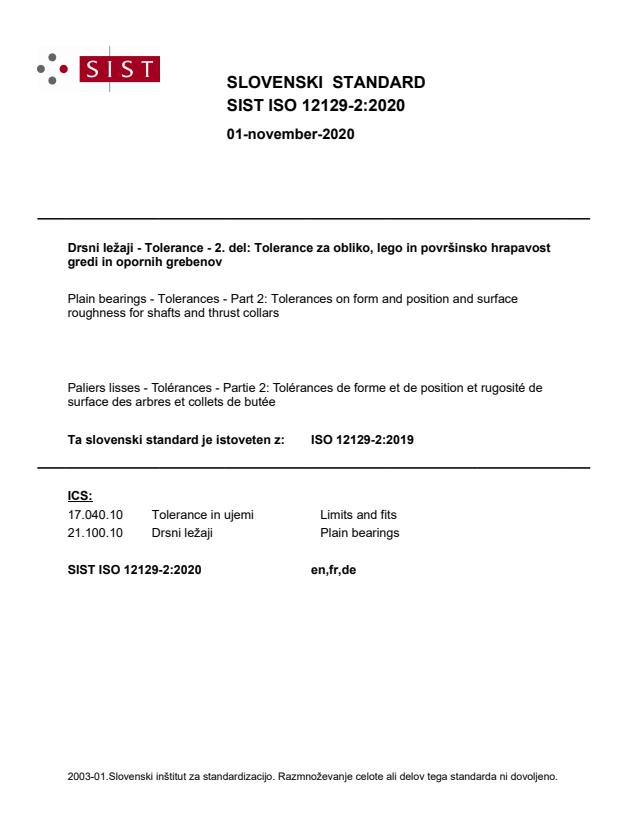
SLOVENSKI STANDARD
01-november-2020
Drsni ležaji - Tolerance - 2. del: Tolerance za obliko, lego in površinsko hrapavost
gredi in opornih grebenov
Plain bearings - Tolerances - Part 2: Tolerances on form and position and surface
roughness for shafts and thrust collars
Paliers lisses - Tolérances - Partie 2: Tolérances de forme et de position et rugosité de
surface des arbres et collets de butée
Ta slovenski standard je istoveten z: ISO 12129-2:2019
ICS:
17.040.10 Tolerance in ujemi Limits and fits
21.100.10 Drsni ležaji Plain bearings
2003-01.Slovenski inštitut za standardizacijo. Razmnoževanje celote ali delov tega standarda ni dovoljeno.
INTERNATIONAL ISO
STANDARD 12129-2
Second edition
2019-04
Plain bearings — Tolerances —
Part 2:
Tolerances on form and position and
surface roughness for shafts and
thrust collars
Paliers lisses — Tolérances —
Partie 2: Tolérances de forme et de position et rugosité de surface des
arbres et collets de butée
Reference number
©
ISO 2019
© ISO 2019
All rights reserved. Unless otherwise specified, or required in the context of its implementation, no part of this publication may
be reproduced or utilized otherwise in any form or by any means, electronic or mechanical, including photocopying, or posting
on the internet or an intranet, without prior written permission. Permission can be requested from either ISO at the address
below or ISO’s member body in the country of the requester.
ISO copyright office
CP 401 • Ch. de Blandonnet 8
CH-1214 Vernier, Geneva
Phone: +41 22 749 01 11
Fax: +41 22 749 09 47
Email: copyright@iso.org
Website: www.iso.org
Published in Switzerland
ii © ISO 2019 – All rights reserved
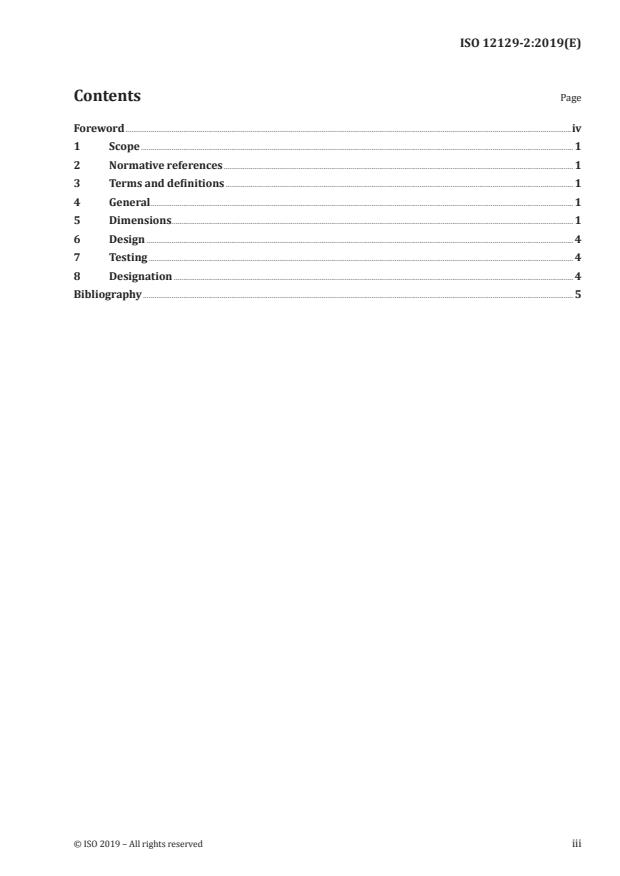
Contents Page
Foreword .iv
1 Scope . 1
2 Normative references . 1
3 Terms and definitions . 1
4 General . 1
5 Dimensions . 1
6 Design . 4
7 Testing . 4
8 Designation . 4
Bibliography . 5
Foreword
ISO (the International Organization for Standardization) is a worldwide federation of national standards
bodies (ISO member bodies). The work of preparing International Standards is normally carried out
through ISO technical committees. Each member body interested in a subject for which a technical
committee has been established has the right to be represented on that committee. International
organizations, governmental and non-governmental, in liaison with ISO, also take part in the work.
ISO collaborates closely with the International Electrotechnical Commission (IEC) on all matters of
electrotechnical standardization.
The procedures used to develop this document and those intended for its further maintenance are
described in the ISO/IEC Directives, Part 1. In particular, the different approval criteria needed for the
different types of ISO documents should be noted. This document was drafted in accordance with the
editorial rules of the ISO/IEC Directives, Part 2 (see www .iso .org/directives).
Attention is drawn to the possibility that some of the elements of this document may be the subject of
patent rights. ISO shall not be held responsible for identifying any or all such patent rights. Details of
any patent rights identified during the development of the document will be in the Introduction and/or
on the ISO list of patent declarations received (see www .iso .org/patents).
Any trade name used in this document is information given for the convenience of users and does not
constitute an endorsement.
For an explanation of the voluntary nature of standards, the meaning of ISO specific terms and
expressions related to conformity assessment, as well as information about ISO's adherence to the
World Trade Organization (WTO) principles in the Technical Barriers to Trade (TBT) see www .iso
.org/iso/foreword .html.
This document was prepared by Technical Committee ISO/TC 123, Plain bearings, Subcommittee SC 3,
Dimensions, tolerances and construction details.
This second edition cancels and replaces the first edition (ISO 12129-2:1995), which has bee
...
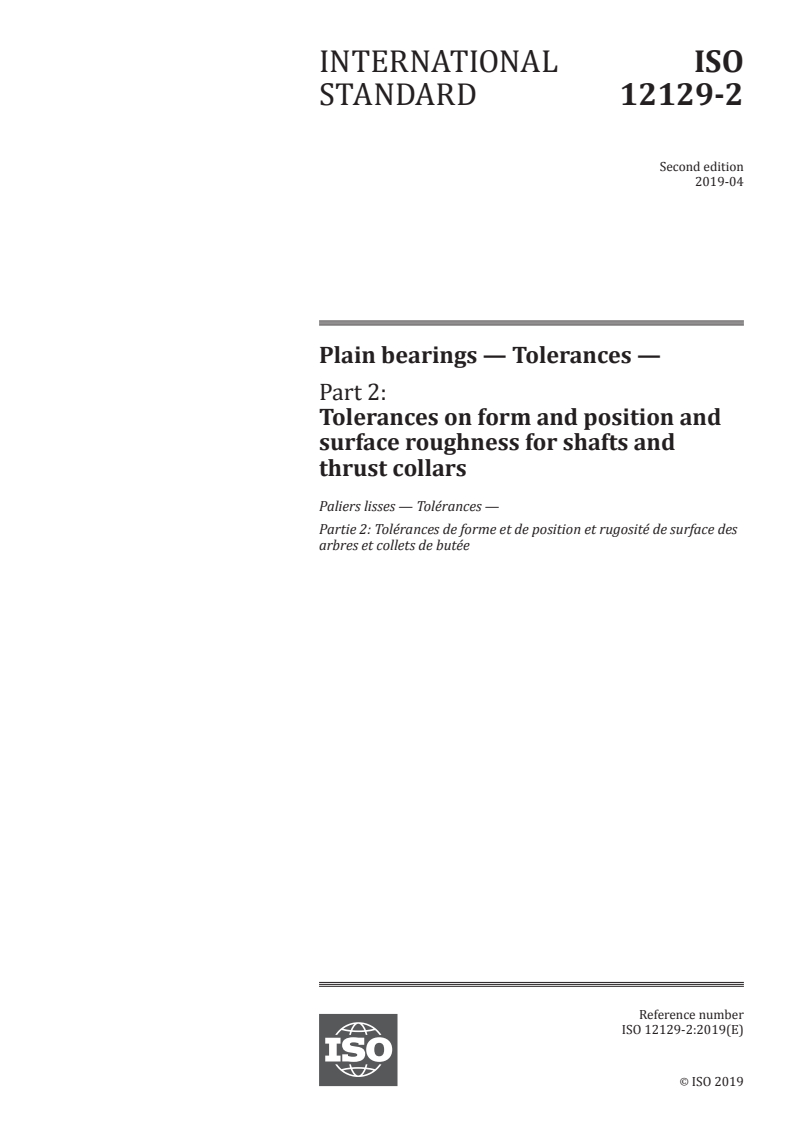
INTERNATIONAL ISO
STANDARD 12129-2
Second edition
2019-04
Plain bearings — Tolerances —
Part 2:
Tolerances on form and position and
surface roughness for shafts and
thrust collars
Paliers lisses — Tolérances —
Partie 2: Tolérances de forme et de position et rugosité de surface des
arbres et collets de butée
Reference number
©
ISO 2019
© ISO 2019
All rights reserved. Unless otherwise specified, or required in the context of its implementation, no part of this publication may
be reproduced or utilized otherwise in any form or by any means, electronic or mechanical, including photocopying, or posting
on the internet or an intranet, without prior written permission. Permission can be requested from either ISO at the address
below or ISO’s member body in the country of the requester.
ISO copyright office
CP 401 • Ch. de Blandonnet 8
CH-1214 Vernier, Geneva
Phone: +41 22 749 01 11
Fax: +41 22 749 09 47
Email: copyright@iso.org
Website: www.iso.org
Published in Switzerland
ii © ISO 2019 – All rights reserved
Contents Page
Foreword .iv
1 Scope . 1
2 Normative references . 1
3 Terms and definitions . 1
4 General . 1
5 Dimensions . 1
6 Design . 4
7 Testing . 4
8 Designation . 4
Bibliography . 5
Foreword
ISO (the International Organization for Standardization) is a worldwide federation of national standards
bodies (ISO member bodies). The work of preparing International Standards is normally carried out
through ISO technical committees. Each member body interested in a subject for which a technical
committee has been established has the right to be represented on that committee. International
organizations, governmental and non-governmental, in liaison with ISO, also take part in the work.
ISO collaborates closely with the International Electrotechnical Commission (IEC) on all matters of
electrotechnical standardization.
The procedures used to develop this document and those intended for its further maintenance are
described in the ISO/IEC Directives, Part 1. In particular, the different approval criteria needed for the
different types of ISO documents should be noted. This document was drafted in accordance with the
editorial rules of the ISO/IEC Directives, Part 2 (see www .iso .org/directives).
Attention is drawn to the possibility that some of the elements of this document may be the subject of
patent rights. ISO shall not be held responsible for identifying any or all such patent rights. Details of
any patent rights identified during the development of the document will be in the Introduction and/or
on the ISO list of patent declarations received (see www .iso .org/patents).
Any trade name used in this document is information given for the convenience of users and does not
constitute an endorsement.
For an explanation of the voluntary nature of standards, the meaning of ISO specific terms and
expressions related to conformity assessment, as well as information about ISO's adherence to the
World Trade Organization (WTO) principles in the Technical Barriers to Trade (TBT) see www .iso
.org/iso/foreword .html.
This document was prepared by Technical Committee ISO/TC 123, Plain bearings, Subcommittee SC 3,
Dimensions, tolerances and construction details.
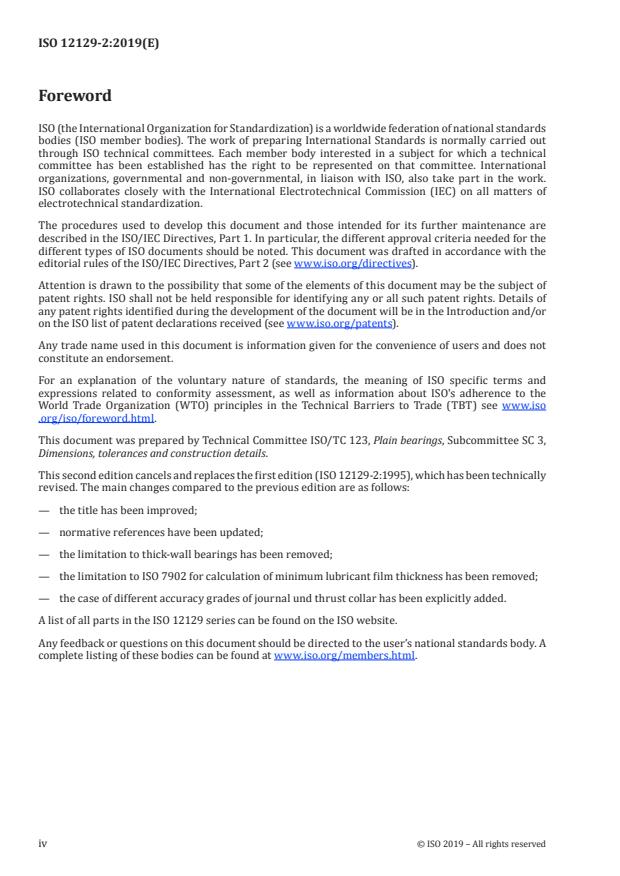
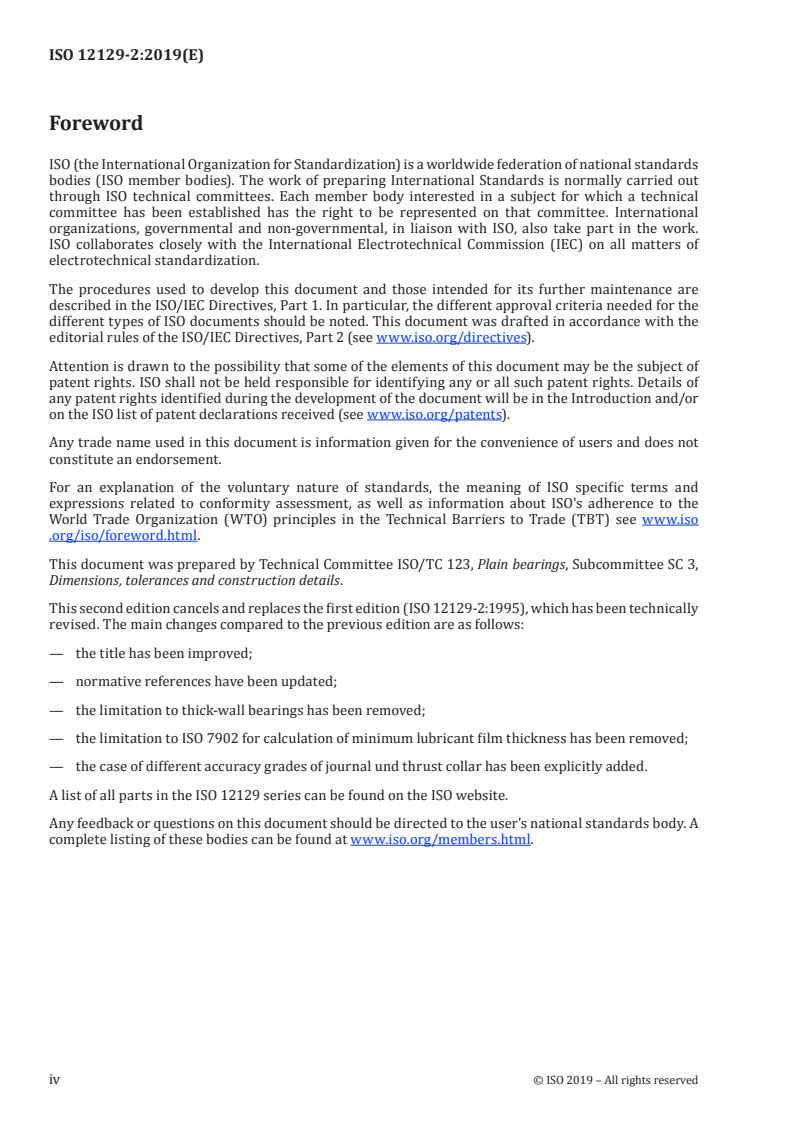
This second edition cancels and replaces the first edition (ISO 12129-2:1995), which has been technically
revised. The main changes compared to the previous edition are as follows:
— the title has been improved;
— normative references have been updated;
— the limitation to thick-wall bearings has been removed;
— the limitation to ISO 7902 for calculation of minimum lubricant film thickness has been removed;
— the case of different accuracy grades of journal und thrust collar has been explicitly added.
A list of all parts in the ISO 12129 series can be found on the ISO we
...
INTERNATIONAL ISO
STANDARD 12129-2
Second edition
2019-04
Plain bearings — Tolerances —
Part 2:
Tolerances on form and position and
surface roughness for shafts and
thrust collars
Paliers lisses — Tolérances —
Partie 2: Tolérances de forme et de position et rugosité de surface des
arbres et collets de butée
Reference number
©
ISO 2019
© ISO 2019
All rights reserved. Unless otherwise specified, or required in the context of its implementation, no part of this publication may
be reproduced or utilized otherwise in any form or by any means, electronic or mechanical, including photocopying, or posting
on the internet or an intranet, without prior written permission. Permission can be requested from either ISO at the address
below or ISO’s member body in the country of the requester.
ISO copyright office
CP 401 • Ch. de Blandonnet 8
CH-1214 Vernier, Geneva
Phone: +41 22 749 01 11
Fax: +41 22 749 09 47
Email: copyright@iso.org
Website: www.iso.org
Published in Switzerland
ii © ISO 2019 – All rights reserved
Contents Page
Foreword .iv
1 Scope . 1
2 Normative references . 1
3 Terms and definitions . 1
4 General . 1
5 Dimensions . 1
6 Design . 4
7 Testing . 4
8 Designation . 4
Bibliography . 5
Foreword
ISO (the International Organization for Standardization) is a worldwide federation of national standards
bodies (ISO member bodies). The work of preparing International Standards is normally carried out
through ISO technical committees. Each member body interested in a subject for which a technical
committee has been established has the right to be represented on that committee. International
organizations, governmental and non-governmental, in liaison with ISO, also take part in the work.
ISO collaborates closely with the International Electrotechnical Commission (IEC) on all matters of
electrotechnical standardization.
The procedures used to develop this document and those intended for its further maintenance are
described in the ISO/IEC Directives, Part 1. In particular, the different approval criteria needed for the
different types of ISO documents should be noted. This document was drafted in accordance with the
editorial rules of the ISO/IEC Directives, Part 2 (see www .iso .org/directives).
Attention is drawn to the possibility that some of the elements of this document may be the subject of
patent rights. ISO shall not be held responsible for identifying any or all such patent rights. Details of
any patent rights identified during the development of the document will be in the Introduction and/or
on the ISO list of patent declarations received (see www .iso .org/patents).
Any trade name used in this document is information given for the convenience of users and does not
constitute an endorsement.
For an explanation of the voluntary nature of standards, the meaning of ISO specific terms and
expressions related to conformity assessment, as well as information about ISO's adherence to the
World Trade Organization (WTO) principles in the Technical Barriers to Trade (TBT) see www .iso
.org/iso/foreword .html.
This document was prepared by Technical Committee ISO/TC 123, Plain bearings, Subcommittee SC 3,
Dimensions, tolerances and construction details.
This second edition cancels and replaces the first edition (ISO 12129-2:1995), which has been technically
revised. The main changes compared to the previous edition are as follows:
— the title has been improved;
— normative references have been updated;
— the limitation to thick-wall bearings has been removed;
— the limitation to ISO 7902 for calculation of minimum lubricant film thickness has been removed;
— the case of different accuracy grades of journal und thrust collar has been explicitly added.
A list of all parts in the ISO 12129 series can be found on the ISO we
...