

SIST EN 285:2016+A1:2021
(Main)Sterilization - Steam sterilizers - Large sterilizers
General Information
- Abstract
This European Standard specifies requirements and the relevant tests for large steam sterilizers primarily used in health care for the sterilization of medical devices and their accessories contained in one or more sterilization modules. The test loads described in this European Standard are selected to represent the majority of loads (i.e. wrapped goods consisting of metal, rubber and porous materials) for the evaluation of general purpose steam sterilizers for medical devices. However, specific loads (e.g. heavy metal objects or long and/or narrow lumen) will require the use of other test loads.
This European Standard applies to steam sterilizers designed to accommodate at least one sterilization module or having a chamber volume of at least 60 l.
Large steam sterilizers can also be used during the commercial production of medical devices.
This European Standard does not specify requirements for equipment intended to use, contain or be exposed to flammable substances or substances which could cause combustion. This European Standard does not specify requirements for equipment intended to process biological waste or human tissues.
This European Standard does not describe a quality management system for the control of all stages of the manufacture of the sterilizer.
NOTE 1 Attention is drawn to the standards for quality management systems e.g. EN ISO 13485.
NOTE 2 Environmental aspects are addressed in Annex A.
- Status
- Published
- Publication Date
- 14-Nov-2021
- Technical Committee
- VAZ - Healthcare
- Current Stage
- 6060 - National Implementation/Publication (Adopted Project)
- Start Date
- 13-Oct-2021
- Due Date
- 18-Dec-2021
- Completion Date
- 15-Nov-2021
- Directive
- 2017/745 - Regulation (EU) 2017/745 of the European Parliament and of the Council of 5 April 2017 on medical devices, amending Directive 2001/83/EC, Regulation (EC) No 178/2002 and Regulation (EC) No 1223/2009 and repealing Council Directives 90/385/EEC and 93/42/EECOJ Ref: L 138 OJ Date: 17-May-2022

Overview
SIST EN 285:2016+A1:2021 - Sterilization: Steam sterilizers - Large sterilizers is the European standard that specifies requirements and test methods for large steam sterilizers used primarily in healthcare for sterilizing medical devices and their accessories. The standard applies to sterilizers that accommodate at least one sterilization module or have a chamber volume of at least 60 L. It covers mechanical construction, piping, measuring and control systems, performance tests (thermometric, hollow load, steam penetration), safety, and service conditions. The standard does not cover equipment intended for flammable substances, biological waste or human tissue processing, nor does it define a quality management system for manufacture (see EN ISO 13485 for QMS).
Key topics and technical requirements
- Scope and applicability: Large steam sterilizers for healthcare and commercial production of medical devices; minimum chamber volume or modular design requirement.
- Mechanical components: Pressure vessel construction, insulation, framework, loading equipment and transport considerations.
- Piping and steam supply: Requirements for steam source (dedicated generator or central supply), piping, air filters and vacuum systems.
- Measuring, indicating and recording systems: Specification of temperature, pressure and time measuring chains, probes, transducers, recording systems and status indicators.
- Control and safety systems: Control logic, fault indication, software verification/validation and usability/risk control requirements.
- Performance testing: Steam penetration, physical parameters (temperature characteristics, dryness), Bowie-Dick test, air leakage/air detectors, hollow load tests, thermometric tests for small and full loads.
- Operational limits and environment: Sound and vibration, rate of pressure change, steam quality (non‑condensable gases, dryness, contaminants), service connections and working environment.
- Documentation and testing program: Calibration, recommended test programme and record keeping for validation and routine testing.
- Environmental considerations: Addressed in Annex A.
Practical applications and users
SIST EN 285 is used to:
- Validate and type-test large steam sterilizers during design and manufacture.
- Define acceptance and routine test procedures for hospital central sterile services departments (CSSD).
- Guide procurement specifications for biomedical engineers, hospital purchasing and clinical engineering.
- Support regulatory compliance and conformity assessment for sterilizer manufacturers and test laboratories.
Typical users:
- Sterilizer manufacturers and designers
- Hospital CSSD managers and biomedical engineering teams
- Quality assurance and validation specialists
- Independent test laboratories and notified bodies
Related standards and notes
- The standard explicitly references quality management standards (for example, EN ISO 13485) for manufacture-related QMS.
- See Annex A of EN 285:2015+A1:2021 for environmental aspects.
Keywords: SIST EN 285, EN 285:2015+A1:2021, steam sterilizers, large sterilizers, medical device sterilization, sterilizer validation, Bowie-Dick test, hollow load test, thermometric tests.
Relations
- Refers
SIST EN 60584-1:2014 - Thermocouples - Part 1: EMF specifications and tolerances (IEC 60584-1:2013) - Effective Date
- 09-Feb-2026
- Refers
SIST EN 60751:2009 - Industrial platinum resistance thermometers and platinum temperature sensors - Effective Date
- 09-Feb-2026
- Effective Date
- 09-Feb-2026
- Effective Date
- 09-Feb-2026
- Effective Date
- 09-Feb-2026
- Effective Date
- 09-Feb-2026
- Effective Date
- 09-Feb-2026
- Effective Date
- 09-Feb-2026
- Effective Date
- 28-Jan-2026
- Refers
SIST EN 764-7:2002 - Pressure equipment - Part 7: Safety systems for unfired pressure equipment - Effective Date
- 28-Jan-2026
- Effective Date
- 28-Jan-2026
- Effective Date
- 28-Jan-2026
- Effective Date
- 28-Jan-2026
- Effective Date
- 28-Jan-2026
- Effective Date
- 28-Jan-2026
Get Certified
Connect with accredited certification bodies for this standard

BSI Group
BSI (British Standards Institution) is the business standards company that helps organizations make excellence a habit.

TÜV Rheinland
TÜV Rheinland is a leading international provider of technical services.

TÜV SÜD
TÜV SÜD is a trusted partner of choice for safety, security and sustainability solutions.
Sponsored listings
Frequently Asked Questions
SIST EN 285:2016+A1:2021 is a standard published by the Slovenian Institute for Standardization (SIST). Its full title is "Sterilization - Steam sterilizers - Large sterilizers". This standard covers: This European Standard specifies requirements and the relevant tests for large steam sterilizers primarily used in health care for the sterilization of medical devices and their accessories contained in one or more sterilization modules. The test loads described in this European Standard are selected to represent the majority of loads (i.e. wrapped goods consisting of metal, rubber and porous materials) for the evaluation of general purpose steam sterilizers for medical devices. However, specific loads (e.g. heavy metal objects or long and/or narrow lumen) will require the use of other test loads. This European Standard applies to steam sterilizers designed to accommodate at least one sterilization module or having a chamber volume of at least 60 l. Large steam sterilizers can also be used during the commercial production of medical devices. This European Standard does not specify requirements for equipment intended to use, contain or be exposed to flammable substances or substances which could cause combustion. This European Standard does not specify requirements for equipment intended to process biological waste or human tissues. This European Standard does not describe a quality management system for the control of all stages of the manufacture of the sterilizer. NOTE 1 Attention is drawn to the standards for quality management systems e.g. EN ISO 13485. NOTE 2 Environmental aspects are addressed in Annex A.
This European Standard specifies requirements and the relevant tests for large steam sterilizers primarily used in health care for the sterilization of medical devices and their accessories contained in one or more sterilization modules. The test loads described in this European Standard are selected to represent the majority of loads (i.e. wrapped goods consisting of metal, rubber and porous materials) for the evaluation of general purpose steam sterilizers for medical devices. However, specific loads (e.g. heavy metal objects or long and/or narrow lumen) will require the use of other test loads. This European Standard applies to steam sterilizers designed to accommodate at least one sterilization module or having a chamber volume of at least 60 l. Large steam sterilizers can also be used during the commercial production of medical devices. This European Standard does not specify requirements for equipment intended to use, contain or be exposed to flammable substances or substances which could cause combustion. This European Standard does not specify requirements for equipment intended to process biological waste or human tissues. This European Standard does not describe a quality management system for the control of all stages of the manufacture of the sterilizer. NOTE 1 Attention is drawn to the standards for quality management systems e.g. EN ISO 13485. NOTE 2 Environmental aspects are addressed in Annex A.
SIST EN 285:2016+A1:2021 is classified under the following ICS (International Classification for Standards) categories: 11.080.10 - Sterilizing equipment. The ICS classification helps identify the subject area and facilitates finding related standards.
SIST EN 285:2016+A1:2021 has the following relationships with other standards: It is inter standard links to SIST EN 60584-1:2014, SIST EN 60751:2009, SIST EN 60204-1:2018, SIST EN 61010-1:2010, SIST EN 61326-1:2013, SIST EN 60770-1:2011, SIST EN 61010-2-040:2016, SIST EN 61010-1:2010/A1:2019, SIST EN 13445-3:2014/A8:2019, SIST EN 764-7:2002, SIST EN ISO 11140-3:2009, SIST EN 13445-2:2014/A1:2017, SIST EN ISO 13408-2:2018, SIST EN 13445-3:2014, SIST EN 13445-2:2014/A3:2018. Understanding these relationships helps ensure you are using the most current and applicable version of the standard.
SIST EN 285:2016+A1:2021 is associated with the following European legislation: EU Directives/Regulations: 2017/745, EUR-PUB; Standardization Mandates: M/575, M/575 Amd 2. When a standard is cited in the Official Journal of the European Union, products manufactured in conformity with it benefit from a presumption of conformity with the essential requirements of the corresponding EU directive or regulation.
SIST EN 285:2016+A1:2021 is available in PDF format for immediate download after purchase. The document can be added to your cart and obtained through the secure checkout process. Digital delivery ensures instant access to the complete standard document.
Standards Content (Sample)
SLOVENSKI STANDARD
01-december-2021
Sterilizacija - Parni sterilizatorji - Veliki sterilizatorji
Sterilization - Steam sterilizers - Large sterilizers
Sterilisation - Dampf-Sterilisatoren - Groß-Sterilisatoren
Stérilisation - Stérilisateurs à la vapeur d'eau - Grands stérilisateurs
Ta slovenski standard je istoveten z: EN 285:2015+A1:2021
ICS:
11.080.10 Sterilizacijska oprema Sterilizing equipment
2003-01.Slovenski inštitut za standardizacijo. Razmnoževanje celote ali delov tega standarda ni dovoljeno.
EN 285:2015+A1
EUROPEAN STANDARD
NORME EUROPÉENNE
October 2021
EUROPÄISCHE NORM
ICS 11.080.10 Supersedes EN 285:2015
English Version
Sterilization - Steam sterilizers - Large sterilizers
Stérilisation - Stérilisateurs à la vapeur d'eau - Grands Sterilisation - Dampf-Sterilisatoren - Groß-
stérilisateurs Sterilisatoren
This European Standard was approved by CEN on 15 November 2015 and includes Amendment 1 approved by CEN on 23 May
2021.
CEN members are bound to comply with the CEN/CENELEC Internal Regulations which stipulate the conditions for giving this
European Standard the status of a national standard without any alteration. Up-to-date lists and bibliographical references
concerning such national standards may be obtained on application to the CEN-CENELEC Management Centre or to any CEN
member.
This European Standard exists in three official versions (English, French, German). A version in any other language made by
translation under the responsibility of a CEN member into its own language and notified to the CEN-CENELEC Management
Centre has the same status as the official versions.
CEN members are the national standards bodies of Austria, Belgium, Bulgaria, Croatia, Cyprus, Czech Republic, Denmark, Estonia,
Finland, France, Germany, Greece, Hungary, Iceland, Ireland, Italy, Latvia, Lithuania, Luxembourg, Malta, Netherlands, Norway,
Poland, Portugal, Republic of North Macedonia, Romania, Serbia, Slovakia, Slovenia, Spain, Sweden, Switzerland, Turkey and
United Kingdom.
EUROPEAN COMMITTEE FOR STANDARDIZATION
COMITÉ EUROPÉEN DE NORMALISATION
EUROPÄISCHES KOMITEE FÜR NORMUNG
CEN-CENELEC Management Centre: Rue de la Science 23, B-1040 Brussels
© 2021 CEN All rights of exploitation in any form and by any means reserved Ref. No. EN 285:2015+A1:2021 E
worldwide for CEN national Members.
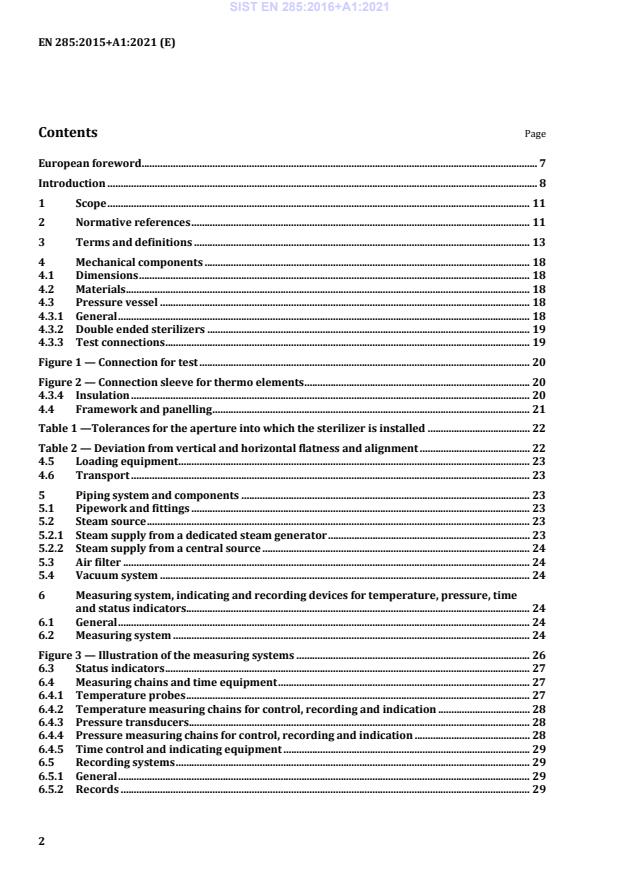
Contents Page
European foreword . 7
Introduction . 8
1 Scope . 11
2 Normative references . 11
3 Terms and definitions . 13
4 Mechanical components . 18
4.1 Dimensions . 18
4.2 Materials . 18
4.3 Pressure vessel . 18
4.3.1 General . 18
4.3.2 Double ended sterilizers . 19
4.3.3 Test connections . 19
Figure 1 — Connection for test . 20
Figure 2 — Connection sleeve for thermo elements . 20
4.3.4 Insulation . 20
4.4 Framework and panelling . 21
Table 1 —Tolerances for the aperture into which the sterilizer is installed . 22
Table 2 — Deviation from vertical and horizontal flatness and alignment . 22
4.5 Loading equipment . 23
4.6 Transport . 23
5 Piping system and components . 23
5.1 Pipework and fittings . 23
5.2 Steam source . 23
5.2.1 Steam supply from a dedicated steam generator . 23
5.2.2 Steam supply from a central source . 24
5.3 Air filter . 24
5.4 Vacuum system . 24
6 Measuring system, indicating and recording devices for temperature, pressure, time
and status indicators. 24
6.1 General . 24
6.2 Measuring system . 24
Figure 3 — Illustration of the measuring systems . 26
6.3 Status indicators . 27
6.4 Measuring chains and time equipment . 27
6.4.1 Temperature probes . 27
6.4.2 Temperature measuring chains for control, recording and indication . 28
6.4.3 Pressure transducers. 28
6.4.4 Pressure measuring chains for control, recording and indication . 28
6.4.5 Time control and indicating equipment . 29
6.5 Recording systems . 29
6.5.1 General . 29
6.5.2 Records . 29
Figure 4 — Diagram of specimen operation cycle given as an example only. 30
Table 3 — Examples of data to be recorded . 31
6.5.3 Data processing . 31
7 Control systems . 32
7.1 General . 32
7.2 Fault indication system . 33
7.3 Software verification and validation . 34
8 Performance requirements . 34
8.1 Steam penetration . 34
8.2 Physical parameters . 35
8.2.1 Temperature characteristics . 35
8.2.2 Bowie and Dick test . 37
8.2.3 Air leakage . 37
8.2.4 Air detector . 37
8.2.5 Hollow load test . 37
8.3 Load dryness . 37
8.3.1 Load dryness, small load, textiles . 37
8.3.2 Load dryness, full load, textiles . 38
8.3.3 Load dryness, metal load . 38
9 Sound power and vibration. 38
9.1 Sound power . 38
9.2 Vibration . 38
10 Rate of pressure change . 38
11 Safety, risk control and usability . 39
11.1 Protective measures . 39
11.2 Risk control, usability . 40
12 Packaging and marking . 40
13 Service and working environment . 41
13.1 General . 41
13.2 Electrical supply . 41
13.3 Steam supply to the sterilizer chamber . 41
13.3.1 Non-condensable gases . 41
13.3.2 Dryness value . 41
13.3.3 Superheat. 41
13.3.4 Contaminants . 41
Table 4 — Suggested maximum values of contaminants in condensate from steam supply to
the sterilizer chamber . 42
13.3.5 Pressure fluctuation . 42
13.3.6 Feed water . 42
13.4 Lighting . 42
13.5 Water, except water specified in 13.3.6. 42
13.6 Compressed air . 43
13.7 Electromagnetic interference . 43
13.8 Drains . 43
13.9 Working Environment . 43
13.10 Service connections . 43
14 Testing . 43
14.1 General . 43
Table 5 — Recommended test programme . 45
14.2 Calibration . 45
14.3 Environment . 45
15 Hollow load test . 46
15.1 General . 46
15.2 Apparatus . 46
15.3 Procedure. 46
16 Thermometric tests . 47
16.1 Small load, thermometric . 47
16.1.1 General . 47
16.1.2 Apparatus . 47
Figure 5 — Example of a method used to introduce temperature probes into a sterilizer
chamber . 48
16.1.3 Procedure. 48
Figure 6 — Location of temperature probes . 49
16.2 Full load, thermometric . 50
16.2.1 General . 50
16.2.2 Apparatus . 50
16.2.3 Procedure. 50
17 Bowie and Dick test . 51
17.1 General . 51
17.2 Apparatus . 52
17.3 Procedure. 52
18 Air leakage test . 52
18.1 General . 52
18.2 Apparatus . 52
18.3 Procedure. 53
18.3.2 Stabilize the temperature of the sterilizer chamber by carrying out one of the
following: . 53
19 Air detector tests . 53
19.1 General . 53
19.2 Air detector, small load . 53
19.2.1 Apparatus . 53
19.2.1.7 Connected services complying with Clause 13. . 54
19.2.2 Procedure. 54
19.3 Air detector, full load . 55
19.3.1 Apparatus . 55
19.3.1.2 Thermometric recording instrument as described in 23.3.4.1. . 55
19.3.2 Procedure. 55
19.3.2.13 If the air leakage causes the sterilizer chamber pressure to rise more than
1,1 kPa/min re-adjust the metering device to cause a pressure rise of
(1,0 ± 0,1) kPa/min. 56
19.4 Air detector function . 56
19.4.1 General . 56
19.4.2 Apparatus . 56
19.4.3 Procedure. 56
20 Load dryness test . 57
20.1 Load dryness, small load, textiles . 57
20.1.1 General . 57
20.1.2 Apparatus . 57
20.1.3 Procedure . 57
20.2 Load dryness, full load, textile . 58
20.2.1 General . 58
20.2.2 Apparatus . 58
20.2.3 Procedure . 58
20.3 Load dryness, metal . 59
20.3.1 General . 59
20.3.2 Apparatus . 59
20.3.3 Procedure . 59
21 Steam quality test . 60
21.1 Non-condensable gases . 60
21.1.1 General . 60
21.1.2 Apparatus . 60
21.1.3 Procedure . 61
Figure 7 — Diagrammatic representation of the apparatus for the measurement of non-
condensable gases . 62
21.2 Dryness . 63
21.2.1 General . 63
21.2.2 Apparatus . 63
Figure 8 — Pitot tube . 63
21.2.3 Procedure . 64
Figure 9 — Diagrammatic representation of the apparatus for the measurement of steam
dryness value . 65
21.3 Superheat. 67
21.3.1 General . 67
21.3.2 Apparatus . 67
Figure 10 — Expansion tube . 67
21.3.3 Procedure . 67
Figure 11 — Diagrammatic representation of the apparatus for the measurement of
superheat . 68
21.4 Sampling of steam condensate . 69
21.4.1 General . 69
21.4.2 Apparatus . 69
21.4.3 Procedure . 69
Figure 12 — Apparatus for sampling steam condensate . 70
22 Rate of pressure change . 71
22.1 General . 71
22.2 Apparatus . 71
22.3 Procedure . 71
23 Test apparatus, equipment and material . 71
23.1 Standard test pack . 71
Figure 13 — Folding and assembling the test pack . 73
23.2 Reduced test pack . 74
23.3 Test instruments . 75
23.3.1 General . 75
23.3.2 Pressure instruments . 75
23.3.3 Temperature instruments . 76
23.3.4 Recording instruments . 77
23.4 Full load, textiles . 78
23.5 Test pack, metal . 78
Figure 14 — Details of test box for test load dryness, metal . 80
23.6 Metering device . 80
24 Documentation to be supplied with the sterilizer . 81
25 Information to be supplied with the sterilizer . 81
Annex A (informative) Environmental aspects . 85
Table A.1 — Environmental aspects addressing clauses of this European Standard . 86
Annex B (informative) Suggested maximum values of contaminants in feed water . 88
Table B.1 — Contaminants in feed water supplied to a dedicated steam generator . 88
Annex C (informative) Temperature and time tolerances during the small load
thermometric test . 89
Figure C.1 — Temperature and time tolerances during the small load thermometric test . 89
Annex D (informative) Guidance for installation and operational qualification tests which
can be included in the instructions for use supplied with a sterilizer. 90
Table D.1 — Suggested tests . 91
Annex E (informative) Criteria for identifying sterilizers as the same type . 92
Annex F (normative) Protective measures . 93
Annex ZA (informative) Relationship between this European Standard and the General
Safety and Performance Requirements of Regulation (EU) 2017/745 aimed to be
covered. 95
Table ZA.1 — Correspondence between this European Standard and Annex I of
Regulation 2017/745 [2017 OJ L 117] . 95
Table ZA.2 — Correspondence between this European Standard and Annex II of
Regulation 2017/745 [2017 OJ L 117] . 105
Table ZA.3 — Relevant Essential Health and Safety Requirements from Directive
2006/42/EC on machinery that are addressed by this European Standard
(according to article 1, item 12 of Regulation (EU) 2017/745) . 107
Bibliography . 116
European foreword
This document (EN 285:2015+A1:2021) has been prepared by Technical Committee CEN/TC 102
“Sterilizers for medical purposes”, the secretariat of which is held by DIN.
This document supersedes !EN 285:2015".
This European Standard shall be given the status of a national standard, either by publication of an
identical text or by endorsement, at the latest by December 2021, and conflicting national standards
shall be withdrawn at the latest by June 2022.
This document has been prepared under a standardization request given to CEN by the European
Commission and the European Free Trade Association, and supports essential requirements of
EU Regulation(s).
For relationship with EU Directive(s), see informative Annex ZA, which is an integral part of this
document.
This document includes Amendment 1 approved by CEN on 23 May 2021.
The start and finish of text introduced or altered by amendment is indicated in the text by tags !".
The following amendments have been made in comparison EN 285:2015:
— normative references have been updated and corrected in the normative text;
— note to entry was added to 3.17 and 3.27;
— 6.2 was adopted;
— subclause 6.4.4.2 was added;
— note was added to 8.1.3 and 15.1;
— Annex ZA relationship with the General Safety and Performance Requirements of Regulation (EU)
2017/745 including Tables ZA.1, ZA.2 and ZA.3 was added.
Any feedback and questions on this document should be directed to the users’ national standards body.
A complete listing of these bodies can be found on the CEN website.
Attention is drawn to the possibility that some of the elements of this document may be the subject of
patent rights. CEN [and/or CENELEC] shall not be held responsible for identifying any or all such patent
rights.
According to the CEN/CENELEC Internal Regulations, the national standards organisations of the
following countries are bound to implement this European Standard: Austria, Belgium, Bulgaria,
Croatia, Cyprus, Czech Republic, Denmark, Estonia, Finland, France, Germany, Greece, Hungary, Iceland,
Ireland, Italy, Latvia, Lithuania, Luxembourg, Malta, Netherlands, Norway, Poland, Portugal, Republic of
North Macedonia, Romania, Slovakia, Slovenia, Spain, Sweden, Switzerland, Turkey and the United
Kingdom.
Introduction
This document specifies test procedures and acceptance criteria to confirm whether the sterilizer is safe
and can deliver an operating cycle for sterilizing the range of medical devices and loading
configurations used in healthcare. It can also be used in other manufacturing sectors and industries. In
addition, national regulations can necessitate consideration of the impact the sterilizer could have on
the environment.
A steam sterilization process uses water in its liquid and vaporous state to penetrate as steam into the
load and to condense on the surfaces of a device. The distribution of moisture and temperature
throughout the sterilization load and the process of sterilization itself cannot be measured directly for
each routine sterilization process. This is done by comparison of measurement results with cycle
parameters shown previously by validation to deliver an efficient sterilization process to the exposed
medical devices.
An instruction manual supplied with the sterilizer is required to have comprehensive information on
the sterilizer, programmed operating cycles and safe operation. Requirements for the validation and
routine control of sterilization are not addressed as they are specified EN ISO 17665-1.
Medical devices used in health care can differ in properties such as materials, mass, shape, volume and
packaging. Each sterilizer load can comprise a variable number of packages each containing different
types of variably distributed medical devices.
The reproducibility of the sterilization process can be affected by this variability and also by other
changes which can include:
— deviation of the defined cycle parameters,
— retention of air in the load, air leakage and non-condensable gases in the steam,
— excessive accumulation of non-condensable gases and/or condensate,
— overheating of the steam,
— selection of an inappropriate operating cycle, and
— orientation of the load.
The state “sterile” is specified in EN 556-1. For the steam sterilization in health care national
regulations and the European Pharmacopoeia require or recommend combinations of minimum
process parameters to produce a substantial overkill. This European Standard identifies combinations
of sterilization temperatures and holding times, with tolerances, recommended by the “Working Party
1)
on Pressure-steam Sterilisers” . The use of these values is justified when also considering the variable
characteristics of sterilizer loads in healthcare.
Process variables and process parameters as defined in EN ISO 17665-1 characterize the microbicidal
effectiveness of the sterilization process. Cycle parameters are associated with the control of the
operating cycle and have implications on the attainment of process parameters, the uniformity of steam
penetration, the removal of air, drying and deterioration of medical devices and their packaging.
1) Working Party on Pressure-steam Sterilisers (JW Howie, Allison VD, JH Bowie, Darmady EM, Knox R, EJK Penikett, Shone
JAV, Sykes G, Weir CD, Wells CA, Wyllie CAP, Kelsey JC): Sterilization by Steam Under Increased Pressure, The Lancet (1959), p.
425-435.
This European Standard specifies test loads and test pieces designed to present a specific challenge to
the operating cycle. The results from each test collectively contribute to a presumption that the
sterilizer and the operating cycles are suitable for use in health care facilities. A test load does not
necessarily mimic a configuration of medical devices. The suitability of an operating cycle for a
particular product will require validation (see EN ISO 17665-1). By specifying numeric pass and fail-
conditions the tests are used to confirm that the cycle parameters of the operating cycle are attained
and maintained.
Limiting values for the properties and the purity of the services are related to the characteristics of the
medical devices, therefore this European Standard does not include specific requirements on services.
However, it does provide guidance and information on recommended properties, limit values and test
methods.
Condensate derived from the sterilizer chamber will include additional impurities from the load and as
a consequence is not representative of the quality of the supplied steam. Recommended limits for the
purity of feed water and condensate are different from the requirements of the European Pharmacopeia
for purified water. This difference is to compensate for increased corrosion to the sterilizer chamber
and instruments resulting from a higher condensate temperature. The level of bacterial endotoxins
2)
contained in the steam will depend on the quality of feed water and the steam generation equipment .
To minimize human errors during routine use this European Standard specifies automatic control of the
operating cycle and a fault detection system designed to automatically detect changes to both services
and operating cycle significant to affect sterility assurance. An air detector is an optional provision
which when set and tested according to this European Standard will routinely challenge the operating
cycle and register a pass/failure. Other methods for routinely assessing specific performance aspects
can be used, such as chemical or biological indicators, providing their performance is determined and
verified using validated test procedures.
Software can only be used in combination with hardware. The tests described in this standard can be
used for the verification and final validation of the repe
...