

SIST EN 203-1:2022+A1:2024
(Main + Amendment)Gas heated catering equipment - Part 1: General safety requirements
General Information
- Abstract
This document specifies the requirements and test methods for the construction and operating
characteristics relating to safety and rational use of energy for gas heated commercial catering and
bakery appliances intended to be used indoor.
This document applies to all professional cooking and bakery appliances using gas for preparing food and
drink.
Only appliances of types A1, A2, A3, B1 and B2, as defined in Clause 4, are considered in this document.
Only the net calorific value (Hi) and net Wobbe index (Wi) are used.
The requirements concerning specific types of appliances are given in the relevant Part 2.
Annex C (informative) lists the main types of equipment covered by the scope of this document.
Appliances covered by this document are not intended to use gases containing carbon monoxide or other
toxic components.
NOTE For appliances intended to be used in vehicles, in trailers or on-board ships, additional requirements
can be necessary.
- Status
- Published
- Publication Date
- 18-Aug-2024
- Technical Committee
- PLN - Gas appliances for domestic use
- Current Stage
- 6060 - National Implementation/Publication (Adopted Project)
- Start Date
- 16-Aug-2024
- Due Date
- 21-Oct-2024
- Completion Date
- 19-Aug-2024
- Directive
- 2016/426 - REGULATION (EU) 2016/426 OF THE EUROPEAN PARLIAMENT AND OF THE COUNCIL of 9 March 2016 on appliances burning gaseous fuels and repealing Directive 2009/142/ECOJ Ref: 2.12.2024, 2024/2944, L, OJ, OJ L OJ Date: 02-Dec-2024

Overview
SIST EN 203-1:2022+A1:2024 (Gas heated catering equipment - Part 1: General safety requirements) defines safety, construction and test requirements for indoor gas heated commercial catering and bakery appliances. It applies to professional cooking and bakery appliances of types A1, A2, A3, B1 and B2 (see Clause 4) and covers requirements for safe operation and the rational use of energy. The standard uses only the net calorific value (Hi) and net Wobbe index (Wi) for gas characterization and excludes appliances intended to burn gases containing carbon monoxide or other toxic components. Annex C lists the main equipment types covered; Part 2 documents give additional, appliance‑specific requirements.
Key Topics and Technical Requirements
The standard groups requirements into constructional, performance and test provisions. Major technical topics include:
Constructional requirements
- Materials and methods of construction, cleanability and food contact surfaces
- Gas connections, soundness of gas circuits and combustion circuits
- Provision for combustion air, evacuation of combustion products and flame visibility
- Electrical safety, stability, mechanical safety and fire risk prevention
- Design and safety of LPG cylinder compartments
Components and controls
- Burners, gas rate control and shut‑off devices, gas rate adjusters
- Auxiliary equipment such as ignition devices and flame supervision devices
- Air‑proving devices and gas/air ratio controls
Performance requirements
- Obtaining and verifying nominal, full and reduced gas rates
- Ignition, cross‑lighting, flame stability and temperature limits
- Combustion performance and tests for sooting limits
- Rational use of energy (efficiency considerations) and behavior under auxiliary energy fluctuations
Test methods and conditions
- Specified test gases, test room set‑up, test pressures and measurement accuracy
- Detailed test procedures for soundness, operational safety and combustion
- Special tests (pressurized parts, overheating of LPG cylinders, appliances with heat‑bearing fluids)
Practical Applications - Who Uses This Standard
SIST EN 203-1 is essential for:
- Manufacturers of professional gas cooking and bakery equipment (design, compliance and CE marking)
- Testing laboratories and conformity assessment bodies performing safety and performance tests
- Safety engineers, product designers and R&D teams ensuring gas appliance safety and energy efficiency
- Procurement, installers and facility managers specifying compliant appliances for commercial kitchens
- Regulators and certification bodies referencing harmonized European safety requirements
This standard helps reduce risks associated with gas combustion, ensures reliable operation in indoor commercial settings, and supports consistent energy‑efficient appliance performance.
Related Standards
- Part 2 documents of the EN 203 series contain appliance‑specific requirements.
- SIST EN 203-1 aligns with the European EN 203 series and national adoptions; users should consult the applicable Part 2 and other EN gas appliance standards and national regulations for vehicle, trailer or ship installations where additional requirements may apply.
Relations
- Effective Date
- 01-Sep-2024
- Effective Date
- 09-Feb-2026
- Effective Date
- 09-Feb-2026
- Effective Date
- 09-Feb-2026
- Effective Date
- 09-Feb-2026
- Effective Date
- 09-Feb-2026
- Effective Date
- 09-Feb-2026
- Effective Date
- 09-Feb-2026
- Effective Date
- 09-Feb-2026
- Effective Date
- 09-Feb-2026
- Effective Date
- 09-Feb-2026
- Effective Date
- 09-Feb-2026
- Effective Date
- 09-Feb-2026
- Effective Date
- 09-Feb-2026
- Effective Date
- 09-Feb-2026
Frequently Asked Questions
SIST EN 203-1:2022+A1:2024 is a standard published by the Slovenian Institute for Standardization (SIST). Its full title is "Gas heated catering equipment - Part 1: General safety requirements". This standard covers: This document specifies the requirements and test methods for the construction and operating characteristics relating to safety and rational use of energy for gas heated commercial catering and bakery appliances intended to be used indoor. This document applies to all professional cooking and bakery appliances using gas for preparing food and drink. Only appliances of types A1, A2, A3, B1 and B2, as defined in Clause 4, are considered in this document. Only the net calorific value (Hi) and net Wobbe index (Wi) are used. The requirements concerning specific types of appliances are given in the relevant Part 2. Annex C (informative) lists the main types of equipment covered by the scope of this document. Appliances covered by this document are not intended to use gases containing carbon monoxide or other toxic components. NOTE For appliances intended to be used in vehicles, in trailers or on-board ships, additional requirements can be necessary.
This document specifies the requirements and test methods for the construction and operating characteristics relating to safety and rational use of energy for gas heated commercial catering and bakery appliances intended to be used indoor. This document applies to all professional cooking and bakery appliances using gas for preparing food and drink. Only appliances of types A1, A2, A3, B1 and B2, as defined in Clause 4, are considered in this document. Only the net calorific value (Hi) and net Wobbe index (Wi) are used. The requirements concerning specific types of appliances are given in the relevant Part 2. Annex C (informative) lists the main types of equipment covered by the scope of this document. Appliances covered by this document are not intended to use gases containing carbon monoxide or other toxic components. NOTE For appliances intended to be used in vehicles, in trailers or on-board ships, additional requirements can be necessary.
SIST EN 203-1:2022+A1:2024 is classified under the following ICS (International Classification for Standards) categories: 97.040.20 - Cooking ranges, working tables, ovens and similar appliances. The ICS classification helps identify the subject area and facilitates finding related standards.
SIST EN 203-1:2022+A1:2024 has the following relationships with other standards: It is inter standard links to SIST EN 203-1:2022, SIST EN 60335-1:2012, SIST EN 60335-2-102:2016, SIST EN IEC 60730-2-9:2019/A2:2020, SIST EN 60335-1:2012/A13:2017, SIST EN 60730-1:2016, SIST EN 61770:2009/A1:2019, SIST EN 60335-1:2012/A1:2019, SIST EN IEC 60730-2-9:2019, SIST EN 60335-1:2012/A14:2019, SIST EN 60335-1:2012/A11:2014, SIST EN IEC 60730-2-9:2019/A1:2019, SIST EN 61770:2009/A11:2018, SIST EN 60730-1:2016/A1:2019, SIST EN 60335-1:2012/A2:2019. Understanding these relationships helps ensure you are using the most current and applicable version of the standard.
SIST EN 203-1:2022+A1:2024 is associated with the following European legislation: EU Directives/Regulations: 2016/426; Standardization Mandates: M/595. When a standard is cited in the Official Journal of the European Union, products manufactured in conformity with it benefit from a presumption of conformity with the essential requirements of the corresponding EU directive or regulation.
SIST EN 203-1:2022+A1:2024 is available in PDF format for immediate download after purchase. The document can be added to your cart and obtained through the secure checkout process. Digital delivery ensures instant access to the complete standard document.
Standards Content (Sample)
SLOVENSKI STANDARD
01-september-2024
Nadomešča:
SIST EN 203-1:2022
Plinske naprave za gostinstvo - 1. del: Splošna varnostna pravila (vključno z
dopolnilom A1)
Gas heated catering equipment - Part 1: General safety requirements
Großküchengeräte für gasförmige Brennstoffe - Teil 1: Allgemeine
Sicherheitsanforderungen
Appareils de cuisine professionnelle utilisant les combustibles gazeux - Partie 1 :
Exigences générales de sécurité
Ta slovenski standard je istoveten z: EN 203-1:2021+A1:2023
ICS:
97.040.20 Štedilniki, delovni pulti, Cooking ranges, working
pečice in podobni aparati tables, ovens and similar
appliances
2003-01.Slovenski inštitut za standardizacijo. Razmnoževanje celote ali delov tega standarda ni dovoljeno.
EN 203-1:2021+A1
EUROPEAN STANDARD
NORME EUROPÉENNE
December 2023
EUROPÄISCHE NORM
ICS 97.040.20 Supersedes EN 203-1:2021
English Version
Gas heated catering equipment - Part 1: General safety
requirements
Appareils de cuisine professionnelle utilisant les Großküchengeräte für gasförmige Brennstoffe - Teil 1:
combustibles gazeux - Partie 1 : Exigences générales de Allgemeine Sicherheitsanforderungen
sécurité
This European Standard was approved by CEN on 3 October 2021 and includes Amendment approved by CEN on 11 October
2023.
CEN members are bound to comply with the CEN/CENELEC Internal Regulations which stipulate the conditions for giving this
European Standard the status of a national standard without any alteration. Up-to-date lists and bibliographical references
concerning such national standards may be obtained on application to the CEN-CENELEC Management Centre or to any CEN
member.
This European Standard exists in three official versions (English, French, German). A version in any other language made by
translation under the responsibility of a CEN member into its own language and notified to the CEN-CENELEC Management
Centre has the same status as the official versions.
CEN members are the national standards bodies of Austria, Belgium, Bulgaria, Croatia, Cyprus, Czech Republic, Denmark, Estonia,
Finland, France, Germany, Greece, Hungary, Iceland, Ireland, Italy, Latvia, Lithuania, Luxembourg, Malta, Netherlands, Norway,
Poland, Portugal, Republic of North Macedonia, Romania, Serbia, Slovakia, Slovenia, Spain, Sweden, Switzerland, Türkiye and
United Kingdom.
EUROPEAN COMMITTEE FOR STANDARDIZATION
COMITÉ EUROPÉEN DE NORMALISATION
EUROPÄISCHES KOMITEE FÜR NORMUNG
CEN-CENELEC Management Centre: Rue de la Science 23, B-1040 Brussels
© 2023 CEN All rights of exploitation in any form and by any means reserved Ref. No. EN 203-1:2021+A1:2023 E
worldwide for CEN national Members.
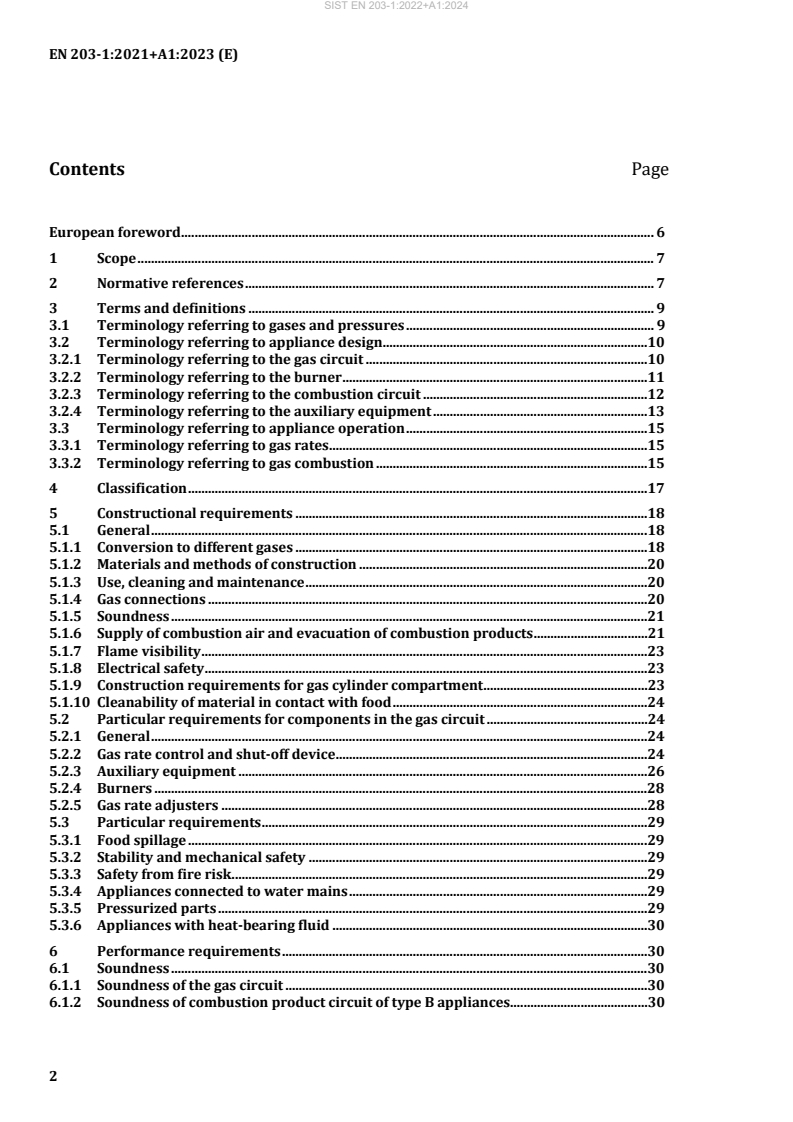
Contents Page
European foreword . 6
1 Scope . 7
2 Normative references . 7
3 Terms and definitions . 9
3.1 Terminology referring to gases and pressures . 9
3.2 Terminology referring to appliance design .10
3.2.1 Terminology referring to the gas circuit .10
3.2.2 Terminology referring to the burner .11
3.2.3 Terminology referring to the combustion circuit .12
3.2.4 Terminology referring to the auxiliary equipment .13
3.3 Terminology referring to appliance operation .15
3.3.1 Terminology referring to gas rates.15
3.3.2 Terminology referring to gas combustion .15
4 Classification .17
5 Constructional requirements .18
5.1 General .18
5.1.1 Conversion to different gases .18
5.1.2 Materials and methods of construction .20
5.1.3 Use, cleaning and maintenance .20
5.1.4 Gas connections .20
5.1.5 Soundness .21
5.1.6 Supply of combustion air and evacuation of combustion products .21
5.1.7 Flame visibility .23
5.1.8 Electrical safety .23
5.1.9 Construction requirements for gas cylinder compartment .23
5.1.10 Cleanability of material in contact with food .24
5.2 Particular requirements for components in the gas circuit .24
5.2.1 General .24
5.2.2 Gas rate control and shut-off device .24
5.2.3 Auxiliary equipment .26
5.2.4 Burners .28
5.2.5 Gas rate adjusters .28
5.3 Particular requirements .29
5.3.1 Food spillage .29
5.3.2 Stability and mechanical safety .29
5.3.3 Safety from fire risk .29
5.3.4 Appliances connected to water mains .29
5.3.5 Pressurized parts .29
5.3.6 Appliances with heat-bearing fluid .30
6 Performance requirements .30
6.1 Soundness .30
6.1.1 Soundness of the gas circuit .30
6.1.2 Soundness of combustion product circuit of type B appliances .30
6.2 Obtaining the gas rate . 31
6.2.1 Nominal heat input (Q ) . 31
n
6.2.2 Full gas rate . 31
6.2.3 Reduced gas rate . 31
6.2.4 Ignition burner heat input . 31
6.3 Safety of operation . 32
6.3.1 Burners . 32
6.3.2 Temperature limits . 32
6.3.3 Ignition – cross-lighting - flame stability . 34
6.3.4 Combustion products discharge safety devices for type B appliances . 34
11BS
6.3.5 Pre-purge . 34
6.4 Influence of burners on each other . 35
6.5 Auxiliary equipment . 35
6.5.1 Flame supervision device . 35
6.5.2 Ignition device . 36
6.6 Air proving device . 36
6.6.1 General . 36
6.6.2 Supervision of the combustion air or combustion products rate . 36
6.6.3 Supervision of the combustion air pressure or combustion products pressure . 37
6.6.4 Gas/air ratio controls . 37
6.7 Combustion . 37
6.7.1 All appliances (in calm air) . 37
6.7.2 Special conditions . 37
6.8 Auxiliary energy . 38
6.8.1 Electrical energy fluctuation . 38
6.8.2 Electrical energy shut off . 38
6.8.3 Other types of auxiliary energy . 38
6.9 Rational use of energy. 38
6.10 Operating requirements - Temperature of the LPG cylinder and its compartment . 38
6.10.1 Temperature of the walls of the compartment . 38
6.10.2 Temperature of the LPG cylinder . 38
7 Test conditions . 39
7.1 General . 39
7.1.1 Characteristics of the test gases . 39
7.1.2 Requirements for making up test gases . 39
7.1.3 Test room . 39
7.1.4 Preparation of the appliance . 39
7.1.5 Practical method of test. 40
7.1.6 Test pressures. 40
7.1.7 Carrying out the tests . 41
7.1.8 Accuracy of measuring instruments . 41
7.2 Soundness . 42
7.2.1 Soundness of the gas circuit . 42
7.2.2 Soundness of the combustion circuit and correct evacuation of the combustion
products for type B appliances . 42
7.3 Obtaining gas rates . 43
7.3.1 General . 43
7.3.2 Nominal heat input . 43
7.3.3 Full gas rate . 45
7.3.4 Reduced gas rate . 45
7.3.5 Ignition device . 46
7.4 Operational safety . 46
7.4.1 Burners .46
7.4.2 Limit temperatures .46
7.4.3 Ignition – cross - lighting - flame stability .47
7.5 Auxiliary equipment .52
7.5.1 Flame supervision device .52
7.6 Combustion .53
7.6.1 General .53
7.6.2 Tests carried out under normal conditions .54
7.6.3 Specific test for type B appliances .56
7.6.4 Test with sooting limit gas .56
7.7 Air-proving device .56
7.7.1 General .56
7.7.2 Supervision of the combustion air or the combustion products rate .57
7.7.3 Supervision of the combustion air or the combustion products pressure .57
7.8 Special tests .58
7.8.1 Stability and mechanical safety .58
7.8.2 Pressurized parts .58
7.8.3 Appliances with heat-bearing fluid .58
7.9 Test method - Overheating of the LPG cylinder and its compartment .58
7.10 Rational use of energy .59
8 Marking and instructions .59
8.1 General requirements for marking and instructions .59
8.2 Marking on the appliance .59
8.2.1 Data plates, labels and packaging .59
8.2.2 Additional marking on the appliance and packaging .60
8.3 Instructions for installation and adjustment .60
8.3.1 Requirements for installation and adjustment .60
8.3.2 Additional requirements for installation and adjustment.62
8.4 Instructions for use and maintenance .62
8.4.1 Requirements for instructions for use and maintenance .62
8.4.2 Additional requirements for instructions for use and maintenance .63
Annex A (informative) National situations .70
A.1 Connection requirements in force in various countries (see 5.1.4) .70
A.2 Requirements for flue connection in force in various countries (see 5.1.6.5).71
A.3 Categories, test gases and test pressures .72
Annex B (normative) Use of symbols on appliances and packaging .73
B.1 General .73
B.2 Electric power supply .73
B.3 Type of gas .73
B.4 Gas supply pressure .73
B.5 Country of destination .74
B.6 Category .74
B.7 Other optional information .74
B.8 Nominal heat input of burner .74
B.9 Nominal heat input of set of burners on appliance .74
Annex C (informative) Trilingual list of appliances in the scope of EN 203-1 and
corresponding Part 2 . 75
Annex D (informative) Configuration of the gas circuit . 77
D.1 Minimum requirements for appliances with or without fan, but with permanent or
alternating ignition burner and appliances with fan and pre-purge . 77
D.2 Minimum requirements for appliances with fan, without permanent or alternating
ignition burner and without pre-purge . 78
Annex E (normative) Material in contact with food . 79
Annex ZA (informative) Relationship between this European Standard and the essential
requirements of Regulation (EU) 2016/426 aimed to be covered . 82
Bibliography . 85
European foreword
This document (EN 203-1:2021+A1:2023) has been prepared by Technical Committee CEN/TC 106
“Large kitchen appliances using gaseous fuels”, the secretariat of which is held by AFNOR.
This European Standard shall be given the status of a national standard, either by publication of an
identical text or by endorsement, at the latest by June 2024, and conflicting national standards shall be
withdrawn at the latest by June 2024.
Attention is drawn to the possibility that some of the elements of this document may be the subject of
patent rights. CEN shall not be held responsible for identifying any or all such patent rights.
This document supersedes !EN 203-1:2021".
This document includes Amendment 1, approved by CEN on 2023-10-11.
The start and finish of text introduced or altered by amendment is indicated in the text by tags !"
This document has been prepared under a Standardization Request given to CEN by the European
Commission and the European Free Trade Association, and supports essential requirements of EU
Directive(s).
For relationship with EU Directive(s), see informative Annex ZA, which is an integral part of this
document.
This document constitutes Part 1 of EN 203, Gas heated catering equipment. Particular requirements are
given in the relevant Part 2: Specific requirements.
!deleted paragraphs"
Any feedback and questions on this document should be directed to the users’ national standards body.
A complete listing of these bodies can be found on the CEN website.
According to the CEN-CENELEC Internal Regulations, the national standards organisations of the
following countries are bound to implement this European Standard: Austria, Belgium, Bulgaria, Croatia,
Cyprus, Czech Republic, Denmark, Estonia, Finland, France, Germany, Greece, Hungary, Iceland, Ireland,
Italy, Latvia, Lithuania, Luxembourg, Malta, Netherlands, Norway, Poland, Portugal, Republic of North
Macedonia, Romania, Serbia, Slovakia, Slovenia, Spain, Sweden, Switzerland, Turkey and the United
Kingdom.
1 Scope
This document specifies the requirements and test methods for the construction and operating
characteristics relating to safety and rational use of energy for gas heated commercial catering and
bakery appliances intended to be used indoor.
This document applies to all professional cooking and bakery appliances using gas for preparing food and
drink.
Only appliances of types A , A , A , B and B , as defined in Clause 4, are considered in this document.
1 2 3 1 2
Only the net calorific value (Hi) and net Wobbe index (Wi) are used.
The requirements concerning specific types of appliances are given in the relevant Part 2.
Annex C (informative) lists the main types of equipment covered by the scope of this document.
Appliances covered by this document are not intended to use gases containing carbon monoxide or other
toxic components.
NOTE For appliances intended to be used in vehicles, in trailers or on-board ships, additional requirements
can be necessary.
2 Normative references
The following documents are referred to in the text in such a way that some or all their content constitutes
requirements of this document. For dated references, only the edition cited applies. For undated
references, the latest edition of the referenced document (including any amendments) applies.
EN 88-1:2011+A1:2016, Pressure regulators and associated safety devices for gas appliances - Part 1:
Pressure regulators for inlet pressures up to and including 50 kPa
EN 88-2:2007, Pressure regulators and associated safety devices for gas appliances - Part 2: Pressure
regulators for inlet pressures above 500 mbar up to and including 5 bar
EN 125:2010+A1:2015, Flame supervision devices for gas burning appliances - Thermoelectric flame
supervision devices
EN 126:2012, Multifunctional controls for gas burning appliances
EN 161:2011+A3:2013, Automatic shut-off valves for gas burners and gas appliances
EN 257:2010, Mechanical thermostats for gas-burning appliances
EN 298:2012, Automatic burner control systems for burners and appliances burning gaseous or liquid fuels
EN 437:2021, Test gases - Test pressures - Appliance categories
EN 549:2019, Rubber materials for seals and diaphragms for gas appliances and gas equipment
EN 751-1:1996, Sealing materials for metallic threaded joints in contact with 1st, 2nd and 3rd family gases
and hot water - Part 1: Anaerobic jointing compounds
EN 751-2:1996, Sealing materials for metallic threaded joints in contact with 1st, 2nd and 3rd family gases
and hot water - Part 2: Non-hardening jointing compounds
EN 1106:2010, Manually operated taps for gas burning appliances
EN 1672-2:2005+A1:2009, Food processing machinery – Basic concepts – Part 2: Hygiene requirements
EN 1717:2000, Protection against pollution of potable water in water installations and general
requirements of devices to prevent pollution by backflow
EN 10226-1:2004, Pipe threads where pressure tight joints are made on the threads - Part 1: Taper external
threads and parallel internal threads - Dimensions, tolerances and designation
EN 10226-2:2005, Pipe threads where pressure tight joints are made on the threads - Part 2: Taper external
threads and taper internal threads - Dimensions, tolerances and designation
EN 12067-2:2004, Gas/air ratio controls for gas burners and gas burning appliances - Part 2: Electronic
types
EN 13611:2019, Safety and control devices for burners and appliances burning gaseous and/or liquid fuels
- General requirements
EN 16340:2014, Safety and control devices for burners and appliances burning gaseous or liquid fuels -
Combustion product sensing devices
EN 60335-1:2012 , Household and similar electrical appliances - Safety - Part 1: General requirements (IEC
60335-1:2010, modified)
EN 60335-2-102:2016, Household and similar electrical appliances - Safety - Part 2-102: Particular
requirements for gas, oil and solid-fuel burning appliances having electrical connections (IEC 60335-2-
102:2004, modified)
EN 60730-1:2016 , Automatic electrical controls for household and similar use - Part 1: General
requirements (IEC 60730-1:2013, modified)
EN IEC 60730-2-9:2019 , Automatic electrical controls - Particular requirements for temperature sensing
control (IEC 60730-2-9:2015)
EN 61770:2009 , Electric appliances connected to the water mains - Avoidance of backsiphonage and
failure of hose-sets (IEC 61770:2008)
EN ISO 228-1:2003, Pipe threads where pressure-tight joints are not made on the threads - Part 1:
Dimensions, tolerances and designation (ISO 228-1:2000)
As impacted by EN 60335-1:2012/AC:2014, EN 60335-1:2012/A11:2014, EN 60335-1:2012/A13:2017,
EN 60335-1:2012/A1:2019, EN 60335-1:2012/A2:2019 and EN 60335-1:2012/A14:2019.
As impacted by EN 60730-1:2016/A1:2019.
As impacted by EN IEC 60730-2-9:2019/A1:2019 and EN IEC 60730-2-9:2019/A2:2020.
As impacted by EN 61770:2009/AC:2011, EN 61770:2009/A11:2018 and EN 61770:2009/A1:2019.
3 Terms and definitions
For the purposes of this document, the following terms and definitions apply.
ISO and IEC maintain terminological databases for use in standardization at the following addresses:
— ISO Online browsing platform: available at https://www.iso.org/obp
— IEC Electropedia: available at https://www.electropedia.org/
3.1 Terminology referring to gases and pressures
3.1.1
gas family
group of gaseous fuels with similar burning behaviour linked together by a range of Wobbe indices
[SOURCE: EN 437:2021, 3.18]
3.1.2
gas group
specified range of Wobbe index within that of the family concerned
Note 1 to entry: See EN 437:2021, Table 1.
Note 2 to entry: This range is determined on the general principle that appliances utilizing this gas group would
operate safely when burning all gases within this range without adjustment.
Note 3 to entry: Adjustment of the appliance may be permitted in accordance with the special national or local
conditions that apply in some countries.
[SOURCE: EN 437:2021, 3.19]
3.1.3
appliance category
means of identifying the gas families and/or gas groups for which a gas appliance is designed to operate
safely and to the desired performance level
[SOURCE: EN 437:2021, 3.20]
3.1.4
gas supply pressure
p
difference between the pressure measured at the inlet connection of the appliance, with the appliance in
operation, and atmospheric pressure
Note 1 to entry: Gas supply pressure is expressed in millibars (mbar).
3.1.5
relative density
d
ratio of the masses of equal volumes of dry gas and dry air under the same conditions of temperature and
pressure: 15 °C or 0 °C and 1 013,25 mbar
3.1.6
calorific value
quantity of heat produced by the complete combustion, of a unit volume or mass of dry gas, the
constituents of the combustible mixture being taken at reference conditions of 15 °C, 1 013,25 mbar and
the products of combustion being brought back to the same conditions
Note 1 to entry: A distinction is made between:
— the gross calorific value H : the water produced by combustion is assumed to be condensed;
s
— the net calorific value H : the water produced by combustion is assumed to be in the vapour state.
i
Note 2 to entry: The calorific value is expressed:
— either in megajoules per cubic metre (MJ/m ) of dry gas under the reference conditions of 15 °C, 1 013,25 mbar;
— or in megajoules per kilogram (MJ/kg) of dry gas.
3.1.7
Wobbe index
gross Wobbe index Ws: net Wobbe index Wi ratio of the calorific value of a dry gas per unit volume and
the square root of its relative density under the reference conditions of 15 °C, 1 013,25 mbar
Note 1 to entry: The Wobbe index is said to be gross or net according to whether the calorific value used is the
gross or net calorific value.
Note 2 to entry: The Wobbe indices are expressed:
— either in megajoules per cubic metre (MJ/m ) of dry gas under the reference conditions of 15 °C, 1 013,25 mbar;
— or in megajoules per kilogram (MJ/kg) of dry gas.
3.2 Terminology referring to appliance design
3.2.1 Terminology referring to the gas circuit
3.2.1.1
gas circuit
part of an appliance, between the gas inlet connection and the burner(s), which conveys or contains the
gas
3.2.1.2
inlet connection
part of the appliance which is intended to be connected to the gas supply
3.2.1.3
mechanical joint (or mechanical means of obtaining soundness)
assembly of several parts, generally metallic, which achieves soundness by use of mechanical means such
as metal-to-metal joints, toroidal sealing rings (O rings) or flat joints
3.2.1.4
restrictor
device with one or more orifices that is placed in the path of the gas flow between the appliance inlet
connection and the burner to create a pressure drop, and thus reduces the gas pressure at the burner to
a predetermined value for a given supply pressure and rate
3.2.1.5
gas rate adjuster
component which allows the gas input to each burner to be set at a predetermined value according to
supply conditions by continuous (screw adjuster) or discontinuous (changing restrictors) action
Note 1 to entry: The operation of setting this device is known as “setting the gas rate”.
3.2.1.6
pressure regulator
device which maintains a constant downstream pressure within a fixed range, independent of the
upstream pressure and/or the gas rate
Note 1 to entry: Only appliances with pressure regulator are considered regulated appliances.
3.2.1.7
gas rate control
tap or equivalent component which allows the gas supply to one or more burners to be opened or closed,
and possibly, the burner or burners to be adjusted to a gas input lower than the nominal heat input
3.2.1.8
touch control
indirect manual burner control resulting from finger contact or light touch, with or without movement
on the contact surface
3.2.1.9
indirect control
control that commands a shut-off or gas regulating device via some auxiliary energy (e.g. electric,
pneumatic, etc.)
3.2.1.10
primary air
air entrained in the burner by gas flow and which is mixed upstream of the burner
3.2.1.11
primary aeration adjuster
device which allows the primary air rate to be set at a desired value, according to the supply conditions
Note 1 to entry: The operation of changing the setting of the device is called “adjusting the primary aeration”.
3.2.1.12
injector
component which admits gas into a burner
3.2.1.13
heat bearing fluid
intermediary fluid that indirectly conveys the heat from a burner to the food or cooking container
3.2.2 Terminology referring to the burner
3.2.2.1
main burner
burner which performs the heating function of the appliance and is often called simply “burner”
3.2.2.2
auxiliary burner
burner which allows, by means of an ignition burner or pilot, ignition of a main burner
3.2.2.3
ignition burner or pilot
burner intended to ignite the main burner or at first an auxiliary burner
Note 1 to entry: If a burner operates independently of the main burners, it is called “pilot”.
3.2.2.4
alternating ignition burner
ignition burner which goes off as soon as the main burner is ignited and is ignited from the main burner
just before the main burner is extinguished
3.2.2.5
permanent ignition burner
ignition burner which remains ignited even when the main burner is in use
3.2.3 Terminology referring to the combustion circuit
3.2.3.1
combustion circuit
circuit including the air supply duct, if it exists, the combustion chamber, the heat exchanger and the
combustion products evacuation duct, if it exists
3.2.3.2
combustion products circuit
circuit including the combustion chamber, the heat exchanger and the combustion products evacuation
duct if it exists
3.2.3.3
combustion chamber
enclosure in which the air/gas mixture burns
3.2.3.4
flue outlet
part of an appliance intended to be connected to a combustion products evacuation duct
3.2.3.5
draught diverter
device placed in the combustion products circuit of type B appliances, which is intended to reduce the
influence of the flue pull and down draught on the burner performance and combustion
3.2.3.6
combustion products outlet or flueway extension
part of an appliance not connected to a flue, through which products of combustion are discharged into a
room
3.2.3.7
combustion products discharge safety device
device that at least shuts off the main burner when there is an unacceptable spillage of combustion
products at the draught diverter of type B appliances
11BS
3.2.3.8
purging
act of forcing air into the combustion circuit to expel any remaining gas/air mixture or products of
combustion
Note 1 to entry: Pre-purging is a purging that takes place between the starting demand and the activation of the
ignition device.
3.2.3.9
control device for aeration or evacuation of combustion products
device which causes shutdown in the event of abnormal aeration or combustion products evacuation
conditions
3.2.3.10
gas/air ratio device
device which automatically adjusts the combustion air flow to the gas flow and vice versa
3.2.4 Terminology referring to the auxiliary equipment
3.2.4.1
auxiliary equipment
all the devices of an appliance which act directly or indirectly on the gas rate (e.g. gas rate control, flame
supervision device, governor, thermostat, etc.)
3.2.4.2
ignition device
means used to light gas admitted to the ignition burner, auxiliary burner or main burner, which may or
may not be fixed to the appliance
3.2.4.3
flame supervision device
device which, on the extinguishment of the supervised flame, shuts off the gas supply
Note 1 to entry: It is described as having “simple control” if it shuts off the gas supply to the main burner only.
Note 2 to entry: It is described as having “complete control” if it shuts off the gas supply to the main burner and
to the ignition burner.
3.2.4.3.1
ignition time
time interval between the ignition of the supervised flame and the moment when the force thus produced
is sufficient to keep the valve open
3.2.4.3.2
ignition safety time
TSA
time that elapses between the input to open the gas supply to the burner and the gas supply being shut
off in the event no flame has been detected
3.2.4.3.3
flame detector
part of the flame supervision device sensing element on which the supervised flame acts directly and
transforms the flame effect into a signal which is transmitted directly or indirectly to a shut off valve
3.2.4.3.4
extinction safety time
TSE
time that elapses between extinguishment of the supervised flame and the input to shut off the gas supply
to the burner
3.2.4.3.5
closing time
time interval between the interruption of the auxiliary energy or the voltage and the achievement of the
closed position
3.2.4.3.6
ignition rate
Q
ign
average heat input during the ignition safety time, expressed as a percentage of the nominal heat input
3.2.4.3.7
spark restoration
automatic process by which, following flame failure, the ignition device is switched on again without total
interruption of the gas supply
3.2.4.3.8
recycling
automatic process by which, after loss of flame during operation, the gas supply is interrupted, and the
full start procedure is re-initiated automatically
3.2.4.3.9
non-volatile lockout of the appliance
safety shutdown such that a restart can only be accomplished by manual reset and by no other means
3.2.4.3.10
volatile lock-out of the appliance
safety shutdown such that a restart can only be accomplished by either the manual reset, or an
interruption of the electrical supply and its subsequent restoration
3.2.4.4
temperature regulator (thermostat)
device which controls the operation of the appliance (by on/off, on/low or modulating control),
maintaining a predetermined temperature within the given limits of operation
3.2.4.5
overheat limit device
manually reset device which ensures that temperature is limited to a predetermined safety value
Note 1 to entry: Overheat limit device is not a regulating device.
3.2.4.6
control knob
component which is moved by hand and operates an appliance control device (e.g. tap, thermostat, etc.)
3.2.5
functional surface
part of the appliance which is hot for the appliance to fulfil its function
3.2.6
marking
permanent indication on the appliance
3.2.7
removable part
part that can be removed or opened without the aid of a tool, a part that is removed or opened in
accordance with the instructions for use, even if a tool is needed for removal
3.3 Terminology referring to appliance operation
3.3.1 Terminology referring to gas rates
3.3.1.1
heat input
Q
quantity of energy used in unit time corresponding to the volumetric or mass flow rates, the calorific
value to be considered in this document being the net calorific value
Note 1 to entry: Heat input is expressed in kilowatts (kW).
3.3.1.2
nominal heat input
Q
n
value of the heat input declared by the manufacturer
Note 1 to entry: Nominal he
...