


oSIST prEN ISO 11997-1:2025
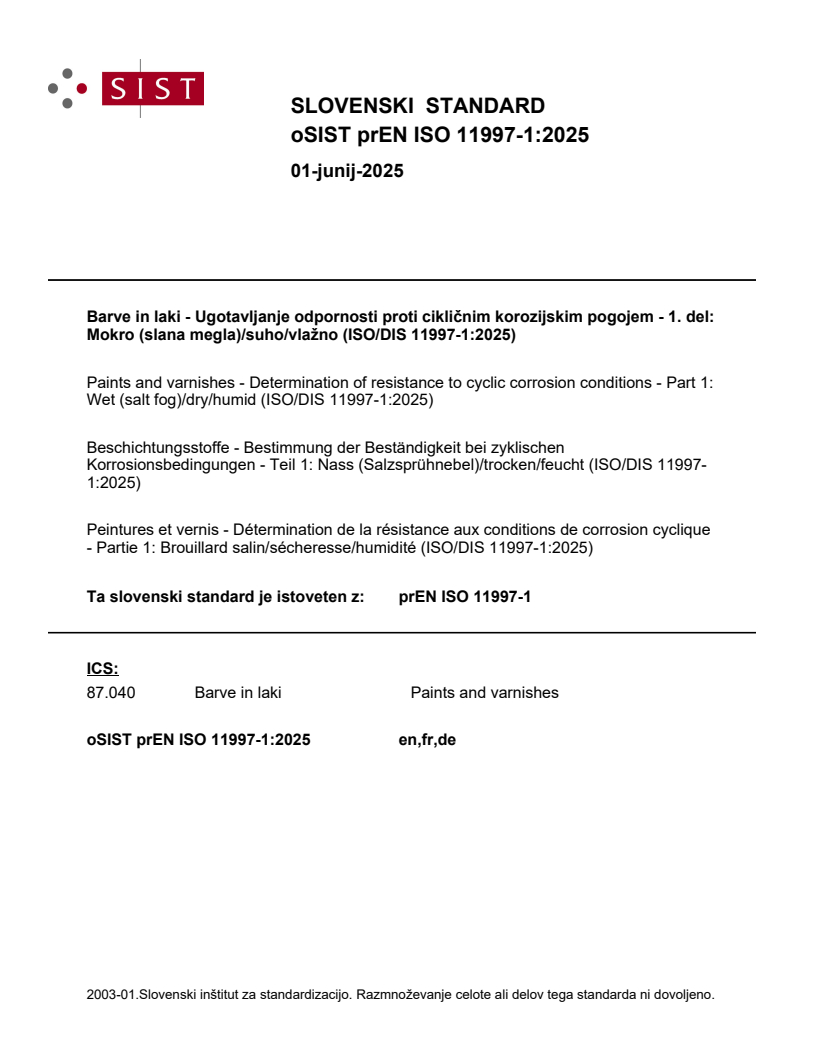
(Main)Paints and varnishes - Determination of resistance to cyclic corrosion conditions - Part 1: Wet (salt fog)/dry/humid (ISO/DIS 11997-1:2025)
Paints and varnishes - Determination of resistance to cyclic corrosion conditions - Part 1: Wet (salt fog)/dry/humid (ISO/DIS 11997-1:2025)
ISO 11997-1:2017 specifies a method for the determination of the resistance of coatings to one of four defined cycles of wet (salt fog)/dry/humid conditions using specified solutions.
Beschichtungsstoffe - Bestimmung der Beständigkeit bei zyklischen Korrosionsbedingungen - Teil 1: Nass (Salzsprühnebel)/trocken/feucht (ISO/DIS 11997-1:2025)
Peintures et vernis - Détermination de la résistance aux conditions de corrosion cyclique - Partie 1: Brouillard salin/sécheresse/humidité (ISO/DIS 11997-1:2025)
ISO 11997-1:2017 spécifie une méthode pour la détermination de la résistance des revêtements à l'un des quatre cycles définis brouillard salin/sécheresse/humidité, au moyen de solutions spécifiques.
Barve in laki - Ugotavljanje odpornosti proti cikličnim korozijskim pogojem - 1. del: Mokro (slana megla)/suho/vlažno (ISO/DIS 11997-1:2025)
General Information
- Status
- Not Published
- Public Enquiry End Date
- 02-Jul-2025
- Technical Committee
- IBLP - Paints and varnishes
- Current Stage
- 4020 - Public enquire (PE) (Adopted Project)
- Start Date
- 14-May-2025
- Due Date
- 01-Oct-2025
- Completion Date
- 18-Jul-2025
Relations
- Effective Date
- 21-Jun-2023
Overview
The oSIST prEN ISO 11997-1:2025:2025 standard, titled Paints and varnishes - Determination of resistance to cyclic corrosion conditions - Part 1: Wet (salt fog)/dry/humid, is a draft international standard developed by CEN in collaboration with ISO Technical Committee ISO/TC 35/SC 9. This standard specifies a reliable laboratory method for evaluating the resistance of coatings-such as paints and varnishes-to cyclic corrosion conditions involving wet (salt fog), dry, and humid environments.
The standard focuses on cyclic corrosion testing using four defined test cycles simulating real-world aggressive outdoor conditions, especially those encountered in marine or industrial environments. By replicating these cycles in laboratory settings, this method provides repeatable, controlled conditions crucial for quality control, product development, and comparative durability assessments of protective coatings.
Key Topics
- Cyclic Corrosion Resistance: The core of this standard is the assessment of coatings’ durability under simulated cyclic corrosion involving salt fog, dryness, and humidity to mimic natural weathering processes.
- Four Defined Test Cycles:
- Cycle A: Based on Japanese Automobile Standards (JASO M 609-91 and M610-92).
- Cycle B: Derived from the VDA 621-415 cycle, widely used in Europe with good correlation for vehicle coatings.
- Cycle C: Developed in the UK for water-soluble and latex paints, closely correlating with natural weathering.
- Cycle D: Follows Japanese Standard JIS K 5621-2003.
- Specified Salt Solutions: These provide the corrosive medium for the wet cycle to accurately simulate conditions like salt spray in marine atmospheres.
- Standardized Testing Procedures: Includes preparation of test panels, application of coatings, scribing, exposure conditions, and evaluation of coating degradation.
- Detailed Evaluation: Utilizes ISO methods (e.g., ISO 4628 series) to quantify degradation phenomena such as blistering, rusting, cracking, flaking, and filiform corrosion.
- Apparatus and Sampling: Provides guidance on test equipment and sample preparation to ensure repeatability and reliability.
- Documentation and Reporting: Outlines the necessary details to include in test reports for full transparency and traceability.
Applications
The oSIST prEN ISO 11997-1:2025:2025 standard has significant practical applications across multiple industries where coatings are critical for corrosion protection:
- Automotive Industry: Ensures paint systems used on vehicles withstand harsh cyclic corrosion conditions encountered during use.
- Marine and Offshore: Validates coatings' resistance in highly corrosive salt-laden environments to extend service life.
- Industrial Maintenance: Supports the selection of paint systems for infrastructure exposed to fluctuating humidity and moisture.
- Quality Assurance: Allows manufacturers to monitor consistency in coating performance and make data-driven improvements.
- Research and Development: Enables testing new coating formulations under controlled, accelerated cyclic corrosion scenarios.
By providing a validated, repeatable test method, this standard helps manufacturers, engineers, and quality professionals enhance product reliability and corrosion resistance.
Related Standards
- ISO 11997-2: Covers cyclic corrosion resistance with incorporation of UV exposure to simulate sunlight effects.
- ISO 1513, 1514, 2808: Related to sample preparation, standard test panels, and film thickness measurement respectively.
- ISO 3696: Specifies water quality for laboratory testing.
- ISO 4628 series: Provides detailed methods for evaluating various types of coating degradation including blistering, rusting, cracking, and filiform corrosion.
- ISO 17872: Guidelines on scribing coatings for corrosion testing.
These complementary standards provide a comprehensive framework for testing and evaluating the performance and durability of paints and varnishes under corrosive environments.
For professionals involved in corrosion testing and coating development, oSIST prEN ISO 11997-1:2025:2025 offers an authoritative and detailed methodology to benchmark cyclic corrosion resistance, ensuring coatings meet stringent industry requirements. Its focus on practical test cycles and thorough evaluation methods caters to the needs of durable, high-performance protective coatings for a variety of demanding environments.

Frequently Asked Questions
oSIST prEN ISO 11997-1:2025 is a draft published by the Slovenian Institute for Standardization (SIST). Its full title is "Paints and varnishes - Determination of resistance to cyclic corrosion conditions - Part 1: Wet (salt fog)/dry/humid (ISO/DIS 11997-1:2025)". This standard covers: ISO 11997-1:2017 specifies a method for the determination of the resistance of coatings to one of four defined cycles of wet (salt fog)/dry/humid conditions using specified solutions.
ISO 11997-1:2017 specifies a method for the determination of the resistance of coatings to one of four defined cycles of wet (salt fog)/dry/humid conditions using specified solutions.
oSIST prEN ISO 11997-1:2025 is classified under the following ICS (International Classification for Standards) categories: 87.040 - Paints and varnishes. The ICS classification helps identify the subject area and facilitates finding related standards.
oSIST prEN ISO 11997-1:2025 has the following relationships with other standards: It is inter standard links to SIST EN ISO 11997-1:2017. Understanding these relationships helps ensure you are using the most current and applicable version of the standard.
oSIST prEN ISO 11997-1:2025 is available in PDF format for immediate download after purchase. The document can be added to your cart and obtained through the secure checkout process. Digital delivery ensures instant access to the complete standard document.
Standards Content (Sample)
SLOVENSKI STANDARD
01-junij-2025
Barve in laki - Ugotavljanje odpornosti proti cikličnim korozijskim pogojem - 1. del:
Mokro (slana megla)/suho/vlažno (ISO/DIS 11997-1:2025)
Paints and varnishes - Determination of resistance to cyclic corrosion conditions - Part 1:
Wet (salt fog)/dry/humid (ISO/DIS 11997-1:2025)
Beschichtungsstoffe - Bestimmung der Beständigkeit bei zyklischen
Korrosionsbedingungen - Teil 1: Nass (Salzsprühnebel)/trocken/feucht (ISO/DIS 11997-
1:2025)
Peintures et vernis - Détermination de la résistance aux conditions de corrosion cyclique
- Partie 1: Brouillard salin/sécheresse/humidité (ISO/DIS 11997-1:2025)
Ta slovenski standard je istoveten z: prEN ISO 11997-1
ICS:
87.040 Barve in laki Paints and varnishes
2003-01.Slovenski inštitut za standardizacijo. Razmnoževanje celote ali delov tega standarda ni dovoljeno.
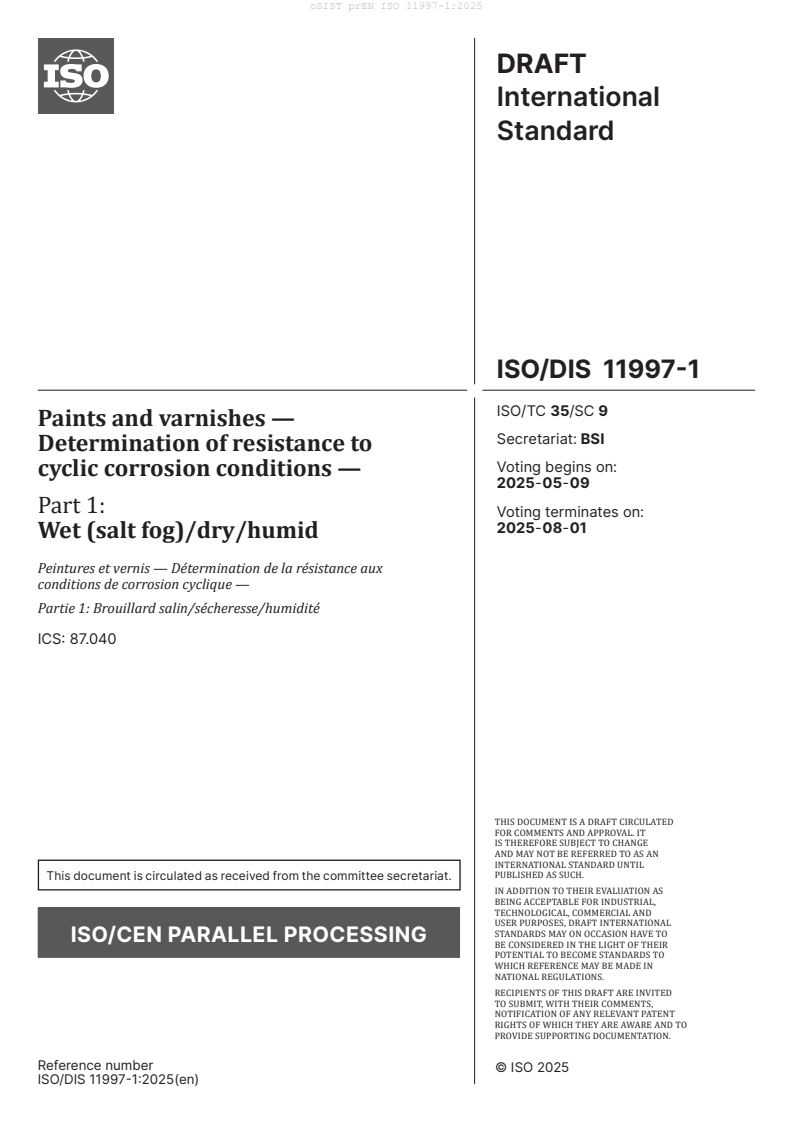
DRAFT
International
Standard
ISO/DIS 11997-1
ISO/TC 35/SC 9
Paints and varnishes —
Secretariat: BSI
Determination of resistance to
Voting begins on:
cyclic corrosion conditions —
2025-05-09
Part 1:
Voting terminates on:
2025-08-01
Wet (salt fog)/dry/humid
Peintures et vernis — Détermination de la résistance aux
conditions de corrosion cyclique —
Partie 1: Brouillard salin/sécheresse/humidité
ICS: 87.040
THIS DOCUMENT IS A DRAFT CIRCULATED
FOR COMMENTS AND APPROVAL. IT
IS THEREFORE SUBJECT TO CHANGE
AND MAY NOT BE REFERRED TO AS AN
INTERNATIONAL STANDARD UNTIL
PUBLISHED AS SUCH.
This document is circulated as received from the committee secretariat.
IN ADDITION TO THEIR EVALUATION AS
BEING ACCEPTABLE FOR INDUSTRIAL,
TECHNOLOGICAL, COMMERCIAL AND
USER PURPOSES, DRAFT INTERNATIONAL
STANDARDS MAY ON OCCASION HAVE TO
ISO/CEN PARALLEL PROCESSING
BE CONSIDERED IN THE LIGHT OF THEIR
POTENTIAL TO BECOME STANDARDS TO
WHICH REFERENCE MAY BE MADE IN
NATIONAL REGULATIONS.
RECIPIENTS OF THIS DRAFT ARE INVITED
TO SUBMIT, WITH THEIR COMMENTS,
NOTIFICATION OF ANY RELEVANT PATENT
RIGHTS OF WHICH THEY ARE AWARE AND TO
PROVIDE SUPPORTING DOCUMENTATION.
Reference number
ISO/DIS 11997-1:2025(en)
DRAFT
ISO/DIS 11997-1:2025(en)
International
Standard
ISO/DIS 11997-1
ISO/TC 35/SC 9
Paints and varnishes —
Secretariat: BSI
Determination of resistance to
Voting begins on:
cyclic corrosion conditions —
Part 1:
Voting terminates on:
Wet (salt fog)/dry/humid
Peintures et vernis — Détermination de la résistance aux
conditions de corrosion cyclique —
Partie 1: Brouillard salin/sécheresse/humidité
ICS: 87.040
THIS DOCUMENT IS A DRAFT CIRCULATED
FOR COMMENTS AND APPROVAL. IT
IS THEREFORE SUBJECT TO CHANGE
AND MAY NOT BE REFERRED TO AS AN
INTERNATIONAL STANDARD UNTIL
PUBLISHED AS SUCH.
This document is circulated as received from the committee secretariat.
IN ADDITION TO THEIR EVALUATION AS
BEING ACCEPTABLE FOR INDUSTRIAL,
© ISO 2025
TECHNOLOGICAL, COMMERCIAL AND
USER PURPOSES, DRAFT INTERNATIONAL
All rights reserved. Unless otherwise specified, or required in the context of its implementation, no part of this publication may
STANDARDS MAY ON OCCASION HAVE TO
ISO/CEN PARALLEL PROCESSING
be reproduced or utilized otherwise in any form or by any means, electronic or mechanical, including photocopying, or posting on
BE CONSIDERED IN THE LIGHT OF THEIR
the internet or an intranet, without prior written permission. Permission can be requested from either ISO at the address below
POTENTIAL TO BECOME STANDARDS TO
WHICH REFERENCE MAY BE MADE IN
or ISO’s member body in the country of the requester.
NATIONAL REGULATIONS.
ISO copyright office
RECIPIENTS OF THIS DRAFT ARE INVITED
CP 401 • Ch. de Blandonnet 8
TO SUBMIT, WITH THEIR COMMENTS,
CH-1214 Vernier, Geneva
NOTIFICATION OF ANY RELEVANT PATENT
Phone: +41 22 749 01 11
RIGHTS OF WHICH THEY ARE AWARE AND TO
PROVIDE SUPPORTING DOCUMENTATION.
Email: copyright@iso.org
Website: www.iso.org
Published in Switzerland Reference number
ISO/DIS 11997-1:2025(en)
ii
ISO/DIS 11997-1:2025(en)
Contents Page
Foreword .iv
Introduction .v
1 Scope . 1
2 Normative references . 1
3 Terms and definitions . 2
4 Principle . 2
5 Salt fog test solution . 2
6 Apparatus . 3
7 Sampling . 4
8 Test panels . 4
8.1 Material and dimensions .4
8.2 Preparation and coating of panels .4
8.3 Drying and conditioning .4
8.4 Thickness of coating .5
8.5 Preparation of scribe .5
9 Method of exposure of test panels . 5
10 Operating conditions . 5
11 Procedure . 6
12 Examination of test panels . 6
13 Precision . 6
14 Test report . 7
Annex A (normative) Cycle A . . 8
Annex B (normative) Cycle B . . 9
Annex C (normative) Cycle C . .10
Annex D (normative) Cycle D .12
Annex E (informative) Factors to be considered in the design and construction of salt spray
cabinets .13
Bibliography . 14
iii
ISO/DIS 11997-1:2025(en)
Foreword
ISO (the International Organization for Standardization) is a worldwide federation of national standards
bodies (ISO member bodies). The work of preparing International Standards is normally carried out through
ISO technical committees. Each member body interested in a subject for which a technical committee
has been established has the right to be represented on that committee. International organizations,
governmental and non-governmental, in liaison with ISO, also take part in the work. ISO collaborates closely
with the International Electrotechnical Commission (IEC) on all matters of electrotechnical standardization.
The procedures used to develop this document and those intended for its further maintenance are described
in the ISO/IEC Directives, Part 1. In particular, the different approval criteria needed for the different types
of ISO documents should be noted. This document was drafted in accordance with the editorial rules of the
ISO/IEC Directives, Part 2 (see www.iso.org/directives).
ISO draws attention to the possibility that the implementation of this document may involve the use of (a)
patent(s). ISO takes no position concerning the evidence, validity or applicability of any claimed patent
rights in respect thereof. As of the date of publication of this document, ISO had not received notice of (a)
patent(s) which may be required to implement this document. However, implementers are cautioned that
this may not represent the latest information, which may be obtained from the patent database available at
www.iso.org/patents. ISO shall not be held responsible for identifying any or all such patent rights.
Any trade name used in this document is information given for the convenience of users and does not
constitute an endorsement.
For an explanation of the voluntary nature of standards, the meaning of ISO specific terms and expressions
related to conformity assessment, as well as information about ISO's adherence to the World Trade
Organization (WTO) principles in the Technical Barriers to Trade (TBT), see www.iso.org/iso/foreword.html.
This document was prepared by Technical Committee ISO/TC 35, Paints and varnishes, Subcommittee
SC 9, General test methods for paints and varnishes, in collaboration with the European Committee for
Standardization (CEN) Technical Committee CEN/TC 139, Paints and varnishes, in accordance with the
Agreement on technical cooperation between ISO and CEN (Vienna Agreement).
This fourth edition cancels and replaces the third edition (ISO 11997-1:2017), which has been technically
revised.
The main changes are as follows:
— the general warning and warnings for each chemical material have been added;
— the dry air supply for cycle C has been revised
— the normative references have been updated
A list of all parts in the ISO 11997 series can be found on the ISO website.
Any feedback or questions on this document should be directed to the user’s national standards body. A
complete listing of these bodies can be found at www.iso.org/members.html.
iv
ISO/DIS 11997-1:2025(en)
Introduction
Coatings of paints, varnishes and similar materials are exposed to one of four cycles of wet and dry
conditions specified in this document (see Annex A to Annex D), using specified salt solutions in a cabinet in
order to simulate, in the laboratory, processes occurring in aggressive outdoor conditions, such as marine
environments. Generally, correlation between such outdoor weathering and laboratory testing cannot
be expected because of the large number of factors influencing the breakdown process. Correlation can
only be expected if the effect on the coating of important parameters (e.g. the nature of the pollutant, the
spectral distribution of the incident irradiance in the relevant photochemical region, the temperature of the
specimen, the type and cycle of wetting and relative humidity) is known. In contrast to outdoor weathering,
laboratory testing in a cabinet is performed with a reduced number of variables which can be controlled,
and therefore the effects are more reproducible. The method described may also give a means of checking
that the quality of a paint or paint system is being maintained.
The method has been found to be useful in comparing the cyclic salt spray resistance of different coatings. It
is most useful in providing relevant ratings for a series of coated panels exhibiting significant differences in
cyclic salt spray resistance.
The test cycles included in this document have been used successfully, with documented evidence, in the
industry for the assessment of performance. The cycles can be summarized as follows.
— Cycle A (see Annex A): This cycle is specified in Japanese Automobile Standards JASO M 609-91 and
JASO M610-92.
— Cycle B (see Annex B): This is based on the VDA 621-415 cycle and is widely used in Europe. It has
also been shown to give good correlation with natural weathering for thermosetting paints in vehicle
corrosion.
— Cycle C (see Annex C): This cycle was developed in the UK for use with water-soluble and latex paint
systems and has been shown to give good correlation with natural weathering.
— Cycle D (see Annex D): This cycle is specified in Japanese Standard JIS K 5621-2003.
It is intended that other cycles will be added at later revisions of this document, as they are developed for
evaluating other paint types.
ISO 11997-2 describes a method for determining the cyclic corrosion resistance of paints which includes
UV exposure as part of the cycle. It has been found to give good correlation with natural weathering for
industrial maintenance coatings.
v
DRAFT International Standard ISO/DIS 11997-1:2025(en)
Paints and varnishes — Determination of resistance to cyclic
corrosion conditions —
Part 1:
Wet (salt fog)/dry/humid
1 Scope
This document specifies a method for the determination of the resistance of coatings to one of four defined
cycles of wet (salt fog)/dry/humid conditions using specified solutions.
2 Normative references
The following documents are referred to in the text in such a way that some or all of their content constitutes
requirements of this document. For dated references, only the edition cited applies. For undated references,
the latest edition of the referenced document (including any amendments) applies.
ISO 1513, Paints and varnishes — Examination and preparation of test samples
ISO 1514, Paints and varnishes — Standard panels for testing
ISO 2808, Paints and varnishes — Determination of film thickness
ISO 3270, Paints and varnishes and their raw materials — Temperatures and humidities for conditioning and testing
ISO 3696, Water for analytical laboratory use — Specification and test methods
ISO 4618, Paints and varnishes — Vocabulary
ISO 4628-1, Paints and varnishes — Evaluation of degradation of coatings — Designation of quantity and size of
defects, and of intensity of uniform changes in appearance — Part 1: General introduction and designation system
ISO 4628-2, Paints and varnishes — Evaluation of degradation of coatings — Designation of quantity and size of
defects, and of intensity of uniform changes in appearance — Part 2: Assessment of degree of blistering
ISO 4628-3, Paints and varnishes — Evaluation of quantity and size of defects, and of intensity of uniform
changes in appearance — Part 3: Assessment of degree of rusting
ISO 4628-4, Paints and varnishes — Evaluation of degradation of coatings — Designation of quantity and size of
defects, and of intensity of uniform changes in appearance — Part 4: Assessment of degree of cracking
ISO 4628-5, Paints and varnishes — Evaluation of quantity and size of defects, and of intensity of uniform
changes in appearance — Part 5: Assessment of degree of flaking
ISO 4628-8, Paints and varnishes — Evaluation of degradation of coatings — Designation of quantity and size of
defects, and of intensity of uniform changes in appearance — Part 8: Assessment of degree of delamination and
corrosion around a scribe or other artificial defect
ISO 4628-10, Paints and varnishes — Evaluation of quantity and size of defects, and of intensity of uniform
changes in appearance — Part 10: Assessment of degree of filiform corrosion
ISO 15528, Paints, varnishes and raw materials for paints and varnishes — Sampling
ISO/DIS 11997-1:2025(en)
ISO 17872:2007, Paints and varnishes — Guidelines for the introduction of scribe marks through coatings on
metallic panels for corrosion testing
3 Terms and definitions
For the purposes of this document, the terms and definitions given in ISO 4618 apply.
ISO and IEC maintain terminology databases for use in standardization at the following addresses:
— ISO Online browsing platform: available at https:// www .iso .org/ obp
— IEC Electropedia: available at https:// www .electropedia .org/
4 Principle
WARNING — This document can involve hazardous materials, operations and equipment. This
document does not purport to address all of the safety concerns, if any, associated with its use. It is
the responsibility of the user of this document to establish appropriate safety and health practices
and determine the applicability of regulatory limitations prior to use.
A coated test panel is exposed to a cyclic wet (salt fog), drying and humidity test schedule and the effects of
exposure are evaluated by criteria agreed in advance between the interested parties, these criteria usually
being of a subjective nature.
5 Salt fog test solution
Prepare the salt fog test solution by dissolving the salt or salts as given in Annexes A, B, C and D in distilled
or deionized water with a conductivity not higher than 20 µS/cm at 25 °C.
The salts shall be of analytical grade and contain a mass fraction of the heavy metals of copper (Cu), nickel
(Ni) and lead (Pb) in total less than 0,005 %. It shall not contain a mass fraction of sodium iodide more than
0,1 % and a mass fraction of total impurities more than 0,5 % calculated for dry salt.
NOTE 1 Sodium chloride with anti-caking agents can act as corrosion inhibitors or accelerators. A useful sodium
chloride salt grade is a grade named Ph. Eur/USP or JIS, ACS.
If the pH of the solution is outside the required range (see Annexes A, B, C and D), the presence of undesirable
impurities in the salt or the water or both shall be investigated. Check the pH using electrometric
measurement. Measurements of pH shall be done using electrodes suitable for measuring in weakly
buffered sodium chloride solutions in deionized water. Any necessary corrections shall be made by adding
hydrochloric acid, sodium hydrogen carbonate or analytical-grade sodium hydroxide, of appropriate
concentrations.
1)
WARNING — Hydrochloric acid (CAS Registry Number® 7647-01-0) solution is toxic, corrosive,
irritating and very toxic to aquatic life. Refer to the safety data sheet for details. Handling of
hydrochloric acid solution shall be restricted to skilled personnel or conducted under their control.
Care shall be taken in the disposal of this solution.
WARNING — Sodium hydroxide (CAS Registry Number® 1310-73-2) solution is toxic, corrosive and
irritating. Refer to the safety data sheet for details. Handling of sodium hydroxide solution shall be
restricted to skilled personnel or conducted under their control. Care shall be taken in the disposal
of this solution.
1) CAS Registry Number® is a trademark of the American Chemical Society (ACS). This information is given for the
convenience of users of this document and does not constitute an endorsement by ISO of the product named. Equivalent
products may be used if they can be shown to lead to the same results.
ISO/DIS 11997-1:2025(en)
NOTE 2 Attention is drawn to the possible changes in pH resulting from loss of carbon dioxide from the solution
when it is sprayed or from dissolution of carbon dioxide from the ambient atmosphere. Such changes can be avoided by
reducing the carbon dioxide content of the solution by, for example, heating it to a temperature above 35 °C before it is
placed in the cabinet or making the solution from freshly boiled water.
Filter the solution before placing it in the reservoir of the cabinet in order to remove any solid matter which
can block the apertures of the spraying device.
6 Apparatus
6.1 General, ordinary laboratory apparatus and glassware, together with the following.
6.2 Spray cabinet, made of, or lined with, material resistant to corrosion by the sprayed solution and
having a roof which prevents condensed moisture dripping onto the test specimens. Due to the limited
capacity of cabinets smaller than 0,4 m , the effect of the loading of the cabinet on the distribution of the
spray and temperature shall be carefully considered. The solution shall not be sprayed directly onto test
specimens but rather spread throughout the cabinet so that it falls naturally down on them.
The size and shape of the cabinet shall be such that the salt fog deposition rate is within the limits given in
Annexes A, B, C and D.
NOTE Cabinets with a volume greater than 2 m will be difficult to operate unless careful consideration is given
to their design and construction.
Factors to be taken into consideration in the design and construction of the cabinet are given in Annex E.
If the cabinet has been used for a spray test, or for any other purpose, using a solution differing from that
specified for the current test cycle, it shall be thoroughly cleaned before use.
6.3 Hot-air blowers, capable of maintaining the cabinet and its contents at the specified temperatures
and achieving the required heating rates (see Annexes A, B, C and D). The temperature shall be controlled by
a thermostat element placed within the cabinet at least 100 mm from the walls of the cabinet.
6.4 Means for spraying the salt solution, comprising a supply of clean compressed air at a controlled
pressure, a reservoir to contain the solution to be sprayed and one or more atomizers made of material
resistant to the solution. The compressed-air supply to each atomizer shall be passed through a filter to
remove all traces of oil or solid matter, shall be at a suitable pre
...
Questions, Comments and Discussion
Ask us and Technical Secretary will try to provide an answer. You can facilitate discussion about the standard in here.
Loading comments...