

SIST EN 50388-2:2025
(Main)Fixed installations and rolling stock for railway applications - Technical criteria for the coordination between electric traction power supply systems and rolling stock to achieve interoperability - Part 2: Stability and harmonics
General Information
- Abstract
This document establishes the acceptance criteria according to EN 50388-1:2022, 10.2 for compatibility between traction units and power supply for known phenomena and known technologies. That is in relation to:
- co-ordination between controlled elements and also between these elements and resonances in the electrical infrastructure in order to achieve network system stability;
- co-ordination of harmonic behaviour with respect to excitation of electrical resonances.
The following electric traction systems are within the scope:
- railways;
- guided mass transport systems that are integrated with railways;
- material transport systems that are integrated with railways.
Public three-phase networks are out of the scope, but networks which are dedicated to railways are included.
This document is applied in accordance with the requirements in EN 50388-1:2022, Clause 10. It does not apply retrospectively to rolling stock or railway power supply elements already in service.
It is the aim of this Part 2 to support acceptance of new elements (rolling stock or infrastructure) by specifying precise requirements and methods for demonstration of compliance. This document acts as “code of practice” quoted in EN 50388-1:2022, 10.2. However, it is still admissible to use the process as defined in EN 50388-1:2022, 10.3 instead.
This version of the standard only applies to AC systems. Later versions might include similar effects in DC networks in addition, see Annex D.
The main phenomena identified and treated in this document are:
- electrical resonance stability;
- low frequency stability;
- overvoltages caused by harmonics.
The interaction with signalling (including track circuits) is not dealt with in this document.
- Status
- Published
- Public Enquiry End Date
- 28-Feb-2024
- Publication Date
- 08-Apr-2025
- Technical Committee
- ŽEN - Electrical applications for railways
- Current Stage
- 6060 - National Implementation/Publication (Adopted Project)
- Start Date
- 12-Mar-2025
- Due Date
- 17-May-2025
- Completion Date
- 09-Apr-2025
2016/797/EU - Directive (EU) 2016/797 of the European Parliament and of the Council of 11 May 2016 on the interoperability of the rail system within the European Union (Text with EEA relevance)OJ Ref: Izvedbeni sklep Komisije 2026/803 OJ Date: 13-Apr-2026

Overview
SIST EN 50388-2:2025, established by the European Committee for Electrotechnical Standardization (CLC), defines technical criteria ensuring compatibility and interoperability between railway traction power supply systems and rolling stock-specifically focusing on network stability and harmonic management. This standard complements EN 50388-1:2022 and guides infrastructure managers, rolling stock manufacturers, and system integrators in designing, testing, and accepting new traction units or infrastructure components. SIST EN 50388-2:2025 applies primarily to AC systems in railways and related guided mass transport or material handling systems integrated with the railway infrastructure.
Key Topics
Network System Stability:
- Coordination between controlled elements (e.g., rolling stock converters, infrastructure converters) and network resonances is critical to ensuring stability.
- Requirements ensure that electrical resonances in the power supply system are not unduly excited, thus preventing oscillations and operational disturbances.
Harmonic Behaviour and Resonances:
- Coordination aims to mitigate the risk of harmonics exciting electrical resonances in the system, which could lead to dangerous overvoltages or system instability.
- Focus is given to limiting the interaction of harmonic-producing components with infrastructure.
Technical Acceptance Criteria:
- The standard specifies clear compatibility requirements for new or modified rolling stock and infrastructure components.
- It details methods for demonstrating compliance, including measurements, simulations, and plausibility checks, to validate theoretical assessments.
Assessment and Testing Procedures:
- Prescribes approaches for measuring and simulating input admittance, stability analysis, and verification against predefined network scenarios.
- Includes provisions for time-domain simulation or appropriate validated methods to verify low-frequency system stability.
Scope Limitations:
- Covers only networks dedicated to railway applications-not public three-phase grids.
- Applies prospectively only to new elements (not systems already in service).
- Initially for AC systems; later versions may extend to include DC effects.
Applications
Railway and Transport Networks:
- Ensuring smooth interoperability of new trains and infrastructure in Europe, especially during network expansions, upgrades, or cross-border operations.
- Applicable to traditional railways, light rail, tram-train systems, and integrated material handling systems relying on fixed railway infrastructure.
Rolling Stock and Component Development:
- Supports manufacturers in designing converters, filter systems, auxiliary equipment, and traction units compatible with diverse European rail networks.
- Provides baseline for testing and acceptance during vehicle commissioning and for infrastructure upgrades.
Infrastructure Planning and Maintenance:
- Guides infrastructure managers in evaluating proposed changes or system extensions for compatibility risks.
- Helps maintainer teams assess upgrades to transformers, autotransformers, or energy compensation devices.
Regulatory and Certification Support:
- Useful for demonstrating conformity with Technical Specifications for Interoperability (TSIs) under the EU Directive (EU) 2016/797.
- Acts as a foundational reference for safety case preparation and third-party certification processes.
Related Standards
- EN 50388-1:2022 – General requirements for the coordination between electric traction power supply systems and rolling stock.
- EN 50163 – Supply voltages of traction systems, foundational for defining nominal and permissible electrical values in the network.
- CLC/TS 50535 – Additional requirements for certain systems regarding stability and input admittance.
- IEC 60050-811 – Provides standardized definitions for electrotechnical terms used in railway applications.
Practical Value
By addressing phenomena such as electrical resonance stability, low-frequency stability, and overvoltages caused by harmonics, SIST EN 50388-2:2025 ensures robust, interoperable electrical railway networks. This protects against costly operational interruptions, facilitates seamless cross-border rail services, and provides clear guidance for introducing new technologies or rolling stock. Compliance with EN 50388-2 helps all stakeholders-including infrastructure managers, rolling stock OEMs, and certification bodies-maintain safe, reliable, and efficient electrified railway transportation across Europe.
Relations
- Effective Date
- 03-Feb-2026
- Effective Date
- 03-Feb-2026
- Effective Date
- 03-Feb-2026
- Effective Date
- 03-Feb-2026
- Effective Date
- 03-Feb-2026
- Effective Date
- 03-Feb-2026
Get Certified
Connect with accredited certification bodies for this standard

IMQ S.p.A. (Certification)
Italian electrical product certification.

IRIS Certification (UNIFE)
International Railway Industry Standard certification.

SLG Prüf- und Zertifizierungs GmbH
German testing and certification body.
Sponsored listings
Frequently Asked Questions
SIST EN 50388-2:2025 is a standard published by the Slovenian Institute for Standardization (SIST). Its full title is "Fixed installations and rolling stock for railway applications - Technical criteria for the coordination between electric traction power supply systems and rolling stock to achieve interoperability - Part 2: Stability and harmonics". This standard covers: This document establishes the acceptance criteria according to EN 50388-1:2022, 10.2 for compatibility between traction units and power supply for known phenomena and known technologies. That is in relation to: - co-ordination between controlled elements and also between these elements and resonances in the electrical infrastructure in order to achieve network system stability; - co-ordination of harmonic behaviour with respect to excitation of electrical resonances. The following electric traction systems are within the scope: - railways; - guided mass transport systems that are integrated with railways; - material transport systems that are integrated with railways. Public three-phase networks are out of the scope, but networks which are dedicated to railways are included. This document is applied in accordance with the requirements in EN 50388-1:2022, Clause 10. It does not apply retrospectively to rolling stock or railway power supply elements already in service. It is the aim of this Part 2 to support acceptance of new elements (rolling stock or infrastructure) by specifying precise requirements and methods for demonstration of compliance. This document acts as “code of practice” quoted in EN 50388-1:2022, 10.2. However, it is still admissible to use the process as defined in EN 50388-1:2022, 10.3 instead. This version of the standard only applies to AC systems. Later versions might include similar effects in DC networks in addition, see Annex D. The main phenomena identified and treated in this document are: - electrical resonance stability; - low frequency stability; - overvoltages caused by harmonics. The interaction with signalling (including track circuits) is not dealt with in this document.
This document establishes the acceptance criteria according to EN 50388-1:2022, 10.2 for compatibility between traction units and power supply for known phenomena and known technologies. That is in relation to: - co-ordination between controlled elements and also between these elements and resonances in the electrical infrastructure in order to achieve network system stability; - co-ordination of harmonic behaviour with respect to excitation of electrical resonances. The following electric traction systems are within the scope: - railways; - guided mass transport systems that are integrated with railways; - material transport systems that are integrated with railways. Public three-phase networks are out of the scope, but networks which are dedicated to railways are included. This document is applied in accordance with the requirements in EN 50388-1:2022, Clause 10. It does not apply retrospectively to rolling stock or railway power supply elements already in service. It is the aim of this Part 2 to support acceptance of new elements (rolling stock or infrastructure) by specifying precise requirements and methods for demonstration of compliance. This document acts as “code of practice” quoted in EN 50388-1:2022, 10.2. However, it is still admissible to use the process as defined in EN 50388-1:2022, 10.3 instead. This version of the standard only applies to AC systems. Later versions might include similar effects in DC networks in addition, see Annex D. The main phenomena identified and treated in this document are: - electrical resonance stability; - low frequency stability; - overvoltages caused by harmonics. The interaction with signalling (including track circuits) is not dealt with in this document.
SIST EN 50388-2:2025 is classified under the following ICS (International Classification for Standards) categories: 29.280 - Electric traction equipment; 45.060.01 - Railway rolling stock in general. The ICS classification helps identify the subject area and facilitates finding related standards.
SIST EN 50388-2:2025 has the following relationships with other standards: It is inter standard links to SIST EN 50163:2005/A3:2023, SIST EN 50163:2005/A1:2007, SIST EN 50163:2005, SIST EN 50163:2005/A2:2020, SIST EN 50388-1:2022, SIST-TS CLC/TS 50729:2025. Understanding these relationships helps ensure you are using the most current and applicable version of the standard.
SIST EN 50388-2:2025 is associated with the following European legislation: EU Directives/Regulations: 2016/797/EU, 2016/797/EU, 2016/797/EU, 2016/797/EU, 2016/797/EU, 2016/797/EU, 2016/797/EU; Standardization Mandates: M/483, M/591. When a standard is cited in the Official Journal of the European Union, products manufactured in conformity with it benefit from a presumption of conformity with the essential requirements of the corresponding EU directive or regulation.
SIST EN 50388-2:2025 is available in PDF format for immediate download after purchase. The document can be added to your cart and obtained through the secure checkout process. Digital delivery ensures instant access to the complete standard document.
Standards Content (Sample)
SLOVENSKI STANDARD
01-maj-2025
Fiksni postroji in vozna sredstva za železniške naprave - Tehnični kriteriji za
uskladitev med napajalnimi viri in voznimi sredstvi za doseganje interoperabilnosti
- 2. del: Stabilnost in harmoniki
Fixed installations and rolling stock for railway applications - Technical criteria for the
coordination between electric traction power supply systems and rolling stock to achieve
interoperability - Part 2: Stability and harmonics
Bahnanwendungen - Ortsfeste Anlagen und Bahnfahrzeuge - Technische Kriterien für
die Koordination zwischen Anlagen der Bahnenergieversorgung und Fahrzeugen zum
Erreichen der Interoperabilität - Teil 2: Stabilität und Oberschwingungen
Installations Fixes et Matériel Roulant pour les Applications ferroviaires - Critères
techniques pour la coordination entre les installations fixes de traction électrique et le
matériel roulant pour réaliser l’interopérabilité
Ta slovenski standard je istoveten z: EN 50388-2:2025
ICS:
29.280 Električna vlečna oprema Electric traction equipment
45.060.01 Železniška vozila na splošno Railway rolling stock in
general
2003-01.Slovenski inštitut za standardizacijo. Razmnoževanje celote ali delov tega standarda ni dovoljeno.
EUROPEAN STANDARD EN 50388-2
NORME EUROPÉENNE
EUROPÄISCHE NORM March 2025
ICS 45.060.01; 29.280
English Version
Fixed installations and rolling stock for railway applications -
Technical criteria for the coordination between electric traction
power supply systems and rolling stock to achieve
interoperability - Part 2: Stability and harmonics
Installations Fixes et Matériel Roulant pour les Applications Ortsfeste Anlagen und Bahnfahrzeuge für
ferroviaires - Critères techniques pour la coordination entre Bahnanwendungen - Technische Kriterien für die
les installations fixes de traction électrique et le matériel Koordinierung zwischen elektrischen
roulant pour réaliser l'interopérabilité - Partie 2 : Stabilité et Bahnenergieversorgungssystemen und Fahrzeugen zum
harmoniques Erreichen der Interoperabilität - Teil 2: Stabilität und
Oberschwingungen
This European Standard was approved by CENELEC on 2025-02-03. CENELEC members are bound to comply with the CEN/CENELEC
Internal Regulations which stipulate the conditions for giving this European Standard the status of a national standard without any alteration.
Up-to-date lists and bibliographical references concerning such national standards may be obtained on application to the CEN-CENELEC
Management Centre or to any CENELEC member.
This European Standard exists in three official versions (English, French, German). A version in any other language made by translation
under the responsibility of a CENELEC member into its own language and notified to the CEN-CENELEC Management Centre has the
same status as the official versions.
CENELEC members are the national electrotechnical committees of Austria, Belgium, Bulgaria, Croatia, Cyprus, the Czech Republic,
Denmark, Estonia, Finland, France, Germany, Greece, Hungary, Iceland, Ireland, Italy, Latvia, Lithuania, Luxembourg, Malta, the
Netherlands, Norway, Poland, Portugal, Republic of North Macedonia, Romania, Serbia, Slovakia, Slovenia, Spain, Sweden, Switzerland,
Türkiye and the United Kingdom.
European Committee for Electrotechnical Standardization
Comité Européen de Normalisation Electrotechnique
Europäisches Komitee für Elektrotechnische Normung
CEN-CENELEC Management Centre: Rue de la Science 23, B-1040 Brussels
© 2025 CENELEC All rights of exploitation in any form and by any means reserved worldwide for CENELEC Members.
Ref. No. EN 50388-2:2025 E
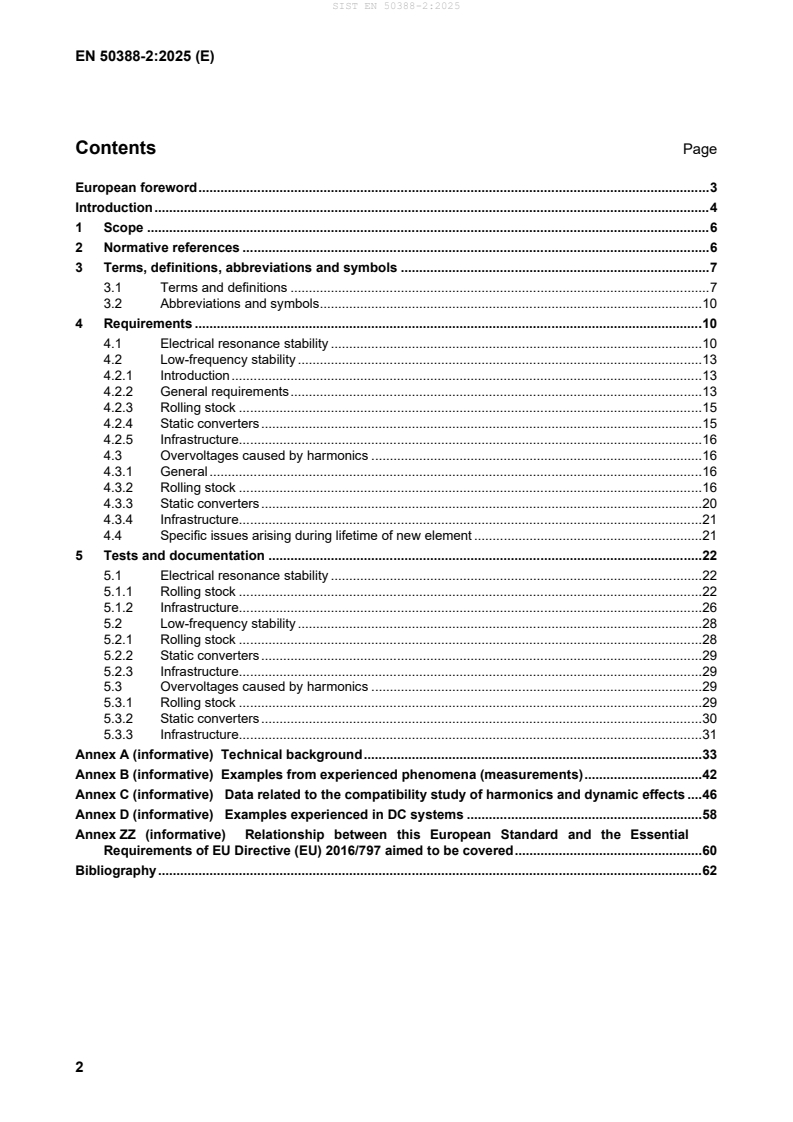
Contents Page
European foreword . 3
Introduction . 4
1 Scope . 6
2 Normative references . 6
3 Terms, definitions, abbreviations and symbols . 7
3.1 Terms and definitions . 7
3.2 Abbreviations and symbols . 10
4 Requirements . 10
4.1 Electrical resonance stability . 10
4.2 Low-frequency stability . 13
4.2.1 Introduction . 13
4.2.2 General requirements . 13
4.2.3 Rolling stock . 15
4.2.4 Static converters . 15
4.2.5 Infrastructure. 16
4.3 Overvoltages caused by harmonics . 16
4.3.1 General . 16
4.3.2 Rolling stock . 16
4.3.3 Static converters . 20
4.3.4 Infrastructure. 21
4.4 Specific issues arising during lifetime of new element . 21
5 Tests and documentation . 22
5.1 Electrical resonance stability . 22
5.1.1 Rolling stock . 22
5.1.2 Infrastructure. 26
5.2 Low-frequency stability . 28
5.2.1 Rolling stock . 28
5.2.2 Static converters . 29
5.2.3 Infrastructure. 29
5.3 Overvoltages caused by harmonics . 29
5.3.1 Rolling stock . 29
5.3.2 Static converters . 30
5.3.3 Infrastructure. 31
Annex A (informative) Technical background . 33
Annex B (informative) Examples from experienced phenomena (measurements) . 42
Annex C (informative) Data related to the compatibility study of harmonics and dynamic effects . 46
Annex D (informative) Examples experienced in DC systems . 58
Annex ZZ (informative) Relationship between this European Standard and the Essential
Requirements of EU Directive (EU) 2016/797 aimed to be covered . 60
Bibliography . 62
European foreword
This document (EN 50388-2:2025) has been prepared by CLC/SC 9XC, “Electric supply and earthing
systems for public transport equipment and auxiliary apparatus (Fixed installations)”, of CLC/TC 9X,
“Electrical and electronic applications for railways”.
It is also relevant to the scope and expertise of CLC/SC 9XB, “Electromechanical material on board of rolling
stock”.
The following dates are fixed:
• latest date by which this document has to be (dop) 2026-03-31
implemented at national level by publication of
an identical national standard or by
endorsement
• latest date by which the national standards (dow) 2028-03-31
conflicting with this document have to be
withdrawn
Attention is drawn to the possibility that some of the elements of this document may be the subject of patent
rights. CENELEC shall not be held responsible for identifying any or all such patent rights.
EN 50388 “Railway applications – Fixed installations and rolling stock - Technical criteria for the coordination
between traction power supply and rolling stock to achieve interoperability” consists of the following parts:
— Part 1: General
— Part 2: Stability and harmonics
This document has been prepared under a standardization request addressed to CENELEC by the
European Commission. The Standing Committee of the EFTA States subsequently approves these requests
for its Member States.
For the relationship with EU Legislation, see informative Annex ZZ, which is an integral part of this
document.
Any feedback and questions on this document should be directed to the users’ national committee. A
complete listing of these bodies can be found on the CENELEC website.
Introduction
This document is linked to EN 50388-1:2022, which describes the general technical criteria for the
coordination between power supply and rolling stock to achieve interoperability.
To improve readability, this document is structured as shown in Table 1, which only shows references to the
most important clauses and subclauses.
Table 1 — Structure of this document
Topic Requirements Tests and documentation
Clause Main requirements Clause Most important elements
Electrical 4.1 Definition of a limit frequency 5.1 For controlled elements, in most
resonance fL cases measurement of frequency
stability response of input admittance is
— Lowest electric traction
required.
power supply system
resonance frequency is > f . 5.1.1.2 Defines in which cases input
L
admittance has to be measured and
— All controlled elements
how it has to be measured.
are passive for all
frequencies > fL. 5.1.1.3 Defines the combined test.
Requirements for filter 5.1.1.4 Defines in which cases
capacitors. simulation is sufficient and specifies
the requirements for the simulator.
5.1.1.5 Defines in which cases
declaration of conformity is sufficient.
5.1.2 Defines the methods to be
used to assess the lowest resonant
frequency of the power supply.
A.1 Technical background about electrical resonance stability
B.1 Examples of real electrical resonance instability experiences
Low- 4.2 Demonstration of stable 5.2 Verification either by
frequency operation for predefined
— time domain simulation (or
stability operation scenarios of
measurements); or
electric traction power supply
— any other validated method.
system and one or several
identical traction units at one
location.
A.2 Technical background about low-frequency stability
A.2.1 Background and experiences.
A.2.2 Acceptance criteria and verification.
B.2 Examples of experienced low frequency power oscillations.
Overvoltages 4.3 4.3.2 Rolling stock 5.3 5.3.1 Demonstration of compliance
caused by for rolling stock by:
Defines the limit of the
harmonics
overvoltage and specifies the — Calculation of line current
calculation method by using spectrum including plausibility check
line current spectrum, by measurement.
bandpass filtering, — Calculation of harmonic voltage
summation methods and assessment using the method given
standardized power supply in 4.3.
impedances.
— Check of interlacing between
4.3.2.3 Overvoltage units.
detection. Suggests methods
— Check of overvoltage protection.
of overvoltage detection.
— If diode rectification is used to
4.3.3 Defines applicability
reduce risk of overvoltages check of
Topic Requirements Tests and documentation
Clause Main requirements Clause Most important elements
and the overvoltage limits for correct transition between pulsing
static converter stations. and blocking of line converter.
4.3.4 Infrastructure related 5.3.2 Demonstration of compliance
topics. for static converters by:
— Assessing the overvoltage by
combining the converter with a line of
variable length.
— defining the assessment method
in time domain.
— plausibility check of the
simulation model by measurement.
5.3.3 Demonstration of compliance
for infrastructure.
A.3 Technical background relating to overvoltages caused by harmonics including
example calculations for rolling stock
B.3 Examples of real overvoltage experiences caused by harmonics
Topics A.4 Depot cases
related to all
phenomena
Annex C Data related to the compatibility study of harmonics and dynamic effects
Annex D Examples experienced in DC systems
1 Scope
This document establishes the acceptance criteria according to EN 50388-1:2022, 10.2 for compatibility
between traction units and power supply for known phenomena and known technologies. That is in relation
to:
— co-ordination between controlled elements and also between these elements and resonances in the
electrical infrastructure in order to achieve network system stability;
— co-ordination of harmonic behaviour with respect to excitation of electrical resonances.
The following electric traction systems are within the scope:
— railways;
— guided mass transport systems that are integrated with railways;
— material transport systems that are integrated with railways.
Public three-phase networks are out of the scope, but networks which are dedicated to railways are included.
This document is applied in accordance with the requirements in EN 50388-1:2022, Clause 10. It does not
apply retrospectively to rolling stock or railway power supply elements already in service.
It is the aim of this Part 2 to support acceptance of new elements (rolling stock or infrastructure) by
specifying precise requirements and methods for demonstration of compliance. This document acts as “code
of practice” quoted in EN 50388-1:2022, 10.2. However, it is still admissible to use the process as defined in
EN 50388-1:2022, 10.3 instead.
This version of the standard only applies to AC systems. Later versions might include similar effects in DC
networks in addition, see Annex D.
The main phenomena identified and treated in this document are:
— electrical resonance stability;
— low frequency stability;
— overvoltages caused by harmonics.
The interaction with signalling (including track circuits) is not dealt with in this document.
2 Normative references
The following documents are referred to in the text in such a way that some or all of their content constitutes
requirements of this document. For dated references, only the edition cited applies. For undated references,
the latest edition of the referenced document (including any amendments) applies.
EN 50388-1:2022, Railway Applications - Fixed installations and rolling stock - Technical criteria for the
coordination between electric traction power supply systems and rolling stock to achieve interoperability -
Part 1: General
EN 50163:2004, Railway applications - Supply voltages of traction systems
As impacted by EN 50163:2004/A1:2007, EN 50163:2004/Corrigendum May 2010, EN 50163:2004/AC:2013, EN 50163:2004/A2:2020,
EN 50163/A3:2022.
3 Terms, definitions, abbreviations and symbols
For the purposes of this document, the terms and definitions given in EN 50388-1:2022 and the following
apply.
ISO and IEC maintain terminology databases for use in standardization at the following addresses:
— ISO Online browsing platform: available at https://www.iso.org/obp
— IEC Electropedia: available at https://www.electropedia.org/
3.1 Terms and definitions
3.1.1
new element
new, rebuilt or modified traction unit or power supply component (hardware or software) having a possible
influence on the harmonic or dynamic behaviour of the power supply system
Note 1 to entry: This new element can be integrated in an existing power supply network with traction units e.g. for
fixed installation:
— transformers;
— HV cables;
— filters;
— converters.
Note 2 to entry: Depot areas are a combination of equipment listed in Note 1 to entry associated with a large number
of traction units and therefore very prone to harmonic and dynamic effects.
Note 3 to entry: New means also introduction of an existing element on another infrastructure system, i.e. “new to
this infrastructure”.
3.1.2
power system
system which includes generation, distribution and consumption of electrical power, i.e. equal to the power
supply system plus power circuits of all trains
3.1.3
electric traction power supply system
electrical power generation or distribution system for trains
Note 1 to entry: In railway systems this includes power stations and frequency converters, transmission lines,
substations including HV impedance at the point of common coupling and contact line systems as well as the return
current circuits.
3.1.4
plausibility check
check of theoretical and calculation methods of assessment, generally based on measurement, to confirm
that assessment predictions are credible and realistic
3.1.5
anti-control
use of negative feedback control systems to reduce and limit the amplitude of a given harmonic frequency
3.1.6
static converter
converter having no moving parts and notably using semi-conductors
Note 1 to entry: For the purpose of this document, this definition is used for fixed installations side only, examples are
frequency converters, phase compensators, energy converters.
[SOURCE: IEC 60050-811:2017, 811-19-05, modified – The note 1 to entry has been added and rectifiers
deleted]
3.1.7
line converter
on-board converter connected to the line or a line transformer which creates an intermediate link, mainly to
supply a traction converter
Note 1 to entry: Derived from EN 61287-1:2014, 6.2.
3.1.8
active
bringing energy into the system at a defined frequency or frequency range
Note 1 to entry: This concerns behaviour of circuit elements.
Note 2 to entry: In the given context, “active“ is always defined for the small-signal behaviour only.
Note 3 to entry: This definition of “active” applies throughout this document and differs from other definitions where
“active” is used to designate a controlled element.
3.1.9
passive
not bringing energy into the system at a defined frequency or frequency range
Note 1 to entry: This concerns behaviour of circuit elements.
Note 2 to entry: In the given context, “passive“ is always defined for the small-signal behaviour only.
Note 3 to entry: This definition of “passive” applies throughout this document and differs from other definitions where
“active” is used to designate a controlled element.
3.1.10
controlled element
electrical component or subsystem that has internal feedback loops controlling its output towards a set point
Note 1 to entry: In this document, controlled element will typically be power electronic converters on infrastructure or
rolling stock. Controlled element can be active or passive at different frequencies.
3.1.11
traction unit
locomotive, motor coach or train-unit
Note 1 to entry: In this document, a traction unit specifically comprises all traction subsystems including auxiliary
supplies, which can be collectively switched off by one current collector / pantograph.
[SOURCE: IEC 60050-811:2017, 811-02-04, modified – The Note 1 to entry has been added.]
Key
motor vehicles are shown in solid grey
unpowered vehicles are shown in white
NOTE In the case of an EMU, motorized axles are typically distributed throughout vehicles.
Figure 1 — Traction unit and influencing unit
3.1.12
influencing unit
set of traction units forming a train which has a communication link in the on-board control
system for the purpose of interlacing between the traction units
Note 1 to entry: See Figure 1 in 3.1.11.
Note 2 to entry: One influencing unit (IU) can consist of several traction units (TU). TUs and IUs are defined slightly
different from CLC/TS 50238-2:2020. Only those TUs which are controlled from or get their reference values from one
single master control unit are part of one IU. Independently controlled TUs (individual train driver, or different vehicle
type) are not part of one single IU.
3.1.13
auxiliary converter
system with power conversion from one frequency (power supply system) to another (auxiliary systems) by
means of devices with fast control, such as PWM (pulse width modulation)
3.1.14
train line
conductor which extends throughout the whole length of each vehicle of a train with couplers to maintain
electric continuity throughout the train
Note 1 to entry: Practically, for the understanding of this document, UIC train busbar, heating train line, train power
supply line are similar. See also UIC leaflet 552 (Electrical power supply for trains – standard technical characteristics of
the train line).
[SOURCE: IEC 60050-811:2017, 811-25-21], modified – “extending” has been replaced with “which extends
throughout”. The Note 1 to entry has been added.]”
3.1.15
AT system
traction power supply system in which energy transmission is at double the overhead line voltage and uses
autotransformers (AT) to feed the overhead line
3.2 Abbreviations and symbols
For the purposes of this document, the following abbreviations apply.
A/D Analog/Digital
AC Alternating Current
AT Autotransformer
DC Direct Current
EMU Electrical Multiple Unit
EU European Union
HV High Voltage
IGBT Insulated Gate Bipolar Transistor
IM Infrastructure Manager
IU Influencing Unit
MIMO Multiple Input Multiple Output
PWM Pulse width Modulation
RMS Root mean square
RL Resistance of an Inductance
RC Resistance of a Capacitance
TSI Technical Specification for Interoperability
TU Traction Unit
C Total capacitance of all lines and cables
Tot
f Limit frequency
L
f Instantaneous fundamental frequency
N
IShc
Total short circuit current
LShc Short circuit inductance
Pmax Total installed maximum power at wheel
U0 RMS voltage of a voltage source
Umax2 Highest non-permanent voltage defined in EN 50163:2004, 3.5
Un Nominal voltage defined in EN 50163:2004, 3.3
Other terms in the document are defined at the point of use within this document.
4 Requirements
4.1 Electrical resonance stability
Electrical resonance stability concerns the following phenomenon: The controllers of the line converters of
rolling stock, but also the controllers of other converters located on infrastructure side, contain feedback
loops, which can make these systems active at certain frequencies. If such frequencies of active behaviour
coincide with resonance frequencies of the power supply system, stability of the power system can be lost,
depending on the damping at these frequencies.
The power system includes the power supply system with all its components in addition to all trains including
running trains and parked trains with filters or cables which are connected directly to the power supply
system. The requirements affect both design and operation of the power system (including degraded /
emergency modes of feeding). Background information and examples can be found in Clause A.1 and
Clause B.1.
In order to prevent electrical resonances in the power systems from being excited to oscillations and
corresponding overvoltages, the following requirements shall be fulfilled:
— The lowest resonance in the power system shall not fall below the limit frequency fL.
— If it is not reasonably practicable to avoid resonances below f (e.g. due to harmonic filters or reactive
L
power compensators), sufficient damping shall be provided, based on a stability analysis (see A.1.2) for
the specific case.
— All controlled elements shall be passive for all frequencies higher than fL, which means that the phase
for its frequency dependent input admittance lies between +90° and −90°. See non-restricted and
forbidden areas in Figure 2.
NOTE 1 There is no need for a stability margin since experience has shown that this sufficiently takes into
account inaccuracies from measurements.
The above requirement concerns rolling stock, traction units, auxiliary converters connected to the train
line as well as static converters in fixed installations feeding the power supply system.
— For equipment connected to the train line (1 000 V, 16,7 Hz or 1 500 V, 50 Hz), CLC/TS 50535:2010
already makes reference to EN 50388 for stability. In this case, the requirement is applicable for the
input admittance seen between train line and ground. For Electrical Multiple Units with networks for
auxiliaries with internal supply and return current, the requirement is only applicable at the pantograph of
the EMU.
The limit frequency f is defined in Table 2 as follows:
L
Table 2 — limit frequency for resonance stability
Power supply frequency 16,7 Hz 50 Hz
Limit frequency f for resonance stability 87 Hz 300 Hz
L
NOTE 2 These values correspond to the 5th harmonic plus some tolerance for control and prediction of resonances
in real systems. The following reasons justify the limit at the 5th harmonic:
— Strong line voltage distortions at 3rd and 5th harmonic can be present today. This is mainly due to the operation
of vehicles with line commutated rectifiers. These line voltage distortions can lead to excessive harmonic voltage
components in the DC-link voltage on inverter vehicles. In order to prevent the excessive harmonic voltages, it shall
remain possible to actively reduce larger distortions of the line voltage up to the 5th harmonic. This active reduction
can make rolling stock active around these frequencies. Thus, it is not possible to reduce the limit frequency to the
5th harmonic or below.
— With weakly damped networks with resonance near the 5th harmonic (or lower) switching on / energizing under
no-load conditions can lead to continuous oscillations which are excited by the non-linearity of transformers
(saturation of the iron core).
— Experience has shown that the bandwidth between the 5th harmonic and the fL needs to be larger for 50 Hz
power supply than 16,7 Hz, hence the limit frequency is 300 Hz rather than 261 Hz for 50 Hz power supply
frequency.
Infrastructure managers may specify higher values of fL in case compatibility between rolling stock and
signalling equipment can only be reached by anti-control on board of rolling stock (which normally makes
traction units active). Also in these cases, one single fL is always valid as requirement for the whole
infrastructure segment (power supply, rolling stock, operation). If an fL value higher than the above needs to
be chosen by the infrastructure manager, this choice shall be justified and stated.
NOTE 3 Examples for different values for fL in 16,7 Hz systems are:
— fL = 103 Hz if 100 Hz track circuits are present;
— fL = 120 Hz in networks where old signalling equipment requires anti-control of the 7th harmonic.
Explanation: fL = 103 Hz is necessary in case of networks having 100 Hz track circuits (100 Hz is a natural harmonic of
the line frequency, which can lead to large harmonic currents during transients). In case of 95 Hz or 105 Hz track circuits,
no anti-control is needed, and fL can remain on the standard value of 87 Hz.
Figure 2 illustrates the requirements for the frequency response of a traction unit.
Figure 2 — Example of a frequency response of input admittance of a traction unit and forbidden
zones of phase angle
With respect to line filter capacitors on board of rolling stock the following requirement applies to new rolling
stock only:
If there are no line converters in operation at all, the value of the effective capacitance per unit power (CL)
shall not exceed the value as defined in Table 3.
CL is defined by the following formula using the imaginary part of the admittance at fL and the installed power
at wheel.
CL = Im(Y(fL)) / (2 · π · fL) / Pinstalled
Table 3 — Limits for CL
Network frequency [Hz] C [nF / MW] at f
L L
16,7 210
50 25
NOTE 4 This requirement will be necessary in order to guarantee that, for example, parked trains do not lower the
critical resonance frequency of a network too much. Values are selected so that the resonance frequency in a critical
network (resonance around fL) is not lowered by more than 3,4 Hz (in 16,7 Hz network) or 10 Hz (in 50 Hz networks) if
the ratio between total installed power at wheel and substation power rating is 4. See A 4.2.
For infrastructure where compatibility with track circuit limits requires the installation of larger filters on
vehicles, or if a large number of trains are stabled that have filters and/or cables which are connected directly
to the power supply system, larger values of C may be allowed. If this is the case, the power supply might
have to be adapted accordingly in order to maintain an acceptable value of fL. This decision is the
responsibility of the infrastructure manager.
For assessment of the above stipulated requirements, see 5.1.
4.2 Low-frequency stability
4.2.1 Introduction
Low-frequency stability concerns oscillatory stability on frequencies below the line frequency (16,7 Hz or
50 Hz). In the time domain, the resulting oscillations are amplitude and/or phase modulation of the
fundamental AC voltage and current.
Such instability can appear when traction units with controlled line converters are combined with power
supply system impedances. The experienced consequences of such instability have included serious service
interruptions,even if the limit of overvoltages as defined in EN 50388-1:2022, 10.3 Table 6 is not reached.
Background information and examples can be found in Clauses A.2 and B.2.
This clause deals with low-frequency oscillations in general. Low-frequency stability due to continuous
feedback control loops in generic traction power systems are in focus. Low-frequency oscillations due to
repetitive and discontinuous controller actions, e.g. by protection functions, is only covered to a limited extent
in the present version of this document. There are also networks having special low-frequency behaviour
that need additional special attention as part of a compatibility study as required in EN 50388-1:2022,
Clause 10.
NOTE One example of a network having special low-frequency behaviour is the Norwegian and Swedish railway
fed by the rotary frequency converters without explicit motor damper windings and having a poorly damped
electromechanical natural frequency.
4.2.2 General requirements
The traction units and power supply system combined shall operate in a stable manner. This implies there is
a sufficient margin to avoid instability, i.e. where self-excited and large steady-state oscillations can occur.
This is shown by the qualitative illustration and explanation in Figure 3. The requirement for stable operation
shall apply to all electrical quantities, i.e. voltages and currents.
Figure 3 — Qualitative illustration of degree of stability (illustrated by DC or AC RMS quantities)
The acceptance criterion is that stable operation shall be ensured by traction units and infrastructure. To
ensure stability, the two following requirements apply for realistic worst-case scenarios:
— The minimum decay shall be 1/4.
NOTE 1 As a target for future, stability is improved by having a decay of ½ or higher.
The decay is defined as the oscillation amplitude decay from one oscillation peak (xn, yn) to the next
(xn+1, yn+1) of same sign as calculated by
Δy = (yn-y(n+1))/(yn-y∞)
with y being the final steady state value.
∞
— The peak-to-peak value of a remaining steady-state oscillation in the RMS line voltage shall not exceed
1 % of Un (see EN 50163:2004).
The predefined scenarios in Table 4 are expected to represent generic and realistic worst cases for a
simplified railway system. This system is illustrated in Figure 4 with the following definition:
— a voltage source with fundamental frequency f and RMS voltage U ;
n 0
— a linear network impedance Z with resistance R and inductance L;
— one or several traction units of identical type at one location.
The traction units are characterized with:
— different operation modes;
at wheel as defined in Table 4; No auxiliary power to be
— total consumed or regenerated power Pl
considered;
— a lowest value of total installed maximum power at wheel Pmax in the most powerful configuration it is
intended to operate as a single train set (see Figure 1). For traction units having lower installed power,
the number of traction units shall be scaled up to meet this least condition as it is intended to work in the
specific operation mode and configuration.
NOTE 2 the study of the phenomenon implies to take into account both actual power demand P and installed power
l
P of the traction units.
max
Figure 4 — Simplified combined system with scaling of number of traction units to fulfil least
requirement on total installed maximum power at wheel.
Table 4 — Parameters for low-frequency stability scenarios with pulsing traction unit line converters
Infrastructure Traction unit
ID Traction unit operation f U R L Z P P
n 0 l max
mode : Description [Hz] [kV] [Ω] [mH] [Ω] [MW] [MW]
A1 Traction: Medium impedance 16,7 16,5 3,7 58,8 7,2 5 ≥ 6
A2 Braking: Medium impedance 16,7 16,5 3,7 58,8 7,2 −4 > 6
A3 Traction: High impedance 16,7 16,5 10,9 130 17,5 1 > 6
A4 Braking: High impedance 16,7 16,5 10,9 130 17,5 −1 > 6
A5 No-load: Very high impedance 16,7 16,5 21,8 237 33,1 0 > 6
Infrastructure Traction unit
A6 Parking mode: Depot 16,7 16,5 0,13 23,8 2,5 0 200
A7 Parking mode: Small depot 16,7 16,5 22,9 312 40 0 18
B1 Traction: Medium impedance 50 26,5 5,2 66,1 21,4 5 > 6
B2 Braking: Medium impedance 50 26,5 5,2 66,1 21,4 −4 > 6
B3 Traction: High impedance 50 26,5 9,47 108 35,2 2 > 6
B4 Braking: High impedance 50 26,5 9,47 108 35,2 −2 > 6
B5 No-load: Very high impedance 50 26,5 18,0 191 62,8 0 > 6
B6 Parking mode: Depot 50 26,5 0,24 14,3 4,5 0 150
NOTE 3 For practical consideration of scenarios the parameters in Table 4 can be adapted by altering the linear
network impedance (Z) and traction unit power (P and P ) if their products (Z·P and Z·P ) and the impedance’s R/L
l max l max
ratio remains unchanged. Example for A6: Z·P = 2,5 × 200 = 500 MW·Ω equivalent to Z·P = 100 × 5 MW·Ω.
max max
NOTE 4 Higher values of Z·P in the scenarios A6 and B6 are under investigation and might be necessary for future
max
revision of this document, see A.2.3.
NOTE 5 Simple interface requirements for single components or subsystems is an open point for future revisions of
this document. Until then, additional specifications to components or subsystems are detailed in 4.2.3 to 4.2.5.
NOTE 6 Stability of several different types of traction units together is an open point for future revisions of this
document and are until then considered covered by these identical type scenarios.
NOTE 7 Stability of rolling stock supplied by more complex infrastructure, e.g. static frequency converters or
compensators, is an open point for future revisions of this document and are until then considered covered by Table 4
and 4.2.4.
NOTE 8 Specific scenarios for special charging tracks for onboard energy storage for traction purposes is an open
point for future.
For assessment of the stipulated requirements, see 5.2.
4.2.3 Rolling stock
For parked traction units in depot parking mode the following applies:
— To reduce the low-frequency dynamics and improve stability of the power system, parked traction units
should switch-off line converter pulsing e.g. apply diode rectification. This is specifically beneficial when
consumed power (e.g. for auxiliaries) is lower than 15 % of the maximum power at wheel, see A.4.3.
— Rare and random events on individual traction units forcing line converter short-term pulsing are still
acceptable and depot scenarios in Table 4 are not applicable. Examples are starting a compressor or
shunting.
— Frequent or synchronised events on several traction units forcing line converter short-term pulsing shall
still be treated according to the scenarios in Table 4 with pulsing converters. Examples are reacting to
line-side DC currents saturating the transformer or violating harmonic current limits, short-term pulsing
periods of line converters, or start of pulsing at high power given by ambient temperature.
To avoid low-frequency oscillations during traction and braking due to repetitive and discontinuous controller
actions, e.g. by protection functions, traction units may be able to reduce power fast, but only ramp up power
again slowly.
4.2.4 Static converters
Specific requirements for static power supply system converters and static compensators are not yet covered
by this document. The compatibility process in EN 50388-1:2022, Clause 10 shall be followed.
NOTE The main contributor to low-frequency dynamics and instability in the scenarios specified in Table 4 are
experienced to be the traction units. Experience has shown that converters can qualitatively provide far better stability
(damping) than required and targeted in 4.2.2.
4.2.5 Infrastructure
If the scenario under consideration is outside the frame given by the product of linear network impedance (Z)
and total installed maximum power at wheel (P ) set by the worst-case scenarios in Table 4, the
max
compatibility process in EN 50388-1:2022, Clause 10 shall be followed.
NOTE Examples are given as application of Table 4:
— A depot having tracks for 10 traction units of 10 MW is designed. Pmax is then 100 MW. 16,7 Hz power supply
impedance is 2 Ω. The product Z·P is 200 MW·Ω. The expected rail operation under consideration is within the
max
given frame in Table 4 scenario A6 (Z·P = 2,5 × 200 = 500 MW∙Ω).
max
— A depot having tracks for 20 traction units of 10 MW is designed. Pmax is then 200 MW. 16,7 Hz power supply
impedance is 3 Ω. The product Z·P is 600 MW· Ω. The expected rail operation under consideration is outside the
max
given frame in Table 4 scenario A6.
4.3 Overvoltages caused by harmonics
4.3.1 General
Overvoltages caused by harmonics concern the following phenomenon: Harmonic currents, produced by the
pulsing of line converters in rolling stock or by the pulsing of static converters, can be amplified by electrical
resonances in the power systems, which can result in overvoltages. For this overvoltage phenomenon no
feedback loop effect is present. Background information and examples can be found in Clause A.3 and
Clause B.3.
For assessment of the above stipulated requirements, see 5.3.
4.3.2 Rolling stock
4.3.2.1 Area of application
The following requirements (4.3.2) apply to new rolling stock with conventional transformers and PWM line
converters. In case overvoltages occur in the presence of traction units with phase angle-controlled
converters, the situation shall be analysed, and mitigation measures shall be defined, using the compatibility
process of EN 50388-1:2022, Clause 10. If, with non-conventional new propulsion systems, the stipulated
requirements cannot be met, they shall be treated according to the compatibility process of EN 50388-
1:2022, Clause 10.
4.3.2.2 Generation of harmonic currents
This subclause aims to define design limits for rolling stock by specifying overvoltage requirements which
need to be met in several representative scenarios.
In order to prevent overvoltages caused by harmonics occurring in AC railway power systems, the following
requirements shall be fulfilled by rolling stock:
NOTE 1 Following variables for impedances, currents and voltages are referred to AC line voltage.
For a number of N independent influencing units (IU) of identical type, the expected RMS value for the
harmonic line voltage UH(f0) for a range of possible resonance frequencies f0, with fL ≤ f0 ≤ f0max (fL = 87 Hz
or 300 Hz respectively, same values for fL as for resonance stability, see 4.1, Table 2) shall be calculated as
follows in this subclause and shall be below UmaxH according to the values in Table 5:
Table 5 — Values for UmaxH
Power supply system 15 kV 16,7 Hz 25 kV 50 Hz
UmaxH 3,2 kV 6,4 kV
NOTE The stated values for U are derived from: U = U /√2 -U
maxH maxH peak max2
and
U = max. allowed peak voltage of the supply system according to
peak
EN 50388-1:2022, 10.3 Table 6.
Short-term limits are applied since the current spectrum of a vehicle changes over
time as well as the position of the vehicle along the line.
U = max. voltage according to EN 50163:2004.
max2
This limit applies to an IU in all its operation modes. Requirements for degraded modes (e.g. one bogie out
of operation due to a hardware failure) are relaxed by means of a different definition of factor N (number of
IUs).
N is calculated from the maximum power at wheel Pmax of the influencing unit and rounded to the next higher
...