

SIST EN 303 661 V1.1.1:2024
(Main)Short Range Devices (SRD) - Ground Based Synthetic Aperture Radar (GBSAR) in the frequency range 17,1 GHz to 17,3 GHz and High Definition Ground Based Synthetic Aperture Radar (HD-GBSAR) in the frequency range 76 GHz to 77 GHz - Harmonised Standard for access to radio spectrum
General Information
- Abstract
The present document specifies technical characteristics and methods of measurements for Ground Based Synthetic
Aperture Radar (GBSAR) in the frequency range 17,1 GHz to 17,3 GHz and High Definition Ground Based Synthetic
Aperture Radar (HD-GBSAR) in the frequency range 76 GHz to 77 GHz.
NOTE: The relationship between the present document and essential requirements of article 3.2 of
Directive 2014/53/EU [i.1] is given in annex A.
- Status
- Published
- Public Enquiry End Date
- 19-May-2024
- Publication Date
- 28-May-2024
- Technical Committee
- MOC - Mobile Communications
- Current Stage
- 6060 - National Implementation/Publication (Adopted Project)
- Start Date
- 27-May-2024
- Due Date
- 01-Aug-2024
- Completion Date
- 29-May-2024
- Directive
- 2014/53/EU - Directive 2014/53/EU of The European Parliament and of the Council of 16 April 2014 on the harmonisation of the laws of the Member States relating to the making available on the market of radio equipment and repealing Directive 1999/5/ECOJ Ref: 15.5.2025, L OJ Date: 15-May-2025
Buy Documents
ETSI EN 303 661 V1.1.0 (2023-02) - Short Range Devices (SRD); Ground Based Synthetic Aperture Radar (GBSAR) in the frequency range 17,1 GHz to 17,3 GHz and High Definition Ground Based Synthetic Aperture Radar (HD-GBSAR) in the frequency range 76 GHz to 77 GHz; Harmonised Standard for access to radio spectrum
ETSI EN 303 661 V1.1.1 (2024-03) - Short Range Devices (SRD); Ground Based Synthetic Aperture Radar (GBSAR) in the frequency range 17,1 GHz to 17,3 GHz and High Definition Ground Based Synthetic Aperture Radar (HD-GBSAR) in the frequency range 76 GHz to 77 GHz; Harmonised Standard for access to radio spectrum
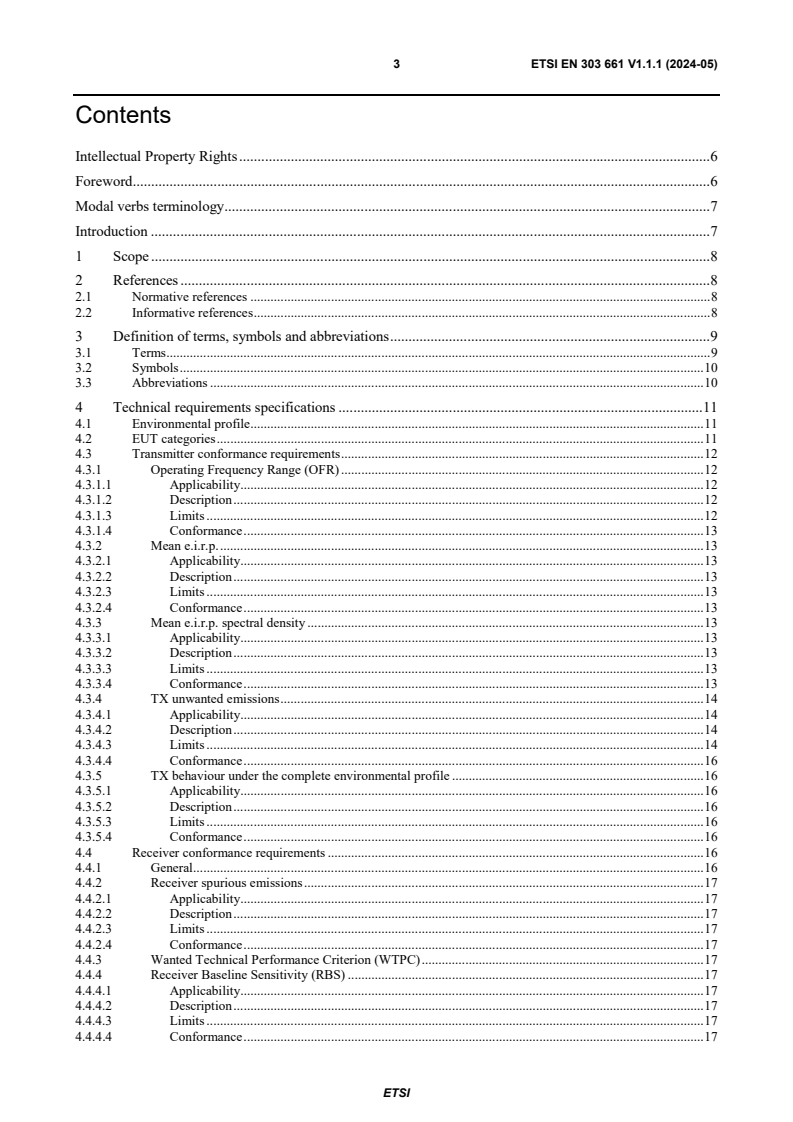
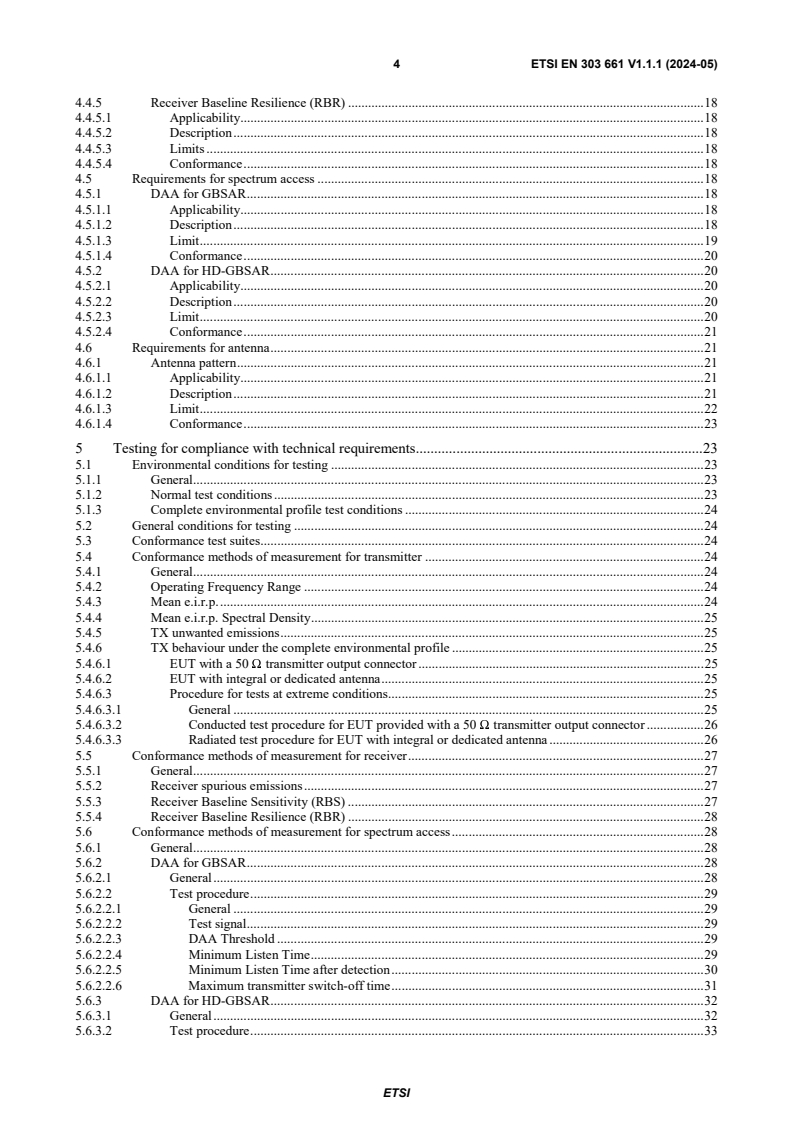
ETSI EN 303 661 V1.1.1 (2024-05) - Short Range Devices (SRD); Ground Based Synthetic Aperture Radar (GBSAR) in the frequency range 17,1 GHz to 17,3 GHz and High Definition Ground Based Synthetic Aperture Radar (HD-GBSAR) in the frequency range 76 GHz to 77 GHz; Harmonised Standard for access to radio spectrum

Overview
SIST EN 303 661 V1.1.1:2024 is a harmonised European standard focused on Short Range Devices (SRD) utilizing Ground Based Synthetic Aperture Radar (GBSAR) and High Definition Ground Based Synthetic Aperture Radar (HD-GBSAR). This standard specifies the technical characteristics and measurement methods for GBSAR in the 17.1 GHz to 17.3 GHz frequency range and HD-GBSAR in the 76 GHz to 77 GHz band. Developed by SIST, aligned with ETSI EN 303 661, and supporting the essential requirements of Article 3.2 of Directive 2014/53/EU (Radio Equipment Directive - RED), it provides a framework for spectrum access, radio spectrum compatibility, and equipment conformity across European markets.
Key Topics
Frequency Ranges and Device Types
- GBSAR: 17.1 GHz - 17.3 GHz
- HD-GBSAR: 76 GHz - 77 GHz
Harmonised Spectrum Access
- Specifications for coexistence and non-interference with other radio services.
- Requirements for transmitter and receiver characteristics.
- Antenna performance and environmental profile guidelines.
Compliance with EU Regulations
- Facilitates market access by aligning with the Radio Equipment Directive (2014/53/EU).
- Enables presumption of conformity when cited in the Official Journal of the European Union.
Testing and Measurement Methods
- Procedures for verifying operating frequency, radiated emissions, unwanted emissions, and receiver resilience.
- defined conditions for normal and extreme environments.
Applications
The standard is practical for organizations designing, manufacturing, or deploying ground-based radar systems in civil engineering, critical infrastructure, geotechnical monitoring, and industrial safety. GBSAR and HD-GBSAR systems are used for:
Structural Health Monitoring
Detection of movement and deformation in bridges, dams, buildings, and slopes, contributing to public safety and worker protection.Geotechnical Surveillance
Real-time monitoring of landslides, rockfalls, or subsidence, especially in hazardous or inaccessible areas.Transport Infrastructure
Applications include radar-based observation of railways, tunnels, and other transport corridors.Critical Event Detection
Early warning systems using radar to detect structural risks, ensuring timely mitigation actions.
These applications benefit from precise radiodetermination and high-resolution movement detection, enabled by compliance with robust technical and spectrum access requirements detailed in SIST EN 303 661.
Related Standards
For a holistic approach to compliance and system integration, the following standards and references are relevant to SIST EN 303 661:
- ETSI EN 303 883-1 and EN 303 883-2: Measurement techniques for transmitters and receivers used in SRD and UWB applications.
- Directive 2014/53/EU (RED): Essential legal framework for radio equipment in Europe.
- CEPT/ERC Recommendation 70-03: Usage of short-range devices in Europe.
- ECC Report 111 and ECC Report 315: Compatibility studies for GBSAR and HD-GBSAR.
- Commission Implementing Decision (EU) 2022/180: Technical conditions for spectrum use.
- ECC/DEC/(21)02: Provisions for HD-GBSAR in the 76-77 GHz band.
By conforming to SIST EN 303 661, manufacturers and operators ensure that GBSAR and HD-GBSAR deployments are interference-free, reliable, and meet all regulatory obligations for access to radio spectrum throughout the EU and EFTA member states.
Keywords: Short Range Devices, GBSAR, HD-GBSAR, Ground Based Synthetic Aperture Radar, radio equipment compliance, spectrum access, radiodetermination, Directive 2014/53/EU, harmonised standard, radiocommunications.
Buy Documents
ETSI EN 303 661 V1.1.0 (2023-02) - Short Range Devices (SRD); Ground Based Synthetic Aperture Radar (GBSAR) in the frequency range 17,1 GHz to 17,3 GHz and High Definition Ground Based Synthetic Aperture Radar (HD-GBSAR) in the frequency range 76 GHz to 77 GHz; Harmonised Standard for access to radio spectrum
ETSI EN 303 661 V1.1.1 (2024-03) - Short Range Devices (SRD); Ground Based Synthetic Aperture Radar (GBSAR) in the frequency range 17,1 GHz to 17,3 GHz and High Definition Ground Based Synthetic Aperture Radar (HD-GBSAR) in the frequency range 76 GHz to 77 GHz; Harmonised Standard for access to radio spectrum
ETSI EN 303 661 V1.1.1 (2024-05) - Short Range Devices (SRD); Ground Based Synthetic Aperture Radar (GBSAR) in the frequency range 17,1 GHz to 17,3 GHz and High Definition Ground Based Synthetic Aperture Radar (HD-GBSAR) in the frequency range 76 GHz to 77 GHz; Harmonised Standard for access to radio spectrum
Get Certified
Connect with accredited certification bodies for this standard

ANCE
Mexican certification and testing association.

Intertek Slovenia
Intertek testing, inspection, and certification services in Slovenia.

LNE (Laboratoire National de Métrologie et d'Essais)
French national laboratory for metrology and testing.
Sponsored listings
Frequently Asked Questions
SIST EN 303 661 V1.1.1:2024 is a standard published by the Slovenian Institute for Standardization (SIST). Its full title is "Short Range Devices (SRD) - Ground Based Synthetic Aperture Radar (GBSAR) in the frequency range 17,1 GHz to 17,3 GHz and High Definition Ground Based Synthetic Aperture Radar (HD-GBSAR) in the frequency range 76 GHz to 77 GHz - Harmonised Standard for access to radio spectrum". This standard covers: The present document specifies technical characteristics and methods of measurements for Ground Based Synthetic Aperture Radar (GBSAR) in the frequency range 17,1 GHz to 17,3 GHz and High Definition Ground Based Synthetic Aperture Radar (HD-GBSAR) in the frequency range 76 GHz to 77 GHz. NOTE: The relationship between the present document and essential requirements of article 3.2 of Directive 2014/53/EU [i.1] is given in annex A.
The present document specifies technical characteristics and methods of measurements for Ground Based Synthetic Aperture Radar (GBSAR) in the frequency range 17,1 GHz to 17,3 GHz and High Definition Ground Based Synthetic Aperture Radar (HD-GBSAR) in the frequency range 76 GHz to 77 GHz. NOTE: The relationship between the present document and essential requirements of article 3.2 of Directive 2014/53/EU [i.1] is given in annex A.
SIST EN 303 661 V1.1.1:2024 is classified under the following ICS (International Classification for Standards) categories: 33.060.01 - Radiocommunications in general. The ICS classification helps identify the subject area and facilitates finding related standards.
SIST EN 303 661 V1.1.1:2024 is associated with the following European legislation: EU Directives/Regulations: 2014/53/EU. When a standard is cited in the Official Journal of the European Union, products manufactured in conformity with it benefit from a presumption of conformity with the essential requirements of the corresponding EU directive or regulation.
SIST EN 303 661 V1.1.1:2024 is available in PDF format for immediate download after purchase. The document can be added to your cart and obtained through the secure checkout process. Digital delivery ensures instant access to the complete standard document.
Standards Content (Sample)
Draft ETSI EN 303 661 V1.1.0 (2023-02)
HARMONISED EUROPEAN STANDARD
Short Range Devices (SRD);
Ground Based Synthetic Aperture Radar (GBSAR)
in the frequency range 17,1 GHz to 17,3 GHz and
High Definition Ground Based Synthetic Aperture Radar
(HD-GBSAR) in the frequency range 76 GHz to 77 GHz;
Harmonised Standard for access to radio spectrum
2 Draft ETSI EN 303 661 V1.1.0 (2023-02)
Reference
DEN/ERM-TGUWB-591
Keywords
harmonised standard, measurement, radio, SRD
ETSI
650 Route des Lucioles
F-06921 Sophia Antipolis Cedex - FRANCE
Tel.: +33 4 92 94 42 00 Fax: +33 4 93 65 47 16
Siret N° 348 623 562 00017 - APE 7112B
Association à but non lucratif enregistrée à la
Sous-Préfecture de Grasse (06) N° w061004871
Important notice
The present document can be downloaded from:
http://www.etsi.org/standards-search
The present document may be made available in electronic versions and/or in print. The content of any electronic and/or
print versions of the present document shall not be modified without the prior written authorization of ETSI. In case of any
existing or perceived difference in contents between such versions and/or in print, the prevailing version of an ETSI
deliverable is the one made publicly available in PDF format at www.etsi.org/deliver.
Users of the present document should be aware that the document may be subject to revision or change of status.
Information on the current status of this and other ETSI documents is available at
https://portal.etsi.org/TB/ETSIDeliverableStatus.aspx
If you find errors in the present document, please send your comment to one of the following services:
https://portal.etsi.org/People/CommiteeSupportStaff.aspx
If you find a security vulnerability in the present document, please report it through our
Coordinated Vulnerability Disclosure Program:
https://www.etsi.org/standards/coordinated-vulnerability-disclosure
Notice of disclaimer & limitation of liability
The information provided in the present deliverable is directed solely to professionals who have the appropriate degree of
experience to understand and interpret its content in accordance with generally accepted engineering or
other professional standard and applicable regulations.
No recommendation as to products and services or vendors is made or should be implied.
In no event shall ETSI be held liable for loss of profits or any other incidental or consequential damages.
Any software contained in this deliverable is provided "AS IS" with no warranties, express or implied, including but not
limited to, the warranties of merchantability, fitness for a particular purpose and non-infringement of intellectual property
rights and ETSI shall not be held liable in any event for any damages whatsoever (including, without limitation, damages
for loss of profits, business interruption, loss of information, or any other pecuniary loss) arising out of or related to the use
of or inability to use the software.
Copyright Notification
No part may be reproduced or utilized in any form or by any means, electronic or mechanical, including photocopying and
microfilm except as authorized by written permission of ETSI.
The content of the PDF version shall not be modified without the written authorization of ETSI.
The copyright and the foregoing restriction extend to reproduction in all media.
© ETSI 2023.
All rights reserved.
ETSI
3 Draft ETSI EN 303 661 V1.1.0 (2023-02)
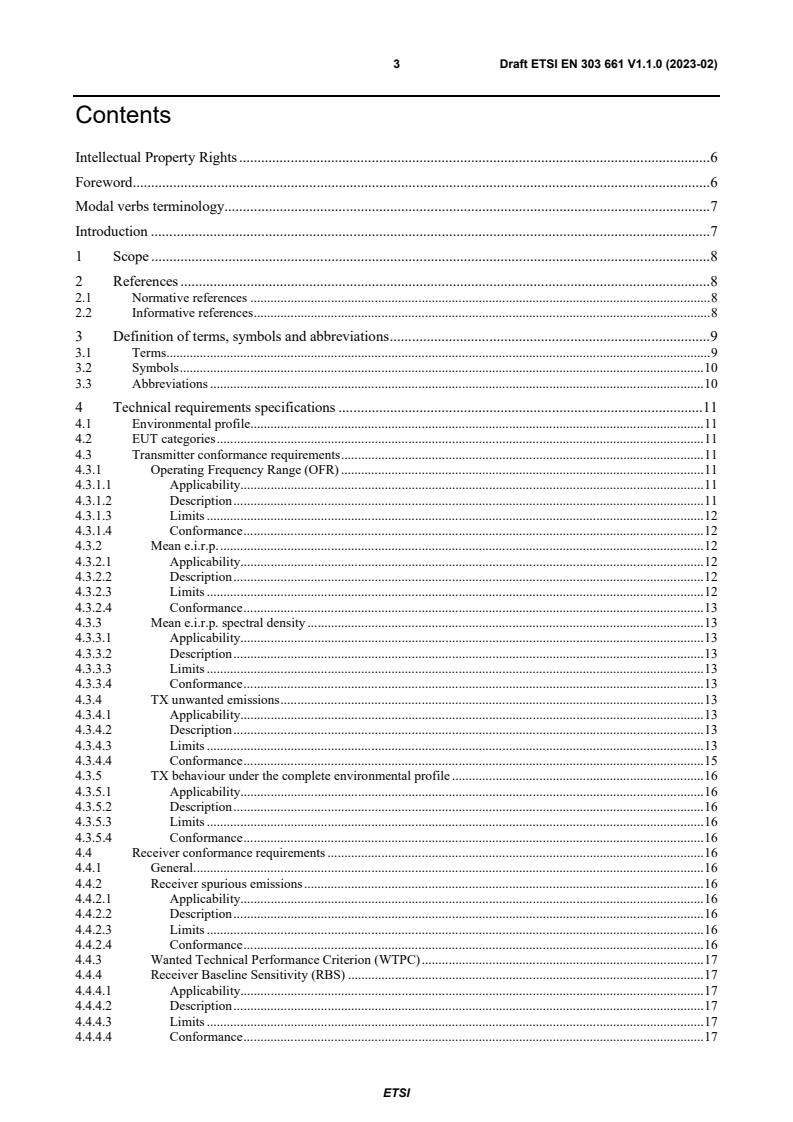
Contents
Intellectual Property Rights . 6
Foreword . 6
Modal verbs terminology . 7
Introduction . 7
1 Scope . 8
2 References . 8
2.1 Normative references . 8
2.2 Informative references . 8
3 Definition of terms, symbols and abbreviations . 9
3.1 Terms . 9
3.2 Symbols . 10
3.3 Abbreviations . 10
4 Technical requirements specifications . 11
4.1 Environmental profile . 11
4.2 EUT categories . 11
4.3 Transmitter conformance requirements . 11
4.3.1 Operating Frequency Range (OFR) . 11
4.3.1.1 Applicability. 11
4.3.1.2 Description . 11
4.3.1.3 Limits . 12
4.3.1.4 Conformance . 12
4.3.2 Mean e.i.r.p. . 12
4.3.2.1 Applicability. 12
4.3.2.2 Description . 12
4.3.2.3 Limits . 12
4.3.2.4 Conformance . 13
4.3.3 Mean e.i.r.p. spectral density . 13
4.3.3.1 Applicability. 13
4.3.3.2 Description . 13
4.3.3.3 Limits . 13
4.3.3.4 Conformance . 13
4.3.4 TX unwanted emissions . 13
4.3.4.1 Applicability. 13
4.3.4.2 Description . 13
4.3.4.3 Limits . 13
4.3.4.4 Conformance . 15
4.3.5 TX behaviour under the complete environmental profile . 16
4.3.5.1 Applicability. 16
4.3.5.2 Description . 16
4.3.5.3 Limits . 16
4.3.5.4 Conformance . 16
4.4 Receiver conformance requirements . 16
4.4.1 General . 16
4.4.2 Receiver spurious emissions . 16
4.4.2.1 Applicability. 16
4.4.2.2 Description . 16
4.4.2.3 Limits . 16
4.4.2.4 Conformance . 16
4.4.3 Wanted Technical Performance Criterion (WTPC) . 17
4.4.4 Receiver Baseline Sensitivity (RBS) . 17
4.4.4.1 Applicability. 17
4.4.4.2 Description . 17
4.4.4.3 Limits . 17
4.4.4.4 Conformance . 17
ETSI
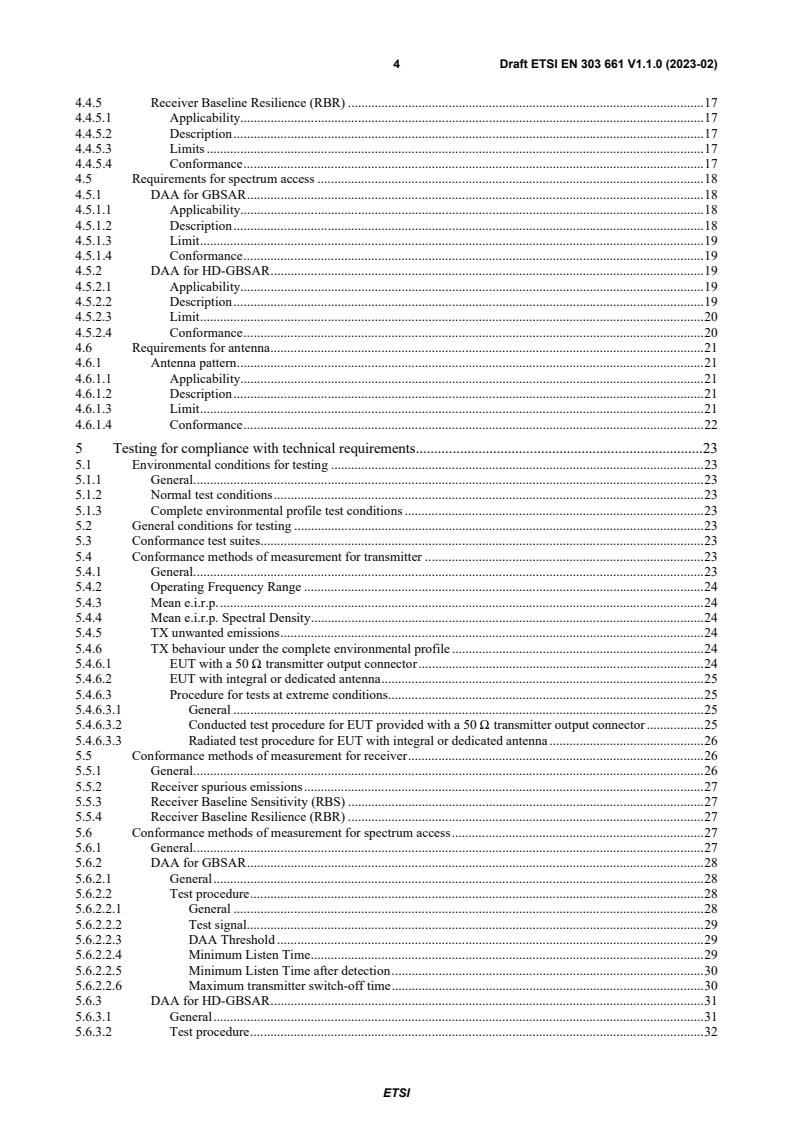
4 Draft ETSI EN 303 661 V1.1.0 (2023-02)
4.4.5 Receiver Baseline Resilience (RBR) . 17
4.4.5.1 Applicability. 17
4.4.5.2 Description . 17
4.4.5.3 Limits . 17
4.4.5.4 Conformance . 17
4.5 Requirements for spectrum access . 18
4.5.1 DAA for GBSAR . 18
4.5.1.1 Applicability. 18
4.5.1.2 Description . 18
4.5.1.3 Limit . 19
4.5.1.4 Conformance . 19
4.5.2 DAA for HD-GBSAR . 19
4.5.2.1 Applicability. 19
4.5.2.2 Description . 19
4.5.2.3 Limit . 20
4.5.2.4 Conformance . 20
4.6 Requirements for antenna . 21
4.6.1 Antenna pattern . 21
4.6.1.1 Applicability. 21
4.6.1.2 Description . 21
4.6.1.3 Limit . 21
4.6.1.4 Conformance . 22
5 Testing for compliance with technical requirements . 23
5.1 Environmental conditions for testing . 23
5.1.1 General . 23
5.1.2 Normal test conditions . 23
5.1.3 Complete environmental profile test conditions . 23
5.2 General conditions for testing . 23
5.3 Conformance test suites . 23
5.4 Conformance methods of measurement for transmitter . 23
5.4.1 General . 23
5.4.2 Operating Frequency Range . 24
5.4.3 Mean e.i.r.p. . 24
5.4.4 Mean e.i.r.p. Spectral Density . 24
5.4.5 TX unwanted emissions . 24
5.4.6 TX behaviour under the complete environmental profile . 24
5.4.6.1 EUT with a 50 Ω transmitter output connector . 24
5.4.6.2 EUT with integral or dedicated antenna . 25
5.4.6.3 Procedure for tests at extreme conditions . 25
5.4.6.3.1 General . 25
5.4.6.3.2 Conducted test procedure for EUT provided with a 50 Ω transmitter output connector . 25
5.4.6.3.3 Radiated test procedure for EUT with integral or dedicated antenna . 26
5.5 Conformance methods of measurement for receiver . 26
5.5.1 General . 26
5.5.2 Receiver spurious emissions . 27
5.5.3 Receiver Baseline Sensitivity (RBS) . 27
5.5.4 Receiver Baseline Resilience (RBR) . 27
5.6 Conformance methods of measurement for spectrum access . 27
5.6.1 General . 27
5.6.2 DAA for GBSAR . 28
5.6.2.1 General . 28
5.6.2.2 Test procedure . 28
5.6.2.2.1 General . 28
5.6.2.2.2 Test signal . 29
5.6.2.2.3 DAA Threshold . 29
5.6.2.2.4 Minimum Listen Time . 29
5.6.2.2.5 Minimum Listen Time after detection . 30
5.6.2.2.6 Maximum transmitter switch-off time . 30
5.6.3 DAA for HD-GBSAR . 31
5.6.3.1 General . 31
5.6.3.2 Test procedure . 32
ETSI
5 Draft ETSI EN 303 661 V1.1.0 (2023-02)
5.6.3.2.1 General . 32
5.6.3.2.2 Test signal . 32
5.6.3.2.3 DAA Threshold and Timing . 33
5.7 Conformance methods of measurement for antenna . 33
5.7.1 General . 33
5.7.2 Measuring distance . 34
5.7.2.1 General . 34
5.7.2.2 Standard position . 34
5.7.2.3 Auxiliary cables . 34
5.7.3 Test procedure . 34
Annex A (informative): Relationship between the present document and the essential
requirements of Directive 2014/53/EU . 36
Annex B (informative): General conditions for testing, measurement uncertainty and
interpretation of the measurement results . 38
Annex C (normative): Use-Case, wanted technical performance criterion and RX-test
conditions . 39
C.1 Description . 39
C.2 Wanted Technical Performance Criterion (WTPC) and RX - requirement . 39
C.2.1 General . 39
C.2.2 RBS-requirement and limit. 40
C.2.3 RBR requirement and limit . 40
Annex D (normative): Interferer for RBR test . 41
D.1 Interferer requirements for RBR tests . 41
D.1.1 General test frequencies for RBR tests . 41
D.1.2 Test frequencies for GBSAR . 41
D.1.3 Test frequencies for HD-GBSAR . 42
Annex E (informative): Test signals for the HD-GBSAR DAA . 43
E.1 General . 43
E.2 Interference with automotive radar signals . 43
E.2.1 Characteristics of automotive radar signals . 43
E.2.2 Interference between two FMCW signals . 44
E.2.3 Selection of the test signals for the HD-GBSAR DAA . 46
Annex F (informative): Mapping requirements . 47
Annex G (informative): Change history . 49
History . 50
ETSI
6 Draft ETSI EN 303 661 V1.1.0 (2023-02)
Intellectual Property Rights
Essential patents
IPRs essential or potentially essential to normative deliverables may have been declared to ETSI. The declarations
pertaining to these essential IPRs, if any, are publicly available for ETSI members and non-members, and can be
found in ETSI SR 000 314: "Intellectual Property Rights (IPRs); Essential, or potentially Essential, IPRs notified to
ETSI in respect of ETSI standards", which is available from the ETSI Secretariat. Latest updates are available on the
ETSI Web server (https://ipr.etsi.org/).
Pursuant to the ETSI Directives including the ETSI IPR Policy, no investigation regarding the essentiality of IPRs,
including IPR searches, has been carried out by ETSI. No guarantee can be given as to the existence of other IPRs not
referenced in ETSI SR 000 314 (or the updates on the ETSI Web server) which are, or may be, or may become,
essential to the present document.
Trademarks
The present document may include trademarks and/or tradenames which are asserted and/or registered by their owners.
ETSI claims no ownership of these except for any which are indicated as being the property of ETSI, and conveys no
right to use or reproduce any trademark and/or tradename. Mention of those trademarks in the present document does
not constitute an endorsement by ETSI of products, services or organizations associated with those trademarks.
DECT™, PLUGTESTS™, UMTS™ and the ETSI logo are trademarks of ETSI registered for the benefit of its
Members. 3GPP™ and LTE™ are trademarks of ETSI registered for the benefit of its Members and of the 3GPP
Organizational Partners. oneM2M™ logo is a trademark of ETSI registered for the benefit of its Members and of the ®
oneM2M Partners. GSM and the GSM logo are trademarks registered and owned by the GSM Association.
Foreword
This draft Harmonised European Standard (EN) has been produced by ETSI Technical Committee Electromagnetic
compatibility and Radio spectrum Matters (ERM), and is now submitted for the combined Public Enquiry and Vote
phase of the ETSI standards EN Approval Procedure.
The present document has been prepared under the Commission's standardisation request C(2015) 5376 final [i.7] to
provide one voluntary means of conforming to the essential requirements of Directive 2014/53/EU on the harmonisation
of the laws of the Member States relating to the making available on the market of radio equipment and repealing
Directive 1999/5/EC [i.1].
Once the present document is cited in the Official Journal of the European Union under that Directive, compliance with
the normative clauses of the present document given in table A.1 confers, within the limits of the scope of the present
document, a presumption of conformity with the corresponding essential requirements of that Directive and associated
EFTA regulations.
Proposed national transposition dates
Date of latest announcement of this EN (doa): 3 months after ETSI publication
Date of latest publication of new National Standard
or endorsement of this EN (dop/e): 6 months after doa
Date of withdrawal of any conflicting National Standard (dow): 18 months after doa
ETSI
7 Draft ETSI EN 303 661 V1.1.0 (2023-02)
Modal verbs terminology
In the present document "shall", "shall not", "should", "should not", "may", "need not", "will", "will not", "can" and
"cannot" are to be interpreted as described in clause 3.2 of the ETSI Drafting Rules (Verbal forms for the expression of
provisions).
"must" and "must not" are NOT allowed in ETSI deliverables except when used in direct citation.
Introduction
The present document is developed by ETSI and is designed to fit in a modular structure to cover all radio and
telecommunications terminal equipment within the scope of the Directive 2014/53/EU [i.1].
It specifically aims at providing requirements for Ground Based Synthetic Aperture Radar (GBSAR) and High
Definition Ground Based Synthetic Aperture Radar (HD-GBSAR). GBSAR and HD-GBSAR are Short Range Devices
used for radiodetermination application. The GBSAR and HD-GBSAR applications are intended exclusively for
detection of movement related to structures potentially effecting the protection of workers and the general public.
For the GBSAR case of the present document, the applicable harmonised standard has been ETSI EN 300 440 [i.6], for
Radio equipment to be used in the 1 GHz to 40 GHz frequency range; this was published in the OJEU on 14 July 2017
with a restriction for receiver categories 2 and 3 as defined in table 5 of that standard.
ETSI
8 Draft ETSI EN 303 661 V1.1.0 (2023-02)
1 Scope
The present document specifies technical characteristics and methods of measurements for Ground Based Synthetic
Aperture Radar (GBSAR) and High Definition Ground Based Synthetic Aperture Radar (HD-GBSAR).
GBSAR devices within the scope of the present document are covered by SRD regulations:
• ERC/REC 70-03 [i.2], annex 6 (17,1 GHz to 17,3 GHz); and
• Commission Implementing Decision (EU) 2022/180 [i.3] for SRD, band no. 65.
GBSAR within the scope of the present document provide:
• an output logic test signal indicating when the intended operation command of GBSAR is started and stopped
respectively;
• an output logic signal indicating when the DAA is active/not active.
HD-GBSAR devices within the scope of the present document are covered by ECC Decision:
• ECC/DEC/(21)02 [i.10].
HD-GBSAR within the scope of the present document also provide:
• an output logic signal indicating when the DAA is active/not active.
NOTE: The relationship between the present document and essential requirements of article 3.2 of Directive
2014/53/EU [i.1] is given in annex A.
2 References
2.1 Normative references
References are either specific (identified by date of publication and/or edition number or version number) or
non-specific. For specific references, only the cited version applies. For non-specific references, the latest version of the
referenced document (including any amendments) applies.
Referenced documents which are not found to be publicly available in the expected location might be found at
https://docbox.etsi.org/Reference/.
NOTE: While any hyperlinks included in this clause were valid at the time of publication, ETSI cannot guarantee
their long term validity.
The following referenced documents are necessary for the application of the present document.
[1] ETSI EN 303 883-1 (V1.2.1) (02-2021): "Short Range Devices (SRD) and Ultra Wide Band
(UWB); Part 1: Measurement techniques for transmitter requirements".
[2] ETSI EN 303 883-2 (V1.2.1) (02-2021): "Short Range Devices (SRD) and Ultra Wide Band
(UWB); Part 2: Measurement techniques for receiver requirements".
2.2 Informative references
References are either specific (identified by date of publication and/or edition number or version number) or
non-specific. For specific references, only the cited version applies. For non-specific references, the latest version of the
referenced document (including any amendments) applies.
NOTE: While any hyperlinks included in this clause were valid at the time of publication, ETSI cannot guarantee
their long term validity.
ETSI
9 Draft ETSI EN 303 661 V1.1.0 (2023-02)
The following referenced documents are not necessary for the application of the present document but they assist the
user with regard to a particular subject area.
[i.1] Directive 2014/53/EU of the European Parliament and of the Council of 16 April 2014 on the
harmonisation of the laws of the Member States relating to the making available on the market of
radio equipment and repealing Directive 1999/5/EC (RE-Directive).
[i.2] CEPT/ERC Recommendation 70-03: "Relating to the use of Short Range Devices (SRD)".
[i.3] Commission Implementing Decision (EU) 2022/180 of 8 February 2022 amending Decision
2006/771/EC as regards the update of harmonised technical conditions in the area of radio
spectrum use for short-range devices (notified under document C(2022) 644).
[i.4] ETSI TS 103 361 (V1.1.1): "Short Range Devices (SRD) using Ultra Wide Band technology
(UWB); Receiver technical requirements, parameters and measurement procedures to fulfil the
requirements of the Directive 2014/53/EU".
[i.5] CEPT/ERC/Recommendation 74-01: "Unwanted emissions in the spurious domain".
[i.6] ETSI EN 300 440 (V2.1.1): "Short Range Devices (SRD); Radio equipment to be used in the
1 GHz to 40 GHz frequency range; Harmonised Standard covering the essential requirements of
article 3.2 of Directive 2014/53/EU".
[i.7] Commission implementing Decision C(2015) 5376 final of 4.8.2015 on a standardisation request
to the European Committee for Electrotechnical Standardisation and to the European
Telecommunications Standards Institute as regards radio equipment in support of Directive
2014/53/EU of the European Parliament and of the Council.
[i.8] ECC Report 111: "Compatibility studies between Ground Based Synthetic Aperture Radar
(GBSAR) and existing services in the range 17.1 GHz to 17.3 GHz".
[i.9] ECC Report 315: "Feasibility of spectrum sharing between High-Definition Ground Based
Synthetic Aperture Radar (HD-GBSAR) application using 1 GHz bandwidth within 74-81 GHz
and existing services and applications".
[i.10] ECC/DEC/(21)02: "The harmonised frequency band 76-77 GHz, technical characteristics,
exemption from individual licensing and free circulation and use of High Definition Ground Based
Synthetic Aperture Radar (HD-GBSAR)".
[i.11] ECC Report 262: "Studies related to surveillance radar equipment operating in the 76 to 77 GHz
range for fixed transport infrastructure".
[i.12] European Communications Office: "EFIS: ECO Frequency Information System".
[i.13] ETSI EG 203 336 (V1.2.1): "Guide for the selection of technical parameters for the production of
Harmonised Standards covering article 3.1(b) and article 3.2 of Directive 2014/53/EU".
[i.14] ETSI TS 103 567 (V1.1.1): "Requirements on signal interferer handling".
3 Definition of terms, symbols and abbreviations
3.1 Terms
For the purposes of the present document, the terms given in ETSI EN 303 883-1 [1], ETSI EN 303 883-2 [2] and the
following apply:
conducted measurements: measurements which are made using a wired/wave-guided connection to the equipment
under test
dedicated antenna: antenna specifically designed for being attached to the radio equipment (i.e. with special
mechanical fixing to the antenna port of the specific radio supplied), but can be separated from the equipment (typically
for transport purpose) by using normal tools
ETSI
10 Draft ETSI EN 303 661 V1.1.0 (2023-02)
Ground Based Synthetic Aperture Radar (GBSAR): radiodetermination application for the detection of movement
related to structures potentially affecting the protection of workers and the general public
integral antenna: antenna designed to be connected to the equipment without the use of an external connector and
considered to be part of the equipment
NOTE: An integral antenna may be fitted internally or externally to the equipment.
radiodetermination: determination of the position, velocity and/or other characteristics of an object, or the obtaining of
information relating to these parameters, by means of the propagation properties of radio waves
receiver spurious emissions: receiver unwanted emissions that emanate from the EUT. Receiver spurious emissions
are generated internally by the receiver or result from the interaction of the RX coupling with the TX signal
smart antenna systems: equipment that combines multiple transmit and/or receive chains with a signal processing
function to increase the throughput and/or to optimize its radiation and/or reception capabilities
NOTE: These are techniques such as spatial multiplexing, beamforming, cyclic delay diversity, MIMO, etc.
3.2 Symbols
For the purposes of the present document, the symbols given in ETSI EN 303 883-1 [1], ETSI EN 303 883-2 [2] and the
following apply:
B bandwidth automotive radar
dBsm decibels per square meter
f lower edge of the permitted frequency range
LP
f upper edge of the permitted frequency range
HP
ms millisecond
M margin of the measured maximum mean e.i.r.p. to the limit of table 4
MEP Maximum mean e.i.r.p. measured across the EUT environmental profile
P Peak power DAA threshold
DAA
P measured Mean e.i.r.p. as measured and corrected by the EUT OFR
max
PSD measured maximum Mean e.i.r.p. spectral density within the EUT OFR
MAX
� HD-GBSAR conducted peak power at the transmitter antenna input in dBm
�
P power value of HD-GBSAR DAA test signal
V
*
P power value +10 dB above the value P
V V
R Reference value for the Maximum mean e.i.r.p.
σ GBSAR/HD-GBSAR accuracy in measuring the displacement
r
σ GBSARHD-GBSAR accuracy in measuring phase differences
ϕ
t time at which GBSAR transmission is intentionally activated
t minimum listen time
D
time at which GBSAR actual transmission is automatically interrupted by the DAA
t
e
t minimum listen time after detection
L
t GBSAR transmitter switch-off time
off
t time at which the GBSAR DAA level falls below the DAA threshold
S
t time at which GBSAR actual transmission is automatically switched-on
t
3.3 Abbreviations
For the purposes of the present document, the abbreviations given in ETSI EN 303 883-1 [1], ETSI EN 303 883-2 [2]
and the following apply:
EDM Error in Distance Measurement
EL Emission Limit
GBSAR Ground Based Synthetic Aperture Radar
HD-GBSAR High Definition Ground Based Synthetic Aperture Radar
ETSI
11 Draft ETSI EN 303 661 V1.1.0 (2023-02)
m meter
mm millimeter
WTPC Wanted Technical Performance Criterion
4 Technical requirements specifications
4.1 Environmental profile
The technical requirements of the present document apply under the environmental profile for operation of the
equipment, which shall be in accordance with its intended use, but as a minimum, shall be that specified in the test
conditions contained in the present document. The equipment shall comply with all the technical requirements of the
present document at all times when operating within the boundary limits of the operational environmental profile
defined by its intended use.
4.2 EUT categories
The present document covers GBSAR and HD-GBSAR devices.
An overview of requirements for GBSAR and HD-GBSAR is given in table 1.
Table 1: Overview of requirements for GBSAR and HD-GBSAR covered by
ERC/REC 70-03 [i.2], 2022/180/EU [i.3] and ECC/DEC/(21)02 [i.10]
TX-requirements RX-requirements
Emission requirements Active mitigation
clause clause clause
GBSAR OFR 4.3.1 DAA 4.5.1 WTPC C.2.1
Mean e.i.r.p. 4.3.2 RBS 4.4.4 & C.2.2
Mean e.i.r.p. spectral density Not applicable
TX unwanted emissions 4.3.4 RBR 4.4.5 & C.2.3
TX behaviour under complete 4.3.5
environmentalprofile
HD-OFR 4.3.1 DAA 4.5.2 WTPC C.2.1
GBSAR
Mean e.i.r.p. 4.3.2 RBS 4.4.4 & C.2.2
Mean e.i.r.p. spectral density 4.3.3
TX unwanted emissions 4.3.4 RBR 4.4.5 & C.2.3
TX behaviour under complete 4.3.5
environmentalprofile
4.3 Transmitter conformance requirements
4.3.1 Operating Frequency Range (OFR)
4.3.1.1 Applicability
This requirement shall apply to all EUT.
4.3.1.2 Description
The description of the Operating Frequency Range is given in clause 5.2 of ETSI EN 303 883-1 [1]. As requested in
clause 5.2 of ETSI EN 303 883-1 [1], for all the EUT the value of X is specified to 23 dB.
ETSI
EUT-
category
12 Draft ETSI EN 303 661 V1.1.0 (2023-02)
4.3.1.3 Limits
The OFR of all the EUT shall lie within the permitted frequency range of the EUT (see table 2 for GBSAR and table 3
for HD-GBSAR).
GBSAR equipment within scope of the present document are capable of operating in all or part of the frequency bands
given in table 2 with either a Radio Frequency (RF) output connection and dedicated antenna or an integral antenna
with a Frequency Modulated Continuous Wave signal.
Table 2: GBSAR permitted frequency range [i.3]
Frequency Band Application
GBSAR Transmit and Receive 17,1 GHz to 17,3 GHz Radiodetermination
HD-GBSAR equipment within scope of the present document are capable of operating in all or part of the frequency
bands given in table 3 with either a Radio Frequency (RF) output connection and dedicated antenna or an integral
antenna with a Frequency Modulated Continuous Wave signal.
Table 3: HD-GBSAR permitted frequency range [i.10]
Frequency Band Application
HD-GBSAR Transmit and Receive 76 GHz to 77 GHz Radiodetermination
The OFR of all the EUT shall lie within the permitted frequency range of the device (see table 2 for GBSAR and table 3
for HD-GBSAR).
4.3.1.4 Conformance
The conformance test shall be done under normal conditions as defined in clause 5.1.2, the conformance test suite for
OFR shall be as defined in clause 5.4.2.
4.3.2 Mean e.i.r.p.
4.3.2.1 Applicability
This requirement shall apply to all EUT.
4.3.2.2 Description
The description of Mean e.i.r.p. is given in clause 5.3.1.1 of ETSI EN 303 883-1 [1].
4.3.2.3 Limits
The transmitter Mean e.i.r.p. shall not exceed the values given in table 4.
Table 4: Mean e.i.r.p.
EUT category Frequency Bands Power Notes
GBSAR 17,1 GHz to 17,3 GHz 400 mW
...
Final draft ETSI EN 303 661 V1.1.1 (2024-03)
HARMONISED EUROPEAN STANDARD
Short Range Devices (SRD);
Ground Based Synthetic Aperture Radar (GBSAR)
in the frequency range 17,1 GHz to 17,3 GHz and
High Definition Ground Based Synthetic Aperture Radar
(HD-GBSAR) in the frequency range 76 GHz to 77 GHz;
Harmonised Standard for access to radio spectrum
2 Final draft ETSI EN 303 661 V1.1.1 (2024-03)
Reference
DEN/ERM-TGUWB-591
Keywords
harmonised standard, measurement, radio, SRD
ETSI
650 Route des Lucioles
F-06921 Sophia Antipolis Cedex - FRANCE
Tel.: +33 4 92 94 42 00 Fax: +33 4 93 65 47 16
Siret N° 348 623 562 00017 - APE 7112B
Association à but non lucratif enregistrée à la
Sous-Préfecture de Grasse (06) N° w061004871
Important notice
The present document can be downloaded from:
https://www.etsi.org/standards-search
The present document may be made available in electronic versions and/or in print. The content of any electronic and/or
print versions of the present document shall not be modified without the prior written authorization of ETSI. In case of any
existing or perceived difference in contents between such versions and/or in print, the prevailing version of an ETSI
deliverable is the one made publicly available in PDF format at www.etsi.org/deliver.
Users of the present document should be aware that the document may be subject to revision or change of status.
Information on the current status of this and other ETSI documents is available at
https://portal.etsi.org/TB/ETSIDeliverableStatus.aspx
If you find errors in the present document, please send your comment to one of the following services:
https://portal.etsi.org/People/CommiteeSupportStaff.aspx
If you find a security vulnerability in the present document, please report it through our
Coordinated Vulnerability Disclosure Program:
https://www.etsi.org/standards/coordinated-vulnerability-disclosure
Notice of disclaimer & limitation of liability
The information provided in the present deliverable is directed solely to professionals who have the appropriate degree of
experience to understand and interpret its content in accordance with generally accepted engineering or
other professional standard and applicable regulations.
No recommendation as to products and services or vendors is made or should be implied.
In no event shall ETSI be held liable for loss of profits or any other incidental or consequential damages.
Any software contained in this deliverable is provided "AS IS" with no warranties, express or implied, including but not
limited to, the warranties of merchantability, fitness for a particular purpose and non-infringement of intellectual property
rights and ETSI shall not be held liable in any event for any damages whatsoever (including, without limitation, damages
for loss of profits, business interruption, loss of information, or any other pecuniary loss) arising out of or related to the use
of or inability to use the software.
Copyright Notification
No part may be reproduced or utilized in any form or by any means, electronic or mechanical, including photocopying and
microfilm except as authorized by written permission of ETSI.
The content of the PDF version shall not be modified without the written authorization of ETSI.
The copyright and the foregoing restriction extend to reproduction in all media.
© ETSI 2024.
All rights reserved.
ETSI
3 Final draft ETSI EN 303 661 V1.1.1 (2024-03)
Contents
Intellectual Property Rights . 6
Foreword. 6
Modal verbs terminology . 7
Introduction . 7
1 Scope . 8
2 References . 8
2.1 Normative references . 8
2.2 Informative references . 8
3 Definition of terms, symbols and abbreviations . 9
3.1 Terms . 9
3.2 Symbols . 10
3.3 Abbreviations . 10
4 Technical requirements specifications . 11
4.1 Environmental profile . 11
4.2 EUT categories . 11
4.3 Transmitter conformance requirements . 12
4.3.1 Operating Frequency Range (OFR) . 12
4.3.1.1 Applicability . 12
4.3.1.2 Description . 12
4.3.1.3 Limits. 12
4.3.1.4 Conformance . 13
4.3.2 Mean e.i.r.p. . 13
4.3.2.1 Applicability . 13
4.3.2.2 Description . 13
4.3.2.3 Limits. 13
4.3.2.4 Conformance . 13
4.3.3 Mean e.i.r.p. spectral density . 13
4.3.3.1 Applicability . 13
4.3.3.2 Description . 13
4.3.3.3 Limits. 13
4.3.3.4 Conformance . 13
4.3.4 TX unwanted emissions . 14
4.3.4.1 Applicability . 14
4.3.4.2 Description . 14
4.3.4.3 Limits. 14
4.3.4.4 Conformance . 16
4.3.5 TX behaviour under the complete environmental profile . 16
4.3.5.1 Applicability . 16
4.3.5.2 Description . 16
4.3.5.3 Limits. 16
4.3.5.4 Conformance . 16
4.4 Receiver conformance requirements . 16
4.4.1 General . 16
4.4.2 Receiver spurious emissions . 17
4.4.2.1 Applicability . 17
4.4.2.2 Description . 17
4.4.2.3 Limits. 17
4.4.2.4 Conformance . 17
4.4.3 Wanted Technical Performance Criterion (WTPC) . 17
4.4.4 Receiver Baseline Sensitivity (RBS) . 17
4.4.4.1 Applicability . 17
4.4.4.2 Description . 17
4.4.4.3 Limits. 17
4.4.4.4 Conformance . 17
ETSI
4 Final draft ETSI EN 303 661 V1.1.1 (2024-03)
4.4.5 Receiver Baseline Resilience (RBR) . 18
4.4.5.1 Applicability . 18
4.4.5.2 Description . 18
4.4.5.3 Limits. 18
4.4.5.4 Conformance . 18
4.5 Requirements for spectrum access . 18
4.5.1 DAA for GBSAR . 18
4.5.1.1 Applicability . 18
4.5.1.2 Description . 18
4.5.1.3 Limit . 19
4.5.1.4 Conformance . 20
4.5.2 DAA for HD-GBSAR . 20
4.5.2.1 Applicability . 20
4.5.2.2 Description . 20
4.5.2.3 Limit . 20
4.5.2.4 Conformance . 21
4.6 Requirements for antenna . 21
4.6.1 Antenna pattern . 21
4.6.1.1 Applicability . 21
4.6.1.2 Description . 21
4.6.1.3 Limit . 22
4.6.1.4 Conformance . 23
5 Testing for compliance with technical requirements. 23
5.1 Environmental conditions for testing . 23
5.1.1 General . 23
5.1.2 Normal test conditions . 23
5.1.3 Complete environmental profile test conditions . 24
5.2 General conditions for testing . 24
5.3 Conformance test suites . 24
5.4 Conformance methods of measurement for transmitter . 24
5.4.1 General . 24
5.4.2 Operating Frequency Range . 24
5.4.3 Mean e.i.r.p. . 24
5.4.4 Mean e.i.r.p. Spectral Density . 25
5.4.5 TX unwanted emissions . 25
5.4.6 TX behaviour under the complete environmental profile . 25
5.4.6.1 EUT with a 50 Ω transmitter output connector . 25
5.4.6.2 EUT with integral or dedicated antenna . 25
5.4.6.3 Procedure for tests at extreme conditions . 25
5.4.6.3.1 General . 25
5.4.6.3.2 Conducted test procedure for EUT provided with a 50 Ω transmitter output connector . 26
5.4.6.3.3 Radiated test procedure for EUT with integral or dedicated antenna . 26
5.5 Conformance methods of measurement for receiver . 27
5.5.1 General . 27
5.5.2 Receiver spurious emissions . 27
5.5.3 Receiver Baseline Sensitivity (RBS) . 27
5.5.4 Receiver Baseline Resilience (RBR) . 28
5.6 Conformance methods of measurement for spectrum access . 28
5.6.1 General . 28
5.6.2 DAA for GBSAR . 28
5.6.2.1 General . 28
5.6.2.2 Test procedure . 29
5.6.2.2.1 General . 29
5.6.2.2.2 Test signal . 29
5.6.2.2.3 DAA Threshold . 29
5.6.2.2.4 Minimum Listen Time . 29
5.6.2.2.5 Minimum Listen Time after detection . 30
5.6.2.2.6 Maximum transmitter switch-off time . 31
5.6.3 DAA for HD-GBSAR . 32
5.6.3.1 General . 32
5.6.3.2 Test procedure . 33
ETSI
5 Final draft ETSI EN 303 661 V1.1.1 (2024-03)
5.6.3.2.1 General . 33
5.6.3.2.2 Test signal . 33
5.6.3.2.3 DAA Threshold and Timing . 33
5.7 Conformance methods of measurement for antenna . 33
5.7.1 General . 33
5.7.2 Measuring distance . 34
5.7.2.1 General . 34
5.7.2.2 Standard position . 34
5.7.2.3 Auxiliary cables . 34
5.7.3 Test procedure . 35
Annex A (informative): Relationship between the present document and the essential
requirements of Directive 2014/53/EU . 36
Annex B (informative): General conditions for testing, measurement uncertainty and
interpretation of the measurement results . 38
Annex C (normative): Use-Case, wanted technical performance criterion and RX-test
conditions . 39
C.1 Description . 39
C.2 Wanted Technical Performance Criterion (WTPC) and RX - requirement . 39
C.2.1 General . 39
C.2.2 RBS-requirement and limit . 40
C.2.3 RBR requirement and limit . 40
Annex D (normative): Interferer for RBR test . 41
D.1 Interferer requirements for RBR tests . 41
D.1.1 General test frequencies for RBR tests . 41
D.1.2 Test frequencies for GBSAR . 41
D.1.3 Test frequencies for HD-GBSAR . 42
Annex E (informative): Test signals for the HD-GBSAR DAA . 43
E.1 General . 43
E.2 Interference with automotive radar signals . 43
E.2.1 Characteristics of automotive radar signals . 43
E.2.2 Interference between two FMCW signals . 44
E.2.3 Selection of the test signals for the HD-GBSAR DAA . 45
Annex F (informative): Mapping requirements . 47
Annex G (informative): Bibliography . 49
Annex H (informative): Change history . 50
History . 51
ETSI
6 Final draft ETSI EN 303 661 V1.1.1 (2024-03)
Intellectual Property Rights
Essential patents
IPRs essential or potentially essential to normative deliverables may have been declared to ETSI. The declarations
pertaining to these essential IPRs, if any, are publicly available for ETSI members and non-members, and can be
found in ETSI SR 000 314: "Intellectual Property Rights (IPRs); Essential, or potentially Essential, IPRs notified to
ETSI in respect of ETSI standards", which is available from the ETSI Secretariat. Latest updates are available on the
ETSI Web server (https://ipr.etsi.org/).
Pursuant to the ETSI Directives including the ETSI IPR Policy, no investigation regarding the essentiality of IPRs,
including IPR searches, has been carried out by ETSI. No guarantee can be given as to the existence of other IPRs not
referenced in ETSI SR 000 314 (or the updates on the ETSI Web server) which are, or may be, or may become,
essential to the present document.
Trademarks
The present document may include trademarks and/or tradenames which are asserted and/or registered by their owners.
ETSI claims no ownership of these except for any which are indicated as being the property of ETSI, and conveys no
right to use or reproduce any trademark and/or tradename. Mention of those trademarks in the present document does
not constitute an endorsement by ETSI of products, services or organizations associated with those trademarks.
DECT™, PLUGTESTS™, UMTS™ and the ETSI logo are trademarks of ETSI registered for the benefit of its
Members. 3GPP™ and LTE™ are trademarks of ETSI registered for the benefit of its Members and of the 3GPP
Organizational Partners. oneM2M™ logo is a trademark of ETSI registered for the benefit of its Members and of the ®
oneM2M Partners. GSM and the GSM logo are trademarks registered and owned by the GSM Association.
Foreword
This final draft Harmonised European Standard (EN) has been produced by ETSI Technical Committee
Electromagnetic compatibility and Radio spectrum Matters (ERM), and is now submitted for the Vote phase of the
ETSI Standardisation Request deliverable Approval Procedure.
The present document has been prepared under the Commission's standardisation request C(2015) 5376 final [i.6] to
provide one voluntary means of conforming to the essential requirements of Directive 2014/53/EU on the harmonisation
of the laws of the Member States relating to the making available on the market of radio equipment and repealing
Directive 1999/5/EC [i.1].
Once the present document is cited in the Official Journal of the European Union under that Directive, compliance with
the normative clauses of the present document given in table A.1 confers, within the limits of the scope of the present
document, a presumption of conformity with the corresponding essential requirements of that Directive and associated
EFTA regulations.
Proposed national transposition dates
Date of latest announcement of this EN (doa): 3 months after ETSI publication
Date of latest publication of new National Standard
or endorsement of this EN (dop/e): 6 months after doa
Date of withdrawal of any conflicting National Standard (dow): 18 months after doa
ETSI
7 Final draft ETSI EN 303 661 V1.1.1 (2024-03)
Modal verbs terminology
In the present document "shall", "shall not", "should", "should not", "may", "need not", "will", "will not", "can" and
"cannot" are to be interpreted as described in clause 3.2 of the ETSI Drafting Rules (Verbal forms for the expression of
provisions).
"must" and "must not" are NOT allowed in ETSI deliverables except when used in direct citation.
Introduction
The present document is developed by ETSI and is designed to fit in a modular structure to cover all radio and
telecommunications terminal equipment within the scope of the Directive 2014/53/EU [i.1].
It specifically aims at providing requirements for Ground Based Synthetic Aperture Radar (GBSAR) and High
Definition Ground Based Synthetic Aperture Radar (HD-GBSAR). GBSAR and HD-GBSAR are Short Range Devices
used for radiodetermination application. The GBSAR and HD-GBSAR applications are intended exclusively for
detection of movement related to structures potentially effecting the protection of workers and the general public.
ETSI
8 Final draft ETSI EN 303 661 V1.1.1 (2024-03)
1 Scope
The present document specifies technical characteristics and methods of measurements for Ground Based Synthetic
Aperture Radar (GBSAR) in the frequency range 17,1 GHz to 17,3 GHz and High Definition Ground Based Synthetic
Aperture Radar (HD-GBSAR) in the frequency range 76 GHz to 77 GHz.
NOTE: The relationship between the present document and essential requirements of article 3.2 of
Directive 2014/53/EU [i.1] is given in annex A.
2 References
2.1 Normative references
References are either specific (identified by date of publication and/or edition number or version number) or
non-specific. For specific references, only the cited version applies. For non-specific references, the latest version of the
referenced document (including any amendments) applies.
Referenced documents which are not found to be publicly available in the expected location might be found at
https://docbox.etsi.org/Reference/.
NOTE: While any hyperlinks included in this clause were valid at the time of publication, ETSI cannot guarantee
their long term validity.
The following referenced documents are necessary for the application of the present document.
[1] ETSI EN 303 883-1 (V1.2.1) (02-2021): "Short Range Devices (SRD) and Ultra Wide Band
(UWB); Part 1: Measurement techniques for transmitter requirements".
[2] ETSI EN 303 883-2 (V1.2.1) (02-2021): "Short Range Devices (SRD) and Ultra Wide Band
(UWB); Part 2: Measurement techniques for receiver requirements".
2.2 Informative references
References are either specific (identified by date of publication and/or edition number or version number) or
non-specific. For specific references, only the cited version applies. For non-specific references, the latest version of the
referenced document (including any amendments) applies.
NOTE: While any hyperlinks included in this clause were valid at the time of publication, ETSI cannot guarantee
their long term validity.
The following referenced documents are not necessary for the application of the present document but they assist the
user with regard to a particular subject area.
[i.1] Directive 2014/53/EU of the European Parliament and of the Council of 16 April 2014 on the
harmonisation of the laws of the Member States relating to the making available on the market of
radio equipment and repealing Directive 1999/5/EC (RE-Directive).
[i.2] CEPT/ERC Recommendation 70-03: "Relating to the use of Short Range Devices (SRD)".
[i.3] Commission Implementing Decision (EU) 2022/180 of 8 February 2022 amending Decision
2006/771/EC as regards the update of harmonised technical conditions in the area of radio
spectrum use for short-range devices (notified under document C(2022) 644).
[i.4] ETSI TS 103 361 (V1.1.1): "Short Range Devices (SRD) using Ultra Wide Band technology
(UWB); Receiver technical requirements, parameters and measurement procedures to fulfil the
requirements of the Directive 2014/53/EU".
[i.5] CEPT/ERC/Recommendation 74-01: "Unwanted emissions in the spurious domain".
ETSI
9 Final draft ETSI EN 303 661 V1.1.1 (2024-03)
[i.6] Commission implementing Decision C(2015) 5376 final of 4.8.2015 on a standardisation request
to the European Committee for Electrotechnical Standardisation and to the European
Telecommunications Standards Institute as regards radio equipment in support of Directive
2014/53/EU of the European Parliament and of the Council.
[i.7] ECC Report 111: "Compatibility studies between Ground Based Synthetic Aperture Radar
(GBSAR) and existing services in the range 17.1 GHz to 17.3 GHz".
[i.8] ECC Report 315: "Feasibility of spectrum sharing between High-Definition Ground Based
Synthetic Aperture Radar (HD-GBSAR) application using 1 GHz bandwidth within 74-81 GHz
and existing services and applications".
[i.9] ECC/DEC/(21)02: "The harmonised frequency band 76-77 GHz, technical characteristics,
exemption from individual licensing and free circulation and use of High Definition Ground Based
Synthetic Aperture Radar (HD-GBSAR)".
[i.10] ECC Report 262: "Studies related to surveillance radar equipment operating in the 76 to 77 GHz
range for fixed transport infrastructure".
[i.11] European Communications Office: "EFIS: ECO Frequency Information System".
[i.12] ETSI EG 203 336 (V1.2.1): "Guide for the selection of technical parameters for the production of
Harmonised Standards covering article 3.1(b) and article 3.2 of Directive 2014/53/EU".
[i.13] ETSI TS 103 567 (V1.1.1): "Requirements on signal interferer handling".
3 Definition of terms, symbols and abbreviations
3.1 Terms
For the purposes of the present document, the terms given in ETSI EN 303 883-1 [1], ETSI EN 303 883-2 [2] and the
following apply:
conducted measurements: measurements which are made using a wired/wave-guided connection to the equipment
under test
dedicated antenna: antenna specifically designed for being attached to the radio equipment (i.e. with special
mechanical fixing to the antenna port of the specific radio supplied), but can be separated from the equipment (typically
for transport purpose) by using normal tools
NOTE: Normal tools are mechanical tools like open-end wrenches or screw drivers.
Ground Based Synthetic Aperture Radar (GBSAR): radiodetermination application for the detection of movement
related to structures potentially affecting the protection of workers and the general public
integral antenna: antenna designed to be connected to the equipment without the use of an external connector and
considered to be part of the equipment
NOTE: An integral antenna may be fitted internally or externally to the equipment.
radiodetermination: determination of the position, velocity and/or other characteristics of an object, or the obtaining of
information relating to these parameters, by means of the propagation properties of radio waves
receiver spurious emissions: receiver unwanted emissions that emanate from the EUT. Receiver spurious emissions
are generated internally by the receiver or result from the interaction of the RX coupling with the TX signal
smart antenna systems: equipment that combines multiple transmit and/or receive chains with a signal processing
function to increase the throughput and/or to optimize its radiation and/or reception capabilities
NOTE: These are techniques such as spatial multiplexing, beamforming, cyclic delay diversity, MIMO, etc.
ETSI
10 Final draft ETSI EN 303 661 V1.1.1 (2024-03)
3.2 Symbols
For the purposes of the present document, the symbols given in ETSI EN 303 883-1 [1], ETSI EN 303 883-2 [2] and the
following apply:
B Bandwidth automotive radar
D output logic signal
dBsm decibels per square meter
f lower edge of the permitted frequency range
LP
f upper edge of the permitted frequency range
HP
m meter
mm millimeter
ms millisecond
M Margin of the measured maximum mean e.i.r.p. to the limit of table 4
MEP Maximum mean e.i.r.p. measured across the EUT environmental profile
P Peak power DAA threshold
DAA
P measured mean e.i.r.p. as measured and corrected by the EUT OFR
max
PSD measured maximum mean e.i.r.p. spectral density within the EUT OFR
MAX
P HD-GBSAR conducted peak power at the transmitter antenna input in dBm
I
P power value of HD-GBSAR DAA test signal
V
*
P power value +10 dB above the value P
V V
R Reference value for the Maximum mean e.i.r.p.
r(t) measurement distance for RBS and RBR test
GBSAR/HD-GBSAR accuracy in measuring the displacement
r
GBSAR/HD-GBSAR accuracy in measuring phase differences
S output logic test signal
t time at which GBSAR transmission is intentionally activated
t minimum listen time
D
t time at which GBSAR actual transmission is automatically interrupted by the DAA
e
t minimum listen time after detection
L
t GBSAR transmitter switch-off time
off
t time at which the GBSAR DAA level falls below the DAA threshold
S
t time at which GBSAR actual transmission is automatically switched-on
t
3.3 Abbreviations
For the purposes of the present document, the abbreviations given in ETSI EN 303 883-1 [1], ETSI EN 303 883-2 [2]
and the following apply:
CH CHannel
EDM Error in Distance Measurement
EDM maximum Error in Distance Measurement
max
EL Emission Limit
GBSAR Ground Based Synthetic Aperture Radar
HD-GBSAR High Definition Ground Based Synthetic Aperture Radar
LFMCW Linear Frequency Modulated Continuous Wave
NLOS Non Line-Of-Sight
PRR Pulse Repetition Rate
RDD Radio Determination Device
WTPC Wanted Technical Performance Criterion
ETSI
11 Final draft ETSI EN 303 661 V1.1.1 (2024-03)
4 Technical requirements specifications
4.1 Environmental profile
The technical requirements of the present document apply under the environmental profile for operation of the
equipment, which shall be in accordance with its intended use, but as a minimum, shall be that specified in the test
conditions contained in the present document. The equipment shall comply with all the technical requirements of the
present document at all times when operating within the boundary limits of the operational environmental profile
defined by its intended use.
4.2 EUT categories
The present document covers GBSAR and HD-GBSAR devices.
GBSAR devices are covered by SRD regulations:
• ERC/REC 70-03 [i.2], annex 6 (17,1 GHz to 17,3 GHz); and
• Commission Implementing Decision (EU) 2022/180 [i.3] for SRD, band no. 65.
GBSAR therefore shall provide:
• an output logic test signal indicating when the intended operation command of GBSAR is started and stopped
respectively;
• an output logic signal indicating when the DAA is active/not active.
GBSAR devices shall either:
• have a common antenna for both receive and transmit;
• or use same antenna type is used for both receive and transmit with both antennas pointing in the same
direction.
HD-GBSAR devices of the present document are covered by ECC Decision:
• ECC/DEC/(21)02 [i.9].
HD-GBSAR therefore shall provide:
• an output logic signal indicating when the DAA is active/not active.
HD-GBSAR devices shall either:
• have a common antenna for both receive and transmit;
• or use same antenna type is used for both receive and transmit with both antennas pointing in the same
direction.
An overview of requirements for GBSAR and HD-GBSAR is given in table 1.
ETSI
12 Final draft ETSI EN 303 661 V1.1.1 (2024-03)
Table 1: Overview of requirements for GBSAR and HD-GBSAR covered by
ERC/REC 70-03 [i.2], 2022/180/EU [i.3] and ECC/DEC/(21)02 [i.9]
TX-requirements RX-requirements
Emission requirements Active mitigation
EUT-
clause clause clause
category
GBSAR OFR 4.3.1 DAA 4.5.1 WTPC C.2.1
Mean e.i.r.p. 4.3.2 RBS 4.4.4 & C.2.2
Mean e.i.r.p. spectral density Not applicable
TX unwanted emissions 4.3.4 RBR 4.4.5 & C.2.3
TX behaviour under complete 4.3.5
environmental profile
HD-GBSAR OFR 4.3.1 DAA 4.5.2 WTPC C.2.1
Mean e.i.r.p. 4.3.2 RBS 4.4.4 & C.2.2
Mean e.i.r.p. spectral density 4.3.3
TX unwanted emissions 4.3.4 RBR 4.4.5 & C.2.3
TX behaviour under complete 4.3.5
environmental profile
4.3 Transmitter conformance requirements
4.3.1 Operating Frequency Range (OFR)
4.3.1.1 Applicability
This requirement shall apply to all EUT.
4.3.1.2 Description
The description of the Operating Frequency Range is given in clause 5.2 of ETSI EN 303 883-1 [1]. As requested in
clause 5.2 of ETSI EN 303 883-1 [1], for all the EUT the value of X is specified to 23 dB.
4.3.1.3 Limits
The OFR of all the EUT shall lie within the permitted frequency range of the EUT (see table 2 for GBSAR and table 3
for HD-GBSAR).
GBSAR equipment within scope of the present document are capable of operating in all or part of the frequency bands
given in table 2 with either a Radio Frequency (RF) output connection and dedicated antenna or an integral antenna
with a Frequency Modulated Continuous Wave signal.
Table 2: GBSAR permitted frequency range covered by 2022/180/EU [i.3]
Frequency Band Application
GBSAR Transmit and Receive 17,1 GHz to 17,3 GHz Radiodetermination
HD-GBSAR equipment within scope of the present document are capable of operating in all or part of the frequency
bands given in table 3 with either a Radio Frequency (RF) output connection and dedicated antenna or an integral
antenna with a Frequency Modulated Continuous Wave signal.
Table 3: HD-GBSAR permitted frequency range according to ECC/DEC/(21)02 [i.9]
Frequency Band Application
HD-GBSAR Transmit and Receive 76 GHz to 77 GHz Radiodetermination
ETSI
13 Final draft ETSI EN 303 661 V1.1.1 (2024-03)
The OFR of all the EUT shall lie within the permitted frequency range of the device (see table 2 for GBSAR and table 3
for HD-GBSAR).
4.3.1.4 Conformance
The conformance test shall be done under normal condit
...
HARMONISED EUROPEAN STANDARD
Short Range Devices (SRD);
Ground Based Synthetic Aperture Radar (GBSAR)
in the frequency range 17,1 GHz to 17,3 GHz and
High Definition Ground Based Synthetic Aperture Radar
(HD-GBSAR) in the frequency range 76 GHz to 77 GHz;
Harmonised Standard for access to radio spectrum
2 ETSI EN 303 661 V1.1.1 (2024-05)
Reference
DEN/ERM-TGUWB-591
Keywords
harmonised standard, measurement, radio, SRD
ETSI
650 Route des Lucioles
F-06921 Sophia Antipolis Cedex - FRANCE
Tel.: +33 4 92 94 42 00 Fax: +33 4 93 65 47 16
Siret N° 348 623 562 00017 - APE 7112B
Association à but non lucratif enregistrée à la
Sous-Préfecture de Grasse (06) N° w061004871
Important notice
The present document can be downloaded from:
https://www.etsi.org/standards-search
The present document may be made available in electronic versions and/or in print. The content of any electronic and/or
print versions of the present document shall not be modified without the prior written authorization of ETSI. In case of any
existing or perceived difference in contents between such versions and/or in print, the prevailing version of an ETSI
deliverable is the one made publicly available in PDF format at www.etsi.org/deliver.
Users of the present document should be aware that the document may be subject to revision or change of status.
Information on the current status of this and other ETSI documents is available at
https://portal.etsi.org/TB/ETSIDeliverableStatus.aspx
If you find errors in the present document, please send your comment to one of the following services:
https://portal.etsi.org/People/CommiteeSupportStaff.aspx
If you find a security vulnerability in the present document, please report it through our
Coordinated Vulnerability Disclosure Program:
https://www.etsi.org/standards/coordinated-vulnerability-disclosure
Notice of disclaimer & limitation of liability
The information provided in the present deliverable is directed solely to professionals who have the appropriate degree of
experience to understand and interpret its content in accordance with generally accepted engineering or
other professional standard and applicable regulations.
No recommendation as to products and services or vendors is made or should be implied.
In no event shall ETSI be held liable for loss of profits or any other incidental or consequential damages.
Any software contained in this deliverable is provided "AS IS" with no warranties, express or implied, including but not
limited to, the warranties of merchantability, fitness for a particular purpose and non-infringement of intellectual property
rights and ETSI shall not be held liable in any event for any damages whatsoever (including, without limitation, damages
for loss of profits, business interruption, loss of information, or any other pecuniary loss) arising out of or related to the use
of or inability to use the software.
Copyright Notification
No part may be reproduced or utilized in any form or by any means, electronic or mechanical, including photocopying and
microfilm except as authorized by written permission of ETSI.
The content of the PDF version shall not be modified without the written authorization of ETSI.
The copyright and the foregoing restriction extend to reproduction in all media.
© ETSI 2024.
All rights reserved.
ETSI
3 ETSI EN 303 661 V1.1.1 (2024-05)
Contents
Intellectual Property Rights . 6
Foreword . 6
Modal verbs terminology . 7
Introduction . 7
1 Scope . 8
2 References . 8
2.1 Normative references . 8
2.2 Informative references . 8
3 Definition of terms, symbols and abbreviations . 9
3.1 Terms . 9
3.2 Symbols . 10
3.3 Abbreviations . 10
4 Technical requirements specifications . 11
4.1 Environmental profile . 11
4.2 EUT categories . 11
4.3 Transmitter conformance requirements . 12
4.3.1 Operating Frequency Range (OFR) . 12
4.3.1.1 Applicability. 12
4.3.1.2 Description . 12
4.3.1.3 Limits . 12
4.3.1.4 Conformance . 13
4.3.2 Mean e.i.r.p. . 13
4.3.2.1 Applicability. 13
4.3.2.2 Description . 13
4.3.2.3 Limits . 13
4.3.2.4 Conformance . 13
4.3.3 Mean e.i.r.p. spectral density . 13
4.3.3.1 Applicability. 13
4.3.3.2 Description . 13
4.3.3.3 Limits . 13
4.3.3.4 Conformance . 13
4.3.4 TX unwanted emissions . 14
4.3.4.1 Applicability. 14
4.3.4.2 Description . 14
4.3.4.3 Limits . 14
4.3.4.4 Conformance . 16
4.3.5 TX behaviour under the complete environmental profile . 16
4.3.5.1 Applicability. 16
4.3.5.2 Description . 16
4.3.5.3 Limits . 16
4.3.5.4 Conformance . 16
4.4 Receiver conformance requirements . 16
4.4.1 General . 16
4.4.2 Receiver spurious emissions . 17
4.4.2.1 Applicability. 17
4.4.2.2 Description . 17
4.4.2.3 Limits . 17
4.4.2.4 Conformance . 17
4.4.3 Wanted Technical Performance Criterion (WTPC) . 17
4.4.4 Receiver Baseline Sensitivity (RBS) . 17
4.4.4.1 Applicability. 17
4.4.4.2 Description . 17
4.4.4.3 Limits . 17
4.4.4.4 Conformance . 17
ETSI
4 ETSI EN 303 661 V1.1.1 (2024-05)
4.4.5 Receiver Baseline Resilience (RBR) . 18
4.4.5.1 Applicability. 18
4.4.5.2 Description . 18
4.4.5.3 Limits . 18
4.4.5.4 Conformance . 18
4.5 Requirements for spectrum access . 18
4.5.1 DAA for GBSAR . 18
4.5.1.1 Applicability. 18
4.5.1.2 Description . 18
4.5.1.3 Limit . 19
4.5.1.4 Conformance . 20
4.5.2 DAA for HD-GBSAR . 20
4.5.2.1 Applicability. 20
4.5.2.2 Description . 20
4.5.2.3 Limit . 20
4.5.2.4 Conformance . 21
4.6 Requirements for antenna . 21
4.6.1 Antenna pattern . 21
4.6.1.1 Applicability. 21
4.6.1.2 Description . 21
4.6.1.3 Limit . 22
4.6.1.4 Conformance . 23
5 Testing for compliance with technical requirements . 23
5.1 Environmental conditions for testing . 23
5.1.1 General . 23
5.1.2 Normal test conditions . 23
5.1.3 Complete environmental profile test conditions . 24
5.2 General conditions for testing . 24
5.3 Conformance test suites . 24
5.4 Conformance methods of measurement for transmitter . 24
5.4.1 General . 24
5.4.2 Operating Frequency Range . 24
5.4.3 Mean e.i.r.p. . 24
5.4.4 Mean e.i.r.p. Spectral Density . 25
5.4.5 TX unwanted emissions . 25
5.4.6 TX behaviour under the complete environmental profile . 25
5.4.6.1 EUT with a 50 Ω transmitter output connector . 25
5.4.6.2 EUT with integral or dedicated antenna . 25
5.4.6.3 Procedure for tests at extreme conditions . 25
5.4.6.3.1 General . 25
5.4.6.3.2 Conducted test procedure for EUT provided with a 50 Ω transmitter output connector . 26
5.4.6.3.3 Radiated test procedure for EUT with integral or dedicated antenna . 26
5.5 Conformance methods of measurement for receiver . 27
5.5.1 General . 27
5.5.2 Receiver spurious emissions . 27
5.5.3 Receiver Baseline Sensitivity (RBS) . 27
5.5.4 Receiver Baseline Resilience (RBR) . 28
5.6 Conformance methods of measurement for spectrum access . 28
5.6.1 General . 28
5.6.2 DAA for GBSAR . 28
5.6.2.1 General . 28
5.6.2.2 Test procedure . 29
5.6.2.2.1 General . 29
5.6.2.2.2 Test signal . 29
5.6.2.2.3 DAA Threshold . 29
5.6.2.2.4 Minimum Listen Time . 29
5.6.2.2.5 Minimum Listen Time after detection . 30
5.6.2.2.6 Maximum transmitter switch-off time . 31
5.6.3 DAA for HD-GBSAR . 32
5.6.3.1 General . 32
5.6.3.2 Test procedure . 33
ETSI
5 ETSI EN 303 661 V1.1.1 (2024-05)
5.6.3.2.1 General . 33
5.6.3.2.2 Test signal . 33
5.6.3.2.3 DAA Threshold and Timing . 33
5.7 Conformance methods of measurement for antenna . 33
5.7.1 General . 33
5.7.2 Measuring distance . 34
5.7.2.1 General . 34
5.7.2.2 Standard position . 34
5.7.2.3 Auxiliary cables . 34
5.7.3 Test procedure . 35
Annex A (informative): Relationship between the present document and the essential
requirements of Directive 2014/53/EU . 36
Annex B (informative): General conditions for testing, measurement uncertainty and
interpretation of the measurement results . 38
Annex C (normative): Use-Case, wanted technical performance criterion and RX-test
conditions . 39
C.1 Description . 39
C.2 Wanted Technical Performance Criterion (WTPC) and RX - requirement . 39
C.2.1 General . 39
C.2.2 RBS-requirement and limit. 40
C.2.3 RBR requirement and limit . 40
Annex D (normative): Interferer for RBR test . 41
D.1 Interferer requirements for RBR tests . 41
D.1.1 General test frequencies for RBR tests . 41
D.1.2 Test frequencies for GBSAR . 41
D.1.3 Test frequencies for HD-GBSAR . 42
Annex E (informative): Test signals for the HD-GBSAR DAA . 43
E.1 General . 43
E.2 Interference with automotive radar signals . 43
E.2.1 Characteristics of automotive radar signals . 43
E.2.2 Interference between two FMCW signals . 44
E.2.3 Selection of the test signals for the HD-GBSAR DAA . 45
Annex F (informative): Mapping requirements . 47
Annex G (informative): Bibliography . 49
Annex H (informative): Change history . 50
History . 51
ETSI
6 ETSI EN 303 661 V1.1.1 (2024-05)
Intellectual Property Rights
Essential patents
IPRs essential or potentially essential to normative deliverables may have been declared to ETSI. The declarations
pertaining to these essential IPRs, if any, are publicly available for ETSI members and non-members, and can be
found in ETSI SR 000 314: "Intellectual Property Rights (IPRs); Essential, or potentially Essential, IPRs notified to
ETSI in respect of ETSI standards", which is available from the ETSI Secretariat. Latest updates are available on the
ETSI Web server (https://ipr.etsi.org/).
Pursuant to the ETSI Directives including the ETSI IPR Policy, no investigation regarding the essentiality of IPRs,
including IPR searches, has been carried out by ETSI. No guarantee can be given as to the existence of other IPRs not
referenced in ETSI SR 000 314 (or the updates on the ETSI Web server) which are, or may be, or may become,
essential to the present document.
Trademarks
The present document may include trademarks and/or tradenames which are asserted and/or registered by their owners.
ETSI claims no ownership of these except for any which are indicated as being the property of ETSI, and conveys no
right to use or reproduce any trademark and/or tradename. Mention of those trademarks in the present document does
not constitute an endorsement by ETSI of products, services or organizations associated with those trademarks.
DECT™, PLUGTESTS™, UMTS™ and the ETSI logo are trademarks of ETSI registered for the benefit of its
Members. 3GPP™ and LTE™ are trademarks of ETSI registered for the benefit of its Members and of the 3GPP
Organizational Partners. oneM2M™ logo is a trademark of ETSI registered for the benefit of its Members and of the ®
oneM2M Partners. GSM and the GSM logo are trademarks registered and owned by the GSM Association.
Foreword
This Harmonised European Standard (EN) has been produced by ETSI Technical Committee Electromagnetic
compatibility and Radio spectrum Matters (ERM).
The present document has been prepared under the Commission's standardisation request C(2015) 5376 final [i.6] to
provide one voluntary means of conforming to the essential requirements of Directive 2014/53/EU on the harmonisation
of the laws of the Member States relating to the making available on the market of radio equipment and repealing
Directive 1999/5/EC [i.1].
Once the present document is cited in the Official Journal of the European Union under that Directive, compliance with
the normative clauses of the present document given in table A.1 confers, within the limits of the scope of the present
document, a presumption of conformity with the corresponding essential requirements of that Directive and associated
EFTA regulations.
National transposition dates
Date of adoption of this EN: 20 May 2024
Date of latest announcement of this EN (doa): 31 August 2024
Date of latest publication of new National Standard
or endorsement of this EN (dop/e): 28 February 2025
Date of withdrawal of any conflicting National Standard (dow): 28 February 2026
ETSI
7 ETSI EN 303 661 V1.1.1 (2024-05)
Modal verbs terminology
In the present document "shall", "shall not", "should", "should not", "may", "need not", "will", "will not", "can" and
"cannot" are to be interpreted as described in clause 3.2 of the ETSI Drafting Rules (Verbal forms for the expression of
provisions).
"must" and "must not" are NOT allowed in ETSI deliverables except when used in direct citation.
Introduction
The present document is developed by ETSI and is designed to fit in a modular structure to cover all radio and
telecommunications terminal equipment within the scope of the Directive 2014/53/EU [i.1].
It specifically aims at providing requirements for Ground Based Synthetic Aperture Radar (GBSAR) and High
Definition Ground Based Synthetic Aperture Radar (HD-GBSAR). GBSAR and HD-GBSAR are Short Range Devices
used for radiodetermination application. The GBSAR and HD-GBSAR applications are intended exclusively for
detection of movement related to structures potentially effecting the protection of workers and the general public.
ETSI
8 ETSI EN 303 661 V1.1.1 (2024-05)
1 Scope
The present document specifies technical characteristics and methods of measurements for Ground Based Synthetic
Aperture Radar (GBSAR) in the frequency range 17,1 GHz to 17,3 GHz and High Definition Ground Based Synthetic
Aperture Radar (HD-GBSAR) in the frequency range 76 GHz to 77 GHz.
NOTE: The relationship between the present document and essential requirements of article 3.2 of
Directive 2014/53/EU [i.1] is given in annex A.
2 References
2.1 Normative references
References are either specific (identified by date of publication and/or edition number or version number) or
non-specific. For specific references, only the cited version applies. For non-specific references, the latest version of the
referenced document (including any amendments) applies.
Referenced documents which are not found to be publicly available in the expected location might be found at
https://docbox.etsi.org/Reference/.
NOTE: While any hyperlinks included in this clause were valid at the time of publication, ETSI cannot guarantee
their long term validity.
The following referenced documents are necessary for the application of the present document.
[1] ETSI EN 303 883-1 (V1.2.1) (02-2021): "Short Range Devices (SRD) and Ultra Wide Band
(UWB); Part 1: Measurement techniques for transmitter requirements".
[2] ETSI EN 303 883-2 (V1.2.1) (02-2021): "Short Range Devices (SRD) and Ultra Wide Band
(UWB); Part 2: Measurement techniques for receiver requirements".
2.2 Informative references
References are either specific (identified by date of publication and/or edition number or version number) or
non-specific. For specific references, only the cited version applies. For non-specific references, the latest version of the
referenced document (including any amendments) applies.
NOTE: While any hyperlinks included in this clause were valid at the time of publication, ETSI cannot guarantee
their long term validity.
The following referenced documents are not necessary for the application of the present document but they assist the
user with regard to a particular subject area.
[i.1] Directive 2014/53/EU of the European Parliament and of the Council of 16 April 2014 on the
harmonisation of the laws of the Member States relating to the making available on the market of
radio equipment and repealing Directive 1999/5/EC (RE-Directive).
[i.2] CEPT/ERC Recommendation 70-03: "Relating to the use of Short Range Devices (SRD)".
[i.3] Commission Implementing Decision (EU) 2022/180 of 8 February 2022 amending Decision
2006/771/EC as regards the update of harmonised technical conditions in the area of radio
spectrum use for short-range devices (notified under document C(2022) 644).
[i.4] ETSI TS 103 361 (V1.1.1): "Short Range Devices (SRD) using Ultra Wide Band technology
(UWB); Receiver technical requirements, parameters and measurement procedures to fulfil the
requirements of the Directive 2014/53/EU".
[i.5] CEPT/ERC/Recommendation 74-01: "Unwanted emissions in the spurious domain".
ETSI
9 ETSI EN 303 661 V1.1.1 (2024-05)
[i.6] Commission implementing Decision C(2015) 5376 final of 4.8.2015 on a standardisation request
to the European Committee for Electrotechnical Standardisation and to the European
Telecommunications Standards Institute as regards radio equipment in support of Directive
2014/53/EU of the European Parliament and of the Council.
[i.7] ECC Report 111: "Compatibility studies between Ground Based Synthetic Aperture Radar
(GBSAR) and existing services in the range 17.1 GHz to 17.3 GHz".
[i.8] ECC Report 315: "Feasibility of spectrum sharing between High-Definition Ground Based
Synthetic Aperture Radar (HD-GBSAR) application using 1 GHz bandwidth within 74-81 GHz
and existing services and applications".
[i.9] ECC/DEC/(21)02: "The harmonised frequency band 76-77 GHz, technical characteristics,
exemption from individual licensing and free circulation and use of High Definition Ground Based
Synthetic Aperture Radar (HD-GBSAR)".
[i.10] ECC Report 262: "Studies related to surveillance radar equipment operating in the 76 to 77 GHz
range for fixed transport infrastructure".
[i.11] European Communications Office: "EFIS: ECO Frequency Information System".
[i.12] ETSI EG 203 336 (V1.2.1): "Guide for the selection of technical parameters for the production of
Harmonised Standards covering article 3.1(b) and article 3.2 of Directive 2014/53/EU".
[i.13] ETSI TS 103 567 (V1.1.1): "Requirements on signal interferer handling".
3 Definition of terms, symbols and abbreviations
3.1 Terms
For the purposes of the present document, the terms given in ETSI EN 303 883-1 [1], ETSI EN 303 883-2 [2] and the
following apply:
conducted measurements: measurements which are made using a wired/wave-guided connection to the equipment
under test
dedicated antenna: antenna specifically designed for being attached to the radio equipment (i.e. with special
mechanical fixing to the antenna port of the specific radio supplied), but can be separated from the equipment (typically
for transport purpose) by using normal tools
NOTE: Normal tools are mechanical tools like open-end wrenches or screw drivers.
Ground Based Synthetic Aperture Radar (GBSAR): radiodetermination application for the detection of movement
related to structures potentially affecting the protection of workers and the general public
integral antenna: antenna designed to be connected to the equipment without the use of an external connector and
considered to be part of the equipment
NOTE: An integral antenna may be fitted internally or externally to the equipment.
radiodetermination: determination of the position, velocity and/or other characteristics of an object, or the obtaining of
information relating to these parameters, by means of the propagation properties of radio waves
receiver spurious emissions: receiver unwanted emissions that emanate from the EUT. Receiver spurious emissions
are generated internally by the receiver or result from the interaction of the RX coupling with the TX signal
smart antenna systems: equipment that combines multiple transmit and/or receive chains with a signal processing
function to increase the throughput and/or to optimize its radiation and/or reception capabilities
NOTE: These are techniques such as spatial multiplexing, beamforming, cyclic delay diversity, MIMO, etc.
ETSI
10 ETSI EN 303 661 V1.1.1 (2024-05)
3.2 Symbols
For the purposes of the present document, the symbols given in ETSI EN 303 883-1 [1], ETSI EN 303 883-2 [2] and the
following apply:
B Bandwidth automotive radar
D output logic signal
dBsm decibels per square meter
f lower edge of the permitted frequency range
LP
f upper edge of the permitted frequency range
HP
m meter
mm millimeter
ms millisecond
M Margin of the measured maximum mean e.i.r.p. to the limit of table 4
MEP Maximum mean e.i.r.p. measured across the EUT environmental profile
P Peak power DAA threshold
DAA
P measured mean e.i.r.p. as measured and corrected by the EUT OFR
max
PSD measured maximum mean e.i.r.p. spectral density within the EUT OFR
MAX
P HD-GBSAR conducted peak power at the transmitter antenna input in dBm
I
P power value of HD-GBSAR DAA test signal
V
*
P power value +10 dB above the value P
V V
R Reference value for the Maximum mean e.i.r.p.
r(t) measurement distance for RBS and RBR test
σ GBSAR/HD-GBSAR accuracy in measuring the displacement
r
σ GBSAR/HD-GBSAR accuracy in measuring phase differences
ϕ
S output logic test signal
t time at which GBSAR transmission is intentionally activated
t minimum listen time
D
t time at which GBSAR actual transmission is automatically interrupted by the DAA
e
t minimum listen time after detection
L
t GBSAR transmitter switch-off time
off
t time at which the GBSAR DAA level falls below the DAA threshold
S
t time at which GBSAR actual transmission is automatically switched-on
t
3.3 Abbreviations
For the purposes of the present document, the abbreviations given in ETSI EN 303 883-1 [1], ETSI EN 303 883-2 [2]
and the following apply:
CH CHannel
EDM Error in Distance Measurement
maximum Error in Distance Measurement
EDMmax
EL Emission Limit
GBSAR Ground Based Synthetic Aperture Radar
HD-GBSAR High Definition Ground Based Synthetic Aperture Radar
LFMCW Linear Frequency Modulated Continuous Wave
NLOS Non Line-Of-Sight
PRR Pulse Repetition Rate
RDD Radio Determination Device
WTPC Wanted Technical Performance Criterion
ETSI
11 ETSI EN 303 661 V1.1.1 (2024-05)
4 Technical requirements specifications
4.1 Environmental profile
The technical requirements of the present document apply under the environmental profile for operation of the
equipment, which shall be in accordance with its intended use, but as a minimum, shall be that specified in the test
conditions contained in the present document. The equipment shall comply with all the technical requirements of the
present document at all times when operating within the boundary limits of the operational environmental profile
defined by its intended use.
4.2 EUT categories
The present document covers GBSAR and HD-GBSAR devices.
GBSAR devices are covered by SRD regulations:
• ERC/REC 70-03 [i.2], annex 6 (17,1 GHz to 17,3 GHz); and
• Commission Implementing Decision (EU) 2022/180 [i.3] for SRD, band no. 65.
GBSAR therefore shall provide:
• an output logic test signal indicating when the intended operation command of GBSAR is started and stopped
respectively;
• an output logic signal indicating when the DAA is active/not active.
GBSAR devices shall either:
• have a common antenna for both receive and transmit;
• or use same antenna type is used for both receive and transmit with both antennas pointing in the same
direction.
HD-GBSAR devices of the present document are covered by ECC Decision:
• ECC/DEC/(21)02 [i.9].
HD-GBSAR therefore shall provide:
• an output logic signal indicating when the DAA is active/not active.
HD-GBSAR devices shall either:
• have a common antenna for both receive and transmit;
• or use same antenna type is used for both receive and transmit with both antennas pointing in the same
direction.
An overview of requirements for GBSAR and HD-GBSAR is given in table 1.
ETSI
12 ETSI EN 303 661 V1.1.1 (2024-05)
Table 1: Overview of requirements for GBSAR and HD-GBSAR covered by
ERC/REC 70-03 [i.2], 2022/180/EU [i.3] and ECC/DEC/(21)02 [i.9]
TX-requirements RX-requirements
Emission requirements Active mitigation
EUT-
clause clause clause
category
GBSAR OFR 4.3.1 DAA 4.5.1 WTPC C.2.1
Mean e.i.r.p. 4.3.2 RBS 4.4.4 & C.2.2
Mean e.i.r.p. spectral density Not applicable
TX unwanted emissions 4.3.4 RBR 4.4.5 & C.2.3
TX behaviour under complete 4.3.5
environmental profile
HD-GBSAR OFR 4.3.1 DAA 4.5.2 WTPC C.2.1
Mean e.i.r.p. 4.3.2 RBS 4.4.4 & C.2.2
Mean e.i.r.p. spectral density 4.3.3
TX unwanted emissions 4.3.4 RBR 4.4.5 & C.2.3
TX behaviour under complete 4.3.5
environmental profile
4.3 Transmitter conformance requirements
4.3.1 Operating Frequency Range (OFR)
4.3.1.1 Applicability
This requirement shall apply to all EUT.
4.3.1.2 Description
The description of the Operating Frequency Range is given in clause 5.2 of ETSI EN 303 883-1 [1]. As requested in
clause 5.2 of ETSI EN 303 883-1 [1], for all the EUT the value of X is specified to 23 dB.
4.3.1.3 Limits
The OFR of all the EUT shall lie within the permitted frequency range of the EUT (see table 2 for GBSAR and table 3
for HD-GBSAR).
GBSAR equipment within scope of the present document are capable of operating in all or part of the frequency bands
given in table 2 with either a Radio Frequency (RF) output connection and dedicated antenna or an integral antenna
with a Frequency Modulated Continuous Wave signal.
Table 2: GBSAR permitted frequency range covered by 2022/180/EU [i.3]
Frequency Band Application
GBSAR Transmit and Receive 17,1 GHz to 17,3 GHz Radiodetermination
HD-GBSAR equipment within scope of the present document are capable of operating in all or part of the frequency
bands given in table 3 with either a Radio Frequency (RF) output connection and dedicated antenna or an integral
antenna with a Frequency Modulated Continuous Wave signal.
Table 3: HD-GBSAR permitted frequency range according to ECC/DEC/(21)02 [i.9]
Frequency Band Application
HD-GBSAR Transmit and Receive 76 GHz to 77 GHz Radiodetermination
ETSI
13 ETSI EN 303 661 V1.1.1 (2024-05)
The OFR of all the EUT shall lie within the permitted frequency range of the device (see table 2 for GBSAR and table 3
for HD-GBSAR).
4.3.1.4 Conformance
The conformance test shall be done under normal conditions as defined in clause 5.1.2, the conformance test suite for
OFR shall be as defined in clause 5.4.2.
4.3.2 Mean e.i.r.p.
4.3.2.1 Applicability
This requirement shall a
...
SLOVENSKI STANDARD
01-julij-2024
Naprave kratkega dosega (SRD) - Talni radar s sintetično odprtino (GBSAR) v
frekvenčnem območju od 17,1 GHz do 17,3 GHz in talni radar visoke ločljivosti s
sintetično odprtino (HD-GBSAR) v frekvenčnem območju od 76 GHz do 77 GHz -
Harmonizirani standard za dostop do radijskega spektra
Short Range Devices (SRD) - Ground Based Synthetic Aperture Radar (GBSAR) in the
frequency range 17,1 GHz to 17,3 GHz and High Definition Ground Based Synthetic
Aperture Radar (HD-GBSAR) in the frequency range 76 GHz to 77 GHz - Harmonised
Standard for access to radio spectrum
Ta slovenski standard je istoveten z: ETSI EN 303 661 V1.1.1 (2024-05)
ICS:
33.060.01 Radijske komunikacije na Radiocommunications in
splošno general
2003-01.Slovenski inštitut za standardizacijo. Razmnoževanje celote ali delov tega standarda ni dovoljeno.
HARMONISED EUROPEAN STANDARD
Short Range Devices (SRD);
Ground Based Synthetic Aperture Radar (GBSAR)
in the frequency range 17,1 GHz to 17,3 GHz and
High Definition Ground Based Synthetic Aperture Radar
(HD-GBSAR) in the frequency range 76 GHz to 77 GHz;
Harmonised Standard for access to radio spectrum
2 ETSI EN 303 661 V1.1.1 (2024-05)
Reference
DEN/ERM-TGUWB-591
Keywords
harmonised standard, measurement, radio, SRD
ETSI
650 Route des Lucioles
F-06921 Sophia Antipolis Cedex - FRANCE
Tel.: +33 4 92 94 42 00 Fax: +33 4 93 65 47 16
Siret N° 348 623 562 00017 - APE 7112B
Association à but non lucratif enregistrée à la
Sous-Préfecture de Grasse (06) N° w061004871
Important notice
The present document can be downloaded from:
https://www.etsi.org/standards-search
The present document may be made available in electronic versions and/or in print. The content of any electronic and/or
print versions of the present document shall not be modified without the prior written authorization of ETSI. In case of any
existing or perceived difference in contents between such versions and/or in print, the prevailing version of an ETSI
deliverable is the one made publicly available in PDF format at www.etsi.org/deliver.
Users of the present document should be aware that the document may be subject to revision or change of status.
Information on the current status of this and other ETSI documents is available at
https://portal.etsi.org/TB/ETSIDeliverableStatus.aspx
If you find errors in the present document, please send your comment to one of the following services:
https://portal.etsi.org/People/CommiteeSupportStaff.aspx
If you find a security vulnerability in the present document, please report it through our
Coordinated Vulnerability Disclosure Program:
https://www.etsi.org/standards/coordinated-vulnerability-disclosure
Notice of disclaimer & limitation of liability
The information provided in the present deliverable is directed solely to professionals who have the appropriate degree of
experience to understand and interpret its content in accordance with generally accepted engineering or
other professional standard and applicable regulations.
No recommendation as to products and services or vendors is made or should be implied.
In no event shall ETSI be held liable for loss of profits or any other incidental or consequential damages.
Any software contained in this deliverable is provided "AS IS" with no warranties, express or implied, including but not
limited to, the warranties of merchantability, fitness for a particular purpose and non-infringement of intellectual property
rights and ETSI shall not be held liable in any event for any damages whatsoever (including, without limitation, damages
for loss of profits, business interruption, loss of information, or any other pecuniary loss) arising out of or related to the use
of or inability to use the software.
Copyright Notification
No part may be reproduced or utilized in any form or by any means, electronic or mechanical, including photocopying and
microfilm except as authorized by written permission of ETSI.
The content of the PDF version shall not be modified without the written authorization of ETSI.
The copyright and the foregoing restriction extend to reproduction in all media.
© ETSI 2024.
All rights reserved.
ETSI
3 ETSI EN 303 661 V1.1.1 (2024-05)
Contents
Intellectual Property Rights . 6
Foreword . 6
Modal verbs terminology . 7
Introduction . 7
1 Scope . 8
2 References . 8
2.1 Normative references . 8
2.2 Informative references . 8
3 Definition of terms, symbols and abbreviations . 9
3.1 Terms . 9
3.2 Symbols . 10
3.3 Abbreviations . 10
4 Technical requirements specifications . 11
4.1 Environmental profile . 11
4.2 EUT categories . 11
4.3 Transmitter conformance requirements . 12
4.3.1 Operating Frequency Range (OFR) . 12
4.3.1.1 Applicability. 12
4.3.1.2 Description . 12
4.3.1.3 Limits . 12
4.3.1.4 Conformance . 13
4.3.2 Mean e.i.r.p. . 13
4.3.2.1 Applicability. 13
4.3.2.2 Description . 13
4.3.2.3 Limits . 13
4.3.2.4 Conformance . 13
4.3.3 Mean e.i.r.p. spectral density . 13
4.3.3.1 Applicability. 13
4.3.3.2 Description . 13
4.3.3.3 Limits . 13
4.3.3.4 Conformance . 13
4.3.4 TX unwanted emissions . 14
4.3.4.1 Applicability. 14
4.3.4.2 Description . 14
4.3.4.3 Limits . 14
4.3.4.4 Conformance . 16
4.3.5 TX behaviour under the complete environmental profile . 16
4.3.5.1 Applicability. 16
4.3.5.2 Description . 16
4.3.5.3 Limits . 16
4.3.5.4 Conformance . 16
4.4 Receiver conformance requirements . 16
4.4.1 General . 16
4.4.2 Receiver spurious emissions . 17
4.4.2.1 Applicability. 17
4.4.2.2 Description . 17
4.4.2.3 Limits . 17
4.4.2.4 Conformance . 17
4.4.3 Wanted Technical Performance Criterion (WTPC) . 17
4.4.4 Receiver Baseline Sensitivity (RBS) . 17
4.4.4.1 Applicability. 17
4.4.4.2 Description . 17
4.4.4.3 Limits . 17
4.4.4.4 Conformance . 17
ETSI
4 ETSI EN 303 661 V1.1.1 (2024-05)
4.4.5 Receiver Baseline Resilience (RBR) . 18
4.4.5.1 Applicability. 18
4.4.5.2 Description . 18
4.4.5.3 Limits . 18
4.4.5.4 Conformance . 18
4.5 Requirements for spectrum access . 18
4.5.1 DAA for GBSAR . 18
4.5.1.1 Applicability. 18
4.5.1.2 Description . 18
4.5.1.3 Limit . 19
4.5.1.4 Conformance . 20
4.5.2 DAA for HD-GBSAR . 20
4.5.2.1 Applicability. 20
4.5.2.2 Description . 20
4.5.2.3 Limit . 20
4.5.2.4 Conformance . 21
4.6 Requirements for antenna . 21
4.6.1 Antenna pattern . 21
4.6.1.1 Applicability. 21
4.6.1.2 Description . 21
4.6.1.3 Limit . 22
4.6.1.4 Conformance . 23
5 Testing for compliance with technical requirements . 23
5.1 Environmental conditions for testing . 23
5.1.1 General . 23
5.1.2 Normal test conditions . 23
5.1.3 Complete environmental profile test conditions . 24
5.2 General conditions for testing . 24
5.3 Conformance test suites . 24
5.4 Conformance methods of measurement for transmitter . 24
5.4.1 General . 24
5.4.2 Operating Frequency Range . 24
5.4.3 Mean e.i.r.p. . 24
5.4.4 Mean e.i.r.p. Spectral Density . 25
5.4.5 TX unwanted emissions . 25
5.4.6 TX behaviour under the complete environmental profile . 25
5.4.6.1 EUT with a 50 Ω transmitter output connector . 25
5.4.6.2 EUT with integral or dedicated antenna . 25
5.4.6.3 Procedure for tests at extreme conditions . 25
5.4.6.3.1 General . 25
5.4.6.3.2 Conducted test procedure for EUT provided with a 50 Ω transmitter output connector . 26
5.4.6.3.3 Radiated test procedure for EUT with integral or dedicated antenna . 26
5.5 Conformance methods of measurement for receiver . 27
5.5.1 General . 27
5.5.2 Receiver spurious emissions . 27
5.5.3 Receiver Baseline Sensitivity (RBS) . 27
5.5.4 Receiver Baseline Resilience (RBR) . 28
5.6 Conformance methods of measurement for spectrum access . 28
5.6.1 General . 28
5.6.2 DAA for GBSAR . 28
5.6.2.1 General . 28
5.6.2.2 Test procedure . 29
5.6.2.2.1 General . 29
5.6.2.2.2 Test signal . 29
5.6.2.2.3 DAA Threshold . 29
5.6.2.2.4 Minimum Listen Time . 29
5.6.2.2.5 Minimum Listen Time after detection . 30
5.6.2.2.6 Maximum transmitter switch-off time . 31
5.6.3 DAA for HD-GBSAR . 32
5.6.3.1 General . 32
5.6.3.2 Test procedure . 33
ETSI
5 ETSI EN 303 661 V1.1.1 (2024-05)
5.6.3.2.1 General . 33
5.6.3.2.2 Test signal . 33
5.6.3.2.3 DAA Threshold and Timing . 33
5.7 Conformance methods of measurement for antenna . 33
5.7.1 General . 33
5.7.2 Measuring distance . 34
5.7.2.1 General . 34
5.7.2.2 Standard position . 34
5.7.2.3 Auxiliary cables . 34
5.7.3 Test procedure . 35
Annex A (informative): Relationship between the present document and the essential
requirements of Directive 2014/53/EU . 36
Annex B (informative): General conditions for testing, measurement uncertainty and
interpretation of the measurement results . 38
Annex C (normative): Use-Case, wanted technical performance criterion and RX-test
conditions . 39
C.1 Description . 39
C.2 Wanted Technical Performance Criterion (WTPC) and RX - requirement . 39
C.2.1 General . 39
C.2.2 RBS-requirement and limit. 40
C.2.3 RBR requirement and limit . 40
Annex D (normative): Interferer for RBR test . 41
D.1 Interferer requirements for RBR tests . 41
D.1.1 General test frequencies for RBR tests . 41
D.1.2 Test frequencies for GBSAR . 41
D.1.3 Test frequencies for HD-GBSAR . 42
Annex E (informative): Test signals for the HD-GBSAR DAA . 43
E.1 General . 43
E.2 Interference with automotive radar signals . 43
E.2.1 Characteristics of automotive radar signals . 43
E.2.2 Interference between two FMCW signals . 44
E.2.3 Selection of the test signals for the HD-GBSAR DAA . 45
Annex F (informative): Mapping requirements . 47
Annex G (informative): Bibliography . 49
Annex H (informative): Change history . 50
History . 51
ETSI
6 ETSI EN 303 661 V1.1.1 (2024-05)
Intellectual Property Rights
Essential patents
IPRs essential or potentially essential to normative deliverables may have been declared to ETSI. The declarations
pertaining to these essential IPRs, if any, are publicly available for ETSI members and non-members, and can be
found in ETSI SR 000 314: "Intellectual Property Rights (IPRs); Essential, or potentially Essential, IPRs notified to
ETSI in respect of ETSI standards", which is available from the ETSI Secretariat. Latest updates are available on the
ETSI Web server (https://ipr.etsi.org/).
Pursuant to the ETSI Directives including the ETSI IPR Policy, no investigation regarding the essentiality of IPRs,
including IPR searches, has been carried out by ETSI. No guarantee can be given as to the existence of other IPRs not
referenced in ETSI SR 000 314 (or the updates on the ETSI Web server) which are, or may be, or may become,
essential to the present document.
Trademarks
The present document may include trademarks and/or tradenames which are asserted and/or registered by their owners.
ETSI claims no ownership of these except for any which are indicated as being the property of ETSI, and conveys no
right to use or reproduce any trademark and/or tradename. Mention of those trademarks in the present document does
not constitute an endorsement by ETSI of products, services or organizations associated with those trademarks.
DECT™, PLUGTESTS™, UMTS™ and the ETSI logo are trademarks of ETSI registered for the benefit of its
Members. 3GPP™ and LTE™ are trademarks of ETSI registered for the benefit of its Members and of the 3GPP
Organizational Partners. oneM2M™ logo is a trademark of ETSI registered for the benefit of its Members and of the ®
oneM2M Partners. GSM and the GSM logo are trademarks registered and owned by the GSM Association.
Foreword
This Harmonised European Standard (EN) has been produced by ETSI Technical Committee Electromagnetic
compatibility and Radio spectrum Matters (ERM).
The present document has been prepared under the Commission's standardisation request C(2015) 5376 final [i.6] to
provide one voluntary means of conforming to the essential requirements of Directive 2014/53/EU on the harmonisation
of the laws of the Member States relating to the making available on the market of radio equipment and repealing
Directive 1999/5/EC [i.1].
Once the present document is cited in the Official Journal of the European Union under that Directive, compliance with
the normative clauses of the present document given in table A.1 confers, within the limits of the scope of the present
document, a presumption of conformity with the corresponding essential requirements of that Directive and associated
EFTA regulations.
National transposition dates
Date of adoption of this EN: 20 May 2024
Date of latest announcement of this EN (doa): 31 August 2024
Date of latest publication of new National Standard
or endorsement of this EN (dop/e): 28 February 2025
Date of withdrawal of any conflicting National Standard (dow): 28 February 2026
ETSI
7 ETSI EN 303 661 V1.1.1 (2024-05)
Modal verbs terminology
In the present document "shall", "shall not", "should", "should not", "may", "need not", "will", "will not", "can" and
"cannot" are to be interpreted as described in clause 3.2 of the ETSI Drafting Rules (Verbal forms for the expression of
provisions).
"must" and "must not" are NOT allowed in ETSI deliverables except when used in direct citation.
Introduction
The present document is developed by ETSI and is designed to fit in a modular structure to cover all radio and
telecommunications terminal equipment within the scope of the Directive 2014/53/EU [i.1].
It specifically aims at providing requirements for Ground Based Synthetic Aperture Radar (GBSAR) and High
Definition Ground Based Synthetic Aperture Radar (HD-GBSAR). GBSAR and HD-GBSAR are Short Range Devices
used for radiodetermination application. The GBSAR and HD-GBSAR applications are intended exclusively for
detection of movement related to structures potentially effecting the protection of workers and the general public.
ETSI
8 ETSI EN 303 661 V1.1.1 (2024-05)
1 Scope
The present document specifies technical characteristics and methods of measurements for Ground Based Synthetic
Aperture Radar (GBSAR) in the frequency range 17,1 GHz to 17,3 GHz and High Definition Ground Based Synthetic
Aperture Radar (HD-GBSAR) in the frequency range 76 GHz to 77 GHz.
NOTE: The relationship between the present document and essential requirements of article 3.2 of
Directive 2014/53/EU [i.1] is given in annex A.
2 References
2.1 Normative references
References are either specific (identified by date of publication and/or edition number or version number) or
non-specific. For specific references, only the cited version applies. For non-specific references, the latest version of the
referenced document (including any amendments) applies.
Referenced documents which are not found to be publicly available in the expected location might be found at
https://docbox.etsi.org/Reference/.
NOTE: While any hyperlinks included in this clause were valid at the time of publication, ETSI cannot guarantee
their long term validity.
The following referenced documents are necessary for the application of the present document.
[1] ETSI EN 303 883-1 (V1.2.1) (02-2021): "Short Range Devices (SRD) and Ultra Wide Band
(UWB); Part 1: Measurement techniques for transmitter requirements".
[2] ETSI EN 303 883-2 (V1.2.1) (02-2021): "Short Range Devices (SRD) and Ultra Wide Band
(UWB); Part 2: Measurement techniques for receiver requirements".
2.2 Informative references
References are either specific (identified by date of publication and/or edition number or version number) or
non-specific. For specific references, only the cited version applies. For non-specific references, the latest version of the
referenced document (including any amendments) applies.
NOTE: While any hyperlinks included in this clause were valid at the time of publication, ETSI cannot guarantee
their long term validity.
The following referenced documents are not necessary for the application of the present document but they assist the
user with regard to a particular subject area.
[i.1] Directive 2014/53/EU of the European Parliament and of the Council of 16 April 2014 on the
harmonisation of the laws of the Member States relating to the making available on the market of
radio equipment and repealing Directive 1999/5/EC (RE-Directive).
[i.2] CEPT/ERC Recommendation 70-03: "Relating to the use of Short Range Devices (SRD)".
[i.3] Commission Implementing Decision (EU) 2022/180 of 8 February 2022 amending Decision
2006/771/EC as regards the update of harmonised technical conditions in the area of radio
spectrum use for short-range devices (notified under document C(2022) 644).
[i.4] ETSI TS 103 361 (V1.1.1): "Short Range Devices (SRD) using Ultra Wide Band technology
(UWB); Receiver technical requirements, parameters and measurement procedures to fulfil the
requirements of the Directive 2014/53/EU".
[i.5] CEPT/ERC/Recommendation 74-01: "Unwanted emissions in the spurious domain".
ETSI
9 ETSI EN 303 661 V1.1.1 (2024-05)
[i.6] Commission implementing Decision C(2015) 5376 final of 4.8.2015 on a standardisation request
to the European Committee for Electrotechnical Standardisation and to the European
Telecommunications Standards Institute as regards radio equipment in support of Directive
2014/53/EU of the European Parliament and of the Council.
[i.7] ECC Report 111: "Compatibility studies between Ground Based Synthetic Aperture Radar
(GBSAR) and existing services in the range 17.1 GHz to 17.3 GHz".
[i.8] ECC Report 315: "Feasibility of spectrum sharing between High-Definition Ground Based
Synthetic Aperture Radar (HD-GBSAR) application using 1 GHz bandwidth within 74-81 GHz
and existing services and applications".
[i.9] ECC/DEC/(21)02: "The harmonised frequency band 76-77 GHz, technical characteristics,
exemption from individual licensing and free circulation and use of High Definition Ground Based
Synthetic Aperture Radar (HD-GBSAR)".
[i.10] ECC Report 262: "Studies related to surveillance radar equipment operating in the 76 to 77 GHz
range for fixed transport infrastructure".
[i.11] European Communications Office: "EFIS: ECO Frequency Information System".
[i.12] ETSI EG 203 336 (V1.2.1): "Guide for the selection of technical parameters for the production of
Harmonised Standards covering article 3.1(b) and article 3.2 of Directive 2014/53/EU".
[i.13] ETSI TS 103 567 (V1.1.1): "Requirements on signal interferer handling".
3 Definition of terms, symbols and abbreviations
3.1 Terms
For the purposes of the present document, the terms given in ETSI EN 303 883-1 [1], ETSI EN 303 883-2 [2] and the
following apply:
conducted measurements: measurements which are made using a wired/wave-guided connection to the equipment
under test
dedicated antenna: antenna specifically designed for being attached to the radio equipment (i.e. with special
mechanical fixing to the antenna port of the specific radio supplied), but can be separated from the equipment (typically
for transport purpose) by using normal tools
NOTE: Normal tools are mechanical tools like open-end wrenches or screw drivers.
Ground Based Synthetic Aperture Radar (GBSAR): radiodetermination application for the detection of movement
related to structures potentially affecting the protection of workers and the general public
integral antenna: antenna designed to be connected to the equipment without the use of an external connector and
considered to be part of the equipment
NOTE: An integral antenna may be fitted internally or externally to the equipment.
radiodetermination: determination of the position, velocity and/or other characteristics of an object, or the obtaining of
information relating to these parameters, by means of the propagation properties of radio waves
receiver spurious emissions: receiver unwanted emissions that emanate from the EUT. Receiver spurious emissions
are generated internally by the receiver or result from the interaction of the RX coupling with the TX signal
smart antenna systems: equipment that combines multiple transmit and/or receive chains with a signal processing
function to increase the throughput and/or to optimize its radiation and/or reception capabilities
NOTE: These are techniques such as spatial multiplexing, beamforming, cyclic delay diversity, MIMO, etc.
ETSI
10 ETSI EN 303 661 V1.1.1 (2024-05)
3.2 Symbols
For the purposes of the present document, the symbols given in ETSI EN 303 883-1 [1], ETSI EN 303 883-2 [2] and the
following apply:
B Bandwidth automotive radar
D output logic signal
dBsm decibels per square meter
f lower edge of the permitted frequency range
LP
f upper edge of the permitted frequency range
HP
m meter
mm millimeter
ms millisecond
M Margin of the measured maximum mean e.i.r.p. to the limit of table 4
MEP Maximum mean e.i.r.p. measured across the EUT environmental profile
P Peak power DAA threshold
DAA
P measured mean e.i.r.p. as measured and corrected by the EUT OFR
max
PSD measured maximum mean e.i.r.p. spectral density within the EUT OFR
MAX
P HD-GBSAR conducted peak power at the transmitter antenna input in dBm
I
P power value of HD-GBSAR DAA test signal
V
*
P power value +10 dB above the value P
V V
R Reference value for the Maximum mean e.i.r.p.
r(t) measurement distance for RBS and RBR test
σ GBSAR/HD-GBSAR accuracy in measuring the displacement
r
σ GBSAR/HD-GBSAR accuracy in measuring phase differences
ϕ
S output logic test signal
t time at which GBSAR transmission is intentionally activated
t minimum listen time
D
t time at which GBSAR actual transmission is automatically interrupted by the DAA
e
t minimum listen time after detection
L
t GBSAR transmitter switch-off time
off
t time at which the GBSAR DAA level falls below the DAA threshold
S
t time at which GBSAR actual transmission is automatically switched-on
t
3.3 Abbreviations
For the purposes of the present document, the abbreviations given in ETSI EN 303 883-1 [1], ETSI EN 303 883-2 [2]
and the following apply:
CH CHannel
EDM Error in Distance Measurement
maximum Error in Distance Measurement
EDMmax
EL Emission Limit
GBSAR Ground Based Synthetic Aperture Radar
HD-GBSAR High Definition Ground Based Synthetic Aperture Radar
LFMCW Linear Frequency Modulated Continuous Wave
NLOS Non Line-Of-Sight
PRR Pulse Repetition Rate
RDD Radio Determination Device
WTPC Wanted Technical Performance Criterion
ETSI
11 ETSI EN 303 661 V1.1.1 (2024-05)
4 Technical requirements specifications
4.1 Environmental profile
The technical requirements of the present document apply under the environmental profile for operation of the
equipment, which shall be in accordance with its intended use, but as a minimum, shall be that specified in the test
conditions contained in the present document. The equipment shall comply with all the technical requirements of the
present document at all times when operating within the boundary limits of the operational environmental profile
defined by its intended use.
4.2 EUT categories
The present document covers GBSAR and HD-GBSAR devices.
GBSAR devices are covered by SRD regulations:
• ERC/REC 70-03 [i.2], annex 6 (17,1 GHz to 17,3 GHz); and
• Commission Implementing Decision (EU) 2022/180 [i.3] for SRD, band no. 65.
GBSAR therefore shall provide:
• an output logic test signal indicating when the intended operation command of GBSAR is started and stopped
respectively;
• an output logic signal indicating when the DAA is active/not active.
GBSAR devices shall either:
• have a common antenna for both receive and transmit;
• or use same antenna type is used for both receive and transmit with both antennas pointing in the same
direction.
HD-GBSAR devices of the present document are covered by ECC Decision:
• ECC/DEC/(21)02 [i.9].
HD-GBSAR therefore shall provide:
• an output logic signal indicating when the DAA is active/not active.
HD-GBSAR devices shall either:
• have a common antenna for both receive and transmit;
• or use same antenna type is used for both receive and transmit with both antennas pointing in the same
direction.
An overview of requirements for GBSAR and HD-GBSAR is given in table 1.
ETSI
12 ETSI EN 303 661 V1.1.1 (2024-05)
Table 1: Overview of requirements for GBSAR and HD-GBSAR covered by
ERC/REC 70-03 [i.2], 2022/180/EU [i.3] and ECC/DEC/(21)02 [i.9]
TX-requirements RX-requirements
Emission requirements Active mitigation
EUT-
clause clause clause
category
GBSAR OFR 4.3.1 DAA 4.5.1 WTPC C.2.1
Mean e.i.r.p. 4.3.2 RBS 4.4.4 & C.2.2
Mean e.i.r.p. spectral density Not applicable
TX unwanted emissions 4.3.4 RBR 4.4.5 & C.2.3
TX behaviour under complete 4.3.5
environmental profile
HD-GBSAR OFR 4.3.1 DAA 4.5.2 WTPC C.2.1
Mean e.i.r.p. 4.3.2 RBS 4.4.4 & C.2.2
Mean e.i.r.p. spectral density 4.3.3
TX unwanted emissions 4.3.4 RBR 4.4.5 & C.2.3
TX behaviour under complete 4.3.5
environmental profile
4.3 Transmitter conformance requirements
4.3.1 Operating Frequency Range (OFR)
4.3.1.1 Applicability
This requirement shall apply to all EUT.
4.3.1.2 Description
The description of the Operating Frequency Range is given in clause 5.2 of ETSI EN 303 883-1 [1]. As requested in
clause 5.2 of ETSI EN 303 883-1 [1], for all the EUT the value of X is specified to 23 dB.
4.3.1.3 Limits
The OFR of all the EUT shall lie within the permitted frequency range of the EUT (see table 2 for GBSAR and table
...