

SIST ISO 5725-2:2020
Accuracy (trueness and precision) of measurement methods and results - Part 2: Basic method for the determination of repeatability and reproducibility of a standard measurement method
General Information
- Abstract
1.1 This document
— amplifies the general principles for designing experiments for the numerical estimation of the precision of measurement methods by means of a collaborative interlaboratory experiment;
— provides a detailed practical description of the basic method for routine use in estimating the precision of measurement methods;
— provides guidance to all personnel concerned with designing, performing or analysing the results of the tests for estimating precision.
NOTE Modifications to this basic method for particular purposes are given in other parts of ISO 5725.
1.2 It is concerned exclusively with measurement methods which yield measurements on a continuous scale and give a single value as the test result, although this single value can be the outcome of a calculation from a set of observations.
1.3 It assumes that in the design and performance of the precision experiment, all the principles as laid down in ISO 5725-1 are observed. The basic method uses the same number of test results in each laboratory, with each laboratory analysing the same levels of test sample; i.e. a balanced uniform-level experiment. The basic method applies to procedures that have been standardized and are in regular use in a number of laboratories.
1.4 The statistical model of ISO 5725-1:1994, Clause 5, is accepted as a suitable basis for the interpretation and analysis of the test results, the distribution of which is approximately normal.
1.5 The basic method, as described in this document, (usually) estimates the precision of a measurement method:
a) when it is required to determine the repeatability and reproducibility standard deviations as defined in ISO 5725-1;
b) when the materials to be used are homogeneous, or when the effects of heterogeneity can be included in the precision values; and
c) when the use of a balanced uniform-level layout is acceptable.
1.6 The same approach can be used to make a preliminary estimate of precision for measurement methods which have not reached standardization or are not in routine use.
- Status
- Published
- Publication Date
- 07-May-2020
- Technical Committee
- ISTM - Statistical methods
- Current Stage
- 6060 - National Implementation/Publication (Adopted Project)
- Start Date
- 28-Apr-2020
- Due Date
- 03-Jul-2020
- Completion Date
- 08-May-2020
Buy Documents

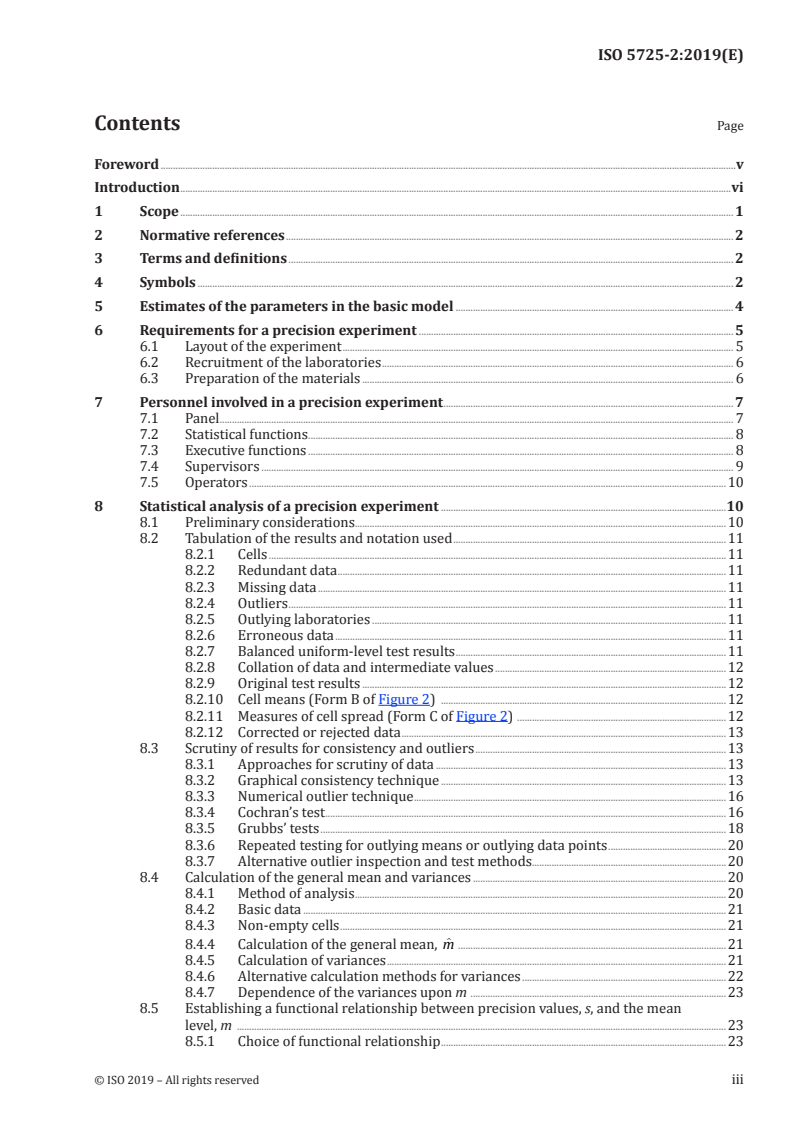
ISO 5725-2:2019 - Accuracy (trueness and precision) of measurement methods and results — Part 2: Basic method for the determination of repeatability and reproducibility of a standard measurement method/6/2019






ISO 5725-2:2019 - Accuracy (trueness and precision) of measurement methods and results

ISO 5725-2:2019 - Exactitude (justesse et fidélité) des résultats et méthodes de mesure — Partie 2: Méthode de base pour la détermination de la répétabilité et de la reproductibilité d'une méthode de mesure normalisée/17/2020


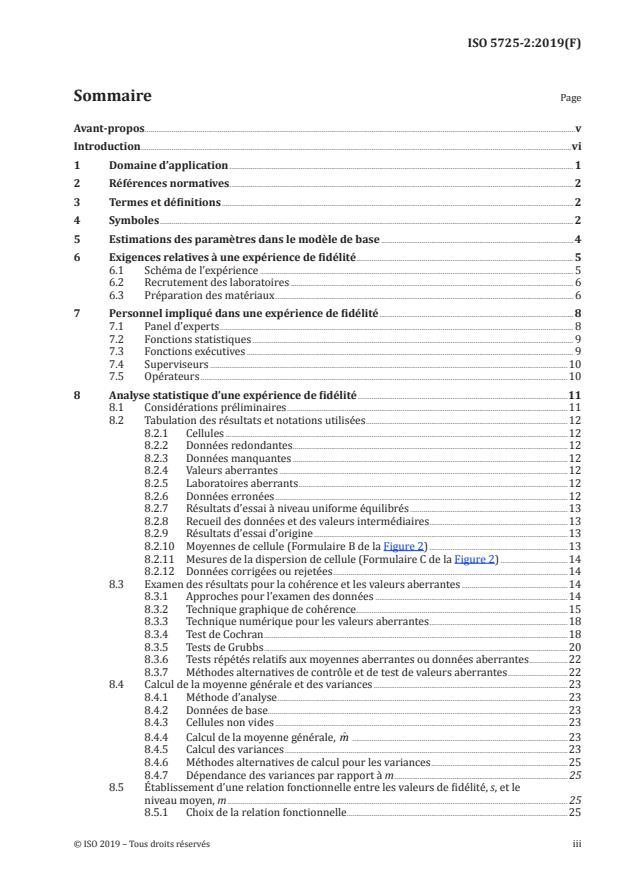
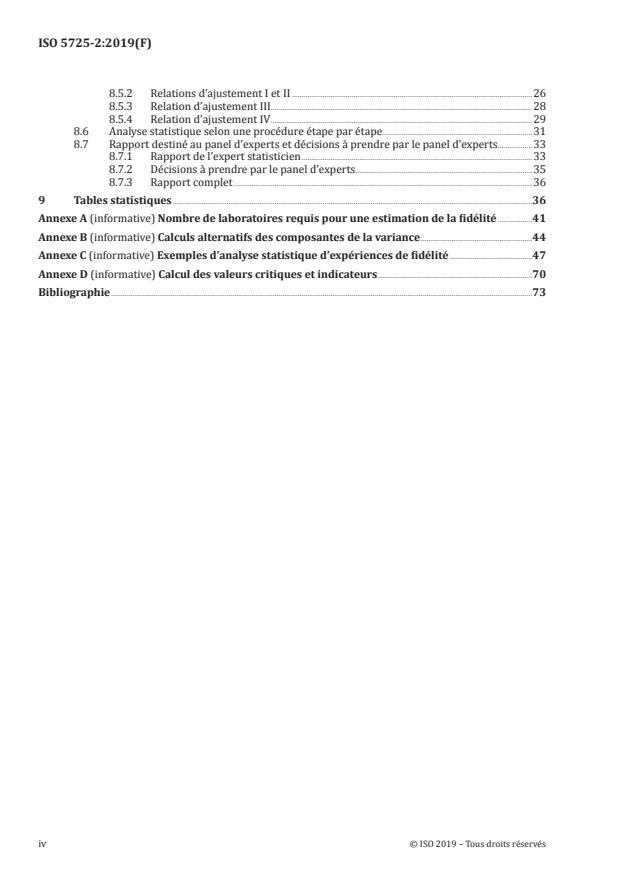
ISO 5725-2:2019 - Exactitude (justesse et fidélité) des résultats et méthodes de mesure
Overview
SIST ISO 5725-2:2020 (equivalent to ISO 5725-2:2019) defines the basic method for estimating the precision of a standard measurement method by means of a collaborative interlaboratory experiment. It amplifies the principles in ISO 5725‑1 and gives practical, routine procedures for determining the two principal precision characteristics: repeatability and reproducibility. The standard applies to measurement methods that produce a single continuous numeric result (including results derived from calculations of observations) and assumes data are approximately normally distributed.
Key technical topics and requirements
- Experimental design: Uses a balanced, uniform‑level layout where each laboratory performs the same number of replicates on the same sample levels.
- Scope of applicability: Intended for standardized procedures in regular use; can also provide preliminary precision estimates for non‑standard methods.
- Material considerations: Requires homogeneous test materials or that heterogeneity effects be included in precision estimates.
- Statistical model: Builds on the ISO 5725‑1 statistical model for interpretation and variance component estimation.
- Personnel and roles: Defines responsibilities for panels, statistical experts, supervisors and operators involved in precision experiments.
- Data scrutiny and outlier handling: Describes graphical and numerical techniques for consistency checks and outlier detection (e.g., Cochran’s and Grubbs’ tests) and permits alternative methods of similar performance.
- Variance estimation & analysis: Details calculation of cell means, measures of spread, general mean and variance components, and fitting functional relationships between precision and mean level.
- Reporting: Specifies reporting requirements to the study panel and content of the full report.
- Supporting material: Annexes include guidance on the number of laboratories needed, alternative variance calculations and worked examples.
Practical applications and users
SIST ISO 5725-2 is essential for:
- Metrology and testing laboratories validating or verifying method precision
- Method developers preparing standardized analytical procedures
- Accreditation bodies and quality managers assessing laboratory competence
- Proficiency testing organizers designing interlaboratory studies
- Statisticians performing precision analyses and uncertainty estimation workflows
Typical uses include method validation, interlaboratory comparison studies, development of performance characteristics for standards, and inputs to measurement uncertainty and conformity assessment.
Related standards
- ISO 5725‑1 - general principles and definitions for accuracy (trueness and precision)
- Other parts of ISO 5725 series - modifications and extensions for particular experimental designs
- ISO 21748 - using interlaboratory estimates of precision and trueness for measurement uncertainty
Keywords: ISO 5725-2, SIST ISO 5725-2:2020, accuracy, trueness, precision, repeatability, reproducibility, interlaboratory experiment, balanced uniform-level, statistical analysis.
Relations
- Effective Date
- 01-Jun-2020
- Effective Date
- 01-Jun-2020
- Effective Date
- 25-Aug-2026
- Effective Date
- 25-Aug-2026
- Effective Date
- 25-Aug-2026
- Effective Date
- 25-Aug-2026
- Effective Date
- 25-Aug-2026
- Effective Date
- 25-Aug-2026
- Effective Date
- 25-Aug-2026
- Effective Date
- 25-Aug-2026
- Effective Date
- 25-Aug-2026
- Effective Date
- 25-Aug-2026
- Effective Date
- 25-Aug-2026
- Effective Date
- 25-Aug-2026
- Referred By
SIST EN 16165:2021 - Determination of slip resistance of pedestrian surfaces - Methods of evaluation - Effective Date
- 29-Jul-2026
Buy Documents
ISO 5725-2:2019 - Accuracy (trueness and precision) of measurement methods and results — Part 2: Basic method for the determination of repeatability and reproducibility of a standard measurement method/6/2019
ISO 5725-2:2019 - Accuracy (trueness and precision) of measurement methods and results
ISO 5725-2:2019 - Exactitude (justesse et fidélité) des résultats et méthodes de mesure — Partie 2: Méthode de base pour la détermination de la répétabilité et de la reproductibilité d'une méthode de mesure normalisée/17/2020
ISO 5725-2:2019 - Exactitude (justesse et fidélité) des résultats et méthodes de mesure
Get Certified
Connect with accredited certification bodies for this standard

BSI Group
BSI (British Standards Institution) is the business standards company that helps organizations make excellence a habit.

Bureau Veritas
Bureau Veritas is a world leader in laboratory testing, inspection and certification services.

DNV
DNV is an independent assurance and risk management provider.
Sponsored listings
Frequently Asked Questions
SIST ISO 5725-2:2020 is a standard published by the Slovenian Institute for Standardization (SIST). Its full title is "Accuracy (trueness and precision) of measurement methods and results - Part 2: Basic method for the determination of repeatability and reproducibility of a standard measurement method". This standard covers: 1.1 This document — amplifies the general principles for designing experiments for the numerical estimation of the precision of measurement methods by means of a collaborative interlaboratory experiment; — provides a detailed practical description of the basic method for routine use in estimating the precision of measurement methods; — provides guidance to all personnel concerned with designing, performing or analysing the results of the tests for estimating precision. NOTE Modifications to this basic method for particular purposes are given in other parts of ISO 5725. 1.2 It is concerned exclusively with measurement methods which yield measurements on a continuous scale and give a single value as the test result, although this single value can be the outcome of a calculation from a set of observations. 1.3 It assumes that in the design and performance of the precision experiment, all the principles as laid down in ISO 5725-1 are observed. The basic method uses the same number of test results in each laboratory, with each laboratory analysing the same levels of test sample; i.e. a balanced uniform-level experiment. The basic method applies to procedures that have been standardized and are in regular use in a number of laboratories. 1.4 The statistical model of ISO 5725-1:1994, Clause 5, is accepted as a suitable basis for the interpretation and analysis of the test results, the distribution of which is approximately normal. 1.5 The basic method, as described in this document, (usually) estimates the precision of a measurement method: a) when it is required to determine the repeatability and reproducibility standard deviations as defined in ISO 5725-1; b) when the materials to be used are homogeneous, or when the effects of heterogeneity can be included in the precision values; and c) when the use of a balanced uniform-level layout is acceptable. 1.6 The same approach can be used to make a preliminary estimate of precision for measurement methods which have not reached standardization or are not in routine use.
1.1 This document — amplifies the general principles for designing experiments for the numerical estimation of the precision of measurement methods by means of a collaborative interlaboratory experiment; — provides a detailed practical description of the basic method for routine use in estimating the precision of measurement methods; — provides guidance to all personnel concerned with designing, performing or analysing the results of the tests for estimating precision. NOTE Modifications to this basic method for particular purposes are given in other parts of ISO 5725. 1.2 It is concerned exclusively with measurement methods which yield measurements on a continuous scale and give a single value as the test result, although this single value can be the outcome of a calculation from a set of observations. 1.3 It assumes that in the design and performance of the precision experiment, all the principles as laid down in ISO 5725-1 are observed. The basic method uses the same number of test results in each laboratory, with each laboratory analysing the same levels of test sample; i.e. a balanced uniform-level experiment. The basic method applies to procedures that have been standardized and are in regular use in a number of laboratories. 1.4 The statistical model of ISO 5725-1:1994, Clause 5, is accepted as a suitable basis for the interpretation and analysis of the test results, the distribution of which is approximately normal. 1.5 The basic method, as described in this document, (usually) estimates the precision of a measurement method: a) when it is required to determine the repeatability and reproducibility standard deviations as defined in ISO 5725-1; b) when the materials to be used are homogeneous, or when the effects of heterogeneity can be included in the precision values; and c) when the use of a balanced uniform-level layout is acceptable. 1.6 The same approach can be used to make a preliminary estimate of precision for measurement methods which have not reached standardization or are not in routine use.
SIST ISO 5725-2:2020 is classified under the following ICS (International Classification for Standards) categories: 03.120.30 - Application of statistical methods; 17.020 - Metrology and measurement in general. The ICS classification helps identify the subject area and facilitates finding related standards.
SIST ISO 5725-2:2020 has the following relationships with other standards: It is inter standard links to SIST ISO 5725-2:2003/C1:2003, SIST ISO 5725-2:2003, SIST EN ISO 20031:2022, SIST EN ISO 9455-17:2024, SIST EN 13451-1:2021, SIST EN ISO 18097:2022, SIST EN ISO 18096:2022, SIST EN ISO 29766:2023, SIST EN ISO 16638-2:2022, SIST-TP CEN/TR 17474:2021, SIST EN ISO 17468:2024, SIST EN ISO 29469:2023, SIST EN ISO 16297:2020, SIST EN 17936:2024, SIST EN 16165:2021. Understanding these relationships helps ensure you are using the most current and applicable version of the standard.
SIST ISO 5725-2:2020 is associated with the following European legislation: EU Directives/Regulations: 2004-01-0865, 2009-01-4018, 2011-01-2525. When a standard is cited in the Official Journal of the European Union, products manufactured in conformity with it benefit from a presumption of conformity with the essential requirements of the corresponding EU directive or regulation.
SIST ISO 5725-2:2020 is available in PDF format for immediate download after purchase. The document can be added to your cart and obtained through the secure checkout process. Digital delivery ensures instant access to the complete standard document.
Standards Content (Sample)
INTERNATIONAL ISO
STANDARD 5725-2
Second edition
2019-12
Accuracy (trueness and precision) of
measurement methods and results —
Part 2:
Basic method for the determination of
repeatability and reproducibility of a
standard measurement method
Exactitude (justesse et fidélité) des résultats et méthodes de mesure —
Partie 2: Méthode de base pour la détermination de la répétabilité et
de la reproductibilité d'une méthode de mesure normalisée
Reference number
©
ISO 2019
© ISO 2019
All rights reserved. Unless otherwise specified, or required in the context of its implementation, no part of this publication may
be reproduced or utilized otherwise in any form or by any means, electronic or mechanical, including photocopying, or posting
on the internet or an intranet, without prior written permission. Permission can be requested from either ISO at the address
below or ISO’s member body in the country of the requester.
ISO copyright office
CP 401 • Ch. de Blandonnet 8
CH-1214 Vernier, Geneva
Phone: +41 22 749 01 11
Fax: +41 22 749 09 47
Email: copyright@iso.org
Website: www.iso.org
Published in Switzerland
ii © ISO 2019 – All rights reserved
Contents Page
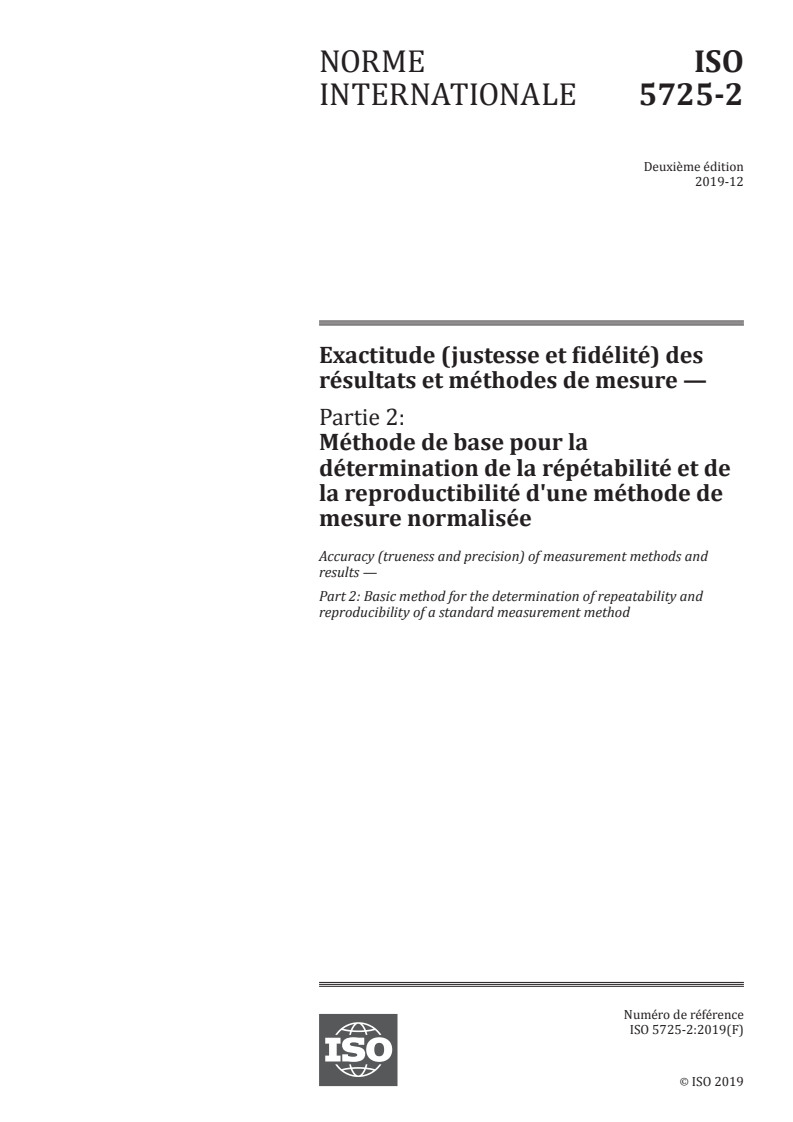
Foreword .v
Introduction .vi
1 Scope . 1
2 Normative references . 2
3 Terms and definitions . 2
4 Symbols . 2
5 Estimates of the parameters in the basic model . 4
6 Requirements for a precision experiment . 5
6.1 Layout of the experiment . 5
6.2 Recruitment of the laboratories . 6
6.3 Preparation of the materials . 6
7 Personnel involved in a precision experiment . 7
7.1 Panel . 7
7.2 Statistical functions . 8
7.3 Executive functions . 8
7.4 Supervisors . 9
7.5 Operators .10
8 Statistical analysis of a precision experiment .10
8.1 Preliminary considerations .10
8.2 Tabulation of the results and notation used .11
8.2.1 Cells .11
8.2.2 Redundant data .11
8.2.3 Missing data .11
8.2.4 Outliers .11
8.2.5 Outlying laboratories .11
8.2.6 Erroneous data .11
8.2.7 Balanced uniform-level test results .11
8.2.8 Collation of data and intermediate values .12
8.2.9 Original test results .12
8.2.10 Cell means (Form B of Figure 2) .12
8.2.11 Measures of cell spread (Form C of Figure 2) .12
8.2.12 Corrected or rejected data .13
8.3 Scrutiny of results for consistency and outliers .13
8.3.1 Approaches for scrutiny of data .13
8.3.2 Graphical consistency technique .13
8.3.3 Numerical outlier technique .16
8.3.4 Cochran’s test .16
8.3.5 Grubbs’ tests .18
8.3.6 Repeated testing for outlying means or outlying data points .20
8.3.7 Alternative outlier inspection and test methods.20
8.4 Calculation of the general mean and variances .20
8.4.1 Method of analysis .20
8.4.2 Basic data .21
8.4.3 Non-empty cells .21
ˆ
8.4.4 Calculation of the general mean, m .21
8.4.5 Calculation of variances .21
8.4.6 Alternative calculation methods for variances .22
8.4.7 Dependence of the variances upon m .23
8.5 Establishing a functional relationship between precision values, s, and the mean
level, m .23
8.5.1 Choice of functional relationship .23
8.5.2 Fitting relationships I and II .24
8.5.3 Fitting relationship III .25
8.5.4 Fitting relationship IV .26
8.6 Statistical analysis as a step-by-step procedure .28
8.7 Report to the panel and decisions to be taken by the panel .30
8.7.1 Report by the statistical expert .30
8.7.2 Decisions to be taken by the panel .32
8.7.3 Full report .33
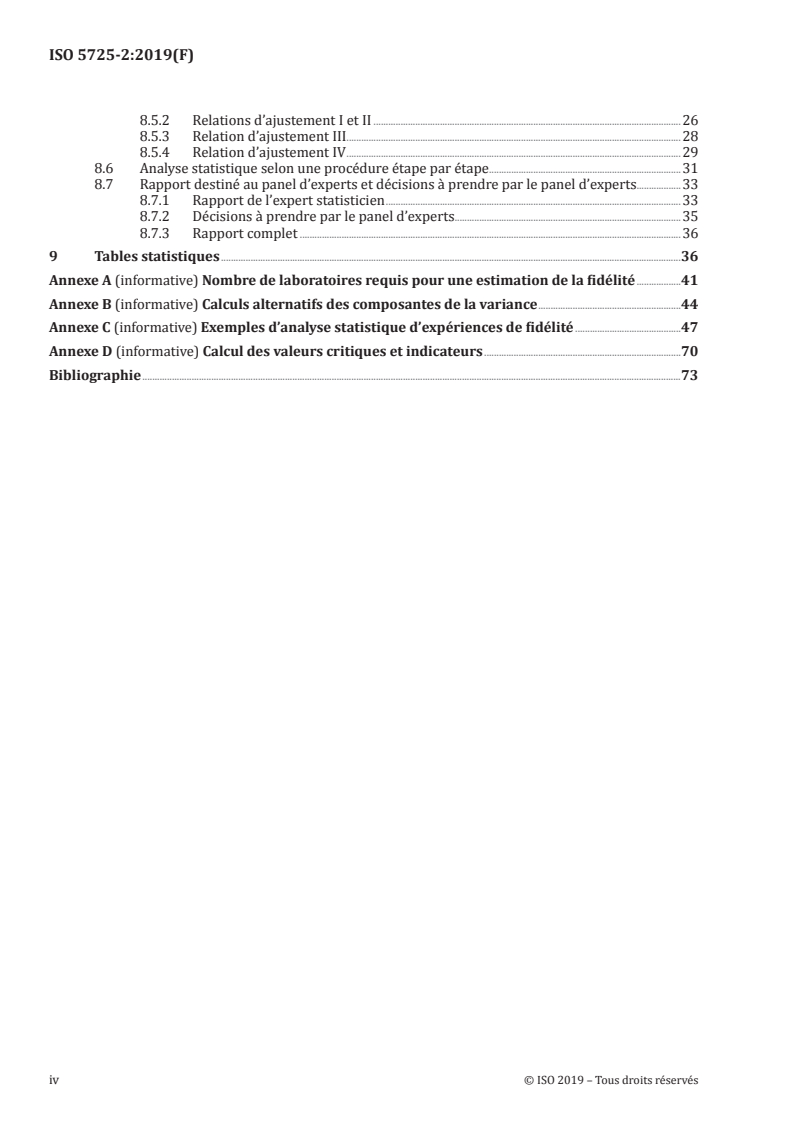
9 Statistical tables .33
Annex A (informative) Number of laboratories required for an estimate of precision .38
Annex B (informative) Alternative calculations of variance components .41
Annex C (informative) Examples of the statistical analysis of precision experiments .44
Annex D (informative) Calculation of critical values and indicators .66
Bibliography .69
iv © ISO 2019 – All rights reserved
Foreword
ISO (the International Organization for Standardization) is a worldwide federation of national standards
bodies (ISO member bodies). The work of preparing International Standards is normally carried out
through ISO technical committees. Each member body interested in a subject for which a technical
committee has been established has the right to be represented on that committee. International
organizations, governmental and non-governmental, in liaison with ISO, also take part in the work.
ISO collaborates closely with the International Electrotechnical Commission (IEC) on all matters of
electrotechnical standardization.
The procedures used to develop this document and those intended for its further maintenance are
described in the ISO/IEC Directives, Part 1. In particular the different approval criteria needed for the
different types of ISO documents should be noted. This document was drafted in accordance with the
editorial rules of the ISO/IEC Directives, Part 2 (see www .iso .org/ directives).
Attention is drawn to the possibility that some of the elements of this document may be the subject of
patent rights. ISO shall not be held responsible for identifying any or all such patent rights. Details of
any patent rights identified during the development of the document will be in the Introduction and/or
on the ISO list of patent declarations received (see www .iso .org/ patents).
Any trade name used in this document is information given for the convenience of users and does not
constitute an endorsement.
For an explanation of the voluntary nature of standards, the meaning of ISO specific terms and
expressions related to conformity assessment, as well as information about ISO's adherence to the
World Trade Organization (WTO) principles in the Technical Barriers to Trade (TBT), see www .iso .org/
iso/ foreword .html.
This document was prepared by Technical Committee ISO/TC 69, Applications of statistical methods,
Subcommittee SC 6, Measurement methods and results.
This second edition cancels and replaces the first edition (ISO 5725-2:1994), which has been technically
revised. It also incorporates the Technical Corrigendum ISO 5725-2:1994/Cor 1:2002.
The main changes compared to the previous edition are as follows:
— permission is given to use alternative scrutiny and outlier detection tests provided that the
performance is similar;
— permission is given to apply modern statistical methods available for calculations of the relevant
precision and trueness characteristics;
— guidance on the number of laboratories required for a precision study has been included;
— information on the computation of critical values has been included.
A list of all parts in the ISO 5725 series can be found on the ISO website.
Any feedback or questions on this document should be directed to the user’s national standards body. A
complete listing of these bodies can be found at www .iso .org/ members .html.
Introduction
ISO 5725 uses two terms, “trueness” and “precision”, to describe the accuracy of a measurement method.
“Trueness” refers to the closeness of agreement between the arithmetic mean of a large number of
test results and the true or accepted reference value. “Precision” refers to the closeness of agreement
between test results.
General consideration of these quantities is given in ISO 5725-1 and so is not repeated in this document.
ISO 5725-1 should be read in conjunction with all other parts of ISO 5725, including this part, because it
gives the underlying definitions and general principles.
This document is concerned solely with estimating the repeatability standard deviation and
reproducibility standard deviation based on an interlaboratory design in which each laboratory
conducts a number of independent measurements of the same sample under repeatability conditions.
There are other designs (such as nested, factorial or split-level experiments) which can be used for the
estimation of precision: these are not dealt with in this document but rather are the subject of other
parts of ISO 5725. Nor does this document consider any other measures of precision intermediate
between the two principal measures; those are the subject of ISO 5725-3.
In certain circumstances, the data obtained from an experiment carried out to estimate precision are
used also to estimate trueness and can be used to evaluate measurement uncertainty. The estimation
of trueness is not considered in this document; all aspects of the estimation of trueness are the subject
of ISO 5725-4. The evaluation of measurement uncertainty, using inter-laboratory estimates of trueness
and precision, is the subject of ISO 21748.
Annex C provides practical examples of estimating the precision of measurement methods by
experiment. Worked examples are given to demonstrate balanced uniform sets of test results, although
in one example a variable number of replicates per cell were reported (unbalanced design) and in
another some data were missing. This is because an experiment designed to be balanced can turn out to
be unbalanced. Stragglers and outliers are also considered.
vi © ISO 2019 – All rights reserved
INTERNATIONAL STANDARD ISO 5725-2:2019(E)
Accuracy (trueness and precision) of measurement
methods and results —
Part 2:
Basic method for the determination of repeatability and
reproducibility of a standard measurement method
1 Scope
1.1 This document
— amplifies the general principles for designing experiments for the numerical estimation of the
precision of measurement methods by means of a collaborative interlaboratory experiment;
— provides a detailed practical description of the basic method for routine use in estimating the
precision of measurement methods;
— provides guidance to all personnel concerned with designing, performing or analysing the results
of the tests for estimating precision.
NOTE Modifications to this basic method for particular purposes are given in other parts of ISO 5725.
1.2 It is concerned exclusively with measurement methods which yield measurements on a continuous
scale and give a single value as the test result, although this single value can be the outcome of a
calculation from a set of observations.
1.3 It assumes that in the design and performance of the precision experiment, all the principles as
laid down in ISO 5725-1 are observed. The basic method uses the same number of test results in each
laboratory, with each laboratory analysing the same levels of test sample; i.e. a balanced uniform-level
experiment. The basic method applies to procedures that have been standardized and are in regular use
in a number of laboratories.
1.4 The statistical model of ISO 5725-1:1994, Clause 5, is accepted as a suitable basis for the
interpretation and analysis of the test results, the distribution of which is approximately normal.
1.5 The basic method, as described in this document, (usually) estimates the precision of a
measurement method:
a) when it is required to determine the repeatability and reproducibility standard deviations as
defined in ISO 5725-1;
b) when the materials to be used are homogeneous, or when the effects of heterogeneity can be
included in the precision values; and
c) when the use of a balanced uniform-level layout is acceptable.
1.6 The same approach can be used to make a preliminary estimate of precision for measurement
methods which have not reached standardization or are not in routine use.
2 Normative references
The following documents are referred to in the text in such a way that some or all of their content
constitutes requirements of this document. For dated references, only the edition cited applies. For
undated references, the latest edition of the referenced document (including any amendments) applies.
ISO 3534-1, Statistics — Vocabulary and symbols — Part 1: Probability and general statistical terms
ISO 3534-2, Statistics — Vocabulary and symbols — Part 2: Applied statistics
ISO 3534-3, Statistics — Vocabulary and symbols — Part 3: Design of experiments
ISO 5725-1, Accuracy (trueness and precision) of measurement methods and results — Part 1: General
principles and definitions
3 Terms and definitions
For the purposes of this document, the definitions given in ISO 3534-1, ISO 3534-2, ISO 3534-3, and
ISO 5725-1 apply.
ISO and IEC maintain terminological databases for use in standardization at the following addresses:
— ISO Online browsing platform: available at https:// www .iso .org/ obp
— IEC Electropedia: available at http:// www .electropedia .org/
4 Symbols
α Probability associated with a critical value of a test statistic, also referred to as a
level of significance
a Intercept in the relationship s = a + bm
a
Intercept parameter in the relationship sa=+ bm
v ()
jv v
A Factor used to calculate the uncertainty of an estimate
b Slope in the relationship s = a + bm
b
Slope parameter in the relationship sa=+ bm
v ()
jv v
B Laboratory component of bias under repeatability conditions
c Intercept in the relationship lg s = c + d lg m
C, C’, C’’ Test statistics
C , C’ , C’’ Critical values for statistical tests
crit crit crit
d Slope in the relationship lg s = c + d lg m
e Component in a test result representing the random error occurring in every test
result
G Grubbs’ test statistic
h Mandel’s between-laboratory consistency test statistic
k Mandel’s within-laboratory consistency test statistic
2 © ISO 2019 – All rights reserved
L(θ) Log-likelihood for variance components θ
m General mean of the test property; level
ˆ
m Estimate of the general mean of the test property
M Transformation matrix used in REML estimation
N Number of iterations
n Number of test results obtained in one laboratory at one level (i.e. per cell)
n Total number of test results obtained at level j of the interlaboratory experiment
j
p Number of laboratories participating in the interlaboratory experiment
P Probability
q Number of levels of the test property in the interlaboratory experiment
r Repeatability limit
R Reproducibility limit
s Estimate of a standard deviation
ˆ
s Predicted standard deviation
T Total or sum of some expression
t Number of test objects or groups
V(θ) Covariance matrix used in REML estimation
W Weighting factor used in calculating a weighted regression
w Weighting factor used in calculating a weighted mean
x Datum used for Grubbs’ test
X Design matrix for REML estimations
y Test result
Grand mean of test results
y
Y Vector of all observations at a level j
θ Vector of variance components used in REML estimation
μ True value or accepted reference value of a test property
σ True value of a standard deviation
Subscripts
i Identifier for a particular laboratory
Index for summation (Annex A)
j Identifier for a particular level
Index for summation (Annex A)
k Identifier for a particular test result in a laboratory i at level j
L Between-laboratory (interlaboratory)
P Probability
r Repeatability
R Reproducibility
REML Estimate arising from a restricted maximum likelihood calculation
v Terms used in calculation of a relationship between mean and combined variance
(see 8.5.1.3, relationship III)
W Within-laboratory (intralaboratory)
1, 2, 3, . For test results, numbering in the order of obtaining them; for other cases
(laboratories), as arbitrary identifiers
st nd st nd
(1), (2), (3), . For test results, (1), (2) … denote the 1 , 2 … etc. order statistic, that is, the 1 , 2 …
etc. value numbered in the order of increasing magnitude
5 Estimates of the parameters in the basic model
5.1 The procedures given in this document are based on the statistical model given in Clause 5 of
ISO 5725-1:1994 and elaborated upon in ISO 5725-1:1994, 1.2. In particular, these procedures are based
on Formulae (2) to (6) of ISO 5725-1:1994, Clause 5.
The model is
y = m + B + e
where, for the particular material tested,
m is the general mean (expectation);
B is the laboratory component of bias under repeatability conditions;
e is the random error occurring in every measurement under repeatability conditions.
NOTE The laboratory component of bias, B, represents the deviation of a laboratory mean from the general
average m.
5.2 ISO 5725-1:1994, Formulae (2) to (6), are expressed in terms of the true standard deviations of
the populations considered. In practice, the exact values of these standard deviations are not known, and
estimates of precision values must be made from a relatively small sample of all the possible laboratories,
and within those laboratories from a small sample of all the possible test results.
4 © ISO 2019 – All rights reserved
5.3 In statistical practice, where the true value of a standard deviation, σ, is not known and is replaced
by an estimate based upon a sample, then the symbol σ is replaced by s to denote that it is an estimate.
This is done in each of ISO 5725-1:1994, Formulae (2) to (6), giving:
— s is the estimate of the between-laboratory variance;
L
— s is the estimate of the within-laboratory variance;
W
2 2
— s is the arithmetic mean of s and is the estimate of the repeatability variance; this arithmetic
r W
mean is taken over all those laboratories taking part in the accuracy experiment which remain after
outliers have been excluded;
— s is the estimate of the reproducibility variance:
R
22 2
ss=+s (1)
RrL
6 Requirements for a precision experiment
6.1 Layout of the experiment
6.1.1 In the layout used in the basic method, samples from q batches of materials, representing q
different levels of the test, are sent to p laboratories which each obtain exactly n replicate test results
under repeatability conditions at each of the q levels. This type of experiment is called a balanced
uniform-level experiment.
6.1.2 The performance of these measurements shall be organized and instructions issued as follows.
a) Any preliminary checking of equipment shall be as specified in the standard method.
b) Each group of n measurements belonging to one level shall be carried out under repeatability
conditions, i.e. within a short interval of time and by the same operator, and without any
intermediate recalibration of the apparatus unless this is an integral part of performing a
measurement.
c) It is essential that a group of n tests under repeatability conditions be performed independently
as if they were n tests on different materials. As a rule, however, the operator knows that he/she
is testing identical material, but the point should be stressed in the instructions that the whole
purpose of the experiment is to determine what differences in results can occur in actual testing.
If it is feared that, despite this warning, previous results can influence subsequent test results and
thus the repeatability variance, it should be considered whether to use n separate samples at each
of the q levels, coded in such a way that the operator does not know which are the replicates for a
given level. However, such a procedure can cause problems in ensuring that repeatability conditions
apply between replicates. This is only possible if the measurements are of such a nature that all the
qn measurements can be performed within a short interval of time.
d) It is not essential that all the q groups of n measurements each be performed strictly within a short
interval of time; different groups of measurements may be carried out on different days.
e) Measurements of all q levels shall be performed by one and the same operator and, in addition, the
n measurements at a given level shall be performed using the same equipment throughout.
f) If in the course of the measurements an operator should become unavailable, another operator
may complete the measurements, provided that the change does not occur within a group of
n measurements at one level but only occurs between two of the q groups. Any such change shall be
reported with the results.
g) A time limit shall be given within which all measurements shall be completed. This can be
necessary to limit the time allowed to elapse between the day the samples are received and the day
the measurements are performed.
h) All samples shall be clearly labelled with the name of the experiment and a sample identification.
6.1.3 In 6.1.2 and elsewhere in this document, reference is made to the operator. For some
measurements, there can in fact be a team of operators, each of whom performs some specific part of the
procedure. In such a case, the team shall be regarded as “the operator” and any change in the team shall
be regarded as providing a different “operator”.
6.1.4 In commercial practice, the test results can be rounded rather crudely, but in a precision
experiment test results shall be reported to at least one more digit than specified in the standard
method. If the method does not specify the number of digits, the rounding shall not be coarser than half
the repeatability standard deviation estimate. When precision depends on the level m, different degrees
of rounding can be necessary for different levels.
6.2 Recruitment of the laboratories
6.2.1 The general principles regarding recruitment of the laboratories to participate in an
interlaboratory experiment are given in ISO 5725-1. Guidance on the number of laboratories is given in
Annex A. In enlisting the cooperation of the requisite number of laboratories, their responsibilities shall
be clearly stated. An example of a suitable enlistment questionnaire is given in Figure 1.
6.2.2 For the purposes of this document, a “laboratory” is considered to be a combination of the
operator, the equipment and the test site. One test site (or laboratory in the conventional sense) can
thus produce several “laboratories” if it can provide several operators each with independent sets of
equipment and situations in which to perform the work.
6.3 Preparation of the materials
6.3.1 A discussion of the points that need to be considered when selecting materials for use in a
precision experiment is given in ISO 5725-1.
6.3.2 When deciding on the quantities of material to be provided, allowance shall be made for
accidental spillage or errors in obtaining some test results which can necessitate using extra material.
The amount of material prepared shall be sufficient to cover the experiment and allow an adequate stock
in reserve.
6.3.3 It should be considered whether it is desirable for some laboratories to obtain some preliminary
test results for familiarization with the measurement method before obtaining the official test result
and, if so, whether additional material (not precision experiment samples) should be provided for this
purpose.
6.3.4 When a material is to be homogenized, this shall be done in the manner most appropriate for that
material. When the material to be tested is not homogeneous, it is important to prepare the samples in
the manner specified in the method, preferably starting with one batch of commercial material for each
level. In the case of unstable materials, special instructions on storage and treatment shall be specified.
NOTE ISO Guide 35 gives information on evaluating homogeneity and stability for reference materials.
6.3.5 For the samples at each level, n separate containers shall be used for each laboratory if there is
any danger of the materials deteriorating once the container has been opened (e.g. by oxidation, by losing
volatile components, or with hygroscopic material). In the case of unstable materials, special instructions
on storage and treatment shall be specified. Precautions can be necessary to ensure that samples
6 © ISO 2019 – All rights reserved
remain identical up to the time the measurements are made. If the material to be measured consists of
a mixture of powders of different relative density or of different grain size, some care is needed because
segregation can result from shaking, for example during transport. When reaction with the atmosphere
can be expected, the specimens may be sealed into ampoules, either evacuated or filled with an inert
gas. For perishable materials such as food or blood samples, it can be necessary to send them in a deep-
frozen state to the participating laboratories with detailed instructions for the procedure for thawing.
Figure 1 — Enlistment questionnaire for interlaboratory study
7 Personnel involved in a precision experiment
NOTE The methods of operation within different laboratories are not expected to be identical. Therefore,
the contents of this clause are only intended as a guide to be modified as appropriate to cater for a particular
situation.
7.1 Panel
7.1.1 The precision experiment should be overseen by a panel which should consist of experts familiar
with the measurement method and its application.
7.1.2 The tasks of the panel are:
a) to plan and coordinate the precision experiment;
b) to decide on the number of laboratories, levels and measurements to be made, and the number of
significant digits to be required;
c) to appoint someone for the statistical functions (see 7.2);
d) to appoint someone for the executive functions (see 7.3);
e) to consider the instructions to be issued to the laboratory supervisors in addition to the standard
measurement method;
f) to decide whether some operators can be allowed to carry out a few unofficial measurements in
order to regain experience of the method after a long interval (such measurements shall never be
carried out on the official collaborative samples);
g) to discuss the report of the statistical analysis on completion of the analysis of the test results;
h) to establish final values for the repeatability standard deviation and the reproducibility standard
deviation;
i) to decide if further actions are required to improve the standard for the measurement method or
with regard to laboratories whose test results have been rejected as outliers.
7.2 Statistical functions
At least one member of the panel should have experience in statistical design and analysis of
experiments. His/her tasks are:
a) to contribute his/her specialized knowledge in designing the experiment;
b) to analyse the data;
c) to write a report for submission to the panel following the instructions contained in 8.7.
7.3 Executive functions
7.3.1 The actual organization of the experiment should be entrusted to a single laboratory. A member
of the staff of that laboratory should take full responsibility; he/she is called the executive officer and is
appointed by the panel.
7.3.2 The tasks of the executive officer are:
a) to enlist the cooperation of the requisite number of laboratories and to ensure that supervisors are
appointed;
b) to organize and supervise the preparation of the materials and samples and the dispatch of the
samples; for each level, an adequate quantity of material should be set aside as a reserve stock;
c) to draft instructions covering all the points in 6.1.2 a) to h), and circulate them to the supervisors
early enough in advance for them to raise any comments or queries and to ensure that operators
selected are those who normally carry out such measurements in routine operations;
d) to design suitable forms for the operator to use as a working record and for the supervisor to
report the test results to the requisite number of decimal places (or significant digits, as required).
Such forms can include the name of the operator, the dates on which samples were received and
measured, the equipment used and any other relevant information;
e) to deal with any queries from laboratories regarding the performance of the measurements;
8 © ISO 2019 – All rights reserved
f) to see that an overall time schedule is maintained;
g) to collect the data forms and present them to the statistical expert.
NOTE The forms referred to in 7.3.2 d) can be electronic; for example a spreadsheet format suitably
protected against unintended modification.
7.4 Supervisors
7.4.1 A staff member in each of the participating laboratories should be made responsible for
organizing the actual performance of the measurements, in keeping with instructions received from the
executive officer, and for reporting the test results.
7.4.2 The tasks of the supervisor are:
a) to ensure that the operators selected are those who normally carry out such measurements in
routine operations;
b) to hand out the samples to the operator(s) in keeping with the instructions of the executive officer
(and to provide material for familiarization experiments, if necessary);
c) to supervise the execution of the measurements (the supervisor shall not take part in performing
the measurements);
d) to ensure that the operators carry out the required number of measurements;
e) to ensure adherence to the set timetable for performing the measurements;
f) to collect the test results recorded to the agreed number of decimal places (or significant digits),
including any anomalies and difficulties experienced, and comments made by the operators.
7.4.3 The supervisor of each laboratory should write a full report which should contain the following
information:
a) the test results, entered legibly by their originator on the forms provided, not transcribed or typed
(computer or testing machine output may be acceptable as an alternative);
b) the original observed values or readings (if any) from which the test results were derived, entered
legibly by the operator on the forms provided, not transcribed or typed;
c) comments by the operators on the standard for the measurement method;
d) information about irregularities or disturbances that can have occurred during the measurements,
including any change of operator, together with a statement as to which measurements were
performed by which operator, and the reasons for any missing results;
e) the date(s) on which the samples were received;
f) the date(s) on which each sample was measured;
g) information about the equipment used, if relevant;
h) any other relevant information.
NOTE The output and forms referred to in 7.4.3 a) and b) can be electronic; for example a spreadsheet format
suitably protected against unintended modification.
7.5 Operators
7.5.1 In each laboratory the measurements shall be carried out by one operator selected as being
representative of those likely to perform the measurements in normal operations.
7.5.2 Because the object of the experiment is to determine the precision obtainable by the general
population of operators working from the standard measurement method, in general the operators
should not be given amplifications to the standard for the measurement method. However, it should be
pointed out to the operators that the purpose of the exercise is to discover the extent to which results can
vary in practice, so that there is less temptation for them to discard or rework results that they feel are
inconsistent.
7.5.3 Although normally the operators should receive no supplementary amplifications to the standard
measurement method, they should be encouraged to comment on the standard and, in particular, to state
whether the instructions contained in it are sufficiently unambiguous and clear.
7.5.4 The tasks of the operators are:
a) to perform the measurements according to the standard measurement method;
b) to report any anomalies or difficulties experienced; it is better to report a mistake than to adjust
the test results because one or two missing test results do not spoil the experiment and many
indicate a deficiency in the standard;
c) to comment on the adequacy of the instructions in the standard; operators should report any
occasion(s) when they are unable to follow their instructions as this can also indicate a deficiency
in the standard.
8 Statistical analysis of a precision experiment
8.1 Preliminary considerations
8.1.1 The analysis of the data, which should be considered as a statistical problem to be solved by a
statistical expert, involves three successive stages:
a) critical examination of the data in order to identify and treat outliers or other irregularities and to
test the suitability of the model;
b) computation of preliminary values of precision and means for each level separately;
c) establishment of final values of precision and means, including the establishment of a relationship
between precision and the level m when the analysis indicates that such a relationship can exist.
8.1.2 The analysis first computes, for each level separately, estimates of
— the repeatability variance, s
r
— the between-laboratory variance, s
L
— the reproducibility variance, s
R
— the mean, m.
NOTE The analysis includes a systematic application of statistical tests for outliers, a great variety of which
are available from the literature and which can be used for the purposes of this document. For practical reasons,
only a limited number of these tests, as explained in 8.3, have been incorporated in this document.
10 © ISO 2019 – All rights reserved
8.2 Tabulation of the results and notation used
8.2.1 Cells
Each combination of a laboratory and a level is called a cell of the precision experiment. In the ideal
case, the results of an experiment with p laboratories and q levels consist of a table with pq cells,
each containing n replicate test results that can all be used for computing the repeatability standard
deviation and the reproducibility standard deviation. This ideal situation is not, however, always
attained in practice. Departures occur owing to redundant data, missing data and outliers.
8.2.2 Redundant data
Sometimes a laboratory can carry out and report more than the n test results officially specified. In that
case, the supervisor shall report why this was done and which are the correct test results. If the answer
is that they are all equally valid, then a random selection may be made from those available test results
to choose the planned number of test results for analysis.
NOTE The calculations of precision terms that are permitted in this document can accommodate differing
numbers of test results in each cell (see 8.2.7). However, substantial variation in the number of reported
observations can adversely affect the interpretation of outlier tests and Mandel’s statistics and can reduce the
reliability of the grand mean.
8.2.3 Missing data
In other cases, some of the test results can be missing, for example because of loss of a sample or a
mistake in performing the measurement. The analysis recommended in this document is such that
completely empty cells can simply be ignored, while partly empty cells can be taken into account by the
standard computational procedure.
8.2.4 Outliers
These are entries among the original test results, or in the tables derived from them, that deviate so
much from the comparable entries in the
...
SLOVENSKI STANDARD
01-junij-2020
Nadomešča:
SIST ISO 5725-2:2003
SIST ISO 5725-2:2003/C1:2003
Točnost (pravilnost in natančnost) merilnih metod in rezultatov - 2. del: Temeljna
metoda določevanja ponovljivosti in obnovljivosti standardne merilne metode
Accuracy (trueness and precision) of measurement methods and results - Part 2: Basic
method for the determination of repeatability and reproducibility of a standard
measurement method
Exactitude (justesse et fidélité) des résultats et méthodes de mesure - Partie 2: Méthode
de base pour la détermination de la répétabilité et de la reproductibilité d'une méthode
de mesure normalisée
Ta slovenski standard je istoveten z: ISO 5725-2:2019
ICS:
03.120.30 Uporaba statističnih metod Application of statistical
methods
17.020 Meroslovje in merjenje na Metrology and measurement
splošno in general
2003-01.Slovenski inštitut za standardizacijo. Razmnoževanje celote ali delov tega standarda ni dovoljeno.
INTERNATIONAL ISO
STANDARD 5725-2
Second edition
2019-12
Accuracy (trueness and precision) of
measurement methods and results —
Part 2:
Basic method for the determination of
repeatability and reproducibility of a
standard measurement method
Exactitude (justesse et fidélité) des résultats et méthodes de mesure —
Partie 2: Méthode de base pour la détermination de la répétabilité et
de la reproductibilité d'une méthode de mesure normalisée
Reference number
©
ISO 2019
© ISO 2019
All rights reserved. Unless otherwise specified, or required in the context of its implementation, no part of this publication may
be reproduced or utilized otherwise in any form or by any means, electronic or mechanical, including photocopying, or posting
on the internet or an intranet, without prior written permission. Permission can be requested from either ISO at the address
below or ISO’s member body in the country of the requester.
ISO copyright office
CP 401 • Ch. de Blandonnet 8
CH-1214 Vernier, Geneva
Phone: +41 22 749 01 11
Fax: +41 22 749 09 47
Email: copyright@iso.org
Website: www.iso.org
Published in Switzerland
ii © ISO 2019 – All rights reserved
Contents Page
Foreword .v
Introduction .vi
1 Scope . 1
2 Normative references . 2
3 Terms and definitions . 2
4 Symbols . 2
5 Estimates of the parameters in the basic model . 4
6 Requirements for a precision experiment . 5
6.1 Layout of the experiment . 5
6.2 Recruitment of the laboratories . 6
6.3 Preparation of the materials . 6
7 Personnel involved in a precision experiment . 7
7.1 Panel . 7
7.2 Statistical functions . 8
7.3 Executive functions . 8
7.4 Supervisors . 9
7.5 Operators .10
8 Statistical analysis of a precision experiment .10
8.1 Preliminary considerations .10
8.2 Tabulation of the results and notation used .11
8.2.1 Cells .11
8.2.2 Redundant data .11
8.2.3 Missing data .11
8.2.4 Outliers .11
8.2.5 Outlying laboratories .11
8.2.6 Erroneous data .11
8.2.7 Balanced uniform-level test results .11
8.2.8 Collation of data and intermediate values .12
8.2.9 Original test results .12
8.2.10 Cell means (Form B of Figure 2) .12
8.2.11 Measures of cell spread (Form C of Figure 2) .12
8.2.12 Corrected or rejected data .13
8.3 Scrutiny of results for consistency and outliers .13
8.3.1 Approaches for scrutiny of data .13
8.3.2 Graphical consistency technique .13
8.3.3 Numerical outlier technique .16
8.3.4 Cochran’s test .16
8.3.5 Grubbs’ tests .18
8.3.6 Repeated testing for outlying means or outlying data points .20
8.3.7 Alternative outlier inspection and test methods.20
8.4 Calculation of the general mean and variances .20
8.4.1 Method of analysis .20
8.4.2 Basic data .21
8.4.3 Non-empty cells .21
ˆ
8.4.4 Calculation of the general mean, m .21
8.4.5 Calculation of variances .21
8.4.6 Alternative calculation methods for variances .22
8.4.7 Dependence of the variances upon m .23
8.5 Establishing a functional relationship between precision values, s, and the mean
level, m .23
8.5.1 Choice of functional relationship .23
8.5.2 Fitting relationships I and II .24
8.5.3 Fitting relationship III .25
8.5.4 Fitting relationship IV .26
8.6 Statistical analysis as a step-by-step procedure .28
8.7 Report to the panel and decisions to be taken by the panel .30
8.7.1 Report by the statistical expert .30
8.7.2 Decisions to be taken by the panel .32
8.7.3 Full report .33
9 Statistical tables .33
Annex A (informative) Number of laboratories required for an estimate of precision .38
Annex B (informative) Alternative calculations of variance components .41
Annex C (informative) Examples of the statistical analysis of precision experiments .44
Annex D (informative) Calculation of critical values and indicators .66
Bibliography .69
iv © ISO 2019 – All rights reserved
Foreword
ISO (the International Organization for Standardization) is a worldwide federation of national standards
bodies (ISO member bodies). The work of preparing International Standards is normally carried out
through ISO technical committees. Each member body interested in a subject for which a technical
committee has been established has the right to be represented on that committee. International
organizations, governmental and non-governmental, in liaison with ISO, also take part in the work.
ISO collaborates closely with the International Electrotechnical Commission (IEC) on all matters of
electrotechnical standardization.
The procedures used to develop this document and those intended for its further maintenance are
described in the ISO/IEC Directives, Part 1. In particular the different approval criteria needed for the
different types of ISO documents should be noted. This document was drafted in accordance with the
editorial rules of the ISO/IEC Directives, Part 2 (see www .iso .org/ directives).
Attention is drawn to the possibility that some of the elements of this document may be the subject of
patent rights. ISO shall not be held responsible for identifying any or all such patent rights. Details of
any patent rights identified during the development of the document will be in the Introduction and/or
on the ISO list of patent declarations received (see www .iso .org/ patents).
Any trade name used in this document is information given for the convenience of users and does not
constitute an endorsement.
For an explanation of the voluntary nature of standards, the meaning of ISO specific terms and
expressions related to conformity assessment, as well as information about ISO's adherence to the
World Trade Organization (WTO) principles in the Technical Barriers to Trade (TBT), see www .iso .org/
iso/ foreword .html.
This document was prepared by Technical Committee ISO/TC 69, Applications of statistical methods,
Subcommittee SC 6, Measurement methods and results.
This second edition cancels and replaces the first edition (ISO 5725-2:1994), which has been technically
revised. It also incorporates the Technical Corrigendum ISO 5725-2:1994/Cor 1:2002.
The main changes compared to the previous edition are as follows:
— permission is given to use alternative scrutiny and outlier detection tests provided that the
performance is similar;
— permission is given to apply modern statistical methods available for calculations of the relevant
precision and trueness characteristics;
— guidance on the number of laboratories required for a precision study has been included;
— information on the computation of critical values has been included.
A list of all parts in the ISO 5725 series can be found on the ISO website.
Any feedback or questions on this document should be directed to the user’s national standards body. A
complete listing of these bodies can be found at www .iso .org/ members .html.
Introduction
ISO 5725 uses two terms, “trueness” and “precision”, to describe the accuracy of a measurement method.
“Trueness” refers to the closeness of agreement between the arithmetic mean of a large number of
test results and the true or accepted reference value. “Precision” refers to the closeness of agreement
between test results.
General consideration of these quantities is given in ISO 5725-1 and so is not repeated in this document.
ISO 5725-1 should be read in conjunction with all other parts of ISO 5725, including this part, because it
gives the underlying definitions and general principles.
This document is concerned solely with estimating the repeatability standard deviation and
reproducibility standard deviation based on an interlaboratory design in which each laboratory
conducts a number of independent measurements of the same sample under repeatability conditions.
There are other designs (such as nested, factorial or split-level experiments) which can be used for the
estimation of precision: these are not dealt with in this document but rather are the subject of other
parts of ISO 5725. Nor does this document consider any other measures of precision intermediate
between the two principal measures; those are the subject of ISO 5725-3.
In certain circumstances, the data obtained from an experiment carried out to estimate precision are
used also to estimate trueness and can be used to evaluate measurement uncertainty. The estimation
of trueness is not considered in this document; all aspects of the estimation of trueness are the subject
of ISO 5725-4. The evaluation of measurement uncertainty, using inter-laboratory estimates of trueness
and precision, is the subject of ISO 21748.
Annex C provides practical examples of estimating the precision of measurement methods by
experiment. Worked examples are given to demonstrate balanced uniform sets of test results, although
in one example a variable number of replicates per cell were reported (unbalanced design) and in
another some data were missing. This is because an experiment designed to be balanced can turn out to
be unbalanced. Stragglers and outliers are also considered.
vi © ISO 2019 – All rights reserved
INTERNATIONAL STANDARD ISO 5725-2:2019(E)
Accuracy (trueness and precision) of measurement
methods and results —
Part 2:
Basic method for the determination of repeatability and
reproducibility of a standard measurement method
1 Scope
1.1 This document
— amplifies the general principles for designing experiments for the numerical estimation of the
precision of measurement methods by means of a collaborative interlaboratory experiment;
— provides a detailed practical description of the basic method for routine use in estimating the
precision of measurement methods;
— provides guidance to all personnel concerned with designing, performing or analysing the results
of the tests for estimating precision.
NOTE Modifications to this basic method for particular purposes are given in other parts of ISO 5725.
1.2 It is concerned exclusively with measurement methods which yield measurements on a continuous
scale and give a single value as the test result, although this single value can be the outcome of a
calculation from a set of observations.
1.3 It assumes that in the design and performance of the precision experiment, all the principles as
laid down in ISO 5725-1 are observed. The basic method uses the same number of test results in each
laboratory, with each laboratory analysing the same levels of test sample; i.e. a balanced uniform-level
experiment. The basic method applies to procedures that have been standardized and are in regular use
in a number of laboratories.
1.4 The statistical model of ISO 5725-1:1994, Clause 5, is accepted as a suitable basis for the
interpretation and analysis of the test results, the distribution of which is approximately normal.
1.5 The basic method, as described in this document, (usually) estimates the precision of a
measurement method:
a) when it is required to determine the repeatability and reproducibility standard deviations as
defined in ISO 5725-1;
b) when the materials to be used are homogeneous, or when the effects of heterogeneity can be
included in the precision values; and
c) when the use of a balanced uniform-level layout is acceptable.
1.6 The same approach can be used to make a preliminary estimate of precision for measurement
methods which have not reached standardization or are not in routine use.
2 Normative references
The following documents are referred to in the text in such a way that some or all of their content
constitutes requirements of this document. For dated references, only the edition cited applies. For
undated references, the latest edition of the referenced document (including any amendments) applies.
ISO 3534-1, Statistics — Vocabulary and symbols — Part 1: Probability and general statistical terms
ISO 3534-2, Statistics — Vocabulary and symbols — Part 2: Applied statistics
ISO 3534-3, Statistics — Vocabulary and symbols — Part 3: Design of experiments
ISO 5725-1, Accuracy (trueness and precision) of measurement methods and results — Part 1: General
principles and definitions
3 Terms and definitions
For the purposes of this document, the definitions given in ISO 3534-1, ISO 3534-2, ISO 3534-3, and
ISO 5725-1 apply.
ISO and IEC maintain terminological databases for use in standardization at the following addresses:
— ISO Online browsing platform: available at https:// www .iso .org/ obp
— IEC Electropedia: available at http:// www .electropedia .org/
4 Symbols
α Probability associated with a critical value of a test statistic, also referred to as a
level of significance
a Intercept in the relationship s = a + bm
a
Intercept parameter in the relationship sa=+ bm
v ()
jv v
A Factor used to calculate the uncertainty of an estimate
b Slope in the relationship s = a + bm
b
Slope parameter in the relationship sa=+ bm
v ()
jv v
B Laboratory component of bias under repeatability conditions
c Intercept in the relationship lg s = c + d lg m
C, C’, C’’ Test statistics
C , C’ , C’’ Critical values for statistical tests
crit crit crit
d Slope in the relationship lg s = c + d lg m
e Component in a test result representing the random error occurring in every test
result
G Grubbs’ test statistic
h Mandel’s between-laboratory consistency test statistic
k Mandel’s within-laboratory consistency test statistic
2 © ISO 2019 – All rights reserved
L(θ) Log-likelihood for variance components θ
m General mean of the test property; level
ˆ
m Estimate of the general mean of the test property
M Transformation matrix used in REML estimation
N Number of iterations
n Number of test results obtained in one laboratory at one level (i.e. per cell)
n Total number of test results obtained at level j of the interlaboratory experiment
j
p Number of laboratories participating in the interlaboratory experiment
P Probability
q Number of levels of the test property in the interlaboratory experiment
r Repeatability limit
R Reproducibility limit
s Estimate of a standard deviation
ˆ
s Predicted standard deviation
T Total or sum of some expression
t Number of test objects or groups
V(θ) Covariance matrix used in REML estimation
W Weighting factor used in calculating a weighted regression
w Weighting factor used in calculating a weighted mean
x Datum used for Grubbs’ test
X Design matrix for REML estimations
y Test result
Grand mean of test results
y
Y Vector of all observations at a level j
θ Vector of variance components used in REML estimation
μ True value or accepted reference value of a test property
σ True value of a standard deviation
Subscripts
i Identifier for a particular laboratory
Index for summation (Annex A)
j Identifier for a particular level
Index for summation (Annex A)
k Identifier for a particular test result in a laboratory i at level j
L Between-laboratory (interlaboratory)
P Probability
r Repeatability
R Reproducibility
REML Estimate arising from a restricted maximum likelihood calculation
v Terms used in calculation of a relationship between mean and combined variance
(see 8.5.1.3, relationship III)
W Within-laboratory (intralaboratory)
1, 2, 3, . For test results, numbering in the order of obtaining them; for other cases
(laboratories), as arbitrary identifiers
st nd st nd
(1), (2), (3), . For test results, (1), (2) … denote the 1 , 2 … etc. order statistic, that is, the 1 , 2 …
etc. value numbered in the order of increasing magnitude
5 Estimates of the parameters in the basic model
5.1 The procedures given in this document are based on the statistical model given in Clause 5 of
ISO 5725-1:1994 and elaborated upon in ISO 5725-1:1994, 1.2. In particular, these procedures are based
on Formulae (2) to (6) of ISO 5725-1:1994, Clause 5.
The model is
y = m + B + e
where, for the particular material tested,
m is the general mean (expectation);
B is the laboratory component of bias under repeatability conditions;
e is the random error occurring in every measurement under repeatability conditions.
NOTE The laboratory component of bias, B, represents the deviation of a laboratory mean from the general
average m.
5.2 ISO 5725-1:1994, Formulae (2) to (6), are expressed in terms of the true standard deviations of
the populations considered. In practice, the exact values of these standard deviations are not known, and
estimates of precision values must be made from a relatively small sample of all the possible laboratories,
and within those laboratories from a small sample of all the possible test results.
4 © ISO 2019 – All rights reserved
5.3 In statistical practice, where the true value of a standard deviation, σ, is not known and is replaced
by an estimate based upon a sample, then the symbol σ is replaced by s to denote that it is an estimate.
This is done in each of ISO 5725-1:1994, Formulae (2) to (6), giving:
— s is the estimate of the between-laboratory variance;
L
— s is the estimate of the within-laboratory variance;
W
2 2
— s is the arithmetic mean of s and is the estimate of the repeatability variance; this arithmetic
r W
mean is taken over all those laboratories taking part in the accuracy experiment which remain after
outliers have been excluded;
— s is the estimate of the reproducibility variance:
R
22 2
ss=+s (1)
RrL
6 Requirements for a precision experiment
6.1 Layout of the experiment
6.1.1 In the layout used in the basic method, samples from q batches of materials, representing q
different levels of the test, are sent to p laboratories which each obtain exactly n replicate test results
under repeatability conditions at each of the q levels. This type of experiment is called a balanced
uniform-level experiment.
6.1.2 The performance of these measurements shall be organized and instructions issued as follows.
a) Any preliminary checking of equipment shall be as specified in the standard method.
b) Each group of n measurements belonging to one level shall be carried out under repeatability
conditions, i.e. within a short interval of time and by the same operator, and without any
intermediate recalibration of the apparatus unless this is an integral part of performing a
measurement.
c) It is essential that a group of n tests under repeatability conditions be performed independently
as if they were n tests on different materials. As a rule, however, the operator knows that he/she
is testing identical material, but the point should be stressed in the instructions that the whole
purpose of the experiment is to determine what differences in results can occur in actual testing.
If it is feared that, despite this warning, previous results can influence subsequent test results and
thus the repeatability variance, it should be considered whether to use n separate samples at each
of the q levels, coded in such a way that the operator does not know which are the replicates for a
given level. However, such a procedure can cause problems in ensuring that repeatability conditions
apply between replicates. This is only possible if the measurements are of such a nature that all the
qn measurements can be performed within a short interval of time.
d) It is not essential that all the q groups of n measurements each be performed strictly within a short
interval of time; different groups of measurements may be carried out on different days.
e) Measurements of all q levels shall be performed by one and the same operator and, in addition, the
n measurements at a given level shall be performed using the same equipment throughout.
f) If in the course of the measurements an operator should become unavailable, another operator
may complete the measurements, provided that the change does not occur within a group of
n measurements at one level but only occurs between two of the q groups. Any such change shall be
reported with the results.
g) A time limit shall be given within which all measurements shall be completed. This can be
necessary to limit the time allowed to elapse between the day the samples are received and the day
the measurements are performed.
h) All samples shall be clearly labelled with the name of the experiment and a sample identification.
6.1.3 In 6.1.2 and elsewhere in this document, reference is made to the operator. For some
measurements, there can in fact be a team of operators, each of whom performs some specific part of the
procedure. In such a case, the team shall be regarded as “the operator” and any change in the team shall
be regarded as providing a different “operator”.
6.1.4 In commercial practice, the test results can be rounded rather crudely, but in a precision
experiment test results shall be reported to at least one more digit than specified in the standard
method. If the method does not specify the number of digits, the rounding shall not be coarser than half
the repeatability standard deviation estimate. When precision depends on the level m, different degrees
of rounding can be necessary for different levels.
6.2 Recruitment of the laboratories
6.2.1 The general principles regarding recruitment of the laboratories to participate in an
interlaboratory experiment are given in ISO 5725-1. Guidance on the number of laboratories is given in
Annex A. In enlisting the cooperation of the requisite number of laboratories, their responsibilities shall
be clearly stated. An example of a suitable enlistment questionnaire is given in Figure 1.
6.2.2 For the purposes of this document, a “laboratory” is considered to be a combination of the
operator, the equipment and the test site. One test site (or laboratory in the conventional sense) can
thus produce several “laboratories” if it can provide several operators each with independent sets of
equipment and situations in which to perform the work.
6.3 Preparation of the materials
6.3.1 A discussion of the points that need to be considered when selecting materials for use in a
precision experiment is given in ISO 5725-1.
6.3.2 When deciding on the quantities of material to be provided, allowance shall be made for
accidental spillage or errors in obtaining some test results which can necessitate using extra material.
The amount of material prepared shall be sufficient to cover the experiment and allow an adequate stock
in reserve.
6.3.3 It should be considered whether it is desirable for some laboratories to obtain some preliminary
test results for familiarization with the measurement method before obtaining the official test result
and, if so, whether additional material (not precision experiment samples) should be provided for this
purpose.
6.3.4 When a material is to be homogenized, this shall be done in the manner most appropriate for that
material. When the material to be tested is not homogeneous, it is important to prepare the samples in
the manner specified in the method, preferably starting with one batch of commercial material for each
level. In the case of unstable materials, special instructions on storage and treatment shall be specified.
NOTE ISO Guide 35 gives information on evaluating homogeneity and stability for reference materials.
6.3.5 For the samples at each level, n separate containers shall be used for each laboratory if there is
any danger of the materials deteriorating once the container has been opened (e.g. by oxidation, by losing
volatile components, or with hygroscopic material). In the case of unstable materials, special instructions
on storage and treatment shall be specified. Precautions can be necessary to ensure that samples
6 © ISO 2019 – All rights reserved
remain identical up to the time the measurements are made. If the material to be measured consists of
a mixture of powders of different relative density or of different grain size, some care is needed because
segregation can result from shaking, for example during transport. When reaction with the atmosphere
can be expected, the specimens may be sealed into ampoules, either evacuated or filled with an inert
gas. For perishable materials such as food or blood samples, it can be necessary to send them in a deep-
frozen state to the participating laboratories with detailed instructions for the procedure for thawing.
Figure 1 — Enlistment questionnaire for interlaboratory study
7 Personnel involved in a precision experiment
NOTE The methods of operation within different laboratories are not expected to be identical. Therefore,
the contents of this clause are only intended as a guide to be modified as appropriate to cater for a particular
situation.
7.1 Panel
7.1.1 The precision experiment should be overseen by a panel which should consist of experts familiar
with the measurement method and its application.
7.1.2 The tasks of the panel are:
a) to plan and coordinate the precision experiment;
b) to decide on the number of laboratories, levels and measurements to be made, and the number of
significant digits to be required;
c) to appoint someone for the statistical functions (see 7.2);
d) to appoint someone for the executive functions (see 7.3);
e) to consider the instructions to be issued to the laboratory supervisors in addition to the standard
measurement method;
f) to decide whether some operators can be allowed to carry out a few unofficial measurements in
order to regain experience of the method after a long interval (such measurements shall never be
carried out on the official collaborative samples);
g) to discuss the report of the statistical analysis on completion of the analysis of the test results;
h) to establish final values for the repeatability standard deviation and the reproducibility standard
deviation;
i) to decide if further actions are required to improve the standard for the measurement method or
with regard to laboratories whose test results have been rejected as outliers.
7.2 Statistical functions
At least one member of the panel should have experience in statistical design and analysis of
experiments. His/her tasks are:
a) to contribute his/her specialized knowledge in designing the experiment;
b) to analyse the data;
c) to write a report for submission to the panel following the instructions contained in 8.7.
7.3 Executive functions
7.3.1 The actual organization of the experiment should be entrusted to a single laboratory. A member
of the staff of that laboratory should take full responsibility; he/she is called the executive officer and is
appointed by the panel.
7.3.2 The tasks of the executive officer are:
a) to enlist the cooperation of the requisite number of laboratories and to ensure that supervisors are
appointed;
b) to organize and supervise the preparation of the materials and samples and the dispatch of the
samples; for each level, an adequate quantity of material should be set aside as a reserve stock;
c) to draft instructions covering all the points in 6.1.2 a) to h), and circulate them to the supervisors
early enough in advance for them to raise any comments or queries and to ensure that operators
selected are those who normally carry out such measurements in routine operations;
d) to design suitable forms for the operator to use as a working record and for the supervisor to
report the test results to the requisite number of decimal places (or significant digits, as required).
Such forms can include the name of the operator, the dates on which samples were received and
measured, the equipment used and any other relevant information;
e) to deal with any queries from laboratories regarding the performance of the measurements;
8 © ISO 2019 – All rights reserved
f) to see that an overall time schedule is maintained;
g) to collect the data forms and present them to the statistical expert.
NOTE The forms referred to in 7.3.2 d) can be electronic; for example a spreadsheet format suitably
protected against unintended modification.
7.4 Supervisors
7.4.1 A staff member in each of the participating laboratories should be made responsible for
organizing the actual performance of the measurements, in keeping with instructions received from the
executive officer, and for reporting the test results.
7.4.2 The tasks of the supervisor are:
a) to ensure that the operators selected are those who normally carry out such measurements in
routine operations;
b) to hand out the samples to the operator(s) in keeping with the instructions of the executive officer
(and to provide material for familiarization experiments, if necessary);
c) to supervise the execution of the measurements (the supervisor shall not take part in performing
the measurements);
d) to ensure that the operators carry out the required number of measurements;
e) to ensure adherence to the set timetable for performing the measurements;
f) to collect the test results recorded to the agreed number of decimal places (or significant digits),
including any anomalies and difficulties experienced, and comments made by the operators.
7.4.3 The supervisor of each laboratory should write a full report which should contain the following
information:
a) the test results, entered legibly by their originator on the forms provided, not transcribed or typed
(computer or testing machine output may be acceptable as an alternative);
b) the original observed values or readings (if any) from which the test results were derived, entered
legibly by the operator on the forms provided, not transcribed or typed;
c) comments by the operators on the standard for the measurement method;
d) information about irregularities or disturbances that can have occurred during the measurements,
including any change of operator, together with a statement as to which measurements were
performed by which operator, and the reasons for any missing results;
e) the date(s) on which the samples were received;
f) the date(s) on which each sample was measured;
g) information about the equipment used, if relevant;
h) any other relevant information.
NOTE The output and forms referred to in 7.4.3 a) and b) can be electronic; for example a spreadsheet format
suitably protected against unintended modification.
7.5 Operators
7.5.1 In each laboratory the measurements shall be carried out by one operator selected as being
representative of those likely to perform the measurements in normal operations.
7.5.2 Because the object of the experiment is to determine the precision obtainable by the general
population of operators working from the standard measurement method, in general the operators
should not be given amplifications to the standard for the measurement method. However, it should be
pointed out to the operators that the purpose of the exercise is to discover the extent to which results can
vary in practice, so that there is less temptation for them to discard or rework results that they feel are
inconsistent.
7.5.3 Although normally the operators should receive no supplementary amplifications to the standard
measurement method, they should be encouraged to comment on the standard and, in particular, to state
whether the instructions contained in it are sufficiently unambiguous and clear.
7.5.4 The tasks of the operators are:
a) to perform the measurements according to the standard measurement method;
b) to report any anomalies or difficulties experienced; it is better to report a mistake than to adjust
the test results because one or two missing test results do not spoil the experiment and many
indicate a deficiency in the standard;
c) to comment on the adequacy of the instructions in the standard; operators should report any
occasion(s) when they are unable to follow their instructions as this can also indicate a deficiency
in the standard.
8 Statistical analysis of a precision experiment
8.1 Preliminary considerations
8.1.1 The analysis of the data, which should be considered as a statistical problem to be solved by a
statistical expert, involves three successive stages:
a) critical examination of the data in order to identify and treat outliers or other irregularities and to
test the suitability of the model;
b) computation of preliminary values of precision and means for each level separately;
c) establishment of final values of precision and means, including the establishment of a relationship
between precision and the level m when the analysis indicates that such a relationship can exist.
8.1.2 The analysis first computes, for each level separately, estimates of
— the repeatability variance, s
r
— the between-laboratory variance, s
L
— the reproducibility variance, s
R
— the mean, m.
NOTE The analysis includes a systematic application of statistical tests for outliers, a great variety of which
are available from the literature and which can be used for the purposes of this document. For practical reasons,
only a limited number of these tests, as explained in 8.3, have been incorporated in this document.
10 © ISO 2019 – All rights reserved
8.2 Tabulation of the results and notation used
8.2.1 Cells
Each combination of a laboratory and a level is called a cell of the precision experiment. In the ideal
case, the results of an experiment with p laboratories and q levels consist of a table with pq cells,
each containing n replicate test results that can all be used
...
INTERNATIONAL ISO
STANDARD 5725-2
Second edition
2019-12
Accuracy (trueness and precision) of
measurement methods and results —
Part 2:
Basic method for the determination of
repeatability and reproducibility of a
standard measurement method
Exactitude (justesse et fidélité) des résultats et méthodes de mesure —
Partie 2: Méthode de base pour la détermination de la répétabilité et
de la reproductibilité d'une méthode de mesure normalisée
Reference number
©
ISO 2019
© ISO 2019
All rights reserved. Unless otherwise specified, or required in the context of its implementation, no part of this publication may
be reproduced or utilized otherwise in any form or by any means, electronic or mechanical, including photocopying, or posting
on the internet or an intranet, without prior written permission. Permission can be requested from either ISO at the address
below or ISO’s member body in the country of the requester.
ISO copyright office
CP 401 • Ch. de Blandonnet 8
CH-1214 Vernier, Geneva
Phone: +41 22 749 01 11
Fax: +41 22 749 09 47
Email: copyright@iso.org
Website: www.iso.org
Published in Switzerland
ii © ISO 2019 – All rights reserved
Contents Page
Foreword .v
Introduction .vi
1 Scope . 1
2 Normative references . 2
3 Terms and definitions . 2
4 Symbols . 2
5 Estimates of the parameters in the basic model . 4
6 Requirements for a precision experiment . 5
6.1 Layout of the experiment . 5
6.2 Recruitment of the laboratories . 6
6.3 Preparation of the materials . 6
7 Personnel involved in a precision experiment . 7
7.1 Panel . 7
7.2 Statistical functions . 8
7.3 Executive functions . 8
7.4 Supervisors . 9
7.5 Operators .10
8 Statistical analysis of a precision experiment .10
8.1 Preliminary considerations .10
8.2 Tabulation of the results and notation used .11
8.2.1 Cells .11
8.2.2 Redundant data .11
8.2.3 Missing data .11
8.2.4 Outliers .11
8.2.5 Outlying laboratories .11
8.2.6 Erroneous data .11
8.2.7 Balanced uniform-level test results .11
8.2.8 Collation of data and intermediate values .12
8.2.9 Original test results .12
8.2.10 Cell means (Form B of Figure 2) .12
8.2.11 Measures of cell spread (Form C of Figure 2) .12
8.2.12 Corrected or rejected data .13
8.3 Scrutiny of results for consistency and outliers .13
8.3.1 Approaches for scrutiny of data .13
8.3.2 Graphical consistency technique .13
8.3.3 Numerical outlier technique .16
8.3.4 Cochran’s test .16
8.3.5 Grubbs’ tests .18
8.3.6 Repeated testing for outlying means or outlying data points .20
8.3.7 Alternative outlier inspection and test methods.20
8.4 Calculation of the general mean and variances .20
8.4.1 Method of analysis .20
8.4.2 Basic data .21
8.4.3 Non-empty cells .21
ˆ
8.4.4 Calculation of the general mean, m .21
8.4.5 Calculation of variances .21
8.4.6 Alternative calculation methods for variances .22
8.4.7 Dependence of the variances upon m .23
8.5 Establishing a functional relationship between precision values, s, and the mean
level, m .23
8.5.1 Choice of functional relationship .23
8.5.2 Fitting relationships I and II .24
8.5.3 Fitting relationship III .25
8.5.4 Fitting relationship IV .26
8.6 Statistical analysis as a step-by-step procedure .28
8.7 Report to the panel and decisions to be taken by the panel .30
8.7.1 Report by the statistical expert .30
8.7.2 Decisions to be taken by the panel .32
8.7.3 Full report .33
9 Statistical tables .33
Annex A (informative) Number of laboratories required for an estimate of precision .38
Annex B (informative) Alternative calculations of variance components .41
Annex C (informative) Examples of the statistical analysis of precision experiments .44
Annex D (informative) Calculation of critical values and indicators .66
Bibliography .69
iv © ISO 2019 – All rights reserved
Foreword
ISO (the International Organization for Standardization) is a worldwide federation of national standards
bodies (ISO member bodies). The work of preparing International Standards is normally carried out
through ISO technical committees. Each member body interested in a subject for which a technical
committee has been established has the right to be represented on that committee. International
organizations, governmental and non-governmental, in liaison with ISO, also take part in the work.
ISO collaborates closely with the International Electrotechnical Commission (IEC) on all matters of
electrotechnical standardization.
The procedures used to develop this document and those intended for its further maintenance are
described in the ISO/IEC Directives, Part 1. In particular the different approval criteria needed for the
different types of ISO documents should be noted. This document was drafted in accordance with the
editorial rules of the ISO/IEC Directives, Part 2 (see www .iso .org/ directives).
Attention is drawn to the possibility that some of the elements of this document may be the subject of
patent rights. ISO shall not be held responsible for identifying any or all such patent rights. Details of
any patent rights identified during the development of the document will be in the Introduction and/or
on the ISO list of patent declarations received (see www .iso .org/ patents).
Any trade name used in this document is information given for the convenience of users and does not
constitute an endorsement.
For an explanation of the voluntary nature of standards, the meaning of ISO specific terms and
expressions related to conformity assessment, as well as information about ISO's adherence to the
World Trade Organization (WTO) principles in the Technical Barriers to Trade (TBT), see www .iso .org/
iso/ foreword .html.
This document was prepared by Technical Committee ISO/TC 69, Applications of statistical methods,
Subcommittee SC 6, Measurement methods and results.
This second edition cancels and replaces the first edition (ISO 5725-2:1994), which has been technically
revised. It also incorporates the Technical Corrigendum ISO 5725-2:1994/Cor 1:2002.
The main changes compared to the previous edition are as follows:
— permission is given to use alternative scrutiny and outlier detection tests provided that the
performance is similar;
— permission is given to apply modern statistical methods available for calculations of the relevant
precision and trueness characteristics;
— guidance on the number of laboratories required for a precision study has been included;
— information on the computation of critical values has been included.
A list of all parts in the ISO 5725 series can be found on the ISO website.
Any feedback or questions on this document should be directed to the user’s national standards body. A
complete listing of these bodies can be found at www .iso .org/ members .html.
Introduction
ISO 5725 uses two terms, “trueness” and “precision”, to describe the accuracy of a measurement method.
“Trueness” refers to the closeness of agreement between the arithmetic mean of a large number of
test results and the true or accepted reference value. “Precision” refers to the closeness of agreement
between test results.
General consideration of these quantities is given in ISO 5725-1 and so is not repeated in this document.
ISO 5725-1 should be read in conjunction with all other parts of ISO 5725, including this part, because it
gives the underlying definitions and general principles.
This document is concerned solely with estimating the repeatability standard deviation and
reproducibility standard deviation based on an interlaboratory design in which each laboratory
conducts a number of independent measurements of the same sample under repeatability conditions.
There are other designs (such as nested, factorial or split-level experiments) which can be used for the
estimation of precision: these are not dealt with in this document but rather are the subject of other
parts of ISO 5725. Nor does this document consider any other measures of precision intermediate
between the two principal measures; those are the subject of ISO 5725-3.
In certain circumstances, the data obtained from an experiment carried out to estimate precision are
used also to estimate trueness and can be used to evaluate measurement uncertainty. The estimation
of trueness is not considered in this document; all aspects of the estimation of trueness are the subject
of ISO 5725-4. The evaluation of measurement uncertainty, using inter-laboratory estimates of trueness
and precision, is the subject of ISO 21748.
Annex C provides practical examples of estimating the precision of measurement methods by
experiment. Worked examples are given to demonstrate balanced uniform sets of test results, although
in one example a variable number of replicates per cell were reported (unbalanced design) and in
another some data were missing. This is because an experiment designed to be balanced can turn out to
be unbalanced. Stragglers and outliers are also considered.
vi © ISO 2019 – All rights reserved
INTERNATIONAL STANDARD ISO 5725-2:2019(E)
Accuracy (trueness and precision) of measurement
methods and results —
Part 2:
Basic method for the determination of repeatability and
reproducibility of a standard measurement method
1 Scope
1.1 This document
— amplifies the general principles for designing experiments for the numerical estimation of the
precision of measurement methods by means of a collaborative interlaboratory experiment;
— provides a detailed practical description of the basic method for routine use in estimating the
precision of measurement methods;
— provides guidance to all personnel concerned with designing, performing or analysing the results
of the tests for estimating precision.
NOTE Modifications to this basic method for particular purposes are given in other parts of ISO 5725.
1.2 It is concerned exclusively with measurement methods which yield measurements on a continuous
scale and give a single value as the test result, although this single value can be the outcome of a
calculation from a set of observations.
1.3 It assumes that in the design and performance of the precision experiment, all the principles as
laid down in ISO 5725-1 are observed. The basic method uses the same number of test results in each
laboratory, with each laboratory analysing the same levels of test sample; i.e. a balanced uniform-level
experiment. The basic method applies to procedures that have been standardized and are in regular use
in a number of laboratories.
1.4 The statistical model of ISO 5725-1:1994, Clause 5, is accepted as a suitable basis for the
interpretation and analysis of the test results, the distribution of which is approximately normal.
1.5 The basic method, as described in this document, (usually) estimates the precision of a
measurement method:
a) when it is required to determine the repeatability and reproducibility standard deviations as
defined in ISO 5725-1;
b) when the materials to be used are homogeneous, or when the effects of heterogeneity can be
included in the precision values; and
c) when the use of a balanced uniform-level layout is acceptable.
1.6 The same approach can be used to make a preliminary estimate of precision for measurement
methods which have not reached standardization or are not in routine use.
2 Normative references
The following documents are referred to in the text in such a way that some or all of their content
constitutes requirements of this document. For dated references, only the edition cited applies. For
undated references, the latest edition of the referenced document (including any amendments) applies.
ISO 3534-1, Statistics — Vocabulary and symbols — Part 1: Probability and general statistical terms
ISO 3534-2, Statistics — Vocabulary and symbols — Part 2: Applied statistics
ISO 3534-3, Statistics — Vocabulary and symbols — Part 3: Design of experiments
ISO 5725-1, Accuracy (trueness and precision) of measurement methods and results — Part 1: General
principles and definitions
3 Terms and definitions
For the purposes of this document, the definitions given in ISO 3534-1, ISO 3534-2, ISO 3534-3, and
ISO 5725-1 apply.
ISO and IEC maintain terminological databases for use in standardization at the following addresses:
— ISO Online browsing platform: available at https:// www .iso .org/ obp
— IEC Electropedia: available at http:// www .electropedia .org/
4 Symbols
α Probability associated with a critical value of a test statistic, also referred to as a
level of significance
a Intercept in the relationship s = a + bm
a
Intercept parameter in the relationship sa=+ bm
v ()
jv v
A Factor used to calculate the uncertainty of an estimate
b Slope in the relationship s = a + bm
b
Slope parameter in the relationship sa=+ bm
v ()
jv v
B Laboratory component of bias under repeatability conditions
c Intercept in the relationship lg s = c + d lg m
C, C’, C’’ Test statistics
C , C’ , C’’ Critical values for statistical tests
crit crit crit
d Slope in the relationship lg s = c + d lg m
e Component in a test result representing the random error occurring in every test
result
G Grubbs’ test statistic
h Mandel’s between-laboratory consistency test statistic
k Mandel’s within-laboratory consistency test statistic
2 © ISO 2019 – All rights reserved
L(θ) Log-likelihood for variance components θ
m General mean of the test property; level
ˆ
m Estimate of the general mean of the test property
M Transformation matrix used in REML estimation
N Number of iterations
n Number of test results obtained in one laboratory at one level (i.e. per cell)
n Total number of test results obtained at level j of the interlaboratory experiment
j
p Number of laboratories participating in the interlaboratory experiment
P Probability
q Number of levels of the test property in the interlaboratory experiment
r Repeatability limit
R Reproducibility limit
s Estimate of a standard deviation
ˆ
s Predicted standard deviation
T Total or sum of some expression
t Number of test objects or groups
V(θ) Covariance matrix used in REML estimation
W Weighting factor used in calculating a weighted regression
w Weighting factor used in calculating a weighted mean
x Datum used for Grubbs’ test
X Design matrix for REML estimations
y Test result
Grand mean of test results
y
Y Vector of all observations at a level j
θ Vector of variance components used in REML estimation
μ True value or accepted reference value of a test property
σ True value of a standard deviation
Subscripts
i Identifier for a particular laboratory
Index for summation (Annex A)
j Identifier for a particular level
Index for summation (Annex A)
k Identifier for a particular test result in a laboratory i at level j
L Between-laboratory (interlaboratory)
P Probability
r Repeatability
R Reproducibility
REML Estimate arising from a restricted maximum likelihood calculation
v Terms used in calculation of a relationship between mean and combined variance
(see 8.5.1.3, relationship III)
W Within-laboratory (intralaboratory)
1, 2, 3, . For test results, numbering in the order of obtaining them; for other cases
(laboratories), as arbitrary identifiers
st nd st nd
(1), (2), (3), . For test results, (1), (2) … denote the 1 , 2 … etc. order statistic, that is, the 1 , 2 …
etc. value numbered in the order of increasing magnitude
5 Estimates of the parameters in the basic model
5.1 The procedures given in this document are based on the statistical model given in Clause 5 of
ISO 5725-1:1994 and elaborated upon in ISO 5725-1:1994, 1.2. In particular, these procedures are based
on Formulae (2) to (6) of ISO 5725-1:1994, Clause 5.
The model is
y = m + B + e
where, for the particular material tested,
m is the general mean (expectation);
B is the laboratory component of bias under repeatability conditions;
e is the random error occurring in every measurement under repeatability conditions.
NOTE The laboratory component of bias, B, represents the deviation of a laboratory mean from the general
average m.
5.2 ISO 5725-1:1994, Formulae (2) to (6), are expressed in terms of the true standard deviations of
the populations considered. In practice, the exact values of these standard deviations are not known, and
estimates of precision values must be made from a relatively small sample of all the possible laboratories,
and within those laboratories from a small sample of all the possible test results.
4 © ISO 2019 – All rights reserved
5.3 In statistical practice, where the true value of a standard deviation, σ, is not known and is replaced
by an estimate based upon a sample, then the symbol σ is replaced by s to denote that it is an estimate.
This is done in each of ISO 5725-1:1994, Formulae (2) to (6), giving:
— s is the estimate of the between-laboratory variance;
L
— s is the estimate of the within-laboratory variance;
W
2 2
— s is the arithmetic mean of s and is the estimate of the repeatability variance; this arithmetic
r W
mean is taken over all those laboratories taking part in the accuracy experiment which remain after
outliers have been excluded;
— s is the estimate of the reproducibility variance:
R
22 2
ss=+s (1)
RrL
6 Requirements for a precision experiment
6.1 Layout of the experiment
6.1.1 In the layout used in the basic method, samples from q batches of materials, representing q
different levels of the test, are sent to p laboratories which each obtain exactly n replicate test results
under repeatability conditions at each of the q levels. This type of experiment is called a balanced
uniform-level experiment.
6.1.2 The performance of these measurements shall be organized and instructions issued as follows.
a) Any preliminary checking of equipment shall be as specified in the standard method.
b) Each group of n measurements belonging to one level shall be carried out under repeatability
conditions, i.e. within a short interval of time and by the same operator, and without any
intermediate recalibration of the apparatus unless this is an integral part of performing a
measurement.
c) It is essential that a group of n tests under repeatability conditions be performed independently
as if they were n tests on different materials. As a rule, however, the operator knows that he/she
is testing identical material, but the point should be stressed in the instructions that the whole
purpose of the experiment is to determine what differences in results can occur in actual testing.
If it is feared that, despite this warning, previous results can influence subsequent test results and
thus the repeatability variance, it should be considered whether to use n separate samples at each
of the q levels, coded in such a way that the operator does not know which are the replicates for a
given level. However, such a procedure can cause problems in ensuring that repeatability conditions
apply between replicates. This is only possible if the measurements are of such a nature that all the
qn measurements can be performed within a short interval of time.
d) It is not essential that all the q groups of n measurements each be performed strictly within a short
interval of time; different groups of measurements may be carried out on different days.
e) Measurements of all q levels shall be performed by one and the same operator and, in addition, the
n measurements at a given level shall be performed using the same equipment throughout.
f) If in the course of the measurements an operator should become unavailable, another operator
may complete the measurements, provided that the change does not occur within a group of
n measurements at one level but only occurs between two of the q groups. Any such change shall be
reported with the results.
g) A time limit shall be given within which all measurements shall be completed. This can be
necessary to limit the time allowed to elapse between the day the samples are received and the day
the measurements are performed.
h) All samples shall be clearly labelled with the name of the experiment and a sample identification.
6.1.3 In 6.1.2 and elsewhere in this document, reference is made to the operator. For some
measurements, there can in fact be a team of operators, each of whom performs some specific part of the
procedure. In such a case, the team shall be regarded as “the operator” and any change in the team shall
be regarded as providing a different “operator”.
6.1.4 In commercial practice, the test results can be rounded rather crudely, but in a precision
experiment test results shall be reported to at least one more digit than specified in the standard
method. If the method does not specify the number of digits, the rounding shall not be coarser than half
the repeatability standard deviation estimate. When precision depends on the level m, different degrees
of rounding can be necessary for different levels.
6.2 Recruitment of the laboratories
6.2.1 The general principles regarding recruitment of the laboratories to participate in an
interlaboratory experiment are given in ISO 5725-1. Guidance on the number of laboratories is given in
Annex A. In enlisting the cooperation of the requisite number of laboratories, their responsibilities shall
be clearly stated. An example of a suitable enlistment questionnaire is given in Figure 1.
6.2.2 For the purposes of this document, a “laboratory” is considered to be a combination of the
operator, the equipment and the test site. One test site (or laboratory in the conventional sense) can
thus produce several “laboratories” if it can provide several operators each with independent sets of
equipment and situations in which to perform the work.
6.3 Preparation of the materials
6.3.1 A discussion of the points that need to be considered when selecting materials for use in a
precision experiment is given in ISO 5725-1.
6.3.2 When deciding on the quantities of material to be provided, allowance shall be made for
accidental spillage or errors in obtaining some test results which can necessitate using extra material.
The amount of material prepared shall be sufficient to cover the experiment and allow an adequate stock
in reserve.
6.3.3 It should be considered whether it is desirable for some laboratories to obtain some preliminary
test results for familiarization with the measurement method before obtaining the official test result
and, if so, whether additional material (not precision experiment samples) should be provided for this
purpose.
6.3.4 When a material is to be homogenized, this shall be done in the manner most appropriate for that
material. When the material to be tested is not homogeneous, it is important to prepare the samples in
the manner specified in the method, preferably starting with one batch of commercial material for each
level. In the case of unstable materials, special instructions on storage and treatment shall be specified.
NOTE ISO Guide 35 gives information on evaluating homogeneity and stability for reference materials.
6.3.5 For the samples at each level, n separate containers shall be used for each laboratory if there is
any danger of the materials deteriorating once the container has been opened (e.g. by oxidation, by losing
volatile components, or with hygroscopic material). In the case of unstable materials, special instructions
on storage and treatment shall be specified. Precautions can be necessary to ensure that samples
6 © ISO 2019 – All rights reserved
remain identical up to the time the measurements are made. If the material to be measured consists of
a mixture of powders of different relative density or of different grain size, some care is needed because
segregation can result from shaking, for example during transport. When reaction with the atmosphere
can be expected, the specimens may be sealed into ampoules, either evacuated or filled with an inert
gas. For perishable materials such as food or blood samples, it can be necessary to send them in a deep-
frozen state to the participating laboratories with detailed instructions for the procedure for thawing.
Figure 1 — Enlistment questionnaire for interlaboratory study
7 Personnel involved in a precision experiment
NOTE The methods of operation within different laboratories are not expected to be identical. Therefore,
the contents of this clause are only intended as a guide to be modified as appropriate to cater for a particular
situation.
7.1 Panel
7.1.1 The precision experiment should be overseen by a panel which should consist of experts familiar
with the measurement method and its application.
7.1.2 The tasks of the panel are:
a) to plan and coordinate the precision experiment;
b) to decide on the number of laboratories, levels and measurements to be made, and the number of
significant digits to be required;
c) to appoint someone for the statistical functions (see 7.2);
d) to appoint someone for the executive functions (see 7.3);
e) to consider the instructions to be issued to the laboratory supervisors in addition to the standard
measurement method;
f) to decide whether some operators can be allowed to carry out a few unofficial measurements in
order to regain experience of the method after a long interval (such measurements shall never be
carried out on the official collaborative samples);
g) to discuss the report of the statistical analysis on completion of the analysis of the test results;
h) to establish final values for the repeatability standard deviation and the reproducibility standard
deviation;
i) to decide if further actions are required to improve the standard for the measurement method or
with regard to laboratories whose test results have been rejected as outliers.
7.2 Statistical functions
At least one member of the panel should have experience in statistical design and analysis of
experiments. His/her tasks are:
a) to contribute his/her specialized knowledge in designing the experiment;
b) to analyse the data;
c) to write a report for submission to the panel following the instructions contained in 8.7.
7.3 Executive functions
7.3.1 The actual organization of the experiment should be entrusted to a single laboratory. A member
of the staff of that laboratory should take full responsibility; he/she is called the executive officer and is
appointed by the panel.
7.3.2 The tasks of the executive officer are:
a) to enlist the cooperation of the requisite number of laboratories and to ensure that supervisors are
appointed;
b) to organize and supervise the preparation of the materials and samples and the dispatch of the
samples; for each level, an adequate quantity of material should be set aside as a reserve stock;
c) to draft instructions covering all the points in 6.1.2 a) to h), and circulate them to the supervisors
early enough in advance for them to raise any comments or queries and to ensure that operators
selected are those who normally carry out such measurements in routine operations;
d) to design suitable forms for the operator to use as a working record and for the supervisor to
report the test results to the requisite number of decimal places (or significant digits, as required).
Such forms can include the name of the operator, the dates on which samples were received and
measured, the equipment used and any other relevant information;
e) to deal with any queries from laboratories regarding the performance of the measurements;
8 © ISO 2019 – All rights reserved
f) to see that an overall time schedule is maintained;
g) to collect the data forms and present them to the statistical expert.
NOTE The forms referred to in 7.3.2 d) can be electronic; for example a spreadsheet format suitably
protected against unintended modification.
7.4 Supervisors
7.4.1 A staff member in each of the participating laboratories should be made responsible for
organizing the actual performance of the measurements, in keeping with instructions received from the
executive officer, and for reporting the test results.
7.4.2 The tasks of the supervisor are:
a) to ensure that the operators selected are those who normally carry out such measurements in
routine operations;
b) to hand out the samples to the operator(s) in keeping with the instructions of the executive officer
(and to provide material for familiarization experiments, if necessary);
c) to supervise the execution of the measurements (the supervisor shall not take part in performing
the measurements);
d) to ensure that the operators carry out the required number of measurements;
e) to ensure adherence to the set timetable for performing the measurements;
f) to collect the test results recorded to the agreed number of decimal places (or significant digits),
including any anomalies and difficulties experienced, and comments made by the operators.
7.4.3 The supervisor of each laboratory should write a full report which should contain the following
information:
a) the test results, entered legibly by their originator on the forms provided, not transcribed or typed
(computer or testing machine output may be acceptable as an alternative);
b) the original observed values or readings (if any) from which the test results were derived, entered
legibly by the operator on the forms provided, not transcribed or typed;
c) comments by the operators on the standard for the measurement method;
d) information about irregularities or disturbances that can have occurred during the measurements,
including any change of operator, together with a statement as to which measurements were
performed by which operator, and the reasons for any missing results;
e) the date(s) on which the samples were received;
f) the date(s) on which each sample was measured;
g) information about the equipment used, if relevant;
h) any other relevant information.
NOTE The output and forms referred to in 7.4.3 a) and b) can be electronic; for example a spreadsheet format
suitably protected against unintended modification.
7.5 Operators
7.5.1 In each laboratory the measurements shall be carried out by one operator selected as being
representative of those likely to perform the measurements in normal operations.
7.5.2 Because the object of the experiment is to determine the precision obtainable by the general
population of operators working from the standard measurement method, in general the operators
should not be given amplifications to the standard for the measurement method. However, it should be
pointed out to the operators that the purpose of the exercise is to discover the extent to which results can
vary in practice, so that there is less temptation for them to discard or rework results that they feel are
inconsistent.
7.5.3 Although normally the operators should receive no supplementary amplifications to the standard
measurement method, they should be encouraged to comment on the standard and, in particular, to state
whether the instructions contained in it are sufficiently unambiguous and clear.
7.5.4 The tasks of the operators are:
a) to perform the measurements according to the standard measurement method;
b) to report any anomalies or difficulties experienced; it is better to report a mistake than to adjust
the test results because one or two missing test results do not spoil the experiment and many
indicate a deficiency in the standard;
c) to comment on the adequacy of the instructions in the standard; operators should report any
occasion(s) when they are unable to follow their instructions as this can also indicate a deficiency
in the standard.
8 Statistical analysis of a precision experiment
8.1 Preliminary considerations
8.1.1 The analysis of the data, which should be considered as a statistical problem to be solved by a
statistical expert, involves three successive stages:
a) critical examination of the data in order to identify and treat outliers or other irregularities and to
test the suitability of the model;
b) computation of preliminary values of precision and means for each level separately;
c) establishment of final values of precision and means, including the establishment of a relationship
between precision and the level m when the analysis indicates that such a relationship can exist.
8.1.2 The analysis first computes, for each level separately, estimates of
— the repeatability variance, s
r
— the between-laboratory variance, s
L
— the reproducibility variance, s
R
— the mean, m.
NOTE The analysis includes a systematic application of statistical tests for outliers, a great variety of which
are available from the literature and which can be used for the purposes of this document. For practical reasons,
only a limited number of these tests, as explained in 8.3, have been incorporated in this document.
10 © ISO 2019 – All rights reserved
8.2 Tabulation of the results and notation used
8.2.1 Cells
Each combination of a laboratory and a level is called a cell of the precision experiment. In the ideal
case, the results of an experiment with p laboratories and q levels consist of a table with pq cells,
each containing n replicate test results that can all be used for computing the repeatability standard
deviation and the reproducibility standard deviation. This ideal situation is not, however, always
attained in practice. Departures occur owing to redundant data, missing data and outliers.
8.2.2 Redundant data
Sometimes a laboratory can carry out and report more than the n test results officially specified. In that
case, the supervisor shall report why this was done and which are the correct test results. If the answer
is that they are all equally valid, then a random selection may be made from those available test results
to choose the planned number of test results for analysis.
NOTE The calculations of precision terms that are permitted in this document can accommodate differing
numbers of test results in each cell (see 8.2.7). However, substantial variation in the number of reported
observations can adversely affect the interpretation of outlier tests and Mandel’s statistics and can reduce the
reliability of the grand mean.
8.2.3 Missing data
In other cases, some of the test results can be missing, for example because of loss of a sample or a
mistake in performing the measurement. The analysis recommended in this document is such that
completely empty cells can simply be ignored, while partly empty cells can be taken into account by the
standard computational procedure.
8.2.4 Outliers
These are entries among the original test results, or in the tables derived from them, that deviate so
much from the comparable entries in the
...
NORME ISO
INTERNATIONALE 5725-2
Deuxième édition
2019-12
Exactitude (justesse et fidélité) des
résultats et méthodes de mesure —
Partie 2:
Méthode de base pour la
détermination de la répétabilité et de
la reproductibilité d'une méthode de
mesure normalisée
Accuracy (trueness and precision) of measurement methods and
results —
Part 2: Basic method for the determination of repeatability and
reproducibility of a standard measurement method
Numéro de référence
©
ISO 2019
DOCUMENT PROTÉGÉ PAR COPYRIGHT
© ISO 2019
Tous droits réservés. Sauf prescription différente ou nécessité dans le contexte de sa mise en œuvre, aucune partie de cette
publication ne peut être reproduite ni utilisée sous quelque forme que ce soit et par aucun procédé, électronique ou mécanique,
y compris la photocopie, ou la diffusion sur l’internet ou sur un intranet, sans autorisation écrite préalable. Une autorisation peut
être demandée à l’ISO à l’adresse ci-après ou au comité membre de l’ISO dans le pays du demandeur.
ISO copyright office
Case postale 401 • Ch. de Blandonnet 8
CH-1214 Vernier, Genève
Tél.: +41 22 749 01 11
Fax: +41 22 749 09 47
E-mail: copyright@iso.org
Web: www.iso.org
Publié en Suisse
ii © ISO 2019 – Tous droits réservés
Sommaire Page
Avant-propos .v
Introduction .vi
1 Domaine d’application . 1
2 Références normatives . 2
3 Termes et définitions . 2
4 Symboles . 2
5 Estimations des paramètres dans le modèle de base . 4
6 Exigences relatives à une expérience de fidélité . 5
6.1 Schéma de l’expérience . 5
6.2 Recrutement des laboratoires . 6
6.3 Préparation des matériaux . 6
7 Personnel impliqué dans une expérience de fidélité . 8
7.1 Panel d’experts . 8
7.2 Fonctions statistiques . 9
7.3 Fonctions exécutives . 9
7.4 Superviseurs .10
7.5 Opérateurs .10
8 Analyse statistique d’une expérience de fidélité .11
8.1 Considérations préliminaires .11
8.2 Tabulation des résultats et notations utilisées .12
8.2.1 Cellules .12
8.2.2 Données redondantes .12
8.2.3 Données manquantes .12
8.2.4 Valeurs aberrantes .12
8.2.5 Laboratoires aberrants .12
8.2.6 Données erronées .12
8.2.7 Résultats d’essai à niveau uniforme équilibrés .13
8.2.8 Recueil des données et des valeurs intermédiaires . .13
8.2.9 Résultats d’essai d’origine .13
8.2.10 Moyennes de cellule (Formulaire B de la Figure 2) .13
8.2.11 Mesures de la dispersion de cellule (Formulaire C de la Figure 2) .14
8.2.12 Données corrigées ou rejetées .14
8.3 Examen des résultats pour la cohérence et les valeurs aberrantes .14
8.3.1 Approches pour l’examen des données .14
8.3.2 Technique graphique de cohérence .15
8.3.3 Technique numérique pour les valeurs aberrantes .18
8.3.4 Test de Cochran .18
8.3.5 Tests de Grubbs .20
8.3.6 Tests répétés relatifs aux moyennes aberrantes ou données aberrantes .22
8.3.7 Méthodes alternatives de contrôle et de test de valeurs aberrantes .22
8.4 Calcul de la moyenne générale et des variances .23
8.4.1 Méthode d’analyse .23
8.4.2 Données de base . .23
8.4.3 Cellules non vides .23
ˆ
8.4.4 Calcul de la moyenne générale, m .23
8.4.5 Calcul des variances .23
8.4.6 Méthodes alternatives de calcul pour les variances .25
8.4.7 Dépendance des variances par rapport à m . 25
8.5 Établissement d’une relation fonctionnelle entre les valeurs de fidélité, s, et le
niveau moyen, m . 25
8.5.1 Choix de la relation fonctionnelle.25
8.5.2 Relations d’ajustement I et II .26
8.5.3 Relation d’ajustement III.28
8.5.4 Relation d’ajustement IV .29
8.6 Analyse statistique selon une procédure étape par étape .31
8.7 Rapport destiné au panel d’experts et décisions à prendre par le panel d’experts.33
8.7.1 Rapport de l’expert statisticien .33
8.7.2 Décisions à prendre par le panel d’experts .35
8.7.3 Rapport complet .36
9 Tables statistiques .36
Annexe A (informative) Nombre de laboratoires requis pour une estimation de la fidélité .41
Annexe B (informative) Calculs alternatifs des composantes de la variance .44
Annexe C (informative) Exemples d’analyse statistique d’expériences de fidélité .47
Annexe D (informative) Calcul des valeurs critiques et indicateurs .70
Bibliographie .73
iv © ISO 2019 – Tous droits réservés
Avant-propos
L’ISO (Organisation internationale de normalisation) est une fédération mondiale d’organismes
nationaux de normalisation (comités membres de l’ISO). L’élaboration des Normes internationales est
en général confiée aux comités techniques de l’ISO. Chaque comité membre intéressé par une étude
a le droit de faire partie du comité technique créé à cet effet. Les organisations internationales,
gouvernementales et non gouvernementales, en liaison avec l’ISO participent également aux travaux.
L’ISO collabore étroitement avec la Commission électrotechnique internationale (IEC) en ce qui
concerne la normalisation électrotechnique.
Les procédures utilisées pour élaborer le présent document et celles destinées à sa mise à jour sont
décrites dans les Directives ISO/IEC, Partie 1. Il convient, en particulier de prendre note des différents
critères d’approbation requis pour les différents types de documents ISO. Le présent document a été
rédigé conformément aux règles de rédaction données dans les Directives ISO/IEC, Partie 2 (voir www
.iso .org/ directives).
L’attention est attirée sur le fait que certains des éléments du présent document peuvent faire l’objet de
droits de propriété intellectuelle ou de droits analogues. L’ISO ne saurait être tenue pour responsable
de ne pas avoir identifié de tels droits de propriété et averti de leur existence. Les détails concernant
les références aux droits de propriété intellectuelle ou autres droits analogues identifiés lors de
l’élaboration du document sont indiqués dans l’Introduction et/ou dans la liste des déclarations de
brevets reçues par l’ISO (voir www .iso .org/ brevets).
Les appellations commerciales éventuellement mentionnées dans le présent document sont données
pour information, par souci de commodité, à l’intention des utilisateurs et ne sauraient constituer un
engagement.
Pour une explication de la nature volontaire des normes, la signification des termes et expressions
spécifiques de l’ISO liés à l’évaluation de la conformité, ou pour toute information au sujet de l’adhésion
de l’ISO aux principes de l’Organisation mondiale du commerce (OMC) concernant les obstacles
techniques au commerce (OTC), voir le lien suivant: www .iso .org/ iso/ fr/ avant -propos.
Le présent document a été élaboré par le comité technique ISO/TC 69, Application des méthodes
statistiques, sous-comité SC 6, Méthodes et résultats de mesure.
Cette deuxième édition annule et remplace la première édition (ISO 5725-2:1994), qui a fait l’objet d’une
révision technique. Elle intègre également le Rectificatif technique ISO 5725-2:1994/Cor 1:2002.
Les principales modifications par rapport à l’édition précédente sont les suivantes:
— l’utilisation de tests alternatifs pour l’examen des résultats et la détection des valeurs aberrantes
est admise, sous réserve que la performance soit similaire;
— l’application des méthodes statistiques récentes disponibles est admise, pour le calcul des
caractéristiques applicables de fidélité et de justesse;
— des recommandations relatives au nombre de laboratoires requis pour une étude de fidélité ont été
incluses;
— des informations sur le calcul des valeurs critiques ont été incluses.
Une liste de toutes les parties de la série ISO 5725 se trouve sur le site web de l’ISO.
Il convient que l’utilisateur adresse tout retour d’information ou toute question concernant le présent
document à l’organisme national de normalisation de son pays. Une liste exhaustive desdits organismes
se trouve à l’adresse www .iso .org/ fr/ members .html.
Introduction
L’ISO 5725 utilise deux termes, «justesse» et «fidélité», pour décrire l’exactitude d’une méthode de
mesure. La «justesse» désigne l’étroitesse de l’accord entre la moyenne arithmétique obtenue à partir
d’une large série de résultats d’essai et la valeur de référence acceptée ou vraie. La «fidélité» désigne
l’étroitesse de l’accord entre les résultats d’essai.
Des considérations générales relatives à ces grandeurs sont données dans l’ISO 5725-1 et ne sont donc
pas reprises dans le présent document. Il convient de consulter l’ISO 5725-1 conjointement à toutes les
autres parties de l’ISO 5725, y compris la présente partie, car elle spécifie les définitions sous-jacentes
et principes généraux.
Le présent document vise seulement à estimer l’écart-type de répétabilité et l’écart-type de
reproductibilité, en se basant sur un plan d’expérience interlaboratoires dans lequel chaque laboratoire
effectue un certain nombre de mesures indépendantes du même échantillon, dans les conditions
de répétabilité. Il existe d’autres plans (par exemple les expériences imbriquées, les expériences
factorielles ou les expériences à niveau fractionné) pouvant être utilisés pour estimer la fidélité: ceux-
ci ne sont pas abordés dans le présent document, mais sont le sujet d’autres parties de l’ISO 5725. De la
même manière, le présent document ne tient pas compte des mesures de fidélité intermédiaires, entre
les deux mesures principales; celles-ci sont couvertes par l’ISO 5725-3.
Dans certaines circonstances, les données obtenues à partir d’une expérience visant à estimer la
fidélité sont également utilisées pour estimer la justesse, et peuvent aussi être utilisées pour évaluer
l’incertitude de mesure. L’estimation de la justesse n’est pas prise en compte dans le présent document;
tous les aspects relatifs à l’estimation de la justesse sont couverts dans l’ISO 5725-4. L’évaluation de
l’incertitude de mesure, en utilisant des estimations interlaboratoires de la justesse et de la fidélité, est
couverte dans l’ISO 21748.
L’Annexe C donne des exemples pratiques de l’estimation de la fidélité de méthodes de mesure. Ces
exemples sont donnés pour décrire des plans uniformes équilibrés de résultats d’essai, bien que dans
un exemple un nombre variable de répétitions par cellule soit fourni (plan non équilibré), et que dans
un autre exemple, certaines données soient manquantes. Cela est dû au fait qu’une expérience planifiée
pour être équilibrée peut devenir non équilibrée. Les valeurs isolées et les valeurs aberrantes sont
également prises en compte.
vi © ISO 2019 – Tous droits réservés
NORME INTERNATIONALE ISO 5725-2:2019(F)
Exactitude (justesse et fidélité) des résultats et méthodes
de mesure —
Partie 2:
Méthode de base pour la détermination de la répétabilité
et de la reproductibilité d'une méthode de mesure
normalisée
1 Domaine d’application
1.1 Le présent document:
— souligne les principes généraux applicables à la planification d’expériences pour l’estimation
numérique de la fidélité des méthodes de mesure au moyen d’une expérience collaborative
interlaboratoires;
— fournit une description pratique détaillée de la méthode de base d’une utilisation courante pour
l’estimation de la fidélité des méthodes de mesure;
— fournit des recommandations pour l’ensemble du personnel concerné par la planification, l’exécution
ou l’analyse des résultats des essais pour l’estimation de la fidélité.
NOTE Des modifications de cette méthode de base pour des cas particuliers sont données dans les autres
parties de l’ISO 5725.
1.2 Il traite exclusivement des méthodes de mesure qui fournissent des mesures sur une échelle
continue et qui donnent comme résultat d’essai une seule valeur, bien que cette valeur unique puisse être
le résultat d’un calcul effectué à partir d’un ensemble d’observations.
1.3 Il prend pour hypothèse que pour la planification et l’exécution de l’expérience de fidélité, tous les
principes donnés dans I’ISO 5725-1 sont suivis. La méthode de base utilise le même nombre de résultats
d’essai dans chaque laboratoire, chacun analysant les mêmes niveaux d’échantillons d’essai, c’est-à-dire
une expérience à niveau uniforme équilibrée. La méthode de base s’applique à des procédures qui ont
été normalisées et qui sont régulièrement utilisées dans un certain nombre de laboratoires.
1.4 Le modèle statistique de l’ISO 5725-1:1994, Article 5, est considéré comme une base appropriée
pour l’interprétation et l’analyse des résultats d’essai dont la distribution est approximativement
normale.
1.5 La méthode de base, telle que décrite dans le présent document, estime (généralement) la fidélité
d’une méthode de mesure:
a) lorsqu’il est nécessaire de déterminer l’écart-type de répétabilité et l’écart-type de reproductibilité
tels qu’ils sont définis dans l’ISO 5725-1;
b) lorsque les matériaux à utiliser sont homogènes ou lorsque les effets de l’hétérogénéité peuvent
être inclus dans les valeurs de fidélité; et
c) lorsque l’utilisation d’un plan de niveau uniforme équilibré est admise.
1.6 Une approche similaire peut être appliquée à l’estimation préliminaire de la fidélité pour des
méthodes de mesure qui n’ont pas atteint le stade de normalisation ou qui ne sont pas d’utilisation
courante.
2 Références normatives
Les documents suivants sont cités dans le texte de sorte qu’ils constituent, pour tout ou partie de leur
contenu, des exigences du présent document. Pour les références datées, seule l’édition citée s’applique.
Pour les références non datées, la dernière édition du document de référence s’applique (y compris les
éventuels amendements).
ISO 3534-1, Statistique — Vocabulaire et symboles — Partie 1: Termes statistiques généraux et termes
utilisés en calcul des probabilités
ISO 3534-2, Statistique — Vocabulaire et symboles — Partie 2: Statistique appliquée
ISO 3534-3, Statistique — Vocabulaire et symboles — Partie 3: Plans d'expériences
ISO 5725-1, Exactitude (justesse et fidélité) des résultats et méthodes de mesure — Partie 1: Principes
généraux et définitions
3 Termes et définitions
Pour les besoins du présent document, les définitions de l’ISO 3534-1, l’ISO 3534-2, l’ISO 3534-3 et
l’ISO 5725-1 s’appliquent.
L’ISO et l’IEC tiennent à jour des bases de données terminologiques destinées à être utilisées en
normalisation, consultables aux adresses suivantes:
— ISO Online browsing platform: disponible à l’adresse https:// www .iso .org/ obp;
— IEC Electropedia: disponible à l’adresse http:// www .electropedia .org/ .
4 Symboles
α Probabilité associée à une valeur critique d’une statistique de test, également désignée
comme niveau de signification
a Ordonnée à l’origine dans la relation s = a + bm
a
Paramètre d’ordonnée à l’origine dans la relation sa=+ bm
v ()
jv v
A Facteur utilisé pour calculer l’incertitude d’une estimation
b Pente dans la relation s = a + bm
b
Paramètre de pente dans la relation sa=+ bm
v ()
jv v
B Composante laboratoire du biais dans les conditions de répétabilité
c Ordonnée à l’origine dans la relation lg s = c + d lg m
C, C’, C” Statistiques de test
C , C’ , C” Valeurs critiques pour les tests statistiques
crit crit crit
d Pente dans la relation lg s = c + d lg m
2 © ISO 2019 – Tous droits réservés
e Composante dans un résultat d’essai représentant l’erreur aléatoire dans chaque
résultat d’essai
G Statistique de test de Grubbs
h Statistique de test de cohérence interlaboratoires de Mandel
k Statistique de test de cohérence intralaboratoire de Mandel
L(θ) Log-vraisemblance pour les composantes de la variance θ
m Moyenne générale de la propriété de l’essai; niveau
ˆ
m Estimation de la moyenne générale de la propriété de l’essai
M Matrice de transformation utilisée dans l’estimation REML
N Nombre d’itérations
n Nombre de résultats d’essai obtenus dans un laboratoire à un niveau (c’est-à-dire par
cellule)
n Nombre total de résultats d’essai obtenus au niveau j de l’expérience interlaboratoires
j
p Nombre de laboratoires participant à l’expérience interlaboratoires
P Probabilité
q Nombre de niveaux de la propriété de l’essai dans l’expérience interlaboratoires
r Limite de répétabilité
R Limite de reproductibilité
s Estimation de l’écart-type
ˆ
s Écart-type prédit
T Total ou somme d’une expression
t Nombre d’objets ou de groupes d’essai
V(θ) Matrice de covariance utilisée dans l’estimation REML
W Facteur de pondération utilisé dans le calcul d’une régression pondérée
w Facteur de pondération utilisé dans le calcul d’une moyenne pondérée
x Donnée utilisée pour le test de Grubbs
X Matrice de planification pour les estimations REML
y Résultat d’essai
Moyenne générale des résultats d’essai
y
Y Vecteur de toutes les observations à un niveau j
θ Vecteur des composantes de la variance utilisé dans l’estimation REML
μ Valeur vraie ou valeur de référence acceptée d’une propriété d’essai
σ Valeur vraie d’un écart-type
Indices
i Identificateur pour un laboratoire spécifique
Utilisé comme indice de sommation dans l’Annexe A
j Identificateur pour un niveau spécifique
Utilisé comme indice de sommation dans l’Annexe A
k Identificateur pour un résultat d’essai spécifique dans un laboratoire i au niveau j
L Interlaboratoires
P Probabilité
r Répétabilité
R Reproductibilité
REML Estimation découlant du calcul du maximum de vraisemblance restreint (REML, REs-
tricted Maximum Likelihood)
v Termes utilisés dans le calcul d’une relation entre variance moyenne et variance com-
binée (voir 8.5.1.3, relation III)
W Intralaboratoire
1, 2, 3. Pour les résultats d’essai, numérotation dans l’ordre de leur obtention; pour les autres
cas (laboratoires), identificateurs arbitraires
re e
(1), (2), (3). Pour les résultats d’essai, (1), (2)… désignent la 1 , 2 , etc. statistique d’ordre, c’est-à-
re e
dire la 1 , 2 , etc. valeur numérotée dans l’ordre d’amplitude croissante
5 Estimations des paramètres dans le modèle de base
5.1 Les procédures données dans le présent document sont basées sur le modèle donné à l’Article 5 de
l’ISO 5725-1:1994, et sont élaborées conformément à l’ISO 5725-1:1994, 1.2. Plus particulièrement, ces
procédures sont basées sur les Formules (2) à (6) données dans l’ISO 5725-1:1994, Article 5.
Le modèle est le suivant:
y = m + B + e
où, pour le matériau spécifique soumis à essai:
m désigne la moyenne générale (espérance);
B désigne la composante laboratoire du biais dans les conditions de répétabilité;
e désigne l’erreur aléatoire survenant dans chaque mesure dans des conditions de répétabilité.
NOTE La composante laboratoire du biais, B, représente l’écart d’une moyenne de laboratoire par rapport à
la moyenne générale, m.
4 © ISO 2019 – Tous droits réservés
5.2 Les Formules (2) à (6) de l’ISO 5725-1:1994 sont exprimées en fonction des écarts-types vrais des
populations considérées. Dans la pratique, les valeurs exactes de ces écarts-types ne sont pas connues et
il faut que des estimations des valeurs de fidélité soient établies à partir d’un échantillon relativement
petit de tous les laboratoires possibles, et à l’intérieur de ces laboratoires, à partir d’un petit échantillon
de tous les résultats d’essai possibles.
5.3 Dans la pratique statistique, lorsque la valeur vraie d’un écart-type, σ, n’est pas connue et
qu’elle est remplacée par une estimation basée sur un échantillon, le symbole σ est alors remplacé
par s pour signaler qu’il s’agit d’une estimation. Cela s’applique à chacune des Formules (2) à (6) de
l’ISO 5725-1:1994, d’où les symboles suivants:
— s désigne l’estimation de la variance interlaboratoires;
L
— s désigne l’estimation de la variance intralaboratoire;
W
2 2
— s est la moyenne arithmétique de s et désigne l’estimation de la variance de répétabilité. Cette
r W
moyenne arithmétique est calculée en tenant compte de tous les laboratoires participant à
l’expérience d’exactitude, et après avoir exclus les valeurs aberrantes;
— s désigne l’estimation de la variance de reproductibilité:
R
22 2
ss=+s (1)
RrL
6 Exigences relatives à une expérience de fidélité
6.1 Schéma de l’expérience
6.1.1 Dans le schéma utilisé dans la méthode de base, des échantillons provenant de q lots de
matériaux, représentant q niveaux différents de l’essai, sont envoyés à p laboratoires qui effectuent
chacun exactement n résultats d’essai répétés, dans des conditions de répétabilité à chacun des q niveaux.
Ce type d’expérience est appelé une expérience à niveau uniforme équilibrée.
6.1.2 L’exécution de ces mesures doit être organisée et les instructions fournies comme suit:
a) tout contrôle préliminaire des équipements doit être effectué comme spécifié dans la méthode
normalisée;
b) chaque groupe de n mesures appartenant à un niveau donné doit être effectué dans des conditions
de répétabilité, c’est-à-dire dans un court intervalle de temps et par le même opérateur, et sans
aucun réétalonnage intermédiaire de l’appareillage, à moins que ceci ne fasse partie intégrante de
l’exécution de la mesure;
c) il est essentiel qu’un groupe de n essais, menés dans des conditions de répétabilité, soit exécuté
indépendamment, comme s’il y avait n essais sur des matériaux différents. L’opérateur sait
cependant qu’il réalise des essais sur un matériau identique, mais il convient d’insister, dans les
instructions, sur le fait que tout l’objectif de l’expérience est de déterminer quelles différences
peuvent survenir dans les résultats lors d’essais réels. S’il est à craindre que, en dépit de cet
avertissement, des résultats précédents puissent influencer les résultats d’essai suivants, et
donc la variance de répétabilité, il convient de considérer s’il faut ou non utiliser n échantillons
indépendants à chacun des q niveaux, codés de telle façon que l’opérateur ne sache pas quelles sont
les répétitions pour un niveau donné. Cependant, une telle procédure peut poser des problèmes
quant à l’assurance que les conditions de répétabilité s’appliquent entre les répétitions. Cela n’est
possible que si les mesures sont effectuées de façon que les qn mesures puissent être exécutées
dans un court intervalle de temps;
d) iI n’est pas essentiel que tous les q groupes de n mesures chacun soient effectués strictement dans
un court intervalle de temps; différents groupes de mesures peuvent être effectués à des jours
différents;
e) les mesures de tous les q niveaux doivent être effectuées par un seul et même opérateur. En
outre, les n mesures à un niveau donné doivent être effectuées en utilisant constamment le même
équipement;
f) si, durant les mesures, un opérateur devenait indisponible, un autre opérateur peut terminer les
mesures, sous réserve que le changement n’intervienne pas au sein d’un groupe de n mesures à un
niveau donné, mais seulement entre deux des q groupes. Un tel changement doit être consigné avec
les résultats;
g) un temps limite doit être donné, au bout duquel toutes les mesures doivent être terminées. Cela
peut s’avérer nécessaire pour limiter le temps alloué entre le jour de réception des échantillons et le
jour d’exécution des mesures;
h) tous les échantillons doivent être clairement étiquetés avec le nom de l’expérience et l’identification
de l’échantillon.
6.1.3 En 6.1.2, et partout ailleurs dans le présent document, il est fait référence à l’opérateur. Pour
certaines mesures, il peut s’agir en fait d’une équipe d’opérateurs, chacun d’entre eux effectuant une
partie spécifique de la procédure. Dans ce cas, l’équipe doit être considérée comme l’«opérateur», et tout
changement dans l’équipe doit être considéré comme donnant un «opérateur» différent.
6.1.4 Dans un cadre commercial, les résultats d’essai peuvent être arrondis sans trop de précision, mais
dans une expérience de fidélité, les résultats d’essai doivent être consignés avec au moins une décimale
de plus que ce qui est spécifié dans la méthode normalisée. Si la méthode ne spécifie pas le nombre
de décimales, l’arrondissage ne doit pas être plus imprécis que la moitié de l’estimation de l’écart-type
de répétabilité. Lorsque la fidélité dépend du niveau m, différentes règles d’arrondissage peuvent être
nécessaires pour les différents niveaux.
6.2 Recrutement des laboratoires
6.2.1 Les principes généraux concernant le recrutement des laboratoires amenés à participer à une
expérience interlaboratoires sont donnés dans l’ISO 5725-1. Des recommandations relatives au nombre
de laboratoires sont données dans l’Annexe A. Lors de l’enregistrement du nombre de laboratoires requis
à des fins de coopération, les responsabilités de ceux-ci doivent être clairement énoncées. Un exemple de
questionnaire d’enregistrement approprié est représenté à la Figure 1.
6.2.2 Dans le cadre du présent document, un «laboratoire» est considéré comme étant la combinaison
de l’opérateur, de l’équipement et du site d’essai. Un même site d’essai (ou laboratoire dans le sens
conventionnel) peut donc fournir plusieurs «laboratoires», s’il peut disposer de plusieurs opérateurs,
chacun avec des ensembles indépendants d’équipement et de situations dans lesquels ils effectuent le
travail.
6.3 Préparation des matériaux
6.3.1 Des informations sur les points à prendre en considération lors de la sélection des matériaux à
utiliser dans une expérience de fidélité sont données dans l’ISO 5725-1.
6.3.2 Lors de la détermination de la quantité de matériau à fournir, une marge de manœuvre doit être
prévue pour tenir compte des accidents ou erreurs dans l’obtention de certains résultats d’essai, qui
peuvent nécessiter l’utilisation de matériau supplémentaire. La quantité de matériau préparée doit être
suffisante pour couvrir l’expérience et permettre de constituer un stock adéquat.
6 © ISO 2019 – Tous droits réservés
6.3.3 Il convient de déterminer s’il est préférable pour certains laboratoires d’obtenir des résultats
d’essai préliminaires afin de se familiariser avec la méthode de mesure avant d’obtenir les résultats
d’essai officiels, et si tel est le cas, s’il convient que du matériau supplémentaire (mais pas des échantillons
de l’expérience de fidélité) soit fourni pour cet objectif.
6.3.4 Lorsqu’un matériau est à homogénéiser, cela doit être fait de la façon la plus appropriée pour
ce matériau. Lorsque le matériau soumis à essai n’est pas homogène, il est important de préparer les
échantillons comme spécifié par la méthode, en commençant de préférence avec un lot de matériau
commercial pour chaque niveau. Dans le cas de matériaux non stables, des instructions spécifiques sur le
stockage et le traitement doivent être données.
NOTE Le Guide ISO 35 donne des informations sur l’évaluation de l’homogénéité et de la stabilité des
matériaux de référence.
6.3.5 Pour les échantillons à chaque niveau, n contenants indépendants doivent être utilisés pour
chaque laboratoire, s’il existe un danger de détérioration des matériaux une fois que le contenant a été
ouvert (par exemple par oxydation, par perte de composants volatiles ou en présence d’un matériau
hygroscopique). Dans le cas de matériaux non stables, des instructions spécifiques sur le stockage et
le traitement doivent être données. Des précautions peuvent être nécessaires pour s’assurer que les
échantillons restent identiques le temps que les mesures soient effectuées. Si le matériau à mesurer est
constitué d’un mélange de poudres présentant des densités relatives différentes ou des grosseurs de
grains différentes, des précautions sont nécessaires, car les secousses, par exemple pendant le transport,
peuvent entraîner une ségrégation. Lorsqu’une réaction avec l’atmosphère est possible, les spécimens
peuvent être enfermés dans des ampoules, soit sous vide, soit remplies avec un gaz inerte. Pour des
matériaux périssables, tels que des échantillons de nourriture ou de sang, il peut être nécessaire de les
expédier en état de congélation aux laboratoires participants, avec des instructions détaillées sur la
procédure de décongélation.
Figure 1 — Questionnaire d’enregistrement pour une étude interlaboratoires
7 Personnel impliqué dans une expérience de fidélité
NOTE II n’est pas escompté que les méthodes fonctionnelles dans les différents laboratoires soient
identiques. Le contenu du présent article n’a donc pour seul objectif que d’être un guide modifiable le cas échéant
pour s’adapter à une situation spécifique.
7.1 Panel d’experts
7.1.1 Il convient que l’expérience de fidélité soit supervisée par un panel d’experts, dont il convient
qu’il soit constitué d’experts familiarisés avec la méthode de mesure et son application.
7.1.2 Les tâches du panel d’experts sont les suivantes:
a) planifier et coordonner l’expérience de fidélité;
b) décider du nombre de laboratoires, du nombre de niveaux et du nombre de mesures à effectuer, et
du nombre de chiffres significatifs requis;
c) nommer une personne pour les fonctions statistiques (voir 7.2);
d) nommer une personne pour les fonctions exécutives (voir 7.3);
8 © ISO 2019 – Tous droits réservés
e) considérer les instructions à fournir aux superviseurs de laboratoire, en plus de la méthode de
mesure normalisée;
f) décider si certains opérateurs peuvent être autorisés à effectuer quelques mesures non officielles
afin de maîtriser à nouveau la méthode après une longue période (de telles mesures ne doivent
jamais être effectuées sur les échantillons collectifs officiels);
g) discuter du rapport d’analyse statistique à l’issue de l’analyse des résultats d’essai;
h) établir les valeurs finales pour l’écart-type de répétabilité et l’écart-type de reproductibilité;
i) décider s’il est nécessaire de mener des actions complémentaires, pour améliorer la méthode de
mesure normalisée ou par rapport aux laboratoires dont les résultats ont été rejetés pour cause de
valeurs aberrantes.
7.2 Fonctions statistiques
Il convient qu’au moins un membre du panel d’experts dispose d’une expérience préalable en
planification et analyse statistique des expériences. Ses tâches sont les suivantes:
a) contribuer de par ses connaissances spécifiques à la planification de l’expérience;
b) analyser les données;
c) rédiger un rapport à soumettre au panel d’experts, en respectant les instructions données en 8.7.
7.3 Fonctions exécutives
7.3.1 Il convient que l’organisation concrète de l’expérience ne soit confiée qu’à un seul laboratoire. Il
convient qu’un membre du personnel de ce laboratoire en assume l’entière responsabilité; il est appelé
le responsable exécutif et est nommé par le panel d’experts.
7.3.2 Les tâches du responsable exécutif sont les suivantes:
a) s’assurer de la coopération du nombre de laboratoires nécessaires et s’assurer que des superviseurs
ont bien été nommés;
b) organiser et superviser la préparation des matériaux et des échantillons, et la distribution des
échantillons; il convient de mettre de côté une quantité adéquate de matériau, afin de constituer un
stock de réserve;
c) élaborer des instructions couvrant l’ensemble des alinéas a) à h) de 6.1.2, et les envoyer suffisamment
en avance aux superviseurs pour qu’ils puissent les commenter ou poser des questions à leur sujet,
et s’assurer que les opérateurs retenus sont ceux qui devront normalement effectuer les mesures
lors des opérations de routine;
d) mettre au point des formulaires qui soient adaptés à l’opérateur, pour qu’il puisse les utiliser
comme enregistrement de travail, et adaptés au superviseur, pour qu’il puisse y consigner les
résultats d’essai avec le nombre de décimales nécessaires (ou de chiffres significatifs, selon le cas).
De tels formulaires peuvent inclure le nom de l’opérateur, les dates auxquelles les échantillons ont
été reçus et mesurés, l’équipement utilisé et toute autre information pertinente;
e) traiter toutes les questions provenant des laboratoires concernant la mise en œuvre des mesures;
f) vérifier le respect du planning;
g) collecter les formulaires de données et les présenter à l’expert statisticien.
NOTE Les formulaires cités à l’alinéa d) de 7.3.2 peuvent être au format électronique; par exemple une feuille
de calcul protégée de manière appropriée contre les modifications indésirables.
7.4 Superviseurs
7.4.1 Il convient qu’un membre du personnel dans chaque laboratoire participant soit responsable de
la mise en œuvre concrète des mesures, en respectant les instructions reçues du responsable exécutif, et
de la consignation des résultats d’essai.
7.4.2 Les tâches du superviseur sont les suivantes:
a) s’assurer que les opérateurs retenus sont ceux qui effectuent normalement les mesures lors des
opérations de routine;
b) distribuer les échantillons à l’opérateur ou aux opérateurs, en respectant les instructions du
responsable exécutif (et de fournir des matériaux pour se familiariser avec l’expérience, si
nécessaire);
c) superviser l’exécution des mesures (le superviseur ne doit pas prendre part à l’exécution des
mesures);
d) s’assurer que les opérateurs effectuent le nombre de mesures nécessaires;
e) s’assurer que l’exécution des mesures respecte le planning défini;
f) collecter les résultats d’essai enregistrés avec le nombre de décimales (ou le nombre de chiffres
significatifs) convenu, en y faisant figurer toutes les anomalies et difficultés rencontrées, et les
commentaires faits par les opérateurs.
7.4.3 Il convient que le superviseur de chaque laboratoire écrive un rapport complet, dont il convient
qu’il contienne les informations suivantes:
a) les résultats d’essai, écrits lisiblement par leurs auteurs sur les formulaires fournis, sans être
transcrits ou tapés (les éléments de sortie émanant d’un ordinateur ou d’une machine d’essai
peuvent constituer une alternative acceptable);
b) les observations ou données d’origine (le cas échéant) à partir desquelles les résultats d’essai ont été
établis, écrites lisiblement par l’opérateur sur les formulaires fournis, sans être transcrites ou tapées;
c) les commentaires des opérateurs sur la méthode de mesure normalisée;
d) des informations sur les irrégularités ou les perturbations qui ont pu survenir pendant les mesures,
y compris tout changement d’opérateur, en stipulant quelles mesures ont été effectuées par quel
opérateur, et les raisons de tout résultat manquant;
e) la ou les dates de réception des échantillons;
f) la ou les dates de mesure des échantillons;
g) des informations sur l’équipement utilisé, si cela est pertinent;
h) toute autre information pertinente.
NOTE Les éléments de sortie et les formulaires cités aux alinéas a) et b) de 7.4.3 peuvent être au format
électronique (par exemple une feuille de calcul protégée de manière appropriée contre les modifications
indésirables).
7.5 Opérateurs
7.5.1 Dans chaque laboratoire, les mesures doivent être effectuées par un seul opérateur, retenu
comme étant représentatif de ceux susceptibles d’effectuer les mesures dans des opérations normales.
10 © ISO 2019 – Tous droits réservés
7.5.2 Comme l’objet de l’expérience est de déterminer la fidélité qui peut être obtenue par l’ensemble de
la population des opérateurs travaillant avec la méthode de mesure normalisée, il convient généralement
de ne pas donner aux opérateurs des développements sur la méthode de mesure normalisée. Cependant,
il convient de signaler aux opérateurs que le but de cet exercice est de connaître dans quelle mesure les
résultats peuvent varier dans la pratique, de façon qu’ils soient moins tentés d’éliminer ou de reprendre
les résultats qu’ils estiment incohérents.
7.5.3 Bien que normalement, il convient de ne pas donner aux opérateurs des développements
supplémentaires sur la méthode de mesure normalisée, il convient de les encourager à commenter la
norme et, en particulier, à indiquer si les ins
...
NORME ISO
INTERNATIONALE 5725-2
Deuxième édition
2019-12
Exactitude (justesse et fidélité) des
résultats et méthodes de mesure —
Partie 2:
Méthode de base pour la
détermination de la répétabilité et de
la reproductibilité d'une méthode de
mesure normalisée
Accuracy (trueness and precision) of measurement methods and
results —
Part 2: Basic method for the determination of repeatability and
reproducibility of a standard measurement method
Numéro de référence
©
ISO 2019
DOCUMENT PROTÉGÉ PAR COPYRIGHT
© ISO 2019
Tous droits réservés. Sauf prescription différente ou nécessité dans le contexte de sa mise en œuvre, aucune partie de cette
publication ne peut être reproduite ni utilisée sous quelque forme que ce soit et par aucun procédé, électronique ou mécanique,
y compris la photocopie, ou la diffusion sur l’internet ou sur un intranet, sans autorisation écrite préalable. Une autorisation peut
être demandée à l’ISO à l’adresse ci-après ou au comité membre de l’ISO dans le pays du demandeur.
ISO copyright office
Case postale 401 • Ch. de Blandonnet 8
CH-1214 Vernier, Genève
Tél.: +41 22 749 01 11
Fax: +41 22 749 09 47
E-mail: copyright@iso.org
Web: www.iso.org
Publié en Suisse
ii © ISO 2019 – Tous droits réservés
Sommaire Page
Avant-propos .v
Introduction .vi
1 Domaine d’application . 1
2 Références normatives . 2
3 Termes et définitions . 2
4 Symboles . 2
5 Estimations des paramètres dans le modèle de base . 4
6 Exigences relatives à une expérience de fidélité . 5
6.1 Schéma de l’expérience . 5
6.2 Recrutement des laboratoires . 6
6.3 Préparation des matériaux . 6
7 Personnel impliqué dans une expérience de fidélité . 8
7.1 Panel d’experts . 8
7.2 Fonctions statistiques . 9
7.3 Fonctions exécutives . 9
7.4 Superviseurs .10
7.5 Opérateurs .10
8 Analyse statistique d’une expérience de fidélité .11
8.1 Considérations préliminaires .11
8.2 Tabulation des résultats et notations utilisées .12
8.2.1 Cellules .12
8.2.2 Données redondantes .12
8.2.3 Données manquantes .12
8.2.4 Valeurs aberrantes .12
8.2.5 Laboratoires aberrants .12
8.2.6 Données erronées .12
8.2.7 Résultats d’essai à niveau uniforme équilibrés .13
8.2.8 Recueil des données et des valeurs intermédiaires . .13
8.2.9 Résultats d’essai d’origine .13
8.2.10 Moyennes de cellule (Formulaire B de la Figure 2) .13
8.2.11 Mesures de la dispersion de cellule (Formulaire C de la Figure 2) .14
8.2.12 Données corrigées ou rejetées .14
8.3 Examen des résultats pour la cohérence et les valeurs aberrantes .14
8.3.1 Approches pour l’examen des données .14
8.3.2 Technique graphique de cohérence .15
8.3.3 Technique numérique pour les valeurs aberrantes .18
8.3.4 Test de Cochran .18
8.3.5 Tests de Grubbs .20
8.3.6 Tests répétés relatifs aux moyennes aberrantes ou données aberrantes .22
8.3.7 Méthodes alternatives de contrôle et de test de valeurs aberrantes .22
8.4 Calcul de la moyenne générale et des variances .23
8.4.1 Méthode d’analyse .23
8.4.2 Données de base . .23
8.4.3 Cellules non vides .23
ˆ
8.4.4 Calcul de la moyenne générale, m .23
8.4.5 Calcul des variances .23
8.4.6 Méthodes alternatives de calcul pour les variances .25
8.4.7 Dépendance des variances par rapport à m . 25
8.5 Établissement d’une relation fonctionnelle entre les valeurs de fidélité, s, et le
niveau moyen, m . 25
8.5.1 Choix de la relation fonctionnelle.25
8.5.2 Relations d’ajustement I et II .26
8.5.3 Relation d’ajustement III.28
8.5.4 Relation d’ajustement IV .29
8.6 Analyse statistique selon une procédure étape par étape .31
8.7 Rapport destiné au panel d’experts et décisions à prendre par le panel d’experts.33
8.7.1 Rapport de l’expert statisticien .33
8.7.2 Décisions à prendre par le panel d’experts .35
8.7.3 Rapport complet .36
9 Tables statistiques .36
Annexe A (informative) Nombre de laboratoires requis pour une estimation de la fidélité .41
Annexe B (informative) Calculs alternatifs des composantes de la variance .44
Annexe C (informative) Exemples d’analyse statistique d’expériences de fidélité .47
Annexe D (informative) Calcul des valeurs critiques et indicateurs .70
Bibliographie .73
iv © ISO 2019 – Tous droits réservés
Avant-propos
L’ISO (Organisation internationale de normalisation) est une fédération mondiale d’organismes
nationaux de normalisation (comités membres de l’ISO). L’élaboration des Normes internationales est
en général confiée aux comités techniques de l’ISO. Chaque comité membre intéressé par une étude
a le droit de faire partie du comité technique créé à cet effet. Les organisations internationales,
gouvernementales et non gouvernementales, en liaison avec l’ISO participent également aux travaux.
L’ISO collabore étroitement avec la Commission électrotechnique internationale (IEC) en ce qui
concerne la normalisation électrotechnique.
Les procédures utilisées pour élaborer le présent document et celles destinées à sa mise à jour sont
décrites dans les Directives ISO/IEC, Partie 1. Il convient, en particulier de prendre note des différents
critères d’approbation requis pour les différents types de documents ISO. Le présent document a été
rédigé conformément aux règles de rédaction données dans les Directives ISO/IEC, Partie 2 (voir www
.iso .org/ directives).
L’attention est attirée sur le fait que certains des éléments du présent document peuvent faire l’objet de
droits de propriété intellectuelle ou de droits analogues. L’ISO ne saurait être tenue pour responsable
de ne pas avoir identifié de tels droits de propriété et averti de leur existence. Les détails concernant
les références aux droits de propriété intellectuelle ou autres droits analogues identifiés lors de
l’élaboration du document sont indiqués dans l’Introduction et/ou dans la liste des déclarations de
brevets reçues par l’ISO (voir www .iso .org/ brevets).
Les appellations commerciales éventuellement mentionnées dans le présent document sont données
pour information, par souci de commodité, à l’intention des utilisateurs et ne sauraient constituer un
engagement.
Pour une explication de la nature volontaire des normes, la signification des termes et expressions
spécifiques de l’ISO liés à l’évaluation de la conformité, ou pour toute information au sujet de l’adhésion
de l’ISO aux principes de l’Organisation mondiale du commerce (OMC) concernant les obstacles
techniques au commerce (OTC), voir le lien suivant: www .iso .org/ iso/ fr/ avant -propos.
Le présent document a été élaboré par le comité technique ISO/TC 69, Application des méthodes
statistiques, sous-comité SC 6, Méthodes et résultats de mesure.
Cette deuxième édition annule et remplace la première édition (ISO 5725-2:1994), qui a fait l’objet d’une
révision technique. Elle intègre également le Rectificatif technique ISO 5725-2:1994/Cor 1:2002.
Les principales modifications par rapport à l’édition précédente sont les suivantes:
— l’utilisation de tests alternatifs pour l’examen des résultats et la détection des valeurs aberrantes
est admise, sous réserve que la performance soit similaire;
— l’application des méthodes statistiques récentes disponibles est admise, pour le calcul des
caractéristiques applicables de fidélité et de justesse;
— des recommandations relatives au nombre de laboratoires requis pour une étude de fidélité ont été
incluses;
— des informations sur le calcul des valeurs critiques ont été incluses.
Une liste de toutes les parties de la série ISO 5725 se trouve sur le site web de l’ISO.
Il convient que l’utilisateur adresse tout retour d’information ou toute question concernant le présent
document à l’organisme national de normalisation de son pays. Une liste exhaustive desdits organismes
se trouve à l’adresse www .iso .org/ fr/ members .html.
Introduction
L’ISO 5725 utilise deux termes, «justesse» et «fidélité», pour décrire l’exactitude d’une méthode de
mesure. La «justesse» désigne l’étroitesse de l’accord entre la moyenne arithmétique obtenue à partir
d’une large série de résultats d’essai et la valeur de référence acceptée ou vraie. La «fidélité» désigne
l’étroitesse de l’accord entre les résultats d’essai.
Des considérations générales relatives à ces grandeurs sont données dans l’ISO 5725-1 et ne sont donc
pas reprises dans le présent document. Il convient de consulter l’ISO 5725-1 conjointement à toutes les
autres parties de l’ISO 5725, y compris la présente partie, car elle spécifie les définitions sous-jacentes
et principes généraux.
Le présent document vise seulement à estimer l’écart-type de répétabilité et l’écart-type de
reproductibilité, en se basant sur un plan d’expérience interlaboratoires dans lequel chaque laboratoire
effectue un certain nombre de mesures indépendantes du même échantillon, dans les conditions
de répétabilité. Il existe d’autres plans (par exemple les expériences imbriquées, les expériences
factorielles ou les expériences à niveau fractionné) pouvant être utilisés pour estimer la fidélité: ceux-
ci ne sont pas abordés dans le présent document, mais sont le sujet d’autres parties de l’ISO 5725. De la
même manière, le présent document ne tient pas compte des mesures de fidélité intermédiaires, entre
les deux mesures principales; celles-ci sont couvertes par l’ISO 5725-3.
Dans certaines circonstances, les données obtenues à partir d’une expérience visant à estimer la
fidélité sont également utilisées pour estimer la justesse, et peuvent aussi être utilisées pour évaluer
l’incertitude de mesure. L’estimation de la justesse n’est pas prise en compte dans le présent document;
tous les aspects relatifs à l’estimation de la justesse sont couverts dans l’ISO 5725-4. L’évaluation de
l’incertitude de mesure, en utilisant des estimations interlaboratoires de la justesse et de la fidélité, est
couverte dans l’ISO 21748.
L’Annexe C donne des exemples pratiques de l’estimation de la fidélité de méthodes de mesure. Ces
exemples sont donnés pour décrire des plans uniformes équilibrés de résultats d’essai, bien que dans
un exemple un nombre variable de répétitions par cellule soit fourni (plan non équilibré), et que dans
un autre exemple, certaines données soient manquantes. Cela est dû au fait qu’une expérience planifiée
pour être équilibrée peut devenir non équilibrée. Les valeurs isolées et les valeurs aberrantes sont
également prises en compte.
vi © ISO 2019 – Tous droits réservés
NORME INTERNATIONALE ISO 5725-2:2019(F)
Exactitude (justesse et fidélité) des résultats et méthodes
de mesure —
Partie 2:
Méthode de base pour la détermination de la répétabilité
et de la reproductibilité d'une méthode de mesure
normalisée
1 Domaine d’application
1.1 Le présent document:
— souligne les principes généraux applicables à la planification d’expériences pour l’estimation
numérique de la fidélité des méthodes de mesure au moyen d’une expérience collaborative
interlaboratoires;
— fournit une description pratique détaillée de la méthode de base d’une utilisation courante pour
l’estimation de la fidélité des méthodes de mesure;
— fournit des recommandations pour l’ensemble du personnel concerné par la planification, l’exécution
ou l’analyse des résultats des essais pour l’estimation de la fidélité.
NOTE Des modifications de cette méthode de base pour des cas particuliers sont données dans les autres
parties de l’ISO 5725.
1.2 Il traite exclusivement des méthodes de mesure qui fournissent des mesures sur une échelle
continue et qui donnent comme résultat d’essai une seule valeur, bien que cette valeur unique puisse être
le résultat d’un calcul effectué à partir d’un ensemble d’observations.
1.3 Il prend pour hypothèse que pour la planification et l’exécution de l’expérience de fidélité, tous les
principes donnés dans I’ISO 5725-1 sont suivis. La méthode de base utilise le même nombre de résultats
d’essai dans chaque laboratoire, chacun analysant les mêmes niveaux d’échantillons d’essai, c’est-à-dire
une expérience à niveau uniforme équilibrée. La méthode de base s’applique à des procédures qui ont
été normalisées et qui sont régulièrement utilisées dans un certain nombre de laboratoires.
1.4 Le modèle statistique de l’ISO 5725-1:1994, Article 5, est considéré comme une base appropriée
pour l’interprétation et l’analyse des résultats d’essai dont la distribution est approximativement
normale.
1.5 La méthode de base, telle que décrite dans le présent document, estime (généralement) la fidélité
d’une méthode de mesure:
a) lorsqu’il est nécessaire de déterminer l’écart-type de répétabilité et l’écart-type de reproductibilité
tels qu’ils sont définis dans l’ISO 5725-1;
b) lorsque les matériaux à utiliser sont homogènes ou lorsque les effets de l’hétérogénéité peuvent
être inclus dans les valeurs de fidélité; et
c) lorsque l’utilisation d’un plan de niveau uniforme équilibré est admise.
1.6 Une approche similaire peut être appliquée à l’estimation préliminaire de la fidélité pour des
méthodes de mesure qui n’ont pas atteint le stade de normalisation ou qui ne sont pas d’utilisation
courante.
2 Références normatives
Les documents suivants sont cités dans le texte de sorte qu’ils constituent, pour tout ou partie de leur
contenu, des exigences du présent document. Pour les références datées, seule l’édition citée s’applique.
Pour les références non datées, la dernière édition du document de référence s’applique (y compris les
éventuels amendements).
ISO 3534-1, Statistique — Vocabulaire et symboles — Partie 1: Termes statistiques généraux et termes
utilisés en calcul des probabilités
ISO 3534-2, Statistique — Vocabulaire et symboles — Partie 2: Statistique appliquée
ISO 3534-3, Statistique — Vocabulaire et symboles — Partie 3: Plans d'expériences
ISO 5725-1, Exactitude (justesse et fidélité) des résultats et méthodes de mesure — Partie 1: Principes
généraux et définitions
3 Termes et définitions
Pour les besoins du présent document, les définitions de l’ISO 3534-1, l’ISO 3534-2, l’ISO 3534-3 et
l’ISO 5725-1 s’appliquent.
L’ISO et l’IEC tiennent à jour des bases de données terminologiques destinées à être utilisées en
normalisation, consultables aux adresses suivantes:
— ISO Online browsing platform: disponible à l’adresse https:// www .iso .org/ obp;
— IEC Electropedia: disponible à l’adresse http:// www .electropedia .org/ .
4 Symboles
α Probabilité associée à une valeur critique d’une statistique de test, également désignée
comme niveau de signification
a Ordonnée à l’origine dans la relation s = a + bm
a
Paramètre d’ordonnée à l’origine dans la relation sa=+ bm
v ()
jv v
A Facteur utilisé pour calculer l’incertitude d’une estimation
b Pente dans la relation s = a + bm
b
Paramètre de pente dans la relation sa=+ bm
v ()
jv v
B Composante laboratoire du biais dans les conditions de répétabilité
c Ordonnée à l’origine dans la relation lg s = c + d lg m
C, C’, C” Statistiques de test
C , C’ , C” Valeurs critiques pour les tests statistiques
crit crit crit
d Pente dans la relation lg s = c + d lg m
2 © ISO 2019 – Tous droits réservés
e Composante dans un résultat d’essai représentant l’erreur aléatoire dans chaque
résultat d’essai
G Statistique de test de Grubbs
h Statistique de test de cohérence interlaboratoires de Mandel
k Statistique de test de cohérence intralaboratoire de Mandel
L(θ) Log-vraisemblance pour les composantes de la variance θ
m Moyenne générale de la propriété de l’essai; niveau
ˆ
m Estimation de la moyenne générale de la propriété de l’essai
M Matrice de transformation utilisée dans l’estimation REML
N Nombre d’itérations
n Nombre de résultats d’essai obtenus dans un laboratoire à un niveau (c’est-à-dire par
cellule)
n Nombre total de résultats d’essai obtenus au niveau j de l’expérience interlaboratoires
j
p Nombre de laboratoires participant à l’expérience interlaboratoires
P Probabilité
q Nombre de niveaux de la propriété de l’essai dans l’expérience interlaboratoires
r Limite de répétabilité
R Limite de reproductibilité
s Estimation de l’écart-type
ˆ
s Écart-type prédit
T Total ou somme d’une expression
t Nombre d’objets ou de groupes d’essai
V(θ) Matrice de covariance utilisée dans l’estimation REML
W Facteur de pondération utilisé dans le calcul d’une régression pondérée
w Facteur de pondération utilisé dans le calcul d’une moyenne pondérée
x Donnée utilisée pour le test de Grubbs
X Matrice de planification pour les estimations REML
y Résultat d’essai
Moyenne générale des résultats d’essai
y
Y Vecteur de toutes les observations à un niveau j
θ Vecteur des composantes de la variance utilisé dans l’estimation REML
μ Valeur vraie ou valeur de référence acceptée d’une propriété d’essai
σ Valeur vraie d’un écart-type
Indices
i Identificateur pour un laboratoire spécifique
Utilisé comme indice de sommation dans l’Annexe A
j Identificateur pour un niveau spécifique
Utilisé comme indice de sommation dans l’Annexe A
k Identificateur pour un résultat d’essai spécifique dans un laboratoire i au niveau j
L Interlaboratoires
P Probabilité
r Répétabilité
R Reproductibilité
REML Estimation découlant du calcul du maximum de vraisemblance restreint (REML, REs-
tricted Maximum Likelihood)
v Termes utilisés dans le calcul d’une relation entre variance moyenne et variance com-
binée (voir 8.5.1.3, relation III)
W Intralaboratoire
1, 2, 3. Pour les résultats d’essai, numérotation dans l’ordre de leur obtention; pour les autres
cas (laboratoires), identificateurs arbitraires
re e
(1), (2), (3). Pour les résultats d’essai, (1), (2)… désignent la 1 , 2 , etc. statistique d’ordre, c’est-à-
re e
dire la 1 , 2 , etc. valeur numérotée dans l’ordre d’amplitude croissante
5 Estimations des paramètres dans le modèle de base
5.1 Les procédures données dans le présent document sont basées sur le modèle donné à l’Article 5 de
l’ISO 5725-1:1994, et sont élaborées conformément à l’ISO 5725-1:1994, 1.2. Plus particulièrement, ces
procédures sont basées sur les Formules (2) à (6) données dans l’ISO 5725-1:1994, Article 5.
Le modèle est le suivant:
y = m + B + e
où, pour le matériau spécifique soumis à essai:
m désigne la moyenne générale (espérance);
B désigne la composante laboratoire du biais dans les conditions de répétabilité;
e désigne l’erreur aléatoire survenant dans chaque mesure dans des conditions de répétabilité.
NOTE La composante laboratoire du biais, B, représente l’écart d’une moyenne de laboratoire par rapport à
la moyenne générale, m.
4 © ISO 2019 – Tous droits réservés
5.2 Les Formules (2) à (6) de l’ISO 5725-1:1994 sont exprimées en fonction des écarts-types vrais des
populations considérées. Dans la pratique, les valeurs exactes de ces écarts-types ne sont pas connues et
il faut que des estimations des valeurs de fidélité soient établies à partir d’un échantillon relativement
petit de tous les laboratoires possibles, et à l’intérieur de ces laboratoires, à partir d’un petit échantillon
de tous les résultats d’essai possibles.
5.3 Dans la pratique statistique, lorsque la valeur vraie d’un écart-type, σ, n’est pas connue et
qu’elle est remplacée par une estimation basée sur un échantillon, le symbole σ est alors remplacé
par s pour signaler qu’il s’agit d’une estimation. Cela s’applique à chacune des Formules (2) à (6) de
l’ISO 5725-1:1994, d’où les symboles suivants:
— s désigne l’estimation de la variance interlaboratoires;
L
— s désigne l’estimation de la variance intralaboratoire;
W
2 2
— s est la moyenne arithmétique de s et désigne l’estimation de la variance de répétabilité. Cette
r W
moyenne arithmétique est calculée en tenant compte de tous les laboratoires participant à
l’expérience d’exactitude, et après avoir exclus les valeurs aberrantes;
— s désigne l’estimation de la variance de reproductibilité:
R
22 2
ss=+s (1)
RrL
6 Exigences relatives à une expérience de fidélité
6.1 Schéma de l’expérience
6.1.1 Dans le schéma utilisé dans la méthode de base, des échantillons provenant de q lots de
matériaux, représentant q niveaux différents de l’essai, sont envoyés à p laboratoires qui effectuent
chacun exactement n résultats d’essai répétés, dans des conditions de répétabilité à chacun des q niveaux.
Ce type d’expérience est appelé une expérience à niveau uniforme équilibrée.
6.1.2 L’exécution de ces mesures doit être organisée et les instructions fournies comme suit:
a) tout contrôle préliminaire des équipements doit être effectué comme spécifié dans la méthode
normalisée;
b) chaque groupe de n mesures appartenant à un niveau donné doit être effectué dans des conditions
de répétabilité, c’est-à-dire dans un court intervalle de temps et par le même opérateur, et sans
aucun réétalonnage intermédiaire de l’appareillage, à moins que ceci ne fasse partie intégrante de
l’exécution de la mesure;
c) il est essentiel qu’un groupe de n essais, menés dans des conditions de répétabilité, soit exécuté
indépendamment, comme s’il y avait n essais sur des matériaux différents. L’opérateur sait
cependant qu’il réalise des essais sur un matériau identique, mais il convient d’insister, dans les
instructions, sur le fait que tout l’objectif de l’expérience est de déterminer quelles différences
peuvent survenir dans les résultats lors d’essais réels. S’il est à craindre que, en dépit de cet
avertissement, des résultats précédents puissent influencer les résultats d’essai suivants, et
donc la variance de répétabilité, il convient de considérer s’il faut ou non utiliser n échantillons
indépendants à chacun des q niveaux, codés de telle façon que l’opérateur ne sache pas quelles sont
les répétitions pour un niveau donné. Cependant, une telle procédure peut poser des problèmes
quant à l’assurance que les conditions de répétabilité s’appliquent entre les répétitions. Cela n’est
possible que si les mesures sont effectuées de façon que les qn mesures puissent être exécutées
dans un court intervalle de temps;
d) iI n’est pas essentiel que tous les q groupes de n mesures chacun soient effectués strictement dans
un court intervalle de temps; différents groupes de mesures peuvent être effectués à des jours
différents;
e) les mesures de tous les q niveaux doivent être effectuées par un seul et même opérateur. En
outre, les n mesures à un niveau donné doivent être effectuées en utilisant constamment le même
équipement;
f) si, durant les mesures, un opérateur devenait indisponible, un autre opérateur peut terminer les
mesures, sous réserve que le changement n’intervienne pas au sein d’un groupe de n mesures à un
niveau donné, mais seulement entre deux des q groupes. Un tel changement doit être consigné avec
les résultats;
g) un temps limite doit être donné, au bout duquel toutes les mesures doivent être terminées. Cela
peut s’avérer nécessaire pour limiter le temps alloué entre le jour de réception des échantillons et le
jour d’exécution des mesures;
h) tous les échantillons doivent être clairement étiquetés avec le nom de l’expérience et l’identification
de l’échantillon.
6.1.3 En 6.1.2, et partout ailleurs dans le présent document, il est fait référence à l’opérateur. Pour
certaines mesures, il peut s’agir en fait d’une équipe d’opérateurs, chacun d’entre eux effectuant une
partie spécifique de la procédure. Dans ce cas, l’équipe doit être considérée comme l’«opérateur», et tout
changement dans l’équipe doit être considéré comme donnant un «opérateur» différent.
6.1.4 Dans un cadre commercial, les résultats d’essai peuvent être arrondis sans trop de précision, mais
dans une expérience de fidélité, les résultats d’essai doivent être consignés avec au moins une décimale
de plus que ce qui est spécifié dans la méthode normalisée. Si la méthode ne spécifie pas le nombre
de décimales, l’arrondissage ne doit pas être plus imprécis que la moitié de l’estimation de l’écart-type
de répétabilité. Lorsque la fidélité dépend du niveau m, différentes règles d’arrondissage peuvent être
nécessaires pour les différents niveaux.
6.2 Recrutement des laboratoires
6.2.1 Les principes généraux concernant le recrutement des laboratoires amenés à participer à une
expérience interlaboratoires sont donnés dans l’ISO 5725-1. Des recommandations relatives au nombre
de laboratoires sont données dans l’Annexe A. Lors de l’enregistrement du nombre de laboratoires requis
à des fins de coopération, les responsabilités de ceux-ci doivent être clairement énoncées. Un exemple de
questionnaire d’enregistrement approprié est représenté à la Figure 1.
6.2.2 Dans le cadre du présent document, un «laboratoire» est considéré comme étant la combinaison
de l’opérateur, de l’équipement et du site d’essai. Un même site d’essai (ou laboratoire dans le sens
conventionnel) peut donc fournir plusieurs «laboratoires», s’il peut disposer de plusieurs opérateurs,
chacun avec des ensembles indépendants d’équipement et de situations dans lesquels ils effectuent le
travail.
6.3 Préparation des matériaux
6.3.1 Des informations sur les points à prendre en considération lors de la sélection des matériaux à
utiliser dans une expérience de fidélité sont données dans l’ISO 5725-1.
6.3.2 Lors de la détermination de la quantité de matériau à fournir, une marge de manœuvre doit être
prévue pour tenir compte des accidents ou erreurs dans l’obtention de certains résultats d’essai, qui
peuvent nécessiter l’utilisation de matériau supplémentaire. La quantité de matériau préparée doit être
suffisante pour couvrir l’expérience et permettre de constituer un stock adéquat.
6 © ISO 2019 – Tous droits réservés
6.3.3 Il convient de déterminer s’il est préférable pour certains laboratoires d’obtenir des résultats
d’essai préliminaires afin de se familiariser avec la méthode de mesure avant d’obtenir les résultats
d’essai officiels, et si tel est le cas, s’il convient que du matériau supplémentaire (mais pas des échantillons
de l’expérience de fidélité) soit fourni pour cet objectif.
6.3.4 Lorsqu’un matériau est à homogénéiser, cela doit être fait de la façon la plus appropriée pour
ce matériau. Lorsque le matériau soumis à essai n’est pas homogène, il est important de préparer les
échantillons comme spécifié par la méthode, en commençant de préférence avec un lot de matériau
commercial pour chaque niveau. Dans le cas de matériaux non stables, des instructions spécifiques sur le
stockage et le traitement doivent être données.
NOTE Le Guide ISO 35 donne des informations sur l’évaluation de l’homogénéité et de la stabilité des
matériaux de référence.
6.3.5 Pour les échantillons à chaque niveau, n contenants indépendants doivent être utilisés pour
chaque laboratoire, s’il existe un danger de détérioration des matériaux une fois que le contenant a été
ouvert (par exemple par oxydation, par perte de composants volatiles ou en présence d’un matériau
hygroscopique). Dans le cas de matériaux non stables, des instructions spécifiques sur le stockage et
le traitement doivent être données. Des précautions peuvent être nécessaires pour s’assurer que les
échantillons restent identiques le temps que les mesures soient effectuées. Si le matériau à mesurer est
constitué d’un mélange de poudres présentant des densités relatives différentes ou des grosseurs de
grains différentes, des précautions sont nécessaires, car les secousses, par exemple pendant le transport,
peuvent entraîner une ségrégation. Lorsqu’une réaction avec l’atmosphère est possible, les spécimens
peuvent être enfermés dans des ampoules, soit sous vide, soit remplies avec un gaz inerte. Pour des
matériaux périssables, tels que des échantillons de nourriture ou de sang, il peut être nécessaire de les
expédier en état de congélation aux laboratoires participants, avec des instructions détaillées sur la
procédure de décongélation.
Figure 1 — Questionnaire d’enregistrement pour une étude interlaboratoires
7 Personnel impliqué dans une expérience de fidélité
NOTE II n’est pas escompté que les méthodes fonctionnelles dans les différents laboratoires soient
identiques. Le contenu du présent article n’a donc pour seul objectif que d’être un guide modifiable le cas échéant
pour s’adapter à une situation spécifique.
7.1 Panel d’experts
7.1.1 Il convient que l’expérience de fidélité soit supervisée par un panel d’experts, dont il convient
qu’il soit constitué d’experts familiarisés avec la méthode de mesure et son application.
7.1.2 Les tâches du panel d’experts sont les suivantes:
a) planifier et coordonner l’expérience de fidélité;
b) décider du nombre de laboratoires, du nombre de niveaux et du nombre de mesures à effectuer, et
du nombre de chiffres significatifs requis;
c) nommer une personne pour les fonctions statistiques (voir 7.2);
d) nommer une personne pour les fonctions exécutives (voir 7.3);
8 © ISO 2019 – Tous droits réservés
e) considérer les instructions à fournir aux superviseurs de laboratoire, en plus de la méthode de
mesure normalisée;
f) décider si certains opérateurs peuvent être autorisés à effectuer quelques mesures non officielles
afin de maîtriser à nouveau la méthode après une longue période (de telles mesures ne doivent
jamais être effectuées sur les échantillons collectifs officiels);
g) discuter du rapport d’analyse statistique à l’issue de l’analyse des résultats d’essai;
h) établir les valeurs finales pour l’écart-type de répétabilité et l’écart-type de reproductibilité;
i) décider s’il est nécessaire de mener des actions complémentaires, pour améliorer la méthode de
mesure normalisée ou par rapport aux laboratoires dont les résultats ont été rejetés pour cause de
valeurs aberrantes.
7.2 Fonctions statistiques
Il convient qu’au moins un membre du panel d’experts dispose d’une expérience préalable en
planification et analyse statistique des expériences. Ses tâches sont les suivantes:
a) contribuer de par ses connaissances spécifiques à la planification de l’expérience;
b) analyser les données;
c) rédiger un rapport à soumettre au panel d’experts, en respectant les instructions données en 8.7.
7.3 Fonctions exécutives
7.3.1 Il convient que l’organisation concrète de l’expérience ne soit confiée qu’à un seul laboratoire. Il
convient qu’un membre du personnel de ce laboratoire en assume l’entière responsabilité; il est appelé
le responsable exécutif et est nommé par le panel d’experts.
7.3.2 Les tâches du responsable exécutif sont les suivantes:
a) s’assurer de la coopération du nombre de laboratoires nécessaires et s’assurer que des superviseurs
ont bien été nommés;
b) organiser et superviser la préparation des matériaux et des échantillons, et la distribution des
échantillons; il convient de mettre de côté une quantité adéquate de matériau, afin de constituer un
stock de réserve;
c) élaborer des instructions couvrant l’ensemble des alinéas a) à h) de 6.1.2, et les envoyer suffisamment
en avance aux superviseurs pour qu’ils puissent les commenter ou poser des questions à leur sujet,
et s’assurer que les opérateurs retenus sont ceux qui devront normalement effectuer les mesures
lors des opérations de routine;
d) mettre au point des formulaires qui soient adaptés à l’opérateur, pour qu’il puisse les utiliser
comme enregistrement de travail, et adaptés au superviseur, pour qu’il puisse y consigner les
résultats d’essai avec le nombre de décimales nécessaires (ou de chiffres significatifs, selon le cas).
De tels formulaires peuvent inclure le nom de l’opérateur, les dates auxquelles les échantillons ont
été reçus et mesurés, l’équipement utilisé et toute autre information pertinente;
e) traiter toutes les questions provenant des laboratoires concernant la mise en œuvre des mesures;
f) vérifier le respect du planning;
g) collecter les formulaires de données et les présenter à l’expert statisticien.
NOTE Les formulaires cités à l’alinéa d) de 7.3.2 peuvent être au format électronique; par exemple une feuille
de calcul protégée de manière appropriée contre les modifications indésirables.
7.4 Superviseurs
7.4.1 Il convient qu’un membre du personnel dans chaque laboratoire participant soit responsable de
la mise en œuvre concrète des mesures, en respectant les instructions reçues du responsable exécutif, et
de la consignation des résultats d’essai.
7.4.2 Les tâches du superviseur sont les suivantes:
a) s’assurer que les opérateurs retenus sont ceux qui effectuent normalement les mesures lors des
opérations de routine;
b) distribuer les échantillons à l’opérateur ou aux opérateurs, en respectant les instructions du
responsable exécutif (et de fournir des matériaux pour se familiariser avec l’expérience, si
nécessaire);
c) superviser l’exécution des mesures (le superviseur ne doit pas prendre part à l’exécution des
mesures);
d) s’assurer que les opérateurs effectuent le nombre de mesures nécessaires;
e) s’assurer que l’exécution des mesures respecte le planning défini;
f) collecter les résultats d’essai enregistrés avec le nombre de décimales (ou le nombre de chiffres
significatifs) convenu, en y faisant figurer toutes les anomalies et difficultés rencontrées, et les
commentaires faits par les opérateurs.
7.4.3 Il convient que le superviseur de chaque laboratoire écrive un rapport complet, dont il convient
qu’il contienne les informations suivantes:
a) les résultats d’essai, écrits lisiblement par leurs auteurs sur les formulaires fournis, sans être
transcrits ou tapés (les éléments de sortie émanant d’un ordinateur ou d’une machine d’essai
peuvent constituer une alternative acceptable);
b) les observations ou données d’origine (le cas échéant) à partir desquelles les résultats d’essai ont été
établis, écrites lisiblement par l’opérateur sur les formulaires fournis, sans être transcrites ou tapées;
c) les commentaires des opérateurs sur la méthode de mesure normalisée;
d) des informations sur les irrégularités ou les perturbations qui ont pu survenir pendant les mesures,
y compris tout changement d’opérateur, en stipulant quelles mesures ont été effectuées par quel
opérateur, et les raisons de tout résultat manquant;
e) la ou les dates de réception des échantillons;
f) la ou les dates de mesure des échantillons;
g) des informations sur l’équipement utilisé, si cela est pertinent;
h) toute autre information pertinente.
NOTE Les éléments de sortie et les formulaires cités aux alinéas a) et b) de 7.4.3 peuvent être au format
électronique (par exemple une feuille de calcul protégée de manière appropriée contre les modifications
indésirables).
7.5 Opérateurs
7.5.1 Dans chaque laboratoire, les mesures doivent être effectuées par un seul opérateur, retenu
comme étant représentatif de ceux susceptibles d’effectuer les mesures dans des opérations normales.
10 © ISO 2019 – Tous droits réservés
7.5.2 Comme l’objet de l’expérience est de déterminer la fidélité qui peut être obtenue par l’ensemble de
la population des opérateurs travaillant avec la méthode de mesure normalisée, il convient généralement
de ne pas donner aux opérateurs des développements sur la méthode de mesure normalisée. Cependant,
il convient de signaler aux opérateurs que le but de cet exercice est de connaître dans quelle mesure les
résultats peuvent varier dans la pratique, de façon qu’ils soient moins tentés d’éliminer ou de reprendre
les résultats qu’ils estiment incohérents.
7.5.3 Bien que normalement, il convient de ne pas donner aux opérateurs des développements
supplémentaires sur la méthode de mesure normalisée, il convient de les encourager à commenter la
norme et, en particulier, à indiquer si les ins
...