

SIST EN 17971:2024
(Main)Devices for in-situ generation of biocides - Ozone
General Information
- Abstract
This document is applicable to devices for the generation and dosing of ozone. The ozone is generated in these devices according to the technology of dielectric barrier discharge. According to EN 1278 and EN 15074, ozone is suited for the use of the treatment of water intended for human consumption (drinking water), and for the treatment of swimming pool water respectively. Ozone can be added to the water for disinfection and for oxidative purposes. This document can also be applied for other technologies to generate ozone, e.g. electrolysis or UV irradiation, as far as reasonable or applicable.
This document specifies device’s construction, and test methods for the equipment used for in situ generation of ozone. It also specifies requirements for instructions for installation, operation, maintenance, safety and for documentation to be provided with the product.
- Status
- Published
- Public Enquiry End Date
- 09-Jul-2023
- Publication Date
- 09-Jul-2024
- Technical Committee
- IOVO - Water supply and waste water engineering
- Current Stage
- 6060 - National Implementation/Publication (Adopted Project)
- Start Date
- 09-Jul-2024
- Due Date
- 13-Sep-2024
- Completion Date
- 10-Jul-2024

Overview
SIST EN 17971:2024 establishes requirements for devices used in the in-situ generation and dosing of ozone as a biocide. These ozone generation devices are widely used for disinfection and water treatment purposes, including treatment of drinking water and swimming pool water. The standard is applicable to devices using the dielectric barrier discharge (DBD) technology, as well as relevant ozone generation methods such as electrolysis and UV irradiation, where suitable.
The document covers construction, performance testing, safety features, operational guidelines, and maintenance requirements for ozone generation equipment. By defining best practices and technical specifications, SIST EN 17971:2024 aims to ensure device reliability, water treatment effectiveness, and user safety.
Key Topics
Device Design & Construction
The standard outlines requirements for design types (compact or modular), operating pressures (negative and positive), and suitable materials for ozone generator components to ensure durability in ozone-rich environments.Ozone Generation Technologies
While centered on dielectric barrier discharge (DBD), alternative approaches such as electrolysis and UV irradiation are referenced where applicable.Technical Parameters & Testing
Ozone generation devices must meet parameters such as:- Feed gas type and purity (oxygen or ambient air)
- Cooling methods (air or liquid cooled)
- Output capacity and efficiency
- Electrical safety and installation guidelines
Instructions & Documentation
Devices must include comprehensive documentation covering installation, operation, maintenance, and safety procedures. Specifications for labeling (name-plate) and user instructions enhance transparency and traceability.Safety Measures
The standard emphasizes operational safety, requiring clear marking, system safeguards (such as residual ozone destructors), and regular maintenance protocols. Adherence to control and monitoring parameters is crucial for safe ozone handling.
Applications
Devices compliant with SIST EN 17971:2024 serve vital roles in:
Drinking Water Treatment
Ozone effectively disinfects water intended for human consumption, in line with EN 1278, offering an alternative to traditional chemical disinfectants.Swimming Pool Water Treatment
Following EN 15074, ozone systems improve water clarity and microbial safety without significant chemical residuals.Other Water Treatment Sectors
These devices are suitable for industrial and wastewater treatment, irrigation water purification, and water reuse applications, thanks to ozone’s strong oxidative properties.Surface and Equipment Disinfection
In manufacturing, food and beverage processing, ozone generators are used for surface hygiene and process water management.Air and Environmental Treatment
Beyond water, ozone generation systems contribute to air purification and odor control in various facilities.
Related Standards
For optimal compliance and integration, SIST EN 17971:2024 should be used alongside:
- EN 1278: Water treatment chemicals - Ozone for drinking water
- EN 15074: Ozone in the treatment of pool water
- EN 12876: Oxygen for water treatment
- EN 60529: IP code for degrees of protection provided by enclosures
- EN ISO 13849-1/2: Safety of machinery - Control system principles and validation
Practical Value
Adopting SIST EN 17971:2024 for ozone generation devices ensures:
- Consistent water disinfection performance
- Reliable device operation and lifespan
- Reduced risks of ozone leakage and exposure
- Compliance with EU biocidal product and chemical safety regulations
- Clear guidelines for installation, operation, and maintenance
Organizations seeking to deliver safe, efficient ozone water treatment and biocide solutions will benefit from following this standard, supporting both public health and operational excellence.
Relations
- Refers
kSIST FprEN 1278:2026 - Chemicals used for treatment of water intended for human consumption - Ozone - Effective Date
- 17-Sep-2026
- Effective Date
- 25-Mar-2026
- Effective Date
- 10-Feb-2026
- Refers
SIST EN 1278:2011 - Chemicals used for treatment of water intended for human consumption - Ozone - Effective Date
- 28-Jan-2026
- Refers
SIST EN 12876:2015 - Chemicals used for treatment of water intended for human consumption - Oxygen - Effective Date
- 28-Jan-2026
- Effective Date
- 28-Jan-2026
- Effective Date
- 28-Jan-2026
- Effective Date
- 28-Jan-2026
- Effective Date
- 28-Jan-2026
Get Certified
Connect with accredited certification bodies for this standard

ECOCERT
Organic and sustainability certification.

CIS Institut d.o.o.
Personal Protective Equipment (PPE) certification body. Notified Body NB-2890 for EU Regulation 2016/425 PPE.

Eurofins Food Testing Global
Global leader in food, environment, and pharmaceutical product testing.
Sponsored listings
Frequently Asked Questions
SIST EN 17971:2024 is a standard published by the Slovenian Institute for Standardization (SIST). Its full title is "Devices for in-situ generation of biocides - Ozone". This standard covers: This document is applicable to devices for the generation and dosing of ozone. The ozone is generated in these devices according to the technology of dielectric barrier discharge. According to EN 1278 and EN 15074, ozone is suited for the use of the treatment of water intended for human consumption (drinking water), and for the treatment of swimming pool water respectively. Ozone can be added to the water for disinfection and for oxidative purposes. This document can also be applied for other technologies to generate ozone, e.g. electrolysis or UV irradiation, as far as reasonable or applicable. This document specifies device’s construction, and test methods for the equipment used for in situ generation of ozone. It also specifies requirements for instructions for installation, operation, maintenance, safety and for documentation to be provided with the product.
This document is applicable to devices for the generation and dosing of ozone. The ozone is generated in these devices according to the technology of dielectric barrier discharge. According to EN 1278 and EN 15074, ozone is suited for the use of the treatment of water intended for human consumption (drinking water), and for the treatment of swimming pool water respectively. Ozone can be added to the water for disinfection and for oxidative purposes. This document can also be applied for other technologies to generate ozone, e.g. electrolysis or UV irradiation, as far as reasonable or applicable. This document specifies device’s construction, and test methods for the equipment used for in situ generation of ozone. It also specifies requirements for instructions for installation, operation, maintenance, safety and for documentation to be provided with the product.
SIST EN 17971:2024 is classified under the following ICS (International Classification for Standards) categories: 13.060.20 - Drinking water; 13.060.25 - Water for industrial use; 71.100.80 - Chemicals for purification of water. The ICS classification helps identify the subject area and facilitates finding related standards.
SIST EN 17971:2024 has the following relationships with other standards: It is inter standard links to kSIST FprEN 1278:2026, SIST EN 15074:2026, SIST EN 60529:1997, SIST EN 1278:2011, SIST EN 12876:2015, SIST EN ISO 13849-1:2023, SIST EN 15074:2015, SIST EN ISO 13849-2:2013, SIST EN ISO 11819-2:2017. Understanding these relationships helps ensure you are using the most current and applicable version of the standard.
SIST EN 17971:2024 is associated with the following European legislation: EU Directives/Regulations: 1907/2006. When a standard is cited in the Official Journal of the European Union, products manufactured in conformity with it benefit from a presumption of conformity with the essential requirements of the corresponding EU directive or regulation.
SIST EN 17971:2024 is available in PDF format for immediate download after purchase. The document can be added to your cart and obtained through the secure checkout process. Digital delivery ensures instant access to the complete standard document.
Standards Content (Sample)
SLOVENSKI STANDARD
01-september-2024
Naprave za proizvodnjo biocidov na kraju samem - Ozon
Devices for in-situ generation of biocides - Ozone
Anlagen zur In-Situ Erzeugung von Bioziden - Ozon
Dispositifs de génération de biocides in situ - Ozone
Ta slovenski standard je istoveten z: EN 17971:2024
ICS:
13.060.20 Pitna voda Drinking water
13.060.25 Voda za industrijsko uporabo Water for industrial use
71.100.80 Kemikalije za čiščenje vode Chemicals for purification of
water
2003-01.Slovenski inštitut za standardizacijo. Razmnoževanje celote ali delov tega standarda ni dovoljeno.
EN 17971
EUROPEAN STANDARD
NORME EUROPÉENNE
June 2024
EUROPÄISCHE NORM
ICS 13.060.20
English Version
Devices for in-situ generation of biocides - Ozone
Dispositifs de génération de biocides in situ - Ozone Anlagen zur In-Situ Erzeugung von Bioziden - Ozon
This European Standard was approved by CEN on 19 May 2024.
CEN members are bound to comply with the CEN/CENELEC Internal Regulations which stipulate the conditions for giving this
European Standard the status of a national standard without any alteration. Up-to-date lists and bibliographical references
concerning such national standards may be obtained on application to the CEN-CENELEC Management Centre or to any CEN
member.
This European Standard exists in three official versions (English, French, German). A version in any other language made by
translation under the responsibility of a CEN member into its own language and notified to the CEN-CENELEC Management
Centre has the same status as the official versions.
CEN members are the national standards bodies of Austria, Belgium, Bulgaria, Croatia, Cyprus, Czech Republic, Denmark, Estonia,
Finland, France, Germany, Greece, Hungary, Iceland, Ireland, Italy, Latvia, Lithuania, Luxembourg, Malta, Netherlands, Norway,
Poland, Portugal, Republic of North Macedonia, Romania, Serbia, Slovakia, Slovenia, Spain, Sweden, Switzerland, Türkiye and
United Kingdom.
EUROPEAN COMMITTEE FOR STANDARDIZATION
COMITÉ EUROPÉEN DE NORMALISATION
EUROPÄISCHES KOMITEE FÜR NORMUNG
CEN-CENELEC Management Centre: Rue de la Science 23, B-1040 Brussels
© 2024 CEN All rights of exploitation in any form and by any means reserved Ref. No. EN 17971:2024 E
worldwide for CEN national Members.
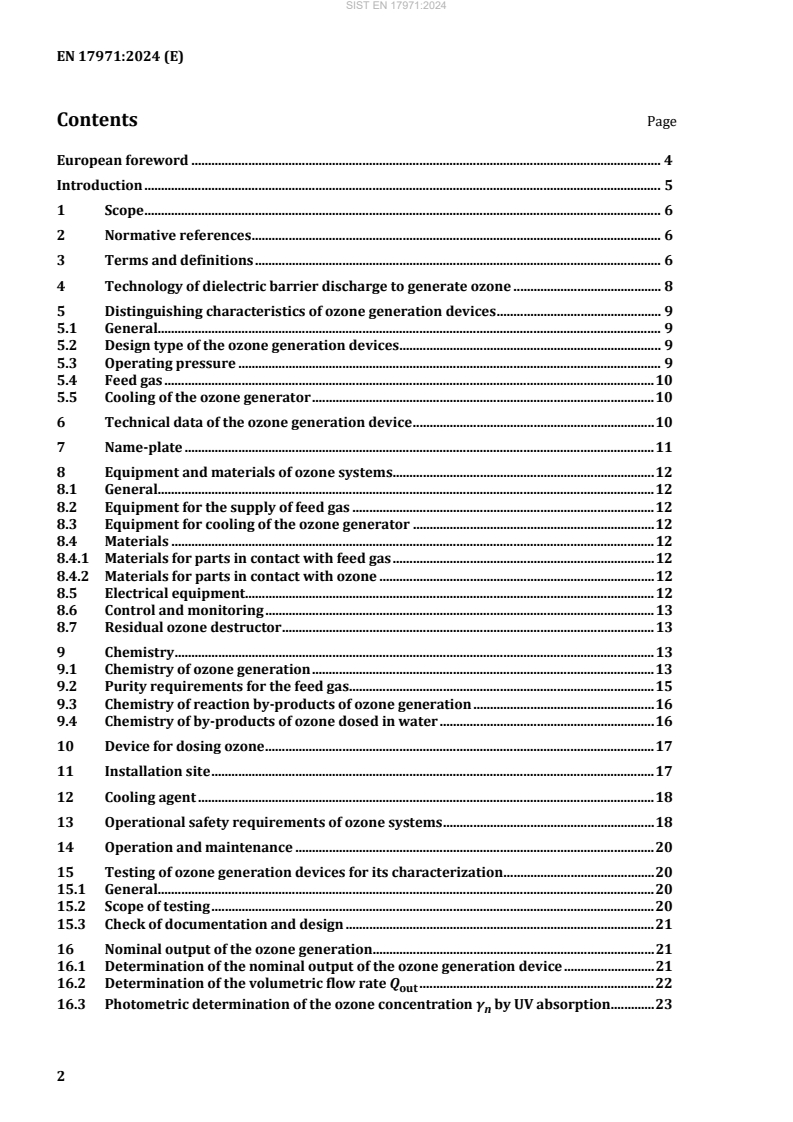
Contents Page
European foreword . 4
Introduction . 5
1 Scope . 6
2 Normative references . 6
3 Terms and definitions . 6
4 Technology of dielectric barrier discharge to generate ozone . 8
5 Distinguishing characteristics of ozone generation devices . 9
5.1 General. 9
5.2 Design type of the ozone generation devices . 9
5.3 Operating pressure . 9
5.4 Feed gas . 10
5.5 Cooling of the ozone generator . 10
6 Technical data of the ozone generation device . 10
7 Name-plate . 11
8 Equipment and materials of ozone systems . 12
8.1 General. 12
8.2 Equipment for the supply of feed gas . 12
8.3 Equipment for cooling of the ozone generator . 12
8.4 Materials . 12
8.4.1 Materials for parts in contact with feed gas . 12
8.4.2 Materials for parts in contact with ozone . 12
8.5 Electrical equipment. 12
8.6 Control and monitoring . 13
8.7 Residual ozone destructor . 13
9 Chemistry . 13
9.1 Chemistry of ozone generation . 13
9.2 Purity requirements for the feed gas . 15
9.3 Chemistry of reaction by-products of ozone generation . 16
9.4 Chemistry of by-products of ozone dosed in water . 16
10 Device for dosing ozone . 17
11 Installation site . 17
12 Cooling agent . 18
13 Operational safety requirements of ozone systems . 18
14 Operation and maintenance . 20
15 Testing of ozone generation devices for its characterization . 20
15.1 General. 20
15.2 Scope of testing . 20
15.3 Check of documentation and design . 21
16 Nominal output of the ozone generation . 21
16.1 Determination of the nominal output of the ozone generation device . 21
16.2 Determination of the volumetric flow rate Q . 22
out
16.3 Photometric determination of the ozone concentration γ by UV absorption. 23
n
16.3.1 Brief description of the method . 23
16.3.2 Procedure and evaluation . 25
16.4 Determination of the ozone concentration γ by titration . 26
n
16.4.1 Brief description . 26
16.4.2 Apparatus . 26
16.4.3 Reagents . 27
16.4.4 Procedure . 27
16.4.5 Evaluation. 29
Annex A (informative) Examples for mixing devices . 30
A.1 Mixing by injector and static mixer. 30
A.2 Multiphase pumps . 31
A.3 Direct injection and static mixer . 31
A.4 Additional mixing methods . 32
Annex B (normative) Methods to determine ozone in water . 34
B.1 DPD Method . 34
B.2 Indigo Method . 34
B.3 potentiometric Method. 35
Annex C (informative) Safety measures to prevent ozone leakages . 36
Bibliography . 38
European foreword
This document (EN 17971:2024) has been prepared by Technical Committee CEN/TC 164“Water
supply”, the secretariat of which is held by AFNOR.
This European Standard shall be given the status of a national standard, either by publication of an
identical text or by endorsement, at the latest by December 2024, and conflicting national standards shall
be withdrawn at the latest by December 2024.
Attention is drawn to the possibility that some of the elements of this document may be the subject of
patent rights. CEN shall not be held responsible for identifying any or all such patent rights.
Any feedback and questions on this document should be directed to the users’ national standards body.
A complete listing of these bodies can be found on the CEN website.
According to the CEN-CENELEC Internal Regulations, the national standards organisations of the
following countries are bound to implement this European Standard: Austria, Belgium, Bulgaria, Croatia,
Cyprus, Czech Republic, Denmark, Estonia, Finland, France, Germany, Greece, Hungary, Iceland, Ireland,
Italy, Latvia, Lithuania, Luxembourg, Malta, Netherlands, Norway, Poland, Portugal, Republic of North
Macedonia, Romania, Serbia, Slovakia, Slovenia, Spain, Sweden, Switzerland, Türkiye and the United
Kingdom.
Introduction
Devices according to this document can be used in different fields of application, e.g. drinking water,
swimming pool water, wastewater, air treatment, surface disinfection, water reuse, irrigation water and
within food and beverage manufacturing, etc. Additional requirements to this document need to be
observed, where appropriate for the specific application.
The in situ generation of active substances, in particular ozone, is subject to the specifications of the
Biocidal Products Regulation (EU) 528/2012 (BPR) [1]. The use of ozone for the purpose of
disinfection/microbiological preservation of water implies compliance with the provisions of the BPR, in
particular access by the user or the device manufacturer to a data set required for the authorization of
ozone under the BPR.
The in situ generation of ozone for non-biocidal applications, e.g. oxidation purposes, is subject to the
specifications of the REACH (Registration, Evaluation, Authorization and Restriction of Chemicals) [2]
Regulation (EC) 1907/2006. The use for non-biocidal purposes implies access by the user to the data set
provided for the authorization of ozone under REACH.
1 Scope
This document is applicable to devices for the generation and dosing of ozone. The ozone is generated in
these devices according to the technology of dielectric barrier discharge. According to EN 1278 and
EN 15074, ozone is suited for the use of the treatment of water intended for human consumption
(drinking water), and for the treatment of swimming pool water respectively. Ozone can be added to the
water for disinfection and for oxidative purposes. This document can also be applied for other
technologies to generate ozone, e.g. electrolysis or UV irradiation, as far as reasonable or applicable.
This document specifies device’s construction, and test methods for the equipment used for in situ
generation of ozone. It also specifies requirements for instructions for installation, operation,
maintenance, safety and for documentation to be provided with the product.
2 Normative references
The following documents are referred to in the text in such a way that some or all of their content
constitutes requirements of this document. For dated references, only the edition cited applies. For
undated references, the latest edition of the referenced document (including any amendments) applies.
EN 12876, Chemicals used for treatment of water intended for human consumption — Oxygen
EN 1278, Chemicals used for treatment of water intended for human consumption — Ozone
EN 15074, Chemicals used for treatment of swimming pool water — Ozone
EN 60529, Degrees of protection provided by enclosures (IP Code)
EN ISO 13849-1, Safety of machinery — Safety-related parts of control systems — Part 1: General principles
for design (ISO 13849-1)
EN ISO 13849-2, Safety of machinery — Safety-related parts of control systems — Part 2: Validation
(ISO 13849-2)
3 Terms and definitions
For the purposes of this document, the following terms and definitions apply.
ISO and IEC maintain terminology databases for use in standardization at the following addresses:
— ISO Online browsing platform: available at https://www.iso.org/obp
— IEC Electropedia: available at https://www.electropedia.org
NOTE In addition, the terminology contained in Article 3 of the BPR [1] is useful for the application of this
document.
3.1
ozone generator
part of the ozone generation device where feed gas is carried through a dielectric barrier discharge field
with the purpose of generating ozone
3.2
ozone generation device
entire device that is necessary for the generation of ozone from the feed gas, including e.g. power supply
and ozone generator
3.3
ozone system
combination of devices which, in addition to the ozone generation device and ozone dosing device, both
described in this document, also comprises devices for the distribution of and reaction with ozone
Note 1 to entry: All ozone exposed equipment or devices, e.g. reaction vessels, pumps, pipes, tanks, residual
ozone destructors, or heat exchangers, are considered as part of the ozone system.
3.4
closed ozone system
ozone system where ozone does not leave the ozone system, or such that only negligible release of ozone
into the building or into the environment occurs
3.5
open ozone system
any system not considered as a closed ozone system according to 3.4
3.6
feed gas
substance that is fed as a gas to the ozone generation device to generate ozone
3.7
dew point
parameter, in °C, to indicate the content of humidity in a gas
Note 1 to entry: The dew point refers to the temperature to which a gas shall be cooled to become saturated with
water vapor, assuming constant air pressure and water content.
Note 2 to entry: When air is cooled below the dew point, its moisture capacity is reduced and airborne water
vapor will condense to form liquid water known as dew. When this occurs via contact with a colder surface, dew
will form on that surface.
3.8
residual ozone destructor
device for the destruction of residual ozone that has not been consumed by the process in the ozone
system and is accumulating in gaseous form in an off-gas flow
Note 1 to entry: The destruction takes places in the gas phase by converting the ozone (O ) into oxygen (O ).
3 2
3.9
normal temperature and pressure of gas
NTP
gas under the conditions of normal temperature t = 0 °C and normal pressure p = 101 325 Pa =
n n
1013,25 hPa
[SOURCE: NIST Standard Reference Data Base 7 Users Guide [3]]
3.10
normal cubic meter
m
n
cubic meter of gas, usually dry, referenced to 1 atmosphere (101 325 Pa) and 0 °C, i.e. to normal
temperature and pressure of gas
3 3
Note 1 to entry: the unit is expressed m . In other documents the unit Nm is sometimes used.
n
[SOURCE: NIST Standard Reference Data Base 7 Users Guide [3]]
3.11
ozone system operating at negative pressure
system where all parts and pipes carrying ozone-containing gas, are under negative pressure from the
ozone generation device up to the mixing device
3.12
ozone system operating at positive pressure
system where all or some parts and pipes, carrying ozone-containing gas, are under positive pressure
from the ozone generation device up to the mixing device
3.13
expert
person who, due to their technical scientific training, work experience and knowledge of applicable
standards and regulations, is able to assess an ozone system with regards to functions and safety
Note 1 to entry: This person can be from the manufacturer or an independent third-party organization (such as
a test institution) without limitations, an inspector according to, EN ISO/IEC 17020 [4] Type C, fulfils this criterion.
3.14
separate lockable installation room
lockable technical room with access for a restricted group of persons, in which the ozone generation
device, and eventually other parts of the ozone system are installed, and furthermore in which other
technical equipment can be installed
3.15
individual installation room
technical room in which only the ozone generation device is installed and operated
Note 1 to entry: term includes also enclosures for installation of the ozone generation device.
4 Technology of dielectric barrier discharge to generate ozone
Dielectric barrier discharge (DBD) is the basis for most of the commercial ozone generators. In practice,
several other terms of the same meaning are in use instead of DBD: silent discharge, silent electrical
discharge, silent arc discharge, corona discharge.
In dielectric barrier discharge, ozone is generated using energy from electrons in an electrical field
between two electrodes. The electrodes are usually two parallel plates or concentric cylinders arranged
with a certain distance to each other to form a single- or a double discharge gap. The electrodes are
isolated from each other by a dielectric (non-conducting) barrier material and the discharge gap, see
Figure 1.
The precursor is ambient air or oxygen gas, also called feed gas. Ozone (O ) is generated from oxygen
(O ) of the feed gas that is piped through the discharge gap, see Figure 1. When the electrical field
generated by the high voltage applied at the electrodes exceeds the insulation field strength of the feed
gas in the discharge gap, the discharge in the feed gas initiates. The discharge creates a current of electric
charged particles, consisting of electrons and ions. In the discharge area, the intended chemical reaction
takes place: 3 O → 2 O (summarized). After a short time, i.e. some microseconds, the discharge current
2 3
is interrupted by the dielectric being polarized by the discharge current, because the polarization of the
dielectric compensates the driving electrical field. As the applied high voltage is an alternating voltage,
the process repeats with opposite sign of the driving electrical field, which has consequently, the moment
the new discharge initiates, the same direction as the electrical field of the dielectric. As before, the
discharge is interrupted when the polarization of the dielectric is inverted and compensates the driving
electrical field. Thus, the alternation of the applied high voltage enables an ongoing process generating
ozone.
The alternation of the applied voltage occurs rapidly. An alternation period is much shorter than the
transition time required for the gas to pass the ozone generator so that the ozone is homogeneously
distributed in the gas leaving the device as ozone output. Consequently, the ozone output of DBD-devices
is constant and without interruption or drops, if the feed gas supply is continuously guaranteed, if the
ambient conditions, e.g. temperature or pressure, are stable, and finally if the high voltage supply runs
constant.
Key
1 electric power supply — alternating voltage
2 inner electrode
3 discharge gap
4 dielectric barrier
5 outer electrode
Figure 1 — Example for ozone generation in an alternating electrical field in a single discharge
gap formed by concentric electrodes and a dielectric barrier
However, the energy of the electric power supply is only partially consumed to generate ozone. The
excess of energy is converted to heat that needs to be dissipated by efficient cooling.
Details of the chemistry of the ozone generation are pointed out in Clause 9 “Chemistry”.
5 Distinguishing characteristics of ozone generation devices
5.1 General
Ozone generation devices are distinguished according to the characteristics of 5.2 to 5.5.
5.2 Design type of the ozone generation devices
Devices of compact or free design, i.e. spatially close grouped or separated installation of equipment
(see Clause 8).
5.3 Operating pressure
Ozone generators may be designed for operation at negative or positive pressure. The size of the ozone
generating elements substantially depends on the operation frequency of the high voltage as well as on
the pressure conditions inside the discharge compartment. Ozone systems can be constructed as ozone
systems operating at negative pressure or at positive pressure according to 3.11 and 3.12 respectively.
In negative pressure systems according to 3.11, the release from the ozone system into the ambient air
of the installation room is physically impossible. This shall be taken into account in the safety assessment.
5.4 Feed gas
The following types of feed gas shall be used as precursor to generate ozone, for purity requirements of
the feed gas see 9.2:
a) ambient air;
b) oxygen.
5.5 Cooling of the ozone generator
Air cooling: convection or forced draft cooling.
Liquid cooling: e.g. water (cooling by direct discharge or by cooling circuit), coolant brine.
6 Technical data of the ozone generation device
The ozone generation device shall be specified by the following technical data, which shall be stated in
the operating instructions:
a) manufacturer or distributor and name of device type/model;
b) name and address of the authorization holder for the product registration ;
NOTE for uses of devices falling under REACH, the operator/user needs access to the REACH-registration for
ozone
c) type of feed gas and pressure range as well as purity/quality requirements;
d) maximum allowable dew point of the feed gas inside the direct supply line to the ozone generator
under normal temperature and pressure, in °C;
e) volumetric flow rate of the feed gas at the direct supply to the ozone generator at normal temperature
and pressure for the nominal output of ozone generation, in m /h;
n
f) type, volumetric flow rate, in l/h or m /h, and temperature, in °C, of the cooling agent and other
quality requirements of the cooling agent;
g) maximum allowable pressure of the cooling agent, in MPa;
h) nominal output of ozone generation, in g/h, at the nominal ozone concentration, in g/m (the
n
volume is related to normal temperature and pressure);
i) setting or control range of ozone generation, in g/h or in % of the nominal output, stepwise or
continuously;
j) operating pressure of the ozone generator; maximum allowable negative or positive pressure, in MPa
;
At the time of publication of this document, the development for labelling the BPR-authorization is under
progress. Hence, this information is not enforced, or included, until this process has been concluded. This is only
applicable for new products if the product is intended for biocidal use.
in MPa [rel], stating negative pressure as a negative numerical value
in MPa [rel], stating negative pressure as a negative numerical value
k) electrical supply data of the ozone generation device: voltage, in V; electric current, in A; apparent
supply power, in VA; and frequency, in Hz;
l) specific energy (for high voltage power supply) (Wh or kWh) to generate 1 g or 1 kg of ozone from
the supplied feed gas at manufacturer specified nominal flow, nominal pressure and at 100 % output
setting of the device (not taken into account: electric power used for pre-treatment of feed gas, etc.
for comparison reasons);
m) principal dimensions of the device, in m or mm;
n) operating weight of the device; in kg;
o) maximum and minimum allowable ambient temperature, in °C, and maximum relative humidity,
in %, inside the installation room.
7 Name-plate
At least the following information shall be given clearly and permanently on a name-plate affixed to the
ozone generation device:
a) manufacturer or distributor, including his address;
b) name and address of the authorization holder for the product registration ;
NOTE For uses of devices falling under REACH, the operator/user needs access to the REACH-registration for
ozone
c) designation of model, series or type;
d) designation of device (e.g. ozone generation device);
e) year of manufacture;
f) type, batch or serial number;
g) CE label;
h) type of feed gas;
i) nominal output of ozone generation, in g/h or kg/h;
j) volumetric flow rate of the feed gas at the measuring point under normal temperature and pressure
for the nominal output of ozone generation, in m /h;
n
k) electrical supply data, in V, A, VA, Hz;
l) allowable operating pressure of the ozone generator, in MPa .
At the time of publication of this document, the development for labelling the BPR-authorization is under
progress. Hence, this information is not enforced, or included, until this process has been concluded. This is only
applicable for new products if the product is intended for biocidal use.
in MPa [rel], stating negative pressure as a negative numerical value
8 Equipment and materials of ozone systems
8.1 General
Ozone systems can include the equipment described in 8.2 to 8.7.
8.2 Equipment for the supply of feed gas
The required equipment is specified according to the type and state of the feed gas that is to be used for
the generation of ozone.
Devices operating with ambient air as feed gas may require equipment to operate with dry air. This type
of equipment comprises an adsorber system, which is filled with a moisture adsorbing material and
through which the feed gas is passed, incorporating upstream or downstream cooling aggregates, if
necessary. The adsorption material should be regenerative. For the operation with dry feed gases (dew
point at normal temperature and pressure below −45 °C) a drying device is required. Depending on the
technical design of the ozone generator, this part of the device will be operated at negative or positive
pressure; the equipment for the gas transport shall be implemented according to this condition.
For devices that are operated with oxygen, additional nitrogen-feeding equipment can be applied.
See 9.2 for more information on feed gas quality.
8.3 Equipment for cooling of the ozone generator
To dissipate the heat that is produced inside the ozone generator during the generation of ozone, cooling
devices are necessary where the heat can be dissipated by means of gases, liquids or radiation.
8.4 Materials
8.4.1 Materials for parts in contact with feed gas
The materials of the equipment shall be suitable for the supply of feed gas. The materials shall be grease-
and oil-free if oxygen is used as the feed gas.
8.4.2 Materials for parts in contact with ozone
Stainless steels, e.g. material numbers 1.4571, 1.4404, 1.4307 (also called SS 316L and SS 304L
respectively); aluminium, e.g. Al 99,8; ceramics or glass, appropriate plastics, e.g. polytetrafluoroethylene
(PTFE) or polyvinylidene fluoride (PVDF) and unplasticized poly(vinyl chloride) (PVC-U) . Concerning
sealing materials, ozone-resistant polymers can be used, e.g. polytetrafluoroethylene (PTFE) and, when
taking into account the conditions of use, also chlorosulphonyl polyethylene (CSM), fluororubber (FPM
or FKM), perfluoroelastomer (FFPM or FFKM), ozone resistant ethylene propylene diene monomer
rubber (EPDM) and ozone resistant silicones.
8.5 Electrical equipment
Electric devices and machinery shall be designed with the minimum degree of protection IP21 according
to EN 60529 if no higher degree of protection is required by the installation site, e.g. IP53. If these devices
and machinery do not provide direct access, IP00 according to EN 60529 is sufficient as long as the
electro-technical safety standard for this type of room is observed.
PVC-U materials used for ozone gas piping without additional safety devices are only suitable for ozone systems
operating at negative pressure, as it is impossible for ozone to escape in the event of a leak. When using PVC-U
piping for ozone gas at positive pressures, additional safety requirements such as leak monitoring may be
required.
8.6 Control and monitoring
The control and monitoring of an ozone generation device and an ozone system shall be easily accessible
and vital parameters clearly labelled. The control and monitoring aims to assist an operator in monitoring
and controlling the ongoing operation as well as providing useful basic information for maintenance
purposes.
Safety requirements for installation and operation shall be in accordance with Clause 13.
Useful control and monitoring parameters for an ozone generation device can be:
a) status of ozone generator device (e.g. OK/Not OK);
b) generator output setting (e.g. 0 % to 100 %, or current ozone output in g/h or kg/h);
c) status of generator cooling (e.g. OK/Not OK, or temperature, or flow rate of cooling agent);
d) feed-gas flow (volumetric or mass flow);
e) feed-gas pressure.
Useful control and monitoring parameters for an ozone system can be:
f) dissolved ozone in water, ORP/Redox value;
g) if used for water treatment, information on ozone dissolution system parameters (e.g. water
pressure, water flow rate, pump operation, etc.).
8.7 Residual ozone destructor
Suited methods to destruct residual ozone are:
a) thermal destruction, e.g. T > 350 °C, t > 2 s;
R
b) catalytic destruction, e.g. Palladium/CuO-MnO;
c) activated carbon, e.g. material manufactured from bituminous coal.
9 Chemistry
9.1 Chemistry of ozone generation
The process of generating ozone through the technology of dielectric barrier discharge (DBD) from the
feed gas, i.e. ambient air or oxygen gas, being the precursor, is quite complex with about 300 reactions
that may have to be considered. Under optimized conditions, the major fraction of the electrodes’ energy
gained in the electric field leads to excited atomic and molecular states of oxygen (feed gases: O and
ambient air) and nitrogen (feed gas: ambient air).
The excited states O * of oxygen O are created and subsequently dissociate according to simplified
2 2
reactions Formula (1) and Formula (2):
− −
O + e → O *+ e (1)
2 2
O * → 2 O (2)
Ozone formation is facilitated through a three-body reaction, Formula (3), with M being a collision
partner: O , O , O, and N in case of ambient air or if N is added.
2 3 2 2
O + O + M → O * + M → O + M (3)
2 3 3
O * is the initial transient excited state of ozone. Its excitation energy needs to be transferred to kinetic
energy of the molecules O and M in order to stabilize the O molecule. The collision partner M is urgently
3 3
required for this process for physical reasons to ensure the conservation of the momentum. N , acting as
“third collision partner”, has the best efficacy to stabilize the O molecule.
When ambient air is used as the feed gas, several nitrogen species such as N*, N *, N, and other excited
atomic, molecular and ionic species increase the complexity of the reaction system. This leads to
additional reactions, involving nitrogen atoms and excited molecular states of N .
Oxygen, which provides the advantage of containing almost five times more oxygen than ambient air, is
often preferred as a feed gas. In industrial applications, it is either delivered in tanks as liquid oxygen
(LOX) or produced (‘concentrated’) on-site from ambient air, usually with pressure swing adsorption
(PSA), vacuum swing adsorption (VSA) or vacuum pressure swing adsorption (VPSA). If the oxygen
precursor does not contain enough nitrogen, some air or nitrogen gas can be added as a make-up gas for
efficient and stable ozone production as the nitrogen acts as a “third collision partner” improving the
ozone generation reaction.
Figure 2 shows a complete process overview for water treatment with ozone generated from oxygen
contained in different feeding gases (feed gas O or feed gas air). For operational safety requirements of
ozone systems see Clause 13, in particular if the ozone decomposition inside the treatment system is
incomplete.
Figure 2 — Ozone generation and water treatment process
Feed gases (air or oxygen) should usually be dry and should not contain particulate matter to avoid
undesired effects on ozone generation. Therefore, ambient air is conditioned by the use of an air dryer
and dust filter before the air is fed to the generator. The dielectric barrier discharge (DBD) method
creates ozone at medium to high concentrations (typically up to ca. 21 % w/w) and is the most often used
technology in industrial applications.
The nominal ozone concentration using clean dry air is typically 20 g ozone per m of process
n
gas = ca. 1,5 % w/w (in practice, this can be up to 70 g/ m = ca. 5,3 % w/w).
n
The nominal ozone concentration using oxygen as a feed gas is typically 100 g per m of process gas = ca.
n
7 % w/w (in practice, this can be up to 300 g/ m = ca. 21 % w/w).
n
The amount of ozone produced and the efficiency of a DBD ozone generator is determined by many
factors: electrode design (electrode geometry, surface area and dielectric material), the applied
voltage/electric power, the quality (dryness and cleanliness) and the type of feed gas (oxygen or air),
pressure of the feed gas inside the gap and temperature/cooling of the generation process:
1) Applied voltage/electric power: The higher the applied voltage/electric power, the higher is the
ozone concentration (g/ m ) and the ozone capacity (g/h).
n
2) Air/oxygen flow rate: the higher the current air/oxygen flow rate, the higher is the ozone output, but
the lower is the ozone concentration in ozone gas.
3) Specific energy: The specific energy is the amount of energy (Wh) required to generate 1 g of ozone.
The specific energy depends in particular on the internal temperature inside the ozone generator.
Operating conditions resulting in an increase of the internal temperature result in an increased
specific energy because more ozone decomposes so that more energy per gram of ozone is required.
Example 1: The specific energy of an ozone generator increases if the cooling equipment operates
insufficient. Example 2: the specific energy of an ozone generator operating at maximum electric
power consumption and generating 100 % of the nominal output can be higher than in case the ozone
generator is operating at reduced electric power consumption and generating less than 100 % of the
nominal output because the amount of heat to be dissipated by the cooling equipment is reduced and
if the internal temperature of the ozone generator is lower.
4) Feed gas pressure: the electrode geometry (especially the gap width) of the generator is optimized
for the operation at intended operation pressure, i.e. at positive or negative pressure (pressure with
respect to atmospheric pressure) to achieve high capacity and high concentration as well as low
specific energy. Typically, the operation at negative pressure is at about −30 hPa to −50 hPa, rel. For
generators designed for operation at positive pressure, the maximum output is mostly at pressures
of around 0,07 MPa to 0,3 MPa, rel (= 0,7 bar to 3,0 bar, rel).
5) Operation frequency of high voltage/power supply: As ozone is being generated at every alternation
of the polarity of the high voltage, the power consumption increases with the operation frequency if
the high voltage is held constant. On the other hand, if the power consumption is held constant by
controlling the high voltage, the ozone capacity as well as the concentration are approximately
independent of the operation frequency in a certain range.
9.2 Purity requirements for the feed gas
To generate ozone with the nominal ozone concentration described in 9.1, the feed gas used for the
generation of the ozone may need a pre-treatment in order to be in compliance with
a) ambient air: typically 21 % oxygen, 78 % nitrogen, free of particulate matter, free of oil (residual oil
(hydrocarbon) content < 0,01 mg/m ). Ambient air can be dried in order to reduce its humidity
before generating ozone from it. Air is considered as dry air, if the residual humidity corresponds to
a dew point below −45 °C at normal temperature and pressure;
b) compressed air: see a);
c) oxygen generated on-site from ambient air using an oxygen generator: ≥ 80 % oxygen, ≤ 20 %
nitrogen, free of particulate matter, free of oil (residual oil content < 0,01 mg/m ), dew point below
−45 °C at normal temperature and pressure, hydrocarbons: max. 50 ppm (according to EN 12876);
d) gaseous oxygen , e.g. from pressurized cylinders, quality according to EN 12876;
e) liquid oxygen (LOX), e.g. from pressure tanks, quality according to EN 12876.
9.3 Chemistry of reaction by-products of ozone generation
In order to generate ozone of sufficient purity, the gas used for the generation of ozone can be purified
mechanically or by adsorption and dried by the equipment inside the ozone generation device. Feed gases
are considered dry below a dew point of −45 °C at normal temperature and pressure.
The purity requirements for feed gas regarding the particle and hydrocarbon content, as well as the
requirements regarding the dew point, shall be fulfilled as described in 9.2, and as stated by the
manufacturer of the ozone generation device.
The generation of ozone from air inevitably produces small amounts of the nitrogen oxides N O and N O .
2 2 5
The involved transient nitrogen oxides NO, NO and NO react with the ozone forming dinitrogen
2 3
pentoxide (N O ).
2 5
Nitrous oxide (N O) also known as laughing gas is considered a non-toxic non-flammable gas that is very
stable and exhibits no chemical activity at room temperature.
If not or insufficiently dried air is used, N O will react with the water that is present due to the humidity
2 5
level to form nitric acid (HNO ) [5] [6].
O + H O → 2 HNO (4)
N
2 5 2 3
The nitric acid itself can accumulate inside the ozone generator and cause corrosion. The formation of
nitric acid will be effectively inhibited by the use of dried air. Furthermore, by drying the air, the energy
demand for the generation of ozone decreases.
Adding e.g. 0,1 % to 2,0 % nitrogen (N ) when generating ozone from pure oxygen will improve the ozone
yield, as pointed out in Formula (3). In particular, for devices with a high output, the additional step of
adding nitrogen can be beneficial from an economic perspective.
9.4 Chemistry of by-products of ozone dosed in water
When introducing ozone to the water that is to be treated, the small amounts of produced nitrogen oxides
will also be transferred to the water. According to Formula (4), the water quickly forms small
−
concentrations of nitrate ( NO ).
Example: ozone gas contains up to 1 % w/w of N O [5], adding 1 mg/l of O to water results in adding
2 5 3
of up to 0,01 mg/l of N O . According to Formula (4), adding 0,01 mg/l (equals to 10 µg/l) of N O results
2 5 2 5
−
in forming 11,5 µg/l of nitrate ( NO ) in the water. In good practice, the amount of nitrogen oxides,
including nitric acid, expressed as N O in the ozone gas is less than 5 mg/g ozone equals to 0,5 % w/w
2 5
(EN 1278).
Furthermore, ozone can react with ingredients of the treated water. The possible reactions depend on
the individual specific properties of water, e.g. composition, pH or temperature. Beside intended
Purity requirement applies only for oxygen not being placed on the market as biocidal product according to the
provisions of the BPR.
reactions with ozone, by-products formed by unintended ozone reactions may be subject of
consideration.
−
Example bromide: Bromide (Br ) is present in all water sources at concentrations ranging from ~10 µg/L
to > 1 000 µg/L in fresh waters and about 67 mg/L in seawater. The ozonation of bromide containing
water generally for
...