

oSIST prEN 1254-2:2007
(Main)Copper and copper alloys - Plumbing fittings - Part 2: Fittings with compression ends for use with copper tubes
General Information
- Abstract
This European Standard specifies materials and test requirements for fittings of copper and copper alloys with or without plating or coating.
- Status
- Not Published
- Public Enquiry End Date
- 18-Jul-2007
- Technical Committee
- INEK - Nonferrous metals
- Current Stage
- 98 - Abandoned project (Adopted Project)
- Start Date
- 02-Jun-2020
- Due Date
- 07-Jun-2020
- Completion Date
- 02-Jun-2020



Overview
oSIST prEN 1254-2:2007 is a crucial European Standard developed by CEN focusing on copper and copper alloy plumbing fittings designed with compression ends for use with copper tubes. This standard specifies the materials, manufacturing, and rigorous testing requirements for these fittings, ensuring their suitability for plumbing applications involving hot, cold, or combined water systems as well as gas distribution such as natural gas and liquefied petroleum gas (LPG).
The standard covers compression fittings ranging in size from 6 mm to 108 mm, supporting seamless copper tubes compliant with EN 1057 and pre-insulated copper tubes as per EN 13349. It establishes a harmonized framework for product conformity, performance, and quality control, addressing essential health, safety, and environmental considerations in plumbing systems across Europe.
Key Topics
Materials and Composition
The standard mandates the use of copper or copper alloy materials, either with or without plating or coating, ensuring corrosion resistance and compatibility with potable water and gas applications. It also addresses resistance to dezincification and stress corrosion.Types of Compression Ends
- Type A: Compression ends requiring no tube end forming, with sealing achieved by compressing a ring or sleeve around the tube.
- Type B: Compression ends involving tube end forming before joint compression for enhanced sealing reliability.
Operating Conditions
Defines permissible operating temperatures and maximum operating pressures for fittings, critical for safety and performance in plumbing and gas piping systems.Design, Manufacture, and Testing
Incorporates strict requirements for design tolerances, bore area, alignment, and manufacturing processes. Comprehensive initial type testing (ITT) and ongoing factory production control (FPC) ensure conformity and long-term reliability.Marking and Documentation
Specifies requirements for permanent and durable product markings for traceability throughout the product lifecycle. Also details obligatory documentation including declarations of conformity and user instructions.Test Methods
Extensive normative annexes cover tests such as:- Leak-tightness under hydrostatic, pneumatic, and vacuum conditions
- Resistance to pull-out and temperature cycling
- Stress corrosion and dezincification resistance
- Performance of welded, brazed, or cast fitting bodies
These tests validate safety and durability under realistic operating scenarios.
Applications
oSIST prEN 1254-2:2007 is essential for manufacturers, installers, and regulators involved in the design, production, certification, and installation of copper compression fittings in various plumbing and gas systems:
Residential and Commercial Plumbing
Compression fittings complying with this standard guarantee safe, leak-tight joints for hot and cold water distribution systems.Heating and Cooling Systems
Ensures reliable connections that tolerate temperature fluctuations and pressure variations inherent in HVAC installations.Natural Gas and LPG Supply
Supports fittings designed for safe transport of combustible gases within regulated pressure limits, conforming to EN 437 and related standards.Quality Assurance in Manufacturing
Provides a basis for factory production control systems aligned with EN ISO 9001, facilitating conformity assessment and regulatory compliance.European Market Compliance
Harmonized with the Construction Product Directive (CPD) and related EU regulations, enabling free trade and standardized safety levels throughout the EU.
Related Standards
To maintain comprehensive compliance and ensure interoperability, oSIST prEN 1254-2:2007 should be considered alongside the following related standards:
- EN 1057 – Seamless copper tubes for water and gas installations
- EN 13349 – Pre-insulated copper tubes with solid covering
- EN 1254 Series – Other parts covering soldered, brazed, threaded, push-fit, and press-end fittings
- EN 549, EN 681-1, EN 682 – Elastomeric seals for water and gas applications
- EN 437 – Test gases and appliance categories for gas installations
- EN ISO 9001 – Quality management systems requirements
- EN 1655 – Declarations of conformity for copper and copper alloy fittings
- EN 1775 – Functional recommendations for gas pipework in buildings
Conclusion
oSIST prEN 1254-2:2007 is a comprehensive European Standard that ensures high-quality, reliable compression fittings employing copper and copper alloys for plumbing and gas systems. By specifying material criteria, testing regimes, and manufacturing controls, it helps secure safe, durable joints capable of performing under diverse operating conditions. Firms manufacturing or utilizing copper compression fittings will benefit from adherence to this standard to meet European regulatory requirements, quality expectations, and safety benchmarks.
Keywords: copper plumbing fittings, copper alloy compression fittings, copper tubes, plumbing standards, EN 1254-2, compression end connections, gas fittings, water system fittings, European standard copper fittings, plumbing materials testing, copper tube connections, factory production control, CE marking copper fittings, fit-for-purpose plumbing components.
Relations
- Referred By
SIST EN ISO 10380:2013 - Pipework - Corrugated metal hoses and hose assemblies (ISO 10380:2012) - Effective Date
- 28-Jan-2026
- Effective Date
- 28-Jan-2026
- Effective Date
- 28-Jan-2026
- Effective Date
- 28-Jan-2026
- Effective Date
- 28-Jan-2026
- Effective Date
- 28-Jan-2026
- Referred By
SIST EN ISO 14555:2014 - Welding - Arc stud welding of metallic materials (ISO 14555:2014) - Effective Date
- 28-Jan-2026
- Effective Date
- 28-Jan-2026
- Effective Date
- 28-Jan-2026
- Effective Date
- 28-Jan-2026
- Effective Date
- 28-Jan-2026
- Effective Date
- 28-Jan-2026
- Referred By
SIST EN ISO 14555:2007 - Welding - Arc stud welding of metallic materials (ISO 14555:2006) - Effective Date
- 28-Jan-2026
- Effective Date
- 28-Jan-2026
- Effective Date
- 28-Jan-2026
Get Certified
Connect with accredited certification bodies for this standard

Element Materials Technology
Materials testing and product certification.

Inštitut za kovinske materiale in tehnologije
Institute of Metals and Technology. Materials testing, metallurgical analysis, NDT.
Institut za varilstvo d.o.o. (Welding Institute)
Slovenia's leading welding institute since 1952. ISO 3834, EN 1090, pressure equipment certification, NDT personnel, welder qualification. Only IIW Au
Sponsored listings
Frequently Asked Questions
oSIST prEN 1254-2:2007 is a draft published by the Slovenian Institute for Standardization (SIST). Its full title is "Copper and copper alloys - Plumbing fittings - Part 2: Fittings with compression ends for use with copper tubes". This standard covers: This European Standard specifies materials and test requirements for fittings of copper and copper alloys with or without plating or coating.
This European Standard specifies materials and test requirements for fittings of copper and copper alloys with or without plating or coating.
oSIST prEN 1254-2:2007 is classified under the following ICS (International Classification for Standards) categories: 23.040.40 - Metal fittings; 77.150.30 - Copper products. The ICS classification helps identify the subject area and facilitates finding related standards.
oSIST prEN 1254-2:2007 has the following relationships with other standards: It is inter standard links to SIST EN ISO 10380:2013, SIST EN 16436-2:2019, SIST EN 13942:2009, SIST EN 1213:2000, SIST EN ISO 17660-2:2007, SIST EN ISO 15614-7:2020, SIST EN ISO 14555:2014, SIST EN ISO 15614-7:2007, SIST EN ISO 10434:2004, SIST EN ISO 3834-5:2015, SIST EN ISO 17292:2016, SIST EN ISO 15614-8:2016, SIST EN ISO 14555:2007, SIST EN ISO 17641-2:2016, SIST EN ISO 14723:2009. Understanding these relationships helps ensure you are using the most current and applicable version of the standard.
oSIST prEN 1254-2:2007 is associated with the following European legislation: EU Directives/Regulations: 305/2011, 89/106/EEC; Standardization Mandates: M/131. When a standard is cited in the Official Journal of the European Union, products manufactured in conformity with it benefit from a presumption of conformity with the essential requirements of the corresponding EU directive or regulation.
oSIST prEN 1254-2:2007 is available in PDF format for immediate download after purchase. The document can be added to your cart and obtained through the secure checkout process. Digital delivery ensures instant access to the complete standard document.
Standards Content (Sample)
SLOVENSKI STANDARD
01-junij-2007
Baker in bakrove zlitine - Fitingi - 2. del: Fitingi za spajanje z bakrenimi cevmi s
stiskanjem
Copper and copper alloys - Plumbing fittings - Part 2: Fittings with compression ends for
use with copper tubes
Kupfer und Kupferlegierungen - Fittings - Teil 2: Klemmverbindungen für Kupferrohre
Ta slovenski standard je istoveten z: prEN 1254-2
ICS:
23.040.40 Kovinski fitingi Metal fittings
77.120.30 Baker in bakrove zlitine Copper and copper alloys
2003-01.Slovenski inštitut za standardizacijo. Razmnoževanje celote ali delov tega standarda ni dovoljeno.
EUROPEAN STANDARD
DRAFT
prEN 1254-2
NORME EUROPÉENNE
EUROPÄISCHE NORM
May 2007
ICS 23.040.40 Will supersede EN 1254-2:1998
English Version
Copper and copper alloys - Plumbing fittings - Part 2: Fittings
with compression ends for use with copper tubes
Kupfer und Kupferlegierungen - Fittings - Teil 2:
Klemmverbindungen für Kupferrohre
This draft European Standard is submitted to CEN members for enquiry. It has been drawn up by the Technical Committee CEN/TC 133.
If this draft becomes a European Standard, CEN members are bound to comply with the CEN/CENELEC Internal Regulations which
stipulate the conditions for giving this European Standard the status of a national standard without any alteration.
This draft European Standard was established by CEN in three official versions (English, French, German). A version in any other language
made by translation under the responsibility of a CEN member into its own language and notified to the CEN Management Centre has the
same status as the official versions.
CEN members are the national standards bodies of Austria, Belgium, Bulgaria, Cyprus, Czech Republic, Denmark, Estonia, Finland,
France, Germany, Greece, Hungary, Iceland, Ireland, Italy, Latvia, Lithuania, Luxembourg, Malta, Netherlands, Norway, Poland, Portugal,
Romania, Slovakia, Slovenia, Spain, Sweden, Switzerland and United Kingdom.
Recipients of this draft are invited to submit, with their comments, notification of any relevant patent rights of which they are aware and to
provide supporting documentation.
Warning : This document is not a European Standard. It is distributed for review and comments. It is subject to change without notice and
shall not be referred to as a European Standard.
EUROPEAN COMMITTEE FOR STANDARDIZATION
COMITÉ EUROPÉEN DE NORMALISATION
EUROPÄISCHES KOMITEE FÜR NORMUNG
Management Centre: rue de Stassart, 36 B-1050 Brussels
© 2007 CEN All rights of exploitation in any form and by any means reserved Ref. No. prEN 1254-2:2007: E
worldwide for CEN national Members.
prEN 1254-2:2007 (E)
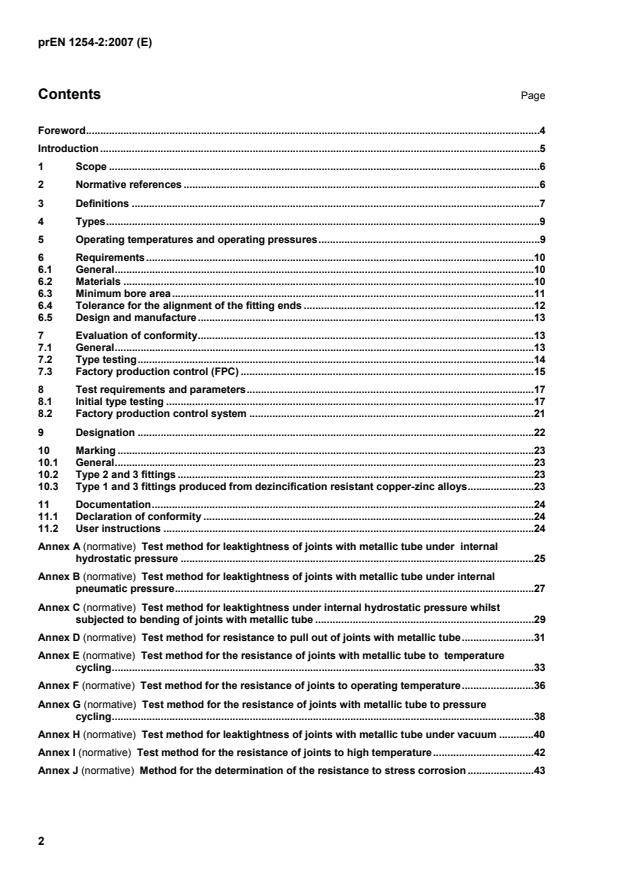
Contents Page
Foreword.4
Introduction .5
1 Scope .6
2 Normative references .6
3 Definitions .7
4 Types.9
5 Operating temperatures and operating pressures.9
6 Requirements.10
6.1 General.10
6.2 Materials .10
6.3 Minimum bore area.11
6.4 Tolerance for the alignment of the fitting ends .12
6.5 Design and manufacture.13
7 Evaluation of conformity.13
7.1 General.13
7.2 Type testing.14
7.3 Factory production control (FPC) .15
8 Test requirements and parameters.17
8.1 Initial type testing .17
8.2 Factory production control system .21
9 Designation .22
10 Marking .23
10.1 General.23
10.2 Type 2 and 3 fittings .23
10.3 Type 1 and 3 fittings produced from dezincification resistant copper-zinc alloys.23
11 Documentation.24
11.1 Declaration of conformity .24
11.2 User instructions .24
Annex A (normative) Test method for leaktightness of joints with metallic tube under internal
hydrostatic pressure .25
Annex B (normative) Test method for leaktightness of joints with metallic tube under internal
pneumatic pressure.27
Annex C (normative) Test method for leaktightness under internal hydrostatic pressure whilst
subjected to bending of joints with metallic tube .29
Annex D (normative) Test method for resistance to pull out of joints with metallic tube.31
Annex E (normative) Test method for the resistance of joints with metallic tube to temperature
cycling.33
Annex F (normative) Test method for the resistance of joints to operating temperature.36
Annex G (normative) Test method for the resistance of joints with metallic tube to pressure
cycling.38
Annex H (normative) Test method for leaktightness of joints with metallic tube under vacuum .40
Annex I (normative) Test method for the resistance of joints to high temperature.42
Annex J (normative) Method for the determination of the resistance to stress corrosion .43
prEN 1254-2:2007 (E)
Annex K (normative) Test method for fittings bodies with as-cast microstructure or fabricated by
welding or brazing under pressure .44
Annex L (normative) Method for the determination of the mean depth of dezincification .46
Annex ZA (informative) Clauses of this European Standard addressing the provisions of the EU
Construction Products Directive (CPD) 89/106/EEC.48
Bibliography.55
prEN 1254-2:2007 (E)
Foreword
This document (prEN 1254-2:2007) has been prepared by Technical Committee CEN/TC 133 “Copper and
copper alloys”, the secretariat of which is held by DIN.
This document is currently submitted to the CEN Enquiry.
This document will supersede EN 1254-2:1998.
Within its programme of work, Technical Committee CEN/TC 133 requested CEN/TC 133/WG 8 "Fittings" to
prepare the revision of the following standard:
EN 1254-2:1998, Copper and copper alloys — Plumbing fittings — Part 2: Fittings with compression ends for
use with copper tubes
This document has been prepared under a mandate given to CEN by the European Commission and the
European Free Trade Association, and supports essential requirements of EU Directives.
For relationship with EU Directives, see informative Annex ZA, which is an integral part of this document.
In comparison with the first edition of EN 1254-2:1998, the following significant technical changes were made:
harmonization of the standard to the Construction Product Directive (CPD);
introduction of new definitions: “maximum operating pressure (MOP)”, "durably marked”, "permanently
marked", “initial type test (ITT)”, and “factory production control (FPC)”;
due to the process of harmonization to the CPD, introduction of three new characteristics in Clause 6
Material characteristics inherent to copper material which are not to be tested;
text in Clause 7 Evaluation of conformity added due to the process of harmonization to the CPD;
for permanent and durable markings, specification of their applicability in Clause 9 Marking;
improved presentation of test methods; in annexes;
due to the process of harmonization to the CPD, introduction of Annex ZA.
This Standard for fittings of copper and copper alloys for joining metallic tubes or plastics pipes is in seven parts.
The other parts are:
— Part 1: Fittings with ends for capillary soldering or capillary brazing to copper tubes
— Part 3: Fittings with compression ends for use with plastics pipes
— Part 4: Fittings with threaded end connections
— Part 5: Fittings with short ends for capillary brazing to copper tubes
— Part 6: Fittings with push-fit ends
— Part 7: Fittings with press ends for metallic tubes
prEN 1254-2:2007 (E)
Introduction
Products in conformity with this part of this standard are considered suitable for drinking water applications
subject to either:
1) compliance with any national regulations in the country of intended destination, or
2) compliance in due course with the proposed European Acceptance Scheme (EAS) that will introduce
common EU requirements for testing for fitness for contact with drinking water. When the EAS is imple-
mented, this part of the Standard shall have added to it a special Annex (Z/EAS) to incorporate the provi-
sions of the EC Mandate M 136 and 1) will no longer be applicable.
This part of this European Standard provides the basis for the assessment of a manufacturer’s production
process for products manufactured in accordance with this standard. The assessment could be based on ini-
tial and continuing surveillance of the factory production control system, which could be concurrent with an
assessment of the manufacturer’s quality management system against EN ISO 9001.
Regulatory marking and the means by which regulatory marking is applied is dealt with in Annex ZA.
prEN 1254-2:2007 (E)
1 Scope
This European Standard specifies materials and test requirements for fittings of copper and copper alloys with
or without plating or coating.
This part of EN 1254 specifies compression end connections in the size range 6 mm to 108 mm for the
purpose of joining copper tubes intended for use in hot or cold or combined hot and cold water, heating and
cooling systems, natural gas and liquefied petroleum gas systems.
Permissible operating temperatures and maximum operating pressures are also established.
This standard is applicable to compression fittings for joining the following tubes:
Copper tubes to EN 1057;
Pre-insulated copper tubes to EN 13349.
Fittings may also be suitable for joining other tubes provided the compression fitting joint with the specified
tube meets the requirements of this standard.
Fittings may comprise a combination of end types, specified in this standard, EN 1254, or other standards,
providing they are suitable for the fluid/gas being conveyed.
The standard establishes a designation system for the fittings.
2 Normative references
The following referenced documents are indispensable for the application of this document. For dated refer-
ences, only the edition cited applies. For undated references, the latest edition of the referenced document
(including any amendments) applies.
EN 437, Test gases — Test pressures — Appliance categories
EN 549, Elastomeric materials for seals and diaphragms for gas appliances and gas systems
EN 681-1, Elastomeric seals — Materials requirements for pipe joint seals used in water and drainage appli-
cations — Part 1: Vulcanised rubber
EN 682, Elastomeric seals — Materials requirements for seals used in pipes and fittings carrying gas and
hydrocarbon fluids
EN 1057, Copper and copper alloys — Seamless, round copper tubes for water and gas in sanitary and heating
applications
EN 1254-1, Copper and copper alloys — Plumbing fittings — Part 1: Fittings with ends for capillary soldering or
capillary brazing to copper tubes
EN 1254-3, Copper and copper alloys — Plumbing fittings — Part 3: Fittings with compression ends for use with
plastics pipes
EN 1254-4, Copper and copper alloys — Plumbing fittings — Part 4: Fittings combining other end connections
with capillary or compression ends
EN 1254-5, Copper and copper alloys — Plumbing fittings — Part 5: Fittings with short ends for capillary brazing
to copper tubes
prEN 1254-2:2007 (E)
prEN 1254-6, Copper and copper alloys — Plumbing fittings — Part 6: Fittings with push-fit ends
prEN 1254-7, Copper and copper alloys — Plumbing fittings — Part 7: Fittings with press ends for metallic
tubes
EN 1655, Copper and copper alloys — Declarations of conformity
EN 1775, Gas supply — Gas pipework for buildings — Maximum operating pressure ≤ 5 bar — Functional
recommendations
EN 13349, Copper and copper alloys — Pre-insulated copper tubes with solid covering
EN 14905, Copper and copper alloys — Plumbing fittings — Recommended practice for the installation of
copper and copper alloy plumbing fittings
EN ISO 6509:1995, Corrosion of metals and alloys — Determination of dezincification resistance of brass
(ISO 6509:1981)
EN ISO 9001:2000, Quality management systems — Requirements
ISO 6957:1988, Copper alloys — Ammonia test for stress corrosion resistance
ISO 9924-1, Rubber and rubber products — Determination of the composition of vulcanizates and uncured
compounds by thermogravimetry — Part 1: Butadiene, ethylene-propylene copolymer and terpolymer, iso-
butene-isoprene, isoprene and styrene-butadiene rubbers
NOTE Informative references to documents used in the preparation of this standard, and cited at the appropriate
places in the text, are listed in the Bibliography.
3 Definitions
For the purposes of this standard, the following definitions apply.
3.1
plumbing fitting
device used in a tube system for the purpose of connecting the tubes either to each other or to a component
part of the system
3.2
compression end
end in which the joint is made by the compression of a ring or sleeve on the outside wall of the tube
3.2.1
compression end, Type A
end that requires no preparation of the ends of the tube other than that they are cut square and deburred, or
chamfered when specified, and in which the joint is made by the compression of a ring or sleeve onto the out-
side wall of the tube with or without additional sealing elements and with or without an internal tube support
NOTE The sealing element may be metallic or non-metallic.
3.2.2
compression end, Type B
end that requires forming of the tube at its end, and in which the joint is made by compressing the formed por-
tion of the tube against the formed end of the fitting or a loose ring or sleeve within the fitting/tube
prEN 1254-2:2007 (E)
3.3
reducer (compression end for copper tube)
component or components used to enable a compression end to connect tube of a smaller nominal diameter
than the nominal diameter of the fitting end
3.4
adaptor fitting
fitting combining more than one type of end
NOTE For details of other ends, see the relevant parts of this standard or other standards.
3.5
nominal diameter
nominal diameter of a fitting end expressed as the nominal outside diameter of the connecting tube
3.6
fuel gas
combustible gases which are gaseous at 15 °C and 1 013 mbar and are generally odorized for safety reasons,
are commonly referred to as manufactured gas, natural gas or liquefied petroleum gases (LPG)
NOTE They are also referred to as first, second or third family gases (see EN 437:1993, Table 1).
3.7
maximum operating pressure
MOP
maximum operating pressure at which pipework can be operated under normal operating conditions
3.8
durably marked
marked in such a way that the marking will remain readable at least up to the time of commissioning of the
installation
NOTE Marked e.g. by ink marking.
3.9
permanently marked
marked in such a way that the marking will remain readable up to the end of the life of the installation
NOTE Marked e.g. by stamping, etching or engraving.
3.10
initial type test
ITT
complete set of tests or other procedures described in the technical specification, determining the perform-
ance of samples of products representative of the product type
NOTE Other procedures e.g. calculation.
3.11
factory production control
FPC
means by which a manufacturer ensures that the performances declared by the manufacturer (obtained from
ITT) continue to be valid for all subsequent products
prEN 1254-2:2007 (E)
4 Types
There are three types of compression fitting ends depending on the medium with which they are suitable for
use, as shown in Table 1.
Table 1 — Types of fitting ends
Type Medium used
1 Water
2 Fuel gas
3 Water and fuel gas
5 Operating temperatures and operating pressures
Operating temperatures and operating pressures for assembled joints shall not exceed the values in Tables 2,
3 or 4 according to classification and medium.
Table 2 — Operating temperatures and operating pressures for Type 1 and Type 3 fitting ends with
metallic sealing elements when used with water
Operating
Fitting size and maximum water operating pressure (MOP)
temperature
bar
°C
6 mm to 15 mm > 15 mm to 28 mm > 28 mm to 54 mm > 54 mm to 108 mm
95 25 16 13 10
NOTE 1 Certain designs of compression fitting ends are suitable for use at temperature/pressure ratings outside
those given in this table. For such applications, the advice of the manufacturer should be sought.
NOTE 2 To allow for system malfunctions, fittings shall be capable of temporary excursions up to a temperature of
110 °C at a pressure of 10 bar.
Table 3 — Operating temperatures and operating pressures for Type 2 and Type 3 fitting ends when
used with gas
Maximum operating pressure for nominal diameters
Operating temperature
from 6 mm up to and including 54 mm
°C
bar
MOP 5 MOP 1
– 20 to + 70 5 1
prEN 1254-2:2007 (E)
6 Requirements
6.1 General
Fittings, including reducers, shall conform to the requirements of 6.2 to 6.5
6.2 Materials
6.2.1 General
Fittings bodies shall be made from copper or copper alloys selected from materials either:
specified in European copper and copper alloy product standards; or
registered by CEN/TC 133;
provided that the fittings manufactured from them meet the functional requirements of this standard.
NOTE Some of the standardized coppers and copper alloys commonly used for the manufacture of fittings are shown
in Table 4. Details of registered alloys can be obtained from the CEN/TC 133 Secretariat.
Table 4 — Examples of commonly used materials
Material designation
Standard
Symbol Number
Cu-DHP CW024A EN 12449
CuSn5Zn5Pb5-C CC491K EN 1982
CuZn36Pb2As CW602N EN 12164
CuZn39Pb3 CW614N EN 12164
CuZn40Pb2 CW617N EN 12165
CuZn33Pb2-C CC750S EN 1982
CuZn15As-C CC760S EN 1982
NOTE This table do not constitute an exhaustive list.
Other components can be made from metallic or non-metallic materials, provided that they do not prevent the
fitting meeting the functional requirements of this standard and do not cause degradation of the connected
tube.
Non-metallic sealing elements for Type 1 and Type 3 fitting ends for water applications shall conform to the
requirements for elastomeric materials in EN 681-1 and Table 5 of this standard.
prEN 1254-2:2007 (E)
Table 5 — Non metallic sealing elements when used in Type 1 or Type 3 fittings — additional
requirements and tests
No. Test procedures
Tear strength in accordance with EN 681-1, Table 3.
1 This requirement applies to all elastomeric sealing materials for water applications.
Minimum tear strength: > 20 N
Thermogravimetric analysis for identity testing of elastomeric materials for water applications.
The TGA is carried out in accordance with ISO 9924-1.
Frequency of test — the TGA shall be carried out at the initial type testing stage to produce the
master graph. Further analysis will be made to compare the production to the master curve at a
frequency of once per year thereafter.
Non-metallic sealing elements for Type 2 and Type 3 fitting ends for use with gas shall conform to the
requirements for elastomeric materials in EN 549 and Table 6 of this standard.
Table 6 — Sealing elements for Type 2 and Type 3 fittings — additional requirements and tests
Test procedures
Ozone resistance testing and requirements in accordance with EN 549, 7.8 and 6.2, Table 3.
Requirement — no cracks
Material identity.
Infrared spectra.
The elastomer and the seal shall meet EN 549, Annex B.2 requirements for infrared spectra.
Frequency of test — the test shall be carried out at the initial type testing stage to produce the master
graph. Further analysis will be made to compare the production to the master graph at a frequency of once
per year thereafter.
Products intended for use in drinking water applications shall meet the requirements of the European Accep-
tance Scheme (EAS).
In the absence of the EAS, national requirements apply.
6.2.2 Safety in case of fire — Reaction to fire
Products which consist of copper or copper alloys are products/materials that do not require to be tested for
reaction to fire (i.e. products/materials of Class A.1 according to Commission Decision 96/603/EC, as
amended 2000/605/EC).
6.2.3 Properties at high temperature
The mechanical properties of products which consist of copper or copper alloys at temperatures encountered
in heating networks are not reduced significantly; for example, no adjustment to maximum admissible stress in
pressure calculations would be necessary for temperatures from ambient up to 110 °C.
Elastomeric seals shall conform to the requirements of EN 681-1, Table 3 for continuous temperatures up to
110 °C.
6.3 Minimum bore area
The minimum cross-sectional area of the bore through each fitting, excluding any internal support, shall be not
less than the theoretical minimum area of the bore given in Table 7, except that for unequal-ended or adaptor fit-
tings with ends specified in EN 1254, or other standards, the smallest diameter shall apply provided that this di-
ameter does not restrict other outlets.
prEN 1254-2:2007 (E)
Table 7 — Minimum bore diameter
Dimensions in millimetres
Nominal diameter
Minimum bore diameter
D
6 4,0
8 6,0
10 7,0
12 9,0
14 10,0
14,7
11,0
16 12,0
18 14,0
18,0
25 21,0
27,4
23,0
29,0
40 35,0
40,5
36,0
53,6
47,0
64 55,0
66,7 57,0
70 60,0
76,1 65,0
80 68,0
88,9 76,0
108 92,0
6.4 Tolerance for the alignment of the fitting ends
The alignment of the ends of the fitting shall be within 2° of the specified axis.
prEN 1254-2:2007 (E)
6.5 Design and manufacture
Joints with seals shall be designed to meet the expected lifetime of a building or to the first expected renova-
tion period of the building.
The tightness of the joint, on the grounds of actual technical knowledge, is presumed to be capable of main-
taining required performance over a period of at least 50 years under the influence of foreseeable actions and
normal maintenance to fulfil the essential requirements, if the joint itself is in conformity with the requirements
of this standard.
6.5.1 Compression fittings, Type A
Compression fittings, Type A, are suitable for use with copper tubes to EN 1057 in all temper conditions.
NOTE Compression fittings, Type A, will possibly require an internal support when used with R220 (annealed) copper
tube and the manufacturer’s advice should be sought.
6.5.2 Compression fittings, Type B
Compression fittings, Type B, are suitable for use with R220 (annealed) or R250 (half-hard) copper tube to
EN 1057.
NOTE Compression fittings, Type B, may be suitable for use with R290 (hard) copper tube and the manufacturer’s
advice should be sought.
6.5.3 Tube abutment
Fitting ends are usually manufactured with an abutment to limit tube insertion.
Fittings may be produced for special purposes, particularly useful for repairs, where the fitting ends do not in-
corporate abutments, allowing for the fitting to slide along the tube.
6.5.4 Tightening systems
Shapes for transmitting tightening torques are required on compression nuts and straight bodies.
6.5.5 Surface condition
Fittings shall be clean and free from sharp edges.
6.5.6 Plated or coated surfaces
Requirements for plated or coated surfaces shall be the subject of agreement between the purchaser and the
manufacturer and shall not impair the performance of the joint.
7 Evaluation of conformity
7.1 General
The conformity of plumbing fittings to the requirements of this standard and with the stated values shall be
demonstrated by:
initial type testing;
factory production control by the manufacturer, including product assessment.
prEN 1254-2:2007 (E)
For the purposes of testing, plumbing fittings may be grouped into families, where it is considered that the se-
lected property/properties is/are common to all the fittings within that family.
7.2 Type testing
7.2.1 Initial type testing
7.2.1.1 General
An initial type test is the complete set of tests or other procedures, determining the performance of samples of
products representative of the product type.
Initial type testing shall be performed to show conformity with this standard.
7.2.1.2 Requirements
All requirements in Clause 6 and Subclause 8.1 shall be subject to initial type testing. The metallic material
characteristics in Subclauses 6.2.2 and 6.2.3 do not need testing because:
reaction to fire – copper and copper alloys are class A.1 according to Commission Decision 96/603/EC;
properties at high temperature – mechanical properties are not reduced significantly at temperatures con-
cerned.
release of regulated (dangerous included) substances — copper or copper alloys standardized or regis-
tered by CEN/TC 133 involve no regulated (dangerous included) substances.
7.2.1.3 Use of historical data
Tests previously performed on fittings of the same design and dimension in accordance with the provisions of
this standard (same characteristic(s), test method, sampling procedure, system of attestation of conformity,
etc.) may be taken into account.
7.2.1.4 Further type testing
Whenever a change occurs in the fitting design, the raw material or supplier of the components, or the produc-
tion process (subject to the definition of a family), which would change significantly one or more of the charac-
teristics, the type tests shall be repeated for the appropriate characteristic(s).
7.2.2 Sampling, testing and conformity criteria
7.2.2.1 Sampling
Initial type testing shall be performed on representative samples of plumbing fittings production.
7.2.2.2 Testing and conformity criteria
Plumbing fittings shall be tested for conformity to the requirements and characteristics listed in Clauses 6 and
8 in accordance with the relevant methods given in Annexes A to L.
The results of all type tests shall be recorded and held by the manufacturer for at least 5 years after the end of
production of the product for which the ITT is representative.
prEN 1254-2:2007 (E)
7.3 Factory production control (FPC)
7.3.1 General
The manufacturer shall establish, document and maintain an FPC system to ensure that the products placed
on the market conform to the declared performance characteristics. The FPC system shall consist of written
procedures (works' manual), regular inspections and tests and/or assessments and the use of the results to
control raw and other incoming materials, equipment, the production process and the product.
All elements, requirements and provisions of FPC adopted by the manufacturer shall be documented in a sys-
tematic manner in the form of written policies and procedures. This production control system documentation
shall ensure a common understanding of conformity evaluation and enable the achievement of the required
component characteristics and checking the effective operation of the production control system, to be
checked.
Factory production control therefore brings together operational techniques and all measures allowing mainte-
nance and control of the conformity of the component with its technical specifications. Its implementation may
be achieved by controls and tests on measuring equipment, raw materials and constituents, processes, ma-
chines and manufacturing equipment and finished components, including material properties in components,
and by making use of the results thus obtained.
An FPC system conforming with the requirements of EN ISO 9001:2000, and made specific to the require-
ments of this part of this standard, is considered to satisfy the above requirements.
7.3.2 Requirements
The FPC system shall fulfill the requirements as described in the following clauses of EN ISO 9001:2000,
where applicable:
4.2 except 4.2.1 a);
5.1 e), 5.5.1, 5.5.2;
Clause 6;
7.1 except 7.1 a), 7.2.3 c), 7.4, 7.5, 7.6;
8.2.3, 8.2.4, 8.3, 8.5.2.
NOTE The FPC system may be part of a Quality Management system, e.g. in accordance with EN ISO 9001:2000.
The manufacturer shall establish procedures to ensure that the production tolerances allow for the plumbing
fittings’ performances to be in conformity with the declared values derived from initial type testing.
The requirements and the means of verification, are given in Clause 6, Subclause 8.2 and Annexes A to L and
the minimum frequency of testing is given by the manufacturer’s quality system.
The manufacturer shall record the results of the tests specified above. These records shall at least include the
following information:
identification of the plumbing fittings tested;
date of testing;
test results.
prEN 1254-2:2007 (E)
The results of inspections, tests or assessments requiring action shall be recorded, as shall any action taken.
The action to be taken when control values or criteria are not met shall be recorded and retained for the period
specified in the manufacturer’s FPC procedures.
7.3.3 Personnel
The responsibility, authority and the relationship between personnel that manages, performs or verifies work
affecting product conformity, shall be defined. This applies in particular to personnel that need to initiate ac-
tions preventing product non-conformities from occurring, actions in case of non-conformities and to identify
and register product conformity problems.
7.3.4 Equipment
All weighing, measuring and testing equipment necessary to achieve, or produce evidence of, conformity shall
be calibrated or verified and regularly inspected according to documented procedures, frequencies and crite-
ria. Control of monitoring and measuring devices shall conform to the appropriate clause of
EN ISO 9001:2000.
All equipment used in the manufacturing process shall be regularly inspected and maintained to ensure use,
wear or failure does not cause inconsistency in the manufacturing process.
Inspections and maintenance shall be carried out and recorded in accordance with the manufacturer’s written
procedures and the records retained for the period defined in the manufacturer's FPC procedures.
7.3.5 Raw materials and components
The specifications of all incoming raw materials and components shall be documented, as shall the inspection
scheme for ensuring their conformity. The verification of conformity of the raw material with the specification
shall be in accordance with EN ISO 9001:2000, 7.4.3.
7.3.6 In-process control
The manufacturer shall plan and carry out production under controlled conditions. Compliance with
EN ISO 9001:2000, 7.5.1 and 7.5.2 shall be deemed to satisfy the requirements of this clause.
7.3.7 Traceability and marking
Batches or packages of plumbing fittings shall be identifiable and traceable with regard to their production ori-
gin. The manufacturer shall have written procedures ensuring that processes related to affixing traceability
codes and/or markings (see Clause 10) are inspected regularly. Compliance with EN ISO 9001:2000, 7.5.3
shall be deemed to satisfy the requirements of this clause.
7.3.8 Non-conforming products
The manufacturer shall have written procedures, which specify how non-conforming products shall be dealt
with. Any such events shall be recorded as they occur and these records shall be kept for the period defined
in the manufacturer’s written procedures. Compliance with EN ISO 9001:2000, 8.3 shall be deemed to satisfy
the requirements of this clause.
7.3.9 Corrective action
The manufacturer shall have documented procedures that instigate action to eliminate the cause of non-
conformities in order to prevent recurrence. Compliance with EN ISO 9001:2000, 8.5.2 shall be deemed to
satisfy the requirements of this clause.
prEN 1254-2:2007 (E)
7.3.10 Handling, storage, packaging
The manufacturer shall have written procedures providing methods of product handling and shall provide suit-
able storage areas preventing damage or deterioration.
8 Test requirements and parameters
8.1 Initial type testing
8.1.1 General
Fittings of all sizes unless otherwise specified, shall be type tested but combinations within a test rig are per-
missible.
New fittings are required for each test.
Details of type tests applicable to fittings intended for joining copper tubes are given in Table 8 and stress cor-
rosion test depending on the material, as detailed in 8.1.14.
Table 8 — List of type tests required
Tests on fitting end
Type 1 Type 2 Type 3
Product
Description of test
application non non non
metallic metallic metallic
metallic metallic metallic
seal seal seal
seal seal seal
Leaktightness under internal
Water Yes Yes N/A N/A Yes Yes
hydrostatic pressure
Leaktightness under internal
Gas N/A N/A Yes Yes Yes Yes
pneumatic pressure
Leaktightness under internal
hydrostatic pressure whilst Water Yes Yes N/A N/A Yes Yes
subjected to bending
Resistance to pull-out Water/Gas Yes Yes Yes Yes Yes Yes
Temperature cycling Water N/A Yes N/A N/A N/A Yes
Working temperature Gas N/A N/A No Yes No Yes
Pressure cycling Water Yes Yes N/A N/A Yes Yes
Vacuum Gas N/A N/A No Yes No Yes
Optional Optional
High temperature Gas N/A N/A No No
*) *)
Durability of the connection Water/Gas N/A Yes N/A Yes N/A Yes
N/A = Not applicable
*) The manufacturer can test according to 8.1.13 to prove the additional properties of the fitting.
8.1.2 Sampling procedures
Samples for performance of the tests in 8.1.5 to 8.1.14 shall be randomly selected and shall be accompanied
by the manufacturer’s assembly instructions.
prEN 1254-2:2007 (E)
For Type 1 and Type 3 fittings for water applications, where a manufacturer maintains the same design prin-
ciple throughout a range of sizes, then three samples only, from the largest size within each sampling group
listed in Table 9, shall be subjected to type approval.
Where an intermediate size within a group is type tested successfully, then only that size and smaller within
that group is approved.
Table 9 — Sampling groups for fittings for water applications
Sampling group 1 2 3 4
Nominal diameter
> 54
≤ 15 > 15 ≤ 28 > 28 ≤ 54
mm
For Type 2 and Type 3 fittings for gas applications, all sizes of fitting shall be tested.
8.1.3 Preparation of fittings for testing
The fittings to be tested in accordance with 8.1.5 to 8.1.14 shall be assembled with the relevant tube, in
accordance with the manufacturer’s instructions.
If the number of turns or torque for tightening the compression nut is given as a tolerance, then the lower value
shall be used. The fittings shall be assembled and type tested with tube, which is in accordance with EN 1057 in
R220 (annealed) and R290 (hard) material condition, unless otherwise specified by the manufacturer.
Tests on the maximum and minimum material conditions of the material cover the range.
Combinations of fitting size within a test rig are permissible. The minimum distance between the fitting under
test and each end of the assembly shall be 100 mm.
New fittings are required for each test.
8.1.4 Test temperature
Tests shall be conducted at a temperature of (23 ± 5) °C unless otherwise stated.
8.1.5 Leaktightness under internal hydrostatic pressure
When tested in accordance with the parameters shown in Table 10 fittings shall show no signs of leakage.
Table 10 — Hydrostatic pressure test parameters
Type Number
Free length of the tube a Test
of fitting Test pressure of test pieces Test method
in the test assembly duration
end per size
1,5 × operating
1 and 3 100 mm 15 min 1 Annex A
pressure
8.1.6 Leaktightness under internal pneumatic pressure
When tested in accordance with the parameters shown in Table 11 fittings shall show no signs of leakage.
prEN 1254-2:2007 (E)
Table 11 — Pneumatic pressure test parameters
Number
Type Free length of st nd rd
1 test 2 test 3 test Test of test Test
of fitting the tube a in the
pressure pressure pressure duration pieces per method
end test assembly
size
1,1 × maximum
2 and 3 200 mm 110 mbar 22 mbar 10 min 3 Annex B
operating pressure
(minimum 3 bar)
8.1.7 Leaktightness under internal hydrostatic pressure whilst subjected to bending
When tested in accordance with the parameters shown in Table 12 fittings under test shall show no signs of
leakage.
Table 12 — Hydrostatic pressure/bending test parameters
Type Distance between Test Deflection Test Number
Test
of fitting Fitting size support centres L pressure duration of test
method
end mm bar mm min pieces
6 to 10 900
12 to 18 1 200
(10 ± 0,5)
21 to 35 1 800
1 and 3 5 1 Annex C
(20 ± 1)
40 to 42 2 400
53,6 to 54 2 700
64 to 108 3 000
(6 ± 0,3)
8.1.8 Resistance to pull-out
When tested in accordance with the parameters shown in Table 13 the joint assemblies shall withstand the
pull-out force without being separated and shall not leak when subjected to the subsequent hydrostatic pres-
sure test.
Table 13 — Pull-out test parameters
Number
Type of fitting end Pull-out force of test pieces Test method
per size
1 and 3 See Annex D 1 Annex D followed by Annex A
8.1.9 Thermal cycling
When tested in accordance with the parameters shown in Table 14 fittings under test shall show no signs of
leakage.
prEN 1254-2:2007 (E)
Table 14 — Temperature cycling test parameters
Hot water Cold water
Type Fitting Test Test Test
Test cycle Flow rate
inlet inlet
of fitting end size pressure duration method
temperature temperature
1 and 3 with
6 to (15 ± 1) min hot, 5 000
non-metallic (93 ± 2) °C (20 ± 5) °C (10 ± 1) bar ≥ 0,5 m/s Annex E
63 mm (15 ± 1) min cold cycles
seal
1and 3 with
(30 ± 2) min hot, 2 500
non-metallic > 63 mm (93 ± 2) °C (20 ± 5) °C (10 ± 1) bar ≥ 0,5 m/s Annex E
(30 ± 2) min cold cycles
seal
8.1.10 Operating temperature
When tested in accordance with the parameters shown in Table 15 fittings under test shall show no signs of
leakage.
Table 15 — Operating temperature test parameters
Free length of
Hot Cold Number
Type of fitting end tube in test Test method
temperature temperature of test pieces
assembly
2 and 3 Annex F
(70 ± 2) °C (– 20 ± 5) °C 1 200
with non-metallic seal followed by Annex B
8.1.11 Pressure cycling
When tested in accordance with the parameters shown in Table 16 fittings under test shall show no visible
signs of leakage.
Table 16 — Pressure cycling test parameters
Number
Type Low High Number Frequency
of test pieces Test method
of fitting end pressure limit pressure limit of cycles of cycles
per size
1 and 3 (1 ± 0,5) bar 25 bar 10 000 (30 ± 5) per min 3 Annex G
8.1.12 Vacuum
When tested in accordance with the parameters shown in Table 17 the change in pressure shall not be
greater than 0,05 bar at the conclusion of the test.
Table 17 — Vacuum test parameters
Number
Type of fitting end Test pressure Test duration Test method
of test pieces per size
2 and 3
1 h 3 Annex H
(– 0,8 ± 0,05) bar
with non metallic seals
prEN 1254-2:2007 (E)
8.1.13 High temperature test
When tested in accordance with the parameters shown in Table 18, each fitting end shall not exceed a
leakage rate of 30 dm /h (nitrogen).
Table 18 — High temperature test parameters
Pressure
Leakage Test Test
Type of fitting end Temperature
rate per end duration method
MOP 5 MOP 1
2 and 3
(5,0 + 0,5) bar (1,0 + 0,5) bar 30dm /h 30 min Annex I
(650 ± 0) °C
with non-metallic seals
8.1.14 Resistance to stress corrosion
Fittings manufactured from copper-zinc alloys containing more than 10 % zinc shall be resistant to stress
co
...