

SIST EN 1317-3:2010
(Main)Road restraint systems - Part 3: Performance classes, impact test acceptance criteria and test methods for crash cushions
General Information
- Abstract
This European Standard specifies requirements for the performance of crash cushions during vehicle impacts. It specifies performance classes and acceptance criteria for impact tests, which should be read in conjunction with EN 1317-1 and EN 1317-5.
The modifications included in this European Standard are not a change of test criteria, in the sense of EN 1317-5:2007, ZA.3.
- Status
- Published
- Publication Date
- 12-Oct-2010
- Technical Committee
- OCE - Road equipment
- Current Stage
- 6060 - National Implementation/Publication (Adopted Project)
- Start Date
- 05-Oct-2010
- Due Date
- 10-Dec-2010
- Completion Date
- 13-Oct-2010



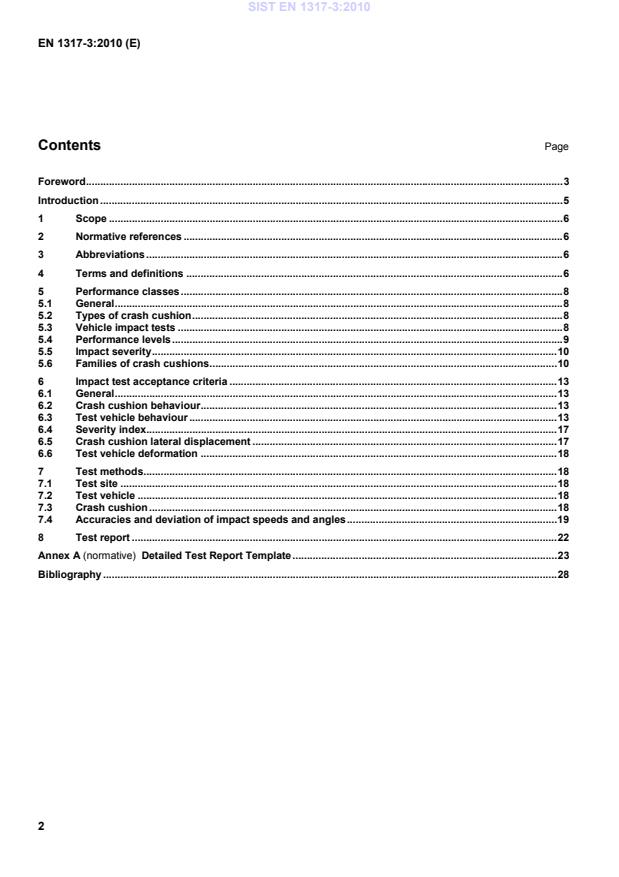
Overview
EN 1317-3:2010 - Road restraint systems, Part 3 - specifies the performance classes, impact test acceptance criteria and test methods for crash cushions used on European roads. Published by CEN, this standard defines how crash cushions must perform during vehicle impacts, the severity indices to be measured, and the test program required for product acceptance. EN 1317-3:2010 is intended to be read in conjunction with EN 1317-1 (terminology and general test criteria) and EN 1317-5 (product requirements and conformity).
Key topics and technical requirements
- Performance classes: Defined levels (50, 80, 100, 110) based on increasing energy absorption and specified vehicle impact tests.
- Impact tests (Table 1): Matrix of test conditions using representative vehicle masses (e.g., ~900 kg, 1 300 kg, 1 500 kg) and speeds from 50 to 110 km/h, plus frontal and lateral approaches (including 15° angles).
- Severity indices: Mandatory measurement of ASI (Acceleration Severity Index) and THIV (Theoretical Head Impact Velocity) to rate occupant impact severity. Severity levels A and B are defined (e.g., A: ASI ≤ 1.0 and THIV ≤ 44 km/h for frontal tests; THIV ≤ 33 km/h for lateral tests).
- Crash cushion types:Redirective (R) - contain and redirect vehicles; Non-redirective (NR) - contain but do not redirect.
- Families of crash cushions: Rules for parent and derivative models allowing a reduced test matrix when models share components, mechanism and product identity.
- Test tolerances and methods: Includes tighter angle tolerance (±1° introduced), combined speed/angle deviation limits for side tests, and the new measurement VCDI (introduced in this revision).
- Acceptance criteria & reporting: Behaviour limits for crash cushion and vehicle, lateral displacement, deformation limits, and a normative Annex A - Detailed Test Report Template.
Applications
- Selection and specification of crash cushions for motorways, interchanges, work zones, and roadside hazards.
- Product type-approval testing and performance verification for manufacturers.
- Design guidance for road safety engineers to meet required occupant protection levels.
- Procurement criteria for authorities and contractors installing roadside protective devices.
Who uses this standard
- Road authorities and infrastructure owners
- Crash cushion and barrier manufacturers
- Accredited test houses and laboratories
- Road safety engineers, designers and consultants
- Contractors, procurement teams and conformity assessment bodies
Related standards
- EN 1317-1:2010 - Terminology and general criteria for test methods
- EN 1317-2 - Safety barriers (related performance and test criteria)
- EN 1317-5 - Product requirements and evaluation of conformity for vehicle restraint systems
Keywords: EN 1317-3:2010, crash cushions, road restraint systems, impact tests, performance classes, ASI, THIV, redirective, non-redirective, crash cushion families, CEN.
Relations
- Effective Date
- 01-Dec-2010
- Effective Date
- 28-Jan-2026
- Effective Date
- 28-Jan-2026
- Effective Date
- 28-Jan-2026
- Effective Date
- 28-Jan-2026
- Effective Date
- 28-Jan-2026
- Effective Date
- 28-Jan-2026
- Effective Date
- 28-Jan-2026
Get Certified
Connect with accredited certification bodies for this standard

CIS Institut d.o.o.
Personal Protective Equipment (PPE) certification body. Notified Body NB-2890 for EU Regulation 2016/425 PPE.

Kiwa BDA Testing
Building and construction product certification.
Kmetijski inštitut Slovenije
Agricultural Institute of Slovenia. Soil testing, plant health, agricultural product analysis.
Sponsored listings
Frequently Asked Questions
SIST EN 1317-3:2010 is a standard published by the Slovenian Institute for Standardization (SIST). Its full title is "Road restraint systems - Part 3: Performance classes, impact test acceptance criteria and test methods for crash cushions". This standard covers: This European Standard specifies requirements for the performance of crash cushions during vehicle impacts. It specifies performance classes and acceptance criteria for impact tests, which should be read in conjunction with EN 1317-1 and EN 1317-5. The modifications included in this European Standard are not a change of test criteria, in the sense of EN 1317-5:2007, ZA.3.
This European Standard specifies requirements for the performance of crash cushions during vehicle impacts. It specifies performance classes and acceptance criteria for impact tests, which should be read in conjunction with EN 1317-1 and EN 1317-5. The modifications included in this European Standard are not a change of test criteria, in the sense of EN 1317-5:2007, ZA.3.
SIST EN 1317-3:2010 is classified under the following ICS (International Classification for Standards) categories: 13.200 - Accident and disaster control; 93.080.30 - Road equipment and installations. The ICS classification helps identify the subject area and facilitates finding related standards.
SIST EN 1317-3:2010 has the following relationships with other standards: It is inter standard links to SIST EN 1317-3:2002, SIST-TP CEN/TR 16303-4:2012, SIST EN 1317-1:2010, SIST-TP CEN/TR 16303-1:2012, SIST-TP CEN/TR 16303-3:2012, SIST EN 1317-5:2007+A2:2012, SIST EN 16303:2020, SIST-TP CEN/TR 1317-10:2024. Understanding these relationships helps ensure you are using the most current and applicable version of the standard.
SIST EN 1317-3:2010 is associated with the following European legislation: EU Directives/Regulations: 2024-01-0765, 305/2011, 89/106/EEC; Standardization Mandates: M/111. When a standard is cited in the Official Journal of the European Union, products manufactured in conformity with it benefit from a presumption of conformity with the essential requirements of the corresponding EU directive or regulation.
SIST EN 1317-3:2010 is available in PDF format for immediate download after purchase. The document can be added to your cart and obtained through the secure checkout process. Digital delivery ensures instant access to the complete standard document.
Standards Content (Sample)
2003-01.Slovenski inštitut za standardizacijo. Razmnoževanje celote ali delov tega standarda ni dovoljeno.Oprema cest - 3. del: Razredi uporabnosti, merila za preskušanje ob naletu in preskusne metode za blažilnike trkovRückhaltesysteme an Straßen - Teil 3: Leistungsklassen, Abnahmekriterien für Anprallprüfungen und Prüfverfahren für AnpralldämpferDispositifs de retenue routiers - Partie 3: Classes de performance, critères d'acceptation des essais de choc et méthodes d'essai pour les atténuateurs de chocRoad restraint systems - Part 3: Performance classes, impact test acceptance criteria and test methods for crash cushions93.080.30Cestna oprema in pomožne napraveRoad equipment and installations13.200NDWDVWURIAccident and disaster controlICS:Ta slovenski standard je istoveten z:EN 1317-3:2010SIST EN 1317-3:2010en,fr,de01-december-2010SIST EN 1317-3:2010SLOVENSKI
STANDARDSIST EN 1317-3:20021DGRPHãþD
EUROPEAN STANDARD NORME EUROPÉENNE EUROPÄISCHE NORM
EN 1317-3
July 2010 ICS 13.200; 93.080.30 Supersedes EN 1317-3:2000English Version
Road restraint systems - Part 3: Performance classes, impact test acceptance criteria and test methods for crash cushions
Dispositifs de retenue routiers - Partie 3: Classes de performance, critères d'acceptation des essais de choc et méthodes d'essai pour les atténuateurs de choc
Rückhaltesysteme an Straßen - Teil 3: Leistungsklassen, Abnahmekriterien für Anprallprüfungen und Prüfverfahren für Anpralldämpfer This European Standard was approved by CEN on 29 April 2010.
CEN members are bound to comply with the CEN/CENELEC Internal Regulations which stipulate the conditions for giving this European Standard the status of a national standard without any alteration. Up-to-date lists and bibliographical references concerning such national standards may be obtained on application to the CEN Management Centre or to any CEN member.
This European Standard exists in three official versions (English, French, German). A version in any other language made by translation under the responsibility of a CEN member into its own language and notified to the CEN Management Centre has the same status as the official versions.
CEN members are the national standards bodies of Austria, Belgium, Bulgaria, Croatia, Cyprus, Czech Republic, Denmark, Estonia, Finland, France, Germany, Greece, Hungary, Iceland, Ireland, Italy, Latvia, Lithuania, Luxembourg, Malta, Netherlands, Norway, Poland, Portugal, Romania, Slovakia, Slovenia, Spain, Sweden, Switzerland and United Kingdom.
EUROPEAN COMMITTEE FOR STANDARDIZATION
COMITÉ EUROPÉEN DE NORMALISATION EUROPÄISCHES KOMITEE FÜR NORMUNG
Management Centre:
Avenue Marnix 17,
B-1000 Brussels © 2010 CEN All rights of exploitation in any form and by any means reserved worldwide for CEN national Members. Ref. No. EN 1317-3:2010: ESIST EN 1317-3:2010
Detailed Test Report Template . 23Bibliography . 28 SIST EN 1317-3:2010
Part 4: Performance classes, impact test acceptance criteria and test methods for terminals and transitions of safety barriers; prEN 1317-4, Road restraint systems Part 4: Performance classes, impact test acceptance criteria and test methods for transitions of safety barriers (under preparation: this document will supersede
ENV 1317-4:2001 for the clauses concerning transitions); EN 1317-5, Road restraint systems Part 5: Product requirements and evaluation of conformity for vehicle restraint systems; prEN 1317-6, Road restraint systems Pedestrian restraint systems
Part 6: Pedestrian Parapet (under preparation); prEN 1317-7, Road restraint systems Part 7: Performance classes, impact test acceptance criteria and test methods for terminals of safety barriers (under preparation: this document will supersede
ENV 1317-4:2001 for the clauses concerning terminals); prEN 1317-8, Road restraint systems Part 8: Motorcycle road restraint systems which reduce the impact severity of motorcyclist collisions with safety barriers (under preparation). Annex A is normative. The significant technical changes incorporated in this revision are: a) Deletion of PHD; SIST EN 1317-3:2010
Attention is drawn to the fact that the acceptance of a crash cushion will require the successful completion of a series of vehicle impact tests (see Tables 1, 2, 3, etc.) as well as compliance with the full standard. SIST EN 1317-3:2010
EN 1317-5:2007+A1:2008, ZA.3. 2 Normative references The following referenced documents are indispensable for the application of this document. For dated references, only the edition cited applies. For undated references, the latest edition of the referenced document (including any amendments) applies. EN 1317-1:2010, Road restraint systems
Part 1: Terminology and general criteria for test methods 3 Abbreviations ASI: Acceleration Severity Index
THIV: Theoretical Head Impact Velocity 4 Terms and definitions For the purposes of this document, the terms and definitions given in EN 1317-1:2010 and the following apply. 4.1 obstacle item or hazard being protected from vehicular impact by the presence of a crash cushion 4.2 front face of the obstacle surface closest to a plane drawn perpendicular to the centre line of the crash cushion 4.3 family of crash cushions multiple performance product that can be assembled to form different models from the same set of components, to obtain different shapes and performances, with the same working mechanism for the system and its components 4.4 crash cushion head structural beginning of a crash cushion, i.e. first point at which the system offers significant resistance to an impact in the direction defined in 5.2 NOTE 1 In some designs, a non-structural beginning (head) may be included which offers no significant resistance to an impact. The crash cushion head is defined by the manufacturer and accepted by the test house performing the test.
NOTE 2 If no agreement is reached between the manufacturer and the test house regarding the definition of the crash cushion head, the test can be performed according to the manufacturer's definition and a note should be added to the test report outlining the diverging points of view. SIST EN 1317-3:2010
W maximum horizontal distance between the approach side and the departure side of the crash cushion, measured orthogonally to its centre line
NOTE See Figure 1.
Key 1 Non structural head L Structural length of the crash cushion W Crash cushion width Figure 1 — Example of crash cushion width 4.7 taper angle maximum angle in plan view from a parallel of the center line and the angled side of the crash cushion
NOTE See Figure 2.
Key
Taper angle Figure 2 — Example of taper angle SIST EN 1317-3:2010
trapezoidal envelope trapezium surrounding the plan profile of the crash cushion, having a minimum plan area as shown in Figures 4 and 5
NOTE Any essential supporting structure should be included within this envelope. 5 Performance classes 5.1 General Crash cushions shall comply with requirements given in 5.2 to 5.6 when tested in accordance with impact test criteria defined in Table 1. Vehicle specifications and deviations shall conform to EN 1317-1. 5.2 Types of crash cushion Types of crash cushion shall be: a) redirective (R): crash cushions which contain and redirect vehicles; b) non-redirective (NR): crash cushions which contain but do not redirect vehicles. 5.3 Vehicle impact tests Vehicle impact test descriptions shall be as given in Table 1. Table 1 — Vehicle impact test descriptions for crash cushions Testa
Approach Total vehicle mass kg Velocity km/h Figure 3 Test no. TC 1.1.50
900 50
TC 1.1.80
900 80 1 TC 1.1.100 Frontal centre 900 100
TC 1.2.80
1 300 80 1 TC 1.2.100
TC 1.3.110
1 500 110 1 TC 2.1.80 Frontal, 900b
80 2 TC 2.1.100 ¼ vehicle offset
TC 3.2.80 Head (centre), at
1 300 80
TC 3.2.100 15° 1 300 100 3 TC 3.3.110
1 500 110
TC 4.2.50 Side impact at 1 300 50
TC 4.2.80 15° 1 300 80 4 TC 4.2.100
1 300 100
TC 4.3.110
1 500 110
TC 5.2.80 Side impact at 1 300
TC 5.2.100 165° 1 300 100 5 TC 5.3.110
1 500 110
a Test notation is as follows:
TC
Test of crash cushion
Approach
Test vehicle mass
Impact speed b For this test condition, the ATD shall be located at the more distant location from the centre line of crash cushion.
Key
1 Test 1
2 Test 2
3 Test 3
4 Test 4
5 Test 5
6 Alternative locations for front face of obstacle
7 Crash cushion
8 1/4 vehicle width For further details see Figure 5a). Figure 3 — Vehicle approach paths for tests 1 to 5 5.4 Performance levels The crash cushion performance classes shall be as given in 5.6 and Table 2. These are classified according to an increasing energy absorption capacity. A successfully tested crash cushion at a given performance level, shall be considered as having met the test conditions of lower levels. Table 2 — Performance levels for crash cushions Level Acceptance test 50 TC 1.1.50 - - - TC 4.2.50a
- 80/1 - TC 1.2.80 TC 2.1.80 - TC 4.2.80a - 80 TC 1.1.80 TC 1.2.80 TC 2.1.80 TC 3.2.80 TC 4.2.80a TC 5.2.80a 100 TC 1.1.100 TC 1.2.100 TC 2.1.100 TC 3.2.100 TC 4.2.100a TC 5.2.100a 110 TC 1.1.100 TC 1.3.110 TC 2.1.100 TC 3.3.110 TC 4.3.110a TC 5.3.110a a Relevant for the redirective crash cushions only.
5.6 Families of crash cushions A family of crash cushion models shall be derived from a single parent crash cushion once the latter has been successfully tested to this standard.
A reduced matrix of tests shall be completed for the other family members in accordance with Tables 4 to 9. The models in the family cover a range of performance classes, width and taper angles.
Provided that the models in the family: a) are assembled from the same set of components; b) have the same product name; c) have the same working mechanism for the system and for the components, the family, specified by the drawings of all the models, can be tested as a single product with multiple performance levels. If the tests specified by the family test matrix are passed, the crash cushion is accepted as a multiple performance product, i.e. each model is accepted in the relevant performance class. All the cushions in the family shall be of the same type, i.e. all redirective or all non-redirective. If the parent crash cushion has the minimum taper angle/width and belongs to the highest performance class, the test matrix is the one shown in Table 4, 5, 6 or 7, depending on the highest velocity of the family. SIST EN 1317-3:2010
100 TC 1.2.100 - TC 4.2.100a 80 TC 1.2.80 - TC 4.2.80a 50 TC 1.1.50 - TC 4.2.50a a Relevant for the redirective crash cushions only.
Table 5 — Parent Crash Cushion with minimum taper angle/width, 100 km/h Performance class km/h Taper angle/width Minimum Intermediate Maximum 100 All Tests - TC 1.1.100 TC 4.2.100a
80 TC 1.2.80 - TC 4.2. 80a 50 TC 1.1.50 - TC 4.2. 50a a Relevant for the redirective crash cushions only.
Table 6 — Parent Crash Cushion with minimum taper angle/width, 80 km/h Performance class km/h Taper angle/width Minimum Intermediate Maximum 80 All Tests - TC 1.1.80 TC 4.2.80a
50 TC 1.1.50 - TC 4.2.50a a Relevant for the redirective crash cushions only.
Table 7 — Parent Crash Cushion with minimum taper angle/width, 50 km/h Performance class km/h Taper angle/width Minimum Intermediate Maximum 50 All Tests - TC 1.1.50 TC 4.2.50a a Relevant for the redirective crash cushions only.
If the parent crash cushion has the minimum taper angle/width, belongs to the 100 km/h performance class and the group also covers the 110 km/h performance class, the test matrix shall be as the one shown in Table 8. SIST EN 1317-3:2010
100 All Tests - TC 1.1.100 TC 4.2.100a 80 TC 1.2.80 - TC 4.2.80a 50 TC 1.1.50 - TC 4.2.50a a Relevant for the redirective crash cushions only.
If the parent crash cushion has the maximum taper angle/width, belongs to the 100 km/h performance class and the group also covers the 110 km/h performance class, the test matrix is the one in Table 9. Table 9 — Parent Crash Cushion with maximum taper angle/width, 100 km/h Performance class km/h Taper angle/width Minimum Intermediate Maximum 110 TC 1.3.110 TC 3.3.110 - TC 4.3.110a 100 TC 1.2.100 TC 4.2.100a
TC 5.2.100
- All Tests 80 TC 1.2.80 - TC 4.2.80a 50 TC 1.
...