

kSIST FprEN IEC 61508-1:2025
(Main)Functional safety of electrical/electronic/programmable electronic safety-related systems - Part 1: General requirements
- Status
- Not Published
- Public Enquiry End Date
- 29-Apr-2025
- Technical Committee
- MOV - Measuring equipment for electromagnetic quantities
- Current Stage
- 5020 - Formal vote (FV) (Adopted Project)
- Start Date
- 13-May-2025
- Due Date
- 01-Jul-2025

kSIST FprEN IEC 61508-1:2025 is the general-requirements part of the IEC 61508 series on functional safety of electrical/electronic/programmable electronic (E/E/PE) safety-related systems. It sets the generic framework for the safety lifecycle, documentation, management, allocation, validation, and maintenance of E/E/PE safety functions. The document is aimed at end users and at technical committees that develop, adapt, or assess sector-specific safety standards.
What does kSIST FprEN IEC 61508-1:2025 specify?
kSIST FprEN IEC 61508-1:2025 specifies the overall requirements for achieving functional safety when E/E/PE systems are used to carry out safety functions. It is the framework document in the IEC 61508 series, so it defines the lifecycle, the management approach, and the way safety requirements are derived and allocated.
The scope is generic and applies across application sectors. It covers E/E/PE safety-related systems that contribute to tolerable risk, including protection systems and control systems, and it can also be used where no product- or sector-specific standard exists. It explicitly brings in cybersecurity-related concerns during hazard and risk analysis when reasonably foreseeable cyber risks are identified, and it treats human factors as part of the safety analysis and operation.
The document is organized into clauses on scope, normative references, definitions and abbreviations, conformance, documentation, functional safety management, the overall safety lifecycle, functional safety assessment, and functional safety audit. It also includes two annexes.
| Annex | What it covers |
|---|---|
| Annex A | Informative example of a documentation structure |
| Annex B | Normative levels of independence for functional safety assurance activities |
What are the key requirements of kSIST FprEN IEC 61508-1:2025?
kSIST FprEN IEC 61508-1:2025 is built around a structured safety lifecycle. In practice, that means the user has to identify hazards, define safety functions, allocate them to E/E/PE systems and other measures, then document, verify, validate, operate, maintain, modify, and eventually decommission the system in a controlled way.
Documentation and control
Clause 5 requires documentation that is sufficient for each completed lifecycle phase, for functional safety management, for verification, and for functional safety assessment. The documentation must be accurate, concise, understandable, accessible, maintainable, searchable, and version-controlled. For a project team, this means safety work has to be traceable and reviewable, not just technically correct.
Functional safety management
Clause 6 requires one or more responsible persons to coordinate the safety lifecycle, interfaces between phases, assessments, and audits. The management arrangements run in parallel with the technical lifecycle. In practice, this gives clear ownership of safety tasks and avoids gaps when several teams, suppliers, or organizations are involved.
Concept, scope, and hazard and risk analysis
Clause 7 starts with understanding the equipment under control (EUC), its control system, and its environment. The scope must define the boundary of the EUC and the hazards to be analyzed. The hazard and risk analysis then has to consider fault conditions, reasonably foreseeable misuse, malevolent or unauthorized action, security, cybersecurity, and human factors. For a project, that means the analysis must be broad enough to capture realistic operating and misuse scenarios, not only normal operation.
Safety requirements and allocation
Clause 7 then requires overall safety requirements to be derived from the hazard analysis. These requirements are allocated to E/E/PE safety-related systems and other risk reduction measures. The document uses safety integrity levels (SIL) and target failure measures to express the required integrity, with separate treatment for low-demand and high-demand or continuous modes of operation. This matters because the safety target has to be set before design choices are fixed, and the allocation has to consider common cause failures and independence.
Realisation, installation, validation, and operation
Clause 7 also requires plans for realization, installation, commissioning, safety validation, operation, maintenance, repair, modification, retrofit, and decommissioning. The safety requirements specification for the E/E/PE system must be clear, testable, and complete enough for design and development, including response time, interfaces, operating modes, failure behaviour, proof testing, environmental conditions, and electromagnetic immunity limits. In practice, these are the details that turn a safety intent into something that can be built, tested, and maintained.
Verification, assessment, and audit
Clause 7 includes verification, Clause 8 covers functional safety assessment, and Clause 9 covers functional safety audit. Annex B adds minimum independence levels for verification, validation, and audit/assessment activities. This is important because safety decisions need independent checking, not only self-review by the design team.
What terms does kSIST FprEN IEC 61508-1:2025 define?
kSIST FprEN IEC 61508-1:2025 uses the definitions and abbreviations from IEC 61508-4. These are the key terms that matter most when reading this part:
- E/E/PE - electrical/electronic/programmable electronic; the technology group covered by the standard.
- EUC - the equipment or process being controlled and assessed for hazards in the safety lifecycle.
- Safety function - the action or behaviour needed to reach or maintain a safe state.
- SIL - safety integrity level; the integrity target assigned to a safety function.
- PFDavg - average probability of dangerous failure on demand; used for low-demand operation.
- PFH - average frequency of dangerous failure per hour; used for high-demand or continuous operation.
- SC - systematic capability; the level of capability associated with systematic fault control.
- Functional safety - safety that depends on the correct functioning of safety-related systems and their safety functions.
Who uses kSIST FprEN IEC 61508-1:2025?
kSIST FprEN IEC 61508-1:2025 is used by technical committees that write product- or sector-specific safety standards, because it provides the generic structure they can build on. It is also used by engineers, safety managers, quality managers, assessors, and auditors who need a common way to specify, verify, and justify functional safety.
The document is relevant in industrial process measurement, control, and automation, and in IT applications in industry, as shown by the ICS classifications. It is also intended for end users who evaluate safety applications and for organizations responsible for operation, maintenance, and modification of E/E/PE safety-related systems.
What changed in kSIST FprEN IEC 61508-1:2025 from the previous edition?
kSIST FprEN IEC 61508-1:2025 cancels and replaces the second edition published in 2010. The document states these significant technical changes:
- It was updated to the 2024 version of the ISO/IEC Directives, which brought editorial changes, clause renumbering, and reworded notes.
- The scope was clarified for artificial intelligence, human factors, and security, with related requirements concentrated in hazard and risk analysis.
- Interfaces to other parts of IEC 61508 were clarified and duplicate requirements were removed.
- The distinction between the required SIL and the achieved Systematic Capability was clarified.
- Annex B introduces levels of independence for functional safety assurance activities.
- Minor editorial errors were corrected, and the normative references and bibliography were updated.
Which standards are used with kSIST FprEN IEC 61508-1:2025?
| Standard | What it contributes |
|---|---|
| IEC 61508-2:202X | Hardware requirements for E/E/PE safety-related systems |
| IEC 61508-3:202X | Software requirements for E/E/PE safety-related systems |
| IEC 61508-4:202X | Definitions and abbreviations used across the series |
| IEC 61508-5 | Guidance and example methods for determining SIL |
| IEC 61508-6 | Guidance for applying Parts 2 and 3 |
| IEC 61508-7 | Overview of techniques and measures |
| IEC Guide 104:2019 | Rules for basic safety publications |
| ISO/IEC Guide 51:2014 | How to include safety aspects in standards |
| IEC 62443 series | Guidance on cybersecurity and security risk handling |
| ISO/IEC 27000 series | Cybersecurity and information security guidance |
| IEC TR 63069 | Coordination between safety and security |
| ISO/IEC TR 19791 | Further guidance on security-related aspects |
| IEC 31010:2019 | Risk management techniques used in hazard analysis |
| IEC 61000-1-2 | Electromagnetic immunity approach for functional safety |
| ISO/IEC TS 22440-1 | Additional requirements for software technology class II |
| ISO/IEC TR 5469:2024 | Further detail on AI-related safety topics |
| ISO/IEC/IEEE 15288:2023 | Guidance on system architecture specification |
| ISO/IEC/IEEE 42010:2022 | Guidance on architecture frameworks |
What does the kSIST FprEN IEC 61508-1:2025 document contain?
kSIST FprEN IEC 61508-1:2025 contains the overall safety lifecycle model, including a clause-by-clause overview in Table 1 of the objectives, inputs, and outputs for each phase. It also includes the SIL target failure measure tables for low-demand and for high-demand or continuous operation, which are the core references for integrity allocation.
The document includes figures for the IEC 61508 framework, the overall safety lifecycle, the E/E/PE and software safety lifecycles, allocation of safety requirements, operation and maintenance models, and modification control. Annex A provides example documentation structures for lifecycle information, and Annex B provides the independence levels used for verification, validation, audit, and assessment.
Relations
- Effective Date
- 23-Jan-2023
- Effective Date
- 11-Oct-2022
Get Certified
Connect with accredited certification bodies for this standard

BSI Group
BSI (British Standards Institution) is the business standards company that helps organizations make excellence a habit.

DVS-ZERT GmbH
German welding certification society.

IMQ S.p.A. (Certification)
Italian electrical product certification.
Sponsored listings
Frequently Asked Questions
kSIST FprEN IEC 61508-1:2025 is a draft published by the Slovenian Institute for Standardization (SIST). Its full title is "Functional safety of electrical/electronic/programmable electronic safety-related systems - Part 1: General requirements". This standard covers: Functional safety of electrical/electronic/programmable electronic safety-related systems - Part 1: General requirements
Functional safety of electrical/electronic/programmable electronic safety-related systems - Part 1: General requirements
kSIST FprEN IEC 61508-1:2025 is classified under the following ICS (International Classification for Standards) categories: 13.110 - Safety of machinery; 25.040.40 - Industrial process measurement and control; 29.020 - Electrical engineering in general; 35.240.50 - IT applications in industry. The ICS classification helps identify the subject area and facilitates finding related standards.
kSIST FprEN IEC 61508-1:2025 has the following relationships with other standards: It is inter standard links to SIST EN 61508-1:2011, SIST EN 61508-1:2011. Understanding these relationships helps ensure you are using the most current and applicable version of the standard.
kSIST FprEN IEC 61508-1:2025 is available in PDF format for immediate download after purchase. The document can be added to your cart and obtained through the secure checkout process. Digital delivery ensures instant access to the complete standard document.
Standards Content (Sample)
SLOVENSKI STANDARD
oSIST prEN IEC 61508-1:2025
01-april-2025
Funkcijska varnost električnih/elektronskih/elektronsko programirljivih varnostnih
sistemov - 1. del: Splošne zahteve
Functional safety of electrical/electronic/programmable electronic safety-related systems
- Part 1: General requirements
Funktionale Sicherheit sicherheitsbezogener
elektrischer/elektronischer/programmierbarer elektronischer Systeme - Teil 1:
Allgemeine Anforderungen
Sécurité fonctionnelle des systèmes électriques/électroniques/électroniques
programmables relatifs à la sécurité - Partie 1: Exigences générales
Ta slovenski standard je istoveten z: prEN IEC 61508-1:2025
ICS:
25.040.40 Merjenje in krmiljenje Industrial process
industrijskih postopkov measurement and control
35.240.50 Uporabniške rešitve IT v IT applications in industry
industriji
oSIST prEN IEC 61508-1:2025 en,fr,de
2003-01.Slovenski inštitut za standardizacijo. Razmnoževanje celote ali delov tega standarda ni dovoljeno.
oSIST prEN IEC 61508-1:2025
oSIST prEN IEC 61508-1:2025
65A/1164/CDV
COMMITTEE DRAFT FOR VOTE (CDV)
PROJECT NUMBER:
IEC 61508-1 ED3
DATE OF CIRCULATION: CLOSING DATE FOR VOTING:
2025-02-14 2025-05-09
SUPERSEDES DOCUMENTS:
65A/1056A/CD, 65A/1075A/CC
IEC SC 65A : SYSTEM ASPECTS
SECRETARIAT: SECRETARY:
United Kingdom Ms Stephanie Lavy
OF INTEREST TO THE FOLLOWING COMMITTEES: HORIZONTAL FUNCTION(S):
TC 8,TC 9,TC 22,TC 31,TC 44,TC 45,TC 56,TC 61,TC
62,TC 65,SC 65B,SC 65C,SC 65E,TC 66,TC 72, TC
77,TC 80,TC 108,SyC AAL,SyC SM,SC 41
ASPECTS CONCERNED:
Safety
SUBMITTED FOR CENELEC PARALLEL VOTING NOT SUBMITTED FOR CENELEC PARALLEL VOTING
Attention IEC-CENELEC parallel voting
The attention of IEC National Committees, members of
CENELEC, is drawn to the fact that this Committee Draft
for Vote (CDV) is submitted for parallel voting.
The CENELEC members are invited to vote through the
CENELEC online voting system.
This document is still under study and subject to change. It should not be used for reference purposes.
Recipients of this document are invited to submit, with their comments, notification of any relevant patent rights of
which they are aware and to provide supporting documentation.
Recipients of this document are invited to submit, with their comments, notification of any relevant “In Some
Countries” clauses to be included should this proposal proceed. Recipients are reminded that the CDV stage is the
final stage for submitting ISC clauses. (SEE AC/22/2007 OR NEW GUIDANCE DOC).
TITLE:
Functional safety of electrical/electronic/programmable electronic safety-related systems - Part
1: General requirements
PROPOSED STABILITY DATE: 2028
NOTE FROM TC/SC OFFICERS:
download this electronic file, to make a copy and to print out the content for the sole purpose of preparing National
Committee positions. You may not copy or "mirror" the file or printed version of the document, or any part of it,
for any other purpose without permission in writing from IEC.
oSIST prEN IEC 61508-1:2025
IEC CDV 61508-1 ED3 © IEC 2025 2 65A/1164/CDV
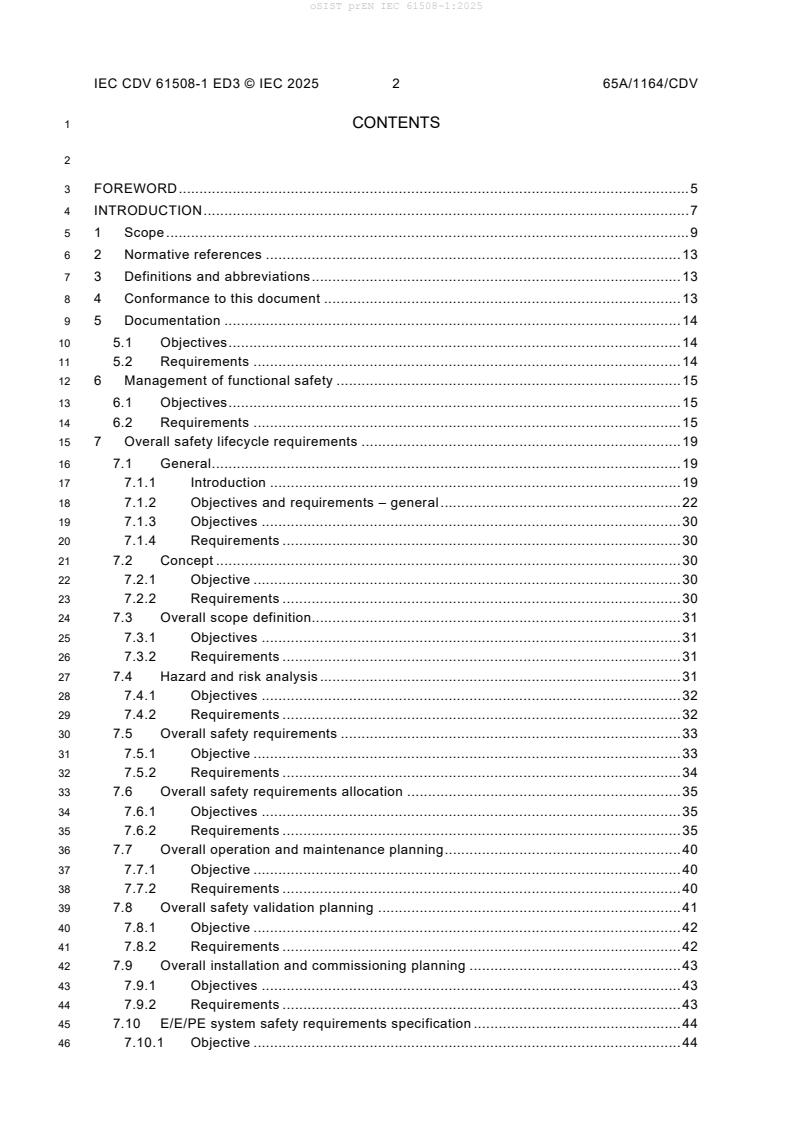
1 CONTENTS
3 FOREWORD . 5
4 INTRODUCTION . 7
5 1 Scope . 9
6 2 Normative references . 13
7 3 Definitions and abbreviations . 13
8 4 Conformance to this document . 13
9 5 Documentation . 14
10 5.1 Objectives . 14
11 5.2 Requirements . 14
12 6 Management of functional safety . 15
13 6.1 Objectives . 15
14 6.2 Requirements . 15
15 7 Overall safety lifecycle requirements . 19
16 7.1 General . 19
17 7.1.1 Introduction . 19
18 7.1.2 Objectives and requirements – general . 22
19 7.1.3 Objectives . 30
20 7.1.4 Requirements . 30
21 7.2 Concept . 30
22 7.2.1 Objective . 30
23 7.2.2 Requirements . 30
24 7.3 Overall scope definition. 31
25 7.3.1 Objectives . 31
26 7.3.2 Requirements . 31
27 7.4 Hazard and risk analysis . 31
28 7.4.1 Objectives . 32
29 7.4.2 Requirements . 32
30 7.5 Overall safety requirements . 33
31 7.5.1 Objective . 33
32 7.5.2 Requirements . 34
33 7.6 Overall safety requirements allocation . 35
34 7.6.1 Objectives . 35
35 7.6.2 Requirements . 35
36 7.7 Overall operation and maintenance planning . 40
37 7.7.1 Objective . 40
38 7.7.2 Requirements . 40
39 7.8 Overall safety validation planning . 41
40 7.8.1 Objective . 42
41 7.8.2 Requirements . 42
42 7.9 Overall installation and commissioning planning . 43
43 7.9.1 Objectives . 43
44 7.9.2 Requirements . 43
45 7.10 E/E/PE system safety requirements specification . 44
46 7.10.1 Objective . 44
oSIST prEN IEC 61508-1:2025
IEC CDV 61508-1 ED3 © IEC 2025 3 65A/1164/CDV
47 7.10.2 Requirements . 44
48 7.11 E/E/PE safety-related systems – realisation . 46
49 7.11.1 Objective . 46
50 7.11.2 Requirements . 46
51 7.12 Other risk reduction measures – specification and realisation . 46
52 7.12.1 Objective . 46
53 7.12.2 Requirements . 46
54 7.13 Overall installation and commissioning. 46
55 7.13.1 Objectives . 47
56 7.13.2 Requirements . 47
57 7.14 Overall safety validation . 47
58 7.14.1 Objective . 47
59 7.14.2 Requirements . 47
60 7.15 Overall operation, maintenance and repair . 48
61 7.15.1 Objective . 48
62 7.15.2 Requirements . 48
63 7.16 Overall modification and retrofit . 51
64 7.16.1 Objective . 51
65 7.16.2 Requirements . 52
66 7.17 Decommissioning or disposal . 53
67 7.17.1 Objective . 53
68 7.17.2 Requirements . 54
69 7.18 Verification. 54
70 7.18.1 Objective . 54
71 7.18.2 Requirements . 54
72 8 Functional safety assessment . 55
73 8.1 Objective . 55
74 8.2 Requirements . 55
75 9 Functional safety audit. 58
76 9.1 Objective . 58
77 9.2 Requirements . 58
78 Annex A (informative) Example of a documentation structure . 60
79 A.1 General . 60
80 A.2 Safety lifecycle document structure . 61
81 A.3 Physical document structure . 64
82 Annex B (normative) Levels of independence for functional safety assurance activities . 66
83 B.1 General . 66
84 Bibliography . 68
86 Figure 1 – Overall framework of the IEC 61508 series . 12
87 Figure 2 – Overall safety lifecycle . 20
88 Figure 3 – E/E/PE system safety lifecycle (in realisation phase) . 21
89 Figure 4 – Software safety lifecycle (in realisation phase) . 21
90 Figure 5 – Relationship of the overall safety lifecycle to the E/E/PE system and
91 software safety lifecycles . 22
92 Figure 6 – Allocation of overall safety requirements to E/E/PE safety-related systems
93 and other risk reduction measures . 37
94 Figure 7 – Example of operations and maintenance activities model . 50
oSIST prEN IEC 61508-1:2025
IEC CDV 61508-1 ED3 © IEC 2025 4 65A/1164/CDV
95 Figure 8 – Example of operation and maintenance management model . 51
96 Figure 9 – Example of modification procedure model . 53
97 Figure A.1 – Structuring information into document sets for user groups . 65
99 Table 1 – Overall safety lifecycle – overview . 24
100 Table 2 – Safety integrity levels – target failure measures for a safety function
101 operating in low demand mode of operation . 38
102 Table 3 – Safety integrity levels – target failure measures for a safety function
103 operating in high demand mode of operation or continuous mode of operation . 38
104 Table A.1 – Example of a documentation structure for information related to the
105 overall safety lifecycle . 62
106 Table A.2 – Example of a documentation structure for information related to the E/E/PE
107 system safety lifecycle . 63
108 Table A.3 – Example of a documentation structure for information related to the
109 software safety lifecycle . 64
110 Table B.1 – Minimum levels of independence – Verification . 67
111 Table B.2 – Minimum levels of independence - Validation . 67
112 Table B.3 – Minimum levels of independence – Audit & Assessment. 67
oSIST prEN IEC 61508-1:2025
IEC CDV 61508-1 ED3 © IEC 2025 5 65A/1164/CDV
115 INTERNATIONAL ELECTROTECHNICAL COMMISSION
116 ____________
118 FUNCTIONAL SAFETY OF ELECTRICAL/ELECTRONIC/
119 PROGRAMMABLE ELECTRONIC SAFETY-RELATED SYSTEMS –
121 Part 1: General requirements
123 FOREWORD
124 1) The International Electrotechnical Commission (IEC) is a worldwide organization for standardization comprising
125 all national electrotechnical committees (IEC National Committees). The object of IEC is to promote international
126 co-operation on all questions concerning standardization in the electrical and electronic fields. To this end and
127 in addition to other activities, IEC publishes International Standards, Technical Specifications, Technical Reports,
128 Publicly Available Specifications (PAS) and Guides (hereafter referred to as “IEC Publication(s)”). Their
129 preparation is entrusted to technical committees; any IEC National Committee interested in the subject dealt with
130 may participate in this preparatory work. International, governmental and non-governmental organizations liaising
131 with the IEC also participate in this preparation. IEC collaborates closely with the International Organization for
132 Standardization (ISO) in accordance with conditions determined by agreement between the two organizations.
133 2) The formal decisions or agreements of IEC on technical matters express, as nearly as possible, an international
134 consensus of opinion on the relevant subjects since each technical committee has representation from all
135 interested IEC National Committees.
136 3) IEC Publications have the form of recommendations for international use and are accepted by IEC National
137 Committees in that sense. While all reasonable efforts are made to ensure that the technical content of IEC
138 Publications is accurate, IEC cannot be held responsible for the way in which they are used or for any
139 misinterpretation by any end user.
140 4) In order to promote international uniformity, IEC National Committees undertake to apply IEC Publications
141 transparently to the maximum extent possible in their national and regional publications. Any divergence between
142 any IEC Publication and the corresponding national or regional publication shall be clearly indicated in the latter.
143 5) IEC itself does not provide any attestation of conformity. Independent certification bodies provide conformity
144 assessment services and, in some areas, access to IEC marks of conformity. IEC is not responsible for any
145 services carried out by independent certification bodies.
146 6) All users should ensure that they have the latest edition of this publication.
147 7) No liability shall attach to IEC or its directors, employees, servants or agents including individual experts and
148 members of its technical committees and IEC National Committees for any personal injury, property damage or
149 other damage of any nature whatsoever, whether direct or indirect, or for costs (including legal fees) and
150 expenses arising out of the publication, use of, or reliance upon, this IEC Publication or any other IEC
151 Publications.
152 8) Attention is drawn to the Normative references cited in this publication. Use of the referenced publications is
153 indispensable for the correct application of this publication.
154 9) IEC draws attention to the possibility that the implementation of this document may involve the use of (a)
155 patent(s). IEC takes no position concerning the evidence, validity or applicability of any claimed patent rights in
156 respect thereof. As of the date of publication of this document, IEC had not received notice of (a) patent(s), which
157 may be required to implement this document. However, implementers are cautioned that this may not represent
158 the latest information, which may be obtained from the patent database available at https://patents.iec.ch. IEC
159 shall not be held responsible for identifying any or all such patent rights.
160 IEC 61508-1 has been prepared by subcommittee 65A: System aspects, of IEC technical
161 committee 65: Industrial-process measurement, control and automation. It is an International
162 Standard.
163 This third edition cancels and replaces the second edition published in 2010. This edition
164 constitutes a technical revision.
165 This edition includes the following significant technical changes with respect to the previous
166 edition (the following list does refer to this document; other parts do mention specific further
167 details):
168 a) Document was upgraded to the 2024 version of the ISO/IEC Directives; this does
169 introduce a significant number of editorial changes, clause renumbering and rewording
170 of the information provided in Notes;
oSIST prEN IEC 61508-1:2025
IEC CDV 61508-1 ED3 © IEC 2025 6 65A/1164/CDV
171 b) The scope includes clarification on ‘artificial Intelligence’ (software technology class),
172 human factors and security. The related requirements are limited to the hazard and risk
173 analysis (refer to 7.1.2.3 on human factors and 7.4.2.3 for security) and further
174 references to external guidance;
175 c) The interfaces to other parts of IEC 61508 have been clarified and duplication of
176 requirements in other Parts has been removed;
177 d) The differentiation between the required Safety Integrity Level (SIL) and the achieved
178 Systematic Capability (SC) has been clarified;
179 e) Requirements on levels of independence for functional safety assurance activities
180 (Annex B) have been introduced;
181 f) Various minor editorial errors have been corrected, the normative references and the
182 bibliography has been updated.
184 It has the status of a basic safety publication according to IEC Guide 104.
185 The text of this document is based on the following documents:
Draft Report on voting
65A/XX/FDIS 65A/XX/RVD
187 Full information on the voting for its approval can be found in the report on voting indicated in
188 the above table.
189 The language used for the development of this document is English.
190 This document was drafted in accordance with ISO/IEC Directives, Part 2, and developed in
191 accordance with ISO/IEC Directives, Part 1 and ISO/IEC Directives, IEC Supplement, available
192 at www.iec.ch/members_experts/refdocs. The main document types developed by IEC are
193 described in greater detail at www.iec.ch/publications.
194 A list of all parts of the IEC 61508 series, published under the general title Functional safety of
195 electrical / electronic / programmable electronic safety-related systems, can be found on the
196 IEC website.
197 The committee has decided that the contents of this document will remain unchanged until the
198 stability date indicated on the IEC website under webstore.iec.ch in the data related to the
199 specific document. At this date, the document will be
200 • reconfirmed,
201 • withdrawn,
202 • replaced by a revised edition, or
203 • amended.
oSIST prEN IEC 61508-1:2025
IEC CDV 61508-1 ED3 © IEC 2025 7 65A/1164/CDV
206 INTRODUCTION
207 Systems comprised of electrical and/or electronic elements have been used for many years to
208 perform safety functions in most application sectors. Computer-based systems (generically
209 referred to as programmable electronic systems) are being used in all application sectors to
210 perform non-safety functions and, increasingly, to perform safety functions. If computer system
211 technology is to be effectively and safely exploited, it is essential that those responsible for
212 making decisions have sufficient guidance on the safety aspects on which to make these
213 decisions.
214 This document sets out a generic approach for all safety lifecycle activities for systems
215 comprised of electrical and/or electronic and/or programmable electronic (E/E/PE) elements
216 that are used to perform safety functions. This unified approach has been adopted in order that
217 a rational and consistent technical policy be developed for all electrically-based safety-related
218 systems. A major objective is to facilitate the development of product and application sector
219 international standards based on the IEC 61508 series.
220 NOTE 1 Examples of product and application sector international standards based on the IEC 61508 series are
221 given in the Bibliography (see references [1], [2] and [3]).
222 In most situations, safety is achieved by a number of systems which rely on many technologies
223 (for example mechanical, hydraulic, pneumatic, electrical, electronic, programmable electronic).
224 Any safety strategy shall therefore consider not only all the elements within an individual system
225 (for example sensors, controlling devices and actuators) but also all the safety-related systems
226 making up the total combination of safety-related systems. The safety strategy shall also
227 consider the influence of humans on the achievement of functional safety. Therefore, while this
228 document is concerned with E/E/PE safety-related systems, it may also provide a framework
229 within which safety-related systems based on other technologies may be considered.
230 It is recognized that there is a great variety of applications using E/E/PE safety-related systems
231 in a variety of application sectors and covering a wide range of complexity, hazard and risk
232 potentials. In any particular application, the required safety measures will be dependent on
233 many factors specific to the application. This document, by being generic, will enable such
234 measures to be formulated in future product and application sector international standards and
235 in revisions of those that already exist.
236 This document
237 – considers all relevant overall, E/E/PE system and software safety lifecycle phases (for
238 example, from initial concept, through design, implementation, operation and maintenance
239 to decommissioning) when E/E/PE systems are used to perform safety functions;
240 – has been conceived with a rapidly developing technology in mind; the framework is
241 sufficiently robust and comprehensive to cater for future developments;
242 – enables product and application sector international standards, dealing with E/E/PE safety-
243 related systems, to be developed; the development of product and application sector
244 international standards, within the framework of this document, should lead to a high level
245 of consistency (for example, of underlying principles, terminology etc.) both within
246 application sectors and across application sectors; this will have both safety and economic
247 benefits;
248 – provides a method for the development of the safety requirements specification necessary
249 to achieve the required functional safety for E/E/PE safety-related systems;
250 – adopts a risk-based approach by which the safety integrity requirements can be determined;
251 – introduces safety integrity levels for specifying the target level of safety integrity for the
252 safety functions to be implemented by the E/E/PE safety-related systems;
253 NOTE 2 This document does not specify the safety integrity level requirements for any safety function, nor does it
254 mandate how the safety integrity level is determined. Instead, it provides a risk-based conceptual framework and
255 example techniques.
oSIST prEN IEC 61508-1:2025
IEC CDV 61508-1 ED3 © IEC 2025 8 65A/1164/CDV
256 – sets target failure measures for safety functions carried out by E/E/PE safety-related
257 systems, which are linked to the safety integrity levels;
258 – sets a lower limit on the target failure measures for a safety function carried out by a single
259 E/E/PE safety-related system. For E/E/PE safety-related systems operating in
260 • a low demand mode of operation, the lower limit is set at an average probability of a
–5
261 dangerous failure on demand of 10 ;
262 • a high demand or a continuous mode of operation, the lower limit is set at an average
–9 -1
263 frequency of a dangerous failure of 10 [h ];
264 NOTE 3 A single E/E/PE safety-related system does not necessarily mean a single-channel architecture.
265 NOTE 4 It can be possible to achieve designs of safety-related systems with lower values for the target safety
266 integrity for non-complex systems, but these limits are considered to represent what can be achieved for relatively
267 complex systems (for example programmable electronic safety-related systems) at the present time.
268 – sets requirements for the avoidance and control of systematic faults, which are based on
269 experience and judgement from practical experience gained in industry. Even though the
270 probability of occurrence of systematic failures cannot in general be quantified this
271 document does, however, allow a claim to be made, for a specified safety function, that the
272 target failure measure associated with the safety function can be considered to be achieved
273 if all the requirements in this document have been met;
274 – adopts a broad range of principles, techniques and measures to achieve functional safety
275 for E/E/PE safety-related systems, but does not explicitly use the concept of fail safe.
276 However, the concept of “fail safe” and “inherently safe” principles may be applicable and
277 adoption of such concepts is acceptable providing the requirements of the relevant clauses
278 in this documentare met.
oSIST prEN IEC 61508-1:2025
IEC CDV 61508-1 ED3 © IEC 2025 9 65A/1164/CDV
281 FUNCTIONAL SAFETY OF ELECTRICAL/ELECTRONIC/
282 PROGRAMMABLE ELECTRONIC SAFETY-RELATED SYSTEMS –
284 Part 1: General requirements
288 1 Scope
289 1.1 This document covers those aspects to be considered when
290 electrical/electronic/programmable electronic (E/E/PE) systems are used to carry out safety
291 functions. A major objective of t
292 The goal of this document is to facilitate the development of product and application sector
293 international standards by the technical committees responsible for the product or application
294 sector. This will allow all the relevant factors, associated with the product or application, to be
295 fully taken into account and thereby meet the specific needs of users of the product and the
296 application sector. A second objective of this document is to enable the development of E/E/PE
297 safety-related systems where product or application sector international standards do not exist.
298 The scope of this document is functional safety for E/E/PE safety-related systems but, apart
299 from normative requirements in the hazard and risk analysis phase, does not itself provide
300 normative requirements for malevolent action arising from a
301 cybersecurity risk. However, if a cybersecurity assessment has identified that a reasonably
302 foreseeable cyber security risk will arise, it is essential that measures be taken for all relevant
303 phases of the overall, E/E/PE and software safety lifecycles in order to protect against such
304 threats to ensure that functional safety is achieved.
305 NOTE 1 For requirements and/or guidance on cybersecurity see IEC 62443 series and ISO/IEC 27000 series.
306 NOTE 2 For guidance on the coordination between safety and security refer to IEC TR 63069.
307 1.2 In particular, this document
308 a) applies to safety-related systems when one or more of such systems incorporates
309 electrical/electronic/programmable electronic elements;
310 NOTE 1 In the context of low complexity E/E/PE safety-related systems, certain requirements specified in this
311 document can be unnecessary, and exemption from compliance with such requirements is possible (see 4.2, and the
312 definition of a low complexity E/E/PE safety-related system in 3.4.3 of IEC 61508-4).
313 NOTE 2 Although a person can form part of a safety-related system (see 3.4.1 of IEC 61508-4), human factor
314 requirements related to those aspects of the design of E/E/PE safety-related systems are not considered in detail in
315 this document.
316 NOTE 3 This document can be applied to custom, low-volume and high volume production safety-related systems,
317 subsystems, elements and compliant items.
318 NOTE 4 This document can be applied to parts of the safety function (e.g., compliant item or tool) but it does not
319 provide a final SIL statement to a part of the safety function.
320 b) is generically based and applicable to all E/E/PE safety-related systems irrespective of the
321 application;
324 c) covers the achievement of a tolerable risk through the application of E/E/PE safety-related
325 systems, but does not cover hazards arising from the E/E/PE equipment itself (for example
326 electric shock);
327 d) applies to all types of E/E/PE safety-related systems, including protection systems and
328 control systems;
oSIST prEN IEC 61508-1:2025
IEC CDV 61508-1 ED3 © IEC 2025 10 65A/1164/CDV
329 e) does not cover E/E/PE systems where
330 – a single E/E/PE system is capable on its own of meeting the tolerable risk, and
331 – the required quantitative performance and integrity of the safety functions of the single
332 E/E/PE system is less than that specified for safety integrity level 1 (the lowest safety
333 integrity level in this document).
334 f) is mainly concerned with the E/E/PE safety-related systems whose failure could have an
335 impact on the safety of persons and/or the environment; however, it is recognized that the
336 consequences of failure could also have serious economic implications and in such cases
337 this document could be used to specify any E/E/PE system used for the protection of
338 equipment or product;
339 NOTE 7 See 3.1.1 of IEC 61508-4.
340 g) considers E/E/PE safety-related systems and other risk reduction measures, in order that
341 the safety requirements specification for the E/E/PE safety-related systems can be
342 determined in a systematic, risk-based manner;
343 h) uses an overall safety lifecycle model as the organisational framework for dealing
344 systematically with the processes and activities necessary for ensuring the functional safety
345 of the E/E/PE safety-related systems;
346 NOTE 8 Although the overall safety lifecycle is primarily concerned with E/E/PE safety-related systems, it might
347 also provide a technical framework for considering any safety-related system irrespective of the technology of that
348 system (for example mechanical, hydraulic or pneumatic).
349 i) specifies the essential concept of safety integrity levels applicable to any sector application;
350 j) does not specify the selection of safety integrity levels required to address risks specific to
351 sector applications (which must be based on detailed information and knowledge of the
352 sector application).
353 k) provides general requirements for E/E/PE safety-related systems where no product or
354 application sector international standards exist;
355 l) requires malevolent and unauthorised actions to be considered during hazard and risk
356 analysis. The scope of the analysis includes all relevant safety lifecycle phases;
357 NOTE 9 For further details refer to ISO/IEC TR 19791 and IEC 62443 series.
358 m) does not cover the precautions that may be necessary to prevent unauthorized persons
359 damaging, and/or otherwise adversely affecting, the functional safety of E/E/PE safety-
360 related systems (see k) above);
361 n) does not specify the requirements for the development, implementation, maintenance and/or
362 operation of security policies or security services needed to meet a security policy that may
363 be required by the E/E/PE safety-related system;
364 o) does apply to software algorithms of software technology class I;
365 does apply to software algorithms of software technology class II and in combination with
366 the additional requirements provided in ISO/IEC TS 22440.
367 NOTE 1 The software technology classes relate to the generically used term “artificial intelligence” as defined in
368 ISO/IEC 22989; for defintions refer to 61508-4, Clauses 3.2.15, 3.2.16 and 3.2.17.
369 NOTE 2 Refer to ISO/IEC TR 5469:2024 and to ISO/IEC TS 22440-1 for further details.
370 NOTE 3 The concept of safety integrity level as described in this document can be applied to the hardware used
371 to execute or implement software algorithms of software technology class I, II or III
373 1.3 This part of the IEC 61508 series of standards includes general requirements that are
374 applicable to all parts. Other parts of the IEC 61508 series concentrate on topics that are more
375 specific:
376 – parts 2 and 3 provide additional and specific requirements for E/E/PE safety-related systems
377 (part 2 for hardware and part 3 for software);
378 – part 4 gives definitions and abbreviations that are used throughout all parts of this document;
oSIST prEN IEC 61508-1:2025
IEC CDV 61508-1 ED3 © IEC 2025 11 65A/1164/CDV
379 – part 5 provides guidelines on the application of part 1 in determining safety integrity levels,
380 by showing example methods;
381 – part 6 provides guidelines on the application of parts 2 and 3;
382 – part 7 contains an overview of techniques and measures.
383 1.4 This document is a basic safety publication to be used in conjunction with the other parts
384 of IEC 61508 for use by end users to evaluate functional safety applications, or by technical
385 committees in the preparation of standards in accordance with the principles contained in IEC
386 Guide 104 and ISO/IEC Guide 51. This document does not apply in the context of low complexity
387 E/E/PE safety-related systems (see IEC 61508-4 3.4.3).
388 1.5 Figure 1 shows the overall framework of the IEC 61508 series and indicates the role that
389 IEC 61508-1 plays in the achievement of functional safety for E/E/PE safety-related systems.
oSIST prEN IEC 61508-1:2025
IEC CDV 61508-1 ED3 © IEC 2025 12 65A/1164/CDV
Technical Requirements Other Requirements
Part 1
Development of the overall
safety requirements
(concept, scope, definition,
hazard and risk analysis)
7.1 to 7.5
Part 5
Example of methods
for the determination
of safety integrity
levels
Part 1
Allocation of the safety requirements
to the E/E/PE safety-related systems
7.6
Part 1
Specification of the system safety
requirements for the E/E/PE
safety-related systems
7.10
Part 6
Guidelines for the
application of
Parts 2 & 3
Part 2 Part 3
Realisation phase Realisation phase
for E/E/PE for safety-related
safety-related software
systems
Part 7
Overview of
techniques and
measures
Part 1
Installation, commissioning
& safety validation of E/E/PE
safety-related systems
7.13 - 7.14
Part 1
Operation, maintenance,repair,
modification and retrofit,
decommissioning or disposal of
E/E/PE safety-related systems
7.15 - 7.17
391 Figure 1 – Overall framework of the IEC 61508 series
oSIST prEN IEC 61508-1:2025
IEC CDV 61508-1 ED3 © IEC 2025 13 65A/1164/CDV
392 2 Normative references
393 The following documents are referred to in the text in such a way that some or all of their content
394 constitutes requirements of this document. For dated references, only the edition cited applies.
395 For undated references, the latest edition of the referenced document (including any
396 amendments) applies.
397 IEC 61508-2:202X, Functional safety of electrical/electronic/programmable electronic safety-
398 related systems – Part 2: Requirements for electrical/electronic/programmable electronic
399 safety-related systems
400 IEC 61508-3:202X, Functional safety of electrical/electronic/programmable electronic safety-
401 related systems – Part 3: Software requirements
402 IEC 61508-4:202X, Functional safety of electrical/electronic/programmable electronic safety-
403 related systems – Part 4: Definitions and abbreviations
404 IEC Guide 104:2019, The preparation of safety publications and the use of basic safety
405 publications and group safety publications
406 ISO/IEC Guide 51:2014, Safety aspects – Guidelines for their inclusion in standards
407 3 Definitions and abbreviations
408 For the purposes of this document, the definitions and abbreviations given in IEC 61508-4 apply.
409 ISO and IEC maintain terminology databases for use in standardization at the following
410 addresses:
411 • IEC Electropedia: available at https://www.electropedia.org/
412 • ISO Online browsing platform: available at https://www.iso.org/obp
413 4 Conformance to this document
414 4.1 To conform to this document it shall be demonstrated that all the relevant requirements
415 have been satisfied to the required criteria specified (for example safety integrity level) and
416 therefore, for each clause or subclause, all the objectives have been met.
417 NOTE This can be done in the form of a safety case (justification) which provides clear, comprehensive and
418 defensible arguments, supported by evidence, that all relevant normative requirements in this document are met
419 when operated in the intended operational environment.
420 4.2 This document specifies the requirements for E/E/PE safety-related systems and has been
421 developed to meet the full range of complexity associated with such systems. However, for low
422 complexity E/E/PE safety-related systems (see 3.4.3 of IEC 61508-4), where dependable field
423 experience exists which provides the necessary confidence that the required safety integrity
424 can be achieved, the following options are available:
425 a) in product and application sector international standards implementing the requirements of
426 IEC 61508-1 to IEC 61508-7, certain requirements may be unnecessary and exemption from
427 compliance with such requirements is acceptable;
428 a) if this document is used directly for those situations where no product or application sector
429 international standard exists, certain of the requirements specified in this document may be
430 unnecessary and exemption from compliance with such requirements is acceptable
431 providing this is justified.
oSIST prEN IEC 61508-1:2025
IEC CDV 61508-1 ED3 © IEC 2025 14 65A/1164/CDV
432 4.3 Product or application sector international standards for E/E/PE safety-related systems
433 developed within the framework of this document shall take into account the requirements of
434 ISO/IEC Guide 51 and IEC Guide 104.
435 5 Documentation
436 5.1 Objectives
437 5.1.1 The first objective of the requirements of this clause is to specify the necessary
438 information to be documented in order that all phases of the overall, E/E/PE system and
439 software safety lifecycles can be effectively performed.
440 5.1.2 The second objective of the requirements of this clause is to specify the necessary
441 information to be documented in order that the management of functional safety (see Clause
442 6), verification (see 7.18) and the functional safety assessment (see Clause 8) activities can be
443 effectively performed.
444 NOTE 1 The information can be contained in physical documents ,if this is explicitly declared in the relevant
445 subclause.
446 NOTE 2 Documentation can be available in different forms (for example on paper, film, or any data medium to be
...