

SIST ISO 8518:2023
(Main)Workplace air - Determination of particulate lead and lead compounds - Flame and electrothermal atomic absorption spectrometric methods
General Information
- Abstract
This document specifies flame and electrothermal atomic absorption spectrometric methods for the determination of the time-weighted average mass concentration of particulate lead and lead compounds in workplace air.
These methods are typically applicable to personal sampling of the inhalable fraction of airborne particles, as defined in ISO 7708, and to static (area) sampling. It can be applied to other health-related fractions as required.
The sample dissolution procedure specifies hot plate or microwave assisted digestion, or ultrasonic extraction (see 11.2). The use of an alternative, more vigorous dissolution procedure is necessary when it is desired to extract lead from compounds present in the test atmosphere that are insoluble using the dissolution procedures described herein (see Clause 5).
The flame atomic absorption method is applicable to the determination of masses of approximately 1 µg to 200 µg of lead per sample, without dilution[1]. The electrothermal atomic absorption method is applicable to the determination of masses of approximately 0,01 µg to 0,5 µg of lead per sample, without dilution[1].
The ultrasonic extraction procedure has been validated for the determination of masses of approximately 20 µg to 100 µg of lead per sample, for laboratory-generated lead fume air filter samples[2].
The concentration range for lead in air for which this procedure is applicable is determined in part by the sampling procedure selected by the user (see 10.1).
- Status
- Published
- Public Enquiry End Date
- 02-Aug-2023
- Publication Date
- 17-Aug-2023
- Technical Committee
- KAZ - Air quality
- Current Stage
- 6060 - National Implementation/Publication (Adopted Project)
- Start Date
- 01-Aug-2023
- Due Date
- 06-Oct-2023
- Completion Date
- 18-Aug-2023




Overview
ISO 8518:2022 specifies validated laboratory procedures for measuring particulate lead and lead compounds in workplace air using flame and electrothermal atomic absorption spectrometric (AAS) methods. The standard covers sampling (personal and static/area), sample dissolution (hot-plate digestion, microwave-assisted digestion, or ultrasonic extraction), instrumental analysis, detection capability ranges, and quality control for time-weighted average (TWA) mass concentrations of inhalable particles (per ISO 7708) and other health-related fractions as needed.
Key topics and requirements
- Scope and purpose: Determination of TWA mass concentration of particulate lead and lead compounds in workplace atmospheres for occupational exposure assessment.
- Sampling types: Personal sampling of the inhalable fraction and static (area) sampling; guidance on sampler selection, sampling position, flow rate, blanks, transport and storage.
- Sample dissolution options:
- Hot-plate digestion
- Microwave-assisted digestion
- Ultrasonic extraction (validated for laboratory-generated lead-fume filter samples at approx. 20 µg to 100 µg lead per sample)
- Use a more vigorous dissolution if target lead compounds are insoluble with the listed procedures.
- Analytical methods:
- Flame AAS - suitable for approximately 1 µg to 200 µg lead per sample (without dilution).
- Electrothermal AAS - suitable for approximately 0.01 µg to 0.5 µg lead per sample (without dilution).
- Measurement strategy: Guidance on assessment strategy, selection of measurement conditions (screening, worst-case, periodic measurements), and how sampling choice affects applicable air concentration range.
- Quality assurance: Reagent/media blanks, spiked samples and duplicates, certified reference materials, external quality assessment, and determination of instrumental/method detection and quantification limits.
- Special considerations: Treatment of sampler wall deposits (informative Annex B), temperature/pressure corrections, and reporting requirements.
Applications and users
ISO 8518:2022 is intended for:
- Industrial hygienists and occupational health professionals conducting workplace air monitoring for lead exposure.
- Analytical laboratories performing trace metal analysis of air filter samples.
- Regulatory and enforcement agencies assessing compliance with occupational exposure limits.
- Employers in industries with potential lead exposure (mining, metal refining, battery manufacture, construction) to verify control measures.
Practical benefits include standardized workflows for sample preparation and AAS analysis, defined detection ranges for method selection, and QA practices that improve comparability and legal defensibility of exposure data.
Related standards
- ISO 7708 - Definition of particle size fractions (inhalable fraction) used in sampling guidance referenced by ISO 8518.
Relations
- Effective Date
- 01-Sep-2023
Get Certified
Connect with accredited certification bodies for this standard

CIS Institut d.o.o.
Personal Protective Equipment (PPE) certification body. Notified Body NB-2890 for EU Regulation 2016/425 PPE.

Kiwa BDA Testing
Building and construction product certification.
Kmetijski inštitut Slovenije
Agricultural Institute of Slovenia. Soil testing, plant health, agricultural product analysis.
Sponsored listings
Frequently Asked Questions
SIST ISO 8518:2023 is a standard published by the Slovenian Institute for Standardization (SIST). Its full title is "Workplace air - Determination of particulate lead and lead compounds - Flame and electrothermal atomic absorption spectrometric methods". This standard covers: This document specifies flame and electrothermal atomic absorption spectrometric methods for the determination of the time-weighted average mass concentration of particulate lead and lead compounds in workplace air. These methods are typically applicable to personal sampling of the inhalable fraction of airborne particles, as defined in ISO 7708, and to static (area) sampling. It can be applied to other health-related fractions as required. The sample dissolution procedure specifies hot plate or microwave assisted digestion, or ultrasonic extraction (see 11.2). The use of an alternative, more vigorous dissolution procedure is necessary when it is desired to extract lead from compounds present in the test atmosphere that are insoluble using the dissolution procedures described herein (see Clause 5). The flame atomic absorption method is applicable to the determination of masses of approximately 1 µg to 200 µg of lead per sample, without dilution[1]. The electrothermal atomic absorption method is applicable to the determination of masses of approximately 0,01 µg to 0,5 µg of lead per sample, without dilution[1]. The ultrasonic extraction procedure has been validated for the determination of masses of approximately 20 µg to 100 µg of lead per sample, for laboratory-generated lead fume air filter samples[2]. The concentration range for lead in air for which this procedure is applicable is determined in part by the sampling procedure selected by the user (see 10.1).
This document specifies flame and electrothermal atomic absorption spectrometric methods for the determination of the time-weighted average mass concentration of particulate lead and lead compounds in workplace air. These methods are typically applicable to personal sampling of the inhalable fraction of airborne particles, as defined in ISO 7708, and to static (area) sampling. It can be applied to other health-related fractions as required. The sample dissolution procedure specifies hot plate or microwave assisted digestion, or ultrasonic extraction (see 11.2). The use of an alternative, more vigorous dissolution procedure is necessary when it is desired to extract lead from compounds present in the test atmosphere that are insoluble using the dissolution procedures described herein (see Clause 5). The flame atomic absorption method is applicable to the determination of masses of approximately 1 µg to 200 µg of lead per sample, without dilution[1]. The electrothermal atomic absorption method is applicable to the determination of masses of approximately 0,01 µg to 0,5 µg of lead per sample, without dilution[1]. The ultrasonic extraction procedure has been validated for the determination of masses of approximately 20 µg to 100 µg of lead per sample, for laboratory-generated lead fume air filter samples[2]. The concentration range for lead in air for which this procedure is applicable is determined in part by the sampling procedure selected by the user (see 10.1).
SIST ISO 8518:2023 is classified under the following ICS (International Classification for Standards) categories: 13.040.30 - Workplace atmospheres. The ICS classification helps identify the subject area and facilitates finding related standards.
SIST ISO 8518:2023 has the following relationships with other standards: It is inter standard links to SIST ISO 8518:2002. Understanding these relationships helps ensure you are using the most current and applicable version of the standard.
SIST ISO 8518:2023 is available in PDF format for immediate download after purchase. The document can be added to your cart and obtained through the secure checkout process. Digital delivery ensures instant access to the complete standard document.
Standards Content (Sample)
SLOVENSKI STANDARD
01-september-2023
Nadomešča:
SIST ISO 8518:2002
Zrak na delovnem mestu - Določevanje svinca in svinčevih spojin v delcih -
Plamenska in elektrotermijska atomska absorpcijska spektrometrijska metoda
Workplace air - Determination of particulate lead and lead compounds - Flame and
electrothermal atomic absorption spectrometric methods
Air des lieux de travail - Dosage du plomb particulaire et des composés particulaires du
plomb - Méthode par spectrométrie d'absorption atomique dans la flamme et méthode
par spectrométrie d'absorption avec atomisation électrothermique
Ta slovenski standard je istoveten z: ISO 8518:2022
ICS:
13.040.30 Kakovost zraka na delovnem Workplace atmospheres
mestu
2003-01.Slovenski inštitut za standardizacijo. Razmnoževanje celote ali delov tega standarda ni dovoljeno.
INTERNATIONAL ISO
STANDARD 8518
Third edition
2022-10
Workplace air — Determination of
particulate lead and lead compounds
— Flame and electrothermal atomic
absorption spectrometric methods
Air des lieux de travail — Dosage du plomb particulaire et des
composés particulaires du plomb — Méthode par spectrométrie
d'absorption atomique dans la flamme et méthode par spectrométrie
d'absorption avec atomisation électrothermique
Reference number
© ISO 2022
All rights reserved. Unless otherwise specified, or required in the context of its implementation, no part of this publication may
be reproduced or utilized otherwise in any form or by any means, electronic or mechanical, including photocopying, or posting on
the internet or an intranet, without prior written permission. Permission can be requested from either ISO at the address below
or ISO’s member body in the country of the requester.
ISO copyright office
CP 401 • Ch. de Blandonnet 8
CH-1214 Vernier, Geneva
Phone: +41 22 749 01 11
Email: copyright@iso.org
Website: www.iso.org
Published in Switzerland
ii
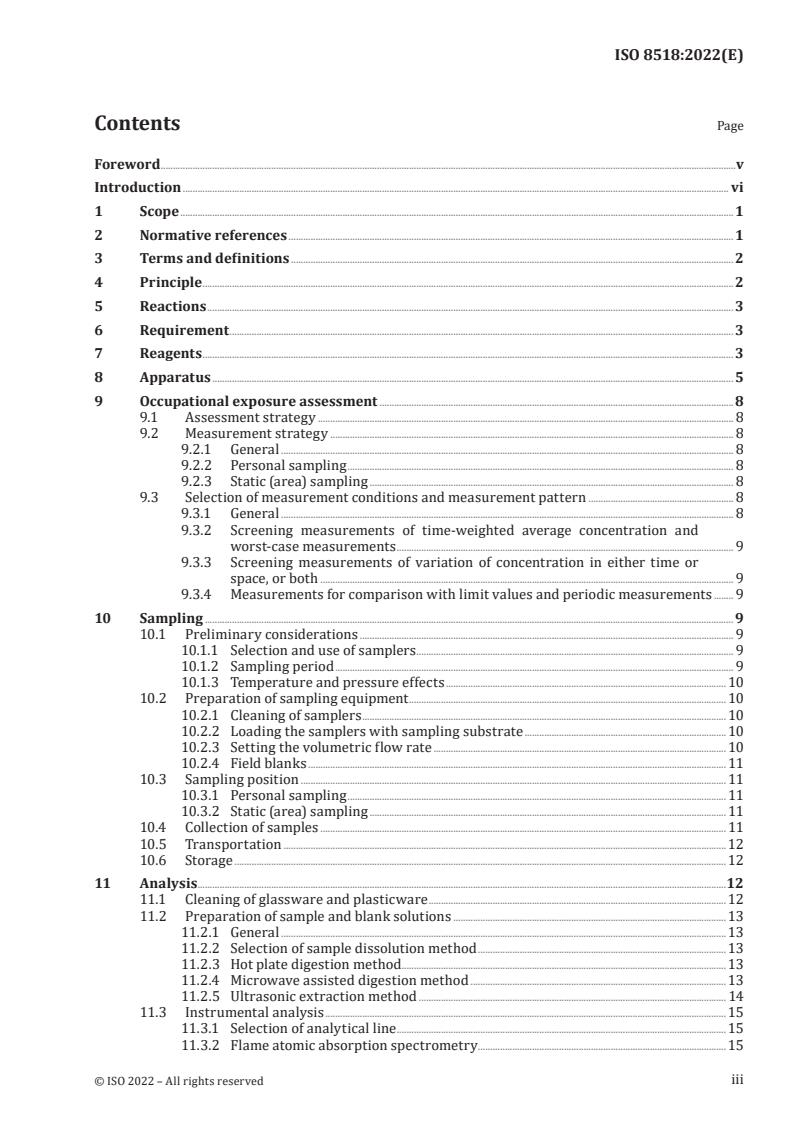
Contents Page
Foreword .v
Introduction . vi
1 Scope . 1
2 Normative references . 1
3 Terms and definitions . 2
4 Principle . 2
5 Reactions . 3
6 Requirement . 3
7 Reagents . 3
8 Apparatus . 5
9 Occupational exposure assessment .8
9.1 Assessment strategy . 8
9.2 Measurement strategy . 8
9.2.1 General . 8
9.2.2 Personal sampling . 8
9.2.3 Static (area) sampling . 8
9.3 Selection of measurement conditions and measurement pattern . 8
9.3.1 General . 8
9.3.2 Screening measurements of time-weighted average concentration and
worst-case measurements . 9
9.3.3 Screening measurements of variation of concentration in either time or
space, or both . 9
9.3.4 Measurements for comparison with limit values and periodic measurements . 9
10 Sampling . 9
10.1 Preliminary considerations . 9
10.1.1 Selection and use of samplers . 9
10.1.2 Sampling period . 9
10.1.3 Temperature and pressure effects . 10
10.2 Preparation of sampling equipment . 10
10.2.1 Cleaning of samplers . 10
10.2.2 Loading the samplers with sampling substrate . 10
10.2.3 Setting the volumetric flow rate . 10
10.2.4 Field blanks . 11
10.3 Sampling position . 11
10.3.1 Personal sampling . 11
10.3.2 Static (area) sampling . 11
10.4 Collection of samples . 11
10.5 Transportation .12
10.6 Storage . 12
11 Analysis .12
11.1 Cleaning of glassware and plasticware .12
11.2 Preparation of sample and blank solutions . 13
11.2.1 General .13
11.2.2 Selection of sample dissolution method . 13
11.2.3 Hot plate digestion method . . 13
11.2.4 Microwave assisted digestion method . 13
11.2.5 Ultrasonic extraction method . 14
11.3 Instrumental analysis . 15
11.3.1 Selection of analytical line . 15
11.3.2 Flame atomic absorption spectrometry . 15
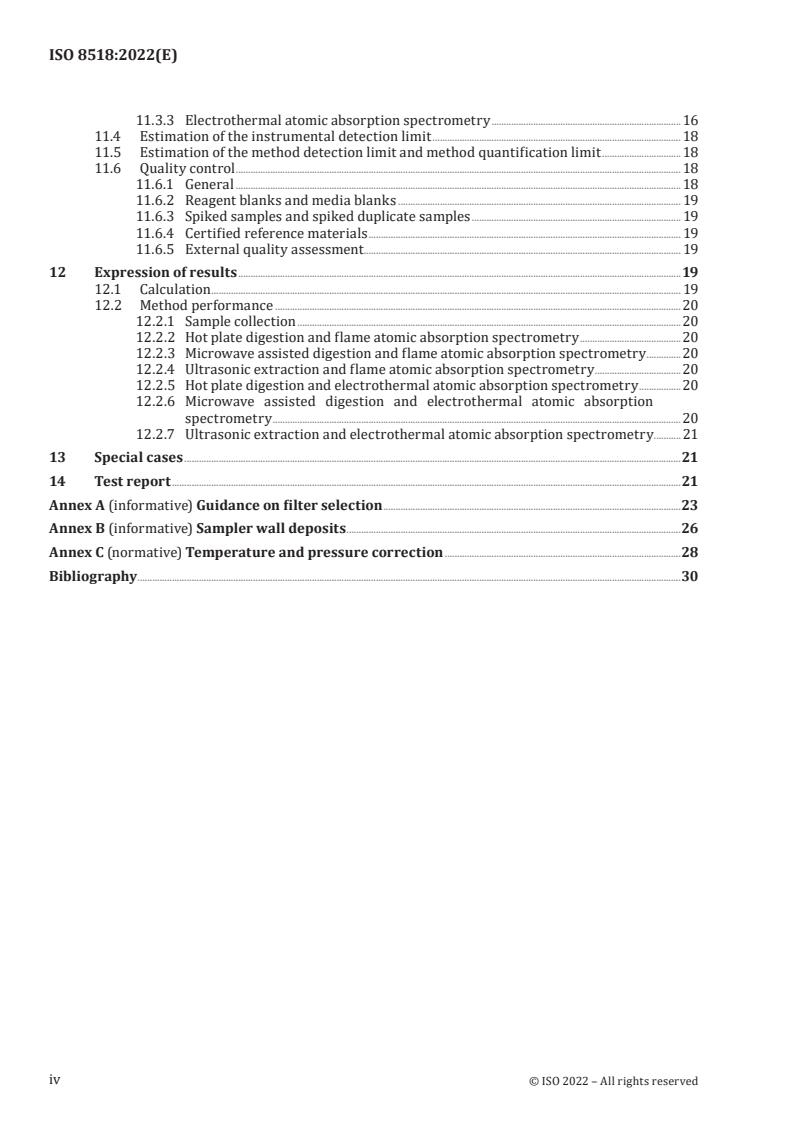
iii
11.3.3 Electrothermal atomic absorption spectrometry . 16
11.4 Estimation of the instrumental detection limit . 18
11.5 Estimation of the method detection limit and method quantification limit . 18
11.6 Quality control . 18
11.6.1 General . 18
11.6.2 Reagent blanks and media blanks . 19
11.6.3 Spiked samples and spiked duplicate samples . 19
11.6.4 Certified reference materials . 19
11.6.5 External quality assessment . 19
12 Expression of results .19
12.1 Calculation . 19
12.2 Method performance . 20
12.2.1 Sample collection .20
12.2.2 Hot plate digestion and flame atomic absorption spectrometry .20
12.2.3 Microwave assisted digestion and flame atomic absorption spectrometry .20
12.2.4 Ultrasonic extraction and flame atomic absorption spectrometry .20
12.2.5 Hot plate digestion and electrothermal atomic absorption spectrometry .20
12.2.6 Microwave assisted digestion and electrothermal atomic absorption
spectrometry . 20
12.2.7 Ultrasonic extraction and electrothermal atomic absorption spectrometry . 21
13 Special cases .21
14 Test report .21
Annex A (informative) Guidance on filter selection .23
Annex B (informative) Sampler wall deposits .26
Annex C (normative) Temperature and pressure correction .28
Bibliography .30
iv
Foreword
ISO (the International Organization for Standardization) is a worldwide federation of national standards
bodies (ISO member bodies). The work of preparing International Standards is normally carried out
through ISO technical committees. Each member body interested in a subject for which a technical
committee has been established has the right to be represented on that committee. International
organizations, governmental and non-governmental, in liaison with ISO, also take part in the work.
ISO collaborates closely with the International Electrotechnical Commission (IEC) on all matters of
electrotechnical standardization.
The procedures used to develop this document and those intended for its further maintenance are
described in the ISO/IEC Directives, Part 1. In particular, the different approval criteria needed for the
different types of ISO documents should be noted. This document was drafted in accordance with the
editorial rules of the ISO/IEC Directives, Part 2 (see www.iso.org/directives).
Attention is drawn to the possibility that some of the elements of this document may be the subject of
patent rights. ISO shall not be held responsible for identifying any or all such patent rights. Details of
any patent rights identified during the development of the document will be in the Introduction and/or
on the ISO list of patent declarations received (see www.iso.org/patents).
Any trade name used in this document is information given for the convenience of users and does not
constitute an endorsement.
For an explanation of the voluntary nature of standards, the meaning of ISO specific terms and
expressions related to conformity assessment, as well as information about ISO's adherence to
the World Trade Organization (WTO) principles in the Technical Barriers to Trade (TBT), see
www.iso.org/iso/foreword.html.
This document was prepared by Technical Committee ISO/TC 146, Air quality, Subcommittee SC 2,
Workplace atmospheres.
This third edition cancels and replaces the second edition (ISO 8518:2001), which has been technically
revised.
The main changes are as follows:
— a new Annex B (informative) has been added concerning sampler wall deposits;
— references and definitions have been updated;
— additional editorial changes have been made.
Any feedback or questions on this document should be directed to the user’s national standards body. A
complete listing of these bodies can be found at www.iso.org/members.html.
v
Introduction
The health of workers in many industries, for example, mining, metal refining, battery manufacture,
construction, is at risk through exposure by inhalation of particulate lead and lead compounds.
Industrial hygienists and other public health professionals need to determine the effectiveness of
measures taken to control workers' exposure, and this is generally achieved by making workplace air
measurements. This document provides a method for making valid exposure measurements for lead. It
will be of benefit to:
— agencies concerned with health and safety at work;
— industrial hygienists and other public health professionals;
— analytical laboratories;
— industrial users and workers of metals and metalloids, etc.
During the development of this document, it has been assumed that the execution of its provisions
and the interpretation of the results obtained is entrusted to appropriately qualified and experienced
people.
vi
INTERNATIONAL STANDARD ISO 8518:2022(E)
Workplace air — Determination of particulate lead and
lead compounds — Flame and electrothermal atomic
absorption spectrometric methods
1 Scope
This document specifies flame and electrothermal atomic absorption spectrometric methods for the
determination of the time-weighted average mass concentration of particulate lead and lead compounds
in workplace air.
These methods are typically applicable to personal sampling of the inhalable fraction of airborne
particles, as defined in ISO 7708, and to static (area) sampling. It can be applied to other health-related
fractions as required.
The sample dissolution procedure specifies hot plate or microwave assisted digestion, or ultrasonic
extraction (see 11.2). The use of an alternative, more vigorous dissolution procedure is necessary when
it is desired to extract lead from compounds present in the test atmosphere that are insoluble using the
dissolution procedures described herein (see Clause 5).
The flame atomic absorption method is applicable to the determination of masses of approximately
[1]
1 µg to 200 µg of lead per sample, without dilution . The electrothermal atomic absorption method is
applicable to the determination of masses of approximately 0,01 µg to 0,5 µg of lead per sample, without
[1]
dilution .
The ultrasonic extraction procedure has been validated for the determination of masses of approximately
[2]
20 µg to 100 µg of lead per sample, for laboratory-generated lead fume air filter samples .
The concentration range for lead in air for which this procedure is applicable is determined in part by
the sampling procedure selected by the user (see 10.1).
2 Normative references
The following documents are referred to in the text in such a way that some or all of their content
constitutes requirements of this document. For dated references, only the edition cited applies. For
undated references, the latest edition of the referenced document (including any amendments) applies.
ISO 3585, Borosilicate glass 3.3 — Properties
ISO 3696:1987, Water for analytical laboratory use — Specification and test methods
ISO 7708:1995, Air quality — Particle size fraction definitions for health-related sampling
ISO 8655-1, Piston-operated volumetric apparatus — Part 1: Terminology, general requirements and user
recommendations
ISO 8655-2, Piston-operated volumetric apparatus — Part 2: Pipettes
ISO 8655-5, Piston-operated volumetric apparatus — Part 5: Dispensers
ISO 8655-6, Piston-operated volumetric apparatus — Part 6: Gravimetric reference measurement
procedure for the determination of volume
ISO 13137, Workplace atmospheres — Pumps for personal sampling of chemical agents — Requirements
and test methods
ISO 15202-2, Workplace air — Determination of metals and metalloids in airborne particulate matter by
inductively coupled plasma atomic emission spectrometry — Part 2: Sample preparation
ISO/IEC 17025, General requirements for the competence of testing and calibration laboratories
ISO 17034, General requirements for the competence of reference material producers
ISO 18158, Workplace air — Terminology
ISO 20581, Workplace air — General requirements for the performance of procedures for the measurement
of chemical agents
EN 13205, Workplace atmospheres — Assessment of performance of instruments for measurement of
airborne particle concentrations
3 Terms and definitions
For the purposes of this document, the terms and definitions given in ISO 18158 and the following apply.
ISO and IEC maintain terminology databases for use in standardization at the following addresses:
— ISO Online browsing platform: available at https:// www .iso .org/ obp
— IEC Electropedia: available at https:// www .electropedia .org/
3.1
sample dissolution
process of obtaining a solution containing all analytes of interest from a sample, which might or might
not involve complete dissolution of the sample
[SOURCE: ISO 15202-2:2020, 3.1]
3.2
sample solution
solution prepared from a sample by the process of sample dissolution (3.1)
Note 1 to entry: A sample solution might need to be subjected to further operations, e.g. dilution, or addition, or
both, of an internal standard(s), in order to produce a test solution (3.3).
[SOURCE: ISO 15202-2:2020, 3.2]
3.3
test solution
blank solution or sample solution (3.2) that has been subjected to all operations required to bring it into
a state in which it is ready for analysis
[SOURCE: ISO 15202-2:2020, 3.3, modified — Note 1 to entry has been deleted.]
4 Principle
4.1 A known volume of air is drawn through a sampling substrate to collect particulate lead and lead
compounds. For personal sampling, a sampler designed to collect the inhalable fraction of airborne
particles is typically used.
4.2 The sampling substrate and collected sample are subjected to a dissolution procedure in order
to extract lead. The sample dissolution procedure can use one of three techniques: hot plate digestion,
microwave assisted digestion or ultrasonic extraction.
4.3 Sample solutions are analysed for lead content by aspirating into the oxidizing air-acetylene
flame of an atomic absorption spectrometer equipped with a lead hollow-cathode lamp or electrodeless
discharge lamp. Absorbance measurements are made at 283,3 nm with background correction (e.
g. Zeeman mode or deuterium background correction), and analytical results are obtained by the
analytical curve technique. Potential interference by anions that form precipitates with lead is overcome
by the addition of the disodium salt of ethylenediamine tetraacetic acid (EDTA) when necessary.
4.4 For accurate lead determination when the concentration of lead in the solution is low, the analysis
can be repeated using electrothermal atomic absorption spectrometry. Aliquots of the test solution are
injected into a graphite furnace, and after drying and sample ashing stages, the sample is atomized
electrothermally. Absorbance measurements are made at 283,3 nm with background correction and
results are obtained by the analytical curve technique.
4.5 The results can be used for the assessment of workplace exposures to airborne particulate lead
[3]
(see ISO 21832 ).
5 Reactions
In general, the overwhelming majority of particulate lead compounds that are commonly found in
2+
samples of workplace air are converted to water-soluble lead ions (Pb ) by the sample dissolution
procedures described in 11.2. However, certain lead compounds, for example, lead-containing silicates,
can possibly not be dissolved. If necessary, a dissolution procedure employing hydrofluoric acid should
be used to dissolve silicate lead. If there is any doubt about the effectiveness of these procedures for the
dissolution of particulate lead compounds that can be present in the test atmosphere, then this shall be
investigated before proceeding with the analytical method described in Clause 11.
6 Requirement
The measuring procedure shall comply with applicable requirements of ISO 20581 and with any
relevant national standard that specifies performance requirements for procedures for measuring
chemical agents in workplace air.
7 Reagents
During the analysis, use only reagents of recognized analytical grade, and only water as specified in 7.1.
7.1 Water, conforming with the requirements for ISO 3696:1987, grade 2 water (electrical
conductivity less than 0,1 mS/m and resistivity greater than 0,01 MΩ·m at 25 °C).
The concentration of lead in the water shall be less than 0,01 µg/ml.
It is recommended that the water used be obtained from a water purification system that delivers
ultrapure water having a resistivity greater than 0,18 MΩ·m (usually expressed by manufacturers of
water purification systems as 18 MΩ·cm).
7.2 Nitric acid (HNO ), concentrated, ρ ≈ 1,42 g/ml (about 70 % mass fraction).
The concentration of lead shall be less than 0,01 µg/ml.
WARNING — Concentrated nitric acid is corrosive and oxidizing, and nitric acid fumes are
irritant. Avoid exposure by contact with the skin or eyes, or by inhalation of fumes. Use suitable
personal protective equipment (including suitable gloves, face shield or safety glasses, etc.)
when working with the concentrated or dilute nitric acid, and carry out sample dissolution with
concentrated nitric acid in open vessels in a fume hood.
7.3 Nitric acid, diluted 1 + 1.
Carefully add 500 ml of concentrated nitric acid (7.2) to 450 ml of water (7.1) in a 2-litre beaker. Swirl
to mix, allow to cool and transfer to a 1-litre one-mark volumetric flask. Dilute to the mark with water,
stopper and mix thoroughly.
7.4 Nitric acid, diluted 1 + 9.
Place approximately 800 ml of water (7.1) in a 1-litre one-mark volumetric flask. Carefully add 100 ml
of concentrated nitric acid (7.2) to the flask and swirl to mix. Allow to cool, dilute to 1 litre with water
and mix thoroughly.
7.5 Hydrofluoric acid (HF), concentrated, with the density, ρ, almost equal to 1,14 g/ml (about 38 %
mass fraction), if required, for digestion of samples containing lead silicates.
The concentration of lead in the HF shall be less than 0,1 µg/ml.
WARNING — Concentrated hydrofluoric acid and hydrogen fluoride vapour are extremely
toxic and intensely corrosive, and diluted hydrofluoric acid can also cause serious and painful
burns that can possibly not be felt until up to 24 h after contact. Avoid exposure by contact with
the skin or the eyes, or by inhalation of the vapour. Use of personal protection (for example,
impermeable gloves, face shield or safety glasses) is essential when working with concentrated
or diluted hydrofluoric acid, and concentrated hydrofluoric acid should be used in a fume
hood. It is essential that hydrofluoric acid antidote gel containing calcium gluconate is readily
available to workers, both during and for 24 h after use of hydrofluoric acid.
7.6 Matrix modifier, NH H PO , Mg(NO ) or Pd(NO ) , or a combination of these, if required, for
4 2 4 3 2 3 2
analysis by electrothermal atomic absorption spectrometry.
7.7 Stock lead standard solution, 1 000 mg/l of lead.
Use a commercial standard solution with a certified lead concentration traceable to national standards.
Observe the manufacturer's expiration date or recommended shelf life.
Alternatively, prepare a lead standard solution by one of the following procedures.
a) Dissolve 1,598 g ± 0,001 g of lead(II) nitrate [Pb(NO ) ], previously dried to constant mass at
3 2
110 °C and cooled in a desiccator, in 200 ml of 1 + 1 nitric acid (7.3). Quantitatively transfer the
solution to a 1 000 ml one-mark volumetric flask. Dilute to the mark with water (7.1), stopper and
mix thoroughly. Store in a suitable container, for example, a polypropylene bottle (8.6.2.2), for a
maximum period of one year.
b) Dissolve 1,000 g ± 0,001 g of lead wire (99,9 % mass fraction Pb) in 200 ml of 1 + 1 nitric acid
(7.3). Quantitatively transfer the solution into a 1 000 ml one-mark volumetric flask, dilute to the
mark with water (7.1), stopper and mix thoroughly. Store in a suitable container, for example, a
polypropylene bottle (8.6.2.2), for a maximum period of one year.
7.8 Working lead standard solution, 1 mg/l of lead, if required, for analysis by electrothermal
atomic absorption spectrometry.
Accurately pipette 100 µl of stock lead standard solution (7.7) into a 100 ml one-mark volumetric flask
(8.6.1.4). Add 1 ml of concentrated nitric acid (7.2), dilute to the mark with water (7.1), stopper and mix
thoroughly. Store in a suitable container, for example, a polypropylene bottle (8.6.2.2), for a maximum
period of one month.
7.9 Hydrogen peroxide (H O ), approximately 30 % mass fraction solution, if required, for use in
2 2
the hot-plate sample digestion method.
The concentration of lead in the hydrogen peroxide solution shall be less than 0,01 µg/ml.
7.10 Acetylene, if required, for use in analysis by flame atomic absorption spectrometry.
7.11 Air, compressed and filtered, if required, for use in analysis by flame atomic absorption
spectrometry.
8 Apparatus
8.1 Inhalable samplers, designed to collect the inhalable fraction of airborne particles, complying
with the provisions of EN 13205, for use when the exposure limits of interest apply to the inhalable
fraction of airborne particles.
NOTE 1 In general, personal samplers for collection of the inhalable fraction of airborne particles do not
exhibit the same size selective characteristics if used for static (area) sampling.
NOTE 2 Some inhalable samplers are designed to collect the fraction of airborne particles on a sampling
substrate, and any particulate matter deposited on the internal surfaces of the sampler is not of interest. Other
inhalable samplers are designed such that airborne particles that pass through the entry orifice(s) match the
inhalable convention, in which case particulate matter deposited on the internal surfaces of the sampler does
form part of the sample. (Samplers of this second type generally incorporate an internal filter cassette or
cartridge that can be removed from the sampler to enable this material to be easily recovered.) The operating
instructions supplied by the manufacturer should be consulted to find out whether particulate matter deposited
on the internal surfaces of the sampler forms part of the sample. Annex B provides additional guidance on
sampler wall deposits.
NOTE 3 Samplers to collect other fractions defined in ISO 7708 can be used when necessary (for example,
when there are occupational exposure limit values associated with those fractions.)
8.2 Sampling substrate, (for example, a filter) of a diameter suitable for use with the samplers (see
8.1), with a collection efficiency of not less than 99,5 % for particles with a 0,3 µm diffusion diameter in
accordance with 2.2 of ISO 7708:1995, with a maximum lead content (typically less than 0,1 µg Pb), and
compatible with the selected sample preparation method.
NOTE 1 Guidance on filter selection is provided in Annex A.
NOTE 2 Digestible cellulosic capsules (consisting of cellulose acetate housing attached to cellulosic filter) that
are placed within certain types of samplers are now available for use, thereby accounting for potential internal
[4],[5]
aerosol wall losses .
8.3 Sampling pumps, meeting the specifications of ISO 13137.
8.4 Flowmeter, portable, with an accuracy that is sufficient to enable the volumetric flow rate (see
10.1.1.2) to be measured to within ±5 %.
The calibration of the flowmeter shall be checked against a primary standard, i.e. a flowmeter whose
accuracy is traceable to national standards. If appropriate (see 10.1.3.1), record the atmospheric
temperature and pressure at which the calibration of the flowmeter was checked.
8.5 Ancillary equipment
8.5.1 Flexible tubing, of a diameter suitable for making a leak-proof connection from the samplers to
the sampling pumps.
8.5.2 Belts or harnesses, to which the sampling pumps can conveniently be fixed for personal
sampling (except where the sampling pumps are small enough to fit inside worker's pockets).
8.5.3 Flat-tipped forceps, for loading and unloading sampling substrates into samplers.
8.5.4 Transport cassettes, or similar, if required to transport samples for laboratory analysis.
8.5.5 Barometer, (readable to 0,1 kPa), suitable for measurement of atmospheric pressure, if required
(see 10.1.3).
8.5.6 Thermometer, (readable to 1 °C), minimum temperature range of 0 °C to 50 °C, with graduated
divisions of 1 °C or less, for measurement of atmospheric temperature.
For applications at temperatures below freezing, the range of the thermometer shall extend to the
appropriate desired range.
8.6 Analytical or laboratory apparatus
Ordinary laboratory apparatus, and the following.
8.6.1 Glassware, made of borosilicate glass 3.3 and conforming with the requirements of ISO 3585.
It is preferable to reserve a set of glassware for analysis of lead by this method, in order to ensure that
problems do not arise from incomplete removal of lead contamination by cleaning.
8.6.2 Plastic labware, including the following:
8.6.2.1 Heatable beakers, beaker covers, etc., if required, made of a material that is resistant to
corrosion by hydrofluoric acid, for example, a fluorocarbon polymer such as polytetrafluoroethylene
(PTFE), and suitable for performing dissolutions using hydrofluoric acid.
8.6.2.2 Polypropylene bottles, of capacities from 100 ml to 1 000 ml.
8.6.3 Piston-operated volumetric instruments, complying with the requirements of ISO 8655-1
and tested in accordance with ISO 8655-6:
8.6.3.1 Pipetters, complying with the requirements of ISO 8655-2, as an alternative to one-mark
pipettes, for the preparation of standard solutions, calibration solutions and dilution of samples.
8.6.3.2 Dispensers, complying with the requirements of ISO 8655-5, for dispensing acids.
8.6.4 Hot plate, thermostatically controlled, capable of maintaining a surface temperature of
approximately 150 °C, for hot-plate procedures.
8.6.5 Microwave digestion apparatus
8.6.5.1 General
Ensure that manufacturer's safety recommendations are followed.
NOTE 1 The specified method is for closed vessel microwave digestion systems with a temperature control
system. Microwave digestion systems that are equipped only with either a pressure control system or lower
pressure vessels, or both, can be used provided that a suitable sample dissolution procedure is developed, and a
prior assessment of dissolution efficiency is carried out.
NOTE 2 Open-vessel microwave digestion systems can give results equivalent to closed-vessel microwave
digestion systems. They can therefore be used provided that a suitable sample dissolution procedure is
developed, and a prior assessment of dissolution efficiency is carried out.
8.6.5.2 Microwave digestion system, designed for closed-vessel sample digestion in the laboratory,
with power output regulation, fitted with a temperature control system capable of minimum sensing
the temperature to within ±2 °C and automatically adjusting the microwave power output within
minimum 2 s.
The microwave cavity shall be corrosion-resistant and well ventilated, with all electronics protected
against corrosion to ensure safe operation.
CAUTION — Do not use domestic (kitchen) microwave ovens, since there are very significant
hazards associated with their use for the procedure described in this document. Acid vapours
released into the cavity can corrode safety devices that prevent the magnetron from shutting
off when the door is opened, potentially exposing the operator to microwave energy. Also, the
fumes generated can be extremely hazardous.
NOTE A pressure control system is also very useful, since it provides a safeguard against the possibility of
sample loss due to excessive pressure build-up and partial venting of the sample vessels.
8.6.5.3 Vessels, designed for carrying out microwave assisted digestions, capable of withstanding a
temperature of 180 °C, and with an internal volume of at least 50 ml.
The vessels shall be transparent to microwave energy, and shall be capable of withstanding internal
pressures up to at least 3 000 kPa or greater, and temperatures up to at least 180 °C or greater.
Closed vessels shall also be equipped with a safety relief valve or disc that will prevent vessel
rupture or ejection of the vessel cap. Such vessels consist of an inner liner and cover made of a
microwave-transparent and chemically resistant material [usually a fluorocarbon polymer such
as tetrafluoromethoxyl polymer (TFM)], which contains and isolates the sample solution from a
high-strength, outer pressure vessel structure. Other types of sample vessel designed to operate at
equivalent or higher temperatures or pressures, or both, can be used. If hydrofluoric acid (HF) is to be
used, the vessels shall be compatible with HF.
CAUTION — For closed-vessel designs, the material from which the outer vessels are made
is usually not as chemically resistant as the liner material. Since the outer vessels provide
the strength required to withstand the high pressures within the inner liners, they shall be
inspected regularly to check for any chemical or physical degradation.
NOTE Alternatively, a one reaction chamber microwave assisted pressure digestion system can be used.
8.6.6 Ultrasonic bath (sonicator), for performing ultrasonic extractions, capable of delivering
sufficient power to effect the quantitative dissolution of particulate lead under the conditions described
in 11.2.5 (typically 1 W/cm power density or greater).
8.6.7 Plastic centrifuge tubes, 50 ml, with screw caps (for ultrasonic procedure).
8.6.8 Atomic absorption spectrometer, fitted with an air-acetylene burner supplied with
compressed air and acetylene, and equipped with either a lead hollow cathode lamp or electrodeless
[6],[7]
discharge lamp . If sample dissolution is carried out with the aid of hydrofluoric acid (see
11.2.3.3 and 11.2.4.2), the atomic absorption spectrometer shall be hydrofluoric acid-compatible. If
electrothermal atomic absorption is to be carried out, the atomic absorption spectrometer shall be
capable of carrying out simultaneous background correction at 283,3 nm, either by using a continuum
source such as a deuterium lamp to measure non-specific attenuation, or by using Zeeman or Smith-
[8]
Hieftje background correction systems .
8.6.9 Electrothermal atomiser, fitted with a solid, pyrolytic graphite platform mounted in a
pyrolytically-coated graphite tube, supplied with argon purge gas, and equipped with an autosampler
capable of injecting microlitre volumes onto the platform.
NOTE Some manufacturers of atomic absorption spectrometers use an alternative design of electrothermal
atomiser to achieve a constant temperature environment during atomisation, and some use aerosol deposition
as a means of sample introduction. The use of such accessories is acceptable, provided satisfactory method
performance is verified. Likewise, atomisers made from heat-resistant metal, such as tungsten, can also be
suitable.
8.6.10 Analytical balance, capable of weighing to ±0,1 mg, if required, for use in preparation of stock
standard lead solution.
8.6.11 Disposable gloves, for prevention of sample contamination.
9 Occupational exposure assessment
9.1 Assessment strategy
[9] [10]
Refer to relevant International or national Standards (for example, EN 689 and ASTM E1370 ) for
guidance on how to develop an appropriate assessment strategy.
9.2 Measurement strategy
9.2.1 General
[9] [10]
Refer to relevant International or national Standards (for example, EN 689 and ASTM E1370 ) for
general guidance on measurement strategy.
9.2.2 Personal sampling
Exposure of workers to lead shall normally be determined by personal sampling, since the concentration
of lead and lead compounds in the breathing zone is usually higher than their background levels in the
workplace.
9.2.3 Static (area) sampling
Static (area) sampling can be carried out, if appropriate, to assess the exposure of workers in a situation
where personal sampling is not possible; to characterise the background level of lead in the workplace
to give an indication of the efficiency of ventilation or other engineering controls; or to provide
information on the location and intensity of an emission source.
9.3 Selection of measurement conditions and measurement pattern
9.3.1 General
9.3.1.1 The sampling procedure shall be devised to provide samples that are representative of normal
working conditions and that are compatible with the analytical method while causing the least possible
interference with the worker and the normal performance of the job.
9.3.1.2 The pattern of sampling shall take into consideration practical issues, such as the nature of
the measurement task and the frequency and duration of particular work activities.
NOTE Additional information concerning purposes of measurement and performance requirements can be
found in ISO 20581.
9.3.2 Screening measurements of time-weighted average concentration and worst-case
measurements
Screening measurements of time-weighted average con
...
INTERNATIONAL ISO
STANDARD 8518
Third edition
2022-10
Workplace air — Determination of
particulate lead and lead compounds
— Flame and electrothermal atomic
absorption spectrometric methods
Air des lieux de travail — Dosage du plomb particulaire et des
composés particulaires du plomb — Méthode par spectrométrie
d'absorption atomique dans la flamme et méthode par spectrométrie
d'absorption avec atomisation électrothermique
Reference number
© ISO 2022
All rights reserved. Unless otherwise specified, or required in the context of its implementation, no part of this publication may
be reproduced or utilized otherwise in any form or by any means, electronic or mechanical, including photocopying, or posting on
the internet or an intranet, without prior written permission. Permission can be requested from either ISO at the address below
or ISO’s member body in the country of the requester.
ISO copyright office
CP 401 • Ch. de Blandonnet 8
CH-1214 Vernier, Geneva
Phone: +41 22 749 01 11
Email: copyright@iso.org
Website: www.iso.org
Published in Switzerland
ii
Contents Page
Foreword .v
Introduction . vi
1 Scope . 1
2 Normative references . 1
3 Terms and definitions . 2
4 Principle . 2
5 Reactions . 3
6 Requirement . 3
7 Reagents . 3
8 Apparatus . 5
9 Occupational exposure assessment .8
9.1 Assessment strategy . 8
9.2 Measurement strategy . 8
9.2.1 General . 8
9.2.2 Personal sampling . 8
9.2.3 Static (area) sampling . 8
9.3 Selection of measurement conditions and measurement pattern . 8
9.3.1 General . 8
9.3.2 Screening measurements of time-weighted average concentration and
worst-case measurements . 9
9.3.3 Screening measurements of variation of concentration in either time or
space, or both . 9
9.3.4 Measurements for comparison with limit values and periodic measurements . 9
10 Sampling . 9
10.1 Preliminary considerations . 9
10.1.1 Selection and use of samplers . 9
10.1.2 Sampling period . 9
10.1.3 Temperature and pressure effects . 10
10.2 Preparation of sampling equipment . 10
10.2.1 Cleaning of samplers . 10
10.2.2 Loading the samplers with sampling substrate . 10
10.2.3 Setting the volumetric flow rate . 10
10.2.4 Field blanks . 11
10.3 Sampling position . 11
10.3.1 Personal sampling . 11
10.3.2 Static (area) sampling . 11
10.4 Collection of samples . 11
10.5 Transportation .12
10.6 Storage . 12
11 Analysis .12
11.1 Cleaning of glassware and plasticware .12
11.2 Preparation of sample and blank solutions . 13
11.2.1 General .13
11.2.2 Selection of sample dissolution method . 13
11.2.3 Hot plate digestion method . . 13
11.2.4 Microwave assisted digestion method . 13
11.2.5 Ultrasonic extraction method . 14
11.3 Instrumental analysis . 15
11.3.1 Selection of analytical line . 15
11.3.2 Flame atomic absorption spectrometry . 15
iii
11.3.3 Electrothermal atomic absorption spectrometry . 16
11.4 Estimation of the instrumental detection limit . 18
11.5 Estimation of the method detection limit and method quantification limit . 18
11.6 Quality control . 18
11.6.1 General . 18
11.6.2 Reagent blanks and media blanks . 19
11.6.3 Spiked samples and spiked duplicate samples . 19
11.6.4 Certified reference materials . 19
11.6.5 External quality assessment . 19
12 Expression of results .19
12.1 Calculation . 19
12.2 Method performance . 20
12.2.1 Sample collection .20
12.2.2 Hot plate digestion and flame atomic absorption spectrometry .20
12.2.3 Microwave assisted digestion and flame atomic absorption spectrometry .20
12.2.4 Ultrasonic extraction and flame atomic absorption spectrometry .20
12.2.5 Hot plate digestion and electrothermal atomic absorption spectrometry .20
12.2.6 Microwave assisted digestion and electrothermal atomic absorption
spectrometry . 20
12.2.7 Ultrasonic extraction and electrothermal atomic absorption spectrometry . 21
13 Special cases .21
14 Test report .21
Annex A (informative) Guidance on filter selection .23
Annex B (informative) Sampler wall deposits .26
Annex C (normative) Temperature and pressure correction .28
Bibliography .30
iv
Foreword
ISO (the International Organization for Standardization) is a worldwide federation of national standards
bodies (ISO member bodies). The work of preparing International Standards is normally carried out
through ISO technical committees. Each member body interested in a subject for which a technical
committee has been established has the right to be represented on that committee. International
organizations, governmental and non-governmental, in liaison with ISO, also take part in the work.
ISO collaborates closely with the International Electrotechnical Commission (IEC) on all matters of
electrotechnical standardization.
The procedures used to develop this document and those intended for its further maintenance are
described in the ISO/IEC Directives, Part 1. In particular, the different approval criteria needed for the
different types of ISO documents should be noted. This document was drafted in accordance with the
editorial rules of the ISO/IEC Directives, Part 2 (see www.iso.org/directives).
Attention is drawn to the possibility that some of the elements of this document may be the subject of
patent rights. ISO shall not be held responsible for identifying any or all such patent rights. Details of
any patent rights identified during the development of the document will be in the Introduction and/or
on the ISO list of patent declarations received (see www.iso.org/patents).
Any trade name used in this document is information given for the convenience of users and does not
constitute an endorsement.
For an explanation of the voluntary nature of standards, the meaning of ISO specific terms and
expressions related to conformity assessment, as well as information about ISO's adherence to
the World Trade Organization (WTO) principles in the Technical Barriers to Trade (TBT), see
www.iso.org/iso/foreword.html.
This document was prepared by Technical Committee ISO/TC 146, Air quality, Subcommittee SC 2,
Workplace atmospheres.
This third edition cancels and replaces the second edition (ISO 8518:2001), which has been technically
revised.
The main changes are as follows:
— a new Annex B (informative) has been added concerning sampler wall deposits;
— references and definitions have been updated;
— additional editorial changes have been made.
Any feedback or questions on this document should be directed to the user’s national standards body. A
complete listing of these bodies can be found at www.iso.org/members.html.
v
Introduction
The health of workers in many industries, for example, mining, metal refining, battery manufacture,
construction, is at risk through exposure by inhalation of particulate lead and lead compounds.
Industrial hygienists and other public health professionals need to determine the effectiveness of
measures taken to control workers' exposure, and this is generally achieved by making workplace air
measurements. This document provides a method for making valid exposure measurements for lead. It
will be of benefit to:
— agencies concerned with health and safety at work;
— industrial hygienists and other public health professionals;
— analytical laboratories;
— industrial users and workers of metals and metalloids, etc.
During the development of this document, it has been assumed that the execution of its provisions
and the interpretation of the results obtained is entrusted to appropriately qualified and experienced
people.
vi
INTERNATIONAL STANDARD ISO 8518:2022(E)
Workplace air — Determination of particulate lead and
lead compounds — Flame and electrothermal atomic
absorption spectrometric methods
1 Scope
This document specifies flame and electrothermal atomic absorption spectrometric methods for the
determination of the time-weighted average mass concentration of particulate lead and lead compounds
in workplace air.
These methods are typically applicable to personal sampling of the inhalable fraction of airborne
particles, as defined in ISO 7708, and to static (area) sampling. It can be applied to other health-related
fractions as required.
The sample dissolution procedure specifies hot plate or microwave assisted digestion, or ultrasonic
extraction (see 11.2). The use of an alternative, more vigorous dissolution procedure is necessary when
it is desired to extract lead from compounds present in the test atmosphere that are insoluble using the
dissolution procedures described herein (see Clause 5).
The flame atomic absorption method is applicable to the determination of masses of approximately
[1]
1 µg to 200 µg of lead per sample, without dilution . The electrothermal atomic absorption method is
applicable to the determination of masses of approximately 0,01 µg to 0,5 µg of lead per sample, without
[1]
dilution .
The ultrasonic extraction procedure has been validated for the determination of masses of approximately
[2]
20 µg to 100 µg of lead per sample, for laboratory-generated lead fume air filter samples .
The concentration range for lead in air for which this procedure is applicable is determined in part by
the sampling procedure selected by the user (see 10.1).
2 Normative references
The following documents are referred to in the text in such a way that some or all of their content
constitutes requirements of this document. For dated references, only the edition cited applies. For
undated references, the latest edition of the referenced document (including any amendments) applies.
ISO 3585, Borosilicate glass 3.3 — Properties
ISO 3696:1987, Water for analytical laboratory use — Specification and test methods
ISO 7708:1995, Air quality — Particle size fraction definitions for health-related sampling
ISO 8655-1, Piston-operated volumetric apparatus — Part 1: Terminology, general requirements and user
recommendations
ISO 8655-2, Piston-operated volumetric apparatus — Part 2: Pipettes
ISO 8655-5, Piston-operated volumetric apparatus — Part 5: Dispensers
ISO 8655-6, Piston-operated volumetric apparatus — Part 6: Gravimetric reference measurement
procedure for the determination of volume
ISO 13137, Workplace atmospheres — Pumps for personal sampling of chemical agents — Requirements
and test methods
ISO 15202-2, Workplace air — Determination of metals and metalloids in airborne particulate matter by
inductively coupled plasma atomic emission spectrometry — Part 2: Sample preparation
ISO/IEC 17025, General requirements for the competence of testing and calibration laboratories
ISO 17034, General requirements for the competence of reference material producers
ISO 18158, Workplace air — Terminology
ISO 20581, Workplace air — General requirements for the performance of procedures for the measurement
of chemical agents
EN 13205, Workplace atmospheres — Assessment of performance of instruments for measurement of
airborne particle concentrations
3 Terms and definitions
For the purposes of this document, the terms and definitions given in ISO 18158 and the following apply.
ISO and IEC maintain terminology databases for use in standardization at the following addresses:
— ISO Online browsing platform: available at https:// www .iso .org/ obp
— IEC Electropedia: available at https:// www .electropedia .org/
3.1
sample dissolution
process of obtaining a solution containing all analytes of interest from a sample, which might or might
not involve complete dissolution of the sample
[SOURCE: ISO 15202-2:2020, 3.1]
3.2
sample solution
solution prepared from a sample by the process of sample dissolution (3.1)
Note 1 to entry: A sample solution might need to be subjected to further operations, e.g. dilution, or addition, or
both, of an internal standard(s), in order to produce a test solution (3.3).
[SOURCE: ISO 15202-2:2020, 3.2]
3.3
test solution
blank solution or sample solution (3.2) that has been subjected to all operations required to bring it into
a state in which it is ready for analysis
[SOURCE: ISO 15202-2:2020, 3.3, modified — Note 1 to entry has been deleted.]
4 Principle
4.1 A known volume of air is drawn through a sampling substrate to collect particulate lead and lead
compounds. For personal sampling, a sampler designed to collect the inhalable fraction of airborne
particles is typically used.
4.2 The sampling substrate and collected sample are subjected to a dissolution procedure in order
to extract lead. The sample dissolution procedure can use one of three techniques: hot plate digestion,
microwave assisted digestion or ultrasonic extraction.
4.3 Sample solutions are analysed for lead content by aspirating into the oxidizing air-acetylene
flame of an atomic absorption spectrometer equipped with a lead hollow-cathode lamp or electrodeless
discharge lamp. Absorbance measurements are made at 283,3 nm with background correction (e.
g. Zeeman mode or deuterium background correction), and analytical results are obtained by the
analytical curve technique. Potential interference by anions that form precipitates with lead is overcome
by the addition of the disodium salt of ethylenediamine tetraacetic acid (EDTA) when necessary.
4.4 For accurate lead determination when the concentration of lead in the solution is low, the analysis
can be repeated using electrothermal atomic absorption spectrometry. Aliquots of the test solution are
injected into a graphite furnace, and after drying and sample ashing stages, the sample is atomized
electrothermally. Absorbance measurements are made at 283,3 nm with background correction and
results are obtained by the analytical curve technique.
4.5 The results can be used for the assessment of workplace exposures to airborne particulate lead
[3]
(see ISO 21832 ).
5 Reactions
In general, the overwhelming majority of particulate lead compounds that are commonly found in
2+
samples of workplace air are converted to water-soluble lead ions (Pb ) by the sample dissolution
procedures described in 11.2. However, certain lead compounds, for example, lead-containing silicates,
can possibly not be dissolved. If necessary, a dissolution procedure employing hydrofluoric acid should
be used to dissolve silicate lead. If there is any doubt about the effectiveness of these procedures for the
dissolution of particulate lead compounds that can be present in the test atmosphere, then this shall be
investigated before proceeding with the analytical method described in Clause 11.
6 Requirement
The measuring procedure shall comply with applicable requirements of ISO 20581 and with any
relevant national standard that specifies performance requirements for procedures for measuring
chemical agents in workplace air.
7 Reagents
During the analysis, use only reagents of recognized analytical grade, and only water as specified in 7.1.
7.1 Water, conforming with the requirements for ISO 3696:1987, grade 2 water (electrical
conductivity less than 0,1 mS/m and resistivity greater than 0,01 MΩ·m at 25 °C).
The concentration of lead in the water shall be less than 0,01 µg/ml.
It is recommended that the water used be obtained from a water purification system that delivers
ultrapure water having a resistivity greater than 0,18 MΩ·m (usually expressed by manufacturers of
water purification systems as 18 MΩ·cm).
7.2 Nitric acid (HNO ), concentrated, ρ ≈ 1,42 g/ml (about 70 % mass fraction).
The concentration of lead shall be less than 0,01 µg/ml.
WARNING — Concentrated nitric acid is corrosive and oxidizing, and nitric acid fumes are
irritant. Avoid exposure by contact with the skin or eyes, or by inhalation of fumes. Use suitable
personal protective equipment (including suitable gloves, face shield or safety glasses, etc.)
when working with the concentrated or dilute nitric acid, and carry out sample dissolution with
concentrated nitric acid in open vessels in a fume hood.
7.3 Nitric acid, diluted 1 + 1.
Carefully add 500 ml of concentrated nitric acid (7.2) to 450 ml of water (7.1) in a 2-litre beaker. Swirl
to mix, allow to cool and transfer to a 1-litre one-mark volumetric flask. Dilute to the mark with water,
stopper and mix thoroughly.
7.4 Nitric acid, diluted 1 + 9.
Place approximately 800 ml of water (7.1) in a 1-litre one-mark volumetric flask. Carefully add 100 ml
of concentrated nitric acid (7.2) to the flask and swirl to mix. Allow to cool, dilute to 1 litre with water
and mix thoroughly.
7.5 Hydrofluoric acid (HF), concentrated, with the density, ρ, almost equal to 1,14 g/ml (about 38 %
mass fraction), if required, for digestion of samples containing lead silicates.
The concentration of lead in the HF shall be less than 0,1 µg/ml.
WARNING — Concentrated hydrofluoric acid and hydrogen fluoride vapour are extremely
toxic and intensely corrosive, and diluted hydrofluoric acid can also cause serious and painful
burns that can possibly not be felt until up to 24 h after contact. Avoid exposure by contact with
the skin or the eyes, or by inhalation of the vapour. Use of personal protection (for example,
impermeable gloves, face shield or safety glasses) is essential when working with concentrated
or diluted hydrofluoric acid, and concentrated hydrofluoric acid should be used in a fume
hood. It is essential that hydrofluoric acid antidote gel containing calcium gluconate is readily
available to workers, both during and for 24 h after use of hydrofluoric acid.
7.6 Matrix modifier, NH H PO , Mg(NO ) or Pd(NO ) , or a combination of these, if required, for
4 2 4 3 2 3 2
analysis by electrothermal atomic absorption spectrometry.
7.7 Stock lead standard solution, 1 000 mg/l of lead.
Use a commercial standard solution with a certified lead concentration traceable to national standards.
Observe the manufacturer's expiration date or recommended shelf life.
Alternatively, prepare a lead standard solution by one of the following procedures.
a) Dissolve 1,598 g ± 0,001 g of lead(II) nitrate [Pb(NO ) ], previously dried to constant mass at
3 2
110 °C and cooled in a desiccator, in 200 ml of 1 + 1 nitric acid (7.3). Quantitatively transfer the
solution to a 1 000 ml one-mark volumetric flask. Dilute to the mark with water (7.1), stopper and
mix thoroughly. Store in a suitable container, for example, a polypropylene bottle (8.6.2.2), for a
maximum period of one year.
b) Dissolve 1,000 g ± 0,001 g of lead wire (99,9 % mass fraction Pb) in 200 ml of 1 + 1 nitric acid
(7.3). Quantitatively transfer the solution into a 1 000 ml one-mark volumetric flask, dilute to the
mark with water (7.1), stopper and mix thoroughly. Store in a suitable container, for example, a
polypropylene bottle (8.6.2.2), for a maximum period of one year.
7.8 Working lead standard solution, 1 mg/l of lead, if required, for analysis by electrothermal
atomic absorption spectrometry.
Accurately pipette 100 µl of stock lead standard solution (7.7) into a 100 ml one-mark volumetric flask
(8.6.1.4). Add 1 ml of concentrated nitric acid (7.2), dilute to the mark with water (7.1), stopper and mix
thoroughly. Store in a suitable container, for example, a polypropylene bottle (8.6.2.2), for a maximum
period of one month.
7.9 Hydrogen peroxide (H O ), approximately 30 % mass fraction solution, if required, for use in
2 2
the hot-plate sample digestion method.
The concentration of lead in the hydrogen peroxide solution shall be less than 0,01 µg/ml.
7.10 Acetylene, if required, for use in analysis by flame atomic absorption spectrometry.
7.11 Air, compressed and filtered, if required, for use in analysis by flame atomic absorption
spectrometry.
8 Apparatus
8.1 Inhalable samplers, designed to collect the inhalable fraction of airborne particles, complying
with the provisions of EN 13205, for use when the exposure limits of interest apply to the inhalable
fraction of airborne particles.
NOTE 1 In general, personal samplers for collection of the inhalable fraction of airborne particles do not
exhibit the same size selective characteristics if used for static (area) sampling.
NOTE 2 Some inhalable samplers are designed to collect the fraction of airborne particles on a sampling
substrate, and any particulate matter deposited on the internal surfaces of the sampler is not of interest. Other
inhalable samplers are designed such that airborne particles that pass through the entry orifice(s) match the
inhalable convention, in which case particulate matter deposited on the internal surfaces of the sampler does
form part of the sample. (Samplers of this second type generally incorporate an internal filter cassette or
cartridge that can be removed from the sampler to enable this material to be easily recovered.) The operating
instructions supplied by the manufacturer should be consulted to find out whether particulate matter deposited
on the internal surfaces of the sampler forms part of the sample. Annex B provides additional guidance on
sampler wall deposits.
NOTE 3 Samplers to collect other fractions defined in ISO 7708 can be used when necessary (for example,
when there are occupational exposure limit values associated with those fractions.)
8.2 Sampling substrate, (for example, a filter) of a diameter suitable for use with the samplers (see
8.1), with a collection efficiency of not less than 99,5 % for particles with a 0,3 µm diffusion diameter in
accordance with 2.2 of ISO 7708:1995, with a maximum lead content (typically less than 0,1 µg Pb), and
compatible with the selected sample preparation method.
NOTE 1 Guidance on filter selection is provided in Annex A.
NOTE 2 Digestible cellulosic capsules (consisting of cellulose acetate housing attached to cellulosic filter) that
are placed within certain types of samplers are now available for use, thereby accounting for potential internal
[4],[5]
aerosol wall losses .
8.3 Sampling pumps, meeting the specifications of ISO 13137.
8.4 Flowmeter, portable, with an accuracy that is sufficient to enable the volumetric flow rate (see
10.1.1.2) to be measured to within ±5 %.
The calibration of the flowmeter shall be checked against a primary standard, i.e. a flowmeter whose
accuracy is traceable to national standards. If appropriate (see 10.1.3.1), record the atmospheric
temperature and pressure at which the calibration of the flowmeter was checked.
8.5 Ancillary equipment
8.5.1 Flexible tubing, of a diameter suitable for making a leak-proof connection from the samplers to
the sampling pumps.
8.5.2 Belts or harnesses, to which the sampling pumps can conveniently be fixed for personal
sampling (except where the sampling pumps are small enough to fit inside worker's pockets).
8.5.3 Flat-tipped forceps, for loading and unloading sampling substrates into samplers.
8.5.4 Transport cassettes, or similar, if required to transport samples for laboratory analysis.
8.5.5 Barometer, (readable to 0,1 kPa), suitable for measurement of atmospheric pressure, if required
(see 10.1.3).
8.5.6 Thermometer, (readable to 1 °C), minimum temperature range of 0 °C to 50 °C, with graduated
divisions of 1 °C or less, for measurement of atmospheric temperature.
For applications at temperatures below freezing, the range of the thermometer shall extend to the
appropriate desired range.
8.6 Analytical or laboratory apparatus
Ordinary laboratory apparatus, and the following.
8.6.1 Glassware, made of borosilicate glass 3.3 and conforming with the requirements of ISO 3585.
It is preferable to reserve a set of glassware for analysis of lead by this method, in order to ensure that
problems do not arise from incomplete removal of lead contamination by cleaning.
8.6.2 Plastic labware, including the following:
8.6.2.1 Heatable beakers, beaker covers, etc., if required, made of a material that is resistant to
corrosion by hydrofluoric acid, for example, a fluorocarbon polymer such as polytetrafluoroethylene
(PTFE), and suitable for performing dissolutions using hydrofluoric acid.
8.6.2.2 Polypropylene bottles, of capacities from 100 ml to 1 000 ml.
8.6.3 Piston-operated volumetric instruments, complying with the requirements of ISO 8655-1
and tested in accordance with ISO 8655-6:
8.6.3.1 Pipetters, complying with the requirements of ISO 8655-2, as an alternative to one-mark
pipettes, for the preparation of standard solutions, calibration solutions and dilution of samples.
8.6.3.2 Dispensers, complying with the requirements of ISO 8655-5, for dispensing acids.
8.6.4 Hot plate, thermostatically controlled, capable of maintaining a surface temperature of
approximately 150 °C, for hot-plate procedures.
8.6.5 Microwave digestion apparatus
8.6.5.1 General
Ensure that manufacturer's safety recommendations are followed.
NOTE 1 The specified method is for closed vessel microwave digestion systems with a temperature control
system. Microwave digestion systems that are equipped only with either a pressure control system or lower
pressure vessels, or both, can be used provided that a suitable sample dissolution procedure is developed, and a
prior assessment of dissolution efficiency is carried out.
NOTE 2 Open-vessel microwave digestion systems can give results equivalent to closed-vessel microwave
digestion systems. They can therefore be used provided that a suitable sample dissolution procedure is
developed, and a prior assessment of dissolution efficiency is carried out.
8.6.5.2 Microwave digestion system, designed for closed-vessel sample digestion in the laboratory,
with power output regulation, fitted with a temperature control system capable of minimum sensing
the temperature to within ±2 °C and automatically adjusting the microwave power output within
minimum 2 s.
The microwave cavity shall be corrosion-resistant and well ventilated, with all electronics protected
against corrosion to ensure safe operation.
CAUTION — Do not use domestic (kitchen) microwave ovens, since there are very significant
hazards associated with their use for the procedure described in this document. Acid vapours
released into the cavity can corrode safety devices that prevent the magnetron from shutting
off when the door is opened, potentially exposing the operator to microwave energy. Also, the
fumes generated can be extremely hazardous.
NOTE A pressure control system is also very useful, since it provides a safeguard against the possibility of
sample loss due to excessive pressure build-up and partial venting of the sample vessels.
8.6.5.3 Vessels, designed for carrying out microwave assisted digestions, capable of withstanding a
temperature of 180 °C, and with an internal volume of at least 50 ml.
The vessels shall be transparent to microwave energy, and shall be capable of withstanding internal
pressures up to at least 3 000 kPa or greater, and temperatures up to at least 180 °C or greater.
Closed vessels shall also be equipped with a safety relief valve or disc that will prevent vessel
rupture or ejection of the vessel cap. Such vessels consist of an inner liner and cover made of a
microwave-transparent and chemically resistant material [usually a fluorocarbon polymer such
as tetrafluoromethoxyl polymer (TFM)], which contains and isolates the sample solution from a
high-strength, outer pressure vessel structure. Other types of sample vessel designed to operate at
equivalent or higher temperatures or pressures, or both, can be used. If hydrofluoric acid (HF) is to be
used, the vessels shall be compatible with HF.
CAUTION — For closed-vessel designs, the material from which the outer vessels are made
is usually not as chemically resistant as the liner material. Since the outer vessels provide
the strength required to withstand the high pressures within the inner liners, they shall be
inspected regularly to check for any chemical or physical degradation.
NOTE Alternatively, a one reaction chamber microwave assisted pressure digestion system can be used.
8.6.6 Ultrasonic bath (sonicator), for performing ultrasonic extractions, capable of delivering
sufficient power to effect the quantitative dissolution of particulate lead under the conditions described
in 11.2.5 (typically 1 W/cm power density or greater).
8.6.7 Plastic centrifuge tubes, 50 ml, with screw caps (for ultrasonic procedure).
8.6.8 Atomic absorption spectrometer, fitted with an air-acetylene burner supplied with
compressed air and acetylene, and equipped with either a lead hollow cathode lamp or electrodeless
[6],[7]
discharge lamp . If sample dissolution is carried out with the aid of hydrofluoric acid (see
11.2.3.3 and 11.2.4.2), the atomic absorption spectrometer shall be hydrofluoric acid-compatible. If
electrothermal atomic absorption is to be carried out, the atomic absorption spectrometer shall be
capable of carrying out simultaneous background correction at 283,3 nm, either by using a continuum
source such as a deuterium lamp to measure non-specific attenuation, or by using Zeeman or Smith-
[8]
Hieftje background correction systems .
8.6.9 Electrothermal atomiser, fitted with a solid, pyrolytic graphite platform mounted in a
pyrolytically-coated graphite tube, supplied with argon purge gas, and equipped with an autosampler
capable of injecting microlitre volumes onto the platform.
NOTE Some manufacturers of atomic absorption spectrometers use an alternative design of electrothermal
atomiser to achieve a constant temperature environment during atomisation, and some use aerosol deposition
as a means of sample introduction. The use of such accessories is acceptable, provided satisfactory method
performance is verified. Likewise, atomisers made from heat-resistant metal, such as tungsten, can also be
suitable.
8.6.10 Analytical balance, capable of weighing to ±0,1 mg, if required, for use in preparation of stock
standard lead solution.
8.6.11 Disposable gloves, for prevention of sample contamination.
9 Occupational exposure assessment
9.1 Assessment strategy
[9] [10]
Refer to relevant International or national Standards (for example, EN 689 and ASTM E1370 ) for
guidance on how to develop an appropriate assessment strategy.
9.2 Measurement strategy
9.2.1 General
[9] [10]
Refer to relevant International or national Standards (for example, EN 689 and ASTM E1370 ) for
general guidance on measurement strategy.
9.2.2 Personal sampling
Exposure of workers to lead shall normally be determined by personal sampling, since the concentration
of lead and lead compounds in the breathing zone is usually higher than their background levels in the
workplace.
9.2.3 Static (area) sampling
Static (area) sampling can be carried out, if appropriate, to assess the exposure of workers in a situation
where personal sampling is not possible; to characterise the background level of lead in the workplace
to give an indication of the efficiency of ventilation or other engineering controls; or to provide
information on the location and intensity of an emission source.
9.3 Selection of measurement conditions and measurement pattern
9.3.1 General
9.3.1.1 The sampling procedure shall be devised to provide samples that are representative of normal
working conditions and that are compatible with the analytical method while causing the least possible
interference with the worker and the normal performance of the job.
9.3.1.2 The pattern of sampling shall take into consideration practical issues, such as the nature of
the measurement task and the frequency and duration of particular work activities.
NOTE Additional information concerning purposes of measurement and performance requirements can be
found in ISO 20581.
9.3.2 Screening measurements of time-weighted average concentration and worst-case
measurements
Screening measurements of time-weighted average concentration can be carried out in the initial
stages of a survey to assess the effectiveness of control measures. This can involve sampling during
representative work episodes to obtain clear information about the level and pattern of exposure, or
worst-case measurements can be made.
9.3.3 Screening measurements of variation of concentration in either time or space, or both
Screening measurements of variation of concentration in either time or space, or both, can be carried
out in the initial stages of a survey to identify locations and periods of elevated exposure, and to set the
duration and frequency of sampling for measurements for comparison with limit values.
NOTE For making screening measurements of variation of concentration in either time or space, or both, the
sampling time used is normally between 5 min and 30 min.
9.3.4 Measurements for comparison with limit values and periodic measurements
For making long-term measurements, samples shall be collected for the entire working period or during
[11]
a number of representative work episodes .
NOTE The best estimate of long-term exposure is obtained by taking samples for the entire working period,
but this is often not practicable or not desirable (for example, because of the possibility of overloading the
sa
...