

SIST EN 131-6:2019+A1:2025
(Main + Amendment)Ladders - Part 6: Telescopic ladders
General Information
- Abstract
This document specifies the general design features, requirements and test methods and defines terms for leaning and standing telescopic ladders.
Ladders with extension elements are not covered by this part of EN 131.
This part of the standard is intended to be used in conjunction with EN 131-1, EN 131-2, EN 131-3 and if applicable EN 131-4.
- Status
- Published
- Publication Date
- 24-Aug-2025
- Technical Committee
- I13 - Imaginarni 13
- Current Stage
- 6060 - National Implementation/Publication (Adopted Project)
- Start Date
- 18-Aug-2025
- Due Date
- 23-Oct-2025
- Completion Date
- 25-Aug-2025
- Directive
- 2001/95/EC - General product safety

Overview
EN 131-6:2019+A1:2025 - Ladders: Part 6 - Telescopic ladders is a CEN European Standard that specifies design features, requirements, terms and test methods for leaning and standing telescopic ladders. It updates and amends EN 131-6:2019 (Amendment 1 approved 11 June 2025) and is intended for adoption as a national standard across CEN members by February 2026. Ladders with extension elements are excluded. This part is intended to be used together with EN 131-1, EN 131-2, EN 131-3 and, where applicable, EN 131-4.
Key topics and technical requirements
- Scope and terms: definitions specific to telescopic ladders (telescopic ladder, rung/step section, locking pin, protection against squeezing, storage position, etc.).
- Functional dimensions: requirements for top rung clearance (measured at 65°–75°; minimum 35 mm, maximum 300 mm) and outside width at the base.
- Rung/step spacing: ascendable rungs/steps must be equally spaced per EN 131-1 with a tolerance of ±2 mm; non-extended sections must stack at the top.
- Locking and indicators: each rung/step section requires a locking mechanism on each stile; visible indication that sections are locked (for example a coloured locking pin).
- Design safety: screws/nuts secured against loosening; sections not separable without tools; protection against squeezing when collapsing (for example a breaking function - typical collapse time example: 300 mm in 1.5 s if uniform).
- Testing program: extensive test methods including drop test, stile strength and bending, lateral deflection, vertical load on rungs/steps and platforms, torsion, pull-out, locking mechanism cyclic/static tests, hinge joint cycles, base slip, feet/end cap pull, asymmetrical bending, durability and opening/closing cycle tests. Separate methods for plastic components and brackets are included.
- Marking & user instructions: mandatory marking and user information, inspection lists and storage guidance.
Applications
- Product design and development of telescopic ladders - ensuring safe geometry, locking systems and user protection.
- Type testing and conformity assessment in test laboratories according to EN 131-6 test sequences.
- Safety compliance and risk reduction for manufacturers, importers and distributors operating in CEN member countries.
- Procurement specifications for workplaces, professional users and institutions requiring validated ladder performance.
Who should use this standard
- Ladder manufacturers and designers
- Test laboratories and conformity assessment bodies
- Product safety engineers and compliance officers
- Procurement teams and safety managers specifying ladder performance in Europe
Related standards
- EN 131-1: Terms, types, functional sizes
- EN 131-2: Requirements, testing, marking
- EN 131-3: Marking and user instructions
- EN 131-4: Hinge-joint ladders (if applicable)
Keywords: EN 131-6:2019+A1:2025, telescopic ladders, ladder standard, CEN, test methods, locking mechanism, top rung clearance, ladder safety.
Relations
- Effective Date
- 25-Jun-2025
- Effective Date
- 28-Jan-2026
- Effective Date
- 28-Jan-2026
- Effective Date
- 28-Jan-2026
- Effective Date
- 28-Jan-2026
- Effective Date
- 28-Jan-2026
Frequently Asked Questions
SIST EN 131-6:2019+A1:2025 is a standard published by the Slovenian Institute for Standardization (SIST). Its full title is "Ladders - Part 6: Telescopic ladders". This standard covers: This document specifies the general design features, requirements and test methods and defines terms for leaning and standing telescopic ladders. Ladders with extension elements are not covered by this part of EN 131. This part of the standard is intended to be used in conjunction with EN 131-1, EN 131-2, EN 131-3 and if applicable EN 131-4.
This document specifies the general design features, requirements and test methods and defines terms for leaning and standing telescopic ladders. Ladders with extension elements are not covered by this part of EN 131. This part of the standard is intended to be used in conjunction with EN 131-1, EN 131-2, EN 131-3 and if applicable EN 131-4.
SIST EN 131-6:2019+A1:2025 is classified under the following ICS (International Classification for Standards) categories: 97.145 - Ladders. The ICS classification helps identify the subject area and facilitates finding related standards.
SIST EN 131-6:2019+A1:2025 has the following relationships with other standards: It is inter standard links to SIST EN 131-6:2019, SIST EN 131-1:2016, SIST EN 131-3:2018, SIST EN 131-4:2007, SIST EN 131-2:2010+A2:2017, SIST EN 16116-1:2014. Understanding these relationships helps ensure you are using the most current and applicable version of the standard.
SIST EN 131-6:2019+A1:2025 is associated with the following European legislation: EU Directives/Regulations: 2001/95/EC; Standardization Mandates: M/285. When a standard is cited in the Official Journal of the European Union, products manufactured in conformity with it benefit from a presumption of conformity with the essential requirements of the corresponding EU directive or regulation.
SIST EN 131-6:2019+A1:2025 is available in PDF format for immediate download after purchase. The document can be added to your cart and obtained through the secure checkout process. Digital delivery ensures instant access to the complete standard document.
Standards Content (Sample)
SLOVENSKI STANDARD
01-oktober-2025
Lestve - 6. del: Teleskopske lestve (vključno z dopolnilom A1)
Ladders - Part 6: Telescopic ladders
Leitern - Teil 6: Teleskopleitern
Échelles - Partie 6 : Échelles télescopiques
Ta slovenski standard je istoveten z: EN 131-6:2019+A1:2025
ICS:
97.145 Lestve Ladders
2003-01.Slovenski inštitut za standardizacijo. Razmnoževanje celote ali delov tega standarda ni dovoljeno.
EN 131-6:2019+A1
EUROPEAN STANDARD
NORME EUROPÉENNE
August 2025
EUROPÄISCHE NORM
ICS 97.145 Supersedes EN 131-6:2019
English Version
Ladders - Part 6: Telescopic ladders
Échelles - Partie 6: Échelles télescopiques Leitern - Teil 6: Teleskopleitern
This European Standard was approved by CEN on 26 November 2018 and includes Amendment 1 approved by CEN on 11 June
2025.
CEN members are bound to comply with the CEN/CENELEC Internal Regulations which stipulate the conditions for giving this
European Standard the status of a national standard without any alteration. Up-to-date lists and bibliographical references
concerning such national standards may be obtained on application to the CEN-CENELEC Management Centre or to any CEN
member.
This European Standard exists in three official versions (English, French, German). A version in any other language made by
translation under the responsibility of a CEN member into its own language and notified to the CEN-CENELEC Management
Centre has the same status as the official versions.
CEN members are the national standards bodies of Austria, Belgium, Bulgaria, Croatia, Cyprus, Czech Republic, Denmark, Estonia,
Finland, France, Germany, Greece, Hungary, Iceland, Ireland, Italy, Latvia, Lithuania, Luxembourg, Malta, Netherlands, Norway,
Poland, Portugal, Republic of North Macedonia, Romania, Serbia, Slovakia, Slovenia, Spain, Sweden, Switzerland, Türkiye and
United Kingdom.
EUROPEAN COMMITTEE FOR STANDARDIZATION
COMITÉ EUROPÉEN DE NORMALISATION
EUROPÄISCHES KOMITEE FÜR NORMUNG
CEN-CENELEC Management Centre: Rue de la Science 23, B-1040 Brussels
© 2025 CEN All rights of exploitation in any form and by any means reserved Ref. No. EN 131-6:2019+A1:2025 E
worldwide for CEN national Members.
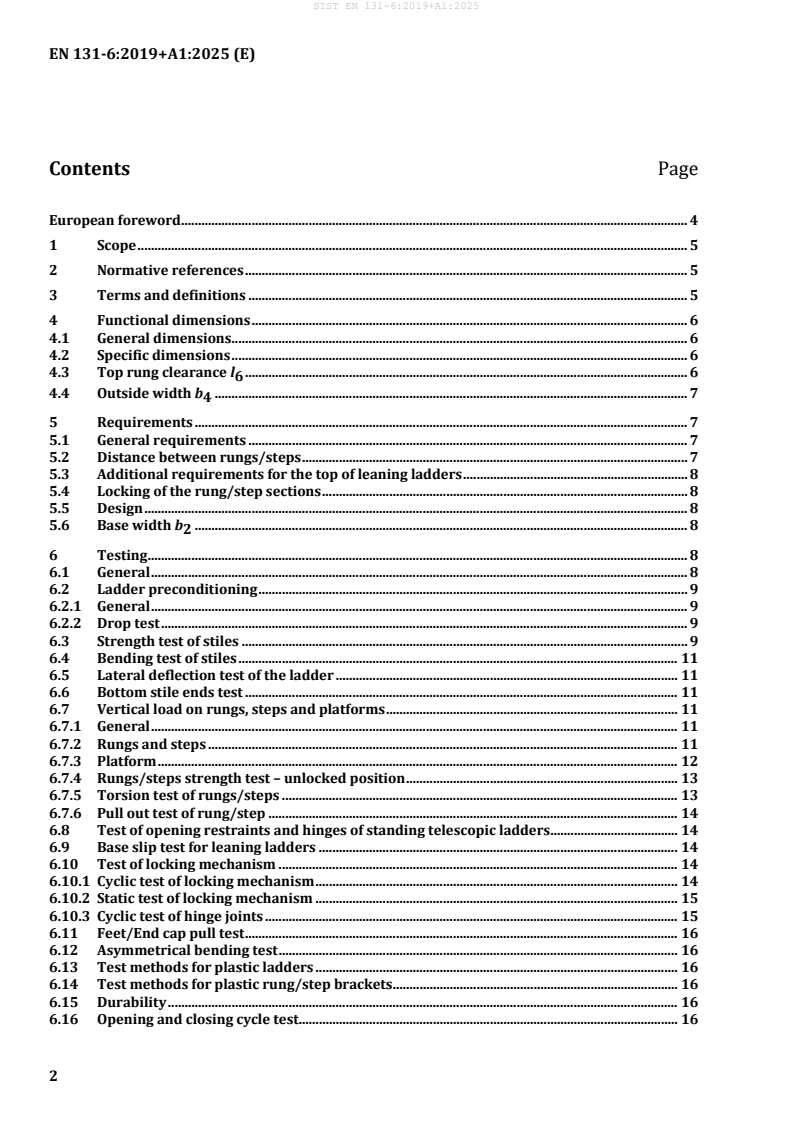
Contents Page
European foreword . 4
1 Scope . 5
2 Normative references . 5
3 Terms and definitions . 5
4 Functional dimensions . 6
4.1 General dimensions . 6
4.2 Specific dimensions . 6
4.3 Top rung clearance l . 6
4.4 Outside width b . 7
5 Requirements . 7
5.1 General requirements . 7
5.2 Distance between rungs/steps . 7
5.3 Additional requirements for the top of leaning ladders . 8
5.4 Locking of the rung/step sections . 8
5.5 Design . 8
5.6 Base width b . 8
6 Testing . 8
6.1 General . 8
6.2 Ladder preconditioning . 9
6.2.1 General . 9
6.2.2 Drop test . 9
6.3 Strength test of stiles . 9
6.4 Bending test of stiles . 11
6.5 Lateral deflection test of the ladder . 11
6.6 Bottom stile ends test . 11
6.7 Vertical load on rungs, steps and platforms . 11
6.7.1 General . 11
6.7.2 Rungs and steps . 11
6.7.3 Platform . 12
6.7.4 Rungs/steps strength test – unlocked position . 13
6.7.5 Torsion test of rungs/steps . 13
6.7.6 Pull out test of rung/step . 14
6.8 Test of opening restraints and hinges of standing telescopic ladders . 14
6.9 Base slip test for leaning ladders . 14
6.10 Test of locking mechanism . 14
6.10.1 Cyclic test of locking mechanism . 14
6.10.2 Static test of locking mechanism . 15
6.10.3 Cyclic test of hinge joints . 15
6.11 Feet/End cap pull test . 16
6.12 Asymmetrical bending test . 16
6.13 Test methods for plastic ladders . 16
6.14 Test methods for plastic rung/step brackets . 16
6.15 Durability . 16
6.16 Opening and closing cycle test . 16
7 Marking and user instructions . 17
7.1 General . 17
7.2 Marking . 17
7.3 User instruction . 17
7.4 List of items to be inspected . 17
7.5 Storage . 18
Annex A (normative) Test sequence . 19
Annex B (informative) Deviations . 20
B.1 General . 20
B.2 Deviations from the Netherlands . 20
Bibliography . 22
European foreword
This document (EN 131-6:2019+A1:2025) has been prepared by Technical Committee CEN/TC 93
“Ladders”, the secretariat of which is held by DIN.
This European Standard shall be given the status of a national standard, either by publication of an
identical text or by endorsement, at the latest by February 2026, and conflicting national standards
shall be withdrawn at the latest by February 2026.
Attention is drawn to the possibility that some of the elements of this document may be the subject of
patent rights. CEN shall not be held responsible for identifying any or all such patent rights.
This document includes Amendment 1 approved by CEN on 2025-06-11.
The start and finish of text introduced or altered by amendment is indicated in the text by tags !".
This document supersedes !EN 131-6:2019".
!Deleted text"
This document has been prepared under a mandate given to CEN by the European Commission and the
European Free Trade Association.
This European Standard is one of a series about ladders. The other standards of this series are listed in
Clause 2 and in the Bibliography.
Any feedback and questions on this document should be directed to the users’ national standards body.
A complete listing of these bodies can be found on the CEN website.
According to the CEN-CENELEC Internal Regulations, the national standards organisations of the
following countries are bound to implement this European Standard: Austria, Belgium, Bulgaria,
Croatia, Cyprus, Czech Republic, Denmark, Estonia, Finland, France, Germany, Greece, Hungary, Iceland,
Ireland, Italy, Latvia, Lithuania, Luxembourg, Malta, Netherlands, Norway, Poland, Portugal, Republic of
North Macedonia, Romania, Serbia, Slovakia, Slovenia, Spain, Sweden, Switzerland, Türkiye and the
United Kingdom.
1 Scope
This document specifies the general design features, requirements and test methods and defines terms
for leaning and standing telescopic ladders.
Ladders with extension elements are not covered by this part of EN 131.
This part of the standard is intended to be used in conjunction with EN 131-1, EN 131-2, EN 131-3 and
if applicable EN 131-4.
2 Normative references
The following documents are referred to in the text in such a way that some or all of their content
constitutes requirements of this document. For dated references, only the edition cited applies. For
undated references, the latest edition of the referenced document (including any amendments) applies.
EN 131-1:2015, Ladders — Part 1: Terms, types, functional sizes
EN 131-2:2010+A2:2017, Ladders — Part 2: Requirements, testing, marking
EN 131-3:2018, Ladders — Part 3: Marking and user instructions
EN 131-4:2007, Ladders — Part 4: Single or multiple hinge-joint ladders
3 Terms and definitions
For the purposes of this document, the terms and definitions given in EN 131-1 and the following apply.
ISO and IEC maintain terminological databases for use in standardization at the following addresses:
— IEC Electropedia: available at http://www.electropedia.org/
— ISO Online browsing platform: available at http://www.iso.org/obp
3.1
telescopic ladder
ladder consisting of three or more rung/step sections with telescopic stiles
3.2
hinge-joint telescopic ladder
ladder including one or more hinge-joint devices with at least one predetermined lockable position
3.3
rung/step section
section of ladder that consists of one rung/step connected to two telescopic stiles
3.4
rung/step bracket
part that attaches the rung/step to the stile
3.5
rung/step section locking mechanism
mechanism that locks a rung/step section
3.6
locking indicator
mechanism or part that indicates that one rung/step section or part of one rung/step section is
locked/unlocked
3.7
locking pin
part that locks each rung/step section and that is engaged when the locking mechanism is locked
3.8
protection against squeezing
mechanism or part that minimizes the risk of squeezing when the ladder is shortened
3.9
release function
function which releases the locking mechanism
3.10
base section
section starting from the lower end of the ladder
3.11
ascendable part
part of the ascending leg consisting only of fully extended rung/step sections
3.12
storage position
position where none of the rung/step sections are extended
3.13
locking mechanism
system that retains the rungs in the desired position of use
4 Functional dimensions
4.1 General dimensions
Dimensions are given in EN 131-1.
4.2 Specific dimensions
For leaning telescopic ladders dimension l is not applicable providing l , see 4.3, is fulfilled. If l is not
3 6 6
fulfilled l shall begreater than 0,5 l and less than l + 15 mm measured along a line in the middle of
3 5 5
the stiles.
4.3 Top rung clearance l
The dimension l is the horizontal clearance between the top rung and any obstruction (specifically the
wall) when the ladder is in its position of use.
The dimension l is the horizontal distance between the top rung and the wall when measured with the
ladder in its position of use at any angle between 65° and 75° (see Figure 1). This shall not be less than
35 mm and not more than 300 mm. The minimum clearance between the top rung and any obstruction
shall be 35 mm in any case.
Figure 1 — Top rung clearance l
4.4 Outside width b
The dimension b is the outside width measured to the outside of the stiles at its widest part at the
bottom of the ladder, see Figure 2.
Figure 2 — Outside width b
5 Requirements
5.1 General requirements
The drawings in this part of EN 131 are examples only and products do not need to correspond.
However, dimensions are binding.
For other requirements EN 131-2:2010+A2:2017, Clause 4 applies.
5.2 Distance between rungs/steps
When the ladder is in its position of use the rungs/steps allowed to stand on shall always be equally
spaced in accordance with EN 131-1:2015, 4.1.
In the position of use the construction shall not allow different distances between the rungs/steps with
a tolerance of ±2 mm in the ascendable part of the ladder and ensure that the rung/step sections that
are not extended shall be stacked at the top of the ladder.
Manufacturer shall take all necessary precautions to prevent these distances been altered without
manipulation and the use of tools.
5.3 Additional requirements for the top of leaning ladders
The top of the ladder shall be designed in a way that a 2-point area of contact between the top of the
ladder and a vertical plane can be ensured.
5.4 Locking of the rung/step sections
The ladder shall be designed in way that all extended rung/step sections are locked when the ladder is
in the position of use.
Every rung/step section shall have a locking mechanism for each stile. With the ladder in position of use
it shall be clearly visible to the user that all of the locking mechanisms are locked or unlocked.
NOTE Visible indication can for example be a coloured area of a visible locking pin.
5.5 Design
Screws and nuts shall be secured against loosening, for example by means of self-locking or
mechanically locked safety mechanisms.
It shall not be possible to separate rung/step sections without using tools.
The unlocking and sliding in of the ladder shall be possible in a safe way. The ladder shall be designed in
a way that squeezing between the rungs/steps is avoided when the ladder is used in accordance to the
user instructions.
Protection against squeezing can be ensured by a breaking function that reduces any impact load on the
user’s hands when the ladder is collapsed according to the manufacturer's instruction. If a permanent
breaking function is used a typical time for collapsing a section of 300 mm is 1,5 s if the movement is
uniform.
If only a distance device is used for protection against squeezing between the rung/steps this device
shall be located at least 80 mm from the manufacturers recommended position of the user’s hands
during collapse of the ladder.
5.6 Base width b
The minimum permanently available base width b for leaning ladders with a length l of 3 000 mm or
2 1
more shall be derived from:
bb=+0,1×l
24 1
Where b is the outside width of the stiles at the bottom of the ladder excluding any rung/step brackets,
see 4.4.
6 Testing
6.1 General
Telescopic ladders shall be tested to and comply with the requirements defined in EN 131-6.
For all tests, unless otherwise stated in the particular test, the following tolerances apply:
— ±1 mm for longitudinal measurements;
— ±5 mm for the measurement of the distance between the supports and the overhanging length;
— ±1 ° for the measurement of angles;
— ±1 % for static forces and torque.
Tests shall be performed at a temperature between 15 °C and 25 °C.
Where the ascendable side cannot be determined by the construction of the product, or where it is a
multiple part combination ladder, the ladder shall be tested twice regarding 6.3 and 6.4. Conduct
strength test and bending test on one side then rotate the ladder 180 ° about the longitudinal axis and
repeat 6.3 and 6.4. The second test can be carried out on a new ladder.
Inspect the ladder before testing to confirm condition and operation of all parts by fully extending the
ladder.
6.2 Ladder preconditioning
6.2.1 General
Ladders for testing shall be preconditioned according to 6.2.2.
After preconditioning the following requirement shall be met:
— no rupturing of parts shall be observed;
— the release function and/or locking indicator shall work correctly;
— the locking mechanism shall work correctly;
— there shall be no relative movement between the connectors and the rungs/steps;
— permanent deformation is only acceptable providing the ladder remains fully functional and it does
not impair the fitness for use, or safety, of the ladder;
— the complete ladder shall be fit for use;
— the protection system against squeezing or entrapment shall be fully functional.
The ladder shall pass all the test from test block A, see Annex A
6.2.2 Drop test
Place the extended ladder in vertical position. Let the ladder fall in the direction of use from vertical to
horizontal position on a flat concrete floor by its own weight. Repeat the test with ladder rotated 180 °
about the longitudinal axis.
Bring the ladder back to storage position.
6.3 Strength test of stiles
The test shall be carried out on the complete ladder. The test shall be carried out on the maximum
extended ladder according to the manufacturer’s instruction.
Where the ascendable side cannot be determined by the construction of the product the ladder shall be
tested twice. For the second test the ladder shall be rotated 180 ° about the longitudinal axis. The
second test can be carried out on a new ladder.
Erect the ladder in its position of use at
...