

SIST EN 17504:2022
(Main)Animal feeding stuffs: Methods of sampling and analysis - Determination of gossypol in cotton seed and feeding stuff by LC-MS/MS
General Information
- Abstract
This document specifies a method for the determination of free gossypol, extractable by acidified acetonitrile/water, in cottonseed, cottonseed products and compound feeds by liquid chromatography with tandem mass spectrometry (LC-MS/MS).
The method described in this document has been successfully validated in the range of 69 mg/kg to 5 950 mg/kg by collaborative trial in the following matrices: cottonseed, cottonseed products (cake/meal, hulls) and compound feeds for bovine, porcine and poultry.
NOTE It is possible to reach quantification limits of approximatively 5 mg/kg in compound feeds. The method might be applicable at lower and at higher concentrations than the concentration range validated in the collaborative trial. However, this needs to be assessed by in-house validation.
- Status
- Published
- Public Enquiry End Date
- 19-Jun-2020
- Publication Date
- 12-May-2022
- Technical Committee
- KŽP - Agricultural food products
- Current Stage
- 6060 - National Implementation/Publication (Adopted Project)
- Start Date
- 04-May-2022
- Due Date
- 09-Jul-2022
- Completion Date
- 13-May-2022


Overview
Standard Reference: EN 17504:2022 (CEN)
Title: Animal feeding stuffs - Determination of gossypol in cotton seed and feeding stuff by LC‑MS/MS
EN 17504:2022 specifies a validated laboratory method for determining free gossypol in cottonseed, cottonseed products (cake/meal, hulls) and compound feeds using liquid chromatography with tandem mass spectrometry (LC‑MS/MS). The method targets gossypol extractable by an acidified acetonitrile/water solvent and was collaboratively validated in the range 69 mg/kg to 5 950 mg/kg. Approximate quantification limits down to ~5 mg/kg in compound feeds are possible, with lower or higher ranges requiring in‑house validation.
Key topics and technical requirements
- Analyte: Free gossypol (both enantiomers measured together; no chiral separation).
- Extraction solvent: 0.1% phosphoric acid in acetonitrile:water (80:20, v:v).
- Sample sizes & extraction: Typical test portions described (e.g., 0.4 g for cottonseed; 1.0 g for products/compound feeds) mixed with extraction solvent (example: 40 mL) and shaken/centrifuged.
- Instrumental technique: Reversed‑phase LC coupled to tandem mass spectrometry (LC‑MS/MS) with multiple selected reaction monitoring in negative ionization mode.
- Calibration & quantification: Multi‑level calibration using standards prepared in extraction solvent; compound feed results corrected for apparent recovery to compensate matrix effects.
- Precision & validation: Collaborative trial data provide repeatability/reproducibility within the validated range. Users must perform in‑house validation for concentrations or matrices outside the trial scope.
- Safety & quality: Gossypol is toxic (reproductive effects); the standard emphasizes laboratory safety and use of LC‑MS grade reagents and appropriate controls.
- Supporting materials: Example LC‑MS/MS conditions, chromatograms and precision data included as informative annexes.
Applications and who should use it
- Feed testing laboratories performing routine or regulatory analysis of cottonseed and compound feeds for gossypol contamination.
- Feed manufacturers and cottonseed processors monitoring raw materials and finished feed safety/quality.
- Regulatory authorities and food safety agencies implementing compliance testing and risk assessment.
- Research and veterinary toxicology groups studying exposure and toxic effects of gossypol in livestock.
This method provides high specificity and sensitivity compared with spectrophotometric techniques and is suited where accurate quantification of free gossypol in complex feed matrices is required.
Related standards
- EN ISO 3696 (quality of water for analytical use) is referenced for reagent water.
- EN 17504 complements other feed analysis standards and existing spectrophotometric gossypol methods (users should be aware of method‑dependent differences in measured “free” gossypol).
Keywords: EN 17504:2022, gossypol, cottonseed, LC‑MS/MS, animal feeding stuffs, compound feeds, method of sampling and analysis, free gossypol, CEN.
Relations
- Effective Date
- 28-Jan-2026
Get Certified
Connect with accredited certification bodies for this standard

Control Union Certifications
Global certification for agriculture and sustainability.

ECOCERT
Organic and sustainability certification.

FSC International
Forest Stewardship Council certification.
Sponsored listings
Frequently Asked Questions
SIST EN 17504:2022 is a standard published by the Slovenian Institute for Standardization (SIST). Its full title is "Animal feeding stuffs: Methods of sampling and analysis - Determination of gossypol in cotton seed and feeding stuff by LC-MS/MS". This standard covers: This document specifies a method for the determination of free gossypol, extractable by acidified acetonitrile/water, in cottonseed, cottonseed products and compound feeds by liquid chromatography with tandem mass spectrometry (LC-MS/MS). The method described in this document has been successfully validated in the range of 69 mg/kg to 5 950 mg/kg by collaborative trial in the following matrices: cottonseed, cottonseed products (cake/meal, hulls) and compound feeds for bovine, porcine and poultry. NOTE It is possible to reach quantification limits of approximatively 5 mg/kg in compound feeds. The method might be applicable at lower and at higher concentrations than the concentration range validated in the collaborative trial. However, this needs to be assessed by in-house validation.
This document specifies a method for the determination of free gossypol, extractable by acidified acetonitrile/water, in cottonseed, cottonseed products and compound feeds by liquid chromatography with tandem mass spectrometry (LC-MS/MS). The method described in this document has been successfully validated in the range of 69 mg/kg to 5 950 mg/kg by collaborative trial in the following matrices: cottonseed, cottonseed products (cake/meal, hulls) and compound feeds for bovine, porcine and poultry. NOTE It is possible to reach quantification limits of approximatively 5 mg/kg in compound feeds. The method might be applicable at lower and at higher concentrations than the concentration range validated in the collaborative trial. However, this needs to be assessed by in-house validation.
SIST EN 17504:2022 is classified under the following ICS (International Classification for Standards) categories: 65.120 - Animal feeding stuffs. The ICS classification helps identify the subject area and facilitates finding related standards.
SIST EN 17504:2022 has the following relationships with other standards: It is inter standard links to SIST EN ISO 3696:1998. Understanding these relationships helps ensure you are using the most current and applicable version of the standard.
SIST EN 17504:2022 is associated with the following European legislation: EU Directives/Regulations: 882/2004; Standardization Mandates: M/523. When a standard is cited in the Official Journal of the European Union, products manufactured in conformity with it benefit from a presumption of conformity with the essential requirements of the corresponding EU directive or regulation.
SIST EN 17504:2022 is available in PDF format for immediate download after purchase. The document can be added to your cart and obtained through the secure checkout process. Digital delivery ensures instant access to the complete standard document.
Standards Content (Sample)
SLOVENSKI STANDARD
01-junij-2022
Krma: metode vzorčenja in analize - Ugotavljanje gosipola v bombažnem semenu
in krmi z LC-MS/MS
Animal feeding stuffs: Methods of sampling and analysis - Determination of gossypol in
cotton seed and feeding stuff by LC-MS/MS
Futtermittel: Probenahme- und Untersuchungsverfahren - Bestimmung von Gossypol in
Baumwollsamen und Futtermitteln mittels LC-MS/MS
Aliments des animaux - Méthodes d’échantillonnage et d’analyse - Dosage du gossypol
dans les graines de coton et les aliments pour animaux par CL-SM/SM
Ta slovenski standard je istoveten z: EN 17504:2022
ICS:
65.120 Krmila Animal feeding stuffs
2003-01.Slovenski inštitut za standardizacijo. Razmnoževanje celote ali delov tega standarda ni dovoljeno.
EN 17504
EUROPEAN STANDARD
NORME EUROPÉENNE
March 2022
EUROPÄISCHE NORM
ICS 65.120
English Version
Animal feeding stuffs: Methods of sampling and analysis -
Determination of gossypol in cotton seed and feeding stuff
by LC-MS/MS
Aliments des animaux - Méthodes d'échantillonnage et Futtermittel: Probenahme- und
d'analyse - Dosage du gossypol dans les graines de Untersuchungsverfahren - Bestimmung von Gossypol
coton et les aliments pour animaux par CL-SM/SM in Baumwollsamen und Futtermitteln mittels LC-
MS/MS
This European Standard was approved by CEN on 10 January 2022.
CEN members are bound to comply with the CEN/CENELEC Internal Regulations which stipulate the conditions for giving this
European Standard the status of a national standard without any alteration. Up-to-date lists and bibliographical references
concerning such national standards may be obtained on application to the CEN-CENELEC Management Centre or to any CEN
member.
This European Standard exists in three official versions (English, French, German). A version in any other language made by
translation under the responsibility of a CEN member into its own language and notified to the CEN-CENELEC Management
Centre has the same status as the official versions.
CEN members are the national standards bodies of Austria, Belgium, Bulgaria, Croatia, Cyprus, Czech Republic, Denmark, Estonia,
Finland, France, Germany, Greece, Hungary, Iceland, Ireland, Italy, Latvia, Lithuania, Luxembourg, Malta, Netherlands, Norway,
Poland, Portugal, Republic of North Macedonia, Romania, Serbia, Slovakia, Slovenia, Spain, Sweden, Switzerland, Turkey and
United Kingdom.
EUROPEAN COMMITTEE FOR STANDARDIZATION
COMITÉ EUROPÉEN DE NORMALISATION
EUROPÄISCHES KOMITEE FÜR NORMUNG
CEN-CENELEC Management Centre: Rue de la Science 23, B-1040 Brussels
© 2022 CEN All rights of exploitation in any form and by any means reserved Ref. No. EN 17504:2022 E
worldwide for CEN national Members.
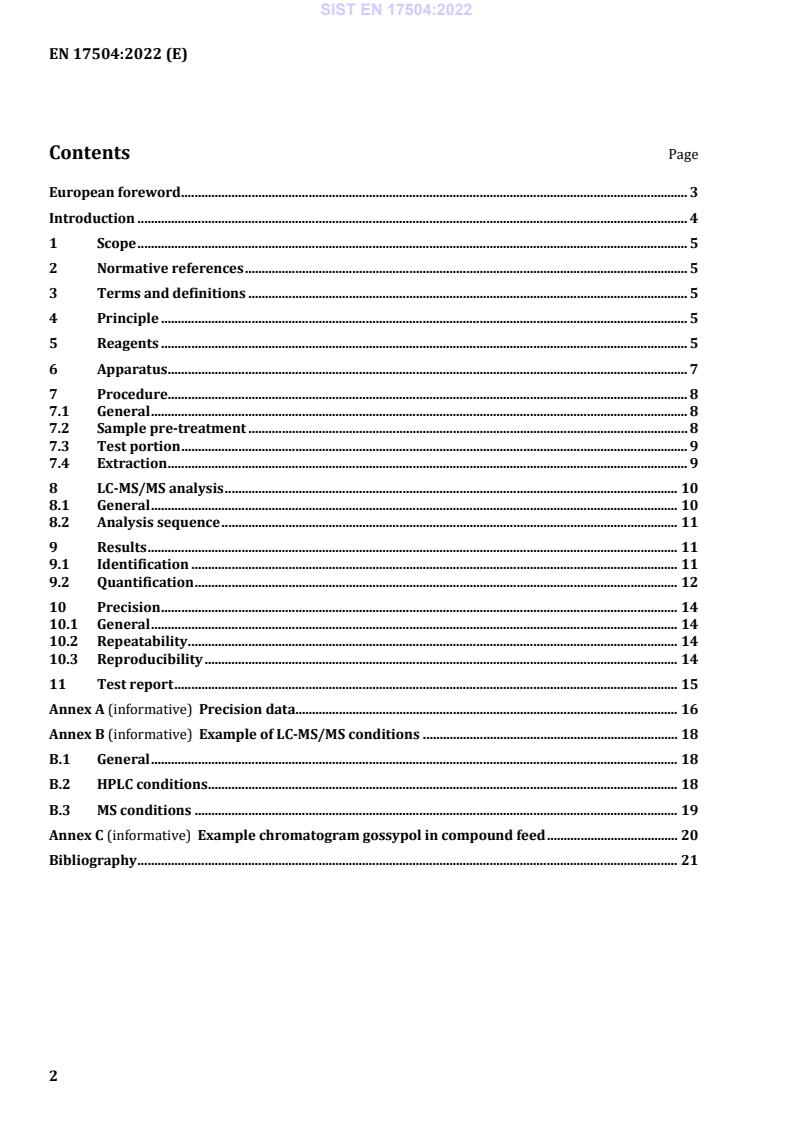
Contents Page
European foreword . 3
Introduction . 4
1 Scope . 5
2 Normative references . 5
3 Terms and definitions . 5
4 Principle . 5
5 Reagents . 5
6 Apparatus . 7
7 Procedure. 8
7.1 General . 8
7.2 Sample pre-treatment . 8
7.3 Test portion . 9
7.4 Extraction . 9
8 LC-MS/MS analysis . 10
8.1 General . 10
8.2 Analysis sequence . 11
9 Results . 11
9.1 Identification . 11
9.2 Quantification . 12
10 Precision . 14
10.1 General . 14
10.2 Repeatability . 14
10.3 Reproducibility . 14
11 Test report . 15
Annex A (informative) Precision data. 16
Annex B (informative) Example of LC-MS/MS conditions . 18
B.1 General . 18
B.2 HPLC conditions . 18
B.3 MS conditions . 19
Annex C (informative) Example chromatogram gossypol in compound feed . 20
Bibliography . 21
European foreword
This document (EN 17504:2022) has been prepared by Technical Committee CEN/TC 327 “Animal
feeding stuffs - Methods of sampling and analysis”, the secretariat of which is held by NEN.
This European Standard shall be given the status of a national standard, either by publication of an
identical text or by endorsement, at the latest by September 2022, and conflicting national standards shall
be withdrawn at the latest by September 2022.
Attention is drawn to the possibility that some of the elements of this document may be the subject of
patent rights. CEN shall not be held responsible for identifying any or all such patent rights.
This document has been prepared under a Standardization Request given to CEN by the European
Commission and the European Free Trade Association.
Any feedback and questions on this document should be directed to the users’ national standards body.
A complete listing of these bodies can be found on the CEN website.
According to the CEN-CENELEC Internal Regulations, the national standards organisations of the
following countries are bound to implement this European Standard: Austria, Belgium, Bulgaria, Croatia,
Cyprus, Czech Republic, Denmark, Estonia, Finland, France, Germany, Greece, Hungary, Iceland, Ireland,
Italy, Latvia, Lithuania, Luxembourg, Malta, Netherlands, Norway, Poland, Portugal, Republic of North
Macedonia, Romania, Serbia, Slovakia, Slovenia, Spain, Sweden, Switzerland, Turkey and the United
Kingdom.
Introduction
Gossypol is a polyphenolic plant toxin produced by species of the genus Gossypium (cotton plant). The
plants are primarily grown for fibre and oil production. The seeds and processed seed materials are also
used as animal feeding stuffs. Gossypol is present in the seeds in two forms: free gossypol and bound
gossypol (mostly to proteins). The measured content of free gossypol depends on the method of
extraction and the specificity of the subsequent method of analysis used ([1], [2]). Consequently, this
method might not be directly comparable to existing standards based on spectrophotometric
measurement (e.g. [3], [4]).
WARNING — This protocol does not purport to address all the safety problems associated with its use.
It is the responsibility of the user of this protocol to establish appropriate safety and health protection
measures and to ensure that regulatory and legal requirements are complied with.
1 Scope
This document specifies a method for the determination of free gossypol, extractable by acidified
acetonitrile/water, in cottonseed, cottonseed products and compound feeds by liquid chromatography
with tandem mass spectrometry (LC-MS/MS).
The method described in this document has been successfully validated in the range of 69 mg/kg to
5 950 mg/kg by collaborative trial in the following matrices: cottonseed, cottonseed products
(cake/meal, hulls) and compound feeds for bovine, porcine and poultry.
NOTE It is possible to reach quantification limits of approximatively 5 mg/kg in compound feeds. The method
might be applicable at lower and at higher concentrations than the concentration range validated in the
collaborative trial. However, this needs to be assessed by in-house validation.
2 Normative references
The following documents are referred to in the text in such a way that some or all of their content
constitutes requirements of this document. For dated references, only the edition cited applies. For
undated references, the latest edition of the referenced document (including any amendments) applies.
EN ISO 3696, Water for analytical laboratory use - Specification and test methods (ISO 3696)
3 Terms and definitions
No terms and definitions are listed in this document.
ISO and IEC maintain terminological databases for use in standardization at the following addresses:
— ISO Online browsing platform: available at https://www.iso.org/obp
— IEC Electropedia: available at https://www.electropedia.org/
4 Principle
Free gossypol is extracted by mixing an homogenized sample of 0,4 g of cottonseed or 1,0 g of cottonseed
product or compound feed with 40 ml of 0,1 % phosphoric acid in acetonitrile:water (80:20) (V:V). The
mixture is shaken for 1 h. After centrifugation a portion of the supernatant is diluted with extraction
solvent in a vial. The final extract is analysed by reversed phase liquid chromatography with tandem mass
spectrometry (LC-MS/MS). Quantification of gossypol in cottonseed and cottonseed products is based on
multi-level calibration using standards in extraction solvent. Quantification of gossypol in compound
feeds is based on multi-level calibration using standards in extraction solvent and corrected for the
apparent recovery.
5 Reagents
WARNING — Gossypol can be hazardous to health. It has a strong toxic effect on the reproductive organs.
Depending on the level of exposure, both acute and chronic effects are possible.
5.1 Gossypol, ≥ 95 %, as gossypol base
Gossypol is a racemic mixture of (+)- and (-)-gossypol. In this method the enantiomers of gossypol are
not separated. A standard containing a mixture of both enantiomers may be used.
Gossypol is also available in the form of a 1:1 complex with acetic acid. In this method either a standard
of gossypol or gossypol-acetic acid may be used.
NOTE Gossypol is sensitive to light.
5.2 Acetonitrile, LC-MS or HPLC quality
5.3 Phosphoric acid 85 % w/w, d = 1,71 g/cm , p.a. quality
5.4 Formic acid, ≥ 98 %, p.a. quality
5.5 Water
Water of LC-MS grade, double-distilled or water of grade 1 as defined in EN ISO 3696.
5.6 Extraction solvent: 0,1 % phosphoric acid in acetonitrile:water (80:20)
Mix 800 ml acetonitrile (5.2) and 200 ml water (5.5) in a bottle of 1 000 ml. Add 1,0 ml phosphoric acid
(5.3) and mix. This solution is stored at room temperature and may be used for 1 month.
5.7 Mobile phase A: 0,5 % formic acid in acetonitrile:water (5:95)
Mix 50 ml acetonitrile (5.2) and 950 ml water (5.5) in a bottle of 1 000 ml. Add 5 ml formic acid (5.4) and
mix. This solution is stored at room temperature and may be used for 1 month.
5.8 Mobile phase B: 0,5 % formic acid in acetonitrile:water (95:5)
Mix 950 ml acetonitrile (5.2) and 50 ml water (5.5) in a bottle of 1 000 ml. Add 5 ml formic acid (5.4) and
mix. This solution is stored at room temperature and may be used for 1 month.
5.9 Gossypol stock solution, 1 mg/ml
Weigh (6.1) 20 mg gossypol (5.1) and transfer into a 20 ml amber volumetric flask. Take into account the
mass, the purity and the chemical form of the standard. Add extraction solvent (5.6), dissolve by mixing
and make up to the mark with extraction solvent (5.6). Transfer to an amber glass bottle (6.7) and store
the stock solution at < −18 °C. Under these conditions the solution may be used for 6 months.
5.10 Gossypol standard solution, 10 µg/ml
Transfer 100 µl of gossypol stock solution (5.9) into a 10 ml amber volumetric flask (6.7) using a pipette.
Fill up to the mark with extraction solvent (5.6) and mix. Transfer to an amber glass bottle (6.7). Store
the standard solution at < −18 °C. Under these conditions the solution can be used for 2 months. Use this
standard solution for preparation of calibration curves.
5.11 Gossypol standard solution, 1 µg/ml
Transfer 1,00 ml of gossypol standard solution (5.10) into a 10 ml amber volumetric flask (6.7) using a
pipette. Fill up to the mark with extraction solvent (5.6) and mix. Transfer to an amber glass bottle (6.7).
Store the standard solution at < −18 °C. Under these conditions the solution can be used for 2 months.
Use this standard solution for preparation of calibration curves.
5.12 Calibration standards
Prepare calibration standards using the standard solutions (5.10) and (5.11) and extraction solvent (5.6)
according to Table 1 (See NOTE). Pipette directly in HPLC vials (6.8).
NOTE The number of calibration points required depends on the concentrations expected in the samples (7.4)
and the dynamic range of the mass spectrometer. It is advised to use all calibration standards, but at least calibration
standards Cal 1, 2, 4 to 6 and 8.
Table 1 — Preparation of calibration standards
Concentration Standard solution of Standard solution of Extraction solvent
1 µg/ml (5.11) 10 µg/ml (5.10) (5.6)
µg/ml
µl µl µl
Cal 1 0,00 0 0 1 000
Cal 2 0,025 25 0 975
Cal 3 0,05 50 0 950
Cal 4 0,10 100 0 900
Cal 5 0,25 0 25 975
Cal 6 0,50 0 50 950
Cal 7 0,75 0 75 925
Cal 8 1,00 0 100 900
6 Apparatus
Usual laboratory equipment and, in particular, the following items:
6.1 Analytical balance, with an accuracy of 0,1 mg or better
6.2 Laboratory balance, with an accuracy of 0,01 g or better
6.3 Pipettors, adjustable, suitable for organic solvents, properly calibrated, with appropriate tips
6.4 Filter disc units, polytetrafluoroethylene (PTFE) with a pore size of 0,45 µm or less
6.5 Centrifuge tubes, polypropylene, 50 ml with screw cap
6.6 Centrifuge, suitable for 50 ml centrifuge tubes (6.5)
6.7 Glass bottles and volumetric flasks, amber coloured, different sizes
6.8 HPLC autosampler vials, amber glass 1,5 ml with caps
6.9 Minishaker or vortex mixer
6.10 Ultrasonic bath
6.11 Vertical or horizontal shaker, adjustable
6.12 Laboratory mill
6.13 HPLC system, consisting of:
6.13.1 Autosampler, thermostated
As an example, an autosampler capable of maintaining a temperature of 10 °C ± 1 °C is suitable.
6.13.2 Binary pump system
Capable of delivering a binary gradient at flow rates appropriate for the analytical column in use with
sufficient accuracy.
6.13.3 Column oven, thermostated
As an example, a column oven capable of maintaining a temperature of 40 °C ± 1 °C is suitable.
6.13.4 Analytical column
Containing C18 reversed phase packing material, capable of the base-line separation of the analyte from
compounds with identical molecular mass.
6.13.5 Pre-column, optional
With the same stationary phase material as the analytical column and with appropriate dimensions.
6.14 Tandem mass spectrometer
Capable of performing multiple selected reaction monitoring in negative ionization mode, with a
sufficiently wide dynamic range and capable of unit mass separation and equipped with a computer-
based data processing system. Any ionization source giving sufficient yield may be employed.
7 Procedure
7.1 General
Animal feed is a complex matrix containing a wide range of ingredients in varying amounts. Sample and
instrument dependent matrix effects (suppression/enhancement) can occur that may affect the
quantification of the analyte in the sample (see NOTE). To correct for these matrix effects a recovery
sample (7.4.3) is included.
Depending on the sensitivity and linear range of the mass spectrometric instrument, it can be necessary
to dilute the sample extracts (7.4) by an appropriate factor with extraction solvent (5.6), taking into
account the expected concentration of the analyte in the sample, to keep the response of the detector
within the dynamic range of the mass spectrometer. Alternatively, the injection volume of the sample
may be reduced, within the calibrated range of the injection system.
NOTE At the conditions described in this document, matrix effects (ion suppression or enhancement) were not
significant for cottonseed and cottonseed products. For compound feed matrix effects were observed.
7.2 Sample pre-treatment
Laboratory samples should be taken and prepared in accordance with European legislation [3] where
applicable or, in any other case with EN ISO 6498.
Homogenize samples in a laboratory mill (6.12) to < 1 mm.
Cottonseeds can contain high amounts of gossypol. Carefully clean all parts of the grinder between
samples to avoid significant carry-over. When cottonseed samples are analysed together with cottonseed
products or compound feed materials, the cottonseed products and the compound feed samples should
be ground prior to the cottonseed samples.
7.3 Test portion
7.3.1 Cottonseed
The amount of homogenized cottonseed material examined is 0,4 g ± 0,01 g.
A larger test sample size may be used by the laboratory in order to improve the representativeness of the
sample. The amount of extraction solvent shall in that case be adjusted accordingly (7.4).
7.3.2 Cottonseed products and compound feed
The amount of homogenized cottonseed product or compound feed material examined is 1,0 g ± 0,05 g.
A larger test sample size may be used by the laboratory in order to improve the representativeness of the
sample. The amount of extraction solvent shall in that case be adjusted accordingly (7.4).
7.4 Extraction
7.4.1 Cottonseed
Weigh (6.2) a test portion of 0,4 g ± 0,01 g homogenized sample (7.3) into a centrifuge tube of 50 ml (6.5).
Add 40,0 ml of extraction solvent (5.6) and mix for 15 s using a vortex mixer (6.9). Place the tube in an
ultrasonic bath (6.10) for 5 min and subsequently shake the tube for 1 h (6.11).
-1
Centrifuge the tube for 5 min at 3 000 min at room temperature (6.6). Transfer 10 µl of the extract into
a HPLC vial (6.8) and add 990 µl extraction solvent (5.6) and mix (see NOTE).
NOTE Cottonseeds can contain high concentrations of gossypol (ranging from 2 000 mg/kg to 8 000 mg/kg).
The expected gossypol concentration in undiluted cottonseed extracts is in the range of 20 µg/ml to 80 µg/ml. After
dilution of the sample extract the expected concentration is in the range of 0,2 µg/ml to 0,8 µg/ml.
7.4.2 Cottonseed products and compound feed
Weigh (6.2) a test portion of 1,0 g ± 0,05 g homogenized sample (7.3) into a centrifuge tube of 50 ml (6.5).
Add 40,0 ml of extraction solvent (5.6) and mix for 15 s using a vortex mixer (6.9). Place the tube in an
ultrasonic bath (6.10) for 5 min and subsequently shake the tube for 1 h (6.11).
-1
Centrifuge the tube for 5 min at 3 000 min at room temperature (6.6). Transfer 200 µl of the extract
(see NOTE 1) into a HPLC vial (6.8) and add 800 µl extraction solvent (5.6) and mix (see
...