


SIST EN 13001-2:2021
(Main)Crane safety - General design - Part 2: Load actions
Crane safety - General design - Part 2: Load actions
This document specifies load actions and load combinations for the calculation of load effects as basis for the proof of competence of a crane and its main components. It will be used together with the other generic parts of the EN 13001 series of standards, see Annex E. As such they specify conditions and requirements on design to prevent mechanical hazards of cranes and provide a method of verification of those requirements.
NOTE Specific requirements for particular types of crane are given in the appropriate European product standards for the particular crane type, see Annex E.
The following is a list of significant hazardous situations and hazardous events that could result in risks to persons during normal use and reasonably foreseeable misuse. Clause 4 of this document provides means to reduce or eliminate the risks of mechanical failures due to the following:
a) rigid body instability of the crane or its parts (tilting);
b) exceeding the limits of strength (yield, ultimate, fatigue);
c) elastic instability of the crane or its parts or components (buckling, bulging).
The hazards covered by this document are identified by Annex G.
This document is not applicable to cranes that are manufactured before the date of its publication as EN.
Kransicherheit - Konstruktion allgemein - Teil 2: Lasteinwirkungen
Dieses Dokument legt Lasteinwirkungen und Lastkombinationen für die Berechnung der Lastwirkungen als Grundlage für den Sicherheitsnachweis eines Krans und dessen Hauptbauteile fest. Es wird zusammen mit den anderen allgemeinen Teilen der Normenreihe EN 13001 angewendet; siehe Anhang E. Zusammen spezifizieren sie die Bedingungen und die Anforderungen an die konstruktive Gestaltung zur Vermeidung von mechanischen Gefährdungen bei Kranen und bieten eine Methode der Überprüfung dieser Anforderungen.
ANMERKUNG Besondere Anforderungen für spezielle Krantypen sind in den zutreffenden Europäischen Produktnormen für den speziellen Krantyp angegeben; siehe Anhang E.
Im Folgenden ist eine Auflistung von signifikanten Gefährdungssituationen und Gefährdungsereignissen gegeben, die Risiken für Personen während des üblichen Gebrauchs und der vernünftigerweise vorhersehbaren Fehlanwendung (des Krans) zur Folge haben könnten. Abschnitt 4 dieses Dokument enthält Maßnahmen zur Verringerung oder Beseitigung der Risiken durch mechanisches Versagen infolge von:
a) Starrkörperinstabilität des Krans oder seiner Teile (Kippen);
b) Überschreitung der Festigkeitsgrenzwerte (Fließgrenze, Bruch-, Ermüdungsfestigkeit);
c) elastische Instabilität des Krans oder seiner Teile oder Komponenten (Knicken, Ausbeulen).
Die Gefährdungen, die in diesem Dokument behandelt werden, sind in Anhang G aufgeführt.
Dieses Dokument gilt nicht für Krane, die vor dem Datum der Veröffentlichung dieses Dokuments als Europäische Norm hergestellt wurden.
Sécurité des appareils de levage à charge suspendue - Conception générale - Partie 2: Charges
Le présent document spécifie les actions de charge et les combinaisons de charges pour le calcul des effets de charge comme base de la vérification d’aptitude des appareils de levage et de leurs principaux composants. Il sera utilisé conjointement avec les autres parties génériques de la série des EN 13001, voir l’Annexe E. Dans ce cadre, elles spécifient les conditions et prescriptions de conception visant à prévenir les dangers mécaniques liés aux appareils de levage à charge suspendue, et elle fournit une méthode de vérification de ces prescriptions.
NOTE Des prescriptions spécifiques pour des types particuliers d’appareil de levage à charge suspendue sont données dans la Norme européenne « Produit » appropriée au type particulier d’appareil de levage à charge suspendue, voir Annexe E.
La liste suivante spécifie les situations et les événements dangereux significatifs susceptibles d’entraîner des risques pour les personnes lors d’une utilisation normale et d’une mauvaise utilisation raisonnablement prévisible. L’Article 4 du présent document fournit les moyens pour réduire ou éliminer les risques de défaillance mécanique causés par les événements suivants :
a) instabilité de corps rigide de l’appareil de levage à charge suspendue ou de ses éléments (basculement) ;
b) dépassement des limites de résistance (élasticité, rupture, fatigue) ;
c) instabilité élastique de l’appareil de levage ou de ses éléments ou de ses composants (flambage, voilement) ;
Les phénomènes dangereux couverts par le présent document sont identifiés à l’Annexe G.
Le présent document n'est pas applicable aux appareils de levage à charge suspendue qui ont été fabriqués avant sa date de publication comme EN.
Varnost žerjava - Konstrukcija, splošno - 2. del: Učinki obremenitev
General Information
- Status
- Published
- Publication Date
- 18-May-2021
- Technical Committee
- DTN - Lift and transport appliances
- Current Stage
- 6060 - National Implementation/Publication (Adopted Project)
- Start Date
- 25-Mar-2021
- Due Date
- 30-May-2021
- Completion Date
- 19-May-2021
Relations
- Effective Date
- 24-Mar-2021
- Effective Date
- 04-Dec-2024
Overview
SIST EN 13001-2:2021 - Crane safety: General design - Part 2: Load actions defines the load actions and load combinations required to calculate load effects used as the basis for the proof of competence of a crane and its main components. It is part of the EN 13001 series and is intended to be used together with other generic parts (see Annex E). The standard addresses mechanical hazards to prevent failures such as tilting, strength exceedance (yield, ultimate, fatigue) and elastic instability (buckling, bulging). It also aligns with relevant EU Directives (see Annex ZA).
Key technical topics and requirements
- Load classification and actions: Defines regular, occasional and exceptional loads and how each contributes to design verification (Clause 4.2).
- Load combinations: Specifies rules for combining different load types, including high-risk situations, favourable/unfavourable masses, and partial safety factors (Clause 4.3).
- Stability and limit states: Provides methods for proving rigid body stability and mitigating instability risks (Clause 4.3.8).
- Measured and displacement-determined loads: Includes provisions for loads determined by measured load effects or displacements (new Clause 4.3.6 and 4.3.5).
- Special load topics: Coverage of wind loads (Annex A aerodynamic coefficients), loads relevant to cranes on vessels, internal loads within mechanisms, and loads for access ways (references to EN 13586).
- Hazard identification: Annex G lists hazards; Annex D gives guidance on risk coefficients for high-risk applications.
- Interface and scope: Clarifies interaction between purchaser, designer and component manufacturers; not applicable to cranes manufactured before the standard’s publication.
Practical applications - who uses this standard
- Crane designers and structural engineers - to determine load cases and verify structural components (steel structure, hooks, wire ropes per other EN 13001 parts).
- Manufacturers and component suppliers - to produce parts that meet specified load actions and partial safety factors.
- Safety assessors, certifiers and notified bodies - to assess conformity with the Machinery Directive (2006/42/EC) and related EU requirements.
- Purchasers and asset owners - to set technical specifications and acceptance criteria for new cranes.
- Inspectors and maintenance engineers - to understand expected load envelopes and potential failure modes (tilting, buckling, fatigue).
Related standards and annexes
- Other parts of EN 13001 (Part 1, Parts 3-x for limit states of specific components)
- EN 13586 (Crane access)
- ISO 4306‑1 (Crane vocabulary)
- Annex A (aerodynamic coefficients), Annex E (selection of product standards), Annex G (hazards), Annex ZA (relationship to EU directives)
Keywords: SIST EN 13001-2:2021, crane safety, load actions, load combinations, proof of competence, crane design, crane stability, wind loads, EN 13001.



Frequently Asked Questions
SIST EN 13001-2:2021 is a standard published by the Slovenian Institute for Standardization (SIST). Its full title is "Crane safety - General design - Part 2: Load actions". This standard covers: This document specifies load actions and load combinations for the calculation of load effects as basis for the proof of competence of a crane and its main components. It will be used together with the other generic parts of the EN 13001 series of standards, see Annex E. As such they specify conditions and requirements on design to prevent mechanical hazards of cranes and provide a method of verification of those requirements. NOTE Specific requirements for particular types of crane are given in the appropriate European product standards for the particular crane type, see Annex E. The following is a list of significant hazardous situations and hazardous events that could result in risks to persons during normal use and reasonably foreseeable misuse. Clause 4 of this document provides means to reduce or eliminate the risks of mechanical failures due to the following: a) rigid body instability of the crane or its parts (tilting); b) exceeding the limits of strength (yield, ultimate, fatigue); c) elastic instability of the crane or its parts or components (buckling, bulging). The hazards covered by this document are identified by Annex G. This document is not applicable to cranes that are manufactured before the date of its publication as EN.
This document specifies load actions and load combinations for the calculation of load effects as basis for the proof of competence of a crane and its main components. It will be used together with the other generic parts of the EN 13001 series of standards, see Annex E. As such they specify conditions and requirements on design to prevent mechanical hazards of cranes and provide a method of verification of those requirements. NOTE Specific requirements for particular types of crane are given in the appropriate European product standards for the particular crane type, see Annex E. The following is a list of significant hazardous situations and hazardous events that could result in risks to persons during normal use and reasonably foreseeable misuse. Clause 4 of this document provides means to reduce or eliminate the risks of mechanical failures due to the following: a) rigid body instability of the crane or its parts (tilting); b) exceeding the limits of strength (yield, ultimate, fatigue); c) elastic instability of the crane or its parts or components (buckling, bulging). The hazards covered by this document are identified by Annex G. This document is not applicable to cranes that are manufactured before the date of its publication as EN.
SIST EN 13001-2:2021 is classified under the following ICS (International Classification for Standards) categories: 53.020.20 - Cranes. The ICS classification helps identify the subject area and facilitates finding related standards.
SIST EN 13001-2:2021 has the following relationships with other standards: It is inter standard links to SIST EN 13001-2:2014, SIST EN 13001-2:2021/oprA1:2025. Understanding these relationships helps ensure you are using the most current and applicable version of the standard.
SIST EN 13001-2:2021 is associated with the following European legislation: EU Directives/Regulations: 2006/42/EC, EUR-PUB; Standardization Mandates: M/396. When a standard is cited in the Official Journal of the European Union, products manufactured in conformity with it benefit from a presumption of conformity with the essential requirements of the corresponding EU directive or regulation.
SIST EN 13001-2:2021 is available in PDF format for immediate download after purchase. The document can be added to your cart and obtained through the secure checkout process. Digital delivery ensures instant access to the complete standard document.
Standards Content (Sample)
SLOVENSKI STANDARD
01-julij-2021
Nadomešča:
SIST EN 13001-2:2014
Varnost žerjava - Konstrukcija, splošno - 2. del: Učinki obremenitev
Crane safety - General design - Part 2: Load actions
Kransicherheit - Konstruktion allgemein - Teil 2: Lasteinwirkungen
Sécurité des appareils de levage à charge suspendue - Conception générale - Partie 2:
Charges
Ta slovenski standard je istoveten z: EN 13001-2:2021
ICS:
53.020.20 Dvigala Cranes
2003-01.Slovenski inštitut za standardizacijo. Razmnoževanje celote ali delov tega standarda ni dovoljeno.
EN 13001-2
EUROPEAN STANDARD
NORME EUROPÉENNE
March 2021
EUROPÄISCHE NORM
ICS 53.020.20 Supersedes EN 13001-2:2014
English Version
Crane safety - General design - Part 2: Load actions
Sécurité des appareils de levage à charge suspendue - Kransicherheit - Konstruktion allgemein - Teil 2:
Conception générale - Partie 2 : Charges Lasteinwirkungen
This European Standard was corrected and reissued by the CEN-CENELEC Management Centre on 21 April 2021.
This European Standard was approved by CEN on 25 January 2021.
CEN members are bound to comply with the CEN/CENELEC Internal Regulations which stipulate the conditions for giving this
European Standard the status of a national standard without any alteration. Up-to-date lists and bibliographical references
concerning such national standards may be obtained on application to the CEN-CENELEC Management Centre or to any CEN
member.
This European Standard exists in three official versions (English, French, German). A version in any other language made by
translation under the responsibility of a CEN member into its own language and notified to the CEN-CENELEC Management
Centre has the same status as the official versions.
CEN members are the national standards bodies of Austria, Belgium, Bulgaria, Croatia, Cyprus, Czech Republic, Denmark, Estonia,
Finland, France, Germany, Greece, Hungary, Iceland, Ireland, Italy, Latvia, Lithuania, Luxembourg, Malta, Netherlands, Norway,
Poland, Portugal, Republic of North Macedonia, Romania, Serbia, Slovakia, Slovenia, Spain, Sweden, Switzerland, Turkey and
United Kingdom.
EUROPEAN COMMITTEE FOR STANDARDIZATION
COMITÉ EUROPÉEN DE NORMALISATIO N
EUROPÄISCHES KOMITEE FÜR NORMUN G
CEN-CENELEC Management Centre: Rue de la Science 23, B-1040 Brussels
© 2021 CEN All rights of exploitation in any form and by any means reserved Ref. No. EN 13001-2:2021 E
worldwide for CEN national Members.
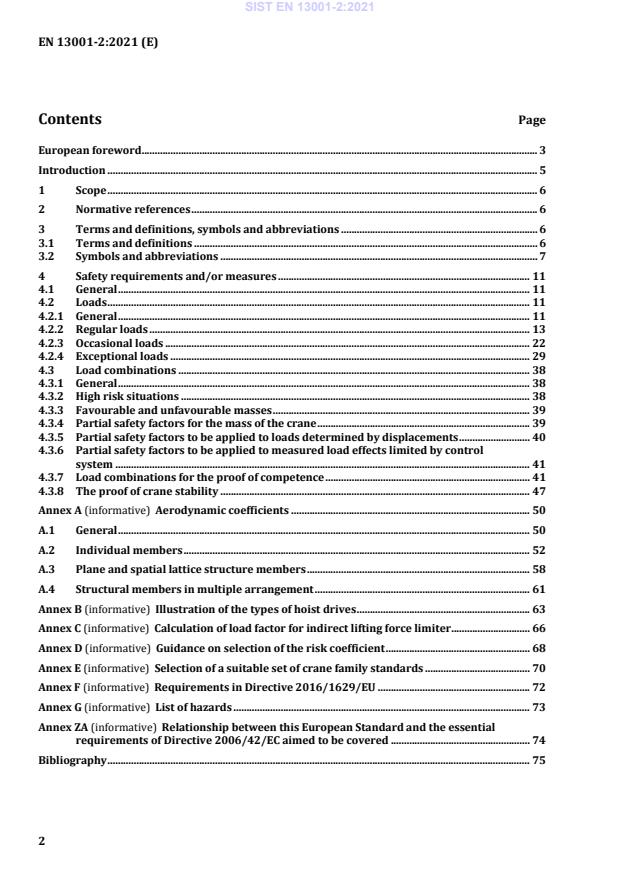
Contents Page
European foreword . 3
Introduction . 5
1 Scope . 6
2 Normative references . 6
3 Terms and definitions, symbols and abbreviations . 6
3.1 Terms and definitions . 6
3.2 Symbols and abbreviations . 7
4 Safety requirements and/or measures . 11
4.1 General . 11
4.2 Loads . 11
4.2.1 General . 11
4.2.2 Regular loads . 13
4.2.3 Occasional loads . 22
4.2.4 Exceptional loads . 29
4.3 Load combinations . 38
4.3.1 General . 38
4.3.2 High risk situations . 38
4.3.3 Favourable and unfavourable masses . 39
4.3.4 Partial safety factors for the mass of the crane . 39
4.3.5 Partial safety factors to be applied to loads determined by displacements . 40
4.3.6 Partial safety factors to be applied to measured load effects limited by control
system . 41
4.3.7 Load combinations for the proof of competence . 41
4.3.8 The proof of crane stability . 47
Annex A (informative) Aerodynamic coefficients . 50
A.1 General . 50
A.2 Individual members . 52
A.3 Plane and spatial lattice structure members . 58
A.4 Structural members in multiple arrangement . 61
Annex B (informative) Illustration of the types of hoist drives . 63
Annex C (informative) Calculation of load factor for indirect lifting force limiter . 66
Annex D (informative) Guidance on selection of the risk coefficient . 68
Annex E (informative) Selection of a suitable set of crane family standards . 70
Annex F (informative) Requirements in Directive 2016/1629/EU . 72
Annex G (informative) List of hazards . 73
Annex ZA (informative) Relationship between this European Standard and the essential
requirements of Directive 2006/42/EC aimed to be covered . 74
Bibliography . 75
European foreword
This document (EN 13001-2:2021) has been prepared by Technical Committee CEN/TC 147 “Cranes —
Safety”, the secretariat of which is held by DIN.
This European Standard shall be given the status of a national standard, either by publication of an
identical text or by endorsement, at the latest by September 2021, and conflicting national standards shall
be withdrawn at the latest by September 2021.
Attention is drawn to the possibility that some of the elements of this document may be the subject of
patent rights. CEN shall not be held responsible for identifying any or all such patent rights.
This document supersedes EN 13001-2:2014.
This document has been prepared under a standardization request given to CEN by the European
Commission and the European Free Trade Association, and supports essential requirements of
EU Directive(s).
For relationship with EU Directive(s), see informative Annex ZA, which is an integral part of this
document.
CEN/TC 147 WG 2 has reviewed EN 13001-2:2014 to adapt the document to the technical progress, new
requirements and changes in the document referred. The main topics and changes include:
— Cranes on vessels which are within the scope of the Directive 2016/1629/EU (Inland Waterway
Vessels) and “European Standard laying down Technical Requirements for Inland Navigation
vessels” (ES-TRIN:2019/1);
— Loads relevant to cranes on vessels were added;
— The clause on favourable/unfavourable masses and the clause on high risk applications including
Annex D were modified;
— A new 4.3.6 for measured load effects was added;
— 4.3.8 on rigid body stability was modified;
— A new 4.2.1.5 added, on internal loads inside mechanisms;
— Requirements for loads on access ways were replaced by a reference to EN 13586:2004+A1:2008;
— Annex ZA has been revised.
This document is Part 2 of the EN 13001 series. The other parts are as follows:
— Part 1: General principles and requirements
— Part 3-1: Limit states and proof of competence of steel structures
— Part 3-2: Limit states and proof of competence of wire ropes in reeving systems
— Part 3-3: Limit states and proof of competence of wheel/rail contacts
— Part 3-4: Limit states and proof of competence of machinery — Bearings
— Part 3-5: Limit states and proof of competence of forged hooks and cast hooks
— Part 3-6: Limit states and proof of competence of machinery — Hydraulic cylinders
For the relationship with other European Standards for cranes, see Annex E.
According to the CEN-CENELEC Internal Regulations, the national standards organisations of the
following countries are bound to implement this European Standard: Austria, Belgium, Bulgaria, Croatia,
Cyprus, Czech Republic, Denmark, Estonia, Finland, France, Germany, Greece, Hungary, Iceland, Ireland,
Italy, Latvia, Lithuania, Luxembourg, Malta, Netherlands, Norway, Poland, Portugal, Republic of North
Macedonia, Romania, Serbia, Slovakia, Slovenia, Spain, Sweden, Switzerland, Turkey and the United
Kingdom.
Introduction
This document has been prepared to be a harmonized standard to provide one means for the mechanical
design and theoretical verification of cranes to conform to the essential health and safety requirements
of the EU Directive 2006/42/EC (Machinery), as amended. This document also establishes interfaces
between the user (purchaser) of the crane and the designer, as well as between the designer and the
component manufacturer, in order to form a basis for selecting cranes and components.
This document is a type C standard as stated in the EN ISO 12100.
The machinery concerned and the extent to which hazards are covered are indicated in the scope of this
document.
When provisions of this type C standard are different from those, which are stated in type A or
B standards, the provisions of this type C standard take precedence over the provisions of the other
standards, for machines that have been designed and built according to the provisions of this
type C standard.
1 Scope
This document specifies load actions and load combinations for the calculation of load effects as basis for
the proof of competence of a crane and its main components. It will be used together with the other
generic parts of the EN 13001 series of standards, see Annex E. As such they specify conditions and
requirements on design to prevent mechanical hazards of cranes and provide a method of verification of
those requirements.
NOTE Specific requirements for particular types of crane are given in the appropriate European product
standards for the particular crane type, see Annex E.
The following is a list of significant hazardous situations and hazardous events that could result in risks
to persons during normal use and reasonably foreseeable misuse. Clause 4 of this document provides
means to reduce or eliminate the risks of mechanical failures due to the following:
a) rigid body instability of the crane or its parts (tilting);
b) exceeding the limits of strength (yield, ultimate, fatigue);
c) elastic instability of the crane or its parts or components (buckling, bulging).
The hazards covered by this document are identified by Annex G.
This document is not applicable to cranes that are manufactured before the date of its publication as EN.
2 Normative references
The following documents are referred to in the text in such a way that some or all of their content
constitutes requirements of this document. For dated references, only the edition cited applies. For
undated references, the latest edition of the referenced document (including any amendments) applies.
EN 13001-1:2015, Cranes — General design — Part 1: General principles and requirements
EN 13586:2004+A1:2008, Cranes — Access
ISO 4306-1:2007, Cranes — Vocabulary — Part 1: General
3 Terms and definitions, symbols and abbreviations
3.1 Terms and definitions
For the purposes of this document, the terms and definitions given in ISO 4306-1:2007, Clause 6 and the
following apply.
ISO and IEC maintain terminological databases for use in standardization at the following addresses:
— ISO Online browsing platform: available at http://www.iso.org/obp
— IEC Electropedia: available at http://www.electropedia.org/
3.1.1
hoist load
sum of the masses suspended from the crane, taken as the sum of payload, the fixed and non-fixed load
lifting attachments and the suspended portion of the hoist medium
Note 1 to entry: “hoist load” is equivalent to “gross load” as defined in ISO 4306-1:2007.
3.1.2
single failure proof system
force carrying arrangement of several components, arranged so that in case of a failure of any single
component in the arrangement, the capability to carry the force is not lost
3.1.3
vessel
floating installation the crane is mounted on
Note 1 to entry: The above definition is limited to vessels which are within the scope of the EU Directive
2016/1629 EU (Inland Waterway Vessels).
3.2 Symbols and abbreviations
For the purposes of this document, the symbols and abbreviations given in Table 1 apply.
Table 1 — Symbols and abbreviations
Symbols, abbreviations Description
A1 to A4 Load combinations including regular loads
A Characteristic area of a crane member
Projection of the hoist load on a plane normal to the direction of the wind
A
g
velocity
Area enclosed by the boundary of a lattice work member in the plane of its
A
c
characteristic height d
Area of an individual crane member projected to the plane of the
A
j
characteristic height d
b
Width of the rail head
h
b Characteristic width of a crane member
B1 to B5 Load combinations including regular and occasional loads
c Spring constant
c , c , c , c
Aerodynamic coefficients
o a oy oz
C1 to C11 Load combinations including regular, occasional and exceptional loads
CFF, CFM Coupled wheel pairs of system F/F or F/M
d Characteristic dimension of a crane member
d , d
Distance between wheel pair i or n and the guide means
i n
e
Width of the gap of a rail
G
f Friction coefficient
f
Loads
i
f
natural frequency
q
f
Term used in calculating v(z)
rec
F Force in general
Symbols, abbreviations Description
F, F , F
Wind loads
y z
ˆ
Maximum buffer force
F
F F
Initial and final drive force
i, f
ΔF Change of drive force
F , F , F , F
Tangential wheel forces
x1i x2i y1i y2i
F
Guide force
y
F , F
Vertical wheel forces
z1i z2i
Abbreviations for Fixed/Fixed and Fixed/Moveable, characterizing the
F/F, F/M
possibility of lateral movements of the crane wheels
g Acceleration due to gravity
Distance between instantaneous slide pole and guide means of a skewing
h
crane
h(t) Time dependent unevenness function
h
Height of the step of a rail
s
Lateral wheel forces induced by drive forces acting on a crane or trolley
H , H
1 2
with asymmetrical mass distribution
HC1 to HC4 Stiffness classes
HD1 to HD5 Classes of the type of hoist drive and its operation method
i Serial number
IFF, IFM Independent wheel pairs of system F/F or F/M
j Serial number
k Serial number
K Drag coefficient of terrain
K , K
Roughness factors
1 2
l Span of a crane
l
Aerodynamic length of a crane member
a
l
Geometric length of a crane member
o
m
Mass of the hoist load
H
m Mass of the crane and the hoist load
Δm
Released or dropped part of the hoist load
H
n Number of wheels at each side of the crane runway
n
Exponent used in calculating the shielding factor η
m
p Number of pairs of coupled wheels
Symbols, abbreviations Description
q Equivalent static wind pressure
q Mean wind pressure
q(z) Equivalent static storm wind pressure
q(3) Wind pressure at v(3)
r Wheel radius
R Out-of-service wind recurrence interval
Re Reynold number
s
Slack of the guide
g
s
Lateral slip at the guide means
y
s
Lateral slip at wheel pair i
yi
S Load effect
ˆ
Maximum load effect
S
S , S
Initial and final load effects
i f
ΔS Change of load effect
t Time
u Buffer stroke
û Maximum buffer stroke
v Travelling speed of the crane
v Constant mean wind velocity
Constant mean wind velocity if the wind direction is not normal to the
*
v
longitudinal axis of the crane member under consideration
v(z) Equivalent static storm wind velocity
Equivalent static storm wind velocity if the wind direction is not normal to
v(z)*
the longitudinal axis of the crane member under consideration
v(3) Gust wind velocity averaged of a period of 3 seconds
v
Three seconds gust amplitude
g
v
Hoisting speed
h
v
Maximum steady hoisting speed
h,max
v
Steady hoisting creep speed
h,CS
v (z)
Ten minutes mean storm wind velocity in the height z
m
v
Reference storm wind velocity
ref
w
Distance between the guide means
b
Symbols, abbreviations Description
z Height above ground level
z(t) Time-dependent coordinate of the mass centre
α
Relative aerodynamic length
r
Angle between the direction of the wind velocity v or v(z) and the
α
w
longitudinal axis of the crane member under consideration
α Skewing angle
α
Part of the skewing angle α due to the slack of the guide
g
α , α Terms used in calculating ϕ
G s 4
α
Part of the skewing angle α due to tolerances
t
α
Part of the skewing angle α due to wear
w
β Angle between horizontal plane and non-horizontal wind direction
β Term used in calculating ϕ
2 2
β Term used in calculating ϕ
3 3
γ
Overall safety factor
f
γ
Resistance coefficient
m
γ
Risk coefficient
n
γ
Partial safety factor
p
γ
Additional safety factor for stability
s
Term used in calculating ϕ
δ
ε
Conventional start force factor
S
ε
Conventional mean drive force factor
M
η Shielding factor
η
Factor for remaining hoist load in out of service condition
W
λ Aerodynamic slenderness ratio
μ, μ′ Parts of the span l
Term used in calculating the guide force F
F
y
F , F Terms used in calculating F and F
1i 2i y1i y2i
Term used in calculating ϕ
ξ
ξ , ξ Term used in calculating F and F
1i 2i x1i x2i
ξ (α ), ξ (α )
Curve factors
G G s s
ρ Density of the air
Symbols, abbreviations Description
φ Solidity ratio
ϕ
Dynamic factors
i
ϕ
Dynamic factor acting on the mass of the crane
Dynamic factor on hoist load when hoisting an unrestrained grounded
ϕ
load in regular operation
Dynamic factor on hoist load when hoisting an unrestrained grounded
ϕ
2C
load under exceptional conditions
ϕ Term used in calculating ϕ
2,min 2
Dynamic factor for inertial and gravity effects by sudden release of a part
ϕ
of the hoist load
ϕ
Dynamic factor for loads caused by travelling on uneven surface
ϕ
Dynamic factor for loads caused by acceleration of all crane drives
ϕ
Dynamic factor for test loads
ϕ
Dynamic factor for loads due to buffer forces
ϕ
Gust response factor
Factors for calculation of force in case the load or moment limiter is
ϕ , ϕ
L ML
activated
ψ Reduction factor used in calculating aerodynamic coefficients
4 Safety requirements and/or measures
4.1 General
Loads and load combinations, as given in 4.2 and 4.3, shall only be applied as relevant for specified
configurations and operational conditions of the crane.
The load actions shall be taken into account in proofs against failure by uncontrolled movement, yielding,
elastic instability and, where applicable, against fatigue.
4.2 Loads
4.2.1 General
4.2.1.1 Introduction
The loads acting on a crane are divided into the categories of regular, occasional and exceptional as given
in 4.2.1.2, 4.2.1.3 and 4.2.1.4. Combinations of regular, occasional and exceptional loads into load
combinations A, B and C are given in 4.3.
Internal loads inside mechanisms are mentioned in 4.2.1.5 and should be considered where relevant.
4.2.1.2 Regular loads
Regular loads are those loads that occur frequently under normal operation.
a) Hoisting and gravity effects acting on the mass of the crane;
b) inertial and gravity effects acting vertically on the hoist load;
c) loads caused by travelling on uneven surface;
d) loads caused by acceleration of all crane drives;
e) loads induced by displacements;
f) loads due to vessel inclinations and motions.
4.2.1.3 Occasional loads
a) Loads due to in-service wind;
b) snow and ice loads;
c) loads due to temperature variation;
d) loads caused by skewing.
Occasional loads occur infrequently. They are usually neglected in fatigue assessment.
4.2.1.4 Exceptional loads
a) Loads caused by hoisting a grounded load under exceptional circumstances;
b) loads due to out-of-service wind;
c) test loads;
d) loads due to buffer forces;
e) loads due to tilting forces;
f) loads caused by emergency cut-out;
g) loads due to dynamic cut-off by lifting force limiting device;
h) loads due to dynamic cut-off by lifting moment limiting device;
i) loads due to unintentional loss of hoist load;
j) loads caused by failure of mechanism or components;
k) loads due to external excitation of crane support;
l) loads caused by erection and dismantling;
m) loads due to vessel inclinations and motions while the crane is in stowage position.
Exceptional loads are also infrequent and are likewise usually excluded from fatigue assessment.
4.2.1.5 Internal loads inside mechanisms
Load effects in drive mechanisms shall be derived both from the global, external load actions on the crane
and from the internal loads inside the mechanisms. The latter depend on one hand on the arrangement
of the mechanism and on the other hand on the physical quantities determining the internal load effects,
e.g.:
— brake torques;
— inertia of rotating components;
— friction in driving contacts.
Special consideration shall be given to internal load effects in mechanisms due to exceptional loads given
in 4.2.4, such as:
— 4.2.4.4, buffer forces;
— 4.2.4.7, emergency cut-out;
— 4.2.4.8, dynamic cut-off by lifting force limiter;
— 4.2.4.9, dynamic cut-off by lifting moment limiter;
— 4.2.4.11, apprehended failure of duplicated mechanism.
Special consideration should be given to rotating components that might be subjected to fatigue from this
internal loading.
4.2.2 Regular loads
4.2.2.1 Mass of the crane
When lifting the load off the ground or when releasing the load or parts of the load, the crane structure is
under effect of vibration excitation, which shall be taken into account as a load effect. The gravitational
force induced by the mass of the crane or crane part shall be multiplied by the factor ϕ . Dependent upon
the gravitational load effect of the mass and load combination in question, the factor ϕ is calculated in
accordance with either Formula (1) or (2). For definitions of unfavourable and favourable load effects see
4.3.3.
The gravitational load effect of the mass is unfavourable, Formula (1) applies:
φδ=1+ with 0≤≤δ 0,1 (1)
The gravitational load effect of the mass is favourable, Formula (2) applies:
φδ=1− with 0≤≤δ 0,05 (2)
The maximum values of δ from the Formulae (1) and (2) shall be used unless other values are justified
by measurements, calculations or obtained from the appropriate European Standard for the particular
type of crane.
The mass of the crane includes those components which are always in place during operation except for
the net load itself. For some cranes or applications, it is necessary to add mass to account for accumulation
of debris.
4.2.2.2 Hoisting an unrestrained grounded load
4.2.2.2.1 General
When hoisting an unrestrained grounded load, the crane is subject to dynamic effects of transferring the
load off the ground onto the crane. These dynamic effects shall be taken into account by multiplying the
gravitational force due to the mass of the hoist load m by a factor ϕ , see Figure 1.
H 2
Figure 1 — Dynamic effects when hoisting a grounded load
The mass of the hoist load includes the masses of the payload, lifting attachments and the suspended
portion of the hoist ropes or chains.
The values of ϕ and ϕ shall be either calculated from the Formula (3) applying the specified stiffness
2 2C
and hoist drive classes or determined experimentally or by dynamic analysis. Where stiffness and hoist
drive classes are not applied, the true characteristics of the drive system and the elastic properties of the
overall load supporting system shall be taken into account.
4.2.2.2.2 Application of stiffness and hoist drive classes
For the purposes of this document, cranes may be assigned to stiffness classes ranging from HC1 to HC4
in accordance with the elastic properties of the crane and its support. The stiffness classes given in the
Table 2 shall be selected on the basis of the characteristic vertical load displacement δ.
The dynamic factor ϕ (and respectively ϕ for Load combination C1, see 4.2.4.1) is calculated with the
2 2C
Formula (3):
φφ +β ×v (3)
2 2,min 2 h
where
β is the factor dependent upon the stiffness class of the crane in accordance with the
Table 2,
v is the characteristic hoisting speed of the load in [m/s] in accordance with the Table 3,
h
different for calculations of ϕ and ϕ ,
2 2C
ϕ is the minimum value of ϕ and ϕ in accordance with Table 4.
2,min 2 2C
=
Table 2 — Stiffness classes
Characteristic vertical load displacement Factor
Stiffness class
β [s/m]
δ
HC1 0,8 m ≤ δ 0,17
HC2 0,3 m ≤ δ < 0,8 m 0,34
HC3 0,15 m ≤ δ < 0,3 m 0,51
HC4 δ < 0,15 m 0,68
The stiffness classes were called hoisting classes in the earlier versions of this document.
The characteristic vertical load displacement δ shall be obtained by measurement or calculated from the
elasticity of the crane structure, the rope system and the crane support, using the maximum hoist load
value and setting the partial safety factors and dynamic factors to 1,0. Product type crane standards may
give specific guidance on selection of stiffness classes.
Where the characteristic vertical load displacement δ varies for differing crane configurations, the
maximum value of δ may be used for the selection of the stiffness class.
For the purposes of this document, hoist drives shall be assigned to classes HD1 to HD5 depending on the
control characteristics as the weight of the load is transferred from the ground onto the crane. The hoist
drive classes are specified as follows:
HD1: Creep speed is not available or the start of the drive without creep speed is possible;
HD2: Hoist drive can only start at creep speed of at least a preset duration;
HD3: Hoist drive control maintains creep speed until the load is lifted off the ground;
HD4: Step-less hoist drive control, which performs with continuously increasing speed;
Step-less hoist drive control automatically ensures that the dynamic factor ϕ does not
HD5:
exceed ϕ .
2,min
See Annex B for illustration of the types of hoist drives.
The characteristic hoisting speed v to be used in load combinations A, B and C is given in the Table 3.
h
Table 3 — Characteristic hoisting speeds v for calculation of ϕ and ϕ
h 2 2C
Load Hoist drive class Factor
combination calculated by
HD1 HD2 HD3 HD4 HD5
(see 4.3.6) Formula (3)
v v v 0,5 × v v = 0 ϕ
A1, B1
h,max h,CS h,CS h,max h 2
v v 0,5 × v ϕ
C1 — —
h,max h,max h,max 2C
Key
v for load combinations A1 and B1: the maximum steady hoisting speed of the load;
h,max
v for load combination C1 (see 4.2.4.1): the maximum hoisting speed resulting from all drives
h,max
(e.g. luffing and hoisting motion) contributing to the hoisting speed of the load;
v is the steady hoisting creep speed.
h,CS
The minimum value ϕ depends upon the combination of the classes HC and HD and shall be selected
2,min
in accordance with the Table 4.
Table 4 — Selection of ϕ
2,min
Hoist drive class
Stiffness class
HD1 HD2 HD3 HD4 HD5
HC1 1,05 1,05 1,05 1,05 1,05
HC2 1,1 1,1 1,05 1,1 1,05
HC3 1,15 1,15 1,05 1,15 1,05
HC4 1,2 1,2 1,05 1,2 1,05
4.2.2.3 Sudden release of a part of the hoist load
For cranes that release a part of the hoist load as a normal working procedure, the peak dynamic action
on the crane can be taken into account by multiplying the hoist load by the factor ϕ (see Figure 2).
Negative value of ϕ means an uplifting force on the crane.
Key
F force
t time
Figure 2 — Factor ϕ
The factor ϕ shall be taken as follows:
∆m
H
φβ=11−+ (4)
( )
m
H
where
Δm is the released part of the hoist load;
H
m is the mass of the hoist load;
H
β = 0,5 for cranes equipped with grabs or similar slow-release devices;
β = 1,0 for cranes equipped with magnets or similar rapid-release devices.
4.2.2.4 Loads caused by travelling on uneven surface
When calculating the dynamic actions on the crane by travelling, with or without load, on or off roadways
or on rail tracks, the induced accelerations shall be taken into account by multiplying the gravitational
forces due to the masses of the crane and hoist load by a factor ϕ .
The dynamic actions shall be determined in one of the following methods:
— the factor ϕ is calculated using a simple single mass — spring — model for the crane as shown
below. The use of this simplified model is restricted to cranes whose actual dynamic behaviour
corresponds to that of the model. Where more than one natural mode contributes a significant
response and/or rotation occurs, the designer may estimate the dynamic loads using an appropriate
model for the circumstances.
— dynamic actions are determined by experiments or by calculation using an appropriate model for the
crane or the trolley and the travel surface or the track. Conditions for the travel surface (gaps, steps)
shall be specified.
— a conventional value for the factor ϕ may be taken from a European Standard for the specific crane
type, with specified conditions for the travel surface.
Key
m mass of the crane and the hoist load
v constant horizontal travelling speed of the crane
c spring constant representing the stiffness of the crane in the vertical direction
z(t) coordinate of the mass centre
h(t) unevenness function describing the step or gap of the rail
Figure 3 — Single mass model of a crane for determining the factor ϕ
The factor ϕ is calculated as follows:
π v
φ 1+ ξ for travelling over a step (see Figure 4a) (5)
4 s
2 gr
=
π v
for travelling over a gap (see Figure 4b) (6)
φ 1+ ξ
4G
2 gr
where
v is the constant horizontal travelling speed of the crane;
r is the wheel radius;
g =
9,81 m/s is the acceleration due to gravity.
ξ (α ), are curve factors that become maximum for the time period after the wheel has passed
s s
the unevenness; they can be determined for α < 1,3 and α < 1,3 by the diagrams given
ξ (α ) s G
G G
in Figure 5.
where
2 fh
q s 2r
α =
(see Figure 5a);
s
vh
s
f e
qG
(see Figure 5b);
α =
G
v
h
is the height of the step (see Figure 4);
s
is the width of the gap (see Figure 4), gaps at a plan (top view) angle of 60° or
e
G
smaller in respect to the travel direction (e.g. rail joint cuts), may be neglected;
c
is the natural frequency of a single mass model of the crane (see Figure 3), if
m
unknown, to be taken as 10 Hz.
f =
q
2π
a) Travelling over a step b) Travelling over a gap
Figure 4 — Step and gap
=
a) Travelling over a step b) Travelling over a gap
The values of the factors are determined analytically by
For α ≠ 1 and α ≠ 1
S G
2 2
α α
S G
ξ 2 + 2cosπα or ξ 2 −2cos 2πα
( ) ( )
SS GG
2 2
1 −α 1 −α
S G
π
For αξ1; Forα 1; ξπ
SS GG
Figure 5 — Curve factors ξ (α ) and ξ (α )
s s G G
4.2.2.5 Loads caused by acceleration of drives
Loads induced in a crane by accelerations or decelerations caused by drive forces shall be calculated. A
rigid body kinetic model may be used. For this purpose, the hoist load is taken to be fixed at the top of the
jib or immediately below the trolley.
ˆ
The load effect S shall be applied to the components exposed to the drive forces and where applicable to
the crane and the hoist load as well. As a rigid body analysis does not directly reflect elastic effects, the
ˆ
load effect shall be calculated by using a factor ϕ as follows (see Figure 6):
S
ˆ
(7)
S S+ϕ ∆S
i 5
where
is the change of the load effect due to the change of the drive force ΔF = F − F ;
∆S S− S
f i
f i
S , S are the initial (i) and final (f) load effects caused by F and F ;
i f i f
F , F are the initial (i) and final (f) drive forces.
i f
=
=
== ==
= =
a) for the change of drive forces from steady-
b) for the positioning case
state
Figure 6 — Factor ϕ
Following values of ϕ shall be applied:
ϕ = 1 for centrifugal forces;
1 ≤ ϕ ≤ 1,5 for drives with no backlash or in cases where existing backlash does not affect
the dynamic forces (e.g. typical for gear boxes) and with smooth change of
forces;
1,5 ≤ ϕ ≤ 2 for drives with no backlash or in cases where existing backlash does not affect
the dynamic forces (e.g. typical for gear boxes) and with sudden change of
forces;
ϕ = 3 for drives with considerable backlash (e.g. open gears) and when not calculated
more accurately from dynamic analysis using a spring-mass model.
Where a force that can be transmitted is limited by friction or by the nature of the drive mechanism, the
limited force and a factor ϕ appropriate to that system shall be used.
Drive forces F acting on a crane or a trolley with asymmetrical mass distribution induce horizontal
forces H and H , as shown in Figure 7. Those shall be taken into account as regular loads acting on
1 2
guiding means in the corners of the crane. Where a guide roller is provided, the whole horizontal force in
the corner shall be applied on that. Where the guiding is by flanges of travel wheels, the horizontal forces
may be distributed between the wheels in a corner as follows:
— 1 or 2 wheels per corner: force applied on the outermost wheel
— 3 or 4 wheels per corner: force distributed equally on the two outermost wheels
— More than 4 wheels per corner: force distributed equally on the three outermost wheels
Key
1 gravity centre
Figure 7 — Forces acting on rail mounted cranes or trolleys with asymmetrical mass
distribution, forces due to acceleration by travel drives
4.2.2.6 Loads determined by displacements
Account shall be taken of loads arising from deformations caused by intended displacements within set
limits and included in the design, such as elastic displacements determined by skew control of the
travelling movement.
Other loads to be considered include those that can arise from deformations caused by unintended
displacements that are within specified limits and include allowance for
— the variations in the height between rails, or the gauge;
— uneven settlement of supports.
4.2.2.7 Loads due to vessel inclinations and motions
4.2.2.7.1 General
Cranes on vessels are exposed to additional loads caused by ambient conditions, such as
— vessel inclinations;
— crane support accelerations caused by vessel motions or
— relative displacement between the crane supporting vessel and the load supporting installation (e.g.
quay constructions).
Respective limits for those conditions within which the crane safely operates shall be specified by the
manufacturer of the crane.
NOTE Guidance on the above loads and conditions is given in EN 13852-1:2013.
4.2.2.7.2 Vessel inclinations
Where relevant, loads due to static inclination (heel/trim) of the vessel shall be specified and applied to
the masses of the crane and the hoist load.
4.2.2.7.3 Vessel accelerations
Where relevant, loads arising from crane support accelerations caused by motions of the vessel (sway,
surge and heave for translational motions and roll, pitch and yaw for angular motions, see Figure 8) shall
be specified. The accelerations shall be applied to the masses of the crane and the hoist load.
Key
1 Sway 4 Pitch
2 Heave 5 Yaw
3 Surge 6 Roll
Figure 8 — Vessel motions
4.2.2.7.4 Relative motions
Where relevant, loads due to relative motions between the crane supporting vessel and the load
supporting fixed (e.g. quay constructions) or moving structure (e.g. floating units, vessels, barges) shall
be specified and applied to the hoist load.
4.2.3 Occasional loads
4.2.3.1 Loads due to in-service wind
The wind loads in respect to different design criteria are calculated as follows:
Wind effect level W1, for the calculation of the structure of
Fq 3××c A
( )
(8)
a
the crane;
Wind effect level W2, for the calculation of the required
F=ε× q 3××cA
( )
(9)
Sa
starting drive forces;
Wind effect level W3, for the calculation of power
F= ε× q 3××cA
( )
Ma (10)
requirements of drive systems during steady movements;
where
F is the wind load acting perpendicularly to the longitudinal axis of the member under
consideration;
c is the aerodynamic coefficient of the member under consideration; it shall be used in
a
combination with the characteristic area A. Values of c shall be those from Annex A or shall
a
be those derived by recognized theoretical or experimental methods;
A is the characteristic area of the member under consideration (see Annex A);
with
is the wind pressure at v(3);
q(3) = 0,5 × ρ × v(3)
=
is the density of the air;
ρ = 1,25 kg/m
ε = 0,7 is the factor for the Wind effect level W2;
S
ε = 0,37
is the factor for the Wind effect level W3;
M
v(3) = 1,5 × v is the gust wind velocity averaged over a period of 3 seconds;
v
is the mean wind velocity, averaged over 10 min in 10 m height above flat
ground or sea level.
For the calculation of loads due to in-service wind it is assumed that the wind blows horizontally at a
constant mean velocity v at all heights.
Considering a crane member, the component v * of the wind velocity acting perpendicularly to the
longitudinal axis of the crane member shall be applied; it is calculated by v * = v × sin α , where α is
w w
the angle between the direction of the wind velocity v and the longitudinal axis of the member under
consideration.
The wind load assumed to act on the hoist load in direction of the wind velocity is determined by analogy
to the wind loads assumed to act on a crane member, whereas a substitution of v by v * shall not be
applied. The factors in the given formulae for F (see above) are as follows:
F is the wind load acting on the hoist load in direction of the wind velocity;
c is the aerodynamic coefficient of the hoist load in direction of the wind velocity;
a
A is the projection of the hoist load on a plane normal to the direction of the wind velocity, in
g
square metres.
In absence of detailed information of the load it should be assumed c = 2,4 and A = 0,000 5 × m , where
a g H
m is the mass of the hoist load in kilograms. A shall not be taken less than 0,8 m .
H g
Depending upon the type of crane, its configuration, operation and service conditions and the specified
number of out-of-service days per year, a mean wind velocity shall be specified. Table 5 gives values of
v
the mean velocity v for standardized wind states.
Table 5 — In-service wind states and design wind pressures
Design wind pressures at different
Wind State
Wind effect levels
[N/m ]
Designation Characteristic wind speeds W1 W2 W3
ε × q(3) ε × q(3)
v [m/s] v(3) [m/s] q(3)
S M
Light 9,4 14 125 88 46
Normal 13,3 20 250 175 92
Heavy 18,9 28 500 350 185
Other wind states may be specified for a crane. The specification shall be based on either of the
characteristic wind speeds or v(3).
v
The correlation of the mean wind velocity, the Beaufort scale and the in-service wind states is shown in
Figure 9.
Key
X Beaufort scale
1 Wind state: Light
2 Wind state: Normal
3 Wind state: Heavy
Figure 9 — Correlation of the mean wind velocity v , the Beaufort scale and the in-service wind
states
The design is based on the following requirement for the operation of the crane: If the wind velocity,
measured at the highest point of the crane, increases and tends to reach v(3), the crane shall be secured,
or its configuration shall be transformed into a safe configuration. As the methods and/or means for this
securing are different and need diffe
...
Questions, Comments and Discussion
Ask us and Technical Secretary will try to provide an answer. You can facilitate discussion about the standard in here.
Loading comments...