

SIST ES 204 009 V1.1.1:2025
(Main)Human Factors (HF) - Requirements for interoperable total conversation services
General Information
- Abstract
The present document provides detailed functional, service and accessibility requirements from the Human Factors perspective for the implementation of and compliance with the European Accessibility Act [i.27] which requires the provision of interoperable total conversation services wherever voice and video communication is available. It details how to provide an interoperable total conversation service, with voice, real-time text and sign language-supportive video communication media synchronized, as a context-optimized service, with no need for additional pre-registration. It also details viable fall-back options. Effective wireless coupling to hearing technologies, with the avoidance of interferences with assistive devices, and beyond, is also addressed. The necessary background information and specifications containing technical parameters is provided as informative annexes to the present document. The present document additionally provides guidance on how to implement the interoperable total conversation services for emergency communications so that the needs of all users, including people with disabilities, are met. As such the present document complements other standards developed in the area, such as EN 301 549 [1] and ETSI TS 101 470 [29].
- Status
- Published
- Publication Date
- 18-Sep-2025
- Technical Committee
- SPN - Services and Protocols for Networks
- Current Stage
- 6060 - National Implementation/Publication (Adopted Project)
- Start Date
- 11-Sep-2025
- Due Date
- 16-Nov-2025
- Completion Date
- 19-Sep-2025
Buy Documents
ETSI ES 204 009 V1.1.1 (2025-06) - Human Factors (HF); Requirements for interoperable total conversation services
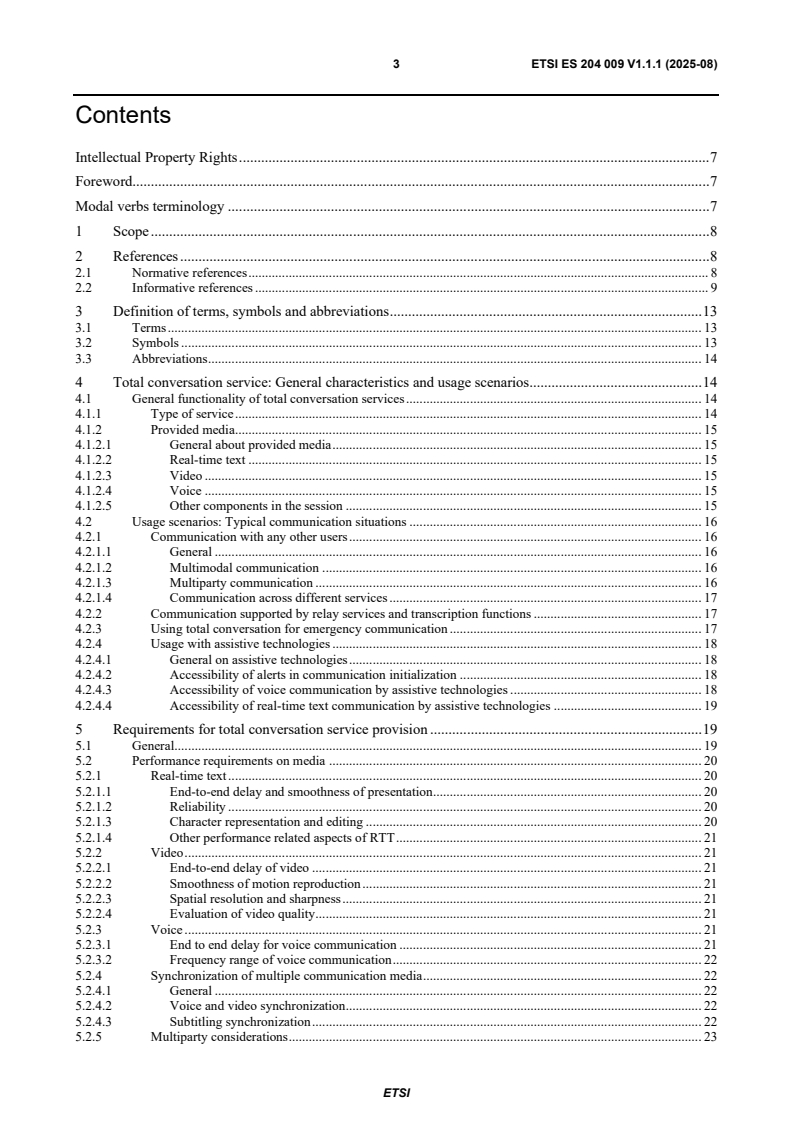
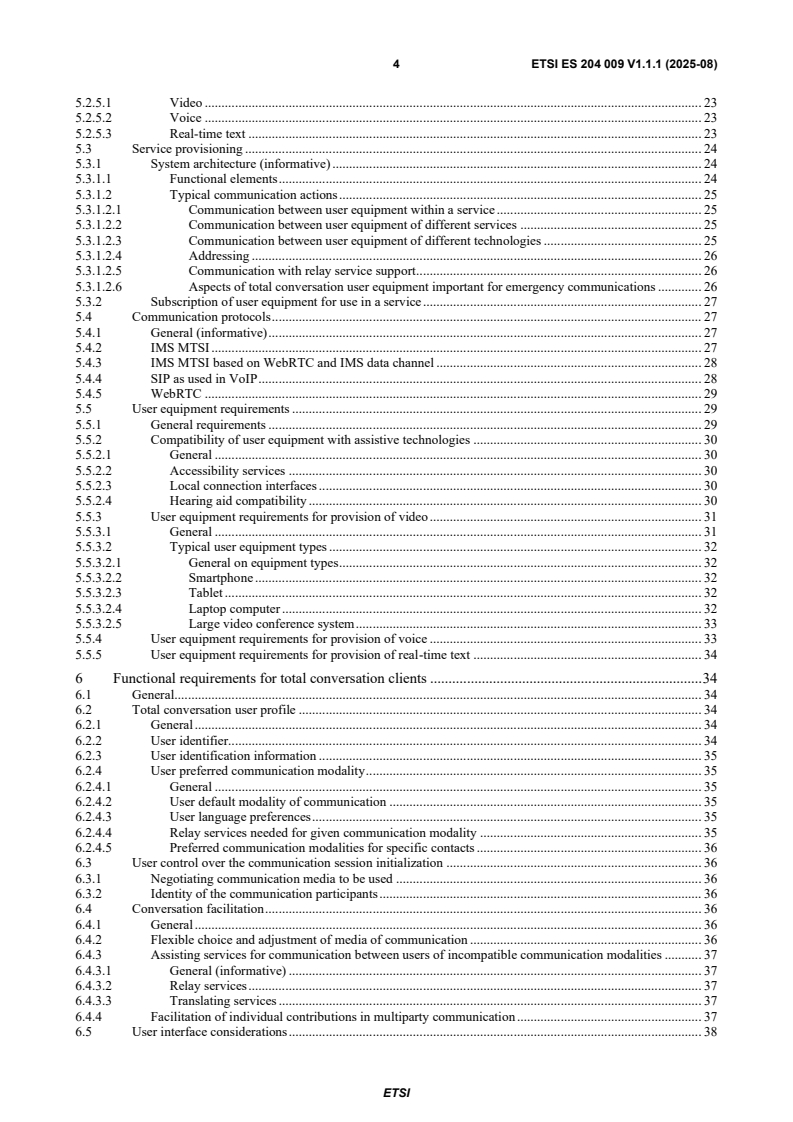
ETSI ES 204 009 V1.1.1 (2025-08) - Human Factors (HF); Requirements for interoperable total conversation services

Overview
SIST ES 204 009 V1.1.1:2025 defines the requirements for interoperable total conversation services from a human factors and accessibility perspective. Developed by SIST and aligned with ETSI ES 204 009 V1.1.1, this standard ensures compliance with the European Accessibility Act when providing communication services wherever voice and video are available. The document specifies how to deliver seamless, accessible, and user-friendly total conversation services that integrate synchronized voice, real-time text, and sign language-supportive video, all without the need for pre-registration. The standard also covers viable fall-back options and technical considerations to maximize usability for all, including persons with disabilities.
Key Topics
- Total Conversation Services: Requirement to provide integrated and synchronized communication via voice, real-time text, and video (including sign language support).
- Human Factors and Accessibility: Focus on inclusive design to ensure accessibility for users with diverse needs, including compatibility with assistive technologies such as hearing aids.
- Service Interoperability: Specifications to guarantee interoperability across platforms and networks, supporting seamless communication between different systems and services.
- Emergency Communications: Special provisions for accessible emergency services, ensuring rapid and reliable access for all users without additional registration.
- User Equipment Requirements: Guidance on equipment compatibility, supporting a range of devices from smartphones and tablets to laptops and conference systems.
- Privacy and Security: Requirements to protect personal data, encrypt communications, and maintain confidentiality, aligned with best practices and legal obligations.
Applications
SIST ES 204 009 V1.1.1:2025 has significant practical applications across the telecommunications sector, public services, and organizations needing to provide accessible communication channels. Key applications include:
- Public Sector and Emergency Services: Ensuring that governmental and emergency response communication channels are universally accessible, especially for people with disabilities.
- Telecommunication Providers: Implementing interoperable solutions that include real-time text, voice, and video as standard communication modes, facilitating compliance with European regulations.
- Relay and Transcription Services: Supporting third-party relay services for users who require translation between communication modalities, such as speech-to-text transcription or sign language to voice.
- Business and Remote Collaboration: Enabling inclusive conferencing solutions where participants can use synchronized media, making remote meetings and virtual collaboration accessible to a wider audience.
- Assistive Technology Integration: Ensuring wireless compatibility and interference avoidance with hearing aids or other assistive devices.
Implementing this standard not only facilitates legal compliance but also enhances user satisfaction, supports digital inclusion, and expands the market reach of services.
Related Standards
- EN 301 549: Accessibility requirements for ICT products and services, providing a broader framework for accessible communications technology.
- ETSI TS 101 470: Further detailing real-time text transmission and interoperability requirements relevant for total conversation services.
- Standards for SIP, IMS, and WebRTC: Ensuring compatibility and performance across different Internet telephony and video platforms.
- Standards for Relay and Emergency Services: Guidelines supporting the interoperability and accessibility of relay and emergency communication solutions.
By aligning with SIST ES 204 009 V1.1.1:2025 and these related standards, organizations can deliver inclusive, reliable, and future-proof communication services in line with current European legislation and best practices in accessibility and human factors engineering.
Buy Documents
ETSI ES 204 009 V1.1.1 (2025-06) - Human Factors (HF); Requirements for interoperable total conversation services
ETSI ES 204 009 V1.1.1 (2025-08) - Human Factors (HF); Requirements for interoperable total conversation services
Get Certified
Connect with accredited certification bodies for this standard

ANCE
Mexican certification and testing association.

Intertek Slovenia
Intertek testing, inspection, and certification services in Slovenia.

LNE (Laboratoire National de Métrologie et d'Essais)
French national laboratory for metrology and testing.
Sponsored listings
Frequently Asked Questions
SIST ES 204 009 V1.1.1:2025 is a standard published by the Slovenian Institute for Standardization (SIST). Its full title is "Human Factors (HF) - Requirements for interoperable total conversation services". This standard covers: The present document provides detailed functional, service and accessibility requirements from the Human Factors perspective for the implementation of and compliance with the European Accessibility Act [i.27] which requires the provision of interoperable total conversation services wherever voice and video communication is available. It details how to provide an interoperable total conversation service, with voice, real-time text and sign language-supportive video communication media synchronized, as a context-optimized service, with no need for additional pre-registration. It also details viable fall-back options. Effective wireless coupling to hearing technologies, with the avoidance of interferences with assistive devices, and beyond, is also addressed. The necessary background information and specifications containing technical parameters is provided as informative annexes to the present document. The present document additionally provides guidance on how to implement the interoperable total conversation services for emergency communications so that the needs of all users, including people with disabilities, are met. As such the present document complements other standards developed in the area, such as EN 301 549 [1] and ETSI TS 101 470 [29].
The present document provides detailed functional, service and accessibility requirements from the Human Factors perspective for the implementation of and compliance with the European Accessibility Act [i.27] which requires the provision of interoperable total conversation services wherever voice and video communication is available. It details how to provide an interoperable total conversation service, with voice, real-time text and sign language-supportive video communication media synchronized, as a context-optimized service, with no need for additional pre-registration. It also details viable fall-back options. Effective wireless coupling to hearing technologies, with the avoidance of interferences with assistive devices, and beyond, is also addressed. The necessary background information and specifications containing technical parameters is provided as informative annexes to the present document. The present document additionally provides guidance on how to implement the interoperable total conversation services for emergency communications so that the needs of all users, including people with disabilities, are met. As such the present document complements other standards developed in the area, such as EN 301 549 [1] and ETSI TS 101 470 [29].
SIST ES 204 009 V1.1.1:2025 is classified under the following ICS (International Classification for Standards) categories: 33.040.01 - Telecommunication systems in general. The ICS classification helps identify the subject area and facilitates finding related standards.
SIST ES 204 009 V1.1.1:2025 is available in PDF format for immediate download after purchase. The document can be added to your cart and obtained through the secure checkout process. Digital delivery ensures instant access to the complete standard document.
Standards Content (Sample)
Final draft ETSI ES 204 009 V1.1.1 (2025-06)
ETSI STANDARD
Human Factors (HF);
Requirements for interoperable total conversation services
2 Final draft ETSI ES 204 009 V1.1.1 (2025-06)
Reference
DES/HF-00301559
Keywords
accessibility, HF, ICT, procurement, relay, service,
total conversation
ETSI
650 Route des Lucioles
F-06921 Sophia Antipolis Cedex - FRANCE
Tel.: +33 4 92 94 42 00 Fax: +33 4 93 65 47 16
Siret N° 348 623 562 00017 - APE 7112B
Association à but non lucratif enregistrée à la
Sous-Préfecture de Grasse (06) N° w061004871
Important notice
The present document can be downloaded from the
ETSI Search & Browse Standards application.
The present document may be made available in electronic versions and/or in print. The content of any electronic and/or
print versions of the present document shall not be modified without the prior written authorization of ETSI. In case of any
existing or perceived difference in contents between such versions and/or in print, the prevailing version of an ETSI
deliverable is the one made publicly available in PDF format on ETSI deliver repository.
Users should be aware that the present document may be revised or have its status changed,
this information is available in the Milestones listing.
If you find errors in the present document, please send your comments to
the relevant service listed under Committee Support Staff.
If you find a security vulnerability in the present document, please report it through our
Coordinated Vulnerability Disclosure (CVD) program.
Notice of disclaimer & limitation of liability
The information provided in the present deliverable is directed solely to professionals who have the appropriate degree of
experience to understand and interpret its content in accordance with generally accepted engineering or
other professional standard and applicable regulations.
No recommendation as to products and services or vendors is made or should be implied.
No representation or warranty is made that this deliverable is technically accurate or sufficient or conforms to any law
and/or governmental rule and/or regulation and further, no representation or warranty is made of merchantability or fitness
for any particular purpose or against infringement of intellectual property rights.
In no event shall ETSI be held liable for loss of profits or any other incidental or consequential damages.
Any software contained in this deliverable is provided "AS IS" with no warranties, express or implied, including but not
limited to, the warranties of merchantability, fitness for a particular purpose and non-infringement of intellectual property
rights and ETSI shall not be held liable in any event for any damages whatsoever (including, without limitation, damages
for loss of profits, business interruption, loss of information, or any other pecuniary loss) arising out of or related to the use
of or inability to use the software.
Copyright Notification
No part may be reproduced or utilized in any form or by any means, electronic or mechanical, including photocopying and
microfilm except as authorized by written permission of ETSI.
The content of the PDF version shall not be modified without the written authorization of ETSI.
The copyright and the foregoing restriction extend to reproduction in all media.
© ETSI 2025.
All rights reserved.
ETSI
3 Final draft ETSI ES 204 009 V1.1.1 (2025-06)
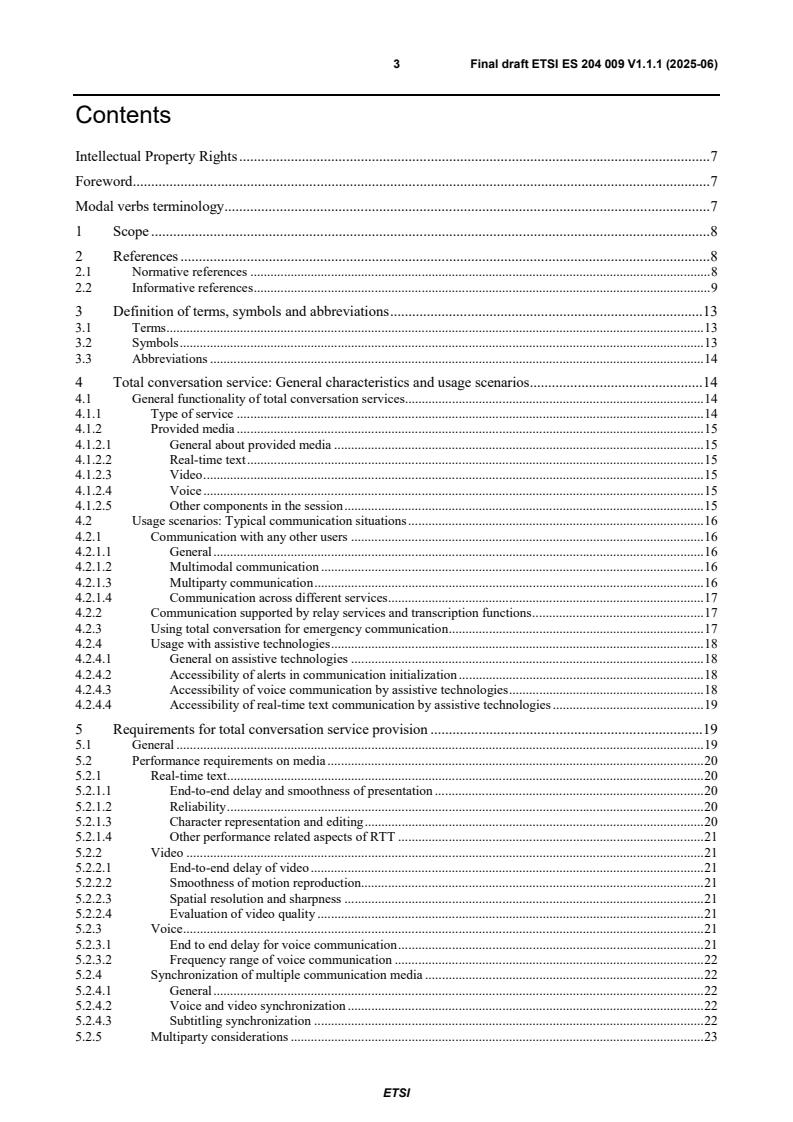
Contents
Intellectual Property Rights . 7
Foreword . 7
Modal verbs terminology . 7
1 Scope . 8
2 References . 8
2.1 Normative references . 8
2.2 Informative references . 9
3 Definition of terms, symbols and abbreviations . 13
3.1 Terms . 13
3.2 Symbols . 13
3.3 Abbreviations . 14
4 Total conversation service: General characteristics and usage scenarios . 14
4.1 General functionality of total conversation services. 14
4.1.1 Type of service . 14
4.1.2 Provided media . 15
4.1.2.1 General about provided media . 15
4.1.2.2 Real-time text . 15
4.1.2.3 Video . 15
4.1.2.4 Voice . 15
4.1.2.5 Other components in the session . 15
4.2 Usage scenarios: Typical communication situations . 16
4.2.1 Communication with any other users . 16
4.2.1.1 General . 16
4.2.1.2 Multimodal communication . 16
4.2.1.3 Multiparty communication . 16
4.2.1.4 Communication across different services . 17
4.2.2 Communication supported by relay services and transcription functions . 17
4.2.3 Using total conversation for emergency communication . 17
4.2.4 Usage with assistive technologies . 18
4.2.4.1 General on assistive technologies . 18
4.2.4.2 Accessibility of alerts in communication initialization . 18
4.2.4.3 Accessibility of voice communication by assistive technologies . 18
4.2.4.4 Accessibility of real-time text communication by assistive technologies . 19
5 Requirements for total conversation service provision . 19
5.1 General . 19
5.2 Performance requirements on media . 20
5.2.1 Real-time text . 20
5.2.1.1 End-to-end delay and smoothness of presentation . 20
5.2.1.2 Reliability . 20
5.2.1.3 Character representation and editing . 20
5.2.1.4 Other performance related aspects of RTT . 21
5.2.2 Video . 21
5.2.2.1 End-to-end delay of video . 21
5.2.2.2 Smoothness of motion reproduction. 21
5.2.2.3 Spatial resolution and sharpness . 21
5.2.2.4 Evaluation of video quality . 21
5.2.3 Voice . 21
5.2.3.1 End to end delay for voice communication . 21
5.2.3.2 Frequency range of voice communication . 22
5.2.4 Synchronization of multiple communication media . 22
5.2.4.1 General . 22
5.2.4.2 Voice and video synchronization . 22
5.2.4.3 Subtitling synchronization . 22
5.2.5 Multiparty considerations . 23
ETSI
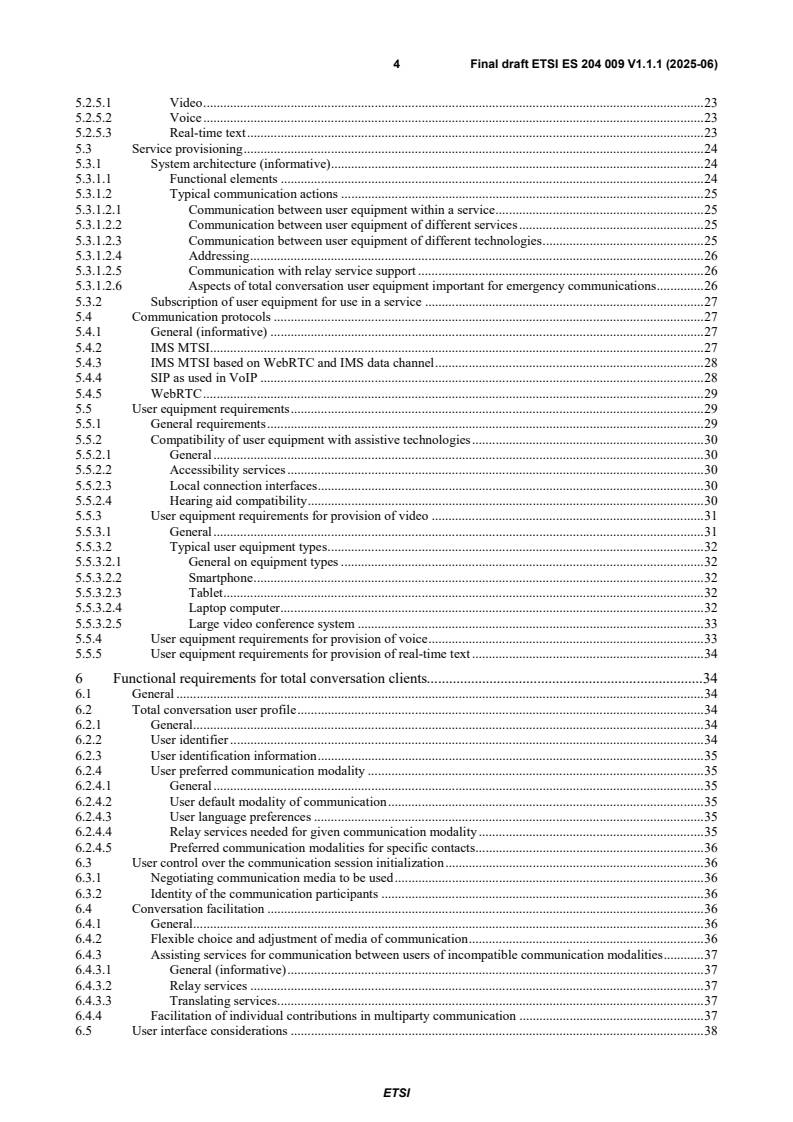
4 Final draft ETSI ES 204 009 V1.1.1 (2025-06)
5.2.5.1 Video . 23
5.2.5.2 Voice . 23
5.2.5.3 Real-time text . 23
5.3 Service provisioning . 24
5.3.1 System architecture (informative) . 24
5.3.1.1 Functional elements . 24
5.3.1.2 Typical communication actions . 25
5.3.1.2.1 Communication between user equipment within a service . 25
5.3.1.2.2 Communication between user equipment of different services . 25
5.3.1.2.3 Communication between user equipment of different technologies . 25
5.3.1.2.4 Addressing . 26
5.3.1.2.5 Communication with relay service support . 26
5.3.1.2.6 Aspects of total conversation user equipment important for emergency communications . 26
5.3.2 Subscription of user equipment for use in a service . 27
5.4 Communication protocols . 27
5.4.1 General (informative) . 27
5.4.2 IMS MTSI . 27
5.4.3 IMS MTSI based on WebRTC and IMS data channel . 28
5.4.4 SIP as used in VoIP . 28
5.4.5 WebRTC . 29
5.5 User equipment requirements . 29
5.5.1 General requirements . 29
5.5.2 Compatibility of user equipment with assistive technologies . 30
5.5.2.1 General . 30
5.5.2.2 Accessibility services . 30
5.5.2.3 Local connection interfaces . 30
5.5.2.4 Hearing aid compatibility . 30
5.5.3 User equipment requirements for provision of video . 31
5.5.3.1 General . 31
5.5.3.2 Typical user equipment types . 32
5.5.3.2.1 General on equipment types . 32
5.5.3.2.2 Smartphone . 32
5.5.3.2.3 Tablet . 32
5.5.3.2.4 Laptop computer . 32
5.5.3.2.5 Large video conference system . 33
5.5.4 User equipment requirements for provision of voice . 33
5.5.5 User equipment requirements for provision of real-time text . 34
6 Functional requirements for total conversation clients. 34
6.1 General . 34
6.2 Total conversation user profile . 34
6.2.1 General . 34
6.2.2 User identifier . 34
6.2.3 User identification information . 35
6.2.4 User preferred communication modality . 35
6.2.4.1 General . 35
6.2.4.2 User default modality of communication . 35
6.2.4.3 User language preferences . 35
6.2.4.4 Relay services needed for given communication modality . 35
6.2.4.5 Preferred communication modalities for specific contacts . 36
6.3 User control over the communication session initialization . 36
6.3.1 Negotiating communication media to be used . 36
6.3.2 Identity of the communication participants . 36
6.4 Conversation facilitation . 36
6.4.1 General . 36
6.4.2 Flexible choice and adjustment of media of communication . 36
6.4.3 Assisting services for communication between users of incompatible communication modalities . 37
6.4.3.1 General (informative) . 37
6.4.3.2 Relay services . 37
6.4.3.3 Translating services . 37
6.4.4 Facilitation of individual contributions in multiparty communication . 37
6.5 User interface considerations . 38
ETSI
5 Final draft ETSI ES 204 009 V1.1.1 (2025-06)
6.5.1 General . 38
6.5.2 Presentation of contributions in total conversation communication . 38
6.5.2.1 Active participant visibility and indication . 38
6.5.2.2 Visibility of assisting service participant . 38
6.5.2.3 Presentation of real-time text . 38
6.5.2.4 Visibility of captions or subtitles . 39
6.5.3 Provision of automated modality conversions . 39
7 Security and privacy of total conversation service . 39
7.1 General . 39
7.2 Security requirements . 40
7.2.1 General . 40
7.2.2 Confidentiality . 40
7.2.2.1 General . 40
7.2.2.2 Data encryption . 40
7.2.2.3 Authentication . 40
7.2.2.3.1 General . 40
7.2.2.3.2 Authentication during emergency communication . 41
7.2.2.4 Confidentiality of assisted communication . 41
7.2.3 Integrity . 42
7.2.4 Availability . 42
7.2.5 Standards to achieve security in total conversation . 43
7.3 Privacy requirements . 43
7.3.1 Protection of sensitive personal data shared automatically . 43
7.3.1.1 General . 43
7.3.1.2 Storage of data . 43
7.3.1.3 Exchange of data . 43
7.3.1.4 Deletion of data . 44
7.3.2 Privacy of user communication . 44
7.3.2.1 General . 44
7.3.2.2 Privacy requirements for visual output . 44
7.3.2.3 Privacy requirements for visual input . 44
7.3.2.4 Privacy requirements for audio output . 45
7.3.2.5 Privacy requirements for audio input . 45
7.3.2.6 Privacy requirements for recorded communications . 45
7.3.2.7 Privacy requirements for assisted communication . 45
8 Maintenance and Support . 46
8.1 General . 46
8.2 Regular update . 46
8.3 Integrated Diagnostic tools . 46
8.4 Support . 46
8.4.1 General . 46
8.4.2 Helplines . 46
8.4.3 Service documentation . 47
Annex A (informative): Background study on the use of total conversation . 48
A.1 Introduction . 48
A.2 Use of total conversation . 48
A.2.1 Introduction . 48
A.2.2 Use of total conversation for interpersonal communication . 48
A.2.3 Use of total conversation together with relay services . 50
A.2.4 Use of total conversation in emergency communication . 51
A.2.5 Use of total conversation for video conferencing . 52
A.2.5.1 General . 52
A.2.5.2 Real-time text in voice dominated conferences . 52
A.2.5.3 Sign language interpreting in voice dominated conferences . 52
A.2.5.4 Accessibility needs in video conferencing . 53
A.2.6 Summary . 53
A.3 Current use of total conversation in Europe and North America . 53
A.3.1 Introduction . 53
ETSI
6 Final draft ETSI ES 204 009 V1.1.1 (2025-06)
A.3.2 Current use in Europe . 54
A.3.3 Current use in North America . 55
A.3.4 Summary . 55
A.4 Performance requirements . 56
A.4.1 Introduction . 56
A.4.2 Real-time text . 56
A.4.3 Video . 57
A.4.4 Audio and audio plus video . 57
A.4.5 Total conversation . 57
A.5 Critical aspects of total conversation provision . 57
A.5.1 Introduction . 57
A.5.2 Interoperability of total conversation on human level . 59
A.5.3 Mechanisms for text based real-time communication services . 61
A.5.3.1 Limited functionality in circuit switched analogue networks . 61
A.5.3.2 Real-time text in packet switched networks . 61
A.5.3.3 Real-time text in web based communication . 62
A.5.3.4 Mechanisms for interoperability within technologies . 62
A.5.4 Mechanisms for interoperability between technologies . 63
A.6 Conclusions and future visions of total conversation use . 63
Annex B (informative): Related standards . 66
B.1 Catalogue of standards relevant for total conversation services . 66
B.1.1 Introduction . 66
B.1.2 Standards regarding user interface and functionality . 66
B.1.3 Standards for use in SIP for general IP networks and mobile networks . 67
B.1.4 Standards and profiles In Mobile Multimedia Telephony from 3GPP, GSMA and ATIS . 68
B.1.5 Standards for Web Technologies . 74
B.1.6 Standards for relay service use . 74
B.1.7 Standards for emergency communications . 75
B.1.8 Use for automatic speech-to-text . 77
Annex C (informative): Simple video quality assessment . 79
C.1 Introduction . 79
C.2 Tools and test setup . 79
C.3 Tests . 79
C.3.1 Resolution. 79
C.3.2 Frame rate . 80
C.3.3 Synchronization of video vs audio . 80
C.3.4 Video latency . 81
Annex D (informative): Change history . 82
History . 83
ETSI
7 Final draft ETSI ES 204 009 V1.1.1 (2025-06)
Intellectual Property Rights
Essential patents
IPRs essential or potentially essential to normative deliverables may have been declared to ETSI. The declarations
pertaining to these essential IPRs, if any, are publicly available for ETSI members and non-members, and can be
found in ETSI SR 000 314: "Intellectual Property Rights (IPRs); Essential, or potentially Essential, IPRs notified to
ETSI in respect of ETSI standards", which is available from the ETSI Secretariat. Latest updates are available on the
ETSI IPR online database.
Pursuant to the ETSI Directives including the ETSI IPR Policy, no investigation regarding the essentiality of IPRs,
including IPR searches, has been carried out by ETSI. No guarantee can be given as to the existence of other IPRs not
referenced in ETSI SR 000 314 (or the updates on the ETSI Web server) which are, or may be, or may become,
essential to the present document.
Trademarks
The present document may include trademarks and/or tradenames which are asserted and/or registered by their owners.
ETSI claims no ownership of these except for any which are indicated as being the property of ETSI, and conveys no
right to use or reproduce any trademark and/or tradename. Mention of those trademarks in the present document does
not constitute an endorsement by ETSI of products, services or organizations associated with those trademarks.
DECT™, PLUGTESTS™, UMTS™ and the ETSI logo are trademarks of ETSI registered for the benefit of its
Members. 3GPP™, LTE™ and 5G™ logo are trademarks of ETSI registered for the benefit of its Members and of the
3GPP Organizational Partners. oneM2M™ logo is a trademark of ETSI registered for the benefit of its Members and of ®
the oneM2M Partners. GSM and the GSM logo are trademarks registered and owned by the GSM Association. ®
BLUETOOTH is a trademark registered and owned by Bluetooth SIG, Inc.
Foreword
This final draft ETSI Standard (ES) has been produced by ETSI Technical Committee Human Factors (HF), and is now
submitted for the ETSI Membership Approval Procedure (MAP).
Modal verbs terminology
In the present document "shall", "shall not", "should", "should not", "may", "need not", "will", "will not", "can" and
"cannot" are to be interpreted as described in clause 3.2 of the ETSI Drafting Rules (Verbal forms for the expression of
provisions).
"must" and "must not" are NOT allowed in ETSI deliverables except when used in direct citation.
ETSI
8 Final draft ETSI ES 204 009 V1.1.1 (2025-06)
1 Scope
The present document provides detailed functional, service and accessibility requirements from the Human Factors
perspective for the implementation of and compliance with the European Accessibility Act [i.27] which requires the
provision of interoperable total conversation services wherever voice and video communication is available. It details
how to provide an interoperable total conversation service, with voice, real-time text and sign language-supportive
video communication media synchronized, as a context-optimized service, with no need for additional pre-registration.
It also details viable fall-back options. Effective wireless coupling to hearing technologies, with the avoidance of
interferences with assistive devices, and beyond, is also addressed. The necessary background information and
specifications containing technical parameters is provided as informative annexes to the present document. The present
document additionally provides guidance on how to implement the interoperable total conversation services for
emergency communications so that the needs of all users, including people with disabilities, are met. As such the
present document complements other standards developed in the area, such as EN 301 549 [1] and ETSI
TS 101 470 [29].
2 References
2.1 Normative references
References are either specific (identified by date of publication and/or edition number or version number) or
non-specific. For specific references, only the cited version applies. For non-specific references, the latest version of the
referenced document (including any amendments) applies.
Referenced documents which are not found to be publicly available in the expected location might be found in the
ETSI docbox.
NOTE: While any hyperlinks included in this clause were valid at the time of publication, ETSI cannot guarantee
their long-term validity.
The following referenced documents are necessary for the application of the present document.
[1] EN 301 549 (V3.2.1) (2021-03): "Accessibility requirements for ICT products and services"
(jointly produced by ETSI/CEN/CENELEC).
[2] ETSI EN 301 489-1: "ElectroMagnetic Compatibility (EMC) standard for radio equipment and
services; Part 1: Common technical requirements; Harmonised Standard for ElectroMagnetic
Compatibility".
[3] ETSI EN 301 489-52: "ElectroMagnetic Compatibility (EMC) standard for radio equipment and
services; Part 52: Specific conditions for Cellular Communication User Equipment (UE) radio and
ancillary equipment; Harmonised Standard for ElectroMagnetic Compatibility".
[4] ETSI ES 202 975: "Human Factors (HF); Requirements for relay services".
[5] ETSI TS 103 479: "Emergency Communications (EMTEL); Core elements for network
independent access to emergency services".
[6] ETSI TS 103 919 (V1.1.1) (2024-08): "Emergency Communications (EMTEL); Accessibility and
interoperability of emergency communications and for the answering of emergency
communications by the public safety answering points (PSAPs) (including to the single European
Emergency number 112)".
[7] ETSI TS 124 229: "Digital cellular telecommunications system (Phase 2+) (GSM); Universal
Mobile Telecommunications System (UMTS); LTE; 5G; IP multimedia call control protocol based
on Session Initiation Protocol (SIP) and Session Description Protocol (SDP); Stage 3 (3GPP
TS 24.229)".
[8] ETSI TS 126 114: "Universal Mobile Telecommunications System (UMTS); LTE; 5G; IP
Multimedia Subsystem (IMS); Multimedia telephony; Media handling and interaction (3GPP
TS 26.114)".
ETSI
9 Final draft ETSI ES 204 009 V1.1.1 (2025-06)
[9] IEC 60118-4: "Electroacoustics - Hearing aids - Part 4: Induction-loop systems for hearing aid
purposes - System performance requirements".
[10] Recommendation ITU-T G.114: "One-way transmission time".
[11] Recommendation ITU-T G.722 (2012): "7 kHz audio-coding within 64 kbit/s".
[12] Recommendation ITU-T G.722.2 (2003): "Wideband coding of speech at around 16 kbit/s using
Adaptive Multi-Rate Wideband (AMR-WB)".
[13] Recommendation ITU-T H.264: "Advanced video coding for generic audiovisual services".
[14] ITU-T H-series supplement 1 (1999): "Application profile - Sign language and lip-reading realtime
conversation using low bit-rate video communication".
[15] Recommendation ITU-T P.1305: "Effect of delays on telemeeting quality".
[16] Recommendation ITU-T T.140: "Protocol for multimedia application text conversation" (including
its Addendum 1).
[17] IETF RFC 3261: "SIP: Session Initiation Protocol".
[18] IETF RFC 3550: "RTP: A Transport Protocol for Real-Time Applications", H. Schulzrinne et.al.,
2003.
[19] IETF RFC 3711: "The Secure Real-time Transport Protocol (SRTP)", Baugher M., McGrew D.,
Naslund M., Carrara E., and Norrman K., DOI 10.17487/RFC3711, March 2004.
[20] IETF RFC 4103: "RTP Payload for Text Conversation", G. Hellstrom, P. Jones, 2005.
[21] IETF RFC 6184: "RTP Payload Format for H.264 Video", Wang Y.-K., Even R., Kristensen T.,
and Jesup R., 2011.
[22] IETF RFC 8445: "Interactive Connectivity Establishment (ICE): A Protocol for Network Address
Translator (NAT) Traversal", Keranen A., Holmberg C., and Rosenberg J., July 2018.
[23] IETF RFC 8446: "The Transport Layer Security (TLS) Protocol Version 1.3", Rescorla E.,
August 2018.
[24] IETF RFC 8866: "SDP: Session Description Protocol", Begen A., Kyzivat P., Perkins C., and
...
ETSI STANDARD
Human Factors (HF);
Requirements for interoperable total conversation services
2 ETSI ES 204 009 V1.1.1 (2025-08)
Reference
DES/HF-00301559
Keywords
accessibility, HF, ICT, procurement, relay, service,
total conversation
ETSI
650 Route des Lucioles
F-06921 Sophia Antipolis Cedex - FRANCE
Tel.: +33 4 92 94 42 00 Fax: +33 4 93 65 47 16
Siret N° 348 623 562 00017 - APE 7112B
Association à but non lucratif enregistrée à la
Sous-Préfecture de Grasse (06) N° w061004871
Important notice
The present document can be downloaded from the
ETSI Search & Browse Standards application.
The present document may be made available in electronic versions and/or in print. The content of any electronic and/or
print versions of the present document shall not be modified without the prior written authorization of ETSI. In case of any
existing or perceived difference in contents between such versions and/or in print, the prevailing version of an ETSI
deliverable is the one made publicly available in PDF format on ETSI deliver repository.
Users should be aware that the present document may be revised or have its status changed,
this information is available in the Milestones listing.
If you find errors in the present document, please send your comments to
the relevant service listed under Committee Support Staff.
If you find a security vulnerability in the present document, please report it through our
Coordinated Vulnerability Disclosure (CVD) program.
Notice of disclaimer & limitation of liability
The information provided in the present deliverable is directed solely to professionals who have the appropriate degree of
experience to understand and interpret its content in accordance with generally accepted engineering or
other professional standard and applicable regulations.
No recommendation as to products and services or vendors is made or should be implied.
No representation or warranty is made that this deliverable is technically accurate or sufficient or conforms to any law
and/or governmental rule and/or regulation and further, no representation or warranty is made of merchantability or fitness
for any particular purpose or against infringement of intellectual property rights.
In no event shall ETSI be held liable for loss of profits or any other incidental or consequential damages.
Any software contained in this deliverable is provided "AS IS" with no warranties, express or implied, including but not
limited to, the warranties of merchantability, fitness for a particular purpose and non-infringement of intellectual property
rights and ETSI shall not be held liable in any event for any damages whatsoever (including, without limitation, damages
for loss of profits, business interruption, loss of information, or any other pecuniary loss) arising out of or related to the use
of or inability to use the software.
Copyright Notification
No part may be reproduced or utilized in any form or by any means, electronic or mechanical, including photocopying and
microfilm except as authorized by written permission of ETSI.
The content of the PDF version shall not be modified without the written authorization of ETSI.
The copyright and the foregoing restriction extend to reproduction in all media.
© ETSI 2025.
All rights reserved.
ETSI
3 ETSI ES 204 009 V1.1.1 (2025-08)
Contents
Intellectual Property Rights . 7
Foreword. 7
Modal verbs terminology . 7
1 Scope . 8
2 References . 8
2.1 Normative references . 8
2.2 Informative references . 9
3 Definition of terms, symbols and abbreviations . 13
3.1 Terms . 13
3.2 Symbols . 13
3.3 Abbreviations . 14
4 Total conversation service: General characteristics and usage scenarios. 14
4.1 General functionality of total conversation services . 14
4.1.1 Type of service . 14
4.1.2 Provided media . 15
4.1.2.1 General about provided media . 15
4.1.2.2 Real-time text . 15
4.1.2.3 Video . 15
4.1.2.4 Voice . 15
4.1.2.5 Other components in the session . 15
4.2 Usage scenarios: Typical communication situations . 16
4.2.1 Communication with any other users . 16
4.2.1.1 General . 16
4.2.1.2 Multimodal communication . 16
4.2.1.3 Multiparty communication . 16
4.2.1.4 Communication across different services . 17
4.2.2 Communication supported by relay services and transcription functions . 17
4.2.3 Using total conversation for emergency communication . 17
4.2.4 Usage with assistive technologies . 18
4.2.4.1 General on assistive technologies . 18
4.2.4.2 Accessibility of alerts in communication initialization . 18
4.2.4.3 Accessibility of voice communication by assistive technologies . 18
4.2.4.4 Accessibility of real-time text communication by assistive technologies . 19
5 Requirements for total conversation service provision . 19
5.1 General . 19
5.2 Performance requirements on media . 20
5.2.1 Real-time text . 20
5.2.1.1 End-to-end delay and smoothness of presentation. 20
5.2.1.2 Reliability . 20
5.2.1.3 Character representation and editing . 20
5.2.1.4 Other performance related aspects of RTT . 21
5.2.2 Video . 21
5.2.2.1 End-to-end delay of video . 21
5.2.2.2 Smoothness of motion reproduction . 21
5.2.2.3 Spatial resolution and sharpness . 21
5.2.2.4 Evaluation of video quality . 21
5.2.3 Voice . 21
5.2.3.1 End to end delay for voice communication . 21
5.2.3.2 Frequency range of voice communication . 22
5.2.4 Synchronization of multiple communication media . 22
5.2.4.1 General . 22
5.2.4.2 Voice and video synchronization . 22
5.2.4.3 Subtitling synchronization . 22
5.2.5 Multiparty considerations . 23
ETSI
4 ETSI ES 204 009 V1.1.1 (2025-08)
5.2.5.1 Video . 23
5.2.5.2 Voice . 23
5.2.5.3 Real-time text . 23
5.3 Service provisioning . 24
5.3.1 System architecture (informative) . 24
5.3.1.1 Functional elements . 24
5.3.1.2 Typical communication actions . 25
5.3.1.2.1 Communication between user equipment within a service . 25
5.3.1.2.2 Communication between user equipment of different services . 25
5.3.1.2.3 Communication between user equipment of different technologies . 25
5.3.1.2.4 Addressing . 26
5.3.1.2.5 Communication with relay service support . 26
5.3.1.2.6 Aspects of total conversation user equipment important for emergency communications . 26
5.3.2 Subscription of user equipment for use in a service . 27
5.4 Communication protocols . 27
5.4.1 General (informative) . 27
5.4.2 IMS MTSI . 27
5.4.3 IMS MTSI based on WebRTC and IMS data channel . 28
5.4.4 SIP as used in VoIP . 28
5.4.5 WebRTC . 29
5.5 User equipment requirements . 29
5.5.1 General requirements . 29
5.5.2 Compatibility of user equipment with assistive technologies . 30
5.5.2.1 General . 30
5.5.2.2 Accessibility services . 30
5.5.2.3 Local connection interfaces . 30
5.5.2.4 Hearing aid compatibility . 30
5.5.3 User equipment requirements for provision of video . 31
5.5.3.1 General . 31
5.5.3.2 Typical user equipment types . 32
5.5.3.2.1 General on equipment types . 32
5.5.3.2.2 Smartphone . 32
5.5.3.2.3 Tablet . 32
5.5.3.2.4 Laptop computer . 32
5.5.3.2.5 Large video conference system . 33
5.5.4 User equipment requirements for provision of voice . 33
5.5.5 User equipment requirements for provision of real-time text . 34
6 Functional requirements for total conversation clients . 34
6.1 General . 34
6.2 Total conversation user profile . 34
6.2.1 General . 34
6.2.2 User identifier. 34
6.2.3 User identification information . 35
6.2.4 User preferred communication modality . 35
6.2.4.1 General . 35
6.2.4.2 User default modality of communication . 35
6.2.4.3 User language preferences . 35
6.2.4.4 Relay services needed for given communication modality . 35
6.2.4.5 Preferred communication modalities for specific contacts . 36
6.3 User control over the communication session initialization . 36
6.3.1 Negotiating communication media to be used . 36
6.3.2 Identity of the communication participants . 36
6.4 Conversation facilitation . 36
6.4.1 General . 36
6.4.2 Flexible choice and adjustment of media of communication . 36
6.4.3 Assisting services for communication between users of incompatible communication modalities . 37
6.4.3.1 General (informative) . 37
6.4.3.2 Relay services . 37
6.4.3.3 Translating services . 37
6.4.4 Facilitation of individual contributions in multiparty communication . 37
6.5 User interface considerations . 38
ETSI
5 ETSI ES 204 009 V1.1.1 (2025-08)
6.5.1 General . 38
6.5.2 Presentation of contributions in total conversation communication . 38
6.5.2.1 Active participant visibility and indication . 38
6.5.2.2 Visibility of assisting service participant . 38
6.5.2.3 Presentation of real-time text . 38
6.5.2.4 Visibility of captions or subtitles . 39
6.5.3 Provision of automated modality conversions . 39
7 Security and privacy of total conversation service . 39
7.1 General . 39
7.2 Security requirements . 40
7.2.1 General . 40
7.2.2 Confidentiality. 40
7.2.2.1 General . 40
7.2.2.2 Data encryption . 40
7.2.2.3 Authentication . 40
7.2.2.3.1 General . 40
7.2.2.3.2 Authentication during emergency communication . 41
7.2.2.4 Confidentiality of assisted communication . 41
7.2.3 Integrity . 42
7.2.4 Availability . 42
7.2.5 Standards to achieve security in total conversation . 43
7.3 Privacy requirements . 43
7.3.1 Protection of sensitive personal data shared automatically . 43
7.3.1.1 General . 43
7.3.1.2 Storage of data . 43
7.3.1.3 Exchange of data . 43
7.3.1.4 Deletion of data . 44
7.3.2 Privacy of user communication . 44
7.3.2.1 General . 44
7.3.2.2 Privacy requirements for visual output . 44
7.3.2.3 Privacy requirements for visual input . 44
7.3.2.4 Privacy requirements for audio output. 45
7.3.2.5 Privacy requirements for audio input . 45
7.3.2.6 Privacy requirements for recorded communications . 45
7.3.2.7 Privacy requirements for assisted communication . 45
8 Maintenance and Support . 46
8.1 General . 46
8.2 Regular update . 46
8.3 Integrated Diagnostic tools . 46
8.4 Support . 46
8.4.1 General . 46
8.4.2 Helplines . 46
8.4.3 Service documentation . 47
Annex A (informative): Background study on the use of total conversation . 48
A.1 Introduction . 48
A.2 Use of total conversation . 48
A.2.1 Introduction. 48
A.2.2 Use of total conversation for interpersonal communication . 48
A.2.3 Use of total conversation together with relay services . 50
A.2.4 Use of total conversation in emergency communication . 51
A.2.5 Use of total conversation for video conferencing . 52
A.2.5.1 General . 52
A.2.5.2 Real-time text in voice dominated conferences . 52
A.2.5.3 Sign language interpreting in voice dominated conferences . 52
A.2.5.4 Accessibility needs in video conferencing . 53
A.2.6 Summary . 53
A.3 Current use of total conversation in Europe and North America . 53
A.3.1 Introduction. 53
ETSI
6 ETSI ES 204 009 V1.1.1 (2025-08)
A.3.2 Current use in Europe . 54
A.3.3 Current use in North America . 55
A.3.4 Summary . 55
A.4 Performance requirements . 56
A.4.1 Introduction. 56
A.4.2 Real-time text . 56
A.4.3 Video . 57
A.4.4 Audio and audio plus video . 57
A.4.5 Total conversation . 57
A.5 Critical aspects of total conversation provision . 57
A.5.1 Introduction. 57
A.5.2 Interoperability of total conversation on human level . 59
A.5.3 Mechanisms for text based real-time communication services . 61
A.5.3.1 Limited functionality in circuit switched analogue networks . 61
A.5.3.2 Real-time text in packet switched networks . 61
A.5.3.3 Real-time text in web based communication . 62
A.5.3.4 Mechanisms for interoperability within technologies . 62
A.5.4 Mechanisms for interoperability between technologies . 63
A.6 Conclusions and future visions of total conversation use . 63
Annex B (informative): Related standards . 66
B.1 Catalogue of standards relevant for total conversation services . 66
B.1.1 Introduction. 66
B.1.2 Standards regarding user interface and functionality . 66
B.1.3 Standards for use in SIP for general IP networks and mobile networks . 67
B.1.4 Standards and profiles In Mobile Multimedia Telephony from 3GPP, GSMA and ATIS . 68
B.1.5 Standards for Web Technologies . 74
B.1.6 Standards for relay service use . 74
B.1.7 Standards for emergency communications . 75
B.1.8 Use for automatic speech-to-text . 77
Annex C (informative): Simple video quality assessment . 79
C.1 Introduction . 79
C.2 Tools and test setup . 79
C.3 Tests . 79
C.3.1 Resolution . 79
C.3.2 Frame rate . 80
C.3.3 Synchronization of video vs audio . 80
C.3.4 Video latency . 81
Annex D (informative): Change history . 82
History . 83
ETSI
7 ETSI ES 204 009 V1.1.1 (2025-08)
Intellectual Property Rights
Essential patents
IPRs essential or potentially essential to normative deliverables may have been declared to ETSI. The declarations
pertaining to these essential IPRs, if any, are publicly available for ETSI members and non-members, and can be
found in ETSI SR 000 314: "Intellectual Property Rights (IPRs); Essential, or potentially Essential, IPRs notified to
ETSI in respect of ETSI standards", which is available from the ETSI Secretariat. Latest updates are available on the
ETSI IPR online database.
Pursuant to the ETSI Directives including the ETSI IPR Policy, no investigation regarding the essentiality of IPRs,
including IPR searches, has been carried out by ETSI. No guarantee can be given as to the existence of other IPRs not
referenced in ETSI SR 000 314 (or the updates on the ETSI Web server) which are, or may be, or may become,
essential to the present document.
Trademarks
The present document may include trademarks and/or tradenames which are asserted and/or registered by their owners.
ETSI claims no ownership of these except for any which are indicated as being the property of ETSI, and conveys no
right to use or reproduce any trademark and/or tradename. Mention of those trademarks in the present document does
not constitute an endorsement by ETSI of products, services or organizations associated with those trademarks.
DECT™, PLUGTESTS™, UMTS™ and the ETSI logo are trademarks of ETSI registered for the benefit of its
Members. 3GPP™, LTE™ and 5G™ logo are trademarks of ETSI registered for the benefit of its Members and of the
3GPP Organizational Partners. oneM2M™ logo is a trademark of ETSI registered for the benefit of its Members and of ®
the oneM2M Partners. GSM and the GSM logo are trademarks registered and owned by the GSM Association. ®
BLUETOOTH is a trademark registered and owned by Bluetooth SIG, Inc.
Foreword
This ETSI Standard (ES) has been produced by ETSI Technical Committee Human Factors (HF).
Modal verbs terminology
In the present document "shall", "shall not", "should", "should not", "may", "need not", "will", "will not", "can" and
"cannot" are to be interpreted as described in clause 3.2 of the ETSI Drafting Rules (Verbal forms for the expression of
provisions).
"must" and "must not" are NOT allowed in ETSI deliverables except when used in direct citation.
ETSI
8 ETSI ES 204 009 V1.1.1 (2025-08)
1 Scope
The present document provides detailed functional, service and accessibility requirements from the Human Factors
perspective for the implementation of and compliance with the European Accessibility Act [i.27] which requires the
provision of interoperable total conversation services wherever voice and video communication is available. It details
how to provide an interoperable total conversation service, with voice, real-time text and sign language-supportive
video communication media synchronized, as a context-optimized service, with no need for additional pre-registration.
It also details viable fall-back options. Effective wireless coupling to hearing technologies, with the avoidance of
interferences with assistive devices, and beyond, is also addressed. The necessary background information and
specifications containing technical parameters is provided as informative annexes to the present document. The present
document additionally provides guidance on how to implement the interoperable total conversation services for
emergency communications so that the needs of all users, including people with disabilities, are met. As such the
present document complements other standards developed in the area, such as EN 301 549 [1] and ETSI
TS 101 470 [29].
2 References
2.1 Normative references
References are either specific (identified by date of publication and/or edition number or version number) or
non-specific. For specific references, only the cited version applies. For non-specific references, the latest version of the
referenced document (including any amendments) applies.
Referenced documents which are not found to be publicly available in the expected location might be found in the
ETSI docbox.
NOTE: While any hyperlinks included in this clause were valid at the time of publication, ETSI cannot guarantee
their long-term validity.
The following referenced documents are necessary for the application of the present document.
[1] EN 301 549 (V3.2.1) (2021-03): "Accessibility requirements for ICT products and services"
(jointly produced by ETSI/CEN/CENELEC).
[2] ETSI EN 301 489-1: "ElectroMagnetic Compatibility (EMC) standard for radio equipment and
services; Part 1: Common technical requirements; Harmonised Standard for ElectroMagnetic
Compatibility".
[3] ETSI EN 301 489-52: "ElectroMagnetic Compatibility (EMC) standard for radio equipment and
services; Part 52: Specific conditions for Cellular Communication User Equipment (UE) radio and
ancillary equipment; Harmonised Standard for ElectroMagnetic Compatibility".
[4] ETSI ES 202 975: "Human Factors (HF); Requirements for relay services".
[5] ETSI TS 103 479: "Emergency Communications (EMTEL); Core elements for network
independent access to emergency services".
[6] ETSI TS 103 919 (V1.1.1) (2024-08): "Emergency Communications (EMTEL); Accessibility and
interoperability of emergency communications and for the answering of emergency
communications by the public safety answering points (PSAPs) (including to the single European
Emergency number 112)".
[7] ETSI TS 124 229: "Digital cellular telecommunications system (Phase 2+) (GSM); Universal
Mobile Telecommunications System (UMTS); LTE; 5G; IP multimedia call control protocol based
on Session Initiation Protocol (SIP) and Session Description Protocol (SDP); Stage 3 (3GPP
TS 24.229)".
[8] ETSI TS 126 114: "Universal Mobile Telecommunications System (UMTS); LTE; 5G; IP
Multimedia Subsystem (IMS); Multimedia telephony; Media handling and interaction (3GPP
TS 26.114)".
ETSI
9 ETSI ES 204 009 V1.1.1 (2025-08)
[9] IEC 60118-4: "Electroacoustics - Hearing aids - Part 4: Induction-loop systems for hearing aid
purposes - System performance requirements".
[10] Recommendation ITU-T G.114: "One-way transmission time".
[11] Recommendation ITU-T G.722 (2012): "7 kHz audio-coding within 64 kbit/s".
[12] Recommendation ITU-T G.722.2 (2003): "Wideband coding of speech at around 16 kbit/s using
Adaptive Multi-Rate Wideband (AMR-WB)".
[13] Recommendation ITU-T H.264: "Advanced video coding for generic audiovisual services".
[14] ITU-T H-series supplement 1 (1999): "Application profile - Sign language and lip-reading realtime
conversation using low bit-rate video communication".
[15] Recommendation ITU-T P.1305: "Effect of delays on telemeeting quality".
[16] Recommendation ITU-T T.140: "Protocol for multimedia application text conversation" (including
its Addendum 1).
[17] IETF RFC 3261: "SIP: Session Initiation Protocol".
[18] IETF RFC 3550: "RTP: A Transport Protocol for Real-Time Applications", H. Schulzrinne et.al.,
2003.
[19] IETF RFC 3711: "The Secure Real-time Transport Protocol (SRTP)", Baugher M., McGrew D.,
Naslund M., Carrara E., and Norrman K., DOI 10.17487/RFC3711, March 2004.
[20] IETF RFC 4103: "RTP Payload for Text Conversation", G. Hellstrom, P. Jones, 2005.
[21] IETF RFC 6184: "RTP Payload Format for H.264 Video", Wang Y.-K., Even R., Kristensen T.,
and Jesup R., 2011.
[22] IETF RFC 8445: "Interactive Connectivity Establishment (ICE): A Protocol for Network Address
Translator (NAT) Traversal", Keranen A., Holmberg C., and Rosenberg J., July 2018.
[23] IETF RFC 8446: "The Transport Layer Security (TLS) Protocol Version 1.3", Rescorla E.,
August 2018.
[24] IETF RFC 8866: "SDP: Session Description Protocol", Begen A., Kyzivat P., Perkins C., and
Handley M., January 2021.
[25] IETF RFC 9071: "RTP-Mixer Formatting of Multiparty Real-Time Text", 2021.
[26] IETF RFC 9110: "HTTP Semantics", 2022.
[27] IETF RFC 9147: "The Datagram Transport Layer Security (DTLS) Protocol Version 1.3", 2022. ®
[28] W3C WebRTC: "Real-Time Communication in Browsers".
...
SLOVENSKI STANDARD
01-november-2025
Človeški dejavniki (HF) - Zahteve za interoperabilne storitve celovitega pogovora
Human Factors (HF) - Requirements for interoperable total conversation services
Ta slovenski standard je istoveten z: ETSI ES 204 009 V1.1.1 (2025-08)
ICS:
33.040.01 Telekomunikacijski sistemi Telecommunication systems
na splošno in general
2003-01.Slovenski inštitut za standardizacijo. Razmnoževanje celote ali delov tega standarda ni dovoljeno.
ETSI STANDARD
Human Factors (HF);
Requirements for interoperable total conversation services
2 ETSI ES 204 009 V1.1.1 (2025-08)
Reference
DES/HF-00301559
Keywords
accessibility, HF, ICT, procurement, relay, service,
total conversation
ETSI
650 Route des Lucioles
F-06921 Sophia Antipolis Cedex - FRANCE
Tel.: +33 4 92 94 42 00 Fax: +33 4 93 65 47 16
Siret N° 348 623 562 00017 - APE 7112B
Association à but non lucratif enregistrée à la
Sous-Préfecture de Grasse (06) N° w061004871
Important notice
The present document can be downloaded from the
ETSI Search & Browse Standards application.
The present document may be made available in electronic versions and/or in print. The content of any electronic and/or
print versions of the present document shall not be modified without the prior written authorization of ETSI. In case of any
existing or perceived difference in contents between such versions and/or in print, the prevailing version of an ETSI
deliverable is the one made publicly available in PDF format on ETSI deliver repository.
Users should be aware that the present document may be revised or have its status changed,
this information is available in the Milestones listing.
If you find errors in the present document, please send your comments to
the relevant service listed under Committee Support Staff.
If you find a security vulnerability in the present document, please report it through our
Coordinated Vulnerability Disclosure (CVD) program.
Notice of disclaimer & limitation of liability
The information provided in the present deliverable is directed solely to professionals who have the appropriate degree of
experience to understand and interpret its content in accordance with generally accepted engineering or
other professional standard and applicable regulations.
No recommendation as to products and services or vendors is made or should be implied.
No representation or warranty is made that this deliverable is technically accurate or sufficient or conforms to any law
and/or governmental rule and/or regulation and further, no representation or warranty is made of merchantability or fitness
for any particular purpose or against infringement of intellectual property rights.
In no event shall ETSI be held liable for loss of profits or any other incidental or consequential damages.
Any software contained in this deliverable is provided "AS IS" with no warranties, express or implied, including but not
limited to, the warranties of merchantability, fitness for a particular purpose and non-infringement of intellectual property
rights and ETSI shall not be held liable in any event for any damages whatsoever (including, without limitation, damages
for loss of profits, business interruption, loss of information, or any other pecuniary loss) arising out of or related to the use
of or inability to use the software.
Copyright Notification
No part may be reproduced or utilized in any form or by any means, electronic or mechanical, including photocopying and
microfilm except as authorized by written permission of ETSI.
The content of the PDF version shall not be modified without the written authorization of ETSI.
The copyright and the foregoing restriction extend to reproduction in all media.
© ETSI 2025.
All rights reserved.
ETSI
3 ETSI ES 204 009 V1.1.1 (2025-08)
Contents
Intellectual Property Rights . 7
Foreword. 7
Modal verbs terminology . 7
1 Scope . 8
2 References . 8
2.1 Normative references . 8
2.2 Informative references . 9
3 Definition of terms, symbols and abbreviations . 13
3.1 Terms . 13
3.2 Symbols . 13
3.3 Abbreviations . 14
4 Total conversation service: General characteristics and usage scenarios. 14
4.1 General functionality of total conversation services . 14
4.1.1 Type of service . 14
4.1.2 Provided media . 15
4.1.2.1 General about provided media . 15
4.1.2.2 Real-time text . 15
4.1.2.3 Video . 15
4.1.2.4 Voice . 15
4.1.2.5 Other components in the session . 15
4.2 Usage scenarios: Typical communication situations . 16
4.2.1 Communication with any other users . 16
4.2.1.1 General . 16
4.2.1.2 Multimodal communication . 16
4.2.1.3 Multiparty communication . 16
4.2.1.4 Communication across different services . 17
4.2.2 Communication supported by relay services and transcription functions . 17
4.2.3 Using total conversation for emergency communication . 17
4.2.4 Usage with assistive technologies . 18
4.2.4.1 General on assistive technologies . 18
4.2.4.2 Accessibility of alerts in communication initialization . 18
4.2.4.3 Accessibility of voice communication by assistive technologies . 18
4.2.4.4 Accessibility of real-time text communication by assistive technologies . 19
5 Requirements for total conversation service provision . 19
5.1 General . 19
5.2 Performance requirements on media . 20
5.2.1 Real-time text . 20
5.2.1.1 End-to-end delay and smoothness of presentation. 20
5.2.1.2 Reliability . 20
5.2.1.3 Character representation and editing . 20
5.2.1.4 Other performance related aspects of RTT . 21
5.2.2 Video . 21
5.2.2.1 End-to-end delay of video . 21
5.2.2.2 Smoothness of motion reproduction . 21
5.2.2.3 Spatial resolution and sharpness . 21
5.2.2.4 Evaluation of video quality . 21
5.2.3 Voice . 21
5.2.3.1 End to end delay for voice communication . 21
5.2.3.2 Frequency range of voice communication . 22
5.2.4 Synchronization of multiple communication media . 22
5.2.4.1 General . 22
5.2.4.2 Voice and video synchronization . 22
5.2.4.3 Subtitling synchronization . 22
5.2.5 Multiparty considerations . 23
ETSI
4 ETSI ES 204 009 V1.1.1 (2025-08)
5.2.5.1 Video . 23
5.2.5.2 Voice . 23
5.2.5.3 Real-time text . 23
5.3 Service provisioning . 24
5.3.1 System architecture (informative) . 24
5.3.1.1 Functional elements . 24
5.3.1.2 Typical communication actions . 25
5.3.1.2.1 Communication between user equipment within a service . 25
5.3.1.2.2 Communication between user equipment of different services . 25
5.3.1.2.3 Communication between user equipment of different technologies . 25
5.3.1.2.4 Addressing . 26
5.3.1.2.5 Communication with relay service support . 26
5.3.1.2.6 Aspects of total conversation user equipment important for emergency communications . 26
5.3.2 Subscription of user equipment for use in a service . 27
5.4 Communication protocols . 27
5.4.1 General (informative) . 27
5.4.2 IMS MTSI . 27
5.4.3 IMS MTSI based on WebRTC and IMS data channel . 28
5.4.4 SIP as used in VoIP . 28
5.4.5 WebRTC . 29
5.5 User equipment requirements . 29
5.5.1 General requirements . 29
5.5.2 Compatibility of user equipment with assistive technologies . 30
5.5.2.1 General . 30
5.5.2.2 Accessibility services . 30
5.5.2.3 Local connection interfaces . 30
5.5.2.4 Hearing aid compatibility . 30
5.5.3 User equipment requirements for provision of video . 31
5.5.3.1 General . 31
5.5.3.2 Typical user equipment types . 32
5.5.3.2.1 General on equipment types . 32
5.5.3.2.2 Smartphone . 32
5.5.3.2.3 Tablet . 32
5.5.3.2.4 Laptop computer . 32
5.5.3.2.5 Large video conference system . 33
5.5.4 User equipment requirements for provision of voice . 33
5.5.5 User equipment requirements for provision of real-time text . 34
6 Functional requirements for total conversation clients . 34
6.1 General . 34
6.2 Total conversation user profile . 34
6.2.1 General . 34
6.2.2 User identifier. 34
6.2.3 User identification information . 35
6.2.4 User preferred communication modality . 35
6.2.4.1 General . 35
6.2.4.2 User default modality of communication . 35
6.2.4.3 User language preferences . 35
6.2.4.4 Relay services needed for given communication modality . 35
6.2.4.5 Preferred communication modalities for specific contacts . 36
6.3 User control over the communication session initialization . 36
6.3.1 Negotiating communication media to be used . 36
6.3.2 Identity of the communication participants . 36
6.4 Conversation facilitation . 36
6.4.1 General . 36
6.4.2 Flexible choice and adjustment of media of communication . 36
6.4.3 Assisting services for communication between users of incompatible communication modalities . 37
6.4.3.1 General (informative) . 37
6.4.3.2 Relay services . 37
6.4.3.3 Translating services . 37
6.4.4 Facilitation of individual contributions in multiparty communication . 37
6.5 User interface considerations . 38
ETSI
5 ETSI ES 204 009 V1.1.1 (2025-08)
6.5.1 General . 38
6.5.2 Presentation of contributions in total conversation communication . 38
6.5.2.1 Active participant visibility and indication . 38
6.5.2.2 Visibility of assisting service participant . 38
6.5.2.3 Presentation of real-time text . 38
6.5.2.4 Visibility of captions or subtitles . 39
6.5.3 Provision of automated modality conversions . 39
7 Security and privacy of total conversation service . 39
7.1 General . 39
7.2 Security requirements . 40
7.2.1 General . 40
7.2.2 Confidentiality. 40
7.2.2.1 General . 40
7.2.2.2 Data encryption . 40
7.2.2.3 Authentication . 40
7.2.2.3.1 General . 40
7.2.2.3.2 Authentication during emergency communication . 41
7.2.2.4 Confidentiality of assisted communication . 41
7.2.3 Integrity . 42
7.2.4 Availability . 42
7.2.5 Standards to achieve security in total conversation . 43
7.3 Privacy requirements . 43
7.3.1 Protection of sensitive personal data shared automatically . 43
7.3.1.1 General . 43
7.3.1.2 Storage of data . 43
7.3.1.3 Exchange of data . 43
7.3.1.4 Deletion of data . 44
7.3.2 Privacy of user communication . 44
7.3.2.1 General . 44
7.3.2.2 Privacy requirements for visual output . 44
7.3.2.3 Privacy requirements for visual input . 44
7.3.2.4 Privacy requirements for audio output. 45
7.3.2.5 Privacy requirements for audio input . 45
7.3.2.6 Privacy requirements for recorded communications . 45
7.3.2.7 Privacy requirements for assisted communication . 45
8 Maintenance and Support . 46
8.1 General . 46
8.2 Regular update . 46
8.3 Integrated Diagnostic tools . 46
8.4 Support . 46
8.4.1 General . 46
8.4.2 Helplines . 46
8.4.3 Service documentation . 47
Annex A (informative): Background study on the use of total conversation . 48
A.1 Introduction . 48
A.2 Use of total conversation . 48
A.2.1 Introduction. 48
A.2.2 Use of total conversation for interpersonal communication . 48
A.2.3 Use of total conversation together with relay services . 50
A.2.4 Use of total conversation in emergency communication . 51
A.2.5 Use of total conversation for video conferencing . 52
A.2.5.1 General . 52
A.2.5.2 Real-time text in voice dominated conferences . 52
A.2.5.3 Sign language interpreting in voice dominated conferences . 52
A.2.5.4 Accessibility needs in video conferencing . 53
A.2.6 Summary . 53
A.3 Current use of total conversation in Europe and North America . 53
A.3.1 Introduction. 53
ETSI
6 ETSI ES 204 009 V1.1.1 (2025-08)
A.3.2 Current use in Europe . 54
A.3.3 Current use in North America . 55
A.3.4 Summary . 55
A.4 Performance requirements . 56
A.4.1 Introduction. 56
A.4.2 Real-time text . 56
A.4.3 Video . 57
A.4.4 Audio and audio plus video . 57
A.4.5 Total conversation . 57
A.5 Critical aspects of total conversation provision . 57
A.5.1 Introduction. 57
A.5.2 Interoperability of total conversation on human level . 59
A.5.3 Mechanisms for text based real-time communication services . 61
A.5.3.1 Limited functionality in circuit switched analogue networks . 61
A.5.3.2 Real-time text in packet switched networks . 61
A.5.3.3 Real-time text in web based communication . 62
A.5.3.4 Mechanisms for interoperability within technologies . 62
A.5.4 Mechanisms for interoperability between technologies . 63
A.6 Conclusions and future visions of total conversation use . 63
Annex B (informative): Related standards . 66
B.1 Catalogue of standards relevant for total conversation services . 66
B.1.1 Introduction. 66
B.1.2 Standards regarding user interface and functionality . 66
B.1.3 Standards for use in SIP for general IP networks and mobile networks . 67
B.1.4 Standards and profiles In Mobile Multimedia Telephony from 3GPP, GSMA and ATIS . 68
B.1.5 Standards for Web Technologies . 74
B.1.6 Standards for relay service use . 74
B.1.7 Standards for emergency communications . 75
B.1.8 Use for automatic speech-to-text . 77
Annex C (informative): Simple video quality assessment . 79
C.1 Introduction . 79
C.2 Tools and test setup . 79
C.3 Tests . 79
C.3.1 Resolution . 79
C.3.2 Frame rate . 80
C.3.3 Synchronization of video vs audio . 80
C.3.4 Video latency . 81
Annex D (informative): Change history . 82
History . 83
ETSI
7 ETSI ES 204 009 V1.1.1 (2025-08)
Intellectual Property Rights
Essential patents
IPRs essential or potentially essential to normative deliverables may have been declared to ETSI. The declarations
pertaining to these essential IPRs, if any, are publicly available for ETSI members and non-members, and can be
found in ETSI SR 000 314: "Intellectual Property Rights (IPRs); Essential, or potentially Essential, IPRs notified to
ETSI in respect of ETSI standards", which is available from the ETSI Secretariat. Latest updates are available on the
ETSI IPR online database.
Pursuant to the ETSI Directives including the ETSI IPR Policy, no investigation regarding the essentiality of IPRs,
including IPR searches, has been carried out by ETSI. No guarantee can be given as to the existence of other IPRs not
referenced in ETSI SR 000 314 (or the updates on the ETSI Web server) which are, or may be, or may become,
essential to the present document.
Trademarks
The present document may include trademarks and/or tradenames which are asserted and/or registered by their owners.
ETSI claims no ownership of these except for any which are indicated as being the property of ETSI, and conveys no
right to use or reproduce any trademark and/or tradename. Mention of those trademarks in the present document does
not constitute an endorsement by ETSI of products, services or organizations associated with those trademarks.
DECT™, PLUGTESTS™, UMTS™ and the ETSI logo are trademarks of ETSI registered for the benefit of its
Members. 3GPP™, LTE™ and 5G™ logo are trademarks of ETSI registered for the benefit of its Members and of the
3GPP Organizational Partners. oneM2M™ logo is a trademark of ETSI registered for the benefit of its Members and of ®
the oneM2M Partners. GSM and the GSM logo are trademarks registered and owned by the GSM Association. ®
BLUETOOTH is a trademark registered and owned by Bluetooth SIG, Inc.
Foreword
This ETSI Standard (ES) has been produced by ETSI Technical Committee Human Factors (HF).
Modal verbs terminology
In the present document "shall", "shall not", "should", "should not", "may", "need not", "will", "will not", "can" and
"cannot" are to be interpreted as described in clause 3.2 of the ETSI Drafting Rules (Verbal forms for the expression of
provisions).
"must" and "must not" are NOT allowed in ETSI deliverables except when used in direct citation.
ETSI
8 ETSI ES 204 009 V1.1.1 (2025-08)
1 Scope
The present document provides detailed functional, service and accessibility requirements from the Human Factors
perspective for the implementation of and compliance with the European Accessibility Act [i.27] which requires the
provision of interoperable total conversation services wherever voice and video communication is available. It details
how to provide an interoperable total conversation service, with voice, real-time text and sign language-supportive
video communication media synchronized, as a context-optimized service, with no need for additional pre-registration.
It also details viable fall-back options. Effective wireless coupling to hearing technologies, with the avoidance of
interferences with assistive devices, and beyond, is also addressed. The necessary background information and
specifications containing technical parameters is provided as informative annexes to the present document. The present
document additionally provides guidance on how to implement the interoperable total conversation services for
emergency communications so that the needs of all users, including people with disabilities, are met. As such the
present document complements other standards developed in the area, such as EN 301 549 [1] and ETSI
TS 101 470 [29].
2 References
2.1 Normative references
References are either specific (identified by date of publication and/or edition number or version number) or
non-specific. For specific references, only the cited version applies. For non-specific references, the latest version of the
referenced document (including any amendments) applies.
Referenced documents which are not found to be publicly available in the expected location might be found in the
ETSI docbox.
NOTE: While any hyperlinks included in this clause were valid at the time of publication, ETSI cannot guarantee
their long-term validity.
The following referenced documents are necessary for the application of the present document.
[1] EN 301 549 (V3.2.1) (2021-03): "Accessibility requirements for ICT products and services"
(jointly produced by ETSI/CEN/CENELEC).
[2] ETSI EN 301 489-1: "ElectroMagnetic Compatibility (EMC) standard for radio equipment and
services; Part 1: Common technical requirements; Harmonised Standard for ElectroMagnetic
Compatibility".
[3] ETSI EN 301 489-52: "ElectroMagnetic Compatibility (EMC) standard for radio equipment and
services; Part 52: Specific conditions for Cellular Communication User Equipment (UE) radio and
ancillary equipment; Harmonised Standard for ElectroMagnetic Compatibility".
[4] ETSI ES 202 975: "Human Factors (HF); Requirements for relay services".
[5] ETSI TS 103 479: "Emergency Communications (EMTEL); Core elements for network
independent access to emergency services".
[6] ETSI TS 103 919 (V1.1.1) (2024-08): "Emergency Communications (EMTEL); Accessibility and
interoperability of emergency communications and for the answering of emergency
communications by the public safety answering points (PSAPs) (including to the single European
Emergency number 112)".
[7] ETSI TS 124 229: "Digital cellular telecommunications system (Phase 2+) (GSM); Universal
Mobile Telecommunications System (UMTS); LTE; 5G; IP multimedia call control protocol based
on Session Initiation Protocol (SIP) and Session Description Protocol (SDP); Stage 3 (3GPP
TS 24.229)".
[8] ETSI TS 126 114: "Universal Mobile Telecommunications System (UMTS); LTE; 5G; IP
Multimedia Subsystem (IMS); Multimedia telephony; Media handling and interaction (3GPP
TS 26.114)".
ETSI
9 ETSI ES 204 009 V1.1.1 (2025-08)
[9] IEC 60118-4: "Electroacoustics - Hearing aids - Part 4: Induction-loop systems for hearing aid
purposes - System performance requirements".
[10] Recommendation ITU-T G.114: "One-way transmission time".
[11] Recommendation ITU-T G.722 (2012): "7 kHz audio-coding within 64 kbit/s".
[12] Recommendation ITU-T G.722.2 (2003): "Wideband coding of speech at around 16 kbit/s using
Adaptive Multi-Rate Wideband (AMR-WB)".
[13] Recommendation ITU-T H.264: "Advanced video coding for generic audiovisual services".
[14] ITU-T H-series supplement 1 (1999): "Application profile - Sign language and lip-reading realtime
conversation using low bit-rate video communication".
[15] Recommendation ITU-T P.1305: "Effect of delays on telemeeting quality".
[16] Recommendation ITU-T T.140: "Protocol for multimedia application text conversation" (including
its Addendum 1).
[17] IETF RFC 3261: "SIP: Session Initiation Protocol".
[18] IETF RFC 3550: "RTP: A Transport Protocol for Real-Time Applications", H. Schulzrinne et.al.,
2003.
[19] IETF RFC 3711: "The Secure Real-time Transport Protocol (SRTP)", Baugher M., McGrew D.,
Naslund M., Carrara E., and N
...