

oSIST prEN IEC 63453:2023
(Main)Railway applications - Current collection systems - Validation of simulation of the dynamic interaction between pantograph and overhead contact line
General Information
- Abstract
IEC 63453:2025 specifies functional requirements for the validation of simulation techniques and tools used to assess the dynamic interaction between overhead contact lines and pantographs, as part of the prediction of current collection quality, to ensure confidence in, and mutual acceptance of the results of the simulations.
This document deals with:
- input and output parameters of the simulation;
- comparison with line test measurements, and the characteristics of those line tests;
- validation of pantograph models;
- comparison between different simulation tools;
- limits of application of validated methods to assessments of pantographs and overhead contact lines.
This document applies to the current collection from an overhead contact line by pantographs mounted on railway vehicles. It does not apply to trolley bus systems.
- Status
- Not Published
- Public Enquiry End Date
- 06-Sep-2023
- Technical Committee
- ŽEN - Electrical applications for railways
- Current Stage
- 98 - Abandoned project (Adopted Project)
- Start Date
- 28-Mar-2025
- Due Date
- 02-Apr-2025
- Completion Date
- 28-Mar-2025

Overview
oSIST prEN IEC 63453:2023 – Railway applications – Current collection systems – Validation of simulation of the dynamic interaction between pantograph and overhead contact line – establishes the functional requirements for validating simulation techniques and tools used in assessing the dynamic interaction between pantographs and overhead contact lines (OCLs). Standardized by SIST and aligned with IEC 63453:2025, this document builds confidence in and ensures mutual acceptance of simulation results across the railway industry.
The standard applies to railway vehicles equipped with pantographs collecting current from overhead lines. It does not cover trolley bus systems. This guidance is critical in verifying simulation tools before they are used to predict current collection quality or to support new pantograph or OCL design approvals.
Key Topics
oSIST prEN IEC 63453:2023 addresses several principal aspects:
- Simulation Inputs and Outputs: Defines required parameters for simulation models, such as contact force, displacement, and force dynamics.
- Validation with Test Measurements: Outlines methodologies for comparing simulation results with measured data from real-world line tests.
- Pantograph Model Validation: Specifies validation procedures for various pantograph models, including mass–spring–damper, transfer function, multi-body, and hardware-in-the-loop approaches.
- Comparison Between Tools: Provides requirements for comparing results obtained from different simulation tools to ensure consistency and reliability.
- Limits of Application: Details the scope and constraints for applying validated simulation methods to new assessments or designs.
The standard provides clear definitions of essential terms (e.g., contact force, contact loss, dynamic interaction) and standardizes model input data, validation steps, and evaluation criteria.
Applications
oSIST prEN IEC 63453:2023 is practically valuable for:
- Railway System Designers and Engineers: Ensuring that simulation models of pantograph and overhead contact line interactions accurately reflect dynamic behavior before physical testing or deployment.
- Authorization Processes: Supporting the approval and certification of new pantograph and OCL designs with standardized, validated simulation evidence, particularly relevant in interoperability contexts.
- Simulation Tool Developers: Providing a structured validation process to demonstrate the reliability and accuracy of their software solutions.
- Technical Assessments: Using simulation to minimize the need for costly and complex live testing by maximizing the value and trustworthiness of computational models.
Following the validation process outlined in this standard ensures that simulation tools can be confidently used within their defined limits, improving project efficiency and safety in railway applications.
Related Standards
For comprehensive application and compliance, this standard references several closely related international standards:
- IEC 60913: Railway applications – Fixed installations – Electric traction overhead contact lines
- IEC 60494-1: Railway applications – Rolling stock – Pantographs – Characteristics and tests, Part 1
- IEC 62846: Railway applications – Current collection systems – Requirements for and validation of measurements of dynamic interaction
- IEC 62486: Railway applications – Current collection systems – Technical criteria for interaction between pantograph and overhead contact line
These standards specify technical requirements for overhead lines, pantographs, measurement and validation procedures, and general interoperability criteria.
Keywords: railway current collection systems, pantograph simulation validation, overhead contact line modeling, dynamic interaction, railway standardization, IEC 63453, pantograph validation, overhead line assessment, interoperability, simulation tool validation.
Relations
- Effective Date
- 11-Oct-2022
- Effective Date
- 11-Oct-2022
Get Certified
Connect with accredited certification bodies for this standard

IMQ S.p.A. (Certification)
Italian electrical product certification.

IRIS Certification (UNIFE)
International Railway Industry Standard certification.

SLG Prüf- und Zertifizierungs GmbH
German testing and certification body.
Sponsored listings
Frequently Asked Questions
oSIST prEN IEC 63453:2023 is a draft published by the Slovenian Institute for Standardization (SIST). Its full title is "Railway applications - Current collection systems - Validation of simulation of the dynamic interaction between pantograph and overhead contact line". This standard covers: IEC 63453:2025 specifies functional requirements for the validation of simulation techniques and tools used to assess the dynamic interaction between overhead contact lines and pantographs, as part of the prediction of current collection quality, to ensure confidence in, and mutual acceptance of the results of the simulations. This document deals with: - input and output parameters of the simulation; - comparison with line test measurements, and the characteristics of those line tests; - validation of pantograph models; - comparison between different simulation tools; - limits of application of validated methods to assessments of pantographs and overhead contact lines. This document applies to the current collection from an overhead contact line by pantographs mounted on railway vehicles. It does not apply to trolley bus systems.
IEC 63453:2025 specifies functional requirements for the validation of simulation techniques and tools used to assess the dynamic interaction between overhead contact lines and pantographs, as part of the prediction of current collection quality, to ensure confidence in, and mutual acceptance of the results of the simulations. This document deals with: - input and output parameters of the simulation; - comparison with line test measurements, and the characteristics of those line tests; - validation of pantograph models; - comparison between different simulation tools; - limits of application of validated methods to assessments of pantographs and overhead contact lines. This document applies to the current collection from an overhead contact line by pantographs mounted on railway vehicles. It does not apply to trolley bus systems.
oSIST prEN IEC 63453:2023 is classified under the following ICS (International Classification for Standards) categories: 29.280 - Electric traction equipment; 45.060.01 - Railway rolling stock in general. The ICS classification helps identify the subject area and facilitates finding related standards.
oSIST prEN IEC 63453:2023 has the following relationships with other standards: It is inter standard links to SIST EN 50318:2019/A1:2022, SIST EN 50318:2019. Understanding these relationships helps ensure you are using the most current and applicable version of the standard.
oSIST prEN IEC 63453:2023 is available in PDF format for immediate download after purchase. The document can be added to your cart and obtained through the secure checkout process. Digital delivery ensures instant access to the complete standard document.
Standards Content (Sample)
SLOVENSKI STANDARD
01-september-2023
Železniške naprave - Sistemi tokovnega odjema - Veljavnost simuliranja
medsebojnih dinamičnih vplivov med tokovnim odjemnikom in kontaktnim
vodnikom
Railway applications - Current collection systems - Validation of simulation of the
dynamic interaction between pantograph and overhead contact line
Ta slovenski standard je istoveten z: prEN IEC 63453:2023
ICS:
29.280 Električna vlečna oprema Electric traction equipment
2003-01.Slovenski inštitut za standardizacijo. Razmnoževanje celote ali delov tega standarda ni dovoljeno.
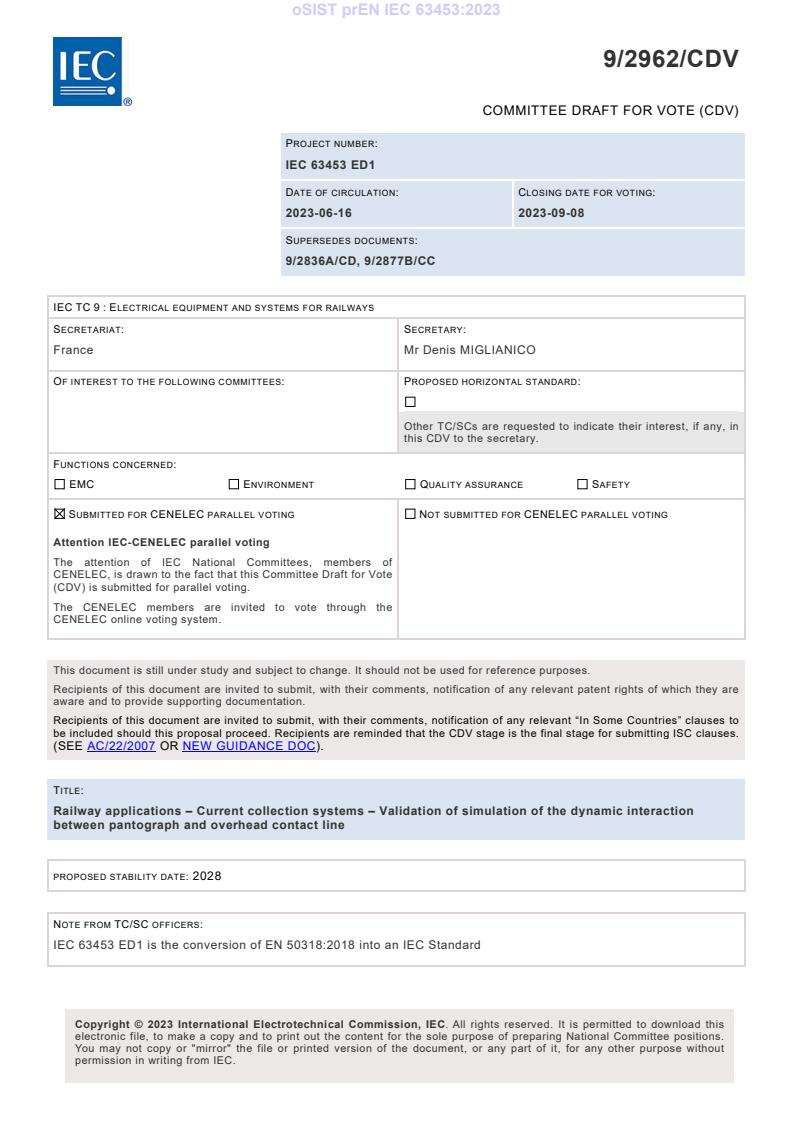
9/2962/CDV
COMMITTEE DRAFT FOR VOTE (CDV)
PROJECT NUMBER:
IEC 63453 ED1
DATE OF CIRCULATION: CLOSING DATE FOR VOTING:
2023-06-16 2023-09-08
SUPERSEDES DOCUMENTS:
9/2836A/CD, 9/2877B/CC
IEC TC 9 : ELECTRICAL EQUIPMENT AND SYSTEMS FOR RAILWAYS
SECRETARIAT: SECRETARY:
France Mr Denis MIGLIANICO
OF INTEREST TO THE FOLLOWING COMMITTEES: PROPOSED HORIZONTAL STANDARD:
Other TC/SCs are requested to indicate their interest, if any, in
this CDV to the secretary.
FUNCTIONS CONCERNED:
EMC ENVIRONMENT QUALITY ASSURANCE SAFETY
SUBMITTED FOR CENELEC PARALLEL VOTING NOT SUBMITTED FOR CENELEC PARALLEL VOTING
Attention IEC-CENELEC parallel voting
The attention of IEC National Committees, members of
CENELEC, is drawn to the fact that this Committee Draft for Vote
(CDV) is submitted for parallel voting.
The CENELEC members are invited to vote through the
CENELEC online voting system.
This document is still under study and subject to change. It should not be used for reference purposes.
Recipients of this document are invited to submit, with their comments, notification of any relevant patent rights of which they are
aware and to provide supporting documentation.
Recipients of this document are invited to submit, with their comments, notification of any relevant “In Some Countries” clauses to
be included should this proposal proceed. Recipients are reminded that the CDV stage is the final stage for submitting ISC clauses.
(SEE AC/22/2007 OR NEW GUIDANCE DOC).
TITLE:
Railway applications – Current collection systems – Validation of simulation of the dynamic interaction
between pantograph and overhead contact line
PROPOSED STABILITY DATE: 2028
NOTE FROM TC/SC OFFICERS:
IEC 63453 ED1 is the conversion of EN 50318:2018 into an IEC Standard
electronic file, to make a copy and to print out the content for the sole purpose of preparing National Committee positions.
You may not copy or "mirror" the file or printed version of the document, or any part of it, for any other purpose without
permission in writing from IEC.
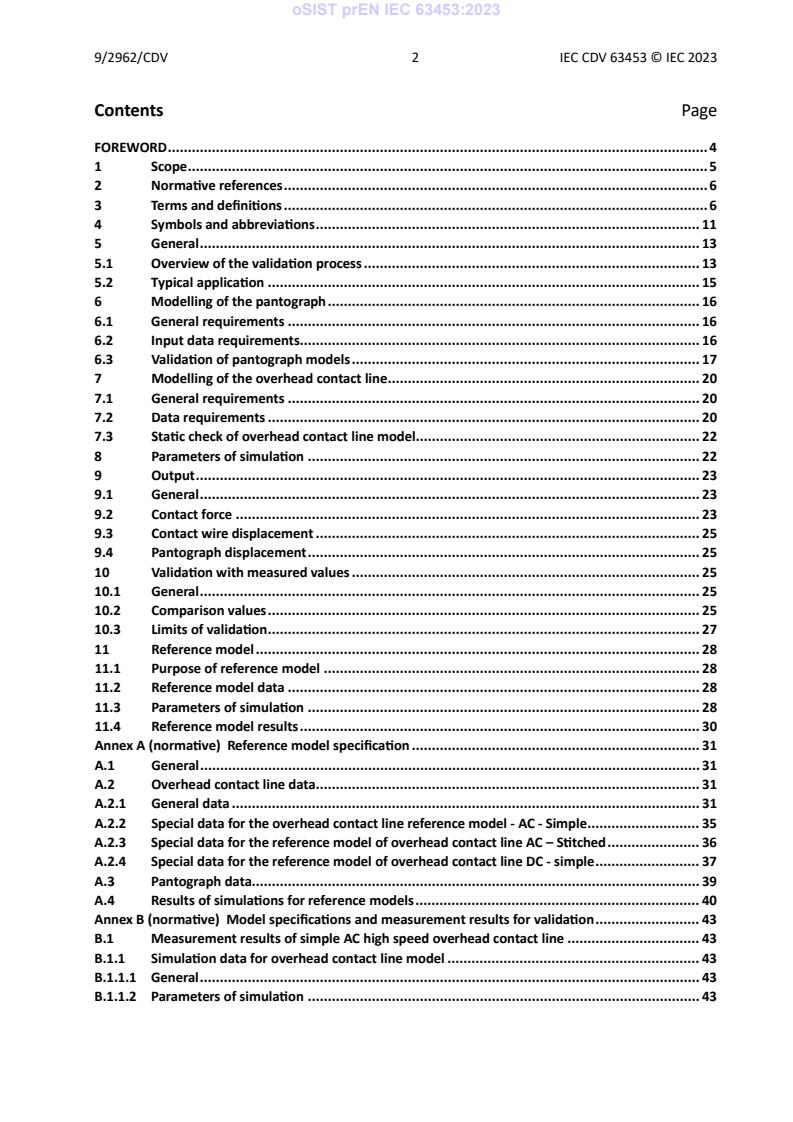
9/2962/CDV 2 IEC CDV 63453 © IEC 2023
Contents Page
FOREWORD . 4
1 Scope . 5
2 Norma�ve references . 6
3 Terms and defini�ons . 6
4 Symbols and abbrevia�ons . 11
5 General . 13
5.1 Overview of the valida�on process . 13
5.2 Typical applica�on . 15
6 Modelling of the pantograph . 16
6.1 General requirements . 16
6.2 Input data requirements. 16
6.3 Valida�on of pantograph models . 17
7 Modelling of the overhead contact line . 20
7.1 General requirements . 20
7.2 Data requirements . 20
7.3 Sta�c check of overhead contact line model . 22
8 Parameters of simula�on . 22
9 Output . 23
9.1 General . 23
9.2 Contact force . 23
9.3 Contact wire displacement . 25
9.4 Pantograph displacement . 25
10 Valida�on with measured values . 25
10.1 General . 25
10.2 Comparison values . 25
10.3 Limits of valida�on . 27
11 Reference model . 28
11.1 Purpose of reference model . 28
11.2 Reference model data . 28
11.3 Parameters of simula�on . 28
11.4 Reference model results . 30
Annex A (norma�ve) Reference model specifica�on . 31
A.1 General . 31
A.2 Overhead contact line data . 31
A.2.1 General data . 31
A.2.2 Special data for the overhead contact line reference model - AC -
Simple . 35
A.2.3 Special data for the reference model of overhead contact line AC – S�tched . 36
A.2.4 Special data for the reference model of overhead contact line DC - simple . 37
A.3 Pantograph data. 39
A.4 Results of simula�ons for reference models . 40
Annex B (norma�ve) Model specifica�ons and measurement results for valida�on . 43
B.1 Measurement results of simple AC high speed overhead contact line . 43
B.1.1 Simula�on data for overhead contact line model . 43
B.1.1.1 General . 43
B.1.1.2 Parameters of simula�on . 43
IEC CDV 63453 © IEC 2023 3 9/2962/CDV
B.1.1.3 Model parameter and mechanical data of OCL . 43
B.1.1.4 Geometrical data of overhead contact line . 45
B.1.1.5 Span defini�on . 45
B.1.1.6 Support defini�on . 46
B.1.1.7 Droppers . 50
B.1.2 Pantograph model . 56
B.1.3 Measured data of dynamic interac�on for valida�on . 57
B.2 Measurement results of a s�tched AC high speed overhead contact line . 58
B.2.1 General . 58
B.2.2 Simula�on data for overhead contact line model . 58
B.2.2.1 Parameters of simula�on . 58
B.2.2.2 Model parameter and mechanical data of OCL . 59
B.2.2.3 Geometrical data of overhead contact line . 60
B.2.2.4 Support data . 69
B.2.3 Pantograph data. 73
B.2.4 Calculated and measured data of OCL-rest posi�on for valida�on . 74
B.2.5 Measuring data of dynamic interac�on for valida�on . 75
B.3 Measurement results of simple DC high speed overhead contact line . 76
B.3.1 General . 76
B.3.2 Simula�on data for overhead contact line model . 76
B.3.2.1 Parameters of simula�on . 76
B.3.2.2 Model parameter and mechanical data of OCL . 76
B.3.2.3 Geometrical data of overhead contact line . 77
B.3.2.4 Support data . 96
B.3.3 Pantograph data. 99
B.3.4 Measured data of dynamic interac�on for valida�on . 100
Annex C (informa�ve) Assessment process example for dynamic interac�on between ‘new’ OCL
design or ‘new’ pantograph design for interoperability purpose . 101
Bibliography . 105
9/2962/CDV 4 IEC CDV 63453 © IEC 2023
Railway applications – Current collection systems –
Validation of simulation of the dynamic interaction
between pantograph and overhead contact line
FOREWORD
1) The International Electrotechnical Commission (IEC) is a worldwide organization for standardization comprising all national
electrotechnical committees (IEC National Committees). The object of IEC is to promote international co-operation on all
questions concerning standardization in the electrical and electronic fields. To this end and in addition to other activities, IEC
publishes International Standards, Technical Specifications, Technical Reports, Publicly Available Specifications (PAS) and
Guides (hereafter referred to as “IEC Publication(s)”). Their preparation is entrusted to technical committees; any IEC National
Committee interested in the subject dealt with may participate in this preparatory work. International, governmental and non-
governmental organizations liaising with the IEC also participate in this preparation. IEC collaborates closely with the
International Organization for Standardization (ISO) in accordance with conditions determined by agreement between the two
organizations.
2) The formal decisions or agreements of IEC on technical matters express, as nearly as possible, an international consensus of
opinion on the relevant subjects since each technical committee has representation from all interested IEC National
Committees.
3) IEC Publications have the form of recommendations for international use and are accepted by IEC National Committees in that
sense. While all reasonable efforts are made to ensure that the technical content of IEC Publications is accurate, IEC cannot
be held responsible for the way in which they are used or for any misinterpretation by any end user.
4) In order to promote international uniformity, IEC National Committees undertake to apply IEC Publications transparently to
the maximum extent possible in their national and regional publications. Any divergence between any IEC Publication and the
corresponding national or regional publication shall be clearly indicated in the latter.
5) IEC itself does not provide any attestation of conformity. Independent certification bodies provide conformity assessment
services and, in some areas, access to IEC marks of conformity. IEC is not responsible for any services carried out by
independent certification bodies.
6) All users should ensure that they have the latest edition of this publication.
7) No liability shall attach to IEC or its directors, employees, servants or agents including individual experts and members of its
technical committees and IEC National Committees for any personal injury, property damage or other damage of any nature
whatsoever, whether direct or indirect, or for costs (including legal fees) and expenses arising out of the publication, use of,
or reliance upon, this IEC Publication or any other IEC Publications.
8) Attention is drawn to the Normative references cited in this publication. Use of the referenced publications is indispensable
for the correct application of this publication.
9) Attention is drawn to the possibility that some of the elements of this IEC Publication may be the subject of patent rights. IEC
shall not be held responsible for identifying any or all such patent rights.
IEC 63453 has been prepared by IEC technical committee 9: Electrical equipment and systems for
railways . It is an International Standard,.
IEC CDV 63453 © IEC 2023 5 9/2962/CDV
1 1 Scope
2 Simula�on techniques are used to assess the dynamic interac�on between overhead contact lines and
3 pantographs, as part of the predic�on of current collec�on quality. This document specifies func�onal
4 requirements for the valida�on of such simula�on tools to ensure confidence in, and mutual acceptance
5 of the results of the simula�ons.
6 This document deals with:
7 – input and output parameters of the simulation;
8 – comparison with line test measurements, and the characteristics of those line tests;
9 – validation of pantograph models;
10 – comparison between different simulation tools;
11 – limits of application of validated methods to assessments of pantographs and overhead contact lines.
12 This document applies to the current collec�on from an overhead contact line by pantographs mounted
13 on railway vehicles. It does not apply to trolley bus systems.
9/2962/CDV 6 IEC CDV 63453 © IEC 2023
14 2 Normative references
15 The following documents are referred to in the text in such a way that some or all of their content
16 cons�tutes requirements of this document. For dated references, only the edi�on cited applies. For
17 undated references, the latest edi�on of the referenced document (including any amendments) applies.
18 IEC 60913:2013, Railway applications — Fixed installations — Electric traction overhead contact lines
19 IEC 60494-1:2013, Railway applications — Rolling stock — Pantographs - Characteristics and tests —
20 Part 1: Pantographs for main line vehicles
21 IEC 62846:2016, Railway applications —Current collection systems — Requirements for and validation of
22 measurements of the dynamic interaction between pantograph and overhead contact line
23 IEC 62486:2017, Railway applications — Current collection systems — Technical criteria for the interaction
24 between pantograph and overhead contact line (to achieve free access)
25 3 Terms and definitions
26 For the purpose of this document, the following terms and defini�ons apply.
27 ISO and IEC maintain terminology databases for use in standardiza�on at the following addresses:
28 • IEC Electropedia: available at http://www.electropedia.org/
29 • ISO Online browsing platform: available at http://www.iso.org/obp
30 3.1
31 contact point
32 location of mechanical contact between a pantograph contact strip and a contact wire
IEC CDV 63453 © IEC 2023 7 9/2962/CDV
33 3.2
34 contact force
35 vertical force applied by a pantograph to the overhead contact line
36 Note 1 to entry: The contact force is the sum of forces of all contact points of one pantograph.
37 3.3
38 static contact force
39 vertical force exerted upward by the collector head on the overhead contact line system at standstill
40 [SOURCE: IEC 60494-1:2013, 3.3.5]
41 3.4
42 aerodynamic force
43 additional vertical force applied by the pantograph as a result of air flow around the pantograph assembly
44 3.5
45 mean contact force
46 statistical mean value of the contact force
47 Note 1 to entry: Fm is formed by the static and aerodynamic components of the pantograph contact force.
48 [SOURCE: IEC 62486:2017, 3.11]
49 3.6
50 standard deviation
51 square root of the sum of the squared sample variance divided by the number of output values minus 1
52 3.7
53 skewness
54 parameter that quantifies the symmetry of the shape of a data distribution
FF−
( )
m
∑
n
55 (1)
sk =
FF−
( )
m
∑
n
56 3.8
57 excess of kurtosis
58 parameter that quantifies whether the shape of the data distribution matches the Gaussian distribution
FF−
( )
m
∑
n
ek − 3
59 (2)
FF−
( )
m
∑
n
60 3.9
61 minimum of contact force
62 minimum value of the contact force while the pantograph passes over the analysis section
=
9/2962/CDV 8 IEC CDV 63453 © IEC 2023
63 3.10
64 maximum of contact force
65 maximum value of the contact force while the pantograph passes over the analysis section
66 3.11
67 contact loss
68 condition where the contact force is zero
69 Note 1 to entry: Contact loss surely induces arcing except in the case of coasting. However, if two or more pantographs
70 are connected electrically each other, arc will immediately disappear and then the condition will shift to ‘current loss’.
71 [SOURCE: IEC 62486:2017, 3.22]
72 3.12
73 simulation method
74 numerical method that uses a fixed set of input parameters describing a system (e.g. pantograph/overhead
75 contact line system) to calculate a set of output values representative of the dynamic behaviour of this
76 system
77 3.13
78 simulation tool
79 software implementing (a) simulation method(s)
80 3.14
81 pantograph model
82 mathematical model in a one- or more-dimensional geometry describing the dynamic characteristics of the
83 pantograph
84 3.15
85 mass – spring – damper – model
86 lumped parameter model
87 method representing a dynamic mechanical system (e.g. pantograph) as a series of discrete concentrated
88 masses connected together by spring and damper elements
89 3.16
90 transfer function
91 ratio of an applied input on pantograph head to the response of the pantograph, depending on frequency
92 3.17
93 apparent mass
94 transfer function describing the relation between applied contact force and resulting acceleration at the
95 contact point for the frequency range of interest
96 3.18
97 hardware in the loop
98 hybrid simulation/test rig measuring method, where a real pantograph responds interacting with a
99 simulation model of the overhead contact line
100 3.19
101 multi-body model
102 method representing a dynamic mechanical system (e.g. pantograph) based on interconnected rigid or
103 flexible bodies
IEC CDV 63453 © IEC 2023 9 9/2962/CDV
104 3.20
105 collector head
106 pantograph head
107 part of the pantograph supported by the frame which includes contact strips, horns and can include a
108 suspension
109 [SOURCE: IEC 60494-1:2013, 3.2.3, modified – the term "pantograph head" has been added.]
110 3.21
111 overhead contact line model
112 mathematical model in a two- or three-dimensional geometry describing the characteristics of an overhead
113 contact line for interaction with pantographs
114 3.22
115 wave propagation velocity
116 speed of a transversal wave, which runs along the contact wire
117 3.23
118 contact wire height at rest position
119 distance from the top of the rail (or road surface for overhead contact line system for trolleybus applications)
120 to the lower face of the contact wire, measured perpendicular to the track
121 Note 1 to entry: The contact wire height is measured perpendicular to the track or road surface.
9/2962/CDV 10 IEC CDV 63453 © IEC 2023
122 3.24
123 maximum uplift at the support
124 maximum value of the vertical uplift of the contact wire at a support
125 3.25
126 analysis section
127 subset of the total overhead contact line model length over which the simulation will be evaluated
128 3.26
129 frequency range of interest
130 frequency range within which the dynamic performance of the overhead contact line – pantograph system
131 is considered
132 Note 1 to entry: For validation with measurements this range correlates with the frequency range defined in IEC
133 62846.
134 3.27
135 dynamic interaction
136 behaviour between pantograph(s) and overhead contact line when in contact, described by contact forces
137 and vertical displacements of contact point(s)
138 3.28
139 frequency band analysis
140 analysis inside a frequency range of interest using subranges of frequencies to study special topics
141 3.29
142 elasticity of overhead contact line
143 uplift divided by the force applied to the contact wire in a static state
144 3.30
145 range of vertical position of the point of contact
146 difference between maximum and minimum dynamic height of the contact point, relative to the track, during
147 dynamic interaction between the pantograph and the contact wire
148 3.31
149 operation height
150 vertical distance between actual operating position of the pantograph and pantographs housed height
151 3.32
152 active pantograph
153 pantograph fited with any type of ac�ve control system which enhances or alters its dynamic response
IEC CDV 63453 © IEC 2023 11 9/2962/CDV
156 4 Symbols and abbreviations
157 For the purpose of this document, the following symbols and abbrevia�ons apply.
Abbreviations:
CT centre of the track
CW contact wire
CWH contact wire height
FFT fast Fourier transformation
HIL hardware in the loop
MT mast type
MW messenger wire
Mxx support or mast number
OCL overhead contact line
ROCL rigid overhead contact line
SDx number of dropper to stitch wire
STx span type number as reference to Figure Span number
SW stitch wire
9/2962/CDV 12 IEC CDV 63453 © IEC 2023
Symbols:
a measured vertical acceleration at the contact point
cp,meas
a simulated vertical acceleration at the contact point
cp,model
C structural damping matrix
s
c damping of element n
n
Dx dropper number
E modulus of elasticity
e elasticity of overhead contact line
ek excess of kurtosis of contact force
F contact force
F measured vertical force applied at the contact point
applied,meas
F simulated vertical force applied at the contact point
applied,model
F mean contact force
m
Fsa lateral force at steady arm
f actual frequency
i
f maximum frequency
n
f minimum frequency
K stiffness matrix
k stiffness of element n
n
Ldr dropper length
Lx dropper length (for CW no. x)
dr
Lsa length of steady arm
M mass matrix
m measured apparent mass
app,meas
m apparent mass of the model
app,model
mn mass of element n
Q accuracy of the pantograph simulation model
sk skewness of contact force
X distance between left mast and dropper no. x
α, β proportional damping coefficients
σ standard deviation of contact force
IEC CDV 63453 © IEC 2023 13 9/2962/CDV
160 5 General
161 5.1 Overview of the validation process
162 The theore�cal study of the dynamic interac�on between pantograph and overhead contact line by
163 computer simula�on makes it possible to obtain much informa�on about the system and to minimize
164 the costs of line tests.
165 To be used with confidence the simula�on tool shall be validated. The valida�on for a simula�on tool
166 shall be done in a process described in Figure 1.
167 A simula�on tool validated according to this standard, shall be considered for applica�on to overhead
168 contact line/pantograph combina�ons and condi�ons only within the limits of validity defined in 10.3.
169 A new valida�on shall be made when the condi�ons to apply simula�on are outside the limita�ons
170 defined in 10.3 for exis�ng valida�ons.
171 The valida�on for a simula�on tool shall be done with the steps which are shown in Figure 1. The steps
172 are:
173 1) A first validation step shall be done by a “desktop assessment” in accordance to Clause 11. The most
174 relevant reference model data shall be chosen from the reference models in Annex A for the conditions
175 for which validation is required.
176 NOTE This desktop assessment will improve the confidence in the simulation tool. As Annex A cannot cover all
177 possible solutions and combinations a choice from this subset is necessary.
178 For validation of simulation tools implemented for new technologies in ways that are totally different
179 from the current state of the art, and which are not able to use models with the data according to
180 Annex A, the “desktop assessment” may be omitted.
181 NOTE Typically, all simulation tools for OCL from type “Flexible overhead contact line” according to IEC 60913 can use
182 models with data according to Annex A.
183 2) The final assessment shall be done by a “Line Test Data Validation” based on test results according
184 to 10.1 to demonstrate the accuracy of simulation according to 10.2.
185 Annex B provides data sets from line test measurements in accordance with IEC62846 to allow for a
186 validation for a given model within the limitations according to 10.3.
187 If the accuracy according to either 10.2 or to 11.4 cannot be achieved, then the simula�on tool shall be
188 improved according to 6.3 for pantograph model adjustments and according to 7.3 for overhead contact
189 line model before revalida�on.
9/2962/CDV 14 IEC CDV 63453 © IEC 2023
Start validation
process
Has the simulation method been
validated against this version of IEC 63453
with the requested conditions from 10.3?
No
Is the simulation tool usable for
„Flexible overhead contact line“ acc. IEC 60913?
Yes
Perform validation against the
most suitable reference model
according to 11
Do the simulation results fall
No
within the acceptable limits of the
No
reference model according to 11.4?
Yes
Yes
Perform validation against
measured line test data
according to 10.1
Are the conditions from 10.2 fulfilled? No
Yes
Validated for
Improve simulation
conditions specified
method utilising 6.3 and 7.3
according to 10.3
and restart validation
191 Figure 1 — Evaluation process
IEC CDV 63453 © IEC 2023 15 9/2962/CDV
192 5.2 Typical application
193 The main purpose of the applica�on of this standard is to inform the process for seeking authoriza�on
194 for an OCL or pantograph design in the context of dynamic interac�on.
195 Annex C shows examples for an assessment process of the elements OCL and pantograph, using
196 simula�on of interac�on in the framework of interoperability.
197 NOTE 1 Examples in Annex C are derived from the authorization process used in Europe for information
198 NOTE 2 Other applications, not related to authorizations (e.g., research, technical development, etc), can require a
199 different process.
9/2962/CDV 16 IEC CDV 63453 © IEC 2023
201 6 Modelling of the pantograph
202 6.1 General requirements
203 A pantograph model shall describe the dynamic characteris�cs of a pantograph, regarding interac�on
204 with overhead contact lines, in the frequency range of interest.
205 Commonly used pantograph models are:
206 – mass – spring – damper – models (lumped parameter models);
207 – transfer function models;
208 – multi-body models;
209 – physical pantographs, when hardware in the loop (HIL) is adopted.
210 The pantograph may be modelled with one or more dimensional geometry, depending on the
211 phenomena to be inves�gated.
212 For the modelling of ac�ve pantographs, the characteris�cs of control and the dynamic characteris�cs
213 shall be available.
214 Aerodynamic effects on the pantograph shall as a minimum be considered by adjus�ng the mean contact
215 force as a func�on of speed.
216 6.2 Input data requirements
217 6.2.1 General
218 Depending on the modelling method and the individual pantograph characteris�cs, the relevant
219 parameters appropriate to fully describe the pantograph shall be available for simula�on.
220 These parameters shall take into account other dependencies (opera�on height, contact wire height,
221 stagger, nonlineari�es, frequency), as required.
222 Common parameters of pantographs are:
223 – kinematics;
224 – transfer function;
225 – natural frequencies;
226 – mass distribution;
227 – degree of freedom of joints;
228 – damping characteristics;
229 – spring characteristics;
230 – friction values;
231 – stiffness;
232 – bump stops;
233 – location of application of the static contact force;
234 – location of application of the aerodynamic forces.
IEC CDV 63453 © IEC 2023 17 9/2962/CDV
235 NOTE Aerodynamic forces usually depend on the running direction of the pantograph, operation height, contact
236 wire height and position of the pantograph and the type of train and the line conditions as open section/tunnel section.
237 6.2.2 Mass – spring – damper – models (lumped parameter models)
238 For mass – spring – damper – models (lumped parameter models), the following input is required:
239 – mass values of discrete mass element(s);
240 – stiffness characteristics of joints connecting the discrete masses, including any nonlinearity (if
241 applicable);
242 – damping characteristics of joints connecting the discrete masses, including any nonlinearity (if
243 applicable);
244 – friction values (if applicable);
245 – bump stops (if applicable).
246 NOTE The number of mass elements needs to be in line with the degree of freedom of the system in the frequency range of interest
248 6.2.3 Multi-body models
249 For mul�-body models, the input set out in 6.2.2 and the following addi�onal input is required:
250 – definition of all parts of the model including mass distributions, inertia characteristics, flexibility (if
251 applicable);
252 – kinematics, describing transmission of movements, kinds of joints and their position and limitations (if
253 applicable);
254 – internal forces applied to the system and their application points for springs, dampers and friction
255 elements.
256 6.2.4 Transfer function models
257 For transfer func�on models the following input is required:
258 – an analytical definition of the Laplace transform function, e.g. zeros and poles affecting the behavior
259 in the frequency range of interest, between the vertical displacement of the contact point and the
260 contact force.
261 6.2.5 Hardware in the loop
262 Hardware in the loop uses the pantograph in its final configura�on on the test rig. Aerodynamic effects
263 shall be implemented as an adjusted sta�c contact force.
264 6.3 Validation of pantograph models
265 The valida�on of the pantograph models shall be carried out by comparison of the dynamic proper�es of
266 the pantograph model with those of the real pantograph as measured with a pantograph test rig. The
267 comparison shall be carried out using the same principle as used in the procedure “Calibra�on of the
268 measurement system” defined in IEC 62846:2016, 7.5.
9/2962/CDV 18 IEC CDV 63453 © IEC 2023
269 The test shall be carried out with the pantograph of interest and with its extension at a typical height
270 inside 20 % to 80 % of the working range, as defined in IEC 60494-1. The force shall be applied centrally
271 to the pantograph head.
272 The results are usable for 20 % to 80 % of the pantograph working range. Values outside this range
273 require addi�onal inves�ga�ons.
274 This test shall be carried out at the predicted mean contact force appropriate to the maximum design
275 speed for the pantograph. The mean contact force shall fulfil the requirements of IEC 62486:2017, 7.3,
276 Table 6 for the designated speed.
277 Measurements of the applied ver�cal force (F ) and the resul�ng ver�cal accelera�on at the contact
applied
278 point (a ) shall be taken applying sinusoidal excita�ons for the frequency range of interest in suitable
cp
279 steps. For comparison and valida�on purposes the excita�on shall be from 0,5 Hz up to 20 Hz in 0,5 Hz
280 steps.
281 The intervals may be reduced at resonant frequencies.
282 The amplitude of excita�on shall be high enough to overcome the sta�c fric�on in the pantograph.
283 NOTE 1 A range of amplitude of the greater between ± 15 % of the mean contact force and ± 20 N usually gives
284 representative results.
285 Based on the measurements of the applied force and the accelera�on at the contact point, the
286 measured apparent mass (m ) in kilograms shall be determined for the frequency range of interest:
app,meas
F
applied,meas
m =
287 (3)
app.meas
a
head,meas
288 The apparent mass of the simula�on model shall be determined in the same way as for the test rig
289 measurement based on the values for applied force and resul�ng accelera�on at the contact point
290 iden�fied in the simula�on environment:
F
applied,model
m =
291 (4)
app.model
a
head,model
292 The apparent mass of the pantograph model (m ) shall be calculated in kilograms using the same
app,model
293 frequencies in the same frequency range as the measurements.
294 The accuracy (Q) of the pantograph simula�on model shall be calculated by using the following formula
295 based on the magnitudes of the apparent mass:
n−1
log mapp,,model i
Q=1− ff−−1 100%
296 (5)
( )
ii+1
∑
ff−
log mapp,,meas i
n 1
i=1
297 For the calcula�on of Q frequencies with measured apparent mass below 2 kg shall be excluded.
298 NOTE 2 The limit of 2 kg is defined to avoid the denominator approaching zero.
299 The accuracy Q of the simula�on model shall be greater than 90 % for the whole frequency range 0,5 Hz
300 to 20 Hz and for the band 0,5 Hz to 5 Hz.
IEC CDV 63453 © IEC 2023 19 9/2962/CDV
301 NOTE 3 The accuracy value Q quantifies the differences between test rig measurements and pantograph model in
302 the shape of the logarithmic curves used to represent the apparent mass. This value does not describe an absolute
303 accuracy.
304 Any change in a pantograph component directly connected to a model parameter shall be accepted
305 without requiring a new valida�on of the pantograph model. New valida�on of the pantograph model is
306 necessary for all other changes.
307 NOTE 4 A pantograph head, for example, is in a lumped mass model a component directly connected to a model
308 parameter, if it is entirely described by m3 and k3 in a model as per figure A4.
309 A comparison between different pantograph models for the same pantograph may be performed by
310 comparing the transfer func�on calculated from the different models.
9/2962/CDV 20 IEC CDV 63453 © IEC 2023
311 7 Modelling of the overhead contact line
312 7.1 General requirements
313 The model of the overhead contact line shall describe the dynamic characteris�cs, regarding interac�on
314 with pantographs, in the frequency range of interest.
315 The overhead contact line may be modelled with two- or three-dimensional geometry, depending on the
316 phenomena to be inves�gated.
317 Rigid Overhead Contact Lines (ROCL) has very small ver�cal displacements in opera�on. The valida�on of
318 these models and interac�on simula�ons is only possible for the contact force in direct comparison with
319 the measured results.
320 NOTE The displacement of a rigid overhead contact line during operation is currently not measured with
321 acceptable accuracy.
322 7.2 Data requirements
323 The length of overhead contact line model shall be greater than the analysis sec�on, so that the passage
324 of the pantographs is not influenced by ini�al transients and end effects of the model. To inves�gate
325 special sec�ons of overhead contact line (e.g. overhead contact line over turnouts, etc) the length of
326 analysis sec�on may be reduced. Depending on the modelling method and the individual overhead
327 contact line characteris�cs, the relevant geometrical and mechanical parameters of the overhead
328 contact line shall be available for simula�on:
329 – length of each span;
330 – position of droppers;
331 – contact wire height at rest position (sag, dropper length, wire gradients);
332 – encumbrance at the supports;
333 – geometry and mass distribution of steady arms;
334 – stagger and offset of all wires;
335 – number and types of wires (contact wire, messenger wire, auxiliary messenger wire, stitch wire,
336 droppers, etc);
337 – mass per unit length of each wire or density and cross-section;
338 – mechanical tension of wires. Where the tension depends on temperature, this relationship shall be
339 specified;
340 – section properties and stiffness for the beams of rigid overhead contact line;
341 – mass of links between wires and droppers (clamps);
342 – the mechanical characteristics of the supports and structures;
343 – the stiffness characteristic of droppers;
344 – damping of all components of the overhead contact line or a damping rate of the system, if available.
IEC CDV 63453 © IEC 2023 21 9/2962/CDV
345 NOTE Typical damping rates (ratio of damping vs. critical damping) of overhead contact lines are between 0,05 %
346 and 0,2 %.
9/2962/CDV 22 IEC CDV 63453 © IEC 2023
347 7.3 Static check of overhead contact line model
348 The usability of the overhead contact line model shall be checked by comparing the results of a sta�c
349 behaviour calculated with this model with measurements or design calcula�ons.
350 The outcome of the calcula�on based on the overhead contact line model in the sta�c condi�on needs
351 to be evaluated to validate the implemented numerical calcula�ons in the addressed simula�on tool.
352 The following results shall be extracted to evaluate the method:
353 – static position of the contact wire at each dropper and at the steady arm;
354 – elasticity of overhead contact line at the same points;
355 – dropper length.
356 The numerical results shall be compared to reference results from Annex A, from Annex B, from
357 measurements or from design calcula�ons.
358 Those results shall be compared to the numerical model for one span which shall remain within the
359 accuracy limits given in table 1.
360 Table 1 — Required accuracy of simulated static values
Parameter Required accuracy
Contact wire position ±5 mm
±0,1 mm/N or ± 10 % whichever
Elasticity
is greater
Dropper length ±10 mm
362 NOTE 1 The values in Table 1 are not applicable to rigid overhead contact line.
363 NOTE 2 The ranges for deviation of elasticity is to cover overhead contact lines with high and low tension forces.
364 This valida�on shall be renewed if the parameters of the overhead contact line differ more than the
365 limita�ons given in 10.3.3.
366 8 Parameters of simulation
367 The parameters of the pantograph and overhead contact line shall be given according to Clauses 6 and
368 7.
369 Depending on the modelling method and the problem to be inves�gated by simula�on, the relevant
370 parameters appropriate to fully describe the simula�on shall be available.
371 Common parameters of simula�ons are:
372 – train speed;
373 – analysis section;
374 The analysis section shall consist of those parts of the overhead contact line model over which the
375 passage of the pantographs is not influenced by initial transients and end effects of the model.
376 Depending on the phenomena to be studied, the analysis section should be defined accordingly. For
377 validation purposes see Clause 10 and for the reference models see Clause 11.
IEC CDV 63453 © IEC 2023 23 9/2962/CDV
378 – number of and distances between pantographs;
379 – static contact force of each pantograph;
380 – aerodynamic effects on each pantograph, taking into account the pantograph orientation;
381 NOTE Aerodynamic effects ca
...