

SIST EN IEC 61952-1:2019
(Main)Insulators for overhead lines - Composite line post insulators for AC systems with a nominal voltage greater than 1 000 V - Part 1: definitions, end fittings and designations (IEC 61952-1:2019)
General Information
- Abstract
This part of IEC 61952 is applicable to composite line post insulators for AC overhead lines with a nominal voltage greater than 1 000 V and a frequency not greater than 100 Hz. It also applies to line post insulators of similar design used in substations or on electric traction lines.
This document applies to line post insulators of composite type, generally with metallic couplings, with and without a base plate. It also applies to such insulators when used in complex structures. It does not apply to hollow insulators adapted for use as line post insulators.
The object of this document is to specify the main dimensions of the couplings to be used on the composite line post insulators in order to permit the assembly of insulators or fittings supplied by different manufacturers and to allow, whenever practical, interchangeability with existing installations.
It also specifies a standard designation system for composite line post insulators.
- Status
- Published
- Publication Date
- 20-Oct-2019
- Technical Committee
- IZL - Insulators
- Current Stage
- 6100 - Translation of adopted SIST standards (Adopted Project)
- Start Date
- 09-Aug-2024
- Due Date
- 08-Aug-2025
- Completion Date
- 15-Apr-2026
Buy Documents



Overview
EN IEC 61952-1:2019 specifies definitions, end fittings and designation rules for composite line post insulators used on AC overhead lines with a nominal voltage greater than 1 000 V (frequency ≤ 100 Hz). Published by CLC/CENELEC and identical to IEC 61952-1:2019, the standard focuses on composite (non-hollow) line post insulators, typically with metallic couplings, with or without base plates, and when used in complex structures or substations and electric traction lines. Its primary objective is to standardize coupling dimensions and a designation system so insulators and fittings from different manufacturers are compatible and, where practical, interchangeable with existing installations.
Key topics and requirements
- Scope and applicability: Composite line post insulators for AC systems > 1 000 V; excludes hollow insulators adapted as line posts.
- Main specified characteristics:
- Maximum Design Cantilever Load (MDCL) - the ultimate limit load where core damage begins (manufacturer specifies direction and value).
- Minimum Lightning Impulse Withstand Voltage (BIL) - defined impulse parameters for dielectric performance.
- Standard coupling codes and standard base-plate codes - main dimensions and types to enable assembly across manufacturers.
- Terms & definitions: line end fitting, base end fitting, coupling, core diameter, reference cantilever load (RCL) and others aligned with IEC vocabulary.
- Mechanical, dimensional and electrical characteristics: guidance on interchangeability, plus notes that additional mechanical properties (tensile, torsion) may be required by specific applications.
- Designation and marking: standardized naming and marking conventions to identify insulator characteristics and couplings.
- Normative references: includes IEC 60050-471 (vocabulary), IEC 60071-1 (insulation coordination) and earlier IEC 61952 editions.
Applications and users
- Transmission and distribution utilities specifying or replacing line post insulators on overhead lines.
- Insulator manufacturers designing composite line post insulators and end fittings to standardized coupling and base-plate dimensions.
- Substation and traction system designers selecting compatible insulators for equipment mounting.
- Procurement, testing laboratories and certification bodies ensuring conformity, interchangeability and correct designation.
- Practical benefits include simplified procurement, reduced retrofit costs, interoperability between suppliers, and clearer engineering documentation.
Related standards
- IEC 61952 (earlier edition) - broader tests and acceptance criteria for composite line post insulators.
- IEC 60050-471 - Electropedia vocabulary for insulator terms.
- IEC 60071-1 - insulation coordination principles.
Keywords: EN IEC 61952-1:2019, composite line post insulators, overhead lines, couplings, MDCL, BIL, interchangeability, designation system, base plate.
Relations
- Effective Date
- 20-Feb-2026
- Effective Date
- 03-Feb-2026
- Refers
SIST EN IEC 60071-1:2021 - Insulation co-ordination - Part 1: Definitions, principles and rules - Effective Date
- 03-Feb-2026
- Effective Date
- 24-Jan-2017
Buy Documents
Get Certified
Connect with accredited certification bodies for this standard

IMQ S.p.A. (Certification)
Italian electrical product certification.

SLG Prüf- und Zertifizierungs GmbH
German testing and certification body.

UL Solutions
Global safety science company with testing, inspection and certification.
Sponsored listings
Frequently Asked Questions
SIST EN IEC 61952-1:2019 is a standard published by the Slovenian Institute for Standardization (SIST). Its full title is "Insulators for overhead lines - Composite line post insulators for AC systems with a nominal voltage greater than 1 000 V - Part 1: definitions, end fittings and designations (IEC 61952-1:2019)". This standard covers: This part of IEC 61952 is applicable to composite line post insulators for AC overhead lines with a nominal voltage greater than 1 000 V and a frequency not greater than 100 Hz. It also applies to line post insulators of similar design used in substations or on electric traction lines. This document applies to line post insulators of composite type, generally with metallic couplings, with and without a base plate. It also applies to such insulators when used in complex structures. It does not apply to hollow insulators adapted for use as line post insulators. The object of this document is to specify the main dimensions of the couplings to be used on the composite line post insulators in order to permit the assembly of insulators or fittings supplied by different manufacturers and to allow, whenever practical, interchangeability with existing installations. It also specifies a standard designation system for composite line post insulators.
This part of IEC 61952 is applicable to composite line post insulators for AC overhead lines with a nominal voltage greater than 1 000 V and a frequency not greater than 100 Hz. It also applies to line post insulators of similar design used in substations or on electric traction lines. This document applies to line post insulators of composite type, generally with metallic couplings, with and without a base plate. It also applies to such insulators when used in complex structures. It does not apply to hollow insulators adapted for use as line post insulators. The object of this document is to specify the main dimensions of the couplings to be used on the composite line post insulators in order to permit the assembly of insulators or fittings supplied by different manufacturers and to allow, whenever practical, interchangeability with existing installations. It also specifies a standard designation system for composite line post insulators.
SIST EN IEC 61952-1:2019 is classified under the following ICS (International Classification for Standards) categories: 29.080.10 - Insulators; 29.240.20 - Power transmission and distribution lines. The ICS classification helps identify the subject area and facilitates finding related standards.
SIST EN IEC 61952-1:2019 has the following relationships with other standards: It is inter standard links to SIST IEC 60050-471:2017, SIST EN 61952:2008, SIST EN IEC 60071-1:2021, SIST EN 61952:2008. Understanding these relationships helps ensure you are using the most current and applicable version of the standard.
SIST EN IEC 61952-1:2019 is available in PDF format for immediate download after purchase. The document can be added to your cart and obtained through the secure checkout process. Digital delivery ensures instant access to the complete standard document.
Standards Content (Sample)
SLOVENSKI STANDARD
01-december-2019
Izolatorji za nadzemne vode - Kompozitni linijski podporni izolatorji za izmenične
sisteme z nazivno napetostjo nad 1000 V - 1. del: Definicije, končni priključki in
označevanje (IEC 61952-1:2019)
Insulators for overhead lines - Composite line post insulators for AC systems with a
nominal voltage greater than 1 000 V - Part 1: definitions, end fittings and designations
(IEC 61952-1:2019)
Isolatoren für Freileitungen - Verbund-Freileitungsstützer für Wechselstromsysteme mit
einer Nennspannung über 1 000 V - Teil 1: Begriffe, Endarmaturen und Bezeichnungen
(IEC 61952-1:2019)
Isolateurs pour lignes aériennes - Isolateurs composites rigides à socle pour systèmes à
courant alternatif de tension nominale supérieure à 1 000 V - Partie 1 : définitions, des
armatures d'extrémité et désignations (IEC 61952-1:2019)
Ta slovenski standard je istoveten z: EN IEC 61952-1:2019
ICS:
29.080.10 Izolatorji Insulators
29.240.20 Daljnovodi Power transmission and
distribution lines
2003-01.Slovenski inštitut za standardizacijo. Razmnoževanje celote ali delov tega standarda ni dovoljeno.
EUROPEAN STANDARD EN IEC 61952-1
NORME EUROPÉENNE
EUROPÄISCHE NORM
June 2019
ICS 29.080.10; 29.240.20
English Version
Insulators for overhead lines - Composite line post insulators for
AC systems with a nominal voltage greater than 1 000 V - Part 1:
definitions, end fittings and designations
(IEC 61952-1:2019)
Isolateurs pour lignes aériennes - Isolateurs composites Isolatoren für Freileitungen - Verbund-Freileitungsstützer für
rigides à socle pour systèmes à courant alternatif de Wechselstromsysteme mit einer Nennspannung über 1 000
tension nominale supérieure à 1 000 V - Partie 1 : V - Teil 1: Begriffe, Endarmaturen und Bezeichnungen
définitions, des armatures d'extrémité et désignations (IEC 61952-1:2019)
(IEC 61952-1:2019)
This European Standard was approved by CENELEC on 2019-05-09. CENELEC members are bound to comply with the CEN/CENELEC
Internal Regulations which stipulate the conditions for giving this European Standard the status of a national standard without any alteration.
Up-to-date lists and bibliographical references concerning such national standards may be obtained on application to the CEN-CENELEC
Management Centre or to any CENELEC member.
This European Standard exists in three official versions (English, French, German). A version in any other language made by translation
under the responsibility of a CENELEC member into its own language and notified to the CEN-CENELEC Management Centre has the
same status as the official versions.
CENELEC members are the national electrotechnical committees of Austria, Belgium, Bulgaria, Croatia, Cyprus, the Czech Republic,
Denmark, Estonia, Finland, Former Yugoslav Republic of Macedonia, France, Germany, Greece, Hungary, Iceland, Ireland, Italy, Latvia,
Lithuania, Luxembourg, Malta, the Netherlands, Norway, Poland, Portugal, Romania, Serbia, Slovakia, Slovenia, Spain, Sweden,
Switzerland, Turkey and the United Kingdom.
European Committee for Electrotechnical Standardization
Comité Européen de Normalisation Electrotechnique
Europäisches Komitee für Elektrotechnische Normung
CEN-CENELEC Management Centre: Rue de la Science 23, B-1040 Brussels
© 2019 CENELEC All rights of exploitation in any form and by any means reserved worldwide for CENELEC Members.
Ref. No. EN IEC 61952-1:2019 E
European foreword
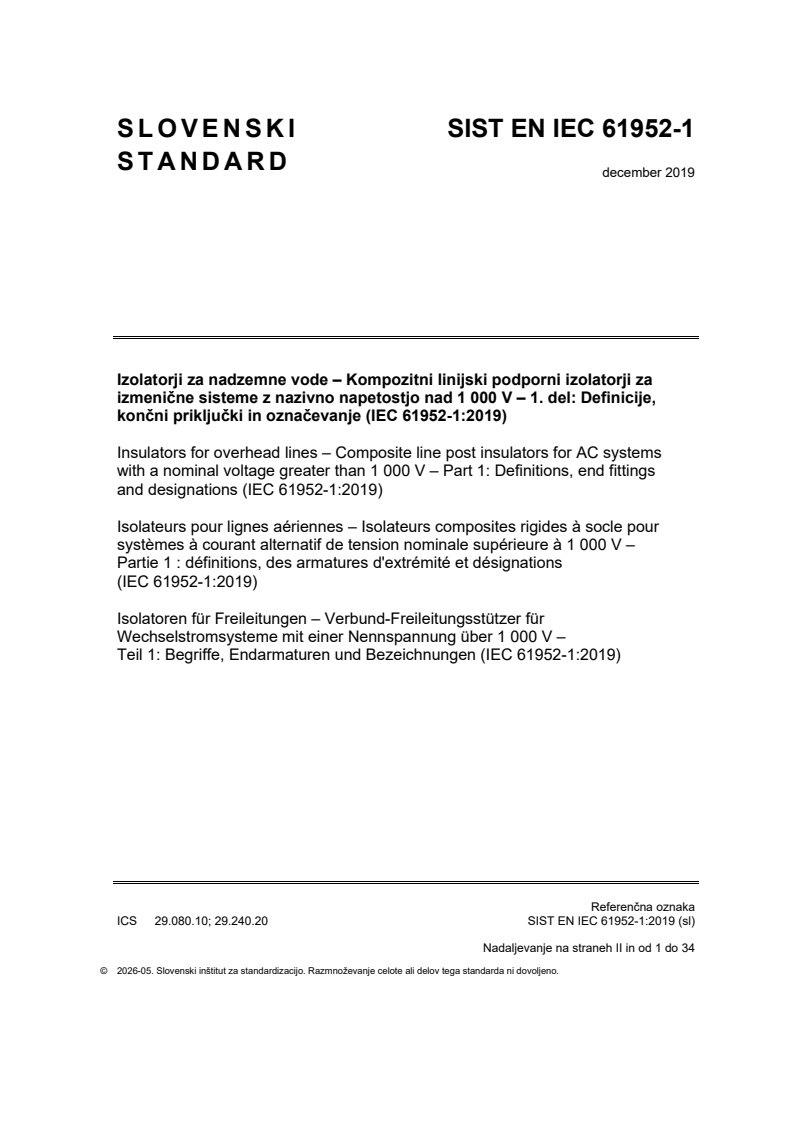
The text of document 36/435/FDIS, future edition 1 of IEC 61952-1, prepared by IEC/TC 36
"Insulators" was submitted to the IEC-CENELEC parallel vote and approved by CENELEC as
The following dates are fixed:
• latest date by which the document has to be implemented at national (dop) 2020-02-09
level by publication of an identical national standard or by endorsement
• latest date by which the national standards conflicting with the (dow) 2022-05-09
document have to be withdrawn
Attention is drawn to the possibility that some of the elements of this document may be the subject of
patent rights. CENELEC shall not be held responsible for identifying any or all such patent rights.
Endorsement notice
The text of the International Standard IEC 61952-1:2019 was approved by CENELEC as a European
Standard without any modification.
Annex ZA
(normative)
Normative references to international publications
with their corresponding European publications
The following documents are referred to in the text in such a way that some or all of their content
constitutes requirements of this document. For dated references, only the edition cited applies. For
undated references, the latest edition of the referenced document (including any amendments)
applies.
NOTE 1 Where an International Publication has been modified by common modifications, indicated by (mod), the relevant
EN/HD applies.
NOTE 2 Up-to-date information on the latest versions of the European Standards listed in this annex is available here:
www.cenelec.eu.
Publication Year Title EN/HD Year
IEC 60050-471 - International Electrotechnical Vocabulary - Part 471: - -
Insulators
IEC 60071-1 - Insulation co-ordination - Part 1: Definitions, EN 60071-1 -
principles and rules
IEC 61952 2008 Insulators for overhead lines - Composite line post EN 61952 2008
insulators for A.C. systems with a nominal voltage
greater than 1 000 V - Definitions, test methods and
acceptance criteria
IEC 61952-1 ®
Edition 1.0 2019-04
INTERNATIONAL
STANDARD
Insulators for overhead lines – Composite line post insulators for AC systems
with a nominal voltage greater than 1 000 V –
Part 1: definitions, end fittings and designations
INTERNATIONAL
ELECTROTECHNICAL
COMMISSION
ICS 29.080.10; 29.240.20 ISBN 978-2-8322-6511-6
– 2 – IEC 61952-1:2019 © IEC 2019
CONTENTS
FOREWORD . 3
INTRODUCTION . 5
1 Scope . 6
2 Normative references . 6
3 Terms and definitions . 6
4 Mechanical, dimensional and electrical characteristics . 7
Characteristics . 7
Maximum design cantilever load (MDCL) and specified cantilever load (SCL) . 8
Minimum lightning impulse withstand voltage class (BIL) . 8
Standard coupling codes . 8
Standard base-plate codes . 18
5 Line post insulator designation . 22
6 Marking . 23
Bibliography . 32
Table 1 – Types of couplings . 9
Table 2 – Types of base plates . 19
Table 3 – Designation and characteristic of composite Line post insulators (IEC
practice) for IEC 60815-3, Class b . 24
Table 4 – Designation and characteristic of composite line post insulators (ANSI
practice) . 28
IEC 61952-1:2019 © IEC 2019 – 3 –
INTERNATIONAL ELECTROTECHNICAL COMMISSION
____________
INSULATORS FOR OVERHEAD LINES – COMPOSITE LINE
POST INSULATORS FOR AC SYSTEMS WITH A NOMINAL
VOLTAGE GREATER THAN 1 000 V –
Part 1: Definitions, end fittings and designations
FOREWORD
1) The International Electrotechnical Commission (IEC) is a worldwide organization for standardization comprising
all national electrotechnical committees (IEC National Committees). The object of IEC is to promote international
co-operation on all questions concerning standardization in the electrical and electronic fields. To this end and
in addition to other activities, IEC publishes International Standards, Technical Specifications, Technical Reports,
Publicly Available Specifications (PAS) and Guides (hereafter referred to as “IEC Publication(s)”). Their
preparation is entrusted to technical committees; any IEC National Committee interested in the subject dealt with
may participate in this preparatory work. International, governmental and non-governmental organizations liaising
with the IEC also participate in this preparation. IEC collaborates closely with the International Organization for
Standardization (ISO) in accordance with conditions determined by agreement between the two organizations.
2) The formal decisions or agreements of IEC on technical matters express, as nearly as possible, an international
consensus of opinion on the relevant subjects since each technical committee has representation from all
interested IEC National Committees.
3) IEC Publications have the form of recommendations for international use and are accepted by IEC National
Committees in that sense. While all reasonable efforts are made to ensure that the technical content of IEC
Publications is accurate, IEC cannot be held responsible for the way in which they are used or for any
misinterpretation by any end user.
4) In order to promote international uniformity, IEC National Committees undertake to apply IEC Publications
transparently to the maximum extent possible in their national and regional publications. Any divergence between
any IEC Publication and the corresponding national or regional publication shall be clearly indicated in the latter.
5) IEC itself does not provide any attestation of conformity. Independent certification bodies provide conformity
assessment services and, in some areas, access to IEC marks of conformity. IEC is not responsible for any
services carried out by independent certification bodies.
6) All users should ensure that they have the latest edition of this publication.
7) No liability shall attach to IEC or its directors, employees, servants or agents including individual experts and
members of its technical committees and IEC National Committees for any personal injury, property damage or
other damage of any nature whatsoever, whether direct or indirect, or for costs (including legal fees) and
expenses arising out of the publication, use of, or reliance upon, this IEC Publication or any other IEC Publications.
8) Attention is drawn to the Normative references cited in this publication. Use of the referenced publications is
indispensable for the correct application of this publication.
9) Attention is drawn to the possibility that some of the elements of this IEC Publication may be the subject of patent
rights. IEC shall not be held responsible for identifying any or all such patent rights.
International Standard IEC 61952-1 has been prepared by IEC technical committee 36:
Insulators.
The text of this standard is based on the following documents:
FDIS Report on voting
36/435/FDIS 36/441/RVD
Full information on the voting for the approval of this International Standard can be found in the
report on voting indicated in the above table.
This document has been drafted in accordance with the ISO/IEC Directives, Part 2.
A list of all parts in the IEC 61952 series, published under the general title Insulators for
overhead lines – Composite line post insulators for AC systems with a nominal voltage greater
than 1 000 V, can be found on the IEC website.
– 4 – IEC 61952-1:2019 © IEC 2019
The committee has decided that the contents of this document will remain unchanged until the
stability date indicated on the IEC website under "http://webstore.iec.ch" in the data related to
the specific document. At this date, the document will be
• reconfirmed,
• withdrawn,
• replaced by a revised edition, or
• amended.
A bilingual version of this publication may be issued at a later date.
IEC 61952-1:2019 © IEC 2019 – 5 –
INTRODUCTION
This part of IEC 61952 is intended to give the main mechanical and dimensional characteristics
of composite line post insulators and their fittings in order to ensure their interchangeability.
Since line post insulators are usually subjected to combined loads (for example vertical due to
the conductor plus compressive and lateral due to the pole being at a line corner or turn), only
the MDCL is given as a specified characteristic for the mechanical strength of the insulator.
Furthermore, composite line post insulators are often used in a braced configuration for higher
voltages and mechanical loads. In these configurations the overall strength depends on the
components and geometry of the whole assembly – including notably the buckling strength of
the line post component which depends more on the core dimensions and flexibility than on
ultimate flexural strength.
In order to address the matter of the strength of composite line post insulators under combined
or complex loads some information is already given in Annex B of IEC 61952:2008 and by the
IEEE [2] . It is intended to expand on this information in a second part of IEC 61952 which will
give application guidelines and examples for common line post usage scenarios.
____________
Numbers in square brackets refer to the bibliography.
– 6 – IEC 61952-1:2019 © IEC 2019
INSULATORS FOR OVERHEAD LINES – COMPOSITE LINE
POST INSULATORS FOR AC SYSTEMS WITH A NOMINAL
VOLTAGE GREATER THAN 1 000 V –
Part 1: Definitions, end fittings and designations
1 Scope
This part of IEC 61952 is applicable to composite line post insulators for AC overhead lines with
a nominal voltage greater than 1 000 V and a frequency not greater than 100 Hz.
It also applies to line post insulators of similar design used in substations or on electric traction
lines.
This document applies to line post insulators of composite type, generally with metallic
couplings, with and without a base plate. It also applies to such insulators when used in complex
structures. It does not apply to hollow insulators adapted for use as line post insulators.
The object of this document is to specify the main dimensions of the couplings to be used on
the composite line post insulators in order to permit the assembly of insulators or fittings
supplied by different manufacturers and to allow, whenever practical, interchangeability with
existing installations.
It also specifies a standard designation system for composite line post insulators.
2 Normative references
The following documents are referred to in the text in such a way that some or all of their content
constitutes requirements of this document. For dated references, only the edition cited applies.
For undated references, the latest edition of the referenced document (including any
amendments) applies.
IEC 60050-471, International Electrotechnical Vocabulary – Part 471: Insulators
IEC 60071-1, Insulation co-ordination – Part 1: Definitions, principles and rules
IEC 61952:2008, Insulators for overhead lines – Composite line post insulators for A.C. systems
with a nominal voltage greater than 1 000 V – Definitions, test methods and acceptance criteria
3 Terms and definitions
For the purposes of this document, the terms and definitions given in IEC 60050-471 and
IEC 61952 and the following apply.
ISO and IEC maintain terminological databases for use in standardization at the following
addresses:
• IEC Electropedia: available at http://www.electropedia.org/
• ISO Online browsing platform: available at http://www.iso.org/obp
IEC 61952-1:2019 © IEC 2019 – 7 –
3.1
coupling
part of the end fitting designed for attachment of the composite line post insulator to line
equipment, supporting structures, base plates or other insulators
3.2
core diameter
nominal diameter of the load-bearing core of the insulator
3.3
line end fitting
fitting at the end of the line post insulator to which the conductor or other live equipment is to
be attached
Note 1 to entry: Line end fitting can be from metal or insulating material.
3.4
base end fitting
fitting at the end intended to be attached to the supporting structure, either directly or by an
intermediate base or plate
3.5
base
intermediate hardware to allow attachment of the line post insulator to the supporting structure
3.6
reference cantilever load
RCL
North American practise for defining maximum admissible working load
3.7
maximum design cantilever load
MDCL
load level above which damage to the core begins to occur and which is the ultimate limit for
service loads. This value and direction of the load are specified by the manufacturer
3.8
minimum lightning impulse withstand voltage
BIL
impulse voltage having a front time of 1,2 µs and a time to half-value of 50 µs
4 Mechanical, dimensional and electrical characteristics
4.1 Characteristics
Composite line post insulators are standardised by the following specified characteristics:
• maximum design cantilever load (MDCL);
• minimum lightning impulse withstand voltage (BIL);
• standard coupling codes;
• standard base plate code (if applicable).
Additional mechanical characteristics may be required for some applications (e.g. tensile
strength, torsion strength). These characteristics do not form part of this document.
– 8 – IEC 61952-1:2019 © IEC 2019
Core diameter does not form part of the specified characteristics of composite line post
insulators; however some fitting dimensions depend on the core diameter. Common nominal
core diameters (in mm) are as follows: 37, 40, 45, 51, 63, 76, 88, 102, 120, 130.
Creepage distance does not form part of the specified characteristics of composite line post
insulators; however it may be included in the insulator designation.
All dimensions are expressed in millimetres. The dimensions apply to the finished product after
any surface treatment.
4.2 Maximum design cantilever load (MDCL) and specified cantilever load (SCL)
Each insulator is characterised by the MDCL and SCL as defined in IEC 61952.
The manufacturer’s recommended working cantilever load may be listed as the MDCL or the
reference cantilever load (RCL) and may be as much as 50 % of the SCL.
4.3 Minimum lightning impulse withstand voltage class (BIL)
Composite line post insulators are divided into classes according to their standard rated
lightning impulse withstand voltage according to IEC 60071-1. For convenience, the standard
values (in kV) are reproduced as follows:
60, 75, 95, 125, 145, 170, 200, 250, 325, 380, 450, 550, 650, 750, 850, 950, 1 050,
1 175, 1 300, 1 425, 1 550, 1 675, 1 800, 1 950, 2 100, 2 550, 2 700.
NOTE Intermediate values are permitted and given in Tables 3 and 4.
Each class includes insulators of increasing length up to the next lightning impulse withstand
voltage class.
4.4 Standard coupling codes
The couplings on composite line post insulators are designated by the codes given in Table 1.
The typical major dimensions defining each size are indicated.
Unless otherwise specified, dimensions given in Table 1 are nominal and subject to the typical
tolerances applicable to the type (threads, metric thread pitch – standard, cast elements, etc.).
Metric bolts and tapping may be replaced by their UNC equivalent; this shall be clearly marked
on all drawings. All dimensions are expressed in millimetres.
IEC 61952-1:2019 © IEC 2019 – 9 –
Table 1 – Types of couplings
DESIGNATION TYPE OF Examples Usual
COUPLING practice
(non preferred values in brackets)
Line Base
End end
A Tapped X X
flange
IEC
A B C
100 M12 x 16
∅ 76
160 M16 x 20
∅ 127
160 ∅ 127 M16 x 24
165 M16 x 20
∅ 127
165 M20 x 24
∅ 127
165 ∅ 127 M24 x 30
165 ∅ 178 M24 x 30
Oversized thread
– 10 – IEC 61952-1:2019 © IEC 2019
DESIGNATION TYPE OF Examples Usual
COUPLING practice
(non preferred values in brackets)
Line Base
End end
B Stud X
pedestal
A B
7 M16 x 20
10 M20 x 24
12 M22 x 25
10 M24 x 30
IEC
C Clevis X X
Often used
with swivel
base “S”,
IEC
A B C
14 20 min.
∅ 24
16 20 min.
∅ 20
16 20 min. ∅ 24
IEC 61952-1:2019 © IEC 2019 – 11 –
DESIGNATION TYPE OF Examples Usual
COUPLING practice
(non preferred values in brackets)
Line Base
End end
D Square X X
flange
IEC
A B C D
165 200 23 ∅ 18
I Integrated X
base(s)
IEC
A B C D
357 249 61
∅ 22
355 254 50 ∅ 22
NOTE The base can be curved or flat.
– 12 – IEC 61952-1:2019 © IEC 2019
DESIGNATION TYPE OF Examples Usual
COUPLING p
...
SL OVEN SK I SIST EN IEC 61952-1
S T A NDA RD
december 2019
Izolatorji za nadzemne vode – Kompozitni linijski podporni izolatorji za
izmenične sisteme z nazivno napetostjo nad 1 000 V – 1. del: Definicije,
končni priključki in označevanje (IEC 61952-1:2019)
Insulators for overhead lines – Composite line post insulators for AC systems
with a nominal voltage greater than 1 000 V – Part 1: Definitions, end fittings
and designations (IEC 61952-1:2019)
Isolateurs pour lignes aériennes – Isolateurs composites rigides à socle pour
systèmes à courant alternatif de tension nominale supérieure à 1 000 V –
Partie 1 : définitions, des armatures d'extrémité et désignations
(IEC 61952-1:2019)
Isolatoren für Freileitungen – Verbund-Freileitungsstützer für
Wechselstromsysteme mit einer Nennspannung über 1 000 V –
Teil 1: Begriffe, Endarmaturen und Bezeichnungen (IEC 61952-1:2019)
Referenčna oznaka
ICS 29.080.10; 29.240.20 SIST EN IEC 61952-1:2019 (sl)
Nadaljevanje na straneh II in od 1 do 34
© 2026-05. Slovenski inštitut za standardizacijo. Razmnoževanje celote ali delov tega standarda ni dovoljeno.
SIST EN IEC 61952-1 : 2019
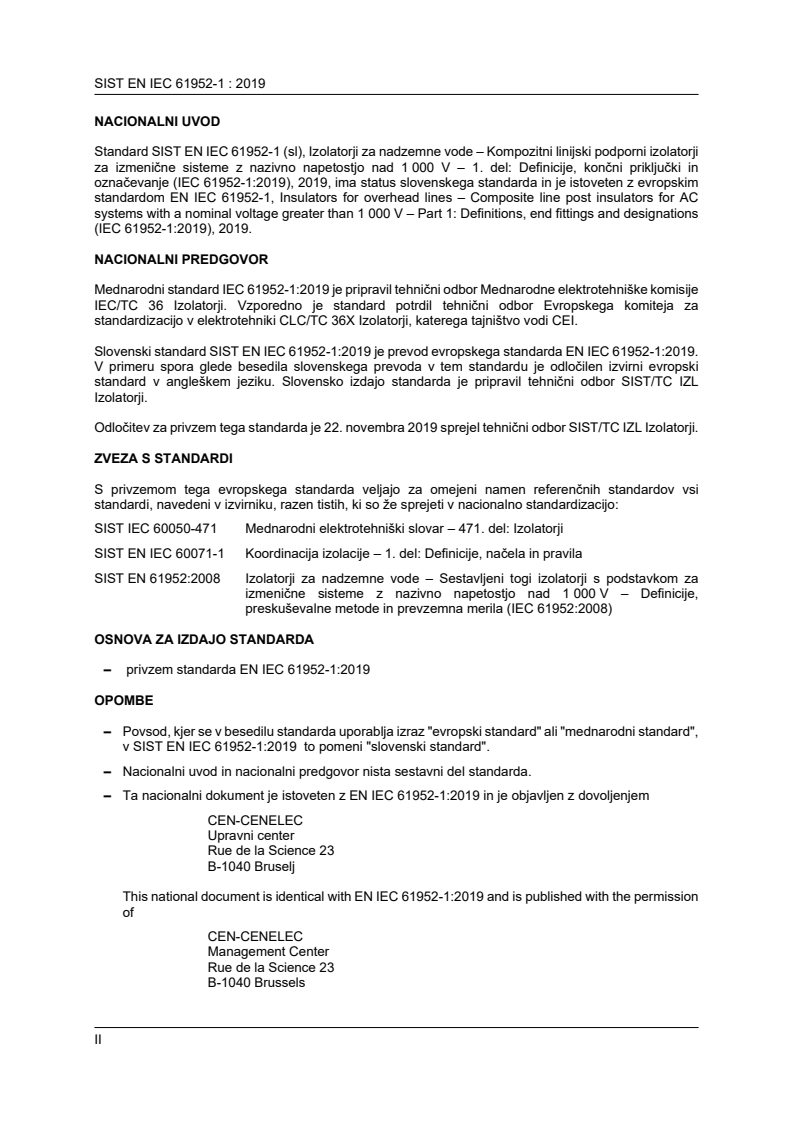
NACIONALNI UVOD
Standard SIST EN IEC 61952-1 (sl), Izolatorji za nadzemne vode – Kompozitni linijski podporni izolatorji
za izmenične sisteme z nazivno napetostjo nad 1 000 V – 1. del: Definicije, končni priključki in
označevanje (IEC 61952-1:2019), 2019, ima status slovenskega standarda in je istoveten z evropskim
standardom EN IEC 61952-1, Insulators for overhead lines – Composite line post insulators for AC
systems with a nominal voltage greater than 1 000 V – Part 1: Definitions, end fittings and designations
(IEC 61952-1:2019), 2019.
NACIONALNI PREDGOVOR
Mednarodni standard IEC 61952-1:2019 je pripravil tehnični odbor Mednarodne elektrotehniške komisije
IEC/TC 36 Izolatorji. Vzporedno je standard potrdil tehnični odbor Evropskega komiteja za
standardizacijo v elektrotehniki CLC/TC 36X Izolatorji, katerega tajništvo vodi CEI.
Slovenski standard SIST EN IEC 61952-1:2019 je prevod evropskega standarda EN IEC 61952-1:2019.
V primeru spora glede besedila slovenskega prevoda v tem standardu je odločilen izvirni evropski
standard v angleškem jeziku. Slovensko izdajo standarda je pripravil tehnični odbor SIST/TC IZL
Izolatorji.
Odločitev za privzem tega standarda je 22. novembra 2019 sprejel tehnični odbor SIST/TC IZL Izolatorji.
ZVEZA S STANDARDI
S privzemom tega evropskega standarda veljajo za omejeni namen referenčnih standardov vsi
standardi, navedeni v izvirniku, razen tistih, ki so že sprejeti v nacionalno standardizacijo:
SIST IEC 60050-471 Mednarodni elektrotehniški slovar – 471. del: Izolatorji
SIST EN IEC 60071-1 Koordinacija izolacije – 1. del: Definicije, načela in pravila
SIST EN 61952:2008 Izolatorji za nadzemne vode – Sestavljeni togi izolatorji s podstavkom za
izmenične sisteme z nazivno napetostjo nad 1 000 V – Definicije,
preskuševalne metode in prevzemna merila (IEC 61952:2008)
OSNOVA ZA IZDAJO STANDARDA
– privzem standarda EN IEC 61952-1:2019
OPOMBE
– Povsod, kjer se v besedilu standarda uporablja izraz "evropski standard" ali "mednarodni standard",
v SIST EN IEC 61952-1:2019 to pomeni "slovenski standard".
– Nacionalni uvod in nacionalni predgovor nista sestavni del standarda.
– Ta nacionalni dokument je istoveten z EN IEC 61952-1:2019 in je objavljen z dovoljenjem
CEN-CENELEC
Upravni center
Rue de la Science 23
B-1040 Bruselj
This national document is identical with EN IEC 61952-1:2019 and is published with the permission
of
CEN-CENELEC
Management Center
Rue de la Science 23
B-1040 Brussels
II
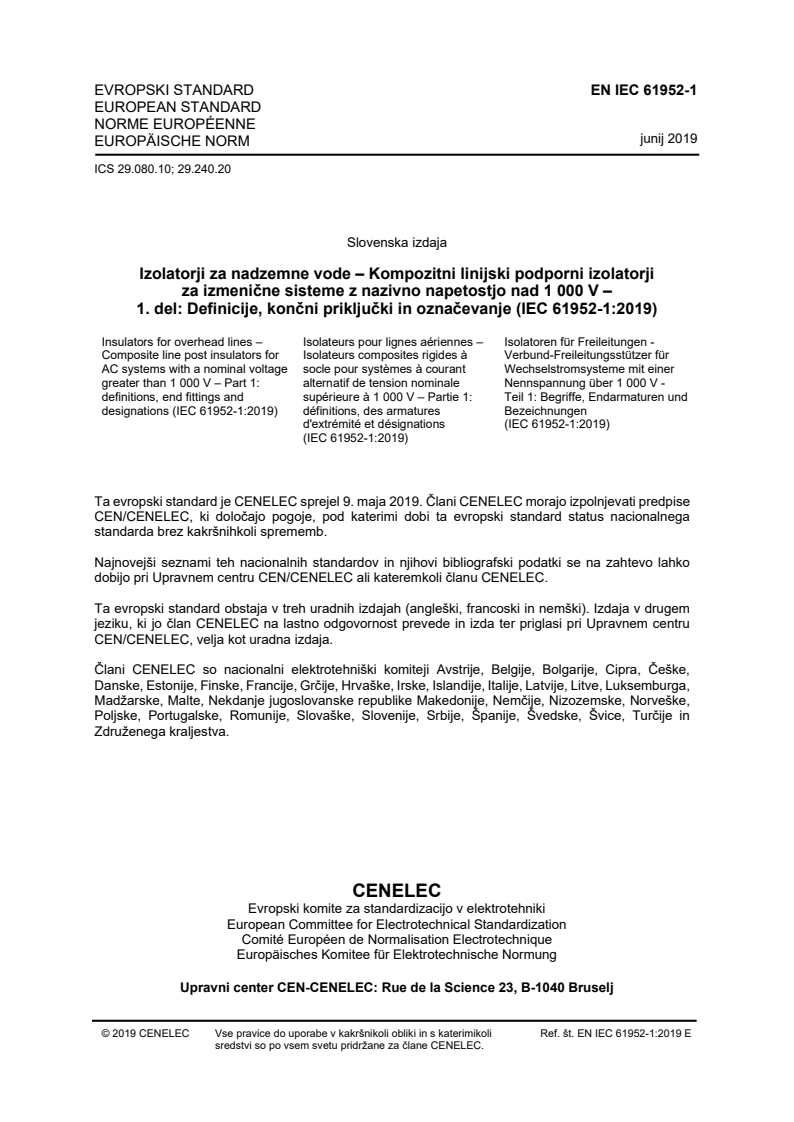
EVROPSKI STANDARD EN IEC 61952-1
EUROPEAN STANDARD
NORME EUROPÉENNE
junij 2019
EUROPÄISCHE NORM
ICS 29.080.10; 29.240.20
Slovenska izdaja
Izolatorji za nadzemne vode – Kompozitni linijski podporni izolatorji
za izmenične sisteme z nazivno napetostjo nad 1 000 V –
1. del: Definicije, končni priključki in označevanje (IEC 61952-1:2019)
Insulators for overhead lines – Isolateurs pour lignes aériennes – Isolatoren für Freileitungen -
Composite line post insulators for Isolateurs composites rigides à Verbund-Freileitungsstützer für
AC systems with a nominal voltage socle pour systèmes à courant Wechselstromsysteme mit einer
greater than 1 000 V – Part 1: alternatif de tension nominale Nennspannung über 1 000 V -
definitions, end fittings and supérieure à 1 000 V – Partie 1: Teil 1: Begriffe, Endarmaturen und
designations (IEC 61952-1:2019) définitions, des armatures Bezeichnungen
d'extrémité et désignations (IEC 61952-1:2019)
(IEC 61952-1:2019)
Ta evropski standard je CENELEC sprejel 9. maja 2019. Člani CENELEC morajo izpolnjevati predpise
CEN/CENELEC, ki določajo pogoje, pod katerimi dobi ta evropski standard status nacionalnega
standarda brez kakršnihkoli sprememb.
Najnovejši seznami teh nacionalnih standardov in njihovi bibliografski podatki se na zahtevo lahko
dobijo pri Upravnem centru CEN/CENELEC ali kateremkoli članu CENELEC.
Ta evropski standard obstaja v treh uradnih izdajah (angleški, francoski in nemški). Izdaja v drugem
jeziku, ki jo član CENELEC na lastno odgovornost prevede in izda ter priglasi pri Upravnem centru
CEN/CENELEC, velja kot uradna izdaja.
Člani CENELEC so nacionalni elektrotehniški komiteji Avstrije, Belgije, Bolgarije, Cipra, Češke,
Danske, Estonije, Finske, Francije, Grčije, Hrvaške, Irske, Islandije, Italije, Latvije, Litve, Luksemburga,
Madžarske, Malte, Nekdanje jugoslovanske republike Makedonije, Nemčije, Nizozemske, Norveške,
Poljske, Portugalske, Romunije, Slovaške, Slovenije, Srbije, Španije, Švedske, Švice, Turčije in
Združenega kraljestva.
CENELEC
Evropski komite za standardizacijo v elektrotehniki
European Committee for Electrotechnical Standardization
Comité Européen de Normalisation Electrotechnique
Europäisches Komitee für Elektrotechnische Normung
Upravni center CEN-CENELEC: Rue de la Science 23, B-1040 Bruselj
© 2019 CENELEC Vse pravice do uporabe v kakršnikoli obliki in s katerimikoli Ref. št. EN IEC 61952-1:2019 E
sredstvi so po vsem svetu pridržane za člane CENELEC.
SIST EN IEC 61952-1 : 2019
Evropski predgovor
Besedilo dokumenta 36/435/FDIS, poznejše izdaje IEC 61952-1, ki ga je pripravil IEC/TC 36 Izolatorji,
je bilo predloženo IEC-CENELEC v vzporedno glasovanje in ga je CENELEC odobril kot EN 61952-
1:2019.
Določena sta bila naslednja datuma:
– zadnji datum, do katerega mora ta dokument dobiti (dop) 2020-02-09
status nacionalnega standarda z objavo istovetnega
besedila ali z razglasitvijo
– zadnji datum, do katerega je treba razveljaviti (dow) 2022-05-09
nacionalne standarde, ki so z dokumentom v
nasprotju
Opozoriti je treba na možnost, da bi lahko bil kateri od elementov tega dokumenta predmet patentnih
pravic. CENELEC ni odgovoren za identifikacijo katerekoli ali vseh takih patentnih pravic.
Razglasitvena objava
Besedilo mednarodnega standarda IEC 61952-1:2019 je CENELEC potrdil kot evropski standard brez
kakršnihkoli sprememb.
SIST EN IEC 61952-1 : 2019
Dodatek ZA
(normativni)
Normativna sklicevanja na mednarodne publikacije z njihovimi ustreznimi
evropskimi publikacijami
Za uporabo tega standarda so deloma ali v celoti nujno potrebni spodaj navedeni dokumenti. Pri
datiranih dokumentih velja samo navedena izdaja. Pri nedatiranih dokumentih velja najnovejša izdaja
referenčnega dokumenta (vključno z vsemi dopolnili).
OPOMBA 1: Če je bila mednarodna objava spremenjena s splošnimi spremembami, označenimi z (mod) (spremenjen), velja
ustrezni standard EN/HD.
OPOMBA 2: Najnovejše informacije o zadnjih izdajah evropskih standardov, navedenih v tem dodatku, so na voljo na:
www.cenelec.eu
Publikacija Leto Naslov EN/HD Leto
IEC 60050- - Mednarodni elektrotehniški slovar –
471 471. del: Izolatorji
IEC 60071-1 - Koordinacija izolacije – 1. del: Definicije, EN 60071-1 -
načela in pravila
IEC 61952 2008 Izolatorji za nadzemne vode – Kompozitni EN 61952 2008
linijski podporni izolatorji za izmenične
sisteme z nazivno napetostjo nad 1 000 V –
Definicije, preskuševalne metode in
prevzemna merila
SIST EN IEC 61952-1 : 2019
Vsebina Stran
Evropski predgovor . 2
Predgovor . 5
Uvod . 7
1 Področje uporabe . 8
2 Zveze s standardi . 8
3 Izrazi in definicije . 8
4 Mehanske, merske in električne karakteristike . 9
4.1 Karakteristike . 9
4.2 Največja zasnovana konzolna obremenitev (MDCL) in določena konzolna obremenitev (SCL) 10
4.3 Razredi najmanjše atmosferske vzdržne udarne napetosti (BIL) . 10
4.4 Standardne kode spojk . 10
4.5 Standardne kode osnovnih plošč . 20
5 Označevanje linijskega podpornega izolatorja . 24
6 Oznake . 25
Viri in literatura . 34
PREGLEDNICA 1: VRSTE SPOJK . 11
PREGLEDNICA 2: VRSTE OSNOVNIH PLOŠČ . 21
PREGLEDNICA 3: OZNAČEVANJE IN ZNAČILNOSTI KOMPOZITNIH LINIJSKIH PODPORNIH IZOLATORJEV
(PRAKSA IEC) ZA IEC 60815-3, RAZRED B . 25
PREGLEDNICA 4: OZNAČEVANJE IN KARAKTERISTIKE KOMPOZITNIH LINIJSKIH PODPORNIH IZOLATORJEV
(PRAKSA ANSI) . 30
SIST EN IEC 61952-1 : 2019
MEDNARODNA ELEKTROTEHNIŠKA KOMISIJA
Izolatorji za nadzemne vode – Kompozitni linijski podporni izolatorji za
izmenične sisteme z nazivno napetostjo, višjo od 1 000 V –
1. del: Definicije, končni priključki in označevanje
Predgovor
1) Mednarodna elektrotehniška komisija (IEC) je svetovna organizacija za standardizacijo, ki združuje vse
nacionalne elektrotehniške komiteje (nacionalni komiteji IEC). Cilj IEC je pospeševati mednarodno
sodelovanje v vseh vprašanjih standardizacije s področja elektrotehnike in elektronike. V ta namen poleg
drugih aktivnosti izdaja mednarodne standarde, tehnične specifikacije, tehnična poročila, javno dostopne
specifikacije in vodila (v nadaljevanju: publikacije IEC). Za njihovo pripravo so odgovorni tehniški odbori (TC).
Vsak nacionalni komite IEC, ki ga zanima obravnavana tema, lahko sodeluje v tem pripravljalnem delu. Prav
tako lahko v pripravi sodelujejo mednarodne organizacije ter vladne in nevladne ustanove, ki so povezane z
IEC. IEC deluje v tesni povezavi z mednarodno organizacijo za standardizacijo ISO skladno s pogoji,
določenimi v soglasju med obema organizacijama.
2) Uradne odločitve ali sporazumi IEC o tehničnih vprašanjih, pripravljeni v tehniških odborih, v katerih so prisotni
vsi nacionalni komiteji, ki jih tema zanima, izražajo, kolikor je mogoče, mednarodno soglasje o obravnavani
temi.
3) Publikacije IEC imajo obliko priporočil za mednarodno uporabo in jih kot take sprejmejo nacionalni komiteji
IEC. Čeprav IEC skuša po najboljših močeh zagotavljati točnost tehničnih vsebin publikacij IEC, IEC ne more
biti odgovoren za način njihove uporabe ali za kakršnokoli razlago katerihkoli končnih uporabnikov.
4) Za pospeševanje mednarodnega poenotenja so se nacionalni komiteji IEC zavezali, da bodo v svojih
nacionalnih in regionalnih publikacijah dolžni čim pregledneje uporabljati publikacije IEC. Vsako odstopanje
med katerokoli publikacijo IEC in ustrezno nacionalno ali regionalno publikacijo je treba to v slednji jasno
označiti.
5) IEC sam ne zagotavlja nikakršnega potrdila o skladnosti. Neodvisni certifikacijski organi zagotavljajo storitve
ocenjevanja skladnosti in na nekaterih področjih dostop do oznak IEC o skladnosti. IEC ni odgovoren za
storitve, ki jih izvajajo neodvisni certifikacijski organi.
6) Vsi uporabniki naj si zagotovijo zadnjo izdajo te publikacije.
7) IEC ali njegovi direktorji, zaposleni, uslužbenci ali agenti, vključno s posameznimi izvedenci ter člani njegovih
tehniških komitejev in nacionalnih komitejev IEC, ne prevzemajo nobene odgovornosti za kakršnokoli osebno
poškodbo, premoženjsko škodo ali katerokoli drugo škodo kakršnekoli vrste, bodisi neposredne ali posredne,
ali za stroške (vključno z odvetniškimi stroški) in izdatke, nastale zaradi te publikacije, njene uporabe ali
zanašanja na to publikacijo IEC ali katerokoli drugo publikacijo IEC.
8) Opozoriti je treba na zveze s standardi, navedene v tej publikaciji. Uporaba navedenih publikacij je nujna za
pravilno uporabo te publikacije.
9) Opozoriti je treba na možnost, da bi lahko bil kateri od elementov te publikacije IEC predmet patentnih pravic.
IEC ni odgovoren za identifikacijo katerekoli ali vseh takih patentnih pravic.
Mednarodni standard IEC 61952-1 je pripravil tehnični odbor IEC/TC 36 Izolatorji.
Besedilo tega standarda temelji na naslednjih dokumentih:
FDIS Poročilo o glasovanju
36/435/FDIS 36/441/RVD
Popolne informacije o glasovanju za potrditev tega mednarodnega standarda so na voljo v poročilu o
glasovanju, navedenem v gornji preglednici.
Ta dokument je bil pripravljen v skladu z 2. delom Direktiv ISO/IEC.
SIST EN IEC 61952-1 : 2019
Seznam vseh delov skupine IEC 61952, izdanih s splošnim naslovom Izolatorji za nadzemne vode –
Kompozitni linijski podporni izolatorji za izmenične sisteme z nazivno napetostjo, višjo od 1 000 V, je
na voljo na spletni strani IEC.
Odbor je odločil, da bo vsebina tega dokumenta ostala nespremenjena do datuma stabilnosti,
navedenega na spletni strani IEC http://webstore.iec.ch v razdelku obvestil, povezanih z zadevnim
dokumentom. S tem datumom bo dokument:
‒ ponovno potrjen,
‒ razveljavljen,
‒ nadomeščen z novo izdajo ali
‒ dopolnjen.
Dvojezična različica te publikacije bo mogoče izdana pozneje.
SIST EN IEC 61952-1 : 2019
Uvod
Namen tega dela IEC 61952 je podati glavne mehanske in merske karakteristike kompozitnih linijskih
podpornih izolatorjev in njihovih priključkov, da se zagotovi njihova medsebojna zamenljivost. Ker so
linijski podporni izolatorji navadno izpostavljeni kombiniranim obremenitvam (na primer navpičnim
zaradi obremeni
...