

SIST EN 13970:2005
(Main)Flexible sheets for waterproofing - Bitumen water vapour control layers - Definitions and characteristics
- Abstract
This document specifies definitions and characteristics of flexible reinforced bitumen sheets for which the intended use is as water vapour control layers for buildings. It specifies the requirements and test methods and provides for the evaluation of conformity of the products with the requirements of this document.
- Status
- Published
- Publication Date
- 30-Apr-2005
- Technical Committee
- VLA - Water proofing
- Current Stage
- 6060 - National Implementation/Publication (Adopted Project)
- Start Date
- 01-May-2005
- Due Date
- 01-May-2005
- Completion Date
- 01-May-2005
- Directive
- 305/2011 - Regulation (eu) No 305/2011 of the European Parliament and of the Council of 9 march 2011 laying down harmonised conditions for the marketing of construction products and repealing council directive 89/106/eecOJ Ref: C 259 OJ Date: 08-Aug-2014
89/106/EEC - Construction productsOJ Ref: C 139 OJ Date: 08-Jun-2005



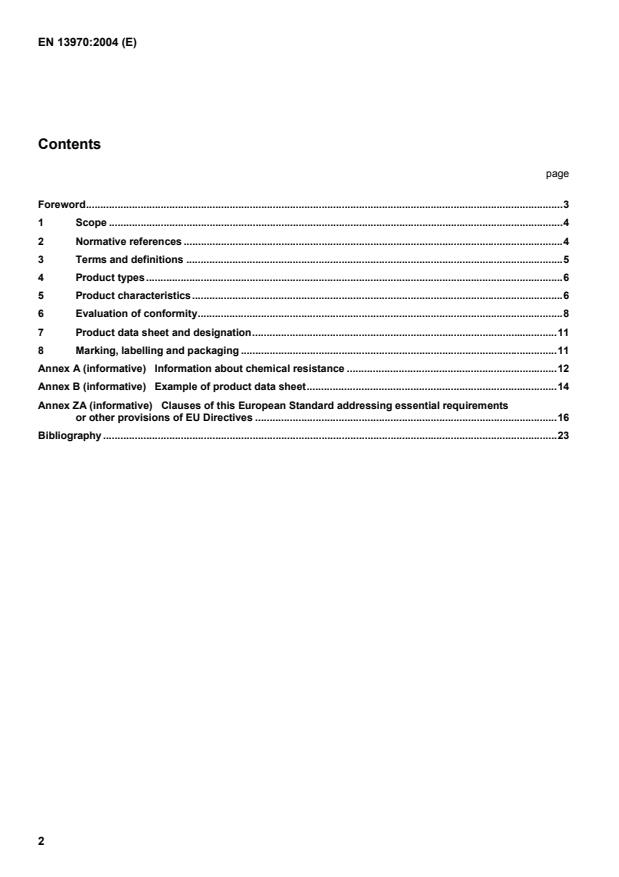
SIST EN 13970:2005 is the Slovenian adoption of EN 13970:2004 from CEN. It covers flexible reinforced bitumen sheets intended to act as water vapour control layers in buildings, and it specifies the definitions, product characteristics, test methods and conformity evaluation used by manufacturers, test laboratories and specifiers.
What does SIST EN 13970:2005 specify?
SIST EN 13970:2005 specifies the requirements for flexible reinforced bitumen sheets used as water vapour control layers for buildings. It is organized into clauses on scope, normative references, terms and definitions, product characteristics, conformity assessment, product data sheets, and marking, labelling and packaging.
| Annex | What it covers |
|---|---|
| Annex A | Information about chemical resistance |
| Annex B | Example of a product data sheet |
| Annex ZA | Clauses addressing essential requirements and other provisions of EU Directives, including CE marking and attestation of conformity |
What are the key requirements of SIST EN 13970:2005?
SIST EN 13970:2005 ties product acceptance to named test methods and declared values. The main idea is simple: the manufacturer states the relevant performance, and the product is checked against those stated values or limits.
Product characteristics and test methods
Clause 5 requires the product to be free of visible defects, checked to EN 1850-1. Dimensions and straightness are verified to EN 1848-1, with length and width meeting the manufacturer’s limiting value (MLV) and straightness staying within the stated limit.
Thickness and mass per unit area are checked to EN 1849-1 against the manufacturer’s declared value (MDV). Watertightness is tested to EN 1928:2000 at 2 kPa and must pass. In practice, these requirements tell the buyer whether the sheet arrives in the right size, is uniform, and will hold back liquid water.
Mechanical and durability performance
Clause 5 also covers resistance to impact, tearing, joint strength, tensile properties and low temperature flexibility. Impact resistance uses EN 12691 with a 300 mm drop height, while tear resistance, joint strength and tensile properties use EN 12310-1, EN 12317-1 and EN 12311-1.
Durability is checked in two ways. After artificial ageing in EN 1296, water vapour resistance measured to EN 1931 must not change by more than ±50%. Where chemical exposure is relevant, EN 1847 is used before re-testing to EN 1931, again with a ±50% limit. For a reader, this means the document asks for evidence that the sheet still performs after ageing or contact with chemicals likely to matter in use.
Fire and substance requirements
Clause 5.13 requires reaction to fire testing and classification according to EN 13501-1:2002, with testing under surface flame attack to EN ISO 11925-2. Clause 5.14 also addresses dangerous substances, including asbestos and coal tar constituents, and requires hazardous additives or constituents to be disclosed.
Conformity evaluation and documentation
Clause 6 requires initial type testing and factory production control (FPC). Initial type testing covers the characteristics in Clause 5 as required, and samples are taken according to EN 13416. The FPC system must be documented and maintained, and its frequency is set by the manufacturer.
Clause 7 requires a technical data sheet with the product name, manufacturer, origin or traceable code, method of application, test results, certification mark if any, consumer information, and a description of the sheet. Clause 8 requires marking on each roll or consignment, including production identification, trade name, dimensions, thickness or mass, and any required dangerous-substance labelling.
What terms does SIST EN 13970:2005 define?
- Water vapour control - action that prevents or controls the passage of water vapour through a building element.
- Bitumen water vapour control layer - a flexible sheet of bitumen or a bitumen composite used to control movement of water and water vapour through a wall, floor or roof.
- Carrier material - material incorporated into or onto the sheet to provide stability and/or mechanical resistance.
- Backing material - material added to the sheet without a permanent mechanical function.
- Manufacturer's limiting value (MLV) - a value stated by the manufacturer that the test result must meet, either as a minimum or a maximum.
- Manufacturer's declared value (MDV) - a value declared by the manufacturer together with a declared tolerance.
- Reinforced bitumen sheet - a factory-made flexible bitumen sheet with one or more carriers, supplied in roll form.
- Sample / test piece / test specimen - the document distinguishes the piece taken from production, the part cut for testing, and the precise specimen used in the test.
Who uses SIST EN 13970:2005?
SIST EN 13970:2005 is used by manufacturers of flexible sheets for waterproofing, especially bitumen sheets intended for water vapour control layers. It is also used by test laboratories, notified bodies, quality and production control staff, and technical buyers who need a common basis for product claims, sampling, and conformity evidence. In practice, it supports product design, routine production control, technical documentation and CE-related information.
What changed in SIST EN 13970:2005 from the previous edition?
SIST EN 13970:2005 is identical to EN 13970:2004.
Which standards are used with SIST EN 13970:2005?
SIST EN 13970:2005 depends on several test and support standards, including EN 13416 for sampling; EN 1850-1 for visible defects; EN 1848-1 for dimensions and straightness; EN 1849-1 for thickness and mass; EN 1928 for watertightness; EN 1931 for water vapour transmission properties; EN 1296 for artificial ageing; EN 1847 for exposure to liquid chemicals; EN 1109, EN 12310-1, EN 12311-1, EN 12317-1 and EN 12691 for flexibility and mechanical properties; EN 13501-1 and EN ISO 11925-2 for reaction to fire; and EN ISO 9001 where a manufacturer uses that system as the basis for FPC.
What does the SIST EN 13970:2005 document contain?
SIST EN 13970:2005 contains the product definition, the list of key performance characteristics, and the test methods used to verify them. It also contains the conformity assessment logic, including initial type testing, family grouping, and factory production control. The annexes add practical material: chemical resistance information, an example data sheet, and the CE-marking route under EU provisions.
Relations
- Effective Date
- 28-Jan-2026
- Effective Date
- 28-Jan-2026
- Effective Date
- 28-Jan-2026
- Effective Date
- 28-Jan-2026
- Effective Date
- 28-Jan-2026
- Effective Date
- 28-Jan-2026
- Effective Date
- 28-Jan-2026
- Effective Date
- 28-Jan-2026
- Effective Date
- 28-Jan-2026
- Effective Date
- 28-Jan-2026
- Effective Date
- 28-Jan-2026
- Effective Date
- 28-Jan-2026
- Effective Date
- 28-Jan-2026
- Effective Date
- 28-Jan-2026
- Effective Date
- 28-Jan-2026
Get Certified
Connect with accredited certification bodies for this standard

DIBt (Deutsches Institut für Bautechnik)
German Institute for Building Technology.
DIN CERTCO
DIN Group product certification.

Aboma Certification B.V.
Specialized in construction, metal, and transport sectors.
Sponsored listings
Frequently Asked Questions
SIST EN 13970:2005 is a standard published by the Slovenian Institute for Standardization (SIST). Its full title is "Flexible sheets for waterproofing - Bitumen water vapour control layers - Definitions and characteristics". This standard covers: This document specifies definitions and characteristics of flexible reinforced bitumen sheets for which the intended use is as water vapour control layers for buildings. It specifies the requirements and test methods and provides for the evaluation of conformity of the products with the requirements of this document.
This document specifies definitions and characteristics of flexible reinforced bitumen sheets for which the intended use is as water vapour control layers for buildings. It specifies the requirements and test methods and provides for the evaluation of conformity of the products with the requirements of this document.
SIST EN 13970:2005 is classified under the following ICS (International Classification for Standards) categories: 01.040.91 - Construction materials and building (Vocabularies); 91.100.50 - Binders. Sealing materials. The ICS classification helps identify the subject area and facilitates finding related standards.
SIST EN 13970:2005 has the following relationships with other standards: It is inter standard links to SIST EN 1931:2001, SIST EN 1848-1:2025, SIST EN 1850-1:2000, SIST EN 1928:2001, SIST EN 12310-1:2025, SIST EN 1849-1:2000, SIST EN 1109:2013, SIST EN 1847:2010, SIST EN 12311-1:2000, SIST EN 13501-1:2002, SIST EN 12691:2018, SIST EN 1296:2001, SIST EN ISO 11925-2:2002, SIST EN 12317-1:2000, SIST EN 13416:2024. Understanding these relationships helps ensure you are using the most current and applicable version of the standard.
SIST EN 13970:2005 is associated with the following European legislation: EU Directives/Regulations: 305/2011, 89/106/EEC, EUR-PUB; Standardization Mandates: M/102. When a standard is cited in the Official Journal of the European Union, products manufactured in conformity with it benefit from a presumption of conformity with the essential requirements of the corresponding EU directive or regulation.
SIST EN 13970:2005 is available in PDF format for immediate download after purchase. The document can be added to your cart and obtained through the secure checkout process. Digital delivery ensures instant access to the complete standard document.
Standards Content (Sample)
2003-01.Slovenski inštitut za standardizacijo. Razmnoževanje celote ali delov tega standarda ni dovoljeno.Flexible sheets for waterproofing - Bitumen water vapour control layers - Definitions and characteristicsHidroizolacijski trakovi - Bitumenski trakovi, ki kontrolirajo gibanje vode in/ali vodne pare - Definicije in lastnostiFeuilles souples d'étanchéité - Feuilles bitumineuses utilisées comme pare-vapeur - Définitions et caractéristiquesAbdichtungsbahnen - Bitumen-Dampfsperrbahnen - Definitionen und Eigenschaften91.100.50Veziva. Tesnilni materialiBinders. Sealing materials01.040.91Gradbeni materiali in gradnja (Slovarji)Construction materials and building (Vocabularies)ICS:SIST EN 13970:2005enTa slovenski standard je istoveten z:EN 13970:200401-maj-2005SIST EN 13970:2005SLOVENSKI
STANDARD
EUROPEAN STANDARDNORME EUROPÉENNEEUROPÄISCHE NORMEN 13970December 2004ICS 01.040.91; 91.100.50English versionFlexible sheets for waterproofing - Bitumen water vapour controllayers - Definitions and characteristicsFeuilles souples d'étanchéité - Feuilles bitumineusesutilisées comme pare-vapeur - Définitions etcaractéristiquesAbdichtungsbahnen - Bitumen-Dampfsperrbahnen -Definitionen und EigenschaftenThis European Standard was approved by CEN on 20 October 2004.CEN members are bound to comply with the CEN/CENELEC Internal Regulations which stipulate the conditions for giving this EuropeanStandard the status of a national standard without any alteration. Up-to-date lists and bibliographical references concerning such nationalstandards may be obtained on application to the Central Secretariat or to any CEN member.This European Standard exists in three official versions (English, French, German). A version in any other language made by translationunder the responsibility of a CEN member into its own language and notified to the Central Secretariat has the same status as the officialversions.CEN members are the national standards bodies of Austria, Belgium, Cyprus, Czech Republic, Denmark, Estonia, Finland, France,Germany, Greece, Hungary, Iceland, Ireland, Italy, Latvia, Lithuania, Luxembourg, Malta, Netherlands, Norway, Poland, Portugal, Slovakia,Slovenia, Spain, Sweden, Switzerland and United Kingdom.EUROPEAN COMMITTEE FOR STANDARDIZATIONCOMITÉ EUROPÉEN DE NORMALISATIONEUROPÄISCHES KOMITEE FÜR NORMUNGManagement Centre: rue de Stassart, 36
B-1050 Brussels© 2004 CENAll rights of exploitation in any form and by any means reservedworldwide for CEN national Members.Ref. No. EN 13970:2004: E
Information about chemical resistance.12 Annex B (informative)
Example of product data sheet.14 Annex ZA (informative)
Clauses of this European Standard addressing essential requirements or other provisions of EU Directives.16 Bibliography.23
value declared by the manufacturer accompanied by a declared tolerance 3.7 reinforced bitumen sheet factory made flexible layer of bitumen, with internal or external incorporation of one or more carriers, supplied in roll form ready for use as a waterproofing sheet 3.8 oxidized bitumen
straight run petroleum bitumen or a fluxed bitumen which has been hardened and rendered less temperature susceptible by blowing with air at high temperature with or without the use of a catalyst 3.9 elastomeric bitumen
petroleum bitumen and/or oxidized bitumen modified by the addition of thermo-plastic rubbers 3.10 plastomeric bitumen
petroleum bitumen and/or oxidized bitumen modified by the addition of polyolefin or polyolefin copolymer compound 3.11 sampling procedure used to select or constitute a sample
(e.g. 10 mm per 5 m length). 5.4 Thickness and mass per unit area The thickness and mass per unit area shall be determined in accordance with EN 1849-1. Where a product is specified by mass per unit area no single measurement shall lie outside the declared tolerance of the manufacturer's declared value. Where a product is specified by thickness, no single measurement value shall lie outside the declared tolerance of the manufacturer's declared value. 5.5 Watertightness Watertightness shall be determined by Method A or B of EN 1928:2000 using a pressure of 2 kPa and shall give a pass result. 5.6 Resistance to impact Where required, the resistance to impact shall be determined in accordance with EN 12691 but with a drop height of 300 mm ± 5 mm. The smallest diameter it will resist shall be less than or equal to the manufacturer's
5.14 Dangerous substances For products placed on the market within the European Economic Area see ZA.1. Outside the EEA products shall conform to any applicable provisions related to dangerous substances valid in the place of use. Bitumen sheets covered by this document shall not contain asbestos or coal tar constituents. The manufacturer shall disclose on the product wrapper and in the health and safety data sheets the use of any additive or constituent considered hazardous. 6 Evaluation of conformity 6.1 General The compliance of a reinforced bitumen sheet with the requirements of this document and with the stated values (including classes) shall be demonstrated by: initial type testing; factory production control by the manufacturer. For the purposes of testing, products may be grouped into families, where it is considered that the selected property is common to all products within that family. 6.2 Type testing 6.2.1 General Initial type testing shall be performed to show conformity with this document. Tests previously performed in accordance with the provisions of this document (same product, same characteristic(s), test method, sampling procedure, system of attestation of conformity, etc.) may be taken into account. In addition, initial type testing shall be performed at the beginning of the production of a new product type (unless a member of the same family) or at the beginning of a new method of production (where this may affect the stated properties). All characteristics in Clause 5 shall be subject to initial type testing, where required. Whenever a change occurs in the product design, the raw material or supplier of the components, or the production process (subject to the definition of a family), which would change significantly one or more of the characteristics, the type tests shall be repeated for the appropriate characteristic(s). 6.2.2 Sampling Samples shall be taken according to EN 13416. The minimum number of tests to show compliance for initial and further type testing shall be one for all characteristics.
EN ISO 9001 shall be applied in full and shall be made specific to the requirements of this document. The results of inspections, tests or assessments requiring action shall be recorded, as shall any action taken. The action to be taken when control values or criteria are not met shall be recorded. 6.3.2 Frequency of testing The characteristics to be controlled within the framework of factory production control are those for which the manufacturer claims a performance. Control of the product is required, either by direct testing or by indirect control. The frequency of testing shall be given in the manufacturer's FPC system.
Table 1 — Compliance criteria for initi
...