


SIST EN 14488-3:2024
(Main)Testing sprayed concrete - Part 3: Flexural strengths (first peak, ultimate and residual) of fibre reinforced beam specimens
Testing sprayed concrete - Part 3: Flexural strengths (first peak, ultimate and residual) of fibre reinforced beam specimens
This document specifies methods (Methods A and B) for the determination of the first peak, ultimate and residual strength of specimens of hardened sprayed concrete.
Prüfung von Spritzbeton - Teil 3: Biegefestigkeiten (Erstriss-, Biegezug- und Restfestigkeit) von faserverstärkten balkenförmigen Betonprüfkörpern
Dieses Dokument legt Verfahren (Verfahren A und Verfahren B) zur Bestimmung der Erstrissfestigkeit, Biegezugfestigkeit und residuellen Biegezugfestigkeit von Probekörpern aus erhärtetem Spritzbeton fest.
Essais pour béton projeté - Partie 3 : Résistances à la flexion (au premier pic, ultime et résiduelle) d’éprouvettes parallélépipédiques en béton renforcé par des fibres
Le présent document spécifie des méthodes (Méthodes A et B) de détermination des résistances au premier pic, ultime et résiduelle d’éprouvettes en béton projeté durci.
Preskušanje brizganega betona - 3. del: Upogibna trdnost (prvi vrh, končna in preostala) z vlakni armiranih prizmatičnih preskušancev
Ta del evropskega standarda določa metodo za ugotavljanje upogibne trdnosti (prvi vrh, končna in preostala) preskušancev iz strjenega brizganega betona.
General Information
- Status
- Published
- Public Enquiry End Date
- 09-May-2021
- Publication Date
- 10-Jan-2024
- Technical Committee
- BBB - Concrete, reinforced concrete and prestressed concrete
- Current Stage
- 6060 - National Implementation/Publication (Adopted Project)
- Start Date
- 07-Dec-2023
- Due Date
- 11-Feb-2024
- Completion Date
- 11-Jan-2024
Relations
- Effective Date
- 01-Feb-2024
Overview
EN 14488-3:2023 (CEN) specifies laboratory methods for determining flexural strengths of hardened fibre‑reinforced sprayed concrete. The standard defines two complementary test procedures - Method A (four‑point bending on sawn beam specimens) and Method B (three‑point bending on a notched square panel) - to measure the first peak, ultimate and residual flexural performance needed for quality control, specification and structural design.
Key facts:
- Approved by CEN on 30 July 2023; supersedes EN 14488-3:2006.
- Introduces Method B for residual strength measurement to support structural design models for permanent sprayed concrete linings.
- Applicable to metallic, synthetic or mixed fibre types.
Key topics and technical requirements
- Scope: Determination of first peak, maximum and residual flexural strengths of hardened sprayed concrete specimens.
- Two test methods:
- Method A: Four‑point bending on beams (deflection‑controlled). Measures first crack (first peak), ultimate and residual flexural strengths.
- Method B: Three‑point bending on a notched square panel. Focused on limit of proportionality (LOP), crack‑mouth opening displacement (CMOD) and residual flexural tensile strength.
- Apparatus & accuracy:
- Testing machine requirements per EN 12390‑4; system stiffness ≥ 200 kN/mm.
- Rollers diameter 20–40 mm; span and spacing defined (span l = 6d with d = 75 mm for Method A examples).
- Deflection transducer resolution ≥ 0.02 mm; deflection control and data logging mandatory.
- Measured parameters:
- First peak load, maximum load, residual load ranges (e.g., residual evaluated at specified deflection/CMOD intervals).
- CMOD and LOP definitions and conversion to equivalent stresses for Method B.
- Reporting & precision: Procedures for specimen preparation, test execution, calculation of flexural strengths and required test report items are specified.
Applications and users
EN 14488-3:2023 is intended for:
- Material testing laboratories performing acceptance and batch verification of sprayed concrete.
- Contractors and quality managers controlling sprayed concrete production and placement (tunnel linings, shotcrete structures).
- Structural and geotechnical engineers incorporating fibre‑reinforced sprayed concrete into design models (permanent linings, reinforced repairs).
- R&D teams developing fibre mixes and durability/performance evaluations.
- Standards bodies and specifiers requiring harmonized flexural performance criteria.
Practical uses include acceptance testing, performance classification of fibre systems, verification for structural design models, and research into toughness and residual load‑carrying capacity.
Related standards
- EN 14488-1 (Sampling fresh and hardened sprayed concrete)
- EN 14487-1 (Sprayed concrete - Definitions, specifications and conformity)
- EN 12390 series (Testing hardened concrete - specimen preparation and machine specs)
- Other parts of the EN 14488 series covering compressive strength, bond strength, fibre content and energy absorption.
Keywords: EN 14488-3:2023, sprayed concrete testing, flexural strengths, fibre reinforced beam specimens, four point bending, three point bending, residual strength, CMOD, limit of proportionality.


Frequently Asked Questions
SIST EN 14488-3:2024 is a standard published by the Slovenian Institute for Standardization (SIST). Its full title is "Testing sprayed concrete - Part 3: Flexural strengths (first peak, ultimate and residual) of fibre reinforced beam specimens". This standard covers: This document specifies methods (Methods A and B) for the determination of the first peak, ultimate and residual strength of specimens of hardened sprayed concrete.
This document specifies methods (Methods A and B) for the determination of the first peak, ultimate and residual strength of specimens of hardened sprayed concrete.
SIST EN 14488-3:2024 is classified under the following ICS (International Classification for Standards) categories: 91.100.30 - Concrete and concrete products. The ICS classification helps identify the subject area and facilitates finding related standards.
SIST EN 14488-3:2024 has the following relationships with other standards: It is inter standard links to SIST EN 14488-3:2006. Understanding these relationships helps ensure you are using the most current and applicable version of the standard.
SIST EN 14488-3:2024 is available in PDF format for immediate download after purchase. The document can be added to your cart and obtained through the secure checkout process. Digital delivery ensures instant access to the complete standard document.
Standards Content (Sample)
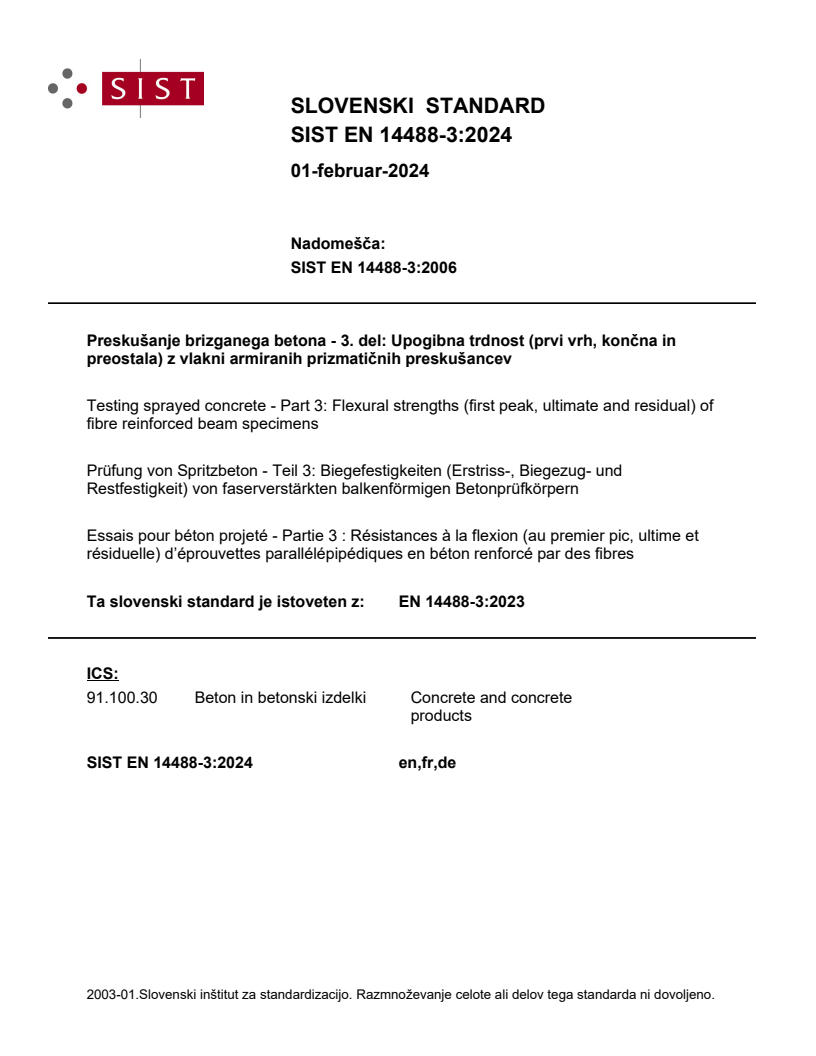
SLOVENSKI STANDARD
01-februar-2024
Nadomešča:
SIST EN 14488-3:2006
Preskušanje brizganega betona - 3. del: Upogibna trdnost (prvi vrh, končna in
preostala) z vlakni armiranih prizmatičnih preskušancev
Testing sprayed concrete - Part 3: Flexural strengths (first peak, ultimate and residual) of
fibre reinforced beam specimens
Prüfung von Spritzbeton - Teil 3: Biegefestigkeiten (Erstriss-, Biegezug- und
Restfestigkeit) von faserverstärkten balkenförmigen Betonprüfkörpern
Essais pour béton projeté - Partie 3 : Résistances à la flexion (au premier pic, ultime et
résiduelle) d’éprouvettes parallélépipédiques en béton renforcé par des fibres
Ta slovenski standard je istoveten z: EN 14488-3:2023
ICS:
91.100.30 Beton in betonski izdelki Concrete and concrete
products
2003-01.Slovenski inštitut za standardizacijo. Razmnoževanje celote ali delov tega standarda ni dovoljeno.
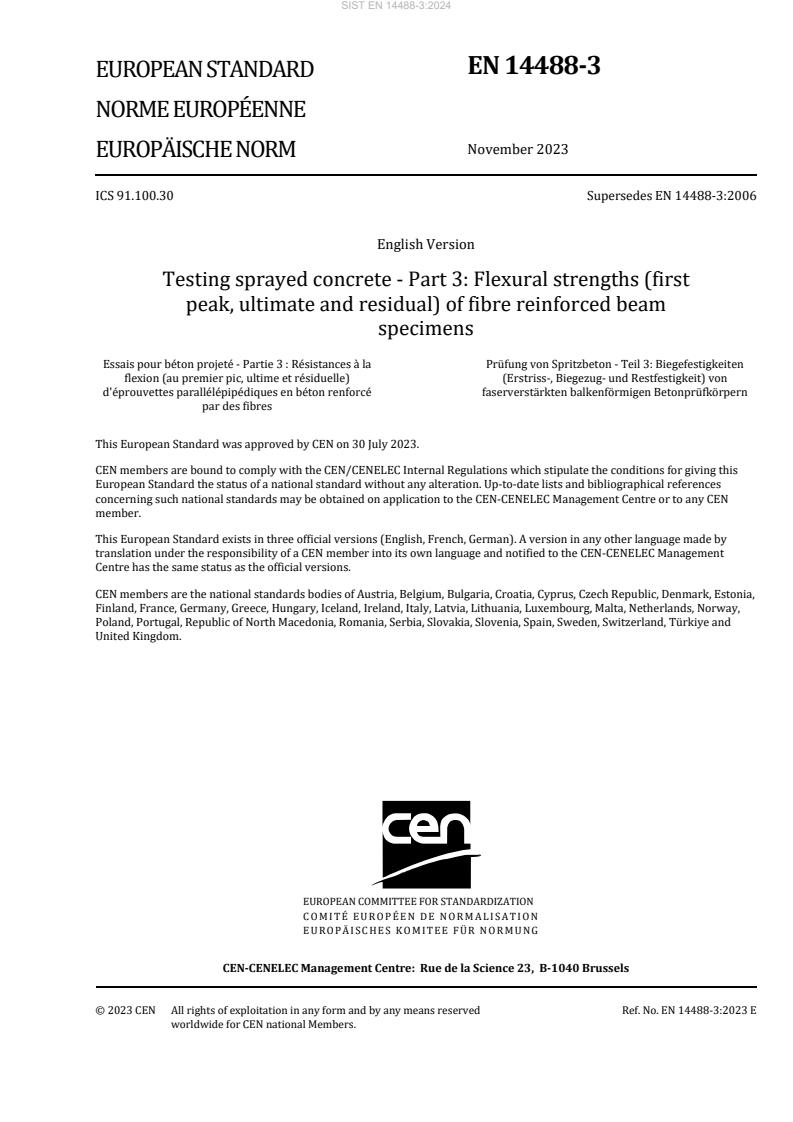
EN 14488-3
EUROPEAN STANDARD
NORME EUROPÉENNE
November 2023
EUROPÄISCHE NORM
ICS 91.100.30 Supersedes EN 14488-3:2006
English Version
Testing sprayed concrete - Part 3: Flexural strengths (first
peak, ultimate and residual) of fibre reinforced beam
specimens
Essais pour béton projeté - Partie 3 : Résistances à la Prüfung von Spritzbeton - Teil 3: Biegefestigkeiten
flexion (au premier pic, ultime et résiduelle) (Erstriss-, Biegezug- und Restfestigkeit) von
d'éprouvettes parallélépipédiques en béton renforcé faserverstärkten balkenförmigen Betonprüfkörpern
par des fibres
This European Standard was approved by CEN on 30 July 2023.
CEN members are bound to comply with the CEN/CENELEC Internal Regulations which stipulate the conditions for giving this
European Standard the status of a national standard without any alteration. Up-to-date lists and bibliographical references
concerning such national standards may be obtained on application to the CEN-CENELEC Management Centre or to any CEN
member.
This European Standard exists in three official versions (English, French, German). A version in any other language made by
translation under the responsibility of a CEN member into its own language and notified to the CEN-CENELEC Management
Centre has the same status as the official versions.
CEN members are the national standards bodies of Austria, Belgium, Bulgaria, Croatia, Cyprus, Czech Republic, Denmark, Estonia,
Finland, France, Germany, Greece, Hungary, Iceland, Ireland, Italy, Latvia, Lithuania, Luxembourg, Malta, Netherlands, Norway,
Poland, Portugal, Republic of North Macedonia, Romania, Serbia, Slovakia, Slovenia, Spain, Sweden, Switzerland, Türkiye and
United Kingdom.
EUROPEAN COMMITTEE FOR STANDARDIZATION
COMITÉ EUROPÉEN DE NORMALISATION
EUROPÄISCHES KOMITEE FÜR NORMUNG
CEN-CENELEC Management Centre: Rue de la Science 23, B-1040 Brussels
© 2023 CEN All rights of exploitation in any form and by any means reserved Ref. No. EN 14488-3:2023 E
worldwide for CEN national Members.
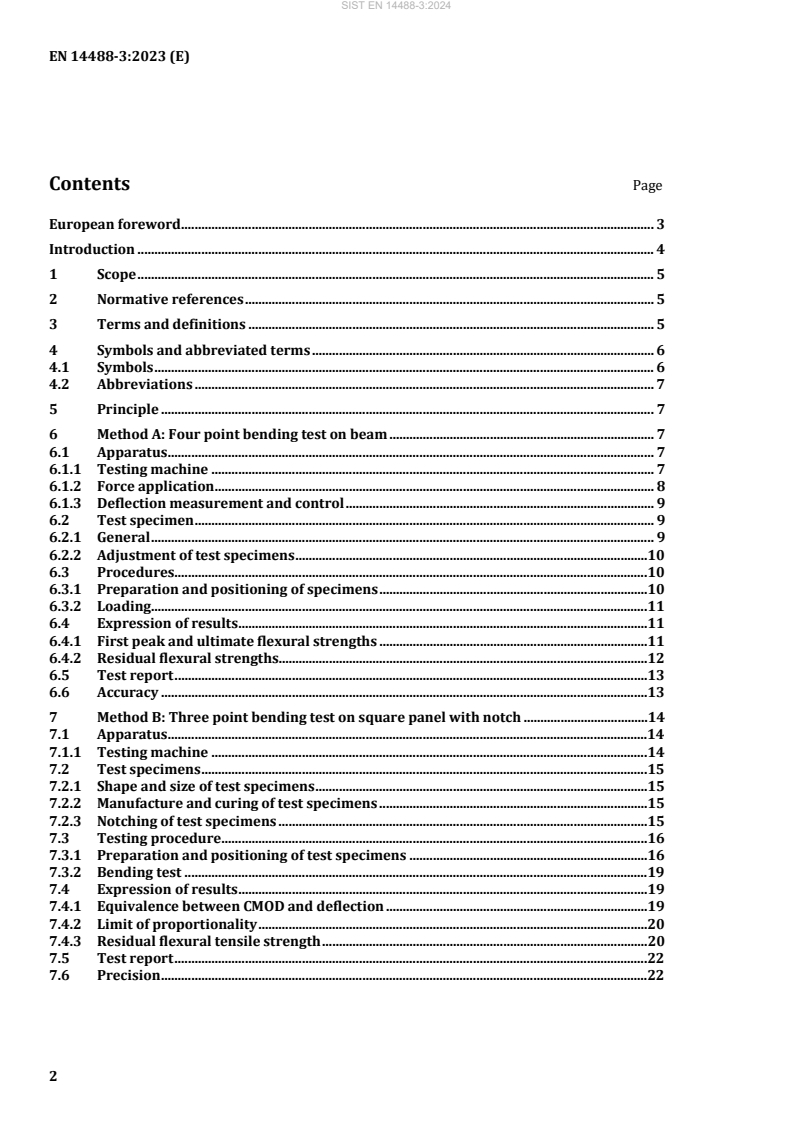
Contents Page
European foreword . 3
Introduction . 4
1 Scope . 5
2 Normative references . 5
3 Terms and definitions . 5
4 Symbols and abbreviated terms . 6
4.1 Symbols . 6
4.2 Abbreviations . 7
5 Principle . 7
6 Method A: Four point bending test on beam . 7
6.1 Apparatus . 7
6.1.1 Testing machine . 7
6.1.2 Force application . 8
6.1.3 Deflection measurement and control . 9
6.2 Test specimen . 9
6.2.1 General . 9
6.2.2 Adjustment of test specimens .10
6.3 Procedures.10
6.3.1 Preparation and positioning of specimens .10
6.3.2 Loading.11
6.4 Expression of results .11
6.4.1 First peak and ultimate flexural strengths .11
6.4.2 Residual flexural strengths.12
6.5 Test report .13
6.6 Accuracy .13
7 Method B: Three point bending test on square panel with notch .14
7.1 Apparatus .14
7.1.1 Testing machine .14
7.2 Test specimens .15
7.2.1 Shape and size of test specimens .15
7.2.2 Manufacture and curing of test specimens .15
7.2.3 Notching of test specimens .15
7.3 Testing procedure .16
7.3.1 Preparation and positioning of test specimens .16
7.3.2 Bending test .19
7.4 Expression of results .19
7.4.1 Equivalence between CMOD and deflection .19
7.4.2 Limit of proportionality .20
7.4.3 Residual flexural tensile strength .20
7.5 Test report .22
7.6 Precision .22
European foreword
This document (EN 14488-3:2023) has been prepared by Technical Committee CEN/TC 104 “Concrete
and related products”, the secretariat of which is held by SN.
This European Standard shall be given the status of a national standard, either by publication of an
identical text or by endorsement, at the latest by May 2024 and conflicting national standards shall be
withdrawn at the latest by May 2024.
Attention is drawn to the possibility that some of the elements of this document may be the subject of
patent rights. CEN shall not be held responsible for identifying any or all such patent rights.
This document supersedes EN 14488-3:2006.
— Introduction of testing Method B, the three point bending test on spray square panel with notch to
determine the flexural residual strength. The residual strength method can be prescribed when the
concrete characteristics are used in a structural design model. This is especially useful for permanent
sprayed concrete linings.
This document is part of a series concerned with testing sprayed concrete.
The EN 14488 series, Testing sprayed concrete, includes the following parts:
— Part 1: Sampling fresh and hardened concrete
— Part 2: Compressive strength of young sprayed concrete
— Part 3: Flexural strengths (first peak, ultimate and residual) of fibre reinforced beam specimens
— Part 4: Bond strength of cores by direct tension
— Part 5: Determination of energy absorption capacity of fibre reinforced slab specimens
— Part 6: Thickness of concrete on a substrate
— Part 7: Fibre content of fibre reinforced concrete
Any feedback and questions on this document should be directed to the users’ national standards body.
A complete listing of these bodies can be found on the CEN website.
According to the CEN-CENELEC Internal Regulations, the national standards organizations of the
following countries are bound to implement this European Standard: Austria, Belgium, Bulgaria, Croatia,
Cyprus, Czech Republic, Denmark, Estonia, Finland, France, Germany, Greece, Hungary, Iceland, Ireland,
Italy, Latvia, Lithuania, Luxembourg, Malta, Netherlands, Norway, Poland, Portugal, Republic of North
Macedonia, Romania, Serbia, Slovakia, Slovenia, Spain, Sweden, Switzerland, Türkiye and the United
Kingdom.
Introduction
Classification of residual flexural strength of fibre reinforced sprayed concrete is made by specification
of a strength level at a certain deformation range.
This could be done using the four point bending test described in Method A or using the three point
bending test on square notched panel described in Method B of this document.
Methods A and B can be used for metallic fibres, synthetic or other fibres, or a combination of fibre types.
1 Scope
This document specifies methods (Methods A and B) for the determination of the first peak, ultimate and
residual strength of specimens of hardened sprayed concrete.
2 Normative references
The following documents are referred to in the text in such a way that some or all of their content
constitutes requirements of this document. For dated references, only the edition cited applies. For
undated references, the latest edition of the referenced document (including any amendments) applies.
EN 12390-1, Testing hardened concrete — Part 1: Shape, dimensions and other requirements for specimens
and moulds
EN 12390-2, Testing hardened concrete — Part 2: Making and curing specimens for strength tests
EN 12390-4, Testing hardened concrete — Part 4: Compressive strength — Specification for testing
machines
EN 14487-1, Sprayed concrete — Part 1: Definitions, specifications and conformity
EN 14488-1, Testing sprayed concrete — Sampling fresh and hardened concrete
3 Terms and definitions
For the purposes of this document, the following terms and definitions apply.
ISO and IEC maintain terminology databases for use in standardization at the following addresses:
— IEC Electropedia: available at https://www.electropedia.org/
— ISO Online browsing platform: available at https://www.iso.org/obp/
3.1
crack mouth opening displacement
linear displacement measured by a transducer installed on a specimen subjected to a central line load F
3.2
deflection
linear displacement measured by a transducer installed on a specimen subjected to a central line load F
3.3
limit of proportionality
stress at the tip of the notch which is assumed to be exerted, in the case of a linear stress distribution, in
an uncracked section at mid-span of a prism subjected to a centred load F (Method A) or F (Method B)
L LS
3.4
residual flexural tensile strength according to Method A
residual strength on the beam calculated from the minimum load on the flexural stress/deflection curve
between 0,5 mm and 1 mm, 2 mm and 4 mm
3.5
residual flexural tensile strength according to Method B
fictitious stress at the tip of the notch which is assumed to act in an uncracked mid-span section, with
linear stress distribution, of a plate subjected to the central line load F corresponding to CMOD where
j
j
CMOD > or to δ where δ > (j = 1,2,3,4)
CMOD δ
j j j
F F
L L
4 Symbols and abbreviated terms
4.1 Symbols
For the purposes of this document, the following symbols apply.
CMOD CMOD at LOP
F
LS
CMOD value of CMOD, j = 1, 2, 3 or 4
js
F load
F load value, j = 1, 2, 3 or 4
js
F load at LOP (according to Method A)
L
F load at LOP (according to Method B)
L
S
L length of test specimen
M bending moment
M bending moment value, j = 1, 2, 3 or 4
j
S
M bending moment corresponding to the load at LOP
L
S
b width of test specimen
f residual flexural strengths determined from sawn beams according to Method A, where
R,j
j = 1, 2 or 4
f residual flexural tensile strengths determined from panels according to Method B, where
R,js
j = 1, 2, 3 or 4
f
LOP
f
ct,Ls
F first peak load
fp
F maximum load
ult
h is the distance, in mm, between the tip of the notch and the top of the beam (equal as the
sp
unnotched height).
l length of span
x width of notch
y distance between bottom of test specimen and axis of displacement transducer
δ deflection
deflection at LOP
δ
F
L
S
δ deflection value, j = 1, 2, 3 or 4
js
4.2 Abbreviated terms
For the purposes of this document, the following abbreviated terms apply.
CMOD crack mouth opening displacement
LOP limit of proportionality
5 Principle
Specimens are subject to a bending moment by the application of load through upper and lower rollers.
The first peak, maximum and residual loads sustained are recorded and the corresponding flexural
strengths calculated.
A fibre reinforced specimen, sawn from a test panel in accordance with EN 14488-1 is subject to a
bending moment by the application of load through upper and lower rollers under deflection control to
obtain its load/deflection response (the latter exclusive of non-bending deformations). The first peak,
ultimate and residual flexural strengths (Method A) or the limit of proportionality and the residual
flexural tensile strength (Method B) are determined from the load/deflection curve.
6 Method A: Four point bending test on beam
6.1 Apparatus
6.1.1 Testing machine
The test shall be carried out using a test machine in accordance with EN 12390-4 for all articles relevant
for bending tests.
The stiffness and control system of the testing machine shall be such that the test can be deflection
controlled.
The stiffness of the load system (including frame, load cell, loading block and support frame) shall be at
least 200 kN/mm.
A steel or aluminium yoke (Figure 1).
A calibrated electronic transducer with a resolution of at least 0,02 mm.
An electronic data logger or XY plotter.
Key
1 cramp
2 reference bar (clamped or glued)
3 loading roller
4 yoke
5 transducer
6 locating screw
A yoke/transducer may be fixed at each side of the beam, instead of at only one as it is represented in the
section of the beam.
Figure 1 — Arrangement of yoke for bending deflection measurement
6.1.2 Force application
The device for applying loads (see Figure 2) shall consist of:
— two supporting rollers;
— two upper rollers carried by an articulated cross member, which divides the load applied by the
machine equally between the two rollers.
All rollers shall be manufactured from steel and shall have a circular cross-section with a diameter
of 20 mm to 40 mm. They shall be at least 10 mm longer than the width of the test specimen.
Three rollers, including the two upper ones, shall be capable of rotating freely around their axes and of
being inclined in a plane normal to the longitudinal axis of the test specimen.
The distance, l, between the outer rollers (i.e. the span) shall be equal to 6d, where d is 75 mm. The
distance between the inner rollers shall be equal to 2d. The inner rollers shall be equally spaced between
the outer rollers as shown in Figure 2. All rollers shall be adjusted to the positions illustrated in Figure 2
to an accuracy of ±2,0 mm.
Dimensions in millimetres
Key
1 loading roller (capable of rotation and of being inclined)
2 stationary supporting roller (fixed support)
3 supporting roller (capable of rotation and of being inclined)
F is the load (F or F ) defined above in N
fp ult
l is the span
w is the average beam width
d is the beam height
L is the beam length
Figure 2 — Arrangement of loading of test specimen
6.1.3 Deflection measurement and control
Bending deflection, excluding any support deformations and twist, shall be measured by means of an
electronic transducer mounted at mid-span to a yoke that is held to the beam at mid-height of the beam
(the neutral axis) and directly over the supports. A suitable yoke arrangement is shown in Figure 1. It is
preferable to use two transducers, one mounted on each side of the beam.
The testing machine shall be controlled fro
...
SLOVENSKI STANDARD
01-februar-2024
Nadomešča:
SIST EN 14488-3:2006
Preskušanje brizganega betona - 3. del: Upogibna trdnost (prvi vrh, končna in
preostala) armiranih vlaken za vzorce nosilcev
Testing sprayed concrete - Part 3: Flexural strengths (first peak, ultimate and residual) of
fibre reinforced beam specimens
Prüfung von Spritzbeton - Teil 3: Biegefestigkeiten (Erstriss-, Biegezug- und
Restfestigkeit) von faserverstärkten balkenförmigen Betonprüfkörpern
Essais pour béton projeté - Partie 3 : Résistances à la flexion (au premier pic, ultime et
résiduelle) d’éprouvettes parallélépipédiques en béton renforcé par des fibres
Ta slovenski standard je istoveten z: EN 14488-3:2023
ICS:
91.100.30 Beton in betonski izdelki Concrete and concrete
products
2003-01.Slovenski inštitut za standardizacijo. Razmnoževanje celote ali delov tega standarda ni dovoljeno.
EN 14488-3
EUROPEAN STANDARD
NORME EUROPÉENNE
November 2023
EUROPÄISCHE NORM
ICS 91.100.30 Supersedes EN 14488-3:2006
English Version
Testing sprayed concrete - Part 3: Flexural strengths (first
peak, ultimate and residual) of fibre reinforced beam
specimens
Essais pour béton projeté - Partie 3 : Résistances à la Prüfung von Spritzbeton - Teil 3: Biegefestigkeiten
flexion (au premier pic, ultime et résiduelle) (Erstriss-, Biegezug- und Restfestigkeit) von
d'éprouvettes parallélépipédiques en béton renforcé faserverstärkten balkenförmigen Betonprüfkörpern
par des fibres
This European Standard was approved by CEN on 30 July 2023.
CEN members are bound to comply with the CEN/CENELEC Internal Regulations which stipulate the conditions for giving this
European Standard the status of a national standard without any alteration. Up-to-date lists and bibliographical references
concerning such national standards may be obtained on application to the CEN-CENELEC Management Centre or to any CEN
member.
This European Standard exists in three official versions (English, French, German). A version in any other language made by
translation under the responsibility of a CEN member into its own language and notified to the CEN-CENELEC Management
Centre has the same status as the official versions.
CEN members are the national standards bodies of Austria, Belgium, Bulgaria, Croatia, Cyprus, Czech Republic, Denmark, Estonia,
Finland, France, Germany, Greece, Hungary, Iceland, Ireland, Italy, Latvia, Lithuania, Luxembourg, Malta, Netherlands, Norway,
Poland, Portugal, Republic of North Macedonia, Romania, Serbia, Slovakia, Slovenia, Spain, Sweden, Switzerland, Türkiye and
United Kingdom.
EUROPEAN COMMITTEE FOR STANDARDIZATION
COMITÉ EUROPÉEN DE NORMALISATION
EUROPÄISCHES KOMITEE FÜR NORMUNG
CEN-CENELEC Management Centre: Rue de la Science 23, B-1040 Brussels
© 2023 CEN All rights of exploitation in any form and by any means reserved Ref. No. EN 14488-3:2023 E
worldwide for CEN national Members.
Contents Page
European foreword . 3
Introduction . 4
1 Scope . 5
2 Normative references . 5
3 Terms and definitions . 5
4 Symbols and abbreviated terms . 6
4.1 Symbols . 6
4.2 Abbreviations . 7
5 Principle . 7
6 Method A: Four point bending test on beam . 7
6.1 Apparatus . 7
6.1.1 Testing machine . 7
6.1.2 Force application . 8
6.1.3 Deflection measurement and control . 9
6.2 Test specimen . 9
6.2.1 General . 9
6.2.2 Adjustment of test specimens .10
6.3 Procedures.10
6.3.1 Preparation and positioning of specimens .10
6.3.2 Loading.11
6.4 Expression of results .11
6.4.1 First peak and ultimate flexural strengths .11
6.4.2 Residual flexural strengths.12
6.5 Test report .13
6.6 Accuracy .13
7 Method B: Three point bending test on square panel with notch .14
7.1 Apparatus .14
7.1.1 Testing machine .14
7.2 Test specimens .15
7.2.1 Shape and size of test specimens .15
7.2.2 Manufacture and curing of test specimens .15
7.2.3 Notching of test specimens .15
7.3 Testing procedure .16
7.3.1 Preparation and positioning of test specimens .16
7.3.2 Bending test .19
7.4 Expression of results .19
7.4.1 Equivalence between CMOD and deflection .19
7.4.2 Limit of proportionality .20
7.4.3 Residual flexural tensile strength .20
7.5 Test report .22
7.6 Precision .22
European foreword
This document (EN 14488-3:2023) has been prepared by Technical Committee CEN/TC 104 “Concrete
and related products”, the secretariat of which is held by SN.
This European Standard shall be given the status of a national standard, either by publication of an
identical text or by endorsement, at the latest by May 2024 and conflicting national standards shall be
withdrawn at the latest by May 2024.
Attention is drawn to the possibility that some of the elements of this document may be the subject of
patent rights. CEN shall not be held responsible for identifying any or all such patent rights.
This document supersedes EN 14488-3:2006.
— Introduction of testing Method B, the three point bending test on spray square panel with notch to
determine the flexural residual strength. The residual strength method can be prescribed when the
concrete characteristics are used in a structural design model. This is especially useful for permanent
sprayed concrete linings.
This document is part of a series concerned with testing sprayed concrete.
The EN 14488 series, Testing sprayed concrete, includes the following parts:
— Part 1: Sampling fresh and hardened concrete
— Part 2: Compressive strength of young sprayed concrete
— Part 3: Flexural strengths (first peak, ultimate and residual) of fibre reinforced beam specimens
— Part 4: Bond strength of cores by direct tension
— Part 5: Determination of energy absorption capacity of fibre reinforced slab specimens
— Part 6: Thickness of concrete on a substrate
— Part 7: Fibre content of fibre reinforced concrete
Any feedback and questions on this document should be directed to the users’ national standards body.
A complete listing of these bodies can be found on the CEN website.
According to the CEN-CENELEC Internal Regulations, the national standards organizations of the
following countries are bound to implement this European Standard: Austria, Belgium, Bulgaria, Croatia,
Cyprus, Czech Republic, Denmark, Estonia, Finland, France, Germany, Greece, Hungary, Iceland, Ireland,
Italy, Latvia, Lithuania, Luxembourg, Malta, Netherlands, Norway, Poland, Portugal, Republic of North
Macedonia, Romania, Serbia, Slovakia, Slovenia, Spain, Sweden, Switzerland, Türkiye and the United
Kingdom.
Introduction
Classification of residual flexural strength of fibre reinforced sprayed concrete is made by specification
of a strength level at a certain deformation range.
This could be done using the four point bending test described in Method A or using the three point
bending test on square notched panel described in Method B of this document.
Methods A and B can be used for metallic fibres, synthetic or other fibres, or a combination of fibre types.
1 Scope
This document specifies methods (Methods A and B) for the determination of the first peak, ultimate and
residual strength of specimens of hardened sprayed concrete.
2 Normative references
The following documents are referred to in the text in such a way that some or all of their content
constitutes requirements of this document. For dated references, only the edition cited applies. For
undated references, the latest edition of the referenced document (including any amendments) applies.
EN 12390-1, Testing hardened concrete — Part 1: Shape, dimensions and other requirements for specimens
and moulds
EN 12390-2, Testing hardened concrete — Part 2: Making and curing specimens for strength tests
EN 12390-4, Testing hardened concrete — Part 4: Compressive strength — Specification for testing
machines
EN 14487-1, Sprayed concrete — Part 1: Definitions, specifications and conformity
EN 14488-1, Testing sprayed concrete — Sampling fresh and hardened concrete
3 Terms and definitions
For the purposes of this document, the following terms and definitions apply.
ISO and IEC maintain terminology databases for use in standardization at the following addresses:
— IEC Electropedia: available at https://www.electropedia.org/
— ISO Online browsing platform: available at https://www.iso.org/obp/
3.1
crack mouth opening displacement
linear displacement measured by a transducer installed on a specimen subjected to a central line load F
3.2
deflection
linear displacement measured by a transducer installed on a specimen subjected to a central line load F
3.3
limit of proportionality
stress at the tip of the notch which is assumed to be exerted, in the case of a linear stress distribution, in
an uncracked section at mid-span of a prism subjected to a centred load F (Method A) or F (Method B)
L LS
3.4
residual flexural tensile strength according to Method A
residual strength on the beam calculated from the minimum load on the flexural stress/deflection curve
between 0,5 mm and 1 mm, 2 mm and 4 mm
3.5
residual flexural tensile strength according to Method B
fictitious stress at the tip of the notch which is assumed to act in an uncracked mid-span section, with
linear stress distribution, of a plate subjected to the central line load F corresponding to CMOD where
j
j
CMOD > or to δ where δ > (j = 1,2,3,4)
CMOD δ
j j j
F F
L L
4 Symbols and abbreviated terms
4.1 Symbols
For the purposes of this document, the following symbols apply.
CMOD CMOD at LOP
F
LS
CMOD value of CMOD, j = 1, 2, 3 or 4
js
F load
F load value, j = 1, 2, 3 or 4
js
F load at LOP (according to Method A)
L
F load at LOP (according to Method B)
L
S
L length of test specimen
M bending moment
M bending moment value, j = 1, 2, 3 or 4
j
S
M bending moment corresponding to the load at LOP
L
S
b width of test specimen
f residual flexural strengths determined from sawn beams according to Method A, where
R,j
j = 1, 2 or 4
f residual flexural tensile strengths determined from panels according to Method B, where
R,js
j = 1, 2, 3 or 4
f
LOP
f
ct,Ls
F first peak load
fp
F maximum load
ult
h is the distance, in mm, between the tip of the notch and the top of the beam (equal as the
sp
unnotched height).
l length of span
x width of notch
y distance between bottom of test specimen and axis of displacement transducer
δ deflection
deflection at LOP
δ
F
L
S
δ deflection value, j = 1, 2, 3 or 4
js
4.2 Abbreviated terms
For the purposes of this document, the following abbreviated terms apply.
CMOD crack mouth opening displacement
LOP limit of proportionality
5 Principle
Specimens are subject to a bending moment by the application of load through upper and lower rollers.
The first peak, maximum and residual loads sustained are recorded and the corresponding flexural
strengths calculated.
A fibre reinforced specimen, sawn from a test panel in accordance with EN 14488-1 is subject to a
bending moment by the application of load through upper and lower rollers under deflection control to
obtain its load/deflection response (the latter exclusive of non-bending deformations). The first peak,
ultimate and residual flexural strengths (Method A) or the limit of proportionality and the residual
flexural tensile strength (Method B) are determined from the load/deflection curve.
6 Method A: Four point bending test on beam
6.1 Apparatus
6.1.1 Testing machine
The test shall be carried out using a test machine in accordance with EN 12390-4 for all articles relevant
for bending tests.
The stiffness and control system of the testing machine shall be such that the test can be deflection
controlled.
The stiffness of the load system (including frame, load cell, loading block and support frame) shall be at
least 200 kN/mm.
A steel or aluminium yoke (Figure 1).
A calibrated electronic transducer with a resolution of at least 0,02 mm.
An electronic data logger or XY plotter.
Key
1 cramp
2 reference bar (clamped or glued)
3 loading roller
4 yoke
5 transducer
6 locating screw
A yoke/transducer may be fixed at each side of the beam, instead of at only one as it is represented in the
section of the beam.
Figure 1 — Arrangement of yoke for bending deflection measurement
6.1.2 Force application
The device for applying loads (see Figure 2) shall consist of:
— two supporting rollers;
— two upper rollers carried by an articulated cross member, which divides the load applied by the
machine equally between the two rollers.
All rollers shall be manufactured from steel and shall have a circular cross-section with a diameter
of 20 mm to 40 mm. They shall be at least 10 mm longer than the width of the test specimen.
Three rollers, including the two upper ones, shall be capable of rotating freely around their axes and of
being inclined in a plane normal to the longitudinal axis of the test specimen.
The distance, l, between the outer rollers (i.e. the span) shall be equal to 6d, where d is 75 mm. The
distance between the inner rollers shall be equal to 2d. The inner rollers shall be equally spaced between
the outer rollers as shown in Figure 2. All rollers shall be adjusted to the positions illustrated in Figure 2
to an accuracy of ±2,0 mm.
Dimensions in millimetres
Key
1 loading roller (capable of rotation and of being inclined)
2 stationary supporting roller (fixed support)
3 supporting roller (capable of rotation and of being inclined)
F is the load (F or F ) defined above in N
fp ult
l is the span
w is the average beam width
d is the beam height
L is the beam length
Figure 2 — Arrangement of loading of test specimen
6.1.3 Deflection measurement and control
Bending deflection, excluding any support deformations and twist, shall be measured by means of an
electronic transducer mounted at mid-span to a yoke that is held to the beam at mid-height of the beam
(the neutral axis) and directly over the supports. A suitable yoke arrangement is shown in Figure 1. It is
preferable to use two transducers, one mounted on each side of the beam.
The testing machine shall be controlled from the
...
Questions, Comments and Discussion
Ask us and Technical Secretary will try to provide an answer. You can facilitate discussion about the standard in here.
Loading comments...