

SIST-TS CEN/TS 17688-2:2022
(Main)Molecular in vitro diagnostic examinations - Specifications for pre-examination processes for Fine Needle Aspirates (FNAs) - Part 2: Isolated proteins
General Information
- Abstract
This document gives guidelines on the handling, documentation, storage and processing of fine needle aspirates (FNAs) intended for protein examination during the pre-examination phase before a molecular examination is performed.
This document is applicable to molecular in vitro diagnostic examinations including laboratory developed tests performed by medical laboratories and molecular pathology laboratories that examine proteins isolated from FNAs. It is also intended to be used by laboratory customers, in vitro diagnostics developers and manufacturers, biobanks, institutions and commercial organisations performing biomedical research, and regulatory authorities.
Different dedicated measures are taken for collecting, stabilizing, transporting and storing of core needle biopsies (FNA Biopsy or FNA B) and are not covered in this document, but in EN ISO 20184-2, Molecular in vitro diagnostic examinations - Specifications for pre-examination processes for frozen tissue - Part 2: Isolated proteins and EN ISO 20166-2, Molecular in vitro diagnostic examinations - Specifications for pre-examination processes for formalin fixed and paraffin-embedded (FFPE) tissue - Part 2: Isolated proteins.
This document is not applicable for protein examination by immunohistochemistry.
NOTE International, national or regional regulations or requirements can also apply to specific topics covered in this document.
- Status
- Published
- Public Enquiry End Date
- 23-Sep-2021
- Publication Date
- 13-Jan-2022
- Technical Committee
- VAZ - Healthcare
- Current Stage
- 6060 - National Implementation/Publication (Adopted Project)
- Start Date
- 29-Dec-2021
- Due Date
- 05-Mar-2022
- Completion Date
- 14-Jan-2022

Overview - CEN/TS 17688-2:2021 (Fine Needle Aspirates, Part 2: Isolated proteins)
CEN/TS 17688-2:2021 provides practical pre-examination guidance for handling Fine Needle Aspirates (FNAs) when the downstream objective is molecular in vitro diagnostic testing of isolated proteins. The Technical Specification covers the pre-analytical phase - from specimen collection at the bedside to receipt, processing, storage and documentation in the laboratory - with the goal of preserving protein integrity and reproducibility for molecular diagnostics.
Key topics and technical requirements
The document defines requirements and recommendations that laboratories and clinical partners should follow during the pre-examination phase:
- Specimen collection and documentation
- Information to capture about the donor/patient and the FNA specimen.
- Selection and use of appropriate FNA primary collection devices and secondary containers.
- Stabilization, storage and transport
- Guidance on using stabilizers vs. non-stabilized collection devices and transport considerations to minimize protein degradation and profile changes.
- Laboratory reception and traceability
- Procedures for specimen reception, labelling, and recording to meet quality system expectations (references EN ISO 15189).
- Cytological processing prior to protein isolation
- Handling of cell suspensions, preparation of paraffin-embedded cell blocks, cytocentrifugation and slide preparations where cytology is required before molecular work.
- Protein isolation and downstream handling
- Recommendations for using validated commercial protein isolation kits or laboratory-developed procedures.
- Assessment of quantity and quality of isolated proteins and guidance on storage of protein extracts.
- Quality and compliance language
- Uses normative verbs (shall, should, may) to distinguish requirements vs. recommendations; aligns with laboratory quality management and traceability needs.
Note: This Technical Specification is not applicable to immunohistochemistry and does not cover core needle biopsies (see related standards below).
Practical applications - who uses it and why
CEN/TS 17688-2:2021 is intended for:
- Medical laboratories and molecular pathology laboratories performing protein-based molecular in vitro diagnostics, including laboratory-developed tests.
- In vitro diagnostic (IVD) developers and manufacturers creating kits for protein analysis from FNAs.
- Biobanks, research institutions and commercial organizations handling FNAs for biomarker discovery or translational research.
- Regulatory authorities and laboratory customers seeking standardized pre-analytical procedures to improve reproducibility of protein assays.
Use of this standard helps to reduce pre-analytical variability, improve assay sensitivity on low-yield FNA samples, and support reliable biomarker and companion diagnostic workflows.
Related standards
- EN ISO 20184-2 - frozen tissue (Part 2: Isolated proteins)
- EN ISO 20166-2 - FFPE tissue (Part 2: Isolated proteins)
- EN ISO 15189 - Medical laboratories - Requirements for quality and competence
Keywords: CEN/TS 17688-2:2021, Fine Needle Aspirates (FNA), pre-examination, isolated proteins, molecular in vitro diagnostics, specimen handling, protein isolation, laboratory-developed tests, molecular pathology.
Relations
- Effective Date
- 28-Jan-2026
Get Certified
Connect with accredited certification bodies for this standard

BSI Group
BSI (British Standards Institution) is the business standards company that helps organizations make excellence a habit.

TÜV Rheinland
TÜV Rheinland is a leading international provider of technical services.

TÜV SÜD
TÜV SÜD is a trusted partner of choice for safety, security and sustainability solutions.
Sponsored listings
Frequently Asked Questions
SIST-TS CEN/TS 17688-2:2022 is a technical specification published by the Slovenian Institute for Standardization (SIST). Its full title is "Molecular in vitro diagnostic examinations - Specifications for pre-examination processes for Fine Needle Aspirates (FNAs) - Part 2: Isolated proteins". This standard covers: This document gives guidelines on the handling, documentation, storage and processing of fine needle aspirates (FNAs) intended for protein examination during the pre-examination phase before a molecular examination is performed. This document is applicable to molecular in vitro diagnostic examinations including laboratory developed tests performed by medical laboratories and molecular pathology laboratories that examine proteins isolated from FNAs. It is also intended to be used by laboratory customers, in vitro diagnostics developers and manufacturers, biobanks, institutions and commercial organisations performing biomedical research, and regulatory authorities. Different dedicated measures are taken for collecting, stabilizing, transporting and storing of core needle biopsies (FNA Biopsy or FNA B) and are not covered in this document, but in EN ISO 20184-2, Molecular in vitro diagnostic examinations - Specifications for pre-examination processes for frozen tissue - Part 2: Isolated proteins and EN ISO 20166-2, Molecular in vitro diagnostic examinations - Specifications for pre-examination processes for formalin fixed and paraffin-embedded (FFPE) tissue - Part 2: Isolated proteins. This document is not applicable for protein examination by immunohistochemistry. NOTE International, national or regional regulations or requirements can also apply to specific topics covered in this document.
This document gives guidelines on the handling, documentation, storage and processing of fine needle aspirates (FNAs) intended for protein examination during the pre-examination phase before a molecular examination is performed. This document is applicable to molecular in vitro diagnostic examinations including laboratory developed tests performed by medical laboratories and molecular pathology laboratories that examine proteins isolated from FNAs. It is also intended to be used by laboratory customers, in vitro diagnostics developers and manufacturers, biobanks, institutions and commercial organisations performing biomedical research, and regulatory authorities. Different dedicated measures are taken for collecting, stabilizing, transporting and storing of core needle biopsies (FNA Biopsy or FNA B) and are not covered in this document, but in EN ISO 20184-2, Molecular in vitro diagnostic examinations - Specifications for pre-examination processes for frozen tissue - Part 2: Isolated proteins and EN ISO 20166-2, Molecular in vitro diagnostic examinations - Specifications for pre-examination processes for formalin fixed and paraffin-embedded (FFPE) tissue - Part 2: Isolated proteins. This document is not applicable for protein examination by immunohistochemistry. NOTE International, national or regional regulations or requirements can also apply to specific topics covered in this document.
SIST-TS CEN/TS 17688-2:2022 is classified under the following ICS (International Classification for Standards) categories: 11.100.10 - In vitro diagnostic test systems. The ICS classification helps identify the subject area and facilitates finding related standards.
SIST-TS CEN/TS 17688-2:2022 has the following relationships with other standards: It is inter standard links to SIST EN ISO 15189:2023. Understanding these relationships helps ensure you are using the most current and applicable version of the standard.
SIST-TS CEN/TS 17688-2:2022 is available in PDF format for immediate download after purchase. The document can be added to your cart and obtained through the secure checkout process. Digital delivery ensures instant access to the complete standard document.
Standards Content (Sample)
SLOVENSKI STANDARD
01-februar-2022
Molekularne diagnostične preiskave in vitro - Specifikacije za predpreiskovalne
procese pri aspiraciji s tanko iglo (FNA) - 2. del: Izolirani proteini
Molecular in vitro diagnostic examinations - Specifications for pre-examination processes
for Fine Needle Aspirates (FNAs) - Part 2: Isolated proteins
Molekularanalytische in‐vitro‐diagnostische Verfahren - Spezifikationen für
präanalytische Prozesse für Feinnadelaspirate - Teil 2: Isolierte Proteine
Analyses moléculaires de diagnostic in vitro - Spécifications pour les processus
préanalytiques pour les ponctions à l’aiguille fine - Partie 2 : Protéines extradites
Ta slovenski standard je istoveten z: CEN/TS 17688-2:2021
ICS:
11.100.10 Diagnostični preskusni In vitro diagnostic test
sistemi in vitro systems
2003-01.Slovenski inštitut za standardizacijo. Razmnoževanje celote ali delov tega standarda ni dovoljeno.
CEN/TS 17688-2
TECHNICAL SPECIFICATION
SPÉCIFICATION TECHNIQUE
December 2021
TECHNISCHE SPEZIFIKATION
ICS 11.100.10
English Version
Molecular in vitro diagnostic examinations - Specifications
for pre-examination processes for Fine Needle Aspirates
(FNAs) - Part 2: Isolated proteins
Analyses moléculaires de diagnostic in vitro - Molekularanalytische in-vitro-diagnostische Verfahren
Spécifications pour les processus préanalytiques pour - Spezifikationen für präanalytische Prozesse für
les ponctions à l'aiguille fine - Partie 2 : Protéines Feinnadelaspirate - Teil 2: Isolierte Proteine
extradites
This Technical Specification (CEN/TS) was approved by CEN on 15 November 2021 for provisional application.
The period of validity of this CEN/TS is limited initially to three years. After two years the members of CEN will be requested to
submit their comments, particularly on the question whether the CEN/TS can be converted into a European Standard.
CEN members are required to announce the existence of this CEN/TS in the same way as for an EN and to make the CEN/TS
available promptly at national level in an appropriate form. It is permissible to keep conflicting national standards in force (in
parallel to the CEN/TS) until the final decision about the possible conversion of the CEN/TS into an EN is reached.
CEN members are the national standards bodies of Austria, Belgium, Bulgaria, Croatia, Cyprus, Czech Republic, Denmark, Estonia,
Finland, France, Germany, Greece, Hungary, Iceland, Ireland, Italy, Latvia, Lithuania, Luxembourg, Malta, Netherlands, Norway,
Poland, Portugal, Republic of North Macedonia, Romania, Serbia, Slovakia, Slovenia, Spain, Sweden, Switzerland, Turkey and
United Kingdom.
EUROPEAN COMMITTEE FOR STANDARDIZATION
COMITÉ EUROPÉEN DE NORMALISATION
EUROPÄISCHES KOMITEE FÜR NORMUNG
CEN-CENELEC Management Centre: Rue de la Science 23, B-1040 Brussels
© 2021 CEN All rights of exploitation in any form and by any means reserved Ref. No. CEN/TS 17688-2:2021 E
worldwide for CEN national Members.
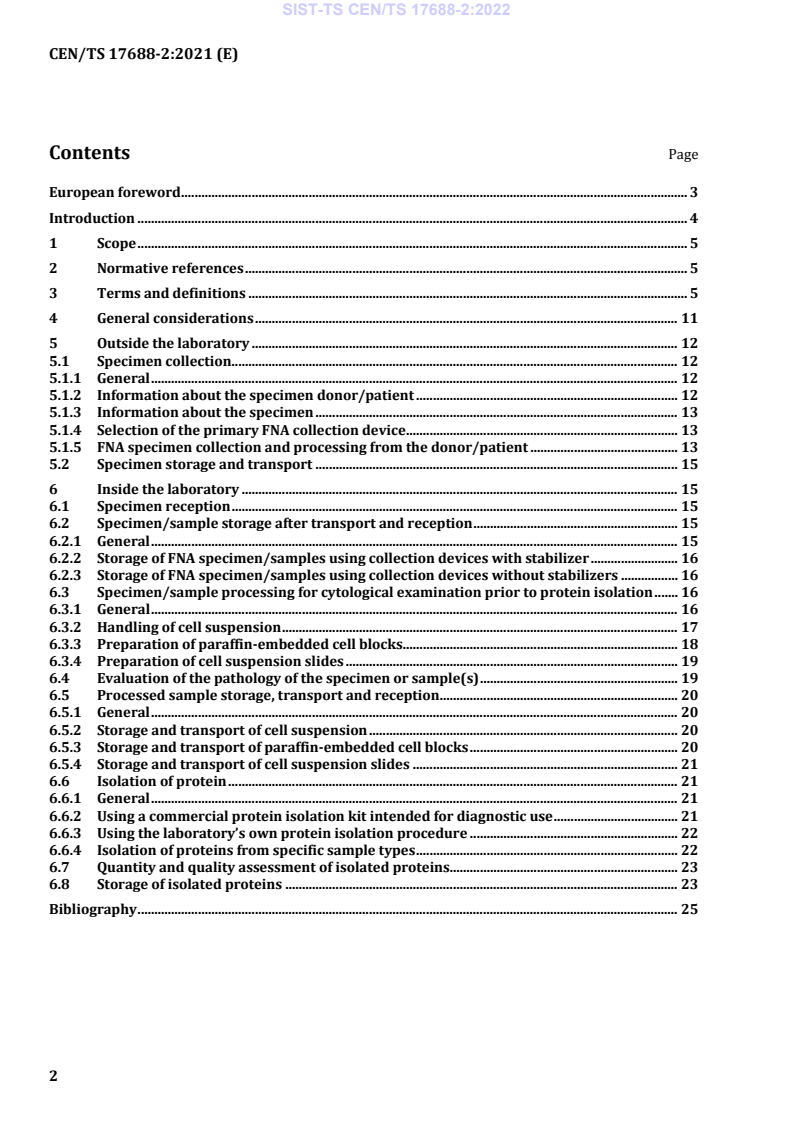
Contents Page
European foreword . 3
Introduction . 4
1 Scope . 5
2 Normative references . 5
3 Terms and definitions . 5
4 General considerations . 11
5 Outside the laboratory . 12
5.1 Specimen collection . 12
5.1.1 General . 12
5.1.2 Information about the specimen donor/patient . 12
5.1.3 Information about the specimen . 13
5.1.4 Selection of the primary FNA collection device . 13
5.1.5 FNA specimen collection and processing from the donor/patient . 13
5.2 Specimen storage and transport . 15
6 Inside the laboratory . 15
6.1 Specimen reception . 15
6.2 Specimen/sample storage after transport and reception . 15
6.2.1 General . 15
6.2.2 Storage of FNA specimen/samples using collection devices with stabilizer . 16
6.2.3 Storage of FNA specimen/samples using collection devices without stabilizers . 16
6.3 Specimen/sample processing for cytological examination prior to protein isolation . 16
6.3.1 General . 16
6.3.2 Handling of cell suspension . 17
6.3.3 Preparation of paraffin-embedded cell blocks. 18
6.3.4 Preparation of cell suspension slides . 19
6.4 Evaluation of the pathology of the specimen or sample(s) . 19
6.5 Processed sample storage, transport and reception . 20
6.5.1 General . 20
6.5.2 Storage and transport of cell suspension . 20
6.5.3 Storage and transport of paraffin-embedded cell blocks . 20
6.5.4 Storage and transport of cell suspension slides . 21
6.6 Isolation of protein . 21
6.6.1 General . 21
6.6.2 Using a commercial protein isolation kit intended for diagnostic use . 21
6.6.3 Using the laboratory’s own protein isolation procedure . 22
6.6.4 Isolation of proteins from specific sample types . 22
6.7 Quantity and quality assessment of isolated proteins. 23
6.8 Storage of isolated proteins . 23
Bibliography . 25
European foreword
This document (CEN/TS 17688-2:2021) has been prepared by Technical Committee CEN/TC 140 “In
vitro diagnostic medical devices”, the secretariat of which is held by DIN.
Attention is drawn to the possibility that some of the elements of this document may be the subject of
patent rights. CEN shall not be held responsible for identifying any or all such patent rights.
Any feedback and questions on this document should be directed to the users’ national standards body.
A complete listing of these bodies can be found on the CEN website.
According to the CEN/CENELEC Internal Regulations, the national standards organisations of the
following countries are bound to announce this Technical Specification: Austria, Belgium, Bulgaria,
Croatia, Cyprus, Czech Republic, Denmark, Estonia, Finland, France, Germany, Greece, Hungary, Iceland,
Ireland, Italy, Latvia, Lithuania, Luxembourg, Malta, Netherlands, Norway, Poland, Portugal, Republic of
North Macedonia, Romania, Serbia, Slovakia, Slovenia, Spain, Sweden, Switzerland, Turkey and the United
Kingdom.
Introduction
Molecular in vitro diagnostics has enabled significant progress in medicine. Further progress is expected
by new technologies analysing profiles of nucleic acids, proteins, and metabolites in human tissues and
body fluids. However, the profiles of these molecules can change drastically during the pre-examination
process, including the specimen collection, transport, storage and processing.
Examination of proteins is commonly used in clinical practice. This includes e.g. prognostic and predictive
biomarker examinations. This is a fast growing field in molecular diagnostics.
Fine needle aspiration is a non-surgical procedure that uses a thin, hollow-bore needle and syringe to
collect a specimen from patients for cytopathological and molecular investigation. As a minimally-
invasive technique, fine needle aspirates (FNAs) are commonly used to diagnose and monitor for example
a range of cancer types, e.g. breast, lung and thyroid cancer, and other diseases, such as inflammatory
diseases. FNAs also provide the opportunity to sample metastatic sites (e.g. lymph nodes) and otherwise
non-resectable tissues.
Besides cytological assessment, molecular biological analysis of FNAs is expected to become increasingly
used for cancer and other disease diagnostics, including companion diagnostics.
One of the challenges facing molecular analysis of FNA samples is their small size and diversity in
composition (cells, blood, body fluid). The low cellular content of FNAs means that the yield of isolated
proteins is typically towards the lower end of detection for molecular examination. Therefore, the protein
isolation procedure should provide a sufficient amount of protein as required by the specific examination.
Protein profiles, protein integrities, and protein–protein interactions in FNAs can change drastically
during and after collection (due to, e.g. gene induction, gene down regulation, protein degradation and
modification). Protein species amounts can change differently in different donors’/patients’ FNAs.
Therefore, standardization of the entire process from specimen collection to protein examination is
needed to minimize protein degradation and protein profile changes during and after FNA collection. This
document describes special measures which need to be taken to obtain good quality FNA
specimens/samples and isolated protein therefrom for molecular examination.
In this document, the following verbal forms are used:
— “shall” indicates a requirement;
— “should” indicates a recommendation;
— “may” indicates a permission;
— “can” indicates a possibility or a capability.
1 Scope
This document gives guidelines on the handling, documentation, storage and processing of fine needle
aspirates (FNAs) intended for protein examination during the pre-examination phase before a molecular
examination is performed.
This document is applicable to molecular in vitro diagnostic examinations including laboratory developed
tests performed by medical laboratories and molecular pathology laboratories that examine proteins
isolated from FNAs. It is also intended to be used by laboratory customers, in vitro diagnostics developers
and manufacturers, biobanks, institutions and commercial organisations performing biomedical
research, and regulatory authorities.
Different dedicated measures are taken for collecting, stabilizing, transporting and storing of core needle
biopsies (FNA Biopsy or FNA B) and are not covered in this document, but in EN ISO 20184-2, Molecular
in vitro diagnostic examinations — Specifications for pre-examination processes for frozen tissue — Part 2:
Isolated proteins and EN ISO 20166-2, Molecular in vitro diagnostic examinations — Specifications for pre-
examination processes for formalin fixed and paraffin-embedded (FFPE) tissue — Part 2: Isolated proteins.
This document is not applicable for protein examination by immunohistochemistry.
NOTE International, national or regional regulations or requirements can also apply to specific topics covered
in this document.
2 Normative references
The following documents are referred to in the text in such a way that some or all of their content
constitutes requirements of this document. For dated references, only the edition cited applies. For
undated references, the latest edition of the referenced document (including any amendments) applies.
EN ISO 15189, Medical laboratories - Requirements for quality and competence (ISO 15189)
3 Terms and definitions
For the purposes of this document, the terms and definitions given in EN ISO 15189:2012 and the
following apply.
ISO and IEC maintain terminological databases for use in standardization at the following addresses:
— ISO Online browsing platform: available at https://www.iso.org/obp
— IEC Electropedia: available at https://www.electropedia.org/
3.1
aliquot
portion of a larger amount of homogenous material, assumed to be taken with negligible sampling error
Note 1 to entry: The term is usually applied to fluids. Tissues are heterogeneous and therefore cannot be
aliquoted.
Note 2 to entry: The definition is derived from the Compendium of Chemical Terminology Gold Book.
International Union of Pure and Applied Chemistry. Version 2.3.3., 2014; the PAC, 1990,62,1193 (Nomenclature for
sampling in analytical chemistry (Recommendations 1990)) p. 1206; and the PAC 1990, 62, 2167 (Glossary of
atmospheric chemistry terms (Recommendations 1990)) p. 2173.
3.2
ambient temperature
unregulated temperature of the surrounding air
[SOURCE: EN ISO 20166-1:2018, 3.2]
3.3
analyte
component represented in the name of a measurable quantity
[SOURCE: ISO 17511:2020, 3.2, modified — Deleted example.]
3.4
biomolecule
organic molecule produced by living organisms that is involved in the maintenance and metabolic
processes of organisms
Note 1 to entry: Examples of organic molecules are protein, carbohydrate, lipid, or nucleic acid.
3.5
cell block
paraffin-embedded cell clot
3.6
cell clot
cell-rich liquid specimen/sample concentrated into a compact cell aggregate for subsequent processing
3.7
cytocentrifugation
cytology method that is specifically designed to concentrate cells on a slide by centrifugation
3.8
deoxyribonucleic acid
DNA
polymer of deoxyribonucleotides occurring in a double-stranded (dsDNA) or single-stranded (ssDNA)
form
[SOURCE: EN ISO 22174:2005, 3.1.2]
3.9
diagnosis
identification of a disease from its signs and symptoms, where the diagnostic process can involve
examinations and tests for classification of an individual's condition into separate and distinct categories
or subclasses that allow medical decisions about treatment and prognosis to be made
[SOURCE: EN ISO 20166-1:2018, 3.7]
3.10
examination
analytical test
set of operations with the objective of determining the value or characteristics of a property
Note 1 to entry: Processes that start with the in situ detection using antibodies, nucleic acid probes or dyes and
include all kinds of parameter testing or chemical manipulation for quantitative or qualitative examination.
[SOURCE: EN ISO 15189:2012, 3.7, modified — Notes to entry 1 to 3 have been removed. Note 1 to entry
has been added and “analytical test” has been added as a preferred term.]
3.11
examination manufacturer
analytical test manufacturer
entity that manufactures and/or produces a specific analytical test
3.12
examination performance
analytical test performance
analytical performance
accuracy, precision, and sensitivity of a test to measure the analyte of interest
Note 1 to entry: Other test performance characteristics such as robustness, repeatability can apply as well.
[SOURCE: EN ISO 20184-1:2018, 3.4]
3.13
fixative
solution used to preserve or harden FNA specimens for microscopic and molecular examination
3.14
formalin
saturated aqueous formaldehyde solution which at 100 % contains 37 % formaldehyde by mass
(corresponding to 40 % by volume)
[SOURCE: EN ISO 20166-1:2018, 3.11]
3.15
fine needle aspirate
FNA
specimen withdrawn by a non-operative procedure that uses a thin, hollow-bore needle
3.16
FNA primary collection device
thin, hollow-bore needle or syringe used for collecting the FNA specimen from the donor/patient
3.17
FNA secondary collection device
suitable container into which the specimen is transferred from the FNA primary collection device
3.18
homogeneous
uniform in structure and composition
[SOURCE: EN ISO 20166-1:2018, 3.31]
3.19
laboratory developed procedure
modified commercially available in vitro diagnostic device or fully in house developed procedure
3.20
nonconformity
nonfulfillment of a requirement
[SOURCE: EN ISO 9000:2015, 3.6.9]
3.21
paraffin embedding
process in which a sample is placed in paraffin to generate a hard surrounding matrix so that thin
microscopic sections can be cut
3.22
pre-examination process
pre-analytical workflow
pre-analytical phase
pre-examination phase
process that starts, in chronological order, from the clinician’s request and includes the examination
request, preparation and identification of the patient, collection of the primary sample(s), transportation
to and within the analytical laboratory, isolation of analytes, and ends when the analytical examination
begins
Note 1 to entry: The pre-examination phase includes preparative processes that influence the outcome of the
intended examination.
[SOURCE: EN ISO 15189:2012, 3.15, modified — An additional term was added and more detail was
included.]
3.23
primary sample
specimen
discrete portion of a body fluid, breath, hair or tissue taken for examination, study or analysis of one or
more quantities or properties assumed to apply for the whole
[SOURCE: EN ISO 15189:2012, 3.16, modified — The term and definition is used here without the original
Notes.]
3.24
proficiency test
evaluation of participant performance against pre-established criteria by means of inter-laboratory
comparisons
[SOURCE: EN ISO/IEC 17043:2010, 3.7, modified — Term and definition are used here without the
original Notes.]
3.25
protein
type of biological macromolecules composed of one or more chains with a defined sequence of amino
acids connected through peptide bonds
3.26
protein profile
amounts of the individual protein molecules that are present in a sample and that can be measured in the
absence of any losses, inhibition and interference
3.27
protein species
amounts of a chemically clearly-defined protein corresponding to one spot on a high-performance two-
dimensional gel electrophoresis pattern
[SOURCE: [16]]
3.28
post translational modifications
PTM
chemical alterations to a primary protein structure, often crucial for conferring biological activity on a
protein
[SOURCE: [17]]
3.29
ribonucleic acid
RNA
polymer of ribonucleotides occurring in a double-stranded or single-stranded form
[SOURCE: EN ISO 22174:2005, 3.1.3]
3.30
room temperature
temperature in the range of 18 °C to 25 °C
Note 1 to entry: Local or national regulations can have different definitions.
[SOURCE: EN ISO 20166-1:2018, 3.22]
3.31
sample
one or more parts taken from a specimen
[SOURCE: EN ISO 15189:2012, 3.24, modified — Example has been removed.]
3.32
stability
ability of a sample material, when stored under specified conditions, to maintain a stated property value
within specified limits for a specified period of time
[SOURCE ISO Guide 30:2015, 2.1.15, modified — The words “reference material” were replaced by
“sample material”.]
3.33
stabilizer
substance which has the ability to maintain a stated property value within specified limits for a specified
period of time of a sample material
Note 1 to entry: The substance can contain a fixative belonging to different fixative subgroups, e.g. crosslinking
fixatives (e.g. formalin) or coagulating fixatives (e.g. methanol, ethanol).
3.34
stabilization
process of maintaining a stated property value within specified limits for a specified period of time of a
specimen/sample material
3.35
standard buffered formalin solution
neutral buffered formalin
NBF
10 % formalin solution in water with a mass fraction of 3,7 % (corresponding to a volume fraction of 4
%) formaldehyde, buffered to pH 6,8 to pH 7,2
Note 1 to entry: Standard buffered formalin solutions often contain small amounts of methanol to inhibit
oxidation and polymerisation of formaldehyde.
[SOURCE: EN ISO 20166-1:2018, 3.25]
3.36
storage
prolonged interruption of the pre-analytical workflow of a sample or analyte respectively, or of their
derivatives, under appropriate conditions in order to preserve their properties
Note 1 to entry: Long-term storage typically occurs in laboratory archives or in biobanks.
[SOURCE: EN ISO 20184-1:2018, 3.21, modified — Example has been removed.]
3.37
tissue processor
automated instrument where tissue fixation, dehydration, clearing and impregnation (with paraffin)
occur
[SOURCE: EN ISO 20166-1:2018, 3.27]
3.38
validation
confirmation, through the provision of objective evidence, that the requirements for a specific intended
use or application have been fulfilled
Note 1 to entry: The term “validated” is used to designate the corresponding status.
[SOURCE: EN ISO 9000:2015, 3.8.13, modified — Note 1 and Note 3 have been omitted.]
3.39
verification
confirmation, through the provision of objective evidence, that specified requirements have been fulfilled
Note 1 to entry: The term “verified” is used to designate the corresponding status.
Note 2 to entry: Confirmation can comprise activities such as:
— performing alternative calculations;
— comparing a new design specification with a similar proven design specification;
— undertaking tests and demonstrations;
— reviewing documents prior to issue.
[SOURCE: EN ISO 9000:2015, 3.8.12, modified — Note 1 and Note 2 have been omitted.]
3.40
workflow
series of activities necessary to complete a task
[SOURCE: EN ISO 20166-1:2018, 3.30]
4 General considerations
For general statements on medical laboratory quality management systems and in particular on
specimen collection, reception and handling (including avoidance of cross contaminations) see
EN ISO 15189, EN ISO/IEC 17020 or EN ISO/IEC 17025. ISO/TS 20658 and EN ISO 20387 (for
biobanking) can also apply. The requirements on laboratory equipment, reagents, and consumables
according to EN ISO 15189 shall be followed; EN ISO/IEC 17020 and EN ISO/IEC 17025 can also apply.
All steps of the pre-examination, examination and post-examination processes (i.e. the entire workflow)
can influence the diagnosis or research study results.
Thus, this entire workflow shall be specified, verified and validated during the development of the
examination, including the development of in vitro diagnostic (IVD) medical devices. This includes
specifically all pre-examination process steps such as the examination request, preparation and
identification of the patient, collection of the primary sample(s), transport to and within the medical
laboratory, storage and isolation of analytes. The specifications about the specimen transport and storage
shall also include information on the stability of the specimen's analyte profile including the timeframe
between collecting the specimen and its examination and storage conditions such as duration,
temperature limits and freeze/thaw cycles. The verification and validation shall take into account the
impact of the FNA specimen variability (e.g. by tissue type, heterogeneity, specimen quantity, presence
of blood cells) on the examination.
During the design and development of a FNA protein based examination, a risk assessment shall be
performed (see also EN ISO 14971). Mitigation measures for eliminating or reducing identified risks shall
be established, where required, for ensuring the performance of the examination. It shall especially be
investigated and ensured that the specific protein profile(s) intended to be analysed is/are not
compromised in a manner impacting the examination performance. This includes investigations on
whether and/or how the protein profile intended to be examined changes during storage and transport.
This can be done, e.g. by applying the intended examination to specimens/samples which underwent time
course studies, reflecting the individual pre-examination process steps such as transport and storage and
by implementing measures to prevent or reduce impacts by the identified pre-analytical variables.
NOTE A time course experiment is a research design that involves repeated observations of the same variables
at specific intervals over a relevant time period (e.g. time 0, 12 h, 24 h, 36 h, 48 h). This is expected to reflect any
knowledge on the stability of the protein(s) of interest. Typically, this involves using aliquots from a homogeneous
starting material.
During the whole pre-examination process, precautions shall be taken to avoid cross contamination
between different specimens/samples (e.g. using single-use material whenever feasible or appropriate
cleaning procedures between processing of different specimens/samples), and to avoid mixing up of
specimens/samples.
During transportation and transient storage between pre-analytical workflow steps of viable cells,
protein profiles can change. In order to minimize pre-analytical impacts on protein profiles, the specimen
should therefore be placed in a collection device containing an appropriate stabilizer solution. The
maximum duration until the specimen is placed into stabilizer solution should be specified and verified.
The duration and the temperature before stabilization shall be documented.
Safety instructions for the whole pre-examination process shall be in place and followed. Safety
regulations on specimen/sample transport and handling shall be considered (see EN ISO 15189,
EN 15190 and ISO/TS 20658). If transport is required over public areas, corresponding regulations or
laws for packaging and transport apply (e.g. International Air Transport Association (IATA) for air
transport).
The manufacturer's material safety data sheet shall be considered for any potentially hazardous material
(e.g. stabilizers such as formaldehyde and methanol).
For all pre-examination steps, the examination manufacturer's instructions shall be followed.
Where, for justified reasons (e.g. unmet patient needs), a commercial product is not used in accordance
to the manufacturer's instructions, responsibility for its verification, validation, use and performance lies
with the laboratory.
5 Outside the laboratory
5.1 Specimen collection
5.1.1 General
For the collection of the FNA specimen, the requirements for the intended molecular examination (e.g.
disease condition, specimen type; see also Clause 6) shall be considered.
See also EN ISO 15189.
5.1.2 Information about the specimen donor/patient
The documentation shall include the identity of the patient/specimen donor, which can be in the form of
a code.
The documentation should include, but is not limited to:
a) the relevant health status of the patient/specimen donor (e.g. disease type, concomitant disease,
demographics [e.g. age and gender]);
b) the information about routine medical treatment and special treatment prior to FNA collection (e.g.
anaesthetics, medications, surgical or diagnostic procedures);
c) the appropriate consent from the specimen donor/patient.
5.1.3 Information about the specimen
The documentation should include, but is not limited to:
a) the type and the purpose of the examination requested including type and location of the FNA
procedure (e.g. lung, lymph node, thyroid gland, breast, head and neck, pancreas);
b) the time and date when the FNA specimen is removed from the body;
c) the aspiration technique used (e.g. suction, capillary method, ultrasound-guided FNA, device used);
d) the tissue condition (e.g. diseased, unaffected by the disease), including references to any
topographic descriptions made by e.g. a surgeon, radiologist or oncologists;
e) the documentation of steps described under 6.2, if the FNA specimen/sample stabilization starts
outside the laboratory at the collection facility.
The documentation should also include the name/identity of the responsible person for collecting the
specimen.
5.1.4 Selection of the primary FNA collection device
The FNA protein profile can be influenced by inadequate collection procedures and inappropriate
storage/transport conditions, FNA specimen/sample preparation as well as by protein isolation
procedures.
FNA specimens should be collected from the donor/patient using appropriate FNA primary collection
devices enabling conventional slide preparation techniques.
The protein examination manufacturer instructions should contain specifications on the FNA primary
collection device (needle and syringe) to be used. Where the examination manufacturer specifies usage
of FNA primary collection devices, these shall be used. Where the examination manufacturer does not
provide such specifications (e.g. due to (a) former less stringent legal framework(s)), the primary
collection device shall be specified, verified and documented by the laboratory.
5.1.5 FNA specimen collection and processing from the donor/patient
5.1.5.1 General
The protein examination manufacturer shall provide specified and verified instructions on the FNA
collection and stabilization procedure. These shall be followed.
Where the examination manufacturer does not provide such specifications (e.g. due to (a) former less
stringent legal framework(s)) the instructions provided by the FNA collection device manufacturer shall
be verified by the laboratory for the intended protein examination.
Where the examination manufacturer and the FNA collection device manufacturer do not provide such
specifications (e.g. due to (a) former less stringent legal framework(s)), the procedure shall be specified,
verified and documented by the laboratory. Instructions shall be written accordingly for the user and
followed.
For transport, storage, processing and for subsequent protein examination, the FNA specimen/samples
are usually transferred into a FNA secondary collection device. This device should be suitable for
centrifugation and should either contain or allow adding a stabilizer (e.g. 15-50 ml polypropylene tubes).
The stabilizer to FNA volume ratio depends on the type of stabilizer and the type of FNA
specimen/sample. This shall be specified and verified.
Where the examination manufacturer specifies usage of FNA secondary collection devices, these shall be
used. Where the examination manufacturer does not provide such specifications (e.g. due to (a) former
less stringent legal framework(s)), the secondary collection device shall be specified, selected, verified
and documented by the laboratory.
For the labelling (sample/specimen identification) of the FNA secondary collection device, a routine
procedure (e.g. as specified in EN ISO 15189 for medical laboratories or EN ISO 20387 for biobanks) shall
be used. Where appropriate, additional information can be provided (e.g. in the form of a 2D-barcode).
The procedure of the FNA specimen collection shall be documented, including the collection devices.
Several FNA specimens from the same patient/donor and the same lesion or site may be put into a single
secondary collection device.
The following steps shall be performed (but are not limited to):
a) the documentation of any additions or modifications to the specimen after removal from the body
(e.g. wash of needle and syringe, addition of reagents);
b) the labelling of the primary and/or secondary collection device (e.g. barcode, specimen type,
quantity, and organ tissue of origin) and additional documentation (information as specified in 5.1.2,
5.1.3);
c) the selection and use of stabilization procedures and packages used for transport according to
applicable regulations (e.g. cooling box for storing and transportation).
5.1.5.2 FNA specimen/sample collection with stabilizers
FNA specimens/samples are usually examined for primary diagnosis with conventional cytological
staining procedures (e.g. May–Grünwald and/or Giemsa staining, PAP stain). The same
specimens/samples can also be used for protein examinations thereafter. Stabilization reagents used for
preservation of protein profiles (i.e. minimizing protein degradation, modification, aggregation) should
therefore also fulfil the cytological examination requirements, where the same sample is used for both
cytological and protein examinations. Where such different examinations are performed, the stabilizer
containing secondary collection device or the stabilization bulk reagent should be selected appropriately
and shall be verified for these examinations by the cytological and/or protein examination laboratory.
FNA stabilizers should sufficiently prevent microbial growth for avoiding impacts on the examination
performance caused by microbial contamination (e.g. target degradation).
If the FNA specimen/sample(s) is (are) intended to be directly fixed or stabilized at the collection facility
before transport to the laboratory, the specimen/samples should be transferred without delay from the
FNA syringe/needle to the secondary collection device, containing the stabilization reagent. The FNA
syringe/needle should be rinsed with an appropriate solution, e.g. stabilizer, buffer or Ringer solution, to
collect all residual specimen material after transfer of specimen. Where the stabilizer manufacturer or
the examination manufacturer has specified a rinsing solution, this shall be used.
5.1.5.3 FNA specimen/sample collection without stabilizers
Where required for justified diagnostic reasons (e.g. dedicated cytological examination not compatible
with the protein stabilizer), the cytological and/or the protein examination laboratory shall decide
whether to use a FNA specimen/sample collection without a stabilizer.
Where the FNA specimen/sample is not stabilized, the syringe or the secondary collection device should
be cooled to 2 °C to 8 °C or kept on wet-ice without delay. Under these cooled conditions, changes to the
FNA protein profiles can still occur. Therefore, the maximum duration until stabilization and/or protein
examination shall be specified and verified.
5.2 Specimen storage and transport
The examination manufacturer should provide specified and verified instructions for the storage and
transport of the collected FNA specimen (e.g. duration, temperature) and these shall be followed.
Where the examination manufacturer does not provide such specifications (e.g. due to (a) former less
stringent legal framework(s)), the procedure shall be specified, verified and documented by the
laboratory. Instructions shall be written accordingly for the user and followed.
When selecting and using transport packages (e.g. box for storing and transportation), transport
regulations apply.
The temperatures of the primary or secondary collection device’s surroundings should be measured and
documented. If the temperature cannot be measured, the temperature shall be estimated and
documented (e.g. as ambient temperature, room temperature, at 2 °C to 8 °C or wet ice).
Unintended freeze–thawing of the FNA specimen and/or sample(s) (e.g. by incorrectly using cool packs)
can lead to protein degradation. It can also impact the cytological characterization. This can be mitigated
by processing the specimen/sample(s) directly or by transferring them into a stabilizer solution.
Any deviations to nonconformities from the verified storage and transport conditions in the written
instructions shall be documented.
6 Inside the laboratory
6.1 Specimen reception
The identity of the person receiving the specimen and/or sample(s) shall be documented. This can e.g. be
done in the form of the name or a code.
The correct identity of the specimen/sample shall be checked. This should include the clinical information
(see 5.1.1 and 5.1.2) of the specimen/sample, hospital admission number and/or patient/specimen
donor identity, name of the patient/specimen donor and date of birth of the patient/specimen donor. In
certain instances, e.g. in research studies, it might be necessary to only work with a code.
The arrival date, time and nonconformities with respect to e.g. labelling, storage and transport
requirements (e.g. temperature, duration) and collection devices (e.g. device type, integrity) shall be
documented. A procedure for handling nonconformities shall be in place.
NOTE This includes for example a note, when specimens/samples have been accidentally frozen.
Where there are nonconformities in collection, labelling, transport and storage of the FNA
specimen/sample that could affect the validity and reliability of the examination, a new specimen should
be obtained, where possible.
6.2 Specimen/sample storage after transport and reception
6.2.1 General
The storage temperature at the laboratory shall be documented.
The total storage duration includes storage durations at the FNA specimen collection facility, the first
examination laboratory (e.g. cytology laboratory), the protein examination laboratory and all transport
durations between these.
The maximum storage duration specified by the examination manufacturer or, if this is not available, by
the collection device manufacturer shall not be exceeded.
Where none of these are available, the maximum storage duration for defined temperature ranges shall
be specified and verified by the laboratory for the intended examination.
6.2.2 Storage of FNA specimen/samples using collection devices with stabilizer
For storing the FNA in devices with stabilizers, the examination manufacturer's instructions on storage
conditions before processing the FNA for protein isolation shall be followed.
Where the examination manufacturer's instructions are not available, the collection device
manufacturer's instructions shall be followed and verified for the intended examination.
Where none of these are available, the laboratory shall specify and verify the maximum storage duration
at defined temperature ranges for the intended examination.
The total storage duration specifications shall not be exceeded.
6.2.3 Storage of FNA specimen/samples using collection devices without stabilizers
For storing the FNA in devices without stabilizers, the examination manufacturer's instructions on
storage duration and temperature before processing the FNA for protein isolation shall be followed.
For a longer storage duration beyond the specified maximum storage duration without stabilizer, the
examination manufacturer instructions shall specify the addition of a stabilizer and associated
instructions on storage duration and temperature ranges. These shall be followed. Where after a
cytological examination, a sample taken from the FNA specimen/sample is only intended to be processed
further for protein examination, it can be stabilized by freezing, e.g. −70 °C or below, according to the
examination manufacturer's instructions.
Where the examination manufacturer's instructions are not provided (e.g. due to (a) former less stringent
legal framework(s)), the laboratory shall specify and verify the maximum storage duration for defined
temperature ranges for the intended examination. Depending on the verification result, it can be required
that the FNA specimen/samples need to be processed without delay, where not stabilized (see 6.4).
For a longer storage duration beyond the specified maximum storage duration without stabilizer, the
laboratory shall add a stabilizer and shall specify and verify the maximum storage duration for defined
temperature ranges for the intended examination.
NOTE 1 Addition of pure alcohols (e.g. ≥ 95 % ethanol, isopropanol, methanol) can stabilize the FNA protein
profile to a limited extent, but does not preserve cellular features in the sample, e.g. morphology.
NOTE 2 Addition of buffers, e.g. phosphate-buffered saline (PBS), Ringer solution, to the FNA specimen/samples
to avoid drying does not stabilize cytology and biomolecule integrity in the specimen/sample(s).
The total storage duration limit shall not be exceeded.
6.3 Specimen/sample processing for cytological examination prior to protein isolation
6.3.1 General
Usually, cytological examination is made prior to deciding which protein examination is needed. For this
cytological examination, specific specimen/sample processing steps are required.
The protein examination manufacturer should provide specified and verified instructions for the
specimen/sample processing prior to cytological examination and prior to FNA protein isolation. These
shall be followed.
Where such instructions are not provided (e.g. due to (a) former less stringent legal framework(s)), but
the cytological examination or the stabilization solution provider supplies these, thes
...