

oSIST prEN 17206-1:2025
(Main)Entertainment technology - Part 1: Machinery for stages and other production areas - Safety requirements and inspections
General Information
- Abstract
This document applies to machinery, machinery installations and machinery control systems used in places of assembly and in staging and production facilities for events and theatrical productions (stage machinery, for short). Such facilities include theatres, multi-purpose halls, exhibition halls; film, television and radio studios; concert halls, schools, bars, discotheques, open-air stages and other rooms for shows and events.
The document applies to machinery installations with guided or unguided loads.
This document covers machinery used in the entertainment industry including machinery that is excluded from the Machinery Directive (2006/42/EC) specifically Article 1, 2(j) which excludes “machinery intended to move performers during artistic performances”.
This machinery includes controls, electrical and electronic control systems, electrical and electronic equipment, hydraulic and pneumatic power supplies.
The principles in this document also apply to machinery installations based on new technologies or specially designed installations which are not expressly mentioned here but which nevertheless operate in a similar manner or are meant for similar purposes to the equipment listed above.
- Status
- Not Published
- Public Enquiry End Date
- 29-Sep-2025
- Technical Committee
- I13 - Imaginarni 13
- Current Stage
- 4020 - Public enquire (PE) (Adopted Project)
- Start Date
- 04-Aug-2025
- Due Date
- 22-Dec-2025
- Completion Date
- 01-Oct-2025

Overview
The oSIST prEN 17206-1:2025:2025 standard, issued by the European Committee for Standardization (CEN), establishes comprehensive safety requirements and inspection protocols for machinery used in stages and other production areas within the entertainment industry. This includes all machinery, installations, and control systems employed across diverse venues-such as theatres, concert halls, studios, exhibition centers, schools, and open-air stages-supporting theatrical performances, concerts, and other live events.
Covering both guided and unguided load machinery, this document ensures that equipment associated with stage technology adheres to stringent safety principles, encompassing mechanical, electrical, hydraulic, and pneumatic components. The standard also extends its principles to specialized or newer technology installations that operate similarly to traditional stage machinery.
Key Topics
Machinery Scope & Definitions
- Addresses a wide array of stage and production machinery, including lifting devices, stage wagons, elevators, and performer flying systems.
- Defines essential terminology related to loads, forces, pressures, and control systems pertinent to entertainment technology.
Safety Hazards and Risk Management
- Identifies significant hazards such as crushing, shearing, trapping points, and fall risks associated with stage machinery.
- Emphasizes the importance of safeguarding hazardous areas to protect operators and performers.
Design and Load Requirements
- Lays out design standards for load-bearing equipment like wire ropes, chains, and diverter pulleys.
- Provides load assumptions specifically for stage components such as elevators, wagons, and turntables.
- Details requirements for drive systems including hydraulic, manual, and auxiliary drives, with focus on load securing and capacity limiters.
Electrical and Control Systems Safety
- Specifies stringent requirements for electrical equipment, control circuits, and control functions.
- Highlights safety functions and fault tolerance strategies to ensure machinery operates reliably even during failures.
- Covers emergency stop functions and protective measures to mitigate accidents.
- Discusses electronic and programmable electronic systems (E/PES) usage, focusing on safety function implementation.
Inspections, Testing, and Documentation
- Mandates rigorous testing before first use and following substantial modifications or repairs.
- Details documentation requirements including operating manuals, installation guides, maintenance instructions, and inspection records.
- Sets standards for marking, warning signs, and clear reference designations to improve operational safety.
Applications
The oSIST prEN 17206-1:2025:2025 is critical for safety managers, stage machinery designers, operators, and maintenance teams working in:
- Theatres and opera houses
- Concert and multi-purpose halls
- Film, television, and radio studios
- Exhibition and event venues
- Schools with performing arts facilities
- Open-air stages and festival sites
- Bars, discotheques, and other public assembly spaces with live performances
By applying this standard, venues and production companies can significantly mitigate risks, protect personnel, and ensure legal compliance with European safety regulations related to stage machinery.
Related Standards
- Machinery Directive 2006/42/EC - Fundamental EU directive governing machinery safety across industries, from which some stage machinery exceptions are noted.
- EN 17206:2020 - The previous version that oSIST prEN 17206-1:2025:2025 will supersede, continuing to evolve safety practices.
- Electrical safety standards relevant to industrial control systems and programmable safety equipment.
- Standards addressing load handling and lifting appliances for industrial and theatrical environments.
Keywords: entertainment technology, stage machinery safety, machinery installations, stage equipment inspections, electrical control systems, stage load safety, theatrical production safety, CEN standards, machinery safety requirements, performer safety systems, stage lifts, safety inspections, stage technology standards, European stage machinery safety.
Relations
- Effective Date
- 28-May-2025
- Effective Date
- 05-Feb-2025
Frequently Asked Questions
oSIST prEN 17206-1:2025 is a draft published by the Slovenian Institute for Standardization (SIST). Its full title is "Entertainment technology - Part 1: Machinery for stages and other production areas - Safety requirements and inspections". This standard covers: This document applies to machinery, machinery installations and machinery control systems used in places of assembly and in staging and production facilities for events and theatrical productions (stage machinery, for short). Such facilities include theatres, multi-purpose halls, exhibition halls; film, television and radio studios; concert halls, schools, bars, discotheques, open-air stages and other rooms for shows and events. The document applies to machinery installations with guided or unguided loads. This document covers machinery used in the entertainment industry including machinery that is excluded from the Machinery Directive (2006/42/EC) specifically Article 1, 2(j) which excludes “machinery intended to move performers during artistic performances”. This machinery includes controls, electrical and electronic control systems, electrical and electronic equipment, hydraulic and pneumatic power supplies. The principles in this document also apply to machinery installations based on new technologies or specially designed installations which are not expressly mentioned here but which nevertheless operate in a similar manner or are meant for similar purposes to the equipment listed above.
This document applies to machinery, machinery installations and machinery control systems used in places of assembly and in staging and production facilities for events and theatrical productions (stage machinery, for short). Such facilities include theatres, multi-purpose halls, exhibition halls; film, television and radio studios; concert halls, schools, bars, discotheques, open-air stages and other rooms for shows and events. The document applies to machinery installations with guided or unguided loads. This document covers machinery used in the entertainment industry including machinery that is excluded from the Machinery Directive (2006/42/EC) specifically Article 1, 2(j) which excludes “machinery intended to move performers during artistic performances”. This machinery includes controls, electrical and electronic control systems, electrical and electronic equipment, hydraulic and pneumatic power supplies. The principles in this document also apply to machinery installations based on new technologies or specially designed installations which are not expressly mentioned here but which nevertheless operate in a similar manner or are meant for similar purposes to the equipment listed above.
oSIST prEN 17206-1:2025 is classified under the following ICS (International Classification for Standards) categories: 97.200.10 - Theatre, stage and studio equipment. The ICS classification helps identify the subject area and facilitates finding related standards.
oSIST prEN 17206-1:2025 has the following relationships with other standards: It is inter standard links to SIST EN 17206:2020/AC:2021, SIST EN 17206:2020. Understanding these relationships helps ensure you are using the most current and applicable version of the standard.
oSIST prEN 17206-1:2025 is available in PDF format for immediate download after purchase. The document can be added to your cart and obtained through the secure checkout process. Digital delivery ensures instant access to the complete standard document.
Standards Content (Sample)
SLOVENSKI STANDARD
01-september-2025
Razvedrilna tehnologija - 1. del: Stroji za odre in druge prireditvene prostore -
Varnostne zahteve in pregledi
Entertainment technology - Part 1: Machinery for stages and other production areas -
Safety requirements and inspections
Veranstaltungstechnik - Teil 1: Maschinen für Bühnen und andere Produktionsbereiche -
Sicherheitstechnische Anforderungen und Prüfungen
Technologies du spectacle - Partie 1: Machinerie pour scènes et autres zones de
production - Exigences et inspections relatives à la sécurité
Ta slovenski standard je istoveten z: prEN 17206-1
ICS:
97.200.10 Gledališka, odrska in Theatre, stage and studio
studijska oprema ter delovne equipment
postaje
2003-01.Slovenski inštitut za standardizacijo. Razmnoževanje celote ali delov tega standarda ni dovoljeno.
DRAFT
EUROPEAN STANDARD
NORME EUROPÉENNE
EUROPÄISCHE NORM
July 2025
ICS 97.200.10 Will supersede EN 17206:2020
English Version
Entertainment technology - Part 1: Machinery for stages
and other production areas - Safety requirements and
inspections
Technologies du spectacle - Partie 1: Machinerie pour Veranstaltungstechnik - Teil 1: Maschinen für Bühnen
scènes et autres zones de production - Exigences et und andere Produktionsbereiche -
inspections relatives à la sécurité Sicherheitstechnische Anforderungen und Prüfungen
This draft European Standard is submitted to CEN members for enquiry. It has been drawn up by the Technical Committee
CEN/TC 433.
If this draft becomes a European Standard, CEN members are bound to comply with the CEN/CENELEC Internal Regulations
which stipulate the conditions for giving this European Standard the status of a national standard without any alteration.
This draft European Standard was established by CEN in three official versions (English, French, German). A version in any other
language made by translation under the responsibility of a CEN member into its own language and notified to the CEN-CENELEC
Management Centre has the same status as the official versions.
CEN members are the national standards bodies of Austria, Belgium, Bulgaria, Croatia, Cyprus, Czech Republic, Denmark, Estonia,
Finland, France, Germany, Greece, Hungary, Iceland, Ireland, Italy, Latvia, Lithuania, Luxembourg, Malta, Netherlands, Norway,
Poland, Portugal, Republic of North Macedonia, Romania, Serbia, Slovakia, Slovenia, Spain, Sweden, Switzerland, Türkiye and
United Kingdom.
Recipients of this draft are invited to submit, with their comments, notification of any relevant patent rights of which they are
aware and to provide supporting documentation.
Warning : This document is not a European Standard. It is distributed for review and comments. It is subject to change without
notice and shall not be referred to as a European Standard.
EUROPEAN COMMITTEE FOR STANDARDIZATION
COMITÉ EUROPÉEN DE NORMALISATION
EUROPÄISCHES KOMITEE FÜR NORMUNG
CEN-CENELEC Management Centre: Rue de la Science 23, B-1040 Brussels
© 2025 CEN All rights of exploitation in any form and by any means reserved Ref. No. prEN 17206-1:2025 E
worldwide for CEN national Members.
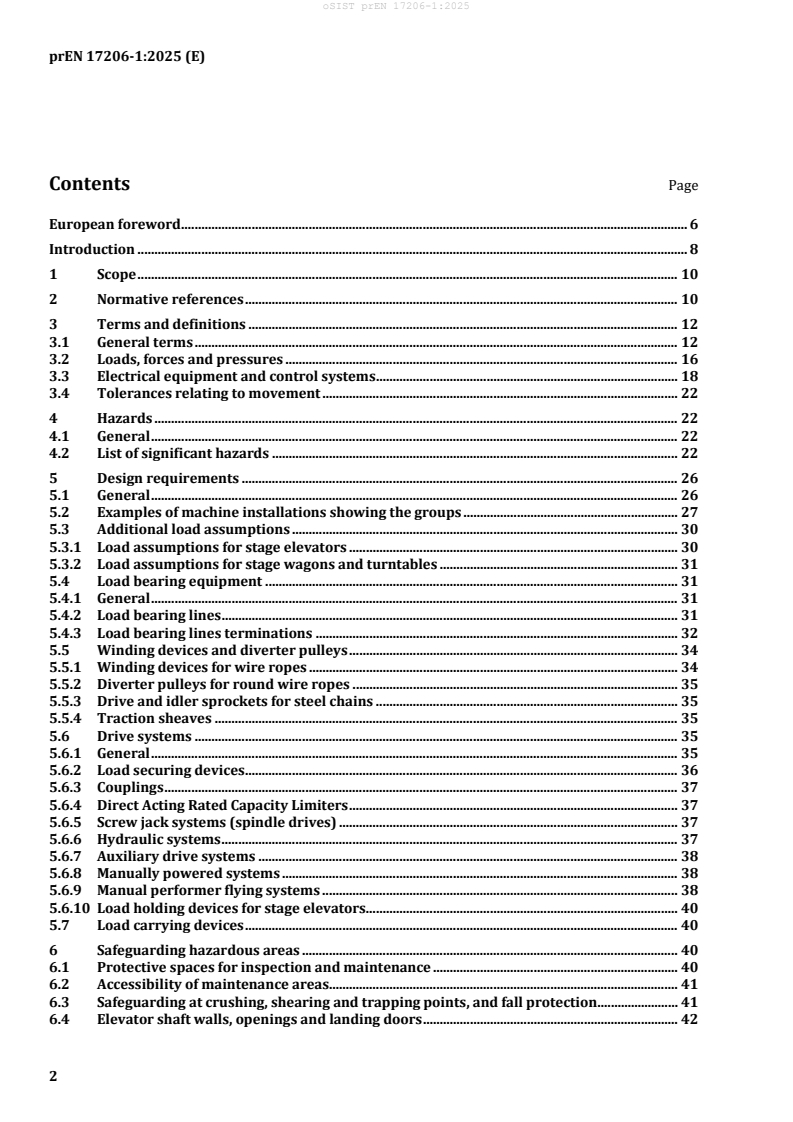
Contents Page
European foreword . 6
Introduction . 8
1 Scope . 10
2 Normative references . 10
3 Terms and definitions . 12
3.1 General terms . 12
3.2 Loads, forces and pressures . 16
3.3 Electrical equipment and control systems . 18
3.4 Tolerances relating to movement . 22
4 Hazards . 22
4.1 General . 22
4.2 List of significant hazards . 22
5 Design requirements . 26
5.1 General . 26
5.2 Examples of machine installations showing the groups . 27
5.3 Additional load assumptions . 30
5.3.1 Load assumptions for stage elevators . 30
5.3.2 Load assumptions for stage wagons and turntables . 31
5.4 Load bearing equipment . 31
5.4.1 General . 31
5.4.2 Load bearing lines . 31
5.4.3 Load bearing lines terminations . 32
5.5 Winding devices and diverter pulleys . 34
5.5.1 Winding devices for wire ropes . 34
5.5.2 Diverter pulleys for round wire ropes . 35
5.5.3 Drive and idler sprockets for steel chains . 35
5.5.4 Traction sheaves . 35
5.6 Drive systems . 35
5.6.1 General . 35
5.6.2 Load securing devices . 36
5.6.3 Couplings . 37
5.6.4 Direct Acting Rated Capacity Limiters . 37
5.6.5 Screw jack systems (spindle drives) . 37
5.6.6 Hydraulic systems . 37
5.6.7 Auxiliary drive systems . 38
5.6.8 Manually powered systems . 38
5.6.9 Manual performer flying systems . 38
5.6.10 Load holding devices for stage elevators. 40
5.7 Load carrying devices . 40
6 Safeguarding hazardous areas . 40
6.1 Protective spaces for inspection and maintenance . 40
6.2 Accessibility of maintenance areas. 41
6.3 Safeguarding at crushing, shearing and trapping points, and fall protection . 41
6.4 Elevator shaft walls, openings and landing doors . 42
6.4.1 General . 42
6.4.2 Interlocking of doors . 42
6.5 Counterweights . 42
7 Electrical equipment and control systems . 43
7.1 General requirements . 43
7.1.1 General . 43
7.1.2 Selection of equipment . 44
7.1.3 Physical environment and operation conditions . 44
7.2 Incoming supply conductor terminations and devices for disconnecting and switching off
............................................................................................................................................................................. 44
7.2.1 Electric motors and associated equipment . 44
7.2.2 Protection against electric shock . 45
7.2.3 Protection of equipment . 45
7.2.4 Control circuits and control functions . 46
7.2.5 Travel of groups of machines . 46
7.3 Safety functions and control functions in the event of failure . 47
7.3.1 General . 47
7.3.2 Providing redundancy . 48
7.3.3 Hazardous operating conditions . 48
7.3.4 Safety devices and safety functions . 49
7.3.5 Means for testing safety devices and safety functions . 52
7.4 Emergency stop functions . 53
7.4.1 Emergency stop . 53
7.4.2 Actuators for and design of emergency stop functions . 53
7.5 Complementary Protective Measures . 53
7.5.1 General . 53
7.5.2 Limitation of number of simultaneous moving machines . 54
7.5.3 Protection against unplanned load deviations (load profile monitoring) . 54
7.6 Electronic and programmable electronic systems (E/PES) . 54
7.6.1 General . 54
7.6.2 Programmable controllers . 54
7.6.3 Use of programmable electronic systems (E/E/PES) to implement safety functions . 54
7.7 Use of electronic and programmable electronic systems (E/PES) without safety functions
............................................................................................................................................................................. 54
7.8 Operator interfaces, control devices and contactors . 54
7.8.1 General . 54
7.8.2 Requirements for contactors . 54
7.9 Marking, warning signs and reference designations . 55
7.10 Testing and validation of electrical systems . 55
7.10.1 General . 55
7.10.2 Scope of routine testing . 55
7.11 Validation and verification of functional safety systems . 55
8 Documentation . 55
8.1 General . 55
8.2 Technical data to be included . 56
8.2.1 General . 56
8.2.2 User information for safety functions . 56
8.3 Marking . 57
8.3.1 General . 57
8.3.2 Entertainment load limit . 57
8.3.3 Supplementary loading information . 58
8.3.4 Machinery . 58
8.3.5 Remote operation . 59
8.4 Documentation and information . 59
8.4.1 General . 59
8.4.2 Operating manual . 59
8.4.3 Installation Instructions . 61
8.4.4 Repair and maintenance instructions . 61
8.4.5 Inspection and examination . 62
8.4.6 Dismantling instructions . 62
8.4.7 Appendix to instructions (for additional necessary documents) . 62
9 Testing prior to first use and after substantial changes . 63
9.1 General . 63
9.2 Test log . 63
9.3 Testing prior to first use . 63
9.3.1 Type, extent and performance of tests . 63
9.3.2 Acceptance test . 64
9.4 Test after changes and modifications . 66
9.4.1 Substantial Changes . 66
9.4.2 Any other changes . 66
Annex A (informative) Examples of hazards and risk origin . 67
Annex B (normative) Use case definitions . 76
B.1 General . 76
B.2 Upper machinery - lifting . 76
B.3 Upper machinery – horizontal movement . 77
B.4 Lower machinery – lifting . 77
B.5 Lower machinery – horizontal movement . 78
Annex C (informative) Recommended safety functions and measures . 79
C.1 General . 79
C.2 Upper machinery - lifting . 79
C.3 Upper machinery – horizontal movement . 80
C.4 Lower machinery – lifting . 81
C.5 Lower machinery – horizontal movement . 82
Annex D (normative) End user information table to be supplied by the manufacturer . 83
Annex E (informative) Designing safeguards on the basis of risk assessment . 86
E.1 General . 86
E.2 Risk assessment as in EN 62061 . 86
E.3 Risk assessment as in EN ISO 13849-1 . 92
Annex F (informative) Examples of using the risk graphs . 95
F.1 Guidance for risk evaluation values for control system functions . 95
F.2 Severity . 95
F.3 Possibility of avoiding the hazardous event . 96
F.4 Possibility frequency and duration of exposure . 96
F.5 Probability of occurrence of a hazardous event . 97
Annex G (informative) Application examples . 98
G.1 General . 98
G.2 Chain hoist for a speaker cluster – Stop on “deadman release” . 98
G.3 Broadcast studio lighting hoist – Protection against overload . 100
G.4 Group of winches lifting a common load – protection against loss of group synchronization
.......................................................................................................................................................................... 102
G.5 Chain hoist to fly a performer – protection against over-speed . 104
G.6 Two winches to fly a performer – Protection against position deviation . 106
G.7 Orchestra pit elevator – Protection against crushing/shearing . 108
G.8 Stage elevator platform – Protection against overload . 110
Annex H (informative) Guidelines for the evaluation of exceptional loads occurring during
vertical movement . 113
H.1 General . 113
H.2 Calculation of exceptional loads . 113
H.3 Measuring the effects of the exceptional load . 114
H.4 Example . 114
Annex I (informative) Partial Safety Factors and Design Risk Factors . 117
I.1 Partial safety factors . 117
I.2 Risk coefficient . 117
I.3 Adapted version of Table 1 with partial safety factors and risk coefficient . 117
Bibliography . 119
European foreword
This document (prEN 17206-1:2025) has been prepared by Technical Committee CEN/TC 433
“Entertainment Technology – Machinery, equipment and installations”, the secretariat of which is held
by DIN.
This document is currently submitted to the CEN Enquiry.
This document will supersede EN 17206:2020 and EN 17206:2020/AC:2021.
CEN/TC 433/WG1 has reviewed EN 17206:2020 to adapt the standard to the technical progress, new
requirements and changes in the standard referenced. The main changes are:
— Terminology related to axis definition has been removed and replaced with shared loads, group of
machines, individual machines, and multiple machines, according to context.
— The definitions of shared and non-shared loads, control system, normal operation, positive load
holding device, and friction load holding device have been added.
— Exceptional load and related failure conditions have been adopted, replacing the concept of Load at
Failure, which is no longer referenced.
— Load assumptions for lower machinery and horizontal machinery have been revised.
— The drive system chapter has been restructured.
— Requirements for Direct Acting Capacity Limiters settings have been revised to align with
EN 14492-2 specifications.
— Traction sheaves specifications, following design requirements as per EN 81-50:2020, have been
adopted.
— Clarifications concerning dynamic forces to be considered for UC1 and UC2 machinery have been
added.
— Manual performer flying system requirements related to fibre ropes, operator lines, travel ropes,
pulleys, block systems, sheaves, drums, track systems, and trolleys have been added.
— Requirements and specifications for machinery horizontal movements have been added.
— Load test of lifting equipment specifications has been revised.
— Specifications and description of protection against position deviation have been added.
— Upper machinery and Lower machinery Use Case requirements have been revised, with the addition
of Use Cases for Upper machinery horizontal movements.
— Standard references to Eurocodes have been corrected.
— An informative Annex H for the calculation of exceptional loads has been added to the document.
— An informative Annex I for the definition of the partial safety factors and design risk factors has been
added to the document.
EN 17206, Machinery for stages and other production areas consists of the following parts:
— Part 1: Safety requirements and inspections [the present document]
— Part 2: Safety requirements for stands and truss lifts of stands
Introduction
The purpose of this document is to produce European safety specifications for the design, manufacture
and installation of lifting and load bearing equipment within the entertainment industry. Apart from the
Machinery Directive, the Council Directive 2009/104/EC of 16 September 2009 concerning the minimum
safety and health requirements for the use of work equipment by workers at work states in Annex II:
“3.1.3
Measures must be taken to ensure that workers are not present under suspended loads, unless such presence
is required for the effective operation of the work
Loads may not be moved above unprotected workplaces usually occupied by workers.
Where that is the case, if work cannot be carried out properly any other way, appropriate procedures must
be laid down and applied.”
This document considers situations that give rise to danger, such as moving or holding scenery or
equipment:
a) over persons and/or unprotected areas;
b) in areas with low light conditions, limited visibility, for example while using stage fog and other
masking effects.
These situations apply not only during performances, but also during rehearsals, technical set-up,
preparations, installations and other situations. This document covers these hazards and suggests
appropriate procedures to maintain safety.
Machinery installations are all technical installations and equipment used for operations in stage and
production facilities in the entertainment industry. Such installations are used to lift, lower, suspend and
carry loads (e.g. scenery, traverse systems, or lighting, film/video and sound equipment). They can also
be used to move persons, and persons can stand under such equipment while the loads are at rest or in
motion.
“Stages” are, for example, staging facilities and production areas in theatres, multipurpose halls, studios,
production facilities for film, television or radio, concert halls, congress centres, schools, exhibition
centres, trade-fair centres, museums, discotheques, amusement parks, sports facilities and open-air-
theatres.
“Events” are, for example, concerts, shows, congresses, exhibitions, presentations, demonstrations, film
or television recordings, etc.
This document considers permanently and temporarily installed lifting and movement equipment for
stages and production areas within the entertainment industry.
This document does not consider the design or control of fire curtains.
Typical applications of this document include but are not limited to the following:
— acoustic doors;
— auditorium elevators;
— compensating elevators;
— cycloramas;
— fly bar systems (manually powered and motor driven);
— lighting bars;
— movable lighting towers;
— movable proscenium arches;
— orchestra elevators;
— performer flying systems;
— point hoists;
— revolving stages and turntables;
— rotators;
— scenery storage elevators;
— side stage and rear stage shutters;
— stage elevators;
— stage wagons;
— tiltable stage floors;
— track guided systems;
— trap elevators.
This document is a type C standard as stated in EN ISO 12100.
When provisions of this type C standard are different from those stated in type A or B standards, the
provisions of this type C standard take precedence over the provision of the other standards, for machines
that have been designed and built according to the provisions of this type C standard.
1 Scope
This document applies to machinery, machinery installations and machinery control systems used in
places of assembly and in staging and production facilities for events and theatrical productions (stage
machinery, for short). Such facilities include theatres, multi-purpose halls, exhibition halls; film,
television and radio studios; concert halls, schools, bars, discotheques, open-air stages and other rooms
for shows and events.
The document applies to machinery installations with guided or unguided loads.
This document covers machinery used in the entertainment industry including machinery that is
excluded from the Machinery Directive (2006/42/EC) specifically Article 1, 2(j) which excludes
“machinery intended to move performers during artistic performances”.
This machinery includes controls, electrical and electronic control systems, electrical and electronic
equipment, hydraulic and pneumatic power supplies.
The principles in this document also apply to machinery installations based on new technologies or
specially designed installations which are not expressly mentioned here but which nevertheless operate
in a similar manner or are meant for similar purposes to the equipment listed above.
2 Normative references
The following documents are referred to in the text in such a way that some or all of their content
constitutes requirements of this document. For dated references, only the edition cited applies. For
undated references, the latest edition of the referenced document (including any amendments) applies.
EN 81-50, Safety rules for the construction and installation of lifts - Examinations and tests - Part 50: Design
rules, calculations, examinations and tests of lift components
EN 818-1, Short link chain for lifting purposes — Safety — Part 1: General conditions of acceptance
EN 818-7, Short link chain for lifting purposes — Safety — Part 7: Fine tolerance hoist chain, Grade T
(Types T, DAT and DT)
EN 1090-2, Execution of steel structures and aluminium structures — Part 2: Technical requirements for
steel structures
EN 1090-3, Execution of steel structures and aluminium structures — Part 3: Technical requirements for
aluminium structures
EN 1993-1, Eurocode 3: Design of steel structures
EN 1999-1, Eurocode 9: Design of aluminium structures
EN 10204, Metallic products — Types of inspection documents
EN 12385-4, Steel wire ropes — Safety — Part 4: Stranded ropes for general lifting applications
EN 13411 (all parts), Terminations for steel wire ropes — Safety
EN 13480-3, Metallic industrial piping — Part 3: Design and calculation
EN 14492-1, Cranes — Power driven winches and hoists — Part 1: Power driven winches
EN 14492-2, Cranes — Power driven winches and hoists — Part 2: Power driven hoists
EN 60034-1, Rotating electrical machines — Part 1: Rating and performance (IEC 60034-1)
EN 60204-1, Safety of machinery — Electrical equipment of machines — Part 1: General requirements
EN 60204-32, Safety of machinery — Electrical equipment of machines — Part 32: Requirements for
hoisting machines
EN IEC 60947-4-1, Low-voltage switchgear and controlgear — Part 4-1: Contactors and motor-starters —
Electromechanical contactors and motor-starters (IEC 60947-4-1)
EN 60947-5-1, Low-voltage switchgear and controlgear — Part 5-1: Control circuit devices and switching
elements — Electromechanical control circuit devices (IEC 60947-5-1)
EN IEC 61000-6-2, Electromagnetic compatibility (EMC) — Part 6-2: Generic standards — Immunity
standard for industrial environments (IEC 61000-6-2)
EN IEC 61000-6-4, Electromagnetic compatibility (EMC) — Part 6-4: Generic standards — Emission
standard for industrial environments (IEC 61000-6-4)
EN 61326-3-1, Electrical equipment for measurement, control and laboratory use — EMC requirements —
Part 3-1: Immunity requirements for safety-related systems and for equipment intended to perform safety-
related functions (functional safety) — General industrial applications
EN IEC 61439-1, Low-voltage switchgear and controlgear assemblies — Part 1: General rules
(IEC 61439-1)
EN 61508 (all parts), Functional safety of electrical/electronic/programmable electronic safety-related
systems (IEC 61508)
EN 62061, Safety of machinery — Functional safety of safety-related electrical, electronic and
programmable electronic control systems
EN 81346-1, Industrial systems, installations and equipment and industrial products — Structuring
principles and reference designations — Part 1: Basic rules (IEC 81346-1)
EN IEC/IEEE 82079-1, Preparation of information for use (instructions for use) of products — Part 1:
Principles and general requirements (IEC/IEEE 82079-1)
EN ISO 12100:2010, Safety of machinery — General principles for design — Risk assessment and risk
reduction (ISO 12100:2010)
EN ISO 13849-1, Safety of machinery — Safety-related parts of control systems — Part 1: General principles
for design
EN ISO 13849-2, Safety of machinery — Safety-related parts of control systems — Part 2: Validation
EN ISO 13850, Safety of machinery — Emergency stop function — Principles for design (ISO 13850)
EN ISO 13854, Safety of machinery — Minimum gaps to avoid crushing of parts of the human body (ISO
13854)
EN ISO 13857, Safety of machinery — Safety distances to prevent hazard zones being reached by upper and
lower limbs (ISO 13857) )
3 Terms and definitions
For the purposes of this document, the following terms and definitions apply.
ISO and IEC maintain terminology databases for use in standardization at the following addresses:
— ISO Online browsing platform: available at https://www.iso.org/obp/
— IEC Electropedia: available at https://www.electropedia.org/
3.1 General terms
3.1.1
competent person
person with sufficient practical and theoretical knowledge and experience to carry out the person’s
duties, and who is aware of the limits of the person’s competency, expertise and knowledge
3.1.2
drive system
part of a load bearing machine that executes movement and holding of the load and which converts
energy into movement
Note 1 to entry: See Figure 2 c), Figure 3 c) and Figure 4 c).
3.1.3
emergency stop
emergency stop function
E-stop
function which is intended to
— avert arising or reduce existing hazards to persons, damage to machinery or to work in progress, and
— be initiated by a single human action
Note 1 to entry: ISO 13850 gives detailed provisions.
[SOURCE: EN ISO 12100:2010, 3.40, modified — Term “E-Stop” added]
3.1.4
failure
termination of the ability of an item to perform a required function
Note 1 to entry: After failure the item has a fault.
Note 2 to entry: “Failure” is an event, as distinguished from “fault”, which is a state.
Note 3 to entry: This concept as defined does not apply to items consisting of software only.
Note 4 to entry: In practice the terms “failure” and “fault” are often used synonymously.
[SOURCE: IEV 192-03-01]
3.1.5
fault
state of an item characterized by inability to perform a required function, excluding the inability during
preventive maintenance or other planned actions, or due to lack of external resources
Note 1 to entry: A fault is often the result of a failure of the item itself, but can exist without prior failure.
Note 2 to entry: In the field of machinery, the English term “fault” is commonly used in accordance with the
definition in IEV 192-04-01, whereas the French term “défaut” and the German term “Fehler” are used rather than
the terms “Panne” and “Fehlzustand” that appear in the IEV with this definition.
Note 3 to entry: In practice, the terms “fault” and “failure” are often used synonymously.
[SOURCE: EN ISO 12100:2010, 3.33]
3.1.6
fly bar
fly bar (e.g. bar or truss) having several load bearing lines for lifting, lowering, and suspending loads, with
the load being either uniformly distributed or concentrated (point load)
Note 1 to entry: A distinction is made between manually powered flying systems (e.g. manual counterweight
systems) and motor-driven systems (e.g. with electric or hydraulic drive).
3.1.7
hazard
potential source of harm
Note 1 to entry: The term “hazard” can be qualified in order to define its origin (for example, mechanical hazard,
electrical hazard) or the nature of the potential harm (for example, electric shock hazard, cutting hazard, toxic
hazard, fire hazard).
Note 2 to entry: The hazard envisaged by this definition either
— is permanently present during the intended use of the machine (for example, motion of hazardous moving
elements, electric arc during a welding phase, unhealthy posture, noise emission, high temperature), or
— can appear unexpectedly (for example, explosion, crushing hazard as a consequence of an
unintended/unexpected start-up, ejection as a consequence of a breakage, fall as a consequence of
acceleration/deceleration).
Note 3 to entry: The French term “phénomène dangereux” should not be confused with the term “risque”, which was
sometimes used instead in the past.
[SOURCE: EN ISO 12100:2010, 3.6]
3.1.8
hazard zone
danger zone
space within and/or around machinery in which a person can be exposed to a hazard
3.1.9
lifting accessory
component or equipment, allowing the load to be held, which is placed between the lifting machinery and
the load or on the load itself, or which is intended to constitute an integral part of the load and which is
independently placed on the market
3.1.10
load bearing element
parts of a machine between the load and the machinery anchor point
3.1.11
load bearing equipment
assembly of load bearing elements, including the drive mechanism
Note 1 to entry: See Figure 2 b), Figure 3 b) and Figure 4 b).
3.1.12
load carrying device
part of stage machinery which directly carries the intended load
EXAMPLES Fly bar of a bar hoist, platform of an elevator, truss, hook of a point hoist.
Note 1 to entry: For trusses refer to EN 17115.
Note 2 to entry: See Figure 2 d), Figure 3 d) and Figure 4 d).
3.1.13
load securing device
mechanical device that can bring a load to a defined stop and prevents unintentional movement
EXAMPLES A brake, self-braking worm gear, shut-off valve.
3.1.14
load holding device
device that prevents unintenti
...